Front matter (continued 11)
Reading edition
The Mallard Duck.—A great many persons have made persistent attempts to breed the canvasback, redhead, mallard, black duck, pintail, teal and other species, on a commercial basis. So far as I am aware the mallard is the only wild duck that has been bred in sufficient numbers to slaughter for the markets. The wood duck and mandarin can be bred in fair numbers, but only sufficient to supply the demand for living birds, for park purposes. One would naturally suppose that a species as closely allied to the mallard as the black duck is known to be, would breed like the mallard; but the black duck is so timid and nervous about nesting as to be almost worthless in captivity. All the species named above, except the mallard, must at present, and in general, be regarded as failures in breeding for the market.
Of all American ducks the common mallard is the most persistent and successful breeder. It quickly becomes accustomed to captivity, it enjoys park life, and when given even half a chance it will breed and rear its young.
Unquestionably, the mallard duck can be reared in captivity in numbers limited only by the extent of breeder's facilities. The amount of net profit that can be realized depends wholly upon the business acumen and judgment displayed in the management of the flock. The total amount of knowledge necessary to success is not so very great, but at the same time, the exercise of a fair amount of intelligence, and also careful diligence, is absolutely necessary. Naturally the care and food of the flock must not cost extravagantly, or the profits will inevitably disappear.
As a contribution to the cause of game-breeding for the market, and the creation of a new industry of value, Mr. L.S. Crandall and the author wrote for the New York State Conservation Commission a pamphlet on "Breeding Mallard Ducks for Market." Copies of it can be procured of our State Conservation Commission at Albany, by enclosing ten cents in stamps.
Breeding Fur-Bearing Animals
When hundreds of persons wrote to me asking for literature on the breeding of fur-bearing animals for profit, for ten years I was compelled to tell them that there was no such literature. During the past three years a few offerings have been made, and I lose not a moment in listing them here.
"Life Histories of Northern Animals", by Ernest T. Seton (Charles Scribner's Sons, 2 volumes, $18), contains carefully written and valuable chapters on fox farming, skunk farming, marten farming, and mink farming, and other valuable life histories of the fur-bearing animals of North America.
Rod and Gun in Canada, a magazine for sportsmen published by W.J. Taylor, Woodstock, Ontario, contained in 1912 a series of articles on "The Culture of Black and Silver Foxes," by R.B. and L.V. Croft. Country Life in America has published a number of illustrated articles on fox and skunk farming.
With its usual enterprise and forethought, the Biological Survey of the Department of Agriculture has published a valuable pamphlet of 22 pages on "Silver Fox Farming," by Wilfred H. Osgood, copies of which can be procured by addressing the Secretary of Agriculture. In consulting that contribution, however, it must be borne in mind that just now, in fox farming, history is being made more rapidly than heretofore.
I do not mean to say that the above are the only sources of information on fur-farming for profit, but they are the ones that have most impressed me. The files of all the journals and magazines for sportsmen contain numerous articles on this subject, and they should be carefully consulted.
Black-Fox Farming. —The ridiculous prices now being paid in London for the skins of black or "silver" foxes has created in this country a small furore over the breeding of that color-phase of the red fox. The prices that actually have been obtained, both for skins and for live animals for breeding purposes, have a strong tendency to make people crazy. Fancy paying $12,000 in real money for one pair of live black foxes! That has been done, on Prince Edward Island, and $10,000 per pair is now regarded as a bargain-counter figure.
On Prince Edward Island, in the Gulf of St. Lawrence, black-fox breeding has been going on for ten years, and is now on a successful basis. One man has made a fortune in the business, and it is rumored that a stock company is considering the purchase of his ten-acre fox ranch at a fabulous figure. The enormous prices obtainable for live black foxes, male or female, make diamonds and rubies seem cheap and commonplace; and it is no wonder that enterprising men are tempted to enter that industry.
The price of a black fox is one of the wonders of a recklessly extravagant and whimsical age. All the fur-wearing world knows very well that fox fur is one of the poorest of furs to withstand the wear and tear of actual use. About two seasons' hard wear are enough to put the best fox skin on the wane, and three or four can be guaranteed to throw it into the discard. Even the finest black fox skin is nothing superlatively beautiful! A choice "cross" fox skin costing only $50 is far more beautiful, as a color proposition; but London joyously pays $2,500 or $3,000 for a single black-fox skin, to wear!
Of course, all such fads as this are as ephemeral as the butterflies of summer. The Russo-Japanese war quickly reduced the value of Alaskan blue foxes from $30 to $18; and away went the Alaskan fox farms! A similar twist of Fortune's fickle wheel may in any year send the black fox out of royal favor, and remove the bottom from the business of producing it. Let us hope, however, that the craze for that fur will continue; for we like to see our friends and neighbors make good profits.
Pheasant Rearing. —This subject is so well understood by game-breeders, and there is already so much good literature available regarding it, it is not necessary that I should take it up here.
CHAPTER XLI
TEACHING WILD LIFE PROTECTION TO THE YOUNG
Thousands of busy and burdened men and women are to-day striving hard, early and late, to promote measures that will preserve the valuable wild life of the world. They desire to leave to the boys and girls of tomorrow a good showing of the marvelous bird and animal forms that make the world beautiful and interesting. They are acting on the principle that the wild life of to-day is not ours, to destroy or to keep as we choose, but has been given to us in trust, partly for our benefit and partly for those who come after us and audit our accounts. They believe that we have no right to squander and destroy a wild-life heritage of priceless value which we have done nothing to create, and which is not ours to destroy.
Duty Of Parents. —This being the case, it is very necessary that the young people of to-day should be taught, early and often, the virtue and the necessity of wild-life protection. There is no reason that the boy of to-day should not take up his share of the common burden, just as soon as he is old enough to wander alone through the woods. Let him be taught in precise terms that he must not rob birds' nests, and that he must not shoot song-birds, woodpeckers and kingfishers with a 22-calibre rifle, or any other gun. At this moment there lies upon my side table a vicious little 22-calibre rifle that was taken from two boys who were camping in the woods of Connecticut, and amusing themselves by shooting valuable insectivorous birds. Now those boys were not wholly to blame for what they were doing; but their fathers and mothers were very much to blame! They should have been taught at the parental knee that it is very wrong to kill any bird except a genuine game bird, and then only in the lawful open season. Those two fathers paid $10 each for having failed in their duty; and it served them right; for they were the real culprits.
Small-calibre rifles are becoming alarmingly common in the hands of boys. Parents must do their duty in the training of their boys against bird-shooting! It is a very serious matter. A million boys who roam the fields with small rifles without having been instructed in protection, can destroy an appalling number of valuable birds in the course of a year. Some parents are so slavishly devoted to their children that they wish them to do everything they please, and be checked in nothing. Such parents constitute one of the pests of society, and a drag upon the happiness of their own children! It is now the bounden duty of each parent to teach each one of his or her children that the time has come when the resources of nature, and especially wild life, must be conserved. To permit boys to grow up and acquire guns without this knowledge is very wrong.
The Duty Of Teachers And Schools. —A great deal of "nature study" is being taught in the public schools of the United States. That the young people of our land should be taught to appreciate the works of nature, and especially animal life and plant life, is very desirable. Thus far, however, there is a screw loose in the system, and that is the shortage in definite, positive instruction regarding individual duty toward the wild creatures, great and small. Along with their nature studies all our school children should be taught, in the imperative mood:
That it is wrong to disturb breeding birds, or rob birds' nests;
That it is wrong to destroy any harmless living creature not properly classed as game, except it be to preserve it in a museum;
That it is no longer right for civilized man to look upon wild game as necessary food; because there is plenty of other food, and the remnant of game can not withstand slaughter in that basis;
That the time has come when it is the duty of every good citizen to take an active, aggressive part in preventing the destruction of wild life, and in promoting its preservation;
That every boy and girl over twelve years of age can do something in this cause, and finally,
That protection and encouragement will bring back the almost vanished birds.
We call upon all boards of education, all principals of schools and all teachers to educate our boys and girls, constantly and imperatively, along those lines. Teachers, do not say to your pupils,—"It is right and nice to protect birds," but say:—"It is your Duty to protect all harmless wild things, and you must do it!"
In a good cause, there is great virtue in "Must."
Really, we are losing each year an immense amount of available wild-life protection. The doctrine of imperative individual duty never yet has been taught in our schools as it should be taught. A few teachers have, indeed, covered this ground; but I am convinced that their proportion is mighty small.
Text Books. —The writers of the nature study text books are very much to blame because nine-tenths of the time this subject has been ignored. The situation has not been taken seriously, save in a few cases, by a very few authors. I am glad to report that in 1912 there was published a fine text book by Professor James W. Peabody, of the Morris High School, New York, and Dr. Arthur E. Hunt, in which from beginning to end the duty to protect wild life is strongly insisted upon. It is entitled "Elementary Biology; Plants, Animals and Man."
Hereafter, no zoological or nature study text book should be given a place in any school in America unless the author of it has done his full share in setting forth the duty of the young citizen toward wild life. Were I a member of a board of education I would seek to establish and enforce this requirement. To-day, any author who will presume to write a text book of nature study or zoology without knowing and doing his duty toward our vanishing fauna, is too ignorant of wild life and too careless of his duty toward it, to be accepted as a safe guide for the young. The time for criminal indifference has gone by. Hereafter, every one who is not for the preservation of wild life is against it and it is time to separate the sheep from the goats.
From this time forth, the preservation of our fauna should be regarded as a subject on which every candidate for a teacher's certificate should undergo an examination before receiving authority to teach in a public school. The candidate should be required to know why the preservation of birds is necessary; why the slaughter of wild life is wrong and criminal; the extent to which wild birds and mammals return to us and thrive under protection; why wild game is no longer a legitimate food supply; why wild game should not be sold, and why the feathers of wild birds (other than game birds) never should be used as millinery ornaments.
As sensible Americans, and somewhat boastful of our intelligence, we should put the education of the young in wild-life protection on a rational business basis.
State Efforts. —In several of our states, systematic efforts to educate children in their duty toward wild life are already being made. To this end, an annual "Bird Day" has been established for state-wide observance. This splendid idea is now legally in force in the following states:
California, Connecticut, Delaware, Illinois, Louisiana, Minnesota, Ohio and Wisconsin.
Bird Day is also more or less regularly observed, though not legally provided for, in New York, Indiana, Colorado and Alabama, and locally in some cities of Pennsylvania. Usually the observance of the day is combined with that of Arbor Day, and the date is fixed by proclamation of the Governor.
Alabama and Wisconsin regularly issue elaborate and beautiful Arbor and Bird Day annuals; and Illinois, and possibly other states, have issued very good publications of this character.
The Phillips Educational Campaign For The Birds. —Quite recently there has come under my notice an episode in the education of school children that has given the public profound satisfaction. I cite it here as an object lesson for pan-America.
In Carrick, Pennsylvania, just across the Monongahela River from the city of Pittsburgh, lives John M. Phillips, State Game Commissioner, nature-lover, sportsman and friend of man. He is a man who does things, and gets results. Goat Mountain Park (450 square miles), in British Columbia, to-day owes its existence to him, for without his initiative and labor it would not have been established. It was the first game preserve of British Columbia.
Three years ago, Mr. Phillips became deeply impressed by the idea that one of the best ways in the world to protect the wild life, both of to-day and the future, would be in teaching school children to love it and protect it. His fertile brain and open check-book soon devised a method for his home city. His theory was that by giving the children something to do, not only in protecting but in actually bringing back the birds, much might be accomplished.
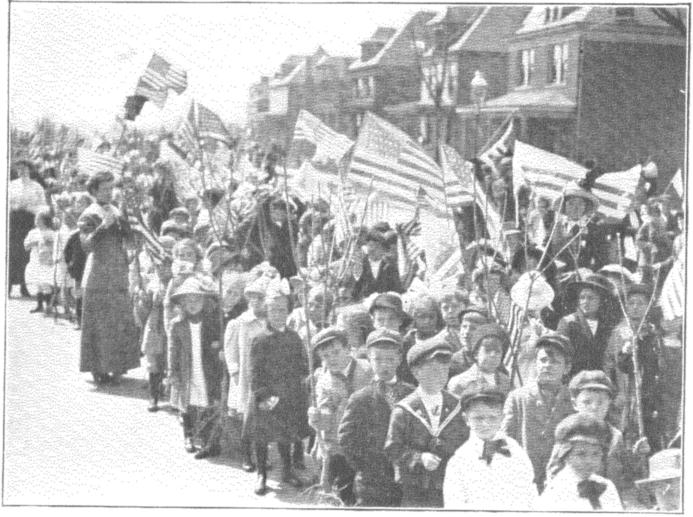
BIRD DAY AT CARRICK, PA.
Marching Behind the Governor
In studying the subject of bringing back the birds, he found that the Russian mulberry is one of the finest trees in the world as a purveyor of good fruit for many kinds of birds. The tree does not much resemble our native mulberry, but is equally beautiful and interesting. "The fruit is not a long berry, nor is it of a purple color, but it grows from buds on the limbs and twigs something after the manner of the pussy-willow. It is smaller, of light color and has a very distinct flavor. The most striking peculiarity about the fruit is that it keeps on ripening during two months or more, new berries appearing daily while others are ripening. This is why it is such good bird food. Nor is it half bad for folks, for the berries are good to look at and to eat, either with cream or without, and to make pies that will set any sane boy's mouth a-watering at sight."—(Erasmus Wilson).
Everyone knows the value of sweet cherries, both to birds and to children.
Mr. Phillips decided that he would give away several hundred bird boxes, and also several hundred sweet cherry and Russian mulberry trees. The first gift distribution was made in the early spring of 1909. Another followed in 1910, but the last one was the most notable.
On April 11, 1912, Carrick had a great and glorious Bird Day. Mr. Phillips was the author of it, and Governor Tener the finisher. On that day occurred the third annual gift distribution of raw materials designed to promote in the breasts of 2,000 children a love for birds and an active desire to protect and increase them. Mr. Phillips gave away 500 bird boxes, 500 sweet cherry trees and 200 mulberry trees. The sun shone brightly, 500 flags waved in Carrick, the Governor made one of the best speeches of his life, and Erasmus Wilson, faithful friend of the birds, wrote this good story of the occasion for the Gazette-Times of Pittsburgh:
The Governor was there, and the children, the bird-boxes, and the young trees. And was there ever a brighter or more fitting day for a children and bird jubilee! The scene was so inspiring that Gov. Tener made one of the best speeches of his life.
The distribution of several hundred cherry and mulberry trees was the occasion, and the beautiful grounds of the Roosevelt school, Carrick, was the scene.
Mr. John M. Phillips, sane sportsman and enthusiastic friend of the birds, has been looking forward to this as the culmination of a scheme he has been working on for years, and he was more than pleased with the outcome. The intense delight it afforded him more than repaid him for all it has cost in all the years past.
But it was impossible to tell who were the more delighted,—he, or the Governor, or the children, or the visitors who were so fortunate as to be present. County Superintendent of Schools Samuel Hamilton was simply a mass of delight. And how could he be otherwise, surrounded as he was by 2,000 and more children fairly quivering with delight?
Children will care for and defend things that are their very own, fight for them and stand guard over them. Realizing this Mr. Phillips undertook to show them how they could have birds all their own. Being clever in devising schemes for achieving things most to be desired, he began giving out bird-boxes to those who would agree to put them up, and to watch and defend the birds when they came to make their homes with them. And he found that no more faithful sentinel ever stood on guard than the boy who had a bird-house all his own.
Here was the solution to the vexed problem. Provide boxes for those who would agree to put them up, care for the birds, and study their habits and needs. The children agreed at once, and the birds did not object, so Mr. Phillips had some hundreds, four or five, blue-bird and wren boxes constructed during the past winter. These were passed out some weeks ago to any boys or girls who would present an order signed by their parents, and countersigned by the principal of the school.
He knows enough about a boy to know that he does not prize the things that come without effort, nor will he become deeply interested in anything for which he is not held more or less responsible. Hence the advantage in having him write an order, have it indorsed by his parents, and vouched for by his school principal.
That he had struck the right scheme was proven by the avidity with which the girls and boys rushed for the boxes. The fact that a heavy rain was falling did not dampen their ardor for a moment, nor did the fact that they were tramping Mr. Phillips' beautiful lawn into a field of mud.
Mr. Phillips, seeing the necessity of providing food for the prospective hosts of birds, and wishing to place the responsibility on the boys and girls, offered to provide a cherry tree or mulberry tree for every box erected, provided they should be properly planted and diligently cared for.
This was practically the culmination of the most unique bird scheme ever attempted, and yesterday was the day set apart for the distribution of these hundreds of fruit trees, the products of which are to be divided share and share alike with the birds.
Nowhere else has such a scheme been attempted, and never before has there been just such a day of jubilee. The intense interest manifested by the children, and the earnest enthusiasm manifested, leaves no doubt about their carrying out their part of the contract.
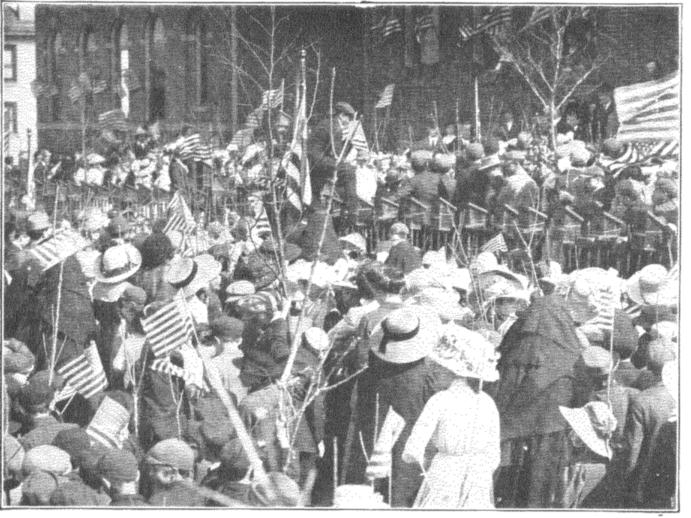
DISTRIBUTING BIRD BOXES AND FRUIT TREES
Up to date (1912) Mr. Phillips has given away about 1,000 bird boxes, 1,500 cherry and Russian mulberry trees, and transformed the schools of Carrick into seething masses of children militantly enthusiastic in the protection of birds, and in providing them with homes and food. As a final coup, Mr. Phillips has induced the city of Pittsburgh to create the office of City Ornithologist, at a salary of $1200 per year. The duty of the new officer is to protect all birds in the city from all kinds of molestation, especially when nesting; to erect bird-houses, provide food for wild birds, on a large scale, and report annually upon the increase or decrease of feathered residents and visitors. Mr. Frederic S. Webster, long known as a naturalist and practical ornithologist, has been appointed to the position, and is now on active duty.
So far as we are aware, Pittsburgh is the first city to create the office of City Ornithologist. It is a happy thought; it will yield good results, and other cities will follow Pittsburgh's good example.
CHAPTER XLII
THE ETHICS OF SPORTSMANSHIP
I count it as rather strange that American and English sportsmen have hunted and shot for a century, and until 1908 formulated practically nothing to establish and define the ethics of shooting game. Here and there, a few unwritten principles have been evolved, and have become fixed by common consent; but the total number of these is very few. Perhaps this has been for the reason that every free and independent sportsman prefers to be a law unto himself. Is it not doubly strange, however, that even down to the present year the term "sportsmen" never has been defined by a sportsman!
Forty years ago, a sportsman might have been defined, according to the standards of that period, as a man who hunts wild game for pleasure. Those were the days wherein no one foresaw the wholesale annihilation of species, and there were no wilderness game preserves. In those days, gentlemen shot female hoofed game, trapped bears if they felt like it, killed ten times as much big game as they could use, and no one made any fuss whatever about the waste or extermination of wild life.
Those were the days of ox-teams and broad-axes. To-day, we are living in a totally different world,—a world of grinding, crunching, pulverizing progress, a world of annihilation of the works of Nature. And what is a sportsman to-day?
A Sportsman is a man who loves Nature, and who in the enjoyment of the outdoor life and exploration takes a reasonable toll of Nature's wild animals, but not for commercial profit, and only so long as his hunting does not promote the extermination of species.
In view of the disappearance of wild life all over the habitable globe, and the steady extermination of species, the ethics of sportsmanship has become a matter of tremendous importance. If a man can shoot the last living Burchell zebra, or prong-horned antelope, and be a sportsman and a gentleman, then we may just as well drop down all bars, and say no more about the ethics of shooting game.
But the real gentlemen-sportsmen of the world are not insensible to the duties of the hour in regard to the taking or not taking of game. The time has come when canon laws should be laid down, of world-wide application, and so thoroughly accepted and promulgated that their binding force can not be ignored. Among other things, it is time for a list of species to be published which no man claiming to be either a gentleman or a sportsman can shoot for aught else than preservation in a public museum. Of course, this list would be composed of the species that are threatened with extermination. Of American animals it should include the prong-horned antelope, Mexican mountain sheep, all the mountain sheep and goats in the United States, the California grizzly bear, mule deer, West Indian seal and California elephant seal and walrus.
In Africa that list should include the eland, white rhinoceros, blessbok, bontebok, kudu, giraffes and southern elephants, sable antelope, rhinoceros south of the Zambesi, leucoryx antelope and whale-headed stork. In Asia it should include the great Indian rhinoceros and its allied species, the burrhel, the Nilgiri tahr and the gayal. The David deer of Manchuria already is extinct in a wild state.
In Australia the interdiction should include the thylacine or Tasmanian wolf, all the large kangaroos, the emu, lyre bird and the mallee-bird.
Think what it would mean to the species named above if all the sportsmen of the world would unite in their defense, both actively and passively! It would be to those species a modus vivendi worth while.
Prior to 1908, no effort (so far as we are aware) ever had been made to promote the establishment of a comprehensive and up-to-date code of ethics for sportsmen who shoot. A few clubs of men who are hunters of big game had expressed in their constitutions a few brief principles for the purpose of standardizing their own respective memberships, but that was all. I have not taken pains to make a general canvass of sportsmen's clubs to ascertain what rules have been laid down by any large number of organizations.
The Boone and Crockett Club, of New York and Washington, had in its constitution the following excellent article:
"Article X. The use of steel traps, the making of large bags, the killing of game while swimming in water, or helpless in deep snow, and the unnecessary killing of females or young of any species of ruminant, shall be deemed offenses. Any member who shall commit such offenses may be suspended, or expelled from the Club by unanimous vote of the Executive Committee."
In 1906, this Club condemned the use of automatic shotguns in hunting as unsportsmanlike.
The Lewis and Clark Club, of Pittsburgh, has in its constitution, as Section 3 of Article 3, the following comprehensive principle:
"The term 'legitimate sport' means not only the observance of local laws, but excludes all methods of taking game other than by fair stalking or still hunting."
At the end of the constitution of this club is this declaration, and admonition:
"Purchase and sale of Trophies.—As the purchase of heads and horns establishes a market value, and encourages Indians and others to "shoot for sale," often in violation of local laws and always to the detriment of the protection of game for legitimate sport, the Lewis and Clark Club condemns the purchase or the sale of the heads or horns of any game."
In 1906 the Lewis and Clark Club condemned the use of automatic shotguns as unsportsmanlike.
The Shikar Club, of London, a club which contains all the big-game hunters of the nobility and gentry of England, [Q] and of which His Majesty King George is Honorary President, has declared the leading feature of its "Objects" in the following terms:
"To maintain the standard of sportsmanship. It is not squandered bullets and swollen bags which appeal to us. The test is rather in a love of forest, mountains and desert; in acquired knowledge of the habits of animals; in the strenuous pursuit of a wary and dangerous quarry; in the instinct for a well-devised approach to a fair shooting distance; and in the patient retrieve of a wounded animal."
In 1908 the Camp-Fire Club of America formally adopted, as its code of ethics, the "Sportsman's Platform" of fifteen articles that was prepared by the writer and placed before the sportsmen of America, Great Britain and her colonial dependencies in that year. In the book of the Club it regularly appears as follows:
CODE OF ETHICS OF THE CAMP-FIRE CLUB OF AMERICA
Proposed by Wm. T. Hornaday and adopted December 10, 1908
The wild animal life of to-day is not ours, to do with as we please. The original stock is given to us in trust, for the benefit both of the present and the future. We must render an accounting of this trust to those who come after us.
Judging from the rate at which the wild creatures of North America are now being destroyed, fifty years hence there will be no large game left in the United States nor in Canada, outside of rigidly protected game preserves. It is therefore the duty of every good citizen to promote the protection of forests and wild life and the creation of game preserves, while a supply of game remains. Every man who finds pleasure in hunting or fishing should be willing to spend both time and money in active work for the protection of forests, fish and game.
The sale of game is incompatible with the perpetual preservation of a proper stock of game; therefore it should be prohibited by laws and by public sentiment.
In the settled and civilized regions of North America there is no real necessity for the consumption of wild game as human food: nor is there any good excuse for the sale of game for food purposes. The maintenance of hired laborers on wild game should be prohibited everywhere, under severe penalties.
An Indian has no more right to kill wild game, or to subsist upon it all the year round, than any white man in the same locality. The Indian has no inherent or God-given ownership of the game of North America, anymore than of its mineral resources; and he should be governed by the same game laws as white men.
No man can be a good citizen and also be a slaughterer of game or fishes beyond the narrow limits compatible with high-class sportsmanship.
A game-butcher or a market-hunter is an undesirable citizen, and should be treated as such.
The highest purpose which the killing of wild game and game fishes can hereafter be made to serve is in furnishing objects to overworked men for tramping and camping trips in the wilds; and the value of wild game as human food should no longer be regarded as an important factor in its pursuit.
If rightly conserved, wild game constitutes a valuable asset to any country which possesses it; and it is good statesmanship to protect it.
An ideal hunting trip consists of a good comrade, fine country, and a very few trophies per hunter.
In an ideal hunting trip, the death of the game is only an incident; and by no means is it really necessary to a successful outing.
The best hunter is the man who finds the most game, kills the least, and leaves behind him no wounded animals.
The killing of an animal means the end of its most interesting period. When the country is fine, pursuit is more interesting than possession.
The killing of a female hoofed animal, save for special preservation, is to be regarded as incompatible with the highest sportsmanship; and it should everywhere be prohibited by stringent laws.
A particularly fine photograph of a large wild animal in its haunts is entitled to more credit than the dead trophy of a similar animal. An animal that has been photographed never should be killed, unless previously wounded in the chase.
This platform has been adopted as a code of ethics by the following organizations, besides the Camp-Fire Club of America:
The Lewis and Clark Club, of Pittsburgh, John M. Phillips, President.
The North American Fish and Game Protective Association (International)
Massachusetts Fish and Game Protective Association, Boston.
Camp-Fire Club of Michigan, Detroit.
Rod and Gun Club, Sheridan County, Wyoming.
The platform has been endorsed and published by The Society for the Preservation of the Wild Fauna of the British Empire (London), which is an endorsement of far-reaching importance.
Major J. Stevenson-Hamilton, C.M.Z.S., Warden of the Government Game Reserves of the Transvaal, South Africa, has adopted the platform and given it the most effective endorsement that it has received from any single individual. In his great work on game protection in Africa and wild-animal lore, entitled "Animal Life in Africa" (and "very highly commended" by the Committee on Literary Honors of the Camp-Fire Club), he publishes the entire platform, with a depth and cordiality of endorsement that is bound to warm the heart of every man who believes in the principles laid down in that document. He says, "It should be printed on the back of every license that is issued for hunting in Africa."
I am profoundly impressed by the fact that it is high time for sportsmen all over the world to take to heart the vital necessity of adopting high and clearly defined codes of ethics, to suit the needs of the present hour. The days of game abundance, and the careless treatment of wild life have gone by, never to return.
CHAPTER XLIII
THE DUTY OF AMERICAN ZOOLOGISTS AND EDUCATORS TO AMERICAN WILD LIFE
The publication of this chapter will hardly be regarded as a bid for fame, or even popularity, on the part of the author. However, the subject can not be ignored simply because it is disagreeable.
Throughout sixty years, to go no further back, the people of America have been witnessing the strange spectacle of American zoologists, as a mass, so intent upon the academic study of our continental fauna that they seem not to have cared a continental about the destruction of that fauna.
During that tragic period twelve species of North American birds have been totally exterminated, twenty-three are almost exterminated, and the mammals have fared very badly.
If "by their works ye shall know them," then no man can say that the men referred to have been conspicuous on the firing line in defense of assaulted wild life. In their hearts, we know that in an academic way the naturalists of America do care about wild-life slaughter, and the extermination of species; and we also know that perhaps fifty American zoologists have at times taken an active and serious interest in protection work.
I am speaking now of the general body of museum directors and curators; professors and teachers of zoology in our institutions of learning—a legion in themselves; teachers of nature study in our secondary schools; investigators and specialists in state and government service; the taxidermists and osteologists; and the array of literary people who, like all the foregoing, make their bread and butter out of the exploitation of wild life.
Taken as a whole, the people named above constitute a grand army of at least five thousand trained, educated, resourceful and influential persons. They all depend upon wild life for their livelihood. When they talk about living things, the public listens with respectful attention. Their knowledge of the value of wild life would be worth something to our cause; but thus far it never has been capitalized!
These people are hard workers; and when they mark out definite courses and attainable goals, they know how to get results. Yet what do we see?
For sixty long years, with the exception of the work of a corporal's guard of their number, this grand army has remained in camp, partly neglecting and partly refusing to move upon the works of the enemy. For sixty years, with the exception of the non-game-bird law, as a class and a mass they have left to the sportsmen of the country the dictating of laws for the protection of all the game birds, the mammals and the game fishes. When we stop to consider that the game birds alone embrace 154 very important species, the appalling extent to which the zoologist has abdicated in favor of the sportsman becomes apparent.
It is a very great mistake, and a wrong besides, for the zoologists of the country to abandon the game birds, mammals and fishes of North America to the sportsmen, to do with as they please! Yet that is practically what has been done.
The time was, thirty or forty years ago, when wild life was so abundant that we did not need to worry about its preservation. That was the golden era of study and investigation. That era ended definitely in 1884, with the practical extermination of the wild American bison, partly through the shameful greed and partly through the neglect of the American people. We are now living in the middle of the period of Extermination! The questions for every American zoologist and every sportsman to answer now are: Shall the slaughter of species go on to a quick end of the period? Shall we give posterity a birdless, gameless, fishless continent, or not? Shall we have close seasons, all over the country, for five or ten years, or for five hundred years?
If we are courageous, we will brace up and answer these questions now, like men. If we are faint-hearted, and eager for peace at any price, then we will sidestep the ugly situation until the destroyers have settled it for us by the wholesale extermination of species.
If the zoologist cares to know, then I will tell him that to-day the wild life of the world can be saved by law, but not by sentiment alone! You cannot "educate" a poacher, a game-hog, a market-gunner, a milliner or a vain and foolish woman of fashion. All these must be curbed and controlled by law. Game refuges alone will not save the wild life! All species of birds, mammals and game fishes of North America must have more thorough and far-reaching protection than they now have.
Do not always take your cue from the sportsmen, especially regarding the enactment of long close seasons! If you need good advice, or help about drafting a bill, write to Dr. T.S. Palmer, Department of Agriculture, Washington, and you will receive prompt and valuable assistance. The Doctor is a wise man, and there is nothing about protective laws that is unknown to him. Go to your state senator and your assemblyman with the bills that you know should be enacted into law, and assure them that those measures are necessary for the wild life, and beneficial to 98 per cent of the people who own the wild life. You will be heard with respectful attention, in any law-making body that you choose to enter.
People who cannot give time and labor must supply you with money for your campaigns. Ask, and you will receive! I have proven this many times. With care and exactness account to your subscribers for the expenditure of all money placed in your hands, and you will receive continuous support.
In times of great stress, print circulars and leaflets by the ten-thousand, and get them into the hands of the People, calling for their help. Our 42,000 copies of the "Wild Life Call" (sixteen pages) were distributed by organizations all over the state of New York, and along with Mr. Andrew D. Meloy's letters to the members of the New York State League, aroused such a tidal wave of public sentiment against the sale of game that the Bayne bill was finally swept through the Legislature with only one dissenting vote! And yet, in the beginning not one man dared to hope that that very revolutionary measure could by any possibility be passed in its first year in New York State, even if it ever could be!
It was the aroused Public that did it!
This volume has been written (under great pressure) in order to put the whole situation before the people of America, including the zoologists, and to give them some definite information, state by state, regarding the needs of the hour. Look at the needs of your own state, in the "Roll Call of States," and you will find work for your hand to do. Clear your conscience by taking hold now, to do everything that you can to stop the carnage and preserve the remnant. Twenty-five or fifty years hence, if we have a birdless and gameless continent, let it not be said that the zoologists of America helped to bring it about by wicked apathy.
At this juncture, a brief survey of the attitude toward wild life of certain American institutions of national reputation will be decidedly pertinent. I shall mention only a few of the many that through their character and position owe specific duties to this cause. Noblesse oblige!
The Biological Survey of the U.S. Department of Agriculture is a splendid center of activity and initiative in the preservation of our wild life. The work of Dr. T.S. Palmer has already been spoken of, and thanks to his efforts and direction, the Survey has become the recognized special champion of preservation in America.
The U.S. Forestry Bureau is developing into a very valuable ally, and we confidently look forward to the time when its influence in preservation will be a hundred times more potent than it is to-day. That will be when every national forest is made a game preserve, and every forest ranger is made a game warden. Let us have both those developments, and quickly.
In 1896 the American Museum Of Natural History became a center of activity in bird protection, and the headquarters of the New York State Audubon Society. The president of the Museum (Professor Henry Fairfield Osborn) is also the president of that organization.
In several of the New York State movements for bird conservation, especially those bearing on the plumage law, the American Museum has been active, and at times conspicuous. No one (so I believe) ever appealed to the President of the Museum for help on the firing line without receiving help of some kind. Unfortunately, however, the preservation of wild life is not one of the declared objects of the American Museum corporation, or one on which its officers may spend money, as is so freely and even joyously done by the Zoological Society. The Museum's influence has been exerted chiefly through the active workers of the State Audubon Society, and it was as president of that body that Professor Osborn subscribed to the fund that was so largely instrumental in creating the New York law against the sale of game.
There is room for an important improvement in the declared objects of the American Museum. To the cause of protection it is a distinct loss that that great and powerful institution should be unable to spend any money in promoting the preservation of our fauna from annihilation. An amendment to its constitution is earnestly recommended.
The activities of the New York Zoological Society began in 1896, and they do not require comment here. They have been continuous, aggressive and far-reaching, and they have been supported by thousands of dollars from the Society's treasury. It is true that the funds available for protection work have not represented a great annual sum, such as the work demands, but the amount being expended from year to year is steadily increasing. In serious emergencies there is always something available! During the past two years, to relieve the Society of a portion of this particular burden, the director of the Park secured several large subscriptions from persons outside the Society, who previously had never entered into this work.
The Milwaukee Public Museum has entered actively and effectively into the fight to preserve the birds of Wisconsin from annihilation by the saloon-loafer element that three years ago determined to repeal the best bird laws on the books, and throw the shooting privilege wide open. Mr. Henry L. Ward, Director of the Museum, went to the firing line, and remained there. Last year the saloon element thought that they had a large majority of the votes in the legislature pledged to vote their way. It looked like it; but when the decent people again rose and demanded justice for the birds, the members of the legislature stood by them in large majorities. The spring-shooting, bag-limit and hunting-license laws were not repealed.
The University Of Kansas (Lawrence) scored heavily for the cause of wild-life protection when in 1908 it gave to the Governor of the state the services of a member of its faculty, Professor Lewis Lindsay Dyche, who was wanted to fill the position of State Fish and Game Commissioner. Professor Dyche proved to be a very live wire, and his activities have covered the State of Kansas to its farthest corners. We love him for the host of enemies he has made—among the poachers, game-butchers, pseudo-"sportsmen" and lawbreakers generally. The men who thought they had the "pull" of friendship for lawbreaking were first warned, and then as second offenders hauled up to the bar, one and all. The more the destroyers try to hound the Commissioner, the more popular is he with the great, solid mass of good citizens who believe in the saving of wild life.
The Museum Of Comparative Zoology has at last made a beginning in the field of protection. Last winter, while the great battle raged over the Wharton no-sale-of-game bill, several members of the Museum staff appeared at the hearings and otherwise worked for the success of the measure. It was most timely aid,—and very much needed. It is to be hoped that that auspicious beginning will be continued from year to year. The Museum should keep at least one good fighter constantly in the field.
The Boston Society Of Natural History takes a very active part in promoting the preservation of the fauna of Massachusetts, and in resisting the attempts of the destroyers to repeal the excellent laws now in force. Its members put forth vigorous efforts in the great campaign of 1912.
The Brooklyn Institute Of Arts And Sciences is well represented in the field of protection by Director Franklin W. Hooper, now president of the American Bison Society, and an earnest promoter of the perpetuation of the bison. When, the Wind Cave National Bison Herd is fully established, in South Dakota, as it practically is already, the chief credit for that coup will be due to the unflagging energy and persistence of Professor Hooper.
The Buffalo Academy Of Sciences in 1911 entered actively and effectively, under the leadership of Dr. Lee H. Smith, into the campaign for the Bayne bill. Besides splendid service rendered in western New York, Dr. Smith appeared in Albany with a strong delegation in support of the bill.
The University Of California was the first institution of learning to enter the field of wild-life protection for active, aggressive and permanent work. W.L. Taylor and Joseph Grinnell, of the University Museum, have taken up the fight to save the fauna of California from the dangers that now threaten it.
At this point our enumeration of the activities of American zoological institutions comes to an unfortunate end. There are many individuals to be named elsewhere, in the roll of honor, but that is another story. I am now going to set before the public the names of certain institutions largely devoted to zoology and permeated by zoologists, which thus far seem to have entirely ignored the needs of our fauna, and which so far we know have contributed neither men, money nor encouragement to the Army of the Defense.
Partial List Of Institutions Owing Service To Wild Life.
The United States National Museum contains a large and expensive corps of zoological curators and assistant curators, some of whom long ago should have taken upon themselves the task of reforming the laws of the District of Columbia, Virginia and Maryland, at their very doors! This museum should maintain at least one man in the field of protection, and the existence of the Biological Survey is no excuse for the Museum's inactivity.
The Field Museum of Chicago is a great institution, but it appears to be inactive in wild-life protection, and indifferent to the fate of our wild life. Its influence is greatly needed on the firing line, especially in Illinois, Wisconsin, Iowa and northern Minnesota. First of all the odious sale-of-game situation in Chicago should be cleaned up!
The Philadelphia Academy of Sciences has been represented on the A.O.U. Committee on Bird Protection by Mr. Witmer Stone. The time has come when this Academy should be represented on the firing line as a virile, wide-awake, self-sacrificing and aggressive force. It is perhaps the oldest zoological body in the United States! Its scientific standing is unquestioned. Its members must know of the carnage that is going on around them, for they are not ignorant men. The Pennsylvania State Game Commission to-day stands in urgent need of active, vigorous and persistent assistance from the Philadelphia Academy in the fierce campaign already in progress for additional protective laws. Will that help be given?
The Carnegie Institute of Washington (endowment $22,000,000) unquestionably owes a great duty toward wild life, no portion of which has yet been discharged. Academic research work is all very well, but it does not save faunas from annihilation. In the saving of the birds and mammals of North America a hundred million people are directly interested, and the cause is starving for money, men and publicity. Education is not the ONLY duty of educators!
The Carnegie Museum at Pittsburgh should be provided by Pittsburgh with sufficient funds that its Director can put a good man into the field of protection, and maintain his activities. The State of Pennsylvania, and the nation at large, needs such a worker at Pittsburgh; and this statement is not open to argument!
The California Academy of Sciences; Appear to have done nothing noteworthy in promoting the preservation and increase of the wild life of America.
The Chicago Academy of Sciences;
The New York Academy of Sciences;
The National Academy of Sciences;
The Rochester Academy of Sciences;
The Philadelphia Zoological Society;
The National Zoological Park;
A Few Of The Institutions Of Learning Which Should Each Devote One Man To This Cause.
Columbia University, of New York, has a very large and strong corps of zoological professors in its Department of Biology. No living organism is too small or too worthless to be studied by high-grade men; but does any man of Columbia ever raise his voice, actively and determinedly, for the preservation of our fauna, or any other fauna? Columbia should give the services of one man wholly to this cause.
There are men whose zoological ideals soar so high that they can not see the slaughter of wild creatures that is so furiously proceeding on the surface of this blood-stained earth. We don't want to hear about the "behavior" of protozoans while our best song birds are being exterminated by negroes and poor whites.
Cornell University should now awaken to the new situation. All the zoological Neros should not fiddle while Rome burns. For the sake of consistency, Cornell should devote the services of at least one member of its large and able faculty to the cause of wild-life protection. Cornell was a pioneer in forestry teaching; and why should she not lead off now in the new field?
Yale University, in Professor James W. Toumey, Director of the School of Forestry, possesses a natural, ready-made protector of wild life. From forestry to wild life is an easy step. We hopefully look forward to the development of Professor Toumey into a militant protectionist, fighting for the helpless creatures that must be protected by man or perish! If Yale is willing to set a new pace for the world's great universities, she has the Man ready at hand.
The University of Chicago should become the center of a great new protectionist movement which should cover the whole Middle West area, from the plains to Pittsburgh. This is the inflexible, logical necessity of the hour. Either protect zoology, or else for very shame give up teaching it!
Every higher institution of learning in America now has a duty in this matter. Times have changed. Things are not as they were thirty years ago. To allow a great and valuable wild fauna to be destroyed and wasted is a crime, against both the present and the future. If we mean to be good citizens we cannot shirk the duty to conserve. We are trustees of the inheritance of future generations, and we have no right to squander that inheritance. If we fail of our plain duty, the scorn of future generations surely will be our portion.
CHAPTER XLIV
THE GREATEST NEEDS OF THE WILD-LIFE CAUSE AND THE DUTY OF THE HOUR
The fate of wild life in North America hangs to-day by three very slender threads, the names of which you will hardly guess unaided. They are Labor, Money and Publicity! The threads are slender because there is so little raw material in them.
We do not need money with which to "buy votes" or "influence," but money with which to pay workers; to publish things to arouse the American people; to sting sportsmen into action; to hire wardens; to prosecute game-hogs and buy refuges for wild life. If a sufficient amount of money for these purposes cannot be procured, then as sure as the earth continues to revolve, our wild life will pass away, forever.
This is no cause for surprise, or wonder. In this twentieth century money is essential to every great enterprise, whether it be for virtue or mischief. The enemies of wild life, and the people who support them, are very powerful. The man whose pocket or whose personal privilege is threatened by new legislation is prompted by business reasons to work against you, and spend money in protecting his interests.
Now, it happens that the men of ordinary means who have nothing personal at stake in the preservation of wild life save sentimental considerations, cannot afford to leave their business more than three or four days each year on protection affairs. Yet many times services are demanded for many days, or even weeks together, in order to accomplish results. Bad repeal bills must be fought until they are dead; and good protective bills must be supported until the breath of life is breathed into them by the executive signature.
With money in hand, good men aways can be found who will work in game protection for about one-half what they would demand in other pursuits. With the men whom, you really desire, sentiment is always a controlling factor. It is my inflexible rule, however, in asking for services, that men who give valuable time and strength to the cause shall not be allowed to take their expense money from their own pockets. Soldiers on the firing line cannot provide the sinews of war that come from the paymaster's chest!
Campaigns of publicity are matters of tremendous necessity and importance; but their successful promotion requires hundreds, or possibly thousands of dollars, for each state that is covered.
I believe that the wealthy men and women of America are the most liberal givers for the benefit of humanity that can be found in all the world. New York especially contains a great number of men who year in and year out work hard for money—in order to give it away! The depth and breadth of the philanthropic spirit in New York City is to me the most surprising of all the strange impulses that sway the inhabitants of that seething mass of mixed humanity. Every imaginable cause for the benefit of mankind,—save one,—has received, and still is receiving, millions of gift dollars.
Some enterprises for the transcendant education of the people are at this moment hopelessly wallowing in the excess of wealth that has been thrust upon them. Men are being hired at high salaries to help spend wealth in high, higher, highest education and research. It is now fashionable to bequeath millions to certain causes that do not need them in the least! In education there is a mad scramble to educate every young man to the topmost notch, often far above his probable station in life, and into tastes and wants far beyond his powers to maintain.
In all this, however, there would be no cause for regret if the wild life of our continent were not in such a grievous state. If we felt no conscience burden for those who come after us, we would not care where the millions go; but since things are as they are, it is heartbreaking to see the cause of wild-life protection actually starving, or at the best subsisting only on financial husks and crumbs, while less important causes literally flounder in surplus wealth.
This regret is intensified by the knowledge that in no other cause for the conservation of the resources most valuable to mankind will a dollar go so far, or bring back such good results, as in the preservation of wild life! The promotion of "the Bayne bill" and the enactment of the Bayne law is a fair example. That law is to-day on the statute books of the State of New York because fifty men and women promptly subscribed $5,000 to a fund formed with special reference to the expenses of the campaign for that measure; and the uplift of that victory will be felt for years to come, just as it already has been in Massachusetts.
At one time I was tempted to show the financial skeleton in the closet of wild-life protection, by inserting here a statement of the funds available to be expended by all the New York organizations during the campaign year of 1911-1912. But I cannot do it. The showing is too painful, too humiliating. From it our enemies would derive too much comfort.
Even in New York State, in view of the great interests at stake, the showing is pitiful. But what shall we say of Massachusetts, Pennsylvania, Connecticut, New Jersey, and a dozen other states where the situation is much worse? In the winter of 1912 a cry for help came to us from a neighboring state, where a terrific fight was being made by the forces of destruction against all reform measures, and in behalf of retrogression on spring shooting. The appeal said: "The situation in our legislature is the worst that it has been in years. Our enemies are very strong, well organized, and they fight us at every step. We have no funds, and we are expected to make bricks without straw! Is there not something that you can do to help us?"
There was!
Only one week previously, a good friend (who declines to be named) gave us two thousand dollars, of real money, for just such emergencies.
Within thirty-six hours an entirely new fighting force had been organized and equipped for service. Within one week, those reinforcements had made a profound impression on the defenses of the enemy, and in the end the great fight was won. Of our small campaign fund it took away over one thousand dollars; but the victory was worth it.
With money enough,—a reasonable sum,—the birds of North America, and some of the small-mammal species also, can be saved. The big game that is hunted and killed outside the game preserves, and outside of such places as New Brunswick and the Adirondacks, can not be saved—until each species is given perpetual protection. Colorado is saving a small remnant of her mountain sheep, but Montana and Wyoming are wasting theirs, because they allow killing, and the killers are ten times too numerous for the sheep. They imagine that by permitting only the killing of rams they are saving the species; but that is an absolute fallacy, and soon it will have a fatal ending.
With an endowment fund of $2,000,000 (only double the price of the two old Velasquez paintings purchased recently by a gentleman of New York!) a very good remnant of the wild life of North America could be saved.
But who will give the fund, or even a quarter of it?
Thus far, the largest sums ever given in America for the cause of wild-life protection, so far as I know personally, have been the following:
Albert Wilcox, to the National Association of Audubon Societies, $322,000
Mary Butcher Fund, to the National Association of Audubon Societies 12,000
Mrs. Russell Sage, for the purchase of Marsh Island 150,000
American Game Protective and Propagation Association, from the manufacturers of firearms and ammunition, annually 25,000
Charles Willis Ward and E.A. McIlhenny, purchase of game preserve presented to Louisiana 39,000
Mrs. Russell Sage, miscellaneous gifts to the National Audubon Society 20,000
The American Bison Society for the Montana National Herd 10,526
New York Zoological Society, total about 20,000
John E. Thayer, purchase of game preserve 5,000
Caroline Phelps Stokes Bird Fund, N.Y. Zoological Society 5,000
Boone and Crockett Fund for Preservation 5,000
A Friend in Rochester 2,500
Henry C. Frick 1,500
Samuel Thorne 1,250
Of all the above, the only endowment funds yielding an annual income are those of the National Association of Audubon Societies and the Caroline Phelps Stokes fund of $5,000 in the treasury of the Zoological Society.
A fund of $25,000 per year for five years has been guaranteed by the makers of shot-guns, rifles and ammunition, to the American Game Protective and Propagation Association. This is like a limited endowment.
In the civilized world there are citizens of many kinds; but all of them can be placed in two groups: (1) those with a sense of duty toward mankind, and who will do their duty as good citizens; and (2) those who from the cradle to the grave meanly and sordidly study their own selfish interests, who never do aught save in expectation of a quick return benefit, and who recognize no such thing as duty toward mankind at large.
Men and women of the first class are honored in life, mourned when dead, and gratefully remembered by posterity. They leave the world better than they found it, and their lives have been successful.
Men and women of the second class are merely so many pieces of animated furniture; and when they pass out the world cares no more than when old chairs are thrown upon the scrap-heap.
There are many men so selfish, so ignorant and mean of soul that even out of well-filled purses they would not give ten dollars to save the whole bird fauna of North America from annihilation. To all persons of that brand, it is useless to appeal. As soon as you find one, waste no time upon him. Get out of his neighborhood as quickly as you can, and look for help among real MEN.
The wild life of the world cannot be saved by a few persons, even though they work their hearts out in the effort. The cause needs two million more helpers; and they must be sought in Group No. 1. They are living, somewhere; but the great trouble is to find them, before it is too late.
There are times and causes in which the good citizen has no option but to render service. The most important of such causes are: the relief of suffering humanity, the conservation of the resources of nature, and the prevention of vandalism. If the American Nation had refused aid to stricken San Francisco, the callous hard-heartedness of it would have shocked the world. If the German army of 1871 had destroyed the art treasures and the libraries of Paris, it would have set the German nation back ten centuries, into the ranks of the lowest barbarians.
And yet, in America, and in the regions now being scourged by the feather trade, a wonderful FAUNA is being destroyed! It took millions of years to develop that marvelous array of wild life; and when gone it never can be replaced! Yet the Army of Destruction is sweeping it away as joyously as a hired laborer cuts down a field of corn.
That wild life can be saved! If done, it must be done by the men and women of Group No. 1. The means by which it can be saved are: Money, labor and publicity. Every man of ordinary means and intelligence can contribute either money or labor. The men on the firing line must not be expected to furnish their own food and ammunition. The Workers MUST be provided with the money that active campaign work imperatively demands! Those who cannot conveniently or successfully labor should give money to this cause; but at the same time, every good citizen should keep in touch with his lawmaking representatives, and in times of need ask for votes for whatever new laws are necessary.
With money enough to arouse the American people in certain ways, the wild life of North America (north of Mexico) can be saved. Money can secure labor and publicity, and the People will do the rest. For this campaign work I want, and must have, a permanent fund of $10,000 per annum,—cash always ready for every emergency in field work. I greatly need, and must have, immediately, an endowment Wild-Life Fund of at least $100,000, and eventually $250,000. I can no longer "pass the hat" each year. This is needed in addition to the several thousands of dollars annually being expended by the Zoological Society in this work. The Society is already doing its utmost in wild-life protection, just as it is in several other fields of activity.
Outside of New York many wealthy men will say, "Let New York do it!" That often is the way when national campaigning is to be done. In national wild-life protection work, New York is to-day bearing about nine-tenths of the burden. It is my belief that in 1912 outside of New York City less than $10,000 was raised and expended in wild-life protection save by state and national appropriations. We know that in the year mentioned New York expended $221,000 in this cause, all from private sources.
In a very short time I shall call for the $100,000 that I now must have as an endowment fund for nation-wide work, to be placed at 5-1/2 per cent interest for the $5,500 annual income that it will yield. How much of this will come from outside the State of New York? Some of it, I am sure, will come from Massachusetts and Pennsylvania; but will any of it come from Cleveland, Cincinnati, Chicago, St. Louis and San Francisco?
The Duty Of The Hour
I have now said my say in behalf of wild life. Surely the path of duty toward the remnant of wild life is plain enough. Will those who read this book pass along my message that the hour for a revolution has struck? Will the millions of men commanded by General Apathy now arouse, before it is too late to act?
Will the true sportsmen rise up, and do their duty, bravely and unselfishly?
Will the people with wealth to give away do their duty toward wild life and humanity, fairly and generously?
Will the zoologists awake, leave their tables in their stone palaces of peace, and come out to the firing-line?
Will the lawmakers heed the handwriting on the wall, and make laws that represent the full discharge of their duty toward wild life and humanity?
Will the editors beat the alarm-gong, early and late, in season and out of season, until the people awake?
On the answers to these questions hang the fate of the wild creatures of the world,—their preservation or their extermination.
FOOTNOTES
INDEX
[A] [B] [C] [D] [E] [F] [G] [H] [I] [J] [K] [L] [M] [N] [O] [P] [Q] [R] [S] [T] [U] [V] [W] [X] [Y] [Z]
Abundance of wild life, 1
Accuracy, value of, in campaigning, 262
Acklen, J. H., 252
Actinomycosis, 82, 83
Adams, Cyrus C., on the lion, 183
Adirondack State Park, 347
Adjutant, 123
Africa, big game of, 181 game preserves in, 364, 367 rinderpest in, 83 "soon to be shot out", 206
African big game disappearing, 187
African game that needs exemption, 383
Agriculture, Department of, 208, 212
Aigrette, 120
Akeley, C. E., 186
Alabama, 42, 46, 49, 106 deer killed in, 172 laws of, 268
Alabama Game Commissioner, 252
Alaska, 46 brown bears of, 178 new laws needed in, 264 game of, 270 Sitka National Monument in, 344
Alaska—Yukon region, 157
Albatross, steamer, seals taken by, 40
Albatrosses, Laysan, 138, 140
Alberta, 45, 51, 158, 162, 165 at fault on antelope-shooting, 351 laws of parks of, 352
Alden, M.P., Percy, 135
Algonquin National Park, 351
Aliens, game wardens killed by, 103 prohibited from owning firearms, 103 slaughter of song-birds by, 100
Altai Mountains of western China, 190
American Bison Society, 180
American Game Protective and Propagation Association, 257, 395
"American Natural History" on hawks and owls, 224, 395
American, North, Fish and Game Protective Association, 385
American private game preserves, 358
Amsterdam, 120
Animallai Hills to-day and in 1877, 188
"Animal Life in Africa," on status of settlers, 365
Animals, predatory, 73 caught by cats, 73 wild, may become nuisances, 234
Antelope, prong-horned, 2 attempts to transplant, 163 in Alberta, 51 in Montana, 287 in Nevada, 288 in Texas, 51 in Wyoming, 51 lumpy jaw in, 83, 84 physical weakness of, 160 present status of, 159 preserve in Montana, 2 wrong to kill, 351
Anthony bill for migratory birds, 267, 306
Antelopes, African, for the South, 242
Aphis devouring potato-tops, 213
Apple crop, losses on, 210
Aquarium, West Indian seals in, 39
Areas inhabitatcd by big game, 157
Argali, Siberian, 191
Arizona, 42, 46 new laws needed in, 270 national monuments in, 344
Arizona elk exterminated, 35
Arkansas, 42, 106 new laws needed in, 270
Army of Defense, 248, 257
Army of Destruction, 54, 59
Army worm, 221
Arnold, Craig D., 43
Ashe, T. J., 133
Asia, future of big game of, 188
Asiatic game that should be close-seasoned, 383
Askins, Charles, article in Recreation by, 107
Association in Pennsylvania fighting Game Commission, 245
Association, Wool-Growers, fighting antelope preserve, 2, 348
Astley, Hubert D., 94
Atkinson, George, 86
Atlanta Journal, 106
Audubon Societies, National Association of, 28, 254, 256, 291, 395
Auk, Great, 9, 10
Austrians in Minnesota, 49
Australia, animal pests in, 331, 332 game preserves in, 364
Automatic and pump shot-guns, 61, 65, 144 campaign against, won in New Jersey, 289 denounced by organizations, 152 use of, prohibited by law, 152
Automobile, use of, in hunting forbidden, 60
Automobiles detrimental to wild life, 293
Avare, Game Warden Henry, 49, 159, 287
Avery, Carlos, 341
Avery Island, La., robin slaughter at, 108
Avicultural Magazine, 94
Avocet, 230
Bag insects, 213
Bag limit, in Africa, 181, 186 a delusion, 60, 66 Alberta, 355 British Columbia, 356 Manitoba, 357 Saskatchewan, 357
Baird, Spencer F., 329
Baker, Frank, 180
Bancroft, W.F., 50
Barber, Charles, 52
Barren grounds of the Arctic regions, 157
Baynard, Oscar E., 28
Bayne law against sale of game in New York, 68 bill, 252, 257 breeding game under, 370 genesis of, 307
Beal, F.E.L., 222
Bear, black, in South Carolina, 150, 179 grizzly, ethics of hunting the, 176 almost gone from United States, 178 California grizzly, 41
Bears, Alaskan brown, 178 alleged damages by, 178 grizzly, bag limit demanded on, 356 in Yellowstone Park, estimated, 336 killed by Forestry Bureau, 70 of Yellowstone Park, 313
Beard, Daniel C. cartoon by, 55 on bird destruction, 77
Beaver in New Brunswick, 52
Bedford, Duke of, David's deer saved by, 36
Beebe, C. William, 69, 93, 115, 192 chapter written by, 195
Bell, Rudolph, 102
Bell, W.B., 44, 50
Berlin feather trade, 120
Beyer, G.E., 48
Big Horn Game Preserve, 349
Biological Survey, 388 on duck disease, 87 work of, 249 on wood-duck, 28
Biology, Elementary, by Peabody and Hunt, 376
Bird, Charles S., 343
Bird boxes distributed by J.M. Phillips, 381
Bird Day in various states, 378
Bird Refuges, National, full list of, 345
Birds, becoming extinct in North America, 17 feeding in winter, 227 killed by cats, 73 by dogs, 76 by foxes, 332 by mongoose, 333 by negroes, 105 by telephone wires, 77 by wild animals, 77 destruction of, in Far East, 195 extinct, 9, 15 food habits of certain, 218 extinct in North America, 7 in distress, 82 killed in New York City, 101 list of, that devour codling moth, 215 threatened with extermination, 18
Bird skins purchased in London, 116, 135
Bishop, Dr. Louis B., 98
Bison, American, now living, 180 last of Colorado, killed, 69, 272 Yellowstone Park, 337 wild, in Yellowstone Park, 336 value of, 2
Bison herd, Wichita National, 179
Bison ranges created, 249
Bison ranges, National: in United States, 180 in Canada, 180
Bison Society, American, 395 proposes National herd, 342
Beaman, D.C., 273
Blackbird, Crow, 222
Blackbirds, destroy cotton-boll weevil, 217 killed as "game", 105
Black-Snake, Pilot, 81
Blair, Dr. W. Reid, 84, 85, 86
Blaubok, extinct, 35
Blauvelt, George A., 251, 281
Blesbok in Cape Colony, 185
Blinding decoy birds, 12, 97
Blooming Grove Park, 359
Bluebirds killed by cold weather, 9
Blue Mountain Forest Association, 343
Bontebok in Cape Colony, 185
Bob-White, food habits of, 219
Boone and Crockett Club, 152, 161, 256, 383, 395
Boston Society of Natural History, 390
Bowdish, B.S., 50
Boxes for birds distributed, 381
Boy Scouts of America, appeal to, 32
Bradley, Guy M., killed by a plume-hunter, 26, 27
Brazil, birds' plumage from, 122
Breeding, ducks in captivity, 373 game and fur in captivity, 369, 374
Breeding wild animals need seclusion, 322
Brett, Lieut.-Col. L.M., animal census from, 336
Brewster, William, 24, 43, 48
Brimley, H.H. and C.S., 44, 50
Bringing back birds and game, 313, 323 vanishing species, 322
British Columbia, 45, 51, 157, 158, 162, 165 game conditions in, 356 game preserves in, 353
British East Africa, remarkable bag "limit" in, 181, 186
Bronx River, ducks killed by pollution of, 92
Brooklyn Institute, 390
Brooks, Earle A., 51
Brown, William Harvey, at Salisbury, 184
Brown, William P., 51
Bryan, W.A., 137, 139
Buckland, James, 125, 135, 136
Buckskin Mountain, 343
Buffalo Academy of Sciences, 390
Buffalo in Cape Colony, 185
Buffalo, American, now living, 180 see Bison
Buffalo Park, Alberta, 352
Bunting, Snow, 8, 58 killed for food, 68
Burnham, John B., 251, 252, 257, 290 portrait of, 251
Burtch, Verdi., 93
Bustard being exterminated, 119
Butcher bird, 80
Butler, A.L., 247
Butler, Amos W., 43, 47
California, 42, 47, 59, 65, 106, 165 grizzlies, 178 new laws needed in, 271 Academy of Sciences, 391 National monuments of, 344 State Game Preserve, 349 University of, 390
Call, San Francisco, 263
Calliste, Superb, 115
Camp-Fire Club of America, 152, 256, 353, 384 code of ethics of, 384
Camp-Fire Club of Detroit, 338, 385
Campion, C, 14
Camp laborers as game destroyers, 71
Canada, 45 game laws and preserves in, 350
Cape Province, South Africa, big game in, 185
Carbonell, E.T., 46
Caribou, 83 in Nova Scotia, 52 in general, status of, 173 killed for their tongues, 46, 269 Osborn, 357 slaughtered and wasted, in Quebec, 70
Caribou disease, 83
Carleton, L.T., 283
Carnegie Institute of Washington, 391
Carrick, Penn., bird day at, 379
Cartridges, estimated annual production of, 150
Cat and its victim, 76
Cats, birds destroyed by, 73, 81
Caterpillars eaten by shore-birds, 231
Caton, John Dean, 359
Cause, choice of a, 258
Cedar Bird, eaten as "game", 106
Cereals, losses on, from insects, 212
Corbin bison herd, 342
Chambers, Fred. W., 51
Chamois, slaughter of protected, in Switzerland, 321
Chapman, Arthur., 45, 50
Charles, Salem D., 253
Cheney, Henry W., 240
Chicago Academy of Sciences, 391
Chicago as a plague-spot for sale of game, 280 devours Norway ptarmigan, 69 University of, 392
Chimpanzee, 187
China barren of wild life, 192 raked and scraped for ducks, 69
Chinch-bug, 209, 210
Chinese now buyers of game, 198
Christian, L.T., 51
Cigarette beetle, 212
Cincinnati Zoological Gardens, 11
Clark, J.C., 50
Clark, W.A., 231
Claxton, Dr. P.P., on Tennessee robin slaughter, 107
Clergy, Italian, duty of, 103
Cleveland-Cliffs Iron Co., 371
Close season law in New York, 90
Close season, at discretion, 89 long, needed, 62
Clubs opposed to automatic guns, 153
Coccidiosus, intestinal, in ducks, 87
Cock of the Rock, 113
Codling moth, birds that devour the, 215
Cold storage of game in New York, 68
Cold storage warehouses and steamers in China, 200
Collier's Weekly, 263
Colonist, Victoria, 263
Colorado, 42, 47, 59, 71 new laws needed in, 272 game-breeding laws of, 369 national monuments of, 344
Comity between states, lack of, 266
Commission, New York Conservation, 252
Commissions, State Game, 250
Comparative Zoology, Museum of, 390
Condor, California, 21, 22, 119, 123
Conference of Powers on African wild life, 364
Congo Free State, 187
Congress, 267 acts of, for wild life, 249 creates National Bison Range, 342, 343 creates National monuments, 344 saves the starving elk, 338
Connaught National Park, 355
Connecticut, 42, 47, 59, 106 new laws needed in, 275 protects wood-duck, 28
Conrad bison herd, 342
Conrad, Charles H., 340
Corbin, Austin, 360 deer sold by, 371
Cormorant, Pallas, 9, 11
Corn and hogs, and wild life protection, 281
Corn, losses on, 208, 212
Corn-root worm, 208
Cornell University, 392
Cotton-boll weevil, 215, 216, 221
Cotton, loss on, 210, 212, 215 rise in price of, affects birds, 110
Cougars destroyed in British Columbia, 356
Country Life in America, 372
Cox, J.D., 50
Coyotes, 53 destroyed, 79 destroyed in British Columbia, 356
Crandall, L.S., on breeding mallard duck, 373
Cranes in Alberta, 355
Crane, Whooping, 18
Crater Lake National Park, 343
Crayfishes eaten by shore-birds, 231
Credit for work done, 264
Cree Indians, 8
Crow, ducklings destroyed by, 80
Crow, F.L., robins slaughtered by, 106
Cruelty of "aigrette" hunters, 130 of albatross killers, 141
Cuppy, W.B., deer raised by, 171
Curculio, 210
Curlew, Eskimo, 9, 14, 228 long-billed, 18
Currituck County wild-fowl slaughter, 292, 311
Currituck Sound, N.C., 64, 134
Cuthbert Rookery, 131
Cut-worm, 209, 221
Dakota, South, National monuments of, 344
Dallas, Tex., disgraced by robin slaughter, 106
Dalton and Young, 121
Damages by deer in Vermont, 241
David's deer, 8, 35
Davis, C.B., narrative of elk slaughter, 70
Davis, Capt. M.B., 45, 50
Deadfall traps in Burma, 198
Deer, accept protection, 313 as a food supply, 234, 242 cash value of, 241 caught in Hudson River, 82 damages to crops by, 240 danger from, 371 in New York City, 91 killed in Louisiana, 5 killed in Vermont since 1897, 240 pamphlet on raising, 371 possibilities in, 236 present status of, 173 slaughter in Montana, 287 value of, 371 black-tailed, 173 European red, 372 fallow, 372 Indian sambar, 372 red, of Europe, 372 white-tailed, breeding, 369 future of, 171 in Iowa, 171 killed in various states, 172 portrait of, 237 weights of, in Vermont, 371
Defects in the protection of western big game, 302
Defenders of wild life, 248
Delaware, 42, 47, 106 new laws needed in, 275
Denmead, Talbott, 48
Destroyers of wild life, 248
Destruction, Army of, 54, 55, 59
Detroit, Camp-Fire Club of, 338
Dike, A.C., on cats, 75
Dill, Homer R., 139, 140
Dimock, Julian A., 131
Diseases, destruction of wild life by, 82
District of Columbia, new laws needed in, 276
Ditmars, Raymond L., 81
Dix, Governor John A., 134, 252, 290
Dodo, 17, 28, 281
Dogs as destroyers of birds, 76
Doves killed and eaten as "game", 106 killed 1909-10 in Louisiana, 5
Dowitcher, 18, 31, 228, 230
Downham, C.F., 124, 127, 129, 134
Downtrodden hunters and anglers, 204
Duck disease, 87
Duck, Labrador, 9, 11 mallard, breeding of, in captivity, 373
Duck breeder, ducks killed by, 57
Duck Mountain Game Preserve, 354
Duck-shooting preserves, 361
Ducks, accept protection, 317, 318 in distress from severe winter, 92 killed 1909-10 in Louisiana, 5
Dutcher fund, Mary, 395
Dutcher law against bird millinery, 115
Dutcher, William, 28, 217, 256, 291 denounces automatic guns, 151
Duties of the hour, 53, 397
Duty of nations, states and lawmakers, 266 of zoologists, 386
Dyche, Lewis Lindsay, 43, 389
Eagle, golden, destroys sheep and goats, 78 in British Columbia, 356
Eagles being exterminated, 118, 119
Ear-worm, 209
Eastgate, Alfred, 44, 50
Eaton, Howard, 51
Edgell, George S., 360
Egret, American, 26 colonies in Florida, 28 preserve of E.A. McIlhenny, 26 snowy, 26
Egrets, being exterminated, 119, 121, 122, 124, 126 slaughter of, in Venezuela, 129 young, starving on nest, 132
Eland in Cape Colony, 185
Elephant, Congo Pygmy, 187
Elephant Seals taken by C.H. Townsend, 40
Elk, Arizona, now extinct, 34 calves killed by pumas, 78 distribution of living, 167 easily bred in captivity, 370 fed in Jackson Hole, 320 of Yellowstone Park and Jackson Hole, 337 progressive extermination of, 164 saved by Congress in 1911, 166 Seton's map of former and existing ranges, 163 slaughter on Buffalo Flats, Mont., 70 supply of elk wasted, 166
Elk Island Park, 352, 353
Elk River Game Preserve, B.C., 353
Elm beetles, 213
Elrod, Morton J., 49
Emeu, 123
Engel, C.M., on the lion, 183
Epicure and quail, 221
Espeut, W.B., 332
Estes Park, 274
Ethics of sportsmanship, 143, 144, 382, 384
Eaton's "Birds of New York", 13
Evans, Game Commissioner Kelly, 350, 351
Ewbank, E.L., 44, 50
Exempt species, lists of proposed, 383
Extermination, African animals in line for, 187 birds threatened with, 18 defined, 8 of big game, 158 of birds for women's hats, 115 of birds of paradise, 125 of species, by states, 42
Extinct species of North American birds, 7
Falcon, perigrine, 226
Fallow deer, 372 introduced in Lambay, 328
Farmers, supineness of, 4, 279
Farming, fox, 374
Feather sales in London, 120, 121, 122
Federal migratory bird law needed, 266, 304, 305, 306
Felton, W.R., 49, 348
"Fence" for sale of stolen game, in Washington, 276
Ferry, John F., 19
Fever tick eaten by plovers, 229
Field, George W., 24, 253
Field, The American, 263
Field and Stream, 263
Figgis & Co., 121
Fines, schedule of suitable, 260
Finley, W.L., 50
Firearms, owned by natives in India, 189 unfair, 143, 148, 149, 150
Fisher, Walter K., 137
Flamingo, American, 20
Fleming, James W., 290
Flies eaten by quail, 221
Florida, 43, 47, 105 deer killed in, 172 new laws needed in, 276
Flycatchers, 222 destroy boll weevil, 217
Foes of wild life, 73
Food for winter birds, 227
Food habits of certain birds, 218
Food supply of deer, possible, 236
Forbes, Professor, 210
Forbush, E.H., 14 on heath hen, 24 quotation from, 75 on the Sunday gun, 153 on upland plover, 21, 31 portrait of, 251, 253
Forest and Stream, 263
Forestry Bureau, United States, 388 on predatory animals, 79
Forests, losses on, 210, 212 National, should be game preserves, 267 of the Far East, 192 preservation of National, 338
Fox, black or "silver", 374
Fox pest in Australia, 331
Fox skins sold in London, 193
Foxes as bird destroyers, 78
Fruit, losses on, 210, 212
France, bird plumage trade in, 117 song birds sold for food in, 98
Frazer River Game Preserve, 353
Frick, Henry C., 395
Fullerton, Samuel, 341
Fund, wild life endowment, 397
Funk Island, 11
Fur-bearing mammals killed in Louisiana, 5
Fur News Magazine, 193
Furs, degradation of fashions in, 105
Fur Seal, 249
Furs sold in London, 193
Game, and agriculture, 234-242 as a state asset, 283 belongs to the People, 143 big, of North America, 155, 157 bill, how to draw a, 260 birds, as a mass, 3 in Yellowstone Park, 336 in Glacier Park, 340 killed in Louisiana, 5 law, how to make a new, 258 market value of, 309 dead game in New York, 311 of Africa, absurd bag limit on, 181 preserves, map of national, 339 slaughter with automatic guns, 147, 148, 149, 150
"Game Birds, Wild Fowl and Shore Birds", 253
Game-hog, 58, 244 not easily educated, 258
Game preserve, see Preserve
"Garceros", 126, 127
Gardiner, Montana, 70, 337 antelope attacked in, 91
Gaspesian F.F. and G. Preserve, 355
Geay, F., 127, 129
Geer vs. Connecticut, decision in Supreme Court, 3, 143
Geese, killed 1909-10 in Louisiana, 5 slaughter of, by automatic guns, 148, 149, 150
Gemsbok in Cape Colony, 185
Georgia, 43, 47, 106 deer killed in, 172 new laws needed in, 278
Gerard, W.W., 52
Gerhardt, Fred., 51
German Carp, 329
Gibb, Walter S., 340
Glacier Park, Alberta, 352, 338 game in, 340
Glenn County Club, record slaughter at, 65, 148
Globe, New York, 263
Globe-Democrat, St. Louis, 263
Goat, White Mountain, present status of, 164
Goats, in Glacier Park, 340 killed for food, 70 mountain, killed by eagles, 78
Goding, Edward N., 253
Godwit, 231 Hudsonian, 18
Goeldi, E.A., 20
Goodnight, Charles, 50, 342
Gorilla, 187
Goshawk, 226
Grand Canyon Game Preserve, 343
Grant, General, National Park, 344
Grant, Madison, 247 portrait of, 254 game laws proposed by, 46
Grasshoppers eaten by quail, 221 by shore-birds, 229
Gray, J.C., protector of ducks, 318
Grinnell, G.B., 256
Grinnell, Joseph, on California condor, 22
Grisol, Mayeul, 126, 129
Grizzly, California, almost extinct, 41, 178 punishing an impudent, 314 silver-tip, in British Columbia, 178
Grosbeak, 223
Grouse becoming extinct in California, 47 Idaho, 47 Montana, 49 North Dakota, 50 Virginia, 51 Wisconsin, 51 Wyoming, 51
Grouse, Canada, 52
Grouse, pinnated, diminishing in Manitoba, 52 Illinois, 47 Indiana, 47 Iowa, 47 Kansas, 48 Missouri, 49 North Dakota, 50 Oklahoma, 50 increasing in Manitoba, 52 shot in Kansas, 245
Grouse, Prairie Sharp-Tailed, 25
Grouse, Ruffed, illegally shipped, 66, 67
Grouse, Sage, 25 in California, 47 in Idaho, 47 becoming extinct in Montana, 49
Guadaloupe Island, elephant seals on, 40
Guanaco in Patagonia, 169
Guerrillas of destruction, 63
Guessaz, O.L., 51
Gulls, slaughtered on Laysan Island, 139 and terns saved by Audubon Societies, 320
Gunners, two, of Kansas City, 61 who kill to the limit, 56, 58, 65 will not give up shooting "rights", 305
Guns, automatic or machine, 153 bill to prohibit use of, 153 increase in deadliness of, 145 four machine, 144 statistics of, 145, 150 swivel and punt, suppressed, 143
Gurkha soldiers destroying game, 190
Gypsy Moth, 211 cost of fighting, 330
Hagenbeck, Carl, 126 agent for, 372
Hale & Sons, 121
Halifax, Curator of Museum at, 52
Hankow, cold storage plant in, 200
Harrison, George L., experience of, 190
Hartebeest in Cape Colony, 185
Hathaway, Harry S., 45, 50
Hawaiian Islands Reservation (Laysan), 142
Hawk, Cooper's, 80, 225 sharp-shinned, 81 pigeon, 80 duck, 80 red-shouldered, 225 red-tailed, 25
Hawk law of Pennsylvania, 223
Hawks, being exterminated, 119 general status of, 223
Hay, loss on, 210, 212
Heath hen, 8, 48 present status of, 24
Henshaw, Henry W., pamphlet by, 216
Herald, New York, 263
Heron, colonies under protection, 28 plumage sold in London, 121, 126
Hessian fly, 210
Hippopotami for the South, 242
Himalayan birds being exterminated, 196
Hodge, C.F., 14
Hog-and-corn area of extermination, 281
Holman. Ralph, 253
Hooper, Franklin W., 390
Hopkins, A.D., 211
Hornaday, W.T., bison census, 180 code of ethics written by, 384
Horse, bicolored wild, 192
Hough, Emerson, gloomy views of, 206
Howard, F.M., 221
Howard, James, 43, 48
Huffman, L.A., 49, 348
Hume, A.O., 197
Hummingbirds, being exterminated, 120 skins sold in London, 116, 121, 124
Humphrey, J.J., 150
Humphrey, William E., 340
Hungarian partridge, 327
Hungarians, song birds killed by, 102
Hunt, Arthur E., text book by, 376
Hunter, W.D., 210
Hunting licenses in all states, 59
Hurd, Lyman E., 253
Ibis being exterminated, 118, 119
Ibis, Scarlet, 18, 20
Idaho, 43, 47, 59, 106, 165 grizzlies, 178 new laws needed in, 278 slaughter of starving elk in, 90 state game preserve, 349
Illinois, 43, 47, 59, 106 new laws needed in, 279
Impeyan pheasant not bred in captivity, 198
In-and-in breeding in wild animals, 328
Independent, New York, 263
Index-Appeal, Pittsburgh, 263
India, sasin antelope in, 82
Indiana, 43, 47, 59 new laws needed in, 280
Indianapolis assists in exterminating bird-of-paradise, 280
Indians, and game of Alaska, 269 as game exterminators, 46 rights of, in game, 384 unjustifiable license given to, 176
Insect ravages in New South Wales, 233
Insectivorous birds killed for food in Minnesota, 49
Insects, eaten by quail, 220 eaten by shore-birds, 229-233 losses by, 208, 212
In the Open magazine, 263
Introduced pests, 330 English sparrow, 334 fox in Australia, 332 gypsy moth, 330 mongoose, 332 pheasants, 325 rabbits in Australia and New Zealand, 331
Iowa, 43, 47, 59 new laws needed in, 280 deer in, 171
Iroquois Theatre fire, lesson of the, 280
Italian peninsula a migration route, 94
Italian population, in Minnesota, 94 must be educated, 103
Italians, slaughter of song birds by, 94, 102 song birds caught alive by, 97 song birds sold as food by, 98 vulture, eaten by, 101
Jabiru, 123
Jackson Hole, starving elk of, 320, 337
Jacobs, Captain of the Thetis, 139
Jacobs, J. Warren, 217
Japanese poachers on Laysan Island, 139
Jasper Park, 352, 353
Jones, C.J. ("Buffalo"), 78, 314 captures nine pumas, 343
Jordan, Arthur, 182
Journal, Minneapolis, 263
Judd, Sylvester, 220
Kadiak Island, bear slaughter proposed on, 269
Kaegebehn, Ferdinand, 35
Kaibab Plateau, catalo herd on, 343
Kalbfus, Joseph, 254, 326, 346 portrait of, 255
Kamchatka, 193
Kangaroo skins, 194
Kansas, 43, 48, 59 new laws needed in, 281 University of, 389
Kansas City gunners, 61
Kashmir, game protection in, 190
Keller, H.W., 47
Kelly, A.F., 332
Kennard, Frederic H., 340
Kentucky, 43, 106 new laws needed in, 282 robbed of game for Pittsburgh, 67
Keuka Lake, ducks in distress on, 93
Kildeer Plover, 228, 229, 230 portrait 255portrait of, 230
Killing men by "mistake", 260
Kingfisher, Belted, 113
Kite, White-Tailed, 12-23
Klamath Lakes of Oregon, 64
Kleinschmidt, Frank E., 46, 269
Kudu in Cape Colny, 185
Laborers as game-killers, 71
Labrador, 157, 355
Lacey, John F., 247
Laglaize, Leon, 126, 127, 128, 129
Lampson & Co., C.M., 193
Lark, meadow, eaten as game, 106, 222
Laurentides Park, 354
Law, making close seasons by petition, 90 of Nature, an inexorable, 63 prohibiting firearms to aliens, 103 proposed for animal nuisances, 235 proposed for Sunday gun, 153
Lawmakers, work with, 262
Lawrence, S.C., 331
Laws, absolutely necessary to wild life, 245 how to secure new, 387 new, needed, 265
Lawyer, George A., 290
Laysan Island, bird tragedy on, 137
League of American Sportsmen, 102, 152
Leek, S.N., 51, 320, 337 elk photographs by, 167
Lemon, Frank E., 136
Le Souef, W.H.D., 332
Lewis and Clark Club, 152, 383
Lewis & Peet., 121, 124, 126
Licenses, hunting, in all states, 59
"Life Histories of Northern Animals", 374
Lincoln, Robert Page, 49
Lion, map of disappearance of the, 183
Lobbying a duty, 250
Locusts eaten by shore-birds, 230
Lodge, Senator Henry Cabot, 338
London Chamber of Commerce, 122, 127, 136
London feather trade, 115, 117
Lord, William R., 253
Loring, J. Alden, wild birds tamed by, 314
Louisiana, 43, 48, 59, 105, 106, 108 deer killed in, 172 game in, 4 new laws needed in, 282 state game preserve, 361 state wild-fowl refuge, 349
Lumpy-jaw in antelope and sheep, 83
Lydekker, Richard, on rabbits, 331
Lynxes destroyed, 79
Lyre bird being exterminated, 118, 125
MacDougal, Dr. D.T., 46
McAtee, W.L. on enemies of codling moth, 215 on "Our Vanishing Shore-Birds", 228-233
McBride, scout, counts game in Yellowstone Park, 336
McIlhenny, Edward A., 5, 255, 349, 395 on egret preserve, 26 on Louisiana birds, 48 robin slaughter mentioned by, 108 testimony from, on shed plumes, 129
McLean, Marshall, on codification of New York game laws, 290
McLean, Senator George P., 275 bill for migratory birds, 267, 306
Macaw, Gosse's, 16 Guadeloupe, 16
Mackay, G.H., 14
Mail and Express, New York, 263
Maine, 43, 45, 59, 157 deer killed in, 172 new laws needed in, 283 protects wood-duck, 28
Malayana, wild life in, 192
Mammals, wholly or nearly extinct, 34
Manitoba, 45, 52 game reserves of, 354
Map, of game preserves in Africa, 366 of National game preserves, 336 of states prohibiting sale of game, 307 of wilderness area of North America, 156 used in campaign for Bayne law, 309
Market-gunners, 63, 64, 65
Marlatt, C.L., on losses by insects, 207, 212
Marlin Fire-Arms Co., 144, 146
Marsh Island, a market-gunner on, 64 map of, 361
Martin, A.P., 214
Martin, Purple, 217 shot for food, 219 disappearing, 48
Maryland, 43, 48, 105, 106 deer killed in, 172 new laws needed in, 284
Mashonaland, 186
Massachusetts, 43, 48, 59, 115, 253 deer killed in, 172 excellent laws of, 284 Fish and Game Protective Association, 385 Game Commission, 253 protects wood-duck, 28 State Board of Agriculture, 75
Megantic Club, 360
Meloy, Andrew D., 388
Merkel, Hermann W., 227
Mershon, W.B., 11, 49
Mesa Verde National Park, 344
Mexico, 169 elephant seals of, 41 Sierre Madre of, 157
Meyer, A.H., 129
Mice and rats destroyed by owls, 224
Michigan, 43, 49, 59, 157 deer killed in, 172 good laws of, 285
Migratory birds, federal protection demanded for, 266
Miles, George W., Indiana Game Commissioner, 47
Miller, Frank M., on wood-duck, 48
Miller, H.N., 49
Milliners' Association, American, 307
Millinery, bird extermination for, 115
Miners as game destroyers in Wyoming, 51
Minnesota, 43, 49, 106, 157 deer killed in, 172 National Game Preserve in, 341 new laws needed in, 285
Mississippi, 43, 105, 106, 165 deer killed in, 172 new laws needed in, 286
Missouri, 44, 49, 59, 106 new laws needed in, 286
Mitchell, Consul Mason, and the takin, 191
Mitchell, W.I., 317
Monachus tropicalis almost extinct, 39
Monal pheasant skins, 197
Money, need for, 257, 393, 394, 397
Mongoose pest in various islands, 332
Montana, 44, 49, 59, 158 grizzlies of, 178 National Bison Range, 180 National monuments of, 344 new laws needed in, 287 state game preserves, 348, 349
Monuments, National, full list of, 344
Moody, C.S., 43, 47
Moore, John D., 290
Moose, in Alaska, 176 increasing in New Brunswick, 52, 175 in Glacier Park, 340 in the United States, 175 season in Wyoming, 51
Mosquitoes eaten by quail, 221
Moth, codling, 210, 214 gypsy, 211
Mt. Olympus National Monument, 340
Mulberry, Russian, as food-tree for birds, 379
Murder of wild animals, 34
Museum, American, 388 Carnegie, 391 Field, 391 Milwaukee Public, 389 of Comparative Zoology, 390 United States National, 390
Musk-Ox, previous slaughter of, 176
Napier, Ernest, 50, 253 arouses New Jersey against machine guns, 289 portrait of, 251
Nash, C.W., 52
National Academy of Sciences, 391
National measures for wild-life protection, 266
National Museum, United States, 36, 37, 390
National organizations of New York City, 254
National Zoological Park, 391
Natives, rights of, in game, 384
Nebraska, 44, 49, 59, 106 protection for extinct game in, 287
Needs of wild-life cause, greatest, 393
Negroes, song-bird slaughter by, in the South, 108, 109, 110
Nelson, E.W., 35
Nepal, destruction of pheasants in, 196
Nets used in taking pigeons, 12, 13
Nevada, 44, 106 new laws needed in, 288
New Brunswick, 45, 152, 157 game laws of, 357
Newfoundland, 157
New Hampshire, 44, 49, 59, 157 deer killed in, 172 new laws needed in, 288
New Jersey, 28, 44, 49, 59, 115, 253 deer killed in, 172 few new laws needed in, 288 game commissioner, 253