"Our Soldiers" (continued 6)
Reading edition
With the morning came the welcome news that General Gough had reached the Cabul plain, and the cloud of dust arising in the distance showed that the enemy had also heard of our reinforcement, and was marching out to attack him. The garrison of Sherpur at once sallied out and attacked the Afghans, creating a diversion, and killing large numbers of the enemy. By nightfall the whole of the Afghans were driven into Cabul. Upon the following day General Cough’s force arrived, and the British were again masters of the country. The whole of the Afghans engaged in the attack fled during the night, and the British marched into Cabul without resistance. This was virtually the end of the fighting at this point.
The time now passed quietly, and it was not until the month of May that any serious fighting took place. Then the tribesmen again began to muster. General Stewart was on his way from Candahar, and the tribes, feeling that if any hostile movement against us was to be successful it must be undertaken before the arrival of the reinforcements, assembled in great numbers. General Macpherson moved out against them, and another battle took place at Charasia, and after some very severe fighting the enemy were scattered.
Sir Donald Stewart’s march had been uneventful as far as Shahjui, the limit of the Candahar province. Here the Teraki country begins, and the Mollahs had been actively preaching a holy war, and had collected several thousand men. As we advanced the villages were deserted. Upon arriving at Ahmed Khel, the enemy were found to have taken up a position in front. Our baggage stretched far in the rear, and it was all-important to prevent the column being outflanked. General Stewart therefore determined to attack at once. The two batteries of artillery opened fire upon the enemy, who numbered from 12,000 to 15,000, and who, at a signal, rushed headlong down from their position, and charged upon General Stewart’s force.
This charge was executed by some 3000 or 4000 Ghazees, as they were called—that is to say, fanatics sworn to give their lives to carry out their object of exterminating the hated infidel. These men were armed, some with rifles and matchlocks, some with heavy swords, knives, and pistols, others with pikes made of bayonets or pieces of sharpened iron fastened upon long sticks. Some were on foot; some on horseback. So sudden and unexpected was the attack, so swiftly did they cross the four or five hundred yards of intervening ground, that they came upon the British before preparations could be made for their reception.
Cavalry were moving in front of the infantry, and these, before they could be got into line for a charge, were surrounded by the enemy. In an instant they were lost to sight in the cloud of dust and smoke caused by the battle; and in the confusion a troop charged to the right in rear of our infantry line, and burst into the 19th Punjaub Native Infantry, in rear of the General and his staff. All was for a moment confusion. The ammunition mules were stampeded, riderless horses dashed hither and thither, and behind the cavalry came in the Ghazees with a furious rush, and a hand-to-hand fight took place.
So impetuous were they, that on the left they swept round in the rear of our infantry; and the results would have been most terrible, had not Colonel Lister, V.C., commanding the 3rd Ghurkas, formed his men rapidly into company squares, and poured a tremendous fire into the fanatics. All along the line the attack raged, and so hurriedly had the affair come on that many of the men had not even fixed bayonets. Desperate was the hand-to-hand fighting; and valour more conspicuous than that of the Ghazees was never shown. But the three regiments, British, Sikh, and Ghurka, to whom they were exposed, held their own, and poured rolling volleys into the ranks of the enemy. So fiercely did these charge that they came up to within thirty yards of the muzzles of Major Waters’ guns, which were firing case and reversed shrapnel, and mowed them down in hundreds. The 2nd Punjaub Cavalry charged again and again in the most gallant manner, and protected the guns from the Ghazees’ attacks. The General, surrounded by his escort, was in the midst of the fight, the enemy having burst in between the guns and the 59th Foot, and officers and troopers had alike to fight for their lives, several of the escort being killed. At last, however, the Ghazees fell back before the terrific fire, and the 1st Punjaub Cavalry, coming up from the rear, took up the pursuit.
The fighting had lasted but an hour; but of the enemy 1000 dead lay upon the field, besides those bodies which had been carried off, and their wounded must have been even more numerous. Among our troops 17 were killed and 126 wounded. Our native allies, the Hazaras, seeing the Afghans defeated, took up the pursuit, and the rout of the enemy was complete.
Ghuznee fell without opposition, the fighting men having been engaged in the battle of Ahmed Khel, and having had enough of hostilities. A force was sent out from Ghuznee on the 23rd of April, under Brigadier-General Palliser; and this had a severe engagement with the natives near the village of Shalez, where they fought with a desperation equal to that shown by the fanatics in the previous battle. Our men, however, were this time prepared, and were able to inflict very heavy losses upon the enemy, without allowing them to get to such close quarters as before. This was the end of the Afghan resistance, and General Stewart moved on to Cabul, and effected a junction with General Roberts. This brought the second period of the Afghan war to a close.
For some months the forces remained quiet at Cabul. Negotiations were now going on. Abdul Rahman was advancing upon Cabul. This chief had long been a resident among the Russians, and had assumed the Ameership, and had been received cordially in the north of Afghanistan. As no other competitor appeared to have equal chances with him, and as the British Government were most desirous to retire from the country, his authority was recognised by us, and upon his approach to Cabul the British force was ordered to retire.
Just at this moment, however, news came which showed that the work was not yet over.
When General Stewart left Candahar in his march towards Cabul, a strong British force had been left at that city. A protégé of the British, named Wali Shere Ali, had been appointed by us Governor of Candahar. His native army was not, however, regarded as reliable; and when the news came that Ayoub, a brother of Yakoob, was moving down from Herat, of which town he was the governor, with a large force, a body of British troops advanced with the Wali’s army towards Girishk on the river Helmund.
On July the 14th the conspiracy which had been going on among the Wali’s troops came to a head. The whole of them deserted, and the small British brigade found itself alone on the Helmund. General Burrows had with him but 1500 infantry, 500 cavalry, and 6 guns, a force clearly inadequate to meet the large body with which Ayoub was advancing, and which would be swelled by the addition of the Wali’s late troops. General Primrose, who commanded at Candahar, decided that no more troops could be sent forward to strengthen this brigade.
Ayoub was advancing steadily, and, after deliberation, General Burrows fell back from Girishk to a point upon the road near Maiwand. Ayoub had crossed the Helmund higher up, and was moving in a parallel line to that taken by the British; and the object of the English commander was to take up a position which would at once bar the road to Candahar and would prevent Ayoub striking by a more northern road, by which he would place himself north of the city and on the road to Cabul. The camping-ground was a village called Khussk-i-Nakhud. Reconnaissances were made by General Nuttal’s cavalry in the direction of the enemy; but General Burrows had but bad information, and had no idea of the real strength of the force with which Ayoub was advancing.
It was not until the 26th that the forces came into collision. It was known then that Ayoub was trying to reach Maiwand without fighting, and General Burrows at once marched from Khussk-i-Nakhud to Maiwand to anticipate this movement. At half-past six the troops marched, the general belief being that it was only Ayoub’s cavalry with which he should have to deal. Upon arriving near Maiwand, however, our spies brought in the news that the whole of Ayoub’s force was in front.
The morning was thick, and but little could be seen of Ayoub’s army. The cavalry were indeed found moving about in large masses, but these fell back on our advance. Lieutenant Maclean, with two Horse Artillery guns and a small cavalry escort, galloped out on the extreme left, and got his guns into action on the Afghan cavalry. The position was considered a dangerous one, and the guns were withdrawn. Large numbers of the enemy, led by Ghazees, were now seen swarming down over the low hills.
The British infantry were formed in the following order:—On the right were the 66th Regiment, the Bombay Grenadiers formed the centre, and Jacob’s Rifles the left. Two guns were placed in position to support the 66th on the right, the remaining ten—for the six British guns had been increased to twelve by a battery captured from the Wali’s mutineers—between the Grenadiers and the main body of Jacob’s Rifles. There was no reserve, nor, indeed, with so small a force could there have been any. The cavalry, the 3rd Scinde Horse and 3rd Bombay Cavalry, formed up in the rear of the left centre.
Our guns shelled the enemy as they advanced, and it was fully an hour before his artillery opened in reply, when five batteries unmasked and opened fire. Under cover of this artillery fire, the enemy’s irregulars advanced. When within 600 or 700 yards of the 66th, the Martini fire of the latter checked them, and in this quarter for a moment the attack ceased.
Unfortunately our position was in every way a bad one. Deep ravines ran both to the right and left of our force. By these the enemy could advance until within a short distance of us. The position, too, was dominated by the hills on either side, and after an artillery duel lasting for some time, the enemy’s guns were moved on to the hills and a terrible fire opened upon our infantry. At about two o’clock the smooth-bore guns began to run short of ammunition, and as only sixty rounds had been captured with them and there was no reserve, these were abandoned. The enemy’s battery now came boldly up, their cavalry manoeuvred on the left flank of the brigade, large numbers of their infantry and irregulars got into the villages behind us, and the position became more and more serious.
Half an hour later the two companies of Jacob’s Rifles on the extreme left began to waver. The retirement from the smooth-bore guns demoralised them, and they broke their ranks and fell into utter confusion, breaking in upon the Grenadiers, who had up to that time fought steadily. The Ghazees swept down in great masses, and the Grenadiers likewise gave way. The remaining companies of Jacob’s Rifles shared in the panic. The enemy now swept in in all directions, their guns from the heights poured volleys of shell into the ranks of the crowded British, and the 66th, borne in upon by the rush of native troops on the one side, pressed by the Ghazees on the other, and cut down by the artillery fire, began to fall back also.
The confusion became hopeless. The artillery fired until the Ghazees were within a few yards of them, and two of the guns were lost. The cavalry were ordered to charge; but they had already been much demoralised by the artillery fire, and could not be persuaded to charge home. In the walled enclosures behind, the 66th and the Grenadiers rallied, and fought nobly. Here Colonel Galbraith was killed and nine other officers of the 66th. Some bodies of troops, entirely cut off from the rest, fought desperately to the end, and, dying, surrounded themselves with a ring of slaughtered enemies. But at length the surviving troops were extricated from the villages, and the retreat commenced.
Fortunately the pursuit lasted only two or three miles, the enemy having themselves suffered terribly, and being, moreover, anxious to take part in the loot of the camp. The retreat was a terrible one. Fifty miles had to be passed, and no water was obtainable on the way. Along the whole line the villagers rose upon the fugitives, and the loss was terrible.
Had the cavalry remained, as was their duty, behind the infantry, protected the retreat, and so given time to the fugitives to rally, the result would have been different. But the conduct of the native cavalry regiments was the reverse of creditable.
Fortunately Ayoub’s army had been to a great extent demoralised by the tremendous losses which it had incurred in the defeat of this handful of British troops, and some days elapsed before it could continue its advance. This gave time to the garrison at Candahar to put all in readiness. The doubtful portion of the population was cleared out of the city, provisions collected, and all put in readiness for a siege.
The news of Maiwand aroused tremendous excitement throughout India, and orders were at once issued for the carrying out of relieving operations. General Roberts was to march from Cabul with a strong division, consisting of tried troops, while General Phayre, with another force, was to move from Quettah. Unfortunately the same false economy which had so delayed the advance after the massacre of Cavaignari, by the instant break-up of the transport trains, again operated to delay General Phayre; and although every possible effort was made, the force advancing from the Bolan could not reach Candahar until after that coming down from Cabul, although the latter had many times the distance to march.
The forces which took part in the memorable march of General Roberts were the 92nd Highlanders, 23rd Pioneers, 24th Punjaub Infantry, 2nd Ghurkas, 72nd Highlanders, 2nd Sikhs, 3rd Sikhs, 5th Ghurkas, 2nd, 60th, 15th Sikhs, 25th Punjaub Infantry, and the 4th Ghurkas. There were three batteries of artillery, and four cavalry regiments—the 9th Lancers, the 3rd Bengal Cavalry, the 3rd Punjaub Cavalry, and the Central India Horse. This gave a total of about 10,000 men. The march would be between three and four weeks. There would, in addition, be 8000 followers to feed, 2000 horses, and some 8000 transport and artillery mules and ponies.
The new Ameer did his best, by sending orders that all should be done to assist the march. But the operation was in any case a dangerous one, and it was questionable whether the force would be able to subsist upon the road. However, it started, and marching steadily day by day, passed through Ghuznee and down to Khelat-i-Ghilzai, where Colonel Tanner had been besieged. No difficulties were met with, and scarce a shot was fired on the way down. In seven days Ghuznee was reached, in fifteen Khelat-i-Ghilzai, the marching being no less than 15.7 miles per day,—not an extraordinary distance for a single regiment to perform, but a wonderful feat for a force containing some 18,000 persons, and 9000 baggage animals, marching through mountainous valleys.
Candahar had held out during the advance of General Roberts. Indeed, Ayoub’s forces had never ventured upon anything like a formidable attack upon it, believing that they would be able to starve out the garrison in time. A sortie had been made, but with disastrous effects, and the garrison were now standing strictly on the defensive.
As the relieving force advanced, Ayoub drew off and took ground on some hills near the town. On the 27th of August the cavalry established heliographic communication, this being the nineteenth day of their march from Cabul. On the 31st the entry was made into Candahar. There was little delay here. Ayoub’s army had taken up its position on the Baba Wali Hills. On the south-west his right was protected by the Pir-Paimal Hill. This, however, was liable to be turned. A reconnaissance was at once made by the cavalry, and the enemy unmasked five guns and opened upon them. The Afghans poured out to the attack of the 15th Sikhs. But these retired steadily, as there was no wish to bring on an engagement. General Macpherson’s brigade, with those of Generals Baker and Macgregor, were to take part in the fray, the latter being in reserve.
The men breakfasted at eight o’clock, and at nine were ready for the advance. The attack commenced by General Macpherson’s brigade carrying a village which the Afghans had occupied in advance of the range. Without maps, it is difficult in the extreme to describe battles; but it may be briefly said that Generals Macpherson and Baker advanced round the end of the Pir-Paimal, carried village after village, in some of which a desperate defence was made by the enemy, and so at last, winning every foot of the ground by hard fighting, they swept round the hill, and turned the enemy’s left. Many of the men were killed by Ghazees, who shut themselves up in the houses of the villages and sold their lives dearly, firing upon our troops until house after house was carried by storm. The whole ground was orchard and enclosed fields, and each of these was the scene of a conflict. Behind the northern hill, where the country is cut up by water-courses and canals between the river and the slopes, the Afghans made their last stand. A deep water-cut, twelve feet broad, with banks two or three feet high, and with cultivated fields in front, served them as an excellent defence. The banks had been ingeniously loopholed for rifle fire, and two camps lay in rear of it. The Highlanders, however, carried the place with a rush, losing upwards of 40 men as they did so. The rest of the enemy, numbering from 8000 to 10,000, who had been gathered in the orchards, were driven round the rear of the line of hills. Wherever they tried to rally, the British were upon them, and at last the fugitives reaching their camp, the whole body of Ayoub’s army took to flight, although his regular regiments had never been engaged during the day, the whole fighting having been done by the irregulars.
In four hours from the time the fight began, the Afghan army was driven from the position it had taken up, its camp and all its appurtenances falling into our hands, as well as thirty-one guns and two Horse Artillery guns, which had been captured at Maiwand. They had made certain of victory, for not a tent was struck, nor a single mule-load of baggage off.
This action, which completely crushed the force of Ayoub, concluded the campaign.
The battle cost the lives of three officers—Lieutenant-Colonel Brownlow, commanding 72nd Highlanders, Captain Frome, 72nd Highlanders, and Captain Straton, 2nd battalion 22nd Foot. Eleven officers were wounded, 46 men were killed and 202 wounded. The enemy’s loss was about 1200 in killed alone. Their work was over; and as General Stewart, with the army of Cabul, had retired from beyond the borders of Afghanistan on the one side, so General Roberts, with his relieving force, fell back on the other, and the Afghan Campaign came to a close.
Chapter Fourteen.
The Zulu War—1879.
Towards the end of the year 1878, serious disputes arose between the British authorities of Natal and Cetewayo, the King of the Zulus, a savage monarch possessing a large army of warriors, composed of men well-trained according to the savage idea of warfare, and possessed of extreme bravery.
The ill-feeling had commenced at the time that the British took over the Transvaal. Between the Boers and the Zulus great hostility prevailed, the Boers constantly encroaching upon the Zulus’ ground, driving off cattle, and acting with extreme lawlessness. The Zulus had long been preparing for retributive warfare; and as the Boers had proved themselves shortly before unable to conquer Secoceni, a chief whose power was as nothing in comparison with that of Cetewayo, the Zulus deemed that they would have an easy conquest of the Transvaal. The occupation of that country by the English baulked them of their expected hopes of conquest and plunder, and a very sore feeling was engendered. This was heightened by the interference of the English with the tribal usages. Wholesale massacres had been of constant occurrence in Zululand, the slightest opposition to the king’s will being punished not only by the death of the offender himself, but by the destruction of all the villages of the tribe to which he belonged. Every fighting man was in the army, and the young men were not permitted to marry until the king gave permission, such permission being never granted until after the regiment to which the man belonged had distinguished itself in fight. Hence it happened that frequently the men were kept single until they reached middle age, and this privation naturally caused among the whole of the younger population an intense desire for war.
The British Government, seeing the danger of such an organisation, and feeling that unless it was broken up war would shortly break out, called upon Cetewayo to abolish this institution. At the same time the Government was acting as arbitrator between the Zulus and the Boers on a question of frontier, and there was also a minor dispute concerning some chiefs who had crossed the Tugela, the frontier river, and carried off some captives.
In December a durbar was held, in which the Government gave the decision on the frontier question in favour of the Zulus, ordered the persons who had violated the frontier to be given up, and at the same time gave in an ultimatum to the Zulu king respecting the dissolution of his army. It was not known what answer the king would give; but it was believed that it would be unsatisfactory. Accordingly every effort was made to place a strong force upon the frontier. Three columns were assembled, one near the mouth of the Tugela, which was to march along the coast; another was to cross the river at Rorke’s Drift; a third was to enter Zululand from the Transvaal. The first of these was to be commanded by Colonel Pearson; the second would be commanded by Colonel Glyn, and accompanied by the General, Lord Chelmsford, himself; and the force acting from the Transvaal would be commanded by Colonel Evelyn Wood.
On the 31st December, Cetewayo returned an answer, expressing his willingness to give up some of the persons whose surrender was demanded, and to pay the fine imposed upon him. As to the other points, however, his answer was purely evasive, and preparations were made to cross the frontier at once. On the 3rd, General Lord Chelmsford left Capetown for the front, and the time given to Cetewayo to return a favourable answer was extended to the 11th. On the 12th, no further reply having been received, the British troops crossed the Tugela River. Lord Chelmsford’s column moved slowly forward, and occupied no less than ten days in getting to Isandula, a place little more than ten miles from the frontier. On the morning of the 22nd, Lord Chelmsford, taking with him the main body of the column, advanced to reconnoitre the country beyond,—five companies of the 1st battalion of the 24th, one company of the 2nd battalion of the 24th, two guns, two rocket tubes, 104 men of one of the frontier corps, and 800 natives remaining behind to guard the camp. These were further reinforced in the course of the day by the arrival of Colonel Durnford with a body of frontier troops. The Zulus were presently seen advancing towards the camp. This was situate in a valley. At the back of the camp was a very high and steep hill, which, had time been given, could have been occupied and held against overwhelming forces. Unfortunately, however, no steps had been taken to occupy this point of vantage, or in any way to strengthen the camp. Had the force been pitched in Salisbury Plain, it could not have acted as if in more perfect security.
Upon the Zulus making their appearance, advancing in their usual formation,—namely, that of a great crescent,—two companies of the 24th advanced to meet them, and Colonel Durnford, with his horse, went out to skirmish. The Zulus, however, were so numerous and came on with such determination, that even the rapid fire of the infantry rifles scarcely sufficed to check them for an instant. The cavalry were forced to fall back; the infantry, after resisting to the last moment, also retired hastily. In the meantime the wing of the Zulu force had swept round, and came down upon the baggage waggons in the rear of the camp. Then the whole body fell upon the little force of British.
So sudden and determined was the attack, so unexpected in its character, that the British force had scarcely time to prepare in any way for it. For a few minutes they fought fiercely, and then the Zulus, with a tremendous rush, were upon them. Then, in a moment, all was confusion and disorder. Some stood in groups and fought desperately, back to back. Others broke and fled. But to all, whether they fought or fled, the same fate came. A few, and a few only, of the mounted frontiers succeeded in cutting their way through the enemy and making for the river but the footmen were, to a man, killed.
The loss was over 1000, and scarce 50 of those engaged effected their escape. Among the dead were Colonel Durnford and Lieutenant Macdonald, Royal Engineers; Captain Russell and Captain Stewart Smith, Royal Artillery; Colonel Pulleine, Major White, Captains Degacher, Warden, Mostyn, and Younghusband; Lieutenants Hobson, Caveye, Atkinson, Davey, Anstie, Dyson, Porteous, Melville, Coghill; and Quartermaster Pullen of the 1st battalion 24th Regiment; and Lieutenants Pope, Austin, Dyer, Griffith, and Quartermaster Bloomfield, together with Surgeon—Major Shepheard, of the 2nd battalion 24th Regiment. A large number of British officers commanding the native contingents were also killed.
Among those who had ridden off while the fight was raging were Lieutenants Melville and Coghill. These were both mounted, and Melville bore the colours of the regiment. Cutting their way through the surrounding Zulus, they rode for the river, hotly pursued by the enemy. Lieutenant Coghill swam safely across; but upon reaching the other side, perceived that his comrade was helpless in the river, his horse having thrown him, and he clinging to a rock. The gallant young officer at once returned and rescued his friend; but the delay was fatal. The Zulus were upon them, and, after a desperate resistance, the young officers were both killed.
In the meantime, by some extraordinary neglect, the column under Lord Chelmsford was marching on without having any idea of what was happening in its rear, no communication whatever being kept up between the two bodies. At last, late in the afternoon, just as it was preparing to halt, the news was brought of the attack upon the camp. The column marched back with all speed; but only arrived at the camp late at night, to find it deserted by the enemy, and strewn with the bodies of those they had left in high health and spirits in the morning, and with the remains of waggons and stores of all descriptions.
That night the force lay on their arms on the scene of the encounter, and next morning marched back to the Tugela, and crossed at Rorke’s Drift.
Here another conflict had taken place upon the previous day; and had it not been for the gallantry and presence of mind of two young officers, not only would the depots here have fallen into the hands of the Zulus, but the retreat of the column would have been cut off, and in all probability it would have shared the fate of those at Isandula.
At Rorke’s Drift was a depot of provisions and stores. This was guarded by a little force of some 80 men of the 24th Regiment, under the command of Lieutenant Bromhead; Lieutenant Chard, Royal Engineers, being senior officer.
In the afternoon the news reached them that the enemy were approaching in force; and without a moment’s loss of time the young officers set their men to work to form an intrenchment with the grain bags and boxes, to connect a house used as an hospital with the storehouse. Scarcely were the preparations complete, when the Zulus, several thousand strong, crossed the river and advanced to the attack. The little garrison defended themselves with heroic bravery. Fortunately, among the stores was a large quantity of ammunition, and they were therefore enabled to keep up a steady and incessant fire all round, without fear of running short. Several times the Zulus charged up to the breastwork and endeavoured to climb over; but each time these efforts were repulsed. The little force, however, was unable successfully to defend the hospital, which, after desperate fighting, was carried by the Zulus and burnt, the garrison then being concentrated in the storehouse and a small piece of ground enclosed by meal-bags in front. For twelve hours the fight continued, and then the Zulus, after suffering a loss which they themselves admit to exceed 1000, fell back, and the all-important station was retained.
Upon the 23rd, as Colonel Pearson’s column was advancing from the lower Tugela Drift, they were attacked by the enemy at the Ebroi River, and a fierce fight ensued. The Zulus, however, were kept at bay by the fire of the rifles, artillery, and rockets, and were unable to come to close quarters. After making several efforts to charge, they fell back with a loss of 300 killed. The force pushed on as far as Ekowe, and there receiving the news of the defeat at Isandula, Colonel Pearson set to work to intrench the position, sent back his mounted men and the native contingents, and determined to hold the place to the last.
When the news of the disaster at Isandula reached England, the effect was immense, and preparations were instantly made to send reinforcements to the Cape, to the extent of six battalions of infantry, two regiments of cavalry, and two batteries of artillery. The 88th Regiment, which was at the Cape, was at once hurried round, and every available man who could be spared landed from the men-of-war. For a few days a panic pervaded the colony, as it was feared that the Zulus, inflamed by victory, would cross the river and invade Natal; and had this bold policy been carried out, there can be no doubt that wholesale devastation could have been caused by them. Fortunately, however, the Zulus, satisfied with their victory and to a certain extent appalled by the tremendous loss which had been inflicted upon them, both at Isandula before they overwhelmed the 24th, and at Rorke’s Drift, where they failed in their attack, fell back from the frontier and allowed the British preparations to be made without interruption.
The column of Colonel Evelyn Wood was attacked two days after the battle of Isandula; but having received news of that disaster, they were well prepared, and repulsed the enemy with much loss. They then fell back to the frontier, and, like the other columns, stood on the defensive.
The troops on the way from England made rapid passages, and arrived at Durban earlier than could have been expected. About the same time Prince Napoleon, who had gone out from England with the permission of Government as a spectator in the war, also arrived there, and was permitted to accompany the British column. Upon the arrival of the first troopship at Natal all fear of an invasion passed away, and as vessel after vessel arrived with its load, the hopes of the British, that the defeat of Isandula would speedily be wiped out, rose high. There was, however, considerable delay in obtaining the waggons and mules required for transport.
The first operation to be undertaken was the relief of Ekowe. This position had been attacked, and had not only defended itself successfully, but the little garrison had sallied out, and burned various kraals in the neighbourhood. Considerable anxiety, however, was felt as to them, for they were entirely cut off from news. A few runners only had managed to make their way through, and these had now ceased, the Zulu watch being too strict to allow any of them to pass. Fortunately the Engineers were able to establish communication by means of flashing signals, and from that time news was received daily, giving an account of the camp, and acquainting those there of the preparations which were being pushed forward for their relief.
On the 12th of March, 100 men of the 80th Regiment, under the command of Captain Moriarty, when marching from Durban to Luneberg, on the north-western frontier of Zululand, were attacked in the night by the enemy; Captain Moriarty and half the force being killed, while the remainder of the party, who were encamped upon the other side of the river Intombi, succeeded in making their escape.
On the 29th of March the column of relief advanced from the Tugela. It consisted of the 99th, 91st, 57th, 3rd, 60th, several companies of the Buffs, the Naval Brigade, 200 cavalry, and two battalions of the native contingent. The Naval Brigade, consisting of the men of the Shah and Tenedos, with two 9-pounders and three Gatling guns, led the advance. No enemy was met with during the first day’s march, and they encamped on the Ioyuni, nine miles north of the Tugela, where they threw up intrenchments at once. The next day they marched to Matacoola, and thence on the following day seven miles farther, to Gingihlovo.
This camp was situated on slightly rising ground, and the tower of Ekowe was distinctly visible from it. From this Colonel Pearson flashed signals that a large force of the enemy was on the march. Intrenchments were thrown up, and the force remained in readiness for an attack. At half-past five in the morning large masses of the enemy were sighted. They crossed the river Inyanzi, and advanced in their usual crescent-shaped formation. The camp was formed in a square; the 60th Rifles were holding the face first threatened by the enemy. For half an hour the 60th were hard at work; but their steady fire beat back the enemy at this point. Sweeping round to the right, they then made a determined effort to force their way in on that side, but were met and checked by a tremendous fire from the 57th and 91st.
Nothing could be finer than the way in which the natives advanced to the attack upon the line of intrenchments, and, notwithstanding the tremendous musketry fire which they encountered, they pressed forward so closely that for some time it appeared as if they would force their way to the intrenchments, and bring the matter to a hand-to-hand fight. The fire, however, proved too much for them, and they wavered and began to fall back. Then the little body of cavalry sallied out from the camp, and fell upon them, and the native contingent followed and took up the pursuit hotly. The Zulu army was composed of some of the picked men of the best regiments of the king, and the result showed conclusively that British troops, if only properly led, can resist an attack of any number, even of the most gallant savages. The loss of the Zulus was estimated at 1500.
The relieving force now pushed on to Ekowe, where they found the gallant garrison in great straits from want of food and from disease, brought on by living so long in confinement. During the siege 4 officers and 26 men had succumbed. Ekowe was evacuated, a force was left at Gingihlovo, and the column then returned to the Tugela.
On the 28th of March, the day before the relief column started for Ekowe, very heavy fighting had taken place in the north-west of Zululand. Colonel Wood had, during the whole of the time of inactivity, harassed the enemy with great success. A chief by the name of Umbelini, however, had made repeated attacks, and it was now determined to punish him by an attack on the strong plateau of Mhlobani, on which Umbelini kept the greater part of his herds. On the morning of the 28th, Colonel Buller, with all the mounted forces, started, gained the plateau without much difficulty, collected great herds of cattle, and prepared for the return.
When, however, they were on the point of leaving the plateau, vast bodies of Zulus were seen approaching from the plains. These were an army which had been sent by Cetewayo to the assistance of Umbelini. The cavalry, scattered among the herds, and unable to act from the rocky nature of the ground, were now in a bad position, and suffered most heavily. Captain Barton’s Volunteer Horse and Colonel Weatherley’s troop suffered most heavily, losing no less than 86 men and 12 officers. Among these were Colonel Weatherley himself, Captain Hamilton of the Connaught Rangers, and Captains Campbell and Burton of the Coldstream Guards. The rest of the force succeeded in getting away, and, hotly pursued, fell back upon the camp at Kambula.
The following day the Zulus were seen approaching in great force. Colonels Buller and Russell, with the cavalry, went out and skirmished, but were speedily driven in. The enemy came on in great force until within 300 yards of the intrenchment, when a heavy fire was opened upon them by the men of the 13th Regiment. This checked their advance upon the front, and they then threatened the cattle laager, hard by, by a flanking movement. Major Hackett of the 90th, with two companies, moved to this, and for three hours a desperate fight raged round the whole circuit of the camp. At the end of this time the Zulus, having suffered terribly from the fire of our breechloaders, began to fall back, when our cavalry under Colonel Buller at once sallied out and fell upon them, and for seven miles pursued and cut them up. Our loss was comparatively small. Lieutenant Nicholson, R.A., and Lieutenant Bright of the 90th were killed, Major Hackett and several other officers being severely wounded.
Many weeks now passed without striking events, and the greatest discontent was caused by the long inactivity. Kambula and Gingihlovo had shown how British troops, when steady, could defeat great masses of the enemy; and it was inexplicable to all why a British force of some 15,000 men could remain for weeks inactive within but four days’ march of the stronghold of the enemy. So great had the discontent become, both in England and Natal, at the extraordinary inaction of the British troops, that the greatest satisfaction was diffused when, on the 26th of May, Sir Garnet Wolseley was appointed to the chief command at the Cape.
On the 1st of June an occurrence took place which cast a gloom over the whole country. The Prince Imperial started with Lieutenant Carey of the 98th, and six men of Bettington’s Horse, on a reconnoitring expedition, and reached a kraal some ten miles from the camp. Here they unsaddled their horses and rested for an hour. As they were in the act of resaddling, a party of Zulus suddenly sprang out. All leaped to their horses and rode off, unhappily headed by the officer, who should have been the last in the retreat. The Prince Imperial was unable to mount his horse, and was overtaken by the Zulus within 300 yards of the kraal, and, being deserted and alone, was killed by the Zulus, making a noble resistance to the last. There is no blacker episode in the history of the British army than this.
Another month was passed in tedious delays and crawling movements. General Sir Garnet Wolseley reached the Cape in the last week in June, and the news of his approach appears to have quickened the faculties of the officer until then commanding the British troops, who accordingly advanced, and upon the 4th of July fought the battle of Ulundi. The British were formed in square, and upon their approach to the king’s head village, were attacked by the Zulus. The fight was never for an instant in doubt. From the four sides of the square a tremendous fire from our breechloaders, aided by guns and Gatlings placed at the angles, mowed down the Zulus, who advanced bravely, but were wholly unable to stand the withering fire. The conflict lasted but a very few minutes, at the end of which the Zulus were in flight, and the war in Zululand was virtually at an end.
After this there was no more actual fighting. Scattered bands were dispersed and places occupied; but the Zulus lost all heart, and went off at once to their villages. A hot pursuit was kept up after the king, and he was finally captured and sent a prisoner to the Cape. The troops were sent back to England as speedily as possible.
After the pacification of Zululand, Sir Garnet Wolseley carried out a very dashing little expedition against Secoceni, who had long defied the strength of the Boers and the authority of the English. His stronghold was captured after sharp fighting, and for a time the South of Africa was pacified.
Chapter Fifteen.
The Egyptian War—1882.
In the spring of 1882 a movement, in which the military were the principal actors and Arabi Pasha the guiding spirit, took place in Egypt; and although Tewfik, the Khedive, was not absolutely deposed, his authority was set at naught. He had, from the commencement of his reign, acted under English advice, and as there was a strong anti-foreign element in the movement, considerable apprehensions were excited lest the safety of the Suez Canal would be threatened, should the revolution be carried to a successful end. The support given by the English to the Khedive excited against us a strong feeling of hostility on the part of Arabi’s party, and the position grew so threatening that an English and French fleet was sent to Alexandria to give a moral support to the Khedive, and to protect the European inhabitants. The situation was further aggravated by a serious riot in Alexandria on 11th June, arising primarily from a quarrel between the natives and the lower class of Greeks and Levantines. The riots spread, and a considerable number of Europeans were killed and wounded.
Preparations were at once made for war, but before the troops could arrive upon the scene a crisis occurred. Arabi’s troops commenced throwing up fresh batteries, in positions menacing the English fleet. Admiral Seymour requested that the work should be discontinued; but as it still went on, he sent in an ultimatum. This was not attended to, and at the expiration of the time given, the British fleet opened fire upon the Egyptian forts and batteries. The events of the action belong rather to Our Sailors, than to the military branch of the service. The firing continued all day, and by the afternoon the Egyptian batteries were all silenced.
The next day the enemy exhibited a flag of truce, and negotiations were kept up until evening. That night the Egyptian troops evacuated the town; but before leaving, they, with the fanatical portion of the populace, set fire to the greater portion of the European quarter, which was almost entirely destroyed. Little loss of life, however, took place, as the greater part of the European inhabitants had gone on board ship previous to the commencement of the bombardment.
The next day 600 marines and seamen landed, and took possession of the town. The troops now began to arrive from Malta and Gibraltar, and a position was taken up outside the town at Ramleh, facing the army of Arabi. Several small skirmishes took place at the outposts, a body of twenty mounted infantry, under Lieutenant Pigott of the 60th Rifles, particularly distinguishing themselves. The troops arrived fast, General Sir Archibald Alison took the command, and reconnaissances of the enemy’s position were made by the troops and by an armour-clad train manned by sailors.
On the 6th of August a reconnaissance in force was made. Six companies of the 60th Rifles, four companies of the 38th, and four of the 64th marched out from the lines at Ramleh, accompanied by seven companies of the marines with the iron-clad train. The 38th and 46th moved forward with one gun, on the left bank of the Mahmoudieh Canal; the 60th, also with a gun, moving on the right bank, while the marines advanced on the railway embankment. The enemy were seen in large numbers in front of the Rifles, and these advanced in skirmishing order. The enemy lined a ditch which ran across the country with a dense jungle on its rear, and opened a heavy fire from the cover upon the Rifles. A hot fire was kept up on both sides, the English gradually pressing forward towards their invisible foe. When the Rifles reached within 100 yards of the ditch, the Egyptians began to steal away through the jungle, and the 60th charged down upon the ditch with a cheer, when the enemy at once took to their heels. The marines were equally successful along the line of the railway embankment. The enemy made a bold stand at the point where the canal and railway approach each other, and, strong reinforcements coming to their assistance, the British fell back in good order, the Egyptians declining to pursue.
At the commencement of the fight, the mounted infantry under Captain Barr and Lieutenants Pigott and Vyse were in advance of the 38th. The officers with six men went forward to reconnoitre, and suddenly found themselves in front of a large body of the enemy; the infantry dismounted and returned the fire opened upon them, expecting support from the rear. Orders, however, came for them to retire. In the meantime two of the little band were struck dead, and two were wounded. Lieutenant Vyse, a great favourite with his men, was struck high in the leg, and, the arteries being severed, bled to death. His comrades would not desert his body, but carried it off under a tremendous fire, the two wounded men, who were still able to use their rifles, covering the retreat with their fire.
Sir Garnet Wolseley arrived at Alexandria on the 15th of August, and on the 19th, the whole of the troops from England having arrived, the fleet with a large number of transports sailed from Alexandria, leaving a division under the command of General Sir Evelyn Wood to defend the town. Arriving at Port Said, the fleet sailed up the Suez Canal to Ismailia, which they occupied without resistance, and the troops at once began to land.
On the 24th an advance was made on Ismailia, and at a distance of seven miles the enemy was encountered. The force was not sufficient to attack the enemy, but an artillery fire was kept up hotly all day. In the evening British reinforcements came up, and the Egyptians in the morning retired without fighting. They made a stand, however, farther back; but the cavalry under General Drury Lowe pushed forward on their flank, and after a short resistance the Egyptians fled, a great number of them making their escape in the railway trains. Seven Krupp guns, an immense quantity of rifles and ammunition, and seventy-five railway waggons, loaded with provisions, fell into our hands. The troops now advanced as far as Kassassin, where the advanced troops were under the command of General Graham.
On the 29th of August the enemy were seen in considerable force near this post, and the cavalry at Mahsameh, four miles in the rear, rode out to assist the force there. The enemy, however, made no attack, and in the afternoon the cavalry returned. Scarcely had they reached camp when a heavy and continuous roar was heard; the Egyptians, with a force of 13,000 men, had advanced with the intention of crushing the small bodies of British troops in their isolated posts. The garrison of Kassassin consisted only of a battalion of Marine Artillery, the 46th and 84th Regiments. The enemy came on in overwhelming numbers, and with great resolution. The British infantry turned out to defend the positions, manning the slight earthwork which had been thrown up round the camp. The Egyptians advanced in a storm of bullets, their artillery playing heavily on the camp. The Egyptians suffered heavily, but advanced with considerable courage, and the position of the British was becoming serious.
At this moment, however, the British cavalry, consisting of the Horse and Life Guards and the 7th Dragoon Guards, with the Horse Artillery,—who had remounted and advanced when the recommencement of the cannonade told that the attack had begun in earnest,—came into action. Instead of advancing direct upon Kassassin, General Lowe took his men by a long détour by the right, and so came round in the darkness upon the enemy’s rear. It was not until they arrived within a mile that the enemy saw the black mass advancing in the moonlight over the sandy plain. A battery of nine guns at once opened upon them, and the Horse Artillery replied immediately to the enemy’s fire. Bullets as well as shell were now falling fast around the cavalry, and General Lowe gave the order to charge the guns. Led by Colonel Sir Baker Russell, the cavalry rode straight at the enemy’s battery. Fortunately, in their haste the Egyptian gunners fired high, and with a few casualties the cavalry reached the guns. The Egyptian gunners were cut down, and then the horsemen dashed into the infantry behind, who were already turning to fly.
The opening of the British guns in their rear at once checked the advance of the assailants of the garrison of Kassassin. The cavalry charge completed the confusion of the enemy, and in a short time the plain was covered with bodies of the flying Egyptians making their way back to Tel-el-Kebir, from which they had started in the morning, confident in their power to annihilate the little British force at Kassassin. Large numbers were killed, and the rout would have been even more complete had not the horses of the cavalry been too much exhausted with their long day’s work under a broiling sun, to permit the pursuit being vigorously continued.
The British advance had been terribly hindered from the difficulties of transport, but at last all was in readiness, and the division which had come from India having been brought round from Suez to Ismailia, all was prepared for the advance against the strong Egyptian position at Tel-el-kebir.
On 9th September the enemy again advanced in great numbers, many of them having been brought up by train from Tel-el-Kebir. The videttes of the Bengal Lancers, who were now at the front, brought in the news of their approach, and the infantry and guns moved out to check them. The enemy had, however, already reached positions whence their fire commanded the camp, and opened fire with thirty guns upon the camp and moving column. The English artillery returned the enemy’s fire, but the numbers were so great that for a time the position of the force appeared critical. General Lowe with his cavalry rode out from camp, and repeated his manoeuvre of the previous engagement. The enemy’s flank movement was checked, and their cavalry fell back, and for half an hour the two bodies of cavalry manoeuvred to outflank each other, halting occasionally while the light artillery on both sides opened fire. In the meantime the Egyptian infantry had advanced on either side of the canal and railway, and down the slopes of the sand-hills, until within 800 yards, when they opened a continuous rifle fire. The 60th Rifles and the marines advanced to meet the enemy coming by the canal and railway line, when the 84th pressed forward against those on the high ground. For a time a tremendous fire was kept up on both sides; then the fire of the Egyptian guns began to slacken under the superior aim of the British artillery.
The order was given to advance, and the three regiments, supported by two others in reserve, went at the enemy, who at once broke and fled, abandoning three of their guns. The English pursued them until within four miles of Tel-el-Kebir. The cavalry, on their side, had not only driven in the cavalry of the enemy, but 5000 of their infantry, who were advancing from Salahieh to outflank our position. So completely demoralised were the enemy by their defeat, that there can be little doubt the force engaged would have been sufficient to have carried Tel-el-Kebir at a rush. Sir Garnet Wolseley, however, ordered a halt, as he had no wish to attack their position until able to deliver a crushing blow with his whole force, which was now close at hand.
On the 12th the whole expeditionary force was assembled at Kassassin, and in the evening the camp was struck, and the army, 14,000 strong, moved out, and, piling their arms, lay down on the sand until one o’clock; then they again fell into rank and advanced. Scarcely a word was spoken, and the dark columns moved off almost noiselessly, their footfalls being deadened by the sand. On the right was Graham’s Brigade, which had already done such good service by twice repelling the assaults of the enemy; next to them came the brigade of Guards, which was, when the action began, to act as their support; next to these moved 42 guns of the Royal Artillery, and on the line of railway the Naval Brigade advanced with the 40-pounder on a truck; beside them came the Highland Brigade,—the Cameronians, 74th, Gordon Highlanders, and Black Watch,—the 46th and 60th forming their support. It was upon these that the brunt of the action fell. So silent was the advance in the darkness, that the enemy did not perceive the advancing column until they were within 300 yards. The Highlanders were advancing to attack the face of the works nearest to the line of march, and consequently arrived at their destination some time before Graham’s Brigade, which had to make a sweep round. Suddenly a terrific fire broke from the Egyptian intrenchment upon the Highlanders. Not a shot was fired in reply, but with a wild cheer the Highland regiments dashed at the enemy’s line.
Against so fierce and rapid an onslaught the Egyptians could make but little stand, and the Highlanders dashed over the line of earthworks. Scarcely, however, had they won that position when the Egyptians opened a tremendous fire from an intrenchment farther back. The Highlanders for a minute or two replied, and then again advanced at a charge. The Egyptians fought stoutly, and for a time a hand-to-hand struggle went on; then some of the Highlanders penetrated by an opening between the Egyptian intrenchments, and opened fire upon their flank. This was too much for them, and they almost immediately broke and fled.
In the meantime fighting had begun on the other flank. Warned by the roar of conflict with the Highlanders, the Egyptians were here prepared, and for a time kept up a steady fire upon our troops. The 18th Royal Irish were sent to turn the enemy’s left, and dashed at the trenches, carrying them at the bayonet’s point. Next to the 18th came the 87th and 84th, with the Guards close behind. For a short time the enemy clung to the line of intrenchments, but their fire was very ineffective. By this time the Highland division was already in their camp, and soon losing heart they too fled, and the whole Egyptian army were in full rout. With hardly a moment’s delay, the cavalry were pushed on in pursuit, and, riding forward with scarcely a halt, reached Cairo in twenty-four hours. Although there was a strong garrison here, it at once surrendered, and Arabi Pasha gave himself up to the English. The instant the news reached the Egyptian army facing Alexandria, it dispersed in all directions, and the war in Egypt came to an abrupt termination.
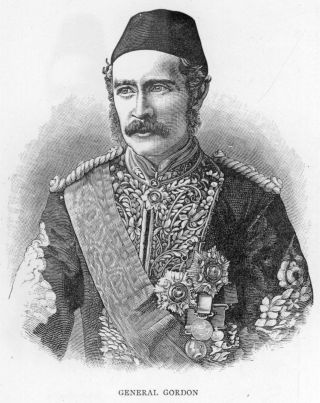
On every occasion throughout this war, when the British came in contact with the enemy they behaved with great valour; but the nature of the conflict, and the poor fighting power of the Egyptian troops, afforded comparatively few opportunities for the display of deeds of individual heroism.
England, however, has every reason to be proud of the conduct of her soldiers and sailors during the Egyptian Campaign, which was accomplished with a dash and rapidity, and with a smallness of loss, in comparison with the number of the enemy’s troops and the strength of their artillery, altogether unprecedented in the annals of modern warfare.
Chapter Sixteen.
Campaigns against the Mahdi—1883-1885.
Although the defeat of Arabi was complete, another and much more serious danger to Egyptian civilisation soon after arose in the Soudan. An Arab of Dongola, a Moslem fanatic, who had been accepted by many of the Arabs as the Mahdi or prophet, the expected Messiah of Islam, had, as far back as 1881, resisted and defeated the Egyptian forces, and during 1882, by repeated successes, had largely increased his power and the number of his adherents. In 1883 serious preparations were made by the Egyptian Government for a campaign against these rebels; and in August an army of over 10,000 men of all arms was collected and despatched against the Mahdi under the command of Colonel Hicks, a retired Indian officer, and at this time a Pasha in the Egyptian service; and with him were many other English officers. For some weeks nothing was heard in lower Egypt of the expedition, but at last news reached Khartoum that the whole force had become entangled in a defile in which an ambuscade had been prepared by the enemy, and that after three days’ fighting, the ammunition being exhausted, the army had been annihilated by the superior numbers of the Mahdi’s followers. In this awful slaughter there fell with Hicks Pasha, the Governor of the Soudan, and more than 1000 officers; while all the guns, munitions of war, and transport animals fell into the hands of the Mahdi.
This and other victories of the Mahdi and his lieutenants added greatly to his prestige as prophet, and to the number of his fanatic followers, who now overran the whole of the Soudan. The British Government urged upon the Egyptian Ministry the necessity of relieving the various invested garrisons, and withdrawing from the country without delay. To this plan the Egyptians reluctantly agreed, but they found themselves unable to accomplish it. The British Government then applied to General Gordon, who had formerly acted as Governor-General of the Soudan, and who had more influence over the Arabs than any other European, to undertake the task of the evacuation of Khartoum, the civil population of which was about 11,000, an operation which, as they could only hope to retire by the Nile, would require months of preparation. General Gordon set out at once for his post, and, reaching Cairo on the 24th January 1884, left for Khartoum on the 26th, with General Stewart as his sole companion. Travelling up the Nile, these two reached Korosko on 1st February, and then mounting camels rode for six days across the desert, and eventually reached Khartoum on 16th February, where they were hailed with the greatest enthusiasm by the people. At first all seemed well, the country was fairly quiet, and Gordon hoped to be able to send the garrison back, and indeed did send in safety some 2500 widows and children to Korosko, but events soon occurred which destroyed all hopes of a peaceful retreat.
After the defeat of Hicks Pasha, Baker Pasha, another quondam British officer, had been collecting a force of Egyptians at Suakin, and while Gordon was still on the road to Khartoum came into contact with the Mahdi’s men. Baker’s force consisted of some 3000 or 4000 Egyptians, who proved of such miserable quality that at the first attack of the enemy they were seized by wild panic, and notwithstanding the heroic effort and example of their European officers, could not be prevailed upon to stand, but broke and fled in all directions, followed by the relentless Mahdists, who massacred them without pity, 2300 men being slaughtered like sheep, and with no more show of resistance, in fifteen minutes. Nearly all the European officers were killed fighting, and only a few, among whom was Colonel Baker, succeeded in cutting their way through, and returning to Suakin. Soon after this disaster Sincat fell; its gallant garrison, under Tewfik Pasha, refusing to surrender, blew up the forts, and then marched out and fell fighting to the last; and Tokar also fell into the Mahdists’ hands, its garrison agreeing to terms of surrender, thus leaving Osman Digna, the Mahdist leader, free to attack Suakin itself.
Battle of El-Teb—1884.
As it was now clear that no reliance could be put upon Egyptian troops, even when led by British officers, it became necessary for Great Britain to intervene if Suakin was not to fall into the hands of the Mahdi. This had to be prevented at all costs, and by the end of February a British force consisting of about 3500 troops was assembled at Suakin under General Graham. The Arabs had taken up a strong position at the village of Teb, a few miles inland of Trinkitat, at the scene of the defeat of Baker’s army, and it was decided to drive them from this position.
Early on the morning of 29th February the British column set out, marching in the form of a hollow square, with the transport animals carrying reserve ammunition and hospital equipment in the middle. The force consisted of 3000 infantry selected from the Gordon Highlanders and Black Watch, the Royal Irish Fusiliers, King’s Royal Rifles, York and Lancaster Regiment, Royal Marines, and some Engineers, 115 of the Naval Brigade, six machine guns and eight Royal Artillery 7-pounders, and some 750 mounted troops.
The Arabs were found in carefully made intrenchments, on which were mounted the guns recently taken from Baker Pasha’s force, but their rear was unprotected; the attack was therefore made on this side. After the village had been shelled by 7-pounders for some time, the square marched against the rear of the Arab lines, the storm of bullets and shell by which they had been greeted having by this time ceased. As the column reached the lines the Arabs, who were concealed on all sides, suddenly sprang up, and with the reckless courage which the British soldier was often to witness in the near future, rushed upon the square, upon three sides at once; they had now, however, a foe of a quality widely different from that of Baker’s force to deal with, and a continuous and well-directed hail of bullets swept them down by hundreds, while all who reached the square fell by the bayonet on its outside, the square meantime steadily advancing. As the village was approached the formation could no longer be kept so regular, and there was fierce hand-to-hand fighting. When the fort was reached, a company of the Black Watch charged, with them being Colonel Burnaby and some bluejackets. The enemy stood their ground, and fought like heroes; in the mêlée Colonel Burnaby was wounded, and also Captain Wilson, R.N., of the Hecla. The latter, seeing a marine in difficulties with five or six of the enemy round him, went to his assistance, and after breaking his sword set to with his fists, doing terrible work with the hilt. The enemy were at length driven out at the point of the bayonet, and though they stubbornly contested every inch of the ground for three hours and a half, at length gave way in all directions. The cavalry were now called into action to pursue the scattered ranks of the Mahdists and prevent their re-forming. The enemy again met the attack with great bravery, and it was at this stage of the action that the principal British losses occurred, for the Arabs lying concealed in holes in the sand and behind hillocks, drove their spears into the horses and men as they passed over them, the sword proving a very inefficient weapon in the encounter, a fact which led to the general use of the lance on future similar occasions.
The Mahdists suffered a crushing and, as it seemed at the time, a complete defeat, and the troops meeting with no further opposition advanced to Tokar, and after destroying the fort returned to Suakin. On our side Major Slade, Lieutenants Freeman and Probyn, and Quartermaster Williams, and 26 non-commissioned officers and men were killed, and 142 officers and men wounded; whilst of the enemy 2500 were found dead upon the field, and probably as many more were wounded.
Battle of Tamanieb—1884.
It was naturally hoped that after so thorough a beating the Arabs round Suakin would make their submission, and a proclamation was issued calling upon the Sheikhs to do so. This, however, only provoked defiance, and it soon became known that the Mahdists were collecting in force at Tamai, about 16 miles to the south-west of Suakin, and accordingly another fight, which proved to be a very severe one, became necessary.
This took place on March 13th, the troops having bivouacked on the previous night a mile or two from the enemy’s position. The force consisted of two brigades under General Sir Redvers Buller and General Davis respectively, the first consisting of men from the Gordon Highlanders, Royal Irish Fusiliers, and King’s Royal Rifles; and the second of some of the Black Watch, York and Lancaster Regiment, and marines, with a force of 10th and 19th Hussars, and mounted infantry under General Stewart.
The Hussars and mounted infantry first came into touch with the enemy, dismounting and firing by volleys and independently, the nature of the ground not being suitable for charging; the enemy faced their fire with great courage, and retired in good order and slowly, as though unwillingly; the loss on our side being only two killed and eight wounded, a number quite out of proportion to the services rendered and loss inflicted on the enemy.
The second brigade, which was leading, had a very severe fight, and suffered heavy loss, which was mainly owing to the open formation of the square at a critical moment. On this account it was not strong enough to resist the sudden rush of the Arabs, who had lain concealed about fifty yards away. The charge being delivered at such close quarters and so suddenly, enabled the enemy to get to close quarters before the guns of the Naval Brigade could be got into position. A charge was ordered, but the Arabs swept round each line as it charged, burst through it, and pressed it back, and a terrible hand-to-hand fight followed. The Black Watch lost many men, being attacked both from front and rear. Three times the naval officers commanding the guns, which they would not leave, were surrounded; at last all of them and many of their men were killed, and for a few minutes the guns were in the hands of the enemy. The York and Lancaster Regiment were also hard-pressed. Seeing the serious position of the brigade, General Stewart sounded a charge, and 700 flashing sabres swept down upon the enemy,—an awe-inspiring sight, which even the courage of the Mahdists could not endure, and after a moment’s hesitation they retreated. Upon this Colonel Wood, commanding the Hussars, ordered his men to halt, dismount, and fire upon the enemy; at the same time General Buller’s brigade poured in a heavy fire, thus affording the second brigade time to re-form, and in a few minutes the victory was complete. The guns were retaken, and the whole force advanced and took possession of the enemy’s position, and destroyed the village and tents, all opposition having entirely ceased.
There fell in this action 120 British officers and men, the heaviest losses being among the Black Watch. Lieutenant Montresor, R.N., Lieutenant Almach, R.N., and Lieutenant Houston, R.N., with seven of their men, were killed at their guns. The enemy’s force was estimated at 15,000 and their loss at over 5000.
The Expedition to Khartoum—1884 and 1885.
The fighting around Suakin in 1884, though successful as to its immediate result, namely, the defeat of local levies of the Mahdi, had no beneficial effect upon the position of Gordon in Khartoum; rather, it would appear, the contrary. The defeat and terrible slaughter of the Arabs at El-Teb and Tamai seem to have been taken as an earnest of the intention of the British to reconquer the Soudan, and so to have decided many hitherto friendly, or at least neutral, Sheikhs to throw in their lot with the Mahdi. Whether this view is correct or not, the fact remains that up to March Khartoum was open, and by the end of the operations it was besieged. Our purpose being rather to relate achievements of “Our Soldiers” than a history of the events which preceded them, we will not attempt to state the cause which led to the seclusion of Khartoum and the isolation of the heroic Gordon and his companions, Colonel Stewart and Consul Power, nor the causes which rendered the splendid engagements at Suakin fruitless, and led to the fall of Berber. It is enough to say that at length the people of Great Britain could bear the spectacle no longer, and the force of public opinion compelled the Government to take steps in the summer of 1884 to achieve, if it were not too late, the relief of Khartoum. What was a possible task a few months before had now become an exceedingly difficult, if not impossible, one, and it was thought that, under the circumstances, the route which was the most feasible would be by the Nile.
In the early part of October news arrived that Colonel Stewart and Mr Power, the special correspondent of the Times, who had also acted as Vice-Consul at Khartoum, had been murdered on their way to Dongola. They were proceeding down the Nile in one of Gordon’s steamers in order to open communications with the British expedition under Lord Wolseley, which was then advancing up the river, and with them were some forty-five other people, including the French Consul at Khartoum. The steamer struck on a rock, and the whole party had to disembark. They were hospitably received by the Sheikh, who promised no harm should happen to them if they came unarmed. This they accordingly did; but no sooner had Colonel Stewart and the Consul entered the Arab’s house than they were attacked, and having no weapons but their fists, were eventually overcome and killed. General Gordon was now absolutely alone, and still holding Khartoum against the Mahdi, and no time was to be lost if he was to be released. Strenuous efforts were made to push on the expedition, and by the middle of December a strong force had assembled at Korti, on the Nile, 1400 miles by the Nile from the sea.
Here Lord Wolseley arrived on the 16th of December. The latest news from General Gordon was dated 14th November, saying that his steamers awaited the expedition at Metammeh, and that he could hold out for forty days, but that after that the defence would be difficult. Upon this news Lord Wolseley decided to send a flying column as soon as possible across the desert to Metammeh, with instructions to send a detachment by the steamers up to Khartoum. The desert route to Metammeh direct from Korti is 176 miles, but the distance is very much greater by the river, which between these two places makes a bend of three parts of a circle. The command of the force selected was given to General Sir Herbert Stewart, with Sir Charles Wilson as second in command. A strong depot having previously been established at the wells of Jakdul, about 100 miles towards Metammeh, the expedition started on the 8th January. It consisted of 5 naval officers and 53 bluejackets under Lord Charles Beresford (sent for service on the steamers), a battery of artillery, 9 officers and 120 men of the 19th Hussars under Colonel Barron, the Guards Camel Regiment under Colonel Boscawen, the Heavy Camel Regiment, consisting of Household troops and cavalry, under Major Gough, infantry mounted also on camels, 400 men of the Royal Sussex, some transport engineers and hospital details—in all 114 officers and 1687 men, with 153 horses and 2888 camels, and some 350 native drivers, etcetera.
The battle of Abu Klea.
Nothing of importance took place until the 17th of January, when the wells of Abu Klea were approached and found to be held in great force by the enemy. Leaving a few men of the Sussex and mounted infantry to hold the camp, the General advanced the remainder of his force to seize the wells, the possession of which was, of course, a matter of supreme importance. The British as usual advanced in the form of a hollow square, the troops being disposed as in the diagram.
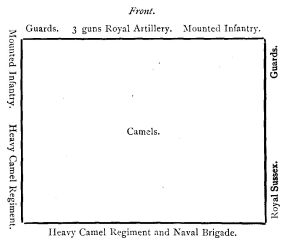
As the square approached the enemy’s position, the attack was delivered in the shape of a well-ordered charge, commencing with a wheel to the left and falling upon the left front and rear of the square. It was a matter of wonder to our men how such a regular formation was preserved over a space of 300 yards in face of a continuous and withering rifle fire. When the enemy got well within 100 yards, the fire of the mounted infantry and Guards began to tell, and the Arabs fell in heaps. The rear left was not so fortunate, for either from the rear not closing rapidly enough, owing to the fact that the Heavies were not trained to infantry work, or from its opening out in order to bring the Gardner gun into action, the square at the left rear corner was not able to bear the force of the charge, and was driven in by sheer weight of numbers, and several of the Arabs got inside. The Gardner gun had become jammed at the tenth round, and so became a source of weakness to the solidity of the square, a fact of which the enemy was quick to take advantage. At this point Colonel Burnaby, who had joined the expedition as a volunteer, was killed while gallantly facing the crowd. The Naval Brigade, as usual refusing to retire from their gun, suffered heavily, and lost all their officers except Lord C. Beresford, who was knocked down in the mêlée. For a few moments the Arabs were in the square and among the camels, and many of the officers had narrow escapes, while Major Gough and others were killed. For five minutes it was a hand-to-hand fight, but after the first wild rush no more of the enemy could pierce the ranks of the Heavies, and all who had entered the square were killed; and the enemy retreated, while the column marched down to and occupied the wells, and rejoiced in abundance of sweet if muddy water. The square had another fight of the same nature before the Nile was reached, but on this occasion the enemy failed to penetrate the zone of fire, and left all their leaders and many of their men lying dead on its front. In the early part of the day General Stewart received a wound which subsequently proved fatal.
It is sad here to relate that all this gallantry of the men, the loss of valuable lives, and the slaughter of thousands of Arabs, which had become necessary by delaying operations until the Mahdi had gathered so much strength, failed in its object, namely, the relief of Khartoum and the rescue of its heroic defenders. For when Colonel Wilson and his party, having found Gordon’s steamer, reached the city, they found it in the possession of the Mahdi, and subsequently learned that Gordon had been killed, and the garrison put to the sword, but two days before their arrival; but, in the words of Lord Wolseley’s despatch—
“It was not through any lack of zeal or want of energy that the steamers only reached Khartoum two days after it had fallen. There is no hesitation in saying that all ranks worked as hard as human beings could, hoping to render the earliest possible assistance to their heroic comrade who was besieged in Khartoum.”
Fighting round Suakin—1885.
In addition to the operations undertaken for the relief of Khartoum by way of the Nile and across the desert, the British Government had placed General Sir G. Graham in command of a strong force collected at Suakin, with instructions to destroy the power of Osman Digna, and to occupy the Hadendowa territory in order to enable a railroad to be built between Suakin and Berber, for which purpose vast quantities and stores had been despatched from England. Among the components of this force were not only Indian troops, both the cavalry and infantry, but for the first time in history a well-equipped body of Volunteer Horse, some 800 strong, despatched at the expense of the Colony of New South Wales, who joined the force on March 8th, and proved to be of great assistance and well worthy of a place among the Soldiers of the Queen.
The Arabs had been in no way disheartened by the defeats inflicted upon them by Sir G. Graham in the preceding year, and from the very first offered a fierce resistance to the advance of the expedition, so that skirmishes of more or less importance took place daily. The first serious battle took place on March 20th near the village of Hasheen, upon which the British column was advancing. About nine a.m. the Berkshire Regiment, supported by some marines, advanced upon the Dhilibat Hill, which was held by swarms of the enemy, who were soon driven down the opposite slope. In pursuing these the 9th Bengal Cavalry were ordered to dismount and fire volleys, but as this most unfortunately took place in thick bush, they were placed at a great disadvantage when the Arabs turned upon them, and they in turn were pursued, and many who were unable to mount in time lost their lives. This pursuit, however, cost the Arabs very dear, for it brought them right down to the square of the Guards, who were in reserve below the hill, before they were aware of them. With their usual bravery the Arabs charged the square, but so heavy and well-sustained was the fire that none got within fifteen yards of the rifles. The hills for the time were cleared, but the Arabs did not retire far, and hung in around the troops in the dense bush, full of fight and as undaunted as ever. The estimate of the enemy’s losses was about 250, while the British loss was 22 killed and 43 wounded; and, in the words of the official despatches, “The conduct of the force was satisfactory in all respects. The Dhilibat Hill was carried by the Berkshire Regiment with the greatest spirit, and the behaviour of the Guards’ square under a heavy fire from an unseen enemy was marked by extreme steadiness.”
McNeill’s Zareba.
Two days later, on Sunday, March 22nd, a second engagement took place, very much more serious than the first, and much more important in its result. General Graham had decided to form a zareba eight miles out on the road to Tamai, in order to make a depot for water and stores,—more especially the former,—preparatory to an advance in force on that place; it was intended to leave troops in this zareba, and on the return of the main body to form and occupy a smaller zareba between it and Suakin. The force selected for the purpose of effecting this object consisted of one squadron 5th Lancers, Naval Brigade with four Gardner guns, detachments of Royal Engineers, Berkshire Regiment, Royal Marines, and company of sailors with four Gatlings, some Royal Engineers, Madras Sappers, 15th Sikhs, 17th Bengal Native Infantry, and 28th Bombay Native Infantry, and one squadron of Hussars, and was under the command of General Sir John McNeill; General Hudson of the Indian force being second in command. The convoy which these troops had to protect consisted of about 1000 camels carrying water and supplies, as well as a large number of mules and horses—no easy task in a country covered with dense bush, which afforded concealment to an enemy who were absolutely fearless. The column started at 6:30, and its troubles soon began, for no sooner was it fairly within the bush than the difficulty of keeping the transport together became apparent, and the rate of progress was necessarily so slow that Sir J. McNeill saw that it would be impossible to carry out the programme of building and occupying the two zarebas before night, and therefore decided to form one only on an open space that the troops had reached about 10:30 a.m. Up to this time no sign of the enemy had been seen, but all precautions were taken to prevent a surprise. The force was drawn up as follows: the Indian troops occupied three sides of a hollow square, the open side being towards the bush through which the column had just come; outposts of infantry, and beyond them of cavalry, were placed in advance on the three sides; and the road to Suakin in the rear was patrolled by the Lancers, and all the convoy was drawn up in the square. All hands at once proceeded to form the zareba. The idea was to form a zareba with its north-east corner pointing to Suakin, and its south-west to Tamai, and at each of these corners to form a minor zareba or redoubt to contain two Gardner guns apiece, and to leave these garrisoned by the Berks, the marines, and the bluejackets, who would thus be able to guard the main zareba, all sides of which could be swept by their fire. The work proceeded merrily, and by three o’clock was nearly finished. At that time the marines had got inside the north-east zareba, and half the Berkshire were having their dinner outside, behind the camels, which, by this time having unloaded, were filing out of the square at the rear of the open side; the other half of the Berkshire were busy cutting bush, leaving their arms piled in the south-west zareba, with half the bluejackets and the two Gardner guns, and the central zareba was nearly completed.
Suddenly a yell was heard, some cavalry videttes came galloping in, and in a moment 5000 Arabs were rushing upon the unclosed square.
The outposts got together and stood back to back, forming rallying squares which the enemy could not break; the Berkshire men who were cutting bush rushed back to the zareba where the small naval brigade was suffering severely, for the guns not being in position the enemy got into the square, but so quickly did the Berks men follow them and recover their weapons, that, though 124 Arabs got into the square no Arab came out again. The other half of that regiment formed square, and with a steady fire kept the Arabs at bay, and eventually gained the north-east zareba without losing a man. But amongst the transport animals the state of affairs was very different. The 17th Native Infantry fell back before the rush, and the enemy, following their retreat, dashed into the central zareba among the transport animals, cutting and slashing in every direction, and in a few moments a general stampede ensued; camels, mules, and horses made one wild rush for Suakin followed by triumphant Arabs, who in their turn were met and routed by the Bengal Cavalry and 5th Lancers. At the first rush a number of the enemy succeeded in getting into the north-east zareba, the east side of which was at the moment undefended, and for a few minutes the marines were in a dangerous position, but while the front rank continued to fire on the enemy on their side, the rear rank faced about, and, fighting back to back, soon cleared the zareba of the enemy and lined the open side. After about twenty minutes the bugle sounded “Cease fire,” and as the smoke cleared away, the enemy were seen streaming away. Thus ended the fight. It was indeed a soldiers’ battle, and but for the steadiness and heroism of the individuals it would have proved another Isandlana. The enemy’s loss was very heavy, and the power of Osman Digna utterly crushed; but the cost to the British was heavy, for the losses of British and Indian troops was 600 in killed and wounded, and a large proportion of the transport train was destroyed.
Chapter Seventeen.
The Chitral Campaign—1885.
In January 1895 the reigning Mehtar of Chitral was murdered by his brother, whom, in breach of a time-honoured custom of Chitralis, he had neglected to murder or exile upon his own accession. Umra Khan, the chief of Jandol, who had long had designs upon Chitral, made this occasion a pretext for invading the territory off which he had been repeatedly warned by the British Government as the Suzerain of Chitral, and laid siege to Kila Drosh. On February 1st, Dr Robertson, the British resident at Mastuj, arrived in Chitral, and at once ordered Umra Khan to retire. Umra Khan, however, who had in the meantime taken Kila Drosh, retorted by calling upon Dr Robertson to retire, and to recognise Sher Afzul as Mehtar. This, of course, the British resident refused to do; and called a durbar, at which Soojah-ul-Moolk was declared Mehtar of Chitral, on 1st of March. The position of the British resident and his small party, which by way of precaution had occupied the fort some time previous, now became very serious. On 2nd of March, Sher Afzul had advanced upon them, and Chitral was very soon invested on all sides, and indeed, as will be seen, the actual siege commenced on 3rd of March.
The siege and defence of Chitral.
With Dr Robertson were Captains Colin Campbell and Townshend of the Central India Horse, Lieutenant Harley of the 14th Sikhs, Surgeon—Captain Whitchurch, Captain Baird of the 24th Punjaub Infantry, and Lieutenant Gurdon, who was acting as political officer before Dr Robertson’s arrival; the troops consisted entirely of natives, there being eventually shut up in the fort, in addition to those named, 543 persons, of whom 460 were combatants, namely 361 Kashmirs and 99 Sikhs. On the 3rd of March, Captain Campbell with 200 men was sent out to make a reconnaissance in the direction of Sher Afzul’s position, and with him were Captains Townshend and Baird, and Surgeon-Captain Whitchurch, joined afterwards by Dr Robertson and Lieutenant Gurdon. They were at once attacked by the enemy in strong force, and were met with a very hot fire, and eventually had to retire to the fort, fighting every inch of the ground, with the enemy on the front and both flanks, and firing from the cover of garden walls. Captain Campbell being wounded, the command devolved upon Captain Townshend, who fought his way back with his wounded to a small hamlet where Dr Robertson was rallying the men; meantime a message had brought out from the fort Lieutenant Harley and 50 Sikhs, a reinforcement which enabled the party to retire steadily into the fort, which they reached at eight o’clock. At the same time a detachment of 50 men under Captain Baird and Lieutenant Gurdon were hotly engaged in another part of the ground. Captain Baird was wounded early in the action, and under the care of Surgeon-Captain Whitchurch, while Lieutenant Gurdon conducted the retreat to the fort. With Whitchurch were a few Kashmir sepoys and some hospital bearers, but the two parties soon got separated in the mêlée, and Whitchurch and his men had to fight their way back inch by inch, carrying their wounded officer. Every now and then they had to stop and make bayonet-charges to clear the enemy out of the shelter of stone walls around them, and when at length they reached the fort nearly half the party had been left dead on the field, yet not a man had left the party. Poor Captain Baird was hit three times in the retreat, and died next day; while, strange to say, his gallant rescuer, Whitchurch, escaped untouched. Many heroic acts are done by our men in war and peace, but none can be greater heroes than these few sepoys, who were able so long to bear the strain of an apparently hopeless retreat and retire orderly, resisting all temptation to a sauve qui peut, when a speedy retreat without encumbrance of the wounded and bearers must at times have seemed the only chance for life. For his gallant conduct on this occasion, Surgeon—Captain Whitchurch received the Victoria Cross.
The total loss on this day was very heavy, and in addition to Captain Baird, General Baj Singh and Major Bhikam of the Kashmirs, and about 60 men, were killed; an ominous outset for the defence, which at first had a very depressing effect upon the troops, the majority of whom, it must be remembered, were of newly raised regiments, and without any British troops to give them confidence. Everything therefore depended upon the vigilance and calmness of the few British officers, one of whom unfortunately, Captain Campbell, was severely wounded in the knee, the command in consequence falling upon Captain Townshend.
From this day the siege commenced, and the fort was cut off from the outer world. On taking stock of their resources the garrison found that, everyone being on half rations, there was supply until about the middle of June, by which time, if they could hold out, they might expect relief; while there was a supply of about 300 rounds of ammunition per man. Of water there was no lack, as fortunately when first the fort was occupied a covered way had been made down to the river, and this covered way was all through the siege one of the principal objects of the enemy’s attacks, and had to be held day and night by a strong guard. The fort itself was 80 yards square, the walls being 25 feet high, and made of stone held together by a frame-work of wood, and 8 feet thick at each angle was a tower, while a fifth guarded the way to the water. Outside the walls were gardens and out-buildings, which afforded shelter to the enemy; these, owing to the rapidity with which the siege had developed, there had been no time to destroy, and this necessary work had therefore now to be done under fire. The enemy all through fought very well, and made every use of the cover afforded to their riflemen, who were excellent shots; and they built sangars on the rising ground above, commanding the fort, so that it was necessary for the besieged to build sheltering galleries to protect the men going from post to post. Hardly a night passed without an attack of some sort, and three times the enemy succeeded in setting the towers on fire, only to be extinguished with great difficulty by the use of earth and water. The enemy employed every device to get into the fort, and succeeded in mining close up to the walls, adding thus the labour of making counter-mines to the other tasks of the garrison. The principal fight took place on the 17th April. The enemy had been for some days previous in the apparently innocent amusement of making a noise with drums and pipes in a summer-house not far from the walls. One of the men suggested that the noise was made to cover the sound of mining—a not uncommon trick of Umra Khan’s. Accordingly men were told off to listen, and the sound of mining was heard close to a tower, so close indeed that no time was to be lost in blowing it up. This dangerous duty was successfully performed by Lieutenant Harley, who rushed the summer-house with 100 men. There was a fierce hand-to-hand fight, and some 30 Chitralis were killed, and the mine successfully destroyed; Harley and his men regaining the fort in an hour and twenty minutes. From the start 22 of the brave 100 were hit, of whom 9 were killed. Nothing of importance occurred after this, for the enemy had heard of the close approach of Colonel Kelly, and by the 19th of April had disappeared.
Thus ended a defence as gallant as any recorded in this book. For forty-six days this little band of sepoys, with five English leaders, held the fort, with inadequate defences and no artillery, against a superior force; the sepoys suffering greatly from want of food, for their caste forbade their eating horseflesh,—their ghi or melted butter, which is as meat to the native, had run out, and all they had left was half rations of flour. To the want of food must be added the mental effect, first of the disastrous day at the opening, then of the absolute ignorance of the measures taken to relieve, and the apparent hopelessness of their position, if we are to take due measure of the pluck and determination of the garrison.
The defence of Reshun.
On the 5th of March, Lieutenants Edwardes and Fowler left Mastuj with orders to join the British agent at Chitral, and they had with them 20 Bengal Sappers and 40 men of the Kashmir Rifles, conveying sixty boxes of ammunition and seven days’ rations. The day on which they arrived at Reshun they heard rumours of opposition ahead of them, and therefore intrenched themselves as well as possible near the river. The next day they were attacked by the tribes, and finding the position too exposed, they carried the houses of the village close by with the bayonet, and hastily made them defensible, and succeeded by nightfall in getting in all their ammunition and supplies and all the wounded. Here the little force, now reduced to about 50 men, was regularly besieged. The first great difficulty was the want of water, as the enemy had diverted the rivulet, thus making it necessary for the garrison to go some distance under fire to bring in sufficient for their daily wants. Food was fortunately plentiful, as, in addition to the rations, eggs and fowls and flour were found in the village. The enemy, after several attempts to take the place by assault, contented themselves with besieging the village, doing as much damage as possible by a continuous fire from the cover of houses and trees, and at length succeeded in occupying a house not more than a few feet from the wall.
On the 13th the enemy hoisted a white flag, and informed the officers that there had been some fighting at Chitral but that now peace was made, and offering to let the garrison go either to Chitral or to Mastuj. Lieutenant Edwardes upon this agreed to a three days’ armistice, and sent letters to Chitral and Mastuj; meantime the garrison were well treated and supplies sent in to them. On the 14th the enemy proposed a game of polo, and invited the officers to come and see it. This invitation was unfortunately, as it turned out, accepted, for, although under the fire of their own men, the two officers were suddenly seized from behind and bound, and a sudden attack was made upon the house occupied by the troops. This was taken by assault, most of the sepoys being killed. On March 16th, the officers were taken to Chitral, where they found about a dozen of the sepoys who had been taken prisoners; after being kept here some time, they were sent to Drosh to Umra Khan. He treated them very well, and even offered to let them join the force in Chitral, but as he would not let their men accompany them they declined. They were afterwards taken with Umra Khan on his return to Jandol, and though strictly guarded were treated with every respect and courtesy, and finally sent in safety to Sir R. Low’s camp. The sepoys also were allowed to go unharmed—an act of forbearance on the part of Umra Khan almost without precedent among Pathans.