"Our Sailors" (continued 6)
Reading edition
To conclude our short account of the services of lifeboats, we may state that in the year 1860 the lives of no less than 326 persons were saved by those stationed on the British coast, every one of which would have been lost.
We will give another example, to exhibit more clearly the nature of the work the brave crews undertake.
In the early part of that year, as the day closed, it was blowing a heavy gale off Lyme-Regis. About eight o’clock at night the alarm was given that a vessel was in distress in the offing. It was pitchy dark; indeed, the intense darkness, the strong gale, and the heavy surf on shore were enough to appal any man entering the lifeboat. After some short delay, however, the boat was manned by a gallant crew—her coxswain, Thomas Bradley, being early at his post. Tar barrels were lighted up on shore, and the boat proceeded on her mission of mercy. So truly awful was the night, that nearly everyone on shore believed she would never return again. However, after battling with the fury of the storm, and after an absence of about an hour and a half, the lifeboat did return, laden with the shipwrecked crew of three men of the smack Elizabeth Ann, of Lyme-Regis.
Chapter Twenty Three.
A brush with an Ironclad.
On the 29th of May 1877 two British corvettes, the Shah and the Amethyst, were engaged in the only encounter at sea in which Her Majesty’s ships have been engaged, (with the exception of fights with slavers) for very many years, and this conflict was the more remarkable inasmuch as their opponent was an ironclad. Peru is the land of revolution and revolt against authority. Such a rising took place in the last week of May. Pierola, the leader, had as his friends the officers of the Peruvian ironclad the Huascar, and this vessel pronouncing in his favour, put to sea with him on board. The Peruvian Government at once sent news of the mutiny on board this ship to Admiral de Horsey, and also notified that they would not be answerable for the proceedings of those on board. The Huascar put into Perajua, and took coal from an English depot there; she then put to sea, stopped two British steamers and took coal also from them. As this was an act of piracy on the high sea, Admiral de Horsey determined to engage her whenever he met her.
On the 28th of May the Huascar appeared off the port of Iquique. Her boats disembarked a portion of her crew, and after a fight with the Peruvian troops, they captured the town. A few hours after that the Peruvian squadron, consisting of the ironclad Independencia, the corvette Unica and the gunboat Pilsomayo, arrived, and it was resolved to engage the Huascar. The fight lasted for an hour and a half, and then darkness came on and the Huascar steamed away.
The next morning she met the Shah and the Amethyst. Admiral Horsey sent an officer on board the Huascar to demand her surrender. Pierola refused, and upon the return of the officer to the Shah, the battle at once commenced.
The Huascar was built for the Peruvian Government by Messrs Samuda, and was a turret-ship mounting two 300-pounder guns in her turret. She had also two 40-pound pivot-guns. The Shah and Amethyst were unarmoured cruisers, but in point of number of guns they were superior to the ironclad. The fight lasted for three hours. The Huascar’s smoke-stack was pierced, and damage done to her deck beams, but the metal of the British guns were not heavy enough to pierce the armour. In the course of the fight the Shah launched a Whitehead torpedo against the ironclad, but it failed to strike her. The British ships were ably handled, and received no serious damage in the encounter; and after a three hours’ engagement the Huascar steamed away and made for a Peruvian port. As this was the first time that unarmoured vessels had ventured to engage an ironclad of modern type, every credit is due to the gallantry of our seamen, although they were unsuccessful in their attempt to capture or sink their opponent.
Chapter Twenty Four.
Gallant deeds performed by Naval men.
Death of Captain Brownrigg—1881.
This officer had greatly distinguished himself by the energy and success with which he had carried on operations against the slaving dhows during the term of his command on the Zanzibar coast. On the 27th of November 1881 he started in the steam pinnace of the London, accompanied by his steward, a native interpreter, and a writer, with a crew consisting of a coxswain, Alfred Yates, three seamen, and three stokers. Captain Brownrigg was going upon a tour of inspection among the boats engaged in repressing the slave trade, and the various depots. On his way he examined any dhows he met which he suspected to contain slaves. On the 3rd of December a dhow was sighted flying French colours. In such cases it was not Captain Brownrigg’s custom to board, but only to go alongside to see that the papers were correct. He therefore ordered the boat’s crew to be careful not to board without direct orders, intending a mere cursory examination, and no detention whatever, as he did not arm the boat’s crew, and directed the time alongside to be noted.
He went alongside without hailing or stopping the dhow in any way, the wind being light and the craft scarcely forging ahead.
Prior to getting alongside he sent the coxswain forward to make a hook, with a chain and rope attached, fast to the dhow, his object in doing so seemingly being to prevent the necessity of the vessel stopping, and to enable him to converse with the captain and to quietly verify her papers. He took the tiller himself, and was alone, with the exception of his steward (a Goanese) and a native interpreter, in the after-part, which is separated from the rest of the boat by a standing canopy, over which one has to climb to get fore or aft. It was still more cut off by the fact of the main-boom having been raised to the height of the top of the ensign staff on the mainmast, and over it the after-part of the rain-awning was spread, being loosely gathered back towards the mast.
When the boat was quite close to the dhow, a man, supposed to be the captain of her, stood up aft with a bundle or roll of papers in his hand, and said something as he unfolded them, and pointed to the French flag. What he exactly said is unknown.
There were then visible on board the dhow four men, two aft and two forward, all armed with the usual Arab swords and creeses. The forecastle sun-awning was spread at the time from the foremast to a stanchion shipped abaft the stern-piece, and under it were two bluejackets and the writer, the leading stoker was at the engines, whilst the two stokers appear to have been sitting on the inside of the gunnel of the well, i.e. the space for boilers and engines.
As the coxswain was standing on the stem of the boat, in the act of making fast with the hook rope, he caught sight of some eight or ten men crouched in the bottom of the boat with guns at the “ready” position. He sang out to the captain aft, when they rose up and fired; he flung the hook at them, and closed with one, both falling overboard together.
The Arabs, the number of whom is variously estimated at from fifteen to twenty-five, then jumped into the pinnace with drawn swords and clubbed guns. As their first fire killed one man (a stoker) outright, mortally wounded another, and severely wounded two others of the boat’s crew, the Arabs found but little difficulty in driving the rest, unarmed as they were, overboard.
Captain Brownrigg and his steward were the only two left, and both were in the after-part of the boat. He seized a rifle, and at the first shot knocked an Arab over; but before he could reload three or four of them rushed aft to attack him, getting on the top of the canopy and at the sides, but he, clubbing his rifle, kept them at bay, fighting with a determination that filled the survivors, who were then in the water unable to get on board, with the greatest admiration, they describing him as “fighting like a lion.”
He knocked two of his assailants over, but was unable to get at them properly, owing to the awning overhead, whilst they were above him on the canopy cutting at him with their long swords, but fearing to jump down and close with him. As he knocked one over, another took his place.
The first wound that seems to have hampered him in the gallant fight was a cut across the forehead, from which the blood, pouring over his face, partially blinded him. He was then cut across the hands, the fingers being severed from the left and partially so from the right one, and, badly wounded in both elbows, he could no longer hold the rifle.
He then appears to have tried to get hold of any of his foes or of anything wherewith to fight on, but, blinded as he was, his efforts were in vain. He fought thus for upwards of twenty minutes, keeping his face to his assailants, and having no thought, or making no effort, to seek safety by jumping overboard. At length he was shot through the heart and fell dead, having, besides the fatal one, received no less than twenty wounds, most of them of a severe, and two of a mortal nature.
During this time, of the men in the water, Thomas Bishop, seaman, was badly wounded, and was supported to the dinghy astern of the pinnace by William Venning, leading stoker, who was himself slightly wounded in the head by a slug. There he held on, but the Arabs, hauling the boat up alongside the pinnace, cut him over the head until he sank.
Samuel Massey, A.B., was severely wounded, and was supported to the shore, a distance of about 700 yards, by Alfred Yates, leading seaman, and William Colliston, ordinary; the remaining stoker swam there by himself, as also did the interpreter. The writer (third class), John G.T. Aers, having been mortally wounded at the first fire, there was left on board the pinnace only the captain’s steward, who lay quiet, pretending to be dead.
The Arabs then left the boat and sailed away in their dhow, when the leading stoker got on board of her,—he having been in the water all the time,—got up steam, and picked up the men on the beach.
Chapter Twenty Five.
The Egyptian Campaign—1882.
The bombardment of Alexandria, which commenced the war in Egypt, was of the highest interest to naval men; for here, for the first time, ironclad ships, armed with new and heavy ordnance, attacked forts mounted with the heaviest guns. A bloodless revolution had taken place in Egypt. The army, headed by Arabi Pasha, had quietly pushed aside the authority of the Khedive, and had become supreme in Egypt. The people at large were with the army, and regarded the movement as a national one; its object being to emancipate the country from foreign control. England was unable to behold the change without apprehension; the Khedive was her own nominee, and had from the commencement of the trouble with the army acted entirely in accordance with the advice of the representative of England. We had a large stake in the country from the numerous loans which had been raised for the most part in England; but we were principally affected by the fact that the rebels would have it in their power to stop the canal, and so to block the highway to our Eastern possessions.
The Egyptians began to manifest a hostile spirit towards foreigners, and an attack was made upon the Europeans in Alexandria; a large number were killed, and the rest compelled to take shelter on board a ship. A powerful English fleet was assembled in the port of Alexandria; the attitude of the Egyptians became more and more threatening, and they proceeded to throw up batteries to command the British fleet. Admiral Seymour, who was in command, peremptorily called upon them to desist; but in spite of his threat to open fire upon them they continued to work upon the forts; the fleet therefore prepared for action. All neutral ships were warned to withdraw from the harbour, and the fleet then steamed out and took up its position facing the outer forts.
At seven o’clock on the morning of the 5th of July 1882, the signal to engage the batteries was made on board the admiral’s ship the Invincible; and the Invincible, Monarch, and Penelope immediately opened fire on the forts known as the Mex batteries; while the Sultan, Alexandria, Superb, and Inflexible, at the same moment, opened fire on the forts at Pharos Point and Ras-el-Tin. The Egyptians were standing at their guns, and instantly replied to the fire. The gunboats were lying in a second line behind the line of battle-ships, but the sailors who manned them were not content to remain idle, and, though without orders to engage, the Cygnet soon crept in close enough to use her guns. The Condor steamed away to the west, and engaged alone and unsupported the Marabout Fort. The admiral, seeing the disproportion of force between the Egyptian fort and the little gunboat, signalled the Bittern and Beacon to join her. The Decoy went of her own accord, and the other gunboats and the Cygnet also moved off to aid in pounding the Marabout Fort.
The roar of the heavy guns of the fleet and batteries was tremendous, and on both sides cannon of vastly heavier metal than had ever before been used in war were sending their deadly messengers. The Egyptians stuck to their guns with the greatest bravery, but their skill was far from being equal to their courage, and the greatest portion of their shot flew high over the vessels; this was especially the case with the heavy guns, the lighter and more manageable pieces were better aimed, and the round shot continually struck the men-of-war but failed to penetrate their iron sides. On the other hand, the huge shot and shell of the ironclads committed terrible devastation on the batteries. These were for the most part constructed of stone, which crumbled and fell in great masses under the tremendous blows of the English shot and shell.
After an hour’s continued firing the return from the forts began to slacken. Many of the guns were dismounted, and rugged gaps appeared in their walls; but it was not for three hours later that the Egyptian gunners were driven from their pieces. Even then they continued to fire steadily from several of their forts. At one o’clock the gunboats had silenced the fire of the Marabout Fort, and proceeded to aid the Invincible, Monarch, and Penelope in their bombardment on the Mex batteries; and the Temeraire, which had hitherto been engaged with a fort commanding the Boghaz Channel, joined the Alexandria, Sultan, and Superb, and their fire completely silenced the Pharos forts and blew up the enemy’s powder magazine. By four o’clock in the afternoon, the enemy’s fire ceased altogether, but for another hour and a half the fleet continued to pound the forts.
The action was decisive; almost every Egyptian gun was dismounted, the forts were riddled with holes and reduced to ruins, and the slaughter of the Egyptian artillery was very great, while on the English side the casualties amounted to only 5 killed and 28 wounded. So tremendous was the effect produced by the fire of the British guns, that the Egyptian soldiers entirely lost heart, and although the fleet carried no force capable of effecting the capture of the town, if staunchly defended, the Egyptians at once evacuated Alexandria. The European quarter was plundered and fired by the mob of the town, and an enormous amount of damage done.
As soon as the place was found to be evacuated, a strong body of marines and bluejackets landed and took possession of it, and speedily restored order, and held the city until the arrival of the troops from England. Sir Archibald Alison came out and took command of the force on shore, and, sallying out with 600 men, captured the waterworks at Ramleh—an important position between the sea and the canal, and facing the camp of Arabi’s army some four miles distant; here, for some time, artillery duels from time to time went on between the guns of the two armies.
Captain Fisher of the Royal Navy took possession of a railway train and made of it a moving battery. Its armament consisted of two heavy guns and some gatlings; the trucks were protected by sand-bags, and the battery was manned by sailors. This train did great service, as the line of railway ran from Alexandria through the rebel camp, and when reconnaissances were made the movable battery accompanied the troops, and by its fire greatly facilitated the operation.
Until the end of July the principal part of the work of defending Alexandria and checking the army of Arabi fell upon the Naval Brigade, but by that time so large a number of troops had arrived that the services of the sailors on shore were no longer required, and, with the exception of those serving in Captain Fisher’s battery, they returned to their respective ships. The marines, however, remained on shore and took part in a sharp engagement which took place on the 5th of August. Sir Archibald Alison was desirous of discovering the exact position and force of Arabi’s advance line of defences, and a reconnaissance, composed of six companies of the 60th Rifles, four companies of the 38th, and four of the 46th, were told off for the service; and seven companies of marines under Colonel Tewson were ordered to advance along the railway embankment in company with the ironclad train. The Rifles were to march by the canal, and the two parties would join at the point where the canal and railway approach closely to each other. The ground between the line taken by the two columns consisted of fields and marshy swamps.
No sooner had the advance begun than a movement was visible in the enemy’s lines, and the Egyptians were soon seen extending in skirmishing order 1000 yards in front of the 60th. They took up their position in a deep ditch which crossed the British line of advance, and behind which was a thick jungle, and opened a heavy fire upon the Rifles. The troops advanced steadily in skirmishing order, opening fire upon their almost invisible foes, whose heads only could be seen when they raised them to discharge their muskets. The Egyptians fired high, and although a hail of bullets swept over the heads of the advancing troops there were but few casualties. When the Rifles approached the ditch, the supports were brought up and a rush was made, when the Egyptians at once forsook their position and fled through the jungle.
In the meantime, the marines, advancing along the embankment, had been met by a hot fire from the enemy, whose main position here was a large house, surrounded by entrenchments on which some guns were mounted. The forty-pounder on the moving battery kept up a steady fire on this position; while the marines, pushing forward, were hotly engaged with the enemy’s infantry. The two columns advanced abreast until they reached a point some 600 yards from the spot where the railway and canal come together; the embankment was strongly held by the Egyptians, but the marines charged them with fixed bayonets and drove them before them—bayoneting and shooting great numbers.
By this time the enemy were coming up in great strength from their camps. The marines were now unsupported, for Colonel Thackwell, who commanded the other column, had received orders to advance to the White House. There were two white houses on the canal, and he stopped at the first, whereas the second was the one intended; the marines having pushed on farther, were therefore entirely without support, and the enemy, massing in great numbers, threatened them on both flanks. The order was therefore given to fall back, but in order to check the enemy while the movement was being carried out, Major Donald with 50 marines advanced boldly close up to the Egyptian position, and kept up so hot a fire that the enemy’s advance was checked, while the main body of the marines retired steadily across the fields to the embankment, keeping perfect order in spite of the tremendous fire which was poured into them, and bringing off every wounded man as he fell.
The enemy had now brought up several batteries of artillery, which opened from a distance, and under this cover pressed hotly upon the marines; these, however, retired in alternate companies, turning round and facing their pursuers, and aided by the musketry fire of the sailors in the train as well as by their machine guns and forty-pounder.
Darkness was fast coming on, and as the batteries at the waterworks now opened fire upon the Egyptians, the latter ceased to press the retiring troops, who withdrew without further molestation to their position at Ramleh.
When the main body of troops from England reached Alexandria, with Sir Garnet Wolseley in supreme command, steps were taken to remove the scene of war to Ismailia—half-way along the Suez Canal—in order to advance upon Cairo from that place, and to avoid the necessity for attacking the formidable works which Arabi had erected facing Alexandria. The plan was kept a profound secret: the troops were placed on board the transports, and, escorted by the fleet, steamed away to Port Said at the mouth of the Suez Canal, and then up the canal to Ismailia.
In spite of the efforts of the sailors, upon whom the burden of the operation of disembarkation fell, there was considerable delay before the troops were in a position to advance, and Arabi was able to collect a large army at Tel-el-Kebir, on the line by which the army would have to advance. While the preparations for a forward movement were going on, a portion of the British troops pushed forward; and a brigade, among whom was a battalion of the marines, occupied Kassassin, a few miles distant from the Egyptian position.
On the 10th of September, Arabi, seeing how small was the force which had taken up its post near him, determined to attack them, with the intention of crushing them first, and then advancing and destroying one by one the small bodies of British troops at the posts on the line down to Ismailia. He advanced with a powerful force, and so quickly did he push forward that the British had scarcely time to get under arms when the Egyptian shell began to fall fast in the camp. The little force fell in with the greatest coolness, and the marines and 60th Rifles advanced in skirmishing order to meet the vastly superior numbers of the Egyptians. So staunchly and steadily did they fight, that they were able to keep their assailants at bay until the English cavalry came up from the next post, and, falling upon the Egyptians in flank, completely routed them. At the battle of Tel-el-Kebir, where Arabi’s army was completely defeated and the rebellion finally crushed, the marines, who had hitherto borne the brunt of all the fighting which had taken place, were not in the front line of attack, and bore but little share in the fighting, which was done almost entirely by the Highland Brigade.
Campaign against the Mahdi—1883-1885.
After the English had broken up the Egyptian army, and had, for a time at least, practically assumed the direction of affairs there, they found themselves face to face with an insurrection under a fanatic who assumed the title of the Mahdi. The followers of this man had overrun the whole of the Soudan, shutting up the various Egyptian garrisons in the towns they occupied. One of the chiefs of the Mahdi, named Osman Digma, was threatening the port of Suakim, on the Red Sea, and had besieged the Egyptian garrisons in the towns of Sinkat and Tokar. Admiral Hewett was ordered to protect Suakim, and with the Ranger, Sphinx, Euryalus, and Decoy took his station off that town.
Several times Osman Digma’s followers came close up to the place, but, whenever they did so, the bluejackets and marines from the four English ships were landed, and the men-of-war opened a fire over the town upon the ground which the rebels must cross to reach it. Thus they succeeded in defending Suakim from any serious attack until Baker Pasha, who was in command of a miscellaneous force known as the Egyptian Police, came down with some thousands of newly-raised troops. These men had received but little drill, and were scarce worthy the name of soldiers; but, as the garrisons of Sinkat and Tokar still held out, although sorely pressed by hunger, Baker Pasha determined to make an effort to relieve them, although he and his officers were well aware of the wholly untrustworthy nature of the force at his command. There were plenty of English troops doing nothing in Egypt, and had but one regiment been sent down to Baker Pasha it would have been worth all the armed rabble he had under him; but the English Government could not at the time bring itself to acknowledge its responsibility for the safety of the Egyptian garrisons.
Baker’s force was conveyed down the coast to Trinkatat; Admiral Hewett with some of the ships going down with him. The force was landed and marched towards Tokar; on the way it was attacked by the tribesmen who had embraced the cause of Osman Digma. The undisciplined levies of Baker broke at once when attacked; their English officers fought gallantly; many were killed, and the greater portion of the Egyptians massacred almost unresistingly; the rest fled to Trinkatat. The rebels, fearing to come within range of the guns of the English ships, ceased from their pursuit, and the survivors of Baker’s force were able to get on board the vessels in safety.
The result of this defeat was that the garrison of Sinkat, who had held out heroically, finding themselves without a hope of relief, and their provisions being wholly exhausted, marched out and tried to cut their way through the besieged town to the coast. They were, however, exterminated, not a man making his way through to tell the tale.
Tokar also fell into the Mahdists’ hands, its garrison having accepted terms of surrender; and thus Osman Digma was left free to attack Suakim itself, which but for the presence of the fleet must have fallen into his hands.
Battle of El Tab.
In the meanwhile the British Government, under the leadership of Mr Gladstone, had come to the conclusion that the advanced posts of the Egyptian Government in the Soudan could no longer be held, and pressed upon that Government the necessity of withdrawing the garrisons. The Egyptians reluctantly accepted the advice of their powerful “ally,” but were unable of themselves to execute its purpose. The British Government then applied to General Gordon, who had been formerly governor of the Soudan, and who had more influence over the Arab tribes than any other European of modern times, to undertake the task of the evacuation of Khartoum, the civil population of which numbered about 11,000. General Gordon at once responded to the call of his country, and set out for Khartoum, which he reached with General Stewart as his sole companion on the 16th of February.
At first all seemed well, and Gordon was able to send down some widows and children, 2500 in all, to Korosko, but the events above related at once destroyed all hope of a peaceful retreat; and it became evident that help from without would become necessary if the population were to be saved; but the two British officers never doubted that their country would aid them in their time of need.
The sensation caused in England by the events around Suakim now became so great that Mr Gladstone’s Government could no longer evade their responsibility, and now took the step which, had it been taken six weeks earlier, would have saved thousands of lives. English troops were set in motion from Egypt, some regiments were stopped on their way home from India up the Red Sea, and a force was assembled at Suakim under General Graham; when these were collected they were taken down to Trinkatat by sea, and the disembarkation there began on the 23rd of February 1884.
As usual, all the hard work to be done fell upon the sailors, who worked incessantly—landing stores through the surf, working up to their necks in water. On the 26th, having accomplished this work, a Naval Brigade, consisting of all the marines and sailors who could be spared from the men-of-war, was landed to take part in the expedition, taking with them several gatlings and light ship guns; all of which were dragged by them through the deep sand, no means of transport being available. Two or three days now elapsed before the advance commenced, as some of the troops had not yet arrived; but on the 65th Regiment coming into port in the Serapis transport, orders were given for the advance to commence. As soon as the 65th landed, they crossed a lagoon, or shallow salt-water lake, which lay behind Trinkatat, and joined the main body, who had already taken post on the other side.
The column consisted roughly of 3000 infantry, 750 cavalry and mounted infantry, 115 men of the Naval Brigade, and about 200 artillery and engineers; of these 150 were left at Trinkatat, and 200 men at the camping ground across the lagoon, which had been entrenched by General Baker and bore his name. The troops advanced in a hollow square. The Gordon Highlanders formed the front face, the Irish Fusiliers the right face, the 65th the left, and the 42nd Highlanders formed the rear of the square. The Rifles marched inside the square next to the Fusiliers, the marines next to the Rifles, the sailors, with six gatling guns, were stationed to the left of the Gordon Highlanders; while the eight seven-pounder guns belonging to the fleet, which had been transferred to the camel battery, were in the centre of the square in reserve. Two squadrons of cavalry were to scout far out on the front and flanks, the rest of the cavalry were to remain in readiness for action in the rear of the square.
Soldiers and sailors were alike in good spirits, and longing to meet the foe and to avenge the massacre of Baker’s troops on the very ground across which they were about to march; but they knew that the work would be no child’s play, and that the greatest steadiness would be needed to resist the tremendous rush of the fanatics. The march began in the morning, and the enemy’s scouts were seen falling back as the cavalry dashed out ahead. Their main position was in the neighbourhood of some wells. It was marked by a number of banners floating in the light air on a low ridge which was swarming with men; guns could be seen in position at various points along the position, which extended about a mile in length.
As the column approached the ridge, the natives took up their post behind it; but, as in a direct advance against it, the column would be swept by the fire of their guns and musketry, without being able to make any adequate return against the concealed foes, General Graham determined to turn it by working round its flank. Accordingly, after a halt, the column continued its march in an oblique direction across the face of the position.
At a few minutes before eleven, the cavalry scouts moved away from the front of the column and left it face to face with the enemy, who were now but a few hundred yards away. Their heads could be seen popping up behind the bushes and earthworks, and every moment it was expected that they would rise from their hiding-places and charge down upon the column which was marching past their front at a distance of about 400 yards.
The assault did not come, but a sudden fire of musketry broke out from the face of the position, and the Krupp guns, captured from Baker’s force, in their batteries opened fire on the column. The effect was at once visible, several men in the square fell out from the ranks wounded; but fortunately the enemy fired high, and the storm of shot and shell, for the most part, passed harmlessly over the column. Without returning a shot, the column moved steadily on in the line which would soon place them across the end of the enemy’s position, and enable them to take it in the rear.
It was very trying to the nerve of the troops to march on without firing while pelted with such a storm of missiles. General Baker was badly wounded in the face by a bullet from a shell, and many men were struck, but by this time the column had reached the desired position; they had passed round the enemy’s line, and were almost in their rear. They halted now, and the men lay down, while the sailors opened fire upon the enemy with the gatlings, and the men of the camel battery with their seven-pounders,—six guns of the enemy replying. These were well handled and aimed, for the garrison of Tokar had three days before surrendered, and were now fighting in the ranks of their captors, whose guns were all worked by the Egyptian artillerymen.
By twelve o’clock the English guns had silenced those of the enemy, and the word was given for an advance against their position; the bagpipes struck up, the men sprang to their feet cheering, and the column, still keeping its formation as a square, marched straight at the enemy’s position. The Arabs ceased firing as the British approached, and when the column was close at hand they leapt to their feet and charged furiously down.
The change of the direction of the march had altered the position of the column, the flank of the square was now its front, and the brunt of the attack fell on the 42nd, 65th, and the Naval Brigade. Groups of twenty and thirty Arabs rushed fiercely down upon them, but they were swept away by the fire of the musketry and the machine guns; but in some places the Arabs came to close quarters, but were unable to break through the line of bayonets.
The column had now reached the position, and with a cheer rushed over the bank of sand. From every bush around them the Arabs leapt up and flung themselves upon the troops. Admiral Hewett himself led the sailors and joined in the hand-to-hand fight. A party of fanatics nearly succeeded in breaking in between the sailors and the 65th, but Captain Wilson, of the Hecla, threw himself into the gap, and, fighting desperately, drove back the assailants.
There was a short halt when the post was captured, to reform the column before moving forward to the attack of the main position of the enemy, of which we were now well in rear; and after a short artillery duel the column again advanced. The whole ground was covered with trenches and innumerable little rifle-pits, all hidden by the close growing bushes, and every foot was contested, the Arabs leaping from their defences and dashing recklessly on the British bayonets. Great numbers of them were slaughtered; and they fought with a desperate courage which extorted the admiration of our soldiers.
At last the column, which was now extended into line, passed across the whole of the position occupied by the enemy and emerged in front; the main body of the enemy withdrawing sullenly. Of the Naval Brigade two men were killed, and Lieutenant Royds and six sailors wounded.
No more fighting took place; a portion of the column advanced to Tokar, which the enemy evacuated at their approach, and brought off such of the townspeople as wished to leave. The force then marched down to Trinkatat, and, re-embarking, were conveyed in the transports back to Suakim, and marched out to attack Osman Digma. The Naval Brigade took part in the advance.
Battle of Tamanieb—1884.
When the column arrived within half a mile of the position occupied by the main force of Osman Digma, they encamped for the night. At eight in the evening, Commander Rolfe, RN, performed a most daring action; he started alone to reconnoitre the camp of the enemy, and made his way close up to their fires, and was able to bring back the news that the enemy were quiet and evidently meditated no immediate attack; the men were therefore able to lie down quietly and sleep for a while. At one o’clock, however, the enemy gathered round the position and kept up a fire all night.
The next day the advance was made, not in squares as before, but in two brigades. In the first of these, with the 42nd and 65th, were the marines and Naval Brigade. As the brigade advanced, the enemy swarmed down to the attack, and the soldiers with their rifles, and the sailors with their machine guns, opened a tremendous fire upon them; but the Arabs still came on with desperate bravery. The brigade was in square, and the 42nd, who were in front, charged the enemy at the double, cheering loudly; but this movement left a gap between them and the 65th, who formed the right face of the square, and, before the gap could be closed up, great hordes of Arabs charged down and burst into the square.
For a while all was confusion. The 65th fell back on the marines. The Naval Brigade, surrounded by the broken soldiers, were unable to use their guns, and, as the confused mass fell back, had to leave these behind them; but with great coolness they removed portions of the machinery, so that when the guns fell into the hands of the enemy they were unable to use them against us.
Wildly the Arabs pressed down upon the retreating troops, but the second brigade, under General Buller, came up in splendid order, their volleys sweeping away the enemy. This gave the retreating troops time to reform their ranks, and they at once advanced again in line with Buller’s brigade; and the enemy were put to flight, after suffering a loss of over 5000 men.
Amongst those who fell in this action were Lieutenant Montresor, RN, Lieutenant Almack, RN, and Lieutenant Houston, RN, with seven of their men who were killed at their guns.
For the subsequent proceedings against the Mahdi, see Our Soldiers, page 338.
Chapter Twenty Six.
Wars in South Africa.
In 1879 Great Britain became involved in war with Cetewayo, chief of a powerful race of savages on the north-eastern border of the colony of Natal in South Africa, and two years after in a short conflict with the Boers, or Dutch farmers, in the Transvaal; and in both of these wars a Naval Brigade took part. From this time onward, South Africa has held a position of increasing importance in our colonial history, and is likely to continue to do so for many years to come; it will be well therefore before considering the wars referred to, to give a general view of the position of the British, the Dutch, and the Zulu at the date of their commencement.
Cape Colony was originally founded by the Dutch about the middle of the seventeenth century; it was seized by Great Britain during the wars with France in 1806, and finally annexed to the British Empire by virtue of the Treaty of Vienna in 1815.
A great proportion of the colonists, and especially of the farmers in the districts farthest from the coast and from civilisation, did not take kindly to British rule; and in 1835 and succeeding years a great number crossed the Orange River—at that time the boundary of the colony on the north—with the intention of setting up independent Dutch communities. To this movement, known as the Great Trek, the occupation by the Dutch Boers (i.e. farmers) of the territories, since known as the Orange Free State and the Transvaal, or South African Republic, is due.
At that time the limits of the British colony were, on the north, the Orange River; and, on the east, the Fish River. Beyond this, on the east, was territory occupied by hostile Kaffir tribes, afterwards called British Kaffraria, and now annexed to Cape Colony, and still farther to the east of these lay the fertile land of Natal.
A large section of the trekking Boers, after passing the Orange and going north, crossed the mountains, and descended upon Natal. There were a few English hunters and traders settled upon the coast, but the country had been depopulated of its original inhabitants by a ferocious and warlike race of superior physique, whom we call the Zulu. These had been trained to a high state of military and athletic perfection by a succession of sanguinary chiefs, and had broken and massacred every tribe with whom they had come in contact, so that in this district of Natal alone it is computed that over a million had perished, and but five or six thousand of the original inhabitants remained lurking in caverns and amid the dense bush.
The first leader of the Boers, Retief, and some 70 persons, were treacherously murdered by Dingaan, the chief or king of the Zulus, at his kraal, which they had visited at his request in February 1838; and the chief made a sudden attack with his armies upon the isolated bands of farmers, and killed a great many of them. After many bloody fights, in which large numbers of Zulus were killed, the Boers drove Dingaan and his armies across the Tugela, and occupied the country.
The British Government, however, declined to recognise the right of its colonists to leave the colony, wage war upon the native tribes, and set up as independent republics, and therefore, after overcoming the resistance of the Boers, occupied Natal, and eventually made it into a separate colony. After some trial of British rule, the bulk of the Dutch recrossed the mountains, and joined their fellow-countrymen in the Orange Free State, or in the land beyond the Vaal.
At length in 1852 the British Government, having enough to do with native wars on the Cape frontier, found it expedient to concede independence to the Transvaal Boers; and two years afterwards abandoned the territory between the Orange and Vaal Rivers to its inhabitants, the Dutch farmers, who thus founded the Orange Free State.
The Dutch of the Free State were of much the same type and education as the Cape Dutch, and soon settled down and arranged their affairs, and evolved an almost ideal form of republican government, under which, after having at great sacrifice and courage overcome the native difficulties on their borders, they lived a happy and contented existence, with increasing prosperity, no public enemy, perfect civil and religious equality, and, except for railways and public works, no public debt, until in 1899 that wonderful loyalty to race which is so remarkable a trait in the Dutch African involved them in the ambitions and the ruin of the South African Republic.
With the Transvaal Boer it was far otherwise. Amongst the leaders of the Voor-trekkers, as the original emigrants from Cape Colony are called, were leaders of whom colonists of any race might be proud, such as Pretorius, Potgieter, Uys, and Retief, and, no doubt, among their followers were many like them; but it was the most discontented and the most uncivilised and turbulent, as a rule, that crossed the Vaal originally; and there they lived isolated lives, far away from any white being but those of their own family, without books, without intercourse with the outer world, surrounded only by their wives and children and Kaffir servants, or rather slaves; and thus the Transvaal Boer, to whom alone we ought to apply the name, became more sullen, obstinate, bigoted, and ignorant than his cousins farther south.
Very little good could such people, with few exceptions little above the average of an English farm-labourer, do with independence. Many years were wasted in quarrelling and even fighting among themselves, every leader of a district with a few scattered farms claiming independence, before all were united under one government. There was constant war with natives on the border, no means of collecting taxes or providing for public works, and by the year 1877 it seemed as though the State must collapse and the Transvaal be overrun by its enemies. The Boers were defeated by Sekukuni, chief of the Bapedi; they had an open dispute with Cetewayo about territory which they had annexed from his country, and he was preparing for war; the tribes in the north had driven back the farmers; the State was bankrupt, and all was confusion. The more settled members of the community in the towns called for firm government, but the president had no power at his back to enforce it.
Such a state of things encouraged a general native rising, and was a menace to the safety of all the whites in South Africa. The Cape Government watched the situation with anxiety, and at length the British Government intervened, and on 12th April 1877 proclaimed the Transvaal to be annexed to the British dominions.
At the time it was believed that the majority of the burghers were in favour of this step, which met with no serious opposition. Subsequent events, however, proved that this belief was not well founded. It is, however, tolerably certain that it saved the Transvaal an attack from the thirty or forty thousand Zulus collected by Cetewayo on its frontier.
Chapter Twenty Seven.
The Zulu War.
Cetewayo had for many years been training a large army of warriors, and had intended, unquestionably, to use them for an attack upon his neighbours the Boers of the Transvaal, who, indeed, had given him more than sufficient cause, by constantly violating the frontier, squatting upon Zulu territory, and committing raids upon Zulu cattle. Upon our taking over the Transvaal, however, the prospect of great plunder and acquisition of territory vanished, and the king and his warriors remained in a state of extreme discontent. So large and threatening was his army, that Sir Bartle Frere, the Governor of the Cape, considered it absolutely necessary to bring matters to a crisis. A commission sat upon the disputed frontier question between the Zulus and the Boers. They had also to investigate charges of a raid into Natal territory by some Zulu chiefs. Their decision was in favour of the Zulus against the Boers; and, in respect of the raids, they ordered that a fine should be paid and the offenders given up.
At the time that this decision was announced to the Zulus, Sir Bartle Frere called upon Cetewayo to disband his army, to abandon the custom of universal conscription, and of the refusal of marriage to the young men until they had proved their prowess in battle. To this demand Cetewayo returned an evasive answer, and an ultimatum was then sent to him.
Preparations were made to enforce the British demands, and, as the British force in Natal was not large, the ships of war on the coast were asked to furnish a contingent. Sailors being always ready for an expedition afloat or ashore, the demand was gladly complied with, and a brigade with rockets and gatling guns was at once organised. This brigade was attached to the column which, under the command of Colonel Pearson, was to advance by the road nearest to the coast.
On the 12th of January, no answer having been received to the ultimatum, the column crossed the Tugela. The sailors had been at work at this point for some time. They had established a ferry-boat worked by ropes, and by this they transported across the river the stores and ammunition needed for the expedition. The column advanced slowly and carefully, and upon the 23rd they were attacked at the Ebroi River by the enemy. These had placed themselves upon high ground, and opened a heavy fire. The sailors at once got the gatlings and rockets to work, and so great was their effect that the rush of the Zulus was checked, and they were unable to carry out their favourite tactics of coming to close quarters. Three hundred of them were killed, and the rest retired.
The column now marched on to Ekowe, and upon reaching that place a messenger from the rear brought the news of the terrible disaster which had befallen Lord Chelmsford’s column at Isandhlwana. The British camp at that place had on the advance of the main body been rushed by a large Zulu force, and the whole of the British and native troops, numbering over 1000, were killed, only a few, scarce 50 escaping. It was a hand-to-hand combat against thousands, and from the Zulus themselves, for no white man saw the end, come the accounts of how firmly the soldiers stood. The Zulus, who had a keen appreciation of gallantry, tell many tales of how our men stood fighting till the last. “How few they were and how hard they fought,” they said; “they fell like stones, each man in his place.”
There was only one sailor in the camp. He belonged to HMS Active, and throughout the terrible fight displayed the utmost courage. At last, when all was nearly over, he was seen in a corner of the laager, leaning against a waggon wheel, keeping the Zulus at bay. One after another fell as he stabbed them with his cutlass. The savages themselves were lost in admiration at his stern resistance. At last a Zulu crept round at the back of the waggon, and stabbed him through the spokes of the wheel.
It would have been the height of rashness to have advanced farther, as the column would now have been exposed to the whole force of the Zulus. Colonel Pearson determined, therefore, to fortify Ekowe, and to maintain himself there until reinforcements came up. The cavalry and the native contingents who had accompanied the column were therefore sent back, the sailors being retained to assist the regular troops in holding the place.
The first step was to erect fortifications, and, as the enemy attempted no attack, these were made strongly and massively. Here for many weeks the little garrison held out. The Zulus surrounded the place closely, but never ventured upon any sustained attack upon it. The garrison, however, suffered severely from fever, heat, and the effects of bad food and water. For some time they were cut off entirely from all communication with Natal; but at length an officer, upon the top of the church, observed one day, far among the hills to the south, a twinkling light. From the regularity with which it shone and disappeared, he came to the conclusion that it was caused by signallers endeavouring to open communications. The flashes were watched, and were found to be in accordance with the Morse alphabet; and the joyful news was spread that their friends were telegraphing to them.
After some trouble, a mirror was fixed and signals returned, and from that time, until relief, regular communication was kept up by this means. There was disappointment at first when it was found that some time must elapse before a relieving column could advance; but as the news came of the arrival of ship after ship, laden with troops from England, confidence was felt that relief would arrive before the exhaustion of the stock of provisions. The garrison on their part were enabled to send to their friends accurate information of the state of their stores, and the time which they would be able to hold out.
At length, on the 28th of March, the news arrived that the column would advance upon the following day. The relieving force was attacked at Gingihlovo, near the river Inyanzi, and there the Zulus were defeated with great loss. With this relieving column was another Naval Brigade, consisting of men of the Shah and Tenedos. The Shah was on her way to England when, upon arriving at Saint Helena, the news of the massacre at Isandhlwana reached her. Captain Bradshaw, who commanded, at once determined to take upon himself the responsibility of returning to Natal, where his arrival caused the liveliest satisfaction, as at that time none of the reinforcements from England had reached the spot, and strong fears were still felt of the invasion of the colony by the Zulus. The Naval Brigade bore their part in the fight at Gingihlovo, and were with the relieving force when it entered Ekowe. The garrison of this place, small as they were, had been prepared upon the following day to sally out to effect a diversion in favour of the column, should it again be attacked in its advance to Ekowe.
The garrison was now relieved. Few of those who had formed part of it were fit for further service. Ekowe was abandoned, and the Naval Brigade returned to Natal. The brigade took part in the further advance after the arrival of Sir Garnet Wolseley; but the defeat of the Zulus at Ulundi occurring a few days after the start had been made, hostilities ceased, and the Naval Brigade were not called upon for further exertions.
Chapter Twenty Eight.
The Boer War—1881.
Two years after the conclusion of the Zulu war, when the troops who had been hurried from England to take part in that campaign had for the most part returned, and the country was almost deserted of troops, the Boers, saved by our arms from all danger of a native rising, longed again for independence, and they determined to have it. They had, in fact, never acquiesced in the act of annexation. At the time, the residents in the towns had desired it for the sake of law and order, and in the general helplessness of the State many of the country Boers acquiesced, and to many it seemed the only way to save the country from the Zulu. But it was expected and promised that some form of self-government would be left to the Dutch community. As time went on, the discontent grew, and it was fomented by the speeches of party leaders in England, where the Liberal party were violently attacking the colonial policy of Lord Beaconsfield; and Mr Gladstone, referring to the Boers’ country, actually said, that if the acquisition was as valuable as it was valueless, nevertheless he would repudiate it. When Mr Gladstone came into office, the Boers, who did not understand the ethics of election campaigns, expected him to reverse an act which he repudiated; and when they found that though he disapproved the act he did not intend to revoke it, they saw that they must take up arms, thinking that their cause would have many supporters among the English, who would put pressure upon the Government to give way,—a view which subsequent events proved to be correct.
The burghers have always objected to paying taxes even to their own republic, and naturally the opposition to our rule presented itself, in the first place, by a resistance to the payment of taxes. Meetings assembled, at which rebellious speeches were uttered; and the rising commenced by an attack upon the English at Potchefstroom, the investment of the garrisons of Pretoria, Leydenburg, Standerton, and other positions, and by an attack upon a column of the 94th on their way from Leydenburg to Pretoria, ending with the slaughter or captivity of the whole force. The instant the news arrived at Pietermaritzburg, the capital, Sir George Colley, the governor, commenced preparations for marching to the frontier, and the ships in harbour were called upon to furnish a naval contingent. A hundred and fifty bluejackets and marines were landed and marched rapidly to Newcastle, an English town within a few miles of the frontier of Natal.
At the attack upon the Dutch lines at Laing’s Nek, the Naval Brigade were in reserve, and took no active part in the engagement. But on the 26th of February a portion of them accompanied General Colley on his night march to Majuba Hill. This mountain was situate on the flank of the Boer position. The Dutch were in the habit of occupying it during the daytime with their videttes, but these at night fell back, leaving the place open to the British assault.
All through the night the troops, who with the bluejackets numbered between 500 and 600 men, laboured across an extremely difficult country; but, after encountering immense fatigue and difficulty, they reached the top of Majuba Hill before sunrise. It was not until two hours later that the Boer videttes, advancing to occupy their usual look-out, found the English in position. The Boers at once perceived the danger, as their position was made untenable by the possession of Majuba Hill by the English. Had the force left in camp been sufficiently strong to threaten a direct attack at this moment, the Boers would doubtless have fled: but the paucity of numbers there prevented any demonstration being made in favour of the defenders of Majuba Hill, and the Dutch were able to use their whole force against these.
Surrounding the hill, and climbing upwards towards the precipitous summit, they kept up for some hours a heavy fire upon the defenders. Presently this lulled, and the garrison thought that the attack had ceased. The Dutch were, however, strongly reinforcing their fighting line, creeping among the bushes and gathering a strong force on the side of the hill, unseen by the British. Suddenly these made an attack, and this in such force that the defenders at the threatened point fell back in haste before they could be reinforced from the main body, who were lying in a hollow on the top of the small plateau which formed the summit of the mountain.
The first to gain the summit were rapidly reinforced by large numbers of their countrymen, and these, covering their advance with a tremendous fire of musketry, rushed upon the British position. The defence was feeble. Taken by surprise, shot down in numbers by the accurate firing of the Boers, attacked on all sides at once, the garrison failed to defend their position, and in a moment the Boers were among them. At this point a bayonet charge would have turned defeat into a victory, but there were no officers left to command, all had been picked off by the accurate shooting of the Boers, and the soldiers were panic-stricken. All cohesion became lost, and in a few minutes the whole of the defenders of the position were either shot down or taken prisoners, with the exception of a few who managed to make their escape down the side of the hill and to lie concealed among the bushes, making their way back to camp during the night. Sir George Colley stood still, and was shot down at close range as the men ran down the hill.
This was the only affair in which the Naval Brigade were engaged during the war, as, shortly afterwards, just as they were hoping to retrieve the disasters which had befallen the force,—the reinforcements from England having now come up to the spot,—peace was made, the Transvaal was surrendered to the Boers, and the sacrifices made and the blood which had been shed were shown to have been spent in vain. The intense disappointment of the troops at this summary and unexpected termination of the campaign was fully shared by the bluejackets and marines.
The defeat at Majuba Hill was a great blow to British prestige, but it was one that, in the course of the war which all the world expected to follow, could have been speedily retrieved, but the effect upon the Dutch must have remained. It seemed, indeed, as if in fighting for freedom they were truly invincible, and as if they could withstand the power of Great Britain, and defeat it, just as their fathers, a few hundred in number, had withstood Dingaan and defeated his thousands of warriors. This impression was greatly strengthened by the action of the British Government.
The Liberal party in England had undertaken the war with very little fervour, to many the cause of the Boer was the cause of freedom, and the sight of a small peasant nation, armed as it then was only with rifles, rising against the power of Great Britain, appealed to the sentiment of many people, to whom the great popular orator had repeatedly declared that the act of annexation was an act of tyranny.
Still the war was the act of their great leader, and had therefore been supported; moreover, regarded as a military matter only, the defeat was of no importance; the various British garrisons in the country were manfully holding their own; Sir Evelyn Wood was gathering sufficient force to take action; he held, he said, the Boers in the hollow of his hand,—so the war must go on, and Sir F (now Lord) Roberts was sent out to take command.
Mr Gladstone now suddenly changed his mind; further prosecution of the war, he said, would be “sheer blood-guiltiness.”
He gave the Boers their independence, but they and all the world noted that he did not discover the blood-guiltiness of the war before the defeat, and they drew their inferences; and to their dislike of British rule, added a contempt for British courage, which led their leaders into a course of action which culminated in an ambition to substitute Dutch for British throughout South Africa, and thus brought down upon the two republics the ruin and disasters of the great war of 1899-1901.
Chapter Twenty Nine.
The Boer War in 1900.
The Siege of Ladysmith.
Early in the year 1899 the differences between Mr Kruger, President of the South African Republic, and the British Government, upon the position of the foreign population in his territory, began to assume an acute phase. A petition to Her Majesty, setting out their grievances and asking for protection for her subjects in the Transvaal, was very largely signed, and the British High Commissioner stated his opinion that the position of the non-burgher population was intolerable, and that this was an overwhelming case for intervention. For many weeks negotiations were carried on between London and Pretoria, the British Government making very little preparation for a war which it hoped to avoid; while Mr Kruger, on the other land, proceeded to arm his burghers and make every preparation for a war which, if he made no concessions, he knew to be inevitable if the British Government did not retire from the position they had taken.
At length, everything being ready on his side, on 9th October President Kruger issued an ultimatum, demanding the withdrawal of Great Britain’s troops within forty-eight hours. This was a declaration of war. War immediately followed, and armed Boers, previously assembled on the frontier, poured in thousands into Natal, crossing the frontier both on the north and on the west on the 12th of October, and gradually overran the north of the colony, converging upon Ladysmith. The British force in that part was small, and though in the various actions at Talana Hill—in which the situation of Majuba Hill may be said to have been reversed—Elandslaagte, and Rietfontein, portions of the Boer forces had been met and defeated, it became evident that their numbers and their mobility had been absurdly underestimated, and that when once concentrated they far outnumbered the forces at the disposal of Sir George White, who therefore decided to entrench and await reinforcements at Ladysmith,—not a strong position, for it was commanded by hills on all sides, but it had been a great depot of military stores which could not be removed.
By 2nd November the railway and telegraph connecting Ladysmith with the south was cut, and the strict siege began. The Boers brought into position on the neighbouring hills guns of far greater calibre than any of those possessed by the garrison and its defences, and kept up a heavy bombardment out of range of their guns.
Most fortunately HMS Powerful, then at Durban, was armed with 4.7-inch guns of as great range as any of the “Long Toms” of the assailants. A land carriage for these had been designed by Captain Percy Scott, and rapidly constructed by the ship’s engineers, and the guns sent up by rail just before the line was cut, together with a Naval Brigade of bluejackets from the ship under the command of Captain Hon. H. Lambton. These guns, the two 4.7-inch and four 12-pounders, were of the greatest value to the defence, for they were the only guns capable of equalling the big guns of the Boers, and the firing was so accurate that during the whole of the siege they succeeded in keeping the enemy’s siege guns at a distance, with so little waste of ammunition, the supply of which was of course limited, that when the siege was raised on 20th February 1900 it was not yet exhausted.
On the 30th of October Lieutenant Egerton, RN, of the Powerful, was struck by a shell and died of his wounds a few days after; he had been at once promoted to commander for his services, and received intelligence of this before his death.
The most serious fight during the siege took place on 6th January, when the enemy made a most determined and as it proved final attempt to carry Ladysmith by storm. Every part of the position was attacked, but the chief assault was upon Cassar’s Camp and Wagon Hill. On the former was a detachment of the Naval Brigade with a 12-pounder gun and some Natal Naval Volunteers, as well as the 1st Battalion Manchesters and 42 Battery, RA; and on Wagon Hill, in addition to its usual garrison, a 12-pounder gun and a 4.7-inch had arrived the day before. The fighting was very severe and at close quarters, and the Boers were only finally driven off after 15 hours’ battle, our losses being 14 officers and 135 men killed, 31 officers and 244 wounded. The Boers lost much more heavily, and made no further attempt.
The sufferings of the garrison and inhabitants during this memorable siege were very severe, and the losses by disease amounted to 12 officers and 529 men.
In addition to those engaged in the defence of Ladysmith, naval brigades with guns from various ships of war on the South African station accompanied the various columns engaged in the movement through the Orange Free State and the Transvaal, which republics have since become the Orange River Colony and the Transvaal Colony.
Chapter Thirty.
Fighting in China—1900.
The early part of 1900 saw an outbreak of religious and anti-foreign fanaticism in China which rapidly assumed alarming proportions. A sect or society known as the Boxers, founded in 1899 originally as a patriotic and ultra-conservative body, rapidly developed into a reactionary and anti-foreign, and especially anti-Christian organisation. Outrages were committed all over the country, and the perpetrators shielded by the authorities, who, while professing peace, encouraged the movement. Thousands of native Christians were massacred, and the protests of the ministers of Christian powers disregarded or answered by lies and denials, and at length Pekin itself became no longer safe to Europeans.
First attempt to relieve the Legations at Pekin.
On the 30th of May Sir E.H. Seymour, the British admiral on the China station, received a telegram from Sir Claude Macdonald, the British minister at Pekin, stating that the situation there had become very grave, the China soldiers mutinous, the people very excited, and that European life and property were in danger. Guards were immediately despatched by train to Pekin, and these, numbering 337 of all nations, among them 79 men and 3 officers of the British Marines, arrived unopposed on the 31st. The position of the legations, however, soon became extremely difficult, and on the 9th of June another telegram was received by the admiral, stating that if relief did not reach the Europeans in Pekin very soon, it would be too late.
The admiral at once put in motion all his available men, and the foreign naval officers commanding on the station co-operated with him. By the 11th, four trains had reached Lofa station, some distance out of Tientsin, containing over 2000 men, namely, 915 British (62 officers, 640 bluejackets, and 213 marines), 25 Austrians, 40 Italian, 100 French, 450 German, 54 Japanese, 112 Russians, and 112 Americans, all under the command of the British admiral.
From this time onward there was continuous fighting. About six p.m., three miles outside Langfang, Boxers attacked Number 1 train, but were repulsed. The next day, after repairing the line, the force advanced to Langfang, but beyond this the line was found to be cut up and bridges destroyed; and, as the necessary repairs would occupy some time, Lieutenant Smith, RN, of HMS Aurora, was sent forward with 3 officers and 44 men to prevent further damage if possible. He occupied a village on the line next morning, and was at once attacked by Boxers. After being driven off three times, they made a final and determined attack, and about 450 charged in line with great bravery, but were again repulsed with heavy loss; this fighting, however, had so reduced the ammunition of his party that Lieutenant Smith was compelled to return to the main body.
The next day, 14th June, the outposts came running in, closely followed by Boxers, who made a determined attack upon the first train, with so much courage that some of them, notwithstanding a tremendous fire, actually reached the train before they were killed. An unfortunate picket of five Italians on outpost duty were cut off and killed by this party.
Meantime the Boxers were also gathering in the rear and damaging the line from Tientsin, and attacked the guard left to protect the line at Lofa. These succeeded in beating them off, and on the arrival of reinforcements, sent back to their assistance, cut them up as they retreated. All was of no avail, for while the force remained at Langfang repairing the road forward, the enemy was busy in the rear breaking up the line, and so cutting off communication with Tientsin, and it now became clear that the attempt to reach Pekin must fail, as provisions and ammunition were running short and it became necessary to protect the rear.
The expedition was, in fact, now in a very critical position. All attempts to send couriers back to Tientsin had failed, and it was cut off from all communication with the outer world, the lines were broken up in front and rear, the whole country was overawed by Boxers, and no supplies could be obtained from the inhabitants.
It was therefore decided to desert the trains and march by the left bank of the river to Tientsin, putting the wounded on board of some junks which had been captured by the Germans. The latter had been unexpectedly attacked on the 18th at Langfang by some 5000 of the enemy, some of whom were undoubtedly imperial troops acting with the Boxers, thus exploding the idea that the Chinese Government would assist the Europeans against the latter. The Chinese on this occasion, though armed with the latest type of magazine rifle, were driven off with a loss of 400 killed, the allies losing only 6 killed and 48 wounded.
The retreat commenced on the afternoon of the 19th June, and it was necessarily slow, as the junks could not be got along very fast, our men not being accustomed to the craft, and the river shoals making the passage in places difficult. The Chinese harassed and obstructed the advance of the column on shore as much as possible, and villages en route had to be taken by the bayonet, and so persistent was the resistance that on the 21st the column did not advance more than six miles, and was brought to a dead stop at a place called Peitang, where the enemy were in such a strong position that by the evening they had not been dislodged from it.
It now appeared to be becoming doubtful whether the column, embarrassed with the wounded, and with no reserves of ammunition, would succeed in getting through to Tientsin; it was therefore determined, after a rest, to make a night march, and, wearied with a continuous day’s battle, the column started again at one a.m. on the 22nd.
After it had gone about one and a half miles, the column was heavily attacked from a village, but the bayonets of the marines soon cleared this, not, however, without a serious loss. The junk which carried the field-guns was sunk by a shot, and all but the Maxim guns lost.
This disaster was, however, destined to be retrieved in a very unexpected manner. At four a.m. the force found itself opposite the Imperial Chinese Armoury, near Hsiku; the allies were not at war with the Imperial Government, by whom officially the Boxers were called rebels, nevertheless the guns from the armoury opened fire upon them. Major Johnstone, Royal Marines, with a party of bluejackets and marines, crossed the river at a point where they were under cover of a village, then, appearing suddenly with a cheer and with the sheen of glittering bayonets, put the Chinese to flight, and captured two Krupp guns. At the same time the Germans crossed over lower down, with similar results, and the Armoury was taken. The Chinese, recovering from their panic, made a determined attempt to retake the position by assault, under cover of artillery fire, but were driven off with loss; but at the same time the allies suffered severely also.
The force now settled down in the Armoury, which could easily be defended and was well supplied with guns and ammunition, and the sick and wounded were now in quarters which, compared with the holds of the junks, must have seemed luxurious; and, but for the question of rations, the force was now safe, but of these latter only enough for three days and that at half allowances remained. Anxiety on this last account was happily set at rest the next day, 23rd June, when, besides immense stores of ammunition, which included war material of the newest pattern, 15 tons of rice were discovered.
All danger was now past. Several efforts had been made to communicate with Tientsin, only five miles distant, but none of the native runners had got through, till the 24th, when a force at once set out under the Russian Colonel Shrinsky, who led a force of 1000 Russians; 600 British, under Captain Bayly, and 300 of other nationalities then arrived at daylight on the 25th. The arsenal, said to contain three million pounds worth of military stores, was set on fire, and the united forces returned to Tientsin the next day without further incident.
So ended the first expedition to relieve the legations in Pekin. The failure was owing to the destruction of the railway and the fact that the Imperial Chinese army, so far from assisting or even standing neutral, took the side of the Boxers and opposed the expedition. That it was not a disaster was owing to the wonderful manner in which officers of no less than eight nationalities worked together, and the courage and endurance of their men. The thought of the Chinese habit of torturing their captives must have added to the natural anxiety of depression on board the junks and to the terrible strain upon the commander.
The capture of the Taku Forts.
Soon after the admiral’s departure it became clear to the commanders of the ships off Taku that the Chinese Government were preparing to bring down an army upon Tongku, the terminus of the railway, and that the communication with Tientsin was threatened, and that the Taku forts were being provisioned and manned. It was therefore decided to occupy the forts, and notice was given to the Chinese of the intention to do so at two a.m. of 17th June.
Taku is situate at the mouth of the Peiho river, which was until the railway was built, and, if this were interrupted, would become again the principal approach from the sea to Pekin, about 80 miles by river, and to Tientsin 44 miles. The entrance, which runs east and west, is strongly guarded by a series of forts on the north and south sides, the principal fort being the north, which is very strong and mounts some 50 guns of all sizes, and connected with this by a covered way is another on the same side but farther up the river with 30 guns. On the south side there is a series of strong forts and batteries for about a mile along the shore, mounting about 120 guns of various patterns, the greater part being quite modern. Some distance inland is another fort and the magazines. These forts, designed to protect the sea-front, are therefore very formidable, and well manned with competent gunners would constitute a real danger to any ships entering the river. The bar of the river is 5 miles off, and is so shoaly that vessels drawing 20 feet have to lie 5 miles off that, that is 10 miles from the forts, and it was at this point that the fleet of the various nations was at this time lying at anchor, the British being Centurion, flagship, Barfleur, Orlando, Endymion, Aurora.
The only vessels that could therefore enter the river and bombard the forts were gunboats and destroyers; of these the Russians had three, Bobr, Koreelah, and Gilyak; the French, the Lion; the British, the Algerine, steel despatch boat with six 4-inch guns, and two destroyers, the Whiting and Fame. These two last captured four perfectly equipped modern destroyers, whose crews bolted; properly handled, they might have destroyed all the attacking ships, who without them found sufficient work to do in keeping down the fire of the forts.
The plan arranged by the others was that, after an effective bombardment, a landing party should attack the north-west and north forts and the other forts in succession.
The Chinese, however, had no intention of letting the Westerns have it all their own way, but at a quarter to one a.m. on the morning of the 17th opened the ball by firing upon the Algerine, who promptly replied, and the battle became general. A terrific bombardment on both sides roared through the night, the gunboats in addition to the fire of their big guns keeping up a continuous hail from their quick-firing guns in their tops. The Chinese were equally determined, and stuck to their guns through it all, but they were very poor gunners, and their shells did not burst, and so for six hours the gunboats’ targets for two miles of forts and some 200 or more guns escaped serious injury.
As daylight came, however, the Chinese made better practice, and the position became more serious for the allies, and it seemed as though the attack was going to fail. The Russian ship Gilyak was hit by a shell, and lost several men. She could not leave her moorings in consequence, and suffered severely from rifle fire from the shore, her losses during the action being the heaviest in the fleet, 2 officers and 10 men killed and 47 wounded.
The tide now rising, the ships boldly steamed amid a storm of shot and shell close under the forts. The German Itlis was seen constantly in the post of danger, and the gallantry with which she was fought evoked the admiration of all.
HMS Algerine, commander R.H. Stewart, greatly contributed to the final success, which at one time was so doubtful. She was always in the thick of the fight, but escaped with only slight damage to cowls and rigging, and received no shot in her hull, largely owing to the fact that her commander put her so close into the forts that they could not be brought to bear on her, and the shot passed over. She had only 1 officer wounded and 3 men killed.
Still the battle continued, and the Chinese kept doggedly at it, and succeeded in bursting their shells. Fortunately about seven a.m. an awful explosion occurred, the chief magazine blew up, and the Chinese lost heart, and soon after all firing ceased. Meantime the storming-parties had seized the north-west fort.
The landing party consisted of British, 23 officers and 298 men, from the Alacrity, Barfleur, and Endymion; German, 3 officers and 130 men; Japanese, 4 officers and 240 men; Russian, 2 officers and 157 men; Italian, 1 officer and 24 men; Austrian, 2 officers and 20 men,—total, 904 officers and men. The command was confided to Commander Craddock, RN. These landed under heavy shell fire in the dark by 2:30 a.m. with no loss, and at 4:30, when the ships’ guns had silenced those of the forts, advanced upon the north-west fort. In the firing line were men from the Alacrity and Endymion on the right, Russians on the left, and Italians on the right flank; the Barfleur’s men supported the charge, and the rest of the force were in support. The Japanese, however, were not to be restrained, and as soon as the charge sounded, raced with the British for the west gate, and both nations climbed the parapet together. Their commander was first in, and the English commander a good second, the former unfortunately being killed. The remaining forts were easily taken, and with small loss to the allies. The Chinese garrison was estimated at 3000, of whom one-third was killed.
The capture of Tientsin City.
During the absence of the admiral and his force, the Chinese had kept our force defending the foreign settlement at Tientsin sufficiently busy, and did everything in their power to prevent trains with reinforcements going forward even before the 14th June, when the rails were torn up. Captain Bayly, RN, of HMS Aurora, had been left in charge of the British forces, and was joined on the 11th June by Commander Beattie, of HMS Barfleur, with 150 bluejackets and marines, and later by between 1600 and 1800 Russians, with cavalry and artillery. The Boxers made their first attack upon the settlement upon 16th June, and from that time, until the capture of the Chinese city, there was almost continual fighting, in the course of which the Naval Brigade lost several officers and men.
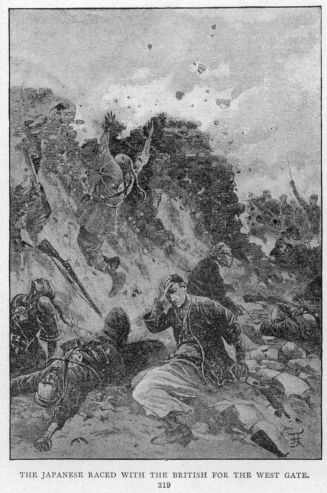
The native city began to bombard the settlement on the 17th, and on the 25th a 12-pounder gun from the Terrible, one of those mounted on Captain Percy Scott’s system, which had done such service in South Africa, arrived and shelled the forts.
The Terrible had also brought to Tongku a military force consisting of Royal Welsh Fusiliers, 7 officers and 328 men, some engineers, and other details, under Major Morris; these with a naval force of about 150, under Captain Craddock, RN, of the Alacrity, together with 1500 Russians with 4 guns and 100 American marines, made on the 23rd June an attack upon the military school, a strong position commanding the settlements. A great deal of bayonet-fighting took place in clearing the villages on the way, but the position itself was easily taken and the settlement relieved. The approximate total of the forces of all nations at Tientsin after this reinforcement was 4500, of whom about 1400 were British.
On 27th June a force of British seamen under Commander Craddock, and marines under Major Johnstone, the whole about 600 strong, under the command of Captain Burke, joined with the Russians in an attack upon the Chinese arsenal. The Russians took the centre and right face, our men being ordered to advance parallel to the left face. At 200 yards they were met with a heavy fire, and had to advance for some space over a flat piece of ground until they could turn and face the arsenal, and when they advanced received the fire of a field-gun at the left corner. However, fixing bayonets, the bluejackets charged with a cheer, the enemy quickly bolted, and were met with the fire of the marines, who had been left outside for that purpose. The Russians also drove out the enemy at their end, and destroyed the arsenal. Our losses were 7 killed and 21 wounded.
On 28th June and the following day messages came in from Pekin, dated 24th June, “Our case is desperate; come at once.” Terrible news indeed for the allies; it was but two days since the expedition which had set out for Pekin had returned, and now the Tientsin settlement itself was in danger, besieged and bombarded daily by the Chinese forts. No attempt even at relief was at this time possible, and there was an awful anxiety both here and in Europe as to what the fate of the embassies might be.
On the 4th of July the Chinese made an attack upon the railway station, and were repulsed; and on the same day two additional 12-pounder guns from the Terrible arrived, and also two Krupp guns taken from the Taku forts, a most important access of strength to the Naval Brigade, for up to this time the only guns had been the 12-pounder of the Terrible, two 9-pounder marine field-guns, and three 6 pounder Hotchkiss.
The next two days the forts in the native city were heavily bombarded by the Terrible’s guns, assisted by French and Japanese field-guns. Several of the Chinese guns were silenced, but others, difficult to locate owing to the use of smokeless powder, replied with spirit and made good practice. A gallant attempt was made on the afternoon of the 6th by Major Bruce of the 1st Chinese Regiment to silence a 9-pounder which had been pushed up to within short range, and appeared to be aiming at the waterworks. The admiral lent him a 9-pounder gun, and Commander Beattie, of the Barfleur, with 70 men. No cover could be found, and the 9-pounder could not be brought into action owing to the heavy rifle fire, and the attempt had to be abandoned. The force lost 2 killed and 5 wounded, among the latter being Major Bruce and Mr F. Esdaile, midshipman of the Barfleur, the latter mortally.
The Chinese for some days had gradually been pushing their lines round to the west and south of the native city, with a view to cutting the communication by river and also placing the battery of the British naval guns under a fire from the rear as well as front. Moreover, the Chinese gunners were improving daily in their practice, and evidently had knowledge from spies of the exact position and ranges of the barracks. It became therefore necessary to clear the enemy out of their position.
It was accordingly arranged that a combined movement should be made at daybreak on 9th July to drive the enemy out of their position, and by a wide flanking movement to converge upon and capture the west arsenal. The command was entrusted to the Japanese General Fukushima, whose force consisted of about 1000 infantry and 150 cavalry, with 150 American 9th Infantry Regiment. The British sent 1000 men, namely, two companies 2nd Battalion Royal Welsh Fusiliers, half company Hong-Kong Regiment, two companies Chinese Regiment, and 400 bluejackets and marines under General Dorward as supports; and the Russians a reserve of 400.
The force moved off before daylight on the 9th. The bulk of the fighting fell upon the Japanese, but there was very little of that, for though the Chinese artillery replied briskly for some time, when once the guns were silenced and the infantry through the line of fire, the Chinese fled precipitately. The Japanese cavalry charged and dispersed a body of Boxers, killing about 200, and the infantry advancing captured four Krupp guns. The arsenal was taken with a rush by the Japanese, and found to be deserted, but being commanded by rifle fire was found to be untenable. The place was therefore set on fire, and the forces returned, having most thoroughly effected their purpose. The naval casualties among the British were 1 killed and 3 wounded.
This reverse, severe though it was, did not weaken the determination of the Boxers, for early in the morning of the 11th they made a most determined attack upon the railway station, an important position for them, from which they could bombard the settlement as well as destroy the rolling stock. The fight lasted three hours, and was stubbornly contested. The Chinese got to close quarters and even crossed bayonets with the allies. They were at length driven out with very heavy loss. The allies also lost heavily, 150 killed and wounded, principally Japanese and French. The British loss was very slight.
At this time the number of the enemy attacking was estimated at 20,000, while of the allies the total force was 12,170, namely, 50 Austrians, 2160 French, 1420 British, 400 Germans, 40 Italians, 3090 Japanese, 4450 Russians, and 560 Americans. The bombardment of the settlement by the Chinese was inflicting daily losses. Hitherto their artillery had been superior to ours, but by the arrival of two 4-inch guns, one from HMS Algerine, and another from HMS Phoenix, the position was altered and it was at length decided to make a general attack upon the enemy on the 18th, with a view to capturing the native city and finally relieving the foreign settlement. In this action the British naval guns were assigned a prominent part, and to their very accurate shooting the success was mainly due. The plan arranged was that under cover of the naval guns on the east the Russians and Germans should take the Chinese batteries to the north-east of the city, while the Japanese and British should at the same time deliver their attack upon the city to facilitate the capture of the batteries by the Russians. The Japanese were under their own general, the rest of the allies under General Donvard. The forces consisted of 1500 Japanese, under General Fukushima; 800 British, of whom 300 were naval; 900 Americans, 30 Austrians, 900 French, and about 3000 Russians and 400 German marines.
After about an hour’s bombardment the main attack was delivered, the French on the right, the British on the left, and the Japanese in the centre, which was the point of greatest danger, for they were to advance upon the south gate and blow it up to effect an entrance. The Americans were ordered to support the left of the Japanese, and to their left were the Welsh Fusiliers. The Americans unfortunately soon became involved in a very exposed position, whence they could neither retreat nor advance, their colonel was killed and they lost very heavily, and 100 men of the Naval Brigade under Lieutenant Phillimore were sent to their aid.
Meantime the naval guns were keeping up a constant and accurate fire, keeping down the fire from the city walls. Still, however, the day wore on; the Japanese were unable to reach the gate, and the city, which it was expected to enter by noon, was not yet taken, and the Japanese general decided to hold his position through the night and to resume the attack in the morning.
Under fire of the naval guns the Fusiliers and American marines were withdrawn with very slight loss, and then the unfortunate 9th Regiment with the company of the Naval Brigade. This was a very delicate business, for they were in danger of being themselves hit by the guns, but so accurate was the fire that it was performed without accident. Splendid work had meantime been done by our men in getting in the American wounded, nearly all of whom they brought in under fire.
The Russians, of whom nothing had been heard during the day, had been thoroughly successful, although their attack had been delayed. In the end they completely routed the Chinese and captured 11 guns, but not without heavy fighting, in which they lost 120 in killed and wounded.
The next morning the Japanese, who in the night had made a bridge across the canal, crossed over at three a.m., blew in the gate, and in less than an hour the city was taken. The British seized a number of junks and a steamer and 8 guns, which had kept up such a fire on the preceding day. The total loss of the allies concerned in the attack on the south gate was—British, naval, 6 men killed, among whom was Captain Lloyd of the marines, and 38 wounded; military, 12 killed, 38 wounded; Americans, 9 killed, 119 wounded; French, no killed and wounded; Japanese, 400.
The effect of the naval guns was remarkable, and is thus reported by General Dorward:
“The success of the operations was largely due to the manner in which the naval guns were worked by Lieutenant Drummond, RN, the accuracy of their fire alone rendering steady fire on the part of the troops possible against the strong Chinese position, and largely reducing the number of casualties.
“The delicate operation of withdrawing troops from advanced positions at nightfall to strengthen other parts of the line, and the bringing back of the wounded, could not have been effected without the aid of the well-directed fire of the guns.
“I desire to place on record my appreciation of the gallantry and fine spirit of the men, and to join in their regret for the heavy loss in killed and wounded, and particularly with the Royal Marines in regret for the death of Captain Lloyd.
“The Naval Brigade had their full share in the fighting at the centre and right of the position, and had the honour of being among the first troops to enter Tientsin. The succour they brought under a heavy fire to the hard-pressed American troops on the right was highly appreciated by the 9th Regiment United States Infantry, who found themselves unexpectedly under the heaviest fire of the day, and were much heartened by the arrival of Lieutenant Phillimore, RN, and his men.”
A young V.C.
During the fighting on 13th July a midshipman, Basil John Douglas Guy, displayed great coolness and bravery in stopping with and attending to a wounded seaman, under an excessively hot fire, eventually assisting to carry him across a fire-swept force. When it is remembered what kind of treatment the Chinese dealt out to all who fell into their hands, and the brutalities of which they were guilty, the heroism of the above act stands out all the more sharply and unmistakably. For the action thus described in the Gazette Mr Guy was awarded a Victoria Cross.
The Siege of Pekin.
The foreign guard that arrived in Pekin on the evening of 31st May and following days numbered only 18 officers and 389 men, far too few for the defence, and ridiculously inadequately supplied with guns and ammunition. The British brought one old type Nordenfeldt; the Austrians, one quick-firing gun; while the Russians brought a supply of 12-pound shell, but left their gun behind. It seemed as if the powers only contemplated a demonstration, whereas this little force was destined to sustain a siege that will rank amongst the most memorable in history, and to hold—against Krupp guns and hordes of Chinese, firing at close quarters modern magazine rifles—gardens and buildings occupying some ten acres of ground, surrounded by a high wall, but in other respects before the commencement of the siege utterly unprotected.