Part 3 — THE NAVIGATOR’S TASK (continued 2)
Reading edition
Occasionally “Hobby” rocked heavily when a heavy sea caught it astern. We rolled violently, not nicely and comfortably, but with heavy violent heaves so that the lashings cut into the planks which lay between them and the corners of the cases. During one of these heaves the man at the wheel was thrown across the wheel, against the rail, at the lee side of the bridge. He hurt himself pretty badly, and was unable to work for some time. The mate’s comforting remark was that conditions might be much worse when we got nearer to the banks. I was more afraid than I have ever been before in my life, and I hope sincerely that I shall never get into a similar position again. It was not my life I feared losing, for there was meantime no danger of this. It was the deck cargo’s fate about which I was concerned, namely, the flying machines. If the cases had been filled with gold they would have been heartily welcome to go overboard, but we must at all costs keep the flying-machines safe and sound. The expedition must not be put off this year. I felt thankful again in my heart that the ships had got separated, for “Fram” could have given us no help. Those on board that vessel could only have stood as helpless spectators.
During the evening of Easter Saturday the wind stopped increasing, and in the course of the night died down somewhat. On Easter Sunday evening we got into the ice and calculated that we were almost in a direct line with Spitzbergen. Under ordinary circumstances the proper thing to do would have been to steer northwest into free water until we were level with King’s Bay. Meantime there was a considerable swell, which now came from the southwest. The fog still surrounded us, coming thicker from the southwest. But the ice meant smooth water for us and safety for the deck cargo. We were, therefore, in no doubt what to do. Hoping that we might be able to keep on a clear water-course, we proceeded through the ice towards the land. Little by little, as we got further in, the swell decreased, and at last almost calmed down. How heartily I blessed that ice. At eleven o’clock we could not risk going any further, as we could no longer see anything ahead. “Hobby” was brought into some compact ice, and we “laid to” for the night.
Even if we should still encounter difficulties in finding our way to King’s Bay, and if the fog should not lift, at least we were now safe for some hours, so I went to my bunk and slept like a log as soon as my head touched the pillow. Six A.M. we were under way again. The fog was still as thick as ever. During the trip we had not taken any observations, apart from the “noon observation” on the day before Easter. But even this was uncertain, as the horizon was hardly visible on account of haze. We therefore did not care to go nearer to the land, but steered along it as well as the clearings in the ice permitted. Our course therefore varied between northeast and northwest. When we thought we were abreast of King’s Bay, we steered right in towards the land and got ready to “cast the lead.” We could now see far enough ahead to stop in good time when necessary. Then it seemed suddenly as if a curtain had been raised right abreast of us to starboard, and in pale clear sunshine we could see the northerly point of Prince Charles Foreland. Holm and Johansen can with good reason be proud of their calculations and navigating. We had kept the right course, steamed full speed and now we sailed right out into the radiant sunshine. Behind us lay the fog like a high gray wall. It was “död dam stille” as we say, and ahead lay King’s Bay. How glad we were. We just looked at each other and smiled as we heaved deep sighs of relief. What a wonderful sensation! We were there! Nothing could now impede the progress of the expedition. How annoyed all the skeptics would be. They would have no reason now to walk through the streets and shout: “I was right. I told you so!” There was a strong feeling of thankfulness, mingled with our satisfaction, that we had been able to get through all right and bring happiness to Amundsen.
We were not long in getting shaved and letting our faces make the acquaintance of fresh water again. Then we went up on deck to see whether “Fram” had arrived. The burning question during the trip had of course been, “Where can ‘Fram’ be?” We had also laid wagers and held various opinions about this, but I believe we forgot these in our joy.
Yes, there she was right up against the ice-edge. “Hobby” had still to force her way through an ice-belt, which was fairly clear, but yet progress seemed to be terribly slow. We were overcome by our own feelings, which seemed to shout the words, “Here we are and everything is all right!” At last we were through, and right up to the edge of the ice. We noticed that things became lively on the “Fram.” I went forward onto the deck-cargo and waved my cap to show that everything was all right. My challenge brought instant response. Ringing cheers reached us. Naval flags were dipped confirming our supposition that they had been anxious about us. When “Hobby” put its nose into the ice-edge we were all on the forecastle. Amundsen came towards us with a broad smile on his face. We knew and understood how pleased he was, and all our anxiety and the terrible strain on our nervous system were soon forgotten.
In King’s Bay
The remainder of my report will nearly be an illustrated book accompanied by a little text in order to avoid what Amundsen has already written in his account.
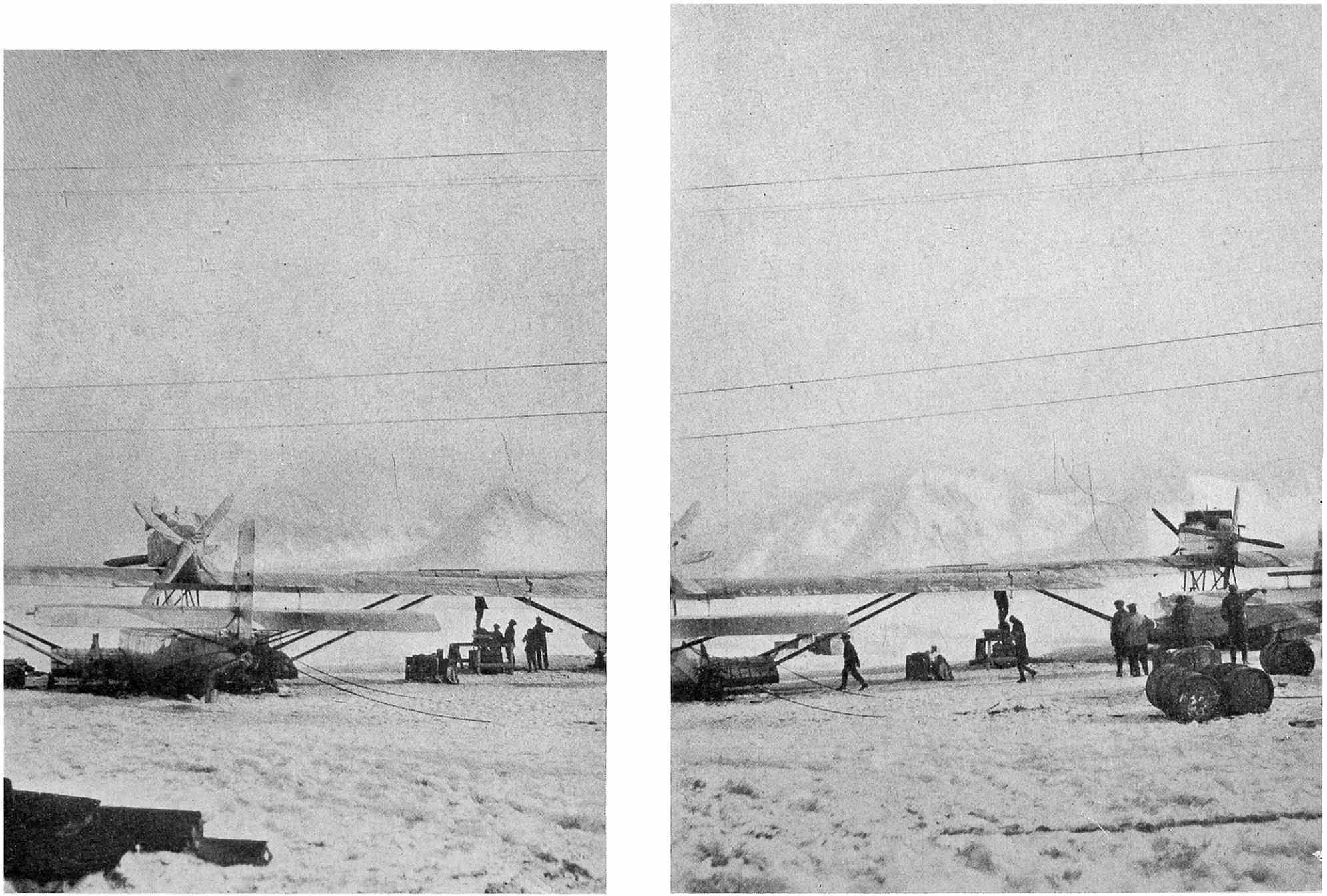
PREPARING THE PLANES, AT SPITZBERGEN, FOR THEIR ARCTIC FLIGHT
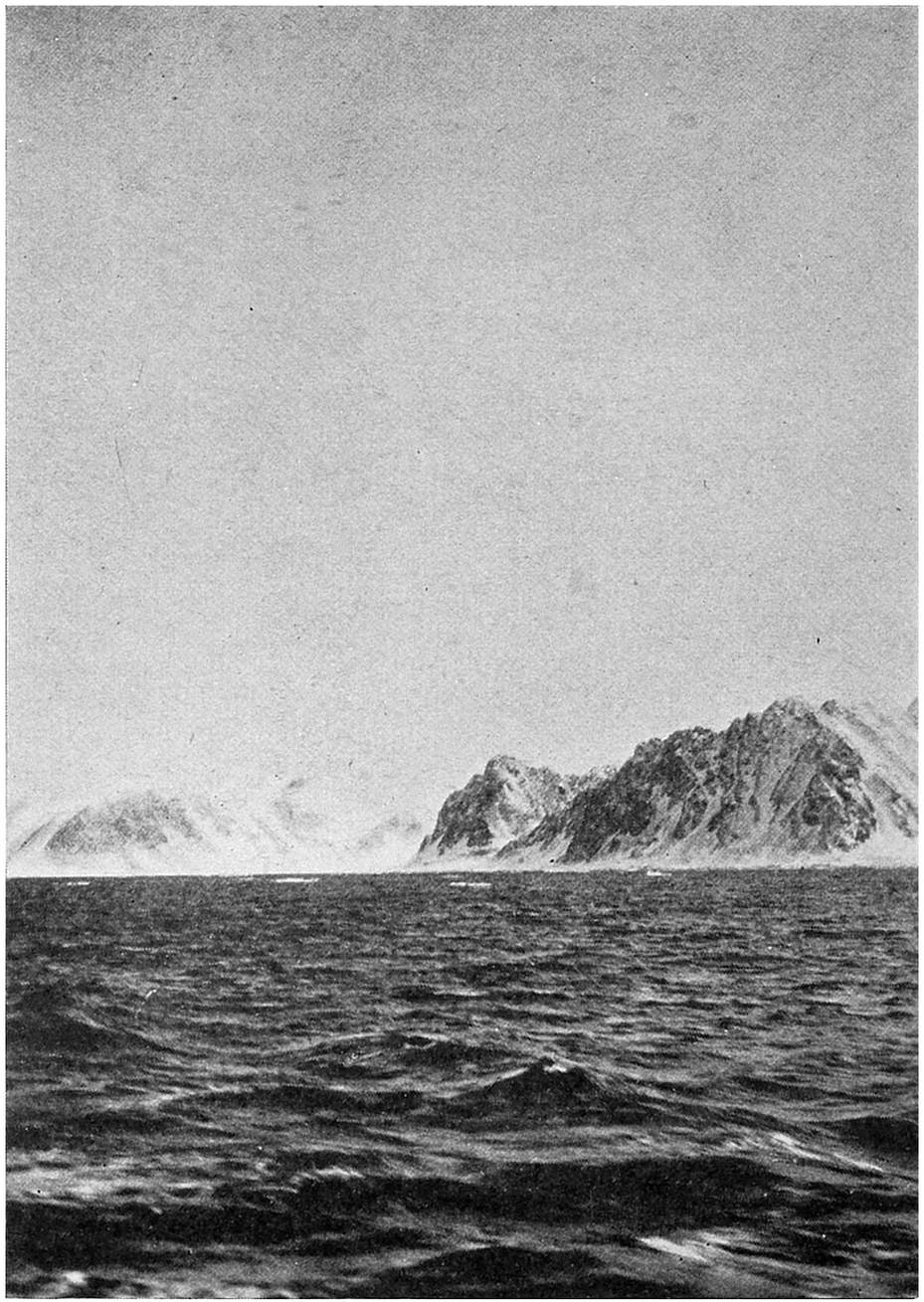
THE LAST VIEW OF SPITZBERGEN
It was a disappointment that the ice stretched so far out. On the ships’ arrival it was so thick that none of them could break it. The next day, however, on account of the mild weather, the ice got so brittle that “Knut Skaaluren” (although with difficulty) managed to break up a channel for us all. As the “Skaaluren” had a good deal of cargo to discharge “Hobby” could not get to the quay for several days. It was a disappointment, but turned out to be a piece of good luck. I had thought about rigging up some booms (which we had on board) to the crane on the upper deck in order to discharge our large cases onto the quay. We had no time to wait until “Skaaluren” was finished, so we had to take our chance with “Hobby’s” own derricks and winches. The last were not specially suitable for lifting heavy pieces. They were electrical ones and could go full speed one way or the other. This would mean stopping with a nasty wrench. In order to reduce this we rigged up some tackle instead of leaving the single wire.
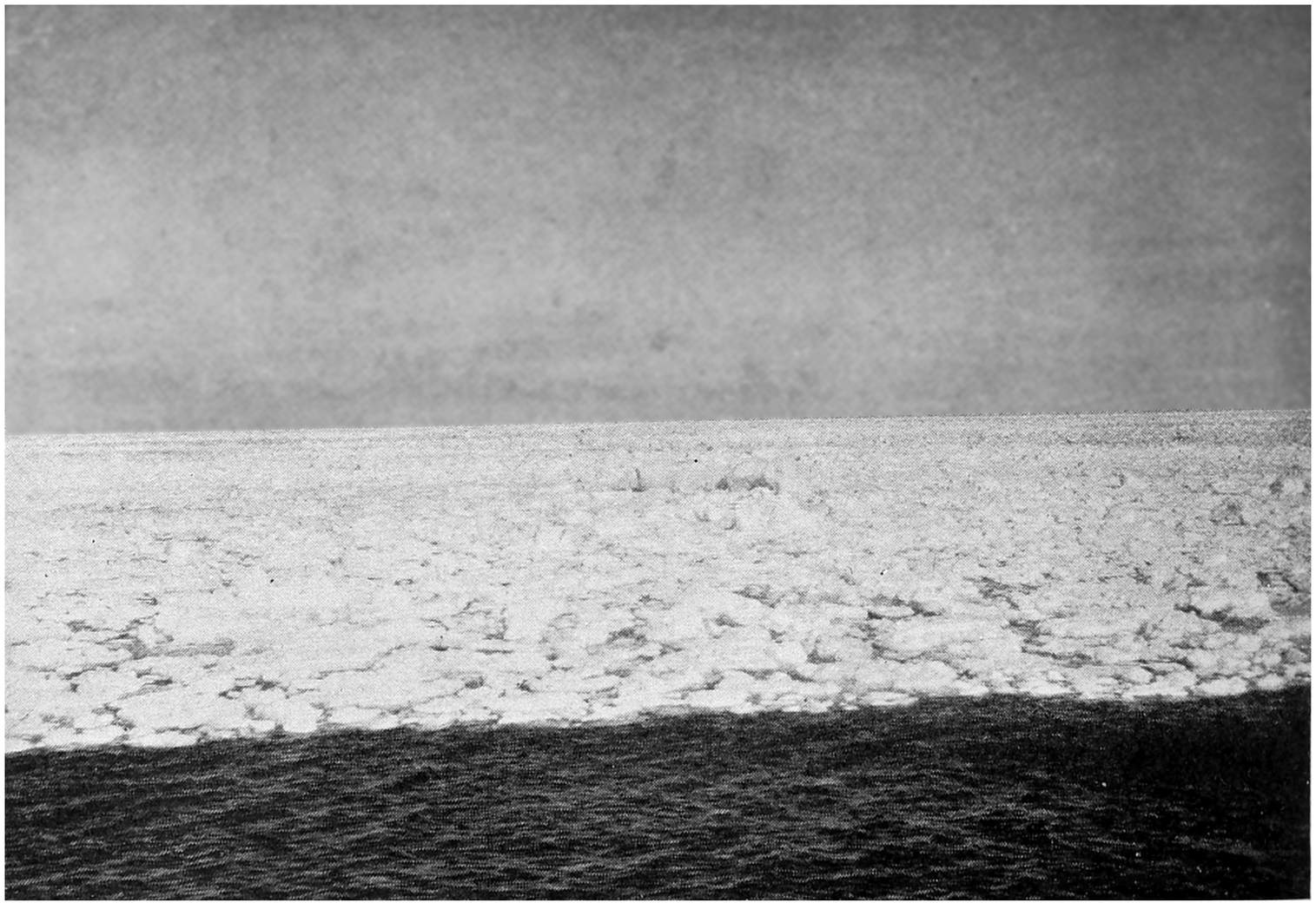
EDGE OF THE POLAR PACK. THE EXPEDITION FLEW 100 MILES OVER THIS BEFORE REACHING SOLID ICE
When I said that the disappointment turned out to be a piece of good fortune, I meant that on account of these circumstances we saved a lot of time by using “Hobby’s” own gear and discharging right onto the ice without loss of time.
In order to reduce the weight of the bodies of the machines we first of all took off the packing.
As the forward derrick could not swing the boats’ bodies clear of the wing cases, which stretched over the railings, we had to take both boats’ bodies in the after derrick. N 25, which stood aft, was lifted first and swung out. It came nicely down onto the ice and N 24 followed.
The aft case with the wings was then turned so that it lay right across the railings. Both cases were put on end so that we could get at the hatches. The motor gondolas were then lifted up and put into their places.
In the meantime the “Fram’s” boys hacked a glide from the fjord ice to the land and the boats’ bodies were pulled along and taken straight to the place which had been chosen for their mounting.
Our assistance for the mounting of them could not have been better. On the one side a mechanical workshop and on the other a smithy, and a big room which was put at our disposal. Here we had benches with vices, etc.
For getting the wings ashore we had to get to the quay under all circumstances, but there was no hurry now, as we had plenty to do in getting the motors ready. It was not just the most comfortable temperature to work in. Now and again one could see war-dances being performed round the warming-pan.
In the meantime “Fram’s” boys cut the ice up round about the quay and kept the water channels open so that the ships could change places more easily.
Just when we had finished our work with the motors, “Skaaluren” left the quay and “Hobby” came into her place. The wing-cases were just lying at the same height as the quay, so that everything considered, it was easy work to get them ashore. Luckily we had no wind that day, so conditions permitted us to carry the cases on end, which was necessary on account of the space.
Under the guidance of Schulte-Frohlinde we started immediately to mount N 24, and soon it began to look more like a flying machine.
When taking N 24’s wings ashore, we had a good deal of wind. It was therefore not easy to get them ashore on end. After landing them we had to carry them in a horizontal position.
We could not wait for calm weather, as the meteorologists predicted a long period of fresh breezes. The bringing ashore of the machines was carried through without the slightest damage to the material, nor had any damage taken place during the long transport from Marina di Pisa to King’s Bay. All of us therefore had good reason to feel pleased that day.
Whilst Schulte-Frohlinde, Feucht and Zinsmayer completed the mounting, Green and Omdal continued their work with the motor and completed it by putting on the propellers.
After everything had been tried and tested and proved to be in splendid order, there arose the burning question, which had been in my mind for the last half year, namely, how would the machines run on the snow? Exactly in front of the mounting place were any number of suitable spots where we could make a trial on level snow, so I made the first test on May 9th. The boat, as was only natural, stuck fast at first, but got free quite easily with a strong pull. It was a delightful sensation to realize how easily it glided along. Had it sunk heavily down into the snow and stuck there, matters would have looked less bright for us.
Flying boats of this size had never been tried on snow before, but we built on our own belief in its being possible; had it not been so we should have been in an unpleasant position.
From the day we gathered all our material together, our program went according to date, and in the beginning of May we were all in readiness to set off in the second half of the month if conditions permitted.
That day was for me, therefore, a great day in the expedition’s course, and every one will understand my feeling of joy when after testing the machine I was able to announce to Amundsen, “We are clear to start the moment our leader says the word!”