Chapter II · THE ADMINISTRATION OF THE NATIONAL FORESTS (continued 2)
Reading edition
Forest Products Laboratory Experiments. The work of the Forest Products Laboratory includes investigations on the mechanical properties of wood; the physical and chemical characteristics and properties of wood; air seasoning and artificial drying of wood; agencies destructive to wood; wood preservation; wood distillation; production of naval stores; and the production of pulp and paper and other chemical products of wood. This work is carried on at the Laboratory and sometimes in coöperation with the National Forests and district experts. At the Laboratory there is a director and a large staff of technical and scientific men, such as chemists, physicists, and engineers, each of whom is an expert in his particular line of work.
A good deal of attention is given to testing the strength of woods grown in the United States, as a means of assisting users to select the species best adapted to a given purpose, or to find substitutes for species which are becoming difficult to obtain. The strength of a good many species used for structural timbers has been tested. The species most used for this class of timber are the Southern pines, Douglas fir, Norway pine, Tamarack, and Red spruce. An important discovery was made several years ago that Western hemlock, generally considered an inferior timber, showed an average strength 88 per cent. as great as that of Douglas fir, one of the best construction timbers in the United States. Strength tests have also been made on fire-killed timber and these have shown that timber killed by fire is almost as strong as green timber. Other tests have been made to determine the effect of preservative treatment upon the strength of timber. As a result of the large number and variety of strength tests carried on by this Laboratory the United States Government now has a more thorough and comprehensive collection of data on the mechanical properties of wood than any other nation.
Many studies are also conducted to determine the physical properties and the structure of the different kinds of wood grown in this country. The minute structure of the wood of many of our native species has been studied by means of microscopic slides. A study has also been made of a large number of species to determine the specific gravity of the actual wood substance. Other tests are made to determine the specific heat of woods.
The drying or seasoning of woods, more especially of certain species which have been found difficult to season, has received a good deal of attention. A new type of kiln, invented by a Forest Service man, has been devised to season such woods as the eucalyptus, which has always been very difficult to handle in drying. Western larch has been seasoned with a loss of only 5 per cent., whereas the loss in ordinary commercial kilns usually ran between 60 and 70 per cent. As a result, many manufacturers have remodeled their old kilns to embody the new Forest Service methods. A new method has also been developed for the rapid dry-kilning of Eastern hemlock, which has great commercial possibilities.
Experiments in wood preservation have to do with the kind of preservatives it is best to use, the character of the wood to be treated, and the methods of injection. Experiments have developed the best methods for treating railroad ties, mine timbers, fence posts, wood paving blocks, telephone and telegraph poles, and wharf piling. Untreated mine timbers have been found to last only from 1 to 2 years, while treated ones are usually entirely sound at the end of 4 years. Untreated railroad ties last from 5 to 10 years, while treated ones will last over 15. Such experiments as these have shown the advisability of treating all kinds of timbers with creosote or zinc chloride, or some other preservative. Many new preservatives are being proposed or marketed each year by various companies or individuals. These are all tested to determine their value to prevent the growth of fungi in the wood. Their efficiency varies greatly and many of them have been shown to have very small value.
Studies in wood distillation seek to find new woods which can be used for this industry, new and more efficient methods which can be employed, and new uses for wood waste and stumps. Charcoal, wood alcohol, acetate of lime, and tar are derived from the distillation of such woods as beech, birch, and maple, to which tar oils and turpentine are added for the pines and other resinous woods. These by-products of wood distillation have many uses, as well as the many products which are, in turn, made from these by-products. Charcoal is used in the manufacture of black powder, acetic acid is used in the manufacture of explosives, and wood alcohol is converted into formaldehyde for disinfection against contagious diseases. By means of temperature control methods developed at the Laboratory in the destructive distillation of hardwoods, the net gain per annum of one company's plant was over $17,000. About one-half of the plants of the country have adopted the new method developed by the Forest Products Laboratory.
Experiments have been conducted by the Laboratory in the distillation of the needles of coniferous trees and the distillation of the crude gum of some of the important timber trees of the South and West. The oils distilled from many trees in this way have found great use for various purposes. Shoeblacking owes its peculiar aromatic odor, faintly suggestive of the deep spruce and hemlock woods, to an oil which is distilled from these same kind of needles. Evergreen tree leaf oils are used for the perfume of soap, and in the manufacture of liniments, insecticides, and medicinal preparations.
Investigations have been carried on at the Forest Products Laboratory in making artificial silk from sawdust. The industry has already attained considerable proportions. It consists principally of converting cellulose into viscose, which, in turn, is manufactured into an almost endless number and variety of silk and other goods varying from sausage casings to silk hose and tapestries. Sawdust is used also in the manufacture of inlaid linoleum and dynamite.
Experiments in naval stores are attempting to improve the old methods of harvesting turpentine, which have proven very destructive to the forests. With the approaching exhaustion of the Southern Pinery as a field for the naval stores industry, it has become more and more important to find other species for this purpose. Consequently the Laboratory has conducted experiments with the various pines on the National Forests in California, Colorado, Arizona, and New Mexico.
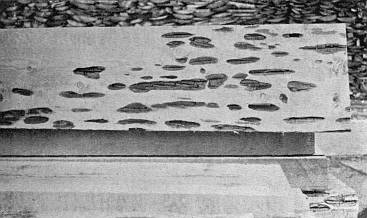
Figure 32. A plank of Incense cedar affected by a disease known as "pin rot." By cutting the cedar timber when it is mature this can be largely avoided. Lassen National Forest, California. Photo by the author.
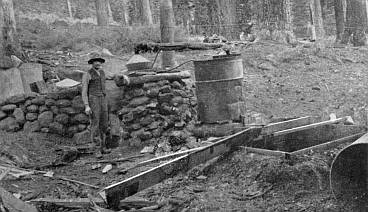
Figure 33. The western pine forests will some day be a great source for naval stores. By distilling the crude resin of the Jeffrey pine a light volatile oil—abietene—is secured which has great healing and curative properties. Lassen National Forest, California. Photo by the author.
A great many pulp and paper investigations are also conducted by this Laboratory. The large size of the industry and the threatened exhaustion of the native spruce forests which furnish the principal supply are circumstances which call for intensive investigations. About nine-tenths of the paper which we use is made from wood, and the amount of wood which is converted into paper annually has reached almost 5,000,000 cords. There are over 2,500 newspapers in the United States, and it is said that a single issue of a New York Sunday paper consumes the trees on about 15 acres of forest. The main object of the work at the Laboratory has been to use other species of wood for the manufacture of paper to offset the fast waning supplies of spruce. Poplar, hemlock, pine and balsam are now being used in considerable quantities. News and wrapping paper has also been successfully made from many National Forest species, including Sitka spruce, Western hemlock, Engelmann spruce, Red fir, White fir, and Lodgepole pine. Kraft paper has been made and manufactured into suitcases, bags, wall coverings, twine, and similar articles. Not only has the Forest Products Laboratory brought into use species of trees never before tried for paper making, but it has also improved some of the old methods of paper making to such an extent that the results have been adopted by various large paper mills.
Many strength tests are conducted with packing boxes. The railroad companies of the United States are paying annually claims amounting to many millions of dollars because of goods damaged in shipment. Much of the damage is preventable through properly constructed boxes. Tests conducted at the Laboratory have shown for canned-food boxes an increase in strength of 300 per cent, by the use of four additional nails in each end of the box. The results of these tests are being rapidly adopted by manufacturers and canners.
The dyeing principle of the Osage orange wood was not used prior to the investigations conducted by the Laboratory. The value of this material has been so conclusively shown that about one million dollars' worth of the dye is now being manufactured annually in the United States and practically all from material which was formerly wasted.
The discovery that sodium fluoride is superior to sodium carbonate in preventing sap stain in lumber promises to reduce materially the present estimated loss of $7,000,000 from this cause.
Industrial Investigations. The function of the Office of Industrial Investigations of the Branch of Forest Research is to conduct statistical and industrial studies of uses of wood in the United States. The aim of these investigations is to determine methods and conditions under which wood is now used; the marketable products obtained from it; tendencies in methods of manufacture; and improved methods possible, especially in the utilization of waste. When practicable, such investigations are followed by the commercial application of their results. This office also conducts all statistical investigations of the production and use of forest products.
The work of industrial investigations includes the following: collection and compilation of statistics on the production and consumption of forest products, prevailing market and stumpage prices, imports and exports, and transportation rates; the compilation and study of specifications of rough and manufactured forest products; studies of lumber manufacture and wood-using industries as to methods, forms of material, waste, costs, equipment, substitution of one species for another, and improvements through a more conservative use of raw material; studies of special problems or features of wood-using industries; advice and assistance to States, industries and individuals along such lines of work; and the dissemination of results by publications.
Many studies in wood utilization are made not only of certain industries like the shingle, or the lumber industry, but also dealing with the industries of particular sections of the country and with the various States. These investigations in the States show the kinds and amounts of woods required by the various industries, the purposes for which the various species are employed, and the extent of their use. So far the wood-using industries of 35 States have been studied and the results published.
Records of lumber prices for important woods are compiled quarterly. These figures are useful in establishing timber sale prices on the National Forests. Statistics as to the annual consumption of lumber in the country are also compiled by this office.
The wood waste exchange was established in 1914 by the Forest Service. It consists of two lists of manufacturers, which are sent out quarterly to persons desiring them. One of these is of "Opportunities to Sell Waste" and contains the names of firms which use sawdust and small pieces of wood. This list is sent to people having waste for sale. The other list is of "Opportunities to Buy Waste," and gives the names of concerns which have waste to dispose of. This list is sent to people who wish to buy material. No charge is made for this service, and at the present time over 500 coöperators are using this exchange.
By the use of this exchange, makers of wooden novelties have been successful in finding supplies of material near their plants. Other wood-working industries have been able to dispose of their waste at higher prices than they could otherwise have obtained. Many firms were located within short distances of each other, but until recently have had no way of getting together. A Philadelphia firm, engaged in the manufacture of composition flooring, has been able to obtain a portion of its sawdust from a New York lumber company. A New York woodworking establishment disposed of its waste pieces of white oak and sugar maple to a maker of wooden novelties in Connecticut for use in the manufacture of furniture knobs. A clock maker of Connecticut secured waste material for making clock boxes from the planing mill of a New York lumber company.