Chapter XVIII · IN NORMAN TIMES: THE CHURCHES
Reading edition
1. When we speak of Norman times we must bear in mind that they lasted for over 130 years—say from 1066 to 1200. That period covers a good many years, and consequently a good many changes took place. Now this period is marked by a particular style of architecture known as Norman or Twelfth Century.
2. With the coming of William the Conqueror to England began a great period of building in this country. There was what we may almost call a "great rage" for founding or establishing religious houses and churches, and for building castles. All the religious houses have gone, and nearly all the castles, but in their ruins we can see specimens of Norman work. In a large number of old churches we can see very good examples of this style. In Hampshire especially there is scarcely one old church, even in the most out-of-the-way village, which has not some Norman work to show.
3. You will expect to find that the style of building altered somewhat during that long time. In the beginning it was very plain, but gradually it became more ornamental. At first there were plain, round-headed arches and heavy stone pillars, with boldly cut caps to them. But in the time of King Henry II, and later, we find the mouldings of the arches, and the caps of the pillars, ornamented more and more with bold carvings. There is a vast difference between the plain, almost ugly Norman work, in St. Alban's Cathedral, which was begun about the year 1077, and the Norman work which can be seen in Durham Cathedral, or the west door of Rochester Cathedral. The St. Alban's builders had no stone at hand to speak of, but any amount of Roman tiles from the ruins of Verulam. They could not build anything very ornamental, but they could and did build something vast and imposing. In most of the cathedrals there are very fine specimens of later Norman work.
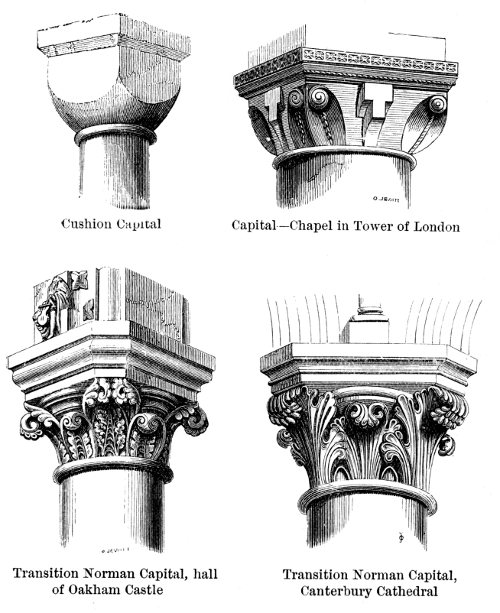
Cushion Capital; Capital— Chapel in Tower of London; Transition Norman Capital, hall of Oakham Castle; Transition Norman Capital, Canterbury Cathedral
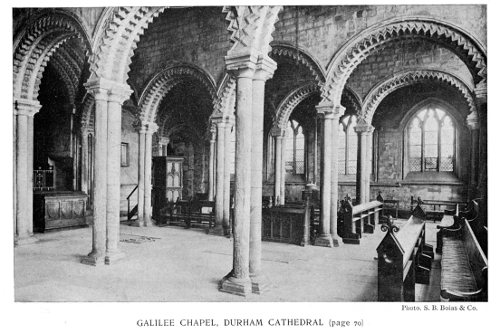
Photo. S. B. Bolas & Co. GALILEE CHAPEL, DURHAM CATHEDRAL (page 70)
4. We see, towards the end of the period, from the way in which the Norman arches were used to intersect each other, and form two pointed arches within a round-headed arch, that a change in style was showing itself. Towards the end of Norman times, in the reigns of Richard I and John, we reach what architects call the Transition Period, when the Norman style was gradually changing into the Early English, or Pointed Style. The choir of Canterbury Cathedral is one of the best-known specimens of this Transition Period. Just as changes took place in the style of the buildings, so, too, the life of the nation changed. All the changes were not improvements; some, indeed, were changes for the worse.
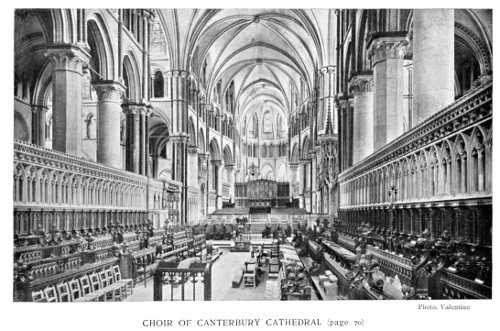
Photo. Valentine CHOIR OF CANTERBURY CATHEDRAL (page 70)
Summary.—The Norman period lasted for 130 years, from 1066 to about the year 1200. The round-headed style of building, called Norman, lasted through this period. It became more ornamented as the years went on. In the latter part of the time the style began to change. St. Alban's Cathedral and Durham Cathedral have examples of plain and highly ornamental Norman work. The choir of Canterbury Cathedral gives an example of Transition work at the end of Norman days.