EDIBLE AGARICS
Reading edition
MEADOW MUSHROOM
Agaricus campestris
"The" mushroom
Description of Campestris
Perhaps the one species which enjoys the widest range of popular confidence as the "mushroom" in the lay mind, as distinguished from "toadstool," is the Agaricus campestris, known as the "meadow mushroom" (Plate 5). It is the species commonly exposed in our markets. Its cultivation is an important industry, but it often yields an enormous spontaneous harvest in its native haunts. The plate shows a cluster of the mushrooms in their various stages of development, the detached specimen below representing the semi-opened condition in which the fungus is usually gathered for market. It will be observed that the base of the stem is entirely free from any suggestion of a volva or cup. As its popular name implies, this species in its wild state is one of the voluntary tributes of our late summer and autumn meadows and pastures, though it may occasionally frequent lawns, shrubberies, and barn-yards. In size it varies from two to three and a half inches across the pileus or cap, which is either smooth or slightly rough, scaly, or scurfy, and creamy white or tawny in color, according to age or variety. The most important distinguishing feature of this species is the color of the gills. If we break away the "veil" in the unopened specimen, we find them to be of a pallid flesh tint. In the more advanced state they become decidedly pinkish, with age and expansion gradually deepening to purplish, purple-brown, and finally brownish black. The gills are of unequal lengths, as shown in the section. The stem is creamy white and of solid substance, and always shows the remains of the veil in a persistent frill or ring just beneath the cap.

PLATE V "THE MUSHROOM"
Agaricus campestris
Pileus: At first globular, its edge connected to stem by the veil; then round convex, at length becoming possibly almost flat. Surface dry, downy, or even quite scaly, varying in color from creamy white to light brown. Diameter at full expansion, about three inches.
Gills: Unequal in length; pink when first revealed, becoming brownish, brown, purplish, and finally almost black.
Stem: Solid; of the color of the cap; paler and white in section, retaining the remnant of the veil in a permanent ragged ring.
Spores: Brown.
Taste: Sweet and inviting, and odor agreeable.
Habitat: Pastures, lawns, and open rich soil generally.
Season: Late summer and early autumn, occasionally in spring.
PLATE V
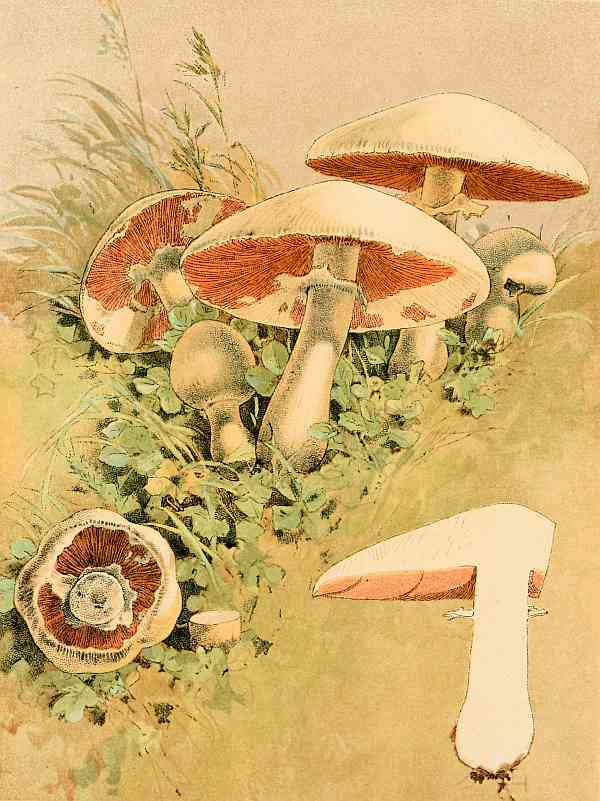
Agaricus Campestris.
Cultivation of mushrooms
Doubtless a sufficient and satisfactory reason for the universal dignity which this species has acquired as "the mushroom" may be found in the fact that it is the only species prominently under cultivation, and almost the only one which is sure to respond to the artificial cultivation of its spawn in the so-called "mushroom bed." The "spawn" of the Campestris has thus become a mercantile commodity, duly advertised in the seedsmen's catalogues.
Mushroom "spawn" bed
This so-called spawn is in truth nothing but the mycelium, or subterranean vine of the mushroom (see Plate 2), taken from the beds in which the mushrooms have been grown, or in which the mycelium has been cultivated. The cultivator simply prepares a "bed" to receive it—duplicating as far as possible the soil conditions from which it was taken, whether from foreign cultivation or his old manure-bed or stable-yard—a rich, warm compost of loam and horse-manure, this latter ingredient being a most important consideration, as the fungus in its several varieties, notably the larger, Agaricus arvensis, known as the "horse-mushroom," has followed the track of the horse around the world. These natural conditions having been even approximately fulfilled, will, within two months, generally reward the cultivator with a crop of mushrooms, which, with the continued ramifications of the mycelium permeating the muck as the yeast fungus permeates the home-made loaf, will insure a continual succession of crops for weeks or months, to be renewed spontaneously, perhaps, the following season.
The present volume, having specific reference to fungi in their wild state, and the celebration of their esculent virtues, being thus essentially in antithesis to artificial culture, further consideration of the cultivation of the mushroom is omitted. The reader is referred to the volumes in my bibliographical list, Nos. 8 and 22, in which full instructions will be found.
Species opposed to cultivation
Certain exceptions
The Campestris is conspicuous among mushrooms in its ready accommodation to artificial imitation of its native environment. There is no other mushroom which is thus confidently to be relied on. Other species—not a dozen, however, out of the thousands—will occasionally reward the cultivator, who has devoted the most scrupulous care to the humoring of their fastidious conditions of growth. Thus the Agaricus candicans of the Italian markets is said to have been successfully raised from chips of the white poplar which have been properly covered with manure. Other species, it is claimed, can be humored from a block of the cob-nut tree after singeing its surface over burned straw, while Dr. Thore claims that both Boletus edulis, and Agaricus procerus are "constantly raised by the inhabitants of his district from a watery infusion of said plants poured upon the ground." The truth of these statements has been denied by authorities, and individual experiment will only tend to discredit their trustworthiness. In general the mushroom or toadstool absolutely refuses to be "coaxed or cajoled." The mycelium of all is practically identical; but species such as the Coprinus, for instance, which are perhaps found growing naturally in company with the Campestris, and whose spawn is similarly transplanted to the artificial environment, will show no sign of reappearance, while its fellow may literally crowd the bed.
Not to be humored
The "fairy-ring" mushroom grows year after year upon our lawn, because its mycelium is continually present, simply threading its way outwardly, inch by inch, in the congenial surrounding soil. Instances are reported of the occasional successful establishment of this mushroom in new quarters by the transfer of a clod of earth threaded with mycelium taken from the "fairy-ring" to another lawn, in which the immediate soil conditions happened to be harmonious, and this method of actual transference of the spawn might occasionally be effectual. But the writer, in his limited number of experiments, has never yet been able to propagate a mushroom by a transfer of the spores to soil where the conditions would appear to be exactly suitable. On a certain lawn, for instance, every year I obtain a number of the Coprinus comatus (Plate 16). Upon another lawn, apparently exactly similar as to soil conditions, I transfer the melting mushroom where it sheds its inky spore-solution upon the earth, and yet, after years of waiting, there is no response. Even an absolute transfer of the webby spawn from the original haunt has proven equally without result. Thus while the habitual fungus-hunter comes to recognize a certain logical association between a given character of natural haunt and some certain species of fungi—a prophetic suspicion often immediately fulfilled—as when he inwardly remarks, as he comes upon an open, clear spot in the woods, "This is an ideal haunt for the green Russula," and instantly stumbles upon his specimen; yet he may take the pallid spawn, with a small clod of earth from its roots, and place it in the mould not ten feet distant, apparently in identically auspicious conditions, and it absolutely refuses to be humored. He may mark the spot, and look in vain in its precincts for a decade for his Russula, though the ground in the vicinity be dotted with them.
Dormant spores
Year after year I have thrown my refuse specimens of hundreds of species of fungi out of my studio window, over the piazza rail or upon my lawn, yet never with the slightest sign that one of the millions of spores in the species thus sown has vegetated.
Considering the ready accommodation of the Campestris, the contrast of the fastidiousness in other species is a notable phenomenon. As a rule, "they will not colonize; they will not emigrate; they will not be cheated out of their natural possessions: they refuse to be educated, and stand themselves upon their single leg, as the most independent and contrary growth with which man has to deal."
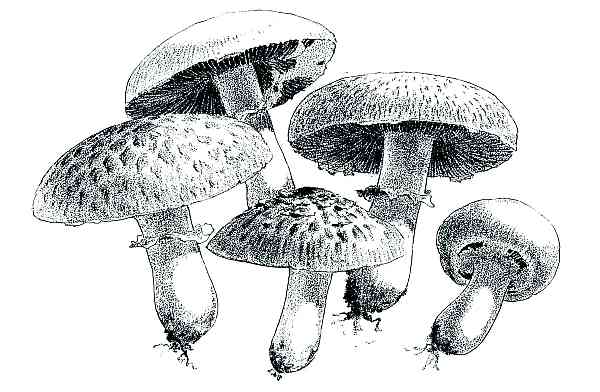
Plate VI. VARIATIONS IN AGARICUS CAMPESTRIS
Varieties of the Campestris
The Campestris is probably the most protean of all mushrooms, and mycologists are even yet at odds as to the proper botanical disposition of many of the contrasting varieties which it assumes. A few of these are indicated in Plate 6. Indeed, some of these, as in the Agaricus arvensis, following, have until quite recently figured as distinct species. In its extreme form it might well so do, but when science is confronted with an intermediate specimen bearing equal affinities to the Campestris and Arvensis—and perhaps reinforced by other individuals which actually merge completely into the Campestris—the discrimination of the Arvensis as a distinct species becomes impossible, and would hardly seem warrantable.
Berkeley gives the following selection of the more distinct varieties, not including the Arvensis with its variations, and which he considers a distinct species:
1. The so-called "garden mushroom," with its brownish, hairy, scaly cap.
2. A. pratensis, in which the pileus is more or less covered with reddish scales, and the flesh as well as gills a pinkish tinge.
3. A. villaticus, large size and very scaly.
4. A. silvicola, pileus smooth and shining, stem elongated and conspicuously swollen at base; often found in woods.
5. A. vaporarius, brown pilose coat which covers the stem as well as the cap, and leaves streaky fragments on the stalk as it elongates.
6. He also figures another marked form, with the cap of a reddish color, completely covered with a pilose coat; the gills being perfectly white in young specimens, and the flesh turning bright red when bruised.
Any one of the above, he admits, are as much entitled to classification as "distinct species" as the Arvensis.
The "horse" mushroom
The application of the title "horse-mushroom" to this last-mentioned species was generally supposed to be referable to the same popular traditions of which we see the analogies in the names horse-weed, horse-nettle, horse-balm, horseradish among the herbs—the prefix "horse" referring to the element of coarseness or rank growth. But in the instance of the mushroom it bears a deeper significance, as this ample cosmopolitan variety of the Campestris, which follows the horse all over the world, from stable and through lane to pasture, and which can only be grown in the manure of this animal, is now generally believed to be a secondary, exaggerated form consequent upon the following conditions:
The spores of the Campestris are shed in myriads in the pastures. The grazing horse no doubt swallows thousands of them, which, upon their return to the soil under especially favorable conditions for growth, vegetate into mycelium, and at length fructify in the full-formed mushroom. The dense white spawn of this species may often be seen beneath the manure in pastures where no sign of the mushroom itself is yet apparent.
A huge variety
During the writing of the present pages I have received from Arizona a letter accompanied with a sketch of a most astonishing mushroom, which my correspondent finds plentifully prevalent in his vicinity, growing in arid sand, even in an exceptionally dry season. He claims that "it is deliciously edible," and he has partaken of it several times. His sketch and description call to mind no existing form of mushroom known to me, though from one peculiarity in particular—namely, its frequently enormous size, "occasionally ten inches in diameter"—one would naturally expect to find it at least notorious, if not famous.
It is plainly an Agaric related to the Campestris, and from the fact of its having "pink gills darker in older specimens" I suspect it to be simply another local masquerade of this same Campestris, which suspicion, by the receipt of further data, I hope soon to verify.
HORSE-MUSHROOM
Agaricus arvensis
Description of Arvensis
This other and larger variety, so readily confounded with the Campestris, demands further and more detailed description. It may frequently be found growing in company with the former, and so closely do the two kinds merge in specimens of equal size that it is often a puzzle to separate the species. Indeed, as already mentioned by some mycologists, the larger form is considered merely as a variety of the Campestris. The accompanying plate (5) may well serve as a portrait of this species also. It frequents the same localities as the former, and is occasionally seen crowded in clusters of crescent shape, or in scattered rings, while its size is generally conspicuous, the solid cream-colored or white cap often expanding to the diameter of seven inches. Its substance discolors to yellowish brown on being bruised. The stem is less solid than in Campestris, often with a pithlike or even hollow heart. The gills are of unequal length, as in the former species, though of much the same tints of pink and brown and black, though more dingy in the lighter shades. The veil is often more conspicuous, and occasionally appears to be double, the outer or lower more or less ragged or split into a fringe at the edge. The species can hardly be mistaken for any poisonous variety, and, once recognized, its generous size, frequent profusion, and savory qualities make it a tempting quest to the epicure, being considered by many as superior in flavor to its rival, the smaller Campestris.
In matters of taste
But this question of gastronomic prestige will perhaps never be finally settled. De gustibus non est disputandum. Species considered here by many as the ne plus ultra of delicacies, like the Campestris, are discriminated against in other countries, and in Rome, it is said, are even thrown into the Tiber by inspectors and guardians of the public health who find it exposed for sale in the markets. There are those connoisseurs in delicate feasting who consider no other species comparable to this. These fastidious gourmands are in turn viewed with pitying consideration by other superior epicurean feeders with finer sensuous discrimination, who know perfectly well that our woods afford a number of common species which easily consign the Campestris to the fourth or fifth choice as a competitor at the feast.
The arts of the chef have been exhausted in the savory preparation of this, the most famous of the mushrooms. A few of his ingenious methods are given in a later chapter. Meanwhile most of us will be perfectly contented with our simple "mushrooms on toast."
While the Campestris is generally considered as "the" mushroom, there is another species which almost equally shares the honors in popular favor.
I have alluded to the habit of the horse-mushroom as "growing in crescents or rings." This singular tendency is, however, much more fully exemplified in another fungus, which has thus won the popular patronymic of the "Fairy-ring" Champignon, and which is considered on page 101.
ST. GEORGE'S MUSHROOM
Agaricus gambosus
Remarkably strong odor
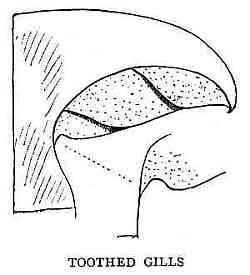
Another very common example of mushroom in its season of early spring is the Agaricus gambosus, or St. George's mushroom, as it is popularly styled in Great Britain, from its usual appearance about the time of St. George's Day, April 23d. In addition to its unusually early season, which is the same with us, and which at this date would be a valuable hint in its identification, it has also the singular habit of growing in rings or clustered in crescents, after the manner of the Fairy-ring Champignon of our lawns. Add to this, also, a very strong odor, and we have at least three suggestive characteristics to aid us. This odor, according to Dr. Cooke, is so strong as to occasionally become oppressive and overpowering where the fungus is plentiful. Workmen employed to root them out are said to have been so overcome by the odor as to be compelled to desist. Other features of this fungus are noted in Plate 7. The cap varies in size in different individuals, but is occasionally very large—five inches or more in diameter, the average expanse, perhaps, being about three inches. The cap is smooth, thick, and fleshy, suggesting soft kid leather, at first rounded convex, ultimately expanding quite horizontally, and is commonly fissured here and there with irregular cracks, both in its expanse and at its edges. Its color is white, or yellowish white. In surface appearance Dr. Berkeley compared it to a "cracknel biscuit." The gills are yellowish white, very moist and densely crowded, and of various lengths, as indicated in my sectional drawing on the plate, and are, moreover, annexed to the solid stout stem by a toothed border, also shown herewith.
Epicurean opinions
The season of this mushroom extends into June, and in its favorite haunt it may occasionally be gathered by the bushel. Opinions are at variance as to the comparative esculent qualities of this species. Certainly delicacy cannot be claimed for it; but those epicures who desire the characteristic fungus flavor at its maximum will find it in the Gambosus.

PLATE VII ST. GEORGE'S MUSHROOM
Agaricus gambosus
Pileus: Three to six inches in diameter, occasionally much larger; rounded convex, at length more flat and commonly cracked here and there; surface smooth, thick, and fleshy, suggesting soft kid leather. Color, pale ochre or yellowish white.
Gills: Densely crowded; yellowish white; very moist; various lengths; each annexed to stem by a small sharp downward curve.
Stem: Solid; stout; substance creamy white.
Spores: White.
Taste: Highly flavored; by some considered "too gamy."
Odor: Powerfully strong, perhaps rank.
Habitat: Fields, lawns, and pastures, frequently growing in broken rings or crescents.
PLATE VII
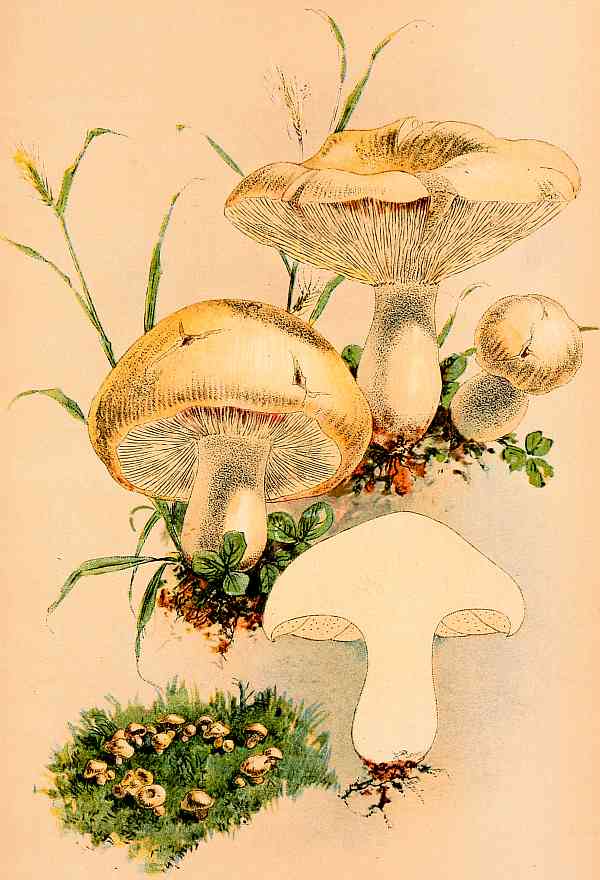
Plate VII.—Agaricus Gambosus.
By many fungus-feasters this species is prized as the ne plus ultra, and most various are the methods of its culinary preparation, either in the form of mince and fricassee with various meats, suitably seasoned with salt, pepper, and butter, or simply broiled and served on buttered toast. An appetizing recipe for this especial mushroom is given on page 313.
TRUE FAIRY-RING CHAMPIGNON
Marasmius oreades
Fairy-ring mushrooms true and false
I remember, as a boy, summer after summer observing upon a certain spot upon our lawn this dense, and at length scattering, ring of tiny yellowish mushrooms, and the aroma, as they simmered on the kitchen stove, is an appetizing memory. This species is very common, and inasmuch as it is likely to be confounded with two noxious varieties, it is advisable to bring in prominent contrast the characters of the true and the false.
The true Fairy-ring Champignon is pictured in Plate 8. It is common on lawns and close-cropped pastures, where it is usually seen growing in rings more or less broken, and often several feet in diameter, or in disconnected arcs, the vegetation extending outward year by year. This mushroom is held in great esteem, and frequently grows in such profusion that bushels may be gathered in a small area.
"True" fairy-ring
The pileus is buff or cream colored, from one to two inches in diameter, leathery and shrivelled when dry, but when moist, after rain or dew, becoming brownish, soft, and pliable, the conditions perhaps alternating for several days; the skin refuses to be peeled, and in the older, fully opened specimens the centre of the cap is raised in a distinct tiny mound; gills, widely separated, about ten or twelve to the inch at circumference in average specimens, same color as cap, or paler, unequal in length, curving upward on reaching stem, thus "free" from apparent contact with it; stem, equal diameter, tough, fibrous, and tenacious, paler than gills, smooth to the base (no spines nor down); cup, none; spores, white; taste nutty, somewhat aromatic, appetizing; habitat usually on lawns or pastures.
Traditions of the mystic "ring"
The "ring" was long involved in mystery, being attributed to moles, lightning, witchcraft, etc.; and, clothed with popular superstition, has found its way into many folk-legends, and has figured in the lore of elfs and goblins, to whom, in the absence of scientific knowledge, the strange, fungus-haunted circle was referred, the "ring" being applied not merely to the circle of mushrooms themselves, but especially to the clearly defined ring of clear, fresh grass surrounding the central, more faded area. But the fairies no longer dance their moonlight rigadoon upon the charmed circle of the champignon, nor do the nimble elves "rear their midnight mushrooms" upon the rings of lush grass as of old, for science has stepped in and cleared up the mystery. The Rev. M. J. Berkeley, in his Outlines to British Fungology, thus completely rescues the "fairy-ring" from the domain of poetry and reduces it to prosaic fact:

PLATE VIII FAIRY RING CHAMPIGNON
Marasmius oreades
Pileus: Convex at first, becoming flat, with a mound at centre, at juncture of stem; texture, tough and pliable when moist, brittle in drying, alternating between these two conditions with rain and sun; color, reddish buff at first, becoming cream colored when old, when it is usually quite wrinkled.
Gills: Broad, and quite separated; about ten or twelve to the inch at rim in large specimens; unequal in length; deep cream color; clearing the stem as they curve upward towards cap.
Stem: Solid; equal diameter; tough and fibrous; naked and smooth at base.
Spores: White.
Taste: Sweet, "nutty," and appetizing.
Odor: Aromatic and pleasant.
Habitat: Pastures and lawns, generally growing in rings or curved lines.
Diameter of pileus, full expansion, one to two inches.
PLATE VIII
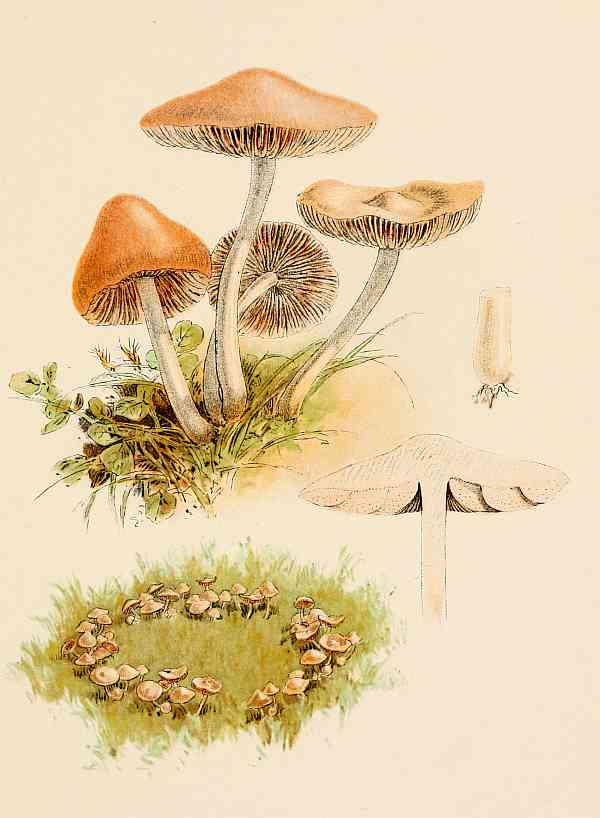
Marasmius Oreades.
The "ring" explained
"These rings are sometimes of very ancient date, and attain such enormous dimensions as to be distinctly visible on a hill-side for a great distance. It is believed that they originate from a single fungus whose growth renders the soil immediately beneath unfit for its reproduction. The spawn, however, spreads all around, and in the second year produces a crop, whose spawn spreads again, the exhausted soil behind forbidding its return in that direction. Thus the circle is continually increased, and extends indefinitely till some cause intervenes to destroy it. If the spawn does not spread on all sides at first, an arc of a circle only is produced. The manure arising from the dead fungi of former years makes the grass peculiarly vigorous around, so as to render the circle visible even when there is no external appearance of fungus, and the contrast is often stronger from that behind being killed by the old spawn. This mode of growth is far more common than is supposed, and may be observed constantly in our woods, where the spawn can spread only in the soil or among the leaves and decaying fragments which cover it."
Various recipes
Many recipes are recommended for the preparation of this mushroom, some of which are given in a later chapter, including the method of desiccation so commonly employed with other species, and by which the champignon may be kept for ready use throughout the winter months.
In its fresh state, according to J. M. Berkeley, "When of good size and quickly grown, it is perhaps the best of all fungi for the table, whether carefully fried or stewed with an admixture of finely mixed herbs and a minute portion of garlic. It is at the same time tender and easy of digestion, and when once its use is known and its character ascertained, no species may be eaten with less fear. It is so common in some districts that bushels may be gathered in a day."
FALSE OR POISON CHAMPIGNON
Marasmius urens
There are two other species of mushroom which might possibly be mistaken for the above by the casual eye, but which are easily distinguishable on careful examination. The first of these is the false Champignon (Plate 9, fig. 1). The most important distinguishing features are italicized. They will be seen to afford a striking contrast to the true edible species in these especial characters.
The pileus is pale buff, convex, central mound absent; the cap varies from one-half to one and a half inches in diameter, and is thus slightly smaller than the "true" fairy-ring; gills, yellowish brown, narrow, and crowded, twenty-five or more to the inch at circumference in good specimen, curving upward at junction with stem, thus "free" from actual attachment; stem, solid, clothed with whitish down, especially noticeable at the base; cup, none; taste, acrid. This last quality alone should distinguish the species, which, moreover, usually grows in woods, though occasionally found upon the lawn in association with the edible species.

PLATE IX POISONOUS CHAMPIGNONS
Marasmius urens
Pileus: Pale buff in color; tough and fleshy; flat convex, becoming depressed and at length wrinkled; one to two inches in diameter.
Gills: Unequal, cream colored, becoming brownish; much closer together than in the true Champignon, hardly reaching the stem proper.
Stem: Solid; fibrous; pale, its surface more or less covered with white, flocculent down, and densely clothed with white down at base.
Taste: Acrid.
Habitat: Lawns and pastures, often in association with the edible M. oreades.
Marasmius peronatus
Pileus: Reddish buff; convex slightly flattened at top, becoming convex by expansion; very wrinkled when old; diameter, at full expansion, between one and two inches.
Gills: Thin and crowded; creamy, becoming light reddish brown, continuing slightly down stem by a short, abrupt curve.
Stem: Solid; fibrous; pale, densely clothed with stiff yellow hairs at base.
Taste: Acrid.
Habitat: In woods, among dead leaves, etc.
PLATE IX
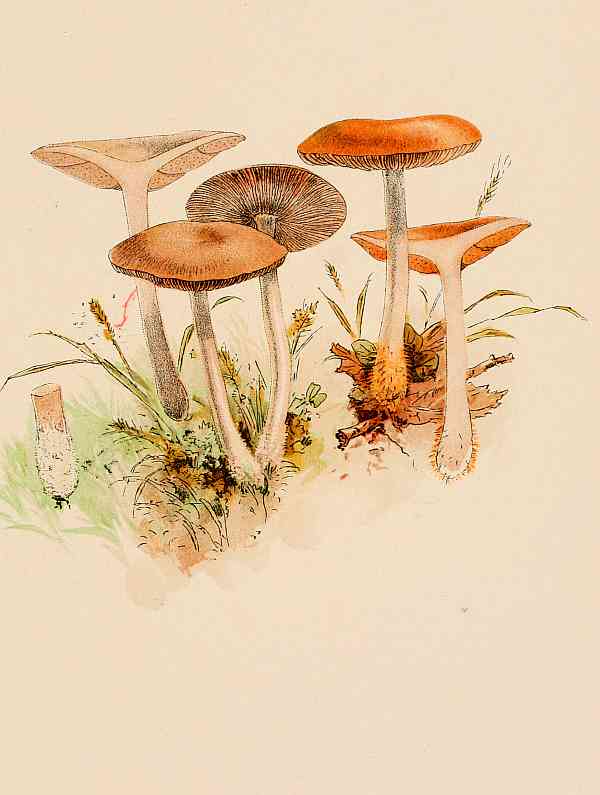
Poisonous Champignons.
MARASMIUS URENS. M. PERONATUS.
POISONOUS FAIRY-RING MUSHROOM
Marasmius peronatus
The other false species (Plate 9, fig. 2) still more closely simulates the "fairy-ring," but may be identified by the growth of spines at the base of the stalk. The gills are also annexed to the stalk by a small, sharp, recurved tooth. Like the previous spurious species, it is found in woods, and is rarely to be seen in association with the true Champignon or in its peculiar haunt.
THE PASTURE MUSHROOM
Agaricus (Lepiota) procerus
Description
One of the most readily recognized of our wild mushrooms is the pasture or parasol Agaric (Agaricus procerus), a cluster of which in various stages of development is shown in Plate 10. It is frequently abundant in pasture-lands, and is occasionally found in woods. Its conspicuous cap sometimes measures six inches or more in diameter, the centre being abruptly raised in a mound. The pileus is at first egg-shaped. The color of the full specimen is pale-brown or buff, more or less spotted with darker brown shaggy patches, generally arranged in somewhat concentric order. The skin of the cap is thick and somewhat tough, especially in drying. The gills are almost pure white in early specimens, slightly creamy later, and unequal in length. Stem, often six or eight inches high, proportionately slender, and of equal diameter, bulbous at base, but without a cup, hollow, fibrous, finely speckled or streaked with brown, and deeply inserted in the cap, at which juncture, by a narrow flat space, as shown in the section drawing below, it is distinctly free from contact with the gills. The remnants of the veil are in the form of a more or less detachable ring encircling the stem. The spores are white and odorous. The flavor, when raw, is distinctly nutty, aromatic, sweet, and palatable; when dry, slightly pungent.
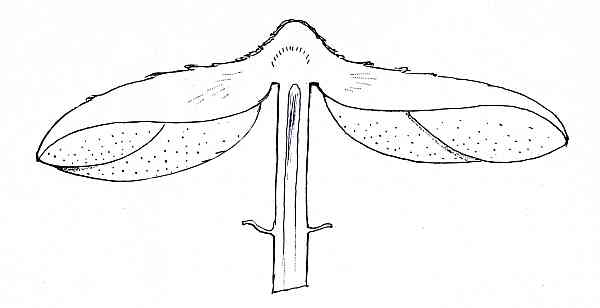
Simple recipe
This species is cosmopolitan, and is a great favorite on the Continent—in France being known as the Coulemelle, in Italy as Bubbola maggiore, and in Spain as Cogomelos. It is by many considered as the choicest of all mushrooms, and is indeed a delicious morsel when quickly broiled over coals, seasoned to taste with salt and pepper and butter melted in the gills, and served hot on buttered toast. Other recipes are noted in a later chapter. The scurfy spots and stems should be removed before cooking.

PLATE X THE PASTURE MUSHROOM
Agaricus procerus
Pileus: At first egg-shaped, finally expanded like a parasol four to seven inches in diameter, the apex raised in a prominent mound or "umbo." Color pale buff or creamy, occasionally almost pure white, more or less regularly spotted with the brown shaggy patches of the separating epidermis, which remains of the pale brown color on the "umbo." Skin thick and somewhat tough; substance hygrometric, drying and swelling naturally in its haunts.
Gills: Unequal in length; crowded; at first almost white, finally becoming creamy or pale buff.
Stem: Tall, slender, equal, hollow, and fibrous; bulbous at base, but with no sign of a "cup;" separated from the gills above by a distinct space; surface streaked and speckled with brown, encircled by a loose ring.
Spores: White, and, like the whole plant, fragrant aromatic—more so, perhaps, than any other fungus.
Taste: Distinctly sweet and "nutty," slightly pungent when dry.
Habitat: Pastures and fields, occasionally woods.
Season: Summer.
PLATE X
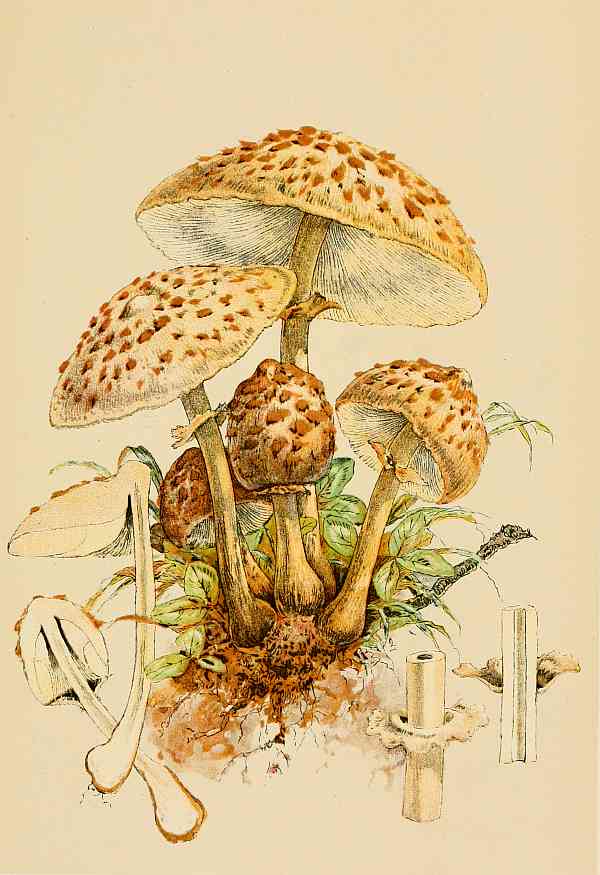
Agaricus Procerus.
Hygrometric properties
This species is especially free from the swarming grubs too commonly found in mushrooms. It is highly hygrometric, dries naturally even while standing in the pasture, in which condition it is decidedly aromatic in fragrance and nutty sweet to the taste, as described. Indeed, it is sometimes called "the nut mushroom." Absorbing moisture from the dews and rains, it again becomes pulpy and enlarged, thus alternating for days between its juicy and dry condition, in which latter state it may be gathered and kept for winter use. It is a palatable morsel at all times, but especially in the prime of its first expansion, each successive alternation, with its gradual loss of spores, affecting its full flavor.
THE RUSSULA GROUP
Generic characters
Among the wild species of mushrooms which the novice might possibly mistake for the common "mushroom" of the markets—which is popularly supposed to be the only edible variety, as distinguished from "toadstools"—is the Russula group. They are extremely frequent in our woods from spring to late autumn, and have many features in common. Their caps vary in color from a gray-green, suggesting cheese-mould, to olive-red, scarlet-red, and purplish. The gills are generally of the same length, or practically so, occasionally double-branched, beginning at the stem and usually extending to the rim of the cap, at which portion they are covered by the mere skin of the pileus, a slightly fluted appearance being observable from above, which indicates the location of the radiating laminæ below (Plate 12, fig. 6).
The stem may be white or cream-colored, or perhaps stained or mottled with the color of the cap.
Principal species
There are at least four of these edible Russulæ that we are certain of meeting in our walks in the woods: The green Russula (R. virescens), with its mottled cap of mouldy or sage green; the various-gilled Russula (R. heterophylla), varying in the lengths of its gill plates; the purple Russula (R. lepida), whose cap varies from bright red to dull purple; and the red Russula (R. alutacea), which presents a variety of shades of red, from bright to dull. Having once identified the Russula as a group, or the common characteristics of the genus, we may take our pick from all of these delicious species for the table; but we must avoid one other member of the genus, also quite common, and which frequently masquerades in the guise of some of the bright red varieties above mentioned. This is the R. emetica, whose obnoxious qualities are indicated by its classical surname, and which will be separately considered.
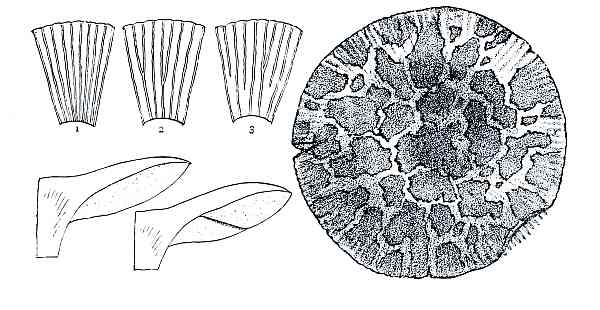
RUSSULA VIRESCENS
(Showing mottled cap of occasional specimen, and variations in gills. 1 even; 2 forked; 3 dimidiate.)
THE GREEN RUSSULA
Agaricus (Russula) virescens
Specific characters
Our first species, the green Russula, is to be found throughout the summer in hard-wood groves, and is apt to frequent the same immediate locality from year to year. I know one such veritable mushroom bed in the woods near by, where I am almost certain of my mess of Russulæ almost any day in their season. This species is shown in its various stages of development and also in section in Plate 11. Its substance is firm and solid creamy white. The pileus, at first almost hemispherical, as it pushes its way through the earth, at length becomes convex, with a slight hollow at the centre, and later ascends in a gentle slope from centre to rim. Its color is sage green, or mouldy green, usually quite unbroken in tint at centre, but more or less disconnected into spots as it approaches the circumference by the gradual expansion of the cap, the creamy undertint appearing like network between the separated patches of color. The substance of the cap becomes gradually thinned towards the circumference, where the mere cuticle connects the gills, the position of these gills being observable from above in a faint fluting of the edge, a peculiarity of all the Russulæ. The cuticle peels readily some distance from the edge, leaving the projecting tips of the gills exposed in a row of comb-like teeth, but usually adheres towards the centre of cap. The gills, with rare exceptions, are all of the same length, white or creamy in color, firm and thick, but very brittle, easily broken into fragments by a rude touch, a characteristic of all the group; spores, white. The stem is short, stout, and solid, and usually tapers towards the base. There is no vestige of a cup or veil at any stage of growth.
A fine specimen of the green Russula should measure five inches in diameter when fully open, but three inches is probably the average size.
The noxious Russulæ
When once acquainted with the above as a type of the Russula group, noting the firm substance, straight, equal gills, and their brittle texture; the sweet, nutty flavor common to all the edible species, these become readily identified, the noxious Russulæ, as in the brilliant pink or scarlet R. emetica (Plate 13), being acrid and peppery to the taste.
Green Russula often sufficient
In an auspicious season and in a congenial habitat—usually an open wood with scant undergrowth and preferably raked clean of dead leaves—the green Russula is often abundant. Familiarity even with this one species will often afford a sufficiency of fungus food during its season. A lady amateur mycophagist of the writer's acquaintance, whose home is located at the border of such a wood as is above described, and who is especially fond of the green Russula, is never at a loss for this especially prized tidbit as a reward for her daily stroll among the trees. A visitor may often see upon her buffet a small glass dish filled with the mushrooms, nicely scraped and cut in pieces—an ever-present relish between meals. For even in their natural state, as she discriminatingly says, they are "as sweet as chestnuts." This is especially the case with the "buttons" or younger specimens.

PLATE XI THE GREEN RUSSULA
Russula virescens
Pileus: Very firm; solid, dull, dry-surfaced, as with a fine "flock"; mouldy green or creamy, with sage-greenish broken spots more united at centre; occasionally entirely green, with warty patches of darker hue. At first globular, then convex with flat top, at length expanded and hollowed towards centre.
Gills: Pale, creamy white; commonly all of equal length, but frequently unequal and forked; very brittle, breaking in pieces at a rude touch.
Stem: Solid; creamy white; no veil.
Taste: Very mild, sweet, and nut-like.
Habitat: In woods—July-September.
Diameter of pileus, ideal specimen, four inches.
PLATE XI
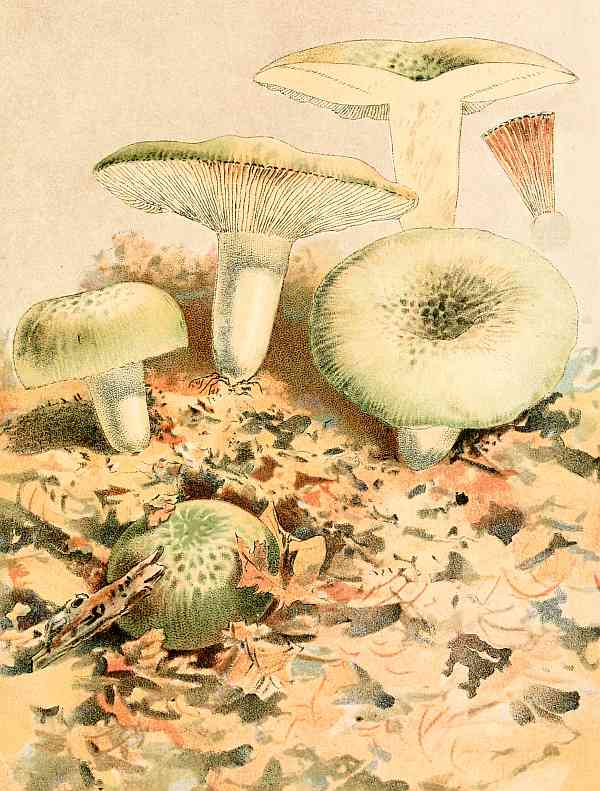
Russula Virescens.
PURPLE RUSSULA
Russula lepida
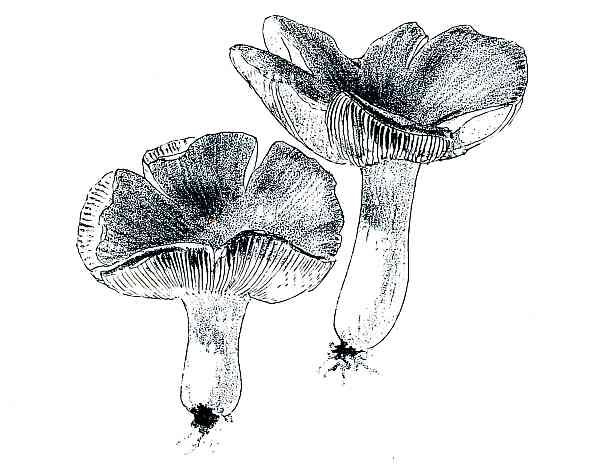
RUSSULA LEPIDA—CONTORTED AND CRACKED PILEUS
Color of cap misleading
Specific characters
This, perhaps the most common species, is figured in Plate 12, fig. 3. It corresponds with the foregoing in size as well as in general shape, firm texture, and friable nature of the gills. The pileus of this species frequently assumes eccentric shapes, or is often cracked, as seen in the accompanying cut. Its name of "purple" is probably local in its application, as it is known also as the red Russula, neither of which titles is at all distinctive. Indeed, the color of the cap is often a misleading character for identification, as a given species may vary greatly in this particular. This feature is thus generally omitted in purely scientific descriptions, more dependence being placed upon the tint of the flesh and that of the spore surface, the laminæ or gills, which are more permanent and reliable as a character. Thus, in the present species, R. lepida, the tint of the pileus or cap is often of a deep dull purplish red or ruddy wine color. Another authority describes it as violet-red and cherry-red or slightly tawny, paler at circumference. Berkeley, in his British Fungi, omits any reference to the color of the cap, as evidently of little value in identification. But from numerous examples gathered by the present writer, the color may, I think, be safely averaged under the general hue of dark, subdued red inclining to maroon. The surface is dull, as with a fine dust or plum-like bloom, and thus without polish. Occasional specimens appear almost velvety in the sheen of surface. But the tints of the flesh and the gills are always uniform, the leaflets or gills being pure white or very slightly creamy, continuous from stem to rim or occasionally forked, not crowded, curved in outline in open specimen, with broadest width near the circumference of cap. The flesh is white or slightly creamy, firm and compact as in the former species, with the same variations of outline from early stage to maturity. The stem is white, solid, and generally more or less tinted or streaked vertically with rose or pale crimson (Fig. 8). The taste of the flesh is sweet and appetizing.

PLATE XII EDIBLE RUSSULÆ
1. Russula heterophylla—Variable Russula
Pileus: Firm, solid; greenish or pinkish-gray; at first convex, with flat top, ultimately rising from centre to rim.
Gills: Milk-white; extremely brittle, like all the Russulæ, and easily crumbled (see Fig. 7); long, short, and forked intermixed. Fig. 5.
Stem: Milk-white; solid.
Taste: Mild and sweet.
2. Russula alutacea—Yellow-gilled Russula
Pileus: Firm, solid; shape as in above; color very variable, from bright to deep red; cuticle thin at rim, where the lines of junction of gills are readily discernible from above by the depressed channels. Fig. 6.
Gills: Equal, brittle, broad; yellow-buff color in all stages. Fig. 4.
Stem: Solid; milk-white, commonly stained or streaked with red towards the base.
Taste: Sweet and nut-like.
3. Russula lepida—Purple Russula
Pileus: In shape like above, varying in color from bright red to dull, subdued purplish, with a distinct bloom.
Gills: White, broad, principally even, occasionally forked as in Fig. 1; like the above, extremely brittle. Fig. 7.
Stem: Solid; white, usually stained and streaked with pink. Fig. 8.
Taste: Sweet, and similar to above.
Average diameter of extended pileus of each of these species about three and one-half inches; veil absent in each.
Habitat: All grow in woods—July-September.
PLATE XII
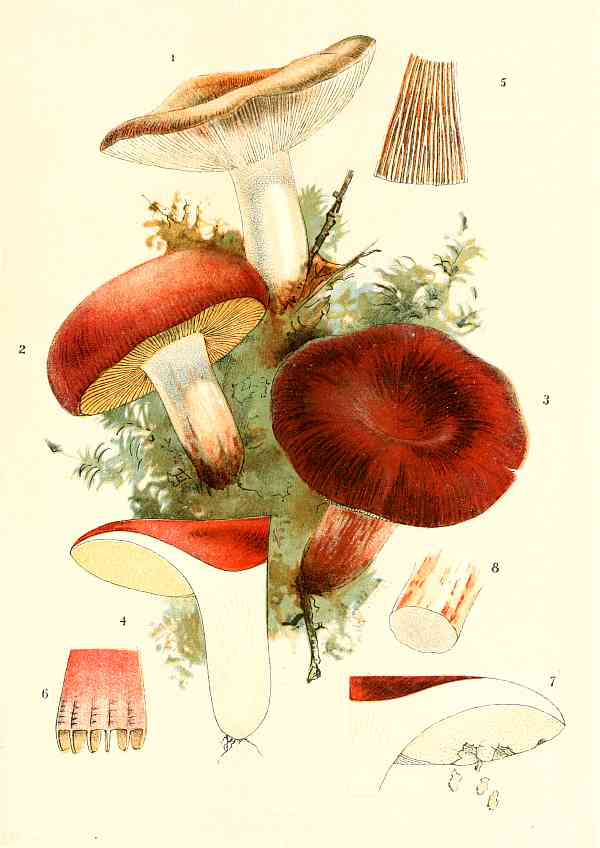
Edible Russulæ.
RUSSULA HETEROPHYLLA. R. ALUTACEA. R. LEPIDA.
YELLOW-GILLED RUSSULA
Russula alutacea
Botanical characters
Our third example of the Russula is one which is also quite common in our woods, and which might in the extreme variation of its color be confounded with the last by a careless observer, as indeed both might be still further confounded with the poisonous member bearing the red tint, and which will be hereafter considered. The Russula alutacea (Pl. 12, figs. 2, 4, 6) is a delicious species. In general size and contour it resembles the foregoing. The color of the cap varies from bright-red to blood-red or even approaching the purplish red of the preceding species, lightening towards edge. But we have a clear distinction in the color of the gills, which are distinctly yellowish, pale ochre, or nankeen, in all stages of the mushroom, or even tawny in old specimens. They are, moreover, usually all of even length, being straight and continuous from stem to circumference of pileus, none of them forked, their juncture with the edge of the cap being clearly manifest from above by the thinness of the cuticle. The flesh is white, stem firm and solid, white and smooth, often tinted with pink or red. The flesh of the cap often appears pinkish upon peeling the cuticle from the edge. The taste resembles that of the previous species—sweet and nutty.
VARIOUS-GILLED RUSSULA
Russula heterophylla
Botanical characters
Growing in company with both of the above is frequently to be seen another species, which is somewhat protean in its accomplishments of color, but which in the character of its gills, as implied in its scientific name, gives us a ready means of identification—heterophylla—various-leaved (Pl. 12, figs. 1 and 5). In the previous examples of Russulæ the gills have been commonly straight, continuous from stem to edge of cap, or more rarely forked and continuous in the bifurcation. In the present species we have both of these conditions, combined also with what are called dimidiate gills, or shorter leaflets, which reach, perhaps, only half-way from rim to stem, all crowded together and alternating. The color of the cap is very variable—occasionally pinkish-ash color or dull pinkish-gray inclining to green or olive or even red. Its surface is smoother than in the foregoing species, being almost polished, and the pellicle of the cap is usually noticeably thinner. Having found such a specimen, possessing also all the other attributes of shape, firmness of flesh, and dry brittleness of gills, if tasted and found sweet in flavor it may be eaten without the slightest fear, and like its congeners will be found a delicious morsel, whether nibbled raw, as the squirrels are so fond of doing, or served hot on toast as an entrée, or otherwise prepared according to taste.
Delicious broiled Russula
Various methods prevail in the culinary preparation of the Russula mushroom, many of which are suggested among the receipts in another chapter, but broiling is perhaps the most simple and generally satisfactory. Having thoroughly cleaned the top, or, if desired, peeled the cuticle, place the mushrooms on a gridiron over a hot fire, gills downward, for a few moments, sufficient to allow them to be heated through without scorching. Then reverse them and repeat the process, melting a small piece of butter in the gills and salting and peppering to taste; serve hot on toast or in the platter with roast beef or fowl. They are also delicious fried in the ordinary way, either with or without batter.
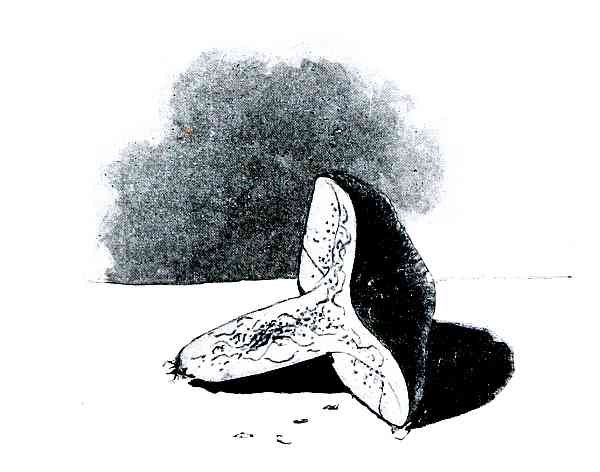
AN INFESTED SPECIMEN
The Russula is particularly in favor among the fungus-eating insects, whose rapid development and voracity are consistently related to the ephemeral nature of their food. A Russula specimen showing barely a trace of insect life when gathered will sometimes prove literally honey-combed and totally unfit for food in the space of twenty-four hours. It is therefore well to cut each specimen in sections before venturing upon its preparation for the table, and to profit thereby according to our individual fastidiousness, as suggested on page 37.
While the above esculent species of Russulæ are being familiarized by the tyro, he must now be put on guard against a certain dangerous species of the group, which is sure to claim his attention, being especially fond of the good company of its cousins, and likely to do some mischief through its frequent disguise.
POISONOUS OR EMETIC MUSHROOM
Russula emetica
The poisonous Russula
A warning tang
The variability in the coloring of the three edible species already described brings them occasionally into such close similarity with the gamut of color of the one common poisonous species of the group that this enemy must also be familiarized ere we venture too confidently upon our Russula diet. The Russula emetica (Plate 13), as its name implies, is at war with luxurious gastronomy, but its distinction from the harmless varieties is, after all, quite simple. Its frequent general similarity to R. lepida and R. alutacea is such that the amateur should hardly rely upon the botanical characters alone. There is but one safe, as it is a simple, rule for him: He should taste every specimen of his Russula of whatever kind before venturing upon its use as food. All of the sweet and palatable Russulæ are esculent. When he chances upon the R. emetica he will be aware of its important demoralizing resources in the peppery-hot tingle of his tongue, which, if not instantly perceived, will within the space of a minute assert itself distinctly. All such acrid specimens should be excluded, as a single one would be sufficient to bring an ignominious denouement to an otherwise delectable feast. In the typical R. emetica the pileus is a bright, brilliant red—which, as we have said, is very variable, as indicated in our plate—often polished and shining; the gills broad, equal, straight, continuous, not crowded, and white, as is the flesh beneath the peeled cuticle. The stem is white or pink. The cap will average, perhaps, three inches in diameter, though occasionally reaching the dimensions indicated by the marks in plate, or even larger.

PLATE XIII POISONOUS OR EMETIC MUSHROOM
Russula emetica
Pileus: Expansion two to four inches; color varying from pale bright pink to deep scarlet; very smooth.
Gills: Broad (in section), mostly equal in length, and continuous from edge of cap to stem; not crowded; white.
Stem: White or pinkish.
Spores: White, like all Russulæ.
Taste: Hot and peppery.
Habitat: Woods, with other Russulæ.
Season: July-September.
Note.—While, for conservative reasons, the poisonous reputation of this species is here perpetuated, it is quite probable that such condemnation is unwarranted, except as to the raw mushroom. The peppery tang and demoralizing powers are now claimed to be dissipated in cooking, and the Emetica will doubtless soon be more generally included with its congeners among the esculents, thus bringing the entire genus Russula into the friendly group. Captain Charles McIlvaine is largely responsible for this conversion in favor of Emetica. His individual experiments warrant him in pronouncing this species "as good as the rest" when cooked. Others of the writer's acquaintance, following his example, echo his opinion.
PLATE XIII
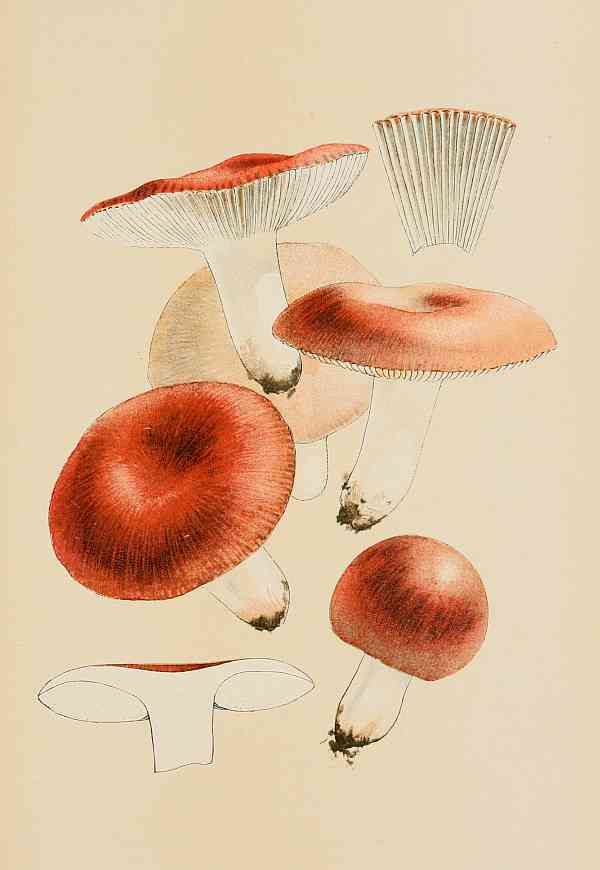
Russula Emetica (POISONOUS)
THE OYSTER MUSHROOM
Agaricus ostreatus
What a mass of nutritious food do we occasionally pass in innocence or spurn with our foot upon the old stump or fallen log in the woods!—a neglected feast, indeed, if the specialists on edible fungi are to be believed; a feast, in truth, for a big family, if we chance upon even an average cluster of the "vegetable oyster," which is pictured in Plate 14.
A "vegetable oyster"
I have commonly observed this species, the Agaricus ostreatus, in the autumn, and this is the season given for its appearance in Europe by the authorities; but according to certain American specialists, notably Charles McIlvaine, it is common in our woods in spring, even as early as March, and through the summer. It is usually found in large clusters, similar to our illustration, growing upon decaying stumps and the trunks of various trees. The "oyster" is a gilled mushroom which grows sidewise from its position, the stem being usually lateral and very short, though occasionally quite prolonged, the two varieties being indicated in the accompanying cut.
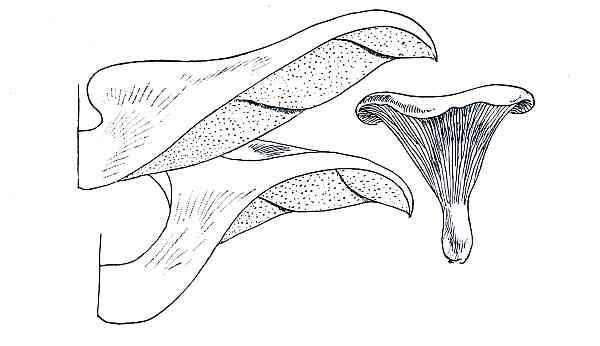
AGARICUS OSTREATUS— Variations in Form
The individual mushroom may be five or six inches in breadth, a cluster affording several pounds in weight. The color of the upper surface is light brown or buff, varying to yellowish-ashen, according to age, and the gills are dirty white of various lengths; spores white.

PLATE XIV THE OYSTER MUSHROOM
Agaricus ostreatus
Pileus: Four to six inches in diameter; smooth. Color, dull, light yellowish, sometimes pale ochre or grayish.
Gills: Dingy white; of various lengths, extending down the stem.
Stem: Short or obsolete; on the side of pileus.
Spores: White.
Taste: Agreeable; suggesting the flavor of the cooked oyster; texture tough in older specimens.
Odor: Pleasant.
Habitat: On old tree trunks and fallen logs, occasionally in dense masses.
PLATE XIV
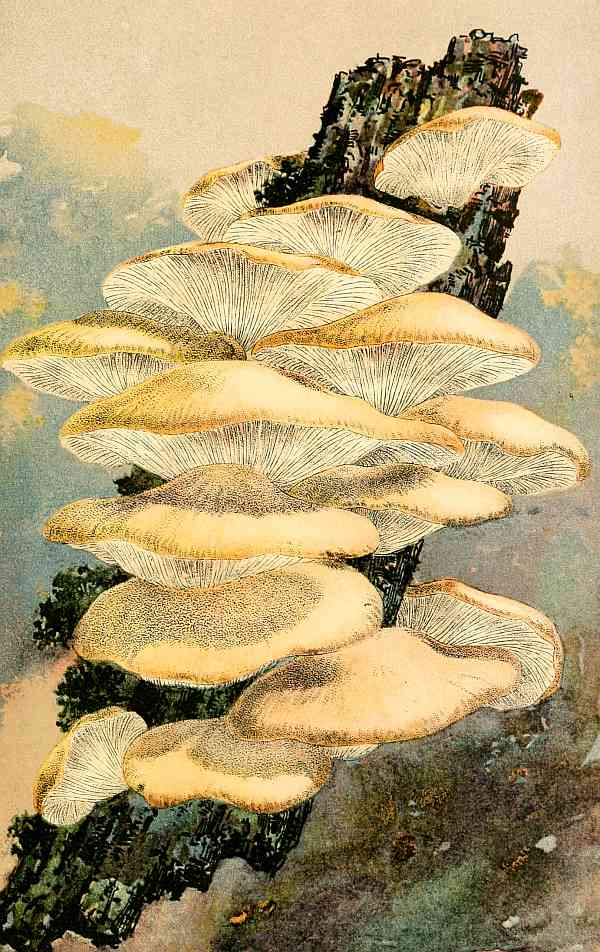
Agaricus Ostreatus.
This species and the one following belong to the subdivision of the typical genus Agaricus, called Leucospori—white spored. The division has many sub-genera. The particular sub-genus in which these are included is the Pleurotus, or side-foot mushrooms, as they are sometimes called.
Another earlier species with which A. ostreatus might be confounded (A. euosmus) has spores of a rosy pinkish or lilac hue, a sufficient identification, and is accounted injurious.
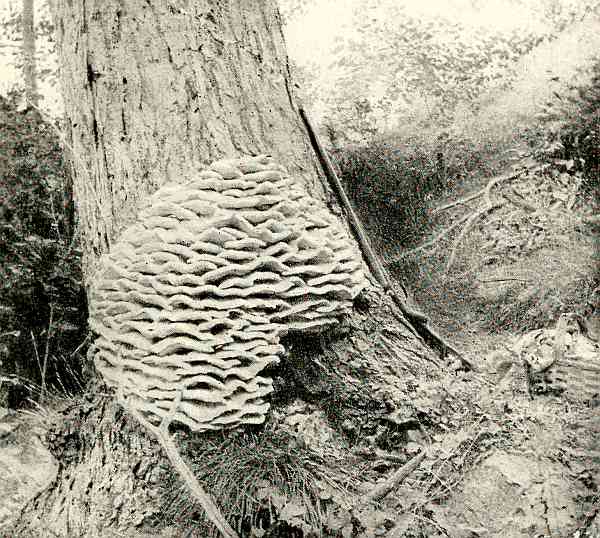
THIRTY POUNDS OF VEGETABLE MEAT
The clustering growth of the "Oyster Mushroom" frequently attains huge proportions, as will be seen from the above reproduction of a photograph sent to me by a correspondent. The dimensions of the mass are easily judged by the height of the gun leaning against the tree, and introduced for comparison.
Broiled oyster recipe
This "Oyster Mushroom" should be gathered in its young state, and may be served in various ways. Broiling over the coals, gills upward, seasoning with butter, pepper, and salt during the cooking, is a favorite method with most of the Agarics, but a well-known fungus epicure claims that this mushroom "may be cooked in any way that an oyster is, and will be found fine eating."
The average specimen will probably prove more ashen in hue than those represented in my plate.
THE ELM MUSHROOM
Agaricus ulmarius
Appetizing qualities
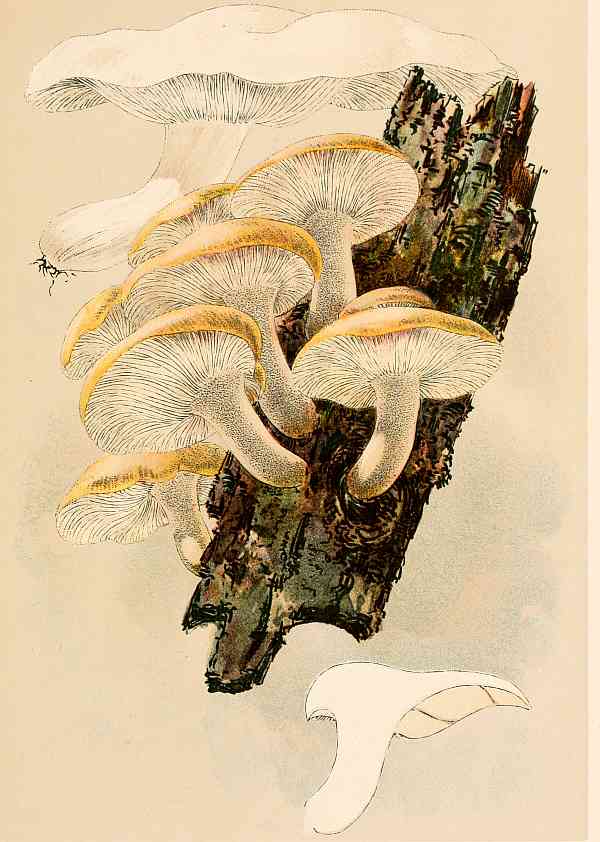
This edible species of mushroom, allied to the foregoing, and which grows in similar clusters on the elm-tree, is the Agaricus ulmarius (Plate 15). While much difference of opinion prevails regarding the appetizing qualities of this mushroom or its right to a place among the esculents, this varying individual judgment has doubtless often had direct reference to the character of the particular specimen chosen for trial. Dr. M. C. Cooke is not disposed to place a high appreciation upon its qualities. "It has been customary," he says, "to regard this and some of its allies [presumably in allusion to the preceding] as alimentary, but there is no doubt that they could all be very well spared from the list." Opposed to this uncomplimentary aspersion is the testimony of other authorities who claim that "it is most delectable" and "a delicious morsel." Certain it is that in its young and tender condition only is it fit for food, as it becomes progressively tough in consistency towards maturity.

PLATE XV THE ELM MUSHROOM
Agaricus ulmarius
Pileus: From three to five inches in diameter. Color, pale yellow or buff; smooth in young specimen, fissured, spotted, and leathery at maturity. Flesh in section white.
Gills: Dingy white, becoming tawny at maturity, extending down the stem.
Stem: Various in length, occasionally very short and attached to side of pileus; generally longer as in Plate, and "off centre"; white; substance solid.
Spores: White.
Taste: Suggesting fish when cooked.
Odor: Pleasant.
Habitat: Trunk of elm or from surfaces of broken or sawn branches. Often growing in dense masses covering several square feet.
PLATE XV
Agaricus Ulmarius.
Massive growth
As its specific name implies—Ulmus —this mushroom is devoted to the elm, upon whose trunk and branches it may be often seen, either singly, which is rare, or in great dense masses, sometimes, covering a space of several square feet, often, unfortunately, at an inaccessible height from the ground. I have in my possession a photograph which has been sent to me by an interested correspondent representing a dead tree trunk, apparently a foot in diameter, densely covered to a height of seven feet from the ground with a mass of the A. ulmarius—and presumably representing thirty or forty pounds in weight. This species is most frequently seen on apparently healthy branches, or growing from the wood of a severed limb. Its season is late summer and autumn.
Botanical characters
A small cluster of these mushrooms is seen in Plate 15. They afford a good refutation of the old-time discriminating "ban," which excluded all mushrooms which grow "sidewise," or "upon wood." The individual mushroom of this species is a horizontal grower, sometimes with a barely noticeable or obsolete stem; in other specimens this portion being quite distinct and an inch or more in length, and firm and solid in texture. The upper surface is pale yellow or buff, smooth in the younger specimens, becoming disfigured by spots and fissures with age. The flesh is white, as also are the gills, though more dingy, becoming tawny-tinted with maturity, when the entire mushroom becomes quite leathery in substance, and might well awaken doubts as to its digestibility. The spores are white.
This fungus is known in some sections as the "Fish Mushroom," referring to its peculiar flavor, the appropriateness of which appellation is suggested in the incident related by Mr. Palmer, and quoted in my last chapter.
SHAGGY-MANE MUSHROOM
Coprinus comatus
A plebeian toadstool
Upon a certain spot on the lawn of one of my neighbors, year after year, without fail, there springs up a most singular crop. For the first two seasons of its appearance it was looked upon with curious awe by the proprietors of the premises, and usually ignominiously spurned with the foot by the undiscriminating and destructive small boy. One day I observed about five pounds of this fungus delicacy thus scattered piecemeal about the grass, and my protest has since spared the annual crop for my sole benefit. It usually makes its appearance in late September, and continues in intermittent crops until November. A casual observer happening upon a cluster of the young mushrooms might imagine that he beheld a convention of goose eggs standing on end in the grass, their summits spotted with brown.

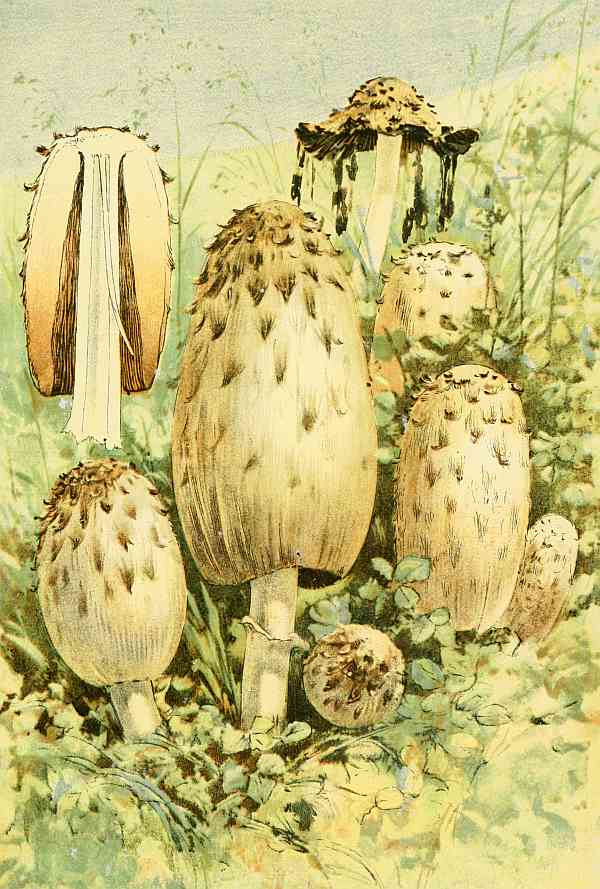
PLATE XVI THE SHAGGY-MANE MUSHROOM
Coprinus comatus
Pileus: Egg-shaped in young specimens; at length more cylindrical, and finally expanded, melting away in inky fluid. Color, creamy white, becoming black at edge with advancing age, as is also the case with the shaggy points upon its surface, which generally cover the pileus.
Gills: Crowded; equal in length; creamy white in young specimens, becoming pink, brown, and finally black, and always moist.
Stem: Cylindrical; creamy white; hollow, or with a loose cottony pith.
Spores: Black, falling away in drops.
Taste: Sweet, which applies only to the pink or white condition, at which time alone the species is considered esculent.
Habitat: Lawns, pastures, gardens, and rich grounds in the neighborhood of barns, etc.; usually grows in dense clusters.
Diameter of cylindrical pileus in average specimens, two inches.
One of the most easily identified of all mushrooms.
PLATE XVI
Coprinus Comatus.
Inky deliquescence
If one of them is examined, it is seen to be a curious short-stemmed mushroom which never fully expands (Plate 16), perhaps five inches high, and whose surface is curiously decorated with shaggy patches. In its early stages it is white and singularly egglike, but later becomes brownish, its curved shaggy points finally changing to almost black. The concealed gills are crowded and of equal length, at first creamy white, but gradually changing through a whole gamut of pinks, sepias, and browns until they become black, at which time the whole substance of the cap melts on its elongated stalk—deliquesces into an unsightly inky paste, which besmears the grass and ultimately leaves only the bare white stem standing in its midst, a peculiar method of dissemination which distinguishes the group Coprinus, of which it is the most conspicuous example. This is the "shaggy-mane" mushroom, Coprinus comatus, the specific name signifying a wig—"from the fancied resemblance to a wig on a barber's block." Even a brief description is unnecessary with its portrait before us. It is a savory morsel, and it cannot be confounded with any other fungus. It frequently grows in such dense, crowded masses that a single group will afford a dinner for a family.
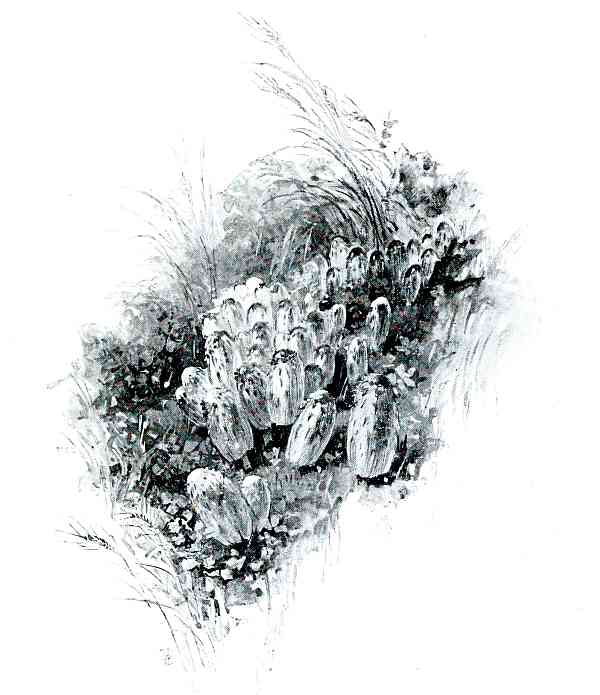
A DINNER FOR A FAMILY
It should be gathered while the gills are in the early white or pink stage, and may be prepared for the table in various ways, either broiled or fried, as described for previous species, or stewed with milk, or otherwise served according to the culinary hints in our later chapter, in which a special recipe for this species is found.
In a recent stroll down the main street of Litchfield, Connecticut, I observed, over the fence in a front door-yard of a summer resident, just such a dense cluster of the shaggy Coprinus, the proprietor of the premises, an appreciative habitué of Delmonico's at other seasons of the year, complacently reading his morning paper in his piazza, little dreaming of the twenty pounds of dainty diet, fit for a king, so easily available.

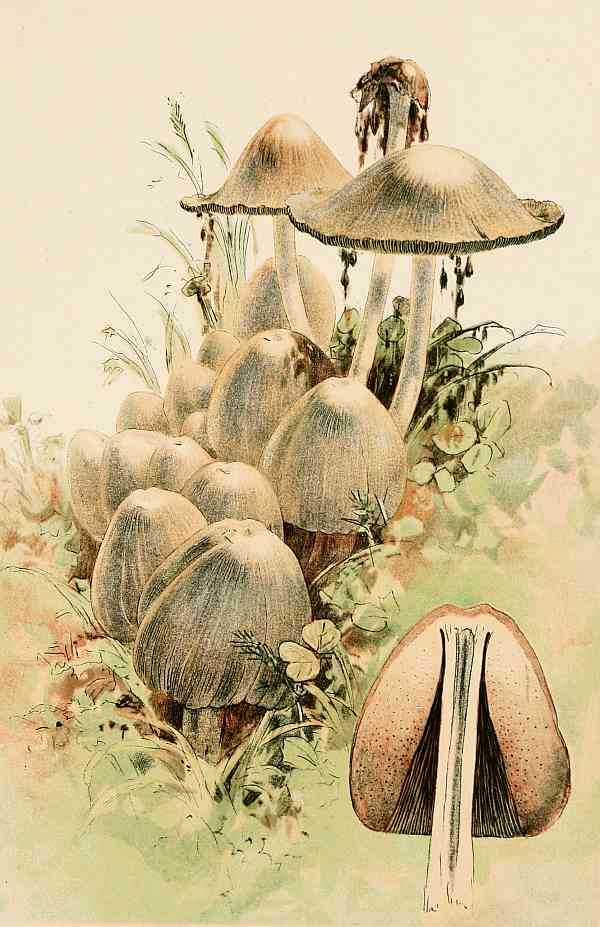
PLATE XVII THE INKY TOADSTOOL
Coprinus atramentarius
Pileus: Fleshy, moist; at first egg-shaped; of a Quaker-drab, dirty white, or even pale brownish color; at length becoming expanded, umbrella-like, when it melts away in inky drops.
Gills: Broad and crowded, not adhering to stem at top; creamy white in young species, becoming pinkish gray, and at length black.
Stem: Firm; white; hollow.
Spores: Black; shed in liquid drops.
Taste: Sweet, as is also the odor, which applies to its early stage only.
Habitat: About old decaying stumps and rotten wood, gardens, rich lawns, and barn-yards; usually growing in clusters, often very dense.
Diameter of pileus, young state, two inches.
PLATE XVII
Coprinus Atramentarius.
INKY MUSHROOM
Coprinus atramentarius
Botanical characters
In frequent company with the foregoing will be found another allied species, Coprinus atramentarius (Plate 17), with the same inky propensities, which is scarcely less delicious as an article of food. In this species the shaggy feature is absent, there being merely a few obscure slightly raised stains at the summit, of a brownish color. The stem is white and hollow. The surface of the pileus is smooth and of a Quaker-drab color, occasionally dirty-white, or with a slight shade of ochre, moist to the touch, darkened by rubbing. In the eatable stage the caps are drooping, as shown in the cluster on the plate, while the mature specimen expands considerably before its inky deliquescence. Its texture when young is firm, and the thick gray cuticle peels readily, leaving an appetizing nutty-flavored morsel, delicious even when raw. The inky Agaric is frequent about barn-yards, gardens, and old stumps in woods, and usually grows in such crowded masses that the central individuals are compressed into hexagonal shape. Like the previous variety, it should be collected for food while its gills are in the white or pink stage.
Cordier claims that all the species of Coprinus are eatable at this stage. The profusion in which they occasionally abound renders it often a simple matter to obtain a bushel of them in a few minutes.
Coprinus ink
Like the foregoing, a large cluster of these mushrooms leaves a most unsightly spot on the lawn. A diluted solution of this melting substance, as Cooke assures us, has been used "to replenish the ink-bottle. The resemblance is so complete that it may readily be employed as a substitute, all that is required being to boil and strain it, and add a small quantity of corrosive sublimate to prevent its turning mouldy." It may also be employed as pigment. It is, indeed, quite possible to paint the portrait of Coprinus with its own dark sepia, as the author has personally demonstrated. (See head-piece to "Illustrations".)
MILKY MUSHROOM
Lactarius deliciosus
Orange-milk Agaric
Prominent among the fungi which give unmistakable characters for their identification is the genus Lactarius, or milky mushrooms, another group of the agarics or gilled fungi, from which we will select for our first example the Lactarius deliciosus, or orange-milk Agaric (Plate 18). The figure will itself almost serve to identify it in its advanced open stage. Having found a specimen resembling our illustration, and anywhere from three to five inches in expanse, its general upper surface dull reddish-orange in color, more or less plainly banded with darker red, it is safe to predict that when its surface or gills are broken an exudation of milky juice will follow. If this exudation is orange or deep yellow in hue, gradually turning greenish on exposure, the identification is complete, and we have the orange-milk L. deliciosus, of which an authority says, "It really deserves its name, being the most delicious mushroom known." W. G. Smith goes still further in its praise, assuring us that "when cooked with taste and care it is one of the greatest delicacies of the vegetable kingdom." The taste of this species when raw is slightly acrid, but this quality disappears in the cooking.

PLATE XVIII THE ORANGE-MILK MUSHROOM
Lactarius deliciosus
Pileus: Diameter three to five inches. Color varying from yellow to dull orange, or even brownish yellow with mottled zones of deeper color, especially in younger plants; outline at first convex, ultimately somewhat funnel-shaped; surface usually smooth and moist.
Flesh: Brittle; creamy, more or less stained with orange.
Gills: Orange; generally clearer in hue than the pileus; when bruised, exuding a copious milky juice of orange color, becoming greenish in drying.
Stem: Paler than pileus; hollow; occasionally spotted with orange or greenish stains from bruises.
Spores: White.
Taste: Slightly peppery.
Habitat: Woods, pine-groves, and swamps.
Season: July-September.
PLATE XVIII
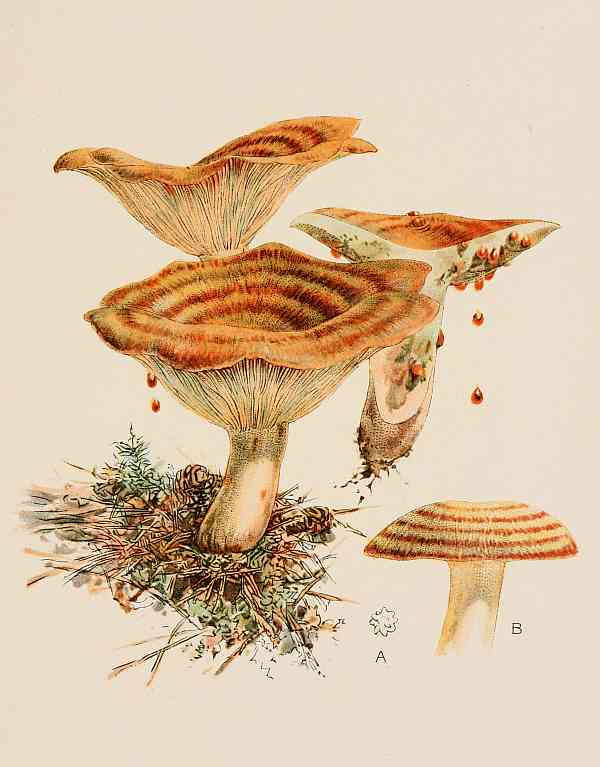
Lactarius Deliciosus.
Mild white-milk species
One other species of Lactarius, L. volemum, may properly find a place in this work as being easily recognized. In general shape it resembles L. deliciosus. The top is of a rich sienna golden hue; the gills are crowded. The milk is white as it first falls from the fracture, becoming dull dark-reddish, and having a mild, pleasant taste; gills white, at length yellowish or buff-colored. This species is esculent.
Peppery white-milk species
Other species are accounted edible, even one—the peppery Lactarius, L. piperatus—a pure-white variety, whose copious exudations of white milk will almost blister the lips, an acrid property which is claimed by Curtis, Smith, and others to be dispelled in cooking, by which treatment it becomes delicious and wholesome.
This species may reach a diameter of seven inches, its shape at first rounded, convex, then flat, concave, and finally funnel-shaped, as in many of the species. But its decidedly ardent tang in the raw state, as reminiscent from my own experience, warns me not to dwell too enthusiastically upon its merits in my limited selection of desirable esculent species.
THE CHANTARELLE
Cantharellus cibarius
Fluted gills
Bearing somewhat the shape of the Lactarius, but having its own distinguishing features, is the Chantarelle (Plate 19).
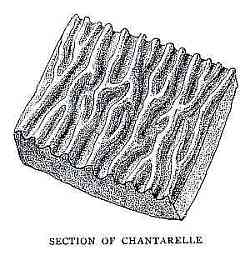
The "Agarics," as already described on page 79, are distinguished by the feature of the gills, or thin laminated curtains—the hymenium—upon which the spores are produced, and from which they are shed beneath the mushroom. These gills vary in thickness and number in the various species, and in one genus are so short, thick, swollen, and branched as to give rather the effect of turgid veins than gills, as shown in the accompanying sectional drawing. We occasionally come upon one of these mushrooms in our walks, usually in the woods. When it first appears the cap is rounded, and the rim folded inward towards the stem; but in mature specimens it assumes the flat or, later, the cup-shaped form shown in Plate 19.

PLATE XIX THE CHANTARELLE
Cantharellus cibarius
Pileus: At first convex, later flat; three to five inches in diameter, with central hollow, and finally almost funnel form. Color, bright to deep yellow above and below.
Gills: Shallow and fluted, resembling swollen veins, branched, more or less interconnected and tapering off down the stem; color same as pileus.
Stem: Solid, generally (often slightly) tapering towards base; paler than pileus or gills.
Spores: Very pale yellow ochre in color; elliptical.
Taste: Peppery and pungent in the raw state; mild and sweet after cooking.
Odor: Suggesting ripe apricots or plums.
Habitat: In woods, especially hemlocks, generally in clusters of two or three, or in lines or arcs of several individuals.
PLATE XIX
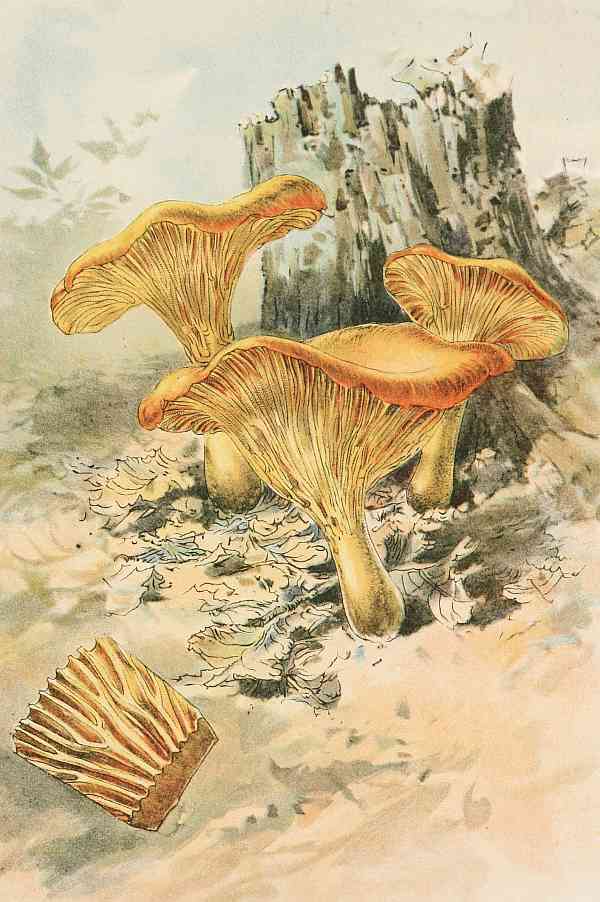
Cantharellus Cibarius.
Botanical characters
A fungus thus formed is a Chantarelle, or Cantharellus, and is readily identified. Any specimen having these features, and which possesses in addition a fine, rich yellow color, is the C. cibarius of our plate, the esculent morsel so highly prized by epicures on the Continent, where to many—perhaps somewhat indiscriminating—gastronomists it forms one of the greatest delicacies among the entire list of edible fungi. The diameter of the mature specimen may reach five inches, though three inches will be nearer the average size. The cap is frequently quite eccentric in its form, wavy-edged, or even folded upon itself in occasional individuals; but the pure, deep yellow color "suggesting the yolk of an egg," and the swollen, vein-like hymenium, generally of a similar color, will be sufficient to distinguish it under any disguise of mere form. Another unique characteristic is its odor, which suggests ripe apricots or plums. The taste of the Chantarelle when raw is pungent and peppery, but this quality disappears in cooking. The spores are of a pale yellow-ochre color, and beneath the microscope are elliptical in shape.
Stewed Chantarelle
From the last of May until early November the Chantarelle may be found in our woods, with more or less frequency, singly or in clusters. According to Dr. Badham, an eminent authority on esculent fungi, "the best ways of dressing the Chantarelle are to stew or mince it by itself, or to combine it with meat or with other fungi. It requires long and gentle stewing to make it tender, but by soaking it in milk the night before, less cooking will be requisite."
But the recipes employed in Great Britain and upon the Continent to the glory of the Chantarelle would almost fill a fair-sized receipt book, and some of them are quite elaborate. A few of these are given in a later chapter. After a trial of a number of them the writer is assured that the simple broiling or frying in butter or oil, with proper seasoning, and serving on toast, will prove a most acceptable substitute.
Another species
Another species of Chantarelle, which might possibly be confounded with the C. cibarius, is the Orange Chantarelle, C. aurantiacus, which is pronounced "scarcely esculent" by the authorities. Its average size is much smaller than the true Chantarelle, and its much deeper orange hue, and straighter, more regularly branched and crowded gills, will readily identify it, the gills of cibarius being thicker, and usually somewhat eccentric and netted. Like the foregoing, it assumes the funnel form with age, as indicated in the generic name, Cantharellus—"a diminutive drinking-cup."