Front matter (continued 2)
Reading edition
"Who is she? Why didn't we see her?" queried the laughing boys as they pressed around Larry, affecting to sniff great delight from his nosegay. Larry's face beamed as he told them that this was a reminder that every Irishman must do his duty, and that he was going to carry the little bouquet to the field of victory for the Catalpas.
"Those pansies grew in Judge Howell's garden," said Ben Burton, surlily, from his seat. Larry's eyes flashed at the covert insult that he thought he saw under Ben's sneer. But he said not a word.
"For shame, Ben Burton!" cried Al Heaton, "for shame to call names like that!"
There was a little cloud over the sun for a fleeting moment. But Larry's bright face and cheery voice soon dispelled the transient shadow, and the talk was turned into merrier channels. Ben Burton grumbled to himself, and, as he saw how his fellows clustered around Larry, whose brown and shining curls were only now and again visible among the lads who pranced about him, he said to Bill Van Orman, "Thinks he's the biggest toad in the puddle; don't he, Bill?" Bill, whose nickname was "The Lily," because he was so big, and red, and beefy, only opened his eyes in surprise.
The telegraph office in Catalpa was in the second story of Niles's building, a brick structure on the main street of the town and chiefly occupied by lawyers and doctors. The narrow stairway was found too narrow for the throngs of people who flocked thither, next day, to learn the news from the contest in Sandy Key. Arrangements had been made by The Catalpa Leaf, the only daily paper in the place, to publish bulletins from the base ball ground, as fast as received. To all inquirers, Miss Millicent Murch, "the accomplished lady operator," as the local newspapers called her, stiffly replied that the telegraph office had no news to give away and that the editor of The Leaf would distribute his intelligence as soon as received.
Even to so great a personage as Judge Howell, who early appeared in search of information, the young lady gave her one unvarying answer. But public excitement ran high when, about two o'clock in the afternoon, a despatch from Al Heaton was received by his father, saying that the game had been called and that "the boys were in tip-top condition." Mr. Heaton signified his intention of staying at the office or thereabouts, until the game was over, in order to receive Al's despatches.
"Is Albert going to send despatches from the ball ground, all day, Mr. Heaton?" asked Alice Howell, who, with sparkling eyes, was eagerly waiting for news from the absent company.
"Indeed he is, Alice," said Mr. Heaton. "That is what he went down to Sandy Key for, and I think you know my boy well enough to believe that he will keep us informed. Al is as much of an enthusiast in base ball matters as you and I are, my dear, and if he is alive and well we will hear from him until the fortunes of the day are decided." Mr. Heaton smiled in a kindly way as he looked down into the bright face of the young lady, and added, "And I believe and hope that he will send us a pleasant message before the day is done. Depend upon that."
"I hope so too, Mr. Heaton," Alice replied, with a slight cloud passing over her countenance, "but somehow, I feel as if we were to be defeated this time. I don't know why. But that is my superstitious notion about it."
Meantime, the telegraph machine had been industriously ticking and Miss Millicent writing as industriously, while the bystanders were talking in low tones.
"A message for Mr. Heaton," said the operator, with perfect composure, as she folded and placed in an envelope, duly addressed, a telegraph despatch which she handed to Mr. Heaton.
"Hateful old thing!" murmured Miss Ida Boardman, "she has had that message all the time and said nothing about it until she got good and ready."
"Hush!" said Alice, in a sort of stage whisper, "let us hear the news."
Mr. Heaton, having glanced hurriedly over the despatch, cried, "Good news from the boys! Hear this!" A dead silence prevailed in the office as the beaming miller read:—
Hurrah for our side! First two innings over. Catalpas score two. Black Hawks none. Great excitement in Sandy Key. Everything lovely.
ALBERT.
"Hooray!" broke from many lips, and the waiting crowd below the windows, hearing the cry, took it up and a fusillade of irregular and scattering hurrahs scattered along the street. Judge Howell, who had lingered during the noonday recess of his court, admonished the crowd that the lady at the telegraph desk would be embarrassed by the confusion, whereupon the company went out and added their joy to that of the assemblage that crowded around a bulletin that was at once posted by the door of The Catalpa Leaf office.
"What did I tell you, Alice," said Miss Ida, regardless of the fact that she had told her nothing. "Didn't I say that the Catalpas would win?"
"But the game has only just begun," said Alice. "I am still hoping and fearing, and I am not going to be put off of my base, so to speak, by the first news which happens to be good. Only two innings, Ida; remember that."
The cheering of the small boys and the excited comments of the still smaller girls, however, proved infectious. One would think that a great battle had been fought, and that victory was already assured to the household troops. The dry-goods man laid down his yard-stick; the carpenter dropped his plane, and even the old bridge-tender forsook his post long enough to stroll into the nearest barber-shop and ask for the news from "the boys" in Sandy Key.
"Another bulletin!" cried Hank Jackson, the burly short stop of the Dean County Nine, as the tall form of Mr. Heaton emerged from the telegraph office. This time, the face of the ardent champion of Catalpa's prowess was not illuminated by a smile. Mounting a convenient dry-goods box, he announced that two more innings had been played and that the score then stood two and two, the Black Hawks having made two runs, and the Catalpas having added nothing to their score. A blank silence fell on the assemblage and Henry Jackson vengefully planted his big fist, with a tremendous thud, upon the short ribs of a side of beef that hung from the doorway of Adee's butcher shop. "That for the Black Hawks," he muttered, with clenched teeth.
But a great triumph was in store for the friends of the absent sons of Catalpa. Even while Alice Howell was trying to cheer her despondent friend Ida with the suggestion that the game was "yet young," the Editor of The Leaf, whose despatches were sent to him across the street in a flying box attached to a wire, put his dishevelled head out of his office window and excitedly cried, "Three cheers for the Catalpa Nine! Fifth inning, Catalpas, five; Black Hawks, one!"
There was something like a little groan for the discomfited Black Hawks and then a wild yell broke out for the home nine. The small boys hurrahed shrilly and lustily, and even the street dogs, sharing in the general joy, barked noisily and aimlessly around the edges of the crowd. Miss Anstress Howell, scanning the joyful mob from the windows of her brother's office, remarked to herself, with aggravated sourness, that it was perfectly ridiculous to see Alice mixing herself up there in the street with a lot of lunatics who were making themselves absurd over a pesky base ball game, away down in Sangamon County. It was unaccountable.
Judge Howell, sitting on his judicial bench in the court-house on the hill, heard the pother in the town below and covertly smiled behind his large white hand to think that the home nine was undoubtedly doing well in Sandy Key.
Once more the traditional enterprise of the daily press vindicated itself with the earliest news, and Editor Downey put out of his office window his uncovered head, every hair of which stood up with excitement, as he bawled, "Sixth inning, Catalpas, none; Black Hawks, two. Seventh inning, no runs scored."
"Now you yoost keep your big fists out of my beef!" said Jake Adee, with his wrathful eye fixed on Hank Jackson, who was looking around for some enemy to punch. There was depression in the crowd, but Alice Howell smiled cheerfully in the rueful face of Mr. Heaton and said that she felt her spirits rising. She was getting more confident as the rest of the party became despondent.
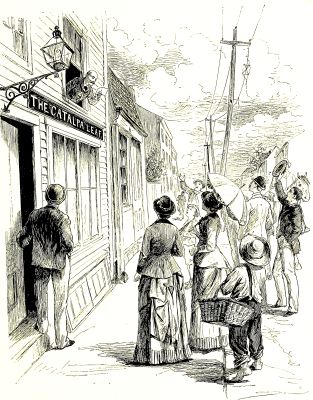
"THREE CHEERS FOR THE CATALPA NINE."—Page 78.
The innings had been made rapidly. Scarcely an hour had passed, and, so intense was the interest in the game, that everybody thought the despatches had trodden upon each other in their hurry to tumble into Catalpa. It was a warm, bright day, and the prairie wind blew softly down the hill above the town. To look into the knots of people standing about the street corners, one would suppose that it was an August noon. Everybody was perspiring. It was a warm engagement down there in Sandy Key where the boys were vigorously doing battle for the honor of old Catalpa. But it seemed even hot in the town where the people waited for the news.
So when Mr. Heaton, radiant with joy, and without waiting to come down the stairs of the telegraph office, put his leg and his head out of the window of the building and cried "Good news again!" everybody stood breathless. As Miss Anstress Howell afterwards remarked, with disdain, one might have heard a pin drop.
Victory! victory! Eighth inning, Catalpas, nine; Black Hawks, none. Glory enough for one day. Your loving son,
ALBERT.
Then went up a shout that reached the jury in the case of the County of Dean against Jeremiah Stowell, shut up in the close room provided in the court-house for jurors and other criminals, and which startled Judge Howell, who, looking out of the window from his private room, beheld his daughter, flushed and almost tearful with joy, hurrying across the court-house green, eager to tell her father the good news. The solitary horse-thief in the jail heard that hurrah and wondered if relief was coming to him from his long-delayed accomplices. Dr. Everett, reining his sturdy steed at the next street corner above the telegraph office, asked a wandering small boy what had happened, but got no answer, for the urchin was off like a shot to tell his mates who were bathing prematurely down under the mill dam. And careful housewives, making ready their early suppers, in houses beyond the railroad track, heard the yell of triumph, and softly laughed to be told in this far-off way that the Catalpa nine were victorious over their adversaries in Sandy Key.
The game was virtually decided. The ninth and last inning showed one run for the Catalpas and a "goose egg" for the Black Hawks. There was more cheering in the street under the windows of the telegraph office. Somebody suggested that the flag should be hoisted on the Court House, but fears of Judge Howell's displeasure and veto prevailed, and the proposition fell dead. Hiram Porter's father, however, raised the stars and stripes over the Catalpa House of which he was proprietor. Editor Downey flung out from his third story window the red bunting with the white Catalpa Leaf that symbolized his standard sheet to the world below.
Later on, when the wild shower of despatches from Al Heaton, Hiram Porter, and others of the home nine, had ceased for a time, this bulletin appeared on the board of The Catalpa Leaf.
A GLORIOUS VICTORY FOR OUR NINE! OLD CATALPA TO THE FRONT!
1 2 3 4 5 6 7 8 9 Catalpas 2 0 0 0 5 0 0 9 1=17. Black Hawks 0 0 0 2 1 2 0 0 0= 5. First Base by errors, Catalpas, 8; Black Hawks, 1. Earned Runs, Catalpas, 7; Black Hawks, 1. Struck out, Catalpas, 2; Black Hawks, 5.
Our esteemed fellow citizen, Benjamin F. Burton, especially distinguished himself with his fine play at short stop, and Larry Boyne, of Sugar Grove, did some of the most brilliant work in the game, having made the highest number of runs of any man in the Nine, and being 'like lightning' as a third base man. Great excitement prevails in Sandy Key, but our men have been treated with distinguished courtesy by the citizens. The receipts at the gate were nearly $1,000.
When Al Heaton came home, next day, he was the hero and oracle of the hour. By reflection, he was shining with the honors of the Catalpa Nine. Wherever he went about the town, he was sure to become the center of an admiring knot of fellow-citizens and small boys, eager to learn how the absent ball-players bore themselves in the arena at Sandy Key.
"I tell you what it is, fellows," said Albert, "you should have seen 'The Lily,' as they call Bill Van Orman, get on the home base in the fifth inning. He never stopped to look for the ball. He seemed to have eyes in the back of his head, and just as he was on the point of being caught out, when he was at least ten feet from the home base, he gave a lunge and threw himself flat on his stomach, ploughed up the turf as he plunged forwards, and, reaching out, grabbed the bag with his hands before he could be put out. Ten feet did I say? Well, I should say it was nearer fifteen feet. And you should have seen 'The Lily's' track where he scooted along that turf."
"The Leaf's correspondent telegraphed that Ben Burton covered himself all over with glory," remarked Jason Elderkin. "How was that?"
"Well, you see that Ben, being at short stop, had many opportunities to do good work, and he put in some very fine licks at different times. For instance, in the first play he put out Harris, the Black Hawk's pitcher, after having muffed the ball, and then picked it up on the run. Everybody said it was one of the best in-field plays of the day. And in the eighth inning, he made a beautiful run, stealing two bases just as easy as falling off a log. Oh, I tell you, Ben is a first-rate player, and they say that the Captain of the Chicago Calumets was down there and wanted to know if Ben would go into their Nine, next season. Ben was very high and mighty about something, and I guess that that was what was the matter with him. He was very much set up about something."
The mention of the famous Calumets evoked much enthusiasm among the base ball connoisseurs of Catalpa, and it was noised about the town that that club might be induced to accept a challenge from the Catalpa Nine. Albert Heaton, when asked what he thought of the possibility of such an event, shook his head.
"I tell you what, Doctor," he said to Dr. Selby, "we all thought it pretty cheeky in our boys to accept a challenge from the Black Hawks, and it is astonishing that we got out of the scrape as well as we did. To be sure, we came off with flying colors, and we have made a great reputation, that is to say, the boys have, for I am not in the Nine. But the Calumets are the champions of the State, and I suppose they will be to the end of the season; to the end of the chapter, unless something very unexpected happens. I guess our boys had better be contented with the laurels they will win outside of Chicago, this year, at any rate."
But that very day while Albert was strolling across the bridge with Miss Alice Howell, and pouring into her ear a glowing account of Larry Boyne's prowess in the field at Sandy Key, he told her, in the strictest confidence, that the Catalpas would never be satisfied until they had measured their strength with the famous Chicago nine, the Calumets.
Alice's eyes sparkled, whether with the excitement stirred by Albert's narrative of Larry's exploits, or at the prospect of so bold a dash for fame as that proposed by the Catalpas, it is not easy to say. The young girl's ardor cooled when she considered the chances against the success of the Catalpas in so unequal a contest.
"I did not believe that we should beat the Black Hawks," said she. "I was almost sure that we should be defeated, and when the tide began to turn in favor of the Catalpas, I could not bring myself to believe that we were actually going to carry off the honors of the day. It was a famous victory, to be sure, and I hope that the Nine will be able to do as well through the season, and then, if all goes well, another season may see them pitted against the best nine in the state, even the best in the country; who knows? They have made a glorious beginning, haven't they, Albert?"
Of course this was conceded by so fast a friend of the absent Nine as Al Heaton certainly was, and it was also clear to even an impartial observer that the Nine had made something of a name for themselves, at the very outset of their career, by defeating the Black Hawks, a Nine of established reputation, victors in many fields.
"What would you think if our nine were to play the Calumets, papa?" asked Alice that night, as they lingered over the tea-table.
"Think?" said the Judge. "I should think that it was a great piece of assurance."
"So should I!" replied Alice; "but I wish they could do it."
CHAPTER VIII.
A TURN OF THE TIDE.
Defeat, utter and overwhelming, followed the Catalpas to Bluford, where they played the "Zoo-Zoo Nine" of that city. The "Zoo-Zoos" were picked players, the lineal descendants of a company of Illinois Zouaves renowned in the Civil War for their bravery, dash, and skill as skirmishers. The original founders of the club had long since disappeared from the field of action, but their successors bore up the banner of their illustrious namesakes with infinite credit. None of the Catalpa people had gone to Bluford to witness the game, Al Heaton being sick at home and the other immediate friends of the Nine being too busy with their farms and merchandise. And so it happened that the only news that came to the town from Bluford dribbled in from the Keokuck evening papers, sent by wire to the editor of The Catalpa Leaf, late at night. Mr. Downey did not think it worth while to post on his bulletin board the discouraging news that the "Zoo-Zoo Nine" had beaten the Catalpas by a score of eleven to one. But the news got out, of course, for the whole town was on the alert to hear the result from Bluford.
Albert Heaton was sitting up in bed, alternately shaken with ague and parched with fever, when his little sister brought him the unwelcome tidings. He groaned aloud and asked if Alice Howell had heard the news. Mrs. Heaton, a motherly woman who had no patience with base ball players that go about the country, like circus-riders, remarked, with some asperity, that she should suppose that Judge Howell would put a stop to Alice's giving so much time and attention to base ball. For herself, if she had a grown-up daughter, she would try and put something else into her head than base ball and such mannish and vulgar doings. If Alice's mother was alive, it would be mighty different in the Howell family. As it was, the Judge allowed Alice to do just about as she pleased, and it was a shame, so it was, for a nice young girl like Alice to be permitted to make a tom-boy of herself. Flirting with that young Irish fellow from Sugar Grove! Did anybody ever hear of the like?
"Oh, mother," sighed poor Albert. "If you only knew how sick and sore I am for the boys, you would let up on Larry. If you had let me go with the Nine, perhaps I might have helped them out of the defeat. At any rate, it might have been less of a clean-out than it is. Dear me! How cold I am! Cover me up and let me be."
With a pang of remorse at having added unwittingly to Albert's sufferings, his mother soothed the sick boy and left him to sorrowful meditations. "And I was fool enough to think that the boys would be able to challenge the Calumets." With these repentant meditations, Albert sunk into a feverish and uneasy sleep. He might have dreamed (perhaps he did) that at that very moment, Alice Howell was looking out into the gloom of the moist summer night and lamenting with bitterness the defeat of "our nine."
Next day, when The Leaf came out, and fuller particulars of the game were made known in a despatch from Charlie King, there was nothing to mitigate the gloom of the friends of the Catalpas. Singularly enough, some of the Dean County Nine, who had been among the most enthusiastic "boomers" of the Catalpa Nine, now assumed a most discouraging attitude. They were sure, so they said, that the Catalpas would be defeated all along the line. They had won the game at Sandy Key by a scratch. They had found their true level in Bluford. They would be beaten along the river, for it was well known that the nines in the river towns were far ahead of those in the interior of the state.
Something of this talk reached the ears of Al Heaton, who was still suffering from fever-and-ague. He took up his bottle of cholagogue and shook it at his terrified little brother (who had retailed the gossip of the drug store, where he had been sent on an errand), and said, "If you hear any such infernal nonsense as that, down town, Dan, you go and tell Tom Selby that I want him to lick the first fellow that says anything against our nine. Do you mind me?"
Little Dan promised stoutly that he would give Tom the message. Whether he did or not, it came to pass that Henry Jackson and Thomas Selby had a discussion, that very night, and that Dr. Selby sent his son home with strict injunctions to cover his face with brown paper and vinegar, while the big-fisted Henry went to bed with a bit of raw beef on his eye.
There is nothing like news from the field of battle to bring out the partisan feelings of a community far from the scene of strife. Catalpa was stirred to its very depths by the ill tidings brought from Bluford. Those who disapproved of base ball asserted themselves in the most unexpected and exasperating manner. Nobody had suspected that there were in Catalpa so many who sympathized not with the home nine and who secretly wished that they might be defeated. But the fact that the nine had met with disaster only stimulated their friends to new courage and stronger hopes for the future. This was a time, they said, for the friends of the nine to show themselves. Mr. Heaton sent an encouraging despatch to Larry Boyne, assuring him that the temporary reverse had only strengthened the confidence of home friends of the club. Even Judge Howell, who was greatly concerned lest the nine should be unduly depressed by their reverses, authorized Lewis Morris to write to Hiram Porter, as Captain of the club, and say to him that the club must be prepared for occasional defeats and that the next news from "the front" would undoubtedly be inspiring to the many supporters of the Catalpas.
"The Judge is a brick!" said Larry Boyne, when this message was read to the members of the club, as they lounged in one of the bed-rooms of Quapaw House, in Galena, where the boys were waiting to begin the championship series of games with the Red Stockings.
"That's just what he is!" exclaimed "The Lily," bringing his somewhat battered fist down with emphasis on a convenient pillow. Bill had had hard luck in the late contest. His fingers had been badly sprained and twisted, and he had played with infinite difficulty on account of the battering that he had received in a game played with the Fulton City Nine, when the Catalpas were on their way to Bluford from Sandy Key. But he was still confident and determined.
"I suppose some of the folks at home think that we are going to get beaten right along, every day from this out," he continued, with a scornful laugh. "They don't know us, do they, Larry? They don't know what we had to contend with in Bluford, what with being used up with that hard ride on the strap-iron railroad and the lame fingers of your humble servant. Oh, yes, I suppose there is downheartedness among the boys at home."
"But I know one chap who is not downhearted," said Larry Boyne, cheerfully, "and that is Al Heaton. He will never get discouraged, whatever happens. And then there is his father, his despatch shows where he stands. Al is clear grit and so is his father; you may depend on that, boys."
Ben Burton, who had virtually lost the game in Bluford by his repeated muffing of the ball, as well as by his failure at the bat, sneered as he said, "I suppose a certain young lady in North Catalpa prompted the Judge's despatch, didn't she, Larry?"
Larry, with reddening cheeks, protested that he had no idea that Judge Howell needed any prompting from anybody to send a good word to the boys when they were away from home; he was too kind-hearted a man, although a little stiff, to require any hint from outsiders to do the fair thing by the Base Ball Club in whose welfare he had already shown great interest.
"I didn't say 'outsiders,' Larry," replied Burton, persistently. "I said that he was probably prompted by a young lady."
At this, Larry deliberately rose and walked out of the room, without a word.
"I say, Ben, can't you quit your everlasting nagging of Larry," broke in Hiram Porter, as the door closed with a bang behind that indignant young man. "What's the use of your getting into a debate, every day or two, about some mysterious young lady that you two fellows are thinking about? Let up! I wish you would."
Ben muttered something about the Captain's showing his little brief authority in matters that did not concern the club, when, by general consent, the meeting was broken up for the more important business of practice on the Galena Base Ball Grounds, placed at the disposal of the visitors by the managers of the championship series.
CHAPTER IX.
HOPE AND SUSPENSE.
It was the custom in Catalpa for the storekeepers to hang out at their doors a little blue flag when they wanted the services of an errand boy. Seeing this signal at the door of Jason Elderkin's dry-goods store, Rough and Ready, wearing in the heats of summer as in winter his 'coonskin cap, shambled in and asked what was wanted. Jason lifted his spectacles from his nose and said, jocularly: "Why, Rough and Ready, I thought you had gone up to Galena to see the match between the boys and the Galena Club."
"No sir-ee," replied the old man, "I have staid at home to keep the town in order. Me and Jedge Howell, we have to look after the boys at home, you know, or some of these frisky young colts like Jase Ayres would get away with the town whilst we were gone." And the old man chuckled as he added, "Cap. Heaton, he and his boy Al have gone together, and they do say that Mrs. Heaton is just wild because she can't keep the old man at home when base ball is going on. Well, it does beat all natur', don't it? Here's Al kept out of the Nine because it isn't high-toned enough for Mrs. Heaton; and here's father and son gone a-galivanting up to Galena to see the show."
"I hear that Al has sent a despatch to the Judge's daughter saying that the Catalpas are going to carry off the honors this time, and no mistake," said the storekeeper. "How's that, Rough?"
"Seein' as how this bundle is going over to Boardman's, I'll jest drop in at the Jedge's house on my way back, and see if Miss Ally has got any news from the seat of war, as it were, and if she has, she'll be sure to tell me. Oh, she's clear grit, too, is that gal, and she knows that I set a heap by Larry. Larry! why, it was him what give my boy all the points he has got in the game, and you may lay your bottom dollar that that boy is goin' to be the all-firedest batter in the Stone River country; and you put that down to remember."
The garrulous old man shouldered his bundle as he spoke and plodded down Bridge Street and so across to the north side of the town. It was the day for the first game of the championship at Galena. The hot sun poured down into the Stone River Valley with great power, and the bleached surface of the old wooden bridge shimmered with undulating lines of heat as Rough and Ready toiled on his way. The roar of the dam had a cooling sound, and the group of cotton-woods and willows on the little island above were green and refreshing to the eye. But no breeze drew up the river, and all of the north side was steeped in liquid sunshine, the trees standing motionless and the yellow road glaring in the blinding light. The toll-keeper's dog panted in the shade of the toll-house, lolling his tongue as old Rough and Ready passed by, without stopping for a word of gossip with the keeper who dozed within the doorway.
The old man paused, when half-way across the bridge, to lift his furry cap from his head and wipe the servile drops from off his burning brow. While he rested his bundle on the guard rail of the bridge, Miss Anstress Howell, the Judge's aged sister, came mincing along from the North Catalpa side, cool and fresh as if she had never before been outside of a bandbox.
"I wonder ef it will be safe to tackle her for news from Galena?" muttered the old man to himself. "She's a dangerous team to fool with. Mebbe she'll get away with me, but I'll try it."
"Good arternoon, Miss Howell. Fine hot day. Good growin' weather, as the farmers say. Hev you heerd that any of your folks got a despatch from Galena givin' any account of how the ball opens?"
Miss Howell's manner stiffened a little as she said, with a slight toss of her head, "Judge Howell, my brother, is holding court in Pawpaw, to-day, for Judge Sniffles, and nobody else but the Judge would be likely to have any despatches concerning base ball."
"Well, Miss Howell, I heerd over in town that Miss Ally had a message of some kind, no offence to you, marm, and I want to hear from the boys powerful bad, you see, and so I make bold to ask if Miss Alice mayn't hev a despatch, or something from Larry, I mean Al."
"There is altogether too much nonsense about this base ball business in Catalpa, Mr. Rough,—excuse me, I forget your other name. It does seem to me as if the people had gone crazy, and the weather so hot too! Excuse me, I don't know anything about what is going on in Galena, no more than a child, I may say, and if any grown people want to begin over again and make children of themselves with playing ball, they have my sympathy."
So saying, and flirting off an imaginary fleck of dust from her gown with a spotless handkerchief, Miss Howell resumed her deliberate walk across the bridge. Rough and Ready replaced his cap, and looking after her said, "Sarves me right! I might hev knowed that I should get the worst on it in a talk with her. My grief! But she is a teaser. Has forgot all about the time when she was a young gal, it's so long ago. P'raps she never was young." With this, the old man shouldered his bundle and slowly made his way northward.
But Alice had received a telegram from Galena, and as Rough and Ready climbed the slope by the Judge's house, a sunny head was popped from one of its upper windows and Alice's cheerful voice cried, "Oh, Roughy,—excuse me for calling you Roughy, but I'm so glad!—Albert Heaton has telegraphed to me that the Catalpas have made ten runs in the first three innings and the Galenas only one! Isn't that perfectly splendid? Does anybody over in town know anything about it?"
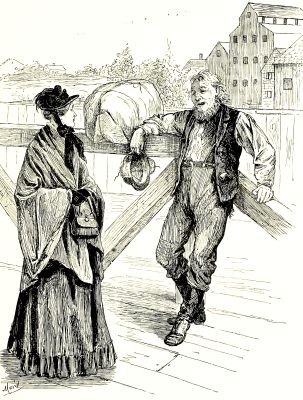
"GOOD ARTERNOON, MISS HOWELL. FINE HOT DAY."—Page 95.
"Bless your bright eyes! Miss Ally, no; the whole town's asleep. It's a hot day, you know, and there's nobody stirring. All the farmers are busy with their crops, and the streets are as lonesome as a last year's bird's nest. Ten to one, did you say? By the great horn spoon! I must go back and wake up the folks."
Suiting the action to the word, the old man tossed Mrs. Boardman's bundle of sheeting over the fence and made his way back to town as fast as his rheumatic legs would carry him. Half way across, he met Lewis Morris who was on his way over to verify the rumor that he had caught concerning the early success of the Catalpas in Galena.
"Hooray for our side!" cried Rough and Ready, exultingly. "I have heard it from the gentle Miss Ally. Our boys have made ten runs in the first three innings, and the Galena fellows have made one—one whole one."
"Then I'll turn right around and tell the news in town!" said Lewis, with excitement. "I'll have to stir the people up, for the whole town has gone to sleep, except Dr. Selby, and he was sweating at every pore, as I came by the drug store, for thinking of another defeat for the Catalpas."
Rough and Ready gazed after the rapidly retreating form of the young man who turned and stepped swiftly across the bridge. Then, putting his hand to his 'coonskin cap, as if trying to recall something to his mind, he murmured, "If I didn't go and leave that ther bundle of sheetin' in the Judge's dooryard! 'Pears to me as if that pesky base ball had knocked my wits clean out." And, smiling at his own feeble joke, he retraced his steps to the North Catalpa side of the river.
When Lewis Morris reached the center of the town, he saw a knot of men and boys gathered around the bulletin board of The Leaf. "Just my luck," he muttered. "Downey has got the news out, and they have taken the edge of it off before I could get back."
But Lewis forgot his little disappointment when he eagerly scanned the bulletin which the editor had posted during his brief run across the bridge. This was what he read:
An overwhelming victory for our nine! In the contest to-day, the Catalpas were the victors by a score of 13 to 3. Great enthusiasm prevails and the visiting nine are now being cheered by the excited populace. The result has astonished everybody, none more so than the defeated nine and their immediate friends. Our esteemed fellow townsman, Mr. Albert Heaton, Senior, has telegraphed to The Leaf the score by innings, as follows:
1 2 3 4 5 6 7 8 9 total. Catalpas 5 4 1 0 0 2 1 0 0 13. Galenas 1 0 0 0 0 0 1 0 1 3. Errors, Galenas, 13; Catalpas, 1.
"Here's Lew Morris!" cried brawny Hank Jackson, "Glory enough for one day! hey, Lew? Everybody in Galena was astonished, they say, and so was everybody in Catalpa, for that matter. Why, I was just coming along the street with Andy Brubaker, and we was a-talking about the chances of our nine's giving up the season if they got cleaned out in Galena, when I heard Mr. Downey tell Dr. Selby that the home nine had beat the Galenas on the first six innings, and says I to him, 'If that's so, Mr. Downey, why don't you put it on the bulletin?' Sure enough, he went up them stairs, five at a time, to have it done, and no sooner had he got up there than he put his head outen the winder and screeched, 'The Catalpas have won the game by thirteen to three!' Gosh! you should have heerd the whoop that the boys gave! And there it is, as big as life." And Hank regarded the bulletin board with an affectionate interest.
The fact was that the community of Catalpa was unprepared for any such victory as that which had dropped in upon them, as it were, like a bolt out of a clear sky. The defeat at Bluford had unnerved all but a few faithful and undaunted spirits, and the usual dull current of town life had resumed its sluggishness until the unexpected news from the north had startled the townsfolk into new alertness. It was a great achievement, as the Galenas were famed for their prowess in the Diamond Field. They were reckoned as first in the number of batters in their nine. One of them, Devoy, stood very near the head of the list of champion batters in the state, and another, Shallcross, was not far behind him in his general average. Yet the Catalpas had "got away with" the famous players. It was marvellous how the news flew through the town and out upon the prairie, so that by the time the moon rose, red and full, over the bluffy banks above Catalpa, in innumerable cabins and farm-houses, far out on the distant wheat-farms, and over many an evening meal, the details of the triumph and its probable effect on the fortunes of "our nine" were discussed with a glow of pride, or with a lively curiosity.
"The boys," in Galena, resting from their labors, and withdrawn from the admiring attention of the citizens of the town, lounged in a big bedroom in the Quapaw House, and told, over and over again, the stirring incidents of the day—incidents on which so much depended that they now became almost like ancient history in importance. They were not too tired to play another game right then, so exhilarated were they by their unwonted success. There was no murmuring, no jealousy, and no "nagging" in the party now. Every man was elated and flushed with a sense of his own value as a factor in the game that had been played, as well as in that which was to be played on the morrow.
"Somehow, boys, I feel it in my bones that we are going to beat to-morrow," said Larry Boyne, who had won fresh laurels in the field, that day. And Larry's bright eyes sparkled anew as he spoke.
"Well, that's a new rôle for you to play, Larry," said Al Heaton who was admiringly hanging over Larry, whom he regarded as the rising player of the country. "You always were a croaker, you know, Larry, old boy, and for you to say that you feel confident of victory now, makes me almost shudder. It seems as if you were losing your head; only I know you are not."
"No, old chap, I am not losing my head. But you know I am rather superstitious; at least, my mother says so, and I have a queer notion, to-night, that we are going to do as well to-morrow as we did to-day."
"That's an encouraging sign, Larry," broke in Captain Hiram Porter. "But you fellows must all do your level best, all the same, and we mustn't let any notion of our superiority run away with us, for we are not superior, perhaps except that I do think that we are better fielders than the Galena boys."
"Whatever happens to-morrow, Al," said Larry, as they broke up their sitting for the night. "Put it down that I said that we were to win the second game in this championship series."
"And if we lose, you will charge it to some adverse fate, won't you, Larry?"
"In the bright lexicon—you know the rest, Al."
By a singular coincidence, at that very hour, Miss Alice Howell, writing to her father the glad news, added a postscript thus: "You will think me overconfident, but I am sure the Catalpas will win the championship."
CHAPTER X.
HOW THE GOOD NEWS CAME.
Catalpa was wide awake, next day, although the weather was hotter than ever and the little breeze that drew in from the prairie was laden with heat. The unexpected result of yesterday's game had set everybody to speculating on the issue of this day's contest. Some scandal was created by the appearance of Hank Jackson on the street with a roll of bills, offering to make bets on the game. It had never been the custom of anybody in Catalpa to wager anything on a base ball game, and there was some frowning now on the part of conservative and upright people; and those who were not specially conservative, but who disapproved of gaming, did not hesitate to reprove Hank in terms more forcible than elegant. Hank had spent some days in Bloomington, where he had frequented pool rooms and had acquired a taste for betting, and his brief experience was regarded by the younger portion of Catalpa with much awe and interest. He was followed about by the smaller boys of the town who listened while he bantered some of his cronies into making bets.
But public opinion in Catalpa was not yet educated to the point of engaging in gambling on the uncertain result of a base ball game. Added to this, it should be said, was Hank's persistence in offering bets on the defeat of the home nine. That was an unpopular side. Almost everybody wanted the Catalpas to win the game. It would decide the championship; and, although it was almost too much to hope for, there was a feeling of confidence through the town that was quite inexplicable. So, Hank, after making a swaggering tour of the shops and stores, but without receiving much popular countenance, quietly dropped out of the throngs which gathered at the street corners and in other public places. It was in vain that he argued with rude logic that it was just as safe to bet on a base ball game as on a horse race. Very few who listened to him cared to encourage this new sort of gambling.
This time, it was Al Heaton who fired the heart of Catalpa with the first intelligence from the Diamond Field. It was nearly three o'clock when his first despatch arrived, and the game had been called at two o'clock. There was much grumbling in the main street of the town, where numerous groups stood in the shade of awnings and tall buildings, waiting for the news. The windows of The Leaf office opened on this street, as well as on the side street on which the telegraph office was situated. Editor Downey had announced that he had made arrangements with Albert to send news directly from the base ball grounds in Galena, and that he would display a bulletin from his office windows.
Accordingly, when there was hung out a big white sheet of paper, with black lettering thereon, the assembly below was hushed in expectation. The despatch ran thus:
Everybody confident. Larry Boyne says our nine will win the game. Weather hot, and the dust intolerable. Look out for fun.
ALBERT HEATON.
"What does he mean by looking out for fun; and who cares what Larry Boyne thinks?" growled Hank Jackson. "I should think he might send us something more bracing than that by this time."
But the straggling cheer that greeted Albert's encouraging message drowned Jackson's grumbling, and the crowd showed by their excitement that they were ready to accept the slightest omen as proof positive that the Catalpa nine would carry the day. So, when Judge Howell's carriage drove up and halted under the shade of the huge catalpa tree that grew in front of Dr. Selby's drug store, from which the fair Alice could see the throng and watch for the bulletin from the newspaper office, there was a little hurrah from some of the younger lads. They seemed to think that the young lady, in some fashion, represented the absent Judge, who was now recognized as one of the steadfast friends of the band of heroes.
"That's a good sign! I'll swear to gracious!" said Rough and Ready, in a low and hoarse whisper, as he saw the Judge's handsome bays, champing their bits, and prancing uneasily under the shade of the spreading catalpa. "It's a good sign, for that gal never went back on the nine, and her coming will bring good luck. Mark my words, Jake!" Jake, the big butcher, nodded his head and only said "yaw," when the bulletin was again flung out from the window of the printing-office.
The magical black letters were read in silence broken only by the stamping of the horses tethered along the street and worried by the flies. This is what the eager spectators read:
First inning—Catalpas, 1; Galenas, 0.
"A big round goose egg!" screamed Lew Morris, with delight. Then he raised a hurrah, and the small boys took up the yell. Horses jumped and tore at their halters and vagrant dogs barked madly about the street. Then there were smiles and even broad laughter among the devoted supporters of the home nine. Almost everybody looked pleased, and Dr. Selby, with the easy confidence of an old friend, went to the side of the Judge's carriage and shook hands heartily with Miss Alice who was waving her parasol with a vague notion that it was necessary to celebrate the auspicious opening of the game.
"I didn't tell you, did I, doctor, that I dreamed, last night, that we had won the game? Well, I did. Aunt Anstress says that dreams go by contraries and that that means our nine will be defeated. But I don't believe that; do you, doctor?"
"Well, I don't believe in dreams, anyhow, Miss Alice, and so I hardly think that that counts. But we will keep on thinking that the boys will beat, to-day, and even if we are disappointed, we have yet one more chance."
The doctor, accepting Alice's invitation, took a seat in the carriage from which advantageous point he looked over the gathering throng, now reinforced by arrivals from the region roundabout the town, for the news had gone forth that despatches were coming in from Al Heaton, and every man, woman and child who had the least interest in the game (and these were many) and could leave the labors and duties of the day, was there to hear.
"It looks as it did in the war, when the news from Shiloh and Vicksburg was coming in; doesn't it, doctor?"
"I don't know about that, Alice. I was in the war, myself, you know; was at Port Hudson and Vicksburg. You were a baby then, and I believe your father was in Congress. Yes, I guess it does look like war times. But see! There comes another bulletin!"
Editor Downey had rigorously excluded from his office all outsiders, and was devoting his personal attention to the all-important business of the day. With his own hands, he hung out the paper sheet bearing these words:
2d inning,—Catalpas, 0; Galenas, 1; 3d inning, Catalpas, 0; Galenas, 0.
"Not so good as it might be," remarked Dr. Selby, cheerfully, "but it will grow better, by and by."
A little cloud passed over the face of Alice, and she bit her lip with vexation as Hank Jackson bawled with a rough voice, "Ten to five on the Galenas!"
"If I were a man, I'd like to take that offer," she said, her eyes sparkling.
"Oh, no, you wouldn't, Alice," cried her friend Ida. "You wouldn't encourage gambling on base ball, I'm sure."
"Perhaps not; but if I were a man, I would like to thrash that big ruffian."
Better news came, after a little while. The bulletin for the fourth inning showed four for the Catalpas and a big round "0" for their opponents. At this, there was a general and apparently concerted hurrah from the company in the street below. Editor Downey, as if thinking the cheer a personal compliment, put his frowsy head out of the window and bowed with as much grace as was possible under the circumstances.
"Mr. Downey's hair looks as if he was laboring under great excitement," said the apothecary, blandly smiling at the editor's somewhat towseled appearance. "Every individual hair is standing on end, as if he were charged with electricity."
Alice laughed joyously and seemed glad to find something under which she could cover her great elation at the good news from the North. Miss Ida uttered sarcastic remarks about the editor's exuberant comments in the morning paper regarding the coming contest in Galena. She declared that she did not think the game nearly as important as any one of the decisive battles of the war. And she was sure that The Leaf would be perfectly ridiculous, next day, if the Catalpas were to win the championship. Her remarks were cut short by the display of another bulletin announcing the result of the fifth inning in these terms:—
Hurrah for our nine! Fifth inning—Catalpas, 0; Galenas, 0.
"What in thunder does that mean?" asked Lew Morris, angrily. "Why does the numbskull tell us to hurrah for our nine when both sides have a zero?"
A yell of derision went up from the crowd, and the editor, hearing groans and cat-calls in the street below, put out his head and, with much trepidation, cried, "It was a mistake. I forgot to put on the sixth inning. Catalpas, one; Galenas, nix!"
A loud laugh greeted this sally, and the crowd good-humoredly proposed three cheers for The Catalpa Leaf, which were given in a random fashion, mingled with laughter. Mr. Downey, now well-smeared with ink, and perspiring with excitement, acknowledged the salute with gravity.
"Six innings played and the Catalpas are six to the Galena's one!" exclaimed Alice, who was keeping the score with an assiduity that seemed to come from a belief that exactness in the figures would, somehow, affect the final result. Scraps of paper, on which observers had marked the score and had set down their prognostications of the innings yet to come, were circulated through the crowd. The Catalpas now had the lead, and it would be difficult for their adversaries to come up with them.
Lew Morris, leaning on the door of the carriage, chatted with Alice, drawing on his vivid imagination for pictures of the nine as they were probably looking now, away up there in Galena. He could see, he thought, Hiram Porter devouring the ground as he made his bases with a giant's stride, his handsome face glowing with mingled heat and determination. He could even hear Larry's voice, in a stage whisper, crying, "Go it, Hiram!" And he could see Larry, at third base, when the Catalpas were in the field, making one of those superb running catches of his, Ben Burton looking on, "as if he would eat him up," added Lewis, jocularly.
"Why should Ben want to eat Larry up?" asked Dr. Selby, innocently. "Does he love him so?"
"On the contrary, quite the reverse," laughed Lewis. "Larry is showing himself to be the best player in the nine, and as Ben thought that he was the best, and is finding out that he is not, he loves Larry accordingly. Besides that, he is jealous of Larry for other reasons," and the young man fixed a bold look on the blushing face of Miss Alice. She turned away to see if another bulletin were not ready, and the doctor shook his head deprecatingly at Lewis.
There was much time for talk, however, before another despatch from the seat of war appeared. The impatient crowd, panting in the heat that was more and more oppressive as the sun approached the west, flung all sorts of appeals upwards to the windows of the office of The Leaf. There was no response, although Mr. Downey, as if to contradict Hank Jackson's loud jeer that the editor had gone to sleep, showed his shaggy head at the window and made a negative motion with the same. There was no news.
Finally, just as some of the less patient were beginning to make their way homewards, like a banner of victory, the sheet of paper again appeared. This time, it was blazoned with these returns:—
7th inning—Catalpas, 1; Galenas, 0; 8th inning—Catalpas, 0; Galenas, 1.
"An even thing for the two innings!" cried Lew Morris triumphantly. "The Galenas cannot possibly pull up in the last inning! The game is ours! The game is ours!"
Lew's jubilant shout was taken up by the crowd, which now grew denser again, and the excitement mounted to fever heat as the sun sank behind the cotton-woods below the town. Satisfied that the game and the championship were virtually won, some of the elder citizens, after exchanging congratulations with everybody that had a word of joy on their lips, walked homewards. But some of them stopped on the road and turned a listening ear towards the main street to hear the rousing cheer that soon went up, telling the town and all the Stone River Valley that the game was won and that our nine had captured the pennant of Northern Illinois.
A grimy and inky young imp, on the roof of The Leaf building, hoisted a particularly inky and grimy flag as the editor hung out from his window this bulletin:—
The victory is complete! Old Catalpa to the front! Glory enough for one day! Following is the score by innings:
1 2 3 4 5 6 7 8 9 total. Catalpas 1 0 0 4 0 1 1 0 1 8. Galenas 0 1 0 0 0 0 0 1 1 3.
The Galenas will banquet the Catalpas at the Quapaw House, this evening, when a right royal time is expected.
ALBERT HEATON.
"And now for the championship of the State, dad?" shouted Tom Selby, exultingly, as his father descended from the carriage of the Judge. Alice, who was beaming with delight, could hardly speak her joy. The great contest was over, and the home nine would come back covered with glory. But she shook her head at Tom's vain-glorious remark. The league games were all made up for the season, she knew, and it would be difficult, if not impossible, to secure a challenge from any club in the league. Oh, no, she couldn't think of it. Tom must not think of it, at least, not until another summer.
The good doctor smiled at the lad's enthusiasm and said that glory enough for one day meant glory enough for one season. There were other contests before the home nine, and they could be content, or they should be, to wear the laurels already won, whatever happened to them hereafter. They could not lose any prestige by any manner of means.
When Judge Howell arrived by the early evening train from Pawpaw, he was surprised to see the dingy flag of The Catalpa Leaf drooping lazily from its staff. He had not forgotten that the second game in the Northern District Championship was to have been played that afternoon; and he remembered his daughter's prediction of success. But it seemed incredible that this should have actually come to pass. As he alighted from the train, his judicial dignity a little soiled by travel and perspiration, he was met by Rough and Ready, who, with a slight touch of his 'coonskin cap, the only recognition of high station of which he was ever capable, said, "Any baggage, Jedge? carry it as cheap as anybody. Our nine has flaxed out the Galenas—eight to three! Big thing, Jedge! Lemme take that grip-sack. Great day for old Catalpa, Jedge. Your darter, she said as how she allowed that you mought like to get the news straight, so I told her I'd come up and tell you quick. Thank you, Jedge." And, dropping a silver quarter into his pocket, Rough and Ready turned and collared a stranger from whom he wrested his valise and marched triumphantly down into the town.
When the Judge, clothed once more in the dignity of cleanliness and his home headship, heard that night from the animated lips of his daughter the story of the winning of the championship, he said, with an air of graceful condescension, "It was a famous victory, Alice. We have reason to be proud of our nine; and I will venture to say that when we get the full particulars of the game, we shall find that that fine-looking young fellow, Lawrence Boyne, contributed the largest share to the triumph."
When the details of the game were brought to Catalpa, next day, in a letter to The Leaf, it was found that the Judge knew just what he was talking about.
But greater news than this came with Larry Boyne and Hiram Porter, a week or two later. The nine had been playing a few games along the river towns and had rested for a day or two in Rock Island, after playing the Dacotahs of that city. Several of the nine took advantage of a lull in their engagements to visit Catalpa. Mr. Heaton and Albert had returned home, and Larry and Hiram had gone to Chicago on some mysterious errand, nobody knew just what. Neddie Ellis was one of those who had come back to Catalpa while the time was passing before they should play the new series of games beginning with the Moline club. Neddie looked very wise when asked where Larry and Hiram had gone, and Albert Heaton assumed a most important air whenever he said anything about the doings of the two absent members of the nine.
But it all came out in due time. Captain Porter and his trusty lieutenant arrived by the noon train, and before the sun had set everybody in Catalpa knew that a match had been arranged between the Catalpa nine and the Calumet club for the State Championship. It was indeed wonderful news, and nothing since the war had happened to stir the population of that region as the intelligence. There were divers opinions regarding this unexpected development. Many thought that it was indiscreet for so young and green a club as the Catalpas to challenge the Calumets—the famous and renowned Calumets. Then there were others who thought that it was presumptuous for the Catalpa boys even so much as to ask any leading club to play them merely because a triumph had been unexpectedly achieved in Galena. But all agreed that it was a great feather in the cap of "our nine" that the Chicago club should have accepted the challenge, or should have agreed to meet them on any terms whatever.
"I am not certain whether I am glad or sorry that our nine will play the Calumets, papa," said Alice Howell. "I mean that I cannot tell yet whether I shall be disappointed if they lose. I depend a great deal on my impressions, you know, and I haven't any as yet."
The Judge smiled at his daughter's odd notion of waiting for impressions, and replied, "I do not wait for any inspiration on the subject, my child. I am sure that the Catalpa nine will be badly beaten. I don't know much about base ball, but I do know enough to know that the Calumet club has been in the newspapers for a long time as the great base ball club of the northwest."
"That's so, papa," sighed Alice, "and I have dreadful forebodings when I think of the risk that they have undertaken."
"Nothing venture, nothing have, Alice, and it will be no disgrace if our nine are defeated by the Calumets. Unless they are very badly beaten indeed, and that is not improbable, to be sure, they will bring some new honors off the field."
The Judge's conservative and moderate view of the case was that of the average of Catalpa. To play the Calumets was in itself an honor.
Henry Jackson represented the most discouraging element in Catalpa public opinion. And when Ben Burton returned to town for a day's holiday, and became at once unusually familiar with Hank, Larry's face clouded and Alice Howell confidentially informed her friend Ida Boardman that she never could abide Ben Burton, and that now she knew he was a man who would consort with mean companions. Nothing could be lower, she thought, than the course that Henry Jackson had taken during the late contest between the Catalpas and the Galenas.
It was only by a lucky accident that the Calumets had been able to find a place in their later engagements for a championship series of three games with the Catalpas. The sudden sickness of several members of the Osceola club, engaged to play the Calumets, had made it necessary to cancel all the engagements of the former club for the season. The Osceolas had been overtaken by a contagious disease that had made sad havoc that summer, as many will remember, among strangers who visited the lower portion of the State, which had been under water from late in February until the beginning of May. But the ill-luck of the Osceola club was the means of opening a way for the Catalpas to play the Calumets; and that was felt to be something almost providential—at least, in the town of Catalpa.
CHAPTER XI.
IN A NEW FIELD.
"I wish so many of the Catalpa folks had not come in to see the game, to-day," said Larry Boyne, discontentedly, on the morning of the first of the championship series of games in Chicago, late in the following October. "It is bad enough to feel like a cat in a strange garret as I do here, without the feeling added of being watched by our friends from home, who will be so awfully cut up if we do not win."
"But you are not afraid of our losing, are you, Larry? And I am sure there is one young lady, at least, whose smiles will encourage you," said Hiram Porter, with a grin that was meant to be sly and also cheery. "It is pretty generally understood among the boys (and as long as we are alone together, there is no need of our being shamefaced about it) that you and Miss Alice have come to an understanding, as the saying is. You needn't say whether that is so or not, Larry, my boy. But, if I were in your place, I would be glad to have those beautiful and sympathetic eyes watching my play. It would make me put in my very best licks, you may be sure of that."
Larry murmured something about there being a difference in people, and turned the subject to the preparations to be made for the day's event. The Catalpas had had only a little opportunity to make themselves familiar with the Chicago base ball grounds. At the end of a game played on the previous day, they had a little practice at pitching, and had taken in the situation of the arena sufficiently to enable them to be not entirely strangers to the place.
They found themselves inside of a complete enclosure, skirted by a grand stand at one end and uncovered and open seats at the other. A high board fence bounded the grassy lawn on which the Diamond Field was laid, and the seats for spectators rose above this fence, so that the players were securely left to their own devices while the game should be in progress. A breeze from the lake, tempered by the October sun, swept over the grounds, and was broken, when the wind arose, by the screen formed by the board enclosure.
When the nine, with beating hearts and quickened pulses, entered the grounds on the day so fraught with importance to them, they were a little dumbfounded to see that an immense crowd of people, perhaps ten thousand, all told, occupied the vast array of seats that lined the amphitheater. A brass band blared and brayed in a tall stand set apart for them, and the entrance of the Catalpa nine was the signal for a burst of kindly applause that helped to reassure the lads composing that now well-known club. Since the matches played in the river towns, the nine had met some of the best-known clubs in the State, and in Iowa. With varying success, but generally doing credit to their own native place, the Catalpas had attracted attention by their uniformly excellent play, their manly bearing, and by their steady habits. They had made no enemies. So, when the young fellows, clad in their blue and white uniform, came into the range of vision of the throngs in the grand stand and boxes, a round of applause greeted them, and one enthusiastic citizen from Catalpa, no less a person than the deputy sheriff of Dean County, ventured to propose three cheers for the Catalpa nine. The proposition fell very flat, and, covered with confusion, the deputy sheriff sat down and mopped his manly brow.
As Hiram Porter threw up the penny for the toss, Larry's eye involuntarily sought a curtained box to which his attention had been directed, the day before, as he had inspected the grounds in company with Miss Ida Boardman, Miss Alice Howell and two other ladies from Catalpa. The party was under the guidance of Mr. Heaton. Albert was never long in one place. He was too highly excited to be depended upon as an escort for the young ladies, and he divided his time between his old companions of the Catalpa nine and the pitcher of the Calumets, Samuel Morse, an old school chum, who had helped signally in arranging the present contest.
So, as Larry's glance lighted on the first box to the right of the grand stand, it caught an answering smile from Miss Alice, and Albert Heaton, who was momentarily fluttering about the box, waved his hand to the favorite third base man of the Catalpas and said, under his breath, "Sail in, old boy!"
"You don't imagine that Mr. Boyne heard that, do you, in all this noise?" asked Alice, with rosy face and sparkling eyes.
"No, I don't suppose that Larry heard or saw anything but what he saw and guessed at in that telegraphic look of yours, Miss Ally," replied Albert, mockingly. "Larry, the dear boy, knows well enough what I would be saying to him; and I hope he knows what you would be telegraphing him by way of encouragement. Hurrah! Hiram has won the toss! He'll send the Calumets to the bat, see if he don't."
Albert was right. The home club were sent to the bat, and Thomas Walsh, of the Black Hawks, took his place as umpire. This was the order in which the two clubs were named and stationed on that eventful day:—
Catalpas. Larry Boyne, 3d B. Samuel Morrison, L.F. Neddie Ellis, C.F. Charlie King, P. Hart Stirling, 2d B. John Brubaker, R.F. Hiram Porter, 1st B. (Capt.) Ben Burton, S.S. Wm. Van Orman, C. Calumets. Darius Ayres, 1st B. (Capt.) Samuel Morse, P. John Handy, 3d B. Rob Peabody, R.F. Thomas Shoff, C.F. Glenn Otto, S.S. James Kennedy, 2d B. Charlie Webb, C. James McWilliams, L.F.
The Catalpa boys thought there should have been breathless silence in the enclosure as Hiram Porter, having carefully placed his men, called to the umpire "play!" Play was accordingly called, but there was silence, by no means, in the grounds. The clatter of late comers reaching their seats, the buzz of conversation that yet arose from the crowds in the amphitheater, and the cry of boys selling score-cards disturbed the serenity of the ardent champions of the Catalpa Nine. They wondered why people should talk when so momentous a game was about opening. And Alice, with a feverish sigh of impatience, said to Miss Ida that she should think that the Chicago people had very little manners. Whereupon Miss Anstress, with great severity, said that the spectators were not so much in love with the players that they cared a pin whether either side won. This unkind remark was turned aside by Mr. Heaton who said that there were not a few among the on-lookers who had bet money in the gambling rooms outside and who did care very much which side won the game.
All this talk was brought to an end when Darius Ayres, the captain of the Calumets, stood up at the bat and made ready for the first play. Darius was a tall and shapely young fellow, renowned for his long-field hits, and a swift runner. He had an evil look in his eyes, as some of the Catalpa visitors thought, and when he struck a straight ball, like a cannon shot, to right field, there was a little shudder in one of the private boxes. But John Brubaker, always alert, captured it on a hard run. This put the Catalpas in good spirits at once. The game had opened well for them. "Two good signs, Alice," said Ida Boardman. "Won the toss and caught out the first man!"
John's clever catch did not pass unnoticed, for the numerous supporters of the Catalpas raised a little cheer which was taken up and continued around the enclosure as Sam Morse went to the bat for the home club. But Samuel fared no better than his captain, and retired on a short and easy fly to Ben Burton. The first half of the inning was ended by John Handy, who hit a hot grounder to Larry Boyne at third base. Larry mastered it in fine style and made a lightning throw to Hiram Porter on first base. The eyes of the visitors and their friends fairly sparkled as the Catalpas came in from the field. They had made a good beginning.
But no sooner had the nine reached the players' bench than Ben Burton began to criticise the manner in which honest John Brubaker had been rewarded for capturing what Ben was pleased to call "a two-old-cat fly." Larry, politely requesting Burton to be civil, picked up his bat and faced the pitching of the renowned Sam Morse. He made two ineffectual plunges at the ball, and, while the catcher of the Calumets was adjusting his mask so as to enable him to come up closer to the player, Larry stole a glance at his comrades and was mortified and annoyed to see a derisive smile on the blonde face of Ben Burton, while the other seven occupants of the bench wore an uneasy expression. Ben Burton was evidently making them uncomfortable. Larry moistened his hands, and, carefully gauging one of Morse's favorite in-shoots, hit the ball with all his might. The flying sphere went swiftly into the left field and yielded the stalwart third base man of the Catalpas two bases. Alice involuntarily clapped her hands, happily unmindful of the sour looks of her observant aunt.
Sam Morrison next stood up before the redoubtable Morse, and hit an easy grounder to Glenn Otto, at short stop, and Samuel was retired at first base. His shot, however, advanced Larry to third base, and Neddie Ellis took up the bat. But Neddie could not yet understand the puzzling curves of the Calumet's pitcher, and, having wildly struck the air three times, went out. This made two out for the Catalpas, with Larry Boyne anxiously waiting on the third base. Not long did he wait, however, for Charlie King, long of limb and keen of eye, came to the bat with great expectations on the part of the sons of Catalpa. Charlie thought favorably of the first ball pitched at him by Morse and he sent it flying to the center field for one base, and allowed Larry to come home amidst a little round of applause from the Catalpa section of the spectators. During the cheer that greeted the successful play, Charlie attempted to steal to second base but was thrown out by Billy Webb, and the ardor of the spirits of Catalpa was consequently soon dampened.
The Calumets now went to work with a will at the beginning of their second inning, and, after receiving some hints from Jamie Kennedy, who assumed to know a little about the mysteries of King's curves, Robert Peabody, the Calumet's right fielder, a Michigan University man and a famous athlete, handled the bat and called for a low ball from the pitcher of the Catalpas. This was delivered, but not where Rob had asked for it, and he politely refused to strike at it, muttering to Captain Darius, "I won't strike until I get one just knee-high." Charlie King overheard this little byplay and continued to put the ball in the vicinity of Peabody's shoulder until the umpire called "six balls." It was now about time for King to give the Chicago player a good ball, but Peabody could not be tempted to strike at it, after being ordered by his captain to try and take his base on called balls. The result was that tricky Charlie King delivered three balls in rapid succession just where the dissatisfied right fielder of the Calumets had requested them, and the umpire called, "One strike!" "Two strikes!" "Three strikes!" "Striker out!"
The ashen stick was then taken up by Tom Shoff, who sent the ball in the direction of Ben Burton at short stop, and who fumbled it, dropping it several times as if it were a hot potato, allowing Tom to reach first base in safety. Next, Glenn Otto hit a ball to Hiram Porter who fielded it handsomely, putting out the striker but allowing Shoff to go to second base. While Jamie Kennedy was at the bat, a passed ball allowed Shoff to complete three quarters of his homeward journey. With two out and a man on third base, Captain Porter naturally felt alarmed. He cautioned his men to be cool and careful, "especially cool," he added. After two strikes were called on Kennedy, he solved one of Charlie King's in-shoots and, to the delight of the Chicago on-lookers, sent the ball rolling in center field while Shoff sped swiftly homewards; and the score stood 1 and 1. The Calumet's half of the inning was ended by the retiring of Webb on a foul fly to "The Lily," as Bill Van Orman was now universally called. The Catalpa boys were not disheartened; they had confidence in each other, and they went to work again with a determination to try and recover what they had lost. In the second inning, however, they found themselves unsuccessful. Hart Stirling was fielded out at first base by Jamie Kennedy; John Brubaker, following him, met with the same fate, being thrown out at first by Glenn Otto; and Hiram Porter ended the inning by hitting a sky-scraper to James McWilliams at left field.
There was intense depression in the Catalpa section and among the nine of that famous town; only the face of Larry Boyne still bore any semblance of contentment. Larry smiled with his attempt to infuse a little more hopefulness into the Catalpa bosom. And looking to the box where Mr. Heaton's tall white hat towered conspicuously, he caught an answering smile from the young lady who carried a blue parasol.
The score now stood even at even innings, and the faces of the Chicago players wore a broad smile of complacency in place of the gloomy look that had previously been their characteristic expression. Full of confidence, James McWilliams picked out his favorite bat and faced "Tricky Charlie," as they had already dubbed the pitcher of the visitors. King was determined to retire this particular player, as "Mac" had often expressed a desire to "take the conceit out of that chap from Catalpa." Charlie did some of his fine work for the occasion and his friend McWilliams threw down his bat in disgust, after hearing the third strike called by the umpire; and Captain Darius Ayres, with a look of vengeful determination, took the place vacated by his club mate. He hit a sharp grounder between first and second bases and reached the first bag. At this point of the game, the boys from Catalpa had lost some of the hope that they had cherished at the beginning of the contest; and they were not cheered in the least by a sarcastic smile that adorned the face of their short stop, Ben Burton, who appeared to be almost glad that the chances of his own club were diminishing, instead of increasing.
Even from her distant point of vantage, Alice Howell, scanning Ben's sour face through her field glass, saw with uneasiness that forbidding look and said, in a tragic whisper to her companion, "Ida, if that scamp could throw the game, I believe he is mean enough to do it."
Sam Morse made a base hit to the right field, and Ayres went safely home to third base, while Morse stole to second base. With second and third bases occupied and but one man out, the Catalpas did not feel in jovial mood, and the deputy sheriff of Dean County looked around upon the bright faces of the local spectators with the air of one who is indignant at an outrage which he is powerless to abate.
The next man to the bat was John Handy, who had the reputation of being "a slugger," and as he called out in a stern voice, "Give me a low ball, and I'll knock it's cover off," some of the excitable players quaked in their shoes; but Hiram Porter quieted his men by saying, in a low tone of voice, "Keep cool, fellows! keep cool and we will double them up yet!" Handy hit the ball, the first that was delivered him, and it went like a rocket to Larry Boyne at third base. That young gentleman was ready to receive it, and by making a difficult one-hand catch, he succeeded in making a double play as Ayres had vacated third base without once dreaming that Larry would be able to capture the ball.
Ben Burton came now to the bat for the Catalpas, in this inning; but Ben had not established a very good reputation as a batsman, and his speedy retiring on a foul ball excited no remark. "The Lily" took his place at the bat and at once gave evidence of his prowess by hitting the ball for two bases which he made with neatness and despatch. Larry Boyne followed him and gently tipped the sphere for a single base-hit, without ado, whereat "The Lily" slipped to third base. The spectators eyed Sam Morrison as he swung his bat over his shoulder and strode to the home plate. Sam was a stocky, well-built young fellow, with a well-shaped head and shoulders, and a fine pair of very long arms. He was anxious to do something to send up the score of the Catalpas, but he sent up nothing but a small fly to Morse, and he was at once succeeded by Neddie Ellis, the rather diminutive center fielder of the Catalpa Nine. Neddie owed the club three base hits, as he thought, and was falling behind in his batting record as the season had advanced. He moistened his hands and, with the avowed intention of losing the ball, he made a plunge, and, as Al Heaton from his perch remarked, "hit the ball on the nose" and sent it flying over the center fielder's head. After Larry and "The Lily" had cleared the home plate, Neddie tried his best to make a home run. Tommy Shoff, however, handled the ball in clever fashion, and by fielding it quickly, caught Neddie at the home plate, ending the inning and making the score three to one in favor of the Catalpas.
A murmur of applause, mingled with the little buzz which always follows the close of an inning, like a sigh of relief, went around as the Catalpas went to the field with light hearts. Two or three of the baser sort of the gambling on-lookers jeered the visitors with derisive remarks, but this indiscretion was speedily suppressed. "Fair play for the visitors" was the watchword of the day. The Catalpa boys disposed of their opponents at the opening of the fourth inning without allowing them to send a man around the circuit. In fact, not a player of the Calumet club reached first base in safety during this inning. Rob Peabody secured first base on called balls, and was followed at the bat by Shoff who hit a grounder to Hart Stirling, at second base, and who delivered the ball in fine style to his captain on first base, after making a neat pick-up. Glenn Otto managed, by great craftiness, to send the ball outside of the diamond with tremendous force, but he lifted it too high and he fell a victim to Sam Morrison's alertness in the left field.
Jamie Kennedy, who succeeded at the bat, also gave the ball a tremendous whack, but he, too, lifted it too high, and Neddie Ellis, in center field, captured it without serious difficulty. The Catalpa club, in this inning, was obliged to be contented with a zero, and Ben Burton's face was a puzzling study to Alice Howell and her friend Ida, who scanned the unconscious Benjamin through their glass, as if his tell-tale countenance were an indicator of the progress of the game. This time, they could not make out whether the Catalpa short stop was pleased by the ill fortune of his own club, or dismayed by the advancing prospects of the Chicago boys. They gave up the riddle with disgust.
There was yet no real occasion for dismay, although there was when Charlie King began the work of going out by hitting a slow ball to Darius Ayres at first base, and Hart Stirling followed his example by a foul tip to Charlie Webb. John Brubaker, "Honest John," as he was called, hit the ball with all his might and had covered half the circuit before he realized that the sphere had gone outside of the foul flags. He made a second attempt, however, and was retired without hitting the ball, Sam Morse's out-curves being more intricate than anything that he had yet encountered. Honest John's inglorious withdrawal closed the inning.
The Calumets sent Webb first to the bat at the opening of the next inning, but Charlie was not fortunate. He hit the ball several times, and it went high in air, and escaped the vigilance of the Catalpas. But Webb sent up one foul too many and the watchful and agile Larry Boyne captured it, after a hard run. James McWilliams for the second time faced Charlie King's pitching, and as he left his seat, said, "Boy's, I'll eat clover for a week if I don't hit him safely this time." Mac had fire in his eye, and his look and his remark did not escape the attention of Charlie King, who, turning to his captain, slyly promised to give the Chicago man an opportunity to make good his promise. King kept his word, and, by cunning pitching, retired McWilliams on strikes after six balls were charged against him.
Captain Darius Ayres hit safely to the left field, but it was too late, as Sam Morse ruined all chances of the scoring of the Calumets by sending a fly which was neatly caught by Hart Stirling at second base. The Catalpas also failed to add any runs to their score in the fifth inning. At this point, Sam Morse was pitching in admirable style and it was with difficulty that the visitors could hit the ball at all. Morse had a very effectual out-curve, and he had made good use of it during the last two innings.
Captain Hiram Porter went to the bat with some of the confidence that he had tried to inspire in the breasts of his comrades, but he failed to accomplish his dearest desire, and went out on the strikes successively called by the umpire. He was followed by Ben Burton, who walked up to the batsman's position with a lazy and indifferent manner, hit the ball in an off-hand fashion, and had the pleasure of seeing it fielded by Glenn Otto, and was retired at first base. Here "The Lily" made a desperate attempt to achieve a home run, and he probably would have been successful if he had hit the ball far enough into the out-field, judging from the manner in which he "sprinted" to first base on a slow ball which was readily fielded by Jamie Kennedy.
"This is our lucky inning," said Captain Ayres to John Handy, as the latter started to face the pitching of Charlie King in the sixth inning. "Here, take my bat for luck," he added, "and see if you can't use it to advantage." Handy accepted the offer of the captain's club and used it with good effect. He called for a high ball, caught King off his guard as he struck, and so secured a good hit on the very first ball, and made first base. Rob Peabody followed and hit a liner to Neddie Ellis who misjudged the distance, and the ball went over his head and allowed Rob to make two bases, while Handy got safely home. This put the figures three to two in favor of the Catalpas and seemed to inspire the Calumets with new confidence, their captain remarking with glee, "I told you this was our lucky inning."
Right here, however, Tommy Shoff went out on a fly to Larry Boyne, and "The Lily" caught a sharp foul tip from the bat of Glenn Otto, which left Peabody on second base and two men out. The prospects of the home nine were not brightening.
Next to the bat came Jamie Kennedy, who tried his best to make a short right field hit that should send his colleague safely home, as Peabody was a good base runner and needed only "half a chance" to make a home run. Jamie hit the ball in the right direction, but his blow was a trifle too hard and the ball was cleverly caught by John Brubaker at right field, and this left the game still three to two in favor of the Catalpas. The latter did not, however, feel safe with so small a lead, and they thought it prudent to send several more men around the circuit of the bases, if possible. Larry Boyne was the first man to the bat for the Catalpas in the sixth inning, and he secured his base on called balls, but fell before Charlie Webb's throwing, while trying to steal to the second bag. Sam Morrison struck out, and Neddie Ellis ended the inning by sending up a sky-scraper which was nicely nipped, just in the nick of time, apparently, by Rob Peabody.
In the seventh inning, both clubs failed to score. Webb hit a ball in the direction of Ben Burton who made an overthrow to first base. McWilliams followed and hit a short one to Hart Stirling at second base, who, with the aid of Hiram Porter, made a very pretty double play. Darius Ayres secured his base on called balls, stole to second base, but was left there, as Sam Morse retired on strikes. Not one of the Catalpa players reached first base. Charlie King and Hart Stirling both went out on flies, the former to Tom Shoff and the latter to Glenn Otto. John Brubaker failed to hit the ball and was consequently called out on strikes.
"The Calumets have everything to gain and nothing to lose," remarked Mr. Heaton, sagely, as he regarded the field from the box from which the little party of interested Catalpans overlooked the beautiful scene below. The yellow sun, now declining westward, tinted the woodwork of the stands and enclosures with a golden hue, and a breeze from the lake flaunted the many-colored flags that adorned the structure. The yellow light only intensified the brilliant greenness of the lawn, on which the Diamond Field was laid, and the brilliant costumes of the players were tricked out with a new and strange luster as the sunshine rained down through veiling mists. But the absorbed spectators, as well as the intensely engrossed players in the field below, had no eyes for the picture. Every eye was fixed on John Handy, as he went to the bat for the Calumets. It was felt that they would take desperate chances. On the next few plays might turn the issue of the game. Silence as complete as if there was not a soul in the vast enclosure reigned as Handy took his place at the bat.
He placed the ball safely in the center field and was followed by Peabody who also gained a single hit, sending the ball into the left field. The next ball was hit to Ben Burton by Shoff. Ben was unable to handle the ball properly, and Hart Stirling came to his rescue and as Ben dropped it out of his hands, Stirling picked it up and sent it to first base in time to head off Shoff. At this point in the game, only one man was out and the second and third bases were occupied. A trifling error would tie the game. A single base hit would give the Calumets the lead. The attention with which the play was now regarded from the seats was something almost painful in its tenseness.
Glenn Otto stood before Charlie King's pitching with a look of resolution and defiance. He had been ordered not to strike at a ball until it was put where he asked for it, and to take the chances of the catcher of the Catalpas having a passed ball charged to him. In this little scheme there was one error. King very well knew the purpose of his opponent, and he managed his own points so well that, before Otto could realize what was about to happen, King had him out on strikes.
Jamie Kennedy was the next man to fall before the destructive tactics now followed by the Catalpas. Jamie hit a sharp ball to Larry Boyne, who, with characteristic skill, retired him at first base. This clever bit of play took a load from the hearts of the Catalpas, and, in the excitement of the moment, Deputy Sheriff Wheeler ejaculated "Gosh all hemlock!" whereupon everybody in that region laughed, as if glad of a pretext to slacken their attention from the play for an instant.
But the riveted intentness of the spectators was at once resumed as the boys of Catalpa went to the bat in the eighth inning, and succeeded in placing another run to their credit. Hiram Porter hit to Kennedy at second base, and was retired at first base. Ben Burton followed his example and "The Lily" finally secured the home run which he had been looking for ever since he had left Catalpa. "The Lily" had many strong points, but base-running was not one of them. He had two strikes called on the first two balls pitched, and then made ready for the third, and, as the ball curved in, he stepped backwards a few inches and hit it with all his might, which was a great deal, for "The Lily" was a man of brawn and muscle. The ball flew over the center fielder's head like a rifle-shot and Bill covered the entire circuit with ease, winning an irrepressible and resounding burst of applause from the multitudes that crowded the amphitheater.
"Splendid, Bill! perfectly splendid!" cried Alice Howell, wholly oblivious of the fact that there were other people than herself in the circle about her. Mr. Heaton looked around with admiration at the impulsive girl, while the dignified maiden aunt glanced into the next box to see if anybody had caught the words of her erratic ward and niece. While this little byplay went on, Alice's eyes were fixed on Larry Boyne who ended the eighth inning by sending a fly ball to McWilliams and so going out.
The score now stood four to two in favor of the Catalpas. To his infinite chagrin, Captain Ayres saw defeat staring him in the face. Hastily calling his men about him, he held a hurried consultation, as they came in from the field. He said,
"Boys, we must take all the chances this time. They lead us two runs, and, in order at least to tie them, you must trust to errors, and, above all things, do not hug the bases."
Captain Darius was right in this particular, and the men obeyed his instructions to the letter in regard to hugging the bases; but it was impossible for them to show any sign of insubordination, as not a man went beyond the first base. Every member of the Calumet club was retired as fast as he went to the bat. Charlie Webb gayly faced "tricky Charlie," and hit the first ball pitched. It went sailing out of the Diamond and into the hands of Sam Morrison. The second victim was McWilliams who failed to take down the pride of King, as he had promised himself that he would; and Charlie felt prouder than ever as he sent his formidable antagonist to the players' bench, put out on strikes.
Darius Ayres made several ineffectual attempts to hit the sphere, and at last struck the ball fairly, but Larry Boyne was prepared for its coming his way. Running backwards, with his eye fixed on the little black speck that dropped out of the clouds with lightning-like swiftness, Larry moved over the turf without seeming to move. Ida Boardman so far forgot herself as to cry out, at this critical juncture, "Catch it! catch it!" The sphere fell into Larry's hardened hand with a resounding thud, and with a fervent "Heaven bless you!" the young lady sunk back into her seat, while a prodigious cheer, frightening to flight the sparrows that twittered on the edges of the structure, and faintly heard far out by sailors on the lake, proclaimed the contest ended with a famous victory for the Catalpa Nine.