Volume 4 — Illustrated (continued 5)
Reading edition
The Koran has much to say of woman. One lengthy sura is taken up almost entirely by this theme. The ancient doctrine of woman's creation from the man is accepted, and probably was derived from contact with the Jews, the influence of which contact is marked throughout Mohammed's teachings. Honor "for the woman who has borne you" is frequently taught; justice and kindness toward female orphans is repeatedly enjoined. Women should be given freely their just dowries, and should not be omitted from the rights of inheritance; but a son may receive as much as two daughters. The prohibited degrees for marriage are most carefully laid down. Accusing a chaste woman of adultery is regarded as one of the seven grievous sins. The prophet counsels that husband and wife adjust their disputes amicably between themselves, "for a reconciliation is better than a separation." Thus one after another, in a manner altogether lacking in order or in systematic treatment, Mohammed gives forth his commands concerning women. Matters of marriage, divorce, dower, chastity, and the like are frequently before the prophet's mind; but his precepts, while making concessions to human weakness, are far higher than his example. The teachings of Mohammed, even at their best, placed woman on a distinctly lower plane than man, rendered her a subservient tool on the earth and painted a heaven where man's sensuality was to be gratified to the limits of his capacity for enjoyment.
The Arabs, while sensual in their nature, have some strict laws concerning chastity. If a woman be guilty of lewdness, she is summarily put to death by her nearest relative. Unless this be done the family will lose all social recognition and civil rights. If it appears that she has been forced to the crime, the ravisher must flee or pay the penalty with his life, or if not, the life of those next of kin is in danger. If the malefactor be caught at once he is slain by the relatives of the woman. If not he may escape death through negotiations by which "the price of blood" is paid for the woman as if she had been killed. Sometimes arrangements of marriage are effected, but even then "the price of virginity" must be paid to the girl's parents.
The method by which a family purifies itself of the unchastity of a daughter is horrible enough. The family of the young woman assembles in some public place; the sheiks and leading men are present in considerable number. Some close relative stands with sword in hand, and says: "My honor and that of my family shall be purified this day by means of this sword which I hold in my hands." The guilty woman is then led out, laid upon the ground, and her head severed from her body at the hands of her father, brother, or some next of kin. The executioner then walks dignifiedly about the bleeding form three times, passing between the head and the trunk of the body, saying at each circuit: "Lo! thus our honor is left unstained." All dip their handkerchiefs in the blood of the culprit and take their leave, without any show of emotion. The body is left unburied, or is hacked to pieces by the woman's relatives and cast into a ditch.
Often, however, it is possible to save the young girl's life. Someone who is sufficiently kindly disposed toward her steps forward at the critical moment when she is being led forth to death and intercedes to save her life. This protector approaches the girl and says to her: "Wilt thou repent of thy fall? If so, I will defend thee." She replies affirmatively: "I will give thee the right to cut my throat if I commit this crime again." The man is then required to strip off his clothing in the presence of the multitude, declare that he has never seen this woman commit any crime, that it must therefore be the power of an evil spirit that took possession of her; "I therefore redeem her," says he. Then the whole scene changes from one of tragic solemnity to one of intense joy. The girl returns to the bosom of her family, reinstated; and no one thereafter has the right to cast any reflections upon her past life.
Pierrotti, in his Customs and Traditions of Palestine, tells of a scene witnessed by him when architect-engineer to Surraya Pasha, of Jerusalem. During a visit to Hebron in company with some Armenian gentlemen, he found the whole community stirred. A youth of eighteen had met in the fields a girl of fifteen, who was betrothed, and had tried to kiss her without her consent. She told her parents of the young man's misconduct. The families belonged to different clans or districts, and so were enemies. Efforts on the part of the boy's parents, through the sheiks of the two communities, were unavailing, though the father entreated earnestly for his son, and even promised to give up all he had as a ransom for his life. The girl's father demanded the boy's blood as propitiation for the wrong. And so, in the presence of an assembled crowd, the parent drew his sword and struck off his child's head, without a tear, saying: "Thus wipe I away every stain from my family." Overcome, he then instantly swooned away. His friends restored him to life, but his reason had fled. A clan war at once commenced, and those who had demanded the youth's destruction were slain in the strife.
Concerning the slaying of a woman, there are certain customs which sound strange to the Western ear, but are in keeping with the general law of "the price of blood" which prevailed among the ancient Hebrews, though in a somewhat modified form. If a man should be so unfortunate as to kill a woman, the members of the family that is wronged seek revenge, just as is the case should a man be slain, but "the price of blood" is never so high in case of the woman, it being about two thousand piastres, or about eighty dollars. This sum goes largely to the relatives of the woman. If the woman be married, the husband's damage is measured at eight hundred piastres and a silk dress. Should the murdered woman be pregnant, the slayer is amerced as if he had killed two. If the offspring would have been a boy, it is as though a woman and a man were slain, and "the price of blood" is so measured. If it would have been a daughter, the smaller price is charged, the father receiving the full price for the child and his eight hundred piastres for the murdered wife. Should it be a maiden, however, who has been slain, arrangement is often made whereby a sister of the slayer is given by her family to the brother of the slain as his wife; or if this arrangement is not feasible, the price of a woman is paid as first described.
A very curious custom exists among the Arabs in connection with the ancient "law of asylum." They recognize the right of sanctuary for those upon whom summary vengeance may be taken for some blood crime. But flight is often exceedingly dangerous because of the possibility of ambuscade along the way; and even when a village which owes protection to a fugitive undertakes to give him safe escort, the defenders may be overcome and the offender slain. Under such circumstances, it is customary to give him over to the escort of two women, who are his defenders. For it is a point of honor among Arabs not to attack or harm anybody or anything that has been placed under the protection of a woman.
That the modern Arab sometimes, however, has great confidence in the power of his wives, over others at least, may be illustrated by an amusing incident told by Loftus. During his researches his party was attacked by a company of Arabs, on account of which some of the assaulting party had been seized and lodged in prison. One of the chief sheiks of the country came to make friends with the explorer and to entreat for the release of the culprits. This was refused. Later a coup was conceived. Loftus looked out and saw the sheik's harem, in most radiant costumes, approaching the tent in single file, led by the sheik and a black eunuch. Thus the Arab hoped to appeal to Occidental chivalry through the prayers of the masked beauties who surrounded the tent, declaring they would not raise the siege till the occupant yielded to their entreaties.
The rich Mohammedan ladies are far less industrious than the poorer classes. Entering the harem at the tender age of twelve to fourteen years, the young woman is condemned to a life of sloth and sensuality. There is little opportunity for self-improvement or for enjoyments of a high order. They eat, drink, gossip, suckle their young, quarrel, plot, and eke out a miserable existence--always under the control of their masters.
The country women have greater freedom and far more influence with their husbands than do the women of the harem. Polygamy among the former class is rare, and hence the women are more highly regarded than those of the city. The peasant woman is industrious, engaged in some useful employment about the house or in the field. She buys and sells and gets gain for her husband and her home, and often is highly esteemed by him; but he will not let you know it, if he can avoid doing so. In public he always assumes the attitude of superiority. If but one can ride, it is the man and the children who sit upon the beast; the woman walks along at the side, carrying a bundle on her head or a baby at her breast--sometimes jogging along with both. If Arab and wife must both walk with burdens, the man carries the lighter load. And the woman must prepare the meal at the journey's end, while her lord reposes--and smokes. Excavators in the East have frequently found Arab girls who desired work, and with their baskets they would for hours carry out the earth with endurance apparently equal to that of the men.
The Arab girls, as a rule, grow up in ignorance. It is not thought worth while to educate the daughter; and, indeed, it is regarded by many as destructive of the best order of society to give woman any opportunity which may cause her to desire to usurp the power which heaven has placed in the hands of men. There is, accordingly, little enlightened housekeeping, little to stimulate a woman's mind, little opportunity here for "the hand that rocks the cradle" to move the world. Sons grow up with little respect for their mothers, for there is nothing to make it otherwise. The husband, should he wish to divorce himself from his wife, simply orders her to leave his house, and his will is law. Civil government takes no cognizance of matrimonial affairs, and religious authority allows the husband to do much as he may see fit in his own house.
AN ORIENTAL WOMAN'S PASTIME After the painting by Frederick A. Bridgman
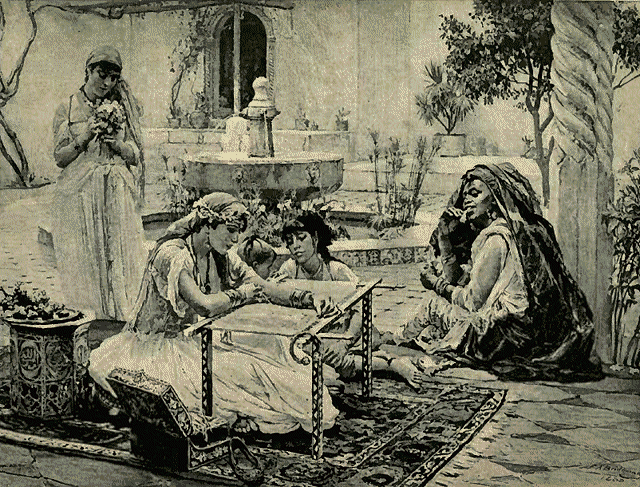
She is not a companion, but only a gilded toy, a decorative object.... Among the higher class she is still kept in strict seclusion, and her time is passed in luxurious idleness, save for the hours she employs at her embroidery or tapestry. The garden, with its heavily perfumed blossoms, pleases her; the ceaseless plash of the fountain falls musically on her ear; all her physical needs are ministered to. But everything conduces to the dreaminess of her nature, to slothful habits; her activities are fettered by the law of Mohammed. After all, her garden is but an exquisite prison.
The women of the Arabs, like the men, are fond of tattooing their bodies, regarding the figures they stamp into their flesh as highly ornamental, though perhaps originally there was a religious significance in them. The figure to be imprinted is first drawn upon a block of wood and blackened with charcoal. This is then impressed upon some part of the body, and then the outlines are pricked with fine needles which have been dipped into an ink made of gunpowder and ox-gall. The whole is subsequently bathed with wine, and the figure is marked indelibly.
Even the poor are very fond of personal ornaments. Chains, rings, necklaces, gold thread, may be seen in abundance, if not in costliness. It is not unusual for an Arab woman, though clothed in tattered raiment, to wear several rings of silver. But if this metal be beyond her means, then of iron or copper and sometimes of glass. Ornaments of variously colored glass are very popular among Arab women; often they can afford no other. Even bracelets are made of this material, and are much worn. Some of the nomadic tribes still wear anklets.
The women of the desert are often seen with nose-drops, or rings in one or the other side of their nostrils, which in consequence tends to droop like the ear. This custom prevails in other parts of the East, more particularly among those whose occupation is thought to call for much ornamentation, such as the dancing girls and odalisques. The ancient Hebrews sometimes used to put rings in swines' snouts for practical reasons, as indeed the Arabs do to-day in the noses of horses, mules, and asses to aid in evaporating the moisture from the nostrils, but the beauty or the utility of a ring in an Arab woman's nose has never been satisfactorily determined.
The Arab women of good quality do not, as a rule, wear their hair very long. It usually reaches about to the neck, and is tied with a colored ribbon. Many of the poorer and less cleanly among them, however, wear their tresses long, ill-kempt, and filthy. The men often think more of their beards than do the women of their locks.
The favorite flower is that of the shrub called Al henna. It is the plant from which is obtained a dye much used by Oriental ladies upon their skin and nails as a cosmetic. The manner of preparation is thus described: "The young leaves of the shrub are boiled in water, then dried in the sun, and reduced to a powder which is of a dark orange color. After this has been mixed with warm water, it is applied to the skin." The use of henna is very old; and when the woman has finished the work of art--she herself being the subject--she looks, as one has said, like a vampire stained with the blood of its victim. The flower of Alhenna, however, is beautiful and strongly fragrant--reminding one in appearance of clusters of many-colored grapes. These blossoms are used as ornaments for the hair and as decorations for the houses, the fragrance often conquering the malodorous atmosphere of many ill-kept, uncleanly homes.
As is the custom with Oriental ladies generally, the women in riding place themselves astride the beast, like a man, and seldom present a graceful appearance to a Western eye. Loftus has thus described an Arab lady as she sits astride the patient mule: "Enveloped in the ample folds of a blue cotton cloak, her face (as required by the strict injunctions of the Koran) concealed under a black or white mask, her feet encased in wide yellow boots, and these in turn thrust into slippers of the same color, her knees nearly on the level with her chin, and her hands holding on to the scanty mane of the mule--an Eastern lady is the most uncouth and inelegant form imaginable."
Mohammedans are never seen walking with their wives in the street, and are seldom seen in company with them or any other woman in any public place. Should a man and his wife have occasion to go to any place at the same time, he goes in advance and she follows on behind him. Jessup, in The Women of the Arabs, gives the following explanation advanced by a Syrian of the aversion which the men feel with reference to walking in public with women:
"You Franks can walk with your wives in public, because their faces are unveiled, and it is known that they are your wives, but our women are so closely veiled that if I should walk with my wife in the street, no one would know whether I was walking with my own wife or another man's. You cannot expect a respectable man to put himself in such an embarrassing position."
If inquiries are made by one man of another concerning his family, the boys and the beasts are invariably mentioned first; the wife last of all. Among the ancient Arabs the birth of a female infant was looked upon as little short of a domestic calamity and sometimes the infant was not allowed to live. The horrible custom, wad-el-benat, of burying infant daughters alive grew out of an unwillingness of parents to share the scant support of the home with the newcomer, or, as has been suggested, from ferocious pride, or false sentiments of honor, fearing the shame that might come should the girl be carried off and dishonored by the enemies of their tribe. The birth of a son, however, was considered the occasion of great rejoicing. The daughters of the modern Arabs are usually well cared for, though apparently with little affection. They are useful in agricultural pursuits, and they are for sale as wives when they become of a marriageable age. Their marketable value is determined by their rank, their fortune, or their beauty. Among the Arabs marriage is seldom an affair of the heart, but is purely a commercial transaction. Three thousand piastres, or about one hundred and twenty dollars, is regarded as a good price to pay for a wife. The price is generally less. The father of the young man pays the bill; his wealth regulating somewhat the amount paid. The parents of the young couple make all the arrangements, though generally assisted by relatives and interested friends. Much bargaining and delay are often gone through with as a matter of course. If the whole sum finally agreed upon cannot be paid in a lump sum, the parties of the first and the second part fix upon the size and frequency of the instalments; the bride being claimed only when the last instalment has been paid.
The time for the wedding is next settled upon, whether it be days, weeks, months, or years in advance. When that event is at length celebrated, the Arab love of feasting has full opportunity to give itself rein. Days are spent in these rounds of pleasure before the young couple settle down to the stern facts of practical copartnership.
The Arab women have a number of folk songs which are sung by them at weddings and at the birth of children. Some of these may be here quoted as revealing the Arab woman's idea of physical grace and of womanly virtue, and of those qualities which are desirable in the wife and the mother. Here is a song to the bride:
"Go thou, where thy destiny leads thee, O fair bride! Tread delicately on the carpets. Should thy spouse speak to thee, what wilt thou answer? Tell him thou art his, thou lovest him and he is thy delight"
Again, they sing:
"Oh yes, she is welcome! Let us hail the arrival of her whose eyes shine with beauty; Whose form is graceful; tall as a young palm tree, Who can shut the window without a stool!"
The rejoicing in maternity, and especially in the birth of sons, is notable among the Arabs. The women sing:
"Behold the wife hath brought forth; She has risen from the bed whereon she reposed, whereon she slept! She hath brought into the world a child, the fairest of boys; He will learn to play with the sword." "No sorrow or harm shall come to thee if thou hast sons. God will give them to thee. He will make thee glad, Esteemed and honored throughout the country; Thou who art in the race as a gazelle."
Between the verses of the songs, the women who are not singing will repeat the refrain:
"La, la, la, la," etc.,
to emphasize their sympathy with the sentiments just sung.
Because of a deep reverence for the mystery of life, the Arabs give to the woman a separate tent or hut during the period of childbirth, and there she must remain for a period. There is a strong superstition concerning the results that might come from seeing or touching her or her belongings during the time of this separation.
In the naming of children, family names are not given, but individual names, to which is often added the name of the father, and sometimes that of the mother. The latter is probably the older, and many ethnologists believe it to have once been the universal custom among the Arabs; pointing to a day when polyandry prevailed, when it was customary for women to have several husbands, if they were not indeed the common property of the tribe.
The influence of the nomadic life of the ancient Arabians still has its power over the modern Arab if he be true or a dweller in tents. These desert roamers despise those Arabs who are engaged in the arts of husbandry. Dr. A. H. Keane, quoting from Junker, gives the following evidence of this prejudice: "In the eyes of his fellow tribesmen, the humblest nomad would be degraded by marriage with the daughter of the wealthiest bourgeois." But, as he adds: "Necessity knows no law, hunger pinches, and so these proud and stubborn were fain ... to renounce the free and lawless life of the solitude and at least partly turn to agriculture for several months in the year."
The Arabs are proverbially a hospitable people. Let a stranger once eat with an Arab family and he is a friend; certainly so long as the food is thought to remain a part of his body. But since the patriarchal idea survives, man is absolutely lord of his own house. Hence, in the house, the inequality of the sexes is most noticeable. The Moslem wife never sits down to a meal with her husband if any male guest be present; and should the husband be very strict and formal in his habits, she is not permitted to eat with her lord, even when there is no guest. It is her pleasure to serve. When the master of the house has finished his repast, he allows what remains to go to the rest of the family. By this the husband does not mean to be selfish at all; but customs which have prevailed for time out of mind give to woman an inferior place as a matter of course. But the guest is never turned away empty. Even in the poorest houses, the Moslems will offer the visitor a cup of black coffee, and it may be cigarettes.
Polygamy was common in ancient Arabia. In earlier days every man might marry as many wives as he could take care of, and the length of the wifehood was solely in the husband's hand. The family possessions were his property, and should he die, his widow was looked upon as a part of the estate. Unions between mothers and step-sons were not infrequent. Mohammed numbered this, however, among the "shameful marriages."
Sir William Muir, in his Annals of the Early Caliphate, says: "Polygamy and secret concubinage are still the privilege, or the curse of Islam, the worm at its root, the secret of its fall. By these the unity of the household is fatally broken, and the purity and virtue weakened of the family tie; the vigor of the dominant classes is sapped; the body politic becomes weak and languid excepting for intrigue; and the throne itself liable to fall a prey to doubtful or contested successors." "Hardly less injurious," says he, "is the power of divorce, which can be exercised without the assignment of any reason whatever, at the mere word and will of the husband. It not only hangs over each individual household like the sword of Damocles, but affects the tone of society at large; for even if not put in force, it cannot fail as a potential influence, existing everywhere, to weaken the marriage bond, and detract from the dignity and self-respect of the sex at large."
Mohammed's complete misunderstanding of the true relation of the sexes has had much to do with the degraded position of woman in Moslem lands, and the complete failure of Islamic social life. It is woman that makes or unmakes society. She is the keystone of the arch, not the mudsill.
Mohammed's state of mind regarding woman is universal among his followers, whether in Algeria, Tunis, or Morocco, in the land of the Lotus, in the Ottoman Empire, or in the lesser Mohammedan dominions. The customs springing from this state are, of course, modified among the different peoples, as, for instance, among the Moors through the admixture of Spanish and Moorish blood, which resulted in a somewhat better appreciation of woman. Yet she is not a companion, but only a gilded toy, a decorative object, to be fitfully enjoyed or waywardly put aside. Among the higher class she is still kept in strict seclusion, and her time is passed in luxurious idleness, save for the hours she employs at her embroidery or tapestry. The garden, with its heavily perfumed blossoms, pleases her; the ceaseless plash of the fountain falls musically on her ear; all her physical needs are ministered to. But everything conduces to the dreaminess of her nature, to slothful habits; her activities are fettered by the law of Mohammed. After all, her garden is but an exquisite prison.
By placing women upon so far lower a plane of social and religious life than man, Mohammedanism has not only degraded the female sex, but has disrupted, if not destroyed, those healthy family relations which lie at the very foundation of all social progress and national greatness.
X
THE TURKISH WOMEN
Out of the ruins of the Seljuk domination arose the Turkish Empire, founded by Ottoman, or Osman I., a nomad chieftain of great prowess, after whom the Ottoman Empire derived its name. Among the very first events narrated concerning the life of this important Turk was one of romance, for Ottoman was not only a bold warrior, but a brave lover, and withal, like the young Hebrew Joseph, a dreamer. In the little village of Itburuni there lived a learned doctor of the law, a man of aristocratic blood, one Edebali, with whom it is said Ottoman loved to converse, not only because of the gentleman's fine personal qualities, but because Edebali had a daughter, whom many named Kamariya, or "Brightness of the Moon," because of her beauty; but most called her Mal Khatum, or "Lady Treasure," on account of her pleasing personality. But the learned sheik did not take kindly to Ottoman's advances, for he had not yet "won his spurs," and his authority was not recognized by neighboring princes. Fortunately, a timely dream--that potent argument which is so effectual among the people of the East--came to Ottoman's aid in the pursuit of his suit. The dream is thus recorded: "One night Ottoman, as he slumbered, thought he saw himself and his host stretched upon the ground, and from Edebali's breast there seemed to rise a moon which waxing to the full, approached the prostrate form of Ottoman and finally sank to rest on his bosom. Thereat from out his loins there sprang forth a tree, which grew taller and taller, raised its head and spread out its branches till the boughs overshadowed the earth and the seas. Under the canopy of leaves towered forth mighty mountains, Caucasus, Atlas, Taurus, and Hæmus, which held up the leafy vault like four great tent poles, and from their sides flowed royal rivers, Nile, Danube, Tigris, and Euphrates. Ships sailed upon the waters, harvests waved upon the fields, the rose, and the cypress, flowers and fruits delighted the eye, on the boughs birds sang their glad music. Cities raised domes and minarets toward the green canopy; temples and obelisks, towers and fortresses lifted their high heads, and on their pinnacles shone the golden crescent. And behold as he looked, a great wind arose and dashed the crescent against the crown of Constantine, that imperial city which stood at the meeting of the two seas and two continents, like a diamond between sapphires and emeralds, the centre jewel of the ring of the Empire. Ottoman was about to put the dazzling ring upon his finger when he awoke." The story of the wondrous dream was told to the father of the fair Mal Khatum. He was at once convinced that the Fates had marked Ottoman for future greatness and for wide dominion. The moon-faced damsel fell a prize to the inevitable conqueror, son of Ertoghrul. Another early incident in Ottoman's career may be of interest in this volume upon the women of Turkey. Ottoman understood that a number of his rivals at arms were to be present at a certain wedding to be celebrated at Bilejik, in the year 1299; and that the event was to be made the occasion of his being entrapped and slain. Learning of the conspiracy against him, he secured for forty women of the Ottoman clan admission to the festivities. When all present were engrossed in the ceremonies of the hour, these forty sturdy warriors cast aside their female attire and not only captured the entire garrison, but also the fair maiden whose nuptials were being celebrated. She was a young Greek lady named Nenuphar, or "the Lotus Blossom," who afterward became the mother of Murad I. Ottoman now descended like an avalanche upon his rivals and their territory, extending his dominion even to Mount Olympus.
It is to Arabia and to Persia that Turkey owes most of its civilization, its religion, its literature, its laws, its manners, and its customs. Beginning with a Tartar basis, Turkish life has been chiefly shaped under the influence of a religion and a literature. As for the first, the debt is chiefly to Arabia; for the second, Persia must have the larger share of credit. Since these two forces, religion and literature, are doubtless the most effective in shaping the ideals of womanhood, and so in developing the female character among any people, we are compelled to look to the ancient lands of Persia and Arabia for the springs of Turkish life.
Remembering the kinship of Turkish literature to the Arabic and Persian, it would not be difficult to surmise that woman would hold no insignificant place in the literature of Turkey. While there are as many as twenty-five different written languages used in the Empire, the literary language is a product of the original Tartaric tongue and strong Persian and Arabic elements. Very much of the romantic material that goes to make up the Turkish literature is drawn from such early stories as the great Persian epic Shahnamah.
The romance of Laili and Majnun has made a deep impression in Turkish literature. Fuzuli of Bagdad, one of the greatest of Turkish poets, has reproduced the strong love of these characters of old Persian legend, besides giving to the nation's literature many ghazels in which fondness for the virtue of woman is presented with characteristic Eastern passion.
The Persian lady also figures in the work of Kemal Bey, who was regarded in his lifetime as "a shining star in the Turkish literary world," and one who did much to arouse the Turks to enthusiasm for their native country. He was the author of a trivial novel Tzesmi, of high repute in Turkish literary circles, in which a Turkish warrior of poetic talent and a Persian princess figure.
There are numerous love ballads of Moorish origin that are highly prized and have greatly influenced Turkish literature, such as Fatima's Love, Zaida's Love, Zaida's Inconstancy, Zaida's Lament, Guhala's Love, and the like; also much Moorish romance, as The Zefri's Bride. So we find Turkish poems breathing of love and womanly charms. Among such productions is that of Ghalib, whose Husn-u-Ashk, or Beauty and Love, is regarded as one of the finest productions of Turkish genius.
It must be remembered, however, in reading Turkish poetry of love that there is often, if not indeed generally, beneath what seems to be a sensuous and even voluptuous song or romance an allegorical or mystical significance. God is the Fair One whose presence the heart craves, and whose veil the suitor would see cast aside that his perfect beauty may be revealed to the worshipper. Man, therefore, is the lover; the tresses are the mystery of the divine character; the ruby lip is the sought-for Word of God; wine is the divine love; the zephyr is the breathing of His spirit; and so on. And yet, that many Turkish, as is true of many Arab and Persian, poems are upon a low moral level of human passion, and are revolting to the ethical sense of the more sensitive natures, is not to be disputed.
Fame in poetry has not been unknown to Turkish women. Notable among these literary women of Turkey is Fatima Alie, daughter of the former state historiographer Dzevdet Pacha, whose history of the Ottoman Empire takes high rank. In Fatima Alie, Turkish womanhood finds one of its staunchest champions.
Zeyneb Effendi was a royal poetess in the days of Mohammed the Conqueror. She recounted in glowing lines her hero's achievements. So also Mirhi Hanum was a poetess of talent. She was born of a wealthy father, a grand vizir. She was so unfortunate as to have had as a lover one who did not reciprocate her passion. She, therefore, sung her young life out in avowed virginity, wearing an amber necklace, symbolizing her eternal choice of celibacy. Among other poetesses of note may be mentioned Sidi, who died in the year 1707, the authoress of Pleasures of Sight and The Divan. Mirhi, who has been styled "the Ottoman Sappho," was a poetess of Amasiya, full of the passion of love. She sang boldly concerning the object of her devotion, but her virtue was never questioned, nor her talent deprecated.
But the women of Turkey have been affected less by the literary influence of Persia than by the religious inheritance from the Arabs. Before Mohammed polygamy flourished among the various Arabian tribes. The prophet brought some order out of the chaos, and the harem became a more or less well-defined system, with its definite laws and regulations. Therein woman was somewhat advanced from the state in which she earlier found herself. And yet, Mohammed manifestly wavered in his treatment of women and in the ideals which underlay it. A certain equality between man and woman is at one time taught in the Koran, as when it said: "The women ought to behave to their husbands in like manner as their husbands should behave towards them, according to what is just." And again the prophet said: "Ye men have right over your wives and your wives have right over you." This truly is reciprocity. And yet he asserted that "woman is a field--a sort of property which her husband may use or abuse as he thinks fit;" and again, that "a woman's happiness in Paradise is beneath the sole of her husband's feet." Commercially, the girl was of more value than the boy, because she could be sold and made a wife, and perhaps she might be converted to the Mohammedan faith.
It is, in truth, the Turkish slave woman's physical beauty, as she was captured and came into the possession of Arab sheiks, which first brought the Turkish woman into notice. But these superbly attractive, dark-eyed slaves at length captured their captors, and the Turk became master of the Arab and the most virile exponent of the Arabian faith and civilization.
Concerning his ideals as to woman, the Turk imbibed much from the Arab, who valued woman mainly for her points of physical excellence--these were tabulated in a standard of eight "fours" as follows: "A woman should have four things black; namely, hair, eyebrows, eyelashes, and the dark part of the eyes. Four things white; namely, the skin, the white of the eyes, the teeth, and the legs. Four red; namely, the tongue, the lips, the middle of the cheek, and the gums. Four round; namely, the head, the neck, the forearm, and the ankle. Four long: the back, the fingers, the arms, and the legs. Four wide: the forehead, the eyes, the bosom, and the hips. Four thick: the lower part of the back, the thighs, the calves, and the knees. Four small: the ears, the breast, the hands, and the feet."
Since Mohammed allowed four wives to all Mussulmans, the sultan as a faithful follower of the prophet may have four official wives; and after these he may take as many non-official wives as his fancy may desire. The four favored ones are known as the kadins. First stands the Bach Kadin, who is the "first lady of the land." Next her is the Skindij Kadin, or "second lady." Then come the "middle lady" or Artanié Kadin, and last of all the Kutchuk Kadin, or the "little lady." When a kadin becomes the mother of a male child she is then entitled to be called Khasseki-Sultan, or "royal princess." When a daughter is born to one of them she is known as Khasseki-Kadin, or "royal lady."
The mother of the reigning sultan always holds high place at court, yet not because she is mother of the ruler, but because it is thought that each of the four legitimate wives of the sultan must in every detail of court life enjoy perfect equality with the others, from the services of "the mistress of the robes down to the lowest scullion." Thus, the mother, called the Valideh-Sultan, holds the rank that usually belongs to the wife of a monogamous ruler. Should the sultan's mother be deceased, his foster-mother holds this position of influence. The present sultan's foster-mother has conducted herself with much conservatism in her exalted position and, it is said, with strict attention to the dignity and economy of the harem. The Valideh is sometimes poetically known as Tatch-ul-Mestourat, that is, "the crown of the veiled heads." This means that the Valideh is regarded as queen of all the Mohammedan women, who are uniformly veiled, according to the teaching of the prophet. The Valideh is in her dignity most august. No woman, not even the Khasseki-Sultan, may dare come before her unless sent for. All women when they appear in her presence must be clothed in full court dress, and, whatever the weather may be, without mantles. When she goes out she is entitled to a military escort similar to that of the sultan. An ancient custom still prevails which demands that the Valideh, once a year, on the night of Kurban Bairam, present a slave girl of twelve years of age to the sultan. The slave damsel at once becomes a member of the harem, and it is possible for her to rise to the highest position a woman may attain at the Turkish court. It is now customary, however, for the young girl to be sent as a pupil in the institution at Scutari, which has been established by the sultan for the higher education of Mohammedan women. She is now more frequently married, with a dowry, to some officer of the court or member of the sultan's household.
The sultan is granted privileges not generally accorded others as to marriage. He may marry a Christian or a Jewess, if he should see fit so to do. As a rule, the women who thus marry are expected to become Moslem in faith, though there have been notable exceptions. Theodora, wife of Orkhan, was a Greek Christian woman, and with marked persistence held on to her ancestral religion. But Orkhan was unlike Mohammed II. in character; for the story is told of the latter's strong passion for the beautiful Irene, who, however, refused to abjure her faith. The priests of Islam reviled their ruler for loving one who would not accept the religion of the prophet. This was too much for Mohammed. One day the priests were assembled in one of the halls of the palace. Here, too, was Irene, covered with a veil of dazzling whiteness. With great solemnity the sultan lifted Irene's veil with one hand and revealed the young woman's great beauty to all who were present. "You see," said the Sultan, "she is more beautiful than any other woman you have ever beheld; fairer than the houris of your dreams! I love her as I do my life; but my life is nothing beside my love for Islam." With this, he seized the long, golden tresses of the unfortunate woman, entwined them in his fingers, and with one stroke of his sharp scimiter severed her head from her body.
A lady of imperial blood has the right to add "Sultan" to her own name. This is her privilege, even though she should marry a subject, which is sometimes the case. Her superior descent, however, is always recognized; for her husband may not sit down before her, unless she should so permit.
Turkish rulers have taken a different view of the value of foreign marriages from that which has usually prevailed in the East. Political ties have been made and strengthened by royal marriages. In Turkey, however, a custom, amounting to law, prevents the sultan from marrying a free woman, one taken from the high families of his own people, or princesses of foreign courts, that no tie of politics or affinity of blood should alter the superior impartiality of the supreme master. Thus, while he is above all his subjects so far as rank is concerned, he is inferior, on his mother's side at least, in the matter of birth, Hence, the meanest subject of the Empire of the Ottomans may here feel himself on an equality with the sultan, since he is "the son of a slave woman."
It is not customary for a ceremony to be performed when the sultan marries. Only three Turkish sultans are said to have undergone a ceremony on the occasion of taking to themselves wives. When the Greek Princess Theodora was wedded to Orkhan; when Roxelana became the wife of Sultan Suleyman; and when Besma, an adopted daughter of a princess of Egypt, was married to Abd-ul-Medjid, the marriage ceremony was performed.
As a mark of certain inferiority, the bride is expected to enter the nuptial bed from the back, lifting the covering with much ceremony. It is never good form for a gentleman to inquire concerning the health of another's wife.
Mothers of the harem are often compelled to live in mortal fear for their infant sons, lest they be foully dealt with. For if a child have any prospect of some day being the Turkish ruler, his life is never regarded as altogether safe. The baby prince is brought up in the harem, with his mother and nurse; but since brothers and even uncles come before sons, the question of succession to the sultanate has often caused great disorder and bloodshed.
On the death of Mohammed, the great Arab leader, there was no mention of a law of succession. This was partly due, doubtless, to the fact that he left no son who might assume leadership of the hosts of Islam. At length, the Seljuk Turks attained to power, after which the empire fell into minor sovereignties, which were brought together at last into the Ottoman Empire. And while of late the stability of the reigning dynasty has been the most noteworthy of the East, yet the fact that there was not early established the ordinary custom of transmitting the sovereignty from father to son has been the cause of much intrigue, crime, and uncertainty in the dominion of the Turk. Cases have not been unknown in Turkish history where several hundred women of the seraglio were drowned in the Bosphorus because of plottings to depose the sultan. They were tied in the traditional sack and dropped into the sea. It was Ibrahim I., known as the Madman, one of the very worst of Turkish rulers, who first conceived the idea of thus disposing of the old women of the seraglio. Surprised and seized in the night, the unfortunate victims of the sultan's madness were tied in sacks and then sunk to the bottom of the sea. Only one of the large company of the unfortunates escaped, by the loosing of the sack, and was picked up by a passing ship and conveyed to Paris to tell the story of the cruel death of her companions. Among the many notable instances of the tragic end to which the plottings of the harem have come may be mentioned that of Tarkhann, mother of Mohammed IV. So desirous was she that her son should reign, that she slew all the other possible male heirs to the throne. She met her nemesis, however, by strangulation. It is upon her life and that of her rival that Racine has constructed his Bajazet.
Connected with the sultan's harem there are estimated to be about fifteen hundred persons. The harem consists of a number of little courts, or dairas; and the central figure of each of these courts is a lady of the female hierarchy.
In the royal household there are three classes of women. The kadins, of whom we have spoken, who may be termed the legitimate wives of the sultan, though they are never formally married. Next are the ikbals, or "favorite women." From this class the kadins are usually chosen. Then come the gediklis, "those pleasant to look upon." The ikbals may come from the number of these. The women of the third class are usually of slave origin, purchased or stolen perhaps from Georgian or Circassian parents. Those who are stolen are usually taken so early from their homes, and so clandestinely, that their origin is seldom known to them. If, however, the lady comes of high station her identity usually becomes known, and she not unfrequently succeeds in elevating her family to a position of power and emolument, either by direct influence or by intrigue. In addition to these three classes of women there are ustas, or "mistresses," who are maids in the service of the sultan's mother; shagirds, or "novices," who are children in training for the higher positions in the harem; and jariyas, or "damsels," who do the more menial work of the establishments.
Captured slave girls have sometimes had a most interesting career. They are brought in an almost continuous stream, but privately. In the earliest days of their presence in the harem they are called alaikés, and are placed under the care of elderly women, or kalfas, who bring them up to suit the tastes of an Oriental court. They are instructed in manners, in music, in drawing, and in embroidery. When later they reach the proper age, they become attendants upon the kadins and the princesses of the imperial household. There is no bar to their reaching at length the highest station that it is possible for a woman to attain, the favorite wife of the sultan.
The female department of the Turkish household is called the Hareemlick, the male apartments being named the Islamlick. The women's apartments are, of course, secluded. A male physician may see only the hand and tongue of the sick lady. A black curtain is stretched to separate her from his inspection. A eunuch conducts the physician to a point where the sick woman may thrust out her hand through a hole in the curtain so that the doctor may diagnose her disease.
Faithfulness in women is held in high esteem, restraint of the harem being intended to insure it. In former days it was not a thing unknown for unfaithful women to be drowned; but the custom has fallen into disuse. Ladies of the harem, however, have a fair amount of liberty. On certain occasions they go out driving and visiting; they frequent the bazaars and the public promenades, always in vehicles, never afoot. They enjoy entertainments among themselves. Theatricals are frequently witnessed by them in the garden of the palace. Operas are also often rendered for their enjoyment. When Turkish ladies visit one another in the harem,--which they may do without permission or restraint from their husbands,--it is customary to place their shoes outside the harem door that their husbands may know guests are being entertained.
The harem of one ruler is generally regarded as the property of his successor. The women thus inherited, however, are not always sure of favor. Sultan Mohammed II. killed, by drowning, all the women of his brother's harem. Indeed, women of the harems generally cannot be said to have ample protection; for no officer may enter any harem to inspect the conduct there, or for any purpose whatever, unless the law of the house admits him. The women, whether they be wives or slaves, are practically at the mercy of their masters. Some women of the sultan's harem have risen to positions of much influence and genuine power, though they have generally been of foreign birth. The mother of the noted reforming sultan, Mahmud II., who began to reign in 1808 when a mere child, was a French woman. His stout resistance of the allied powers won for him a certain admiration for doggedness, even if success did not crown his efforts to keep Greece in subjection. It was into this struggle that Lord Byron threw himself on behalf of Greece. Mahmud, it may be to some extent through the influence of his French mother, introduced French tactics into his army, but to no avail, and at length Grecian freedom was assured.
The wife of Mahmud, Besma, taken as a little girl from the life of a peasant, rose to a position of supreme dignity and great influence. Her beauty easily won the passion of Mahmud. She never lost sight of her humble origin and was much beloved by the masses of the people, even those of the most lowly classes. She was the mother of Abd-ul-Aziz, and it was she who unsuspectingly gave to the sultan, her son, the scissors with which he killed himself. At any rate, the unfortunate monarch was found dead in his apartments. The mother pined away in seclusion, and was seen only in her deeds of charity. It was Besma who built the mosque Yeni Kalideh at Ak Serai, and it is here she rests in the midst of a beautiful garden of flowers, of which, during her lifetime, she was so fond. On her death, about fifteen years ago, she was accorded a funeral of great magnificence, and she was generally mourned throughout the empire. It is said that when Besma was building the mosque, her money fell short of her purpose, so that she could build but one minaret instead of two, as custom entitled. Her son, however, came forward, offering the necessary funds, which she declined with the remark: "No, one minaret is sufficient to call the people to prayers; another would only glorify me; the poor need a fountain." So she built a fountain for the people, and it is one of the most beautiful in Constantinople.
One of the most celebrated--even if she be not one of the best--women of Turkey history was Khurrem, the "Joyous," whom Europeans generally knew as Roxelana. She was wife of the greatest figure in Turkish annals, Suleyman the Magnificent, who reigned about the middle of the sixteenth century. Roxelana, though her origin has not been clearly traced, was probably of Russian descent. From the first this strong-minded woman exerted great influence over Suleyman. In the first place, she forced him to marry her publicly and with much ceremony, a proceeding which was then without precedent. Usually to have it announced that a woman had become mother of a male heir to the throne was regarded as sufficient announcement of marriage with the sultan. But this woman, who had now risen from the position of a slave woman to that of the highest dignity possible for a woman in the empire, determined that her marriage with the great monarch should be full of publicity and pomp. There was feasting and, apparently, great rejoicing, though the people were surprised and hardly understood what it all might mean. Roxelana was, however, equal to the emergency, and with the sagacity and determination which were native to her sent many slaves among the people as they feasted, distributing presents of money and pieces of silk to the masses. From this time, she not only held absolute sway over the sultan, but evinced great skill in buying the friendship of the people by gifts and acts of charity. Diplomacy was characteristic of her, and from cruelty she would not shrink if it were necessary to carry out her purposes, for she induced Suleyman, generally so just and prudent, to destroy the oldest and most promising of his sons, since the young man, Mustafa by name, stood in the way of her own son Selim as heir to the throne. She succeeded in her designs, but placed on the throne one of the weakest and most worthless of Turkish rulers, "Selim, the Sot." Roxelana's beauty is described as that which "attests that mixture of the Asiatic and Tartar blood, wherever the dark eyes, the silken lashes, the creamy paleness of the tint, the languor of the attitude habitual to the Persian beauties, contrast with the rounded outline of the face, with the shortness of the nose, the thickness of the lips, and the warm coloring of the skin, traits peculiar to the daughters of the Caucasus." At fifteen, she is said to have been the marvel and even the mystery of the harem. Her memory knew only the rearing of the seraglio; but her remarkable alertness and force of mind as well as beauty of person made her from the first one of a thousand. Taught in the arts of music and dancing, versed in foreign languages, and the study of history and poetry, Roxelana added to her exuberance of youth a power of mind which marked her for preëminence.
Rebia, wife of Mohammed IV., is another example of womanly power over the head and heart of the supreme ruler of Turkey. Rebia was a Greek girl from the island of Crete. Lamartine says of her: "The delicacy of her lineaments, the brilliancy of her complexion, the ocean azure of her eyes, the golden auburn of her hair, the caressing tone of her voice, and the witchery of her wit made her to be dreaded still as the prison companion of a fallen monarch, of whom she might amuse the languor and reëstablish the intrigue from the depth of his captivity." Even in Mohammed's dethronement, Rebia clung to the fortunes of her lord, over whom, during his power, she had always exerted decisive influence.
Italian women have also risen to a place of prominence in the royal harem. This was notably true in the case of the beautiful Safia, a Venetian captive girl, who had been brought into the seraglio of Sultan Murad III., who succeeded Selim his father in the year 1574. Murad was not strong, and was easily deceived by sycophants and ruled by women. Among the latter was Safia, sometimes known as Baffo, belonging to the family of Baffo of Venice. Baffo proceeded to rule her royal lord in the interests of her native land. Venice, after Suleyman's death, had become restless of Turkish rule, and proceeded successfully to throw it off. Baffo never forgot her origin, and ruled with a high hand, not only as Khasseki-Sultan, but also as Valideh. She set her son Mohammed III. on the throne as successor to her husband, even though the consummation could be reached only by the slaying of nineteen of the one hundred and two sons of Murad. Foreign women will probably never again play so large a rôle in Turkish affairs. The present sultan is said, however, to be fond of the social attractions of European women. He is probably the first Turkish sultan who has invited a European lady to dine with him.
The Turkish sultans have long lived in much magnificence. The old seraglio, or imperial residence (from the word seray, a palace), was beautifully situated "among the groves of plane and cypress that clothe the apex of the triangle upon which the ancient city of Constantinople is built." Now, however, the sultans have left these precincts around which clustered so many memories of the horrible tragedies enacted there, memories which even the magnificence of the place could not destroy, and established their present residence, equal in natural beauty to the old, but removed from the dirt and the memories, which had at length gathered about the old seraglio.
The women's quarters are situated in the innermost portion of the seraglio. Here are from three to twelve hundred women; at times there are even more. These women are all foreigners. Indeed, all the guards and attendants of the palace are of foreign blood. The sultan and his children are the only Turks dwelling in the inner departments of the royal palaces; and both he and they are born of foreign mothers. The women's departments are carefully guarded. There were specially appointed officers in the old seraglio as guards of the queens and their children. These were the Baltajis, or "halberdiers," who were four hundred in number. They, however, really attended the royal women only when the sultan took with him some members of his harem to bear him company on a journey or a campaign.
The Baltajis, on such occasions, walked by the side of the carriages of the imperial ladies and guarded their camp at night. Ordinarily, the sultan's harem was under the care of the black eunuchs, or about two hundred Africans, who were specially entrusted with the imperial ladies. Their chief was known as the Kislar Aghasi, or "master of the girls," and was regarded as one of the chief men of the empire.
The trade in captive boys and girls stolen from Europe, Asia, and Africa was once very large; the pick of them being brought by purchase into the sultan's palace, for one purpose or another. It was thought that his imperial majesty's life was safer in the hands of foreigners brought up almost from infancy in the palace, and knowing no other allegiance than that to the will of the sultan.
Times have changed, however, and it is not possible for the ruler of the Turks to regard the best of the children of white and black parentage as born to replenish his harem. Much of the old time mediæval splendor has been swept away, not only through the reforms of Sultan Mahmud II., but by modern conditions which make the old seraglio an impossibility.
In the olden days the young princes were closely confined in a part of the seraglio known as the Chimshirlick, or "boxwood shrubbery." It contained twelve pavilions each surrounded by high walls which enclosed a little garden. These were the residences of the sons of the sultan. Each young prince was kept guarded in his pavilion enclosure, from which he dared not emerge without his royal father's special permission. Thus a prince's minority was spent in the kafe, or "cage." Each youth had as attendants ten or twelve fair girls, besides a number of pages. These and black eunuchs, who were his teachers, were his sole companions. As a rule, the tongues of male attendants and of women unable to bear children were slit. At the tenth year a young prince leaves his mother and the harem for the guardianship of a lalo, or "male attendant," who is his companion day and night; next a mullah, or "priest," takes the youth in hand and gives him his schooling, which consists chiefly in instruction in the teachings of the Koran.
THE MUTES After the painting by P. L. Bouchard
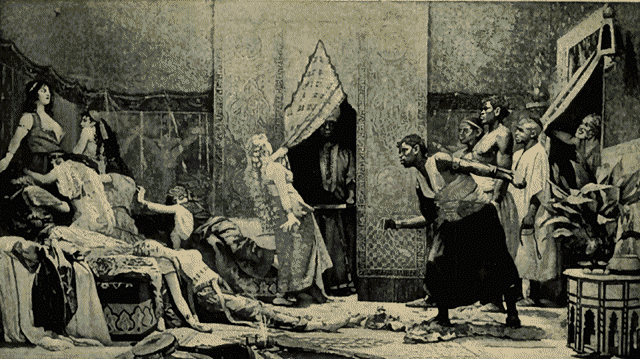
The women's quarters are situated in the innermost portion of the seraglio. Here are from three to twelve hundred women; at times there are even more. These women are all foreigners. Indeed, all the guards and attendants of the palace are of foreign blood..... The women's departments are carefully guarded. Women who bear no children and the subaltern eunuchs have their tongues slit. Whan an order of death is issued, these mutes, with the fatal cords, enter and noiselessly fulfil their commands.
Among the female officials of the seraglio is the Hasnada Ousta, or "grand mistress of the robes." She is usually an elderly woman of respectability and of dignity. This lady acts as vice-Valideh, caring for matters in the establishment to which it may not be possible for the Valideh Sultan to give her own personal attention. She holds a place of much honor, and women holding this position have been known to become Valideh. There is also the Kyahya Kadin, or "lady comptroller," who is generally selected by the sultan from among the oldest and most trusted of the Gediklis.
The dress of the ladies of the royal harem was formerly altogether Oriental; so also were the furnishings of the women's apartments. These last still consist largely of low divans, costly embroidery, couches, and the like; but European customs have now made themselves felt, not only in the furnishings of the rooms, but more particularly in the matter of feminine attire. Costly robes from Paris and Vienna have invaded the precincts of the harem; and these, added to the wealth of jewelry of which Oriental ladies are so fond, make it possible for the women of the rich Turkish households to be quite cosmopolitan in their modes of dressing.
Many of the lower ranks wear upon their head a sort of hood of black silk, the Egyptian chaf-chaf. To this is attached a piece of black netting, which can be dropped over the face of the wearer when she so pleases. The women of Constantinople, however, are not so careful in the matter of the veil as are the ladies living in cities under less cosmopolitan influence.
European ideas and habits have greatly modified Turkish customs. The yashmac is the face veil which the Turkish girl receives when she attains to the marriageable age. The word is derived from a verb which means, when fully interpreted, "May long life be granted you." The material is thin, fine lawn or similar stuff. The older and less attractive women, or ladies who do not wish to be recognized in a public concourse, as when shopping, wear a veil of thicker material.
The cloak used is the feridjè. It is usually of black material, and its shape is intended to conceal the outlines of the figure. The feridjè is now much modified, however, by European tastes, and is not greatly different from the opera cloak worn by the ladies of Paris.
The once fashionable footgear, the yellow Turkish slipper, has given place generally to the slipper of patent leather worn by European ladies. Much of the beauty of color and picturesqueness of costume has therefore passed away, as may be seen from the following description of the Turkish woman's appearance at the middle of the sixteenth century: When they (the women of Turkey) go abroad, the ladies wear the yashmac made of gold stuff, heavily fringed, and confined to the head by a crown blazing with jewels. The figure is concealed by a cloak of richest brocade or velvet. Sometimes you may have the charm of seeing as many as one hundred arabas, or carts, very splendid and richly gilded, drawn by gaily decorated bullocks, each containing a number of these great ladies with their children and slaves.
"The procession is a most gorgeous sight. Each cart has as many as four mounted eunuchs to protect it from the curiosity of the public, who have their faces almost to the earth, or avert them entirely, as the caravan passes." So, also, Lady Mary Wortley Montagu has left, in a letter to the Duchess of Marlborough, written in 1717, a very graphic account of the costume of the sultana.
Lady Mary describes the dolma, or "vest of long sleeves," the diamond-bedecked girdle, the long and costly chain about the neck, reaching even to the knees, the earrings of diamonds shaped like pears, the talpoche, the headdress covered with bodkins of emeralds and diamonds, the diamond bracelets, the five rings upon her fingers, the largest ring Lady Mary ever saw except that worn by Mr. Pitt. There was also a pelisse of rich brocade brought to the royal Turkish lady when she walked out into her garden. Fifty different kinds of meat were served at her dinner, but one at a time; her golden knives were set with diamonds in the hafts; gorgeously embroidered napkins were in abundance, etc. Much of this magnificence and display has now passed away, but, as Stanley Lane-Poole says in his The History of Turkey: "While the house of the Ottoman monarch of to-day, if more in keeping with the spirit of the time, is very commonplace beside that of last century ... nevertheless, the modern seraglio is hardly an anchorite's cell."
Cosmetics were once used in profusion. The painting of the eyebrows and the dyeing of the finger tips with henna were considered marks of beauty. The custom is dying out entirely in Constantinople, though in the remoter regions of the empire the habit is still in vogue. The attempts at beautifying the face are often referred to by the poets as marks of beauty, as when Fuzuli dilates upon the
"Eyes with antimony darkened, hands with henna crimson dyed. Among these beauties vain and wanton, like to thee was ne'er a bride. Bows of painted green thy eyebrows; thy glances shafts provide."
Mohammedan countries of any culture have long held the bath in great esteem. Turkish ladies of high rank once frequented the public baths with regularity, but the modern improvements in the private houses have made this custom far less general.
The women of the Turkish empire present an almost infinite variety. Under the dominion of the sultan the nationalities are many and heterogeneous. So also it would be impossible to make any general statement of the treatment of women among the Turks. In many parts of Turkey there is but one wife in the household, and she is well treated and highly respected; affection prevails in the harems of not a few; while in others concubinage, neglect, harshness, ignorance, vice are present with their deadly effect.
Divorce may be readily obtained in Turkey; but parental influence often protects the woman who otherwise might fare unjustly. Mohammed also gave some protection to wives, since he considered a wife to have rights in her own fortune even while married, and held that if divorced, restitution of this fortune was to be made.
Turkish women, except those of the richer families, generally nurse their own children. Many children die in infancy through the ignorance of mothers of the lower classes. Some mothers still swaddle their little ones. In the event of illness, instead of a trained physician, many mothers send for a "wise woman" or a wizard. In the harems, it is suspected that many infants are actually killed. The Mohammedan population increases more slowly, notwithstanding the practice of polygamy, than the Christian population of the Turkish Empire.
It is the custom among families of the better class to give the boys over from infancy to the care of a dadi, or slave girl, whose business it is to care for him during his youth, and it is not infrequent that evil springs from this intimacy. Both boys and girls are under the care of a lalo, or male slave, when the children are out of the precincts of the harem. The influence of the slaves and menials, with whom so many Turkish children are thrown, is, as a rule, far from elevating.
Submission is a lesson that is very early taught to Turkish children. This insures an obedient, tractable spirit, and is the cause of all that is best in the Turkish character.
There are almost thirty million Turkish women, the masses of whom move upon a very low level of culture. This cannot, however, be said of all, for many of the upper classes and of the court are well educated, though the branches or subjects they are taught are not varied. Foreign governesses are often employed to teach the girls French, German, and English, which they can, in many cases, speak fluently. Language and literature furnish a large part of their education. A change is gradually coming over the Turkish people in this matter of the development of its women, and this, notwithstanding, the fear in many minds that a better educated woman will be a less manageable woman; a creature dissatisfied with her lot. A recent writer of acute observation of Turkish affairs has said of efforts on the part of American philanthropists to instil the spirit of the American public school into the minds of the Turks: "The general opinion seemed to be that the female sex had no intellectual capacity. The first efforts of the Americans to make the women sharers in intellectual progress and refinement were met with opposition, and often with derisive laughter. They created a new public sentiment in favor of the education of women. This is shown by the interest taken in the schools established by Americans for the education of girls. Pashas, civil and military officers of high rank, the ecclesiastics and wealthy men of all the different nationalities attend the examinations, and express their hearty approval of the efforts made by the Americans for improving the conditions of the women of Turkey."
The tendency of these influences is to win for women a greater respect from fathers, husbands, brothers; greater freedom in choice of their life partners; to defer the marriageable age from twelve years to fifteen or twenty; to secure for mothers greater respect from their children; and to elevate womanhood in every relation of life.
Turkish women who are still living under the patriarchal system--and in no small part of the empire does this ancient system prevail--develop under a different environment from that prevailing in the other parts of the realm. Under a patriarchate the mother yields to the grandmother and the great-grandmother. The wife holds not only a subservient place in the family, which often contains as many as forty persons, but she is often, literally, a slave to the mother-in-law, and her children are trained by almost everybody else but herself. The patriarchal system is gradually yielding, however; and more and more, even in the conservative regions of the world, newly married people are forsaking father and mother and cleaving to one another, setting up their own homes and developing the parental character, and training their young in their own sweet way.
Under strict Moslem influence, motherhood has a place of honor; at least in theory. For Mohammedanism gives to the woman who bears children and trains them faithfully a rank in heaven with the martyrs. Unfortunately, however, the light esteem in which women are held in Moslem lands makes against woman's power, even in her noblest opportunity,--that of moulding the children into character that is noblest and best. Much work has been done by foreign philanthropists in an effort to raise the standard of home training among the Turks. Stanley Lane-Poole, in his Studies in a Mosque, a book not written from the viewpoint of the modern missionary, but that of a candid and diligent student of historic conditions, says: "It is quite certain that there is no hope for the Turks, so long as Turkish women remain what they are, and home training is the imitation of vice." This is surely a dark picture. But the time may yet come when the Turkish woman will assume a position more like that of her Western sisters and become an elevating influence in the land whose present territory includes much of the most renowned soil the sun ever shone upon, not only that which saw the birth of the religion of the Jew, the Christian, and the Mohammedan, but also much that is rich in classic and mediæval memories--the country of which Byron wrote:
"The land of the cedar and pine, Where the flowers ever blossom, the beams ever shine; Where the light wings of Zephyr, oppressed with perfume, Wax faint in the gardens of Gul in her bloom. ....................................................... Where the virgins are soft as the roses they twine, And all save the spirit of man is divine."
Yes, even the land of the Turk may see such ideals of womanhood realized as those which made the women of the ancient Hebrews and the early Christians--who lived upon what is now Turkish soil--to be honored throughout the ages.
XI
THE MOORISH WOMEN
We are now to turn our attention to one of the most fascinating of all the women of the world--the Moorish woman. Her fascination does not lie altogether in her intrinsic charm, but in the atmosphere that romance has cast about her. And while there is, of course, a very close kinship between the Moorish women of Spain and Morocco and the women of the Orient, especially the Mohammedan women, yet, the lady of Moorish ancestry has a history and a life of her own which are well worthy of consideration.
The Moors brought culture to Spain, and it was not long after their expulsion that learning began to decline, and with it Spain. It was during the period of the Western movement of Mohammedanism that Islam made its contribution to the world's progress. In its very work of devastation, Arabian civilization was destined to render mankind great service. Conquering the north of Africa and then coming across the narrow Straits of Gibraltar, the Moors were destined to write out a wonderful history in their European home. So deeply did the Moors impress their life upon the Spaniards, that long after their expulsion they continued to influence Spain by the power of their thought and the impress of their customs. Even to-day, after the lapse of more than four centuries, Moorish footprints are traceable in Spanish soil. While the Moors brought culture into Spain, it cannot be said that they made any direct attempt to educate or to elevate their women. But among a people whose learning was relatively so high for its age, it was impossible to prevent the women from receiving a certain refinement and at times an elevation of mind which made them worthy of the respect and admiration of not only the prouder sex, but of the world. The capacity for true poetry and the gift of music were not uncommon accomplishments of these women. There was ample leisure for these arts to be cultivated by them. Charm of presence seemed to belong by nature and habit to the Moorish woman, as
"Some grace propitious on her steps attends, Adjusts her charms by stealth and recommends."
The Moorish women were pretty, as indeed their descendants are, especially when young. Like the ancient Egyptians, they blackened their eyelashes and eyebrows and used henna stains upon their finger tips. Beauty was at a high premium, not because there was so little of it in Moorish Spain, but because it was highly prized. Some of this peculiar type of beauty persists even to-day in parts of the peninsula. As Aranzadi (quoted by Ripley) says: "The very prevalent honey-brown eyes of the southwest quarter of Spain, near Granada, is probably due to strong Moorish influence."
The respect for women among the Moors of Spain was higher than it would be natural to expect in a land where Mohammed's influence was paramount. It is a tradition that the Prophet once declared: "I stood at the gate of Paradise and lo! most of its inmates were poor; and I stood at the gate of Hell and lo! most of its inmates were women." The Arabian nature was intuitive, ardent, impulsive. So the beauty of a beautiful woman awakened the feeling of love and chivalry. On the other hand, the women were warm-hearted, though custom required them to be dignified and self-contained. Among a people where generosity, courage, hospitality, and veneration for old age were conspicuous virtues, it is not strange that women should have received more than ordinary respect. And yet these very qualities, when abused, often degenerated into idleness, pride, ignorance, bigotry, and even the grossest sensuality.
Chivalry, however, had its better side, for "Here gallants held it little thing for ladies' sake to die," as the old Spanish ballad tells us. The Cid stories of valor--like that of Antar in Arabian literature, Orlando in Italian, and Arthur in early English legend--brought this powerful influence upon the imaginations and conduct of both men and women:
"For here did valor flourish and deeds of warlike might Ennobled lordly palaces in which was our delight."
Spain was for centuries known for its gallantry. Indeed, "the Spaniards bore away the palm of gallantry from the French," and have in some respects perpetuated the influence stamped upon them by the Moorish women, even to this day. As Thomas Bourke says, in his Moors in Spain: "Much of the chivalrous manner of the Granadians is no doubt to be attributed to their women, who were exactly qualified to create and keep alive this spirit of gallantry among their countrymen and to occasion those excesses of love, of which so many examples, equally extraordinary as pleasing, occur both in Spanish and in Arabian history."
What is the secret of the alluring and overpowering charms with which the Moorish women have fascinated the historian, enkindled the novelist and poet, set the musician's heart to vibrating and stirred the imagination of the world? A description of them which goes back to the old Arabian days is of interest in finding the secret of their power over the senses and the imaginations of men. "They are uncommonly beautiful; their charms which very rarely fail to impress, even at first sight, are further set off by a lightness and grace which gives them an influence quite irresistible. They are rather below the middle stature; their hair, which is of a beautiful black, descends almost to their ankles. No vermilion can vie with their lips, which are continually sending forth the most bewitching smiles, as if expressly to display teeth as white as alabaster. They are profuse in the use of perfumes and washes which, being exquisite in their kinds, give a freshness and lustre to the skin rarely to be equalled by the women of other countries. Their steps, their dances, all their movements display a graceful softness, an easy negligence, that enhances their other charms, and not only renders them irresistible, but exalts them beyond all power of praise. Their conversation is lively and poignant; their wit refined and penetrating, equally adapted to grave and abstruse discussions as to the pleasantest and most lively sallies."
The dresses of the Granadian women, not unlike those of the modern Turks and Russians, consisted chiefly of a long tunic, which was held in by a girdle. There was also an upper garment with straight sleeves. This was called a dolyman. Large drawers upon the legs and Morocco slippers upon the feet finished the costume, with the exception of their small bonnets, to which were attached costly veils, richly embroidered and descending to their knees, altogether presenting a picture which, at its best, made the Moorish woman one of the most graceful and picturesque of her day. The stuffs which went into a Moorish woman's dress were usually of extraordinary fineness, and the trimmings were costly, gold and silver edging being used without stint.
Hairdressing was not an unimportant part of her toilette. The black hair, befitting her complexion, was allowed to fall down in braids upon the shoulders, but in front there was a fringe. Strings of coral beads were often intertwined with the side locks; and the ornaments of the hair, often costly pearls, were allowed to hang down, giving a delicate tinkle as the woman moved her head. There were some little superstitions about the hair. It was thought that a direful curse fell upon those who joined another's hair to their own. To send a person a bit of hair, or even, by metonymy, the silken string which bound it, was a token of submission. Jewelry was used by the Moorish women in great profusion. They are still passionately fond of ornaments. Even the poorest are well supplied, and the shapely brown arms of the little girls are encircled at the wrist and above the elbow with bands of brass or copper. As the women walk they "make a tinkling with their feet, because of all the rings and anklets and bangles which they wear with so much delight." This jewelry is the woman's personal property, and in case her husband should see fit to divorce her, it still remains her own.
One of the most important parts of a Moorish lady's daily life was the bath, a pastime which was both pleasurable and imperative, especially in the homes of the wealthier classes. Coppée, in his Conquest of Spain, has thus described the bathing equipment of a Moorish home: "Passing from the centre of a luxurious court through a double archway into another patio, similar in proportions and surroundings, and usually lying at right angles to the first, in the centre is a great estangue, or oblong basin, seventy-five feet long by thirty in width, and six feet in depth in its deepest part, supplied with limpid waters, raised to a pleasant temperature by heated metallic pipes. Here the indolent, the warm, the weary, may bathe in luxurious languor. Here the women disport themselves, while the entrances are guarded by eunuchs against intrusion. The contented bather may then leave the court by a postern in the gallery, which opens into a beautiful garden, with mazy walks and blooming parterres, redolent with roses and violets. Water is everywhere; one garden house is ingeniously walled in with fountain columns, meant to bid defiance to the fiercest heats and droughts of summer."
From these ample and often luxurious arrangements, it might be surmised that by the Moor water was regarded not as a luxury, but as an absolute necessity to a happy life. All classes shared more or less in the habits of cleanliness; for it is said that many of the poor would have spent "their last dirhem for soap, preferring rather to be dinnerless than dirty," while the Moors of the higher order were so scrupulously cleanly that they are said to have spent a very large part of their lives in the bath.
Strangely enough, the Catholics of Spain, determining to get as far away as possible from the customs of their Mohammedan captors, eschewed the bath because the Moors made so much of it; and men and women among them were known to be strangers to the touch of water. So far from cleanliness being regarded as next to godliness, dirt became the very emblem of Christian society, "monks and nuns boasted of their filthiness," and there is on record a female saint who boasted at the age of sixty that no drop of water had ever touched her body, except that the tips of her fingers had been dipped into the holy water at the mass!
Nine hundred well-equipped baths in the rich city of Cordova, and thousands throughout Spain, were destroyed by Philip II., the husband of Queen Mary of England, on the ground that they were but relics of Spain's occupancy by the infidel.
While Mohammed refused to Mohammedan women the right to marry any but a Mohammedan, yet he granted to his male followers the right to marry Christians or Jewesses if they saw fit. This privilege led to a considerable admixture of blood in Moorish Spain. Spanish pride did not suffice to prevent these intermarriages of Arab and Spaniard. Polygamy also being in vogue,--for their religion allowed the Moors four wives,--a blending of races went on rapidly, and the Moorish type of beauty may be discovered to-day in any part of southern Spain. The Christian influence in Spain tended to soften the almost necessary asperities of a life where plural marriages are sanctioned. The degradation incident to Mohammedan ideals concerning women was much checked by a counter current of Christian feeling, by which the Moors could not but be influenced. So, also, did poets and lovers in Moorish Spain show a respect for womanly worth and grace, if not womanly virtue, which marks an advance from the Mohammedan or even the earlier Arabian days.
As might be inferred from their Oriental antecedents, the Spanish Arabs gave much time to eating and drinking. The chief meal followed the evening prayer. The men ate alone, the women and children followed when their lord had finished his repast. The tray containing the food was placed upon an embroidered rug. Silver and fine earthenware were not wanting. Bread and limes were expected with every meal. A dish made of the flesh of a sheep or fowls stewed with vegetables was a common dish, as, indeed, it is a favorite among the Moorish people to-day. "The diner sat on a low cushion, with legs crossed. A servant poured water on his hands before eating, from a basin and ewer, which formed a necessary part of the table furniture. The meal then began with the Bismillah--'In the name of the most merciful God'--for grace. The right hand only was used in eating; and with it the host, if he had guests, transferred choice pieces from his own plate to theirs, and sometimes, as a mark of greater favor, to their very mouths. Ordinarily there were soups, boiled meats, stuffed lambs, and all meats not forbidden. Very little water was taken during the meal; in its place, and especially after the meal, sherbets were drunk, those flavored with violet and made very sweet being preferred."
The contact between the Mohammedans and the Christians in Moorish Spain inevitably brought conflict. Christians often unnecessarily threw away their lives in courted martyrdom. Many were the staunch women who thus willingly laid down their lives. The story of Flora, the beautiful daughter of a Moorish father and a Christian mother, has in it elements of the deepest pathos. The offspring of mixed marriages among the Moors was universally regarded by them as of necessity Mohammedan in faith. Flora's mother, however, had secretly instilled into her the beliefs of the Christian religion, though outwardly she was a good follower of the Prophet. At length, however, stirred by the sacrifices she saw the Christian martyrs making for their cause, her father being now dead, she fled from her home and took refuge among the Christians. Her Mohammedan brother searched for her, but in vain. Priests were charged with her abduction and were punished with imprisonment. Unwilling that they should be thus punished on her account, Flora returned and gave herself up, confessing that she was no longer a Moslem, but a Christian. All efforts to make her recant proved fruitless. There remained nothing except to bring her before the Mohammedan judge and try her for the capital offence of apostasy. The judge, however, willing to show mercy, sentenced Flora not to death as the law prescribed, but to a severe flogging. Her brother was enjoined to take the girl home and instruct her in the faith of Mohammed. It was not long, however, before she again made good her escape and joined some Christian friends, among whom a new experience awaited her. Here, Saint Eulogius, an enthusiast among the Christians, met Flora and conceived for her a love that was pure and tender, so admirable did he adjudge her steadfastness to the faith. It was a day when martyrs willingly laid down their lives, accounting it a proud distinction to die at the hands of the infidel. They courted death. So with Flora. Appearing before the judge one day with a Christian maiden who also sought a martyr's death, this girl of half Moorish blood, but with staunch Christian faith, reviled that officer and cursed his religion and the Prophet. The Mohammedan judge pitied the young girls, but had them thrown into prison. Here they might have weakened had not Eulogius urged them to stand fast in their holy faith. The sentence of death was passed upon them; and the girls were led away to execution. Eulogius, who loved Flora above all else on earth, and hence desired her to win what he considered the most glorious of all crowns, that of martyrdom, looked on in the hour of her death, and wrote: "She seemed to me an angel. A celestial illumination surrounded her; her face lightened with happiness; she seemed already to be tasting the joys of the heavenly home.... When I heard the words of her sweet mouth, I sought to establish her in her resolve, by showing her the crown that awaited her. I worshipped her, I fell down before this angel, and besought her to remember me in her prayers; and strengthened by her speech, I returned less sad to my sombre cell." Thus did Moorish blood and Christian faith unite to make a life of wonderful daring and fortitude.
To-day in Moorish states the strictest seclusion prevails for the women. The love of idleness, ignorance, and sensuality are their dominating traits. They are veiled when in public, and in the north of Africa wear a striped white shawl, called a haik, of coarser or finer material, according to the wealth or position of the wearer. This piece of apparel is thrown over the head and conceals the person down to the feet, the face being hidden by a white linen handkerchief, called the adjar, tied tightly across the nose just under the eyes. Says Sequin, in Walks about Algiers, in describing the Moorish women of that region: "In the street they present the appearance of animated clothes-bags, and walk with a curious shuffling gait, very far removed from the unfettered dignity of their lords and masters. They are not 'emancipated'; and though in the houses of the richer Moors the slavery of their women may be gilded, it is but slavery after all. The Mohammedan invariably buys his wife--that is to say, he pays a price for her to her family, large or small, according to her reputed beauty, or accomplishments as a housewife; and though when a girl is born to him, an Arab laments, a man with many daughters, if he knows how to dispose of them well, in time becomes rich. Arab women, unlike the men, are small in stature, and the wearing of the adjar has flattened their noses and made their faces colorless. It is a curious fact that this disguise was unknown among Arab women until the time of Mahommed's marriage with his young and beautiful wife Ayesha, as to whose conduct, indeed, it became needful for the angel Gabriel to make a special communication, before the Prophet's uneasiness could be removed. The jealousy of one man has been powerful enough to cover the faces of all Moslem wives and daughters for twelve hundred years."
The Moorish women of the better class are rarely seen upon the streets or in public places. Indeed, they are not expected to cross their threshold for at least twelve months after their marriage; and when that time has elapsed, it is seldom they are seen abroad. They go to the baths, and sometimes on Fridays they visit the cemeteries. Other recreations or amusements are not open to them, except that in the marriage ceremonies women have peculiar privileges, since these ceremonies are held in the women's apartments. "Marriage festivities last a week, during which time the chief amusement is the eating of sweetmeats and the dressing, bejewelling, dyeing, painting, and generally adorning of the bride, who is, as a rule, a girl of some thirteen or fourteen years old, and who is compelled to sit idle and immovable the whole time without showing the slightest interest in anything. She has probably never seen and has certainly never been seen by the bridegroom. At the conclusion of the ceremonies the bridegroom is introduced to the women's apartments, and permitted to raise his bride's veil, but etiquette obliges the lady to keep her eyes tightly closed on the occasion, and in some cases the unfortunate young woman's eyelashes are gummed down to her cheeks, to save the possibility of an indiscreet glance. If the face of the bride is displeasing to the bridegroom, he is at liberty after this one glance to reject her. If, on the contrary, he is satisfied, he drinks a few drops of scented water from the bride's hand, offers her the same from his, and the marriage is concluded."
In contrast with their once great enemies, the Spaniards, the Moors have no kind of public spectacle. For the Moors of Africa, story-telling, in which the Arabs have time out of mind delighted, the recitation of poems, to which is usually added a dance of almehs, generally negresses, expert in their art of pleasing the native assemblies. These entertainments are held in the open courtyard of some quaint old Moorish house; the centre of the court being reserved for the dancers and the musicians. The men fill the space around, beneath the arches, while in the galleries are the ghostly forms of veiled women.
It cannot be said that the Moorish women of to-day still retain that grace of form and charm of manner which the Moorish lady of five centuries ago possessed. A prominent woman, who has travelled widely in Moslem countries, has given this rather repellent description of the women of the Moors of to-day. "They are huge puncheons of greasy flesh, daubed with white and scarlet, strung with a barbaric wealth of jewels and scented beads. They eat and sleep, and then for variety's sake they sleep and eat. They gossip, scold, and intrigue; and are valued according to their weight. They blacklead their eyes, and paint their cheeks like Jezebel; beat their slaves, drink tea and chat and quarrel." Not a very attractive picture is this,--and perhaps a little gloomy,--but it is given as presenting a marked and altogether truthful contrast between the Moorish women of the days when chivalry flourished in southern Spain, and the women of the Morocco of to-day in their poverty and degradation. Once the women exerted a strong influence over the men; the truth is that frequently the "power behind the throne" was to be located within the harem. This was probably true during the reign of Hakam II., who was so fond of books that war and the practical concerns of government had little charm for him. He was the son of the great Kalif of Cordova, Abd-er-Rahman III. The latter had built a city to please his Ez-Zahra, and called it "City of the Fairest," but he did not turn over the government to his spouse. His son Hakam, however, allowed the influence of the women of the court to become dominant, and on his death the Sultana Aurora, mother of the young Kalif Hisham, became the most important personage in the state. It was she who was chiefly instrumental in introducing into power the young Almanzor. Gifted in the fine art of flattery and being brilliant withal, the princesses, and more particularly Aurora herself, fell in love with the talented young man, and turned all the currents of influence and power toward him. Thus did the women of the court succeed in developing one of the most successful and unscrupulous of Moorish leaders. He made all Spain tremble by his victories, and Christians sighed with relief when death at last conquered the conqueror.