Chapter IX
Reading edition
PERSIAN RUGS
N the grouping of Oriental rugs, it is not always desirable to follow the present political divisions of territory, since great and frequent changes in national boundaries have occurred without corresponding changes in the traditional style of weaving. Thus it happens that with the rugs made in Persia, which is still called Iran by its inhabitants, it is desirable to group those made within that former Iran that included the valley of Mesopotamia on the west and part of Afghanistan on the east. The woven products of all this territory have characteristics that are similar to one another and that differentiate them from those of other countries. Their patterns are distinctly floral, representing leaf, bud, and flower, and show a tendency to naturalistic drawing with graceful and often intricate lines. Moreover, their colour schemes of delicate tones are not only beautiful but in perfect harmony. In marked contrast with them are the rugs of Caucasia, Asia Minor, and Central Asia, which have patterns of geometric shape or highly conventionalised flower forms, and colours that often appear in bold contrast. In the Chinese rugs, also, is generally less harmony of colour, as well as less co-ordination of design, than in the Persian. The scroll and floral patterns appear on the field in isolated figures, or else imitate with more formal drawing the diaper pattern of some Iranian carpets. Only in the rugs of India is there a similarity to the patterns and colour tones of those of Persia; but the designs are more realistically drawn, less artistically arranged, and less profuse.
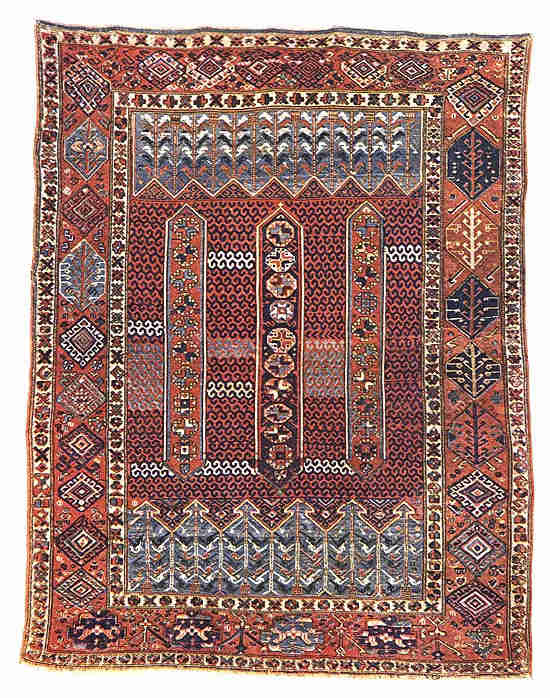
COLOUR PLATE IV—BERGAMO RUG
The weaver of this interesting Bergamo followed the early Asia Minor traditions in the use of rich, deep blue and red of field and border, yet in respect to pattern showed his freedom from conventionality by departing from types peculiar to his district and adopting many nomadic designs prevalent throughout Anatolia. Reciprocal latch-hooks form the background of the central field, on which are three upright panels containing octagonal discs; and latch-hooks surrounding lozenges and forming what may originally have been intended to represent the tree of life appear almost as conspicuously in the border. There are also combs, knots of destiny, and innumerable S-forms. The panels at the upper and lower ends of the field and the reciprocal vandykes are most suggestive of Ladiks, but in the place of pomegranates at the ends of the upright stalks are small checquered squares. Bergamos with such patterns are now rarely seen.
Loaned by Mr. Hulett C. Merritt
The similarity in the rugs of the Persian group is due to past political influences as well as to common ties of race and religion. From the time when Ctesiphon and Babylon vied with the cities of Persia in the splendour of their capitals, all of this territory was repeatedly under one and the same dominant power, which at different times was held by Saracens, Seljukian Turks, Timurids, and Safavids; and even after the end of the Safavid dynasty the influence of Nadir Shah was felt over Mesopotamia as well as Western Afghanistan. A still stronger influence is that of race; for Aryans, Arabs, Armenians, and Turks have blended with the early people of the whole territory, until not only do all resemble one another, but their craftsmanship is similar. Furthermore, with the exception of a few rapidly disappearing Parsees, who still cling to the early Zoroastrian faith, all are Mohammedans; and in their frequent pilgrimages to the same shrines is a constant interchange of ideas and exchange of fabrics. It is true Asia Minor, Caucasia, and India have shared to some extent the same influences, but to a much less degree.
A resemblance, also, exists between many of the physical features of the entire country that affect the habits and industries of the people. To be sure the Euphrates and Tigris, that wind sluggishly through the great Mesopotamian valley, and the great ranges of the Elburz and Zagros, that extend from Mt. Ararat easterly and southeasterly through Persia, have no counterpart; but on the other hand in Mesopotamia, Persia, and Western Afghanistan are great stretches of sandy wastes where there is little vegetation, high table-lands where during rainless summer months the earth is parched, and little valleys of fertile soil that are watered by streams from the encircling mountain ridges. Throughout this territory, wherever physical conditions are similar, the people follow similar pursuits. In the deserts the impoverished Bedouins live; in the higher lands some two millions of nomads follow their sheep and goats, pitching their tents wherever there is pasture; in the valleys are several millions of people, who, with the placid contentment of the East, irrigate their garden patches, fashion simple articles of metal, and weave artistic rugs.
A general decadence in social, political, and industrial life pervades the whole country; yet due partly to the inheritance of a past associated with the glories of Persepolis and Ecbatana, Babylon and Nineveh, Bagdad and Ctesiphon, and to the more immediate influence of the textile masterpieces of three centuries ago, rugs are still produced that in delicacy of weave, beauty of design, and harmony of colours surpass those of any other part of the world. In the weave of the best examples is displayed a technical skill only approached by a few of the Royal Bokharas. In the fine rhythm of lines and in the colour scheme of harmonious and delicate tones, with which a few of the best products of India alone compare, is united the touch of both artist and artisan. The fields of the old pieces are lavishly covered with intricate designs of buds and blossoms supported by vines or tendrils, and frequently encircled by arabesques that interlace so as to form an harmonious whole. The fields of the modern pieces are frequently of solid colour, with central medallions and triangular corners defined by graceful lines. Again, the ground colour of the field, which is either uniform or slightly shading from one end to the other, is covered with realistically drawn or conventionalised floral designs that are arranged with studied precision, and are now and then relieved by some nomadic design. Surrounding the fields are borders of several stripes, some of which contain an undulating vine with pendent flowers or palmettes co-ordinate in drawing and colouring with the main pattern. It is, however, principally in the colours, which are delicate yet rich, subdued yet lustrous, that these rugs surpass all others. Their most distinctive tones are blues, reds, browns, and greens, so arranged that the ground colours of border and field generally contrast yet remain in perfect harmony; as where there is some moss green in border and wine colour in field, each being subordinated to other superimposed colours representing floral detail.
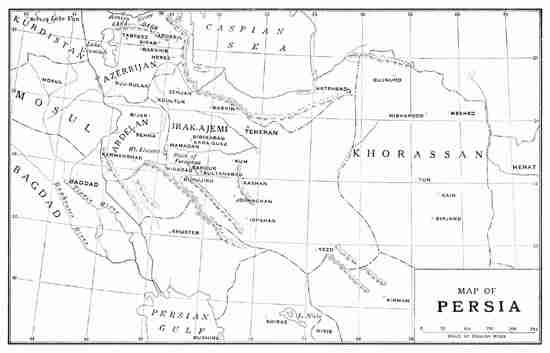
MAP OF PERSIA
The best known of the floral patterns, repeated with formal precision throughout the field, is the Herati pattern, which is of uncertain antiquity and origin. It consists of a central figure that generally represents a rose, but sometimes a peony or rosette, about which are grouped other figures like crumpled or lance-shaped leaves. Probably both the central and encircling figures are of Persian origin, though the latter have been regarded by some authorities as representing fish and attributed to Egypt or to China; in fact, they are occasionally drawn so as distinctly to show eyes and fins. Very frequently four of these figures are arranged about a lattice-shaped design with pendants and a central rosette, as in Plate O, Fig. 4 (Page 291). This Herati or Fish Pattern, as it is frequently called, appears in many of the old Persian rugs and in most of the modern pieces, particularly the Feraghans and Herats. A less frequently seen floral pattern, which has been used from a very remote time and is still represented in modern rugs, is the Guli Hinnai, or Flower of Hinnai (Plate O, Fig. 3). Of this plant Mohammed was so fond that he called it the “chief of this world and the next.” It occurs as a formal pattern in many of the Feraghans, and in several other rugs in which its bright five-petalled flowers are scattered informally over the field. Another floral pattern frequently seen is the Mina Khani, illustrated in Plate O, Fig. 2, that was named after Mina Khan, a former Persian ruler. It is particularly characteristic of Persian Kurdish pieces in which a dark blue field is covered by a network of intersecting olive-coloured vines. At the intersections are placed large flowers that alternate in regular series according to their different designs and colours; and between them often appear other flowers, such as the smaller and brighter coloured Hinnai, so as to destroy too great stiffness of design. As the flowers are relatively large and sufficiently separate to show the intervening blue field, this is one of the most effective of the formal repetitive floral patterns. A still more formal pattern (Plate O, Fig. 1), which appeared in some of the Persian rugs of the XVI and XVII centuries, was named after Shah Abbas. It is not unlikely that it was suggested by the Mina Khani design, to which it bears a slight resemblance; but the principal motive is so conventionalised that it has lost much of the floral character. Between the large and formal palmettes, that are arranged with mathematical precision, are grouped with similar regularity smaller palmettes, connected by angular vines and leafy branches.
Only a few Persian rugs have the formal repetitive patterns, such as the Herati, Guli Hinnai, Mina Khani, and Shah Abbas. Others have the repetitive pattern of bushes, flowers, or the pear, on a field of rich colour. The remainder have patterns consisting largely of scrolls, vines, or tendrils, drawn with exquisite art and decorated with leaves, flowers, and buds in beautiful profusion; also birds, beasts, human beings, demons, and other imaginary shapes, sometimes associated with the foliage but frequently bearing no apparent relation to it, appear as special motives. Since many of these forms, which originated in the remote past, have been transplanted from one country to another, and conventionalised to meet the new environment, it is interesting to observe the designs in the different classes of rugs and trace as far as possible the influences to which they are due.
Herats.—On great lines of travel between India, Turkestan, and Persia, the city of Herat in Northwestern Afghanistan for centuries occupied commercially a most important position, so that its people long since became familiar with the best fabrics of the surrounding countries. During the XV Century it reached its greatest prosperity, and exerted an important influence on the art and culture of Western Asia. Before the art decadence that followed the capture of the city by Nadir Shah in 1731, and the removal of many of its artisans to Persia, its looms were producing some of the best rugs of the Orient, which excelled in delicacy of drawing and in perfect harmony of colours. The fields contained patterns of serrated leaves entwined with flowing arabesques, scrolls, and Chinese cloud-bands. Conspicuous among this tracery were palmettes and such flowers as the lotus and peony, which were often most realistically drawn.17 These rugs are of further interest, as they contained in field and border the design that, slightly changed, appears in many of the later rugs of Persia as the Herati pattern.
The modern rugs are as unlike other Afghans as were the antique pieces and show a close relationship to those of Persia. Nor is this surprising, as the weavers, though falling far short of the high standards of the time when Herat was part of Persia, are still mindful of the early traditions. Moreover, many of the rugs are made across the border in Khorassan, and have the silky pile peculiar to the rugs of that province; but their tones of colour, consisting principally of red or blue in the field, and light green, yellow, and ivory in the border, as well as most of the patterns, are dissimilar. In one type the fields are covered with pear designs; but their bent narrow ends always turn in the same direction, whilst those of other rugs turn in different directions in alternate rows. Another type suggests the Feraghans, because their fields are covered with the Herati or Fish pattern; but the borders of the Feraghans usually have the well-known turtle pattern, while the borders of these adhere to the traditional Herati design. It is also not unusual to see a large central medallion, in which blue or red predominates, separated by a field of lighter colour from the triangular patterns of the corners. Now and then, a nomadic influence is seen in the small adventitious figures of the field.
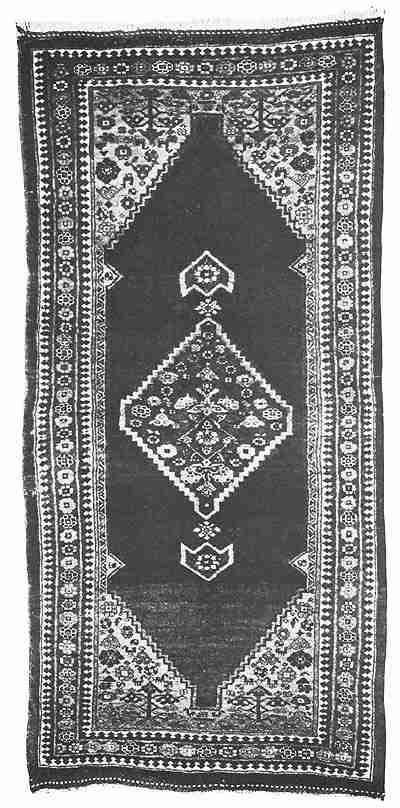
Plate 24. Bijar Rug
One of the most characteristic features of this class are the borders, that generally have three stripes, of which the central consists of a continuous vine of crumpled leaves so conventionalised as to be merely bent, thorny stalks partly enveloping formal rosettes. The other stripes are narrow, and have some simple undulating vine. This typical border, the stout, closely woven warp and weft of cotton, their large, almost square shapes and rather coarse weave, are important aids in distinguishing this class from all others. Some of the rugs recently made are coarse; but the older rugs have excellent dyes, lustrous nap, and matured tones of well-blended colours.
Type Characteristics.18 Colours, principally red and blue with minor quantities of green, yellow, and ivory. Knot, Ghiordes, rarely Sehna. Knots to inch horizontally, eight to eleven; perpendicularly, nine to twelve. A half knot, as it appears at back, is about as long, measured in direction of length of rug, as wide.19 The rows of knots are firmly pressed down so that the warp is concealed at back. Warp, of cotton, rarely wool; one of the two threads encircled by a knot is generally doubled under the other, sometimes it is only depressed. Weft, wool, occasionally cotton; of coarse diameter. For a short space a thread of weft crosses twice, that is across and back once, between every two rows of knots, then three times, and so alternates every several rows. Pile, wool of medium length, soft, and silky. Border, three to five stripes, and frequently an outer edging of uniform colour. Sides, a double overcasting. Both ends, narrow web and loose warp fringe. Texture, stout and firm. Weave at back is of coarse grain. Usual length, eight to twenty feet. Usual width, three fifths to three quarters length.
Khorassans.—Among Iranians, Khorassan is often spoken of as the Land of the Sun. In its northern part are long ranges of mountains where herds and flocks find excellent pastures, and intervening valleys where the soil is cultivated. But the remainder of the province, with the exception of scattered oases, where small towns and villages are located, is almost entirely a desert, from which in classic times the Parthians advanced to harass the armies of Greece and Rome, then retreated to seek the protection of its vast salt marshes and inhospitable wastes.
Nevertheless, in the little villages surrounded by a dreary wilderness have been produced as beautiful rugs as in those more favoured spots where prevailed cultured influences that could develop an Omar Khayyam and produce the sacred shrine of Meshed. Even before the Mongolian invasion several hundred looms, each employing four or five women, were busy in the town of Toon in Central Khorassan. Lying farther to the east is the district of Kain, which was once renowned for its beautiful rugs of Herati pattern, but of later years has produced coarser pieces with inferior designs and bad colours. Still better known was Birjand, in the southeastern part of the province, where formerly were woven pieces of superior workmanship that contained from two hundred to three hundred knots to the square inch. Their colours were of delicate shades; and it was not unusual to employ ivory or other light tones for the ground, with which was contrasted the darker tones of the Herati or pear patterns. Over a century ago many such towns in Khorassan were weaving rugs of artistic design and beautiful colours, but as a rule the present products fall far below the early standards.
Most of the Khorassans now seen were made almost fifty years or more ago and rival the best of modern Persian rugs. As a rule, they are of large size and have closely woven texture. They can be distinguished from most others by the silkiness of their moderately long nap, which is often due to the fact that it is from the fleece of a yearling lamb as well as because it is cut long and unevenly. Another characteristic is the use of some shade of red, as a pink, rose, or wine colour. Very frequently it is magenta or even purple, which are rarely found in other Persian rugs. Blue and cream are also largely employed. Their colours are generally softened by age, yet are warm, and at times brilliant, as when a large field of bright rose red or blue surrounds a central medallion.
The diversity of pattern in Khorassans is partly due to copying designs of rugs brought from other provinces by the pilgrims who yearly visit Meshed, and to the remoteness from one another of different centres of weaving in a province occupying one fourth of all Persia. One pattern, however, based upon the treatment of the pear design, which is employed in many of these pieces, at once distinguishes them from rugs of other districts. It consists of large pears arranged in regular order on a field of dark colour with their principal axes inclined diagonally in the same direction, and of two or three much smaller pears partly resting on them and partly projecting beyond their edges. Unlike the pear designs in other Persian rugs, which are oval, these are elongated like those of Indian rugs; and within them, as well as in the field, are often small floral figures. This distinctive pattern is rendered more effective by the colour scheme; since frequently pears of red or magenta, defined by lines of yellow and containing white petalled flowers, rest upon a ground of dark blue. The Herati design is also frequently employed, and in very old pieces are occasionally represented birds and animals naturalistically drawn. It is not unusual to see a central medallion or large vase of flowers surrounded by a field of bright uniform colour, and in some rugs are two medallions. When the centre contains a medallion, the triangular-shaped corners are set off by lines that are much simpler than those in Sarouks and Kermanshahs.
Few other rugs have more noticeable borders; for not only are they very wide, but in the main stripe, which is as wide as several guard stripes, is some characteristic pattern. Occasionally it contains the Herati design, but more frequently it consists of a heavy undulating vine with incipient flower forms, that at times almost assume the appearance of a bird’s head resting on a sub-pattern of double floral vine. This stripe, illustrated in Plate E, Fig. 2, (opp. Page 156) is so frequently met with in Khorassans as to be characteristic of them. The narrow guard stripes usually contain some simple vine or ornate reciprocal figure.
Type Characteristics. Colours, principally rose, blue, and ivory, with minor quantities of yellow and green. Knot, Sehna. Many are “left-hand.” Knots to inch horizontally, eight to thirteen; perpendicularly, twelve to twenty. The rows of knots are firmly pressed down, so that the warp is concealed and the weft is partly hidden at back. Warp, cotton; one of the two threads encircled by a knot is doubled under the other. A few short lengths of threads of warp hang loose at the back of some pieces. Weft, almost always cotton, occasionally wool of fine diameter and usually dyed blue. A thread of weft crosses twice between two rows of knots, excepting at intervals of every six or eight rows of knots, where it crosses three or more times. Pile, wool of medium length, silky and unevenly clipped. Border, three to six stripes, and generally an outer edging of uniform colour. Sides, a double overcasting of same colour as edging. Both ends, a narrow web and short warp fringe. Texture, moderately firm. Weave at back is of moderately fine grain. Usual length, five to twelve feet. Usual width, three fifths to three quarters length.
Mesheds.—In few parts of the East have the weavers received greater inspiration from sacred and historic association than those of Meshed. To Shiite Mohammedans it contains the most holy spot in Persia; for within a mosque resplendent with façade of blue and white tiles, and with gilded minarets of exquisite design, lie the remains of Ali Riza, the eighth Imam or Moslem priest, in a tomb that is viewed yearly by nearly one hundred thousand pilgrims. It was for a short time the capital of Shah Abbas, who beautified its mosques; and here Nadir Shah, whose remains lie in the mausoleum, held his court after the capture of Delhi. Within its walls was born Firdousi, the Homer of Persia; and not far away, among the mountains to the west, was the home of the poet and astronomer, Omar Khayyam. Not only devotees but large numbers of merchants regularly visit the city in the caravans from Khiva, Bokhara, Herat, Yezd, and Teheran, so that it is also a city of commercial importance.
It is possible that a few of those matchless pieces which were attributed to Herat before its destruction by Nadir Shah were made in the district near Meshed, since according to an Arabian traveller20 who visited it during the XIV Century many fine carpets then lay on the floor of its mosque. It is also believed that within the shrine, which has never been entered by an unbeliever, still remain some of the most magnificent carpets of the Orient. But for more than a century the textile industry has been declining, and the rugs now seen are generally of recent manufacture.
As a rule, these rugs are of the Khorassan type, and have the same silky appearance of nap, though it is shorter and more evenly clipped. The pattern, however, is generally different, as seldom is the field completely covered with the pear design, but whenever used, it is of elaborate drawing and frequently very large. Nor is the characteristic Khorassan border stripe, illustrated in Plate E, Fig. 2 (opp. Page 156), employed. On the other hand, it is not usual to see large central medallions, with floral designs in tones of rose or pink on fields of blue or ivory, and borders with undulating floral vines, in which appears evidence of Herati influence. Most of the rugs that now exist were made within the last fifty years, and are of large size and almost square shape. The colour scheme inclines to light and often brilliant tones, which at times are strongly contrasted with small masses of much darker shades. The wool is excellent, and the warp and weft are rarely coarse.
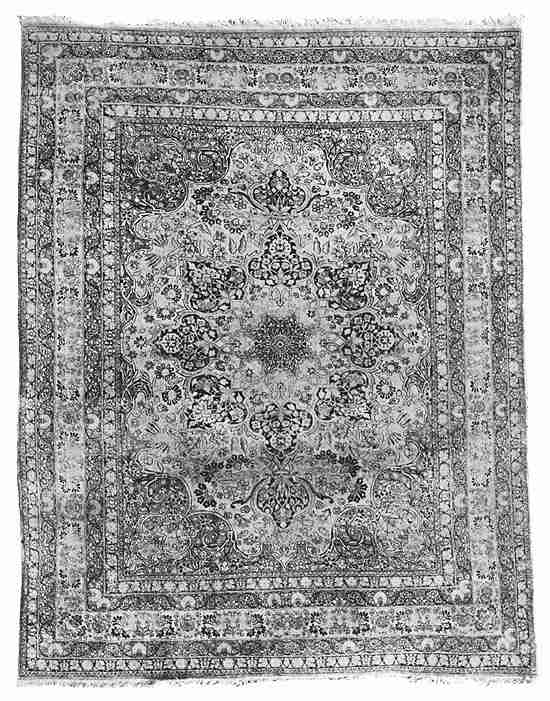
Plate 25. Kermanshah Rug
Type Characteristics. Colours, principally rose or pink, blue and white, with minor quantities of yellow and green. Knot, generally Sehna, rarely Ghiordes. Knots to inch horizontally, eight to fifteen; perpendicularly, twelve to seventeen. The rows of knots are pressed down, so that the warp is concealed and the weft is partly hidden at back. Warp, generally cotton, occasionally wool; one of the two threads encircled by a knot is doubled under the other. Weft, wool or cotton, of fine diameter and usually dyed blue. A thread of weft crosses twice between every two rows of knots. Pile, wool of fine quality and medium length. Border, usually from three to six stripes, occasionally as many as eight, and generally an outer edging of uniform colour. Sides, a double overcasting of same colour as edging. Lower end, a narrow web and warp fringe. Upper end, a web and warp fringe. Texture, moderately firm. Weave at back is of slightly coarse grain. Usual length, six to fourteen feet. Usual width, two thirds to seven eighths length.
Ispahans.—Still imposing in the ruins of its former splendour, surrounded by orchards, vineyards, and groves of trees that shade a broad, well-watered plain, is the ancient city of Ispahan. Under the Caliphs it became the capital of Persia; and though sacked by Tamerlane, who slew seventy thousand of its inhabitants, it rose to such importance that in the XVII Century it contained within its walls several palaces, one hundred and sixty mosques, over two score of colleges, nearly two thousand caravansaries, and about three quarters of a million people. Now the population has dwindled to about sixty thousand; and the few stately mosques and colleges that remain amid miles of deserted streets, abandoned bazaars, and ruined homes but feebly reflect the magnificence of the former capital.
Here was the royal court of Shah Abbas, who sent to Italy, for the purpose of studying decorative art, a number of the most experienced artisans, to whom are accredited some of the gracefully drawn designs of many of the early carpets. Here, in the days of its greatest prosperity, were founded many industries, and on its looms were undoubtedly woven some of the best of old Persian carpets. Though Herat is now regarded by some authorities as the centre where the so-called Ispahan rugs were made, it is improbable, as previously pointed out, that all of them came from there. But after the death of Shah Abbas the rug industry began to decline; and with the removal of the capital to Shiraz, in 1760, Ispahan ceased to be a rug-producing centre of consequence. There may be a doubt whether such enormous carpets, as the one with length of sixty feet and breadth of thirty that Sir Purdon Clark in his monograph on Oriental Carpets mentions as lying in the hall of Chehel Sutoon at Ispahan, were made there or were imported from other cities; but the weaving of rugs has never entirely ceased; and so great is the fame of the former glory of the city that even now Oriental dealers will often apply to rugs the term “Ispahan” as an epithet of superiority.
The few modern pieces which reach the western markets bear little resemblance to their prototypes; and even among themselves show little similarity of pattern, though the pear and Herati designs are not uncommon. In some rugs a century old the field is almost covered with what is known as the Persian crown jewel, and in others the field contains diamond-shaped medallions arranged in regular order with small foliate and floral forms placed between them. Small figures of animals are also occasionally represented. The border is generally narrow and lacking in impressive individuality, so that the character of the rugs depends largely on the pattern of the field and the well-seasoned colours, which are always rich and harmonious. Some shade of red or blue is usually chosen for the ground; and in the designs are green, yellow, and white. The weave has variations rarely found in other rugs; for the warp, which is usually cotton, may also be wool, or wool and cotton twisted together; and the weft may likewise be wool or cotton, and may cross between the rows of knots either once or twice in different rugs, or even once or twice in the same rug.
Type Characteristics.21 Colours, principally red and blue, with minor quantities of green and yellow. Knot, Ghiordes. Knots to inch horizontally six to nine; perpendicularly, eight to fourteen. The rows of knots are firmly pressed down. Warp, usually cotton, occasionally wool; in a few pieces wool or cotton are twisted together. Each thread of warp is equally prominent at back. Weft, wool or cotton. A thread of weft crosses once or twice between two rows of knots. If it is wool, it generally crosses twice; if of cotton, two threads are generally placed side by side and cross together once as a single thread. Pile, wool, of short or medium length. Sides, a double selvage of two or three chords. Lower end, a web. Upper end, a web and fringe. Occasionally the web is turned back and hemmed. Texture, firm. Weave at back is moderately coarse. Usual length, six to fourteen feet. Usual width, two fifths to two thirds length.
Kirmans.—On account of the isolated position of Kirman in Southeastern Persia, where the almost impassable saline and sandy deserts by which it is surrounded on the north and east, and the mountain ridges that separate it from the fertile valleys of Persia on the west, in a measure protected it from the repeated invasions that disturbed the political and industrial conditions of Northern Persia, it has continuously for over a thousand years been an important centre for the manufacture of rugs. Moreover, during all this period it has been noted for the excellence of their quality. As early as the Mohammedan conquests its fabrics were taken to furnish the floors and divans of Caliphs’ palaces. When Marco Polo visited Persia in 1270 he wrote of the beautiful shawls and carpets made by the women of Kirman; and the noted French traveller Chardin, who lived in that country during part of the XVII Century, also spoke most favourably of them. Even after Nadir Shah removed many of the most skilled weavers to the northern part of Persia subsequent to ascending the throne in 1739, and Aga Mohammed Khan pillaged the city and massacred many of the inhabitants in 1794, the rug industry continued to prosper, and to-day that district is producing the best of modern pieces.
To this isolation is also largely due the excellence of the weave and dyes, since the artisans have in a measure escaped the pernicious influences of market demands and aniline colours. And to it must be attributed the fact that the old Iranian textile art appears nowhere else in greater purity; for of all the rugs on the market to-day these conform more nearly in texture, colour, and design to the masterpieces of earlier times, and show none of the foreign influences appearing in pieces woven in the north. And yet in Kirman is complexity of race as well as religion; for the Beluches who have wandered across the desert mingle with the Persians; and the Guebres, still practising in secret their fire worship, meet with the Mohammedans.
For long ages silkworms have been cultivated in the district about Kirman and fed on the mulberry trees that grow wild among its hills, so that it is not surprising that small quantities of silk are sometimes used in the rugs; but as a rule the pile is entirely of wool, yet of such fine quality and so well woven that many of the old pieces have a lustrous and silky appearance. This wool, which is white and of unusually fine texture, is partly the product of the native sheep and partly the product of a variety of goats that live among the ridges and yield fleeces almost as fine as those of Kashmir.
It is probably because of the fondness of the people of Kirman for roses, which they cultivate for the attar, that they depict them so profusely in their rugs. Sometimes they represent them as filling vases set in rows, or again as formal bouquets arranged in regular order upon the field. They also weave them in the borders among green leaves, as placed there tenderly and not hanging from such stiffly formed vines as are seen in other Persian rugs. Nor are they conventionalised like the flowers of most modern rugs; but petal, leaf, and stem are drawn with a precision that suggests the work of Indian weavers. Usually they are red contrasting with a ground colour of soft, ashy grey in the field, and of golden yellow in the rich, harmonious border. Sometimes, instead of a profusion of roses, there are other flowers, such as the sunflower, suggesting the old Zoroastrian faith, the cypress, or the sacred “cocos.” Again, the general design may be modified from one strictly floral, and amid the foliage may be introduced birds, animals, or human beings; but the naturalistic drawing is always noticeable. In modern pieces the central medallion is often adopted, yet the general resemblance to older pieces is evident. As a rule the border has five stripes, of which the main one is twice the width of any other, and surrounding the outer is a narrow edging that is usually pinkish red; though now and then, according to the general colour scheme, a very pleasing effect is obtained by substituting an edging of moss green.
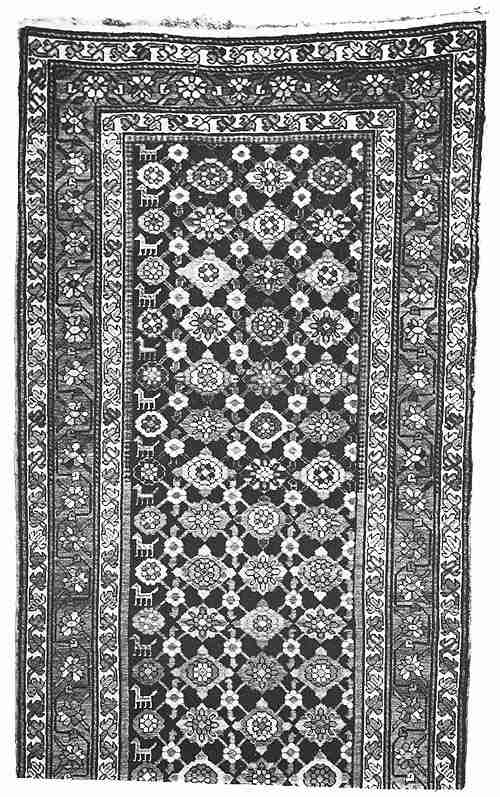
Plate 26. Kurdistan Rug with Mina Khani Pattern
Type Characteristics. Colours, principally grey or ivory, with minor quantities of faun, yellow, rose, and blue. Knot, Sehna. Knots to inch horizontally eleven to twenty; perpendicularly, eleven to twenty. The rows of knots are pressed down so that the warp is concealed and the weft is partly hidden at back. Warp, cotton; one of the two threads encircled by knot is doubled under the other. Weft, generally wool of fine diameter, occasionally cotton, and frequently dyed blue. A thread of weft crosses twice between every two rows of knots. Pile, wool, short, soft, and silky. Border, usually of five stripes and an outer edging of uniform colour that is generally pink but sometimes green. Sides, a double overcasting of the same colour as edging. Both ends, a narrow web and short warp fringe. Texture, very firm. Weave at back is of moderately fine grain. Usual length, five to seven feet. Usual width, three fifths to two thirds length.
Yezd.—In the centre of a sandy plain, midway between Kirman and Kashan, is the city of Yezd, where almost the last of the Iranian fire-worshippers, now a small part of the total population, still follow the ancient faith. Though partly shut off from the great desert of Khorassan by a mountain range, the city is only an oasis, where the drifting sands that buried the old city ever suggest to the inhabitants the dread spirit of desolation which finds an echo in ruined walls within. At the present time very few piled rugs are woven there and they are rarely seen in Western markets; yet on account of the historic interest in its people, the name is sometimes applied to modern products made in other districts. At one time it was noted for its silk rugs, and also for its felt “namads,” which are generally too heavy to be transported, since some of them have a thickness of two inches and a superficial area of ten thousand square feet.
Shiraz.—Near the centre of a small, well-cultivated valley encircled by mountains is Shiraz, capital of Farsistan. During the reign of Kerim Khan, from 1760 to 1779, it was the capital of Persia; but since then it has suffered from earthquakes and neglect until now much of its former glory has departed. And yet there still remain associations to kindle the imagination, for without the gates are the gardens that Persian poets have extolled in verse; the tombs of Saadi and Hafiz; and not far away are the spots where Cyrus, Darius, and Xerxes lived, and the ruined palaces that Alexander destroyed in a night of drunken revelry.
As early as the time of the Caliphs this district produced large numbers of carpets; though few, if any, remain that were woven before the XV Century. As is the case with modern pieces, all of them were distinguished for their soft and beautiful wool, which is to be attributed to the climate and pasture of the surrounding mountains and valleys. One of the oldest existing rugs of this district which displays the characteristic wool is referred to by Dr. F. R. Martin in the following words:22 “As soon as I had touched it, I was certain that we had to deal with a very rare kind of carpets which were made at Shiraz, or at least with the brilliant Shiraz wool. Most of the carpets made of that wool are lost, because the material was such a soft one that it was easily worn out. I know of very few which are older than the eighteenth century. No wool in all Persia takes such rich and deep colour as the Shiraz wool. The deep blue and the dark ruby red are equally extraordinary, and that is due to the brilliancy of the wool, which is firmer and, so to say, more transparent than silk, and makes one think of translucent enamel. As a piece of colour this carpet is certainly one of the finest, and there are very few carpets that have greater charm, which even the best reproduction could not give. In its colours there is something of an early Gothic stained-glass window, where the dust of ages has so covered the design that it has become obscured and the imagination of the spectator must complete it. Certainly the Persians for whom this carpet was made used to sit and dream for hours over the beauty of its colours, beautiful as the wonderful landscape surrounding Shiraz.”
On account of the design and workmanship of this remarkable piece it is referred by Dr. Martin to the XV Century. During the two following centuries the carpets of Shiraz attained the high standard of excellence prevalent in the principal cities of Persia; but most of those pieces are now extremely rare, as they were woven chiefly for imperial use or for exchange with foreign rulers. This city experienced the art decadence that began with the XVIII Century, yet under the patronage of Kerim Khan imperial factories for weaving were again established there.
Though some of the rugs made eighty or even sixty years ago are certainly beautiful, these modern pieces, as a rule, lack the excellent qualities of early rugs, and those more recently woven are still poorer. On a few of them are depicted designs that are strictly Persian; but they generally depart widely from the early traditions, and floral forms are very much conventionalised. In a large number of this class the field is covered with pear designs which are described by straight lines and angles. Sometimes they are as small as in the Sarabends, occupying the whole field as the principal motive; or they may be placed less prominently within diagonal or perpendicular stripes. Again, they may be as large as in Khorassans and grouped with other designs. Another very common pattern, known as the “pole-medallion,” consists of a narrow perpendicular bar connecting two or more large diamond-shaped figures on which are grouped conventionalised floral forms and geometric designs. In other pieces the pattern is as geometric as that of any Caucasian rug, and it is not unusual to see both field and border profusely adorned with latch-hooks enclosed within and surrounding geometric figures. Nor is it unusual to see small figures of men and animals scattered through the field. Indeed, there is no other Persian rug in which the pattern is so heterogeneous. The borders usually consist of a number of narrow stripes, or a wide one with narrow guard stripes. One of them, at least, almost invariably contains some form of vine and leaves, and not infrequently the row of small X figures that also appear in Shirvans. In fact, the rugs are sometimes mistaken for Shirvans on account of the resemblance in geometric designs.
Though there is such variety in the patterns, these rugs are not difficult to recognise. There is something distinctive about the dark blues and reds contrasted with smaller areas of ivory and yellow. They are, as a rule, loosely woven, and many of them have a trait of lying unevenly on the floor. Not infrequently an extra band of pile is woven between the border and the broad embroidered webs of the ends, from which hang a loose fringe. The sides are overcast with heavy strands of wool varied like a barber-pole at regular intervals; and, as is not the case with any other class, they are often ornamented at intervals with coloured tassels.
There are also large numbers of Shiraz saddle-bags, which are superior to any others made. They resemble the Caucasian, as the patterns are geometric; but they may be distinguished from them by the finer wool and a slightly different colour scheme.
Not infrequently the term “Mecca” is applied to Shiraz rugs, and the impression is conveyed that they were made there. Nor is the statement always entirely devoid of truth; for each year caravans aggregating some two hundred thousand souls enter that city to make their devotions to Allah, to walk around the sacred stone within the Kaaba, and leaving behind their forgotten sins to return homeward with a bit of sacred earth or a strip of the temple’s covering. Each of these pilgrims bears offerings for propitiation, of which a large proportion are rugs; and whatever their size, they are invariably the choicest the devotee can offer. Since the Mohammedan priests regard the best interests of their religion and themselves as conserved by a disposition of all articles not directly available for their use, they sell large quantities of such rugs, that find their way to Cairo, Damascus, and Constantinople. Furthermore, the pilgrims carry many pieces which are sold or exchanged along the routes of the caravans or at Mecca, and ultimately reach the same markets. Such a large number of the pieces that years ago came from these sources were of the well-known type of Shiraz rugs that they and similar pieces which had never left Persia were called Mecca rugs. This deception is still encouraged by some dealers, because for many buyers a special interest is attached to a piece that they are persuaded has been carried on this pilgrimage as an offering.
Type Characteristics. Colours, principally blue, red, and ivory, with minor quantities of yellow and green. Knot, generally Sehna, frequently Ghiordes. Knots to inch horizontally seven to twelve; perpendicularly, eight to twelve. At back one of the half knots is generally smaller than the other and pressed to one side. The other half knot is about as long as wide, and the yarn is not drawn tight against the warp. The rows of knots are pressed down, so that their alignment is slightly irregular, and the warp is concealed at back. Warp, almost always wool; in a few modern rugs goats’ hair is used. Each of the threads encircled by a knot is almost equally prominent at back, or occasionally one to each knot is depressed. Weft, wool of medium diameter, frequently coloured red. A thread of weft crosses twice between every two rows of knots. Pile, wool, short to medium, and silky. Border, three to five stripes. Beyond the borders, at each end, is frequently a narrow band of pile. Sides, a heavy double overcasting in a barber-pole stripe or in short lengths of different colours, which generally consist of two of the following colours: red, yellow, green, and blue. In some pieces small tufts of wool protrude from the sides at regular intervals of one or more feet. Lower end, a broad web of coloured stripes, through which may run a dovetailed coloured cord, and warp loops. Upper end, a broad web of coloured stripes, through which may run a dovetailed coloured cord, and warp fringe. Texture, loose. Weave at back is of slightly coarse grain. Usual length, five to nine feet. Usual width, three fifths to four fifths length.
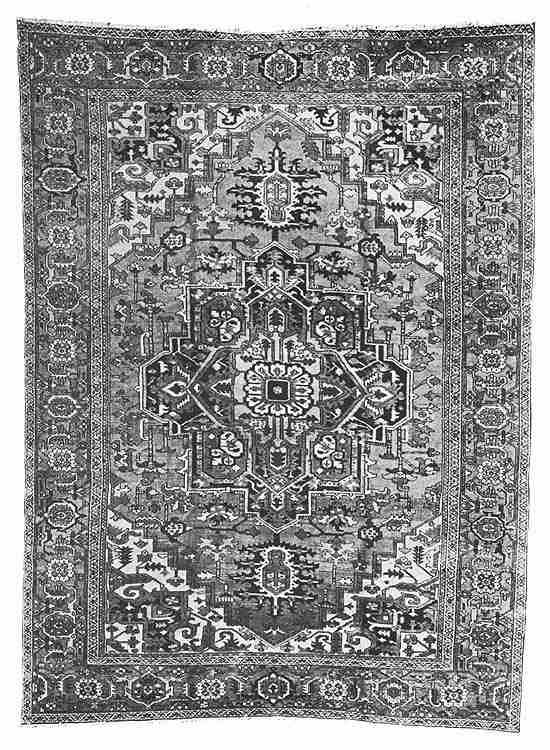
Plate 27. Gorevan Rug
Niris.—A resemblance exists between the rugs that take their name from Lake Niris and those of Shiraz, which is distant only fifty miles to the westward; for many of each class are woven with the same silky wool, obtained from sheep that graze in the intervening mountain ranges, and the shepherd weavers about the lake have acquired ideas from the old capital. This resemblance exists mostly in the soft, floccy appearance of the nap, and in the barber-pole or parti-coloured overcasting of the sides. The webs of each end are broad and have long fringes; but generally those of the Shiraz are embroidered and crossed with one or more parti-coloured cords, whilst those of Niris pieces are, as a rule, flatly woven in stripes of different colours. There is also an occasional resemblance in pattern, but the best known pattern of the Niris is rarely seen in the Shiraz. On the other hand, they are more firmly woven; and there is a slight difference in the character of their weave, since one of the two threads of warp encircled by a knot is depressed below the other, and the weft is of wool coloured red, whereas in the Shiraz it is frequently of cotton.
The pears are the favourite design, and, like those in Sarabends, extend over the field in orderly array; but they are much larger and consist of an assemblage of bright colours isolated from one another, yet grouped gracefully in a way that might readily suggest the origin of crown jewels sometimes ascribed to them. Frequently the ground is a dark blue, and the pears are of red, blue, green, and ivory. Violet and yellow are also employed. In other types, less usually seen, the field is covered with a lattice-work pattern containing small figures. The typical border has a broad central stripe of vine and flower, with narrow guards of simpler vine or reciprocal trefoil. Barber-pole stripes are also characteristic of the borders.
Type Characteristics. Colours, principally blue, red, yellow, green, and ivory. Knot, Ghiordes. Knots to inch horizontally six to eleven; perpendicularly, seven to fifteen. The rows of knots are not closely pressed down, so that at the back the warp is noticeable and the weft conspicuous. Warp, wool; one of the two threads encircled by a knot is depressed below the other at back and frequently doubled under the other. Weft, wool of medium diameter, generally dyed red. A thread of weft crosses twice between every two rows of knots. Pile, wool, of medium length. Border, generally of three stripes, sometimes as many as seven. Sides, a heavy double overcasting in a barber-pole stripe or in short lengths of different colours, such as red, blue, green, yellow, and black. Both ends, a broad web of coloured stripes, one row of knots, and loose warp fringe. Texture, loose. Weave at back is of slightly coarse grain. Usual length, four to seven feet. Usual width, three quarters to four fifths length.
Feraghans.—Stretching eastward from the base of Mt. Elwund is the plain of Feraghan. Its length does not exceed forty-five miles, nor its breadth ten or fifteen, yet here are clustered several hundred villages. On account of its altitude of seven thousand feet, the ground is covered with snow in winter, and the people are then huddled in their low mud houses, and the flocks and herds are gathered within the village walls. But in the spring the men are cultivating the fields, and the sheep are grazing on the banks of numerous streams. It is a plain of fertility and industry. For generations it has been productive of large numbers of fine rugs, and it is still possible among its villages to find some of those old pieces that have been regarded by the Persians themselves as the best examples of the textile art.
When the characteristic patterns of Feraghans have once been carefully observed, they are never forgotten; yet it is surprising to note the many distinctions observable in a large collection. These patterns may conveniently be divided into two groups, namely: one in which the field is entirely covered with diaper designs, and the other in which the field contains a central medallion surrounded by uniform colour. Probably nine tenths of these rugs fall within the first group, which is divisible into three sub-groups: those in which the field is covered with the Herati design; those in which the field is covered with the Guli Hinnai design; and those in which the field is covered with some other small diaper design.
The Herati design is the one most frequently seen, and is found in the very oldest of existing Feraghans. As a rule, the crumpled leaf does not exceed a length of four or five inches, and the rosettes are proportionally small, so that the ground colour is almost entirely concealed, and at a short distance is not distinguishable; but there are other pieces in which the leaf is over a foot in length, and the figures less closely clustered, so that the ground enters prominently into the colour scheme. The prevailing colour of the leaf and rosette is generally rose red, which gives a distinctly reddish tone to the rug; though the small designs have shades of green, yellow, white, and light blue. The ground is usually a rich, dark blue; but occasionally red or even ivory is used. In very few other rugs are the corners separated from the field, unless there is a central medallion; but in almost all Feraghans small triangular-shaped corners, with colours contrasting with those of the field, are separated from it by lines bearing teeth or serrated edges.
Surrounding the field is a border that has from five to seven stripes. The main stripe is about three times as wide as any other, and may have a ground colour of red, blue, or ivory white; but in many of the best pieces it is moss green, with blue, yellow, or red appearing in the overlying pattern. Of different but corresponding shades is the colour of the ground and designs of other stripes. Probably three fourths of the Feraghans now seen have the well-known turtle design in the main stripe; but it is sometimes replaced by the rose design shown in Plate E, Fig. 12 (opp. Page 156), or by an undulating vine with rosette or palmettes. On the innermost stripe, which is very narrow, is invariably represented some reciprocal figure, as the trefoil or sawtooth; and on the other stripes are undulating vines, with floral or quasi-floral figures.
The Feraghans with fields covered with Guli Hinnai designs instead of the Herati show a difference in both drawing and colouring, though the general effect is much the same. In place of crumpled leaves and rosettes of reddish hue are the star-like flowers of the Hinnai plants that brighten the mountains surrounding the Feraghan plain with their large yellow or ivory coloured petals. The pattern, as a whole, is slightly more prominent, and the prevailing colour tone, which is rich, is less red and more yellow. There is, however, a very noticeable difference in the pattern of the third sub-group, though specimens are not frequently seen. In these the small figures of conventionalised flowers sometimes have geometric shapes and are arranged in diagonal or perpendicular rows. Moreover, they generally lack the rich colouring of the preceding sub-groups.
The central medallion is found not only in modern but also in old Feraghans. It is generally of diamond or hexagonal shape, with serrated edges and with pendants. Almost invariably Herati figures cover its surface, and not infrequently some lattice-work design with small conventionalised leaves or flowers appear faintly on the field of uniform colour surrounding it. As a rule, pieces of this group are of a more striking and handsome appearance than those in which the entire field is covered with numerous minute figures of equally rich hues that blend and produce, when viewed at a distance, an undefined colour. The border designs are similar to those of the other group. All of the old pieces were stoutly woven; and though the nap was short, many of those that remain are still serviceable.
Type Characteristics. Colours, principally red and dark blue, with minor quantities of yellow, light blue, green, and white. Knot, Sehna, rarely Ghiordes. Knots to inch horizontally eight to thirteen; perpendicularly, seven to eighteen. The rows of knots are pressed down, so that the warp is usually concealed at back. Warp, cotton; each of the two threads encircled by a knot is equally prominent at back. Weft, cotton, occasionally dyed blue or pink. A thread of weft of fine or medium diameter crosses twice between every two rows of knots, or occasionally a thread of coarse diameter with much slack crosses only once, so that the transverse warp produces a quincunx effect. Pile, wool, clipped short. Border, three stripes. Sides, a double overcasting in dark colour. Lower end, a web. Upper end, a web and warp fringe. Texture, firm. Weave at back is of slightly coarse grain. Usual length, four to twelve feet. Usual width, three fifths to two thirds length.
Hamadans.—A little to the northeast of Elwund and at an altitude that overlooks a small, well-cultivated valley adjacent to the Feraghan plain is the city of Hamadan. On this site was the ancient city of Ecbatana, capital of Media; and here guarded by Jews is a tomb, which tradition declares is the burial place of Esther and Mordecai. Within the encircling walls are gardens, bazaars, and mosques; yet the present city of forty thousand inhabitants with its general misery and squalor has little to remind one of the magnificence of that former capital which for a short period was mistress of the world.
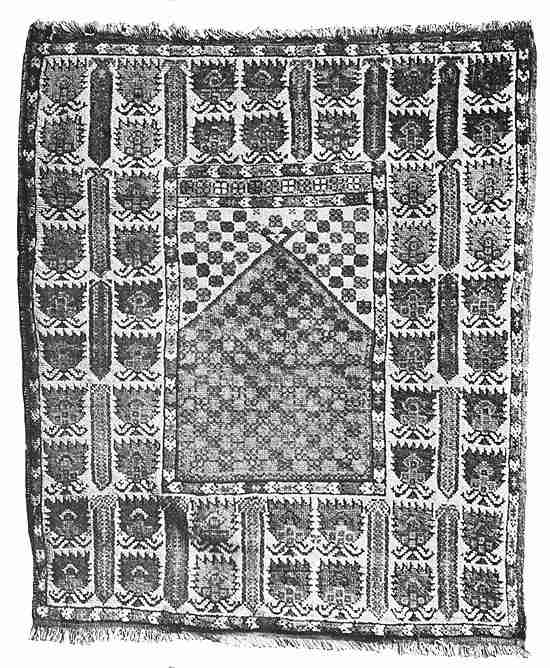
Plate 28. Bergamo Prayer Rug
Like Yezd, Hamadan is famous for its namads; and like Yezd it once produced, according to tradition, most beautiful silk carpets, though no longer are any woven there. But its looms have been busy for the last few generations weaving rugs of wool and camels’ hair, which have such marked individuality that they bear unmistakably on their face the stamp of identification. The few old rugs that remain are sterling pieces, which are stoutly woven and of excellent dyes. They come in many sizes; some are simply mats, others sedjadehs, and an unusually large number are runners. The typical pattern of the mats and smaller sedjadehs consists of a central diamond-shaped medallion, surrounded by a field of contrasting colour, from which are set off the triangular-shaped corners. In the large sedjadehs and in the runners, which are sometimes twenty feet or more in length, are often three or more pole medallions, though the pole device may be omitted. These medallions and corners are covered with small, carefully drawn geometric figures, or more frequently with floral designs such as appear in Feraghans, and as a rule are defined by serrated lines or are fringed with hooks or comb-like teeth. The colour of the surrounding field is unobtrusive. In some pieces it is void of pattern, and its monotonous tone is broken only by slight variations of shade; yet not infrequently it is marked with faint lines of slightly darker or lighter tint, like a delicate tracery. Not only are the borders wide, but a broad edging, which is at least one half and sometimes two thirds as wide as all the coloured stripes combined, surrounds them. As it is usually of camels’ hair and without pattern, it is a very noticeable characteristic. The main stripe has an undulating vine with conventionalised flowers, and the two guard stripes have a simpler vine, or, more frequently, the reciprocal trefoils.
To this general type, however, are many exceptions. Sometimes the figures of the medallion and corners are more geometric; sometimes the corners are omitted; the outside edging may be decorated with large conventionalised floral or geometric figures; and occasionally a camel or some other animal is represented in the field or border. A few of the old rugs were strikingly handsome. Dr. George Birdwood refers to a large Hamadan that formerly hung in the India Museum in these words:23 “An irregular lozenge form, a little island of bright clustering flowers, of which the prevailing colours are red and blue, adorns the centre; while the wide extended ground of yellow, in irregular shades, surrounds it with a rippling amber sea; and there are blue pieces in the corners, within the broad blue border worked in arabesques. It is a carpet not to be laid on a floor, but to be hung in a gallery, to be looked at like a golden sunset. It was a sacrilege to remove it from the mosque where it evidently was once spread under the great dome. Beati possidentes.”
Most of the old pieces have disappeared, and in their places are modern products with pile of wool or goat’s hair often dyed in garish colours. There are also many nondescript rugs, which were gathered from wandering tribes or surrounding villages and taken to Hamadan, since for a long time it has been one of the great rug markets of Persia. When exported from there they were often classed as products of that city.
Moderately old Hamadans contain more camel’s hair than any other class of rugs, since in very many of them it forms the pile of both field and outer edging, where its soft tones of pale chestnut colour contrast with the bright shades of blue, red, and yellow yarn used in other parts of the field and border. This lavish use of camel’s hair, the broad encircling edging, the cotton warp, and a single thread of coarse weft passing once between two rows of knots, distinguish them from all other rugs.
Type Characteristics. Colours, principally the chestnut of camel’s hair with red and blue. Knot, Ghiordes. Knots to inch horizontally, six to nine; perpendicularly, eight to twelve. The rows of knots are firmly pressed down. Warp, cotton; each of the two threads encircled by a knot is equally prominent at back. Weft, generally cotton, frequently wool; of coarse diameter. A thread of weft crosses only once without slack between every two rows of knots, so that the white spots of transverse cotton warp exposed at back have a quincunx appearance. Pile, in old rugs, mostly camel’s hair and some wool; in recent rugs, mostly wool clipped short. Border, wide, generally of three or four stripes, and a broad outer edging of camel’s hair. Sides, overcast, generally in brown or red. Lower end, a narrow web and warp loops. Upper end, a narrow web turned back and hemmed. Texture, very firm. Weave, at back is of moderately coarse grain. Length, three to twenty-four feet. Width, two fifths to three quarters length.
Irans.—Although neither a city nor district of Persia is called Iran, a well-defined class of rugs is known to the trade by that name. They are woven by some of the old Iranian stock dwelling principally in the province of Irak-Ajemi. These people follow no particular pattern or colour scheme of their own, but to a large extent copy those of a few well-known Persian classes; yet in other respects their rugs have a noticeable individuality. They are woven with a Ghiordes knot and so loosely that if the rug be observed from the front, as it is bent backward in a plane parallel to the direction of the weft, the foundation threads of warp and weft, which are of cotton, will show distinctly between the knots. Each of the two threads of warp encircled by a single knot are equally prominent at the back. Ordinarily the threads of weft cross twice between the rows of knots, but occasionally they cross only once, as in Hamadans. Many of the fabrics regarded as Sarabends, Feraghans, and even Hamadans are in reality Irans, which on account of their inferior workmanship are much less valuable.
Type Characteristics. Colours, principally blue and red, with minor quantities of ivory, yellow, green, and brown. Knot, Ghiordes. Knots to inch horizontally, six to eleven; perpendicularly, seven to eleven. A half knot as it appears at back is frequently longer, measured in the direction of the length of the rug, than wide. The rows of knots are not pressed down closely, so that the warp is noticeable at back. Warp, cotton; each of the two threads encircled by a knot is equally prominent at back; they are not closely strung, so that each half knot stands out distinctly. Weft, cotton; a thread of weft of coarse diameter as a rule crosses twice between each two rows of knots, and only rarely crosses but once. The weft is conspicuous between the knots at front when the rug is bent backwards. Pile, wool of medium length. Border, generally four to six stripes. Sides, a heavy double overcasting that is generally brown or black, but sometimes red. Lower end, a narrow web. Upper end, a narrow web and loose warp fringe. Texture, loose. Weave at back is of coarse grain. Usual length, five to ten feet. Usual width, two fifths to three quarters length.
Sarouks.—Towards the western end of the Feraghan plain and at an altitude of seventy-five hundred feet is the mud-walled village of Sarouk. Here, shaded by poplars, are clustered one hundred and fifty houses, with floors, roofs, and sides of mud that has dried and cracked until it admits the wind. The sun and light enter through the open doors, for there are no windows. Nor are there chimneys, but simply openings between the rafters to permit the escape of smoke from the open fireplace in the floor below and the entrance of more wind. At times the atmosphere is not only oppressive with smoke, but is laden with odours that arise from the pens beneath and beside the houses, where fowls, sheep, and goats are huddled. During the winter and early spring snow lies on the ground; a little later a hot summer follows. Yet amid these depressing surroundings and under these adverse conditions lived weavers who gave the name of their little village to some of the most beautiful rugs made in all the East.
Now and then is seen an old piece with surface like velvet and with mellowed tones of perfect harmony that has come from these huts or surrounding hills; but probably not one in a score, perhaps not one in a hundred, of the Sarouks now offered for sale in this country was woven there, as most of them are made in the workhouses of larger cities, though they follow essentially the general appearance and technique of old and genuine pieces, even if lacking some of their best qualities. Nevertheless, the modern pieces are of handsome colour, of graceful pattern, and are well woven. Some of them, which were made two or three decades ago, had large designs of the cypress, willow, or the tree of life, as well as realistically drawn animals represented in the fields; but the great majority of those now seen invariably follow a pattern consisting of a large medallion with pendants, or of two or more concentric medallions resting on the field, from which are set off the four corners. Defining the edges of both medallions and corners are lines that are most artistically irregular, yet correspond with one another.
Between each part is the greatest co-ordination, for the designs of field, corners, medallions, and borders are similar. On long delicate stems that bend and interlock like carved tracery are leaves, buds, and flowers, suggesting the craftsmanship of the best days of old Iran. The borders generally have only three stripes: a broad main stripe on which appears an elaborately drawn undulating vine with pendent flowers, and a narrow guard stripe on each side. Sometimes the guards are ornamented with only a simple vine, but more frequently with a reciprocal pattern, which, however, is so well drawn as to conflict in no wise with the harmony of the floral forms. In the drawing of the borders the weavers exercise greater latitude than in any other part of the rug; for occasionally they add a narrow outer edging of dark colour, place the reciprocal figure next to the innermost stripe as a fringe to the field, or increase the number of stripes to seven. Rarely is the medallion wanting in modern pieces, but now and then the pendants are replaced by bunches of flowers, and in some pieces the corners extend along the sides in undulating lines until they meet near the centre.
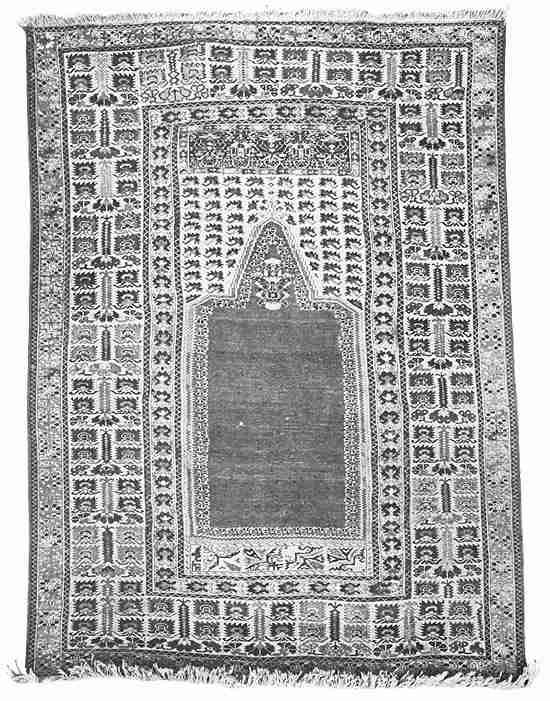
Plate 29. Ghiordes Prayer Rug
All of these pieces are so closely woven that the fine bluish weft is hardly discernible at the back. Very few other rugs have such short-cut wool, which has a velvety appearance, rendered more effective by the soft, rich colours that are always in perfect harmony and excellent taste. As a rule they are dark. Ever present in the ground colours are deep blues and reds, suggestive of the hues of the so-called “Ispahans;” while olives, delicate greens, and ivory represent with consummate dignity of tone and design a lavish tracery of leaves and foliage motives.
Type Characteristics. Colours, principally dark blue and red, with minor quantities of green, olive, buff, and ivory. Knot, Sehna. Knots to inch horizontally twelve to eighteen; perpendicularly, twelve to twenty. The rows of knots are pressed down, so that the warp is concealed and the weft is partly hidden at back. Warp, cotton, rarely linen; one of the two threads encircled by a knot is almost always doubled under the other; in a few pieces it is only depressed. Weft, cotton, of small diameter, dyed blue. A thread of weft of fine diameter crosses twice between every two rows of knots. Pile, wool, short and velvety. Border, generally of three stripes but sometimes as many as seven. Occasionally there is an outer edging of dark colour. Sides, a tightly wound double overcasting of red, blue, or black wool. Both ends, a narrow web, or web and short warp fringe. Texture, very firm. Weave at back is of fine grain. Length, four to twelve feet. Width, two thirds to three quarters length.
Kashans.—Near the centre of the province of Irak-Ajemi, on the ancient and well-travelled highway between Ispahan and Teheran, is the city of Kashan, from which, according to an old tradition, the three Wise Men of the East followed the Star of Bethlehem. Like many of the cities of Persia it is now largely in ruins; its homes are infested with scorpions; for many months of the year the heat, which in a measure is due to the proximity of the great salt desert that extends far into Khorassan, is unendurable; yet in spite of these inconveniences, for which perhaps familiarity has in a measure lent contempt, forty thousand people live there. In the past it has produced some of the greatest artists and artisans of weaving. It was once the home of Maksoud, whom Shah Ismael I ordered to weave the famous carpet of the Mosque of Ardebil, which, ranking among the greatest woven products that still exist, bears unmistakable evidence of the wonderful technique and artistic skill then practised in Kashan. Without a doubt other textile masterpieces of the XVI and XVII Centuries were woven there, for it would be unreasonable to believe that the city where Maksoud had learned his art was not at that time a prominent rug-producing centre.
According to Persian tradition many of the antique silk carpets came from Kashan. At any rate, it has been for a long time customary to take the raw silk from other places to be spun and dyed there. Some of it is woven into rugs, which are considered among the best of modern pieces, though the demand for them is small.
On the other hand, the woollen pieces are now found in every market, though it is only within recent years that they have been generally known. Occasionally they are defined as a higher grade of Sarouks, on account of the striking resemblance in texture, colours, and designs; yet there are certain distinctions: the warp is often linen, the nap is a little shorter, the texture slightly firmer, and there are a great number of border stripes. A feature that is more frequently found in these two classes than in any other is the fringe of hooks or short comb-like teeth that border the innermost stripe and extend into the field. Without doubt Kashans are among the most perfect as well as the most expensive woollen products of the modern Persian looms. Their velvet-like surface and rich sheen give them an appearance that to those unfamiliar with rugs seems like that of silken pieces. The fine wool is dyed with rich, deep tones of blue, olive, red, and brown; the perfectly balanced pattern is artistic as well as ornate; and on account of the very short nap the drawing of each minute detail is clear. In place of bold designs accentuated by masses of colour are delicate tracings of floral and foliage motives, of graceful arabesques and foliated stalks, so expressed in rhythmic lines and harmonious tones as to give a sense of the greatest refinement. Even though these rugs be modern and chemically washed, their wealth of artistic workmanship and exquisite colour make them exceedingly handsome.
Type Characteristics. Colours, principally dark blue, red, and yellowish brown, with minor quantities of light blue and green. Knot, Sehna. Knots to inch horizontally sixteen to twenty; perpendicularly, sixteen to twenty-four. The rows of knots are firmly pressed down so that the warp is concealed and the weft almost hidden at back. Warp, generally cotton, rarely linen; one of the two threads encircled by a knot is doubled under the other. Weft, generally cotton, of small diameter, dyed blue; rarely linen. A thread of weft crosses twice between every two rows of knots. Pile, wool, very short and velvety. Border, generally of seven stripes. Sides, a tightly wound double overcasting in dark red, blue, or brown. Lower end, a narrow web. Upper end, a narrow web and short warp fringe. Texture, very firm. Weave at back is of very fine grain. Usual length, six to ten feet. Usual width, three fifths to three quarters length.
Sababends.—Standing on the top of lofty Elwund, that rises on the boundary between the provinces of Ardelan and Irak-Ajemi, in Northwestern Persia, one would see within a radius of ninety miles as prolific a centre of rug weaving as anywhere exists. Just within this distance to the northwest are Sehna and Bijar, to the southeast is Sultanabad, to the southwest is Kermanshah; and skirting the mountain on the eastern side are the high plains where lie the districts of Hamadan, Feraghan, and Sarawan, as well as the village of Sarouk and less important centres of weaving.
Among the valleys of the Sarawan district, that lies on the northern flanks of mountain ranges extending as far as Ispahan, are made the rugs which, by a corruption of the word Sarawan, are known as the Sarabends. No other rugs of Persia have a pattern that is so simple, and that for generations has been followed with so little variation. Nor are there any other modern rugs that have changed less from the old styles in respect to colour and quality. The typical pattern of the field consists of rows of pear designs arranged in transverse lines, with the smaller ends pointing in different directions in alternate lines. The pears of the field show great diversity of shape, but those of the borders are long, narrow, and most angular; yet they never assume the rectilinear figures found in Baku rugs. Only very rarely is there any departure from this pattern; though in a few old pieces is an adaptation of the Herati design, and now and then is seen a geometric figure, or human form, or the date when the piece was woven.
The ground colour of the field may be blue, red, or white. If blue, it is so largely covered with pinkish or rose-coloured pears that the prevailing hue, when the pieces are viewed from a distance, is light red. If, on the other hand, the field is red, the pears are mostly blue; and if the field is ivory white, the pears are red and blue. In all old pieces the blue has rich, deep tones, the red has mellowed into soft rose or delicate pink, and the white has turned to ivory. This pleasing effect is increased by shades of yellow and green, which are added to the other colours of the pears.
With few exceptions the borders have a large number of narrow stripes, of which the central is about one third the aggregate width. Its ground colour is ivory white, but the angular vine and pendent, narrow pears have the same colours as those of the field. On each side of it is usually a stripe with ground colour corresponding to that of the field and with an undulating vine and rosette. Almost invariably there is an outer stripe of reciprocal trefoil in red and blue, which may be balanced by a reciprocal sawtooth adjoining the field. It is not unusual to see large pieces with two white stripes, and very rarely one is seen with three.
The best of these pieces are made in the town of Mirabad, which signifies the “city of Mir,” and are accordingly called Mir-Sarabends. They can be distinguished from others, known to the trade as Royal Sarabends, by the fact that in tying the knots the yarn is so twisted that one thread of warp is doubled under the other; and in the latter each of the two threads appear with equal prominence at the back. Neither of them should ever be mistaken for Iran imitations, in which the pile is of much looser texture and is tied with the Ghiordes knot. For durability, there are very few modern pieces that will give the satisfaction of Sarabends; for as a rule they are stoutly and closely woven, and though there is monotony in the pattern, those coloured with vegetable dyes will grow more beautiful with age.
Type Characteristics. Colours, principally red or blue, with minor quantities of ivory, yellow, and green. Knot, Sehna. Knots to inch horizontally eight to thirteen; perpendicularly, nine to thirteen. The rows of knots are firmly pressed down, so that the warp does not show at back. Warp, cotton. In Mir-Sarabends one of the two threads encircled by a knot is doubled under the other at back. In Royal Sarabends each is equally prominent. Weft, cotton, of fine diameter, and dyed red or blue. A thread of weft crosses twice between every two rows of knots. Pile, wool of short or medium length. Border, five to seven stripes, and occasionally even more. Sides, a red double overcasting. Lower end, a web, or web and short warp fringe. Upper end, a web and short warp fringe. Texture, firm. Weave at back is of moderately fine grain. Length, five to eighteen feet. Usual width, two fifths to two thirds length.
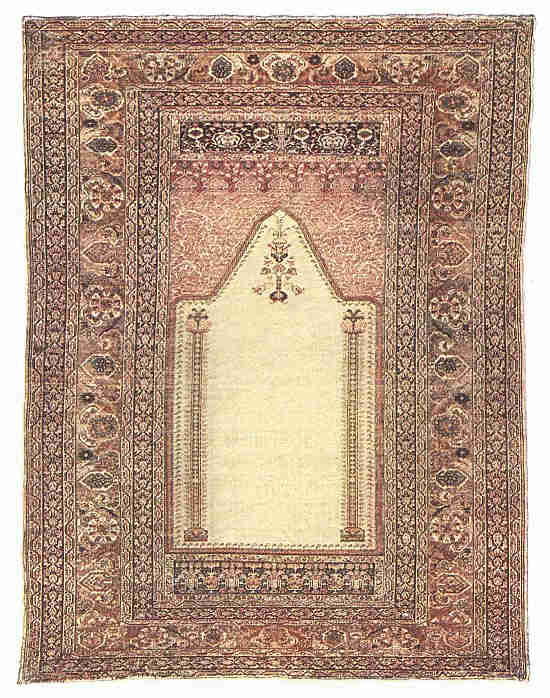
COLOUR PLATE V—GHIORDES PRAYER RUG
Only now and then is seen a prayer Ghiordes that represents such a high type of artistic skill. The weaving follows more closely the fine technique of the Persian than that of the Asia Minor weaver. Yet it is the drawing and colouring that claim attention. The delicate tracery of the spandrel, the minute delineation of tendril and leaf in the border, and the perfect balance of every part of one side with a corresponding part in the other, resemble the finest workmanship of old Iran. Not only so, but the beautiful border pattern of rosette and leaf is so suggestive of the well-known Herati design that it seems not improbable that here is shown the influence of those Persian weavers that Solyman the Magnificent took with him to Asia Minor after his capture of Tabriz. The colour also displays dainty tones and careful shading found in no other class of Asia Minor rugs. Such pieces are usually regarded as products of the XVI Century.
Property of the Author
Burujirds.—About sixty miles to the west of Sultanabad and forty to the south of the Sarawan district is the city of Burujird. It is in a rich, well-watered valley and is surrounded by numerous hamlets. Most of the population are engaged in agriculture; and only a small part, who are stimulated by the increased prices occasioned by the rug industry of Sultanabad, are weavers. They produce pieces that resemble closely the Sarabend rugs, as the field is generally occupied with pear designs; but on account of the Ghiordes knot and cotton warp and weft, they might be mistaken for Iran rugs.
Sultanabads.—Southeastward from the plain of Feraghan is the city of Sultanabad, which in recent years has become important as the centre of a great rug industry controlled by Europeans and Americans. Higher prices, resulting from the constantly increasing Western demand for Persian rugs, have stimulated the native weavers to more persistent efforts. Those who are too poor to purchase wool and dyes24 are supplied by the companies. Others, who are more dependent, are paid regular wages. Thus it happens that not only large numbers of looms are constantly at work in the city, but a hundred hamlets and villages that lie within a day’s journey produce rugs that are marketed there. But while the output has been increased the true artistic spirit has been suppressed, and patterns favoured or supplied by foreign purchasers only are in demand. Most of the rugs are well woven, though there is a difference in grades. Some take the name of the city, others are called Savalans, from a range of mountains that lie to the north, and others are known as Mahals. Most of them are large pieces, rather coarsely woven.
Muskabads.—In the district of Muskabad, a short distance to the northwest of Sultanabad, are produced rugs very similar to the Mahals. They come in the same large carpet sizes and nearly square shapes; they have almost the same harmonious colour scheme of unobtrusive red, yellow, blue, green, and ivory; they have the same cotton warp and weft, the same finish of sides and ends; but as a rule they are less closely woven. The patterns are varied. Occasionally they have large figures such as are seen in Gorevans, though these are more usual in Mahals. In some of them the field is covered with conventionalised leaf and floral form. But the usual type has two or more concentric medallions of different colours covered with the small Herati designs so distinctive of the Feraghans. When such is the case, the border has usually the turtle pattern in the main stripe and some stiffly drawn vine and floral pattern in the smaller stripes. But the velvety appearance, the elegant finish of old Feraghans, is always lacking. The nap is of soft wool of medium length, but the surface of the back displays coarse texture. These pieces lack the artistic qualities of most Persian rugs; but on account of their excellent quality of material and stoutness of weave they are very serviceable.
Type Characteristics. Colours, principally red, blue, and ivory, with minor quantities of green and brown. Knot, Ghiordes or Sehna. Knots to inch horizontally seven to fourteen; perpendicularly, eight to twelve. The rows of knots are not firmly pressed down. Warp, cotton; one of the two threads encircled by a knot is generally depressed at back, and frequently nearly doubled under the other. Weft, cotton, of medium to coarse diameter. A thread of weft crosses twice between every two rows of knots. Pile, wool, of medium length. Border, three to five stripes, with a narrow outer edging. Sides, a double overcasting. Lower end, a very narrow web and short warp fringe. Upper end, short warp fringe. Texture, moderately firm. Weave at back is of very coarse grain. Length, ten to eighteen feet. Width, two thirds to seven eighths length.
Joshaghans.—Lying to the southeast of Sultanabad and to the north of Ispahan is a district where a century ago were woven some of the best carpets of Persia, known as Joshaghans or Djushghans. Even long before then it was noted for its textile fabrics; but during the reign of Nadir Shah, who removed many of the best artisans from the central to the northwestern part of Persia, the carpet weaving received a new impulse, and continued to flourish there until nearly the middle of the last century. Since that time it has almost ceased, so that the genuine Joshaghans of rich, deep colour and skilfully drawn pattern are all sixty or more years of age. They may still be found scattered throughout the country, and should be carefully preserved; for they merit the high esteem accorded to them by the Persians themselves.
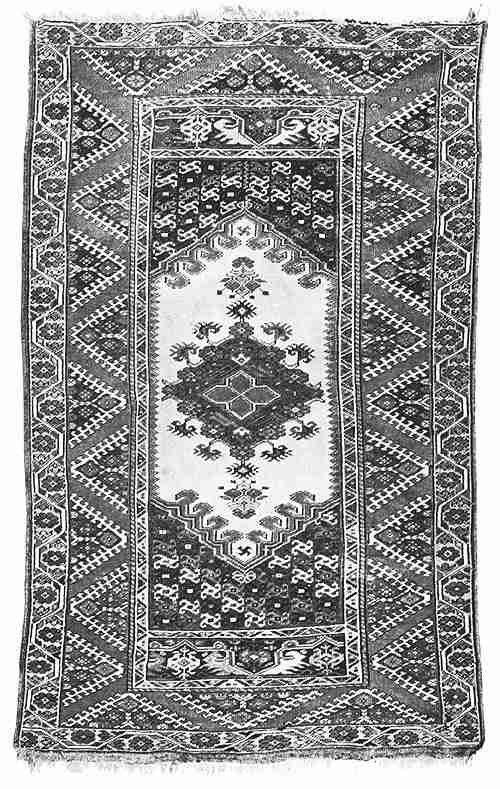
Plate 30. Ghiordes Rug
In a few of these pieces are seen the Shah Abbas pattern. In other pieces the field is covered with scrolls, or with a lattice-work pattern in which small floral forms are the motives. Again it is occupied by pear designs encircled by small rounded figures, which combined form the outlines of a larger pear, while in the intervening spaces are small floral forms. The principal border stripe generally consists of floral designs, which not infrequently are some form of the Herati pattern. The secondary stripes often contain floral vines.
Whatever the pattern of the field, the effect is always striking and beautiful; for the lines are never harsh, and the colours are rich. The ground is very frequently a rose tint, but is sometimes dark blue; and the overlying designs are rose, yellow, green, and ivory. The colours of the border are generally the same as those of the smaller designs, so that the effect is always harmonious. These rugs are excellently woven; and the soft lustrous wool of the pile, which is usually longer than that of Sarabends and Feraghans, has often an appearance like plush.
Type Characteristics. Colours, principally red and blue, with lesser quantities of yellow, green, brown, and ivory. Knot, Ghiordes. Knots to inch horizontally seven to eleven; perpendicularly, eight to thirteen. The rows of knots are not always firmly pressed down, so that the warp may be seen at back. Warp, usually cotton, occasionally wool; one of the two threads encircled by a knot is usually depressed below the other at the back. Weft, wool, sometimes dyed red, brown, or reddish brown, but frequently of natural colour. A thread of weft generally crosses twice, but sometimes three times between every two rows of knots. Pile, wool of short or medium length. Border, usually three stripes. Sides, a double overcasting that is generally brown or black. Lower end, a web. Upper end, a web and warp fringe. Texture, moderately firm. Weave at back is of moderately fine grain. Usual length, eight to sixteen feet. Usual width, two fifths to two thirds length.
Sehnas.—Seldom has prophecy been more precisely fulfilled than the one made a decade ago that the old Persian rugs would rapidly disappear from the market. Nor is it better exemplified than in the case of those woven before the middle of the last century in Sehna, capital of Ardelan, for to-day it is exceedingly difficult to obtain any of them. Nevertheless, there are still many looms among the four or five thousand families of the city, where true to early traditions are woven modern fabrics that maintain the same floral Persian patterns, the same colour, the same general character of weave; but they lack the fine technique of the older pieces. It is, indeed, surprising that these modern pieces so closely resemble the old in all save quality, when it is considered that Sehna is distant only fifty miles from the western border of Persia; that it is surrounded by Kurdish tribes who for generations have woven rugs with nomadic features; and that it is not far distant from other important rug centres.
To one familiar with the leading characteristics it is possible at once to distinguish these rugs. Their nap is exceedingly short, and the weave is so distinctive that with eyes closed an expert will generally recognise them after rubbing the hand across the front and back. Their patterns, also, conform to well-established types, yet have sufficient variety to be always interesting. They may be conveniently divided into two groups: one represents the entire field covered with floral designs, and the other represents a field of uniform colour with a medallion at the centre, or with two or more concentric medallions. The former, which is undoubtedly the older group, has generally a small diaper pattern of the Herati design or floral figures daintily drawn. To obviate too great monotony, a number of the old pieces have the leaves and flowers so adjusted that the ground conveys the effect of lattice work, or less often have small trees of cypress regularly placed amid the other floral designs. Again, the field may be covered with large pear designs placed in rows. Of modern pieces the most beautiful pattern, as a rule, consists of a field of rich, uniform colour, as ivory or red, containing at its centre a single medallion of contrasting ground colour, which is generally dark blue or even black. The four corners of the field have serrated edges and are covered with floral designs similar to those of the medallion. The borders, which are invariably narrow, usually consist of three stripes, but sometimes of only two. With very few exceptions they are floral, and in the main one, that has a ground colour of yellow or red, are represented designs which are also similar to those of the medallion. Some of the old Sehnas had borders that were less floral than more modern pieces, and the turtle design so common to Feraghans was often used. Isolated and adventitious designs, such as are seen in all nomadic rugs, are never found in these pieces, nor are the floriated scrolls that are peculiar to Sarouks, Kashans, and Kermanshahs.
As is seldom the case with modern rugs, occasionally both linen and silk are used for the warp, and silk for overcasting, but generally the warp is cotton and the overcasting is of wool. The city of Sehna has given its name to the kind of knot with which almost all the rugs of China and Turkestan as well as many of the rugs of India and Persia are tied; yet strange as it may seem, its own weavers have been inconsistent in its use. To be sure, most of its rugs have the Sehna knot, but a surprisingly large proportion of both recent and comparatively old pieces have the Ghiordes knot. Only a few other rugs ever adopt the same style of weaving; for a thread of weft passes between two rows of knots but once, so that at the back only alternate threads of white cotton warp appear between these knots and thus give to the weave a checkered appearance or quincunx effect. Moreover, the yarn of the knots is not drawn tightly against the warp, so that in whatever direction the hand is rubbed the surface feels like a file. Very few other rugs are so closely woven, as four hundred knots to the square inch are not uncommon; and in very old pieces nearly double that number are now and then met with. Since both warp and weft are of fine threads and the nap is very short, these rugs are exceedingly thin and, accordingly, are not well adapted for floor use.
Some old saddle-bags are still to be found, rich in their fields of deep blues and floral forms of brighter tones, but unfortunately they are somewhat marred by the long slit in the centre made to fit the saddle.
Type Characteristics. Colours, principally dark blue, red, and ivory, with lesser quantities of green, light blue, and yellow. Knot, Sehna, often Ghiordes. Knots to inch horizontally eleven to twenty; perpendicularly, twelve to twenty-four. The rows of knots are closely pressed down, but the yarn of knots is not drawn tight against the warp. Warp, generally cotton, occasionally linen, rarely silk. Each of the two threads encircled by a knot is equally prominent at back. Weft, generally cotton, occasionally wool or linen, rarely silk. A single thread of small diameter crosses only once between every two rows of knots, so that the white spots of transverse warp exposed at back have a quincunx appearance. Pile, wool clipped very short. Border, three stripes. Sides, a tightly wound double overcasting. Lower end, a short web, or web and warp loops, or web and short warp fringe. Upper end, short web and fringe. Texture, very firm. Weave at back is of fine grain but very rough. Length, three to seven feet. Width, two thirds to three quarters length.
Bijars.—One hundred miles beyond Hamadan, on the road to Tabriz, is the city of Bijar, capital of the district of Gehrous. It is surrounded by barren mountains that rise out of high table-lands, where for miles scarcely a habitation or bush breaks the monotony, and where not even a blade of grass or flower brightens the cracked and sun-parched earth, except for a short season of the year. As is the case throughout nearly all Persia, the spirit of desolation has crept into the city; the grapevine climbs over ruined walls; the shade of poplars and willows falls alike on decaying palace and crumbling houses. Yet there still remain caravansaries, schools, and mosques, as well as a population of five thousand people. Without doubt the importance of the city is partly due to the regiment of soldiers that the governor maintains to keep in subjection the bands of robbers and fierce Kurds who, in large numbers, live throughout the surrounding country. Nor are they the only tribes of fierce foreign blood dwelling in this region; for it is stated that during the invasions of the Timurids, a body of Turkomans from the fortress town of old Saraks, where the corners of Persia and Afghanistan meet Turkestan, followed the conqueror westward and settled here. After them is named a small river that flows a short distance to the north and finally empties into Lake Urumiah; and it is not unusual to apply the name Saraks to the rugs woven about Bijar, though they have none of the Turkoman characteristics.
By adopting some of the best qualities of both Persian and Kurdish rugs, the Bijar weavers have produced pieces of unusual merit. The foundation is generally of wool; but unlike almost all other rugs with nomadic features one thread of warp to each knot is doubled beneath the other in the process of weaving, so that it is almost or entirely concealed. Bijars are accordingly pieces of great firmness and durability. Moreover, their threads of warp and weft are of coarse diameter, so that they are invariably thick even when the nap is not long. They are also distinctive in the effective massing of bright and strong colours. Perhaps the association with ranges of treeless hills, with salt wastes, with vast plains where rainless months leave the grass parched and the flowers withered, has deadened the Persian love for the brilliant, joyous colours so acutely cherished in other parts of Asia; but by the weavers of Bijar it is not unusual to discard many of the Persian colours, which, however rich, are subdued and sombre, and adopt the brighter hues seen in some of the rugs of Asia Minor. Yet, as is not always the case with the latter, there is no sense of outraged taste; and though crimson reds, deep blues, or tawny camel’s hair be brought in relief against a field of strongly contrasting colour, the effect, except in modern pieces of poor dyes, is never displeasing.
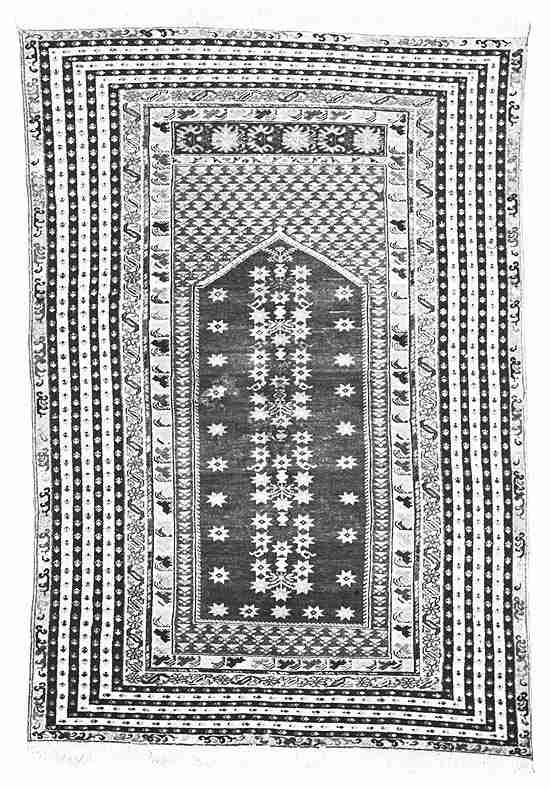
Plate 31. Kulah Prayer Rug
In the pattern much latitude is exercised, but only in the oldest pieces are found the gracefully flowing lines suggestive of the highest Persian art. In many pieces a central medallion and triangular-shaped corners, separated by a field of plain or slightly shaded colour, is a favourite pattern. But the defining lines are severe, and lack the delicate drawing characteristic of Kermanshahs and Sarouks. Or the field may be covered with a lattice-work pattern that contains small repetitive forms, consisting of slender stems supporting one or more flowers. Frequently a rug is covered with a medley of designs composed of conventionalised flowers, crudely drawn trees, as well as birds, animals, or human beings. The borders generally consist of an outer edging of plain colour, and three stripes, on which are often represented purely geometric forms, but more frequently the undulating vine and pendent leaves, such as are common to most Persian rugs. Fortunately many sterling pieces still remain that have none of the earmarks of factory-made rugs, but are beautiful with their soft wool and lustrous colours, as well as interesting with their blending of Persian and Kurdish features.
Type Characteristics. Colours, principally red, also blue, ivory, green, yellow, and chocolate. Knot, Ghiordes. Knots to inch horizontally six to ten; perpendicularly, eight to twelve. The rows of knots are pressed down, so that the warp is concealed at back and the weft partly hidden. Warp, wool; one of the two threads encircled by a knot is doubled under the other. Weft, wool, of medium or coarse diameter, frequently dyed red. A thread of weft crosses twice between every two rows of knots. Pile, of medium length, usually wool, but frequently partly of camel’s hair. Border, of three stripes, often with an outer edging. Sides, a double overcasting in red or purple. Lower end, a web that is occasionally coloured or a narrow braided selvage. Upper end, a web with loose warp fringe and sometimes a braided selvage. The webbing is occasionally turned back and hemmed. Texture, very firm. Weave at back is of coarse grain. Length, six to sixteen feet. Width, one quarter to three fifths length.
Kermanshahs.—On an ancient highway between Bagdad and Teheran is the city of Kermanshah. As it is situated near the frontiers of northwestern Persia, facing the Turkish provinces, and is surrounded by mountains where once wandered bands of homeless marauding Kurds who recognised no government, it was formerly a most important stronghold of defence. A century ago Robert Kerr Porter, who visited the city, referred to the luxurious gardens and orchards that surrounded it, and to the villages of the vicinity in which were made “carpets of most beautiful colour and fabric.” Within later years the moat has filled with rubbish, the encircling walls have crumbled, and the deserted bazaars and caravansaries show that its present population of about twelve thousand is but a small part of what it has been. With its decline in political importance followed a decline in industrial activities; yet for a long time it remained a rug-producing centre of importance. In 1880 Sir George Birdwood wrote that “the finest Oriental rugs of our time, which at the Vienna Exhibition astonished all beholders, are those made in the palace of the Governor of Kermanshah, in Kurdistan, and are only disposed of as presents.”25 And in 1890 a traveller26 spoke of the weaving as follows: “It is a process carried on in homes, hovels, and tents by women and children.... The vegetable dyes used are soft and artistic, especially a wonderful red and the various shades of indigo. The dull, rich tints, even when new, are quite beautiful. The women pursue their work chiefly in odds and ends of time, and in some cases make it much of a pastime.”
From this city and the surrounding hills are still obtained large quantities of rugs, which follow the same patterns that for years have been characteristic of this district. Yet most of the modern Kermanshahs are made elsewhere in the workhouses of exporting companies. So noticeable is the resemblance in drawing and colouring of some of them to the Kirmans of Southeastern Persia, that they are offered now and then by dealers as real Kirmans, though they lack the fine technique and artistic merit of the latter. They possess, however, the same wealth of floral expression, for throughout border and field are sprays of flowers on delicate vines and foliate stalks. Most of the pieces now seen contain at the centre of the field a large medallion, which may have serrated or lobed edges, be oval or of diamond shape, and with or without pendants. The corners are