Part 2 — CHAPTER IX THE LESSON PROBLEM
Reading edition
Problem, a Motive.—The foregoing description and examples of the educative process have shown that new knowledge necessarily results whenever the mind faces a difficulty, or need, and adjusts itself thereto. In other words, knowledge is found to possess a practical value and to arise as man faces the difficulties, or problems, with which he is confronted. The basis of conscious activity in any direction is, therefore, a feeling of need. If one analyses any of his conscious acts, he will find that the motive is the satisfaction of some desire which he more or less consciously feels. The workman exerts himself at his labour because he feels the need of satisfying his artistic sense or of supplying the necessities of those who are dependent upon him; the teacher prepares the lessons he has to present and puts forth effort to teach them successfully, because he feels the need of educating the pupils committed to his care; the physician observes symptoms closely and consults authorities carefully, because he feels the need of curing his patients; the lawyer masters every detail of the case he is pleading, because he feels the need of protecting the interests of his client. What is true of adults is equally true of children in school. The pupil puts forth effort in school work because he feels that this work is meeting some of his needs.
Nature of Problem.—It is not to be assumed, however, that the only problem which will prompt the individual to put forth conscious effort must be a purely physical need, such as hunger, thirst, or a distinct desire for the attainment of a definite object, as to avoid danger or to secure financial gain or personal pleasure. Nor is it to be understood that the learner always clearly formulates the problem in his own mind. Indeed, as will be seen more fully later, one very important motive for mastering a presented problem is the instinct of curiosity. As an example of such may be noted a case which came under the observation of the writer, where the curiosity of a small child was aroused through the sight of a mud-turtle crawling along a walk. After a few moments of intense investigation, he cried to those standing by, "Come and see the bug in the basket." Here, evidently, the child's curiosity gave the strange appearance sufficient value to cause him to make it an object of study. Impelled by this feeling, he must have selected ideas from his former experience (bug—crawling thing; basket—incasing thing), which seemed of value in interpreting the unknown presentation. Finally by focusing these upon this strange object, he formed an idea, or mental picture, which gave him a reasonable control over the new vague presentation. Such a motive as curiosity may not imply to the same degree as some others a personal need, nor does it mean that the child consciously says to himself that this new material or activity is satisfying a specific need, but in some vague way he knows that it appeals to him because of its attractiveness in itself or because of its relation to some other attractive object. In brief, it interests him, and thus creates a tendency on the part of an individual to give it his attention. In such situations, therefore, the learner evidently feels to a greater or less degree a necessity, or a practical need, for solving the problem before him.
NEED OF PROBLEM
Knowledge Gained Accidentally.—It is evident, however, that at times knowledge might be gained in the absence of any set problem upon which the learner reacts. For example, a certain person while walking along a road intent upon his own personal matters observed a boy standing near a high fence. On passing further along the street, he glanced through an opening and observed a vineyard within the inclosure. On returning along the street a few minutes later, he saw the same boy standing at a near by corner eating grapes. Hereupon these three ideas at once co-ordinated themselves into a new form of knowledge, signifying stealing-of-fruit. In such a case, the experience has evidently been gained without the presence of a problem to guide the selecting and relating of the ideas entering into the new knowledge. In like manner, a child whose only motive is to fill paper with various coloured crayon may accidentally discover, while engaged on this problem, that red and yellow will combine to make orange, or that yellow and blue will combine to make green. Here also the child gains valuable experience quite spontaneously, that is, without its constituting a motive, or problem, calling for adjustment.
Learning without Motive.—In the light of the above, a question suggests itself in relation to the lesson problem, or motive. Granting that a regular school recitation must contain some valuable problem for which the learning process is to furnish a solution, and granting that the teacher must be fully conscious both of the problem and of its mode of solution, the question might yet be asked whether a problem is to be realized by the child as a felt need at the beginning of the lesson. For example, if the teacher wishes his pupils to learn how to compose the secondary colour purple, might he have them blend in a purely arbitrary way, red and blue, and finally ask them to note the result? Or again, if he wishes the pupils to learn the construction of a paper-box or fire-place, would he not be justified in directing them to make certain folds, to do certain cutting, and to join together the various sections in a certain way, and then asking them to note the result? If such a course is permissible, it would seem that, so far at least as the learner is concerned, he may gain control of valuable experience, or knowledge, without the presence of a problem, or motive, to give the learning process value and direction.
Problem Aids Control.—It is true that in cases like the above, the child may gain the required knowledge. The cause for this is, no doubt, that the physical activity demanded of the pupil constitutes indirectly a motive for attending sufficiently to gain the knowledge. But in many cases no such conditions might exist. It is important, therefore, to have the pupil as far as possible realize at the outset a definite motive for each lesson. The advantage consists in the fact that the motive gives a value to the ideas which enter into the new knowledge, even before they are fully incorporated into a new experience. For example, if in a lesson in geometrical drawing, the teacher, instead of having the child set out with the problem of drawing a pair of parallel lines, merely orders him to follow certain directions, and then requests him to measure the shortest distance between the lines at different points, the child is not likely to grasp the connections of the various steps involved in the construction of the whole problem. This means, however, that the learner has not secured an equal control over the new experience.
Pupils Feel Its Lack.—A further objection to conducting a lesson in such a way that the child may find no motive for the process until the close of the lesson, is the fact that he is himself aware of its lack. In school the child soon discovers that in a lesson he selects and gives attention to various ideas solely in order to gain control over some problem which he may more or less definitely conceive in advance. For this reason, if the teacher attempts, as in the above examples, to fix the child's attention on certain facts without any conception of purpose, the pupil nevertheless usually asks himself the question: "What does the teacher intend me to do with these facts?" Indeed, without at least that motive to hold such disconnected ideas in his mind, it is doubtful whether the pupil would attend to them sufficiently to organize them into a new item of knowledge. When, therefore, the teacher proposes at the outset an attractive problem to solve, he has gone a long way toward stimulating the intellectual activity of the pupil. The setting of problems, the supplying of motives, the giving of aims, the awakening of needs—this constitutes a large part of the business of the teacher.
PUPIL'S MOTIVE
Pupil's Problem versus Teacher's.—But it is important that the problem before the pupil at the beginning of the lesson should really be the pupil's and not the teacher's merely. The teacher should be careful not to impose the problem on the pupils in an arbitrary way, but should try to connect the lesson with an interest that is already active. The teacher's motive in teaching the lesson and the pupil's motive in attending to it are usually quite different. The teacher's problem should, of course, be identical with the real problem of the lesson. Thus in a literature lesson on "Hide and Seek" (Ontario Third Reader), the teacher's motive would be to lead the pupil to appreciate the music of the lines, the beauty of the images, and the pathos of the ideas; and in general, to increase the pupil's capacities of constructive imagination and artistic appreciation. The pupil's motive might be to find out how the poet had described a familiar game. In a nature study lesson on "The Rabbit," the teacher's motive would be to lead the pupil to make certain observations and draw certain inferences and thus add something to his facility in observation and inference. The pupil's motive in the same lesson would be to discover something new about a very interesting animal. In general, the teacher's motive will be (1) to give the pupil a certain kind of useful knowledge; (2) to develop and strengthen certain organs; or (3) to add something to his mechanical skill by the forming of habitual reactions. In general, the pupil's motive will be to learn some fact, to satisfy some instinct, or perform some activity that is interesting either in itself or because of its relation to some desired end. That is, the pupil's motive is the satisfaction of an interest or the promotion of a purpose.
Pupil's Motive May Be Indirect.—It is evident from the foregoing that the pupil's motive for applying himself to any lesson may differ from the real lesson problem, or motive. For instance, in mastering the reading of a certain selection, the pupil's chief motive in applying himself to this particular task may be to please and win the approbation of the teacher. The true lesson problem, however, is to enable the learner to give expression to the thoughts and feelings of the author. When the aim, or motive, is thus somewhat disconnected from the lesson problem itself, it becomes an indirect motive. While such indirect motives are undoubtedly valuable and must often be used with young children, it is evident that when the pupil's motive is more or less directly associated with the real problem of the lesson, it will form a better centre for the selecting and organizing of the ideas entering into the new experience.
Relation to Pupil's Feeling.—A chief essential in connection with the pupil's motive, or attitude, toward the lesson problem, is that the child should feel a value in the problem. That is, his apprehension of the problem should carry with it a desire to secure a complete mastery of the problem from a sense of its intrinsic value. The difference in feeling which a pupil may have toward the worth of a problem would be noticed by comparing the attitude of a class in the study of a military biography or a pioneer adventure taken from Canadian or United States sources respectively. In the case of the former, the feeling of patriotism associated with the lesson problem will give it a value for the pupils entirely absent from the other topic. The extent to which the pupil feels such a value in the lesson topic will in most cases also measure the degree of control he obtains over the new experience.
AWAKENING INTEREST IN PROBLEMS
As will be seen in Chapter XXIX, where our feeling states will be considered more fully, feeling is essentially a personal attitude of mind, and there can be little guarantee that a group of pupils will feel an equal value in the same problem. At times, in fact, even where the pupil understands fairly well the significance of a presented lesson problem, he may feel little personal interest in it. One of the most important questions of method is, therefore, how to awaken in a class the necessary interest in the lesson problem with which they are being presented.
1. Through Physical Activity.—It is a characteristic of the young child to enjoy physical activity for the sake of the activity itself. This is true even of his earliest acts, such as stretching, smiling, etc. Although these are merely impulsive movements without conscious purpose, the child soon forms ideas of different acts, and readily associates these with other ideas. Thus he takes a delight in the mere functioning of muscles, hands, voice, etc., in expressive movements. As he develops, however, on account of the close association, during his early years, between thought and movement, the child is much interested in any knowledge which may be presented to him in direct association with motor activity. This fact is especially noticeable in that the efforts of a child to learn a strange object consist largely in endeavouring to discover what he can do with it. He throws, rolls, strikes, strives to open it, and in various other ways makes it a means of physical expression. Whenever, especially, he can discover the use of an object, as to cut with knife or scissors, to pound with a hammer, to dip with a ladle, or to sweep with a broom, this social significance of the object gives him full satisfaction, and little attention is paid to other qualities. For these reasons the teacher will find it advantageous, whenever possible, to associate a lesson problem directly with some form of physical action. In primary number work, for example, instead of presenting the child with mere numbers and symbols, the teacher may provide him with objects, in handling which he may associate the number facts with certain acts of grouping objects. It is in this way that a child should approach such problems as:
How many fours are there in twelve? How many feet in a yard? How many quarts in a peck? etc.
The teaching of fractions by means of scissors and cardboard; the teaching of board measure by having boards actually measured; the teaching of primary geography by means of the sand-table; the teaching of nature study by excursions to fields and woods; these are all easy because we are working in harmony with the child's natural tendency to be physically active. The more closely the lesson problem adjusts itself to these tendencies, the greater will be the pupil's activity and hence the more rapid his progress.
2. Through Constructive Instinct.—The child's delight in motor expression is closely associated with his instinctive tendency to construct. When, therefore, new knowledge can be presented to the child in and through constructive exercises, he is more likely to feel its value. Thus it is possible, by means of such occupations as paper folding or stick-laying, to provide interesting problems for teaching number and geometric forms. In folding the check-board, for example, the child will master necessary problems relating to the numbers, 2, 4, 8, and 16. In learning colour, it is more interesting for the child to study different colours through painting leaves, flowers, and fruits, than to learn them through mere sense impressions, or even through comparing coloured objects, as in the Montessori chromatic exercises. A study of the various kindergarten games and occupations would give an abundance of examples illustrative of the possibility of presenting knowledge in direct association with various types of constructive work.
A. Activity must be Directly Connected with Problem.—It may be noted, however, that certain dangers associate themselves with these methods. One danger consists in the fact that, if care is not taken, the physical activity may not really involve the knowledge to be conveyed, but may be only very indirectly associated with it. Such a danger might occur in the use of the Montessori colour tablets for teaching tints and shades. In handling those, kindergarten children show a strong inclination to build flat forms with the tablets. Now unless these building exercises involve the distinguishing of the various tints and shades, the constructive activity will be likely to divert the attention of the pupil away from the colour problem which the tablets are supposed to set for the pupils.
B. Not too much Emphasis on Manual Skill.—Again, in expressive exercises intended merely to impart new knowledge, it may happen that the teacher will lay too much stress on perfect form of expression. In these exercises, however, the purpose should be rather to enable the child to realize the ideas in his expressive actions. When, for example, a child, in learning such geographical forms as island, gulf, mountain, etc., uses sand, clay, or plasticine as a medium of expression, too much striving after accuracy of form in minor details may tend to draw the pupil's attention from the broader elements of knowledge to be mastered. In other words, it is the gaining of certain ideas, or knowledge, and not technical perfection, that is being aimed at in such expressive movements.
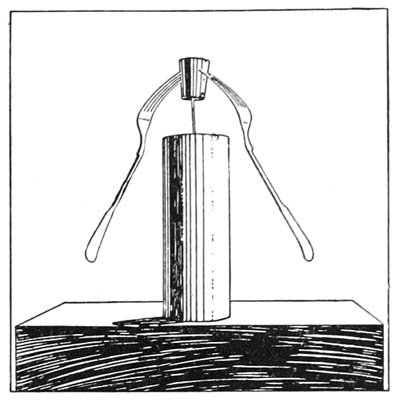
3. Instinct of Curiosity as Motive.—The value of the instinct of curiosity in setting a problem for the young child has been already referred to. From what was there seen, it is evident that to the extent to which the teacher awakens wonder and curiosity in his presentation of a lesson problem, the child will be ready to enter upon the further steps of the learning process. For example, by inserting two forks and a large needle into a cork, as illustrated in the accompanying Figure, and then apparently balancing the whole on a small hard surface, we may awaken a deep interest in the problem of gravity. In the same manner, by calling the pupils' attention to the drops on the outside of a glass pitcher filled with water, we may have their curiosity aroused for the study of condensation. So also the presentation of a picture may arouse curiosity in places or people.
4. Ownership as Motive.—The natural pleasure which children take in collection and ownership may often be associated with presented problems in a way to cause them to take a deeper interest in the knowledge to be acquired. For example, in presenting a lesson on the countries of Europe, the collection of coins or stamps representative of the different countries will add greatly to the interest, compared with a mere outline study of the political divisions from a map. A more detailed examination of the instincts and tendencies of the child and their relation to the educative process will, however, be found in Chapter XXI.
5. Acquired Interest as Motive.—Finally, in the case of individual pupils, a knowledge of their particular, or special, interests is often a means of awakening in them a feeling of value for various types of school work. As an example, there might be cited the experience of a teacher who had in his school a pupil whom it seemed impossible to interest in reading. Thereupon the teacher made it his object to learn what were this pupil's chief interests outside the school. Using these as a basis for the selecting of simple reading matter for the boy, he was soon able to create in him an interest in reading for its own sake. The result was that in a short time this pupil was rendered reasonably efficient in what had previously seemed to him an uninteresting and impossible task.
6. Use of Knowledge as Motive.—In the preceding cases, interest in the problem is made to rest primarily upon some native instinct, or tendency. It is to be noted, however, that as the child advances in the acquisition of knowledge, or experience, there develops in him also a desire for mental activity. In other words, the normal child takes a delight in the use of any knowledge over which he possesses adequate control. It is to be noted further, that the child masters the new problem by bringing to bear upon it suitable ideas selected out of his previously acquired experiences. It is evident, therefore, that, when a lesson problem is presented to the child in such a way that he sees a connection between it and his present knowledge and feels, further, that the problem may be mastered by a use of knowledge over which he has complete mastery, he will take a deeper interest in the learning process. When, on the other hand, he has imperfect control over the old knowledge from which the interpreting ideas are selected, his interest in the problem itself will be greatly reduced. Owing to this fact, the teacher may adapt his lesson problems, or motives, to the stage of development of the pupils. In the case of young children, since they have little knowledge, but possess a number of instinctive tendencies, the lesson problem should be such as may be associated with their instinctive tendencies. Since, however, the expressing of these tendencies necessarily brings to the child ideas, or increases his knowledge, the pupil will in time desire to use his growing knowledge for its own sake. Here the child becomes able to grasp a problem consciously, or in idea, and, so far as it appeals to his past experience, will desire to work for its solution. Thus any problem which is recognized as having a vital connection with his own experience constitutes for the child a strong motive. For older pupils, therefore, the lesson problem which constitutes the strongest motive is the one that is consciously recognized and felt to have some direct connection with their present knowledge.
KNOWLEDGE OF PROBLEM
Relation to Pupil's Knowledge.—Since the conscious apprehension of the problem by the pupil in its relation to his present knowledge constitutes the best motive for the learning process, a question arises how this problem is to be grasped by the pupil. First, it is evident that the problem is not a state of knowledge, or a complete experience. If such were the case, there would be nothing for him to learn. It is this partial ignorance that causes a problem to exist for the learner as a felt need, or motive. On the other hand it is not a state of complete ignorance, otherwise the learner could not call up any related ideas for its solution. When, for example, the child, after learning the various physical features, the climate, and people of Ontario, is presented with the problem of learning the chief industries, he is able by his former knowledge to realize the existence of these industries sufficiently to feel the need of a fuller realization. In the same way the student who has traced the events of Canadian History up to the year 1791, is able to know the Constitutional Act as a problem for study, that is, he is able to experience the existence of such a problem and to that extent is able to know it. His mental state is equally a state of ignorance, in that he has not realized in his own consciousness all the facts relative to the Act. In the orderly study of any school subject, therefore, the mastery of the previous lesson or lessons will in turn suggest problems for further lessons. It is this further development of new problems out of present knowledge that demands an orderly sequence of topics in the different school subjects, a fact that should be fully realized by the teacher.
Recognition of Problem: A. Prevents Digressions.—An adequate recognition of the lesson problem by the pupil in the light of his own experience is useful in preventing the introduction of irrelevant material into the lesson. Young children are particularly prone (and, under certain circumstances, older students also) to drag into the lessons interesting side issues that have been suggested by some phase of the work. As a rule, it is advisable to follow closely the straight and narrow road that leads to the goal of the lesson and not to permit digressions into attractive by-paths. If a pupil attempts to introduce irrelevant matter, he should be asked what the problem of the lesson is and whether what he is speaking of will be of any value in attaining that end. The necessity of this will, however, be seen more fully in our consideration of the next division of the learning process.
B. Organizes the Lesson Facts.—The adequate recognition of the lesson problem is valuable in helping the pupil to organize his knowledge. If you take a friend for a walk along the streets of a strange city engaging him in interesting conversation by the way, and if, when you have reached a distant point, you tell him that he must find his way back alone, he will probably be unable to do so without assistance. But if you tell him at the outset what you are going to do, he will note carefully the streets traversed, the corners turned, the directions taken, and will likely find his way back easily. This is because he had a clearly defined problem before him. The conditions are much the same in a lesson. When the pupil starts out with no definite problem and is led along blindly to some unknown goal, he will be unable to retrace his route; that is, he will be unable to reproduce the matter over which he has been taken. But with a clearly defined problem he will be able to note the order of the steps of the lesson, their relation to one another and to the problem, and when the lesson is over he will be able to go over the same course again. The facts of the lesson will have become organized in his mind.
HOW TO SET LESSON PROBLEM
Precautions.—If the teacher expects his pupils to become interested in a problem by immediately recognizing a connection between it and their previous knowledge, he must avoid placing the problem before them in a form in which they cannot readily apprehend this connection. The teacher who announced at the beginning of the grammar lesson, "To-day we are going to learn about Mood in verbs" started the problem in a form that was meaningless to the class. The simplest method in such a lesson would be to draw attention to examples in sentences of verbs showing this change and then say to the class, "Let us discover why these verbs are changed." Similarly, to propose as the problem of the history lesson "the development of parliamentary government during the Stuart period" would be to use terms too difficult for the class to interpret. It would be better to say: "We are going to find out how the Stuart kings were forced by Parliament to give up control of certain things." Instead of saying, "We shall study in this lesson the municipal government of Ontario," it would be much better to proceed in some such way as the following: "A few days ago your father paid his taxes for the year. Now we are going to learn by whom, and for what purposes, these taxes are spent." Similarly, "Let us find out all we can about the cat," would be inferior to, "Of what use to the cat are his sharp claws, padded feet, and rough tongue?"
On the other hand, it is evident that, in attempting to present the problem in a form in which the pupils may recognize its connection with their previous experiences, care must be taken not to tell outright the whole point of the lesson. In a lesson on the adverb, for instance, it would not do to say: "You have learned how adjectives modify, or change the meaning of, nouns. To-day we shall study words that modify verbs." A more satisfactory way of proceeding in such a lesson would be to have on the black-board two sets of sentences exactly alike except that the second would contain adverbs and the first would not. Then ask: "What words are in the second group of sentences that are not in the first? Let us examine the use of these words." In the same way, to state the problem of an arithmetic lesson as the discovery of "how to add fractions by changing them to equivalent fractions having the same denominator" is open to the objection of telling too much. In this case a better method would be to present a definite problem requiring the use of addition of fractions. The pupil will see that he has not the necessary arithmetical knowledge to solve the problem and will then be in the proper mental attitude for the lesson.
EXAMPLES OF MOTIVATION
A few additional examples, drawn from different school subjects, are here added to illustrate further what is meant by setting a problem as a need, or motive.
A. History.—The members of a Form IV class were about to take up the study of the influence of John Wilkes upon parliamentary affairs during the reign of George III. As most of the pupils had visited the Canadian Parliament Buildings and had watched from the galleries the proceedings of the House of Commons, the teacher took this as the point of departure for the lesson. First, he obtained from the class the facts that the members of the Commons are elected by the different constituencies of the Dominion and that nobody has any power to interfere with the people's right to elect whomsoever they wish to represent them. The same conditions exist to-day in England, but this has not always been the case there. There was a time when the people's choice of a representative was sometimes set aside. The teacher then inquired regarding the men who sit in the gallery just above the Speaker's chair. These are the parliamentary reporters for the important daily newspapers throughout the Dominion. They send telegraphic despatches regarding the debates in the House to their respective newspapers. These despatches are published the following day, and the people of the country are thus enabled to know what is going on in Parliament. Nobody has any right to prevent these newspapers from publishing what they wish regarding the proceedings, provided, of course, the reports are not untruthful. These conditions prevail also in England now, but have not always done so.
The work of the lesson was to see how these two conditions, freedom of elections and liberty of the press, have been brought about. The pupils were thus placed in a receptive attitude to hear the story of John Wilkes.
B. Arithmetic.—A Form IV class had been studying decimals and knew how to read and write, add and subtract them. The teacher suggested a situation requiring the use of multiplication, and the pupils found themselves without the necessary means to meet the situation. For instance, "Mary's mother sent her to buy 2.25 lb. tea which cost $.375 per lb. What would she have to pay for it?" Or, "Mr. Brown has a field containing 8.72 acres. Last year it yielded 21.375 bushels of wheat to the acre. Wheat was worth 97.5 cents per bushel. What was the crop from the field worth?" The pupils saw that, in order to solve these questions, they must know how to multiply decimals. Multiplication of decimals became the problem of the lesson, the goal to be attained.
C. Grammar.—The teacher wished to show the meaning of case as an inflection of nouns and pronouns. He had written on the black-board such sentences as:
I dropped my book when John pushed me. When the man passed, he had his dog with him.
He asked the pupils what words in these sentences refer to the same person, and obtained the answer that I, my, and me all refer to one person, and he, his, and him to another. Then, he proposed the problem, "Let us find out why we have three different forms of a word all meaning the same person." The problem was adapted to animate the curiosity of the pupils and call into activity their capacity for perceiving relationships.
D. Literature.—The teacher was about to present the poem, "Hide and Seek," to a Form III class. He said, "You have all played 'hide and seek.' How do you play it? You will find on page 50 of your Ontario Third Reader a beautiful poem describing a game of 'hide and seek' that is rather a sad one. Let us see how the poet has described this game." The pupils were at once interested in what the poet had to say about what was to them a very familiar diversion, and, while the lesson was in progress, their capacity for sympathy and for artistic appreciation was appealed to.
E. Geography.—A Form III class was to study some of the more important commercial centres of Canada. Speaking of Montreal, the teacher proposed the problem, "Do you think we can find out why a city of half a million people has grown up at this particular point?" The pupils' instinct of curiosity was here appealed to and their capacity for perceiving relationships was challenged.
F. Composition.—The teacher wished to take up the writing of letters of application with a class of Form IV pupils. He wrote on the black-board an advertisement copied from a recent newspaper, for example, "Wanted—A boy about fifteen to assist in office; must be a good writer and accurate in figures; apply by letter to Martin & Kelly, 8 Central Chambers, City." Then he said, "Some day in the near future many of you will be called upon to answer such an advertisement as this. Now what should a letter of application in reply to this contain?" The class at once proceeded, with the teacher's assistance, to work out a satisfactory letter. Here, a purpose for the future was the principal need promoted.
G. Nature Study.—The pupils of a Form II class had been making observations regarding a pet rabbit that one of their number had brought to school. After reporting these observations, the pupils were asked, "What good do you think these long ears, large eyes, strong hind legs, split upper lip, etc., are to the rabbit?" Here the problem set was related to the children's instinctive interest in a living animal, appealed to the instinct of curiosity, and challenged their capacity to draw inferences.