Our Meeting Places.
Reading edition
Our Church Edifices.
We append some notes in regard to the three places of worship, which have been occupied since 1819.
The congregation in the early years of the nineteenth century worshipped in private houses, and also in the first Court House on Lawrence St. In 1819, a meeting-house was erected which stood on the northern part of the site of the present Church. “This site was kindly offered by Phillip Freeman,” we read in an old record, the price named being £15. This comprised the whole lot occupied by the present structure. The rules and regulations, drawn up in the clear hand writing of Charles Baker, Esq. then Registrar of Deeds, set forth that “The Baptist Society of Amherst have the appointment of trustees, and that said meeting-house when not occupied by the Baptist minister shall be open and free to any denomination of ministers, wishing to prevent none from approaching the throne of grace and mercy for forgiveness and salvation.” The fourth regulation is, “that each subscription of above Five pounds be paid in money, butter or neat stock, to be at the valuation of men chosen by the parties; if under five pounds, to be paid in money or butter, provided that any person may take a job or contract for materials or labor, with the trustees, for a part or the whole of their subscription.” The conclusion is worth reading, as shewing the social state of affairs at that day. “We therefore, whose names are hereto subscribed, feeling the necessity of a house being set apart for the worship of God in this township, and willing to do our part on removing the inconvenience of being without a house of public worship in the centre of the said township of Amherst, for the furtherance of so laudable a work, approving and agreeing to the above regulations, do severally promise to pay to the Trustees, viz, Wm. Freeman, T. S. Black, George Revell, (an English Baptist who lived here for some years, and built several brick houses), and Luther Lusby, the survivor or survivors” etc. Then follows the list of names and the amounts subscribed by each. The signatures of the forefathers are here, embracing the names of the families in the surrounding townships. With one or two exceptions the names are still in the county. They were not all Baptists, though in the religious changes which subsequently took place, many of them identified themselves with the Baptist Church. Numbers came in declaring “We will go with you, for God is with you.” Here is the record in fading characters with the signatures of the ancestors of those who now form a large part of the Church. Here is seen a lesson of zeal for the Lord of Hosts, and their determination like the Hebrews of old to build a tabernacle for the Most High.
In the deed of trust for this first meeting-house the proviso is made that four Trustees shall be appointed by other Protestants, and that each set of Trustees is to guard certain rights and privileges, and the deed has the signature affixed of ten persons; the additional names are Thomas Embree, Wm. Donkin, Thomas Logan, Rufus Freeman, and Wm. Freeze Black. In a note just before the names of the witnesses there is this proviso: “It is agreed that neither denomination shall disturb the other during their association. The Baptists within mentioned to be considered those of the Calvinist Baptists.
“Signed and sealed in the presence of Charles Baker. Patrick Sullivan.”
The word “association,” evidently refers to the common meetings of the church.
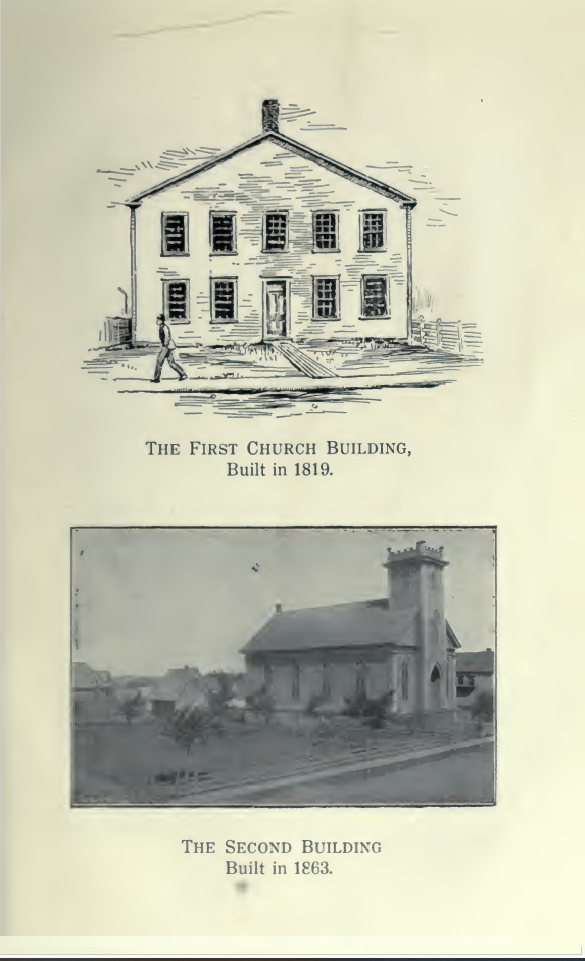
This first building was a box like structure 42 ft square with double rows of ordinary windows, like a two storey residence; the lower tier had segment tops. The first pulpit was of the stilted sort with sounding board over it, as was the fashion in those days. The cost of the building was about $2000.00. In this building consisting of a single room were conducted all the services of the Church and Sunday School. In the course of years, as other denominations provided places of worship the building came into the hands of the Baptists exclusively. This was the home of the Church for forty-four years.
The following is a description of the second meeting house. The building was in rectangular form, 80x45 ft, with basement vestry 40 ft square, and was surmounted by a tower and spire which reached the height of 130 ft This Church was dedicated June 7th, 1863.
It cost $8,000.00, and seated 600. The spire was found to injure the building, and was removed in 1874. At the back of the pulpit, was a pipe-organ, with ascending seats for the choir, Major J. A. Black rendering his services as organist and choir leader gratis for thirty years. At the opposite end of the audience room was a crescent shaped gallery, with seats for one hundred and fifty. At the head of each window was the figure of a descending dove, a gentle reminder of the descent of the Holy Spirit upon our Gracious Lord at His Baptism. The acoustic qualities of this Church were such that the lightest intonations of the preacher’s voice were distinctly audible at the farthest part of the building. There were many notable gatherings during the thirty years this building was occupied. There being no hall in town capable of containing a large audience the Trustees were frequently called upon to open the doors for temperance and other lectures. There was one assemblage of historical interest, when a special session of the Convention of the Maritime Convention was held May 12, 1875. The occasion was to decide where the Baptists should concentrate their Foreign Mission forces. Some desired to labor among the Siamese, or among the Karens who lived in Siam. Others strongly urged that we continue to labor in Burmah; while a third party urged that the Baptists of the Lower Provinces unite with the Baptists of Ontario, in their endeavour to win over to Christ the Telugus in British India. After a discussion lasting from 4 p. m. Wednesday till Friday at noon, it was decided that our Missionaries be instructed to occupy a part of the Telugus field, acting in harmony with our brethren in Ontario and Quebec. This accordingly has been our Foreign Mission field ever since. This church was removed in 1894 to a site in the rear; turned into a musical hall; burned down August 2nd, 1908.
The congregation was increasing, and more accommodation was called for. After much deliberation, it was decided to erect a substantial structure equipped with all modem facilities for carrying on Church work. With quarries of sandstone near the town there could be no long hesitation in deciding of what material to build. The result is the present Church fronting on Victoria Street on the old site in the heart of the town. The lecture room was opened for worship March 10th, 1895. This is on a level with the main audience-room, with which it is connected by folding doors. This church occupies the whole of the site of the two former edifices. Easy staircases at front and rear lead to the second storey of the lecture room, where are rooms for the different Classes. There are also rooms for the Ladies’ meetings on the ground floor, and cosy corners in the towers which are utilized by the teachers. The Baptistery is at the side of the pulpit in full view of the Congregation. The windows of chaste design mellowing the light, are restful to the eye of the worshippers, the seats are comfortable without the aid of cushions, and the whole effect is inspiring.
To the above account of the meeting place must be added the three other church buildings, one at Warren, and one at Salem, one at Amherst Point. Regular services are held in these places by the assistant pastor. Each has a Sunday School and social services are held weekly. With the chapel in the southern part of the town, the total is five congregations.
THE MEANING OF ALL THIS.
We have come to the end of the minutes. What does this record for a hundred years indicate? These old manuscripts traced by hands long since gone to dust tell us that these people believed that they were called with a Holy Calling; that it was their duty to shew forth the works of Him who had called them out of darkness into His marvellous light. They adopted the old doctrine that when they were Baptized, they were Baptized into his death, and that henceforth they must walk in oneness of life. That they observed the two grand outstanding ordinances of the new covenant. Baptism on the profession of their faith in their risen Lord, and the memorial of his dying Love, the Supper instituted by Him for all His followers. That they walked in fellowship with one another, and often met together to talk with one another of the all important matters of the soul. That they confessed that they were still angers and pilgrims here, and that the object of their pilgrimage on earth was to obtain an enduring inheritance in a better Country, that is an Heavenly.
Also, that they as a Church exercise a watch care over one another. If any were reported as having gone astray it is not left with the pastor alone; Brethren are appointed by the Church to confer with them, and to win them back. Nor need it be supposed that these remonstrances ended in a report to the Church. If brethren remained contumacious they were set aside or excluded. In many instances discipline had a salutary effect. The wandering members came back and were gladly received into their fellowship. It is also seen that the Church recognized its obligation to give the Gospel to the world. It is on record that this Church took up the collection in the Maritime Provinces for Dr. Judson when he established himself in Burmah as a Baptist Missionary.
From all these, we readily infer the divine origin of the Church. It is a society of Christians who associate to help one another in all that pertains to good honorable lives; to encourage one another when in trouble; to bear one another’s burdens and so to fulfil the law of Christ. A real Church, will, like its Divine Lord, be filled with tender solicitude for the lost sheep.
We are ready to confess that the ideal has not been attained; but we humbly claim that in striving for this we and our fathers have had such an uplift as could not otherwise be possible. For whatever this Church has been, for whatever it has done through a long line of men and women, we, their successors desire to render the glory to Him, whose spirit has ever prompted to such a course, and who by His Grace has strengthened us to do His Will.
THE ASSISTANT PASTORS OF THE CHURCH
Rev. George O. Gates, D. D., when a student at Acadia spent three months in the summer of 1872. Mr. Tate from Newton Theological Seminary spent the vacation of 1873 with us.
As the town grew the work at the branches could not be overtaken by any one man. After the above dates Rev. J. I. DeWolfe* spent one year; Rev. R. I. Skinner* two years; Rev. Wm. George* (hiring the years 1879-81. Rev. Geo. R. White.*
Mr. Gates, brother of G. O. Gates, was with us during the summer of ’86, Rev. C. W. Corey during 1887, Rev. Mr. Gehring, Rev. A. S. Kempton,* Rev. J. H. McDonald, Rev. H. G. Estabrooks, W. H. McLeod, Johnson Miner, A. F. Newcombe, J. A. Huntley, M. A. Richardson, J. T. Dimock, Ernest Brooks, Lemuel E. Ackland, F. F. Foshay, G. C. R. Keirstead. *Deceased.
THE LICENTIATES OF THE CHURCH
Hilbert Black* (son of Dea. W. F. Black). S. McCully Black* (D. D. and editor for twenty years of denominational organ). Joseph H. Pipes* (died before completing his education), Absalom Powell, (pastor in the United States and this Province) Walter S. Black, (pastor in the North-West). Charles A. Eaton D. D., (pastor in Natick, Mass.; Bloor St., Toronto; Cleveland, Ohio; Madison Ave., New York. Geo. B. Cutten, Ph. D. (Yale), pastor in New Haven, New York, and Ohio, now President of Acadia University, Wolfville N. S. Geo. A. Lawson, pastor West end Halifax, and now of Moncton. W. M. Steele* B. A. Acadia and M. A. Yale, Pastor Greenville S. C. and Professor of Philosophy at Furman University, S. C. Wm Travis, Pastor in the North West. M. S. Richardson, pastor Prince St., Truro, N. S. Ernest J. Brooks, pastor at Rawdon. David Dixon, pastor in Digby Co.
NOTE:— Revs. Geo. W. Schurman, Stephen Schurman, and David Crandall were also members of this Church, but were not licensed by us. *Deceased.
THE DEACONS OF THE CHURCH DURING THE ONE HUNDRED YEARS.
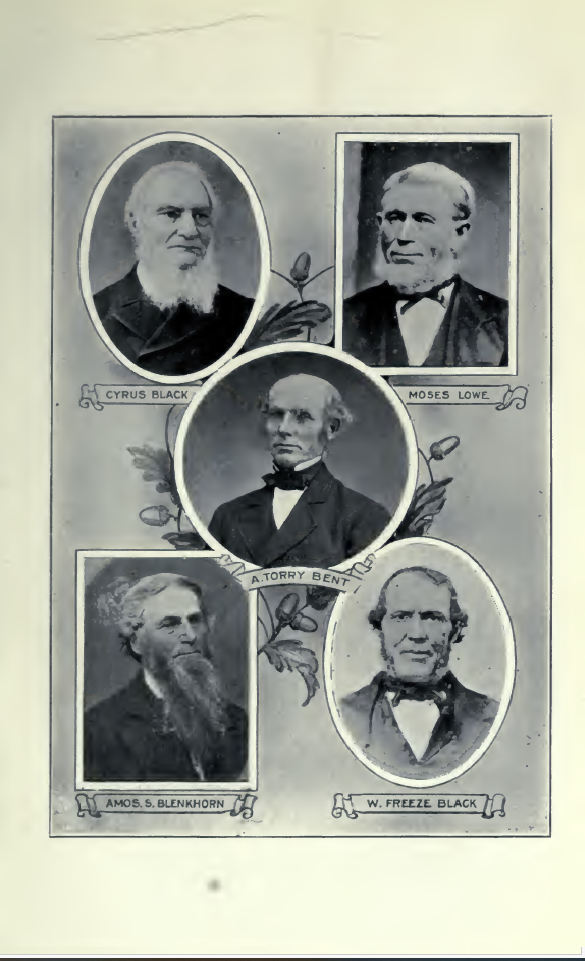
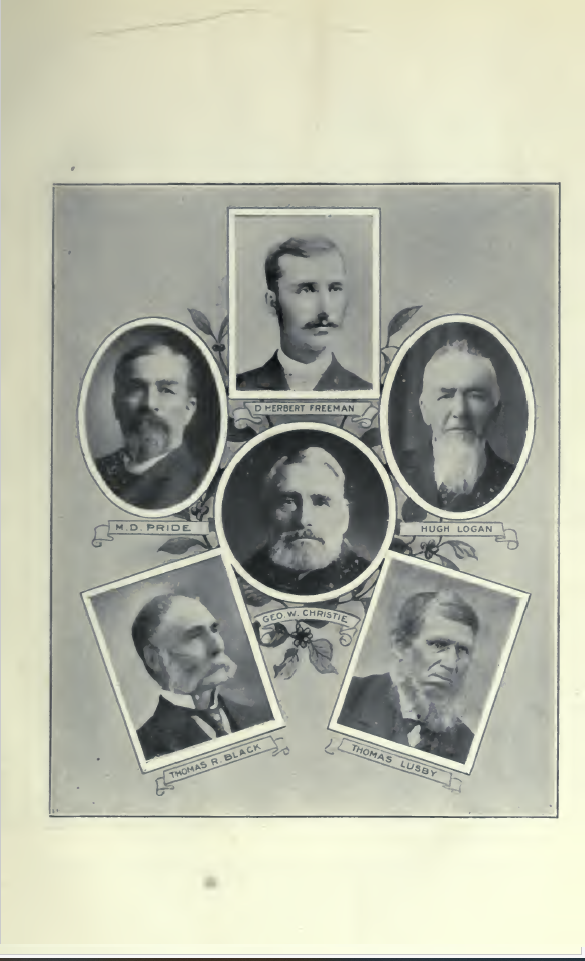
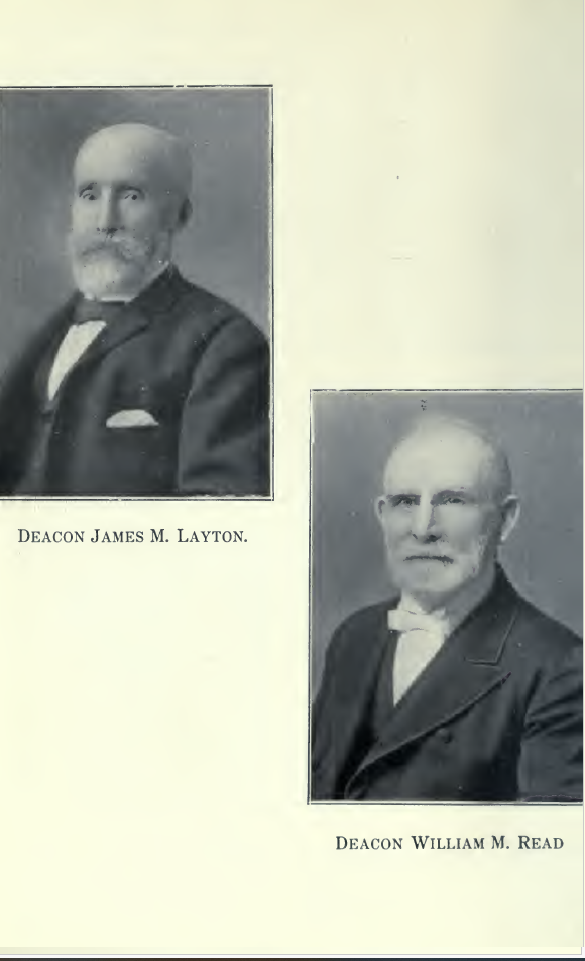
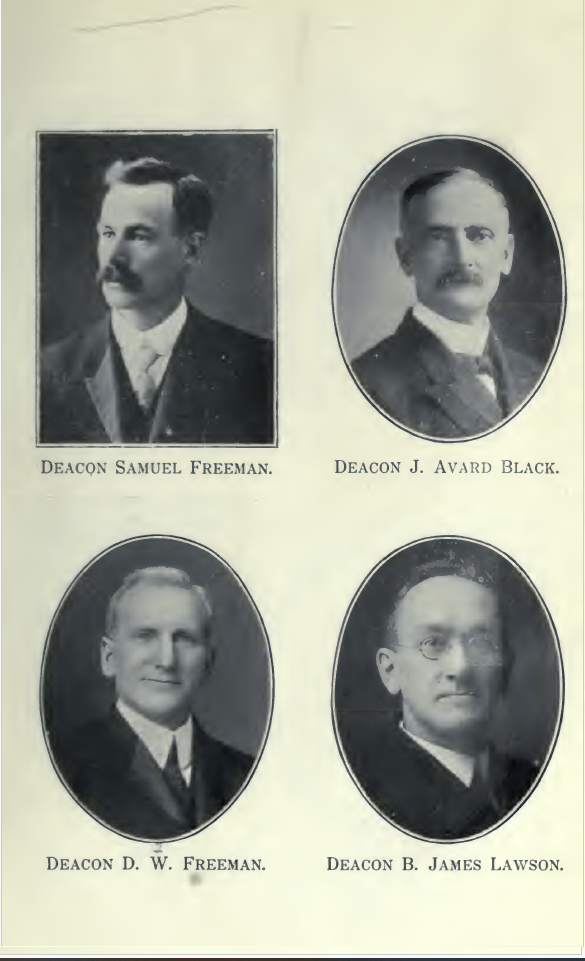
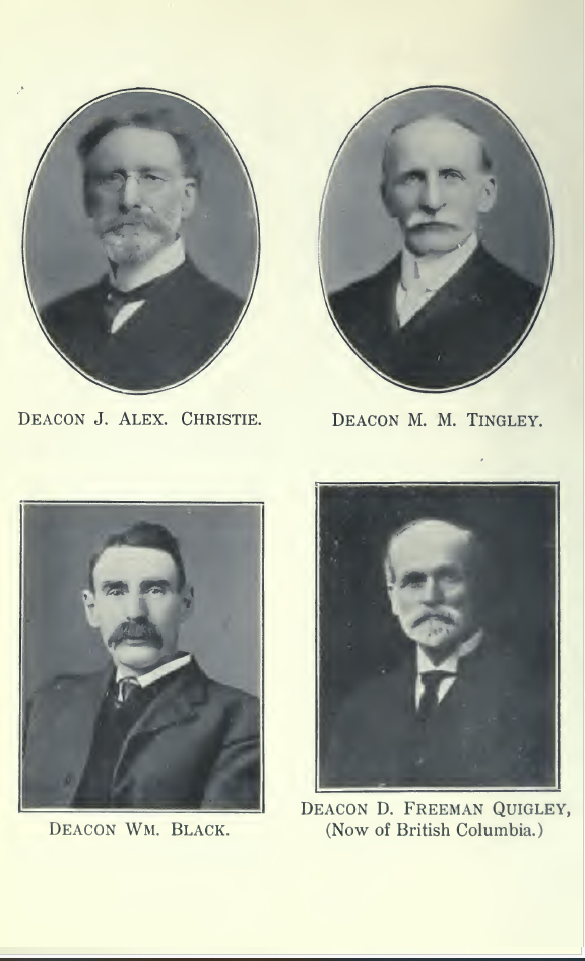
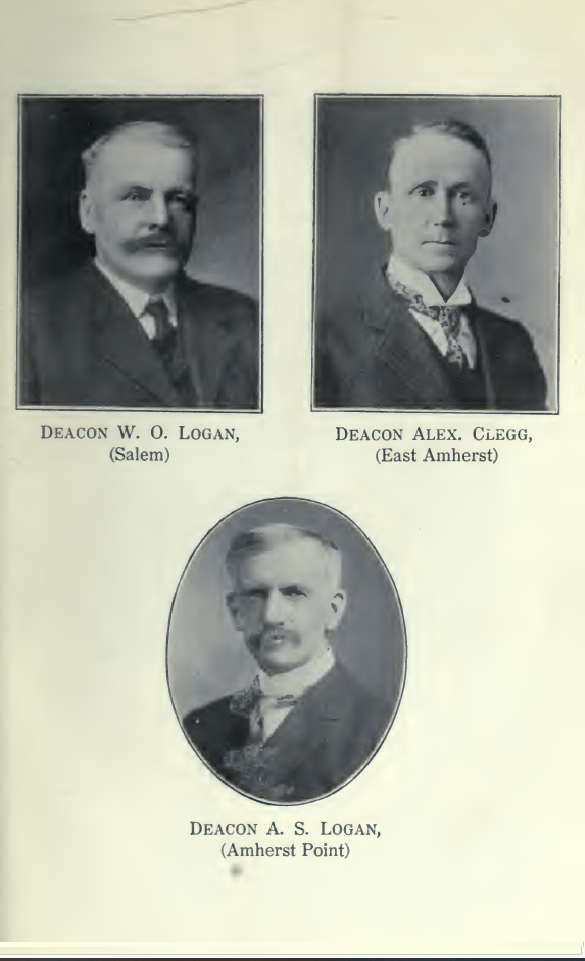
Thomas Stokes Black*, (the first and probably for many years the only deacon; he was the son of the first Wm. Black, and brother of the Rev. Wm. Black, the apostle of Methodism). W. Freeze Black*, (son of Thomas S. Black, who was five years deacon contemporaneously with his father). Wm. Donkin*. Elisha B. Cutten*, (These two brethren were deacons in 1842). Samuel Taylor*, Salem. Cyrus Black*, (clerk for many years), Moses Lowe* and Robert Embree*, were elected and ordained on Nov. 3rd, 1885; Robert McCully*, (son of Rev, S. McCully* died May 19th, 1878). Amos Blenkhorn* (prothonotary, died March 24th, 1892, aged 86). A Torrey Bent*, (died 1897, aged 86 yrs.) J. M. Layton, (who has served under every pastor in the church). Thomas R. Black*, (Grandson of deacon T. S. Black, Senator of the Dominion, died Sept 16th, 1905, aged 74) M. D. Pride.* Geo. W. Christie* (Died July 31st, 1908) Wm. M. Read, (prothonotary). Hugh Logan, 3rd* (died Sept 24th 1906, aged 79). D. F. Quigley, (removed to Vancouver B. C.) Hebert Freeman*, (died July 23rd, 1905, aged 46.) Samuel Freeman, 3rd. D. Wilbur Freeman. J. Avard Black. B. James Lawson. Amos Logan. Wilbur O. Logan. Alex Clegg. J. Alex Christie. W. W. Black. M. M. Tingley. *Deceased