COLORS IN GENERAL.
Reading edition
Details Concerning Yacht Flags, and How They Are Used.
The pennant is a triangular shaped flag, and is used for the club burgee. The swallowtail is used for the captain’s (owner’s) private signal. The rectangular flag is used principally for flag officers’ distinguishing flags. The shape of the bunting will generally signify whether the flag is that of the club, of a flag officer or of a captain. The bunting used for flag officers’ distinguishing flags is colored—blue for commodore, red for vice-commodore, and white for rear-commodore.
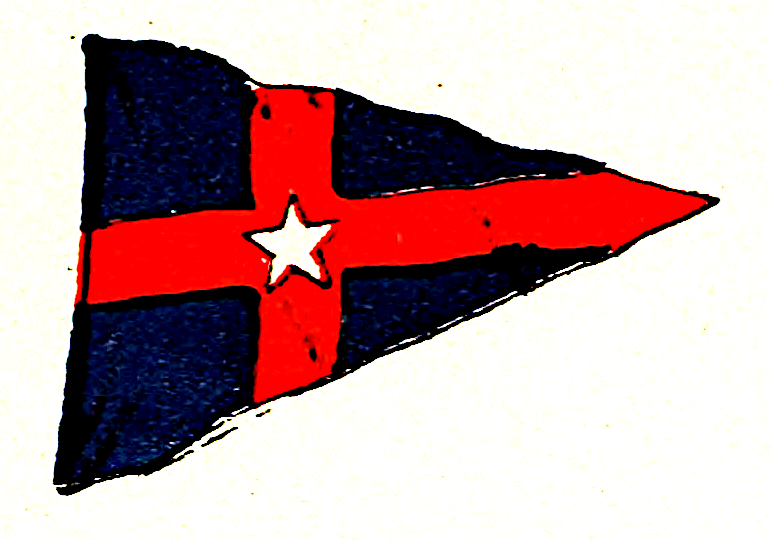
CLUB BURGEE
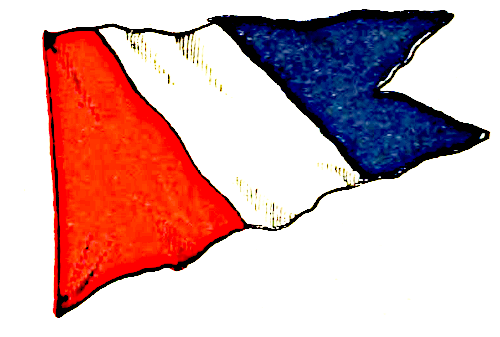
PRIVATE SIGNAL
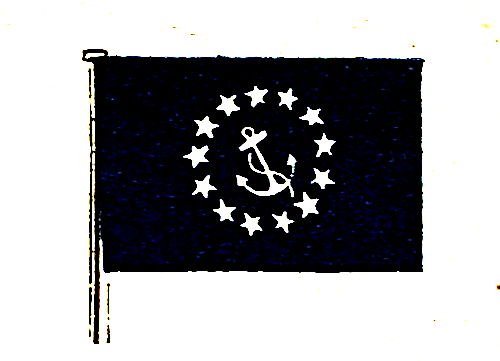
COMMODORE’S FLAG
Time to Make Colors—Place to Display Same.
When at anchor or underway, the ensign and colors of a yacht in commission should be hoisted at 8 A. M. and kept flying until sunset (local time). This does not apply to a flag officer, who should display his official flag continuously (day and night) while in commission. When at anchor the ensign is hoisted on the flagpole at the stern of both steam and sail yachts, and when underway it is hoisted to the after gaff-end on sailing vessels; but is retained on the pole in the case of steam yachts, although it may be hoisted to the gaff-end if desired. The burgee should be hoisted to the foretopmast head on schooners, and the private signal at the maintopmast. In the case of yawls, the ensign may be hoisted to the mizzenmast head, both when at anchor and when underway, and the burgee may be hoisted to the mainmast head when at anchor and the private flag when underway, the same as on cutters, sloops and chief officers, or the yawl may be considered as a schooner and the bunting displayed as for the latter vessel. In the case of a launch the burgee should be flown from the bow pole. Flag officers’ signals should be flown from the truck of a cutter, sloop or catboat, the main truck of a schooner, yawl or steamer, and the bow pole of a launch. The church pennant is hoisted over the ensign during divine service. (See “Colors to be Flown in Yacht’s Boats.”)
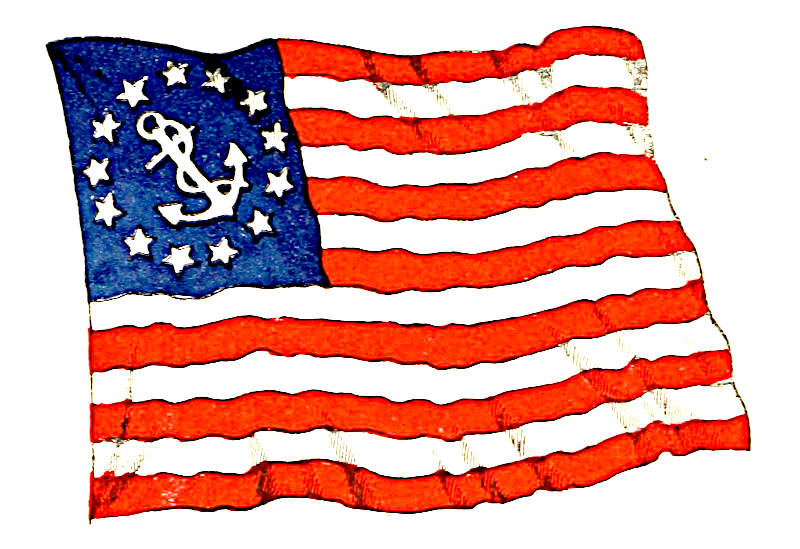
YACHT ENSIGN
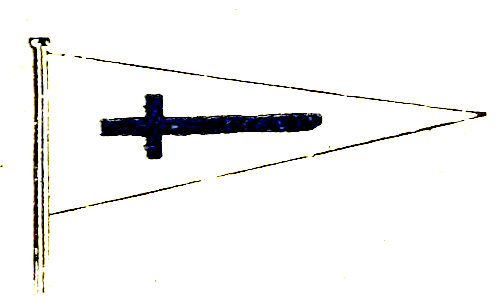
CHURCH FLAG
Senior Officer Present to Give the Time for Colors and Sunset.
The time for making colors and sunset should be taken from the senior officer’s yacht present, whether he is on board or not, and the only gun fired for colors and sunset should be the one on such senior’s yacht.
At Anchor With Naval Vessel or Off a Naval Station.
When a yacht is in company with a vessel of her own navy, or at anchor off a naval station, she should regulate the time for colors and sunset to such vessel or station.
Visiting Home Waters of Another Yacht Club.
Yachts visiting the home waters of another club (provided such waters are other than their own) should take their time for colors and sunset from the yacht of the senior officer of such club present.
Entering or Leaving Port Before Colors or After Sunset.
When a yacht enters port in the morning before colors are made, or in the evening after sunset, her ensign, club burgee and private signal should be displayed and kept flying until the yacht comes to anchor, when they should be hauled down—provided there be sufficient light for the colors to be recognized.
Night Pennant.
During the night (between sunset and colors) the yacht should fly a night pennant at the maintopmast head, or in the case of a three-mast vessel, at the mizzenmast head—except in the case of flag officers.
Absent Flag.
During the absence of the captain from the yacht, a blue rectangular flag (called Absent Flag) should be kept flying from daylight until dark at the starboard main spreader of a fore-and-aft vessel, or on the starboard main-yard arm of a square-rigged vessel. The private signal (or flag officer’s pennant), however, is to be kept flying, whether the captain is on board or not.
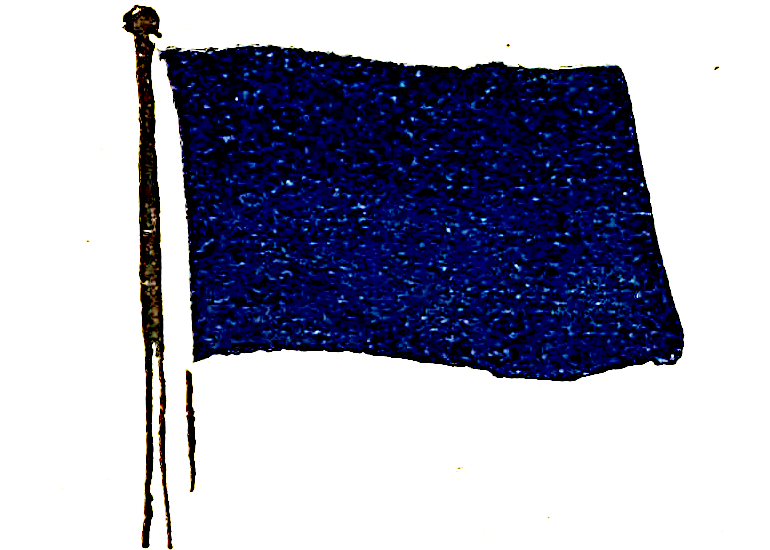
ABSENCE FLAG
Single Stickers—Where, When and How to Fly Burgee and Private Signal.
Single-masted vessels should not fly the private signal on the same halliards as the club burgee. When at anchor the club burgee should be displayed, and when underway the private signal, except when on the annual cruise of the club, when the club burgee should be flown both at anchor and underway.
Meal Pennants.
Meal Pennants may be hoisted during hours when the colors are not displayed.
During the meal hours of the captain, when the yacht is at anchor, a white rectangular flag should be flown at the starboard main spreader, and when same is exhibited, guests are politely debarred. During the meal hours of the crew a red pennant should be flown from the port fore spreader, and at such times boat crews should not be called away unnecessarily. Of course, on a “single-sticker” the white flag and red meal pennant must both be flown from the same mast, but they will be exhibited on their proper sides. After dark a white light should be shown from the starboard main spreader to indicate that the captain is at dinner. Meal flags should not be flown when the yacht is underway. In a square-rigged yacht the captain’s meal pennant should be flown from the starboard main yard arm, and the crew’s meal pennant at the port fore yard arm. (See Dinner Light.)
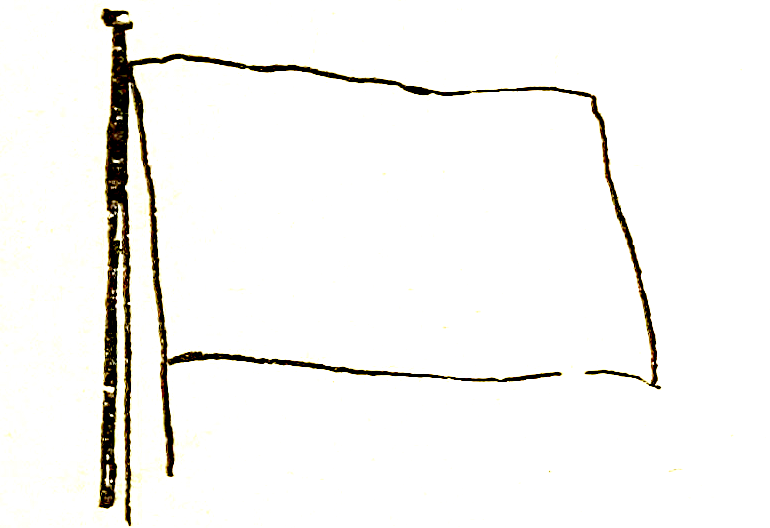
OWNER’S MEAL FLAG
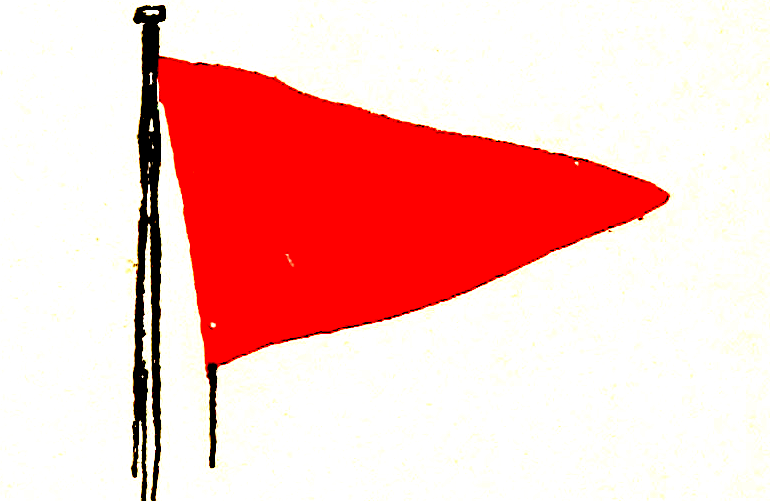
CREW’S MEAL FLAG
Colors to be Flown in Yacht’s Boats.
The yacht’s gig, launch, etc., when brought to the gangway or when away from the yacht, shall display the ensign at the stern. While the captain is in the boat, the private signal should be displayed at the bow. If a club member is in the boat without the captain, a club burgee should be displayed at the bow.
Ensign to be Exhibited When Passing Naval Vessels, Lighthouses, Military Posts, etc.
The yacht ensign should be exhibited when at sea on falling in with naval vessels, or when approaching lightships, lighthouses, signal stations and military posts.
Flag Officer’s Pennant.
Flag officers fly a pennant at the main on yachts and on the forward flagstaff of gigs, to distinguish their rank. These pennants take the place of the yacht’s private signal.
Yacht Short-Handed.
If the yacht is short-handed, two flags may be bent on to the same set of halliards, so that while one flag is being sent aloft the other may be coming down.
Burgee and Private Signal May be Broken Out.
The club burgee and private signal may be “made up” and mast-headed previous to colors, and “broken out” when the signal for colors is given, but the ensign should never be made up and broken out.
Colors to be Well Hoisted.
Daylight should never show between the head of a flag and the truck.
Mastless Yachts.
On mastless yachts the colors are exhibited on staffs placed forward and aft.
National Mourning.
On occasions of national mourning the ensign should be half-masted, but the burgee and private signal should be kept mast-headed, unless the official was a member of the club whose flag you are flying, in which case the club burgee should be half-masted.
Death of Captain.
In the event of the death of the captain on shore, both the club burgee and private signal of his yacht should be kept half-masted from colors until sunset on the day of his funeral, but the ensign should be kept fully hoisted during the same time. If, on the other hand, the death should occur on board while the yacht is in port, then the ensign also should be half-masted as soon as the body leaves the vessel for the shore, and the ensign should be kept so flying until sunset of the same day. Should the burial of the Captain take place at sea, then the ensign of the vessel and the captain’s private signal should be displayed at half-mast at the commencement of the ceremony and kept flying until its conclusion, when the ensign and private signal should be hauled down.
Death of Flag Officer.
On the occasion of the death of a flag officer while his yacht is in port, his pennant should be hauled down at sunset on the day of his funeral, and should not be again hoisted—the yacht’s private signal taking its place. If the funeral takes place at sea, then the pennant should be hauled down with the ensign at the conclusion of the ceremonies.
Death of Club Member.
When mourning is ordered for the death of a club member, the burgee only is half-masted, and this should be observed whether underway or at anchor.
How to Half-Mast Colors.
The ensign, burgee and private signal (also flag officer’s pennant) should always be mast-headed before they are half-masted.
Saluting With Ensign at Half-Mast.
Whenever it becomes necessary to salute with the ensign while it is flying at half-mast, it must be mast-headed before it is dipped, and mast-headed again before it is half-masted after the salute.
Hauling Down Half-Mast Colors.
Before hauling down half-masted colors, always mast-head them first.
Death of One of the Crew.
In the event of the death of the Sailing-Master, mate, or other officer, or one of the crew at sea, the ensign of the yacht should be half-masted during the funeral ceremony. Should the death of one of the above occur on board while the yacht is in port, then the ensign should be half-masted from the time that the body leaves the yacht until the return of the boat that conveyed the body to the shore.
Permission to Half-Mast Colors to be Obtained.
No yacht of a fleet other than that of the senior officer present should ever half-mast her colors until permission to do so has been obtained.
Hours for Half-Masting Colors.
Funeral honors in the way of half-masting colors should not be paid before sunrise nor after sunset.
Boat Engaged in Funeral Ceremony.
When a boat is engaged in funeral ceremonies in conveying a body to the shore, the ensign in the stern should be kept half-masted until the body is landed.
Making Colors.
About five minutes before colors, have the club and private signals, night pennant and ensign halliards manned, the boat-boom guys tended, and a hand stationed at the ship’s bell. As soon as the signal is given for colors, call: “Strike eight bells and hoist away!” At this instant swing out the boat booms, haul down the night pennant, and send aloft the bunting. The flags may be sent up in stops before eight bells, and broken out on the first stroke of the bell, but the ensign should never be broken out, and should be hoisted slowly.
Making Sunset.
About fifteen minutes before the time given for sunset, have the anchor light, gangway light, and signal light or lights all ready, the boats either hoisted or dropped astern, and the night pennant bent on. About five minutes before sunset, station the men at the boom guys, club and private signals and ensign halliards, anchor-light whip, gangway light, and, if a flagship, the distinguishing lights. If you are the flagship you will also have a gunner stationed at the offshore gun, and wait, watch in hand (care should be observed to have it on correct local time), for the time given for sunset. But if you are taking time from another vessel, or from the shore, the time need not concern you; simply await the sunset signal; then call, “Haul down!” At this instant let go the forward boat-boom guys and swing the booms in. Observe that the club, private signal, and ensign are hauled down (the two former preserving the same height to one another until they reach the deck) and that the night pennant and anchor light go aloft as soon as the order to haul down is given. Arrange the gangway lights, and make the bunting up neatly and stow it away in the flag locker. If the boats are riding astern, give them a short painter to prevent them from being run over by vessels coming in to anchor, or passing under your stern, and never allow a boat to ride astern without a white light in same. If boat booms remain swung out, they should have a white light at the outboard end.
Day Signals for Pilots.
The following signals, numbered 1 and 2, when displayed together or separately, shall be deemed to be signals for a pilot, in the day time: 1st, To be hoisted at the fore, the Jack or other national color usually worn by merchant ships, having round it a white border one-fifth of the breadth of the flag; or, 2d, The International Code Pilotage Signal, indicated by Flag “S.”.
Night Signals for Pilots.
The following signals, numbered 1 and 2, when used or displayed together, or separately, shall be deemed to be signals for a pilot, in the nighttime; 1st, The pyrotechnic light, commonly known as a blue light, every fifteen minutes; or, 2d, a bright white light, flashed or shown at short intervals, just above the bulwarks, for about a minute at a time.
Signal for Towing-Boat.
The signal for a towing-boat is made by setting the ensign in the main rigging a little above the deck.
Dressing Ship.
The prettiest mode of dressing a ship with flags is to make an arch of them from the jib-boom end to the foretopmast head, thence across to the maintopmast head, and down to the main boom end, allowing two or more flags to hang down under the jib-boom end and the main boom end respectively, with a lead attached to the end of each line to keep the flags from flying around. Hoisted to the trucks, by the regular signal halliards, should be the ensign Jack, or the flags of the nation in whose port the ship is lying, or the distinguishing flags of the person whom it is desired to honor. The arch of flags should be hoisted so as to give the former flags room to display themselves. Have blocks at the topmast heads for the fore-and-aft strings of arch flags, and hoist the flags to them by means of a whip. The flying jib halliards will do to hoist the foremost part of the arch (from the jib-boom end to the foretopmast head). Care should be taken and taste must be exercised in selecting and placing the flags, and rectangular flags should alternate with pennants. Reeve off the three arch halliards and measure the distance in the three clear parts, by marking the halliards so that you will know what length of flags to bend on, and thus avoid the inconvenience and annoyance of sending the string on deck after they have once been hoisted, for the purpose of alterations. In addition to stopping the flags to the halliards on the head and tack, take a couple of stitches to the halliards about midway. The Jack should be hoisted on the Jack-staff on the bowsprit. In reeving off the halliards for the span between the fore and maintopmast heads, let the ends (or hauling parts) lead through single blocks and down alongside of the fore and main masts, respectively, bending the flags on to the bight, and trice up by the two parts, manned at the same time that the flags are sent aloft. At sunset come up with your outhauls, and the forward and after strings of flags will come inboard, and can then be lowered away. Just before “colors” send the two mast-head ensigns aloft “made up.” When the signal is made, hoist away on the arch halliards, and, at the instant the flags reach home, “break out” the ensign and the Jack. Pennants and square flags should be bent on alternately. Another mode of dressing ship is by “up-and-down” flags—that is, by flying a string of flags from each topmast head to the deck. Flag officers’ pennants and burgees should not be used in dressing ship, nor should the ensign of any foreign nation be displayed, except it is desired to compliment such nation, when it should be flown from the main truck. When a yacht is dressed all her lowered boats should fly the ensign, whether underway or riding to the boat booms. On special occasions a steam yacht underway, or a sailing yacht being towed, may dress ship.
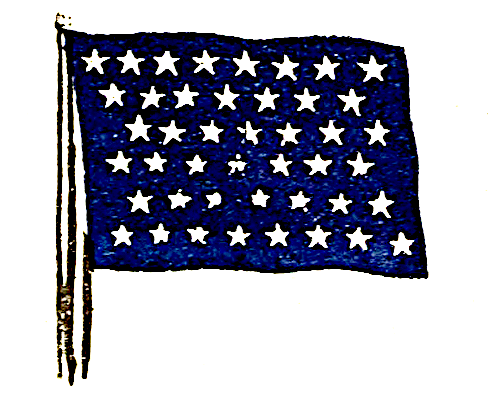
UNION JACK
Commodore of a Club on a Cruise with Another Club in Which He Is a Member.
In such an event the Commodore should not fly his rank flag, but should fly the club flag of the cruising club, and should also fly his private signal, so as not to exhibit evidence of his flag rank in any way. In other words, he should act simply as a Captain during the cruise, or while he remains with the squadron. When at anchor with the squadron at night, he should display only the Captain’s light, the same as the other Captains, and never, under any circumstances, show Commodore’s lights.
Flag Officer of a Club Entering Harbor of Another Club in Which He Is a Member.
In this case circumstances govern. Should the Commodore enter said harbor, either alone or while on a cruise with his squadron, he should fly his Commodore’s pennant and club flag; but if he is cruising independently, after relegating his command to his junior, and is at anchor in the harbor of a yacht club to which he belongs, then, if he elects to fly the latter’s club flag, he should do so together with his private signal; but he should not fly his Commodore’s pennant with a club flag other than that of which he is Commodore.
Use of Commodore’s Private Signal.
The Commodore’s private signal should be used only on such occasions as he does not fly his Commodore’s pennant—cruising with another club in which he is a member, etc.
Commodore’s Pennant Night and Day.
The Commodore’s flag shall not be hauled down at sunset, but shall be flown day and night. Should it be desired to substitute an old pennant for service during the night, then send aloft the old pennant made up, and break it out before commencing to lower the other. Of course, this requires two sets of halliards, which should always be rove on a flagship.
The Jack—When Displayed.
The Jack should be set on Sundays, also on all occasions of ceremony, the same being flown from a staff on the bowsprit. Wash clothes should not be hung up when the Jack is exhibited.