PROPOSITION IX.
Reading edition
Radiant Light consists in Undulations of the luminiferous Ether.
This proposition is the general conclusion from all the preceding; and it is conceived that they conspire to prove it in as satisfactory a manner as can possibly be expected from the nature of the subject. It is clearly granted by Newton, that there are undulations, yet he denies that they constitute light; but it is shown in the three first Corollaries of the last Proposition, that all cases of the increase or diminution of light are referable to an increase or diminution of such undulations, and that all the affections to which the undulations would be liable, are distinctly visible in the phenomena of light; it may therefore be very logically inferred, that the undulations are light.
A few detached remarks will serve to obviate some objections which may be raised against this theory.
1. Newton has advanced the singular refraction of the Iceland crystal, as an argument that the particles of light must be projected corpuscles; since he thinks it probable that the different sides of these particles must be differently attracted by the crystal, and since Huygens has confessed his inability to account in a satisfactory manner for all the phenomena. But, contrarily to what might have been expected from Newton’s usual accuracy and candour, he has laid down a new law for the refraction, without giving a reason for rejecting that of Huygens, which Mr. Hauy has found to be more accurate than Newton’s; and, without attempting to deduce from his own system any explanation of the more universal and striking effects of doubling spars, he has omitted to observe that Huygens’s most elegant and ingenious theory perfectly accords with these general effects, in all particulars, and of course derives from them additional pretensions to truth: this he omits, in order to point out a difficulty, for which only a verbal solution can be found in his own theory, and which will probably long remain unexplained by any other.
2. Mr. Michell has made some experiments, which appear to show that the rays of light have an actual momentum, by means of which a motion is produced when they fall on a thin plate of copper delicately suspended. (Priestley’s Optics.) But, taking for granted the exact perpendicularity of the plate, and the absence of any ascending current of air, yet since, in every such experiment, a greater quantity of heat must be communicated to the air at the surface on which the light falls than at the opposite surface, the excess of expansion must necessarily produce an excess of pressure on the first surface, and a very perceptible recession of the plate in the direction of the light. Mr. Bennet has repeated the experiment, with a much more sensible apparatus, and also in the absence of air; and very justly infers from its total failure, an argument in favour of the undulatory system of light. (Phil. Trans. for 1792, p. 87.) For, granting the utmost imaginable subtility of the corpuscles of light, their effects might naturally be expected to bear some proportion to the effects of the much less rapid motions of the electrical fluid, which are so very easily perceptible, even in their weakest states.
3. There are some phenomena of the light of solar phosphori, which at first sight might seem to favour the corpuscular system; for instance, its remaining many months as if in a latent state, and its subsequent re-emission by the action of heat. But, on further consideration, there is no difficulty in supposing the particles of the phosphori which have been made to vibrate by the action of light, to have this action abruptly suspended by the intervention of cold, whether as contracting the bulk of the substance or otherwise; and again, after the restraint is removed, to proceed in their motion, as a spring would do which had been held fast for a time in an intermediate stage of its vibration; nor is it impossible that heat itself may, in some circumstances, become in a similar manner latent. (Nicholson’s Journal. Vol. II. p. 399.) But the affections of heat may perhaps hereafter be rendered more intelligible to us; at present, it seems highly probable that light differs from heat only in the frequency of its undulations or vibrations; those undulations which are within certain limits, with respect to frequency, being capable of affecting the optic nerve, and constituting light; and those which are slower, and probably stronger, constituting heat only; that light and heat occur to us, each in two predicaments, the vibratory or permanent, and the undulatory or transient state; vibratory light being the minute motion of ignited bodies, or of solar phosphori, and undulatory or radiant light the motion of the ethereal medium excited by these vibrations; vibratory heat being a motion to which all material substances are liable, and which is more or less permanent; and undulatory heat that motion of the same ethereal medium, which has been shown by Mr. King, (Morsels of Criticism. 1786. p. 99.) and M. Pictet, (Essais de Physique. 1790,) to be as capable of reflection as light, and by Dr. Herschel to be capable of separate refraction. (Phil. Trans. for 1800. p. 284.) How much more readily heat is communicated by the free access of colder substances, than either by radiation or by transmission through a quiescent medium, has been shown by the valuable experiments of Count Rumford. It is easy to conceive that some substances, permeable to light, may be unfit for the transmission of heat, in the same manner as particular substances may transmit some kinds of light, while they are opaque with respect to others.
On the whole it appears, that the few optical phenomena which admit of explanation by the corpuscular system, are equally consistent with this theory; that many others, which have long been known, but never understood, become by these means perfectly intelligible; and that several new facts are found to be thus only reducible to a perfect analogy with other facts, and to the simple principles of the undulatory system. It is presumed, that henceforth the second and third books of Newton’s Optics will be considered as more fully understood than the first has hitherto been; but, if it should appear to impartial judges, that additional evidence is wanting for the establishment of the theory, it will be easy to enter more minutely into the details of various experiments, and to show the insuperable difficulties attending the Newtonian doctrines, which, without necessity, it would be tedious and invidious to enumerate. The merits of their author in natural philosophy, are great beyond all contest or comparison; his optical discovery of the composition of white light, would alone have immortalised his name; and the very arguments which tend to overthrow his system, give the strongest proofs of the admirable accuracy of his experiments.
Sufficient and decisive as these arguments appear, it cannot be superfluous to seek for further confirmation; which may with considerable confidence be expected, from an experiment very ingeniously suggested by Professor Robison, on the refraction of the light returning to us from the opposite margins of Saturn’s ring; for, on the corpuscular theory, the ring must be considerably distorted when viewed through an achromatic prism: a similar distortion ought also to be observed in the disc of Jupiter; but, if it be found that an equal deviation is produced in the whole light reflected from these planets, there can scarcely be any remaining hope to explain the affections of light, by a comparison with the motions of projectiles.
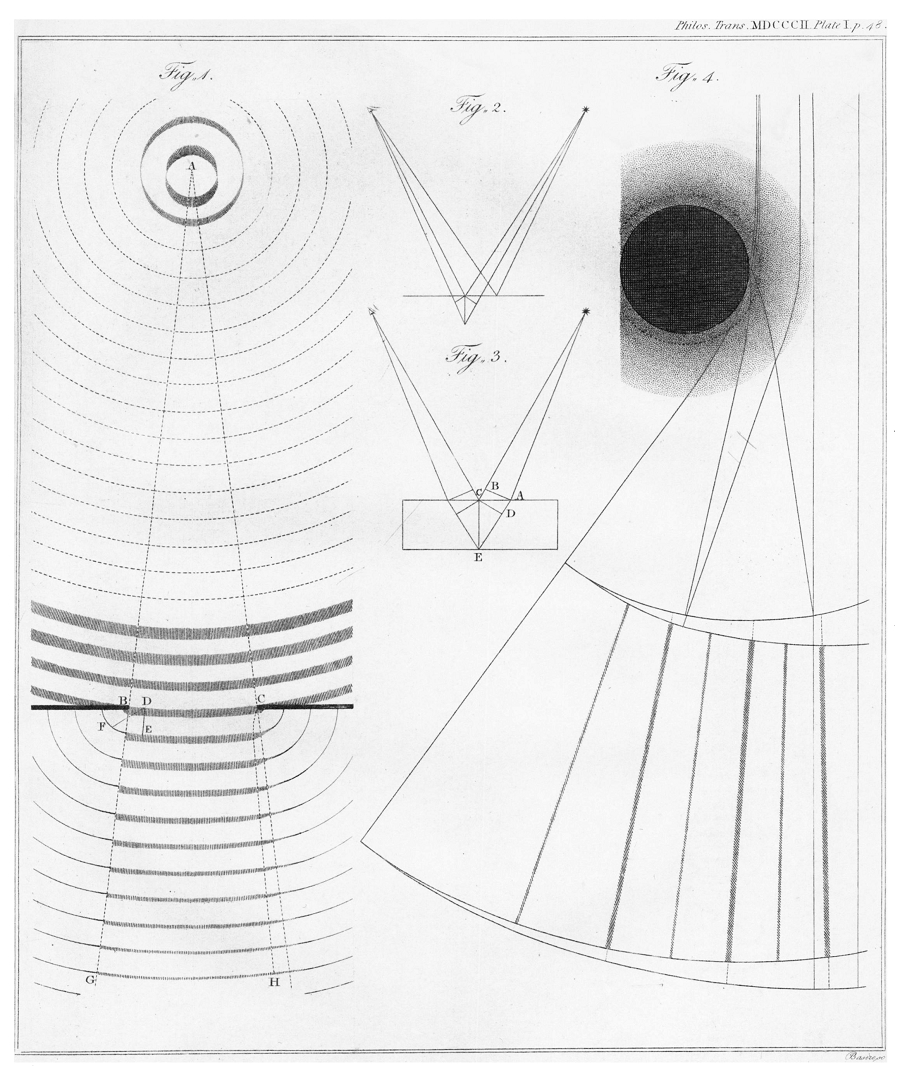
Plate I.