(Plates I.–VIII.) (continued 2)
Reading edition
It is only since my return home, and since I have been able to compare the productions of Celebes side by side with those of the surrounding islands, that I have been fully impressed with their peculiarity, and the great interest that attaches to them. The plants and the reptiles are still almost unknown; and it is to be hoped that some enterprising naturalist may soon devote himself to their study. The geology of the country would also be well worth exploring, and its recent fossils would be of especial interest as elucidating the changes which have led to its present anomalous condition. This island stands, as it were, upon the boundary-line between two worlds. On one side is that ancient Australian fauna which preserves to the present day the facies of an early geological epoch; on the other is the rich and varied fauna of Asia, which seems to contain, in every class and order, the most perfect and highly organized animals. Celebes has relations to both, yet strictly belongs to neither; it possesses characteristics which are altogether its own; and I am convinced that no single island upon the globe would so well repay a careful and detailed research into its past and present history.
In the following catalogue of the Malayan species of Papilionidæ I have included those from Woodlark Island, collected by M. Montrouzier, as that island comes fairly within the limits of the archipelago; while I exclude New Caledonia as belonging more to the Australian and Pacific fauna. I have given full particulars of the variation of the several species, and have described all new species, forms, varieties, and undescribed sexes. The distribution of each species is noted chiefly from my own observations[11]. As the full synonymy and references to almost every work on Lepidoptera are given in the British Museum List of Papilionidæ, I have not thought it necessary to do more than to refer to a good figure and description in well-known works; and I have quoted Boisduval’s ‘Species Général des Lépidoptères’ throughout. In all cases, however, where I have myself corrected the synonymy, or determined sexes which had been before improperly located, I have given much fuller references.
I have found it necessary to describe and name twenty new species, and to separate six or seven more which have been hitherto considered as varieties or sexes of other species. I have also described and separated twenty-five local forms or races, and twenty polymorphous forms or sexes, as well as several simple varieties. On the other hand, I have reduced fourteen species, which figure in some of our latest lists, to the rank of sexes or local or polymorphic forms of other species. For convenience of reference, I add a list of these, with a reference to the page where will be found the reasons for not adopting them.
Ornithoptera Pronomus, G. R. Gray, = O. Poseidon, Db. (var.), p. 36.
Ornithoptera Archideus, G. R. Gray, = O. Poseidon, Db. (var.), p. 36.
Ornithoptera Euphorion, G. R. Gray, = O. Poseidon, Db. (♀ var.), p. 36.
Ornithoptera Amphimedon, Cr., = O. Helena, L. ♀, p. 38.
Papilio Hegemon, G. R. Gray, = P. Polyphontes, Bd., p. 43.
33Papilio Melanides, De Haan, = P. Theseus, Fab. (♀ form), p. 53.
Papilio Romulus, Cr., = P. Pammon, L. (♀ form), p. 52.
Papilio Rumanzovia, Eschsch., = P. Emalthion, Hübn. (♀ form), p. 48.
Papilio Polytes, L., = P. Pammon, L., ♀, p. 51.
Papilio Orophanes, Bd., = P. Ambrax, Bd., ♀, p. 54.
Papilio Elyros, G. R. Gray, = P. Alphenor, Cr. (♀ form), p. 53.
Papilio Amanga, Bd., = P. Ormenus, Guér. (♀ form), p. 55.
Papilio Onesimus, Hewits., = P. Ormenus, Guér. (♀ form), p. 55.
Papilio Drusius, Cr., = P. Gambrisius, Cr., ♀, p. 58.
As the arrangement of the species of Papilio which I have adopted in this paper is somewhat new, and I hope will be found to be more natural than those which have been previously used, I here add lists of the Indian and Australian species arranged in the same manner. Those already included in my Malayan list will be indicated thus, (Mal.), and printed in italics.
List of the Papilionidæ of the Indian Region.
1.
Teinopalpus imperialis, Hope.
2.
Ornithoptera Darsius, G. R. G. (Ceylon).
3.
—— Rhadamanthus, Bd.
4.
—— Pompeus, Cr. (Mal.).
5.
—— Amphrisius, Cr. (Mal.).
Papilio (Sect. A).
Nox group.
6.
Papilio Varuna, White (Mal.).
7.
—— Aidoneus, Db.
8.
—— Philoxenus, G. R. G.
9.
—— Polyceutes, Db.
10.
—— Dasarada, Moore.
11.
—— Ravana, Moore.
12.
—— Minereus, G. R. G.
13.
—— Icarius, Westw.
14.
—— Bootes, Westw.
15.
—— Janaka, Moore.
Coon group.
16.
Papilio Doubledayi, Wall.
Polydorus group.
17.
Papilio Jophon, G. R. G. (Ceylon).
18.
—— Diphilus, Esp. (Mal.).
19.
—— Alcinous, Klug.
20.
—— Mencius, Feld.
21.
—— Hector, L.
Papilio (Sect. B).
Protenor group.
22.
Papilio Protenor, Cr.
23.
Papilio Elphenor, Db.
24.
—— Rhetenor, Westw.
25.
—— Sakontala, Hewits.
Peranthus group.
26.
Papilio Crino, Fab. (Ceylon).
27.
—— Bianor, Cr.
28.
—— Polyctor, Bd.
29.
—— Ganesa, Db.
30.
—— Arcturus, Westw.
31.
—— Paris, L.
32.
—— Palinurus, Fab.?
33.
—— Krishna, Moore.
Memnon group.
34.
Papilio Androgeus, Cr. (Mal.).
35.
—— Polymnestor, Cr. (Ceylon).
36.
—— Demetrius, Cr.
Helenus group.
37.
Papilio Helenus, L. (Mal.).
38.
—— Chaon, Westw.
39.
—— Castor, Westw.
40.
—— Nephelus, Bd. (Mal.).
Pammon group.
41.
Papilio Pammon, L. (Mal.).
Demolion group.
42.
Papilio Demolion, Cr. (Mal.).
34Papilio (Sect. C).
Erithonius group.
43.
Papilio Erithonius, Cr. (Mal.).
Paradoxa group.
44.
Papilio Telearchus, Hewits.
45.
—— Slateri, Hewits.
Dissimilis group.
46.
Papilio dissimilis, L.
47.
—— Panope, L.
48.
—— Lacedæmon, Fab.
49.
—— Pollux, Westw.
Papilio (Sect. D).
Macareus group.
50.
Papilio Macareus, God. (Mal.).
51.
—— Leucothoë, Westw. (Mal.).
52.
—— Megarus, Westw.
53.
—— Agestor, G. R. G.
54.
—— Epytides, Hewits.
55.
—— Xenocles, Db.
Antiphates group.
56.
Papilio Antiphates, Cr. (Mal.).
57.
—— Agetes, Westw.
58.
—— Anticrates, Db.
59.
—— Orestes, Fab.
60.
—— Alebion, G. R. G.
61.
—— Glycerion, G. R. G.
Eurypylus group.
62.
Papilio Gyas, Westw.
63.
—— Evan, Db.
64.
—— Cloanthus, Westw.
65.
—— Sarpedon, L. (Mal.).
66.
—— Chiron, Wall.
67.
—— Jason, Esp. (Mal.).
68.
—— Agamemnon, L. (Mal.).
69.
—— Rama, Feld. (Mal.).
4.
Chinese species.
61.
Indian species.
4.
Ceylon species.
List of the Papilionidæ of the Australian Region.
Ornithoptera (Priamus group).
1.
Ornithoptera Poseidon, Db. (Mal.).
2.
—— Richmondia, G. R. G.
Papilio (Sect. A).
Polydorus group.
3.
Papilio Leodamas, Wall. (Mal.).
4.
—— Liris, Godt. (Mal.).
5.
—— Godartianus, Bd. (Pacific Islands).
Papilio (Sect. B).
Helenus group.
6.
Papilio Capaneus, Westw.
7.
—— Ilioneus, Don.
Ulysses group.
8.
Papilio Ulyssinus, Westw.
9.
—— Montrouzieri, Bd. (New Caledonia).
Pammon group.
10.
Papilio Canopus, Westw.
Erectheus group.
11.
Papilio Erectheus, Don.
12.
—— Amyntor, Bd. (New Caledonia).
Papilio (Sect. C).
Erithonius group.
13.
Papilio Erithonius, Cr. (Mal.).
Anactor group.
14.
Papilio Anactor, McL.
Papilio (Sect. D).
Antiphates group.
15.
Papilio Leosthenes, Db.
16.
—— Permatus, G. R. G. (Mal.).
Eurypylus group.
17.
Papilio Sarpedon, L. (Mal.).
18.
—— Gelon, Bd. (New Caledonia).
19.
—— Lycaon, Westw.
20.
—— Macleayanus, Leach.
21.
—— Scottianus, Feld. (Ash Islands).
22.
Eurycus Cressida, Fab.
6.
Pacific Islands.
16.
Australia.
35
Catalogue of Malayan Papilionidæ.
Ornithoptera (Boisd.).
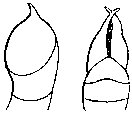
Fig. 1. Anal valves of O. Amphrisius.
The characters in the larva and pupa which have been supposed to distinguish this genus from Papilio are erroneous, or at least do not exist in all the species. My own observations on O. Poseidon show that the larva has no “external sheath” to the thoracic tentacles, and that the suspending thread passes round the pupa, and is not “fastened on each side to a silky tubercle.” There remain therefore only the characters of the perfect insect, the most important of which are the anal valves in the male. These are very large, ovate or rounded, coriaceous, and not hairy, and are furnished with projecting points or spines (sometimes very conspicuous) which serve to attach the male more firmly to the female in copulâ. In several species I have observed, these points or hooks were buried in the protruded anal gland of the female, and thus effectually prevented the great weight of the insects causing them to separate upon suddenly taking flight. The great strength and size of these insects, the thick texture of their wings, their long curved and stout antennæ, their peculiar form, colour, and distribution, are the only other characters that separate them from Papilio. Though these may not perhaps be technically sufficient, I think it advisable and convenient to retain a genus so well known and long established.
Ornithoptera is pre-eminently a Malayan genus, seventeen species inhabiting the archipelago, one (Rhadamanthus, Bd.) India and China, one (Darsius, G. R. Gray) peculiar to Ceylon, one (Richmondia, G. R. Gray) North Australia. O. Victoriæ, G. R. Gray, from some island east of New Guinea, should probably be included in the Malayan list; and Æacus, Felder, from an unknown locality. The following are the well-established Malayan species.
a. Priamus group.
1. Ornithoptera Priamus, Linnæus.
♂. Papilio Priamus, L.; Cram. Pap. Ex. t. 23. f. A, B; Godart, Enc. Méth. ix. p. 25. O. Priamus, Bd. Sp. Gén. Lép. p. 173.
♀. P. Panthous, L.; Cram. Pap. Ex. t. 123. f. A, t. 124. f. A.
This may be at once distinguished from all the allied species with which it has been often confounded—in the male, by the more rounded and deeply scalloped hind wings, with larger black spots and a broader border, the upper wings with no green on the median nervure or its branches, and the sooty patch extending only to the second median nervule; in the female, by the very constant and peculiar light olive-brown colour, the absence of any spots in the discoidal cell of the upper wings, and the broad shallow scallops of the hinder margin.
Hab. Amboyna and Ceram, probably also Bouru (Wall.).
2. Ornithoptera Poseidon, Doubleday.
O. Poseidon, Db. Ann. of Nat. Hist. xvi. p. 173; Westwood, Cat. of Orient. Ent. pl. 11, 14.
36The numerous specimens of Ornithoptera which I obtained in various parts of New Guinea and the adjacent islands show so much instability of form, colouring, and even of neuration, no two individuals being exactly alike, that I am obliged to include them all in one variable species, to which I believe must also be referred O. Pronomus, G. R. Gray, from Cape York, O. Euphorion, G. R. Gray, from North Australia, O. Archideus, G. R. Gray (ex Boisd.), erroneously said to be from Celebes, and O. Boisduvalii, Montrouzier, from Woodlark Island.
Var. a, Aru Islands (Wall.). O. Arruana, Feld. Lep. Frag. p. 24.
Individuals from this locality differ in the arrangement of the nervures; in some the third subcostal nervure of the upper wings branches from the same point with the upper disco-cellular, in others considerably beyond it; the points from which the subcostal nervures branch also vary. The amount of green colour on the median nervure and its branches varies. In some specimens there is a spot at the anal angle of lower wings beneath, agreeing with O. Pronomus, G. R. Gray; but this is generally wanting.
Var. b, Dorey, Salwatty, south-west coast of New Guinea (Wall.).
These agree very closely with O. Poseidon, as figured by Westwood; they differ individually in the same manner as the last, and also in the length of the lower disco-cellular nervure on the under wings. They have generally no golden spots beneath the wings. They vary also in the outline of the under wings, the outer and anal angles being more acute in some specimens than in others. Some have the under wings of a uniform green entirely without spots, while others have a range of black spots more or less fully developed.
Var. c, Waigiou (Wall.). Archideus, G. R. Gray, ♀.
This agrees with the last; but the male is of a more delicate green than any of the others, and has less of that colour on the median veins. On the under side there are no golden spots. The whole surface has a golden tinge, and the central portion of the lower wings is tinged with amber-brown.
The females of all the above vary extremely, much more even than the males, and from the same locality two specimens are rarely alike. The discoidal cell is in some specimens more than half occupied by a whitish patch, while in others there are only a few small spots. One of my specimens from Salwatty almost exactly agrees with that figured by Westwood (Cat. of Or. Ent. pl. 14) as from Cape York. One of the Waigiou specimens is the same as Archideus, G. R. G., figured by Boisduval (Voy. de l’Astrolabe, t. 4. f. 1, 2); and another, from New Guinea, differs very little from Euphorion, G. R. G. (Brit. Mus. Cat. Lep. pt. 1. pl. 2. f. 3), from North Australia.
From these facts I am led to conclude that we have here a variable form spread over an extensive area, and kept variable by the continual intercrossing of individuals, which would otherwise segregate into distinct and sharply defined races. The same area is inhabited by many species of birds common to all parts of it; and just as the birds of Ceram and Amboyna are almost all distinct species from those of New Guinea, so do we find those islands inhabited by the Ornithoptera Priamus, a well-marked and constant species, readily distinguishable in either sex from the inconstant forms of New Guinea 37proper. The same parallel holds in North Australia. Many New Guinea species of birds extend, with very slight variation, to the country about Cape York; but when we reach the Moreton Bay district all these have disappeared, and we find only true Australian species. So the variable forms of O. Poseidon reach North Australia and Cape York, while in the Moreton Bay district we find the comparatively well-marked species O. Richmondia. Similar causes, whether geographical or climatal, have thus produced an analogous distribution in these widely separated groups of animals.
3. Ornithoptera Crœsus, Felder.
O. Crœsus, Feld. Wien. Ent. Monats., Dec. 1859. O. Crœsus, G. R. Gray, Proc. Zool. Soc. 1859, p. 424.
Hab. Batchian (Moluccas) (Wall.).
Local form, a.—Male: has the orange colour of the upper surface of a much deeper fiery-red hue; on the under surface, the black spots of the lower wings are nearer the margin, and the yellow spots below them are entirely absent; there is also a green line between the subcostal nervure and the margin; on the under surface of the fore wings the green patch in the discoidal cell extends to its base, and is reflexed in a narrow line along its upper edge.
Female: differs still more from that sex in O. Crœsus; the white markings on all the wings are so large as almost to fill up the spaces between the veins, the lower part of the discoidal cell in both upper and under wings being also occupied with a whitish patch; the range of spots occupying the posterior margin are of a dusky yellow colour.
Hab. Ternate (♂), Gilolo (♀) (Wall.).
This well-marked local form is no doubt peculiar to Gilolo and the small adjacent islands, as the original species is to Batchian.
I was three months in the island of Batchian before I obtained a specimen of this fine insect, which I had seen once or twice only flying high in the air. I at length came upon it flying about a beautiful cinchonaceous shrub with white bracts and yellow flowers (Mussænda, sp.); and having cleared a path round about, I visited the place every morning on my way to the forest, and once or twice a week had the satisfaction of capturing a fine male specimen of O. Crœsus. The females were more plentiful and more easily caught. I afterwards sent out one of my men with a net every day to look after this insect only. He would stay out all day long, wandering up a broad rocky torrent, where the males flew up and down occasionally or settled on the rocks which just appeared above the water. He generally brought me one, and sometimes even two or three specimens; and thus, with those that I myself captured at the flowers, I secured a fine series of this richly coloured species.
4. Ornithoptera Tithonus, De Haan.
O. Tithonus, De Haan, Verh. Nat. Gesch. Ned. t. 1. f. 1.
Hab. S.W. Coast of New Guinea (Leyden Museum).
This remarkable species must be very rare, as I never saw it in any part of the New 38Guinea district that I visited; nor was it seen during the exploration, a few years ago, by a Dutch steamer which visited the part of the coast where the only specimen known was said to have been obtained.
5. Ornithoptera Urvilliana, Guérin.
Papilio Urvilliana, Guér. Voy. de la Coquille, Lép. t. 13. f. 1, 2, ♂.
O. Urvilliana, Boisd. Sp. Gén. Lép. p. 175.
Hab. New Ireland (Paris Museum).
b. Pompeus group.
6. Ornithoptera Remus, Cramer.
Papilio Remus, Cr. Pap. Ex. t. 135. f. A, t. 136. f. A (♀), t. 386. f. A, B (♂); Fab. Syst. Ent. iii. 1. p. 11.
O. Remus, Bd. Sp. Gén. Lép. p. 176. Papilio Panthous ♂, Clerck, Icon. t. 18 (♀).
Hab. Amboyna, Ceram, Gilolo, Morty Island, Sulla Island, Celebes (Wall.).
The specimens above quoted agree well with Cramer’s figures. The female from the Sulla Islands differs only in having more yellow towards the anal angle of the lower wings. The specimens figured by Cramer in pls. 10, 11, under the name of “Hypolitus” seem to be a remarkable variety, in which the female has much of the character of the male. Messrs. Doubleday and G. R. Gray have adopted Panthous as the specific name of this insect; but this name was first used by Linnæus for the female of Priamus only, in the 10th ed. of the ‘Systema Naturæ’ (1758). Clerck (in 1759) adopted the name, but supposed he had found the male in the female of Remus. Linnæus, in Mus. Lud. Ulric. (1764), and in the 12th ed. of the ‘Systema Naturæ’ (1766), adopts this error, so far as referring to Clerck’s two figures; but in both these works his description refers only to the female of P. Priamus, indicating that the supposed other sex (P. Remus) was not known to him personally. The name of Panthous must therefore altogether drop, it having been applied to this species only through a double error—first, that of Linnæus, in supposing his Panthous to be distinct from Priamus, and then that of Clerck, in thinking that a female Remus was the male of the Linnean Panthous.
7. Ornithoptera Helena, Linnæus.
♂. P. Helena, Cram. Pap. Ex. t. 140. f. A, B. O. Helena, Boisd. Sp. Gén. Lép. p. 177.
♀. P. Amphimedon, Cram. Pap. Ex. t. 194. f. A. O. Amphimedon, Boisd. Sp. Gén. p. 176.
Hab. Amboyna and Ceram (Wall.).
The females from these localities are always sooty, with the spots and markings on the hinder wings of a dull buff-colour even in the freshest specimens.
a. Local form Bouruensis.—Male: exactly resembles the Amboyna specimens, except that the yellow patch is more variable in form and extent.
Female: nearly black, and with the markings on the lower wings almost as pure and deep yellow as in the males: size a little smaller than in the type.
Hab. Bouru (Wall.).
b. Local form Papuensis.—Female: sooty black, the two first branches of the subcostal 39nervure margined with whitish near their origin; markings of the lower wings of the same tint of orange-yellow as is O. Helena ♂, but not so glossy.
Male not known.
Hab. New Guinea, Salwatty (Wall.).
c. Local form Celebensis.—Male: wings a little more pointed than in O. Helena; yellow patch of lower wings extending nearer to the posterior margin, and bounded towards the abdominal margin by the first branch of the median nervure. Beneath, having the nervures between the discoidal cell and the outer border ashy-margined.
Female not known.
Hab. Macassar (Celebes) (Wall.).
Remarks.—Of these three local modifications of O. Helena, the first is very distinct in the female, but not separable in the male sex. Of the second and third, only one sex is known; and they may very probably prove to be well-marked species when more materials are obtained.
8. Ornithoptera Leda, n. s.
Male: upper wings elongate, triangular, glossy black, quite uniform and immaculate; the outer margin delicately white-marked at the termination of the nervures. Lower wings yellow, as in the allied species, with a black border about the same width as in O. Pompeus on the outer and abdominal margins, narrower on the inner margin; the posterior scalloping of the yellow patch not so deep as in O. Pompeus, and having a spot at the anal angle connected more or less with the margin.
The under surface differs from that of O. Pompeus by the ashy margins of the veins of the upper wings being entirely absent, and in having much less white on the outer edge. There are no submarginal spots except the anal one, much red at the base of the wings, and no black spots on the abdomen.
Female: this sex varies very much, some having the upper wings immaculate, while others have the veins about the end of the discoidal cell broadly margined with whitish. The marginal series of spots on the lower wings vary as they do in O. Pompeus and O. Amphrisius. The best distinction from O. Pompeus (♀) seems to be the more elongated wings, the less crenellated margin, and the more produced outer angle of the lower wings. The yellow patch is also of a deeper colour both on the upper and under surfaces.
Hab. Celebes (Macassar and Menado) (Wall.)
9. Ornithoptera Pompeus, Cramer.
P. Pompeus, Cr. Pap. Ex. t. 25. f. A (♂). P. Minos, Cr. Pap. Ex. t. 195. f. A (♀). P. Heliacon, Fab. Ent. Syst. 3. i. p. 19, 60.
O. Heliacon, Boisd. Sp. Gén. Lép. p. 178.
Hab. Sumatra, Borneo, Java, Lombock (Wall.), India (var.).
Remark.—The form that occurs in India, in its more elongate wings and darker colouring, approaches very closely to O. Rhadamanthus.
4010. Ornithoptera Nephereus, G. R. Gray.
P. Astenous, Eschscholtz, Voy. Kotzebue, t. 4. f. A, B, C. (nec Fab.).
O. Nephereus, G. R. G., List of Lep. B. M. Papilionidæ, p. 6.
Hab. Philippine Islands.
Remark.—This is quite distinct from O. Rhadamanthus, Bd., with which it has generally been identified.
11. Ornithoptera Magellanus, Felder.
O. Magellanus, Feld. Lep. Nov. Phil. p. 11.
Hab. North of Luzon (Philippines).
Remark.—This fine species has a beautiful opalescent glow on the lower wings when viewed obliquely.
12. Ornithoptera Criton, Felder.
O. Criton, Feld. Lep. Fragm. p. 49.
Hab. Batchian, Ternate, Gilolo, Morty Island (Wall.).
13. Ornithoptera Plato, n. s.
Male: resembles O. Criton in the form and extent of the yellow patch, but the upper wings differ in having the outer half of a lighter tint; on the under surface this outer half of the wing is of a light ash-colour. Abdomen almost wholly black beneath. No red patches at the base of the wings, or any red collar.
Female unknown.
Hab. Timor (Wall.).
This is a very distinct species, though at first sight resembling several others. I obtained a single male specimen only.
14. Ornithoptera Haliphron, Boisduval.
O. Haliphron, Bd. Sp. Gén. Lép. p. 181 (♂); Felder, Lep. Fragm. p. 37, Taf. ii. f. 2, 3 (♂, ♀).
Hab. Macassar (Celebes) (Wall.).
15. Ornithoptera Amphrisius, Cramer.
P. Amphrisius, Cr. Pap. Ex. t. 219. f. A; Godardt, Enc. Méth. ix. p. 27, pt.
O. Amphrisius, Bd. Sp. Gén. Lép. p. 178.
Hab. Malacca, Java, Borneo (Wall.).
This may be readily distinguished from the allied species by the upper wings in the male being yellow-marked, and by the absence of red spots at the base of the wings beneath in both sexes.
c. Brookeana group.
16. Ornithoptera Brookeana, Wallace.
O. Brookeana, Wall. Proc. Ent. Soc. 1855, p. 104; Hewitson, Ex. Butt. Papilionidæ, i. f. 1. Papilio Trogon, V. Voll. Tijdschrift voor Ent. 1860, p. 69, pl. 6.
Hab. Borneo (Sarawak) (Wall.), Sumatra (Leyden Museum).
41Remarks.—I have been in much doubt about the position of this remarkable species, and was for some time inclined to place it among the Papilios. It agrees, however, far better with Ornithoptera in the form and stoutness of the wings, the long stout and curved antennæ, the red collar and patches at the base of the wings beneath, the abdominal fold, and the flight and general appearance. It is powerful on the wing, and occasionally settles on the ground in damp sunny places. It inhabits the interior of North-west Borneo and the mountains of West Sumatra. The female is unknown. It is peculiar in the great length of the discoidal cell of the wings and its altogether unique style of coloration, and must be considered as the type of a distinct group of the genus Ornithoptera.
Papilio.
This is without doubt the finest and most remarkable genus of Diurnal Lepidoptera. About 360 species are now known, all, except ten, being tropical or subtropical. I have given at p. 23 the characters of the sections and groups into which I divide the Malayan species.
Section A.
a. Nox group.
17. Papilio Nox, Swainson.
P. Nox., Sw. Zool. Ill. pl. 102; Horsf. Lep. Ins. E. I. C. pl. 1. f. 1; Boisd. Sp. Gén. Lép. p. 277.
P. Neesius, Zink. Nov. Act. Acad. Nat. Cur. xv. t. 14. f. 1.
Hab. Java (♂, ♀) (Wall.), Penang (♂) (Brit. Mus.).
18. Papilio Noctis, Hewitson. Tab. V. fig. 1 (♂)[12].
P. Noctis, Hewits. Proc. Zool. Soc. 1859, p. 423, pl. 66. f. 5 (♀).
Male: differs from the same sex of P. Nox by the broader apex of the fore wings, and by the hind wings being more elongate, more glossy, and especially by the entire nondentated hinder margin.
Hab. Borneo (Sarawak) (Wall.), (♂, ♀ Mus. nost.)
19. Papilio Erebus, Wallace.
P. Nox, var., De Haan, Verh. Nat. Gesch. t. 5. f. 3 (♀).
Hab. Malacca (Wall.), Banjermassing, Borneo (De Haan).
Remarks.—I am somewhat doubtful of the species, the female only being known; but it differs so strikingly from the same sex of P. Nox and P. Noctis (the former of which seems very constant), that I think it better to separate it in order to draw attention to other specimens that may exist in collections. It differs from P. Nox (♀) by its narrower and more elongate hind wings, which are black, glossed with steel-blue; the fore wings are black, with the veins beyond the cell clearly white-margined. The lower margin is also much less strongly dentated.
4220. Papilio Varuna, White.
♀. P. Varuna, Wh., Entomologist, 1842, p. 280; Westw. Ann. Nat. Hist. ix. p. 37. P. Chara, Westw. Arc. Ent. pl. 66. f. 2.
♂. P. Astorion, Westw. Ann. Nat. Hist. ix. p. 37; Arc. Ent. pl. 66. f. 1.
Hab. Pulo Penang, Sylhet.
21. Papilio Semperi, Felder.
P. Semperi, Feld. Lep. Nov. Philipp, pp. 1, 11.
Hab. Luzon, Philippines (♂, ♀).
N.B. The Philoxenus group peculiar to India follows on after these.
b. Coon group.
22. Papilio Neptunus, Guérin.
P. Neptunus, Guér. Deless. Voy. dans l’Inde, p. 69, t. 19 (P. Saturnus).
Hab. Malacca, Borneo (♂, ♀) (Wall.).
23. Papilio Coon, Fabricius.
P. Coon, Fab. Ent. Syst. iii. 1. pp. 10, 27; Don. Ins. China, pl. 24. f. 1; Lucas, Lep. Ex. t. 6. f. 2; Boisd. Sp. Gén. Lép. p. 201.
Hab. Java, Sumatra (Wall.), Borneo (De Haan).
Remarks.—The specimens from Sumatra are constantly larger than those from Java. The Indian form, in which the markings are red instead of yellow, with other differences, I consider a distinct species, for which I propose the name of P. Doubledayi, after the late Mr. Edward Doubleday of the British Museum[13].
c. Polydorus group.
24. Papilio Polydorus, Linnæus.
P. Polydorus, L.; Clerck, Icon. t. 33. f. 3. P. Leobates, Reinw. Verh. Nat. Gesch. Zool. t. 6. f. 3 (♀).
Hab. Ceram, Matabello Island, Bouru, Batchian (♂, ♀) (Wall.).
Local form or variety a.—The white markings on the fore wings forming a patch below the cell; red spots on the hind wings nearer to the posterior margin and that next the anal angle larger.
Hab. Ké Island, Aru Island (♂, ♀) (Wall.).
4325. Papilio Leodamas, n. s. Tab. V. fig. 2 (♂).
P. Polydorus, in Brit. Mus. List of Papilionidæ, p. 10.
Male. Above, glossy black, upper wings immaculate (the veins pale-margined in the female). Lower wings with a rounded white spot divided into six parts by fine nervures, of which the outermost and that in the cell are sometimes reduced to points; marginal row of red spots obscured with black, and but faintly indicated.
Beneath, the white patch has a small red spot attached to the part next the anal angle; and the marginal row of six red spots are clearly marked, that at the anal angle being twice the size of the rest. Wings short, much rounded, scarcely or not at all produced in the caudal region.
Expanse of wings 3¾ in. to 4 in.
Hab. New Guinea, Mysol (♂, ♀) (Wall.), Rockingham Bay (Australia), (Brit. Mus., ♀).
26. Papilio Diphilus, Esper.
P. Diphilus, Esp. Ausl. Schmett. t. 40. f. 1. P. Polydorus, Boisd. Sp. Gén. Lép. p. 267; and most authors.
Hab. Java, Malacca (Wall.), Philippine Islands, India.
Remarks.—The specimens from Manilla are larger, and the females paler-coloured, than those from other localities, all of which have slight characteristic peculiarities; but they also vary in the individuals from each locality, so that no perfect segregation of local forms has yet taken place.
27. Papilio Antiphus, Fabricius.
P. Antiphus, Fab. Syst. Ent. iii. 1. pp. 10–28; Boisd. Sp. Gén. Lép. p. 266.
Hab. Sumatra, Borneo, Lombock, Java (Wall.), Philippine Islands.
Remarks.—The Philippine form (P. Kotzebuea, Eschsch.) is rather larger and of a more uniform glossy black than those from other localities. P. Theseus, Cram., has been erroneously supposed to be the female of this species, whereas it is the female of one of the Pammon group, belonging to a different section of the genus. De Haan figures P. Theseus as P. Antiphus ♀, in Verh. Nat. Gesch. t. 8. f. 2. As has been already pointed out, P. Theseus mimics this species.
28. Papilio Polyphontes, Boisduval.
P. Polyphontes, Bd. Sp. Gén. Lép. p. 268. P. Hegemon, G. R. G., List of Papilionidæ in B. Mus.
Hab. Celebes, Batchian, Morty Isl. (♂, ♀) (Wall.).
Remarks.—The markings vary from pure white to a smoky tint; but otherwise all the specimens from the above localities agree. De Haan gives (Verh. Nat. Gesch. t. 8. f. 4) a female of one of the Pammon group as P. Polyphontes ♀.
29. Papilio Annæ, Felder.
P. Annæ, Feld. Lep. Nov. Philipp, p. 1.
Hab. Mindoro (Philippines).
4430. Papilio Liris, Godart.
P. Liris, God. Enc. Méth. iv. p. 72; Boisd. Sp. Gén. Lép. p. 268; De Haan, Verh. Nat. Gesch. p. 38, t. 4. f. 3 (♀).
Hab. Timor (Wall.), N.W. Australia (Brit. Mus.).
Remarks.—The Australian specimens are smaller. The female of P. Œnomaus mimics this species, as has been already mentioned (p. 22). Both species were taken by myself on the same spot, and, though such large and conspicuous insects, they could never be distinguished without a close examination after capture. The female of this species differs very little from the male, being rather larger, with broader wings and less vivid coloration.
Section B.
d. Ulysses group.
31. Papilio Ulysses, Linnæus.
P. Ulysses, L., Cramer, Pap. Ex. t. 121. f. A, B (♀), t. 122 A (♀). P. Diomedes, Boisd. Sp. Gén. Lép. p. 202.
Hab. Amboyna, Ceram (♂, ♀) (Wall.).
Remark.—The largest specimens of this glorious insect are found in the island of Amboyna, where it is rather common, hovering about the forest pathways. It sometimes visits the gardens in the town of Amboyna.
32. Papilio Penelope, n. s.
Male: rather smaller than P. Ulysses. Upper wings with six black cottony patches, and all separate from each other; whereas in P. Ulysses there are seven, and the four lower ones are always united at their margins. The blue colour fills the discoidal cell, and generally extends beyond it at the extremity; the upper disco-cellular nervure not black-bordered as in P. Ulysses. Lower wings with the blue colour extending further along the abdominal margin, and not quite so far towards the outer angle.
Female: has the blue colour of the same form and extent as in P. Ulysses ♀, but of the same bright tint as in the male; the marginal lunules more deeply curved.
Expanse of wings 5 inches.
Hab. New Guinea, Waigiou, Aru Is. (♂, ♀) (Wall.).
Remark.—As all the other forms closely allied to P. Ulysses have received names (Telemachus, Montr., Chaudoiri, Feld., Telegonus, Feld., and Ulyssinus, Westw.), I have also given one to this form peculiar to New Guinea and the Papuan Islands, the distinctive characters of which, though very slight, seem sufficiently constant.
33. Papilio Telegonus, Felder.
P. Telegonus, Feld. Lep. Fragm. p. 50.
Hab. Batchian, Gilolo (♂, ♀) (Wall.).
Remark.—A very distinct species, separated from P. Ulysses by the extent of the cottony patch on the upper wings, and by the different form and colour of the blue markings.
4534. Papilio Telemachus, Montrouzier.
P. Telemachus, Mont. Ann. de la Soc. d’Agriculture de Lyon, 1856, p. 395.
Hab. Woodlark Isl. (S. E. of New Guinea).
Remark.—This is a small species (exp. 4 in.), with less blue on the lower wings.
e. Peranthus group.
35. Papilio Peranthus, Fabricius.
P. Peranthus, Fab. Syst. Ent. iii. 1. p. 15; Don. Ins. China, pl. 26; Lucas, Lep. Ex. t. 12. f. 2; Boisd. Sp. Gén. Lép. p. 203.
Hab. Java, Lombock (Wall.).
36. Papilio Pericles, n. sp. Tab. VI. fig. 1 (♂).
Wings more elongate, and upper wings more pointed, than in P. Peranthus.
Above: black, the basal half of a silvery blue, greenish towards the base of the costa, and purplish on the outer margin, where on the lower wings it shades off into separate scales. On the submedian and two lower branches of the median nervure are elongate black cottony patches as in P. Ulysses, the lower ones joined at the base, the upper one separate; above these the outer margin is of a brown-black, with a few atoms of yellow and blue scales towards the apex; the blue colour extends beyond the discoidal cell of the upper wings in a line parallel with the outer margin, on the lower wings it rounds away to the anal angle, and below it are five submarginal lunules of blue atoms, the outer one almost obsolete, and that next the tail largest and most deeply coloured. Thorax and body green.
Beneath: as in P. Peranthus, but the posterior range of lunules margined with brilliant blue and orange brown.
Expanse of wings 3½ inches.
Hab. Timor (♂) (Wall.).
37. Papilio Philippus, Wallace. Tab. VI. fig. 3.
P. Peranthus, var. A, Boisd. Sp. Gén. Lép. p. 204.
Above: basal half of the wings of a rich green-blue, the rest black, with a triangular patch at the apex of the uppers, formed of green atoms situated between the nervures; on the lower wings six large submarginal lunules, the lowest of which sends out some green atoms along the tail. The black cottony spot is of a different form from that of P. Peranthus, the separate patches being only joined in the middle, and two of them extending along the nervures in a point nearly to the discoidal cell.
Beneath: brilliantly marked with lunules of buff, black, and blue.
Expanse of wings 4½–5 inches.
Hab. Moluccas (Wall.).
Remarks.—My specimen from Ceram is of a greener tinge, and the colour extends a little beyond the end of the discoidal cell; that from Batchian is smaller, of a bluer tinge, and the colour of less extent. The species seems to be very rare.
4638. Papilio Macedon, Wallace. Tab. VI. fig. 2 (♂).
P. Peranthus, var. B., Boisd. Sp. Gén. Lép. p. 204.
Boisduval’s description sufficiently shows the remarkable differences of form, size, and colouring which this species presents, compared with that of which he considers it a variety. The female agrees with the male, except that the colours are a little less brilliant, and the cottony patches of the fore wings are absent.
Expanse of wings, ♂, 5 inches; ♀, 5–6 inches.
Hab. Macassar, Menado (Celebes) (Wall.).
39. Papilio Brama, Guérin.
P. Brama, Guér. Rev. Zool. 1840, p. 43, t. 1. f. 3, 4. P. Palinurus, De Haan, Verh. Nat. Gesch. pp. 5, 29.
Hab. Malacca, Sumatra (Wall.).
40. Papilio Dædalus, Felder.
P. Dædalus, Feld. Lep. Nov. Philipp. p. 2.
Hab. Luzon (Philippine Islands).
41. Papilio Blumei, Boisduval. Tab. VI. fig. 4 (♂).
P. Blumei, Boisd. Sp. Gén. Lép. p. 206.
Hab. Menado (Celebes) (Wall.). “Amboyna,” Bd., error of locality.
Remark.—This very fine species comes nearest to the last, but is of much larger size, and is conspicuous by its brilliantly coloured tails.
42. Papilio Arjuna, Horsfield.
P. Arjuna, Horsf. Cat. Lep. E. I. Comp. pl. 1. f. 14; Boisd. Sp. Gén. Lép. p. 209. P. Arjuna, var. a., Brit. Mus. Cat. of Papilionidæ, p. 17.
Hab. Java, Borneo, Sumatra (Wall.).
The Bornean form differs from that of Java by its larger size, and on the under surface by the three middle lunules being formed of a violet line only, with scarcely a trace of red beneath it, and by the orange-red lunules both at the anal and outer angles being divided (not margined) by a violet line. The scales sprinkled at the base of the lower wings are white and blue, and are neither so dense nor do they extend so far as the yellowish scales of the Java specimens. In all these particulars the Sumatra specimens are somewhat intermediate, but approach most to those of Borneo. This is one of the examples which show the isolation of Java, notwithstanding its proximity to Sumatra.
f. Memnon group.
(N.B. The Protenor group of India is intermediate between this and the last group.)
43. Papilio Memnon, Linnæus. Tab. I. figs. 1 (♂), 2, 3, 4 (♀s).
♂, P. Memnon, L., Cram. Pap. Ex. t. 91. f. C (♂); Boisd. Sp. Gén. Lép. p. 192.
♀, 1st dimorphic form, P. Anceus, Cr. Pap. Ex. t. 222. f. A, B.
? P. Laomedon, Cr. Pap. Ex. t. 50. f. A, B; De Haan, Verh. Nat. Gesch. p. 24, t. 3. f. 2.
47♀, 2nd dimorphic form, P. Achates, Cr. Pap. Ex. t. 243. A.
Hab. Java, Sumatra (Wall.).
Local form a.—Male: border of posterior wings beneath narrow and of an ashy-blue colour.
Female: near P. Anceus, Cr., and P. Laomedon, Cr., but of an olive-ashy colour.
Hab. Borneo (Wall.).
Local form b.—Male: band on under side of posterior wings ashy; the spots large, with reddish-orange lunules between the two series, and below the four outer ones.
Hab. Lombock (Wall.).
Remarks.—The difference between the male and the 2nd form of female is so great, both in form and colouring, that they could not have been imagined to be the same, had they not been bred from the same larvæ. They have also been taken “in copulâ” by myself. Each form varies considerably, both individually and locally; yet there are none intermediate between the two. I consider them, therefore, as presenting a fine instance of dimorphism; and I also believe that the second form mimics P. Coon, for reasons which I have explained at p. 21.
44. Papilio Androgeus, Cramer.
♂, P. Androgeus, Cr. Pap. Ex. t. 91. f. A, B.
♀, 1st dimorphic form, P. Agenor, L., Cr. Pap. Ex. t. 32. f. A, B.
♀, 2nd dimorphic form, P. Achates, Cr. Pap. Ex. t. 182. f. A, B; P. Alcanor, Cr. Pap. Ex. t. 166, f. A.
Hab. Malacca (Wall.), India.
Remarks.—Ever since it was discovered that the insects figured by the old authors as P. Anceus, P. Agenor, P. Achates, &c. were varying females of P. Memnon and P. Androgeus, the whole of these were very naturally concluded to belong to one varying species. An examination of many extensive collections, however, has convinced me that the continental forms, on the one hand, and the insular ones, on the other, can be readily distinguished, and really form two very well-marked species. The red lunules at the anal region beneath characterize all specimens from India (Androgeus, Cr.), while these are entirely absent in all the insular specimens (Memnon, Cr.); and the same characteristic difference can be traced in a greater or less degree throughout all the infinitely varying female specimens. My specimen from Malacca has a faint trace only on the upper surface of the characteristic red mark at the base of the anterior wings; in other respects it resembles the continental individuals. This form mimics the Indian form of P. Coon (P. Doubledayi, Wall.).
45. Papilio Lampsacus, Boisduval.
P. Lampsacus, Bd. Sp. Gén. Lép. p. 190; De Haan, Verh. Nat. Gesch. p. 23, t. 2. f. 2.
Hab. Java (♂) (Wall.).
46. Papilio Priapus, Boisduval.
P. Priapus, Bd. Sp. Gén. Lép. p. 190; De Haan, Verh. Nat. Gesch. p. 23, t. 2. f. 1.
Hab. Java (Boisd.), Sumatra (Raffles), Borneo (De Haan).
4847. Papilio Emalthion, Hübner.
♂, Iliades Emalthion, Hübn. Samml. Exot. ii. t. 117; P. Emalthion, Boisd. Sp. Gén. Lép. p. 196; P. Floridor, Godt. Enc. Méthod. ix. p. 809; P. Kruscusterina in Eschsch. Voy. Kotzebue, t. 3. f. 5.
♀, 1st form, P. Emalthion, Cat. of Lep. Brit. Mus. pl. 5. f. 4.
♀, 2nd form, P. Rumanzovia, Eschsch. Voy. Kotz. t. 2. f. 4; P. Descombesi, Boisd. Sp. Gén. p. 197; P. Floridor, ♀. Godt. Enc. Méth. ii. p. 809.
Hab. Philippine Islands.
Remarks.—I have no doubt whatever that we have here another case of dimorphism, and I therefore unhesitatingly place these supposed species under one name. The male of P. Emalthion very closely resembles the next species (P. Deiphontes), and the 2nd form of female (P. Rumanzovia, Eschsch.) as closely resembles the female of the same species; so that there can be no doubt that Godardt was right in describing them as the sexes of his P. Floridor. The female figured in the British Museum Catalogue is intermediate between these, but has more of the characters of the male; and it is to be remarked that both these forms of female have arrived in Europe accompanied by the same male. I am therefore obliged to reduce by one the hitherto received species of Philippine Papilios.
48. Papilio Deiphontes, n. s.
P. Deiphobus, var. A., Bd. Sp. Gén. Lép. p. 201.
♂. Above: exactly as in P. Deiphobus, but having a small tooth only in place of the tail, and the posterior band of a clear ashy blue.
Beneath: with the markings as in P. Emalthion, except that the red patch at the base of the upper wings is smaller.
♀. Also tailless, but resembling in markings the same sex of P. Deiphobus, the pale patch on the upper wings not extending into the discoidal cell.
Expanse of wings, ♂, 5½ inches; ♀, 5¾ inches.
Hab. Batchian, Gilolo, Ternate, Morty Isl. (Wall.).
49. Papilio Deiphobus, Linnæus.
P. Deiphobus, L., Cramer, Pap. Ex. t. 181. f. A, B; Donovan, Ins. Ind. pl. 17. f. 2; Lucas, Lep. Ex. t. 11; Boisd. Sp. Gén. Lép. p. 200.
♀, P. Alcandor, Cr. Pap. Ex. t. 40. f. A, B.
Hab. Ceram, Amboyna, Bouru (Wall.).
Remark.—A simple variety of both this and the last species frequently occurs, in which all the markings on the under side are ochre-yellow instead of red.
50. Papilio Ascalaphus, Boisduval.
P. Ascalaphus, Bd. Sp. Gén. Lép. p. 200 (♂); De Haan, Verh. Nat. Gesch. p. 26, t. 1. f. 2 (♀).
Hab. Menado, Macassar (Celebes), Sulla Isl. (Wall.).
51. Papilio Œnomaus, Godardt.
P. Œnomaus, Godt. Encyc. Méth. ix. p. 72; Boisd. Sp. Gén. Lép. p. 190; De Haan, Verh. Nat. Gesch. p. 24, t. 4. f. 1 (♂), 2 (♀).
Hab. Timor (♂, ♀) (Wall.).
49Remark.—As has been already noticed (p. 22), the female of this species closely resembles P. Liris ♀, in company with which it was captured.
g. Helenus group.
52. Papilio Severus, Cramer.
P. Severus, Cr. Pap. Ex. t. 227. f. A, B (♂), t. 278. f. A, B (♀); Boisd. Sp. Gén. Lép. p. 212.
Hab. Bouru, Ceram, Amboyna, Gilolo, Batchian, Aru Isl. (Wall.).
Remarks.—This species exhibits a large amount of simple variation, in the presence or absence of a pale patch on the uppers, in the brown submarginal marks on the lower wings, in the form and extent of the yellow band, and in the size of the specimens. The most extreme forms, as well as the intermediate ones, are often found in one locality and in company with each other, indicating that over the above range continual intermixture probably takes place, and thus prevents any one form from becoming specialized in a restricted area. The two following modifications of it, however, have acquired perfect stability, each in a large island situated on the extreme limits of the species. I therefore consider them to be distinct, though the actual differences are but small.
53. Papilio Pertinax, n. s. Tab. V. fig. 4 (♂).
Upper side: anterior wings rather more elongate and pointed than in P. Severus, dusky brown, with faint longitudinal rows of yellow scales in the cell, and with rather denser scales between the nervures beyond it; these are condensed into a narrow yellowish band parallel to the outer margin, and rather nearer to the cell than to it. Hind wings black, with three yellowish white subquadrate spots (the upper one smallest) situate between the outer angle and the discoidal nervule; beyond these and continued to the anal angle are a few very faint and minute groups of scales.
Under side as above, but the transverse band on the upper wings is whiter, and on the lower wings are seven submarginal brownish-yellow lunules, the middle ones least marked, and those at the outer and anal angles having above them a very small group of minute blue scales.
The female is paler-coloured, with the markings rather more diffused, and has on the under side an imperfect ocellus at the anal angle, a row of faint brown lunules extending to the three white spots, and two irregular lunules of blue atoms below those next the abdominal margin.
Expanse of wings, ♂, 4¼ inches; ♀, 5 inches.
Hab. Macassar (Celebes) (Wall.).
Remark.—This species was rather abundant near Macassar, in woody places, and was very constant in its markings and general aspect.
54. Papilio Albinus, n. s. Tab. V. fig. 5 (♂).
Wings broader than in P. Severus, costa less arched, tail smaller, and the caudal margin less produced.
Upper side: brown-black; anterior wings with very faint horizontal lines of yellowish 50scales in the cell; apical portion of the wing more thickly powdered between the nervures, the powdering fading away towards the outer angle. Posterior wings with a large yellowish-white patch, commencing close to the anterior margin, widening in the middle so as to cross the end of the cell, and ending in a triangle with prolonged apex at the abdominal margin; the outer edge of this spot is regularly angulated and scalloped; two very faint brown lunules occur next the anal angle; and the outer margin is rather broadly white-edged between the dentations.
Under side: the anterior wings have distinct greyish lines of scales between the nervures in the apical region; posterior wings not dotted with scales as in P. Severus, but with two or three single rows of scales in the cell only; the yellowish band consisting of a lunule next the upper margin, followed by three rhomboidal spots notched below, of which the middle one is the largest, then a roundish spot and a small horizontal mark; a row of seven submarginal lunules, of which the three middle ones are smallest and nearly obsolete, and that at the anal angle much the largest and, with the whitish marginal spot below it, forming an incomplete ocellus.
Expanse of wings 3½–3¾ inches.
Hab. New Guinea (♂) (Wall.).
55. Papilio Phestus, Guérin.
P. Phestus, Guér. Voyage de la Coquille, t. 14. f. 2; Bd. Voy. de l’Astrolabe, i. p. 41; Sp. Gén. Lép. p. 212.
Hab. New Guinea (Paris Museum).
56. Papilio Helenus, Linnæus.
P. Helenus, L.; Cramer, Pap. Ex. t. 153. f. A, B; Lucas, Lep. Ex. t. 15. f. 2; Boisd. Sp. Gén. Lép. p. 211.
Hab. China (“type,” Cramer’s figure).
Local form a. Has more falcate wings and longer tail; the red marks at the anal angle beneath are divided by a violet-white mark.
Hab. North India.
Local form b. Same form of wings as the last, but smaller; the third and fourth lunules from the anal angle beneath very small or quite absent.
Hab. Java, Sumatra (Wall.).
57. Papilio Hecuba, n. s. Tab. V. fig. 3 (♂).
Upper wings falcate, and their outer margin much hollowed out, as in many of the Celebes butterflies.
♂. Upper side: the outer half of the anterior wings of a fine cottony texture, as in P. Helenus, but more marked; the red lunule at the anal angle wanting; the rest as in P. Helenus.
Under side: the lunules and ocelli are ochre-yellow instead of deep red, the two outer ones very small, the third almost obsolete, and the next two absent; the anal ocellus is bordered with blue above, and adjoining it is a blue lunule in the place of the red one in P. Helenus.
51♀. Upper side: of a browner colour; two orange-brown ocelli at the anal angle.
Under side: the lunules and ocelli all larger; the two intermediate ones entirely absent, as in the male.
Expanse of wings 5½–5¾ inches.
Hab. Macassar, Menado (Celebes) (Wall.).
58. Papilio Iswara, White.
P. Iswara, White, Entom. 1842, p. 280; Doub. and Hew. Gen. of Diurn. Lep. pl. 2. f. 1 (♀).
Hab. Penang, Malacca, Singapore, Borneo (♂, ♀) (Wall.).
59. Papilio Hystaspes, Felder.
P. Hystaspes, Feld. Lep. Nov. Philipp. p. 12.
Hab. Luzon (Philippines).
This is the Philippine form of P. Helenus.
60. Papilio Araspes, Felder.
P. Araspes, Feld. Ent. Fragm. p. 17.
Hab. Philippine Islands.
This comes near to P. Iswara.
61. Papilio Nephelus, Boisduval.
P. Nephelus, Bd. Sp. Gén. Lép. p. 210; De Haan, Verh. Nat. Gesch. p. 29, t. 4. f. 4, ♂.
Hab. Malacca, Sumatra, Borneo (♂, ♀) (Wall.), Assam (Brit. Mus.).
h. Pammon group.
62. Papilio Pammon, Linnæus. Tab. II. figs. 1 (♂), 3, 5, 6 (♀ ♀).
♂, P. Pammon, L.; Cram. Pap. Ex. t. 141. f. B; Boisd. Sp. Gén. Lép. p. 272.
♀, P. Polytes, L.; Cram. Pap. Ex. t. 265. f. A, B, C.
Hab. Malacca, Singapore (Wall.), China, India, Ceylon.
The continental specimens of P. Pammon have all considerably developed tails in both sexes; the insular specimens on the other hand, (which I treat as a separate species), have only a prominent tooth or very short tail in the males. The females also differ considerably, presenting an analogous but distinct series of forms. In the true P. Pammon the males are very constant; but the females exist under three distinct forms, each of them presenting more or less numerous varieties, viz.:—
1st form of female. Tab. II. fig. 3.
This exactly resembles the male, except in the possession of a distinct ocellus at the anal angle on the upper surface. Rarely a variety occurs having in addition a submarginal row of red lunules, indicating a slight approximation towards some varieties of the second form.
2nd form of female (P. Polytes). Tab. II. fig. 5.
This is by far the most common form of female. A variety of this rarely occurs, which 52wants the red patch at the anal angle, and has the white patch formed of a row of spots all situated a little below the discoidal cell. This is the nearest approach to the first form.
3rd form of female (P. Romulus, Cram. Pap. Ex. t. 43. f. A; P. Mutius, Fab., Boisd. Sp. Gén. p. 270; P. Hector ♀, De Haan). Tab. II. fig. 6.
This not uncommon Indian butterfly I consider to be a third form of the female of P. Pammon. I was first led to suspect this by finding that no males of it are known (the male and female from Ceylon, noted in the British Museum List, I have ascertained to be both females), nor have I been able to find any after an examination of the chief collections in England. It is also to be observed that it has been received from no locality which is not also inhabited by P. Pammon; there is no other known Indian butterfly that can possibly be the other sex of it; and lastly, it agrees very closely with the second form of female (P. Polytes) in all its details of form, texture, and neuration; and though at first sight having a very different aspect, specimens are to be found which by a very slight modification could be changed so as to resemble that form. I am therefore quite satisfied in my own mind that I am right in sinking this species into a form of P. Pammon. I have already stated my opinion that it mimics P. Hector, with which, however, it has no affinity. The resemblance was such as to induce De Haan to place it as the female of that species.
63. Papilio Theseus, Cramer. Tab. II. figs. 2, 4, 7 (♀ ♀).
P. Theseus, Cr. Pap. Ex. t. 180. f. B (♀); Boisd. Sp. Gén. Lép. p. 276.
P. Antiphus ♀, De Haan, Verh. Nat. Gesch. p. 49, t. 8. f. 2; Brit. Mus. List. Pap. p. 12.
P. Polyphontes ♀, De Haan, Verh. Nat. Gesch. t. 8. f. 4.
P. Melanides, De Haan, Verh. Nat. Gesch. t. 8. f. 3 (♀).
Male like P. Pammon ♂, but smaller, and the tail always reduced to a projecting tooth.
Hab. Java, Sumatra, Borneo, Lombock, Timor (Wall.).
Local form a. Much larger; more falcate wings; a broad short tail.
Hab. Macassar (Wall.)
1st form of female. Tab. II. fig. 2.
Like the male, but with a very slightly marked blue and red ocellus at the anal angle. This is very rare in the islands. I found one specimen only in Timor, which I took “in copulâ” with a male almost exactly resembling it.
2nd form of female (P. Polyphontes ♀, De Haan). Tab. II. fig. 4.
Like the 2nd form of P. Pammon ♀; but has the pale portion of the anterior wing of a much lighter colour, and not extending so far towards the base of the wing; the white spot on the hind wings is more rounded, and has always a rather large portion within the cell. This form is to some extent local, not existing, I believe, in Sumatra, where it is replaced by the next.
Hab. Borneo, Java, Timor (Wall.).
3rd form of female (P. Theseus, Cr.; P. Antiphus ♀, De Haan). Tab. II. fig. 7.
This is well characterized by the entire absence of the white spot from the hind wings. 53The red spots and lunules remain; but in some specimens only those in the anal region are visible, and these have a very close resemblance to P. Antiphus. This is also a local form, not occurring, I believe, in company with the last.
Hab. Sumatra, Lombock (Wall.).
4th form of female (P. Melanides, De Haan, Verh. Nat. Gesch. t. 8. f. 3).
I consider this to be an isolated modification of P. Theseus, Cr., peculiar to Borneo. It possesses all the characteristics of a female of this species.
Hab. Banjarmassing (Borneo) (Leyden Museum).
N.B. The 2nd, 3rd, and 4th forms of ♀ are all tailed, as in the females of P. Pammon.
64. Papilio Alphenor, Cramer.
P. Alphenor, Cr. Pap. Ex. t. 90. f. B (♀); Boisd. Sp. Gén. Lép. p. 274 (♂, ♀); P. Ledebouria, Eschsch. Voy. Kotz. t. 3. f. 7.
This is very closely allied to P. Theseus. The male is larger, has the caudal tooth scarcely perceptible, and on the under side has white instead of red marginal lunules. The female is tailed, much larger than P. Theseus ♀ form 2nd, from which it further differs by the white patch on the hind wings having the red markings blended with it, and more prominent.
Hab. Celebes, Bouru, Amboyna, Ceram (Wall.), Philippine Islands.
1st form of female (P. Ledebouria, Eschsch.).
Like the male, but with a brown tinge and an obscure anal lunule. This has been noticed only in the Philippine Islands.
2nd form of female (P. Alphenor, Cr.).
Distribution the same as the male.
3rd form of female (P. Elyros, G. R. Gray, B. M. List Pap. p. 26).
The white patch on the lower wings reduced to a small spot, or quite absent. There are many varieties of this, showing very instructively how such isolated forms of female as occur in the two preceding species may have been produced by simple variation followed by a “natural selection” of the forms best adapted to special conditions.
Hab. Philippine Islands (B. M.)
65. Papilio Nicanor, Felder, ‘Voyage of the Novara,’ pl. ... f. c, d.
Male. Upper side:—like P. Alphenor ♂; but the band of white spots is broader and more regular, and there is a row of four white submarginal lunules.
Under side as in P. Alphenor; but the marginal spots of the upper wings, and the submarginal lunules of the lower wings, are larger and more distinct.
Female quite tailless, like the male. Upper side:—like P. Alphenor ♀; but the rufous anal spots are much smaller, not forming an ocellus at the anal angle, and they do not join the white central patch.
Under side, differs from P. Alphenor in nearly the same manner as on the upper side.
Hab. Batchian, Gilolo, Morty Island (Wall.).
Remarks.—The absence of tails in the female, and the white submarginal lunules in the 54male, distinguish this at a glance from all its allies. It has a comparatively restricted range, and is very constant in both sexes. The plate sent me by Dr. Felder is not numbered.
66. Papilio Hipponous, Felder[14].
P. Hipponous, Feld. Lep. Nov. Philipp. p. 12; P. Dironus, B. M. List (no description).
Hab. Luzon, Mindanao (Philippines).
67. Papilio Ambrax, Boisduval.
P. Ambrax, Bd. Sp. Gén. Lép. p. 218; Voy. au Pôle Sud, Lép. t. 1. f. 3, 4 (♂); De Haan, Verh. Nat. Gesch. t. 7. f. 2 (♀). P. Orophanes, Boisd. Sp. Gén. p. 275 (♀).
Hab. Mysol, Salwatty, Dorey (Wall.).
Remark.—I believe that two, if not three, well-marked forms or species have been mixed up under the name of P. Ambrax, as I have endeavoured to show by the references. My specimens of the two sexes of each show a uniformity of character in each locality.
68. Papilio Ambracia, Wallace.
P. Ambrax, Bd.; De Haan, Verh. Nat. Gesch. t. 7. f. 1 (♂).
Male. Differs from P. Ambrax, Bd., by the ashy-white patch at the apex of the anterior wings.
Female. Has a large, roundish, white patch on the anterior wings, extending from the discoidal cell to the hinder angle. The red lunules on the hind wings are smaller. Same size as P. Ambrax.
Hab. Waigiou (♂, ♀) (Wall.).
69. Papilio Epirus, n. s.
Male. Above:—anterior wings as in P. Ambrax; posterior wings more elongate, the white band much narrower, notched behind at the nervures, with the portions between regularly rounded; the part which crosses the cell is cut by black nervures, and there is an oblique red mark at the anal angle.
Beneath:—with a submarginal of seven lunules on the hinder wings, the one above the anal angle very large; whereas the last two species have one small lunule only beneath, at the anal angle.
Female. Is probably that figured in ‘Voy. au Pôle Sud,’ Lép. t. 1, f. 5, which resembles most the female of P. Ambracia, but differs in the form of the white and red patches. It is said to be from “the coasts of New Guinea”; but as the expedition touched at the Aru Islands, it is very probable that there is an error of locality, as I have ascertained to be very often the case in the indications furnished by these and other ‘Voyages.’
Hab. Aru Islands (Wall.).
5570. Papilio Dunali, Montrouzier.
P. Dunali, Mont. Ann. Soc. d’Agricult. de Lyon, 1856, p. 394.
Hab. Woodlark Island (S.E. of New Guinea).
Remark.—This seems closely allied to the last species.
i. Erectheus group.
71. Papilio Ormenus, Guérin. Tab. III. figs. 2 (♂), 1, 3, 4 (♀ ♀).
P. Ormenus, Guér. Voy. de la Coquille, pl. 14. f. 3; Boisd. Sp. Gén. Lép. p. 211.
P. Erectheus, var., Voy. au Pôle Sud, Lép. t. 1. f. 1, 2.
P. Amanga, Boisd. Sp. Gén. p. 216, ♀ (P. Onesimus, Hew. Ex. Butt. Pap. iii. f. 8).
Hab. Waigiou, Aru Isl., Ké Isl., Matabello and Goram Isl. (Wall.).
This belongs to a remarkable group of Papilios inhabiting the Austro-Malayan region, and which are especially interesting as exhibiting a good instance of polymorphism, the females being of two or three distinct forms.
The male in this species is characterized by the small amount of marking on the under surface.
1st form of female. Tab. III. fig. 1.
Almost exactly intermediate between the male and the normal female, which resembles P. Erectheus ♀.
Upper side brown-black; a band of four whitish-yellow spots across the anterior wings beyond the cell, the upper one of the same size and position as in the male, the 2nd and 3rd elongated towards the cell, the 4th rather shorter than the 3rd, and immediately beneath it. Posterior wings with a central patch of a pale sulphur-yellow just crossing the end of the cell, and separated below into five truncate lobes; below this, and next the anal margin, are two irregular blue lunules, with a red lunule at the anal angle and a smaller one lower down beneath the second blue lunule.
Under side as above; on the hind wings the upper half of the yellow patch is dusky, and there is a complete submarginal series of seven red lunules.
Hab. Waigiou (a single specimen) (Wall.).
2nd form of female. Tab. III. fig. 3.
Resembles very closely P. Erectheus ♀; but the white patch on the hind wings does not cover so much of the cell, and the two middle lobes are much elongated posteriorly, and separated by wedge-shaped spaces; the blue lunules are but slightly marked, and do not exceed two in number.
Under side:—differs from P. Erectheus in the white patch never reaching the anterior margin of the hind wings. In a specimen from Waigiou, the four middle lunules are nearly white. This may be considered the typical form of female, as it occurs everywhere in company with the male.
3rd form of female (Amanga, Bd.). Tab. III. fig. 4.
I have three specimens of this form from three of the localities in which the male occurs. They differ slightly from each other, but agree generally with the figure and description above quoted. An allied form of female (of the next species) was observed 56closely followed by two males of the ordinary form; they were watched for some time, the males hovering over the females in the manner usual before pairing; and the three were then captured at one stroke of the net. This occurred three years after the capture of the specimen figured by Mr. Hewitson, and at once convinced me that these puzzling specimens were an additional form of female to a well-known male. The fact that the only females known of an allied species (P. Tydeus) are intermediate between these forms confirms this determination.
Hab. Aru Island, Mysol, Goram Isl. (Wall.)
72. Papilio Pandion, n. s.
Male. Closely resembles P. Ormenus, but presents the following differences:—
Upper side:—the band of spots across the fore wings is faintly marked, or more frequently quite absent; the grey lines bordering the nervures at the apex are more distinct; on the hind wings, the first three indentations of the whitish patch are followed by faint powdered lunules of the same colour.
Under side:—the apex of the fore wings is strongly marked with grey lines between the nervures, but has generally no spots; on the hind wings there is a curved submarginal band of lunules across the wing, viz., at the anal angle a large irregular red lunulate spot with a blue and a grey mark above it—2nd, a larger grey lunule with an angular blue mark below it, and a red lunule nearer the margin—3rd, a similar grey lunule and blue mark—4th, a larger grey lunule, and a smaller blue mark with a faint red lunule below—5th, a grey lunule and a faint blue dash below—6th, a blue lunule with a faint grey mark above—7th, a blue lunule with a very faint mark above it. These vary somewhat in different specimens, but the whole series can always be traced.
1st form of female.
Scarcely distinguishable from the typical female of the last species: the blue lunules on the under surface form a complete series, almost as in P. Erectheus ♀.
Hab. New Guinea, Salwatty, Mysol Island (with the male) (Wall.).
2nd form of female.
Upper surface:—fore wings as in P. Onesimus, Hew.; hind wings yellowish-white, a broad black border along the anterior, and a narrow one along the posterior margin, two yellowish lunules near the outer angle, anal angle pale yellow, then an oblong black spot with a bluish mark in its upper part, followed by a second (half-obliterated) black spot.
Under surface with the same markings; but there are a series of six blue angulated marks upon a black ground, the two intermediate ones being smaller and less distinct. Abdomen yellow; under side black.
Hab. Dorey (New Guinea) (Wall.)
Remarks.—This specimen was taken in company with two males, as before mentioned. An insect, described by M. Montrouzier as the female of his P. Godartii (from Woodlark Island), agrees very closely with this, and is no doubt the female of the same species, or a closely allied one which he puts in his list as P. Ormenus. The fact, therefore, that this peculiar pale form of female Papilio has been found in five islands, from no one of which 57is a male insect known which can be mated with it, except those of the Ormenus-form (which always occur in the same places), may, in conjunction with the observation already given of the companionship of the two forms, be taken to prove that this is really a case of polymorphism. I believe also it will be found that these extreme departures from the typical form of a species are connected with mimetic resemblances and the safety of the individuals. We have already seen that the extreme forms of P. Memnon ♀ and P. Pammon ♀ respectively resemble other species which from their habits and abundance seem to have some peculiar immunity from danger. In this case also there is a resemblance to quite a different family of butterflies, the Morphidæ. In form, coloration, and general appearance these pale-coloured Papilios resemble species of the genus Drusilla; and the same genus is also imitated by other butterflies—one of these, Melanitis Agondas ♀, having been actually confounded with Drusilla bioculata as the same species, so great is the resemblance. This fact of species of several genera imitating the Drusillas would indicate that they have some special immunities which make it advantageous to other insects to be mistaken for them; and their habits confirm this opinion. They have all a very similar style of dress, and fly very slowly, low down in damp woods, often settling on the ground or on rotten wood; and they are exceedingly abundant in individuals. Now these are the general characteristics of all groups which are the subjects of imitation; and we may therefore presume, when we see forms departing widely from the general appearance of their close relations, and resembling closely other groups with which they have no affinity, that what we must call accidental variations have been accumulated and rendered definite by natural selection for the protection and benefit of those forms.
73. Papilio Tydeus, Felder. Tab. IV. figs. 3 (♂), 2 (♀).
P. Tydeus, Feld. Lep. Fragm. p. 52 (♂).
Female.—Upper side dusky brown; fore wings with the central portion below the cell nearly white; hind wings with the basal two-thirds white, with an irregular and obtusely dentated margin, and edged with ochre-yellow; the rest black, with a submarginal row of seven broad yellowish lunules, and above those nearest the anal angle three irregular blue patches.
Under side nearly as above; the white space on the upper wings is more extensive and better defined; the marginal lunules are dilated so as to form a crenellated band, and the blue marks are increased to six or seven in number. Head and thorax dusky; abdomen yellowish.
Hab. Batchian, Morty Island (Wall.).
Remark.—The female, which seems to be of only one form in this species, is especially interesting as being allied to the pale-yellow form of P. Ormenus and P. Pandion.
74. Papilio Adrastus, n. s. Tab. IV. fig. 1 (♀).
Male.—Upper side, like P. Ormenus ♂; but has the band of the hind wings narrower, not crossing the cell, and more pointed towards the anal angle.
58Under side with a single red anal spot, and three blue lunules beyond it.
Female.—Upper side brown-black; anterior wings with the apical half browner, a whitish patch around the end of the cell, and an ovate spot within it; posterior wings with a small central whitish patch more or less tinged with ochreous; a submarginal row of very large deep-red lunules, that at the anal angle forming an irregular ocellus bordered above with pale blue, and a few blue atoms on the side of it. Indentations of all the wings broadly margined with ochreous.
Under side:—the white patch of the anterior wings larger and well defined, and continued by smaller and fainter patches to the outer angle; posterior wings with the small central patch and marginal lunules as above, with the addition of a faint row of angulated blue marks between them.
Wings elongated posteriorly, and somewhat angulated at the termination of the first median nervure.
Expanse of wings, ♂, 5¼ inches; ♀, 6 inches.
Hab. Banda Island (Wall.).
Remarks.—This species is near P. Ormenus in the male, but approaches P. Gambrisius in the female, which differs from all others in this group by its dark colouring and the short narrow band on the hind wings. A male and two females were obtained in the small island of Banda.
75. Papilio Gambrisius, Cramer.
P. Gambrisius, Cr. Pap. Ex. t. 157. f. A, B (♂); Boisd. Sp. Gén. Lép. p. 213.
P. Drusius, Cr. Pap. Ex. t. 229. f. A, t. 230. f. A (♀); Boisd. Sp. Gén. Lép. p. 218.
Hab. Amboyna, Ceram, Bouru (Wall.).
Remarks.—The males of this fine species are not uncommon in Ceram, and in hot weather come down to the beach and settle on the wet sand. The females, however, are very rare; I obtained one in the mountainous forests of Ceram, and this is, I believe, the only fine and perfect specimen now in Europe.
Expanse of male 5½–6½ inches, of female 7 inches.
76. Papilio Amphitrion, Cramer.
P. Amphitrion, Cr. Pap. Ex. t. 7 f. A, B; Boisd. Sp. Gén. Lép. p. 217.
Hab. Celebes?
Remarks.—The habitat of this rare species is doubtful. Cramer says, “America;” Godart, “Amboyna;” but I believe its true locality will be found to be Celebes. It forms a transition to the next species.
77. Papilio Euchenor, Guérin.
P. Euchenor, Guér. Voy. de la Coquille, t. 13. f. 3 (♂); P. Axion, Boisd. Sp. Gén. Lép. p. 46 (♂).
Female.—Similar to the male; but the markings are all of a dull ochre-yellow, and the second and third spots, reckoning from the inner margin of the upper wings, are almost entirely wanting. This sex is much rarer than the male.
Hab. New Guinea, Aru Island, Ké Island (Wall.).
5978. Papilio Godartii, Montrouzier.
P. Godartii, Montr. Ann. Soc. d’Agric. de Lyon, 1856, p. 394.
Hab. Woodlark Island.
Remark.—Closely allied to the last; perhaps a variation only.
k. Demolion group.
79. Papilio Demolion, Cramer.
P. Demolion, Cr. Pap. Ex. t. 89. f. A, B; P. Cresphontes, Fabr.; Boisd. Sp. Gén. Lép. p. 220.
Hab. Java, Borneo, Sumatra, Singapore (Wall.), Moulmein (Brit. Mus.).
80. Papilio Gigon, n. s. Tab. VII. fig. 6 (♀).
“P. Gigon,” List of Papilionidæ in Brit. Mus. p. 27 (no description).
Much larger than P. Demolion; costal margin of the fore wings very much arched from the base; tail proportionally shorter.
Upper side:—markings as in P. Demolion, with the following differences. In the cell of the fore wings are four longitudinal curved greyish-yellow lines; the yellow band begins higher on the abdominal margin, and curves outward toward the tip, where the spots are obliquely elongate, and the three last distinctly notched; on the hind wings the lunulate spots are much deeper and are rather further from the margin, and the two spots at the outer angle (often obsolete in P. Demolion) are large and well marked.
Under side:—the markings resemble those of P. Demolion, but are stronger; the band of silvery spots is much more sinuate, and possesses an additional lunule above the outer angle; a patch of ochre-yellow covers the lower margin of the cell, extending a little along the nervures which radiate from it.
Abdomen blackish, with numerous stripes and spots of pale yellow.
Expanse of wings 4¾ to 5⅓ inches.
Hab. Celebes, Sulla Island (Wall.).
Remark.—This was regarded by Boisduval as a large variety of P. Demolion (see Sp. Gén. Lép. p. 221); but it offers remarkable differences both in form and markings.
l. Erithonius group.
81. Papilio Erithonius, Cramer.
P. Erithonius, Cr. Pap. Ex. t. 232. f. A, B.
P. Epius, Fabr.; Don. Ins. China, pl. 29. f. 2; Boisd. Sp. Gén. Lép. p. 238.
Hab. India, China (type).
Local form a (Malayanus).—The two spots on the lower margin of the cell of the hind wings wanting; anal spots redder, and the ocellus at the outer angle darker: two spots in cell of fore wings, as in the type; but in Flores specimens these approach so as almost to unite.
Hab. Singapore, Flores (Wall.), Manilla.
60Local form b (Sthenelus, Macleay).—A single large spot in the cell of the fore wings; one small detached spot on the margin of the cell of the hind wings.
Hab. Goram Island (Wall.), Australia.
Section C.
m. Paradoxa group.
82. Papilio Paradoxa, Zinken.
Zelima Paradoxa, Zink. Beitr. Ins. Java, t. 15. f. 9, 10.
P. Paradoxa, Westw. Cab. Or. Ent. pl. 9. f. 1, 1*.
Hab. Java (Wall.).
Local form a.—P. Paradoxa, var., Hew. Proc. Zool. Soc. 1859, p. 422, pl. 67. f. 1 (♂), 2 (♀).
Hab. Borneo (Wall.).
Local form b.—Smaller; intermediate in the markings between the Java and Borneo forms; interior row of elongate marks on upper wings light blue, not descending to the outer angle.
Hab. Sumatra (Wall.).
Both sexes of this species closely resemble the corresponding sexes of Euplœa Midamus, Cr., which is very common in all the above-mentioned localities.
83. Papilio Ænigma, n. s. Tab. VII. fig. 3 (♂).
Size, form, and markings nearly the same as in P. Paradoxa.
Above:—purplish black, without any gloss or silky reflexions; a submarginal row of white spots on all the wings, more or less blue-edged on the upper wings, sometimes partially obsolete on the lower ones; one or two spots at the end of the cell, and a row of six or seven elongate marks beyond it, bright blue.
Beneath, the submarginal row of white spots only.
Female.—P. Paradoxa, var. A, Hewitson, Proc. Zool. Soc. 1859, p. 423, pl. 67. f. 3.
I put this as the female of the above with some hesitation, as it was not captured in the same island. It agrees, however, in the entire absence of gloss, and in the peculiar elongation of the outer angle of the lower wings.
Hab. Malacca, Sumatra (♂); Borneo (♀) (Wall.).
Female variety?—P. Paradoxa, var. B, Hewitson (Proc. Zool. Soc. pl. 66. f. 4), may be an extreme variation of this, but will more probably, when the male is discovered, prove to be a distinct species.
84. Papilio Caunus, Westwood.
P. Caunus, Westw. Cab. Or. Ent. pl. 9. f. 2, 2*.
Hab. Sumatra, Borneo (♂, ♀) (Wall.), Java (Leyden Mus.).
Remarks.—My specimens have less white on the lower wings than is represented in Mr. Westwood’s figure. The female is of a brownish colour, with the same white markings 61as the male, but without any blue tinge. This species is very like Euplœa Rhadamanthus, one of the most common butterflies in all the above-mentioned localities. It is undistinguishable from that insect on the wing, though it flies very slowly, like the species it mimics.
85. Papilio Astina, Westwood.
P. Astina, Westw. Cab. Or. Ent. pl. 9. f. 3.
Hab. Java (Brit. Mus. ex Coll. Horsf.).
86. Papilio Hewitsonii, Westwood.
P. Hewitsonii, Westw. Proc. Ent. Soc. 1864, p. 10.
P. Slateri ♀, Hew. Ex. Butt. Pap. pl. 4. f. 9; P. Cammu, B. M. List of Papilionidæ (no description).
Hab. Borneo (♂) (Wall.).
Remarks.—The last two species should probably form a distinct group, on account of the peculiar elongation of the cell of the lower wings. They both resemble dark species of Euplœa. P. Slateri is a quite distinct species from North India, to which Mr. Hewitson referred the present species as the female. All the specimens known of both species are, however, males.
n. Dissimilis group.
87. Papilio Echidna, De Haan.
P. Echidna, De Haan, Verh. Nat. Gesch. p. 42, t. 8. f. 6; Clytia dissimilis, Sw. Zool. Ill. 2nd ser. pl. 120; P. dissimilis, var., Brit. Mus. List of Papilionidæ.
Hab. Timor (♂, ♀) (Wall.).
Remarks.—This species has been confounded with P. dissimilis, from which it is very distinct, by the absence of the yellow marginal band beneath. It is also widely separated geographically from that species, which inhabits the continent of India only. The sexes are alike, as they are in P. dissimilis. P. Panope, L., which has been supposed to be its female, is a very distinct species, of which also both sexes exist in most collections.
88. Papilio Palephates, Westwood.
P. Palephates, Westw. Arc. Ent. pl. 79. f. 1; P. dissimilis, var. b, Brit. Mus. List of Papilionidæ.
Hab. Philippine Islands.
Section D.
o. Macareus group.
89. Papilio Veiovis, Hewitson.
P. Veiovis, Hew. Ex. Butt. Pap. pl. 7. f. 20 (♂).
Hab. Menado (Celebes) (“Coll. Hewitson.”).
Remark.—This fine new species has been recently received from Menado, and seems best placed in this group, near P. Encelades.
6290. Papilio Encelades, Boisduval.
P. Encelades, Bd. Sp. Gén. Lép. p. 376; Hewitson, Ex. Butt. Pap. pl. 4. f. 10 (♂).
Hab. Macassar (Celebes) (Wall.).
91. Papilio Deucalion, Boisduval.
P. Deucalion, Bd. Sp. Gén. Lép. p. 375; Hewitson, Ex. Butt. Pap. pl. 4. f. 11 (♀).
Hab. Macassar, Menado (Celebes) (Wall.).
Remarks.—At Macassar I took only males of P. Encelades, and females of P. Deucalion at the same spot (a half-dry river-bed), and therefore conjectured that they might be sexes of one species, although so unlike. Some years afterwards, however, I took at Menado a fine male of P. Deucalion, which only differs in its rather smaller size and brighter colouring.
92. Papilio Idæoides, Hewitson.
P. Idæoides, Hew. Ex. Butt. Pap. pl. 1. f. 2.
Hab. Philippine Islands (♂) (Brit. Mus.).
Remark.—This singular species must closely resemble on the wing Hestia Leuconoë, from the same islands.
93. Papilio Delessertii, Guérin.
P. Delessertii, Guér.; Deless. Souvenirs, t. 17.
Hab. Pulo Penang (Hope Museum, Oxford).
Remark.—This resembles the species of Hestia and Idæopsis, from the same locality, and is intermediate in size. It has been confounded with the next.
94. Papilio Dehaanii, Wallace.
P. Laodocus, De Haan, Verh. Nat. Gesch. t. 8. f. 5 (nec Fab.); P. Melanides, Erichs. Archiv für Natur. 1843 (nec De Haan, 1839).
Hab. Malacca, Borneo (Wall.), Java (Leyden Mus.).
Remarks.—The Bornean specimens are rather larger, and have the yellow anal spot somewhat differently shaped. The two names which have been applied to this species having been preoccupied, I have named it after the first describer.
95. Papilio Leucothoë, Westwood.
P. Leucothoë, Westw. Arc. Ent. pl. 79. f. 3; P. Xenocles, var., Brit. Mus. List of Pap.
Hab. Singapore, Malacca (Wall.), N. India.
96. Papilio Macareus, Godart.
P. Macareus, Godt. Enc. Méth. ix. pl. 76; Horsf. Desc. Cat. Lep. E. 1. C. pl. 5. f. 1; Boisd. Sp. Gén. Lép. p. 374.
P. striatus, Zink. Beitr. Ins. Java, t. 14. f. 5.
Hab. Malacca (Wall.), Java (Horsfield), Borneo (Leyden Mus.).
This species closely resembles Danais Aglaë, Cr., found in the same islands.
6397. Papilio Stratocles, Felder.
P. Stratocles, Feld. Lép. Nov. Philipp, p. 2.
Hab. Mindanao (Philippines).
98. Papilio Thule, n. s. Tab. VII. fig. 1 (♂).
Form of P. Macareus, but smaller.
Above:—brown-black, spotted and marked with greenish white; a row of spots near the outer margin of all the wings, and on the upper wings a second row between the first and the end of the cell, three or four others close to the cell, and 5–7 irregularly placed in the cell; the spot next the outer angle is double, and the two lower spots of the second row are continued indistinctly to the cell. The lower wings have a mark at the end of the cell, and five elongated spots radiating from it between the nervures.
Beneath:—brown, with the spots all whiter and more distinct. Neck with four white points; abdomen dusky, with pale lines on the sides and beneath.
Expanse of wings 3¾ inches.
Hab. New Guinea (♂) (Wall.).
Variety or local form a.—Like the above, but with the discal spots of the lower wings united into a transverse band divided by fine nervures.
Hab. Waigiou Island (♂) (Wall.).
This species imitates Danais sobrina, Bd., a New Guinea species. The figure represents the upper surface of both forms of this insect.
p. Antiphates group.
99. Papilio Antiphates, Cramer.
P. Antiphates, Cr. Pap. Ex. t. 72, f. A, B; Boisd. Sp. Gén. Lép. p. 248.
P. Pompilius, Fab.; Lucas, Lep. Ex. t. 22. f. 1; Godt. Enc. Méthod, ix. p. 49.
P. Alcibiades, Fab.; Godt. Enc. Méthod, ix. p. 49.
Hab. India, China (“type”).
Local form a.—Podalirius Pompilius, Sw. Zool. Ill. 2nd ser. pl. 105.
Hab. Malacca, Sumatra, Java, Borneo (Wall.).
These differ from the type in the black apical portion not quite reaching the outer angle, and in the first and second bands on the upper wings not extending below the cell. The fourth band varies in extent, as does the amount of grey colouring in the caudal region.
100. Papilio Euphrates, Felder.
P. Euphrates, Feld. Lep. Nov. Philipp. p. 12; P. Coretes, Brit. Mus. List of Papilionidæ (no description).
Hab. Philippine Islands.
101. Papilio Androcles, Boisduval. Tab. VII. fig. 5 (♂).
P. Androcles, Bd. Sp. Gén. Lép. p. 279.
Hab. Macassar (Celebes) (Wall.).
64Remarks.—I only met with this magnificent species on one occasion, on the banks of a mountain-stream and on the sands close to a waterfall. When resting on the ground, the very long white tails are raised up at a considerable angle, and are very conspicuous.
102. Papilio Dorcus, De Haan.
P. Dorcus, De Haan, Verh. Nat. Gesch. Zool. t. 7. f. 4.
Hab. Gorontalo (N. Celebes) (“Leyden Museum”).
103. Papilio Rhesus, Boisduval.
P. Rhesus, Bd. Sp. Gén. Lép. p. 253.
Hab. Macassar (Celebes) (Wall.). “Bengal,” the locality given by Boisduval, is erroneous.
104. Papilio Aristæus, Cramer.
P. Aristæus, Cr. Pap. Ex. t. 318, f. E, F; Boisd. Sp. Gén. Lép. p. 252.
Hab. Ceram, Batchian (Wall.).
105. Papilio Parmatus, G. R. Gray.
P. Parmatus, G. R. Gray, Cat. Lep. Ins. Brit. Mus. pl. 3. f. 2.
Hab. Aru Islands, Waigiou (Wall.), Australia (Brit. Mus.).
Remarks.—The Aru specimen agrees almost exactly with the type specimen in the British Museum. The Waigiou insect is rather darker on the under surface, and has the black markings more sharply defined.
q. Eurypylus group.
106. Papilio Codrus, Cramer.
P. Codrus, Cr. Pap. Ex. t. 179. f. A, B; Boisd. Sp. Gén. Lép. p. 228.
Hab. Amboyna and Ceram (type) (♂, ♀) (Wall.).
Local form a (Gilolensis).—Differs from the true P. Codrus in having always an additional semiovate spot below the submedian nervure, and in having a small round spot on the anterior margin of the lower wings beneath: it is also rather smaller.
Hab. Batchian and Gilolo (Wall.)
Subspecies b (Celebensis).—Fore wings in the male more attenuate, with the costal margin more curved than in true P. Codrus; upper surface more green and glossy; an additional large quadrate spot on the inner margin of the fore wings. Under surface lighter brown, the whitish marks near the anal angle wanting; a dark subtriangular band across the cell of the fore wings. Rather smaller than P. Codrus.
Hab. Celebes, Sulla Islands (Wall.).
Subspecies c (Papuensis).—Hind wings less elongate than in the true P. Codrus; macular band much broader, and reaching the inner margin of the upper wings, the lower portion divided by nervures only; the band continued on the lower wings by means of an obscure white fascia.
65Beneath, the greenish white band continues on to the lower wings, but gradually fades away after reaching the cell. Expanse of wings 4¼ inches.
Hab. Waigiou, Aru Island (Wall.).
Remarks.—This approaches the next species. Subspecies b and c I consider to be really as distinct as many universally received species, differing in form and in several points of coloration. As, however, it is probable that there are forms in other islands which may present intermediate characters, I prefer retaining the whole under the old specific name.
107. Papilio Melanthus, Felder.
P. Melanthus, Feld. Lep. Nov. Philipp. p. 12.
Hab. Mindanao (Philippines).
108. Papilio Empedocles, Fabricius.
P. Empedocles, Fab. Ent. Syst. iii. 1. p. 70; Don. Ins. Ind. pl. 17. f. 1; Boisd. Sp. Gén. Lép. p. 229.
Hab. Borneo (Wall.).
109. Papilio Payeni, Boisduval.
P. Payeni, Bd. Sp. Gén. Lép. p. 235; Van der Hoeven, Tijd. von Nat. Gesch. v. t. 8, f. 1, 2, 6.
Hab. Borneo (Wall.), Java (Van der Hoeven).
Remarks.—This remarkable species has been placed by Boisduval in a group by itself. It, however, agrees very closely in habits and structure with this group, and can hardly, I think, be separated, though very abnormal in colouring. P. Evan, Db., is a closely allied species from India; and P. Gyas, Westw., from the same country, is also nearly related, though it has been hitherto placed in another section of the genus.
110. Papilio Sarpedon, Linnæus.
P. Sarpedon, L.; Cram. Pap. Ex. t. 122. f. D, E.; Boisd. Sp. Gén. Lép. p. 235.
Chlorisses Sarpedon, Sw. Zool. Ill. 2nd ser. pl. 89.
Hab. Borneo, Sumatra (typical), New Guinea, Aru Is. (darker), Java (broader band) (Wall.).
Local form a (Moluccensis, Cram. Pap. Ex. t. 122. f. D, E).—Black, with the bands and spots rich blue.
Hab. Ceram, Batchian, Gilolo, Bouru (Wall.). (The Ceylon form closely resembles this.)
111. Papilio Miletus, n. s. Tab. VII. fig. 2 (♂).
Wings larger and more falcate than in P. Sarpedon, costal margin abruptly curved near the base of the wing.
Above, black; macular band rich blue, very narrow, the spots on the upper wings all more or less rounded and separated by thick black bands; the marginal lunules large and angularly bent.
Beneath, the upper wings have a row of four pearly-white lunules from the outer angle; and there is one of the same colour at the outer angle of the lower wings, which 66have also an additional red spot on the margin of the cell, below the first branch of the subcostal nervure. Expanse of wings 4¾ inches.
Hab. Macassar and Menado (Celebes) (Wall.).
Remarks.—I have separated this species from all the other forms of P. Sarpedon, because, while they differ in markings and colour only, this differs greatly in form as well as very strikingly in size, colour, and markings. I cannot conceive, therefore, why such a combination of distinctive peculiarities should not entitle it to specific rank.
112. Papilio Wallacei, Hewitson.
P. Wallacei, Hew. Ex. Butt., “Papilio,” iii. f. 7.
Hab. Aru Islands, Batchian (Wall.).
Remark.—This isolated species is very rare: I obtained a single male specimen in each of the above localities in the virgin forest.
113. Papilio Bathycles, Zinken.
P. Bathycles, Zink. Beitr. Ins. Java, p. 157, tab. 14. f. 6, 7; Boisd. Sp. Gén. Lép. p. 232.
Hab. Java, Borneo, Malacca (Wall.).
Remark.—The Indian form generally confounded with this I consider to be a very distinct species, for which I propose the name of P. Chiron, and add a description below[15].
114. Papilio Eurypylus, Linnæus.
P. Eurypylus, L.; Cram. Pap. Ex. t. 122. f. C, D; Boisd. Sp. Gén. Lép. p. 233.
Hab. Amboyna (type), Ceram, Bouru, Batchian, New Guinea (Wall.).
Remark.—The male has the abdomen above and abdominal margin white; the female blackish.
115. Papilio Jason, Esper.
P. Jason, Esp. Ausl. Schmett. t. 58. f. 5; P. Jason, L.? P. Eurypylus, var., Boisd. Sp. Gén. Lép. p. 233.
Hab. Malacca, Sumatra, Borneo (♂, ♀) (Wall.).
Remarks.—This species is readily distinguished from P. Eurypylus by the abdomen above, and the abdominal margin, being black in both sexes, by the smaller size, more pointed upper wings, and by the lower wings having a narrower band and larger spots. 67of a deeper green colour. On the under surface the marginal lunules, the cell-spots, and sub-basal stripe are all larger.
Variety or dimorphic form a.—Evemon, Boisd. Sp. Gén. Lép. p. 234.
Hab. Malacca, Java, Sumatra, Borneo (♂, ♀). (Wall.)
This may be a distinct species, but is more probably a case of dimorphism. The two forms are absolutely identical, except that the red spot at the base of the lower wings beneath, in P. Jason, is constantly absent in P. Evemon.
116. Papilio Telephus, n. s. Tab. VII. fig. 4 (♂).
Larger than P. Eurypylus; anterior wings more elongated, with their costal margin abruptly curved near the base.
Above, the four spots in the cell of the upper wings linear, of equal width, not increasing in thickness from the base outwards, as in P. Eurypylus; the macular band narrower, nearly white on the lower wings; abdomen and abdominal margin pure white.
Beneath, the red anal spot is not produced upwards along the abdominal margin, the pearly spots have a distinct dusky border, owing to their exceeding in size those on the upper surface. Expanse of wings 4¼ inches.
Hab. Celebes (Wall.).
Remarks.—This is a powerful species of very rapid flight, and difficult to capture. It comes about muddy places in the villages of South Celebes, and is also found abundantly at pools in the half-dry mountain-streams. I consider it quite distinct from all the allied forms.
117. Papilio Ægistus, Linnæus.
P. Ægistus, L.; Cram. Pap. Ex. t. 241. f. C, D; Boisd. Sp. Gén. Lép. p. 231.
Hab. Ceram, Gilolo, Batchian, Aru Islands (Wall.)
118. Papilio Agamemnon, Linnæus.
P. Agamemnon, L.; Cram. Pap. Ex. t. 106. f. C, D; Boisd. Sp. Gén. Lép. p. 230.
This species presents numerous slight modifications of form and marking, which seem hardly prominent enough to characterize as species, though tolerably constant in each locality. Type tailed.
Hab. India, Manilla.
Local form a. Tail shorter; wings rather pointed.
Hab. Timor, Flores (Wall.).
Local form b. Tail as in the last; two outer rows of spots on the lower wings absent.
Hab. Ké Island (Wall.).
Local form c. Size small; tail very short.
Hab. Malacca, Sumatra, Borneo, Java (Wall.).
Local form d. Wings much elongated, abruptly curved near the base; tail very short; size large.
Hab. Celebes (Wall.).
68Local form e. Broader and less sinuated wings, body large, tail very short.
Hab. Ceram, Bouru, Batchian (Wall.).
Local form f. Form of c; tail reduced to a tooth; markings and spots well defined, rounded.
Hab. New Guinea, Aru Islands, Waigiou (Wall.).
119. Papilio Rama, Felder.
P. Rama, Feld. Lep. Nov. Mal. p. 1. P. Arycles, Boisd. Sp. Gén. Lép. p. 231?
Hab. Malacca, Sumatra (Wall.).
Remarks.—I have little doubt but this is the P. Arycles of Boisduval. His description, however, does not mention the distinctive character of the four large spots only in the discoidal cell; I have therefore used Dr. Felder’s name.
Leptocircus, Swainson.
This small but interesting genus differs somewhat from Papilio in the neuration of the wings, but is best distinguished by the longitudinal fold and great elongation of the hind wings. The species frequent water, often settling on the edges of rills, or hovering over pools and rivulets in the sunshine. The few species known are all very closely allied, and might with equal propriety have been considered as local forms of one species. Three have been already described, and I have therefore thought it better to add one more, than to attempt to reduce those which have been generally accepted as species to a lower rank.
120. Leptocircus Meges, Zinken.
P. Meges, Zink. Beitr. Ins. Java, p. 161, tab. 15. f. 8. Leptocircus Curius, Sw. Zool. Ill. pl. 106; Boisd. Sp. Gén. pl. 7. f. 1, pl. 17. f. 3, p. 381.
Hab. Java, Malacca (Wall.).
121. Leptocircus Curtius, n. s.
Larger than L. Meges; outer black margin broader, and apical nervures thicker; bluish band much narrower, of equal width on both wings, straight, abruptly narrow where it crosses the discoidal cell of the fore wings, and rounded at the inner margin so as to form a small notch at the junction of the fore and hind wings.
Under side with the band bluish silvery; the three small bands on the anal margin differing from those on L. Curius and L. Meges, the first being transverse, and not produced obliquely to join the vertical band, the second small and nearly obsolete, the third at the anal angle transverse, very little curved, and sharply defined.
Body beneath and base of all the wings greenish ashy. Expanse of wings 1⁹⁄₁₀–2 inches. Length, head to tip of tail 2⁶⁄₁₀ inches.
Hab. Celebes (Wall.).
122. Leptocircus Decius, Felder.
L. Decius, Feld. Lep. Nov. Philipp. p. 13. L. Corion, G. R. Gray, List of Pap. in Brit. Mus.
Hab. Philippine Islands.
69123. Leptocircus Curius, Fabricius.
L. Curius, Fab. Ent. Syst. iii. 1. p. 28; Doubleday, Zoologist, 1843, p. 111; Gen. of Diurnal Lep. pl. 4*. f. 1; Don. Ins. Ind. pl. 47. f. 1.
Hab. Java (Wall.), North India.
Note.
In referring to the species described by Dr. Felder, I have quoted from papers which he has sent me, with distinct titles and separate paging, but which were all first published in the ‘Wiener Entomologischen Monatschrift,’ viz. “Lepidopterologische Fragmente” (quoted as “Lep. Fragm.”), published at intervals from June 1859 to August 1860, “Lepidoptera Nova Malayica” (quoted as “Lep. Nov. Mal.”), published in 1860, and “Lepidoptera Nova a Dr. Carolo Semper in insulis Philippinis collecta” (quoted as “Lep. Nov. Philipp.”), published in 1861. It is to be regretted that the titles and paging of these separate papers were not made to correspond with the original publication, so as to have made a more exact reference possible.
I have also quoted Zinken’s ‘Beitrag zur Insecten-Fauna von Java’ separated from the ‘Nova Acta Acad. Nat. Curios.’; but in this case the pages and the numbering of the plates have been preserved as in the original work.