MAPS. (continued 2)
Reading edition
The greatest number of attacks in any one day occurred on the 1st of September, immediately after the outbreak commenced. The following day the attacks fell from one hundred and forty-three to one hundred and sixteen, and the day afterwards to fifty-four. A glance at the above table will show that the fresh attacks continued to become less numerous every day. On September the 8th—the day when the handle of the pump was removed—there were twelve attacks; on the 9th, eleven; on the 10th, five; on the 11th, five; on the 12th, only one; and after this time, there were never more than four attacks on one day. During the decline of the epidemic the deaths were more numerous than the attacks, owing to the decease of many persons who had lingered for several days in consecutive fever.
THE PUMP-WELL IN BROAD STREET, GOLDEN SQUARE.
There is no doubt that the mortality was much diminished, as I said before, by the flight of the population, which commenced soon after the outbreak; but the attacks had so far diminished before the use of the water was stopped, that it is impossible to decide whether the well 52still contained the cholera poison in an active state, or whether, from some cause, the water had become free from it. The pump-well has been opened, and I was informed by Mr. Farrell, the superintendent of the works, that there was no hole or crevice in the brickwork of the well, by which any impurity might enter; consequently in this respect the contamination of the water is not made out by the kind of physical evidence detailed in some of the instances previously related. I understand that the well is from twenty-eight to thirty feet in depth, and goes through the gravel to the surface of the clay beneath. The sewer, which passes within a few yards of the well, is twenty-two feet below the surface. The water at the time of the cholera contained impurities of an organic nature, in the form of minute whitish flocculi, visible on close inspection to the naked eye, as I before stated. Dr. Hassall, who was good enough to examine some of this water with the microscope, informed me that these particles had no organised structure, and that he thought they probably resulted from decomposition of other matter. He found a great number of very minute oval animalcules in the water, which are of no importance, except as an additional proof that the water contained organic matter on which they lived. The water also contained a large quantity of chlorides, indicating, no doubt, the impure sources from which the spring is supplied. Mr. Eley, the percussion-cap manufacturer of 37 Broad Street, informed me that he had long noticed that the water became offensive, both to the smell and taste, after it had been kept about two days. This, as I noticed before, is a character of water contaminated with sewage. Another person had noticed for months that a film formed on the surface of the water when it had been kept a few hours.
I inquired of many persons whether they had observed 53any change in the character of the water, about the time of the outbreak of cholera, and was answered in the negative. I afterwards, however, met with the following important information on this point. Mr. Gould, the eminent ornithologist, lives near the pump in Broad Street, and was in the habit of drinking the water. He was out of town at the commencement of the outbreak of cholera, but came home on Saturday morning, 2nd September, and sent for some of the water almost immediately, when he was much surprised to find that it had an offensive smell, although perfectly transparent and fresh from the pump. He did not drink any of it. Mr. Gould’s assistant, Mr. Prince, had his attention drawn to the water, and perceived its offensive smell. A servant of Mr. Gould who drank the pump-water daily, and drank a good deal of it on August 31st, was seized with cholera at an early hour on September 1st. She ultimately recovered.
Whether the impurities of the water were derived from the sewers, the drains, or the cesspools, of which latter there are a number in the neighbourhood, I cannot tell. I have been informed by an eminent engineer, that whilst a cesspool in a clay soil requires to be emptied every six or eight months, one sunk in the gravel will often go for twenty years without being emptied, owing to the soluble matters passing away into the land-springs by percolation. As there had been deaths from cholera just before the great outbreak not far from this pump-well, and in a situation elevated a few feet above it, the evacuations from the patients might of course be amongst the impurities finding their way into the water, and judging the matter by the light derived from other facts and considerations previously detailed, we must conclude that such was the case. A very important point in respect to this pump-well is that the water passed with almost everybody as being 54perfectly pure, and it did in fact contain a less quantity of impurity than the water of some other pumps in the same parish, which had no share in the propagation of cholera. We must conclude from this outbreak that the quantity of morbid matter which is sufficient to produce cholera is inconceivably small, and that the shallow pump-wells in a town cannot be looked on with too much suspicion, whatever their local reputation may be.
PUMP-WELL, BROAD ST., GOLDEN SQ.
Whilst the presumed contamination of the water of the Broad Street pump with the evacuations of cholera patients, affords an exact explanation of the fearful outbreak of cholera in St. James’s parish, there is no other circumstance which offers any explanation at all, whatever hypothesis of the nature and cause of the malady be adopted. Many persons were inclined to attribute the severity of the malady in this locality to the very circumstance to which some people attribute the comparative immunity of the city of London from the same disease, viz., to the drains in the neighbourhood having been disturbed and put in order about half a year previously. Mr. Bazelgette, however, pointed out, in a report to the commissioners, that the streets in which the new sewers had been made suffered less than the others; and a reference to the map will show that this is correct, for I recollect that the streets in which the sewers were repaired about February last, were Brewer Street, Little Pulteney Street, and Dean Street, Soho. Many of the non-medical public were disposed to attribute the outbreak of cholera to the supposed existence of a pit in which persons dying of the plague had been buried about two centuries ago; and, if the alleged plague-pit had been nearer to Broad Street, they would no doubt still cling to the idea. The situation of the supposed pit is, however, said to be Little Marlborough Street, just out of the area in which the chief mortality 55occurred. With regard to effluvia from the sewers passing into the streets and houses, that is a fault common to most parts of London and other towns. There is nothing peculiar in the sewers or drainage of the limited spot in which this outbreak occurred; and Saffron Hill and other localities, which suffer much more from ill odours, have been very lightly visited by cholera.
IRRUPTION OF CHOLERA AT DEPTFORD.
Just at the time when the great outbreak of cholera occurred in the neighbourhood of Broad Street, Golden Square, there was an equally violent irruption in Deptford, but of a more limited extent. About ninety deaths took place in a few days, amongst two or three score of small houses, in the north end of New Street and an adjoining row called French’s Fields. Deptford is supplied with very good water from the river Ravensbourne by the Kent Water Works, and until this outbreak there was but little cholera in the town, except amongst some poor people, who had no water except what they got by pailsful from Deptford Creek—an inlet of the Thames. There had, however, been a few cases in and near New Street, just before the great outbreak. On going to the spot on September 12th and making inquiry, I found that the houses in which the deaths had occurred were supplied by the Kent Water Works, and the inhabitants never used any other water. The people informed me, however, that for some few weeks the water had been extremely offensive when first turned on; they said it smelt like a cesspool, and frothed like soap suds. They were in the habit of throwing away a few pailsful of that which first came in, and collecting some for use after it became clear. On inquiring in the surrounding streets, to which this outbreak of cholera did not extend, viz., Wellington Street, Old King Street, and Hughes’s Fields, I found that there had been no alteration in the water. I concluded, 56therefore, that a leakage had taken place into the pipes supplying the places where the outbreak occurred, during the intervals when the water was not turned on. Gas is known to get into the water-pipes occasionally in this manner, when they are partially empty, and to impart its taste to the water. There are no sewers in New Street or French’s Fields, and the refuse of all kinds consequently saturates the ground in which the pipes are laid. I found that the water collected by the people, after throwing away the first portion, still contained more organic matter than that supplied to the adjoining streets. On adding nitrate of silver and exposing the specimens to the light, a deeper tint of brown was developed in the former than in the latter.
All the instances of communication of cholera through the medium of water, above related, have resulted from the contamination of a pump-well, or some other limited supply of water; and the outbreaks of cholera connected with the contamination, though sudden and intense, have been limited also; but when the water of a river becomes infected with the cholera evacuations emptied from on board ship, or passing down drains and sewers, the communication of the disease, though generally less sudden and violent, is much more widely extended; more especially when the river water is distributed by the steam engine and pipes connected with waterworks. Cholera may linger in the courts and alleys crowded with the poor, for reasons previously pointed out, but I know of no instance in which it has been generally spread through a town or neighbourhood, amongst all classes of the community, in which the drinking water has not been the medium of its diffusion. Each epidemic of cholera in London has borne a strict relation to the nature of the 57water supply of its different districts, being modified only by poverty, and the crowding and want of cleanliness which always attend it.
THE EPIDEMIC OF 1832.
The following table shows the number of deaths from cholera in the various districts of London in 1832, together with the nature of the water supply at that period. (See next page.)[11]
This table shows that in the greater part of Southwark, which was supplied with worse water than any other part of the metropolis, the mortality from cholera was also much higher than anywhere else. The other south districts, supplied with water obtained at points higher up the Thames, and containing consequently less impurity, were less affected. On the north of the Thames, the east districts, supplied, in 1832, with water from the river Lea, at Old Ford, where it contained the sewage of a large population, suffered more than other parts on the north side of London. Whitechapel suffered more than the other east districts; probably not more from the poverty and crowded state of the population, than from the great number of mariners, coalheavers, and others, living there, who were employed on the Thames, and got their water, whilst at work, direct from the river. There were one hundred and thirty-nine deaths from cholera amongst persons afloat on the Thames. The cholera passed very lightly over most of the districts supplied by the New River Company. St. Giles’ was an exception, owing to the overcrowding of the common lodging-houses in the part of the parish called the Rookery. The City of London also suffered severely in 1832. Now when the engine at Broken Wharf was employed to draw water from the Thames, this water was supplied more particularly to the City, and not at all to the higher districts supplied by the New River Company. This would offer an explanation of the high mortality from cholera in the City at that time, supposing the engine were actually used during 1832; but I have not yet been able to ascertain that circumstance with certainty. I know, however, that it was still used occasionally some years later.
58TABLE II.
Districts. Population. Deaths from Cholera. Deaths from Cholera in 10,000 living. Water Supply.
St. George the Martyr, Southwark} 77,796 856 110 Southwark Water Works, from Thames at London Bridge. No filter or settling reservoir.
St. Olave’s, Southwark}
St. Saviour’s, Southwark}
Christchurch, Southwark 13,705 35 25} Chiefly by Lambeth Water Works, from Thames opposite Hungerford Market. No filter or settling reservoir.
Lambeth 87,856 337 38}
Newington 44,526 200 45} Chiefly by South London Water Works, from Thames at Vauxhall Bridge. Reservoirs. No filter.
Camberwell 28,231 107 37}
Bermondsey 29,741 210 70} South London Water Works, & Tidal Ditches.
Rotherhithe 12,875 19 14}
Bethnal Green 62,018 170 27} 42{ East London Waterworks, from tidal part of river Lea at Old Ford.
St. George-in-the-East 38,505 123 31}
Poplar 25,066 107 42}
Stepney 78,826 225 28}
Whitechapel[12] 52,848 470 88}
59Clerkenwell 47,634 65 13} 34{ New River Company, from various springs, and river Lea in Hertfordshire; and occasionally from Thames at Broken Wharf, near Blackfriar’s Bridge.
St. Giles 52,907 280 52}
Holborn 27,334 46 16}
Islington 37,316 39 10}
London City 55,798 359 64}
East and West London No return. }
St. Luke’s 46,642 118 25}
Strand 9,937 37 37}
Hackney 7,326 8 10 } New River and East London Water Companies.
Shoreditch 68,564 57 8 }
Westminster 124,585 325 26 Chelsea Water Works, from Thames at Chelsea. Reservoirs and filters.
St. George, Hanover Sq. 58,209 74 12} 15{ Chelsea Water Works and Grand Junction Water Works, also supplying water from Thames at Chelsea, and having settling reservoirs.
Kensington 75,130 134 17}
St. Marylebone 122,206 224 20 West Middlesex Water Works, from Thames at Hammersmith. Settling reservoirs.
St. Pancras 103,548 111 10 West Middlesex, New River, and Hampstead Water Works.
THE EPIDEMIC OF 1849.
60Westminster suffered more in 1832 than St. George, Hanover Square, and Kensington, which at that time had the same water. This arose from the poor and crowded state of part of its population. The number of cases of cholera communicated by the water would be the same in one district as in the other; but in one district the disease would spread also from person to person more than in the others.
Between 1832 and 1849 many changes took place in the water supply of London. The Southwark Water Company united with the South London Water Company, to form a new Company under the name of the Southwark and Vauxhall Company. The water works at London Bridge were abolished, and the united company derived their supply from the Thames at Battersea Fields, about half a mile above Vauxhall Bridge. The Lambeth Water Company continued to obtain their supply opposite to Hungerford Market; but they had established a small reservoir at Brixton.
But whilst these changes had been made by the water companies, changes still greater had taken place in the river, partly from the increase of population, but much more from the abolition of cesspools and the almost universal adoption of waterclosets in their stead. The Thames in 1849 was more impure at Battersea Fields than it had been in 1832 at London Bridge. A clause which prevented the South London Water Company from laying their pipes within two miles of the Lambeth Water Works was repealed in 1834, and the two Companies were in 61active competition for many years, the result of which is, that the pipes of the Lambeth Water Company and those of the Southwark and Vauxhall Company pass together down all the streets of several of the south districts. As the water of both these Companies was nearly equal in its impurity in 1849, this circumstance was of but little consequence at that time; but it will be shown further on that it afterwards led to very important results.
On the north side of the Thames the Water Companies and their districts remained the same, but some alterations were made in the sources of supply. The East London Water Company ceased to obtain water at Old Ford, and got it from the river Lea, above Lea Bridge, out of the influence of the tide and free from sewage, except that from some part of Upper Clapton. The Grand Junction Company removed their works from Chelsea to Brentford, where they formed large settling reservoirs. The New River Company entirely ceased to employ the steam engine for obtaining water from the Thames. The supply of the other Water Companies remained the same as in 1832.
The accompanying table (No. 3), shows the mortality from cholera in the various registration districts of London in 1849, together with the water supply. The annual value of house and shop-room for each person is also shown, as a criterion, to a great extent, of the state of overcrowding or the reverse. The deaths from cholera and the value of house room, are taken from the “Report on the Cholera of 1849,” by Dr. Farr, of the General Register Office. The water supply is indicated merely by the name of the Companies. After the explanation given above of the source of supply, this will be sufficient. It is only necessary to add, that the Kent Water Company derive their supply from the river Ravensbourne, and the Hampstead Company from springs and reservoirs at Hampstead.
62TABLE III,
Showing the mortality from Cholera, and the Water Supply, in the Districts of London, in 1849. The Districts are arranged in the order of their Mortality from Cholera.
District. Population in the middle of 1849. Deaths from Cholera. Deaths by Cholera to 10,000 inhabits. Annual value of House & Shop room to each person in £. Water Supply.
Rotherhithe 17,208 352 205 4.238 Southwark and Vauxhall Water Works, Kent Water Works, & Tidal Ditches.
St. Olave, Southwark 19,278 349 181 4.559 Southwark and Vauxhall.
St. George, Southwark 50,900 836 164 3.518 Southwark and Vauxhall, Lambeth.
Bermondsey 45,500 734 161 3.077 Southwark and Vauxhall.
St. Saviour, Southwark 35,227 539 153 5.291 Southwark and Vauxhall.
Newington 63,074 907 144 3.788 Southwark and Vauxhall, Lambeth.
Lambeth 134,768 1618 120 4.389 Southwark and Vauxhall, Lambeth.
Wandsworth 48,446 484 100 4.839 Pump-wells, Southwark and Vauxhall, river Wandle.
Camberwell 51,714 504 97 4.508 Southwark and Vauxhall, Lambeth.
West London 28,829 429 96 7.454 New River.
Bethnal Green 87,263 789 90 1.480 East London.
Shoreditch 104,122 789 76 3.103 New River, East London.
Greenwich 95,954 718 75 3.379 Kent.
Poplar 44,103 313 71 7.360 East London.
Westminster 64,109 437 68 4.189 Chelsea.
Whitechapel 78,590 506 64 3.388 East London.
63St. Giles 54,062 285 53 5.635 New River.
Stepney 106,988 501 47 3.319 East London.
Chelsea 53,379 247 46 4.210 Chelsea.
East London 43,495 182 45 4.823 New River.
St. George’s, East 47,334 199 42 4.753 East London.
London City 55,816 207 38 17.676 New River.
St. Martin 24,557 91 37 11.844 New River.
Strand 44,254 156 35 7.374 New River.
Holborn 46,134 161 35 5.883 New River.
St. Luke 53,234 183 34 3.731 New River.
Kensington (except Paddington) 110,491 260 33 5.070 West Middlesex, Chelsea, Grand Junction.
Lewisham 32,299 96 30 4.824 Kent.
Belgrave 37,918 105 28 8.875 Chelsea.
Hackney 55,152 139 25 4.397 New River, East London.
Islington 87,761 187 22 5.494 New River.
St. Pancras 160,122 360 22 4.871 New River, Hampstead, West Middlesex.
Clerkenwell 63,499 121 19 4.138 New River.
Marylebone 153,960 261 17 7.586 West Middlesex.
St. James, Westminster 36,426 57 16 12.669 Grand Junction, New River.
Paddington 41,267 35 8 9.349 Grand Junction.
Hampstead 11,572 9 8 5.804 Hampstead, West Middlesex.
Hanover Sq. & May Fair 33,196 26 8 16.754 Grand Junction.
London 2,280,282 14137 62
64A glance at the table shows that in every district to which the supply of the Southwark and Vauxhall, or the Lambeth Water Company extends, the cholera was more fatal than in any other district whatever. The only other water company deriving a supply from the Thames, in a situation where it is much contaminated with the contents of the sewers, was the Chelsea Company. But this company, which supplies some of the most fashionable parts of London, took great pains to filter the water before its distribution, and in so doing no doubt separated, amongst other matters, the greater portion of that which causes cholera. On the other hand, although the Southwark and Vauxhall and the Lambeth Water Companies professed to filter the water, they supplied it in a most impure condition. Even in the following year, when Dr. Hassall made an examination of it, he found in it the hairs of animals and numerous substances which had passed through the alimentary canal. Speaking of the water supply of London generally, Dr. Hassall says:—
“It will be observed, that the water of the companies on the Surrey side of London, viz., the Southwark, Vauxhall, and Lambeth, is by far the worst of all those who take their supply from the Thames.”[13]
In the north districts of London, which suffered much less from cholera than the south districts, the mortality was chiefly influenced by the poverty and crowding of the population. The New River Company having entirely left off the use of their engine in the city, their water, being entirely free from sewage, could have had no share in the propagation of cholera. It is probable also, that the water of the East London Company, obtained above Lea Bridge, had no share in propagating the malady; and 65that this is true also of the West Middlesex Company, obtaining their supply from the Thames at Hammersmith; and of the Grand Junction Company, obtaining their supply at Brentford. All these Water Companies have large settling reservoirs. It is probable also, as I stated above, that the Chelsea Company in 1849, by careful filtration and by detaining the water in their reservoirs, rendered it in a great degree innocuous.
Some parts of London suffered by the contamination of the pump-wells in 1849, and the cholera in the districts near the river was increased by the practice, amongst those who are occupied on the Thames, of obtaining water to drink by dipping a pail into it. It will be shown further on, that persons occupied on the river suffered more from cholera than others. Dr. Baly makes the following inquiry in his Report to the College of Physicians.[14]
“How did it happen, if the character of the water has a great influence on the mortality from cholera, that in the Belgrave district only 28 persons in 10,000 died, and in the Westminster district, also supplied by the Chelsea Company, 68 persons in 10,000; and, again, that in the Wandsworth district the mortality was only 100, and in the district of St. Olave 181 in 10,000 inhabitants—both these districts receiving their supply from the Southwark Company?”
The water of the Chelsea Company has been alluded to above, but whether this water had any share in the propagation of cholera or not, it is perfectly in accordance with the mode of communication of the disease 66which I am advocating, that it should spread more in the crowded habitations of the poor, in Westminster, than in the commodious houses of the Belgrave district. In examining the effect of polluted water as a medium of the cholera poison, it is necessary to bear constantly in mind the more direct way in which the poison is also swallowed, as I explained in the commencement of this work. As regards St. Olave’s and Wandsworth, Dr. Baly was apparently not aware that, whilst almost every house in the first of these districts is supplied by the water company, and has no other supply, the pipes of the company extend to only a part of the Wandsworth district, a large part of it having only pump-wells.
The epidemic of 1849 was a continuance or revival of that which commenced in the autumn of 1848, and there are some circumstances connected with the first cases which are very remarkable, and well worthy of notice. It has been already stated (page 3) that the first case of decided Asiatic cholera in London, in the autumn of 1848, was that of a seaman from Hamburgh, and that the next case occurred in the very room in which the first patient died. These cases occurred in Horsleydown, close to the Thames. In the evening of the day on which the second case occurred in Horsleydown, a man was taken ill in Lower Fore Street, Lambeth, and died on the following morning. At the same time that this case occurred in Lambeth, the first of a series of cases occurred in White Hart Court, Duke Street, Chelsea, near the river. A day or two afterwards, there was a case at 3, Harp Court, Fleet Street. The next case occurred on October 2nd, on board the hulk Justitia, lying off Woolwich; and the next to this in Lower Fore Street, Lambeth, three doors from where a previous case had occurred. The first thirteen cases were all situated in the localities just 67mentioned; and on October 5th there were two cases in Spitalfields.
Now, the people in Lower Fore Street, Lambeth, obtained their water by dipping a pail into the Thames, there being no other supply in the street. In White Hart Court, Chelsea, the inhabitants obtained water for all purposes in a similar way. A well was afterwards sunk in the court; but at the time these cases occurred the people had no other means of obtaining water, as I ascertained by inquiry on the spot. The inhabitants of Harp Court, Fleet Street, were in the habit, at that time, of procuring water from St. Bride’s pump, which was afterwards closed on the representation of Mr. Hutchinson, surgeon, of Farringdon Street, in consequence of its having been found that the well had a communication with the Fleet Ditch sewer, up which the tide flows from the Thames. I was informed by Mr. Dabbs, that the hulk Justitia was supplied with spring water from the Woolwich Arsenal; but it is not improbable that water was occasionally taken from the Thames alongside, as was constantly the practice in some of the other hulks, and amongst the shipping generally.
When the epidemic revived again in the summer of 1849, the first case in the sub-district “Lambeth; Church, 1st part,” was in Lower Fore Street, on June 27th; and on the commencement of the epidemic of the present year, the first case of cholera in any part of Lambeth, and one of the earliest in London, occurred at 52, Upper Fore Street, where also the people had no water except what they obtained from the Thames with a pail, as I ascertained by calling at the house. Many of the earlier cases this year occurred in persons employed amongst the shipping in the river, and the earliest cases in Wandsworth and Battersea have generally been amongst persons getting 68water direct from the Thames, or from streams up which the Thames flows with the tide. It is quite in accordance with what might be expected from the propagation of cholera through the medium of the Thames water, that it should generally affect those who draw it directly from the river somewhat sooner than those who receive it by the more circuitous route of the pipes of a water company.
THE EPIDEMIC OF 1853, IN LONDON.
London was without cholera from the latter part of 1849 to August 1853. During this interval an important change had taken place in the water supply of several of the south districts of London. The Lambeth Company removed their water works, in 1852, from opposite Hungerford Market to Thames Ditton; thus obtaining a supply of water quite free from the sewage of London. The districts supplied by the Lambeth Company are, however, also supplied, to a certain extent, by the Southwark and Vauxhall Company, the pipes of both companies going down every street, in the places where the supply is mixed, as was previously stated. In consequence of this intermixing of the water supply, the effect of the alteration made by the Lambeth Company on the progress of cholera was not so evident, to a cursory observer, as it would otherwise have been. It attracted the attention, however, of the Registrar-General, who published a table in the “Weekly Return of Births and Deaths” for 26th November 1853, of which the following is an abstract, containing as much as applies to the south districts of London.
69TABLE IV.
Water Companies. Sources of Supply. Aggregate of Districts supplied chiefly by the respective Companies. Deaths in 100,000 inhabitants.
Population. Deaths by Cholera in 13 wks. ending Nov. 19.
(1) Lambeth and (2) Southwark and Vauxhall Thames, at Thames Ditton and at Battersea 346,363 211 61
Southwark and Vauxhall Thames, at Battersea 118,267 111 94
(1) Southwark and Vauxhall, (2) Kent Thames, at Battersea; the Ravensbourne, in Kent, & ditches and wells 17,805 19 107
It thus appears that the districts partially supplied with the improved water suffered much less than the others, although, in 1849, when the Lambeth Company obtained their supply opposite Hungerford Market, these same districts suffered quite as much as those supplied entirely by the Southwark and Vauxhall Company, as was shown in table III, p. 62. The Lambeth water extends to only a small portion of some of the districts necessarily included in the group supplied by both Companies; and when the division is made a little more in detail, by taking sub-districts instead of districts, the effect of the new water supply is shown to be greater than appears in the above table. The Kent Water Company was introduced into the table by the Registrar-General on account of its supplying a small part of Rotherhithe. The following interesting remarks appeared, respecting this portion of Rotherhithe, in the “Weekly Return” of December 10, 1853:—
THE EPIDEMIC OF 1853.
“London Water Supply.—The following is an extract 70from a letter which the Registrar-General has received from Mr. Pitt, the Registrar of Rotherhithe:—
“‘I consider Mr. Morris’s description of the part of the parish through which the pipes of the Kent Water Company were laid in 1849, is in the main correct; for though the Company had entered the parish, the water was but partially taken by the inhabitants up to the time of the fearful visitation in the above year.
“‘With respect to the deaths in 1849, they were certainly more numerous in the district now generally supplied by the Kent Company than in any other part of the parish. I only need mention Charlotte Row, Ram Alley, and Silver Street,—places where the scourge fell with tremendous severity.
“‘Among the recent cases of cholera, not one has occurred in the district supplied by the Kent Water Company.
“‘The parish of Rotherhithe has been badly supplied with water for many ages past. The people drank from old wells, old pumps, open ditches, and the muddy stream of the Thames.’
“In 1848–9 the mortality from cholera in Rotherhithe was higher than it was in any other district of London. This is quite in conformity with the general rule, that when cholera prevails, it is most fatal where the waters are most impure.”
The following table (which, with a little alteration in the arrangement, is taken from the “Weekly Return of Births and Deaths” for 31st December 1853) shows the mortality from cholera, in the epidemic of 1853, down to a period when the disease had almost disappeared.
The districts are arranged in the order of their mortality from Cholera.
71TABLE V.
Districts. Population in 1853 (estim.) Deaths by Chol. in 17 wks., Aug. 21 to Dec. 17, 1853. Deaths by Cholera to 100,000 living. Water Supply.
Bermondsey 48,128 73 150 Southwark & Vauxhall.
S. Saviour, Southwark 35,731 52 146 Southwark and Vauxhall, Lambeth.
S. George, Southwark 51,824 74 143 Southwark and Vauxhall, Lambeth.
St. Olave 19,375 26 134 Southwark & Vauxhall.
Rotherhithe 17,805 20 112 South. & Vaux., Kent.
Whitechapel 79,759 78 95 East London.
Newington 64,816 37 57 Southwark and Vauxhall, Lambeth.
Kensington,—except Paddington 73,699 40 53 West Middlesex, Chelsea, Grand Junction.
Wandsworth 50,764 26 51 South. & Vaux., Pump-wells, River Wandle.
St. George (East) 48,376 21 43 East London.
Camberwell 54,667 22 40 Southwark and Vauxhall, Lambeth.
Stepney 110,775 40 34 East London.
Lambeth 139,325 48 34 Lambeth, Sou. & Vaux.
Greenwich 99,365 32 31 Kent.
Marylebone 157,696 48 30 West Middlesex.
Westminster 65,609 19 27 Chelsea.
St. James, Westminster 36,406 9 25 Grand Junction, New River.
Hackney 58,429 13 22 New Riv., East London.
Paddington 46,305 10 22 Grand Junction.
Shoreditch 109,257 23 21 New Riv., East London.
Bethnal Green 90,193 18 20 East London.
Poplar 47,162 9 17 East London.
West London 28,840 4 14 New River.
Hanover Square and May Fair 33,196 5 12 Grand Junction.
Islington 95,329 12 12 New River.
Chelsea 56,538 6 11 Chelsea.
East London 44,406 4 9 New River.
London City 55,932 5 9 New River.
Clerkenwell 64,778 5 8 New River.
Belgrave 40,034 3 7 Chelsea.
St. Martin-in-the-Fields 24,640 1 5 New River.
St. Pancras 166,956 8 5 New River, Hampstead, West Middlesex.
St. Luke 54,055 2 4 New River.
Lewisham 34,835 1 3 Kent.
Holborn 46,571 1 2 New River.
St. Giles 54,214 1 2 New River.
Strand 44,460 New River.
Hampstead 11,986 Hampst., West Mid’sex.
2,362,236 796
THE EPIDEMIC OF 1853, IN LONDON.
72It will be observed that Lambeth, which is supplied with water in a great measure by the Lambeth Company, occupies a lower position in the above table than it did in the previous table showing the mortality in 1849. Rotherhithe also has been removed from the first to the fifth place; owing, no doubt, to the portion of the district supplied with water from the Kent Water Works, instead of the ditches, being altogether free from the disease, as was noticed above.
As the Registrar-General published a list of all the deaths from cholera which occurred in London in 1853, from the commencement of the epidemic in August to its conclusion in January 1854, I have been able to add up the number which occurred in the various sub-districts on the south side of the Thames, to which the water supply of the Southwark and Vauxhall, and the Lambeth Companies, extends. I have presented them in the table opposite, arranged in three groups.
73TABLE VI.
Sub-Districts. Population in 1851. Deaths from Cholera in 1853. Deaths by Cholera in each 100,000 living. Water Supply.
St. Saviour, Southwark 19,709 45 227 Southwark and Vauxhall Water Company only.
St. Olave 8,015 19 237
St. John, Horsleydown 11,360 7 61
St. James, Bermondsey 18,899 21 111
St. Mary Magdalen 13,934 27 193
Leather Market 15,295 23 153
Rotherhithe[15] 17,805 20 112
Wandsworth 9,611 3 31
Battersea 10,560 11 104
Putney 5,280
Camberwell 17,742 9 50
Peckham 19,444 7 36
Christchurch, Southwk. 16,022 7 43 Lambeth Water Company, and Southwark and Vauxhall Company
Kent Road 18,126 37 204
Borough Road 15,862 26 163
London Road 17,836 9 50
Trinity, Newington 20,922 11 52
St. Peter, Walworth 29,861 23 77
St. Mary, Newington 14,033 5 35
Waterloo (1st part) 14,088 1 7
Waterloo (2nd part) 18,348 7 38
Lambeth Church (1st part) 18,409 9 48
Lambeth Church (2nd part) 26,784 11 41
Kennington (1st part) 24,261 12 49
Kennington (2nd part) 18,848 6 31
Brixton 14,610 2 13
Clapham 16,290 10 61
St. George, Camberwell 15,849 6 37
Norwood 3,977 Lambeth Water Company only.
Streatham 9,023
Dulwich 1,632
First 12 sub-districts 167,654 192 114 Southwk. & Vaux.
Next 16 sub-districts 301,149 182 60 Both Companies
Last 3 sub-districts 14,632 Lambeth Comp.
74Besides the general result shown in the table, there are some particular facts well worthy of consideration. In 1849, when the water of the Lambeth Company was quite as impure as that of the Southwark and Vauxhall Company, the parish of Christchurch suffered a rather higher rate of mortality from cholera than the adjoining parish of St. Saviour; but in 1853, whilst the mortality in St. Saviour’s was at the rate of two hundred and twenty-seven to one hundred thousand living, that of Christchurch was only at the rate of forty-three. Now St. Saviour’s is supplied with water entirely by the Southwark and Vauxhall Company, and Christchurch is chiefly supplied by the Lambeth Company. The pipes and other property of the Lambeth Company, in the parish of Christchurch, are rated at about £316, whilst the property of the Southwark and Vauxhall Company in this parish is only rated at about £108. Waterloo Road, 1st part, suffered almost as much as St. Saviour’s in 1849, and had but a single death in 1853; it is supplied almost exclusively by the Lambeth Company. The sub-districts of Kent Road and Borough Road, which suffered severely from cholera, are supplied, through a great part of their extent, exclusively by the Southwark and Vauxhall Company; the supply of the Lambeth Company being intermingled with that of the other only in a part of these districts, as may be seen by consulting the accompanying map (No. 2). The rural districts of Wandsworth and Peckham contain a number of pump-wells, and are only partially supplied by the Water Company; on this account they suffered a lower mortality than the other sub-districts supplied with the water from Battersea Fields. In the three sub-districts to which this water does not extend, there was no death from cholera in 1853.
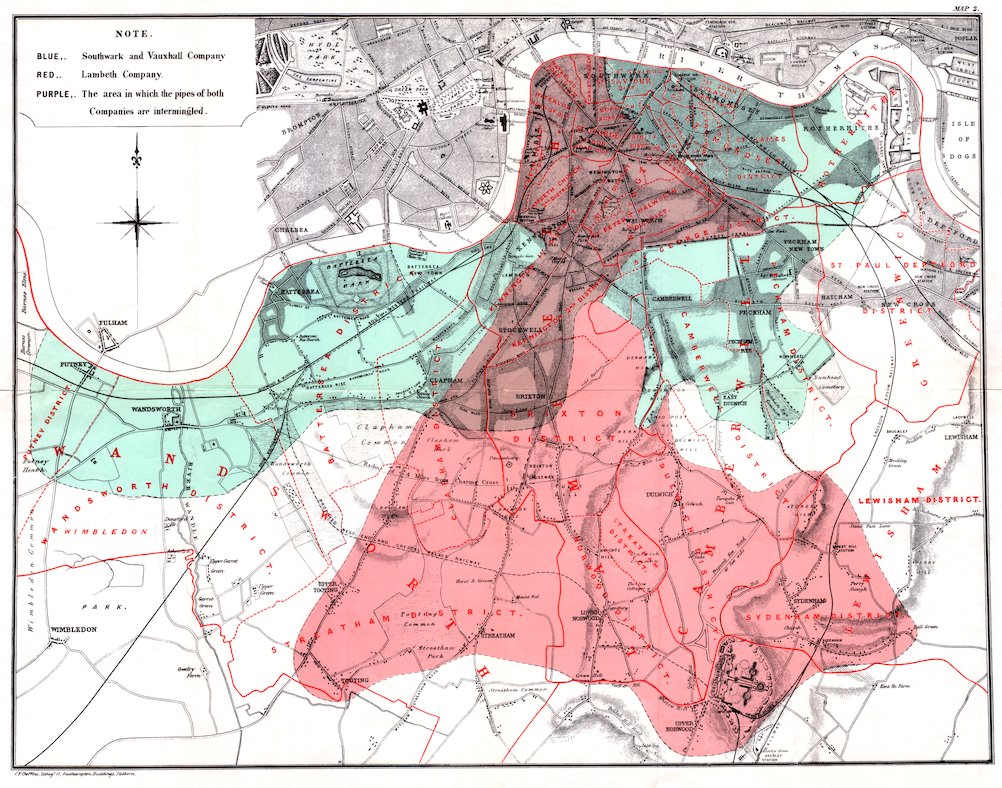
MAP 2.
THE NEW WATER SUPPLY OF THE LAMBETH COMPANY.
75Although the facts shown in the above table afford very strong evidence of the powerful influence which the drinking of water containing the sewage of a town exerts over the spread of cholera, when that disease is present, yet the question does not end here; for the intermixing of the water supply of the Southwark and Vauxhall Company with that of the Lambeth Company, over an extensive part of London, admitted of the subject being sifted in such a way as to yield the most incontrovertible proof on one side or the other. In the sub-districts enumerated in the above table as being supplied by both Companies, the mixing of the supply is of the most intimate kind. The pipes of each Company go down all the streets, and into nearly all the courts and alleys. A few houses are supplied by one Company and a few by the other, according to the decision of the owner or occupier at that time when the Water Companies were in active competition. In many cases a single house has a supply different from that on either side. Each Company supplies both rich and poor, both large houses and small; there is no difference either in the condition or occupation of the persons receiving the water of the different Companies. Now it must be evident that, if the diminution of cholera, in the districts partly supplied with the improved water, depended on this supply, the houses receiving it would be the houses enjoying the whole benefit of the diminution of the malady, whilst the houses supplied with the water from Battersea Fields would suffer the same mortality as they would if the improved supply did not exist at all. As there is no difference whatever, either in the houses or the people receiving the supply of the two Water Companies, or in any of the physical conditions with which they are surrounded, it is obvious that no experiment could have been devised which would more thoroughly test the effect of water supply on the progress of cholera than this, which circumstances placed ready made before the observer.
The experiment, too, was on the grandest scale. No fewer than three hundred thousand people of both sexes, of every age and occupation, and of every rank and station, from gentlefolks down to the very poor, were divided into two groups without their choice, and, in most cases, without their knowledge; one group being supplied with water containing the sewage of London, and, amongst it, whatever might have come from the cholera patients, the other group having water quite free from such impurity.
EPIDEMIC OF 1854, IN THE SOUTH DISTRICTS OF LONDON.
To turn this grand experiment to account, all that was required was to learn the supply of water to each individual house where a fatal attack of cholera might occur. I regret that, in the short days at the latter part of last 76year, I could not spare the time to make the inquiry; and, indeed, I was not fully aware, at that time, of the very intimate mixture of the supply of the two Water Companies, and the consequently important nature of the desired inquiry.
When the cholera returned to London in July of the present year, however, I resolved to spare no exertion which might be necessary to ascertain the exact effect of the water supply on the progress of the epidemic, in the places where all the circumstances were so happily adapted for the inquiry. I was desirous of making the investigation myself, in order that I might have the most satisfactory proof of the truth or fallacy of the doctrine which I had been advocating for five years. I had no reason to doubt the correctness of the conclusions I had drawn from the great number of facts already in my possession, but I felt that the circumstance of the cholera poison passing down the sewers into a great river, and being distributed through miles of pipes, and yet producing its specific effects, was a fact of so startling a nature, and of so vast importance to the community, that it could not be too rigidly examined, or established on too firm a basis.
I accordingly asked permission at the General Register Office to be supplied with the addresses of persons dying of cholera, in those districts where the supply of the two Companies is intermingled in the manner I have stated above. Some of these addresses were published in the “Weekly Returns,” and I was kindly permitted to take a copy of others. I commenced my inquiry about the middle of August with two sub-districts of Lambeth, called Kennington, first part, and Kennington, second part. There were forty-four deaths in these sub-districts down to 12th August, and I found that thirty-eight of the houses in which these deaths occurred were supplied with 77water by the Southwark and Vauxhall Company, four houses were supplied by the Lambeth Company, and two had pump-wells on the premises and no supply from either of the Companies.
As soon as I had ascertained these particulars I communicated them to Dr. Farr, who was much struck with the result, and at his suggestion the Registrars of all the south districts of London were requested to make a return of the water supply of the house in which the attack took place, in all cases of death from cholera. This order was to take place after the 26th August, and I resolved to carry my inquiry down to that date, so that the facts might be ascertained for the whole course of the epidemic. I pursued my inquiry over the various other sub-districts of Lambeth, Southwark, and Newington, where the supply of the two Water Companies is intermixed, with a result very similar to that already given, as will be seen further on. In cases where persons had been removed to a workhouse or any other place, after the attack of cholera had commenced, I inquired the water supply of the house where the individuals were living when the attack took place.
The inquiry was necessarily attended with a good deal of trouble. There were very few instances in which I could at once get the information I required. Even when the water-rates are paid by the residents, they can seldom remember the name of the Water Company till they have looked for the receipt. In the case of working people who pay weekly rents, the rates are invariably paid by the landlord or his agent, who often lives at a distance, and the residents know nothing about the matter. It would, indeed, have been almost impossible for me to complete the inquiry, if I had not found that I could distinguish the water of the two companies with perfect 78certainty by a chemical test. The test I employed was founded on the great difference in the quantity of chloride of sodium contained in the two kinds of water, at the time I made the inquiry. On adding solution of nitrate of silver to a gallon of the water of the Lambeth Company, obtained at Thames Ditton, beyond the reach of the sewage of London, only 2·28 grains of chloride of silver were obtained, indicating the presence of ·95 grains of chloride of sodium in the water. On treating the water of the Southwark and Vauxhall Company in the same manner, 91 grains of chloride of silver were obtained, showing the presence of 37·9 grains of common salt per gallon. Indeed, the difference in appearance on adding nitrate of silver to the two kinds of water was so great, that they could be at once distinguished without any further trouble. Therefore when the resident could not give clear and conclusive evidence about the Water Company, I obtained some of the water in a small phial, and wrote the address on the cover, when I could examine it after coming home. The mere appearance of the water generally afforded a very good indication of its source, especially if it was observed as it came in, before it had entered the water-butt or cistern; and the time of its coming in also afforded some evidence of the kind of water, after I had ascertained the hours when the turncocks of both Companies visited any street. These points were, however, not relied on, except as corroborating more decisive proof, such as the chemical test, or the Company’s receipt for the rates.
A return had been made to Parliament of the entire number of houses supplied with water by each of the Water Companies, but as the number of houses which they supplied in particular districts was not stated, I found that it would be necessary to carry my inquiry into 79all the districts to which the supply of either Company extends, in order to show the full bearing of the facts brought out in those districts where the supply is intermingled. I inquired myself respecting every death from cholera in the districts to which the supply of the Lambeth Company extends, and I was fortunate enough to obtain the assistance of a medical man, Mr. John Joseph Whiting, L.A.C., to make inquiry in Bermondsey, Rotherhithe, Wandsworth, and certain other districts, which are supplied only by the Southwark and Vauxhall Company. Mr. Whiting took great pains with his part of the inquiry, which was to ascertain whether the houses in which the fatal attacks took place were supplied with the Company’s water, or from a pump-well, or some other source.
Mr. Whiting’s part of the investigation extended over the first four weeks of the epidemic, from 8th July to 5th August; and as inquiry was made respecting every death from cholera during this part of the epidemic, in all the districts to which the supply of either of the Water Companies extends, it may be well to consider this period first. There were three hundred and thirty-four deaths from cholera in these four weeks, in the districts to which the water supply of the Southwark and Vauxhall and the Lambeth Company extends. Of these it was ascertained, that in two hundred and eighty-six cases the house where the fatal attack of cholera took place was supplied with water by the Southwark and Vauxhall Company, and in only fourteen cases was the house supplied with the Lambeth Company’s water; in twenty-two cases the water was obtained by dipping a pail directly into the Thames, in four instances it was obtained from pump-wells, in four instances from ditches, and in four cases the source of supply was not ascertained, owing to the person being 80taken ill whilst travelling, or from some similar cause. The particulars of all the deaths which were caused by cholera in the first four weeks of the late epidemic, were published by the Registrar-General in the “Weekly Returns of Births and Deaths in London,” and I have had the three hundred and thirty-four above enumerated reprinted in an appendix to this edition, as a guarantee that the water supply was inquired into, and to afford any person who wishes it an opportunity of verifying the result. Any one who should make the inquiry must be careful to find the house where the attack took place, for in many streets there are several houses having the same number.
According to a return which was made to Parliament, the Southwark and Vauxhall Company supplied 40,046 houses from January 1st to December 31st, 1853, and the Lambeth Company supplied 26,107 houses during the same period; consequently, as 286 fatal attacks of cholera took place, in the first four weeks of the epidemic, in houses supplied by the former Company, and only 14 in houses supplied by the latter, the proportion of fatal attacks to each 10,000 houses was as follows. Southwark and Vauxhall 71. Lambeth 5. The cholera was therefore fourteen times as fatal at this period, amongst persons having the impure water of the Southwark and Vauxhall Company, as amongst those having the purer water from Thames Ditton.
It is extremely worthy of remark, that whilst only five hundred and sixty-three deaths from cholera occurred in the whole of the metropolis, in the four weeks ending 5th August, more than one half of them took place amongst the customers of the Southwark and Vauxhall Company, and a great portion of the remaining deaths were those of mariners and persons employed amongst the shipping in 81the Thames, who almost invariably draw their drinking water direct from the river.
It may, indeed, be confidently asserted, that if the Southwark and Vauxhall Water Company had been able to use the same expedition as the Lambeth Company in completing their new works, and obtaining water free from the contents of sewers, the late epidemic of cholera would have been confined in a great measure to persons employed among the shipping, and to poor people who get water by pailsful direct from the Thames or tidal ditches.
The number of houses in London at the time of the last census was 327,391. If the houses supplied with water by the Southwark and Vauxhall Company, and the deaths from cholera occurring in these houses, be deducted, we shall have in the remainder of London 287,345 houses, in which 277 deaths from cholera took place in the first four weeks of the epidemic. This is at the rate of nine deaths to each 10,000. But the houses supplied with water by the Lambeth Company only suffered a mortality of five in each 10,000 at this period; it follows, therefore, that these houses, although intimately mixed with those of the Southwark and Vauxhall Company, in which so great a proportional mortality occurred, did not suffer even so much as the rest of London which was not so situated.
In the beginning of the late epidemic of cholera in London, the Thames water seems to have been the great means of its diffusion, either through the pipes of the Southwark and Vauxhall Company, or more directly by dipping a pail in the river. Cholera was prevailing in the Baltic Fleet in the early part of summer, and the following passage from the “Weekly Returns” of the Registrar-General shows that the disease was probably imported thence to the Thames.
82“Bermondsey, St. James. At 10, Marine Street, on 25th July, a mate mariner, aged 34 years, Asiatic cholera 101 hours, after premonitory diarrhœa 16¹⁄₂ hours. The medical attendant states: ‘This patient was the chief mate to a steam-vessel taking stores to and bringing home invalids from the Baltic Fleet. Three weeks ago he brought home in his cabin the soiled linen of an officer who had been ill. The linen was washed and returned.’”
The time when this steam-vessel arrived in the Thames with the soiled linen on board, was a few days before the first cases of cholera appeared in London, and these first cases were chiefly amongst persons connected with the shipping in the river. It is not improbable therefore that a few simple precautions, with respect to the communications with the Baltic Fleet, might have saved London from the cholera this year, or at all events greatly retarded its appearance.
As the epidemic advanced, the disproportion between the number of cases in houses supplied by the Southwark and Vauxhall Company and those supplied by the Lambeth Company, became not quite so great, although it continued very striking. In the beginning of the epidemic the cases appear to have been almost altogether produced through the agency of the Thames water obtained amongst the sewers; and the small number of cases occurring in houses not so supplied, might be accounted for by the fact of persons not keeping always at home and taking all their meals in the houses in which they live; but as the epidemic advanced it would necessarily spread amongst the customers of the Lambeth Company, as in parts of London where the water was not in fault, by all the usual means of its communication. The two subjoined tables, VII and VIII, show the number of fatal attacks in houses supplied respectively by the two Companies, in all 83the sub-districts to which their water extends. The cases in table VII, are again included in the larger number which appear in the next table. The sub-districts are arranged in three groups, as they were in table VI, illustrating the epidemic of 1853.
In table VIII, showing the mortality in the first seven weeks of the epidemic, the water supply is the result of my own personal inquiry, in every case, in all the sub-districts to which the supply of the Lambeth Company extends; but in some of the sub-districts supplied only by the Southwark and Vauxhall Company, the inquiry of Mr. Whiting having extended only to 5th August, the water supply of the last three weeks is calculated to have been in the same proportion by the Company, or by pump wells, etc., as in the first four weeks,—a calculation which is perfectly fair, and must be very near the truth. The sub-districts in which the supply is partly founded on computation, are marked with an asterisk.
The numbers in table VIII differ a very little from those of the table I communicated to the Medical Times and Gazette of 7th October, on account of the water supply having since been ascertained in some cases in which I did not then know it. The small number of instances in which the water supply remains unascertained are chiefly those of persons taken into a workhouse without their address being known.
84 TABLE VII.
The mortality from Cholera in the four weeks ending 5th August.
Sub-Districts. Population in 1851. Deaths from in the four weeks ending 5th August. Water Supply.
Southwark & Vauxhall. Lambeth. Pump-wells. River Thames, ditches, etc. Unascertained.
St. Saviour, Southwark 19,709 26 24 2
St. Olave, Southwark 8,015 19 15 2 2
St. John, Horsleydown 11,360 18 17 1
St. James, Bermondsey 18,899 29 23 6
St. Mary Magdalen 13,934 20 19 1
Leather Market 15,295 23 23
Rotherhithe 17,805 26 17 9
Battersea 10,560 13 10 1 2
Wandsworth 9,611 2 2
Putney 5,280 1 1
Camberwell 17,742 19 19
Peckham 19,444 4 4
Christchurch, Southwk. 16,022 3 2 1
Kent Road 18,126 8 7 1
Borough Road 15,862 21 20 1
London Road 17,836 9 5 4
Trinity, Newington 20,922 14 14
St. Peter, Walworth 29,861 20 20
St. Mary, Newington 14,033 5 5
Waterloo Road (1st) 14,088 5 5
Waterloo Road (2nd) 18,348 5 5
Lambeth Church (1st) 18,409 5 2 1 1 1
Lambeth Church (2nd) 26,784 10 7 2 1
Kennington (1st) 24,261 11 9 1 1
Kennington (2nd) 18,848 3 3
Brixton 14,610 1 1
Clapham 16,290 5 4 1
St. George, Camberwell 15,849 9 7 2
Norwood 3,977
Streatham 9,023
Dulwich 1,632
Sydenham 4,501
486,936 334 286 14 4 26 4
85 TABLE VIII.
Mortality from Cholera in the seven weeks ending 26th August.
Sub-Districts. Population in 1851. Deaths from Cholera in the seven weeks ending 26th August. Water Supply.
Southwark & Vauxhall. Lambeth. Pump-wells. River Thames, ditches, etc. Unascertained.
*St. Saviour, Southwark 19,709 125 115 10
*St. Olave, Southwark 8,015 53 43 5 5
*St. John, Horsleydown 11,360 51 48 3
*St. James, Bermondsey 18,899 123 102 21
*St. Mary Magdalen 13,934 87 83 4
*Leather Market 15,295 81 81
*Rotherhithe 17,805 103 68 35
*Battersea 10,560 54 42 4 8
Wandsworth 9,611 11 1 2 8
Putney 5,280 1 1
*Camberwell 17,742 96 96
*Peckham 19,444 59 59
Christchurch, Southwk. 16,022 25 11 13 1
Kent Road 18,126 57 52 5
Borough Road 15,862 71 61 7 3
London Road 17,836 29 21 8
Trinity, Newington 20,922 58 52 6
St. Peter, Walworth 29,861 90 84 4 2
St. Mary, Newington 14,033 21 19 1 1
Waterloo Road (1st) 14,088 10 9 1
Waterloo Road (2nd) 18,348 36 25 8 1 2
Lambeth Church (1st) 18,409 18 6 9 1 2
Lambeth Church (2nd) 26,748 53 34 13 1 5
Kennington (1st) 24,261 71 63 5 3
Kennington (2nd) 18,848 38 34 3 1
Brixton 14,610 9 5 2 2
*Clapham 16,290 24 19 5
St. George, Camberwell 15,849 42 30 9 2 1
Norwood 3,977 8 2 1 5
Streatham 9,023 6 1 5
Dulwich 1,632
Sydenham 4,501 4 1 2 1
486,936 1514 1263 98 29 102 22
86The following is the proportion of deaths to 10,000 houses, during the first seven weeks of the epidemic, in the population supplied by the Southwark and Vauxhall Company, in that supplied by the Lambeth Company, and in the rest of London.
TABLE IX.
Number of houses. Deaths from Cholera. Deaths in each 10,000 houses.
Southwark and Vauxhall Company 40,046 1,263 315
Lambeth Company 26,107 98 37
Rest of London 256,423 1,422 59
The mortality in the houses supplied by the Southwark and Vauxhall Company was therefore between eight and nine times as great as in the houses supplied by the Lambeth Company; and it will be remarked that the customers of the Lambeth Company continued to enjoy an immunity from cholera greater than the rest of London which is not mixed up as they are with the houses supplied by the Southwark and Vauxhall Company.
As regards the period of the epidemic subsequent to the 26th August to which my inquiry extended, I have stated that the Registrar-General requested the District Registrars to make a return of the water supply of the house of attack in all cases of death from cholera. Owing to difficulties such as I explained that I had met with in the beginning of my inquiry, the Registrars could not make the return in all cases, and as they could not be expected to seek out the landlord or his agent, or to apply chemical tests to the water as I had done, the water supply remained unascertained in a number of cases, but 87the numbers may undoubtedly be considered to show the correct proportions as far as they extend, and they agree entirely with the results of my inquiry respecting the earlier part of the epidemic given above.
The Registrar-General published the returns of the water supply, which he had obtained from the District Registrars, down to 14th October, in a table which is subjoined. As the whole of the south districts of London were included in the inquiry of the Registrar-General, the deaths in the Greenwich and Lewisham districts, which are supplied by the Kent Water Company, and did not enter into my inquiry, are included in the table, but they do not in the least affect the numbers connected with the other companies.
TABLE X.
Week ending. Deaths from Cholera. Water Supply.
Southwk. and Vauxhall. Lambeth. Kent Company. Pumps, and other sources. Not ascertained.
September 2. 670 399 45 38 72 116
„ 9. 972 580 72 45 62 213
„ 16. 856 524 66 48 44 174
„ 23. 724 432 72 28 62 130
„ 30. 383 228 25 19 24 87
October 7. 200 121 14 10 9 46
„ 14. 115 69 8 3 6 29
3920 2353 302 191 279 795
Now 2,353 deaths in 40,046 houses, the number supplied by the Southwark and Vauxhall Company, are 537 deaths to each 10,000 houses; and 302 deaths to 26,107, the number of houses supplied by the Lambeth Company, are 115 deaths to each 10,000 houses; consequently, in 88the second seven weeks of the epidemic, the population supplied by the Southwark and Vauxhall Company continued to suffer nearly five times the mortality of that supplied with water by the Lambeth Company. If the 795 deaths in which the water supply was not ascertained be distributed equally over the other sources of supply in the above table (No. X), the deaths in houses supplied by the Southwark and Vauxhall Company would be 2,830, and in houses supplied by the Lambeth Company would be 363. By adding the number of deaths which occurred in the first seven weeks of the epidemic, we get the numbers in the subjoined table (No. XI), where the population of the houses supplied by the two water companies is that estimated by the Registrar-General.[16]
TABLE XI.
Population in 1851. Deaths by Cholera in 14 wks. ending Oct 14. Deaths in 10,000 living.
London 2,362,236 10,367 43
West Districts 376,427 1,992 53
North Districts 490,396 735 14
Central Districts 393,256 612 15
East Districts 485,522 1,461 30
South Districts 616,635 5,567 90
Houses supplied by Southwark and Vauxhall Company 266,516 4,093 153
Houses supplied by Lambeth Company 173,748 461 26
We see by the above table that the houses supplied with the water from Thames Ditton, by the Lambeth 89Company, continued throughout the epidemic to enjoy an immunity from cholera, not only greater than London at large, but greater than every group of districts, except the north and central groups.
In the next table (No. XII), the mortality from cholera in 1849 is shown side by side with that of 1854, in the various sub-districts to which the supply of the two water companies with which we are particularly interested extends. The mortality of 1854 is down to October 21, and is extracted from a table published in the “Weekly Return of Births and Deaths” of October 28; that of 1849 is from the “Report on Cholera” by Dr. Farr, previously quoted. The sub-districts are arranged in three groups as before, the first group being supplied only by the Southwark and Vauxhall Company, the second group by this Company and the Lambeth, and the third group by the Lambeth Company only. It is necessary to observe, however, that the supply of the Lambeth Company has been extended to Streatham, Norwood, and Sydenham, since 1849, in which year these places were not supplied by any water company. The situation and extent of the various sub-districts are shown, together with the nature of the water supply, in Map 2, which accompanies this work.
90TABLE XII.
Sub-Districts. Deaths from Cholera in 1849. Deaths from Cholera in 1854. Water Supply.
St. Saviour, Southwark 283 371 Southwark & Vauxhall Company only.
St. Olave 157 161
St. John, Horsleydown 192 148
St. James, Bermondsey 249 362
St. Mary Magdalen 259 244
Leather Market 226 237
Rotherhithe[17] 352 282
Wandsworth 97 59
Battersea 111 171
Putney 8 9
Camberwell 235 240
Peckham 92 174
Christchurch, Southwark 256 113 Lambeth Company, and Southwark and Vauxhall Compy.
Kent Road 267 174
Borough Road 312 270
London Road 257 93
Trinity, Newington 318 210
St. Peter, Walworth 446 388
St. Mary, Newington 143 92
Waterloo Road (1st) 193 58
Waterloo Road (2nd) 243 117
Lambeth Church (1st) 215 49
Lambeth Church (2nd) 544 193
Kennington (1st) 187 303
Kennington (2nd) 153 142
Brixton 81 48
Clapham 114 165
St. George, Camberwell 176 132
Norwood 2 10 Lambeth Company only.
Streatham 154 15
Dulwich 1
Sydenham 5 12
First 12 sub-districts 2261 2458 Southwk. & Vauxhall.
Next 16 sub-districts 3905 2547 Both Companies.
Last 4 sub-districts 162 37 Lambeth Company.
THE CHOLERA OF 1849 COMPARED WITH THAT OF 1854.
91The table exhibits an increase of mortality in 1854 as compared with 1849, in the sub-districts supplied by the Southwark and Vauxhall Company only, whilst there is a considerable diminution of mortality in the sub-districts partly supplied by the Lambeth Company. In certain sub-districts, where I know that the supply of the Lambeth Water Company is more general than elsewhere, as Christchurch, London Road, Waterloo Road 1st, and Lambeth Church 1st, the decrease of mortality in 1854 as compared with 1849 is greatest, as might be expected. Waterloo Road 1st, which suffered but little from cholera in the present year, is chiefly composed of very dirty narrow streets, in the neighbourhood of Cornwall Road and the New Cut, inhabited by very poor people; and Lambeth Church 1st, which suffered still less, contains a number of skinyards and other factories, between Lambeth Palace and Vauxhall Bridge, which have often been inveighed against as promoting the cholera. The high mortality of the Streatham district in 1849 was caused by the outbreak of cholera in Drouett’s Asylum for pauper children, previously mentioned.
Whilst making inquiries in the south districts of London, I learned some circumstances with respect to the workhouses which deserve to be noticed. In Newington Workhouse, containing 650 inmates, and supplied with the water from Thames Ditton, there had been but two deaths from cholera amongst the inmates down to 21st September, when the epidemic had already greatly declined. In Lambeth Workhouse, containing, if I remember rightly, nearly 1,000 inmates, and supplied with the same water, there had been but one death amongst the inmates when I was there in the first week of September. In St. Saviour’s workhouse, which is situated in the parish of Christchurch, and is supplied with water by the Lambeth Company, no inmate died of cholera before I called in the first week of September. On the other hand, in the workhouse of St. George, Southwark, supplied with the water of the Southwark and Vauxhall Company, six inmates died out of about 600 before the 26th August, when the epidemic had only run one-third of its course. The mortality was also high amongst the inmates of St. Olave’s Workhouse, supplied with water by the Southwark and Vauxhall Company, but I do not know the number who died. I trust, however, that the Registrar
HORSEMONGER LANE GAOL.
92General, in giving an account of the recent epidemic, will make a return of the deaths amongst the inmates of the various workhouses and other institutions on the south side of the Thames, together with the water supply of the buildings. Bethlehem Hospital, the Queen’s Prison, Horsemonger Lane Gaol, and some other institutions, having deep wells on the premises, scarcely suffered at all from cholera in 1849, and there was no death in any of them during the part of the recent epidemic to which my inquiry extended.
DISTRICT OF CHELSEA WATER COMPANY.
On the north side of the Thames the mortality during the recent epidemic seems to have been influenced more by the relative crowding and want of cleanly habits of the people, and by the accidental contamination of the pump-wells, than by the supply of the water companies. The water of the New River Company could have no share in the propagation of cholera, as I explained when treating of the epidemic of 1849; and the extensive districts supplied by this company have been very slightly visited by the disease, except in certain spots which were influenced by the causes above mentioned. The water of the East London Company is also free from the contents of sewers, unless it be those from the neighbourhood of Upper Clapton, where there has been very little cholera. The districts supplied by this company have been lightly visited, except such as lie near the Thames, and are inhabited by mariners, coal and ballast-heavers, and others, who are employed on the river. Even Bethnal Green and Spitalfields, so notorious for their poverty and squalor, have suffered a mortality much below the average of the metropolis. The Grand Junction Company obtain their supply at Brentford, within the reach of the tide and near a large population, but they detain the water in large reservoirs, and their officers tell me they filter it; at all 93events, they supply it in as pure a state as that of the Lambeth Company obtained at Thames Ditton, and their districts have suffered very little from cholera except at the spot where the irruption occurred from the contamination of the pump-well in Broad Street, Golden Square. The West Middlesex Company, obtaining their supply from the Thames at Hammersmith, have also very large reservoirs, and the districts they supply have suffered but little from cholera, except the Kensington brick fields, Starch Green, and certain other spots, crowded with poor people, chiefly Irish.
CHOLERA IN THE DISTRICT OF THE CHELSEA WATER COMPANY.
The districts supplied by the Chelsea Company have suffered a much greater mortality, during the recent epidemic, than the average of the whole metropolis, as the subjoined table (No. XIII) shows. But the mortality in these districts is only half as great as in the houses supplied by the Southwark and Vauxhall Company, who obtain their supply from the Thames just opposite the spot where the Chelsea Company obtain theirs. The latter company, however, by detaining the water in their reservoirs, and by filtering it, are enabled to distribute it in a state of comparative purity; but I had ample opportunities of observing, in August and September last, that this was far from being the state of the water supplied by the Southwark and Vauxhall Company. Many of the people receiving this latter supply were in the habit of tying a piece of linen or some other fabric over the tap by which the water entered the butt or cistern, and in two hours, as the water came in, about a tablespoon of dirt was collected, all in motion with a variety of water insects, whilst the strained water was far from being clear. The contents of the strainer were shown to me in scores of instances. I do not, of course, attribute the cholera either to the insects or the visible dirt; but it is extremely probable that the measures adopted by the Chelsea Company 94to free the water from these repulsive ingredients, either separated or caused the destruction of the morbid matter of cholera. It is very likely that the detention of the water in the company’s reservoirs permitted the decomposition of the cholera poison, and was more beneficial than the filtering, for the following reasons. The water used in Millbank Prison, obtained from the Thames at Millbank, was filtered through sand and charcoal till it looked as clear as that of the Chelsea Company; yet, in every epidemic, the inmates of this prison suffered much more from cholera than the inhabitants of the neighbouring streets and those of Tothill Fields Prison, supplied by that company.[18] In the early part of August last, the use of the Thames water was entirely discontinued in Millbank Prison, and water from the Artesian well in Trafalgar Square was used instead, on the recommendation of Dr. Baly, the physician to the prison. In three or four days after this change, the cholera, which was prevailing to an alarming extent, entirely ceased.
TABLE XIII.
Population in 1851. Deaths by Cholera
In 15 wks. ending October 21. To every 10,000 living.
Chelsea, south 19,050 122 64
Chelsea, north-west 17,669 99 56
Chelsea, north-east 19,819 71 36
Belgrave 40,034 238 59
St. John, Westminster 34,295 173 50
St. Margaret, Westminster 31,314 238 76
Total of districts supplied by the Chelsea Water Company 162,181 941 56
Houses supplied by the Southwark and Vauxhall Company 266,516 2,900 108
London 2,362,236 10,530 45
London, except the houses supplied by the Chelsea Company, and by the Southwark & Vauxhall Compy. 1,933,539 6,689 34
95The quantity of impurity in the Thames was greatly increased during the late autumn, by the long course of dry weather. From 5th August to 12th September, a period of more than five weeks, only 0·29 of an inch of rain fell at Greenwich, as appears by the report of the Astronomer Royal. The stream of the Thames above the reach of the tide became so slender, that it was difficult to navigate barges above Richmond. The Thames in London is a very large body of water, and if the whole of it flowed away into the sea every day, the liquid which flows down the sewers in twelve hours would form but a very small part of it; but it must be remembered that the quantity of water which passes out to sea, with the ebb of every tide, is only equal to that which flows over Teddington Lock, and from a few small tributary streams. In hot dry weather this quantity is moreover greatly diminished by the evaporation taking place from the immense surface of water exposed between Richmond and Gravesend, so that the river becomes a kind of prolonged lake, the same water passing twice a day to and fro through London, and receiving the excrement of its two millions and more of inhabitants, which keeps accumulating till there is a fall of rain. In time of cholera, the evacuations of the patients keep accumulating in the river along with the other impurities; and it is probably in this way that the dry weather with a high barometer aids in promoting cholera, as it has often been observed to do.
IMPURITY OF THE THAMES.
I thought at first that the quantity of common salt, previously 96mentioned as being present in the water of the Southwark and Vauxhall Company, consisted entirely of the salt which had passed down the sewers into the river, for I had no idea that any admixture of sea water reached as high as Battersea Fields. Mr. Quick, the engineer of the above Company, informed me, however, that an impregnation of salt water does extend as far after a long course of dry weather. It is obvious that a dry season, whilst it increases the quantity of impurity in the Thames, must also cause the sea water to flow further inland than at other times. I did not examine the water of the Thames in August or September, but I have done so now, at the latter part of November, and I am inclined to think that even yet a slight admixture of sea water may reach to Battersea Fields with every tide. I found 5·8 grains of chloride of sodium per gallon in water obtained at Hungerford Market, at half-flow of the tide, on 19th November, and 19·1 grains per gallon, in water obtained at the same place, on 27th November, at an hour and a half before high water; whilst water obtained at London Bridge, on 28th November, at high water, contained 63·3 grains per gallon.
A specimen of water obtained on 21st November, from a house supplied by the Southwark and Vauxhall Company, contained 28·8 grains of common salt per gallon, or about three-quarters as much as it contained in September, when the quantity was 37·9 grains. It is very obvious from the above analyses, that the Water Company obtain their supply from the Thames at high water, or nearly so, although this is the time of the tide when the water contains the greatest amount of impurity. It is quite certain that the sea water cannot reach to Thames Ditton, any more than the contents of the London sewers, and therefore, whatever may be its source, the 97quantity of chloride of sodium in the water is quite conclusive as regards the purpose for which I examined into it, viz., to distinguish between the water of the two Companies.
When the water of the Southwark and Vauxhall Company was examined by Messrs. Graham, Miller, and Hofmann, at the latter part of January 1851, it contained only 1·99 grains of chloride of sodium, or about one-twentieth as much as it contained last September, and one-fifteenth as much as on 21st November 1854.[19]
ALLEGED EFFECT OF LEVEL.
Dr. Farr discovered a remarkable coincidence between the mortality from cholera in the different districts of London in 1849, and the elevation of the ground; the connection being of an inverse kind, the higher districts suffering least, and the lowest suffering most from this malady. Dr. Farr was inclined to think that the level of the soil had some direct influence over the prevalence of cholera, but the fact of the most elevated towns in this kingdom, as Wolverhampton, Dowlais, Merthyr Tydvil, and Newcastle-upon-Tyne, having suffered excessively from this disease on several occasions, is opposed to this view, as is also the circumstance of Bethlehem Hospital, the Queen’s Prison, Horsemonger Lane Gaol, and several other large buildings, which are supplied with water from deep wells on the premises, having nearly or altogether escaped cholera, though situated on a very low level, and surrounded by the disease. The fact of Brixton, at an elevation fifty-six feet above Trinity high-water mark, having suffered a mortality of 55 in 10,000, whilst many districts on the north of the Thames, at less than half the 98elevation, did not suffer one-third as much, also points to the same conclusion.
I expressed the opinion in 1849,[20] that the increased prevalence of cholera in the low-lying districts of London depended entirely on the greater contamination of the water in these districts, and the comparative immunity from this disease of the population receiving the improved water from Thames Ditton, during the epidemics of last year and the present, as shown in the previous pages, entirely confirms this view of the subject; for the great bulk of this population live in the lowest districts of the metropolis.
The prevalence of cholera has been very much under the influence of the water supply in other towns besides London. The cholera has prevailed to a considerable extent in the crowded habitations of the poor in Liverpool and some other towns, where the general supply of water was not in fault, but I know of no instance in which it has spread through all classes of the community, except where the general supply of water has been contaminated with the contents of the drains and sewers; and all the towns with which I am acquainted that have enjoyed an almost complete immunity from this disease, have a water supply quite free from any chance of contamination. Birmingham, Bath, Cheltenham, and Leicester have nearly escaped the cholera in every epidemic. The few cases that have occurred being chiefly those of persons newly arrived from places where the disease was prevailing, and a few others who came in communication with them. All these towns have a supply of water quite free from connection with the drains and sewers, and the small rivers which flow through them are so impure that it would be 99impossible to drink the water. Leicester is crowded with a poor population, and has hardly any physical advantage except its water supply.
CHOLERA IN EXETER.
The first cases of cholera in Exeter in 1832, were three in the same day, besides one in St. Thomas’s, a suburb of Exeter, in a gentleman just arrived from London, where the disease was prevailing. The other three were a woman and her two children; the former, with one of her children, had returned from Plymouth the previous day, where she had been nursing a child that had died of the cholera. Within five days from this time, there were seven fresh cases in as many different parts of the town, amongst persons having no intercourse with each other or the first cases. The disease soon became very prevalent, and in three months there were 1,135 cases, and 345 deaths. Exeter is situated on ground which rises from the edge of the river to an elevation of one hundred and fifty feet. In 1832 the inhabitants were chiefly supplied with river water by water-carriers, who conveyed it in carts and pails. Dr. Shapter, from whose work[21] the above particulars are obtained, kindly furnished me with information concerning the sewers, and with maps of their position. The water-carriers, by whom Exeter was very greatly supplied, obtained their water almost exclusively from certain streams of water, diverted from the river in order to turn water-mills; and one of the chief sewers of the town, which receives such sewage as might come from North Street, in which the first cases of cholera occurred, empties itself into the branch from the river which divides into the two mill-streams just mentioned. It must be remarked that the parish of St. Edmund, in which these streams of water were situated, had a lower mortality from cholera than other parts of the 100town like it, densely populated and on low ground near the river. Dr. Shapter attributes this lower rate of mortality, and I believe rightly, to St. Edmund’s being freely intersected by running streams of water. The people would probably not drink more of the water than in parts of the town where it was less plentiful, and had to be paid for, but they would have much better opportunities for personal cleanliness: so that whilst they would be exposed to only the same number of scattered cases, they would be less likely to have the malady spreading through families, and by personal intercourse. After the cholera of 1832, measures were taken to afford a better supply of water to Exeter; not, so far as I can find by Dr. Shapter’s work, that its impurity was complained of, but because of its scarcity and cost. Waterworks were established on the river Exe, two miles above the town, and more than two miles above the influence of the tide. Exeter has since been very plentifully supplied with this water, and Dr. Shapter informed me that in 1849 there were only about twenty cases of cholera, nearly half of which occurred in strangers coming into the town, and dying within two or three days after their arrival. This last summer there was only one death from cholera in Exeter.
CHOLERA IN HULL.
We will now consider the town of Hull, in which, together with other sanitary measures adopted since 1832, there has been a new and more plentiful supply of water, but with a far different result to that at Exeter. In 1832 Hull was scantily supplied with water conveyed in pipes from springs at Anlaby, three miles from the town. About 1844, new waterworks were established to afford a more plentiful supply. These works were situated on the river Hull, at Stoneferry, two miles and three quarters from the confluence of that river with the Humber. About half the sewage of the town is delivered into the 101river of the same name, the rest being discharged into the Humber, as appears from information and a map kindly furnished me in 1849 by Dr. Horner of Hull, who was making great efforts to have better water obtained for the town. The tide flows up the river many miles past the waterworks, carrying up with it the filth from the sewers. The supply of water was, to be sure, obtained when the tide was down, but as the banks of the river are clothed with sedges in many parts, and its bottom deep with mud, the water can never be free from sewage. Moreover, there are some parts of the river above Stoneferry much deeper than the rest, and where the deeper water is, according to the testimony of boatmen, nearly stagnant; thus allowing the water carried up by the tide to remain and gradually mix with that afterwards flowing down. There are also boats, with families on board, passing up the river to the extent of five thousand voyages in the year. The water when taken from the river was allowed to settle in the reservoir for twenty-four hours, and was then said to be filtered before being sent to the town. In 1832 the cholera was confined almost exclusively to the poor, and the deaths amounted to three hundred.
In 1849 the deaths in Hull (including the suburb of Sculcoates) were 1834, although 8,000 or 10,000 left the town, it is said, to avoid the ravages of the disease. Dr. Horner informed me that the deaths occurred amongst all classes of the community, and that the town was much better drained in 1849 than in 1832.
CHOLERA IN YORK.
When the cholera made its appearance at York, about the middle of July 1849, it was at first chiefly prevalent in some narrow streets near the river, called the Water Lanes. The inhabitants of this spot had been in the habit, from time immemorial, of fetching their water from the river at a place near which one of the chief sewers of 102the town empties itself; and recently a public necessary had been built, the contents of which were washed every morning into the river just above the spot at which they got the water. In a short time from twenty to thirty deaths occurred in this locality; but the medical men considering the impure water injurious, the people were supplied from the waterworks, with water obtained from the river at a point some distance above the town, and the cholera soon ceased nearly altogether in this part of the city, but continued to spread in some other parts. The cholera having thus abated in the Water Lanes, the gratuitous supply of water was cut off, and the people went to the river as before. There were still cases of cholera in the town, and it soon broke out again in this locality, and in the first few days of September eight deaths occurred among the persons who used water obtained direct from the river. The tap for general use was again opened, and the river water interdicted, and the cholera again ceased, and did not recur. These circumstances were communicated to me by a friend on whose accuracy I can rely.
The inhabitants of Dumfries drink the water of the river Nith, which flows through the town, and into which the sewers discharge their contents, which float afterwards to and fro with the tide. In 1832 there were 418 deaths from cholera out of a population of 11,606, being at the rate of 360 in 10,000, or 1 in every 28 of the inhabitants. The cholera again visited Dumfries at the close of 1848, and carried off 431 persons, or 1 in every 32, out of a population now numbering 14,000; so that the mortality was excessive on both occasions.
Preston and Oldham, in Lancashire, are supplied with water from surface drainage on the neighbouring hills, and there was scarcely any cholera at either of these 103places in 1849. The greater part of the town of Paisley is supplied in a similar way; and I was informed that the cases of cholera which occurred there in 1849 were confined to a quarter of the town to which this supply of water does not extend. Nottingham is supplied with filtered water obtained from the river Trent, some distance above the town. In 1832 this supply did not extend to all the inhabitants, and the cholera was somewhat prevalent amongst the poor, of whom it carried off 289; the population of the town being 53,000. After that time the water was extended copiously to all the inhabitants, and there were but thirteen deaths from the epidemic in 1849. The local Sanitary Committee placed the supply of water amongst the chief causes of this immunity from cholera, and I believe justly. There were but seven deaths from cholera in Nottingham last summer.
CHOLERA IN GLASGOW.
Glasgow has been supplied, since the early part of the present century, with the water of the Clyde, obtained a little way above the town, but within the influence of the tide, and consequently mixed with the contents of the sewers. It is imperfectly filtered through sand. In 1847, however, the parish of Gorbals, which forms the south part of Glasgow, was furnished with a supply of water collected on the neighbouring hills; and Dr. Leech, of Glasgow, speaks as follows respecting the influence of this water on the prevalence of cholera: “During the late cholera there was a remarkable circumstance, which deserves notice as compared with the epidemic of 1832. Since the former period, the population of Glasgow, south of the Clyde, has nearly doubled; and with this exception, and the introduction of the soft-water supply, the circumstances might be considered as the same at both periods. In one district, the parish of Gorbals, the attack in 1832 was fearful; while Glasgow, north of the Clyde, 104also suffered severely. During the late epidemic [that of 1848–49], Gorbals parish furnished comparatively a small number of cases; while the epidemic in other parts of Glasgow was very severe. The unanimous opinion of the Medical Society was, that this comparative immunity was to be attributed to the soft-water supply.”[22]
CHOLERA IN NEWCASTLE.
I was informed that when the cholera was prevalent in Glasgow last winter, the parish of Gorbals again enjoyed a similar immunity from the disease.
The following passage respecting the water supply of Paris is from Dr. Farr’s “Report to the Registrar-General on the Cholera of 1848–49”:—“The supply of Paris is from various sources, but four-fifths of the water is from the Canal de l’Ourque, which, by the decision of Napoleon, was also appropriated to navigation. The water for some years, and in 1832, when the epidemic was so fatal, was drawn from the dirty basin in which the boats and barges of the canals rested; but is now drawn from the canal before it enters the basin.... The mortality of cholera in Paris was excessive, and in 1832 varied from 80, of 10,000 inhabitants, in the elegant Chaussée d’Antin and in Montmartre on the heights, to 530 and 520 in the low quartiers of the Hôtel de Ville and the Cité.” (p. lxxviii.)
The town of Newcastle-upon-Tyne affords a remarkable instance of the influence of the water supply on the prevalence of cholera. In 1831–32 there were no waterworks at Newcastle; it was supplied, in an insufficient manner, with spring water, which generally had to be carried some distance to the houses from “pants” in the streets. The epidemic was pretty severe at this time. From November 1831 to November 1832 there were 801 deaths from cholera out of a population of 42,760. The disease prevailed 105chiefly amongst the poor, and was worst in the least elevated parts of the town, near the river. Subsequently to 1832, waterworks were established on the river Tyne, a little above the town; but these were abandoned, in 1848, in favour of a supply from a rivulet and springs at Whittle Dean, about ten miles distant. In 1849, there were but 295 deaths from cholera in a population then increased to 71,847. In the beginning of July 1853, two months before the reappearance of cholera in England, the Whittle Dean Water Company found their proper sources insufficient for the demands of the population and the various factories, and they made use of the former waterworks, mentioned above, to obtain water from the Tyne. The point at which they obtained water from the river, is scarcely a mile above Newcastle, and the tide flows for six miles above the town, carrying the contents of the sewers with it. There are also villages, containing several thousands of colliers and ironfounders, on the banks of the Tyne, above the waterworks. The water from the Tyne was mixed, without filtration, with that from Whittle Dean, to the extent of one-third; and the mixed water, so supplied, was discoloured, and contained the large quantity of 7·1 grains of organic matter per gallon.
In the autumn of 1853, the cholera was prevailing extensively at Hamburgh, and in nearly all the ports of the Baltic, whence a number of ships were arriving every day in the Tyne. The first cases of cholera commenced, with diarrhœa, on the 27th and 28th August, at Bell Quay, on the banks of the Tyne, three miles below Newcastle. One of the patients from Bell Quay was taken worse whilst on a visit to her mother at Newcastle: she died on 2nd September. Her mother was taken ill the same evening, and died on the following day. Other cases occurred in Newcastle on the 1st and 2nd of September, having no 106connexion with these. A ship from Bremen was lying at Bell Quay, opposite the house where the first cases occurred; but there had been no illness on board this ship, and the precise way in which the cholera was introduced on this occasion, is not known.
The disease soon spread to an extent almost unprecedented in this country: by the 15th of September the deaths exceeded a hundred a day. In nine weeks there were 1,533 deaths from cholera in a population of 86,114, being 178 to each 10,000 inhabitants; but the greater number of these deaths occurred in a few days, as 1001 took place from the 13th to the 23rd Sept. inclusive.[23]
Gateshead, which is situated opposite to Newcastle, on the other side of the Tyne, is supplied with the same water; and in 1849 it shared with that town a comparative immunity from cholera, whilst in the autumn of 1853, 433 persons died of that disease out of a population of 26,000, or thereabouts, being 166 to each 10,000 inhabitants.
The lowest streets in Newcastle and Gateshead are about five feet above high-water mark; and only a few streets are situated at this level, for the banks rise very abruptly, at a little distance from the river, on both sides. A great portion of each town is elevated nearly 200 feet above the river, and some parts are nearly 300 feet high; yet the Water Company supplies all these districts, and all were severely visited by the cholera, which on this occasion spared no class of the community. In the districts which are most crowded, the mortality was greatest, the deaths being much more numerous in the parishes which contained a great number of tenements consisting of a single room, than in those which consisted chiefly of houses 107occupied by one family.[24] This, however, is quite in accordance with the principles which I am throughout endeavouring to explain. A great deal of stress is laid, very properly, by the Commissioners who have reported respecting this outbreak, on the ill-arranged buildings, the defective drainage, and want of privy accommodation, in Newcastle; but it must be remembered that all these evils existed in 1849, when Newcastle escaped with less cholera than most towns,—to a greater extent than they did in 1853, for many improvements had taken place in the meantime.