CHAP. V. THE METHOD USED IN THE CULTIVATION OF THE IMPROVED BEET ROOT UPON STRONG LAND AT BEDFORDS.
Reading edition
It may be proper, in the first place, to state what is meant by strong land. The surface soil is loamy, and from 4 to 12 inches deep, upon a bed of strong clay mixed with gravel. It is too heavy, and generally too wet, in the winter, even for sheep to eat a crop of turnips on the ground; and although good turnips are grown upon it, it is always necessary 32to draw them for the sheep, stall-fed cattle, or for cattle in the yards. The ground is prepared to receive the seed, and cleaned in the same way as it would have been for Swedish turnips. As that part of the business is so well known to all farmers, it is not necessary to enter into detail upon it.
In the middle, or latter end of the month of April, the furrows are set out with the plough, 2 feet apart, and double ploughed; that is, the plough returns on the furrow to the point whence it set out, forming a ridge between each furrow.
33Double ploughing with a common plough is preferred to single ploughing with a double mould board plough, because it affords a greater depth of loose earth than the double mould board plough would produce.
In these furrows, the manure, which should be in a rotten state, is deposited, after the rate of six cubic yards to an acre.
The ridges are then split by the plough going and returning the same way as before mentioned, leaving the manure immediately under the middle of the new ridges, A light roller is 34then passed along the ridges, in the middle of which the seed is dibbled, so that the plants may receive all the benefit which can be derived from the manure.
The seed is deposited about an inch deep whilst the moisture is fresh in the earth, and covered by drawing a garden rake along the rows.
After this, the light roller is again passed along the ridges, and the work is finished.
When the plants are about the size of a radish, they are hoed with a turnip 35hoe, leaving the plants in the rows about 12 inches apart. If any of the seeds fail, and there happen not to be an even crop, the roots, where they are too thick, are drawn out before the hoeing takes place, and transplanted, to fill up the vacant places, and insure a full crop, which is always certain, inasmuch as 99 plants out of 100, thrive and do well. In transplanting, care is necessary to prevent the point of the root from turning upwards.
The weeds, whilst the plants are young, are kept hoed, but after the head of the plant has once spread, no weed can live underneath its shade, and 36the expence of hoeing afterwards is very trifling indeed.
The whole of the crop is taken up in the month of November, in dry weather. The tops are cut off near the crown of the plants, and the plants, when perfectly dry, are piled up in a shed, and covered with straw sufficiently thick to preserve them from the frost. They kept last year till the latter end of March, and they would have kept much longer.
The seed may be had of Cochran, seedsman, in Duke Street, Grosvenor Square; of Messrs. Gibbs and Co. 37Half Moon Street, Piccadilly; and of Mr. Mason, Fleet Street. From 3 to 4 pounds of the seed will be sufficient for an acre of ground, prepared and dibbled according to the method here stated. The price last year was 7s. per pound, but it may probably be less hereafter, as the growers of the root, so long as that high price continues, will of course save their own seed, and thereby lessen the demand from the seedsman.
38
THE METHOD BEFORE DESCRIBED ELUCIDATED.
Form of the ridges before manuring.
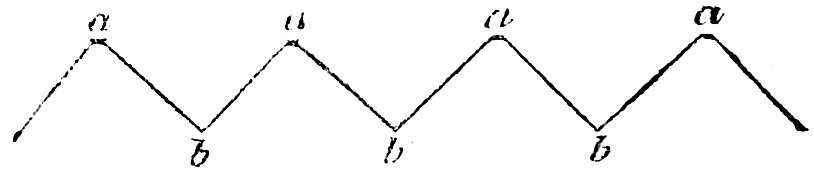
The tops of the ridges about 2 inches broad, a. a. a.
Intervals of 24 inches from one a to another.
Depths about 12 inches from a to b.
Furrows where the manure is deposited, b. b. b.
Form of the ridges after splitting and rolling.

Tops A. A. A. 9 inches broad, in the middle of which the seed is deposited.
Situation of the manure B. B. B.
39