Part 1 — SECTION II. ON FORCE, AND THE RELATIONS BETWEEN FORCE AND MATTER. (continued 2)
Reading edition
Sir David Brewster is of opinion that all the properties of double refraction and the gorgeous phenomena of polarization, whether by crystals or produced in various substances permanently or transiently by heat, cold, rapid cooling, compression, dilatation, and induration, 74are wholly the result of the forces by which the atoms are held together; but these phenomena may rather be said to depend upon a reciprocal action between an irregular molecular structure and the agency of light and heat: which indeed seems to be confirmed by the transit of these two forces through right and left-handed quartz, for there is no reason to believe that there is any difference in the form of the particles in these two crystalline substances.
The experiments of M. Becquerel show that electricity is a power which makes the atoms of matter aggregate in crystalline forms; for he has succeeded in forming crystals of gold, silver, cobalt, nickel, platinum, and a variety of the gems undistinguishable from those in nature, by exposing saturated solutions of these substances for a very long time to feeble voltaic electricity; and crystals of earthy matter have been obtained in the same manner. The electric and magnetic state of mineral veins in mines which contain a vast variety of crystals, metallic and non-metallic, strongly favours this view of the origin of crystalline form.
M. Regnault has proved that the ratio between the specific heat and the weight of the atoms of matter is intimately connected with the mode of their aggregation; and indeed if it be considered that the atoms have not only specific heat and weight, but specific affinity, electricity, magnetism, consequently polarity, and probably specific forms, these peculiar forces must necessarily influence the structure of crystals according as they combine with or oppose the natural or artificial forces acting upon them, or upon their dissimilar faces, and this may be the cause of the great variety of forms that matter appears under. Carbonate of lime alone assumes more than 1,200 different modifications of its primitive type, but whatever be the variety of forms which any one substance may take, they are found to 75be all compatible with and derivative from a common type. The circumstances which have caused dimorphous crystals to deviate from the general law have not yet been explained.
It is very singular that when chlorate of soda is dissolved in water the solution does not possess the property of circular polarization, but when evaporated and allowed to crystallise, some of the crystals turn light to the right, and others to the left. Now if all the crystals that have the same property be picked out and dissolved in water a second time, the liquid will still have no circular polarization, but when allowed to crystallise, some of the crystals make light revolve through them to the right and others to the left as before. From this it is supposed that the atoms of liquids, which are free to move in every direction, already possess part of the characters which the change to solidity renders evident and permanent.
Although the relations between the force of magnetism and the atoms of matter do not exhibit such brilliant phenomena as light does, they are nevertheless most interesting and wonderful. Mr. Faraday discovered that all substances, whether solid, liquid, or aëriform, are either magnetic like iron, or diamagnetic like bismuth, the latter being by far the most numerous. Thus if a bar of iron be freely suspended between the poles of an extremely powerful magnet or electro-magnet, it will be attracted by both poles and will rest or sit axially, that is, with its length between the poles or in the line of magnetic force; whereas an equal and similar bar of bismuth so suspended will be repelled by both poles and will rest or sit equatorially, that is with its length perpendicular to the line of magnetic force. Magnetism and diamagnetism are both dual forces, but they are in complete antithesis to one another, which is strikingly illustrated by their action on crystalline matter.
76A sphere of amorphous substance freely suspended under magnetic influence is indifferent, that is to say it has no tendency to set one way more than another; but a sphere cut out of a crystal whether magnetic or diamagnetic, is more powerfully attracted or repelled in one direction than in any other, which shows a connection between the magnetic forces and crystalline structure.
Crystals of carbonate of iron and carbonate of lime are isomorphous, that is, they have exactly the same crystalline form, but the carbonate of iron being highly magnetic is most powerfully attracted in the direction of its greatest optical axis which therefore sets axially, that is, in the line of magnetic force; while the principal optic axis of the carbonate of lime, which is diamagnetic, is most powerfully repelled and therefore sets equatorially. In both cases the antithetic forces follow the same law of decrease in intensity from the greatest optical axis to the least.
A bar of soft iron sets with its longest dimensions axially, but a bar of highly compressed iron-dust, whose shortest dimensions coincide with the line of pressure, sets equatorially, because it is most powerfully attracted in the line of greatest density. A bar of bismuth sets equatorially, but a bar of highly compressed bismuth dust, whose shortest dimensions coincide with the line of pressure, sets with its length axially, because it is most strongly repelled in the direction of its greatest density. Hence the action of magnets upon matter is most powerful in the line of maximum density, the force being attractive or repulsive according to the kind of magnetism possessed by the atoms. It follows therefore that the density is greatest in the line of the principal optical axis, and gradually decreases to the least optical axis, where it is a minimum.
The position which crystals take with regard to the magnetic force depends also upon their natural joints of 77cleavages, and upon their power of transmitting electricity. The diamagnetic force is inversely as the conducting power of bodies, and the conducting power of crystals is a maximum in the planes of their principal natural joints. Hence the action of the diamagnetic power is least in the natural joints, and conversely the magnetic force is greatest. In fact, the magnetic phenomena of crystals depends upon unequal conductibility in different directions, and their set is determined by the difference between the forces of attraction and repulsion of the poles, for one pole of the magne-crystallic axis is attracted and the other repelled. It is unnecessary to give more examples to show the action of the magnetic forces upon the atomic structure of crystals.[9]
Magnetism changes the relations and distances between the ultimate atoms of matter, a circumstance which probably depends upon their polarity. It changes steel permanently, iron temporarily, and it elongates a bar of iron, which loses in breadth what it gains in length; and as heat is developed in one direction and absorbed in the other, the temperature of the bar remains the same. Heat being an expansive force, diminishes the magnetism of iron and nickel in proportion as it increases the distance between their atoms, till at length they lose their cohesive force altogether. But there seems to be a temperature at which the magnetic force is a maximum, above and below which temperature it diminishes. Thus the magnetism of cobalt increases with the temperature up to a certain point; it then decreases as the temperature increases, and it loses its magnetism altogether when the heat amounts to 1996°.
Sir Humphry Davy and M. Arago noticed that the voltaic arc takes a rotatory motion on the approach of a 78magnet; and the effect of magnetism on the stratified appearance of the electric light in highly rarefied air shows how powerful its action is. In the year 1858, Mr. Gassiot published a series of observations on stratified light; subsequently various publications appeared on the subject both by Mr. Gassiot and by Professor Plücker, who made a series of very interesting observations on the nature of the stratifications, but more especially on the effects produced when they are under the influences of magnetism. Since that time, Mr. Gassiot has published several papers on the subject, and still continues his experiments on the stratifications of electric light, which give a visible proof of the connection between electricity and magnetism. He first showed that the stratified character of the electric discharge through highly attenuated media is remarkably developed in the Torricellian vacuum; latterly he has made his experiments by passing electricity through closed glass tubes of various lengths and internal diameters, filled with highly attenuated gases and vapours.[10] Two among the many brilliant experiments of this gentleman may be selected as illustrations of the property of electric light.
One of these closed glass tubes containing a highly attenuated gas was 38 inches long with an internal diameter of about an inch, and had the extremities of two platinum wires fused into the same side 32 inches apart. When these wires were put in connection with the wires of an induction battery and brought into contact, and the electricity passed through the tube, the luminous appearances at the extremities or poles of the platinum wires were very different, but simultaneous. 79A glow surrounded the negative pole, and in close approximation to the glow, a well defined black space appeared, while from the positive pole there issued in rapid succession a series of alternate dark and brilliantly luminous curved strata, which formed a column of stratified light, the concavities of the strata being turned to the positive pole. The stratifications do not extend to the black band round the negative wire or ball, which is quite different to the dark intervening space between the stratified discharge and the luminous negative glow. On making and breaking the electric circuit, the stratified discharge emanates from each pole alternately, the concavities of the strata turning alternately in different directions; in fact the whole phenomena are reversed, but not changed. ‘The stratified discharge arises from the impulses of a force acting on highly attenuated but resisting media,’ a new proof of the wonderful power inherent in highly attenuated gases; the number of stratifications given out at each discharge, depending upon the intensity of the electricity and rarity of the gas.
Fig. 1.
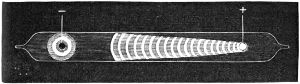
Fig. 1 represents the form which the stratified discharge assumes in a vacuum tube one inch diameter and 38 inches in length, + and - representing platinum wires attached to the terminals of a Ruhmkorff’s induction coil.
When the tube, with its stratifications just described, was laid horizontally on the pole of a magnet, the 80stratified column showed a tendency to rotate as a whole round it. According to the theory of Ampère, the polarity of a magnet is owing to a superficial current of electricity perpetually circulating in a direction perpendicular to its axis; and he also showed that currents of electricity flowing in the same direction attract one another, while currents flowing in opposite directions repel each other. Hence, since the currents of electricity in the magnet and tube were flowing in the same direction on one side of the magnet, and in opposite directions on the other side, the stratified column was attracted at one end and repelled at the other, so as to take the form , in consequence of its tendency to rotate as a whole round the pole of the magnet.

When narrow bands of tin foil wrapped round the glass tube near the platinum wires were put in communication with the poles of the induction battery, brilliant stratifications filled the whole tube between the tin coatings every time the electric circuit was broken or renewed; and when the tube was placed horizontally on the pole of a magnet, the stratifications no longer showed a tendency to rotate as a whole, they were divided into two parts tending to rotate in opposite directions; when the tube was placed between the poles of a powerful electro-magnet, one half of the stratifications were repelled and the other half attracted. When the tube was placed on the north pole, the divided stratifications arranged themselves on each side of the tube, changing their respective positions when placed on the south pole, but in every case each half was concave in opposite directions.
Fig. 2 (p. 81) represents the form which the induced stratified discharges assume when the vacuum tube is placed on or between the poles of a powerful electro-magnet—the tin foil coatings C+ C- being attached by wires to the terminals of an induction coil.
81
Fig. 2.
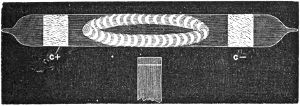
If a vacuum tube with or without wires or tin coatings be laid upon the induction coil of a battery, or upon the prime conductor of an electrifying machine, stratifications are produced by induction which are divided by a magnet. Thus there are two distinct forms of the stratified discharge, one direct, the other induced.
When Professor Plücker of Bonn sent an induced current of electricity from Ruhmkorff’s coil through a vacuum tube having a platinum wire fused into each extremity, and extending a little way into the interior of the tube, electric light radiated from every point of the negative wire, and when exposed to the action of an electro-magnet the whole tube was filled with a luminous atmosphere. But when all the negative platinum wire except its extreme point was insulated by a coating of glass, the rays of electric light which radiated from the point were united into one single and perfectly regular magnetic curve, upon the approach of an electro-magnet; when the negative platinum wire was partially insulated by glass coating, electric light emanated from every exposed part, and assumed the form of magnetic curves under electro-magnetic action. Whence Professor Plücker concluded that the luminous atmosphere in the first experiment was the locus of an infinite number of magnetic curves, and consequently 82that magnetic light emanates from the negative or warmth pole, and electric light from the positive or light pole. These magnetic curves of light are precisely similar to those assumed by iron filings from magnetic action.
The most remarkable of these experiments is the absolute extinction of a powerful electric discharge by magnetic action. Mr. Gassiot sent a discharge from a voltaic water battery, containing 3,520 insulated cells, into a tube filled with attenuated carbonic acid gas. The discharge was so strong that it was capable of passing through more than six inches of the gas, yet, on the approach of a very powerful electro-magnet, the stratifications were arrested as soon as they appeared, as if blown out, and finally extinguished. A stratified discharge, in vacuo, from 400 insulated cells of a nitric acid battery, was extinguished by the large electro-magnet of the Royal Institution; the luminous strata rushed from the positive pole of the battery, but under the magnetic force they retreated; cloud followed after cloud with deliberate motion, appearing as if swallowed up by the positive terminal. The amount of electricity that passed through the tube appeared to be materially increased by exciting the electro-magnet; the discharge was so intense on one occasion as to fuse half an inch of the positive terminal. A very powerful magnet is also capable of extinguishing a stratified discharge. In fact, according to the law of the reciprocal action of magnetism, the forces are equal in intensity and opposite in direction.
The electric discharge from an induction coil is discontinuous, or eruptive sparks of high tension are given out producing stratified discharges.
The discharge of the voltaic battery had hitherto been considered absolutely continuous; and so it is for chemical action, whether of analysis or combination; 83nevertheless certain phenomena gave reason to doubt its continuity. Mr. Gassiot has proved that the tension of a single cell of a galvanic battery increases in force according to the chemical energy of the exciting liquid, and in all his experiments he found that ‘the higher the chemical affinities of the elements used, the greater was the development of evidence of tension.’ These observations induced him to institute a series of experiments with galvanic batteries of different chemical affinities, and to compare the resulting phenomena with those produced by the induction coil, whose sparks are of high tension. The same carbonic acid vacuum tubes were made use of in all the experiments; a copper wire formed the positive terminal, and a copper plate was fixed at the extremity of the negative terminal. In other tubes platinum terminals extended into the interior, coated with glass, except the points, to which charcoal balls were fixed. One end of the tubes was of small diameter and contained caustic potash.
When a discharge from an induction coil was sent through these tubes, there were either minute luminous spots, narrow stratifications, or a well defined cloud-like discharge at the positive pole, according to the size and structure of the terminal, but the characteristic phenomenon in all the tubes was a large cloud-like luminosity or circular glow on the brass plate or charcoal ball at the negative terminal.
With 512 insulated cells of copper and zinc of Daniell’s constant battery, the exciting liquid being dilute sulphuric acid, a brilliant glow appeared round the charcoal ball of the negative terminal on the passage of the electric discharge through the tube, with very trifling luminosity of the positive pole.
Two copper plates that could be separated or closed by a screw, were placed between the poles of a nitric acid battery, so that the circuit could be made or 84broken gradually, and spark discharges were obtained between them. The vacuum tubes were placed between one of these plates and a pole of the battery; one of these tubes was 24 inches long, 18 in circumference, and had a circular copper disc 4 inches in diameter on its negative terminal. On completing the circuit, the discharge of the battery passed with a display of magnificent strata of dazzling brightness; on separating the plates by the screw, the luminous discharges presented the same appearance as when taken from an induction coil, but brighter. On the copper disc within the vacuum tube, there was a white layer, then a dark space about an inch broad, and then a bluish atmosphere curved like the disc, evidently three negative envelopes on a great scale. When the disc was made the positive pole, the effect was feeble.
In vacuum tubes 6 inches long and 1 inch diameter, with carbon balls on the terminals, the discharge of the nitric acid battery elicits extreme heat. In one of these the discharge presented a stream of light of intolerable brightness, but when viewed through a plate of green glass strata could be seen. This soon changed to a sphere of light on the positive ball, which became red hot, the negative being surrounded by magnificent envelopes; with a horse-shoe magnet the positive light was drawn out into strata. The needle of a galvanometer in circuit was violently deflected and the polarity reversed. When the caustic potash was heated, the discharge burst into a sunlike flame, subsequently subsiding into three or four large strata of a cloud-like shape, but intensely bright. This is called the arc discharge: it occurs in vacuum tubes with charcoal balls; when the potash is heated intensely, dazzling stratifications suddenly emanate from the positive ball, and powerful chemical action takes place in the battery, after which the discharge ceases.
85This process facilitates the discharge and assists the disintegration of the carbon particles, and these in a minute state of division are subsequently found attached to the sides of the glass. It is these particles which produce the arc discharge with its intense vivid light so suddenly observed with far more brilliant effects than the usual stratified discharge. During its passage the conducting power of the vacuum tube is greatly enhanced.
It was already mentioned that a stratified discharge was obtained from 3,520 insulated cells of a water battery, which differs but little in intensity from 400 cells of the nitric acid battery. On one occasion the electricity seemed to pass through the vacuum tubes in a continuous stream, but when examined with Mr. Wheatstone’s revolving mirror it was decidedly stratified. Mr. Gassiot never could obtain a continuous discharge in air, whether between the points or metallic plates of the water battery. The discharge was invariably in the form of minute clearly defined and separate sparks.
Thus it was proved by the preceding experiments that a spark discharge could be obtained in air from both the nitric acid and water battery; and that when these discharges were passed through the highly attenuated matter contained in carbonic acid vacua, the same luminous and stratified appearance was produced as by an induction coil; a proof that whatever may be the cause of the phenomena it could not arise from any peculiar action of that apparatus.
Mr. Gassiot finally concludes that the cause of the stratified discharge arising from the impulses of a force acting upon highly attenuated but resisting media is also applicable to the discharge of the voltaic battery in vacuo; while the fact of this discharge even in its full intensity having been now ascertained to be 86also stratified leads to the conclusion that the ordinary discharge of the voltaic battery, under every condition, is not continuous but intermittent, that it consists of a series of pulsations or vibrations of greater or less velocity, according to the resistance in the chemical or metallic elements of the battery or the conducting media through which the discharge passes.
Caustic potash absorbs the carbonic acid gas by degrees, and at last so completely exhausts a vacuum tube that electricity cannot be conducted. Air is a non-conductor, and an electric discharge that will not pass through an inch of air, will pass through more than 30 or 40 inches of attenuated gas.
It has already been mentioned that the stratified discharge can be obtained by a single discharge of the primary current of an inductive coil, however long may be the vacuum tube through which the discharge is passed. If no addition be made to the battery and no alteration be made in the arrangement of the coil so as to increase or diminish the intensity of the discharge, the stratifications will always present the same appearance and form, occupying the same spaces and positions in the vacuum tube; but if any change be made so as to alter the intensity, then a corresponding alteration will appear in the discharge, the striæ assuming a different shape, and the bright and dark divisions occupying different positions.
In order to try what effect a change of intensity would produce, three separate insulated voltaic batteries, in which the exciting liquid was brine, formed an electric circuit which was completed by two long wires. It was so arranged that the discharge of one, two, or all the three batteries could be separately employed. In order to vary the resistance at pleasure, two tubes 18 inches long containing distilled water and connected at their base were introduced into the circuit. By varying the 87depth to which the terminal wires of the circuit were plunged into the water, the resistance could be regulated at pleasure, and it was immaterial in what part of the circuit the vacuum tube was introduced provided the circuit was completed.
The first experiments were made with a carbonic acid vacuum tube 20 inches long and 4 inches in diameter. The negative terminal at one extremity of the tube was of aluminium, cup-shaped, about 3 inches in diameter; the positive terminal was a wire of the same metal fused into the other extremity of the tube; the point of the wire and cup were about four inches and a half apart. With this tube and 2,240 cells of the battery the discharge when the resistance was introduced had the appearance of a positive and negative discharge, impinging on and intermingling with each other, without any dark space intervening. Around the negative terminal the luminosity extends to the sides of the tube and tapers to the point of the positive wire. The light round the negative terminal becomes brighter, a dark space appears next to it when the resistance is diminished, and increases as the resistance decreases, by the rolling back of the light in bright clouds to the point of the positive terminal. These changes can be perfectly regulated by the resistance, and various luminous phenomena occur at each stage.
With 2,240 cells distinct sounds were heard in the tube; with the whole battery of 3,360 series the sounds were not heard till a magnet was applied to the striæ, when they again became audible and the striæ were spread over the surface of the tube.
A carbonic acid vacuum tube with platinum terminals fused into the same side far apart was now put into the circuit, the part of the wires that penetrated within the tube being coated with glass up to the carbon balls in which they terminated. When a discharge from all the 88three batteries passed through the tube, changes occurred in the form and number of the striæ corresponding to the greater or less amount of the resistance offered in the circuit.
At the commencement of the experiments there were 18 inches of water in each of the tubes, which formed the maximum resistance. The wires attached to the terminal wires of the battery were placed inside of these tubes, and as soon as they touched the surface of the water a faint luminous discharge was seen at each ball in the vacuum tube. As the wire attached to the negative end of the battery was slowly depressed, the two luminous discharges appeared to travel towards or attract each other, and at times a portion of the positive luminosity passed over and mingled with the negative; in this state the discharge was extinguished by a magnet.
When the wire was pressed farther into the water a dark space about an inch in length divided the light into two parts, the positive glow being sharply defined, the negative glow having an irregular edge. When the wire had been about three inches deep in the water, the positive and negative glows became more brilliant, and a single clearly defined luminous disc burst from the positive side and occupied the middle of the dark space. When the wire was pressed down till 13 inches of it were in the water, a second luminous disc travelled from the positive side, and then the two luminous discs or striæ occupied the dark space at a little distance from one another. As the wire was pressed more into the water, three parallel luminous striæ appeared, then four, then five, and so on till as many as thirteen or fourteen striped the dark central space. With the full power of the battery, the adjacent disc impinged on the glow that surrounded the negative ball. This disc was of a pale green, those adjacent were reddish, while the negative glow was of a bluish white; minute bright scintillations 89emanated from the negative ball, while distinct luminous flash discharges took place through the striæ. Thus by the amount of resistance introduced into the circuit, the number of striæ can be regulated, their position fixed, separating or closing up the dark space between the luminous glows round the balls.
In these experiments there is indication of a force emanating from the negative wire. The actual disruption of the particles from the negative terminal also indicates a force, and the disruption is as freely obtained by the continuous discharge of the battery as it is by the intermittent discharge of the induction coil. Besides, when Mr. Gassiot sent discharges from the induction coil through Torricellian vacua, he several times observed that while a cloud-like discharge issued from the positive terminal, a long tongue of the most brilliant blue phosphorescent light emanated from the upper part of the negative terminal, and a brilliant white tongue of light was also seen close to the negative wire: so there is reason to believe that force emanates from both terminals.
Some of the preceding striated discharges ‘present an appearance somewhat analogous with the stationary undulations (or nodes) which exist in a column of air when isochronous progressive undulations meet one another from opposite directions, and on the surface of water by mechanical impulses similarly interfering with each other.’[11]
‘May not the dark bands be the nodes of undulations arising from similar impulses proceeding from positive and negative discharges? or can the luminous stratifications which we obtain in a close circuit of the secondary coil of an induction apparatus, and in the circuit of a voltaic battery, be the representations of 90pulsations which pass along the wire of the former, and through the battery of the latter, impulses probably generated by the action of the discharge along the wires?’
The action of magnetism and electricity on light is similarly illustrated by the rotation of the plane of polarization. Sir John Herschel was the first who tried to rotate the plane of polarization of a ray of light by surrounding it with a spiral wire electrized by the great battery of two enormous plates of copper and zinc at the London Institution, but he obtained no evidence of any such action. Long afterward Professor Faraday succeeded by sending a ray of light through a piece of silico-borate of lead, which formed the core of a magnetic helix. The silico-borate took on a quasi-crystallised state during the passage of the electric current round it, giving it for the moment the property of circular polarization, analogous to that of glass in a state of tension or compression.
Substances vary exceedingly in the facility with which they transmit electricity; even the same substance under another form differs remarkably in that property: charcoal, which next to the metals is the best conductor known, when under the form of diamond is quite impervious to electricity. In general, substances that are the best conductors of heat are also the best conductors of electricity, as for example the metals, which however, possess the transmissive property in very different degrees. Silver and copper are the best conductors, lead one of the worst; its resistance to the passage of electricity is twelve times greater than that of silver and copper, consequently it becomes twelve times as hot, for when a current of electricity is impeded it is changed into heat. So great is the resistance offered by a fine platinum wire, that the heat amounts to 3280° and the wire is melted, a striking 91instance of the correlation of electricity and heat, and of the power of the cohesive force.
When electricity is passing through conducting substances or when it is static, it induces an electric state in bodies at a distance by transmission through non-conducting substances or air, for it gives polarity and tension to the adjacent atoms, and these to the next, and the next in succession, throughout the whole intervening mass,—a strong proof of the individuality and polarity of the atoms of matter.
Motion, which is the result of all the physical powers, has itself a strong action upon the ultimate elements of matter; in cases of unstable equilibrium it accelerates and even determines their chemical union. Some substances will remain merely mixed as long as they are at rest, but no sooner is their inertia disturbed by a slight motion than they rush into permanent combination. In newly sublimed iodide of mercury the vibration impressed by the scratch of a pin is so rapidly transmitted through the mass that its colour is immediately changed from yellow to bright red. By a new arrangement of the molecules their action on light is altered.
Catalysis or the chemical decomposition and composition of substances by the contact of a foreign body, is well illustrated by the chloride of nitrogen, that explodes when touched by substances which at ordinary temperatures would neither combine with the chlorine nor with the nitrogen. The iodide of nitrogen explodes if touched by a feather, and M. Becquerel decomposed the iodide of nitrogen by the vibrations of sound. When substances only exist in consequence of the inertia of their atoms, the instability of their chemical attractions and repulsions is only increased by an external agent, so that a great effect is produced by a slight cause, as in an avalanche, the snowy mass is on the point of falling, and the smallest motion, a breath of wind, hurls 92it down. In such cases the potential energy of the unstable mass is in a moment changed into vis viva or impetus. Daguerreotype impression shows the power of the chemical rays on substances in unsteady equilibrium, and the length of time required to make the impression under the same circumstances is a measure of the instability.
Most of the fulminates are compounds of nitrogen; of that the fulminate of aniline is a recent instance, since it is formed by the slow action of nitrous acid on aniline. Explosion takes place on the sudden evolution of gas, or the sudden change of a solid into vapour. In these cases fire or percussion are the foreign causes of change. They are all particular instances of the general principle of catalysis, which is the chemical combination of heterogeneous atoms by the action of a substance that does not participate in the change. Thus it has long been known that when platinum is plunged into a mixture of oxygen and hydrogen it combines these gases into water. Acids in some cases seem to have the same effect; for when rags or starch are dissolved in an acid the starch is changed to dextrine and the liquid has acquired the power of turning the plane of polarised light to the right. The acid has undergone no alteration, but it has changed the properties of the starch though not its chemical composition. After a time, a second transformation takes place, the liquid ceases by degrees to turn the plane of polarisation to the right, and ends by turning it to the left. The acid is still unchanged, but the dextrine has now disappeared: it has combined with the water and is transformed into glucose or sugar of grapes.
The quantity of the physical powers, active and latent, is inappreciably great. The quantity of heat or potential energy generated by chemical combination alone is enormous.
93