Front matter
Reading edition
A few typographical errors have been corrected. They have been marked in the text with mouse-hover popups.
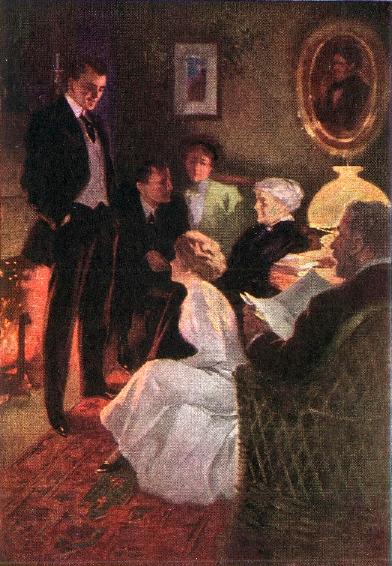
“IT’S A GOOD THING TO EXERCISE THE IMAGINATION, NOW AND THEN. THAT’S THE WAY CHANGES COME”
full text
ALL RIGHTS RESERVED, INCLUDING THAT OF TRANSLATION INTO FOREIGN LANGUAGES, INCLUDING THE SCANDINAVIAN

COPYRIGHT, 1910, BY THE RIDGWAY COMPANY

ILLUSTRATIONS
“It’s a good thing to exercise the imagination, now and then. That’s the way changes come”
Frontispiece
FACING PAGE
“Cut it out—cut out the steam calliope!” 22
“Billy!” His sister Margaret’s voice was anxious. “Are you sure you’d better?” 32
There was flesh and blood in the message he gave them, and it was the message they needed 52




LL the Fernald family go back to the old home for Christmas, now, every year. Last Christmas was the third on which Oliver and Edson, Ralph and Guy, Carolyn and Nan, were all at the familiar fireside, as they used to be in the days before they were married. The wives and husbands and children go too—when other family claims can

Taking them all together they are quite a company. And as Father and Mother Fernald are getting rather well along in years, and such a house-party means a good deal of preparation, last year their younger daughter Nan, and her husband, Sam Burnett: and their youngest son, Guy, and his wife of a year, Margaret: went up to North Estabrook two days ahead of the rest, to help with the finishing labours. Sam Burnett and Guy Fernald, being busy young men all the year round, thought it great sport to get up into the country in the winter, and planned, for a fortnight beforehand, to be able to
“I don’t know but this is the best part of the party,” mused John Fernald, looking from one to another of them, and then at his wife, as they sat together before the fireplace, on the evening of the arrival. “It was all over so quick, last year, and you were all piling back to town, to your offices, in such a hurry, you boys. Now we can have a spell of quiet talk, before the fun begins. That suits us to a T —eh, Mother?”
Mrs. Fernald nodded, smiling. Her hand, held fast in Guy’s, rested on his knee; Nan’s charming head, with its modish dressing, lay against her shoulder. What more could a mother ask? Across the fireplace, Sam Burnett, most satisfactory of sons-in-law, and Margaret, Guy’s best beloved, who had made the year
There was much to talk about. To begin with, there was everybody in North Estabrook to inquire after; and though North Estabrook is but a very small village, it takes time to inquire after everybody. Quite suddenly, having asked solicitously concerning a very old woman, who had nursed most of the Fernald children in their infancy and was always remembered by them with affection, it occurred to Nan to put a question which had been on her mind ever since she had come into town on the afternoon stage.
“Speaking of Aunt Eliza, Mother, makes me think of the old church. She used to talk so much about liking to hear the bell ring, right up over her head, next door. Does the bell ever ring, these days—or have cobwebs grown over the clapper?”
“It’s a miserable shame, Nancy, but that church hasn’t had a door open since a year ago last July, when the trouble burst out. We haven’t had a service there since. Mother and I drive over to Estabrook when we feel like getting out—but that’s not often, come winter-time. Being the only church building in this end of the township, it’s pretty bad having it closed up. But there’s the fuss. Folks can’t agree what to do, and nobody dares get a preacher here and try to start things up, on their own responsibility. But we feel it—we sure do. I don’t like to look at the old meeting-house, going by, I declare I don’t. It looks lonesome to me. And there’s where
“It’s barbarous!” Guy exclaimed, in a tone of disgust.
“And all over nothing of any real consequence,” sighed Mrs. Fernald, in her gentle way. “We would have given up our ideas gladly, for the sake of harmony. But—there were so many who felt it necessary to fight to have their own way.”
“And feel that way still, I suppose?” suggested Sam Burnett, cheerfully. “There’s a whole lot of that feeling-it-necessary-to-fight, in the world. I’ve experienced it myself, at times.”
They talked about it for a few minutes, the younger men rather enjoying the details of the quarrel, as those may who are outside of an affair sufficiently far to see its inconsistencies and humours. But it
“People! —Let’s open the church—ourselves—and have a Christmas Day service there!”
They stared at her for a moment, thinking her half dreaming. But her face was radiant with the light of an idea which was not an idle dream.
Guy began to laugh. “And expect the rival factions to come flocking peaceably in, like lambs to the fold? I think I see them!”
“Ignore the rival factions. Have a service for everybody. A real Christmas service, with holly, and ropes of greens, and a star, and music—and—a sermon,” she ended, a little more doubtfully.
“The sermon, by all means,” quoth
“But it’s really a beautiful idea,” said Margaret, her young face catching the glow from Nan’s. “I don’t see why it couldn’t be carried out.”
“Of course you don’t.” Guy spoke decidedly. “If people were all like you there wouldn’t be any quarrels. But unfortunately they are not. And when I think of the Tomlinsons and the Frasers and the Hills and the Pollocks, all going in at the same door for a Christmas Day service under that roof—well——” he gave a soft, long whistle— “it rather strains my imagination. Not that they aren’t all good people, you know. Oh, yes! If they weren’t, they’d knock each other down in the street and have it over with—and a splendid thing it would be, too. But, I tell you, it strains my imagination to——”
“Who would conduct such a service?” Mrs. Fernald asked thoughtfully.
“You couldn’t get anybody out to church on Christmas morning,” broke in Mr. Fernald, chuckling. “Every mother’s daughter of ’em will be basting her Christmas turkey.”
“Then have it Christmas evening. Why not? The day isn’t over. Nobody knows what to do Christmas evening—except go to dances—and there’s never a dance in North Estabrook. Whom can we get to lead it? Well——” Nan paused, thinking
“Billy!”
“Billy! Whoop-ee!” Guy threw back his head and roared with delight at the notion. “The Reverend Billy, of St. Johns, coming up to North Estabrook to take charge of a Christmas-evening service! Why, Billy’ll be dining in purple and fine linen at the home of one of his millionaire parishioners—the Edgecombs’, most likely. I think they adore him most. Billy! —Why don’t you ask the Bishop himself?”
Margaret flushed brightly. The
“Of course Billy would,” cried Margaret. “You know perfectly well he would, Guy, dear. He doesn’t care a straw about millionaires’ dinners—he’d rather have an evening with his newsboys’ club, any time. He has his own service Christmas morning, of course, but in the evening—He could come up on the afternoon train—he’d love to. Why, Billy’s a bachelor—he’s nothing in the world to keep him. I’ll telephone him, first thing in the morning.”
From this point on there was no lack of enthusiasm. If Billy Sewall was coming to North Estabrook, as
“Put a notice in the post office,” advised Guy, comfortably crossing his legs and grinning at his father, “and tell Aunt Eliza and Miss Jane Pollock, and the thing is done. Sam, I think I see you spending the next two days at the top of ladders, hanging greens. I have a dim and hazy vision of you on your knees before that stove that always used to smoke when the wind was east—the one in the left corner—praying to it to quit fussing and draw. A nice, restful Christmas vacation you’ll have!”
“You old dear!” murmured Nan, jumping up to stand behind his chair, her two pretty arms encircling his stout neck from the rear. “You could preach a better sermon than lots of ministers, if you are only an upright old bank cashier.”
“Doubtless, Nancy, doubtless,” murmured Sam, pleasantly. “But as it will take the wisdom of a Solomon, the tact of a Paul, and the eloquence of the Almighty Himself to preach a sermon on the present occasion that will divert the Tomlinsons and the Frasers, the Hills and the Pollocks from glaring at each other across the pews, I don’t think I’ll apply for the job. Let Billy Sewall tackle it. There’s one
II
“Hi, there, Ol—why not get something doing with that hammer? Don’t you see the edge of that pulpit stair-carpeting is all frazzled? The preacher’ll catch his toes in it, and then where’ll his ecclesiastical dignity be?”
The slave-driver was Guy, shouting down from the top of a tall step-ladder, where he was busy screwing into place the freshly cleaned oil-lamps whose radiance was to be depended upon to illumine the ancient interior of the North Estabrook church. He addressed his eldest
“Your motive is undoubtedly a good one,” Mrs. Oliver conceded. She spoke to Nan, busy near her, and she gazed critically about the shabby old walls, now rapidly assuming a quite different aspect as the great ropes of laurel leaves swung into place under the direction of Sam Burnett. That young man now had Edson Fernald and Charles Wetmore—Carolyn’s husband—to assist him, and he was making the
“It’s Christmas,” replied Nan. Her cheeks were the colour of the holly berries in the great wreaths she was arranging to place on either side of the wall behind the pulpit. “They can’t quarrel at Christmas—not with Billy Sewall preaching peace on earth, good will to men, to them.
“Nobody expects Marian to be on any side but the other one,” consolingly whispered merry-faced Jessica, Edson’s wife—lucky fellow!—as she held the wreath for Nan to affix the wire.
“What’s that about Sewall?” Oliver inquired. “I hadn’t heard of that. You don’t mean to say Sewall’s coming up for this service?”
“Of course he is. Margaret telephoned him this morning, and he said he’d never had a Christmas present equal to this one. He said it interested him a lot more than his morning service in town, and he’d be up, loaded. Isn’t that fine of Billy?” Nan beamed triumphantly at her oldest brother, over her holly wreath.
“That puts a different light on it.” And Mr. Oliver Fernald, president
“Do I understand that you mean to attempt music?” Mrs. Oliver seemed grieved at the thought. “There are several good voices in the family, of course, but you haven’t had time to practise any Christmas music together. You will have merely to sing hymns.”
“Fortunately, some of the old hymns are Christmas music, of the most exquisite sort,” began Nan, trying hard to keep her temper—a
“Cut it out—cut out the steam calliope!—unless you want a burlesque. That organ hasn’t been tuned since the deluge—and they didn’t get all the water out then.”
“I won’t hit that key again,” called Carolyn. “Listen, you people.”
“Listen! You can’t help listening
But the next instant nobody was jeering, for Margaret’s voice had never seemed sweeter than from the old choir-loft.
“Over the hills of Bethlehem,
Lighted by a star,
Wise men came with offerings,
From the East afar....”
It took them all, working until late on Christmas Eve, to do all that needed to be done. Once their interest was aroused, nothing short of the best possible would content them. But when, at last, Nan and Sam, lingering behind the others, promising to see that the fires were safe, stood together at the back of the church for a final survey, they felt that their work had been well worth while. All the lights were out but one on either side, and the dim interior, with its ropes and wreaths of
“Don’t you believe, Sammy,” questioned Nan, with her tired cheek against her husband’s broad shoulder, “the poor old ‘meeting-house’ is happier to-night than it has been for a long, long while?”
“I think I should be,” returned Sam Burnett, falling in with his wife’s mood, “if after a year and a half of cold starvation somebody had suddenly warmed me and fed me and made me hold up my head again. It does look pretty well—much better than I should have thought it could, when I first saw it in its barrenness. —I wonder what the North Estabrook people are thinking about this—that’s what I wonder. Do you suppose the Tomlinsons and the
“Not much else.” Nan smiled contentedly. Then suddenly: “O Sam—the presents aren’t all tied up! We must hurry back. This is the first Christmas Eve I can remember when the rattling of tissue paper wasn’t the chief sound on the air.”
“If this thing goes off all right,” mused Burnett, as he examined the stoves once more, before putting out the lights, “it’ll be the biggest Christmas present North Estabrook ever had. Peace and good will—Jove, but they need it! And so do we all—so do we all.”
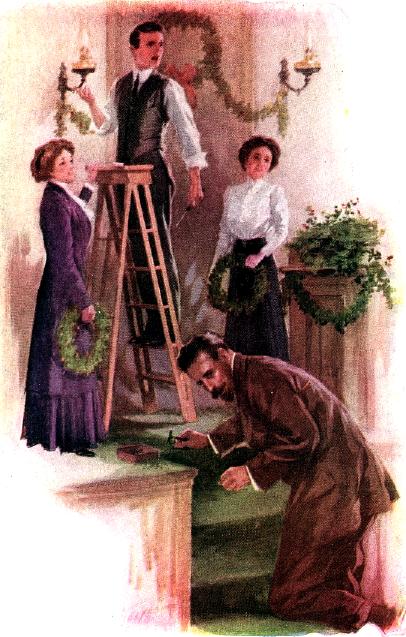
“CUT IT OUT—CUT OUT THE STEAM CALLIOPE!”
III
“There go pretty near every one of the Fernalds, down to the station. Land, but there’s a lot of ’em, counting the children. I suppose they’re
Miss Jane Pollock, ensconced behind the thick “lace curtains” of her “best parlour,” addressed her sister, who lay on the couch in the sitting-room behind, an invalid who could seldom get out, but to whom Miss Jane was accustomed faithfully to report every particle of current news.
“I suppose they think,” Miss Jane went on, with asperity, “they’re going to fix up the fuss in that church, with their greens and their city minister preaching brotherly love. I can tell him he’ll have to preach a pretty powerful sermon to reach old George Tomlinson and Asa Fraser, and make ’em notice each other as they pass by. And when I see Maria Hill coming toward me with a smile on her face and her hand out I’ll know something’s happened.”
“No, I don’t,” retorted Miss Jane, very positively. “And I don’t see how you can think it, Deborah. You know perfectly well it was Maria Hill that started the whole thing—and then talked about me as if I was the one. How that woman did talk—and talks yet! Don’t get me thinking about it. It’s Christmas Day, and I want to keep my mind off such disgraceful things as church quarrels—if the Fernald family’ll let me. A pretty bold thing to do, I call it—open up that church on their own responsibility, and expect folks to come, and forget the past. —Debby, I wish you could see Oliver’s wife, in those furs of hers. She holds her head as high as ever—but she’s the only one of ’em that does it disagreeably—I’ll say that for are all city folks now. And of course she isn’t a Fernald. —Here comes Nancy and her husband. That girl don’t look a minute older’n when she was married, five years ago. My, but she’s got a lot of style! I must say her skirts don’t hang like any North Estabrook dressmaker can make ’em. They’re walking—hurrying up to catch the rest. Sam Burnett’s a good-looking man, but he’s getting a little stout.”
“Jane,” said the invalid sister, wistfully, “I wish I could go to-night.”
“Well, I wish you could. That is—if I go. I haven’t just made up my mind. I wonder if folks’ll sit in their old pews. You know the Hills’ is just in front of ours. But as to your going, Deborah, of course that’s out of the question. I suppose I shall go. I shouldn’t like to offend the Fernalds, and they do say Guy’s wife’s brother is worth hearing. There’s to be music, too.”
O Lord—” she closed her patient eyes and whispered it— “make them all choose to go—to Thy house—this Christmas Day. And to thank Thee that the doors are open—and that they have strength to go. And help me to bear it—to stay home!”
IV
“The problem is—” said the Reverend William Sewall, standing at the back of the church with his sister Margaret, and Guy Fernald, her husband, and Nan and Sam Burnett—the four who had, as yet, no children, and so could best take time, on Christmas afternoon, to make the final arrangements for the evening— “the problem is—to do the right thing, to-night. It would
He regarded the pulpit as he spoke, richly hung with Christmas greens and seeming eagerly to invite an occupant.
“I should say,” observed his brother-in-law, Guy, his face full of affection and esteem for the very admirable figure of a young man who stood before him, “that a fellow who’s just pulled off the sort of service we know you had at St. John’s this morning, wouldn’t consider this one much of a stunt.”
Sewall smiled. “Somehow this strikes me as the bigger one,” said he. “The wisest of my old professors used to say that the further you got into the country the less it mattered about your clothes but the more about your sermon. I’ve been wondering, all the way up, if I knew enough to preach that sermon. Isn’t there any minister in town, not even a visiting one?”
“There is one minister,” Nan admitted. “But I’d forgotten all about him, till Father mentioned him last night. But he doesn’t really count at all. He’s old—very old—and infirm.”
“Superannuated, they call it,” added Sam Burnett. “Poor old chap. I’ve seen him—I met him at the post-office this morning. He has a peaceful face. He’s a good man. He must have been a strong one—in his time.”
“Had he anything to do with the church trouble?” Sewall demanded, his keen brown eyes eager.
Nan and Guy laughed.
“Old ‘Elder Blake’?—not except as he was on his knees, alone at home, praying for the fighters—both sides,” was Guy’s explanation. “So Father
“If I can get hold of a man whose part in the quarrel was praying for both sides, I’m off to find him,” said Sewall, decidedly. He picked up his hat as he spoke. “Tell me where he lives, please.”
“Billy!” His sister Margaret’s voice was anxious. “Are you sure you’d better? Perhaps it would be kind to ask him to make a prayer. But you won’t——”
“You won’t ask him to preach the sermon, Billy Sewall—promise us that,” cried Guy. “An old man in his dotage!”
Sewall smiled again, starting toward the door. Somehow he did not look like the sort of fellow who could be easily swayed from an intention once he had formed it—or be forced to make promises until he was ready. “You’ve got me up here,“ said he, ”now you’ll have to take the consequences.
And he departed. Those left behind stared at one another, in dismay.
“Keep cool,” advised Sam Burnett. “He wants the old man’s advice—that’s all. I don’t blame him. He wants to understand the situation thoroughly. Nothing like putting your head into a thing before you put your foot in. It saves complications. Sewall’s head’s level—trust him.”
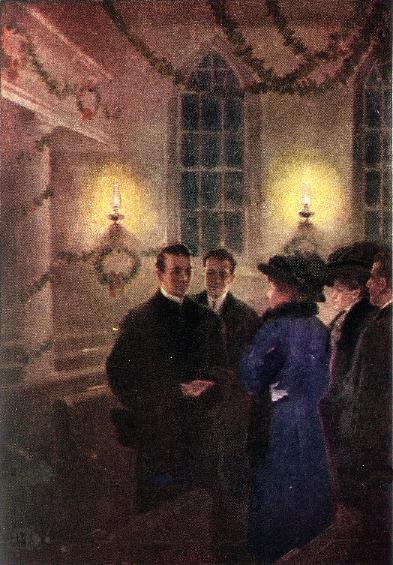
“BILLY!” HIS SISTER MARGARET’S VOICE WAS ANXIOUS. “ARE YOU SURE YOU’D BETTER?”
V
“I can’t—” said a very old man with a peaceful face—now wearing a somewhat startled expression— “I can’t quite believe you are serious, Mr. Sewall. The people are all expecting you—they will come out to hear you. I have not preached for—“ he hesitated— ”for many years. I will not say that it would not be—a
“If I were half as fit,” answered Sewall, gently, “I should be very proud. But I’m—why, I’m barely seasoned, yet. I’m liable to warp, if I’m exposed to the weather. But you—with all the benefit of your long experience—you’re the sort of timber that needs to be built into this strange Christmas service. I hadn’t thought much about it, Mr. Blake, till I was on my way here. I accepted the invitation too readily. But when I did begin to think, I felt the need of help. I believe you can give it. It’s a critical situation. You know these people, root and branch. I may say the wrong thing. You will know how to say the right one.”
“If I should consent,” the other man said, after a silence during which, with bent white head, he studied the matter, “what would be your part? Should you attempt—”
Sewall’s face, which had been grave, relaxed. “No, Mr. Blake,” said he. “It wouldn’t be possible, and it wouldn’t be—suitable. This is a community which would probably prefer any other service, and it should have its preference respected. A simple form, as nearly as possible like what it has been used to, will be best—don’t you think so? I believe there is to be considerable music. I will read the Story of the Birth, and will try to make a prayer. The rest I will leave to you.”
“And Him,” added the old man.
“And Him,” agreed the young man, reverently. Then a bright smile broke over his face, and he held out his hand. “I’m no end grateful to you, sir,” he said, a certain attractive boyishness of manner suddenly coming uppermost and putting
The old man, with a gently humorous look, glanced down at his own thin, bent shoulders, then at the stalwart ones which towered above him.
“You speak metaphorically, my dear lad,” he said quaintly, with a kindly twinkle in his faded blue eyes. He laid his left hand on the firm young arm whose hand held his shrunken
“And tolerance,” added William Sewall, pressing the hand, his eyes held fast by Elder Blake’s.
“And love,” yet added the other. “Love. That’s the great thing—that’s the great thing. I do love this community—these dear people. They are good people at heart—only misled as to what is worth standing out for. I would see them at peace. Maybe I can speak to them. God knows—I will try.”
VI
“The Fernald family alone will fill the church,” observed the bachelor son of the house, Ralph. He leaned
“I can discern the velvet gowns,” conceded Edson, from his place just in front, where his substantial figure supported his mother’s frail one. “But I fail to make out any rags. Take us by and large, we seem to put up rather a prosperous front. I never noticed it quite so decidedly as this year.”
“There’s nothing at all ostentatious about the girls’ dressing, dear,” said his mother’s voice in his ear. “And I noticed they all put on their simplest clothes for to-night—as they should.”
but!” He whistled a bar or two of ragtime. “I can see myself now, as a lad, sitting on that fence over there—” he indicated a line of rails, half buried in snow, which outlined the borders of an old apple orchard— “counting the quarters in my trousers pockets, earned by hard labour in the strawberry patch. I thought it quite a sum, but it wouldn’t have bought——”
“A box of the cigars you smoke now,” interjected Ralph unexpectedly, from behind. “Hullo—there’s the church! Jolly, but the old building looks bright, doesn’t it? I didn’t know oil lamps could put up such
“See them coming—from all directions.” Nan, farther down the line, clutched Sam Burnett’s arm. “Oh, I knew they’d come out—I knew they would!”
“Of course they’ll come out.” This was Mrs. Oliver. “Locks and bars couldn’t keep a country community at home, when there is anything going on. But as to the feeling—that is a different matter. —Oliver, do take my muff. I want to take off my veil. There will be no chance once I am inside the door. Nan is walking twice as fast now as when we started. She will have us all up the aisle before——”
“Where’s Billy Sewall bolting to?” Guy sent back this stage-whisper from the front of the procession, to Margaret, his wife, who was walking with Father Fernald, her hand on his gallant arm. In John Fernald’s
“He caught sight of Mr. Blake, across the road. They’re going in together,” Margaret replied. “I think Mr. Blake is to have a part in the service.”
“Old Ebenezer Blake? You don’t say!” Father Fernald ejaculated in astonishment. He had not been told of Sewall’s visit to the aged minister. “Well—well—that is thoughtful of William Sewall. I don’t suppose Elder Blake has taken part in a service in fifteen years—twenty, maybe. He used to be a great preacher, too, in his day. I used to listen to him, when I was a young man, and think he could put things in about as interesting a way as any preacher I ever heard. Good man, too, he was—and is. But nobody’s thought of asking him to make a prayer in public since—I don’t know when.
VII
The organ was playing—very softly. Carolyn was a skilful manipulator of keyboards, and she had discovered that by carefully refraining from the use of certain keys—discreetly marked by postage stamps—she could produce a not unmusical effect of subdued harmony. This unquestionably added very much to the impression of a churchly atmosphere, carried out to the eye by the Christmas wreathing and twining of the heavy ropes of shining laurel leaves, and by the massing of the whole pulpit-front in the soft, dark green of hemlock boughs and holly. To the people who entered the
But the faces were the same—the faces. And George Tomlinson did not look at Asa Fraser, though he passed him in the aisle, beard to beard. Miss Jane Pollock stared hard at the back of Mrs. Maria Hill’s bonnet, in the pew in front of her, but when Mrs. Hill turned about to glance up at the organ-loft, to discover who was there, Miss Pollock’s face became as adamant, and her eyes remained fixed on her folded hands until Mrs. Hill had twisted about again, and there was no danger of their glances encountering. All over the church, likewise,
There was no vestry in the old meeting-house; no retiring place of any sort where the presiding minister might stay until the moment came for him to make his quiet and impressive entrance through a softly opening pulpit door. So when the Reverend William Sewall of St. John’s, of the neighbouring city, came into the North Estabrook sanctuary, it was as his congregation had entered, through the front door and up the aisle.
There was a turning of heads to see him come, but there was a staring of eyes, indeed, when it was seen by whom he was accompanied. The erect figure of the young man, in his unexceptionable attire, walked slowly,
Now, to the subdued notes of the organ, which had been occupied with one theme, built upon with varying harmonies but ever appearing—though perhaps no ear but a trained one would have recognized it through the veil—was added the breath of voices. It was only an old Christmas carol, the music that of a German folk song, but dear to generations of Christmas singers everywhere. The North Estabrook people recognized it—yet did not recognize it. They
“Holy night! peaceful night!
All is dark, save the light
Yonder where they sweet vigils keep
O’er the Babe, who in silent sleep
Rests in heavenly peace.”
It was the presence of Margaret Sewall Fernald which had made it possible to attempt music at this service—the music which it seemed impossible to do without. Her voice was one of rare beauty, her leadership that of training. Her husband, Guy, possessed a reliable, if uncultivated, bass. Edson had sung a fair tenor in his college glee-club. By the use of all her arts of persuasion Nan had provided an alto singer, from the ranks of the choir which had once occupied this organ-loft—the daughter of Asa Fraser. Whether the quartette thus formed would have passed muster—as a quartette—with the choir-master of St. John’s,
As “Holy Night” came down to him, William Sewall bent his head. But Ebenezer Blake lifted his. His dim blue eyes looked up—up and up—quite through the old meeting-house roof—to the starry skies where it seemed to him angels sang again. He forgot the people assembled in front of him—he forgot the responsibilities upon his shoulders—those bent shoulders which had long ago laid down such responsibilities. He saw visions. It is the old men who see visions. The young men dream dreams.
The young city rector read the Christmas Story—out of the worn
“How silently, how silently,
The wondrous gift is given;
So God imparts to human hearts
The blessing of His heaven....
O Holy Child of Bethlehem!
Descend to us, we pray;
Cast out our sin, and enter in,
Be born in us to-day.”
Then William Sewall made a prayer. Those who had been looking to see old Elder Blake take this part in the service began to wonder if he had been asked into the pulpit simply as a courtesy. They supposed he could pray, at least. They knew he had never ceased doing it—and for them. Elder Blake had not an enemy in the village. It seemed strange that he couldn’t be given some part, in spite of his extreme age. To be sure, it was many years since anybody had asked him to take part in any service whatsoever, even a funeral service—for which, as is well
A number of people, among them Miss Jane Pollock, were beginning to feel more than a little indignant about it, and so lost the most of Sewall’s prayer, which was a good one, and not out of the prayer-book, though there were phrases in it which suggested that source, as was quite natural. The city man meant to do it all, then. Doubtless he thought nobody from the country knew how to do more than to pronounce the benediction. Doubtless that was to be Elder Blake’s insignificant part—to pronounce the——
Miss Jane Pollock looked up quickly. She had been staring steadily at the back of Maria Hill’s
William Sewall’s prayer was not ended. He could no longer be heard by the people, but in his seat, behind the drooping figure of the old man, he was asking things of the Lord as it seemed to him he had never asked anything before. Could His poor, feeble, “superannuated” old servant ever speak the message that needed to be spoken that night? William Sewall felt more than ever that he himself could not have done it. Could Ebenezer Blake?
“Make him strong, O God,—make ,” requested William Sewall, fervently. Then, forgetting even a likeness to prayer-book phrase, he added, with fists unconsciously tight-clenched, in the language of the athletic field where a few years back he himself had taken part in many a hard-fought battle— “Help him to buck up!”
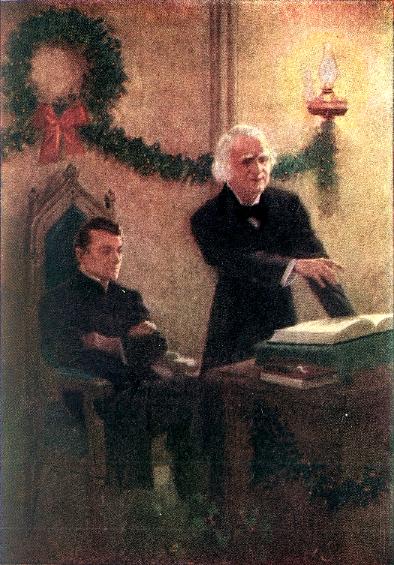
THERE WAS FLESH AND BLOOD IN THE MESSAGE HE GAVE THEM, AND IT WAS THE MESSAGE THEY NEEDED
VIII
They talk about it yet, in North Estabrook, though it happened a year ago. Nobody knew how it was that from a frail old man with a trembling voice, which, in its first sentences, the people back of the middle of the church could hardly hear, there came to stand before them a fiery messenger from the skies. But such was the miracle—for it seemed no less. The bent figure straightened, the trembling
Peace and good will? Oh, yes—he preached it—no doubt of that. But it was no milk-and-water peace, no sugar-and-spice good will. There was flesh and blood in the message he gave them, and it was the message they needed. Even his text was not the gentle part of the Christmas prophecy, it was the militant part— “And the government shall be upon His shoulder.” They were not bidden to lie down together like lambs, they were summoned to march together like lions—the lions of the Lord. As William Sewall looked down into the faces of the people and watched the changing expressions there, he felt
Suddenly the sermon ended. As preachers of a later day have learned the art of stopping abruptly with a striking climax, so this preacher from an earlier generation, his message delivered, ceased to speak. He left his hearers breathless. But after a moment’s pause, during which the silence was a thing to be felt, the voice spoke again. It no longer rang—it sank into a low pleading, in words out of the Book upon which the clasped old hands rested:
“Now, therefore, O our God, hear the prayer of Thy servant and his ”
IX
Up in the choir-loft, chokily Guy whispered to Margaret, “Can’t we end with ‘Holy Night,’ again? Nothing else seems to fit, after that.”
She nodded, her eyes wet. It had not been thought best to ask the congregation to sing. There was no knowing whether anybody would sing if they were asked. Now, it seemed fortunate that it had been so arranged, for somehow the congregation did not look exactly as if it could sing. Certainly not George Tomlinson, for he had a large frog in his throat. Not Asa Fraser, for he had a furious cold in his head. Not Maria Hill, for though she hunted vigorously, high and low, for her handkerchief,
So the four in the organ loft sang “Holy Night” again. They could not have done a better thing. It is a holy night, indeed, when a messenger from heaven comes down to this world of ours, though he take the form of an old, old man with a peaceful face—but with eyes which can flash once more with a light which is not of earth, and with lips upon
“Silent Night! Holy night!
Darkness flies, all is light!
Shepherds hear the angels sing—
Hallelujah! hail the king!
Jesus Christ is here!”
X
George Tomlinson came heavily out of his pew. He had at last succeeded in getting rid of the frog in his throat—or thought he had. It had occurred to him that perhaps he ought to go up and speak to Elder Blake—now sitting quietly in his chair, with William Sewall bending over him—though he didn’t know exactly what to say that would seem adequate to the occasion.
At the same moment, Asa Fraser, still struggling with the cold in his head, emerged from his pew, directly
As each stood momentarily at the opening of his pew, neither quite determined whether to turn his face pulpit-ward or door-ward, Samuel Burnett, coming eagerly up to them from the door-ward side, laid a friendly hand on either black-clad arm. Whether Sam was inspired by Heaven, or only by his own strong common-sense and knowledge of men, will never be known. But he had been a popular man in North Estabrook, ever since he had first begun to come there to see Nancy Fernald, and both Tomlinson and Fraser heartily liked and respected him—a fact he understood and was counting on now.
Almost without their own volition Tomlinson and Fraser found themselves proceeding toward the pulpit—yet Sam’s hands did not seem to be exerting any force. The force came from his own vigorous personality, which was one that invariably inspired confidence. If Burnett was going up to speak to the Elder, it seemed only proper that they, the
William Sewall, having assured himself that his venerable associate was not suffering from a more than natural exhaustion after his supreme effort, stood still by his side, looking out over the congregation. He now observed an interesting trio approaching the platform, composed of his valued friend, Samuel Burnett—his fine face alight with his purpose—and two gray-bearded men of somewhat unpromising exterior, but plainly of prominence in the church, by the indefinable look of them. He watched the three climb the pulpit stairs, and come up to the figure in the chair—Sam, with tact, falling behind.
“You did well, Elder—you did well,” said George Tomlinson, struggling to express himself, and finding only this time-worn phrase. He stood awkwardly on one foot, before
Elder Blake looked up—and William Sewall thought he had never seen a sweeter smile on a human face, young or old. “You are kind to come and tell me so, George,” said he. “I had thought never to preach again. It did me good.”
“It did us good, sir,” said Sam Burnett. He had waited an instant for Fraser to speak, but saw that the cold in the head was in the ascendancy again. “It did me so much good that I can hardly wait till I get back to town to hunt up a man I know, and tell him I think he was in the right in a little disagreement we had a good while ago. I’ve always been positive he was wrong. I suppose the facts in the case haven’t changed—” he smiled into the dim
“Ah, it’s not worth while,” agreed the old man quickly. “It’s not worth while for any of us to be hard on one another, no matter what the facts. Life is pretty difficult, at its best—we can’t afford to make it more difficult for any human soul. Go back to town and make it right with your friend, Mr. Burnett. I take it he was your friend, or you wouldn’t think of him to-night.”
“Was—and is!” declared Sam, with conviction. “He’s got to be, whether he wants to or not. But he’ll want to—I know that well enough. We’ve been friends from boyhood—we’d just forgotten it, that’s all.”
There was a little pause. The old man sat with his white head leaning against the high back of his chair,
Asa Fraser lifted his eyes and met those of George Tomlinson. With a palpable effort—for he was a man of few words—he spoke.
“George,” said he, “I guess I made a mistake, thinking as I did.”
“Asey,” responded Tomlinson quickly, “I guess you weren’t the only one that’s made a mistake.” And he held out his hand.
Fraser grasped it. With his other hand he raised his handkerchief and blew his nose once more, violently—and finally. From this point the smile in his eyes usurped the place of the moisture which had bothered him so unwontedly, and put it quite to rout.
Do you know how sometimes the ice goes out of a river? From shore to shore it has been frozen, cold and hard. For many months it has grown solid, deepening and thickening until it seems as if there could be no life left beneath. Then, at last, comes crack, crack!—crack, crack!—in every direction the ice is breaking up. Look quickly, now, if you would see that frozen surface stretching seamless between shore and shore—for suddenly dark lanes of water open up, which widen while you watch—and soon, incredibly soon, the river has burst its bonds and is rushing freely once more between its banks, with only the ever-diminishing blocks of melting ice upon its surface to tell the story of its long imprisonment.
Even so, on that memorable Christmas night, did the ice in the North Estabrook church break up. Crack!—George Tomlinson and Asa Fraser, old friends but sworn foes, had shaken hands. Crack! Mrs. Tomlinson Crack! —With no difficulty whatever Miss Pollock slipped the handkerchief into Mrs. Hill’s hand, whispering commiseratingly: “I presume you’ve got one somewhere, Maria, but you just can’t lay your hand on it. Don’t take the trouble to return it—it isn’t of any value.”
And Mrs. Hill, accepting the handkerchief, will return it, Jane, if it’s only so’s to come to your house again—if you’ll let me in, after all I’ve said.”
Even as they smiled, shamefacedly but happily, at each other, similar scenes were being enacted. All about them spread the breaking ice. Incredible, that it should happen in a night? Not so. The forces of Nature are mighty, but they are as weakness beside the spiritual forces of Nature’s God.
XI
“Well, Billy Sewall, have you taken your young friend home and put him to bed?”
The questioner was Ralph Fernald, sitting with the rest of the family—or those members of it who were not
“I’ve taken him home,” Sewall replied. “But there was no putting him to bed. I think he’ll sit up till morning—too happy to sleep, the fine old man.”
They had saved the big armchair for him, in the very centre of the circle, but he would have none of it. He went over to a corner of the inglenook, and dropped upon the floor at his sister Margaret’s feet, with his arm upon her knee. When somebody protested Guy interfered in his defence.
“Let him alone,” said he. “He gets enough of prominent positions. If he wants to sit on the fence and kick his heels a while, let him. He’s certainly earned the right to do as he
Sewall shook his head. “You may have seen team-work,” said he, “though Mr. Blake was the most of the team. But there was no sacrifice play on my part. It was simply a matter of passing the ball to the man who could run. I should have been down in four yards—if I ever got away at all.”
John Fernald looked at his wife with a puzzled smile. “What sort o’ talk is that?” he queried. Then he went on: “I suppose you boys are giving the credit to Elder Blake—who ought to have it. But I give a good deal to William Sewall, whose eyes were sharp enough to see what we’ve been too blind to find out—that the old man was the one who could deal with us and make us see light on our quarrel. He did make
He looked round upon the group, scanning one stirred face after another as the ruddy firelight illumined them. His glance finally rested on his daughter Nan. She too sat upon the floor, on a plump red cushion, with her back against her husband’s knee. Somehow Nan and Sam were never far apart, at times like these. The youngest of the house of Fernald had made perhaps the happiest marriage of them all, and the knowledge of this gave her father and mother great satisfaction. The sight of the pair, returning his scrutiny, with bright faces, gave John Fernald his next comment.
“After the preachers, I guess
“It would have taken more than my hand to tow them away,” said Sam Burnett, “after they found out how it felt to be friends again. Nobody could come between them now, with an axe.”
“The music helped,” cried Nan, “the music helped more than anything, except the sermon. Think how Margaret worked over that!—and Carolyn over that crazy little old organ! And Guy and Ed and Charles hung all those greens——”
“I stoked those stoves,” asserted Ralph. “That left-hand one—Christopher! —I never saw a stove like that to hand out smoke in your face. But the church was warm when I got through with ’em.”
“You all did wonderfully well,” came Mother Fernald’s proud and happy declaration.
“All but me,” said a voice, from the centre of the group. It was a voice which nobody had ever expected to hear in an acknowledgment of failure of any sort whatsoever, and all ears listened in amazement.
“I did nothing but discourage everybody,” went on the voice, not quite evenly. “I believe I’m apt to do that, though I never realized it before. But when that wonderful old man was speaking it came to me,
There was never a deeper sincerity than breathed in these astonishing words from Marian, Oliver’s wife. Astonishing, because they all understood, knowing her as they did—Oliver was oldest, and had been first to marry—what a tremendous effort the little speech had cost her, a proud woman of the world, who had never seemed to care whether her husband’s family loved her or not, so that they deferred to her.
For a moment they were all too surprised and touched—for there is nothing more touching than humility, where it is least expected—to speak. Then Ralph, who sat next Marian,
“Bully for you!” said he.
Upon Marian’s other side her husband’s mother slipped a warm, delicate hand into hers. Nan, leaning past Sam’s knee, reached up and patted her sister-in-law’s lap. Everybody else smiled, in his or her most friendly way, at Oliver’s wife; and Oliver himself, though he said nothing, and merely continued to stare fixedly into the fire, looked as if he would be willing to tack pulpit stair-carpets for a living, if it would help to bring about such results as these.
“Marian’s right in calling him a ‘wonderful old man.’” Guy spoke thoughtfully. “He got us all—Fernalds as well as Tomlinsons and Frasers. He hit me, square between the eyes, good and hard—but I’m glad he did,” he owned, with characteristic frankness.
They all sat gazing into the fire in
“Bless my soul!” he cried. “It’s close on to twelve o’clock! You children ought to be in bed—oughtn’t they, Mother?”
There was a murmur of laughter round the group, for John Fernald was looking at his wife over his spectacles in just the quizzical way his sons and daughters well remembered.
“I suppose they ought, John,” she responded, smiling at him. “But you might let them sit up a little longer—just this once.”
He looked them over once more—it was the hundredth time his eyes had gone round the circle that night. It was a goodly array of manhood and womanhood for a father to look at and call his own—even William Sewall, the brother of his son’s wife,
“Well,” he said, leaning over to clasp her hand in his own, as she sat next him, “I guess maybe, just this once, it won’t do any harm to let ’em stay up a little late, They’re getting pretty big, now.... And it’s Christmas Night.”
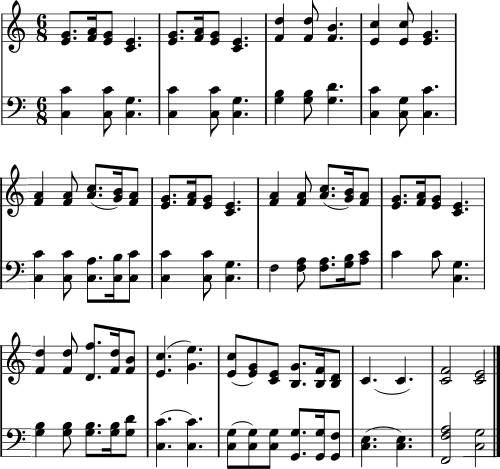
MIDI file (music)
THE END

THE COUNTRY LIFE PRESS GARDEN CITY, N.Y.
Title Page
On Christmas Day In The Evening by Grace S. Richmond Illustrated by Charles M. Relyea A. L. Burt Company Publishers New York
In the original text, each individual page was surrounded by a decorative border: