ON THE INHALATION OF CHLOROFORM, ETC. (continued 2)
Reading edition
The person who is about to inhale chloroform is occasionally in a state of alarm, either about that agent itself or the operation which calls for its use. It is desirable to allay the patient’s fears, if possible, before he begins to inhale, as he will then be able to breathe in a more regular and tranquil manner. In a few cases, however, the apprehensions of the patient cannot be removed, and they subside only as he becomes unconscious from the inhalation. It has been said that chloroform ought not to be administered if the patient is very much afraid, on the supposition that fear makes the chloroform dangerous. This is, however, a mistake; the danger, if any, lies in the fear itself. Two cases will be related hereafter in which the patients died suddenly from fear, whilst they were beginning to inhale chloroform, and before they were affected by it; but the probability is that, if they had lived till the chloroform took effect, they would have been as safe as other patients who inhaled it. If chloroform were denied to the patients who are much afraid, the nervous and feeble, who most require it, would often be deprived of its benefits. Moreover, the patients would either be prevented altogether from having the advantage of surgery, or they would be subjected to the still greater fear of the pain, as well as the pain itself; for whatever undefined and unreasoning fears a patient may have when the moment comes for inhaling chloroform, he has only chosen to inhale it on account of a still greater fear of pain.
77Fear and chloroform are each of them capable of causing death, just as infancy and old age both predispose to bronchitis, but it seems impossible that fear should combine with the effects of chloroform to cause danger, when that agent is administered with the usual precautions. Fear is an affection of the mind, and can no longer exist when the patient is unconscious; but the action of that amount of chloroform which is consistent even with disordered consciousness is stimulating, and increases the force and frequency of the pulse, in the same way as alcohol. I believe that no one would assert that a person would die the sooner of fright for having taken a few glasses of wine, or a small amount of distilled spirits, whatever might be the state of his health. When chloroform has been absorbed in sufficient quantity to cause unconsciousness, fear subsides, and with the fear its effects on the circulation. It is a subject of almost daily observation with me that the pulse, which is extremely rapid from some ill defined apprehension, when certain patients begin to inhale chloroform, settles down to its natural frequency after they become unconscious.
The practice I have always followed has been to try to calm the patient, by the assurance that there was nothing to apprehend from the chloroform, and that it would be sure to prevent all pain; but where it has been impossible to remove the fears of the patient in this way, I have always proceeded to remove them by causing a state of unconsciousness. It would of course be wrong to choose a moment for beginning the inhalation, when fear was producing a very marked depression of the circulation. On feeling the pulse of a gentleman, about twenty-one years of age, in March 1855, who had just seated himself in the chair to take chloroform, previous to having some teeth extracted, by Mr. Thos. A. Rogers, I found it to be small, weak, and intermitting, and it became more feeble as I was feeling it. 78I told the patient that he would feel no pain, and that he had nothing whatever to apprehend. His pulse immediately improved. He inhaled the chloroform, had his teeth extracted, woke up, and recovered without any feeling of depression. Now if the inhalation had been commenced in this case, without inquiry or explanation, the syncope which seemed approaching would probably have taken place, and it would have had the appearance of being caused by the chloroform, although not so in reality.
MODE OF ADMINISTERING CHLOROFORM.
The experiments previously related show that air containing rather less than two grains of chloroform, in one hundred cubic inches, is capable of causing a state of insensibility, sufficiently deep for surgical operations; but in a creature the size of the human being, an inconvenient length of time would be occupied in causing insensibility with vapour so much diluted. About four cubic inches of vapour, or rather more than five grains of chloroform to each hundred cubic inches of air, is the proportion which I have found most suitable in practice for causing insensibility to surgical operations. In medical and obstetric cases, it should be inhaled in a more diluted form.
Dr. Simpson recommended chloroform to be administered on a handkerchief—the method in which sulphuric ether was administered by Dr. Morton, in the first case in which he exhibited that medicine. The objection to giving chloroform on a handkerchief, especially in surgical operations, where it is necessary to cause insensibility, is that the proportions of vapour and of air which the patient breathes cannot be properly regulated. Indeed, the advocates of this plan proceed on the supposition that there is no occasion to regulate these proportions, and that it is only requisite that the patient should have sufficient air for the purposes of 79respiration, and sufficient chloroform to induce insensibility, and all will be right.[53] The truth is, however, that if there be too much vapour of chloroform in the air the patient breathes, it may cause sudden death, even without previous insensibility, and whilst the blood in the lungs is of a florid colour. Chloroform may indeed be inhaled freely from a handkerchief without danger, when it is diluted with one or two parts by measure of spirits of wine, but the chloroform evaporates in largest quantity at first, and less afterwards, until a portion of the spirit is left behind by itself. The process, however, of inhaling chloroform from a handkerchief is always uncertain and irregular, and is apt to confirm the belief in peculiarities of constitution, idiosyncrasies and predispositions, which have no existence in the patient.[54]
80The most exact way in which it is practicable to exhibit chloroform to a patient about to undergo an operation, is to introduce a measured quantity into a bag or balloon of known size, then to fill it up by means of the bellows, and allow the patient to inhale from it; the expired air being prevented from returning into the balloon, by one of the valves of the face-piece to which it is attached. I tried this plan in a few cases, in 1849, with so much chloroform in the balloon as produced four per cent. of vapour in proportion to the air. The effects were extremely uniform, the patients becoming insensible in three or four minutes, according to the greater or less freedom of respiration; and the vapour was easily breathed, owing to its being so equally mixed with the air. I did not try, however, to introduce this plan into general use, as the balloon would sometimes have been in the way of the surgeon, and filling it with the bellows would have occasioned a little trouble. It seemed necessary to sacrifice a little of absolute perfection to convenience, and I therefore continued the plan which I had already followed.
The great point to be observed in causing insensibility by any narcotic vapour, is to present to the patient such a mixture of vapour and air as will produce its effects gradually, and enable the medical man to stop at the right moment. Insensibility is not caused so much by giving a dose as by performing a process. Nature supplies but one mixture of diluted oxygen, from which each creature draws as much as it requires, and so, in causing narcotism by inhalation, if a proper mixture of air and vapour is supplied, each patient will gradually inhale the requisite quantity of the latter to cause insensibility, according to his size and strength. It is indeed desirable to vary the proportions of vapour and air, but rather according to the purpose one has in view, whether medicinal, obstetric, or surgical, than on 81account of the age or strength of the patient; for the respiratory process bears such a relation to the latter circumstances, as to cause each person to draw his own proper dose from a similar atmosphere in a suitable time.
The inhaler represented in the adjoining engraving is, with some slight alterations, the same that I have employed since the latter part of 1847. It is made of metal, and consists of a double cylinder, the outer space of which contains cold water, and the inner serves for the evaporation of the chloroform which the patient is to breathe. Into the inner part of the cylinder there is screwed a frame, having numerous openings for the admission of air, and four stout wires which descend nearly to the bottom of the space, and are intended to support two coils of stout bibulous paper, which are tied round them, and reach to the bottom of the inhaler. In the lower part of this paper four notches are cut, to allow the air to pass in the direction indicated by the arrows. As the quantity of chloroform which is put in should never fill the apertures or notches, the air which passes through the inhaler meets with no obstruction whatever. There is a glass tube communicating with the interior of the inhaler, and passing to the outside, to enable the operator to see when the chloroform requires to be renewed. The elastic tube which connects the inhaler to the face-piece is three-quarters of an inch in internal diameter, to allow of the passage of as much air as the patient can possibly breathe. On the introduction of the practice of inhaling sulphuric ether there was no tubing in this country fit to be breathed through; that in ordinary use was only about one-third, or three-eighths of an inch in diameter,—not more than a quarter of the proper calibre.
82
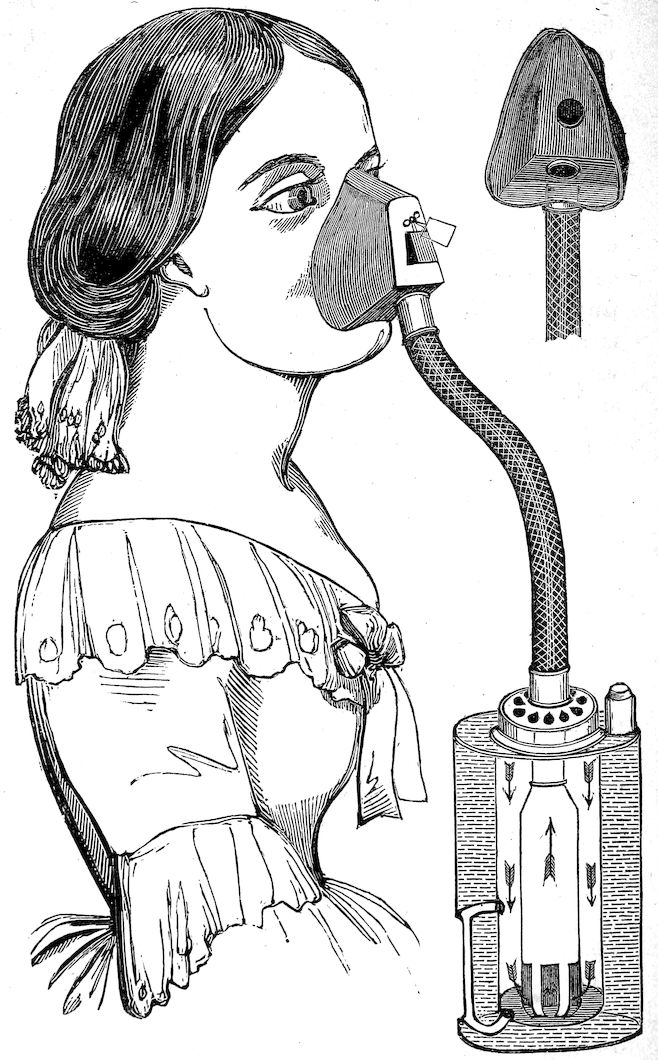
83The face-piece, to include both the mouth and nostrils, of which that shown in the engraving is one of the modifications, is one of the greatest mechanical aids to the process of inhalation which has been contrived in modern times. Dr. Francis Sibson is its inventor. Dr. Hawkesley did indeed contrive a very similar one about the same time as Dr. Sibson,—early in 1847,—but he did not make it known. Dr. Ingen Housz made patients inhale oxygen through the nostrils by means of a bottle of India rubber with the bottom cut off; and Mr. Waugh, of Regent Street, had more recently contrived a mouth-piece to be adapted outside the lips, but the usual practice of inhalation previous to 1847, was for the patient to draw in the medicated air by means of a tube placed in the mouth. This led generally to great awkwardness at first, as the patient usually began to puff as if he were smoking a pipe; and it had the further inconvenience, in the administration of ether, that the tube dropped from the mouth, and the patient began to breathe by the nostrils, just as he was getting unconscious. The sides of the face-piece delineated in the engraving are made of thin sheet lead, which is pliable, and enables it to be adapted exactly to the inequalities of the face, and the patient can breathe either by the nostrils or mouth, just as his will, or instinct, or other nervous functions, determine.
I have introduced two valves into this face-piece, one which rises on inspiration, to admit the air and vapour from the inhaler, and closes again on expiration, and the other which rises to allow the expired air to escape. I contrived the latter valve to turn more or less to one side, as indicated by the additional line in the engraving, and thus admit more or less of the external air to dilute still further that which has passed through the inhaler, and become charged with vapour. By this means the patient can begin by breathing air containing very little vapour, and more and more of the air which has passed over the moistened bibulous paper can be admitted, as the air-passages become blunted to the pungency of the vapour.
84The object of the water-bath is to supply the caloric which is rendered latent, and carried off, as the chloroform is converted into vapour, and thus to render the process of inhalation steady and uniform. Without the water-bath, the evaporation of the chloroform would soon reduce the temperature of the inhaler below the freezing point of water, and limit very much the amount of vapour the patient would inhale; and if the apparatus were warmed by the hand, the temperature would be too high, and the amount of vapour too great. A medical author of great reputation in Paris sent to inquire at what temperature I used the water-bath, and being informed, at the ordinary temperature, published his opinion that it had no effect, and might as well be left off. He appeared not to have considered the relations of heat, either to liquids or vapours.
In arranging the bibulous paper in the inhaler, it is my object to contrive that the air passing through, in the ordinary process of inhalation, and at the ordinary temperature of about 60°, shall take up about five per cent. of vapour. This quantity can be diminished, as much as is desired, by turning the expiratory valve of the face-piece a little to one side; and in winter I usually place a short coil of bibulous paper against the outer circumference of the inside of the inhaler, in addition to the central coils which are delineated.
I commonly put two, or two and a half, fluid drachms of chloroform into the inhaler at first. About a drachm of this is absorbed by the filtering paper, and the rest remains at the bottom of the inhaler; and in a protracted operation, when it is seen, by means of the glass tube, that the latter part of the chloroform has disappeared, more is added, by a drachm or so at a time, to prevent the paper ever becoming dry. Mr. Matthews, 8, Portugal Street, Lincoln’s Inn Fields, makes the inhaler. There are smaller face-pieces for 85children. The patient never inhales in so upright a posture as the artist has represented.
There are several other kinds of apparatus in use for the inhalation of chloroform. The most usual consist of Dr. Sibson’s face-piece more or less altered, and with a small piece of sponge placed inside. The apparatus which is in most reputation on the continent is that of M. Charrière; it consists of a glass vase with suitable valves, and a fabric for exposing a surface wetted with chloroform to the air which passes through it.
M. Duroy, of Paris, has contrived an ingenious, but very complicated, apparatus, which he calls an anæsthesimeter. The object of it is to regulate the amount of chloroform which is inhaled in a given time, and this can be varied from four to sixty drops in the minute; but the experiments which I have related show that the quantity of chloroform employed is not so important as the proportion of it in the inspired air; and although each of these circumstances has considerable influence over the other, in many cases there are conditions in which no regular relation exists between them. For instance, if the inhaler were supplied with sixty drops of chloroform per minute, these sixty drops weigh twenty grains, and produce 15·3 cubic inches of vapour; and if an adult patient were breathing the average quantity of four hundred cubic inches per minute, the air he would breathe would contain nearly four per cent. of vapour, which would answer extremely well; but if the breathing were slow or feeble, or if he should hold his breath for an interval and commence again, he might breathe air much more highly charged with vapour. Indeed it would depend on the amount of surface moistened with chloroform, the temperature of the air, and other physical conditions, whether or not the air he inhaled might not be charged with chloroform to a dangerous degree; whilst, on the other hand, if 86the breathing were deep and rapid, as often happens whilst the patient is getting slightly under the influence of the chloroform;—if, for instance, the patient were to breathe at the rate of 1,600 cubic inches, instead of 400, the air he would inhale would contain less than one per cent. of vapour, and he would not become insensible with the utmost supply of the anæsthesimeter, till his breathing should be moderated. M. Duroy also follows the rude and objectionable plan of using a nose clasp, and thus compelling the patient to breathe by the mouth alone.
It is advisable to request the patient to breathe gently and quietly, when he commences to inhale chloroform; in other words, to do nothing but conduct himself as if he were about to fall asleep naturally; for, if he breathes deeply, the vapour feels much more pungent than it otherwise would do, and is apt to excite coughing, or a feeling of suffocation.
In using the inhaler described above, the patient should commence to inhale with the expiratory valve of the face-piece turned on one side, and it should be gradually advanced to the required extent, over the opening it is intended to cover, as the sensibility of the lungs becomes diminished. Not only patients with phthisis or bronchitis, but many sensitive and irritable persons with sound lungs, have a great intolerance of the vapour of chloroform at first, on account of its pungency; and it is necessary to occupy two or three minutes in gradually commencing the inhalation, before the patient makes any appreciable progress towards insensibility. In administering chloroform to children also, it is desirable to begin very gently; by this means, and with a little persuasion, one generally succeeds in getting them to inhale voluntarily; although, occasionally, it is necessary to use a little force to accomplish one’s purpose.
87In certain cases of the medicinal application of chloroform, and also in obstetric cases, where the pains are not severe, it is unnecessary to render the patient unconscious, but for surgical operations this is nearly always requisite. No force should ever be employed so long as the patient is conscious, unless it be to children or lunatics; but some patients become excited as soon as they are unconscious, and attempt to leave the couch, or push away the chloroform; under such circumstances, if they cannot be calmed by what is said to them, they should be held, and the vapour should be steadily and gently continued, for a minute or two, till a state of quietude is produced. By far the greater number of patients remain quiet as they become unconscious, but there is no difficulty in ascertaining whether a patient is unconscious or not. If the eyelids remain open, the countenance shows whether the patient is conscious or not; and, if they are closed, it is only necessary to touch them gently, to ascertain this circumstance. If he is still conscious, he will look at his medical man, and probably speak, or, at all events, show intelligence in his countenance.
Signs of Insensibility. The absence of consciousness, and a state of quietude, are both requisite before the commencement of a surgical operation, and they go a good way towards the preparation of a patient for it, but these symptoms may be present and the patient not be ready for an operation. The surgeon wishes to know whether he will lie still under the knife, or whether he will make a resistance and outcry which he would probably not make in his waking state. Some surgeons have recommended that the patient should be pricked with the point of a knife or some other instrument. This is not a good or satisfactory plan, however, for a person will often show no sign of feeling a slight prick, when a severe incision would rouse him to resistance. A more elegant and successful plan is to 88raise the eyelid gently, by placing one finger just below the eyebrow, and then to touch its ciliary border very lightly with another finger. This should not be done roughly nor too frequently, for fear of exhausting the sensibility when it is slight. Just after unconsciousness is induced, the eyelids are often closed very strongly when their margins are touched, especially in females, and there seems to be a positive hyperæsthesia; this, however, is only apparent, and arises from the control of the will being removed, whilst sensibility remains. By continuing the chloroform, the sensibility of the edges of the eyelids diminishes until, at last, they may be touched without causing winking. Under these circumstances, the most severe operation may, in almost every case, be commenced without sign of pain. I have employed this test of the sensibility or insensibility of the patient ever since chloroform has been in use, and also in the employment of ether in 1847, and I am satisfied that it affords more reliable information on this point than any other single symptom. It even indicates the amount of sensibility where a little remains; when, for instance, touching the margin of the eyelids causes very slight and languid winking, the patient will commonly flinch a little if the knife is used, but only in a manner that can be easily restrained, and will not interfere with the majority of operations. The cases, in which the indication afforded by the eyelids is not always to be depended on, are those of hysterical patients, in whom there is sometimes no winking on touching the eyelids, even when unconsciousness is scarcely induced. In such cases, one must judge by the other symptoms, and also by the length of time the patient has inhaled, the strength of the vapour, and depth and activity of the breathing. Indeed, these conditions should be observed and taken into account in every case; and all the symptoms exhibited by the patient should be watched, such 89as the expression of the face, the state of the breathing, and the condition of the limbs with regard to their tension or relaxation. The last is indeed sometimes relied on as the chief or sole sign whether the operation may be commenced, but it is of itself very insufficient, and even fallacious. The patient may allow his limbs to lie relaxed when he is scarcely unconscious, and not at all insensible, merely because he is not exerting his will upon them; if the arm is lifted, it may fall listlessly down again, at a time when the knife of the surgeon would rouse the patient to active resistance. Indeed, the limbs, which have been lying relaxed, may become tense as the effect of the chloroform increases, and may remain so during a short operation, in which there is no sign of pain.
Although the pulse of itself gives no indication as to how far a patient is under the influence of chloroform, it is proper to pay attention to it, not only during the first administration of the chloroform, but also throughout the operation, especially if it be attended with much bleeding. The pulse sometimes becomes intermittent or irregular during the administration of chloroform, more especially in elderly persons. This more commonly happens in the first exhibition of it, than when it is repeated during the course of an operation. I have not seen any harm from either of these conditions, but it is well to intermit the chloroform for ten or fifteen seconds, and let the patient have a few inspirations without it, if the pulse is not in a satisfactory condition. If the precaution be taken to ensure that the air the patient breathes shall never contain more than five per cent. of vapour, the pulse can never be seriously affected by the direct action of the chloroform, and the state of the breathing affords the best warning against continuing the inhalation too long at a time.
The breathing is fortunately also a sign that cannot be 90overlooked. It is by the breath that the chloroform enters, and it is extremely improbable that any one would go on giving the vapour after the breathing became stertorous and laboured.
The patient sometimes holds his breath after he is unconscious, and before he is insensible; this occurs under two conditions: first, after deep and rapid breathing, during which the patient seems to absorb more oxygen than is immediately required, under the circumstances; and in this condition, I have known him hold his breath for a whole minute, whilst the pulse was unaffected. The other condition in which the breathing is suspended, is when there is rigidity in the third degree of narcotism, and the respiratory muscles seem to partake of the general rigidity; the holding of the breath in these cases seldom continues so long as under the former circumstances. I do not consider that there is any danger from either of these kinds of suspension of breathing. I believe it always returns as soon as there is a want of oxygen in the system. Of course the inhaler need not be applied to the face when the patient is not breathing, and he may as well have an inspiration or two without chloroform when the breathing is renewed. It is seldom requisite to carry the effects of chloroform so far that the breathing becomes stertorous, and whenever stertor is observed, the inhalation should be suspended; under these circumstances, the patient is always insensible. In some cases, in which a little more chloroform has been inhaled than is necessary, the patient breathes for half a minute or so by the diaphragm only, and breathes in fact hardly at all. The abdomen rises and falls freely, but, from the muscles of the chest not fixing the ribs, hardly any air enters the lungs, and the face becomes rather livid; meanwhile the pulse goes on very well, and at last the patient draws a deep, sonorous inspiration, the face resumes its 91proper colour, and all is right again. I have not heard of any accident from chloroform commencing in this manner. This state of breathing, when it does occur, usually takes place a few seconds after the inhalation has been left off, and arises from the accumulation of the effects of the chloroform, owing to the absorption into the system of the vapour which was contained in the lungs at the time when the inhalation was discontinued.[55] This accumulation or increase of the effects of chloroform lasts for about twenty seconds; it is not dangerous unless the vapour is inhaled of too great strength, but it should be borne in mind in all cases. It may be prevented altogether, by reducing the strength of the vapour, just as the patient is getting insensible, or by giving it with intermissions of a few seconds, at this time.
The rigidity and struggling previously mentioned (pages 39 and 50) as occurring occasionally in the third degree of narcotism, more particularly in robust persons, often form a very prominent feature in the effects of chloroform; and have sometimes caused the medical man to discontinue the exhibition of chloroform, under the belief that it did not agree with the constitution of the patient, and that its further exhibition would be unsafe. The proper course to pursue is to continue the inhalation gently, till the struggling and rigidity are subdued. The patient is often insensible before these symptoms are subdued, but it is necessary to have him quiet, in order to enable the surgeon to operate with convenience and safety. I have always succeeded in subduing the involuntary struggling and rigidity, but have 92occasionally occupied five or six minutes in doing so. It is desirable to proceed slowly and cautiously, because, when these symptoms occur, the patient has already absorbed nearly the usual quantity of chloroform, and he often holds his breath, and then takes a sudden and deep inspiration, when he might inhale an overdose of vapour, unless it were presented to him in a well diluted state.
When the rigidity and struggling are subdued, the breathing, in some cases, becomes stertorous, and relaxation of the muscles takes place, the limbs appearing quite flaccid; but by proceeding gently, these effects may generally be avoided, and the patient becomes quiet, whilst the breathing is natural, and the muscles are in a moderate state of tension. If the operator should be afraid to proceed with the exhibition of chloroform, on account of the violence of the muscular spasm and rigidity, it will be satisfactory to him to know that, if the inhalation is resumed in a few minutes, these symptoms will be less violent than at first.
Struggling and rigidity are less likely to occur, when chloroform is administered slowly, than under opposite circumstances; but it is impossible to prevent these phenomena altogether in certain patients. After they are once subdued, they but very rarely recur during the operation; the patient, in most cases, seems to take on, when he is subdued by the chloroform, the same relation to it that women, children, and persons in a state of debility have from the first. M. Chassaignac has called this condition one of tolerance of the chloroform. It is a condition in which the patient bears both the chloroform and the operation very comfortably; but tolerance of a medicine is generally meant to imply that the patient can take it in larger quantity than before. But this is the reverse of what occurs when the patient is in a tranquil state from chloroform; he has already absorbed a considerable quantity, which has most likely penetrated 93deeply into the tissues, and he certainly does not require, and could not bear, so much as in the earlier stage of inhalation, where he is restless and breathing more quickly, and thus exhaling and getting rid of the chloroform at a greater rate.
It might be a question whether the absence of muscular excitement, in a number of cases, does not arise from the circumstance that anæsthesia, or absence of common sensibility, is obtained, and the operation performed, at a stage of narcotism anterior to that in which the muscular rigidity and spasm occur. This is true in a few cases, but I am satisfied by careful observation that, in the greater number of instances in which muscular excitement is absent, it would not occur at all, though the inhalation should be pushed to the most extreme degree. Many animals also are killed by chloroform without the least excitement of the muscular system occurring at any part of the process.
The pupils of the eyes are dilated in the deep state of insensibility which I have called the fourth degree of narcotism, but it is desirable to avoid carrying the effects of chloroform to this extent. They are occasionally dilated, however, under the slighter effects of chloroform, and even as the patient is recovering from its effects. In the third degree of narcotism, when the eyes are turned upwards, the pupils are usually, if not always, contracted; there seems to be a consentaneous action in the iris and the muscles which turn up the eye. The pupils seem also to be less sensitive to light, when the patient is insensible from chloroform, than at other times. This is all the information I am able to give about the pupils. Some writers have entered into a good deal of detail about the pupils, but their statements are very conflicting. The pupils are acted on by other causes, both external and internal, as well as the chloroform. The amount of light has great effect on them; and I have 94seen them remain dilated for some time after the chloroform was discontinued, and then suddenly contract, as the patient began to use his eyes. Even if definite laws could be ascertained with regard to the action of chloroform on the pupils, in different doses, and under different conditions, there would be some difficulty in applying them during the administration of the vapour, as the patient cannot be made to direct his eyes to or from the light. There is also some difficulty in making correct observations on the pupils. Very often, when I am exhibiting chloroform, one of the bystanders lifts the patient’s eyelid and makes a remark on the state of the pupil, and, on my looking in the face of the speaker, I often have occasion to tell him that his own pupils are quite as much dilated, or contracted, as the case may be.
With regard to the position of the eyes, they are usually turned upwards in the third degree of narcotism, as I have already said, but in a considerable number of instances they retain their usual position all through the inhalation. In a few cases, they are turned downwards, the pupils being almost hid under the lower eyelids, and causing a curious expression. I have noticed this most frequently in children of ten to fourteen years of age. I have scarcely ever seen temporary strabismus under the influence of chloroform.
The length of time which it is most desirable to occupy in the administration of chloroform, before the commencement of an operation, is about two minutes in infants, three minutes in children, and four or five minutes in adults. Circumstances occasionally occur, however, to lengthen these periods. The time during which the adult patient usually remains conscious whilst inhaling, is about two and a half minutes, but this period is sometimes prolonged from the nervousness of the patient, or his intolerance of the pungency of the vapour. Again, when unconsciousness is 95induced, there is, in many cases, an increased flow of saliva; and although this usually causes no impediment, the patient sometimes keeps making efforts of deglutition which very much retard the inhalation; and, at other times, he holds his breath, with his mouth full of saliva, as if he had some obscure idea of disposing of it in a suitable manner.[56] The delay which often arises from the struggling and rigidity has been already mentioned; but notwithstanding all these circumstances, it hardly ever takes more than seven or eight minutes to make a patient sufficiently insensible.
I have indeed met with a few cases in which a longer time has been occupied, but there has always been a physical reason for it. I have never had occasion to attribute the delay to any idiosyncracy, or great peculiarity in the patient, but only to the circumstance that the vapour did not enter the lungs in sufficient quantity within a given time. I have had under my care several patients who, it was supposed, were not susceptible of the effects of chloroform, or were, at least, very difficult to bring under its influence, as previous attempts had failed. It so happens, however, that I have had no difficulty whatever with any of these cases.
Two or three female patients who were about to undergo some trifling operation, preferred to leave off before they were unconscious, on account of unpleasant sensations in the head or chest, and to have the operation performed without the full effects of the chloroform; but there is no doubt the agent would have acted well enough if it had been continued.
The following case will show that chloroform may be inhaled 96with advantage in cases which at first seem very unfavourable. I received a note in 1849 from a medical man in the country, in which he says:—“I have now a young lady under my charge, from whom I am about to remove a tumour attached to the ear. She is anxious to take chloroform, and by the desire of herself and mother, I yesterday administered it by way of trial, but only to what would be termed the second, and perhaps you would say, the first degree. She lost some sensation, but was quite conscious, and spoke. She felt giddy; there was tumultuous beating of the heart, and a much accelerated pulse, with a dilated pupil; a perfect coldness over the whole skin, with an equally cold perspiration; and, during recovery from this slight effect, severe tremors of the whole body, so much so as to shake the couch on which she was lying. From this state she did not recover for nearly an hour. She complained of great giddiness and oppression at her chest. She is a healthy-looking, florid girl, but not strong, and has had, from time to time, severe spasm affecting her chest, so much so as to take away her breath. I have thus endeavoured to give you an outline of the constitution of my patient, how she had suffered, and what were the effects of the small dose of chloroform given by an inhaler. I never witnessed such extreme cold, tremor, or such tumultuous action of the heart; and am therefore anxious for the opinion of one who has administered chloroform under a greater variety of circumstances than myself, and to learn whether the symptoms I have described are sufficient to deter one from giving a sufficient dose to cause entire suspension of consciousness. My own impression is that they are sufficient to deter, but the patient and her friends being both anxious it should be inhaled if possible, I shall only be too glad to hear that you have witnessed like symptoms, and that you do not consider them sufficient indications of danger to deter me from its careful administration in the case.”
97I advised that the chloroform should be administered again, and continued steadily till the patient should become insensible; expressing my belief that the unpleasant symptoms would subside as unconsciousness was induced. I received a reply to the effect that the operation had been performed very successfully under the influence of chloroform, although the vapour had an exciting effect for some time.
Repetition of Chloroform during an Operation. The first application of chloroform often suffices for an operation, if it be of short duration, without repeating the inhalation. In a few cases the patient remains insensible to the knife for three minutes after the inhalation is left off, but this is an exception; and one cannot, at all events, make sure of this prolonged effect of chloroform, without producing a deeper state of narcotism than is desirable. More usually, if the operation lasts more than a minute or two, it is necessary to repeat the inhalation; it is, indeed, generally desirable to let the patient have a few inspirations of air charged with chloroform vapour every half minute or so, whilst the operation continues, in order to keep up the insensibility. When the surgeon is cutting in the neighbourhood of important parts, it is desirable to prevent any sign of sensibility, and to keep repeating the chloroform so as to keep up the coma, without, however, causing embarrassment of the breathing, or wide dilatation of the pupil. In the greater number of operations, however, it is better to wait till there is some sign of sensibility, such as a slight cry or tendency to flinch, before the inhalation is resumed; and then a few inspirations of well diluted vapour make the patient quiet again.
RECOVERY FROM THE EFFECTS OF CHLOROFORM.
As soon as a patient has ceased to inhale, the chloroform 98begins to exhale in the form of vapour from the blood as it passes through the lungs. It cannot be detected by the sense of smell, after the lungs have been emptied, by two or three expirations, of the vapour they contained at the moment when the inhalation was discontinued; but I have detected it by chemical means, after consciousness had returned. The chloroform exhales in greatest quantity at first, and the patient usually recovers his sensibility and consciousness in the time which it ought to take for the chief part of the chloroform to be exhaled, according to mechanical principles; as will be explained in treating of the modus operandi of this agent. The last traces of the chloroform of course exhale more slowly, and a very minute and insignificant quantity may remain for a considerable period in the system, not only of the patient, but of anyone who was standing by whilst he inhaled.
It is probable that a small portion of chloroform passes out by other channels than that of the expired air: the latter, however, offers such a ready and expeditious outlet, that the quantity excreted in any other way is, most likely, very minute. I have on four occasions examined urine passed after the inhalation of chloroform, by boiling it in a flask, and passing the vapour, first through a red-hot tube, and afterwards through a tube moistened inside with solution of nitrate of silver, and I only on one occasion obtained a very slight precipitate of chloride of silver.
The patient usually becomes conscious within five minutes after the inhalation has been discontinued. After a short inhalation, for a very brief operation, consciousness sometimes returns immediately, and after a prolonged inhalation the recovery of consciousness is sometimes retarded till ten minutes have elapsed. Old people are often longer than others in awaking from the effects of chloroform, owing, no doubt, to their slower breathing and circulation. Children, 99on the other hand, usually recover very quickly from its direct effects; but they often lapse into a natural sleep which lasts a considerable time—even for hours if they are not disturbed, and if the operation has left no painful wound or other cause of uneasiness.
It is desirable not to talk to the patient as he is recovering from the effects of chloroform, but to leave him to collect his ideas, and not speak to him till he is quite conscious, or makes some remark or inquiry himself. If not prevented by the medical attendant, the friends of the patient often address him the moment he opens his eyes; and the words they generally use are of a very equivocal meaning to one who cannot understand their application. They usually say “It’s all over”, which very often has the effect of raising an indefinite feeling of alarm in the patient; for, until he has had time to recover his memory, the operation he was to undergo is generally the farthest thing from his mind. When left to himself the patient usually recovers from the insensibility in a very tranquil manner. If he has not been moved whilst insensible, and awakes in the position in which he fell asleep, he supposes, very commonly, that he has not been asleep at all; and in a great number of instances will contend this point very stoutly, even after a protracted operation, and assert that the chloroform has not taken effect. It is as well to let him remain in this conceit for a while, or even till he finds out the mistake himself; for, if reminded of the pain they have been spared, just on waking after an operation, persons are liable to be excited by emotions of pleasure and gratitude; but a few minutes later, when the effects of the chloroform have more completely subsided, they are better able to control their emotions. A few persons wake with a full recollection of the preceding circumstances, and inquire if the operation is done; whilst others, on first 100awaking, are still entirely occupied with the subject of their dreams.
The greater number of patients who inhale chloroform have to remain in bed on account of the operation which has been performed, but after minor operations, the patient is sometimes able to walk away within five minutes; although more frequently there is a little languor or feeling of fatigue for half an hour or so; and it is desirable in all cases for the patient to sit or lie quietly for this space of time, if not longer, before he makes any mental or bodily exertion, even if he feels quite well.
OCCASIONAL SEQUELÆ OF THE INHALATION OF CHLOROFORM.
Sickness. The chief drawback to the benefits conferred by chloroform is the sickness which in many cases follows its use. It is most frequent when the inhalation takes place soon after a meal, and some of the precautions which are requisite in order to avoid this symptom, or render it as rare as possible, have already been described (p. 74); but it occurs in certain cases, notwithstanding the best measures which may be used for its prevention. Moving the patient as the effects of the chloroform are subsiding is very apt to excite vomiting when it might not otherwise occur; it is therefore desirable, when convenient, to allow the patient to lie for half an hour or so, without moving his head from the pillow. By this means, even when a feeling of nausea is present, it often subsides without the occurrence of vomiting. It is advisable also not to give the patient anything to eat or drink till about an hour after the inhalation, and, as a general rule, not even then, unless there is some inclination for it; for if anything is taken into the stomach before the effects of the chloroform have entirely subsided, it is apt to excite vomiting. Even medicine, such as an opiate, is better delayed for an hour or upwards, 101unless there is an urgent necessity for giving it sooner. Severe faintness from loss of blood during an operation of course forms an exception to this rule; in such a case brandy and water should be given, and repeated if it should be vomited.
These rules respecting food are, moreover, meant to apply only to the use of chloroform in surgical operations, and not to its employment during labour. Under the latter circumstances, one allows the patient all the nourishment that is desirable, intermitting the inhalation now and then for the purpose. And chloroform, given in the moderate way in which it is employed in labour, hardly ever causes sickness, but often alleviates it when present from physiological causes.
The sickness induced by chloroform usually subsides of itself in the course of an hour, or even less; I, therefore, think it advisable not to do anything for it during this space of time. When it has continued beyond this period, I have found a little cold brandy and water to remove it in most cases; and when the tendency to vomit still remained after a few hours, I have seen it removed by a dose of opium. Effervescing draughts have not appeared to be of service in the sickness from chloroform, and sal volatile and draughts of warm water seem injurious. It is desirable for the patient to make no effort, but only to vomit if obliged to do so.
Several cases have come within my knowledge, in which the sickness has continued for two or three days after every thing that was taken into the stomach. These cases have not been under my care, but under that of the surgeon. I have been informed, however, that all the usual remedies for sickness were applied for the time mentioned above without success. The cases in which the sickness lasts so long form but a very small portion of the whole number in 102which chloroform is administered, and they chiefly occur in persons who are subject to attacks of vomiting from slight causes, or, as they say, to bilious attacks.
The most usual time for the vomiting to commence is when the inhalation has been discontinued, and the effects of the chloroform are passing of. In many cases, it occurs before the patient has become quite conscious, and he does not know that it has occurred unless he is told. In a few cases, especially where there is a good deal of food in the stomach, the vomiting comes on before the operation is finished, or even before it is commenced. When vomiting comes on during an operation, it is apt to interfere with the inhalation, and it is sometimes difficult to prevent the patient from waking; but this can be accomplished by wiping the patient’s mouth, and reapplying the chloroform, the moment the act of vomiting ceases. In many cases, however, the sickness does not come on till the patient is quite awake, and perhaps, even then, not until he moves. I believe that the sickness which is due to chloroform always commences within an hour or two, or at the farthest, just after the first food which is taken. I have known vomiting attributed to the chloroform which did not occur till the following day, but I ascertained that a dose of opium had been taken at night, and it was to this that the sickness was probably owing. In those cases where the chloroform does cause sickness in the first instance, it is not always the cause of all the vomiting which the patient may suffer. If the patient becomes infected or is inoculated with the poison of erysipelas or hospital gangrene at the time of the operation, he will probably be attacked with vomiting a day or two afterwards; and if sickness has already been caused by the chloroform, that which is due to disease may appear to be a continuation of it.
Soon after the introduction of chloroform, I administered 103it to a gentleman, aged about 55, whilst a fatty tumour was removed from the nape of the neck. It did not turn out as fatty tumours usually do, but required to be dissected out. The patient had taken a meal before the operation, and vomited freely afterwards. On his visit the next morning, the surgeon thought his patient going on well. Vomiting returned, however, and the patient became affected with partial stupor and delirium, which his friends attributed to the chloroform. He became covered with an eruption of erysipelas over a great part of the body, had a very rapid pulse with great depression, and died on the fifth day. An examination after death showed that there had been diffuse cellular inflammation around the seat of the operation. A surgeon who assisted at the operation on the above patient, and also at the post-mortem examination, removed an encysted tumour from the scalp of an old lady the day following the latter event. This operation was performed without chloroform, but the patient was attacked with erysipelas and diffuse cellular information, and died in three or four days.
Faintness and Depression. Although chloroform acts as a stimulant to the circulation, increasing the force and frequency of the pulse whilst it is being inhaled, it is occasionally followed by a feeling of faintness, especially if the patient remains in the sitting posture. At one period in the history of medical opinion, it would have been said that the depression was a consequence of the previous excitement. The facts, however, would not agree with such a doctrine. The subjects who are most stimulated by chloroform are the strong and robust, and they do not suffer from depression afterwards; whilst the feeble and debilitated, who are most liable to subsequent depression, are but little stimulated by it at the time of inhaling. Some amount of faintness and depression usually accompanies the sickness 104caused by chloroform, and is in fact a consequence of it, being, like the sickness, most frequent after a full meal. This depression is usually relieved by vomiting. I have met with a few cases in which there has been more decided faintness, and once or twice absolute syncope after chloroform, which was not attributable to loss of blood. In these cases, however, the patients were in the sitting posture, and they recovered from the syncope immediately, on being placed horizontally. The patients most subject to faintness after chloroform are those who are subject to this affection at other times, being often persons in a state of anæmia, or having the symptoms of fatty degeneration of the heart. Faintness is, however, very much more rare after operations with chloroform than without it. The only cases in which I have seen it follow the use of chloroform in the horizontal position, and where there was no considerable loss of blood, have been two or three of operations on the rectum, performed before breakfast, and after a brisk purgative had been taken the previous night. It might be advisable, where persons in a state of debility have taken a purgative, to make an exception to the usual rule of prohibiting the breakfast, and to risk the inconvenience of vomiting rather than the more formidable symptoms of faintness from inanition.
The faintness which now and then follows an operation under chloroform should be treated on ordinary principles, as the horizontal posture, the application of the vapour of ammonia to the nostrils, and the exhibition of brandy or wine, if the other measures do not suffice. I never give ammonia internally where a patient is sick or faint, but the spirit of sal volatile, when at hand, serves very well to pour on the corner of a towel and apply to the nostrils.
Hysteria. I have already stated (p. 51) that chloroform occasionally excites hysteria in those who are subject to 105that complaint; and that, in a few cases, the hysteria, which has been subdued by the chloroform, reappears as the effects of the vapour subside. It is nearly always in the female sex that one meets with these phenomena, although I have two or three times seen hysterical symptoms in the male for half an hour or so after the inhalation. The hysteria commonly takes the form of laughing or crying, but the patient sometimes remains quiet, and simply in an unconscious state. The hysterical symptoms usually pass off spontaneously, in half an hour or less, without any remedies; if they last longer, the ordinary remedies for hysteria may be applied. I am not aware that the hysteria has lasted longer than three or four hours in any of the cases in which I have administered chloroform, but it may have done so without my being informed of the circumstance. I was informed of the case of a young woman in King’s College Hospital, who remained unconscious, or at least apparently so, for three days after chloroform had been administered for an operation, the nature of which I have forgotten. She recovered without ill effects. When the patient does not wake spontaneously, and cannot be roused to the waking state, within twenty minutes or half an hour after the inhalation of chloroform has been left off, we may rest assured that the patient is affected with hysteria—at least this has been the case in every instance with which I have become acquainted. The physical properties of this agent do not permit it to remain long in the system, if the circulation and respiration are going on properly, and this circumstance ought to prevent unnecessary alarm, in the absence of other symptoms except the state of unconsciousness. I have, however, known great alarm to exist where the properties of chloroform were not well understood. Soon after its introduction, a medical man administered it to a young woman in domestic service, for the extraction of 106a tooth. He became alarmed, in the first instance, from the impression that he had given an overdose. In a few minutes, however, the patient burst out in a loud fit of laughter, but again became unconscious, and various measures were used to restore her, including even artificial respiration, in the idea that she was still under the influence of chloroform. I was sent for thirty-six hours after the inhalation, and found the patient apparently in a profound state of insensibility, and breathing very feebly. Guided by the considerations mentioned above, I concluded that she was only labouring under hysteria, and that the anxiety of those about her tended very much to keep up the complaint. The anxious attendance on her was discontinued, she took some medicine containing valerian, and became quite conscious in few hours. I was told, however, that she did not seem quite well for some time.
I am not aware of any permanent ill effects having been produced by chloroform, although, amongst the multitudes of persons who have inhaled it, some have not failed to blame it for symptoms that have occurred afterwards.
A clergyman from the country called on me, in 1852, and the following are some notes I made when he left my room. He is 63 years of age. He said that he had inhaled chloroform about a year ago to have four teeth extracted. He felt very well for about a week afterwards, but on his pupils returning, and his beginning to apply himself to teaching, he became affected with flushings of the face and a rushing noise in his head, which lasted occasionally for a day or two, and have troubled him ever since. An eminent physician, whom he named, prescribed quinine, under the use of which he became worse. An eminent surgeon prescribed infusion of hops, etc., and he has tried other medicines without good effect. He had been recommended to travel, and had been to Switzerland; but the complaint troubled him when at leisure, as well as when applying 107himself mentally. He could not sleep at night, when affected with the attacks. He is rather deaf, and has been so for three or four years; he was also occasionally troubled with a rushing sound behind the ears before he inhaled the chloroform. He is rather short and rather stout, and has a florid complexion. The pulse was rather feeble. The second sound of the heart was rather louder than the first. In other respects its sounds were natural, but its impulse was not strong. In every respect, except the symptoms above named, the health of the patient was good, and he felt quite well between the attacks.
It was my opinion that the complaint of this gentleman was coming on long before he inhaled the chloroform, and that it depended on a much less transient cause. I have not heard from him since.
CAUSE AND PREVENTION OF DEATH FROM CHLOROFORM.
All narcotics are capable of causing death, and the discovery of preventing pain by inhalation consists essentially in carrying the effects of a narcotic much further than had previously been the custom; there was, therefore, every reason to apprehend that accidents might occur in the new practice, unless the effects of the medicines employed could be very effectually controlled. There are certain circumstances connected with the physiological properties of chloroform, as ascertained in the experiments previously related, which indicate how accidents may very easily happen with this agent, if not carefully and systematically managed. It was calculated (p. 74) that 18 minims of chloroform is the average quantity in the system of an adult, when sufficiently insensible for a surgical operation, and that this amount might be absorbed by the use of 36 minims, allowing one-half of the quantity breathed to be exhaled again, without being absorbed; but 36 minims of chloroform make only 37·5 cubic inches of vapour, which, at the temperature 108of 60° Fah., may exist in combination with 257 cubic inches of air, making it expand to not quite 300 cubic inches; the whole of which might be breathed in twelve ordinary inspirations of 25 cubic inches each. If the inhalation of vapour of this strength were continued till insensibility was induced, the lungs would still contain a great quantity of unabsorbed vapour. The amount of air usually present in the lungs is about 250 cubic inches, and if saturated with chloroform at the temperature of 60° it would contain the vapour of 30 minims. About half of this might be absorbed, the remaining half passing off in the expired air; but the addition of 15 minims to the 18 minims already absorbed would almost double the quantity of chloroform in the system, and bring the patient necessarily to the brink of death. It is true that, in the ordinary methods of inhalation, the air seldom becomes quite saturated with vapour, and usually is not more than half saturated, or accidents might be of much more frequent occurrence; but the above considerations are sufficient to show that the amount of vapour contained in the air breathed by the patient should not be left to mere accident, such as the varying temperature of the handkerchief from which the chloroform is breathed, or the greater or less extent of wetted surface over which the air passes. It should be recollected also that the patient sometimes draws a deep and sudden inspiration by which he may inspire 100 cubic inches of air, which would contain, if strongly charged with vapour, ten or twelve minims of chloroform—a large quantity to be suddenly added to that already in the circulation, when the patient is insensible, or nearly so.
It is, however, only by a knowledge of the different modes in which chloroform is capable of causing death, that the exact nature of the accidents from this agent can be understood, together with the means of preventing them, and 109the reason why they are usually irremediable when they happen. If animals are kept for a very long time under the deep influence of chloroform, they become ultimately exhausted, the circulation and respiration are gradually weakened, and cease nearly together. Such a mode of death from this agent is never likely to occur to the human subject, and therefore need not engage our further attention. The following experiments illustrate the different modes of dying, when death is caused more suddenly by this agent.[57]
Experiment 23. A young but full grown cat was placed in a glass jar, of the capacity of 1,600 cubic inches, and a fluid drachm of chloroform was introduced, by a portion at a time, through a tube in the cover of the jar. As twenty-five minims of chloroform produce twenty-six cubic inches of vapour, the atmosphere which the cat had to breathe contained nearly four per cent. of vapour, and the jar was moved about, to ensure the uniform mixture of the vapour with the air. In five minutes, the cat became insensible, and lay breathing naturally. In about ten minutes more, the breathing became very feeble, and it ceased altogether in about another minute, or sixteen minutes after the cat commenced to breathe the chloroform. It was immediately taken out and laid on a table, and the stethoscope was applied to the chest. The heart could be heard beating distinctly at first, but the pulsations became slower and 110feebler, and in about a minute they could be no longer heard. Just at this time, however, the cat took a gasping inspiration, and immediately the heart was heard to beat in a most rapid manner. The gasps were repeated, and the action of the heart became less rapid, but stronger. In a little time, both the breathing and the action of the heart became natural, the cat remaining, however, insensible for some minutes.
Experiment 24. A cat, about the same size as the last, was put into the same jar, and the same quantity of chloroform was introduced. It was removed at the end of four minutes, when it was so far insensible as to offer no resistance. Being laid on the table, it was made to breathe air charged with ten per cent. of vapour of chloroform from a bladder. Twenty-five minims of chloroform were put into the bladder, which held 250 cubic inches, and it was filled up with the bellows. A portion of another bladder which was attached to the stop-cock, was made to surround the head of the cat, which consequently breathed to and from the bladder. In half a minute it was quite insensible: in about half a minute more the breathing became difficult, and the sounds of the heart less distinct. The breathing became gradually slower, and ceased altogether between three and four minutes after the respiration from the bladder commenced. The sounds of the heart were rather frequent, and scarcely audible, just before the breathing ceased, and they could not be heard afterwards. The chest was opened three-quarters of an hour after death. The lungs were of a pale red colour, everywhere permeated with air; and a small quantity of fluid blood flowed from them on making an incision. The right cavities of the heart were quite full of blood, and the left cavities contained a small quantity.
Experiment 25. A cat was made insensible in the same manner as the two previous ones. As it made strong efforts 111to get out of the jar, and consequently breathed more deeply, the chloroform took effect sooner; and it was removed and laid on the table, in a passive state, at the end of two minutes and a half. The respiration and sounds of the heart were quite natural. The nose of the animal was placed in the mouth of a metal vessel, lined with bibulous paper, and used as a chloroform inhaler. The inhaler contained chloroform, and was surrounded with water of the temperature of 110° Fahr. The stethoscope was kept applied to the chest whilst the chloroform was exhibited. After four or five inspirations from the inhaler, the heart suddenly ceased to beat, the breathing still going on. The inhaler was removed as soon as I was satisfied that the action of the heart had ceased, and there were two or three rather convulsive respirations afterwards, and then the breathing stopped; but, between one and two minutes later, there were two or three feeble inspirations, accompanied with motion of the nostrils, but no returning action of the heart could be heard. The chest was opened ten minutes after death. The lungs were quite pale throughout. There was a little clear serum in the pericardium. The heart appeared quite motionless when first observed; but, after exposure to the air for a short time, there were some slight contractions of a few fibres of the right ventricle. The right auricle and ventricle were filled with blood.
The air which this cat breathed must have contained much more than ten per cent. of vapour.
In experiment 23 the breathing was arrested by the influence of the chloroform on the nervous centres, but the action of the heart continued, until it was stopped, or very nearly so, for want of respiration, as in asphyxia from privation of air. In experiments 24 and 25 the action of the heart was arrested by the direct effect of the chloroform; in one instance at the same moment as the respiration, and in the other instance, even before it.
112The paralysing effect on the heart of large doses of chloroform was shown in the first experiments which were made with this substance, viz., those by Dr. R. M. Glover in 1842.[58] In animals which were killed by injecting it into the jugular vein, the irritability of the heart was found to be destroyed, whilst this organ retained its irritability in those that were killed by the injection of chloroform into the arteries, stomach, or peritoneum. I have frequently arrested the action of the heart remaining in animals which were opened immediately after death, by blowing the vapour of chloroform on it; and I ascertained by some experiments on frogs, that the motion of the heart can be arrested by an amount of chloroform somewhat greater than suffices to suspend the respiration. As absorption of chloroform vapour is continued by the skin of these animals after the respiratory movements have ceased, they can be exposed to the vapour till the action of the heart is suspended by its direct influence.
Experiment 26. Four and a half grains of chloroform were introduced into a jar containing 600 cubic inches, being three-quarters of a grain to each 100 cubic inches, and, the vapour having been equally diffused, two frogs were put in. They tried to climb up the side of the jar, as if wishing to make their escape, and one or the other occasionally ceased to breathe for a minute or two, probably from disliking the vapour, but commenced to breathe again. In about five minutes the efforts to escape ceased, and they only moved to adjust their equilibrium when the jar was disturbed. They were now breathing regularly, and continued to do so till about ten minutes after their introduction, when all voluntary power ceased, and the breathing began to be performed only at intervals. They were allowed to remain till half an hour had elapsed, during the 113last ten minutes of which time no respiratory movement was observed in either of them. On taking them out, and laying them on their backs, the pulsations of the heart were observed on each side of the sternum. These pulsations were the more distinct, from the lungs being apparently empty. I continued the experiment on these frogs, placing one of them back again, in the course of two or three minutes, in the same jar, with three grains of chloroform, and the other in a jar of 400 cubic inches capacity, with five grains. They were laid on their backs, and the heart of the former one, in air containing half a grain of chloroform to each 100 cubic inches, continued to beat distinctly and regularly, 45 times in the minute, for four hours that it remained in the jar, and it was not observed to breathe during the whole time, although it was watched almost constantly. The respiration commenced again within half an hour after its removal. In about an hour, it recovered its power of voluntary motion, and it was not injured by the long narcotism.
The pulsations of the heart of the other frog, in air containing a grain and a quarter of chloroform to each 100 cubic inches of air, became slower and more feeble, and in a quarter of an hour could not be observed. The frog was left in the jar a quarter of an hour longer, and removed when it had been in half an hour. The under part of the thorax was immediately opened sufficiently to expose the heart. It was moderately full of blood, but not contracting at all, and it did not evince the least irritability on being pricked, either at first or after exposure to the air for some time. It is evident that the heart of this last frog became paralysed by the absorption into the blood of more vapour, in addition to the quantity that was sufficient to arrest the respiration. The temperature of the room during this experiment was 65° Fah.
114The effect of chloroform on the heart of the frog is further shewn by the next experiment.
Experiment 27. A frog was placed in the jar containing 600 cubic inches, with six grains of chloroform. In twenty minutes the respiration had ceased, but the heart continued to pulsate strongly. At the end of three-quarters of an hour, the pulsations were more feeble, and had diminished from 40 to 30 in the minute. An hour and five minutes from the commencement of the experiment, no movement of the heart could be observed. The frog was taken out of the vapour, and a portion of the sternum and integuments removed, so as partly to expose the heart, when it was found to be still contracting, with a very feeble undulatory motion. This motion increased in force, and, in a quarter of an hour after its removal, the heart was pulsating regularly and strongly, the ventricle apparently emptying itself perfectly. When the frog had been out twenty minutes, it was placed again in the same jar, with the same quantity of chloroform. In about ten minutes, the heart’s action began to fail again; and in about twenty minutes, the slightest movement could no longer be perceived in it. The frog was immediately taken out, and the ventricle of the heart was pricked with a needle. In a few seconds, a slight quivering was observed,—whether the result of the prick is not certain,—and the action of the heart became gradually reestablished as before. It was arrested a third time by exposure to the vapour; and although, in its third removal, the anterior extremities of the frog had become rigid, the heart resumed its action partially, and continued to contract feebly for three or four hours after the rigidity of death had invaded the body and limbs of the animal. The temperature of the room was 62° during this experiment.[59]
In the human being and all other creatures of warm 115blood, any vapour which is inhaled and absorbed in the lungs passes at once to the left side of the heart, and as the coronary arteries are the first branches given off from the aorta, the heart must, during the process of inhalation, be always a very little in advance of the rest of the body, as regards the amount of vapour to which it is subjected. This, however, is no source of danger, as regards chloroform, if the inhalation takes place in a gradual and uniform manner; for the heart being able, as shown by the above experiments on frogs, to bear a greater amount of this narcotic than the brain, its action continues even after respiration has ceased, if the vapour is added only by a little at once to the blood, as it passes through the lungs. But if the air which the patient breathes be too highly charged with vapour, it is easy to understand how the sensibility of the nerves of the heart may be paralysed, notwithstanding their power to bear somewhat more of this agent than the brain and nerves of respiration. I calculated (p. 74) the quantity of chloroform which would suffice to arrest respiration in the adult of average size to be thirty-six minims, provided it were equally diffused through the circulation; but supposing a patient breathes, at any time, air containing ten per cent. of vapour of chloroform, a considerable part of this might enter the lungs at a very few inspirations, for thirty-six minims of chloroform occupy only 37·5 cubic inches, and would be contained in 375 cubic inches of air, and might be breathed in less than a minute; but for the whole of the blood to pass through the lungs occupies a considerable time—I believe about four minutes in the adult—and therefore the portion of blood which is passing through the lungs, at the time when vapour of the above strength is inhaled, must become much overcharged with chloroform, making every allowance for the portion of vapour which is expired again, without being absorbed.
116I have observed the manner in which the breathing and circulation ceased in a great number of instances, with the stethoscope applied to the chest of the animal, when the quantity of chloroform contained in the air it breathed was known, and have notes of the result. The animals were chiefly cats, which would otherwise have been killed by prussic acid, or in some other way. In every instance in which the quantity of vapour in the air breathed by the animals was from three to six per cent., the respiration ceased whilst the sounds of the heart were still very distinct, as in Experiment 23, related above; in many instances the heart continued to beat from two to three minutes after the breathing had ceased, and, in a great number of instances, there were one or more gasping inspirations just at the moment when the sounds of the heart ceased. In many cases these gasping inspirations caused the action of the heart to return, as in Experiment 23, if the animal had been withdrawn from the chloroform; but this was not always the case; and if the chloroform was still breathed during these gasping efforts, all signs of life immediately ceased in every instance.
When, on the other hand, the air breathed by the animals contained eight or ten per cent., or upwards, of vapour of chloroform, the action of the heart was always seriously affected and rendered extremely feeble, if it did not actually cease, at the time the breathing was arrested. In several instances, indeed, the sounds of the heart entirely ceased before the breathing, as in Experiment 25; and although the chloroform was withdrawn, in this and many other experiments, the moment the heart ceased to beat, and fresh air was drawn in by inspiratory efforts, it very rarely had the effect of restoring the heart’s action, although this happened so frequently when that organ had gradually ceased to act on account of suspension of the breathing, by the effect of more diluted vapour.
117In order to see more precisely the action of the vapour of chloroform on the heart, when not sufficiently diluted, the chest and pericardium were opened on four occasions, in cats and a rabbit, and chloroform was exhibited by artificial respiration. I was assisted by Mr. Peter Marshall in these experiments, and the following is the account of one of them.[60]
Experiment 28. A young rabbit, rather more than half-grown, was made insensible by breathing air charged with four per cent. of vapour of chloroform in a large jar. The trachea was then opened, and a tube was introduced and tied. The lungs and heart were then exposed, by making an incision and removing the lower half of the sternum, with the adjoining part of the cartilages of the ribs on each side. The front of the pericardium was also cut away, to expose the heart. Whilst these operations were performed, artificial respiration was kept up by means of a bladder of air attached to the tube in the trachea. The heart contracted vigorously and quickly, and the lungs were of a light red colour. The rabbit was beginning to show signs of returning sensibility, when the bladder of air was changed for one containing ten per cent. of vapour of chloroform. The bladder contained 125 cubic inches, and twelve minims of chloroform were put in before it was filled with the bellows. Three or four inflations of the lungs only were made, when I perceived that the heart was beginning to be affected, and I changed the chloroform for a bladder containing only air. These three or four inflations of the lungs with chloroform, had the effect of causing the right cavities of the heart to become distended with blood, and its pulsations to become much slower. In two or three minutes, however, the action of the heart was quite reestablished by the artificial respiration, the pulsations being vigorous and 118frequent, and the ventricles being apparently emptied at each contraction. The bladder charged with ten per cent. of chloroform was again attached, and artificial respiration was made with it. The right ventricle began almost immediately to become distended; and, by the time that eight or ten inflations of the lungs had been made, the contractions of the heart were very slow and feeble. Artificial respiration with air was resumed, but without the effect of restoring the action of the heart. The lungs were observed at the time when the right ventricle was becoming distended, and it was noticed that their colour was unchanged. They afterwards became paler, as the artificial respiration was continued after the ventricle had ceased to empty itself. No contractions of the diaphragm were observed after the first inflation of the lungs with chloroform, and the rabbit did not gasp at any time; whilst the cats were observed to make a few gasping efforts at the time when the heart’s action was ceasing.
The circumstance of the lungs not changing in colour at the moment when the right ventricle was becoming distended, which was observed in the cats as well as in the rabbit, shows that the distension arose from the failure of the contractile power of the heart, and not from impediment to the pulmonary circulation; for, in the latter case, the lungs would have become congested, and of a deeper colour. In one of the cats, it appeared to me that the left, as well as the right ventricle, was distended with blood; but this distension of the left ventricle did not continue.
In the Experiments 24 and 25, related above, the animals were first made insensible by vapour of moderate strength, in order to keep them quiet for the application of the stethoscope whilst the stronger vapour was inhaled, but when animals are made to breathe air containing ten per cent. or so of vapour of chloroform from the first, death takes place 119in the same manner, i. e. by the direct action of the chloroform on the heart. Under these circumstances the creatures die suddenly, after a brief interval of agitation and excitement, without previous insensibility. This is what has happened in some of the accidents from chloroform, to be related further on; whilst in many cases death has happened after a longer or shorter period of insensibility.
In many of the fatal cases of inhalation of chloroform the alarming symptoms commenced whilst the patient was still inhaling, but in a considerable number there was no sign of danger until after the inhalation had been left off; and this is a result which may be imitated on animals. The two following experiments, which were made at Dr. Sibson’s on December 27th, 1849, illustrate this point.
Experiment 29. The subject of this experiment was a young guineapig, about half-grown. Ten or twelve drops of chloroform were put into a short bent metal tube, lined with bibulous paper, which formed part of an inhaler, and one end of the tube was applied to the animal’s nose, which closed it. The guineapig consequently breathed backwards and forwards through the tube, which was, moreover, warm from being held in the hand. It struggled at first, endeavouring to get away from Dr. Sibson, who held it; but in twenty or thirty seconds it became quiet; and observing that the conjunctiva was insensible, I withdrew the chloroform, and the guineapig was laid on the table. We remarked that the breathing was very slow; and scarcely had this remark been made, when it ceased altogether, three or four inspirations only having been made since the inhalation was left off. Dr. Sibson proceeded immediately to open the body; but as soon as he had divided the integuments of the chest the animal began to make some convulsive gasping inspirations, during which the mouth was widely opened, and we observed that the diaphragm acted alone, the ribs 120being pressed inwards by the atmosphere. The heart was not contracting at all when the pericardium was first opened; but in a few moments the auricles began to contract rhythmically. The lungs were of a light red colour.
Experiment 30. Another guineapig of the same age was treated in the same manner, except that I removed the tube from the nose for a short time between every two or three inspirations, in order to see if I could not make it insensible in this way without a fatal result. In half a minute or so the animal no longer required to be held, but lay on the table without making any resistance, the conjunctiva being still sensible, and some motion of the limbs, apparently voluntary, remaining. It only inhaled once after Dr. Sibson ceased to hold it, and whilst in the state just described, and then only for two or three inspirations. After this it appeared quite insensible, and no more chloroform was given. It breathed at first naturally, except more slowly and gently than before the inhalation; but the breathing became slower, and ceased altogether about a quarter of a minute after the inhalation had been left off. The body was opened immediately. When the pericardium was opened, the auricles were observed to contract slightly, and the contractions increased after their exposure to the air.
The amount of vapour in the air breathed by these two guineapigs is not known, but there is no doubt that it was upwards of eight per cent.
FATAL CASES OF INHALATION OF CHLOROFORM.
If it were possible for a medical man to mistake or disregard the symptoms of approaching danger, and to go on exhibiting vapour of chloroform, diluted to a proper strength, till the death of the patient, this event would take place slowly and gradually, as in Experiment 23, related above, 121and every other experiment in which the air did not contain more than five per cent. of vapour. The action of the heart would survive the respiration; there would be a great tendency to spontaneous recovery, and the patient would be easily restored by artificial respiration, if it were performed whilst the heart was still acting; as I have always found it to be successful in animals under these circumstances.
In examining the recorded cases of fatal inhalation of chloroform, we shall find, however, that they have none of them taken place in this gradual manner; but that in all cases the fatal symptoms, if not the actual death, have come on very suddenly. Dr. Sibson was, I believe, the first to point out that, in the fatal cases of inhalation of chloroform, death was caused by its paralysing the heart; but he was not at that time aware of the physical conditions under which this agent may act directly on the heart. In commenting on the first four deaths from chloroform, he says:[61] “In all the four cases it is manifest that the immediate cause of the instantaneous death lay in the heart. The heart, influenced by the poison, ceased to contract, not from the cessation of respiration, for the heart in asphyxia will beat from one to three minutes after respiration has ceased, but from immediate death of the heart. There is no doubt a combination of causes operating to destroy the heart’s contractile power: the mental influence, the congestion in the systemic, and that in the pulmonary capillaries, will all have a material influence.” And further on he says: “We are obliged, then, from the experience of these cases, to conclude, that in man the death is usually instantaneous, and due, as every instantaneous death is, to paralysis of the heart. In animals the death is usually due to paralysis of the muscles of respiration. It is chiefly owing to the 122superior control of the mind over the body in man, that in him the poison acts on the heart more than in dogs.”
I had been long aware that chloroform was capable of paralysing the heart in animals; and, indeed, that sulphuric ether would do so when it could reach the heart in sufficient quantity;[62] and soon after Dr. Sibson’s remarks I was able to ascertain and point out the strength of the vapour which will produce this effect, and how one may avoid the risk of it, by having the vapour sufficiently diluted.[63] The greater number of experimenters who have killed animals with chloroform have found that the action of the heart continued after the breathing ceased; but they did not either control or ascertain the proportion which the vapours of chloroform bore to the inspired air. In Mr. Thomas Wakley’s experiments the action of the heart continued after the breathing had ceased; and this was the case in a great number of experiments performed by a Commission which reported to the Society of Emulation of Paris, in 1855.[64]
This Commission came to the conclusion that, in all instances in which animals are killed by chloroform, the action of the heart survives the respiration; but they might have administered chloroform to an equal number of human patients without any one of them being cut off by sudden paralysis of the heart. If animals were usually to die suddenly of paralysis of the heart, when the chloroform is given in a manner similar to what may be called its ordinary administration to patients, we should be at a loss to know how this agent could be used at all. It is only reasonable to suppose that, in experiments so conducted, that mode of death should usually be met with which would occur to the 123human subject, if the chloroform were continued, in the disregard of dangerous symptoms, till death should ensue. I have, indeed, been informed of several instances in which animals died in a sudden, and what was thought an unaccountable manner, whilst chloroform was given to prevent the pain and struggles which would be occasioned by physiological experiments. In these cases there is no doubt the heart was paralysed; but the experimenters were often too intent on other matters to observe the circumstance. By a proper arrangement of circumstances, however, one may produce at will the event in animals which occurs, in fact, so very rarely to a patient, although it may at any time happen if great caution, guided also by right principle, is not used.
Air, when saturated only at 60° Fah., contains 12 per cent. of vapour of chloroform, and at 70° 19 per cent. (p. 33); and 8 or 10 per cent. in the inspired air is capable, as we have seen, of causing sudden death by paralysing the heart; but in practice the air is usually far from being saturated, in passing over a handkerchief or similar material, even at the temperature at which it is inhaled; and this is generally lowered considerably by the absorption of caloric by the chloroform, as it changes its condition from a liquid to a vapour. Moreover, air strongly charged with vapour of chloroform is not easy to breathe, owing to its pungency; and the physiological knowledge and close attention of every medical man who administers this medicine causes him to withdraw it immediately on the least appearance of danger.
Case 1. The first death from chloroform was that of Hannah Greener, which occurred at Winlaton, near Newcastle, on the 28th of January, 1848. The patient was a girl of 15, who required to have the nail of the great toe 124removed. A similar operation had been performed on the other foot, in the previous November, in the Newcastle Infirmary, when ether was administered with a satisfactory result. The following is the account of the accident by Dr. Meggison, who administered the chloroform: “She appeared to dread the operation, and fretted a good deal: in fact, she commenced sobbing on our entering the house, and continued so until seated in the operating chair, and commencing the inhalation, which was done from a handkerchief on which a teaspoonful of chloroform had been poured. After drawing her breath twice, she pulled my hand from her mouth. I told her to put her hands on her knees, and breathe quietly, which she did. In about half a minute, seeing no change in breathing, or alteration of pulse, I lifted her arm, which I found rigid. I looked at the pupil and pinched her cheek, and, finding her insensible, requested Mr. Lloyd to begin the operation. At the termination of the semilunar incision she gave a kick or twitch, which caused me to think the chloroform had not sufficient effect. I was proceeding to apply more to the handkerchief, when her lips, which had been previously of a good colour, became suddenly blanched, and she spluttered at the mouth, as if in epilepsy. I threw down the handkerchief, dashed cold water in her face, and gave her some internally, followed by brandy, without, however, the least effect, not the slightest attempt at a rally being made. We laid her on the floor, opened a vein in her arm, and the jugular vein, but no blood flowed. The whole process of inhalation, operation, venesection, and death, could not, I should say, have occupied more than two minutes.”[65]
An examination of the body was made the day after death by Sir John Fife and Dr. Glover, who reported as follows:—“The body was that of a well-grown female of 125about fifteen years of age.... On opening the chest, the lungs were not collapsed. One or two very slight adhesions were encountered on separating them from the walls of the chest. The external appearance of both lungs, over the whole surface, but especially in the inferior portions, was that of organs in a very high state of congestion. They were mottled with patches of a deep purple, blueish, or scarlet hue. They were everywhere crepitant. Along the outer and interior border of both lungs, particularly of the upper lobe of the left lung, were several emphysematous bubbles of small size.... The pulmonary tissue was filled with bloody froth, which was also found in the interior of the bronchi, mixed with mucus. There was no appearance of hepatization. On examining the larynx and trachea, the epiglottis was found reddened at the summit, of a vermilion hue. The mucous membrane of the larynx was redder than natural—mottled with vascular patches. The sinuses of the larynx contained a good deal of dark mucus. The œsophagus was healthy. The stomach was distended with food. Some of the veins were more distinct than usual. The heart contained dark fluid blood in both its cavities: very little in the left. Its structure, and that of the great vessels near it, quite healthy. The brain, externally and internally, was more congested than usual; and the ventricles contained rather more than the usual quantity of serum.”[66]
Sir John Fife and Dr. Glover expressed the opinion that chloroform caused death by producing congestion of the lungs. After the further experience which has been gained respecting chloroform, this opinion of the mode in which it caused death, in the above case, would probably not now be offered. Indeed, in similar cases which have since occurred, the same opinion has not been advanced; 126and as the lungs were crepitant throughout, in the above case, it is probable that the congestion was not greater than is commonly met with in cases of sudden death without hæmorrhage. Dr. Simpson published his opinion, immediately after this case occurred, that it was not caused by the chloroform, but by the brandy which was given when the alarming symptoms came on; but Dr. Meggison replied that only a teaspoonful of brandy was given; that it was swallowed, though with difficulty; that there were no symptoms of choking from it; and that the girl was without pulse when it was given.[67]
From the lips becoming suddenly blanched in the above case, there is every reason to conclude that the heart was suddenly paralysed. The patient breathed for a little time after this, and was able to swallow, though with difficulty. The process of inhalation occupied only a little more than half a minute in Dr. Meggison’s estimation; yet he appeared to think that the fluid drachm of chloroform which he had put on the handkerchief had evaporated; for he was about to apply more when the alarming symptoms appeared. But supposing only one-third of the drachm was actually inhaled into the lungs in the half minute, the vapour would necessarily be in a highly concentrated state—probably twenty cubic inches of vapour in 200 cubic inches of air, which would be adequate to occasion the result which happened. In the short space of about half a minute, the blood could not be uniformly impregnated with the vapour; only a portion of it could pass through the lungs in the time; yet, as the patient was rendered insensible, this portion must necessarily have been highly charged with vapour.
It was often the practice to render the patient insensible in as short a time as half a minute, when chloroform was first introduced, but I believe never without danger; and I 127had expressed the opinion before any accident happened, that, for reasons such as I have stated above, a patient should on no account be rendered insensible in less than two minutes.[68]