NOTE. (continued 3)
Reading edition
Although I do not recognize the right of any man to call me to account for my conduct when I have wronged nobody, although I believe I ought not to be excluded from the universal right of a man to determine his own actions, still, I am willing to state briefly my motives for leaving Upsala without playing, cherishing the hope that a cultured and impartial public will feel and agree with me that it was something quite other than a freakish temperament which led me to take that step.
I had laid my route by way of Upsala with the intention of inviting, as I had done in Lund, the students of the University to attend my concert, cherishing the fond hope that the cultivated young men at Sweden’s first University would kindly receive, through me, a musical greeting from the brother–land, and give me their approbation. Although the insignificant affair which took place on my arrival in Upsala of itself neither could so offend me that it should lead me to leave the town in “angry mood,” nor seduce me to such an act of injustice as to lay the fault of a few thoughtless young men at the door of a numerous and honorable corporation, still, every one who intelligently and impartially examines the matter will see that it brought me into a frame of mind not at all in harmony with the problem I was about to solve. Consequently, it was not anger on account of the wrong I had suffered, or ill–will toward Upsala town and the students, but despondency and dejected spirits which led me so quietly to leave a town which I both desire and expect to see again under more favorable circumstances, for no one recognizes more fully than I that it is the aim and object of art to unite, not to disunite.
Ole Bull.
The renowned historian, Professor Gustaf Geijer, now wrote to Ole Bull, urging him to come to Upsala. He cordially consented, and to his first concert he invited the whole body of students. Each selection played by the violinist was warmly applauded, and the excitement culminated in the wildest enthusiasm, when, at the request of Professor Geijer, he improvised variations on the popular Swedish melody, “Lille Karen.” At the close of the concert he was met in the vestibule by the students, who escorted him with songs and cheers to his hotel, where they finally dispersed after giving a hearty cheer in response to his few words of thanks. At six o’clock a “Sexa” was given in the large University Hall. A letter published at this time, said:—
The artist, whose frank, attractive manner won him all hearts, in responding to the toast proposed in his honor, dwelt especially on the good–will which in his person had been shown the brother kingdom and Norse people, and when lifted on the “golden chair,”[12] proposed from his elevated seat the toast, “Sweden for ever!” while from the same height Professor Geijer emptied his glass to “his boys.”
Sentiment after sentiment was given, and the guest of the evening at last expressed his happiness at the misadventure of his first visit, which had caused him to know better possibly than he would otherwise have done, the students of Upsala. After midnight the company followed him to his door, and he promised another concert in the University Hall, where he said he had received the greatest honor of his life. No other artist has been the recipient of such homage.
His second concert was, if possible, a greater success than the first, and both Bishop Faxe and Professor Geijer thanked him in behalf of the Upsala people.
From Upsala Ole Bull returned to Stockholm. There he had very serious trouble, to which he refers in a letter to his wife, January 26, 1843, as follows:—
Pratté wrote his dear friend Mr. R., who five years since published that pamphlet against me in Copenhagen, and told him that I had spoken ill of the king and royal family, of the royal orchestra and its leader, of the Swedes in general, and of Stockholm in particular. He also sent a criticism to be published in the papers. Mr. R. circulated these rumors, and succeeded in making many enemies for me everywhere; but the affair in Upsala, where I showed much moderation, has already disarmed many people, and the public begin to know how matters stand. To R.’s published attacks I have made no reply. Qui s’excuse s’accuse—and he is getting to be too well known to lead people astray longer. Pratté wrote to R. that Henrik Wergeland was the author of the critique. It is simply absurd to impute to him such meanness. We must hope that all will turn out for the best.
February 6, 1843, he writes:—
Intrigue against me has exhausted itself; but he who endures slavery deserves to live a slave. I have thus far been able to turn circumstances that seemed against me to my advantage.
Ole Bull was deeply hurt and put to great inconvenience by the ill–will of the musicians of Stockholm, and had been obliged to call in an orchestra from a neighboring town; but in the end his vindication was complete, and the weapons of his assailants recoiled upon themselves. He gave a concert at the palace, arranged by the queen in honor of the king’s birthday, and was received more warmly than ever. His detractors had only helped to establish him more firmly in the esteem of the people of the Swedish capital.
The twenty–fifth anniversary of Karl Johan’s accession to the throne was also Ole Bull’s birthday, and he invited the Norwegians in Stockholm to celebrate the royal festivities, and played the national melodies.
He soon received letters from Henrik Wergeland, in whose house Pratté lived, and who was indignant to find that his name should have been used against his friend. It was to destroy this vexatious fabrication that he determined to write the sketch of Ole Bull’s life which is quoted so often in the present memoir.
On his way from Upsala to Stockholm, Ole Bull met at Jönköping his old teacher Lundholm, who, it will be remembered, had prophesied that his pupil would in time become as good a fiddler as himself. It was at the close of a snowy day, and the northern lights were shooting up the sky. Lundholm, muffled in a bear skin, came along in a sleigh, and unwrapping his face called out to Ole Bull’s driver to stop. Then he shouted to the artist: “Now that you are a celebrated violinist remember that, when I heard you play Paganini, I predicted your career would be a remarkable one.” “You were mistaken,” cried Ole Bull, jumping up; “I did not read Paganini at sight; I had played it before.” “It makes no difference—good–by,” and Lundholm urged on his horse and in a moment was out of sight.
We must pass by pleasant incidents at various cities and hurry on to Copenhagen, where he gave three concerts to audiences numbering several thousands. At the last concert he played his new composition, “Siciliano e Tarantella,” which he was obliged to repeat, and then to acknowledge the ringing plaudits by playing a Norse and Danish national song. He was so happy in uniting these melodies, that the audience, when he had finished, rose to their feet with cries of “Viva Ole Bull!” While in Copenhagen he visited the Students’ Union, and on his entrance was greeted by a song set to one of his own melodies:—
“Thanks for thy giving Our spirits their freedom; Thanks for thy greeting From Sigtuna town. Bend but thy bow and Send forth thy arrows, Bleeds not the bosom With lovelier wound.”
Here too the students escorted him to his hotel; and the king gave him a handsome ring in brilliants.
The celebrated violinist Ernst and the pianist Döhler were in Copenhagen at this time, and all three artists were living at the same hotel. They were old friends and heartily enjoyed the reunion. Ole Bull used to relate an amusing story of his early acquaintance with Ernst in Paris in 1836. He had been engaged by the Princess Damerond to arrange and take part in some quartette music at one of her soirées, and had secured the aid of Ernst and the brothers Boucher. As the musicians descended the stairs some white Polish dogs followed them, snarling and barking, to the salon. Ernst, who had on silk stockings and low shoes, began to retreat, thus encouraging one of the little brutes to bite him. The cur then rushed at Ole Bull, who deliberately lifted it on his toe and sent it up among the lights of the great chandelier. The attendant found on picking it up that the fall had killed it. The princess, raised on a sort of dais at the end of the apartment, had seen her pet’s mishap, and in her agitation sent a messenger to request the musicians to leave immediately. Ole Bull expressed his willingness to comply with the gracious request, so soon as the compensation of the artists he had engaged should be handed him. Her feelings were somewhat mollified at this suggestion, but as three of the quartette had already left, there was no other course but to pay him the twenty–five louis d’or, which the four friends spent in a supper at the Palais–Royal.
In April Ole Bull left Copenhagen, and gave concerts in Kiel, Hamburg, Bremen, and Oldenburg, returning to Hamburg. He there met Fanny Elssler, who had just returned from the United States. She urged him to try a season in that country, and he decided to make the trip at the earliest moment possible. Just at this time, he saw a malicious attack upon himself written by the secretary of Ernst and Döhler, but, as he discovered, without their knowledge. To meet this attack, so far as it denounced his compositions, he gave Schubert three of his pieces for publication—the first and last he ever published. These were, “Variazioni di Bravoura,” “La Preghiera d’una Madre” (Adagio Religioso), and “Il Notturno.” They were all received with great favor by the critics at the time.
On the 19th of May, he wrote his wife from Hamburg of his happiness that a daughter had been born to them. He also referred to the attack made upon him by Ernst’s secretary. “If artists will make light of and ignore calumny and censure,” he said, “they are sure to repent it in the end. They may keep their nobility of soul, but they will lose the respect of the public, and confidence in their own merits will be weakened. As I am about to go abroad I desire to leave behind some remembrance of myself, and have given Schubert certain pieces to publish.”
In June he returned again to Copenhagen, and the enthusiasm then was, if possible, greater than ever. Ole Bull and his compositions became the universal topic of the newspaper paragraphers and of the people. Before the end of the month he went again to Christiania, and the illustrious Danish poet, Adam Öhlenschläger, happened to be a fellow–passenger on the steamer. In his “Reminiscences” the latter says:—
In 1843 I went with my youngest son, William, to Norway. One of our fellow–travelers was the violinist, Ole Bull, who, because of his own talent, has acquired not only a European but a world–wide celebrity. He had often awakened my admiration as well as my astonishment. His life is remarkable. He came as a poor unknown musician to Paris, and had suffered the most extreme want, when he was recognized, heard, appreciated, loved, married, and soon acquired by his concerts a considerable fortune. His musical performances were an expression of his own character, a peculiar combination of a charming, childlike good–nature and tenderness, often interrupted by a restless excitement. Thus the most beautiful, ravishing tones and most genial fancies alternated with sudden piercing shrieks. It seemed as if Ole Bull with capricious fickleness delighted in destroying the tenderest and loftiest sentiment which he had evoked, and in offending those whom he had charmed, with oddities which did not control himself, but which he in a proud mood called forth whenever he pleased. He frequently appeared to me like a painter, who shows us a beautiful picture which he has just finished, and just as we are about to examine it more closely he draws his brush over it and blots it all out again. Still, justice must be done him. We heard many a charming piece that was not thus interrupted, and it is quite probable that this manner of his has been entirely abandoned in his riper years. No one ever played so charmingly as he an adagio of Mozart. In it he was able to subdue completely those grating features of a too violent individuality. I say he was precisely thus in his life. He sometimes spoiled the good he had done, but, with a childlike nature that was most becoming to the strong, fair young Norseman, it cost him no effort, on the other hand, to make amends for the harm he had done.
When he at one time, on board the steamer, had caused my displeasure by a too severe criticism of the Swedes and I had taken my seat on a bench, he came leaping toward me on his hands and feet and barked at me like a dog. This was a no less original than amiable manner of bringing about a reconciliation. He often visited me in Copenhagen. In Christiania, where his young and beautiful wife resided, who as a Parisian did not find life in the North very agreeable, we dined with him, and on leaving he was kind enough to offer us one of his carriages for the journey to Bergen, his native town, whither he also soon was going. He was very strong, his arms were like steel, and it is very possible that it was his excessive physical strength which occasionally interrupted the tender tones, while he shook his head so that his hair fell down into his beautiful brown eyes.... When he played for the king in Copenhagen, and Frederick VI. asked him who had taught him to play, he answered “The Mountains of Norway, your majesty.”
From Christiania Ole Bull went to Trondhjem, and at his concerts there, and in all the Norse towns the enthusiasm was unbounded. On the 12th of July, 1843, he writes:—
I have been on the Dovrefjeld since yesterday evening. It commands a splendid view, being the highest mountain in Norway, eight thousand feet above the level of the sea. As we ascended it began to rain, then to snow and hail very hard. The thunder and lightning had a weird effect. I was from the noon of one day until four the next morning ascending and descending the mountain from Jerkind. G., who was unused to mountain climbing, failed to reach the summit; he was almost buried in the snow. Some Englishmen were of the party. I outwalked the guide, and reached the top before the others. A passing traveler does me the kindness to forward this to you.
From Trondhjem he writes:—
Gertner will remain here to paint the cathedral, which is a splendid structure and eight hundred years old. I gave a concert without any assistance, playing nearly two hours without cessation. It was very fatiguing, but, at least, nothing was ruined by a bad accompaniment, and the audience was pleased.
On the way from Bergen to Christiania, he stopped at several points to play for the peasants. Especially memorable to him was the scene in Sogn. He found many of the people in their Sunday dress, assembled in the quaint Borgund church, which has stood there some eight hundred years; and, with a driving storm outside, he played for them the folk–songs, as old, probably, as the edifice which sheltered them. Ole Bull visited this church again in 1879. On this, his last trip over the mountains, knots of working–men had assembled to greet him. Every hat was lifted and hearty cheers were given as the carriage rolled past. Wergeland says:—
Ole Bull’s power, exercised through his violin over an audience, was truly wonderful. Once, on a journey in Norway, he played for a number of peasants whom he incidentally found gathered in an inn. When he finished playing the deepest silence prevailed. Only the ticking of the big watches in their pockets was heard, when suddenly one of the men struck out his hand, and with great emphasis cried aloud, “This is a lie.” If true mental power consists in lifting the unconscious forces of life into the light of the conscious, giving them form and shape, converting them into thought and will, Ole Bull’s playing was not a lie. His tones fell on his hearers, like the first warm rain of spring, with a blessing.
His last months in Norway were spent in making preparations for the great journey to America. August found him again in Christiania. On the 11th of September he gave his farewell concert, and left with his wife and three children on the 16th, for Copenhagen. Wergeland, writing of his departure, says: “He left for America, preceded by his fame, and followed by thousands and thousands of grateful farewells from his countrymen.”
On the 3d of October he gave a concert in Luneburg, which was attended by the King of Hanover and other royal personages; and, sending his family to Paris, he went himself, by way of Amsterdam and London, to Liverpool, where he took passage. He wrote his wife from Liverpool, November 4, 1843:—
Schubert has published the “Adagio Religioso,” which will be sent you at Paris. You will find your name on the title–page. The “Bravura Variations” are dedicated to King Karl Johan (Bernadotte) as follows: “Variazioni di Bravoura, Fantasy on a theme of Bellini, dedicated to Karl Johan, King and Benefactor of my native land, Norway.” It will be sent you, too....
I am well now, but in a fever of anxiety concerning you and our children, whom I am about to leave. I must have patience. With a firm will, talent, and God’s blessing, all will be well.... I embrace you very tenderly. Kiss our children for me.
Wergeland’s celebrated poems to Ole Bull were published at this time, and, like Welhaven’s, are valued as among the finest lyrics in the Norse literature.[13]
Ole Bull landed in Boston, in November, 1843, and went directly on to New York. His belief in the sturdy common people of his own country and his love of freedom made him anticipate with great interest an acquaintance with a people who governed for themselves, and this acquaintance resulted in giving him greater hopes for his own land, which he proudly felt was able to show already the most liberal constitution of all the European monarchical governments. He was then and ever zealous to the utmost, that every precedent which had been favorable to the growing power of the Norse people, through their constitution, should be jealously guarded. He insisted that their only safety and good lay in a demand for a fuller sovereignty of the people, and in their better education for such power. To him, therefore, the interest of his first visit and sojourn in the American Republic was not confined to his profession. He was from the first, and to the last, an earnest student of republican government and institutions.
His friend R. B. Anderson writes of him:—
Extremes meet. Ole Bull was at once the most perfect cosmopolitan and the most zealous patriot. Having spent much of his time abroad in the various European countries and in America, he had thoroughly learned the peculiarities of all nationalities. He was a keen observer. Mastering quickly the various European vernaculars, and winning easily the hearts of the people, he became conversant with the political and social questions that agitate the different nations. He was earnest in proclaiming their merits, but usually silent as to their faults. His face would brighten at every evidence he found of progress toward freedom of thought and the establishment of liberal governments in the various monarchical countries of Europe.
Ole Bull’s best thoughts were given to his own country, to Norway. During all the years of conquest in his profession, and all the honors bestowed upon him in foreign lands, he never forgot his dear “Gamle Norge.” He ever talked with loving tenderness of Norway’s gray mountains. He was but four years old when the young Norway was born. When he went out into the world the names Norway and Norwegian were scarcely to be found in the European vocabularies, these terms having previously been absorbed by Denmark and Dane. With his fame and name, attention was everywhere called to the fact that Norway had cast off the yoke of Denmark, and asserted her right to exist as an independent nation; and when people saw Ole Bull they said, “A land that can foster such sons has an inalienable right to its independence.”
His name was now to become a household word through the length and breadth of the United States. At first circumstances seemed unfavorable. There were already two violinists in New York—Vieuxtemps, who was assisted by the famous singer Madame Damoreau, and Artot. The French, loyal to their countrymen, made a formidable opposition, and many difficulties had to be encountered. Ole Bull gave his first concert as early as the 23d of November. The contest between the parties continued with much vigor; the fact that not a Frenchman was present at the Norwegian’s first concert made it now a question between the French and Americans. The papers were filled with contributions in prose and in verse, witty epigrams, and cartoons. Victory soon inclined to Ole Bull. With his first concert, he won the good–will of the Americans, and ever afterwards held it. His audiences kept growing, until he was obliged to play in larger halls than were intended for concert purposes, and oftentimes many were unable to gain admission. The rapidity with which he traveled, and the frequency of his performances, were also remarkable. As an illustration of this, we will give a list of his concerts for the month of December, 1843. After appearing in New York again on the 29th of November, he gave the following concerts in December:—
December 1.Philadelphia.
„ 3.New York.
„ 5.New York.
„ 7.Philadelphia.
„ 9.Philadelphia.
„ 12.New York.
„ 15.Philadelphia.
„ 16.Philadelphia.
„ 18.New York.
„ 19.New York.
„ 21.Baltimore.
„ 23.Baltimore.
„ 25.Washington.
„ 26.Baltimore.
„ 27.Washington.
„ 28.Richmond.
„ 29.Petersburg.
„ 30.Richmond.
And up to 1879 many months of winter and spring, and sometimes nine months of a year, would show similar records of travel and work. It was not his fine physique alone that enabled him to bear the strain, but a rigid adherence to simple diet and habits, with an almost total abstinence from stimulants during the season of work, and constant exercise in the open air during the summer vacation in Norway. He doubtless traveled more miles and was heard by a larger number of people than any other man among his contemporaries.
Mrs. Child’s account of his New York concerts written for the Boston Courier, and published later in her “Letters from New York,” will be of interest. She did not speak from the judgment of a cultivated musical ear. She analyzed and expressed the effects of Ole Bull’s performance on the multitude.
In Mrs. Child’s first letter, she says:—
I have twice heard Ole Bull. I scarcely dare to tell the impression his music made upon me. But, casting aside all fear of ridicule for excessive enthusiasm, I will say that it expressed to me more of the infinite than I ever saw, or heard, or dreamed of, in the realms of Nature, Art, or Imagination.
They tell me his performance is wonderfully skillful; but I have not enough of scientific knowledge to judge of the difficulties he overcomes. I can readily believe of him, what Bettina says of Beethoven, that “his spirit creates the inconceivable, and his fingers perform the impossible.” He played on four strings at once, and produced the rich harmony of four instruments. His bow touched the strings as if in sport, and brought forth light leaps of sound, with electric rapidity, yet clear in their distinctness. He made his violin sing with flute–like voice, and accompany itself with a guitar, which came in ever and anon like big drops of musical rain. All this I felt as well as heard without the slightest knowledge of quartetto or staccato. How he did it, I know as little as I know how the sun shines, or the spring brings forth its blossoms. I only know that music came from his soul into mine, and carried it upward to worship with the angels.
Oh, the exquisite delicacy of those notes! Now tripping and fairy–like as the song of Ariel; now soft and low as the breath of a sleeping babe, yet clear as a fine–toned bell; now high as a lark soaring upward, till lost among the stars!
Noble families sometimes double their names, to distinguish themselves from collateral branches of inferior rank. I have doubled his, and in memory of the Persian nightingale have named him Ole Bulbul....
When urged to join the throng who are following this star of the North, I coolly replied: “I never like lions; moreover I am too ignorant of musical science to appreciate his skill!” But when I heard this man, I at once recognized a power that transcends science, and which mere skill may toil after in vain. I had no need of knowledge to feel this subtle influence, any more than I needed to study optics to perceive the beauty of the rainbow. It overcame me like a miracle, I felt that my soul was for the first time baptized in music; that my spiritual relations were somehow changed by it, and that I should henceforth be otherwise than I had been. I was so oppressed with “the exceeding weight of glory” that I drew my breath with difficulty.
As I came out of the building, the street sounds hurt me with their harshness. The sight of ragged boys and importunate coachmen jarred more than ever on my feelings. I wanted that the angels that had ministered to my spirit should attune theirs also. It seemed to me as if such music should bring all the world into the harmonious beauty of divine order. I passed by my earthly home and knew it not. My spirit seemed to be floating through infinite space. The next day I felt like a person who had been in a trance, seen heaven opened, and then returned to earth again.
This doubtless appears very excessive in one who has passed the enthusiasm of youth, with a frame too healthy and substantial to be conscious of nerves, and with a mind instinctively opposed to lion–worship. In truth it seems wonderful to myself; but so it was. Like a romantic girl of sixteen, I would pick up the broken string of his violin and wear it as a relic, with a half superstitious feeling that some mysterious magic of melody lay hidden therein.
I know not whether others were as powerfully wrought upon as myself; for my whole being passed into my ear, and the faces around me were invisible. But the exceeding stillness showed that the spirits of the multitude bowed down before the magician. While he was playing, the rustling of a leaf might have been heard; and when he closed, the tremendous bursts of applause told how the hearts of thousands leaped up like one.
His personal appearance increases the charm. He looks pure, natural, and vigorous, as I imagine Adam in Paradise. His inspired soul dwells in a strong frame, of admirable proportions, and looks out intensely from his earnest eyes. Whatever may be his theological opinions, the religious sentiment must be strong in his nature; for Teutonic reverence, mingled with impassioned inspiration, shines through his honest Northern face and runs through all his music. I speak of him as he appears while he and his violin converse together. When not playing there is nothing observable in his appearance, except genuine health, the unconscious calmness of strength in repose, and the most unaffected simplicity in dress and in manner. But when he takes his violin and holds it so caressingly to his ear to catch the faint vibration of its strings, it seems as if “the angels were whispering to him.” As his fingers sweep across the strings, the angels pass into his soul, give him their tones, and look out from his eyes, with the wondrous beauty of inspiration. His motions sway to the music like a tree in the winds; for soul and body chord. In fact “his soul is but a harp, which an infinite breath modulates; his senses are but strings, which weave the passing air into rhythm and cadence.”
If it be true, as has been said, that a person ignorant of the rules of music, who gives himself up to its influence, without knowing whence it comes or whither it goes, experiences, more than the scientific, the passionate joy of the composer himself in his moments of inspiration, then was I blest in my ignorance. While I listened, music was to my soul what the atmosphere is to my body; it was the breath of my inward life. I felt more deeply than ever that music is the highest symbol of the infinite and holy. I heard it moan plaintively over the discords of society, and the dimmed beauty of humanity. It filled me with inexpressible longing to see man at one with Nature and with God; and it thrilled me with joyful prophecy that the hope would pass into glorious fulfillment.
With renewed force I felt what I have often said, that the secret of creation lay in music. “A voice to light gave being.” Sound led the stars into their places and taught chemical affinities to waltz into each others’ arms.
“By one pervading spirit Of tones and numbers all things are controlled; As sages taught, where faith was found, to merit Initiation in that mystery old.”
Some who never like to admit that the greatest stands before them say that Paganini played the “Carnival of Venice” better than his Norwegian rival. I know not. But if ever laughter ran along the chords of musical instrument with a wilder joy, if ever tones quarreled with more delightful dissonance, if ever violin frolicked with more capricious grace than Ole Bulbul’s in that fantastic whirl of melody, I envy the ears that heard it....
His reception in New York has exceeded all preceding stars. His first audience were beside themselves with delight, and the orchestra threw down their instruments in ecstatic wonder. Familiarity with his performance brings less excitement, but I think more pleasure.
From Richmond Ole Bull went to Charleston, and thence to New Orleans. He gave five concerts in that city at the same time that Vieuxtemps and Madame Damoreau were giving a series of soireés. The Spanish, English, and German papers rivaled the American in their friendly criticisms of his performances. After three concerts in Mobile, he returned again to New Orleans for two final concerts there.
An anecdote of one of his first Southern visits, told by the late Mr. Thomas R. Gould, the sculptor, is illustrative of his many curious adventures at that time. A large diamond in his violin bow, which had been given him by the Duke of Devonshire with the request that he should use it, had attracted the attention of a man, who came to him and told him that he wanted the stone. The violinist replied, that, as it was a gift, it had associations, and he could neither give it away nor sell it. “But I am going to have that stone!” said the man, as he began to draw his bowie knife from the collar of his coat; but the movement was parried by the musician’s muscular arm, and the fellow was felled to the floor by a blow with the edge of the hand across his throat. “The next time I would kill you,” said Ole Bull, with his foot on the man’s chest, “but you may go now.” On his release the fellow expressed his admiration for Ole Bull’s dexterity and muscle, and asked him to accept the bowie knife, which he had meant to use against him. This was not the only present of the kind he received—as five knives, four given him in the Southern States, and one in Spain, were kept among his curiosities at home, and sometimes drew from him a story of his adventures. He was often obliged, while in the South, to take the cash box, after his concerts, from one place to another, the banks being few and far between, and was finally warned by detectives of a gang of men who were following him for the sake of plunder. He had several encounters with them, and was more than once in serious danger. He writes at this time:—
My brave servant Henry watches over me as a father over a son. He always fears that I may be attacked by villains; but I do not think I am in danger from any weaponed hand.
One more story will sufficiently illustrate his Southern and Western adventures. Going down the Mississippi, he met on the steamboat a party of half–savage men, colonists from the far West. While reading his newspaper he was accosted by one of the men, who had been sent as spokesman by his companions, with the request that the fiddler would take a drink with them, offering him a whiskey flask at the same time. “I thank you,” said Ole Bull politely, “but I never drink whiskey.” With a curse, the fellow asked if he was a teetotaler. “No, but whiskey is like poison to me.” “If you can’t drink, come and fight then!” The man’s comrades had gathered round him meantime, and they all cried, “If you won’t drink, you must fight. You look d‑‑n strong; show us what you are good for.” “A Norseman can fight as well as anybody when his blood is up, but I can’t fight when my blood is cold, and why should I?” “You look like a strong fellow, and d‑‑n it, you shall fight.” Seeing no way of escape, Ole Bull quietly said, “Since you insist on testing my strength and there is no reason for fighting, I will tell you what I will do. Let any one of you take hold of me in any way he likes, and I’ll wager that in half a minute he shall lie on his back at my feet.” A big fellow was chosen, who stepped forward and grasped the violinist round the waist, but was instantly thrown over his head by a sudden wrench and lay senseless on the deck. Ole Bull now felt himself in a very uncomfortable position, for he saw one of the man’s comrades draw his bowie knife, but was relieved when it was used only to open a flask. A good dose of its contents poured down his throat soon revived the fainting man, and his first question, “How the devil was I thrown down here?” was answered by a shout of laughter from his companions, in which he himself joined. He sprang to his feet, and after vainly trying to persuade Ole Bull to show him how he had thrown him, he said: “Take this knife home with you; you fight d—d well; you are as quick as lightning!” The artist heard of the same fellow later as having gone to an editor to call him to account for an adverse criticism on his playing, ready to fight for “the strongest fiddler he had ever seen, anyhow!”
Ole Bull now decided to visit Cuba, and landed in Havana. He there wrote two compositions on Cuban motives: “Agiaco Cubano,” and “Recuerdos de la Habana,” which he played at his last concert.
He wrote to his wife from New Orleans, January 24, 1844:—
All these days we have had summer weather, very warm but extremely damp; the atmosphere is very heavy, and my strings break constantly.... Yesterday I gave my last concert in New Orleans for this visit; I was overwhelmed with bouquets and flowers. I have practiced speech–making, and it goes better than one would think, as I have no facility in speaking English; but a firm will can accomplish much.... The French are still pursuing me, that they may hold up Vieuxtemps and Artot; they invent all manner of outrageous stories to lower me in the public estimation, but as yet without success. It is probable that these rumors will be circulated in Paris, with the same end in view. Well, my dear, one must bear much malice and misrepresentation when he has become a public character, and you know I have already had my share; but, at the same time, I have met with forbearance and generosity, and this ought not to be forgotten. My life has hitherto, as you know, been a most changeful one, and superhuman strength is sometimes needed to enable one to stand against such infamous attacks and—keep silence. But enough of this.... I am sorry you are not satisfied with the nurse Miette; she is the only servant to whom I feel really indebted for the care she has given our children, and I believe that she loves us. Try to overlook little faults, which are of no consequence; we must remember her good qualities, and the attachment she has shown us in the past. Give her my greetings, say that I am grateful for all the love she has shown our children up to this time, and that I thank her for what I know she will still do in the future.... My regards to the Vuillaumes. Say that when I return I desire to play in Paris. They shall see that I have not wasted my time during our separation....
He also wrote of Havana as follows:—
I was advised to be very careful; not to expose myself to the sun or moonlight, to keep quiet after dinner, and to eat no fruit in the evening. As I heeded this advice, I remained seven weeks in Havana without an attack of the yellow fever or the diseases raging there. I gave ten concerts, four in the principal theatre and six in the immense Tacon Theatre. To show the inhabitants how grateful I felt for their enthusiasm, I composed two pieces, in which I introduced some of the most popular Cuban airs. I think you will like them. I was much excited and nearly beside myself when I composed and played them for a people so favored by nature and climate. The fairy–like and beautiful climate of the tropics surpasses all description. How strange to see an orchestra composed almost without exception of negroes and mulattoes! Their faces recorded the sentiments and passion of the music, at times laughing, then weeping, and sometimes rolling their eyes in a melancholy fashion, as they turned their good–natured physiognomies to the audience, to their music stands, or towards me. They are the best musicians in all America! In the “Polacca,” which was demanded at nearly every concert, I was accompanied by picked players from the seven regimental bands in Havana.
But suddenly a dangerous conspiracy was discovered among the negroes; they had planned to poison all the whites on the island! The owners of several sugar and coffee plantations were murdered in the most barbarous manner; nobody dared to go out after dark; the soldiers killed people in the streets without warning, nor were they called to account for it. More than seven hundred negroes were shot by order of the governor. I had engaged support, and my expenses were four thousand francs a night. I considered myself fortunate not to lose money in the circumstances. But who could foresee such a catastrophe? I exerted all my strength in that intense heat. I played with all possible animation, and truly the enthusiasm of the Havanese paid me amply for my exertions! They sent me many beautiful poems, and garlands enough to cover the stage; one of the wreaths, with inscriptions, I have saved for you, my beloved.... I shall work for you and our children, and do all in my power to assure them a good education. This is a great and sacred duty, which gives me strength to brave all danger. From Havana I returned by sea to Charleston. I slept for a couple of hours exposed to the sun, and the consequence was that my whole body, a week after, was poisoned. My face was covered with a thick crust, and I suffered very much; it was a miracle that I did not die on the spot! But I treated myself with cold water, ate very little, took cold baths and much exercise.... I pray you not to have the least anxiety, since I am now well again.
From Charleston he went to Columbia and Norfolk, and thence by sea to Baltimore, giving concerts in each place. He then went direct to Boston, by way of New York, where Schubert (who had come with him from Hamburg as secretary) had him arrested for debt, though in reality Schubert was himself indebted to Ole Bull for the publication of his compositions. The arrest compelled Ole Bull to give security for $5,000, and brought upon him a troublesome lawsuit, which was not decided till 1852, and then in his favor. He never received from Schubert a penny of the sum promised him for his compositions, which passed through many editions. This attempted detention was intended to prevent the artist’s meeting his engagements in Boston, but it rather benefited than injured him, so far as the public was concerned. He gave his concerts in Boston in the “Melodeon,” which seated 2,000 persons, but the orchestra had to go on the stage to make room for more seats. The papers were filled with articles and anecdotes concerning his life and work. A visit which he made to a lady, too ill to attend his concerts, taking his violin and playing for her, was commented on; but to his countrymen at home, who knew how often he had done this, for the sick or poor, special mention of the incident seemed strange. The insane hospitals were often visited by him in the different cities, and he felt a real pleasure in seeing the delight that his playing gave the inmates.
No expression of thanks for a visit to the sick–room was ever more appreciative than the account written by Alice Cary of his coming one morning, after she was confined to her room during her last illness, and bringing the cheer and comfort of his voice and instrument. Her sensitive, beautiful face was radiant with a loving welcome, which kept bravely back the pain and weakness fast gaining the ascendency. Fearing that this was to be his last sight of her, he resolved that he would share and soothe one of the many hours of pain and apprehension, which those noble and lovely women were bearing so patiently. When he again visited this country, both Alice and Phebe Cary had passed away, leaving their friends how much the poorer for their loss!
Mrs. Mary Clemmer, in a letter recently received, says:—
My own first personal meeting with Ole Bull was at the house of Alice Cary; indeed, on that special evening she invited him expressly to give me the great pleasure of meeting him.
Before I saw him, she said: “In meeting Ole Bull I seem to renew my entire youth; not merely the years of youth, but all the freshness, fullness, rapturous sweetness of its impressions. I have the feeling that should I stay in his presence I could never grow old. It is many years since I have met any human being who could arouse in me such emotions.”...
Recalling what the presence and music of Ole Bull were to Alice Cary in her comparative health and fullness of life, you can realize what they must have been to charm and uplift her spirit when, wistfully dropping human loves, with pathetic grief, yet with abiding faith, she stood at the very close of the valley of shadows, listening to his seraphic strains, sweet to pain, yet full of the promise and melody of heaven.
You may be sure, in the silence that came afterwards, she breathed out her swan–song to him.
Of this first visit to Boston and the many things written concerning it, none were of more interest, perhaps, than this extract from Margaret Fuller’s private journal, written in March, 1844, and sent by a friend afterwards to the artist:—
At six o’clock William and C‑‑‑‑ came out with carriage to take me to the Ole Bull concert. The music this evening plunged me in anguish, and raised me to rapture. The “Mountains of Norway,” and the “Siciliano e Tarantella” were the great pieces. The last is unlike anything I ever heard, and how he looked when he played it! When encored, he played, among other things, “On the Lake where drooped the Willow,” and again, “The Last Rose of Summer.” He loves that as I do. I could not sleep at all, and went up to C.’s room and wrote.
Evening. Ole Bull again. I am extremely happy in him. He is one of my kin....
He played to–night, first, “Recollections of Havana.” This begins with a great swelling movement in the orchestra, and then his part comes in like the under–song of thought. I do not know whether the piece was fine or not. I soon forgot it, and was borne away into the winged life. Being encored, he played “The Last Rose of Summer,” and modulated into “Auld Robin Gray.” These sweet simple strains of human tenderness become celestial in his violin; their individual expression is more, not less, definite by being thus purified. Next, a “Notturno Amoroso,” and, being encored, the “Adagio Religioso.” Both were enchanting. I felt raised above all care, all pain, all fear, and every taint of vulgarity was washed out of the world!
From Boston he went to the chief towns of New England, New York, and Canada, returning to Bristol, R. I., for rest in the months of August and September. He there wrote down his musical thoughts of Niagara. He had spent many days at the falls at different times, and saw them in all lights—in sun and storm. One evening great forest fires added their blaze and glare to the silvery shimmer of the moonlit rapids, and the lurid light with the grand rush and roar of the waters made a deep impression upon him. His enjoyment was heightened during that visit by the society of Mr. George Ticknor and his family, whom he happened to meet there. He had already been hospitably received by Mr. Ticknor in Boston, and the notes of invitation preserved among his papers show that their intercourse at Niagara was of the same pleasant nature. The last winter he spent in Boston, when he again visited this house, so famous for its generous hospitality, and was kindly welcomed by the venerable hostess, grateful recollections of the eminent man and scholar, who had done so much to make him at home when a stranger, crowded upon his memory.
While in Bristol Ole Bull had received a letter from the directors of the Musical Fund Society in Philadelphia, in which they asked him to appear at their first concert for the season, and expressed the hope that he would make his terms as moderate as possible, as their object was to start a fund for the support of poor musicians. He returned a letter of thanks, and said “his only remuneration should be the honor of assisting so highly esteemed a society in its noble efforts.” When they received this answer they resolved to strike a medal in his honor, and it was presented to him at the close of the concert.
The “Niagara,” which he played for the first time in New York that winter of 1844, was disappointing to the general public, while the criticisms were favorable. It gradually came more into favor, and was well received on its first performance in Philadelphia. Another composition, “The Solitude of the Prairies,” won a more immediate popular success, and had to be played at nearly every concert. A religious composition, “David’s Psalm,” was also much liked.
N. P. Willis wrote as follows of the “Niagara”:—
We believe that we have heard a transfusion into music—not of “Niagara,” which the audience seemed bona–fide to expect, but of the pulses of a human heart at Niagara. We had a prophetic boding of the result of calling the piece vaguely “Niagara,”—the listener furnished with no “argument” as a guide through the wilderness of “treatment” to which the subject was open. This mistake allowed, however, it must be said that Ole Bull has, genius–like, refused to misinterpret the voice within him—refused to play the charlatan, and “bring the house down”—as he might well have done by any kind of “uttermost,” from the drums and trumpets of the orchestra.
The emotion at Niagara is all but mute. It is a “small, still voice” that replies within us to the thunder of waters. The musical mission of the Norwegian was to represent the insensate element as it was to him—to a human soul, stirred in its seldom reached depths by the call of power. It was the answer to Niagara that he endeavored to render in music—not the call!
After his December concerts in New York Ole Bull returned to Boston, where he gave several concerts, and revisited some of the New England towns. He then returned to New York, to give his last concert in that city for the season, at the Tabernacle, to an audience of 3500 people.
The criticisms from the papers of that date would be pronounced as extravagant as Mrs. Child’s letters, while her accounts are more vividly descriptive of the intense excitement which prevailed. Another quotation from her is therefore given—from the letter dated December 24, 1844:—
You ask me for my impressions of Ole Bull’s “Niagara.”
It is like asking an Æolian harp to tell what the great organ of Freyburg does. But since you are pleased to say that you value my impressions because they are always my own, and not another person’s—because they are spontaneous, disinterested, and genuine,—I will give you the tones as they breathed through my soul, without anxiety to have them pass for more than they are worth....
Grand as I thought “Niagara” when I first heard it, it opened upon me with increasing beauty when I heard it repeated. I then observed many exquisite and graceful touches, which were lost in the magnitude of the first impression. The multitudinous sounds are bewildering in their rich variety.
“The cataracts blow their trumpets from the steep.” “The whispering air Sends inspiration from the rocky heights, And dark recesses of the caverned rocks; The little rills, and waters numberless, Blend their notes with the loud streams.”
There is the pattering of water–drops, gurglings, twitterings, and little gushes of song.
“The leaves in myriads jump and spring, As if, with pipes and music rare, Some Robin Goodfellow were there, And all the leaves, in festive glee, Were dancing to the minstrelsy.”
It reminded me of a sentence in the “Noctes Ambrosianæ,” beautifully descriptive of its prevailing character: “It keeps up a bonnie wild musical sough, like that o’ swarming bees, spring–startled birds, and the voices of a hundred streams, some wimpling awa’ ower the Elysian meadows, and ithers roaring at a distance frae the clefts.”
The sublime waterfall is ever present with its echoes, but present in a calm, contemplative soul. One of the most poetic minds I know, after listening to this music, said to me: “The first time I saw Niagara, I came upon it through the woods, in the clear sunlight of a summer’s morning; and these tones are a perfect transcript of my emotions!” In truth, it seems to me a perfect disembodied poem; a most beautiful mingling of natural sounds with the reflex of their impressions on a refined and romantic mind. This serene grandeur, this pervading beauty, which softens all the greatness, gave the composition its greatest charm to those who love poetic expression in music; but it renders it less captivating to the public in general than they had anticipated. Had it been called a Pastorale composed within hearing of Niagara, their preconceived ideas would have been more in accordance with its calm, bright majesty.
She also mentions his “Prairie Solitude,” and says:—
A friend acquainted with prairie scenery said it brought vividly before her those “dream–like, bee–sung, murmuring, and musical plains.”
Many who have hitherto been moderate in their enthusiasm about Ole Bull recognize in these new compositions more genius than they supposed him to possess. Tastefully intertwined Fantasias, or those graceful musical garlands, Rondos, might be supposed to indicate merely a pleasing degree of talent and skill. But those individuals must be hard to convince who do not recognize the presence of genuine inspiration in the earnest tenderness of the “Mother’s Prayer,” that sounds as if it were composed at midnight, alone with the moon; in the mad, wild life of the “Tarantella”; in the fiery, spirit–stirring eloquence of the “Polacca Guerriera”; in the deep spiritual melody of the “Prairie Solitude”; and in the serene majesty of “Niagara.”
If I appear to speak with too much decision, it is simply because my own impressions are distinct and strong, and I habitually utter them alike without disguise and without pretension. In the presence of mere skill, I know not what to say. It may please me somewhat; but whether it is more or less excellent than some other thing I cannot tell. But bring me into the presence of genius, and I know it by rapid intuition as quick as I know a sunbeam. I cannot tell how I know it. I simply say, This is genius, as I say, This is a sunbeam.
It is an old dispute, that between genius and criticism, and probably will never be settled, for it is one of the manifold forms of conservatism and innovation. In all departments of life, genius is on the side of progress, and learning on the side of established order. Genius comes a Prophet from the future to guide the age onward. Learning, the Lawgiver, strives to hold it back upon the past. But the Prophet always revolutionizes the laws, for thereunto was he sent. Under his powerful hand, the limitations gradually yield and flow, as metals melt into new forms at the touch of fire.
“Over everything stands its dæmon, or soul,” says Emerson; “and as the form of the thing is reflected to the eye, so is the soul of the thing reflected by a melody. The sea, the mountain ridge, Niagara, superexist in precantations, which sail like odors in the air; and when any man goes by with ears sufficiently fine, he overhears them, and endeavors to write them down without diluting or depraving them.” Thanks to “old, ever–young Norway,” she has sent us her finely–organized son, to overhear the voices and echoes, and give them to us in immortal music....
America, in taking the Norwegian minstrel thus warmly to her heart, receives more than she can give. His visit has done, and will do, more than any other cause to waken and extend a love of music throughout the country; and where love exists, it soon takes form in science. All things that are alive are born of the heart.
From New York and Brooklyn he went to Philadelphia, and then, after visiting Louisville and Wilmington, he returned to New Orleans, where he gave five concerts in the Great Armory Hall.
While in New Orleans, he gave a banquet to his friends at the St. Charles Hotel. Late in the evening a stranger was announced, who had just arrived from Europe, Mr. Alexander, the prestidigitateur. He was cordially received by Ole Bull. Alexander soon suggested to his host that it would give him pleasure to entertain the company with some of his tricks, if, in return, he might hear Ole Bull play. After he had astonished the company with his sleight–of–hand marvels, he turned to Ole Bull and asked to see the silver medal presented him in Philadelphia. On opening the case it was found to contain only a piece of lead; and when the violin was taken from its case, the strings were found broken, and the instrument cracked as it was lifted out. Ole Bull turned pale, as he feared his own instrument had been tampered with, but soon discovered that both his violin and medal were safe. He played far into the night for his friends, who insisted that they had not heard him do so well in public.
During the spring and summer months concerts were given in every place of note in the Mississippi Valley. The Mammoth Cave in Kentucky was also visited. At one point in the cave the artist was too venturesome, and his rashness nearly cost him his life. He had gone on in advance of the guide, and was near falling into one of the subterranean rivers, his light being extinguished as he crawled through an opening which at one point seemed too narrow to permit of his going forward or retreating. Fortunately, he had scaled the narrow ledge in the darkness, and was quite unconscious of the chasm on the verge of which he had been creeping till lights were brought, when he found that one false move would have precipitated him into the depths. He played in the cave, and the music had a weird, unearthly sound, as it was echoed through those eerie, uncanny chambers.
In St. Louis the only concert hall belonged to a private gentleman. It was lighted by oil lamps, as gas had not been introduced. A local paper relates the following incident:—
The hall was crowded by the élite of this old French city; the audience was enjoying the last encore, when a sudden draught from an open window extinguished one of the lamps, which, smoking and spluttering, sent a puff of smoke and soot over Ole Bull’s face and person. Absorbed in his performance, he did not notice what had happened, but having finished, and taken out his pocket handkerchief to wipe his forehead, alas!—what a change was there in the appearance of poor Ole! His face was black, his pocket handkerchief, his hands, his violin—all black! Looking at his violin, he exclaimed, “My poor fiddle, I am so sorry for you!”
In October, 1845, Ole Bull returned to New York and Boston, to give a series of concerts before his departure for Europe. The knowledge that he was so soon to leave the country made the rush for places greater than ever. A new composition, to the “Memory of Washington,” a descriptive piece, was much liked then, and was found to be effective when played the last time in 1876, in Boston. On the 30th of October he gave his last concert in New York, in the Broadway Tabernacle, to an audience of more than 4000 people. The proceeds were given by the artist to a fund for the widows and orphans of Masons. During the intermission between the parts of the programme, he was presented with the regalia of the Masons of the State of New York. The Secretary concluded his long presentation speech with, “You will be followed by the ‘mother’s prayer’ and the warm gratitude of the fatherless.... The world will learn that the strongest bond is the union of free and honest men in the indissoluble tie of brotherly love.”
The warmth of feeling shown by the audience, in response to the words spoken, deeply touched Ole Bull. He said in a low voice:—
“My homage to the memory of Washington is not mine alone; it is the homage of the whole Norse folk that is heard through me. The principles for which this people drew the sword and shed their blood inspired the Norwegians, and strengthened them in their struggle for independence. The admiration of the Norsemen for American institutions and for their great founder was early implanted in my breast, and admiration for Washington and love of liberty were indelibly impressed upon the tablets of my heart.”
In November he gave concerts in Philadelphia and Baltimore, and was just preparing to leave America when he received a letter signed by the principal musicians of New York, requesting him to visit that city once more before he left. He consented to do so, and appointed the 26th of November for the concert, to which he invited all the inmates of the New York Asylum for the Blind, by the following letter:—
Astor House, N. Y., November 18, 1845.
My Friends!—I have heard that many of you are fond of music. In a few days I am to leave America, and if I, before my departure, could afford you some pleasure, it would be to me a pleasant thing to remember. If, therefore, all of you, pupils and teachers, will come and hear me next Wednesday, I will do my best to entertain you. It would be my greatest desire to be able for a moment to make you forget that you are unable to enjoy the beauty of the flowers.
Your sympathetic friend, Ole B. Bull.
To the Members of the Asylum for the Blind.
This invitation was accepted, and the house was filled two hours before the performance began. Among the manifestations of regard he received from the great audience must be mentioned a song written for the occasion and sung by a choir of the pupils from the Blind Asylum, after an address of thanks. From his first appearance in the country to the last, he was welcomed with more than cordiality and kindness. He left the shores of the New World feeling that his love of liberty and republican government was strengthened, though he could not help recognizing their unequal distribution in the United States. Slavery could not but be hateful to him; its evil effects on the whites seemed to him as apparent as on the blacks.
He wrote to his wife November 30, 1845:—
Soon after you receive these lines you will have me with you. I leave Wednesday, December 3, on the Baltimore for Havre. There are several reasons for my preference to go by a sailing vessel. First, its movements are much pleasanter; you haven’t the smoke or jar of the machinery. I shall, too, avoid unpacking my cases in England; and lastly, I need some rest after my exertions and late hours. I have been greatly benefited by my intercourse with noble and distinguished men and women here. My relation to the Americans is that of an adopted son.... My farewell concerts in Boston, in Philadelphia, and especially in New York, were remarkable for the regret which the people expressed at my departure, and I was deeply touched.
The New York Herald wrote as follows of his American visit:—
The unparalleled enthusiasm awakened by him everywhere and his popularity in every city were most remarkable.
He gave his first concert in New York in the Park Theatre, and the house was crowded; with the same success he gave six more in the same hall. Then by the advice of his friends he went to the Tabernacle, which seats 4000 people, and here too he had a full house. On one occasion he played to 7000 people for the American Institute in Niblo’s Garden.
From New York, Ole Bull traveled through the United States and Canada and a part of the West Indies, and everywhere called forth the same tremendous enthusiasm and overwhelming joy. He traveled in these countries more than 100,000 miles, and played in every city of importance. From his first landing till his departure he gave over 200 concerts, of which some netted him only $200, while others, as for instance those in New York, netted him over $3000. Estimating them as low as $400 on the average, his concerts must have given him a profit of $80,000. Besides he contributed more than $20,000 by concerts to charitable institutions, and to artists who assisted him he paid $15,000.
No artist has ever visited our country and received so many honors. Poems by the hundred have been written to him; gold vases, jewels, medals, etc., have been presented to him by various corporations. His whole remarkable appearance in this country is really unexampled in glory and fame. He came from Norway, the most northern country of Europe, the birthplace of Odin, and inspired all America. His tender farewell composition in New York made the tears come to many eyes.... After having thus for over two years won triumph upon triumph and an abundance of gold and fame in the New World, Ole Bull left on December 3d for Havre, whence he intended to go to Paris....
Mrs. Child’s and Mrs. Botta’s good–byes seem most fitting to close this account of Ole Bull’s first American trip. The former is as follows:—
Where on this planet is a place so sublimely appropriate as the rocky coast of Norway, to the newly–invented Æolian sea–signals? Metal pipes, attached to floating buoys, are placed among the breakers, and through these do the winds lift their warning voices, louder and louder, as the sea rages more and more fiercely. Here is a magnificent storm–organ, on which to play, “Wind of the winter night, whence comest thou?”
On this coast has Ole Bull, from childhood, heard the waves roar their mighty bass to the shrill soprano of the winds, and has seen it all subside into sun–flecked, rippling silence. There, in view of lofty mountains, sea–circled shores, and calm, deep, blue fjords, shut in by black precipices and tall green forests, has he listened to “the fresh mighty throbbings of the heart of Nature.” Had he lived in the sunny regions of Greece or Italy, instead of sea–girt Norway, with its piled–up mountains, and thundering avalanches, and roaring waterfalls, and glancing auroras, and the shrill whispering of the northern wind through broad forests of pines, I doubt whether his violin could ever have discoursed such tumultuous life, or lulled itself to rest with such deep–breathing tenderness.
I know not what significance the Nordmen have in the world’s spiritual history; but it must be deep. Our much boasted Anglo–Saxon blood is but a rivulet from the great Scandinavian sea. The Teutonic language, “with its powerful primeval words—keys to the being of things”—is said by the learned to have come from the East, the source from which both light and truth dawned upon the world. This language has everywhere mixed itself with modern tongues, and forms the bone and nerve of our own. To these Nordmen, with their deep reverence, their strong simplicity, their wild, struggle–loving will, we owe the invention of the organ, and of Gothic architecture. In these modern times, they have sent us Swedenborg, that deep in–seeing prophet, as yet imperfectly understood, either by disciples or opponents; and Frederika Bremer, gliding like sun–warmth into the hearts of many nations; and Thorwaldsen, with his serene power and majestic grace; and Beethoven, with aspirations that leap forth beyond the “flaming bounds of time and space;” and Ole Bull, with the primeval harmonies of creation vibrating through his soul in infinite variations. Reverence to the Nordmen; for assuredly their strong free utterance comes to us from the very heart of things....
Wordsworth thus describes the young maiden, to whom Nature was “both law and impulse:”—
“She shall lean her ear In many a secret place, Where rivulets dance their wayward round, And Beauty, born of murmuring sound, Shall pass into her face.”
The engraved likeness of Ole Bull often reminds me of these lines. It seems listening to one of his own sweet strains of melody, passing away, away,—and vanishing into the common air, fine as the mist scattered afar by the fountains. The effect, thus transmitted in form by the artist, reproduces its cause again; for, as I look upon it, a whirling spray of sound goes dancing through my memory, to the clink of fairy castanets. When I look at Domenichino’s “Cumæan Sibyl,” and Allston’s wonderful picture of the “Lady Hearing Music,” my soul involuntarily listens, and sometimes hears faint, wandering strains of melody....
This spiritual expression of music is heard in very different degrees by different people, and by some not at all. One man remarked, as he left Ole Bull’s concert, “Well, there is no such thing as getting a dollar’s worth of music out of a fiddle, in three hours.” Of the same concert, a man of thorough musical science, and deep feeling for his musical art, writes to me thus: “Ole Bull has certainly impressed me as no man ever impressed me before. The most glorious sensation I ever had was to sit in one of his audiences, and feel that all were elevated to the same pitch with myself. My impulse was to speak to every one as to an intimate friend. The most indifferent person was a living soul to me. The most remote or proud I did not fear or despise. In that element they were all accessible, nay, all worth reaching. This surely was the highest testimony to his great art and his great soul.”
An eloquent writer, who publishes under the fictitious signature of “John Waters,” describes his first impressions of Liszt’s piano–playing, with an enthusiasm that would doubtless seem very ridiculous to many who listened to the same sounds. He says that, “with blow after blow upon the instrument with his whole force, he planted large columnar masses of sound, like the Giant’s Causeway. The instrument rained, hailed, thundered, moaned, whistled, shrieked round those basaltic columns, in every cry that the tempest can utter in its wildest paroxysms of wrath.... Then we were borne along, through countless beauties of rock and sky and foliage, to a grotto, by the side of which was a fountain that seemed one of the Eyes of the Earth, so large and darkly brilliant was it, so deep and so serene. Here we listened to the voices rather than the songs of birds, when the music by degrees diminished and ceased.”
A lady to whom he spoke of the concert acknowledged that the sounds had brought up very similar pictures to her soul; but probably not ten of the large audience listened in such a spirit. That it was thus received by any, shows that it was in the music, whether the composer was aware of it or not; and genius only can produce those magical effects, even on a few.
To Him who made the ear a medium of pleasure to the soul, I am humbly grateful for delight in sweet sounds; and still more deeply am I grateful that the spiritual sense of music is more and more opened to me. I have joy in the consciousness of growth, as I can imagine a flower might be pleased to feel itself unfolding and expanding to the sunlight. This expressiveness of music no man ever revealed to me like Ole Bull, and therefore, in my joy and gratitude, I strive, like a delighted child, to bring all manner of garlands and jewels wherewith to crown his genius.
Here is a wreath of wild flowers to welcome his return:—
Welcome to thee, Ole Bull! A welcome warm and free! For heart and memory are full Of thy rich minstrelsy. ’Tis music for the tuneful rills To flow to from the verdant hills; Music such as first on earth Gave to the Aurora birth. Music for the leaves to dance to; Music such as sunbeams glance to; Treble to the ocean’s roar, On some old resounding shore. Silvery showers from the fountains; Mists unrolling from the mountains; Lightning flashing through a cloud, When the winds are piping loud. Music full of warbling graces, Like to birds in forest places, Gushing, trilling, whirring round, Mid the pine–trees’ murm’ring sound. The martin scolding at the wren. Which sharply answers back again, Till across the angry song Strains of laughter run along. Now leaps the bow with airy bound, Like dancer springing from the ground, And now like autumn wind comes sighing, Over leaves and blossoms dying. The lark now singeth from afar Her carol to the morning–star, A clear soprano rising high, Ascending to the inmost sky. And now the scattered tones are flying, Like sparks in midnight darkness dying; Gems from rockets in the sky, Falling—falling—gracefully. Now wreathed and twined—but still evolving Harmonious oneness in revolving; Departing with the faintest sigh, Like ghost of some sweet melody. As on a harp with golden strings, All nature breathes to thee, And with her thousand voices sings The infinite and free. Of beauty she is lavish ever; Her urn is always full; But to our earth she giveth never Another Ole Bull.
Mrs. Botta’s poem is entitled
A FAREWELL TO OLE BULL. There was a fountain in my heart Whose depths had not been stirred; A thirst for music in my soul My ear had never heard; A feeling of the incomplete To all bright things allied; A sense of something beautiful, Unfilled, unsatisfied. But, waked beneath thy master–hand, Those trembling chords have given A foretaste of that deep, full life That I shall know in heaven. In that resistless spell, for once, The vulture of unrest, That whets its beak upon my heart, Lies charmed within my breast. Pale Memory and flushed Hope forget; Ambition sinks to sleep; And o’er my spirit falls a bliss So perfect that I weep. Oh, stranger! though the farewell notes Now on the breeze may sigh, Yet, treasured in our thrilling hearts, Their echo shall not die. Thou’st brought us from thy Northern home Old Norway’s forest tones, Wild melodies from ancient lands, Of palaces and thrones. Take back the “Prairie’s Solitude,” The voice of that dry sea Whose billowy breast is dyed with flowers, Made audible by thee. Take back with thee what ne’er before To Music’s voice was given, The anthem that “Niagara” chants Unceasingly to heaven; The spirit of a people waked By Freedom’s battle cry; The “Memory of their Washington,” Their song of victory. Take back with thee a loftier fame, A prouder niche in art, Fresh laurels from our virgin soil, And take—a nation’s heart!
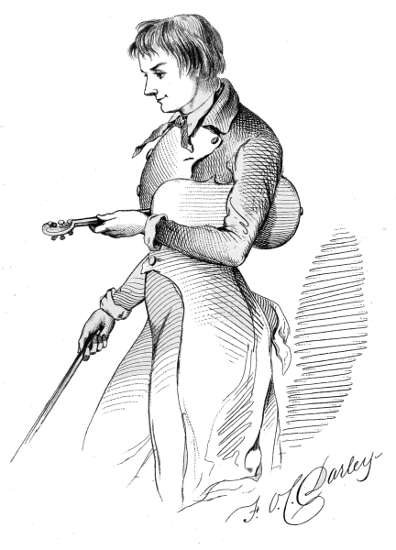
The wife and children of Ole Bull awaited his coming in Paris. His letters make frequent mention of his children, for whom he had many pet names, and he delighted to tell his friends about them. In one of his last letters from New York he said:—
I have dreamed of Alexander and Thorvald, and my soul is filled with grief—for they would not recognize me.... I must play to–morrow, and this kills one.[14] I shall soon come to you myself, and you will hear more from my own lips than I will trust to this cold paper.
It is easy to imagine the pleasure of the meeting,—and also the pain, since he could not yet feel that his independence was sufficiently secured to justify him in giving up his professional tours. He had not received the proportion of the returns from his two years’ work that was fairly his due. He had left, as he habitually did, his business settlements till the last moment, and often trusted his funds in what proved to be unsafe hands. As a consequence, he was still obliged to think of the pecuniary results of his work.
In the spring of 1846 he appeared several times in Paris, and on the 19th of April he gave a concert at the Italian Opera. The following is an extract from an advance notice in the Corsaire Satan, of the 15th of April:—
Each year public opinion, having fluttered about for a time, at last settles upon an artist, who, to use an English phrase, becomes the lion of the season. This happy advantage has been accorded this year to Ole Bull. After the extraordinary success which he had attained at Roger’s entertainments, he could not leave Paris without giving a grand concert at the Théâtre Italien. This is a custom made fashionable by Liszt, Thalberg, Madame Pleyel,—in fact, by all great artists; a fashion which some lesser stars with more boldness than success have followed. Ole Bull was not too sanguine in regard to his strength, for all the tickets are already sold. This part of the problem has been solved; to solve the other half he only needs to play, as he has done at the Grand Opéra, and the Opéra Comique, and his victory will be both brilliant and complete.... Ole Bull’s violin does not pipe and shriek like those of some of his confrères, who whine when they pretend to sing; his bow really possesses something magic and inspired. It is the human voice in its most exalted expression.
The following criticism of the performance, by P. A. Fiorentino, appeared in Le Constitutionnel for the 22d of April:—
Ole Bull has given a grand concert at the Théâtre Italien. All the Norse courage and daring was needed in venturing to offer the public a very battle of five violin pieces. What fire and what power! But a favorable result justifies the greatest rashness, and Ole Bull, in the course of the evening, showed us that he was not over–sanguine in regard to his powers. He first played variations of a diabolic difficulty and originality on Bellini’s aria: “L’amo, ah, l’amo, e m’è più cara.” It was as if the spirits of hell, sunk in dark despair, must love and long for the light of heaven. Paganini’s “Carnival,” which, as by magic, carries us to Via del Corso, in the very midst of the ringing laughter and joyful abandon of the Maccolettians, was repeated at the emphatic demand of the audience. “A Mother’s Prayer,” composed by the artist beneath the quiet arches of the cloister of Santa Maria, is a great and severe piece, full of mystic tenderness and religious warmth. Finally, the “Polacca Guerriera,” which we had twice heard before, seemed to us more and more to merit the enthusiastic reception the public is everywhere giving it. Ole Bull sang splendidly last night. He was applauded and recalled so many times, that he might have believed himself in Venice, Florence, or Naples.
In May Ole Bull was playing in Bordeaux, to the rapturous applause of that city. Before his departure, he gave a banquet at the Hotel de la Paix, to which the Courrier de la Gironde refers as follows:—
The apartments which Ibrahim Pacha had occupied a fortnight previous were fitted up for the occasion, and were truly regal in the elegance of their appointments. The large salon, especially, was dazzling; and the brilliant toilets of the fairest ladies of the city heightened the effect, as they clustered about the piano. All persons in Bordeaux distinguished for talent, rank, or wealth, participated in the reception. A quintette, by Mozart, was played by the artist with our ablest amateurs, and a duet for piano and violin, by Mayseder, was accompanied by a lady. Compositions and improvisations of the violinist followed. As a host, Ole Bull was a prince; one of the most distinguished ladies present remarked, when she saw him receive with the exquisite courtesy and aristocratic charm of manner peculiarly his own, that Ole Bull seemed to her that evening a second Count of Monte Christo.... No artist has ever been received with so much distinction and enthusiasm in Bordeaux.
At the end of the month he filled a most successful engagement in Toulouse, where a fête lyrique was given in his honor by the residents of that city at the Théâtre du Capitole. In Lyons he gave a concert for the benefit of a poor actress, who, friendless, and unable to obtain an engagement, had been driven in her despair to attempt suicide.
In July he appeared in Marseilles, where he had full houses, although he complains in his letters that, as his concerts had not been well announced or arranged in advance, his profits were less than they should have been. His financial success could not always be measured by his artistic triumphs. The Marseilles Le Sud said of him:—
His place is between Paganini and Liszt. If we were asked what distinction we would make between the young Norse artist and the immortal Genoese virtuoso, we should answer, that, so far as talent is concerned, the question is a difficult one. Who among us remembers with sufficient distinctness the marvels performed by Paganini’s bow in this place ten years ago, to be able to determine with exactness whether Ole Bull overcomes equally great difficulties? It is possible that at certain moments Paganini’s manner was even more wonderful and powerful; but nothing is more certain than that Ole Bull is his equal, if not his superior, in beauty, warmth, tenderness, and variety. When, on the other hand, we leave out of the account purely technical questions, which even artists themselves cannot decide, it must be admitted that admiration is more readily accorded to the frank, modest, unselfish young man, who has given evidence, in many ways, of an exalted nobility of character....
A no less electric enthusiasm broke forth again and again, when the artist played the “Carnival of Venice,”—his own variations. One can hardly imagine with what power of originality Ole Bull has mastered this favorite theme of Paganini’s. He is especially brilliant in the humorous part. If we remember right, Paganini did not produce that natural and gushing sprightliness in the conversation between Punchinello and the policeman. It is strange enough, that the Northman has been able to put more sly cunning and rollicking fun into the scene than the Italian Mephistopheles. Ole Bull ends this composition with a bird–song, which is the most surprising imitation one can imagine. Here his instrument is no more a violin, but a gathering of the most charming song–birds.
Ole Bull here met frequently with his friend Hans Andersen, who was visiting Marseilles.
In the autumn of 1847 he crossed the Mediterranean to Algiers, joining his friend General Youssuf, and they had many an exciting adventure on their journey across the desert. He had his violin with him and played for the officers in the little town of Milianah. His audience was a singularly mixed one, being composed of Europeans, Arabs, and negroes; and the expressions of admiration or wide–mouthed astonishment which followed his playing were in keeping. The violin case had been given by General Youssuf, with strict instructions, to the keeping of two Arabs; they regarded it with a holy awe, and handled it with the greatest care, too proud of their trust to permit any one to come near it.
From Algiers the artist went to Spain. The melodies and songs of that country charmed him, and he declared them to be the most beautiful in the world. He was delighted too with the language, and often spoke of its admirable adaptiveness to express the finest shadings of thought, combined with strength and sonorousness.
During the festivities attending the marriage of Isabella II. with Francisco d’Assiz, and Donna Fernanda with the Duc de Montpensier, he gave concerts in Madrid. He composed by request “La Verbena de San Juan,” which he dedicated to the Queen, who offered him a general’s commission. She thought, no doubt, that the brilliant dress of a staff–officer would become him, but he declined the honor. Her majesty presented him a flower composed of one hundred and forty brilliants in the form of a verbena, and the order of Charles III. in brilliants; also the Portuguese order of Christus.
From a long notice in the Español of the 15th of October the following is taken:—
It is now fifteen years since we heard Ole Bull for the first time in Paris. He was very young then, but gave promise of becoming what he now is, a great violinist. We also knew Paganini, and can assure our readers that of all the violinists we have heard, Ole Bull nearest approaches him in his performance. Besides his wonderful execution, only to be accomplished by an arm of iron like his, he draws from his instrument a powerful and vigorous tone; he plays the andante to perfection, and besides clearness and precision he makes his instrument sing, a quality without which all his other accomplishments would be colorless. This violinist has created the greatest sensation ever known in Madrid; and his triumph is all the greater for coming as he did unheralded by the trumpets of fame. He has performed pieces of great length, which were not fantasias or variations on known operas, of which the Spanish are fond; and as instrumental concerts are not much liked here, we feared that the efforts and skill of Ole Bull would not be duly recompensed; but his immense talent very soon commanded the sympathies of the public and compelled their applause. The Norwegian artist deserves no less praise as a composer than as a performer. His great “Concerto” has all the severity and qualities of that form of composition....
The following is from the Valencia Fenix of June 27, 1847:—
The violin in Ole Bull’s hands is a perfect orchestra, and an impetuous torrent of delightful harmonies; it seems as if the strings multiply themselves, and, obedient to the inspiration of the artist, they as well imitate the human voice as the trumpet of the warrior, the song of the maiden, or the lyre of the poet. We have heard nothing so magical, seducing, and astonishing.
The delirious public offered him an ovation such as no other artist had received here before....
From Spain he returned to Paris, bringing with him seven pictures by old Spanish masters, one of them from the 10th century, and two fine violins. En route, he gave concerts in Bordeaux and Nantes. His letters spoke of the Spaniards, their music, their boundless hospitality, and the dangers of travel in the mountains on account of bandits. Because of this he returned by sea to Marseilles, and rejoined his wife, spending with her some months in the country, at St. Michel, near Paris.
During the revolution of 1848, he went, at the head of the Norwegians in Paris, to the Palais de Justice, and presented a Norwegian flag to President Lamartine, with an address, as evidence of their sympathy. This flag was preserved in the Hotel de Ville till that building was destroyed by the Commune in 1871. He also gave a concert in Paris for the wounded of the revolution.
He remained in that city most of the summer, working upon and studying the construction of the violin, with his friend, the great violin–maker Vuillaume. The following extract from a letter of Vuillaume’s may be of interest here:—
Since you left us so long ago, I have wished twenty times to write to you. I have had many things of all sorts to tell you—very important, as you may imagine, and which I have promised myself much pleasure in communicating. Something or other has always prevented my doing this; but to–day here I am in the country for four hours, and I improve the opportunity to chat with you....
You are aware that my daughter Emilie is married to Alard, and we are all well pleased with the match. You do not know him, but when you come you shall make his acquaintance....
When you were in Paris I showed you some instruments with which I had taken extraordinary pains, and you liked them. I have since kept up this kind of work, and had made some quartettes and double–basses for the Exposition; but finding nothing novel in all this finished work, I resolved to make something colossal—an octobasse! It is the giant of bow instruments. I have never seen nor heard of anything like it. It is made exactly, in all its proportions, like a double–bass, but it is twelve feet in height. It is strung with three enormous chords, which give the notes re, sol, ut. The sound is clear, deep, and sonorous, nothing at all like the dull and thick tone of the ordinary double–bass. The fingering is done by means of mechanism connected with keys at the lower end of the finger–board, which the performer, standing on a stool, easily reaches with the left hand, while with the right he draws a big bow across the strings. The use of this instrument must be reserved for the grander effects of harmony. It is like the sub–bass of the organ. I believe I have added a new and powerful voice to the family of instruments....
Give me some news of yourself, of your family, of your plans, what your children are doing—all this will interest me....
I have just arranged a room for my collection of old instruments. I have already many interesting specimens, to which I shall add as occasion offers. The finish and the furniture of the room are all in old carved oak of the time of Francis I.... You see I am not afraid of tiring you with all these details. I hope to bore you still more in showing you all my relics when you come....
In October Ole Bull returned to Norway and bought a place near Christiansand, having decided to remain for a time in his own country. He gave many concerts, and was everywhere enthusiastically received. His success determined him to attempt to found a National Theatre. The country had, up to that time, depended upon Danish plays, Danish actors, and Danish musicians. He wanted a national drama and the national music, and for this he spent his money and his time without stint.
It should be remarked, perhaps, here, that Ole Bull was too apt to consider that loyalty to an undertaking meant a confidence and interest so entire as not only to demand the giving all that he had, but often the burning of his ships behind him in the neglect of his own legitimate work. It was characteristic of him all his life, to stake all without reserve, and to feel that he could not hope for success unless he was willing to do this. His great undertakings, as a rule, failed only in their benefit to himself. Almost without exception, they have resulted in permanent good, and that which lay nearest his heart he lived to see recognized by his countrymen. The seed of national feeling and national dramatic and musical work he had planted grew in his time, and bore the best fruit. Jonas Lie says:—
With all the influence which his mighty name gave him, Ole Bull demanded the realization of a national drama. What Waldemar Thrane had begun in his Norse Opera should be continued in a development of the national music; whatever of dramatic art had been previously borrowed from Denmark should be replaced by what was purely Norwegian. Beside the current which swept through the country from the French Revolution at that time, there were other circumstances which also tended to awaken a national feeling, since, beside Ole Bull, there were several Norse painters at home, because of the troubles abroad. Among these were Tidemand and Gude. To these exiled artists, the return home was like a re–baptism of patriotism, and their presence inspired the people in their turn. The air was filled with ideal demands, and a movement was inaugurated which marked an epoch in our National Art, as well as in the development of our literature.
A Norse theatre with a Norse orchestra was what Ole Bull, in his enthusiasm, determined to realize in his birthplace, Bergen. He appointed committees, engaged actors, built and furnished a theatre. He himself led the orchestra, worked up public sentiment, and inspired the press, until at last, on the 2d of January, 1850, his National Theatre was opened with a representation which was acknowledged, by his opponents even, to have been a surprising success.[15]
The hasty, animated lines which he wrote to his wife that day, in which he mentions his exertions, his many disappointments, and his persevering, energetic hope for the undertaking, strike one very forcibly.
The selection of plays was restricted, since they were necessarily adapted to the limited powers of the actors. Ole Bull conducted the orchestra and played, as did also his friend, Möllar–gutten, or Thorgeir Andunson of Haukelid–Rock. Mr. Goldschmidt thus speaks of this peasant–violinist, celebrated all over Norway:[16]—
He used to play at dancing parties, and in him many of the old legends, pointing to the demoniac power of music, were revived. In order to understand this, one must have seen the national dances of Norway—the Halling–dance especially. It commences with a slow, majestic measure, and it is surprising to see with what dignity and grace the powerful forms of old and young move; by degrees it becomes quicker, the elder folk retire, and at last it turns into a leaping dance, which only the strongest young people can safely perform, and during which formidable leaps are executed by the lads.
“Oh, never talk again to me Of Spanish girls and Southern dancers,”
you would say, paraphrasing Byron, if you saw this passionate, frantic, though serious and chaste dance, that exhibits the fierce, martial spirit of Norwegian youth. It once happened that, whilst the dance whirled to the wild, fiery music—to the strain proceeding, as it were, from the depths of earth, from the foaming waterfall from the howling tempest of the mountains—the knives of the lads “became loose in their sheaths,” and blood flowed along the floor. The cellar–man, on proceeding to the cellar to bring up beer, saw seated behind a hogshead Old Nick himself playing the fiddle; then, understanding why blood flowed so freely above, he came up and cried out: “Stop your ears, the devil plays the fiddle!” Well, it was said that Thorgeir Andunson could play in like manner, having on his lonely rock of Haukelid learnt it from the spirit reigning in the foaming river below, although his appearance was quiet and gentle and frequently sad. He had married a girl of the same station of life as himself, but always looked up to her as to a peculiar being that had descended to him. Being once asked what was his ambition in life, he answered: “To be able to buy a pair of shoes and a silk neckerchief for my wife.” Having heard of Ole Bull, he came to pay him a visit, and was quite bewildered when he heard one of Mozart’s compositions. “Well,” he said, “this is music!” and strolling about the garden all night, tried to play it from memory; but in his hands it turned into mere Halling–dance. His fine sense showed him in Ole Bull the happier artist, and far from envying, he attached himself to him with a kind of devotion that proved itself afterwards when the violinist established at Bergen the first Norwegian theatre. When the messenger came to Thorgeir, bidding him to gird his loins, and come down to play before a public, the shy artist overcame his bashfulness, and followed the messenger at once, “for I must do something to see and hear Ole.” The farmers along the mountain road, meanwhile, having heard the tidings that Thorgeir was going to Ole to establish an independent Norse theatre, gave him a mounted escort as a prince. One great farmer, a descendant of the old kings, wished to retain Thorgeir for a night to give a soirée, as we should say, and on Thorgeir declining and escaping from his house,—“for Ole expects me at the Norse theatre,”—it nearly came to a battle between the squads, which was prevented by Thorgeir’s solemn promise that he would return and play to the dancers “three entire nights.” He returned home a wealthy man. Ole Bull had made him earn 2000 specie dollars (about £400),—an immense fortune for the fiddler on Haukelid–Rock.