OLD TRAILS CHAPTER (continued 4)
Reading edition
Captain Isaac Moulton—1857, Minneapolis.
The middle of December 1857, it began to rain and rained for three days as if the heavens had opened. The river was frozen and the sleighing had been fine. After this rain there was a foot of water on the ice. I was on my way to Fond du Lac, Wis. to get insurance on my store that had burned. You can imagine what the roads leading from St. Paul to Hastings were. It took us a whole day to make that twenty mile trip, four stage loads of us.
I have often thought you dwellers in the Twin Cities nowadays give little thought to the days when the stage coach was the essence of elegance in travel. The four or six horses would start off with a flourish. The music of the horn I have always thought most stirring. The two rival companies vied with each other in stage effect. If one driver had an especial flourish, the other tried to surpass him, and so it went on. No automobile, no matter how high powered, can hold a candle to those stage coaches in picturesque effect, for those horses were alive.
On this trip, I hired a man with two yearling steers to take my trunk full of papers from the Zumbro River that we had crossed in a skiff, as the bridge was out, to Minnieski where we could again take the stage. Those steers ran and so did we eight men who were following them in water up to our knees. We reached Minnieski about as fagged as any men could be.
Mr. George A. Brackett—1857, Minneapolis.
Prior to the Indian outbreak, I had charge of the feeding of the troops, comprising Stone's Division at Poolville, Md., with beef and other supplies. In this Division were the First Minnesota, several New York (including the celebrated Tammany Regulars) and Pennsylvania troops. I continued in that service until the Sioux outbreak, when Franklin Steele and myself were requested by General Sibley to go to Fort Ridgely and aid in the commissary department, General Sibley being a brother-in-law of Franklin Steele. I remained in this position until the close of the Sibley campaign, other St. Paul and Minneapolis men being interested with me in the furnishing of supplies.
Just after the battle of Birch Coolie, when General Sibley had assembled at Fort Ridgely a large force to go up the Minnesota River against the Indians, he sent Franklin Steele and myself to St. Peter to gather up supplies for his command. We started in a spring wagon with two good horses. A number of refugees from the fort went with us in Burbank's stages and other conveyances. At that time Burbank was running a line of stages from St. Paul to Fort Ridgely, stopping at intervening points. Allen, the manager of the lines, was in Fort Ridgely. A few miles out the cry was raised, "The Indians are in sight." Immediately the whole party halted. Allen went over the bluff far enough to see down to the bottoms of the river. Soon he returned very much frightened saying, "The valley is full of Indians." This caused such a fright that notwithstanding our protest, the whole party returned pell-mell to Fort Ridgely, except Steele and myself. The party was so panic stricken that Allen was nearly left. He had to jump on behind. We determined to go on. A mile or so further on, we saw a man crawling through the grass. I said to Steele, "There's your Indian," and drove up to him. It proved to be a German who, in broken English said, "The Indians have stolen my cattle and I am hunting for them." Driving a few miles further, we came to what had been Lafayette, burned by the Indians days before. Some of the houses were still smoking.
We stopped at the ruins of a house belonging to a half breed, Mrs. Bush, and killed and ate two chickens with our other lunch. When the refugees got back to the fort they reported to General Sibley that we had gone on. He said we were reckless and sent George McLeod, Captain of the Mounted Rangers, with fifty men to overtake us and bring us back. However, we drove on so fast that McLeod got to St. Peter about the time we did. There we bought out a bakery and set them to baking hard tack, and purchased cattle and made other arrangements for the feeding of the troops.
One day, before this, while I was at General Sibley's camp talking to him, I saw someone coming toward the camp. I called General Sibley's attention to it and he sent an officer to investigate. It proved to be a friendly Indian who had stolen a widow and her children from the hostiles and brought them to the fort. Her husband had been killed by the Indians.
Mrs. C. A. Smith—1858.
In the spring of 1858 we came to St. Paul. We took a boat which plied regularly between St. Paul and Minnesota river points, to Chaska. There we left the boat and walked to Watertown where our new home was to be. My father carried $2,000 in gold in inside pockets of a knitted jacket which my mother had made him. With this money we paid for two quarter sections of improved land and the whole family began to farm. We lived just as we had in Sweden, as we were in a Swedish settlement. We were Lutheran, so there were no parties. Going to church was our only amusement.
The prairies were perfectly lovely with their wild flower setting. There had been a fire two years before and great thickets of blackberry vines had grown up. I never saw such blackberries. They were as large as the first joint of a man's thumb. The flavor was wild and spicy. I never ate anything so good. Cranberries by the hundreds of bushels grew in the swamps. We could not begin to pick all the hazel nuts. We used to eat turnips as we would an apple. They were so sweet, they were as good. We made sun-dials on a clear spot of ground and could tell time perfectly from them.
We children made dolls out of grass and flowers. I have never seen prettier ones. We kept sheep and mother spun and wove blankets and sheets. We had bolts and bolts of cloth that we made and brought with us from Sweden. Here, we raised flax and prepared it for spinning, making our own towels.
Nothing could be cozier than our cabin Christmas eve. We had brought solid silver knives, forks and spoons. These hung from racks. Quantities of copper and brass utensils burnished until they were like mirrors hung in rows. In Sweden mother had woven curtains and bed coverings of red, white and blue linen and these were always used on holidays. How glad we were they were the national colors here! We covered a hoop with gay colored paper and set little wooden candle holders that my father had made all around it. This was suspended from the ceiling, all aglow with dips. Then, as a last touch to the decorations, we filled our brass candle sticks with real candles and set them in the windows as a greeting to those living across the lake. A sheaf for the birds and all was done.
The vegetables grew tremendous. We used to take turns in shelling corn and grinding it, for bread, in a coffee mill. Mother would say, "If you are hungry and want something to eat of course you will grind." We made maple sugar and fine granulated sugar from that.
My sisters used to walk from Watertown to Minneapolis in one day, thirty-seven miles, following an Indian trail and then were ready for a good time in the evening. How many girls of today could walk that many blocks?
The lake was full of the biggest fish imaginable. We used to catch them, and dry and smoke them. They made a nice variety in our somewhat same diet. We used to fish through the ice, too.
Major C. B. Heffelfinger—1858, Minneapolis.
Well I remember the St. Charles hotel as it was when I first boarded there. The beds were upstairs in one room in two rows. Stages were bringing loads of passengers to Minneapolis. They could find no accommodations so no unoccupied bed was safe for its owners. Although my roommate and I were supposed to have lodging and were paying for it, the only safe way was for one to go to bed early before the stage came in and repel all invaders until the other arrived. If the sentry slept at his post the returning scout was often obliged to sleep on the floor, or snuggle comfortably against a stranger sandwiched between them.
The strangers who arrived had made a stage coach journey from La Crosse without change and spent two nights sitting erect in the coaches, and were so tired that they went to bed with the chickens. On lucky nights for us they were detained by some accident and got in when the chickens were rising.
Nothing was ever stolen and many firm friendships were thus cemented. Our pocketbooks were light, but our hearts were also. It was a combination hard to beat.
1857 was the most stringent year in money that Minnesota has ever known. There was absolutely no money and every store in the territory failed. Everything was paid by order. Captain Isaac Moulton, now of La Crosse, had a dry goods store. A woman, a stranger, came in and asked the price of a shawl. She was told it was $15.00. It was done up for her. She had been hunting through her reticule and now put down the money in gold. The Captain looked at it as if hypnotized, but managed to stammer, "My God woman, I thought you had an order. It is only $5.00 in money."
Mrs. Martha Gilpatrick—1858, Minneapolis.
When I married, my husband had been batching it. In the winter his diet was pork! pork! pork! Mrs. Birmingham, who helped him sometimes, said she bet if all the hogs he ate were stood end to end, they would reach to Fort Snelling.
We had a flock of wild geese that we crossed with tame ones. They were the cutest, most knowing things. I kept them at the house until they were able to care for themselves, then I turned them out mornings. I would go in the pasture and say, "Is that you nice gooses?" They would act so human, be so tickled to see me and flop against me and squawk. When Mr. Fitzgerald came home they would run for him the same way as soon as they saw the horse. They were handsome birds.
I used to go to my sister's. She had a boarding house on the East Side. Her boarders were mill workers and "lathers." That is what we used to call the river drivers. They always had a pike pole in their hand. It looked like a lath from a distance, so they got the name of "lathers" from this.
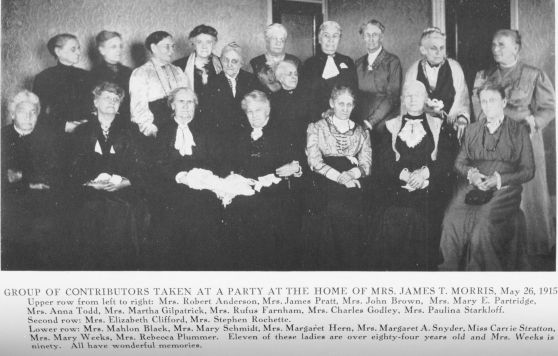
GROUP OF CONTRIBUTORS TAKEN AT A PARTY AT THE HOME OF MRS. JAMES T. MORRIS, May 26, 1915
Upper row from left to right: Mrs. Robert Anderson, Mrs. James Pratt, Mrs. John Brown, Mrs. Mary E. Partridge, Mrs. Anna Todd, Mrs. Martha Gilpatrick, Mrs. Rufus Farnham, Mrs. Charles Godley, Mrs. Paulina Starkloff.
Second row: Mrs. Elizabeth Clifford, Mrs. Stephen Rochette.
Lower row: Mrs. Mahlon Black. Mrs. Mary Schmidt, Mrs. Margaret Hern, Mrs. Margaret A. Snyder, Miss Carrie Stratton, Mrs. Mary Weeks, Mrs. Rebecca Plummer. Eleven of these ladies are over eighty-four years old and Mrs. Weeks is ninety. All have wonderful memories.
Mrs. Margaret Hern—1858.
My husband enlisted in the Fall of 1861. It was not a very easy thing for him to do, for our farm was not yet very productive, our three children were very young, one a tiny baby, and we had no ready money. However, he felt that his country called him and when the recruiting officer told him that all soldier's families would be welcome at the post and that we could go there with him, he rented our farm to George Wells and went on to Fort Ridgeley. We lived forty miles from there on the Crow River, near Hutchinson.
We found that the officer had lied. We were not expected or wanted at the fort. We finally made arrangements to stay by promising to board the blacksmith in his quarters. His name was John Resoft. His rations and my husband's supported us all. Mr. Hern was very handy about the house, as he was a Maine Yankee and daily helped me with the work.
There was a great sameness about the life as there were only about a hundred men stationed at the fort. Very few of them had their families with them. The only women were Mrs. Mueller, wife of the doctor, Mrs. Sweet, wife of the chaplain and their three children, Mrs. Edson, the Captain's wife; Sargeant Jones' wife and three children; Mrs. Dunn and their three children; Mrs. Snider and three children; Mrs. Mickel and three children; Mrs. Randall, the sutler's wife, and myself and our three children.
The winter passed monotonously. We used to have some fun with the squaws. Once I was writing home to mother. I wanted a little lock of Indian hair to show her how coarse an Indian's hair was. Old Betts happened to come in just then, so I took my scissors and was going to cut a little bit of her "raving locks." When she saw what I was going to do she jumped away screaming and acting like a crazy woman. She never came near that house again, but in the spring after my husband had gone to the front and Mrs. Dunn and I had joined forces and gone to living in another cabin, she stuck her head in our window to beg. I jumped and grabbed a looking glass and held it before her to let her see how she really did look. She was a sight. She had an old black silk hood I had given her and her hair was straggling all over. When she saw the reflection she was so mad she tried to break the glass.
Three weeks before the outbreak, the Sioux, our Indians had a war dance back of the fort and claimed it was against the Chippewas. At first we believed them, but when the half breed, Indian Charlie, came in to borrow cooking utensils, he sat down and hung his head, as if under the influence of liquor. He kept saying "Too bad! Too bad!"
Mrs. Dunn became suspicious and knowing I knew him well, as he had often stopped at our cabin, said "Ask him what is too bad." He said, "Injins kill white folks. Me like white folks. Me like Injins. Me have to fight. Me don't want to." He seemed to feel broken-hearted. I did not believe him and thought him drunk, but Mrs. Dunn said "You go over and tell Sergeant Jones what he said." I did. Sergeant Jones said, "What nonsense! They are only going to have their war dance. All of you white people go over and see that dance."
We all went. The soldiers were all there. The Indians had two tom-toms, and the squaws beat on them while the Indians, all painted hideously, jumped stiff legged, cut themselves until they were covered with blood and sweat and yowled their hideous war whoop. They were naked excepting their breech clout. Sargeant Jones had control of all the guns at the fort, and unknown to us, the cannon were all trained on the dancers. We could not understand why the soldiers were so near us, but later in the day learned that there was a soldier for everyone of us to snatch us away if it was necessary to fire on the Indians.
On Monday morning, August eighteenth, 1862, at about ten o'clock, we saw a great cloud of dust arising. Soon it resolved itself into teams, people on horseback and on foot coming pell mell for the fort. They said that Redwood Agency, twelve miles distant, had been attacked and the Indians were killing all the white settlers.
As they were flying for their lives, they passed the sutler of the Redwood store lying face downwards with a board on his back on which was written, "Feed your own squaws and papooses grass."
He had trusted the Indians until he would do so no longer. Their annuities were long, long overdue and they were starving. They appealed to him again and again and pleaded for food for their starving families. He finally told them to "Go eat grass." The settlers had seen the consequence. They had passed seven dead, besides on the way.
This was only the beginning of a sad multitude of refugees, who, wounded in every conceivable way, and nearly dead from terror, poured into the fort.
Captain Marsh, as soon as he had heard the stories, called the soldiers out on the parade ground and called for volunteers, who would go with him to try and stop the awful carnage. Every soldier came forward. Captain Marsh told them that he thought the sight of the soldiers would cow them as it had so many times before. They at once departed, leaving about thirty men with us.
We knew nothing of what was happening to this little handful of soldiers, but as more and more refugees came in with the terribly mutilated, our fears increased. We knew a small group of the savages could finish us. Just at dusk, Jim Dunn, a soldier of nineteen who always helped us about our work, came reeling in, caked with blood and sweat. I said, "For God's sake, what is the news, Jim?" He only panted, "Give me something to eat quick." After he had swallowed a few mouthfuls, he told us that nearly all of the boys had been killed by the Indians. He said, "The devils got us in the marsh by the river. Quinn told the Captain not to go down there, but he held his sword above his head and said, 'All but cowards will follow me.'" The Indians on the other side of the river were challenging us to come by throwing up their blankets way above their heads. Only three more of the boys came in that night.
All of us who were living outside, had gone into the stone barracks with the refugees. That night we were all sitting huddled together trembling with fear. We had helped feed the hungry and cared for the wounded all day long and now were so fatigued we could hardly keep awake. I had brought my little kerosene lamp with me. I lit it and brought out of the darkness the sorrowful groups of women and children. Some one called "Lights out." I turned mine down and set it behind the door. We sat in darkness. A voice called, "Up stairs." I gathered my baby in my arms, told Walter to hold on to mother's dress on one side and Minnie on the other, and up stairs we went, all pushed from behind so we could not stop. We were pushed into a large room, dark as pitch. There we all stood panting through fear and exertion. How long, I do not know. A voice in the room kept calling, "Ota! Ota!" meaning "Many! Many!" We knew there were Indians with us, but not how many. I had the butcher knife sharpened when the first refugees came and covered with a piece of an old rubber. It was now sticking in my belt. I asked Mrs. Dunn what she had to protect herself with. She said she had nothing, but found her shears in her pocket. I told her to put out their eyes with them, while they were killing us, for we expected death every minute after hearing those Indian voices. I heard Jim Dunn's voice and called him and told him where my lamp was and asked him to bring it up. He brought it to me. This was the crucial moment of my life. I sat the lamp on the floor, and with one hand on the butcher knife, slowly turned up the light. I saw only three squaws and three half breed boys, instead of the large number of Indians I expected. Each declared "Me good Injin! Me good Injin!"
All was confusion. William Hawley was inside guard at the door of the room we were in upstairs. He was just out of the hospital and was very weak. In spite of this he had gone with the soldiers to Redwood and had just returned after crawling out from under his dead companions and creeping through the brush and long grass those dreadful miles. He was all in. His gun had a fixed bayonet.
My eyes never left those squaws for a moment. I was sure they were spies who would go to the devils outside and tell them of the weakness of the fort. Two of the squaws began to fight about a fine tooth comb. The more formidable of the two, with much vituperation, declared she would not stay where the other one was. Just at the height of the fight, a gun outside was fired. The minute it was fired, the squaw started for the door. I suspected that it was a signal for her to come outside, and tell what she knew. Hawley had left his post and come in among us. Our babies were on a field bed on the floor. Calling to Mrs. Dunn to look after them, I sprang to the door and grabbed the discarded gun. At that moment, the squaw tried to pass. I ordered her back. She called me a "Seechy doe squaw" meaning "mean squaw" and tried to push me back. I raised the bayonet saying, "Go back or I'll ram this through you." She went back growling and swearing in Sioux. Probably in half an hour I was relieved of my self-appointed task. Martin Tanner taking my place, I said to him, "Don't let that squaw get away." I sat down on a board over some chairs and made the squaw sit beside me. There we sat all that long night with my right hand hold of my knife and the other holding her blue petticoat. Didn't she talk to me and revile me? None of the others even tried to leave. At last we saw the dawn appear.
Have you ever been in great danger where all was darkness where that danger was? If so, you will know what an everlasting blessing that daylight was.
From our upper windows we could look out and see that our foes were not yet in sight. All night long among the refugees, praying, supplicating and wailing for the dead, was constant, but as the light came and we began to bestir ourselves among them, nursing the wounded and feeding the hungry, this ceased and only the crying of the hungry children was heard.
The Indians had driven away all the stock so there was no milk. My baby had just been weaned. All those ten days we stayed in the fort, I fed her hard tack and bacon; that was all we had. I chewed this for her. There were many nursing mothers, but all were sustaining more than their own.
There was no well or spring near the fort. All water had to be brought from the ravine by mule team. Early that morning, under an escort, with the cannon trained on them, the men drove the mule teams again and again for water. Busy as all the women who lived at the fort were, I never let that squaw out of my sight. I kept hold of a lock of her hair whenever I walked around. She swore volubly, but came along.
About ten o'clock in the morning Lieutenant Gere, a boy of nineteen, who was left in command when the senior officers were killed, called on me. On a hill to the northwest, a great body of Indians were assembled. He wanted me to look through the field piece and see if Little Crow was the leader. I knew him at once among the cavorting throng of challenging devils. I knew too, whose captive I would be if the fort fell, for he had offered to buy me from my husband for three ponies. He loved so to hear me sing. Mr. Gideon Pond had tried to teach him to sing. We watched them breathlessly as they sat in council knowing that if they came then we were lost. The council was long, but finally after giving the blood curdling war whoop, they rode away.
They were hardly out of sight before the soldiers who had been with us and had just left for Fort Ripley before the outbreak, filed in. Captain Marsh had sent for them just before leaving the fort for Redwood. Those noble fellows, nearly exhausted from the long march, with no sleep for thirty hours, immediately took their places with the defenders, without rest or sleep the night before. Gere had sent to St. Peter for the Renville Rangers and some of our own men. They came in the evening.
The prayers of thanksgiving that could be heard in many tongues from that mournful group of refugees, as they knew of the soldiers return, could never be forgotten. Mrs. Dunn and I had asked for guns to help fight, but there were none for us. There was little ammunition too. The blacksmith, John Resoft, made slugs by cutting iron rods into pieces. Mrs. Mueller, Mrs. Dunn and I worked a large share of that day making cartridges of these, or balls. We would take a piece of paper, give it a twist, drop in some powder and one of these, or a ball, and give it another twist. The soldiers could fire twice as fast with these as when they loaded themselves. All the women helped.
My squaw was still with me. The others made no effort to escape. Just as night came, she broke away and when she really started she could run off with me, as she was big and I only weighed one hundred and three pounds. When I found I could not stop her, I screamed to Sargeant MCGrew, "This squaw is going to get away and I can't stop her." He turned his gun on her and shouted, "If you don't go back, I'll blow you to h—-." That night I had to sleep and she got away.
With a hundred and sixty soldiers in the fort, all were so reassured that we all slept that night.
The next morning was a repetition of Tuesday. The care of the wounded under that great man, Doctor Mueller and his devoted wife, was our work. One woman who was my especial care had been in bed with a three day's old baby when the smoke from the burning homes of neighbors was seen and they knew the time to fly had come. A wagon with a small amount of hay on it stood near the door with part of a stack of hay by it. Her husband and the hired man placed her and the baby on this and covered them with as much hay as they could get on before the savages came, then mounted the horses and started to ride away. They were at once shot by the Indians who then began a search for her. They ran a pitch fork into the hay over and over again, wounding the woman in many places and hurting the child so that it died. They then set fire to the hay and went on to continue their devilish work elsewhere. She crawled out of the hay more dead than alive and made her way to the fort. Besides the pitchfork holes which were in her legs and back, her hair and eyebrows were gone and she was dreadfully burned.
None of the women seemed to think of their wounds. They lamented their dead and lost, but as far as they themselves were concerned were thankful they were not captives. The suffering of these women stirred me to the depths. One poor German woman had had a large family of children. They all scattered at the approach of the Indians. She thought they were all killed. She would sit looking into space, calling, "Mine schilder! Mine schilder!" enough to break your heart. I thought she had gone crazy when I saw her look up at the sound of a child's voice, then begin to climb on the table calling, "Mine schilder! Mine schilder!" In a group on the other side she had seen four of her children that had escaped and just reached the fort that Wednesday morning.
Early in the afternoon the long expected fighting began. We were all sent up stairs to stay and obliged to sit on the floor or lie prone. All the windows were shot in and the glass and spent bullets fell all around us. I picked up a wash basin heaping full of these and Mrs. Dunn as many more. By evening the savages retired, giving their awful war whoops.
Thursday there was very little fighting as the rain wet the Indians' powder. Mrs. Dunn, Mrs. Sweatt and I spent the time making cartridges in the powder room in our stocking feet. We also melted the spent bullets from the day before and ran them in molds. These helped out the supply of ammunition amazingly.
Friday was the terrific battle. A short distance from the fort was a large mule barn. The Indians swarmed in there. Sergeant Jones understood their method of warfare, so trained cannon loaded with shell on the barn. At a signal these were discharged, blowing up the barn and setting the hay on fire. The air was full of legs, arms and bodies, which fell back into the flames. We were not allowed to look out, but I stood at the window all the time and saw this. Later I saw vast numbers of the Indians with grass and flowers bound on their heads creeping like snakes up to the fort under cover of the cannon smoke. I gave the alarm, and the guns blew them in all directions. There was no further actual fighting, though eternal vigilance was the watchword. It was those hundred and sixty men who saved even Minneapolis and St. Paul, and all the towns between. If Fort Ridgely had fallen, the Sioux warriors would have come right through. General Sibley did not get there with reinforcements until the next Thursday after the last battle.
You can imagine the sanitary condition of all those people cooped up in that little fort. No words I know could describe it.
Note.—Mrs. Hern has a medal from the government for saving the fort.
Mrs. Mary Ingenhutt—1858, Minneapolis.
Mrs Ingenhutt, now one hundred years old, for ninety years has made "Apfel Kuchen," "Fist Cheese" and wine as follows:
Apfel Kuchen—Mix a rich dough using plenty of butter and rich milk. Line a pan with this, cut in squares and cover with apples sprinkled thick with sugar and cinnamon. Bake until apples are thoroughly cooked.
Fist Cheese—Take a pan of clabbered milk. Set over a slow fire. When the whey comes to the top, strain off and shape in balls. Let stand in warm place until it is ripe—that is, until it is strong.
Wine—Grape, currant, rhubarb and gooseberry wine: Mash home grown fruit with a home made potato masher, squeeze it through a coarse cloth, add sugar and place in warm spot to ferment. Draw off in kegs and allow to stand at least two years.
I used to love to go to the picnics in the early days. Everyone had such a good time, and was trying to have everyone else have one, too. Then, all were equal. Nowadays, each one is trying to be prouder than the next one.
Captain L. L. McCormack.
Georgetown on the Red River was the Hudson Bay post. After the railroad was built to St. Cloud the Red River carts crossed there on a ferry and then on the Dakota side went from point to point on the river in the timber to camp. The river is very crooked. A days journey with one of these carts was twelve miles. The first stop was at Elk River, now Dalyrimple, then to Goose River, the present site of Caledonia and then to Frog Point and from there to what is now Grand Forks. The freight was teamed to and from St. Cloud and Benson.
Mr. Charles M. Loring—1860.
On the 20th day of September 1860, I reached Minneapolis with my wife and little son, and went to the Nicollet Hotel where I made arrangements for board for the winter. The hotel was kept by Eustis & Hill. They fixed the price at $6.00 a week including fire and laundry for the family, i. e. $2.00 a week for each person. Mr Loren Fletcher occupied the rooms adjoining and paid the same price that I paid, notwithstanding there were but two in his family, but his rooms were considered to be more favorably located being on the corner of Hennepin and Washington Avenues.
The cook at the hotel was a Mrs. Tibbets from New England who was an expert in preparing the famous dishes of that section of our country, and in the many years that have elapsed since that time, I have never been in a hotel where cooking was so appetizing.
Our first winter in Minnesota was passed in the most delightful and pleasant manner.
The following spring, I rented the house on the corner of what is now Third Avenue and Sixth Street, for the sum of $6.00 a month. This house is still standing and is a comfortable two story New England house. At that time it stood alone on the prairie with not more than three or four houses south of it. One of these is still standing at the corner of Tenth Street and Park Avenue and is occupied as a "Keeley Cure."
There were few luxuries in the market, but everything that could be purchased was good and cheap. There was but one meatshop which was kept by a Mr. Hoblet. He kept his place open in the forenoon only, as his afternoons were spent in driving over the country in search of a "fat critter." The best steaks and roasts were 8c a pound and chickens 4 to 6c a pound. Eggs, we bought at 6c a dozen and butter at 8 to 10c a pound. In winter, we purchased a hind quarter of beef at 3 and 4c a pound, chickens 3c and occasionally pork could be bought at 6c a pound, but this was rarely in market. Mutton was never seen. Prairie chickens, partridges, ducks and venison was very plentiful in the season and very cheap. We used to purchase these in quantities after cold weather came, freeze them and pack them in snow. This worked well provided we had no "January thaw" and then we lost our supplies.
The only fruit we had for winter use was dried apples, wild plums, wild crab apples and cranberries. In the season, we had wild berries which were very plentiful. There was a cranberry marsh a half mile west of Lake Calhoun, on what is now Lake Street, where we used to go to gather berries. One day a party of four drove to the marsh and just as we were about to alight, we saw that a large buck had taken possession of our field. We did not dispute his claim, but silently stole away. That same autumn a bear entered the garden of W. D. Washburn, who lived on Fifth Street and Eighth Avenue and ate all of his sweet corn.
About this time the settlers on Lake Minnetonka were clearing their claims in the "Big Woods" burning most of the timber, but some of the hard maple was cut as cordwood and hauled to Minneapolis and sold for from $2.00 to $2.50 a cord.
The winters were cold but clear and bright. The few neighbors were hospitable and kind and I doubt if there has been a time in the history of Minneapolis when its citizens were happier than they were in the pioneer days of the early sixties.
There were few public entertainments, but they enjoyed gathering at the houses of their neighbors for a game of euchre and occasionally for a dance in Woodmans' Hall which was situated on the corner of Helen Street, now Second Avenue, and Washington Avenue. One violinist furnished the music. Sleighing, horse racing on the river and skating were the out-of-doors amusements for the winter. A favorite place for skating was in a lot situated on Nicollet Avenue between Fourth and Fifth Streets. Nicollet Avenue had been raised above the grade of this lot, causing a depression which filled with water in the fall. There was a small white house in the center of the lot and the skaters went around and around it, and no skating park was more greatly enjoyed.
At the time the war broke out, the town began to show signs of recovering from the effects of the panic of 1857 and its wonderfully beautiful surroundings attracted new settlers and the foundation of the great commercial city was laid.
Dr. Stewart of Sauk Center.
I was government physician for many years and so was back and forth all the time. I used to meet old man Berganeck, an old German, who carried supplies for the government. He always walked and knit stockings all the way. This was very common among the German settlers. The government paid such an enormous price for its freighting that one could almost pay for an outfit for supplies in one trip. Berganeck became very wealthy.
I often passed the night near the bivouac of the Red River drivers. They knew me and were very glad to have me near. I never saw a more rugged race. They always had money even in the panic times of '57. If I treated them for any little ailment, I could have my choice of money or furs. The mosquitoes did not seem to bother them, though they would drive a white man nearly crazy.
I started for Fort Wadsworth, a four company post, in January '68. The winters, always severe, had been doubly so in '67 and '68. I went by team, leaving Sauk Center with the mercury at forty below zero. It never got above forty five below in the morning, while we were on the trip. The snow was three feet on a level and we broke the roads. It took us twelve days to make this three day's trip. My driver was drunk most of the time. There were no trees from Glenwood to Big Stone Lake on the trail. When I drove up to Brown's station, a big log house with a family of about forty people, Nellie met me. To my inquiry as to whether I could stay over night, she answered, "Yes, but there is no food in the house. We have had none for three days. My father is somewhere between here and Henderson with supplies. He knows we are destitute, so will hurry through." About three o'clock, we heard an Indian noise outside. It was Joe with his Indian companions. All he had on that big sled was half a hog, a case of champagne and half a dozen guns. These men were always improvident and never seemed to think ahead.
His daughters, Amanda and Emily, twins, had a peculiarity I never knew before in twins. One day, one would be gay, the other sad. The next day, it would be reversed.
Mrs. J. M. Paine, Minneapolis.
During the early days of the war my husband raised a company of cavalry and wanted me to inspect them as they drilled. I was only a girl of seventeen, but had instructions enough how to behave when they were drilling, for a regiment. I was mounted on one of the cavalry horses and was to sit sedately, my eye on every maneuver and a pleased smile on my face.
I was ready with the goods, but unfortunately when I was ready, my steed was not. At the first bugle call he started on a fierce gallop, squeezing himself in where he had belonged, while a terrified bride clung to his neck with both arms. The only reason that I did not cling with more was that I did not have them.
I went once on a buffalo hunt with my husband. It does not seem possible that all those animals can be gone. The plains were covered with them. The steaks from a young male buffalo were the most delicious I have ever tasted.
Miss Minnesota Neill.
My father, the Reverend Mr. J. D. Neill, first came to St. Paul in April '49, then returned east to get my mother. In July, when they arrived at Buffalo on their way west, at the hotel, they met Governor and Mrs. Ramsey who were on their way to Minnesota to take up their duties there. They were delighted to meet my father as he was the first man they had ever met who had seen St. Paul. When they arrived, they were much surprised at the smallness of the place. My mother was not easily consoled over the size of their metropolis. Among other supplies she had brought a broom as she had heard how difficult it was to get them. Mr. H. M. Rice, who came down to meet them, chided her for being disappointed and putting the broom over his shoulder with pure military effect, led her along the little footpath which led over the bluff to the town, and to the American House. Although this was a hotel par excellence for the times, the floor was made of splintered, unplaned boards. My mother was obliged to keep her shoes on until she had got into bed and put them on before arising, to escape the slivers. The furniture of the bedroom consisted of a bed and wash stand on which last piece, the minister wrote powerful sermons. My mother wished to put down a carpet and bring in some of her own furniture, but the landlady would not allow this, saying, "There was no knowing where it would stop, if one was allowed to do the like."
They early began the construction of a small chapel and a large brick house which later became the stopping place of all ministers entering the state. In the fall of '49 the house was not completed, but the chapel was. They felt that the Scotts, where they then lived, needed their room, so moved into the chapel and putting up their bed on one side of the pulpit and stove on the other, kept house there for six weeks. The only drawback was that the bed had to be taken down every Sunday. In all the six weeks it never rained once on Sunday.
My mother used often to go alone through a ravine at night to see the Ramsey's. She carried a lantern but was never molested or afraid although it was often very dark. Their storeroom, in those days everyone had one, was stocked in the fall with everything for the winter. My father would buy a side of beef and then cut it up according to the directions his wife would read from a diagram in a cook book. This was frozen and placed in an outside storeroom.
One Sunday my father announced from the pulpit that if anyone was in need they always stood ready to help. That night everything was taken from the storehouse. It was thought the act was done by someone who respected my father's wishes as expressed in his sermon.
Their first Christmas here, the doorbell rang. When it was answered, no one was there, but a great bag containing supplies of all kinds hung from the latch. A large pincushion outlined in black was among the things. It was years before the donor was known.
Once some eastern people came to see us and we took them for a long drive. The bridges were not built, so we had to cross the Mississippi on a ferry. We went first to Fort Snelling which seemed to be abandoned. In one of the rooms we found some peculiar high caps which had belonged to the soldiers. My father took one and amused the children much when he went under Minnehaha Falls by leaving his own hat and wearing that funny cap.
Mr. L. L. Lapham.
When we were coming to Houston County, if we couldn't get game we breakfasted on codfish. I think it was the biggest slab of codfish I ever saw when we started. It made us thirsty. The fish called for water and many's the time mother and I knelt down and drank from stagnant pools that would furnish fever germs enough to kill a whole city nowadays, but I suppose we had so much fresh air that the germs couldn't thrive in our systems.
Speaking of codfish, reminds me that one day we met a man and his family making their way to the river. I halted him and asked him what he was going back for. You see we met few "turnouts" on the road for all were going the same way.
"Well," said he, "I'm homesick—homesick as a dog and I'm going back east if I live to get there." "Why what's the matter with the west?" I asked. "Oh nothing, only it's too blamed fur from God's country and I got to hankering fer codfish—and I'm agoin' where it is. Go lang!" and he moved on. I guess he was homesick. He looked, and he talked it and the whole outfit said it plain enough. You can't argue with homesickness—never.
Arnold Stone and his good wife lived up there on the hill. One day in the early 60's an Indian appeared in Mrs. Stone's kitchen and asked for something to eat. They were just sitting down to dinner and he was invited to join the family. The butter was passed to him, and he said, "Me no butter knife." "I told Arnold," said Mrs. Stone, "that when it gets so the Injuns ask for butter knives it's high time we had one."