"Old Gold" (continued 4)
Reading edition
All this and more passed through his brain in those frightful minutes as the men tugged hard at the oars, and they kept on parallel with the great descending sheet of water.
Now and then, as if divided by a puff of air which did not reach them, the rolling mist opened and displayed piled-up natural piers of rock, towering above their heads and dividing the curtain of gleaming descending waters; but for the most part the falls were hidden from them by an impenetrable veil, and at last they were upon the outskirts of this mist as they rowed on.
At first Brace believed that his eyesight was dimming, and he shuddered, for the faces of his fellow-sufferers appeared to him to be strangely distorted and indistinct; but he grasped the reason, and knew now that in a few minutes more they would pass on to their death.
But no one else seemed to be affected by the surroundings. To a man, with fixed staring eyes and set teeth, the sailors dragged at their oars, waiting till their officer at the tiller should bid them cease, while his face seemed to have become set to a stony solidity which never changed, for Lynton was ready to meet the worst and, determined to help till the water beat them down, he breathed hard and thrust in the regular seaman’s swing.
Suddenly Brace felt more than saw that the yard above them swung slightly, and no doubt creaked; but no sound save the deafening roar of the waters could reach to his ear, and he just glanced upward, to feel for the moment that the canvas darkened their position, and it seemed to him that the time had come, for the sail was like one of the wings of death beating over them, and a curious feeling of resignation made him calm.
He had not felt anything like fear during the last few minutes: he was only aware in a rapt dreamy way that something was about to happen—that something which was the end of everything on earth: and he felt sorry for his brother, who would take it terribly to heart that he did not return. But, directly after, his brain was intent upon the efforts he was making to help the rower in front.
Then the mist became very thick around them, and as the boat was gliding faster and still faster through the water the already moistened sail seemed to be struck a violent blow which nearly capsized the boat, as she heeled over to port and did not recover.
“We’re going down,” thought Brace, and he closed his eyes and threw back his head till his face was towards the sky, but only to resume his old position, for he awoke to the fact that the men seemed to be making a last desperate attempt to get out of the rushing water.
And now, as he unclosed his eyes, it was to find himself in the clear sunshine with the boat dashing at headlong speed through the water, her port gunwale only an inch or two from the surface and the wet sail bellied out in a dangerous way, while Dan was holding on by the sheet.
The roar of the water was stunning, but the sudden change in the state of affairs seemed to stun him far more, till it gradually dawned upon him that they had rowed on in their desperation till the boat had passed into a current of air, one caused by the wind striking against and being reflected from the rocks at one side of the falls, and by whose help they were gliding so rapidly into safer waters that the men suddenly ceased rowing, while Lynton uttered a yell.
“Look, look!” he shouted. “Do you see? Do you see?”
“See? How?” panted Briscoe. “I am nearly blind with staring at death.”
“Yes, yes, but look, look! Mr Brace—the water, the water! We have got into an eddy, and it is setting right away from the falls.”
Brace turned round and saw that Lynton’s words were true. He sat staring at the water until he was recalled to a sense of what was passing around him by hearing Lynton’s voice.
“Oh, catch hold, sir; catch hold of this tiller and steer. Let her go—fast as she will—so as to get away from this horrid place. Quick! quick! I can’t bear it! I’m going mad!”
Brace snatched at the tiller, and only just in time, for Lynton’s grasp upon it gave out, and with a lurch forward he fell upon his face, which was, however, saved from injury, for he had clasped his hands upon it, and now lay in the bottom of the boat, hysterically sobbing with emotion like a girl.
Chapter Twenty Five.
Briscoe’s Yellow Fever.
Brace felt shocked at seeing a strong man so overcome, and carefully refrained from glancing at the American, for fear of seeing a look of contempt in his eyes.
But the weakness passed away as quickly as it had come, and Lynton sprang up, to give a sharp glance round at the surface of the broad stretch of water, and then he turned to the others, but he did not speak for a few moments.
“We’re all right,” he said then, in a quiet voice. “That current don’t spread as far as this. Why, it was exactly like looking death right in the face, and when I’d wound myself up to meet him like a man, it was as if something went off inside me, and I ran down all at once when I found we were not to die after all.”
“It was awful,” said Brace, to whom the words were addressed. “I expected it to be over every instant.”
After a while Briscoe said:
“I am glad we have come safely through it all. It is more than I had dared to hope for.”
“That it was,” said Lynton. “I don’t know how you were, but I felt like a great girl. Well, it’s all over, and very thankful I am. Mind shaking hands with me, Mr Briscoe?”
“Mind?” cried the American warmly, as he held out both his own to the mate. “No; why should I mind?”
“Because I turned round on you and cut up rough when we were in trouble. Thank you. I beg your pardon.”
“Bah! nonsense, man. It was quite natural.”
And there was a warm exchange of pressure as the two men gazed in each other’s eyes.
“Perhaps you wouldn’t mind either, sir?” said Lynton, turning to Brace.
“I was waiting for my turn,” replied Brace heartily.
And again there was a warm pressure of hands exchanged.
“I say, both of you,” said the second mate, in a low voice: “you don’t think I was very cowardly over it, do you?”
“Cowardly?” cried Briscoe. “My dear fellow, I think you behaved like a hero.”
“No,” said Lynton, flushing. “You mean Mr Brace here.”
“He means we all behaved well,” said Brace laughingly; “and I think you ought to say a few words to the men.”
“That’s what I feel, sir; but don’t you think it would come better from you?”
“Certainly not. You ought to speak. You are their officer.”
“Perhaps Mr Briscoe would not object to speaking to them?”
“No; it would come best from you: so say something at once.”
“All right,” said Lynton, clearing his throat with a good cough, and turning to the men. “Look here, my lads.—Would you mind taking the helm for a few minutes, Mr Brace? Thankye.—Look here, my lads.”
“Ay, ay, sir!” came heartily, and it seemed to put the mate out, for he coughed again, took off his straw hat, wiped his streaming brow, and made a fresh start.
“Look here, my lads,” he began.
“Ay, ay, sir.”
“Heave to a minute, will you?” cried the mate. “You put me out. Look here, my lads: we’ve just now jolly well escaped from being drowned, and—and I—we—I—here, shake hands, all of you. Brave boys!—brave boys!—brave boys!”
He repeated the last two words again and again in a husky voice, as he shook hands heartily with each of the men in turn, and then uttered a sigh of relief as he took his place at the tiller again.
“Look here, sir,” he said: “I don’t see that we need go on flying through the water like this. We’re out of danger, and it seems to me that we’ve only got to keep a sharp look-out to see when the current changes and keep clear of it.”
“Yes,” said Brace; “I think we might slacken sail a little now. We seem to have got right out of the surface current leading to the falls.”
“We’d no right to go sailing up so close to where the water comes over the rocks. That’s where we were wrong in the first place,” remarked the second mate.
“Yes,” said Briscoe; “but it was a wonderfully interesting experience.”
“That’s what you call it, sir,” said Lynton rather gruffly, “and I suppose you’re right; but it’s rather too expensive a game for me. It was experience though, and like a lesson, for I feel now as if I could navigate these waters without getting into trouble again. How do you feel about going right across now and landing?”
“I think we ought to,” said Briscoe. “Why can’t we go close in and then sail up as near as it seems safe before landing? After that we might shoulder our guns and see if we can climb up level with the top of the falls.”
“Yes, let’s try that,” said Brace. “It would be most interesting.”
Lynton steered the boat close in to the shore and kept her sailing along at only a few yards’ distance until they arrived at a spot which looked favourable for landing.
Brace and Briscoe gave a sharp look round and then the little party landed, and, after leaving the boat-keepers with orders to fire by way of alarm if they saw any sign of Indians, Brace led off to climb a long rocky slope, which proved to be perfectly practicable for a boat to be drawn up on rollers, and soon after they were standing gazing to their right at the top of the falls, while away to their left in a smooth gliding reach there were the upper waters of the river winding away through beautiful park-like woodlands as far as the eye could see.
“Splendid!” cried Lynton. “I should just like a mile of this to rig up my house and retire from business. I say, what’s he looking for?”
This was to draw Brace’s attention to Briscoe, who had gone forward to descend to a little sandy nook by the water-side, where he was raking about with a stick.
“Looking for something, I suppose—to see if he can find precious stones among the pebbles perhaps. Maybe he’s finding fresh-water shells. Any oysters there, Mr Briscoe?”
“Haven’t found any yet,” shouted Briscoe, laughing.
But Brace noticed that he stooped down once or twice and scooped up a handful of sand, to wash it about in the water and examine it very carefully before tossing it away, and then, shouldering his gun, he returned to Brace’s side.
“What a lovely place this is!” he said. “Hadn’t we better get back and report progress to your brother?”
“Yes, I think so,” said Brace; “but what did you find?”
“Pst! Keep quiet. I don’t want the men to know.”
“What was it—footprints in the sand belonging to the men of your golden city?”
Briscoe looked at him sharply.
“No,” he said, in a low tone so that no one else could hear, “but signs of gold itself, and we may be on the way to the legendary city after all.”
“What?” cried Brace, smiling. “You don’t mean to say that you are still thinking about that! I thought you had entirely forgotten it.”
“To be frank, I always do think about it, for I believe in it most firmly: otherwise I should not be here.”
“Nonsense! It’s nothing but a myth—a legend,” said Brace.
“I think not,” said Briscoe gravely. “I believe it’s as much a fact as the golden cities of the Mexicans and Peruvians that the Spaniards proved to be no myths.”
“No: that was true enough,” replied Brace thoughtfully.
“So’s this. I’ve dreamed about it for years, and I mean to find it yet.”
“Why, you surprise me. I thought it was the temple of natural history which you used as your place of worship.”
“So I do, but I’ve got the golden city behind all that.”
“Nonsense! It is, as you said just now, merely a dream.”
“Perhaps.”
“Where is it to be found? You did not fancy it was up the Orinoco, did you, when you planned to go up there?”
“Yes, either there or up here,” said Briscoe. “Don’t you understand that it must be on the banks of some river out of the bed of which the Indians could wash gold?”
“No. I should have thought it would be close to some mountain out of which the old people could dig gold.”
“Then I shouldn’t,” said Briscoe. “The first gold-finders found it in the beds of the streams down which it had been washed. That’s what I think, and I determined to come up and examine the South American rivers till I found the right one. I meant to go up the Orinoco; but the Amazons did just as well. It might be there, but it’s just as likely to be here, and—”
“Let’s go back and have some lunch in the boat first,” said Brace, smiling at his companion’s earnestness. “We can then hoist the sail and run back to the brig and tell my brother that you’ve broken out with the gold fever, and that there is to be no more collecting of specimens.”
“No, we won’t,” said Briscoe drily; “for I’ve said what I did to you in confidence, and you won’t say a word. I’m going to collect and do as you do; but there’s nothing to hinder me from making a grand discovery besides, is there?”
“Oh, no,” said Brace merrily; “but I don’t see any reason why we should keep it a secret from my brother and the rest.”
“Perhaps not, but I do. We don’t want the brig’s crew to go mad, do we?”
“Certainly not.”
“Then don’t you say a word about there being gold in this river for them to hear or the consequences might be serious.”
“I shall not speak about it, for I don’t think there is any.”
“Perhaps not,” said Briscoe drily; “but I do. For there is, and plenty of it.”
“What?” cried Brace.
“That’s right. Don’t be surprised. By-and-by I’ll show you, and open your eyes.”
No more was said, and, the order being given, the men trudged back to the boat; the wind was fair, and soon after they ran back alongside of the brig and reported the possibility of getting the boat up the portage.
“That’s good,” said the captain. “Then I tell you what: as soon as Sir Humphrey is well enough I’ll have the brig safely moored, and we’ll man two boats and go right up the river.”
“Then we’ll go at once,” said Sir Humphrey. “I shall get better much more quickly lying back in the stern-sheets of a boat than sitting about here on the deck of the brig.”
“I think so too,” said the captain. “What do you say then to starting to-morrow?”
“Do you think we can manage that?” asked Sir Humphrey.
“Yes; I have everything ready,” said the captain.
“But suppose the brig is attacked by Indians while we are away?”
“We won’t suppose anything of the kind, if you please,” said the captain, “for it seems to me that we’re quite out of their reach. If there had been Indians about here we should have seen some sign. Anyhow, the brig’s mine, and I can do as I like with her. What I would like is to come with you on this first trip, so we’ll chance leaving the brig well moored, and to-morrow off we go. I rather like a bit of shooting when there’s a chance.”
Chapter Twenty Six.
Brace has Symptoms.
Rollers were soon made by the carpenter, and the men, who were as eager as a pack of boys, worked hard over the necessary preparations, looking forward as they did to the trip as a kind of holiday excursion. Consequently, when without mishap the two boats reached the side at the foot of the falls next day, the stores were landed and carried up the slope, the boats drawn ashore and in an incredibly short space of time dragged on to the rollers, so many men harnessing themselves like a team of horses to the rope attached to the boats’ keels, and cheering loudly as difficulty after difficulty was surmounted, the rollers being changed time after time till the top was at length reached.
The lowering down into the water was easily accomplished: stores were re-embarked, and then, with a brisk breeze to fill their sails, the party started upon what was to prove an adventurous voyage along the upper waters of the great river, leaving the thunder of the falls far behind.
Fish and game proved to be abundant, wood for their fire plentiful, and they bivouacked that evening under one of the forest monarchs upon the bank, partaking of the result of their shooting, Dan revelling in his task of playing cook, and grinning with delight at the praises bestowed upon him by masters and men.
To Brace’s satisfaction, his brother seemed all the better for the little exertion he had gone through, and when the boats were once more sought and the fire extinguished to save them from drawing upon themselves the attentions of any Indians who might be near, Sir Humphrey was one of the first to fall asleep under the tent-like sail, the boats swinging gently in the darkness at the end of the rope secured to a huge overhanging bough.
“It’s a pity not to have kept the fire going, Mr Briscoe,” said Brace, as the two sat together trying to pierce the darkness as they gazed towards the shore.
“Pity for some things,” replied Briscoe; “but there’s for and against. It would keep the wild beasts away, but would bring the insects and reptiles to see what it means, besides rousing up the birds to come and singe their wings. I say: everybody seems to have gone to sleep.”
“Except the two men of the watch in the boats’ bows.”
“I say!”
“Yes?” said Brace, for his companion stopped short.
“What did Sir Humphrey say to my ideas about the golden city?”
“Nothing whatever.”
“Nothing?”
“Not a word, for he did not know.”
“Didn’t you tell him?”
“Of course not. Didn’t you say that your words were in confidence?”
“Yes,” said Briscoe, with a grunt, “but I didn’t mean to include him. He wouldn’t try to argue the case again, would he, and want to have me set ashore here?”
“Certainly not. He would say that you had a perfect right to indulge in such dreams. He would not interfere.”
“Not if I was to begin prospecting?”
“Not unless you began to do anything to hinder our trip. But I say, look here: what’s the meaning of this sudden interest in gold?”
Briscoe smiled.
“There’s nothing sudden about it,” he said. “It came on, as I told you, years ago, and I’ve been thinking about the golden city ever since.”
“Golden clouds,” said Brace derisively. “Give it up, man, and stick to the birds.”
“I’ll stick to them too,” said Briscoe quietly. “I won’t interfere with your plans.”
Brace was silent for a few minutes, during which the darkness seemed to grow deeper, and the strange noises in the forest increased till it was possible for an active imagination to conjure up the approach of endless strange creatures bent upon attacking the invaders of their solitudes. But the time glided on with the water gently lapping at the sides of the boat they were in, and one moment Brace was trying hard to say something to the American, the next he was gliding up the strange river towards the overgrown crumbling walls of a city standing high upon a rocky eminence a little back from the river bank. Then all at once the swift, easy, gliding motion of the boat ceased, and though the sail was well filled out they got no nearer to the city, whose gateway stood temptingly open, while in the glowing evening sunshine crumbling wall and tower appeared to be made of deadened gold.
For a few moments Brace sat gazing hard at the buildings, feeling certain that this was the golden city of which Briscoe had spoken. Then a strange feeling of irritation came over him, and he tried to turn and order the crew to lay out their oars and pull for their lives so as to reach the goal. But somehow he could not stir to rouse up the men to row, and the boat remained strangely balanced upon the swiftly-gliding water, just as if she were straining hard at an anchor which had been thrown out astern.
Then—how the young man could not have explained—the ruddy golden city grew fainter—darker—till it died away in a dense blackness; for it was all a building-up of the imagination, in the deep sleep which had overcome the young adventurer as he leaned against the side of the boat.
Chapter Twenty Seven.
A Sudden Check.
Days and days passed of sailing on and on over waters which grew more and more shallow. Brilliantly-coloured birds were shot and skinned: and an ample supply of fine turkey-like fellows made the men’s eyes sparkle as they thought of the rich roasts Dan would make at the evening’s camping-place to supplement the toothsome fish that were hauled in, flashing gold, silver, blue, and scarlet from their scales, whenever a line was thrown out astern.
Sometimes a shot was obtained at some fierce animal or loathsome reptile, whose pursuit and capture lent excitement to the trip and fully repaid the men for their labour at the oars when the wind went down.
The change from the brig to the boat seemed to give Sir Humphrey new life, and at the end of a fortnight he was thoroughly himself again, and ready to take his turn at an oar so as to rest the men, to fish, or to land on one or the other bank of the river in search of game for the cook or specimens for their boxes of skins.
“It’s glorious,” cried Brace, more than once.
“Would be,” said Briscoe, “if we could catch sight of the golden city.”
“You’ll only see it as I did,” cried Brace—“in a dream; but you can read about it when we get back home, in some book of imaginary travels.”
“Perhaps,” said Briscoe drily; “but I have more faith than you have, my fine fellow. Just wait and see.”
That afternoon a wide reach of the river was entered where the water shallowed so rapidly that all of a sudden a grating sound arose from under the foremost boat, and then came a shout from the captain to Lynton.
“Look out there,” he roared. “Shove your helm down.”
The second mate obeyed the order instantly; but the warning came too late, for there was a sudden check and Brace nearly went overboard, and in fact would have taken a header if Briscoe had not made a snatch at his arm.
Both boats were fast aground and refused obstinately to yield to the poling and punting toiled at by the men to get them over the sandy shoal in which they were fixed.
“Never mind, my lads,” cried the captain at last: “it’s getting late, and there’s a capital camping-place ashore. Wade, some of you, and lighten the boats so as to run ’em in. You, Dan, and a couple more see to your fire. There don’t seem to be any of those flippers in the water here. Stream’s too swift for them.”
The men were over the sides of the boats and into the water directly, and, thus lightened, the vessels were run close up to the bank before they grounded side by side.
“We’ll lighten your boat more still, gentlemen, in the morning,” said the captain, “and pole her along to find a deeper channel. It’s too late now, and we’re all tired. My word!” he continued, as he stood on one of the after-thwarts and looked down through the crystal-clear water at the sandy gravel; “why, this looks just the sort of place where you might wash for gold.”
“Hah!” ejaculated Brace: and then to himself: “He has done it now.”
The captain’s loudly-spoken words had been plainly heard by all, and seemed to send a magnetic thrill through every man.
Without exception, at the word “gold” all stopped in what they were doing and stared down through the clear water at their feet with eager dilated eyes, while to Brace it appeared as if each hearer held his breath in the excitement which had chained him motionless there.
Briscoe’s eyes flashed a meaning look at Brace, who glanced at him, and then he cried: “Yes; that’s what I was thinking, skipper. S’pose we have a try?”
“All right, do,” said the captain good-humouredly. “But never you mind, my lads: get the things ashore. You, Dellow, take a rifle and have a look-out for squalls—Injuns, I mean. Not that there’s much likelihood, for there’s no cover for the enemy here. Now, then; what are you all staring at? Are you struck comic? Never heard the word ‘gold’ before?”
The men all started as if they had been rudely awakened from sleep, and began to carry the necessaries ashore, while Brace turned to the American, who was busy at the locker, from which he was getting out a couple of the shallow galvanised-iron wash-bowls they used.
“Cast loose that shovel from under the thwart, Brace, my lad,” he said. “I say, sure there are none of those little flippers about?”
“Oh, yes, I’m sure,” cried Brace, laughing. “We should have known if there were before now.”
“That’s right,” said Briscoe, stepping overboard, “for I don’t feel as if I wanted bleeding.”
“Are you going to try for gold?” asked Sir Humphrey.
“That was what I thought of doing,” said the American, “for the place looks so likely. Gravelly sandy shallow in a great river which runs down from the mountains.”
“Oh, you won’t find any gold here,” said Lynton, smiling.
“I don’t know,” said Sir Humphrey. “Try; the place looks very likely.”
Chapter Twenty Eight.
The Yellow Metal.
The men had landed and made fast the boat, and were now gathering wood for a fire, as Brace and the American stepped to the shallowest part they could find, where the stream ran swiftly, washing the stones so that they glittered and shone in the bright sunshine.
“Suppose we try here,” said Briscoe, rolling up his sleeves and making use of the shovel they had brought to scrape away some of the larger pebbles. “Now then, there, hold the bowls, or they’ll be floating away.”
Brace thrust them down under the water, and Briscoe placed a shovelful of gravelly sand in one, balancing it so that it was level on the bottom of the bowl.
“I say, we did not come up here to begin gold-hunting,” said Brace reproachfully.
“No, of course not. Ours is a naturalists’ trip, and this is testing the mineralogy of the district,” said Briscoe, with a peculiar smile.
Plosh! Another shovelful of gravelly sand was raised and placed in the second bowl. Then the shovel was driven in, to stand upright.
“Now,” cried Briscoe, “wash away.”
“Like this?” said Brace, shaking the bowl, as he began to feel a peculiar interest in the proceedings.
“No,” said the American: “like this.” And, stooping down and holding his bowl just under water, he gave it a few dexterous twists which brought all the bigger stones and pieces to one side, so that he could sweep them off with his hand into the river again.
“I say, you’ve done this sort of thing pretty often before,” cried Brace.
“Yes, a few times,” said Briscoe, laughing. “Up in the north-west in cañon and gulch, with the Indians waiting for one. Come, go ahead; there are no Indians here.”
“There don’t seem to be,” said Brace, imitating his companion’s acts and washing away till nothing was left in the bottom of the two bowls but half a handful of fine sand.
“Did you find much gold up yonder?” said Brace, shaking away at his bowl.
“Lots,” said Briscoe coolly.
“And made yourself rich?”
“No,” said the American drily; “I made myself as poor as a rat.”
“I don’t understand! How was that? You found gold?”
“Oh, yes. My partners and I spent one season up there prospecting, and altogether we managed to get together a hundred thousand dollars’ worth of the yellow stuff.”
“That was pretty good.”
“Tidy.”
“Then how do you make out that you lost by it?”
“Just this way. When we got back to civilisation and totted up, allowing fairly for the time it took and the cost of travelling, and what we might have done, say at work earning eight or ten dollars a week each, we reckoned that we were out of pocket.”
“Indeed?” said Brace, staring.
“Yes. Gold-hunting’s gambling. One man out of five hundred—or say a thousand—makes a pile: half of them don’t make wages, and the other half make themselves ill, if they don’t lose their lives. So I call it gambling.”
“Don’t gamble then,” said Sir Humphrey, who had waded to where they stood: and he looked on smiling. “Well, what fortune?”
“Nothing in mine,” said Brace, “and—nothing in Briscoe’s.”
“Wrong,” said the American: “you’re new to the work, anyone can tell. There’s plenty here to pay well.”
“What!” cried Brace. “Why, I can’t see a bit of metal.”
“Look again,” said Briscoe, and, dipping his shallow bowl, he gave it a clever twist to get rid of the water again and leave the fine sand spread all round and over the bottom.
He held the bowl full in the sunshine, with the last drops of water draining off.
“Now,” he said, turning to Brace, “what can you see?”
“Nothing at all,” said Brace.
“Nothing?”
“Well, there’s a tiny speck, and something that looks just yellowish right in the middle there. But you don’t call that gold?”
“Well, it isn’t silver,” said Briscoe, laughing, “so I do call it gold.”
“Absurd!” said Brace.
“Oh, no, it isn’t. That’s good gold, and if properly treated the sand and gravel are rich enough to pay well.”
“When I go gold-washing I shall want to be where you can find nuggets and scales in plenty,” said Brace.
“Ah, so I suppose,” replied Briscoe. “You wouldn’t be content with a quartz reef with nothing in it visible, but which when powdered up and treated gave a couple of ounces of pure gold for every ton of rock that was broken out and crushed, would you?”
“Certainly not,” replied Brace.
“Plenty make fortunes out of it, though, on such terms, and don’t turn up their noses at a reef if they can get one ounce of it of a ton. This riverbed’s rich, Sir Humphrey, and ready for explorers and prospectors. But let’s try that sand-bank yonder, farther out.”
The trio had to wade through a channel knee-deep to get to the long sand-spit, for the most part bare, but over a part of which an inch or two of clear water trickled.
Here the same process was gone through over and over again, with the result that when some shovelfuls of sand had been obtained from about two feet below the surface, the washings were rich enough to show glittering specks in the sunshine, while out of his own pan Brace picked a dozen thick scales of a rich dull yellow—the peculiar yellow of pure gold. He showed them to Briscoe, who nodded and said:
“You have struck it pretty rich.”
“But how do I know that this isn’t that what-you-may-call-it that’s nearly all sulphur—that pretty yellow ore of iron?”
“Iron pyrites?” said the American: “by trying it with the edge of your knife.”
“How?”
“Like this,” said Briscoe, picking up a flat water-worn pebble and, drawing his keen sheath-knife, he took the thickest scale in Brace’s pan out of the sand, to place it upon the smooth surface. “Now,” he said, handing this and the knife to the young man, “try and cut that scale in two.”
Brace tried, and by exercising a little pressure he cut through the yellow scale almost as easily as if it had been lead.
“There,” said the young man half-contemptuously, “what does that prove?”
“That it is pure gold,” replied Briscoe.
“But all is not gold that glitters,” said Sir Humphrey, laughing.
“Not by a long way,” said Briscoe; “but that is metal?”
“Certainly.”
“It is yellow?”
“Yes,” said Sir Humphrey.
“Then it is gold.”
“Why isn’t it iron pyrites—the salt of iron and sulphur?”
“Because if it had been it would have broken up into little bits: you could have ground it into dust.”
“So you could this,” said Brace.
“Impossible. You could beat it out into a thin sheet which you could blow away. That’s gold, sir. I had two years’ prospecting for metals and precious stones up in the Rockies, with a first-class mineralogist, and, without bragging, I think I know what I’m saying. This river’s full of rich metallic gold, I’m sure of that.”
“I daresay you are,” said Sir Humphrey: “only if this sand-spit is ten times as rich in gold I’m not going to stay here any longer. We shall be eaten up.”
“Yes,” said Brace, “the little wretches! They’re almost as bad as the tiny fish.”
“What, these sand-flies?” said Briscoe, slapping his face and arms. “Yes, they are a pretty good nuisance. Let’s get ashore towards the fire—the smoke will soon make them drift.”
“Well, I’ve learned something about gold to-day,” said Brace, as they picked their way back through the shallows to the bank of the river; “but oughtn’t we to mark this place down so that it should be ready for the next gold-seekers?”
“It wants no marking down,” replied Briscoe: “the place will tell its own tale to anyone hunting for it.”
And he tossed the sand out of the pans, gave them a rinse, and stepped ashore.
In another hour the excellent meal prepared by Dan had been enjoyed, and the regular preparations were made for passing the night on board; but in a very short time everyone had come to the conclusion that it would be impossible to sleep in the neighbourhood of the sand-spits, on account of the myriads of tiny sandflies, whose poisonous bites were raising itching bumps and threatening to close the eyes of all who were exposed to them.
“It’s getting too late to drift down the river a little way,” said Lynton, “and, besides, it wouldn’t be safe.”
“And we should only be getting out of Scylla into Charybdis,” said Sir Humphrey.
“I should like to be buried in sand up to my nose,” cried Brace, whose face was getting terribly swelled.
“Strikes me,” said Briscoe, “that we’d better go ashore and sleep there after making up a good smother on the fire with green stuff that will smoke well. There’s plenty about.”
This was agreed to unanimously after an announcement from the mate that, if they were to spend the night ashore, a proper watch would have to be set and kept.
After the necessary preparations had been made in the dry, slightly-raised clearing in the middle of which the fire had been lighted, the party covered themselves with their blankets and rejoiced in the success of the plan, for the smoke rose and in the moist night air hung low, spreading itself out in a thin layer a few feet from the ground; and beneath this canopy the weary party lay down to sleep.
Chapter Twenty Nine.
The Crew down with the Golden Fit.
The gold had got into Brace’s head so much that, though he fell off fast asleep directly, it was only to begin dreaming of the sand and gravel beneath the swiftly-flowing shallow water, the ruddy pebbles seeming to change when he turned them over with his foot as he stood ankle-deep, for they grew yellower and glistened, till upon stooping to pick one up he saw that all he had supposed to be stones were really nuggets of gold.
He was about to stoop and pick up all he could gather, when he suddenly felt a sharp pain in his right ankle, and to his horror found that a tremendous shoal of the tiny carnivorous fish had come up the river, dimming the clear water like a cloud of silvery mud, and with a sharp cry he turned to escape to shore, and awoke.
But the pain in his ankle was no dream, for it stung sharply, and, sitting up, he drew up his foot, to find that he had been bitten by some insect.
His first thought was to rise and plunge the bitten place in the cool fresh water, and, creeping cautiously away so as not to awaken the rest, he had nearly reached the water-side when he was brought up short by a low whispering away towards where a tree stood alone.
His blood seemed to turn cold, for the thought came that a party of Indians had been attracted by the fire, and that this, their first night passed ashore, was to prove a fatal mistake.
But his common-sense soon told him that savages bent upon a night attack would never betray themselves by whispering loudly together in eager discussion, while directly after his nose became as fully aware of something being on the way as his ears.
Brace began to sniff.
That was smoke, certainly, but not the smoke of the fire, that he could smell, for it was plainly enough the familiar strong plug Cavendish tobacco which the men cut up small and rubbed finer between their horny palms before thrusting it into their pipes.
That explained all, no doubt. The flies had been attacking them in spite of the wood-smoke, and they had crept away to get under the boughs of the big tree to try what the stronger fumes of tobacco would do in the way of keeping off the noxious stinging insects.
“And no wonder,” he said to himself; as he bent down to lay his hand upon his tingling ankle. “Poor fellows! They—”
Brace started upright again, and was in the act of taking a step to reach the running water, when a voice sounded louder from among the whisperers, and in the intense silence of the night he plainly heard the words:
“Not a foot furder do I go, mates, and leave that gold.”
There was silence for a few moments, and then a voice said:
“You can do as you like, my lads: here I am, and here I stays till I’ve made my pile.”
“That was Jem’s voice,” thought Brace; and then he listened again intently.
“What about the skipper?” said a voice.
“Skipper’ll have to put up with it,” said another of the men. “I like the skipper, and I haven’t a word to say about the two mates. I like Mas’ Dellow as well as I like Mas’ Lynton, and t’other way on; but gold aren’t silver, messmates, and what we might do over a shilling’s a diffrun thing to what a man feels boun’ to do over a pound. Here we are with the gold lying in shovelfuls among the sand o’ this here river, plenty for all on us to make our fortuns, and I says it would be a sin and a shame to leave it behind to go shooting red and yaller and blue cock robins and jenny wrens to get their skins. There, that’s the longest speech I ever made in my life, but it had to be done. So I says I’m your side, messmate Jemmy, and my name’s gold.”
There was a low murmur here, and Jem spoke again:
“Anyone else got a word to say?”
“Yes, I have,” said a fresh voice. “I’m with you, Jemmy, my lad, and there’s my hand on it; but there’s some’at in the way.”
“What’s that?” growled Jem.
“What about the Yankee chap as found the gold, and Sir Humphrey and Master Brace?”
“What about ’em?” said Jem, while Brace’s ears tingled.
“On’y this, messmates. They’ve took the ‘Jason’ and paid for her for as long as they like. S’pose they say we shan’t stop gold-digging and tells us to go on?”
“We must tell ’em we won’t leave the gold, and that they must stop and dig and wash, and go shares with us.”
“Tchah! they won’t. Chaps like they, who can hire brigs and skippers and crews, are chock full o’ money. They’d on’y laugh at us, for they’d rather have a noo kind o’ butterfly than a handful o’ gold,” continued the speaker. “Suppose they says we shall go on?”
“Then we tells ’em we won’t, and there’s an end on it.”
“But the skipper won’t pay us for breaking our bargain.”
“Well, what’s a few months’ pay to men who’ve got their sea chesties chock full o’ gold?”
“That’s true enough, messmate, but s’pose they turns nasty and picks up their guns. They’re wunners to shoot.”
“They dursen’t,” said Jem scornfully. “It would be murder. Finding gold like this upsets everything else. We don’t mean them no harm: all they’ve got to do is to jyne in and share, for not a yard further do we go, messmates, till we’ve got to the bottom of that gold.”
“Then they’ll sail without us.”
“No, they won’t,” said Jem meaningly; “for we shall want that there brig to take us back with all our gold.”
“Then there’ll be a fight.”
“Very well then, my lads, we must fight. Now then, it’s come to this—are we going to stand together like men?”
Brace held his breath as he waited for the answer, and the time seemed long; but it was only a few moments before a murmur of assent came which told only too plainly that the thirst for gold had swept every feeling of duty or allegiance aside.
“And I’ve been playing the mean treacherous part of an eavesdropper,” thought Brace, as he drew back softly and returned to the side of the smouldering fire, and after carefully judging the distance he made out where Briscoe was lying, and, proceeding cautiously to his side, knelt down and laid a hand upon his companion’s lips.
There was a violent start, and then the American lay perfectly still, and a husky whisper arose from his lips:
“What is it?”
Brace placed his lips to Briscoe’s ear and said:
“You’ve done it now.”
“Eh? Done what?”
Brace acquainted him with all that had passed, and ended with a word or two about listening and eavesdropping.
“Listening—eavesdropping?” said Briscoe. “You did not go to listen. It was forced upon you. Why, Brace, man, it means mutiny.”
“And all through your miserable craze for gold,” said Brace angrily.
“Come, I like that!” replied the American. “Haven’t I kept it all a secret between us two? Who was it began about the gold this evening, and made all the men prick up their ears?”
Brace was silent for a few moments.
“Yes,” he said, at length; “but you jumped at the chance, and began to wash.”
“I should have been a queer sort of fellow if I had not, sir. The fruit was popped into my mouth by the skipper, and of course, as it was so much to my taste, I ate it. Well, it’s no use to begin shouting before we’re hurt. There’s one good thing over tonight’s work: we’ve had warning, and know what to do.”
“That’s just what we don’t know,” said Brace sharply.
“Oh, yes, we do. Let’s see: there’s Sir Humphrey, the skipper, the two mates, and our two selves—that makes six.”
“And the men are a dozen—two to one,” said Brace.
“Unarmed, and in the wrong,” said Briscoe; “we’re armed, and in the right.”
“Then you would force the men to go on—you’d fight?”
“Of course—if necessary. I’d force the men to do their duty.”
“And their duty is to obey orders,” said Brace quickly.
“Of course.”
“Then we ought to wake and warn the others before the men come back to camp.”
“To be sure, and hear what your brother and the skipper say. I’ll take a look round first to make sure there’s no one within hearing, for it will be another point in our favour to give the scamps a surprise by being ready for them.”
“It’s all right,” whispered Briscoe five minutes later. “They’re all whispering and plotting together yonder. Now for it. You tackle the skipper, and I’ll tell your brother. Be as quiet as you can.”
Brace thought that the duty of warning his brother should be his, but he said nothing, and, creeping to the captain’s side, he bent over in the dark, and laid a hand upon his shoulder.
In an instant two powerful hands had him by the throat, and he had hard work not to struggle.
“Who is it?” said the captain hoarsely.
“I—Brace Leigh,” said the young man, in a hoarse whisper.
“You shouldn’t rouse me like that, my lad. What is it—Indians?”
Brace told him, and the captain lay back, perfectly till, gazing up at the smoke.
“Bless ’em!” he said softly. “That’s trouble to-morrow morning then—not to-night. Well, have you told Dellow and Lynton?”
“No; but Mr Briscoe is telling my brother.”
“Mr Briscoe, eh? Think he’s siding with the men?”
“Oh, no: I’m sure he is not.”
“I don’t know,” said the captain thoughtfully. “He jumped at that gold to-day like a baby at sugar. I’ve always been a bit suspicious about him, and now I see I’ve been right.”
“What do you mean?” said Brace warmly.
“That chap’s natural history has all been a cloak to screen him while he has been gold-hunting. I would bet that he came up this river with us in the hopes of finding that El Dorado place the Spaniards used to swear by.”
“Quite right,” said Brace drily.
“That’s it, my lad; but he won’t find it here. It’s in quite another place.”
“Indeed! Do you know?” said Brace eagerly.
“Oh, yes, I know. It’s in the moon. Well, let’s hear what Sir Humphrey thinks.”
“Hist, captain,” whispered the latter, almost at the same moment.
“Yes, sir. What do you think of it all?” asked the captain.
“It is horrible,” whispered Sir Humphrey. “These men must be brought to reason.”
“Don’t you flurry yourself about that, sir,” said the skipper grimly. “I’m going to have a few words with my two bulldogs, just to put them up to what’s going on, and then we shall just keep quiet and take no notice of anything till the lads begin. Then I shall let Dellow and Lynton loose at ’em, holding myself in reserve. That will settle ’em. But if we did seem to be getting the worst of it you three gentlemen might come and lend us a hand.”
“And all be ready armed,” said Sir Humphrey, “as you three will be.”
The captain chuckled softly.
“Armed—guns and pistols?” he said at last. “Oh, no. I daresay you gents have had the gloves on and know how to use your fists?”
“Well, yes,” said Sir Humphrey; “I must confess to that. Brace is particularly smart with his.”
“I’ll be bound to say he is,” said the captain, chuckling. “Then we are likely to have some fun to-morrow.”
“You don’t apprehend danger, then, skipper?” said Briscoe: “no shooting?”
“Not a bit, sir,” was the reply. “We Englishmen are not so fond of using shooting-irons as you Yankees are. As to danger? Well, yes, there will be a bit for the lads if they really do begin to play the tune called mu-ti-nee. For there’ll be a few eyes closed up and swelled lips. Lynton’s a very hard hitter, and when I do use my fists it generally hurts. Good three years, though, since I hit a man. He was a bit of a mutineer too: an ugly mulatto chap, full of fine airs, and given to telling me he wouldn’t obey orders, and before the crew. I did hit him—hard.”
“Right into the middle of next week, skipper?” said Briscoe, laughing.
“No, but right overboard,” said the captain, “and one of the men threw a noose about his neck and pulled it tight, bringing him alongside. There he was between drowning and hanging when I looked over the bows at him. ‘Now, young fellow,’ I says, ‘what’s it to be: obey orders or no?’ ‘Oh, captain, captain,’ he whines, ‘take me aboard.’ ‘Climb up by the bobstay,’ I said. He wasn’t long coming aboard, and I kept an eye on him, half-expecting to see him come at me with his knife; but, bless you, no: he was showing his teeth at me an hour after in a real smile, and he seemed to feel a sort of respect for me all the rest of the voyage.”
“Then I hope you will be as successful with these men, captain,” said Brace.
“Oh, we’ll try, Mr Brace: we’ll try. Well, there’s nothing to mind to-night, gentlemen, so we may as well have our sleep out.”
“Sleep?” said Brace. “What! with the men in a state of mutiny?”
“Pah!” ejaculated the captain. “Hallo! who’s here?”
“Me—Dellow,” said the first mate, in a hoarse whisper. “Lynton’s here too. Is anything wrong?”
“Yes,” said the captain, and the two mates were made acquainted with the trouble.
“Oh, that’ll be all right, gentlemen,” said the first mate quietly. “I was afraid it was Indians and poisoned arrows. You can’t reason with them: you can with our lads. Lynton here is a wonderful arguer if there’s any trouble there, eh?”
Lynton laughed softly, and in obedience to the captain’s request all took their places again about the fire, to lie listening till the men returned, when, to Brace’s great surprise, next morning at sunrise he found himself being shaken by his brother, and ready to ask whether the events of the night had been another dream.
Chapter Thirty.
Frying-Pan to Fire.
A good breakfast was eaten upon that eventful morning, Dan having plenty of materials for producing a capital meal, and, to judge from appearances, the men were quite ready to settle down to their tasks again, as they made no sign.
Brace had hard work to keep from casting uneasy glances at them, but he did pretty well, joining in the chat over the meal, and listening to a yarn from the captain about how he had traced out the deep channel years before in just such a shallow river as this, and how he was going to find one now.
“This’ll be ten times as easy,” he said, “for we only want water enough for these boats. I wanted water enough then for a big schooner, heavily laden.—What’s the matter, sir?”
This was to Brace, who passed the question off.
“Nothing, nothing,” he said aloud. “Go on.”
“Oh, there’s nothing more to tell. I found a winding channel by sounding from the schooner’s boat with an eighteen-foot bamboo,” said the captain loudly; and then, as Sir Humphrey was speaking to Briscoe, he bent forward to pick up a biscuit, and whispered to Brace:
“What was it, my lad?”
“Half the guns and rifles have been taken away! and I think they’re hidden behind those bushes close to the boats.”
“Very likely,” said the captain, without moving a muscle. “All right, sir, all right. My lads have got gold dust in their eyes, and can’t see right. We’ll dust it out of ’em by-and-by.”
The by-and-by was not long after, for the captain suddenly cried out:
“Now, my lads, lighten the cutter all you can. Jem, you and three more will man her. Like to come with me, Mr Brace?”
“Yes, I’ll come,” said the young man firmly, and he gazed anxiously at the men to see what was to happen next.
Nothing. No one stirred till the captain sprang to his feet.
“Did you hear me?” he roared.
For answer the crew clustered together on the shore, and there was a quick whispering, several of the men urging Jem to speak.
This he did at last, desperately, his words following one another in a hurried way.
“We’ve been thinking, captain, that now we’ve found plenty of gold we don’t want to go no farther up this here river.”
“Oh! have you?” cried the captain sarcastically; “we have? You mean you have, my lad. Well, it was very kind of you, but you see these gentlemen say that though we’ve found plenty of gold they would like to go a bit farther, so tumble into the boat at once, and don’t you ever speak to me again like that, or maybe you’ll be saying more and getting yourself into trouble.”
“That’s all very well, captain,” said the man, after a desperate glance at his messmates; “but we think, all of us, that it won’t do to leave all this gold. There’s a fortune apiece for us, you and all, so we’re going to—”
“Lighten that boat, I say!” roared the captain, making a rush at the man, who was, however, too quick, for he darted aside and ran back behind his fellow-mutineers.
“Bring that fellow here,” shouted the captain, to the two mates, and Dellow and Lynton stepped forward at once, as if to seize the sailor and drag him to the captain’s feet.
But the men stood firm, closing in round their chosen leader, backing away the while, and suddenly making a dash for the bushes close to the boats. The evolution was well performed and showed that it had been carefully thought out, for the next minute six of the men disappeared, and after stooping down came again to the front, each carrying a gun or rifle, while the other six darted behind them to arm themselves with boathooks and bamboos.
“Just you keep off, Mr Dellow, and you too, Mr Lynton, and you won’t be hurt,” cried Jem fiercely. “If you do come on, mind, it’s your own fault if you get a charge of shot through you.”
At this moment Brace made for his gun, but the captain shouted at him.
“No, no!” he roared; “we don’t want anything of that kind, sir. I can bring my lads to reason without guns. Here, you sirs, throw down those tools, or it will be the worse for you. Do you hear?”
“Yes, and it’ll be the worse for you, captain, it you don’t keep back. Stand fast, lads. It’s to make us rich men for life.”
“It’s to make you convicts, you dogs,” roared the captain. “Now, my lads, let ’em have it.”
“They’re four to one, Brace,” cried Sir Humphrey, through his clenched teeth. “I can’t stand this. Come on.”
“You might ask me to chip in,” said Briscoe fiercely; “I’m coming all the same.”
And the three lookers-on turned themselves into combatants and rushed to the support of the captain and his two officers, who, regardless of the weapons held by the crew, rushed at them with doubled fists.
There were shouts and yells of defiance, and directly after thud, thud, thud, the dull heavy sounds of well-delivered blows, for the captain was a very truthful man: he said he hit hard, and he did, while his two officers showed that they were worthy pupils; and with such an example before them in the wild excitement of the combat, the three passengers followed their fists again and again, science helping them, so that their adversaries went down or fell back struggling.
As previously intimated, the crew had six guns among them, but not a shot was fired. In fact, they were presented merely as a menace and under the vain belief that the sight of the weapons would be sufficient to make the captain’s party yield at once to any arrangements the men proposed respecting the gold. Consequently, in the confusion of the attack, first one piece and then another was thrown down and trampled under foot, those who had held them taking to their natural weapons of defence, and faring very badly.
At the end of a minute, instead of the enemy being two to one, and all picked, big muscular fellows, the numbers were even, six not wounded but half-stunned sailors lying or sitting upon the earth.
One was holding his jaw, literally, and not in the metaphorical fashion of keeping silence; another was carefully rubbing his forehead as if to get rid of a lump; another had made a compress of his left hand to hold over his left eye; again another was upon all-fours like a dog, gazing ruefully at the earth and shaking his head slowly, not because he was sorry, but to rid himself of a strange dizzy sensation, while the nearest man to him was sitting down contemplating something white which lay glistening in his hand and looking wonderfully like a fine front tooth.
Just at that moment the captain shouted a warning, for the second half of the crew suddenly gave way and made a rush for the boats.
“Quick!” roared the captain; “cut them off!”
Wild with excitement now, Brace bounded forward, running faster than he had ever run before, reaching one of the men, who proved to be Jem, and planting a blow on his ear just as the fellow was stooping to raise the grapnel from where a couple of its flukes were driven firmly into the earth.
The result of this was that Jem went over side-wise just in front of another fugitive, who tripped over him and took a flying plunge, hands first, into the shallow water, sending it up in splashes which sparkled in the sunshine.
By this time Lynton was up with the rest, hitting right and left, before facing round with Brace to defend the boats, while Briscoe and Dellow came to their help, and, thus cut off; the six sailors turned off along the river bank and made for the nearest clump of trees, among which they disappeared, leaving their wounded upon the field.
“Hah!” cried the captain breathlessly, “I’ve ’most lost my wind. Now, gentlemen, I call that a neat job. Will you do the crowing, Mr Brace?”
“I don’t think there’s any need, captain,” said Brace, who was examining one hand.
“Not a bit, my lad. Hullo ... hurt?”
“Only knocked the skin off my knuckles. Your men have such hard heads.”
“Yes, but we’ve softened some of ’em,” said Lynton.
“Given ’em a thoroughly good licking,” cried the captain; “eh, Sir Humphrey? Better than shooting the idiots ever so much. Be a lesson to ’em,” he continued, raising his voice. “You, Lynton, collect those pieces that the thieving dogs took. They dropped ’em all, didn’t they?”
“Yes, sir; they’ve left every one of ’em,” said the second mate.
“That’s right. Mr Brace, just you take one of the shot guns and keep guard over these six chaps littering the deck—ground, I mean. They’re prisoners, and I’m going to make slaves of them to row us up the river. I’ll give ’em gold. If one of ’em tries to run after those other cowardly swabs you fire at him, sir. Pepper him well in the legs, and if that doesn’t stop him, give him the other barrel upwards.”
“All right,” said Brace, laughing.
“I’ll be ready too,” said Briscoe, “in case you miss. But wouldn’t it be better to put ’em in the small boat for the present, and take out the oars and sail?”
“Good idea, Mr Briscoe,” said the captain. “See to it, Dellow, and make her fast to the stern of the other boat with the grapnel-line.”
The first mate nodded, strode to the man who was looking at his tooth, ordered him into the lesser boat, and the man rose and went like a lamb, the rest following slowly and in a more sheepish way, as the big mate walked to them in turn and pointed meaningly ahead.
“What about the others, captain?” said Sir Humphrey.
“T’other six, sir?” replied the gentleman addressed. “Oh! they’ve cut and run. Let ’em go gold-washing and making their fortunes. They’re off on a holiday, and as they’ll have no dish-washing or other dooties to do they’ll have plenty of time, and I hope they’ll enjoy themselves.”
“You mean to leave them behind?”
“That’s about it, sir. They’ve gone. It isn’t my doing. I didn’t drive them away.”
“What, skipper?” cried Briscoe, laughing. “It that wasn’t driving, what was it?”
The captain’s face puckered up into a peculiar grin in which the corners of his eyes participated with those of his mouth.
“Well, it wasn’t a bad charge, was it?” he said. “But now then, business. Let’s have all those cooking traps and things aboard again. Eh? Oh, there’s your chap hard at work over them, Mr Briscoe. I missed him, and thought he’d gone off with the gang.”
“What, my Dan?” cried Briscoe. “I say, skipper, did you get a crack in the fight?”
“Nary crack, sir, as you’d say,” replied the captain. “Why?”
“Because your head doesn’t seem clear this morning.”
“I beg his pardon, then,” said the captain, in a gruff voice. “Now then, all on board as soon as we can, and let’s be off before we catch Mr Briscoe’s complaint and want to stop and wash for gold.”
The American laughed at the captain’s dry remark, and joined in with the rest, working away till all that had been landed was on board the larger boat, when Brace turned to the captain.
“This is all very well,” he said; “but we were aground last night, and you were speaking about searching to-day for a channel along which we could pick our way.”
“That’s right, sir,” said the captain grimly; “but Nature’s been on our side.”
“I don’t know what you mean,” said Brace, staring at him.
“River’s a foot deeper than it was last night. There’s been a storm somewhere up there in the mountains.”
“I see no sign of it,” said Sir Humphrey. “Oh, yes, I do. Look, Brace: the water is nothing like so clear.”
“That’s right, sir,” said the captain. “These rivers alter a deal sometimes in twenty-four hours. Have we got everything on board?”
“Ay, ay, sir,” cried Lynton.
“Except the rest of the crew, captain,” said Sir Humphrey.
“Oh, yes, of course, sir; but we shall ride lighter without them.”
“You never mean to leave them to starve in this wilderness, captain?”
“Aren’t this a matter of navigation, Sir Humphrey?” asked the captain sternly, but with a twinkle in the eye.
“Certainly not,” said Sir Humphrey. “It is a question of common humanity.”
“About six common men, sir,” said the captain. “Well, we shall see. Anyhow, I’m going on up the river to give them a lesson; and if we come back and find them all reduced to skins and skeletons down upon their marrow-bones asking to be took aboard, why, then, perhaps, we shall see, and—what in the name of wonder’s up now?”
For all at once, as the boats pushed off and the sail of the foremost was being hoisted, the six men reappeared from where they had hidden in the woods and came running towards them, shouting and making signs.
“They’ve caved in at once, skipper,” said Briscoe laughingly. “Look here, you’d better have a court-martial and sentence them to give each other a round dozen with a rope’s-end upon the bare back.”
“Look, look!” shouted Brace, springing to his feet and shading his eyes, before snatching up a rifle, an example immediately followed by the rest, for there in the distance appeared the whole of the six deserters running hard in a knot, and dodging in and out among the trees as they made for the shore, while in full pursuit there was about double their number of savages apparently armed with bows and arrows, of which they made use by stopping from time to time to send a shaft in pursuit of the fugitives.
“Shall we land and go to their help?” said Brace.
“I don’t think we need,” said Sir Humphrey. “They seem to be holding their own in running, and I suppose now, captain, you’ll have no objection to them on board?”
“Not a doubt of it, sir,” said the captain drily.
“Here, Lynton, haul that boat alongside. We shall want them now, Mr Brace.”
“Of course,” replied the young adventurer.
“But you haven’t looked down the river, sir.”
“What at?” said Brace, staring; and then, panting with his excitement: “I say, there are four large canoes coming up.”
“That’s right, sir,” said the captain gravely. “Now look the other way. See that?”
Chapter Thirty One.
The Fire Grows Hotter.
“I do,” said Briscoe, staring. “I can see two canoes coming round the bend yonder, half a mile away.”
“Two!” cried Brace excitedly; “why, there are three.”
“Yes,” said the captain coolly; “we’re took front, back, and flank. Better put off the rope’s-ending now, Mr Briscoe, eh?”
“Well, it would be better,” said the American coolly, as he carefully loaded his piece. “These things are as well done privately and without a lot of lookers on. It might give these dark gentlemen a bad opinion of the whites.”
“What are you going to do, captain?” said Sir Humphrey impatiently.
“There’s only one course open to us, sir—and that is to fight.”
“I mean what will you do about those men who are ashore?”
“Oh, they’re settling that themselves, sir,” said the captain, with a chuckle of satisfaction. “They’ve broke away like so many naughty boys who think they can manage for themselves, and as soon as they start they’ve got frightened and are running home for safety.”
“But you’ll take them on board, won’t you?” said Brace.
“Certainly I shall, and make ’em fight too, sir,” said the captain.
“Yes,” said the American, “and they’ll have to do their level best. Shall I cover them, skipper, and let the niggers have a sprinkling of buckshot to show them we are ready?”
“Yes,” said the captain; “and you two gentlemen had better help. That’s the first thing—to get them aboard safe.”
Pieces were cocked, and their holders sat in the boats watching the flight and pursuit, Brace’s heart beating violently. He glanced up and down at the novel sight of canoes where all heretofore had been so deserted, and saw at once that there was nothing to fear in their direction for the next half-hour, while in another minute or two he could plainly see that a serious engagement would have commenced with the natives on shore, and the sensation this caused was both novel and strange to him.
“The idiots!” he said, in a low voice; “why couldn’t they keep to their duties instead of breaking away like this?”
“Because they’re just ordinary men,” said Briscoe, who was by his side. “They’re going to pay pretty dear for their game, though.”
“Don’t you think that they will be able to get here safely?”
“That’s just what I am afraid about. The niggers are better runners than they are, and more at home on the ground, and they could catch up to them at once, only they like to tackle their enemies at a distance. Look!”
“Yes, I see,” said Brace, whose breath came and went as if he had been running hard, and his eyes dilated when he saw that, as the men tore off through the various obstacles of rock, bush, and tree, the Indians suddenly began to slacken their pace and prepare their bows.
“Ah, we must put a stop to that, gentlemen,” cried the captain. “Give them something to put an end to those games.”
A low murmur of acquiescence arose, and guns were levelled, but no shot rang out.
“Can’t fire yet, skipper,” growled Briscoe. “I could pick off a man or two with a rifle easily, but I’m not loaded with ball, and these buckshot scatter so. I don’t want to hurt any of our own chaps if I can help it.”
“And they’re too far off from us as yet,” said Brace excitedly.
“Well, they’ll soon shorten the distance,” growled the captain; and then he clapped his hand to the side of his mouth and yelled to his mutineers: “Now, run, you lubbers! Don’t go to sleep. Run as if you meant it.”
Taang!
“Bah! he’s got it,” cried the captain.
There was the dull half-musical sound of a bowstring, and to Brace’s horror one of their flying men made a spasmodic jump into the air and came down upon hands and knees, his nearest messmates passing on some twenty yards before they could check their speed; and then, in the midst of the thrill of excitement which ran through the occupants of the boats, the retreating party paused, and dashed back to help their fallen mate.
An involuntary cheer of encouragement rang out from those in the boats.
“Good boys—good boys!” yelled the captain. “That’s true British, Briscoe. There, I forgive ’em all for that. Oh, if they only had something in their fists they’d drive the beggars back to the woods. Pick him up, boys, a leg or a wing apiece, and run again. Oh, Lor’ a’ mercy, gentlemen, can’t one of you shoot?”
For in those exciting moments the Indians, who had come bounding forward with a triumphant yell on seeing the white man fall, hesitated and stopped in fear and surprise when they saw that their flying enemies had halted and dashed back to rescue their messmate.
This, however, was only a momentary pause, for, recovering themselves, they yelled again and rushed forward.
It was the opportunity wanted, and almost together three guns flashed out their contents, sending a little storm of buckshot amongst the runners, who turned on the instant and began to retreat towards the woods.
“Missed!” cried the captain.
“Hit!” cried Briscoe.
“No: there’s not a man gone down,” cried the captain.
“But plenty of hits,” said Briscoe, setting the example of reloading. “Look at them rubbing their coppery hides. The shots wouldn’t penetrate at this distance.”
“Never mind: it’s stopped them, anyhow,” growled the captain. “Bravo! Good boys!” he cried, as he saw his mutinous lads carefully raise their companion, while two of the party armed themselves with big pieces of stone and formed themselves into a rearguard, backing slowly, their faces to the hesitating enemy.
“Bravo!” continued the captain. “My boys are the right stuff after all.”
He sprang over the boat’s side, gun in hand, as he spoke, and, influenced by the same feeling, Brace and Briscoe followed, the former thrusting his brother back.
“No, no, Free,” he cried. “You’re not strong enough yet. Stay in the boat and cover us with one of the rifles.”
A look of resentment rose in Sir Humphrey’s eyes, but he accepted the position, dropped back into a seat, exchanged his double fowling-piece for one of the rifles lying ready, and sat watching the progress of the three, who were at once supported by Dellow and Lynton, the men on board cheering as the party of five splashed through the shallow water to meet the mutineers, who were compelled to come slowly on account of their load.
The support was none too soon, for, recovering themselves, and enraged at seeing their intended victims escaping, the savages were now advancing once more at a run.
“Make for the boat, boys,” cried the captain, as he led his party past the mutineers, and then, setting the example, levelled his piece. “We three will give ’em this taste, gentlemen,” he cried. “You cover us while we reload. Now then, all together—fire!”
There were the dull flashes, the puffs of smoke, and a yelling from the enemy who, at fifty yards away, received the stinging volley and were checked, Brace and Briscoe standing fast while the captain and the two mates followed the retreating party with their load.
“Two of the enemy down,” said Briscoe coolly. “Old skipper will think he and his men are better shots than we are.”
“Let him,” said Brace. “They’re up again. Look out: they’re coming on.”
“Stand fast, then,” said Briscoe. “Let ’em have it this way. Can you let ’em come on till they’re five-and-twenty yards nearer?”
“Yes,” said Brace, immediately following his companion’s example and dropping on one knee to take aim.
“Aim low, Brace,” said Briscoe. “Let’s try to cripple their legs. We don’t want to kill any of them. Aim right in the brown, as you English sportsmen say.”
“Right,” replied Brace, setting his teeth and kneeling firm as a rock, while the Indians came on at a trot, grimacing and yelling to frighten them into flight.
But they had the wrong stuff to deal with, and their eyes dilated and rings of white appeared round the irises in theft utter astonishment at seeing the two white men calmly awaiting their onslaught, Briscoe with the stump of a cigar in his teeth, mumbling out:
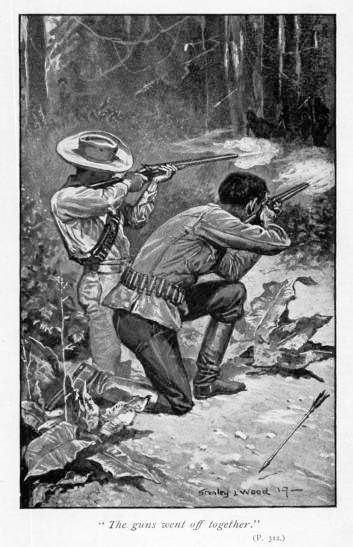
“Twenty-eight—twenty-seven—twenty-six—twenty-five—fire!”
The guns went off together, and the pair sprang up and ran after their companions, to find fifty yards nearer the boat the captain and his officers down on one knee waiting to cover them.
“Well aimed!” cried the former. “You two halt to cover us just at the water’s edge. That’ll give the boys time to get aboard, and then we can laugh at the copper-skinned vermin. Look sharp and reload: they’re coming on again.”
Brace and his companion continued their retreat, overtaking the sailors with the wounded man, whom they now saw to be Jem, and had endorsement of the fact in the tones of his voice, for he was growling and abusing his bearers.
“Put me down, I says, and go and help the old man. I tell you I can get to the boat myself without any help.”
“Hold your row,” said one of the men; “if you don’t we’ll bump you.”
“Don’t talk, my lads; hurry on,” cried Brace, who was busy reloading. “Look sharp and get aboard.”
“Ay, ay, sir,” cried the party cheerily.
The next minute they were at the water’s edge, where their defenders halted ready, just as the captain’s voice was heard to shout:
“Fire!”
Three shots rang out, and, covered by the smoke, the captain and his mates ran on, to begin reloading.
“Look sharp, boys!” panted the captain; “get to the boats, each man to his own, but put the wounded man in mine. You’re ready, Mr Brace—Mr Briscoe?”
“Yes.”
“That’s right: we won’t row away and leave you. Forward, my lads, and get under cover of the boat’s side. Hoist the sail half-mast, and keep behind it. They’ll begin to shoot directly. We’ll get on board first, gentlemen, to cover you from the boats. Stand fast till we’re all in if you can, and then give ’em all four barrels and make a dash for it before the smoke rises.”
These next were anxious moments, but Brace did not flinch, and his companion went on talking with his eyes fixed upon the approaching enemy, each man holding an arrow to his bowstring, but unaccountably refraining from winging it home. He seemed to be in every case watching the muzzles of the guns in wonder and fear as he slowly approached.
“I want to cut and run horribly, Brace,” said the American, in a husky voice; “only I suppose we mustn’t. We shall look like porcupines directly—full of arrows, I expect; but keep up your spirits: I daresay we shall each have a fair share.”
“I say, don’t!” said Brace. “It is too serious to joke about.”
“And no mistake. Are they all aboard yet?” asked Briscoe.
“Don’t know, and can’t look round. I must face them. It would be ever so much worse to turn our backs.”
“Ten times,” said Briscoe. “Look out! I say; that’s a fresh party—twenty or thirty of them, coming out of the woods a quarter of a mile away. They ought to be too late to reach us.”
“Our men are all on board, and the Indians are going to rush us,” whispered Brace.
“That’s so,” said the American. “Be ready. I’ll say ‘Fire!’ Then wait till the smoke lifts, when I’ll give the word again, and then it’s a rush through the water to the boats. Bet you two cents I get most arrows in my back.”
“Steady!” growled Brace hoarsely.
“Fire!” shouted the captain from the boat, and, in spite of the order upsetting their plans, the covering party obeyed and sent their little shower of shot amongst the yelling enemies’ legs.
“Let ’em have it again,” roared the captain from the second boat.
The remaining two barrels rang out, and those who fired sprang up and dashed through the water to reach the larger boat, where they were seized and dragged in and under cover.
None too soon, for a little shower of arrows came aboard and through the sails, which were shivering in the brisk breeze.
The next minute, in response to a thrust or two, and a touch at the tillers, both sails half-filled, and the boats were gliding swiftly away from the shore, the arrows coming more and more seldom, till the last two failed to reach them, but fell into the water twenty yards astern.
Then the captain, who had been tending the wounded man, rose up and said, loud enough for those in both boats to hear:
“There we are then, my lads, quite out of danger now, and nothing to mind but a few canoes up stream and a few more down; but look here, I’ve just got this to say to you all: if you’d had your way there’d have been a big fire ashore to-night and a general collection of Indians to the biggest roast they had enjoyed for years. After it was over everyone of those copper-skinned gentlemen would have been going about with a good big bit of my crew in his inside. That’s quite true, isn’t it, Mr Briscoe?”
“Oh, yes,” said the American: “these people are cannibals still when they get the chance.”
“That’s so,” cried the captain; “and now you know, my lads. There, you’ve had your touch of the gold fever, and if we get back on board I’ll give every man-jack of you a dose of quinine. But now I shall say no more about it, for I see you’re all sorry for being such fools, and are going to fall back into your work.”
There was a low murmur of assent at this, and the captain spoke again:
“What say, Sir Humphrey?”
“I say, we seem to be leaving the canoes down the river well behind, but those up stream are bearing down upon us fast.”
“Then,” said the captain, “they’d better look out, gentlemen, and keep out of our way, for I mean to rush right upon them full sail. The prows of these boats are pretty sharp, and their dug-outs don’t take much to send them to the bottom. I say, you Dan,” he went on, “you’d better serve round some biscuit and bacon to the lads, for they must be getting peckish after what they’ve gone through. I say, Sir Humphrey, what do you say to making a hand-grenade or two out of pound powder-tins and pieces of rag?”
“To throw on board the canoes?” said Sir Humphrey: “horrible!”
“Quite true, sir; but it would be more horrible still if these savages should manage to get the better of the crew of the ‘Jason’ brig. What do you say to that?”
“I give up,” replied Sir Humphrey. “I hate the idea of slaughtering the poor ignorant wretches, but self-preservation is the first law of nature.”
“Exactly so, sir. If we kill it won’t be for the sake of killing.”
“How is Jem’s wound going on?” said Brace anxiously.
“You take no notice about that, sir,” said the captain, with a peculiar look. “He has got a hole in his leg made by an arrow, and I’ve doctored it up just as I did your brother’s, and laughed at him and told him it served him right. You gentlemen had better take the same line. If he sees that we look serious about it he’ll take and die right off: he’ll kill himself with the belief that he’s shot by a poisoned arrow.”
“Is he?” said Brace, in an eager whisper.
“I didn’t see the arrow made, sir, and I didn’t see it dipped in anything. What’s more, I never saw the arrow at all, for the boys pulled it out and chucked it away. Maybe it was poisoned; but you see these arrows are only meant to kill birds, and what might kill a bird won’t do much harm to a man. I’ve done all I know for the wound, same as we did for your brother’s. He got well, and if we laugh at Jem he’ll get well too.”
“The niggers are coming right down upon us, sir,” said the first mate from the other boat, “and evidently mean to fight.”
“All right, Dellow; be ready for ’em. I shall lead. We mean to fight too.”
Chapter Thirty Two.
The Way to Nowhere.
The long light canoes of the approaching Indians were well manned, and as they came nearer Brace could see that most of the occupants wore a kind of tiara made of the tail feathers of parrots or macaws. Several held spears or bows, but the major part were busy paddling, and they came down with the stream, evidently full of fierce determination to destroy or capture the strange intruders upon their solitudes, striving hard to increase the speed of their canoes, which were in a well-kept line.
There was no time for the discussion of plans, for the distance between the brig’s boats and the enemy was rapidly growing less.
“One wouldn’t have time to prepare anything if one wanted to,” said the captain, after a sharp glance forward. “Will you leave it to me, gentlemen, to do my best?”
“Of course,” said Sir Humphrey, and Briscoe nodded from where he knelt, with his double gun held ready in his hand.
“Then here goes,” said the captain. “Ahoy there, Dellow; clap on all you can, take the tiller yourself; and run one of the canoes down. Let your lads knock all over who try to board you.”
“Ay, ay!” came back in answer from the second boat.
“Now, Lynton,” continued the captain, “steer for that canoe in the centre. We’re going faster than they are. You, gentlemen, don’t shoot, but use the butt-ends of your rifles if we should happen to get to close quarters. Every man take an oar or boathook, and use ’em like as if they were whaling-lances. Ready? Look out!”
Their boat, with the sail straining at the sheet, was now rushing through the water, the side not two inches above the surface, as she raced for the centre of the line of canoes.
“Sit fast!” roared the captain. “Down with you, Mr Brace, or you’ll be overboard.”
Brace, who had risen in his excitement so as to be able to club his gun, dropped down on to the seat at once.
Then from in front as their own boat seemed to be standing absolutely still and the line of canoes dashing rapidly at them with the paddles churning up the water on either side, there was a fierce yelling, a gleam of opal-rimmed eyes, a crash which made the boat quiver from stem to stern. The sail jerked and snapped as if it were going to fall over the side, and then they were past the centre canoe, sailing on as fast as ever.
Lynton had done his work well, steering so that he drove the boat’s iron-protected cut-water right upon the centre canoe’s bows diagonally some six feet from the front, when for a few brief moments their progress seemed to be stopped. Directly afterwards the occupants of the stoutly-built boat felt her gliding right over the canoe, which rolled like a log of wood, and then the men were cheering as they looked back at the glistening bottom of the long vessel and six or eight black heads bobbing about in the water.
Crash, grind, and there was another canoe capsized, literally rolled over by the second boat, which seemed to those in the first to rise and glide over the crank dug-out, now beginning to float broadside on with her crew swimming to her side.
A hearty cheer rose now from Dellow and his men, which was echoed from the first boat, as the distance between the party and their fierce enemies rapidly increased.
“You did that splendidly, captain!” cried Brace excitedly.
“Tidy, sir, tidy,” was the reply; “but these boats weren’t built for steeplechasing in South American rivers. Let’s see what damage is done. I don’t suppose we’re much hurt.”
The captain stepped from thwart to thwart as he spoke, and, getting right forward, he leaned over the bows and carefully examined as far as he could reach, before raising his face again and turning to Brace, who had followed him, to now meet his eyes with an enquiring look.
“Right as a trivet,” he said. “Took off some of the varnish; that’s all that I can see. Ahoy! what damage, Dellow?” he roared to the mate in the boat astern.
There was no reply for a minute or so whilst the first mate examined his boat.
Then came a shout, in Dellow’s familiar tones:
“Twopenn’orth o’ paint gone, and a bit of a splintery crack in the top plank.”
“Any leakage?”
“Not a doo-drop, sir,” was the reply.
“Well done. Keep close up abreast,” shouted the captain; and, now that the safety of the boats was assured, attention was directed to the canoes, which were being rapidly left astern.
“They seem to be trying to right their craft,” said Sir Humphrey, who, like Briscoe, was making observations with his pocket glass.
“Yes,” added Briscoe, “and they turned them over quite easily, but their sides are down flush with the water.”
“The men have got in again, and they appear to be splashing out the water with their paddles,” said Sir Humphrey.
“That’s right,” said Briscoe, “and the other canoes have ranged up alongside. I can see quite plainly: there’s a canoe on each side of the injured ones to keep them up.”
“It’s my belief that they may bale till all’s blue before they get ’em to float. Those dug-outs are worked till they get ’em as thin and light as they can, and if we haven’t cut a good gap in each one’s side, it’s a rum one,” growled the captain. “What are they doing now, sir? It’s rather far to see, but it seems to me that they’re trying to get the sunken canoes to the shore.”
“Yes: that’s just what they are trying to do,” cried Sir Humphrey. “Oh, yes, I can see that plain enough.”
“Then they won’t follow us up to-day, gentlemen,” said the captain; “and perhaps we may not see them again. Might like to sail back, p’r’aps, Mr Briscoe,” he continued, “and give the copperskins a friendly word about hope they’re not damaged, and then settle down in the shallows for a good afternoon’s gold-washing.”
“Not to-day, thankye, skipper,” said the American drily. “It might be teaching the savages how to catch the gold fever, as you called it, and be bad for their health.”
“P’r’aps so,” said the captain, with a peculiarly grim look and a glance round at the crew; “and they’ll be better employed gumming up those holes in the sides of the canoes.”
“Do you think they’ll pursue us, captain?” said Brace.
“Most likely, sir,” was the cheerful reply. “They’ll be wanting to bring us the bill for damages. I’m thinking it would be the safest thing to try and drop down by ’em after dusk. This part begins to be rather unsafe.”
He looked at Sir Humphrey as he spoke, and the latter turned to his brother.
“Well, I don’t know, captain,” he said: “the wind holds good, and we seem to have passed the danger. I don’t like to give up yet. What do you say, Mr Briscoe?”
“I think it would be a hundred pities,” was the quick reply. “The country is getting more and more attractive. Who knows what we may discover, eh, Brace?”
“I feel exactly as you do, and think we should proceed,” said the latter quickly.
“We’ve got whole skins now,” said the captain dubiously, “all but one of us.”
“You think it running too much risk to go on?” said Sir Humphrey.
“Well, I can’t say that, sir,” was the reply, “because we may sail on for weeks and weeks and not see another Indian, while if we go back we are sure to see some.”
“Exactly,” said Sir Humphrey; “but I can’t help thinking that we are getting now into a more uninhabited part of the country, perhaps where travellers have never been before.”
“Then I say let’s go on,” said Briscoe, “and we may find El Dorado, after all.”
“El Dorado or no El Dorado, I say don’t let’s give up yet,” said Brace. “Let’s keep on till we are obliged to go back to the brig for stores; and by that time we shall know whether it is worth while to come up here again.”
“That’s good advice, sir,” said the captain, smiling at Brace as he spoke. “I don’t want to give up: I like it as well as you do. There’s only one thing wherrits me.”
“What’s that?” said Brace.
“My brig. I lay awake for a good ten minutes last night thinking about what we should all feel if we got back to where we left her and found that the old ‘Jason’ had dragged her anchors and navigated herself out to sea.”
“Oh, but if she had dragged her anchors, captain,” said Brace, “they’d lay hold again somewhere lower down.”
“Yes, sir,” said the captain drily; “that’s what comforted me. All right, gentlemen. On we go then. I’m thinking now that after the lesson we gave those gentlemen to-day they mayn’t care to meddle with us again.”
“Do you think any of them were killed?” said Brace.
“Hardly, sir. Certainly not with the buckshot. If any of them lost the number of their mess it would be just now in the river.”
“Drowned?”
“Oh, no. They swim like seals. It would be through some of the natives below: old friends of theirs.”
Brace felt a shudder run through him as he glanced down over the side, where the water glided deep and dark now from where they were sailing to the tree-clothed shore.
But the conversation took another turn then, the captain proposing that a good midday meal should be eaten now, and no halt made till a suitable well-screened resting-place was reached about an hour before dusk.
“Why not keep right on till it is quite dusk?” said Sir Humphrey.
“He means so that we can land and light our fire in the forest, do our cooking, and put it out again before it’s dark, when it would show our position to any prowling natives,” said Briscoe.
“That’s right,” said the captain.
These tactics were carried out, a strong wind wafting the boats along mile after mile to a far greater distance than any amount of paddling would bring canoes in pursuit; and fortune favoured them far more, for, just about the time decided upon, the fine river up which they had come suddenly opened out fan-like, offering them five different routes onward.
“Which shall it be, Brace?” said Sir Humphrey, as he stood up with his brother in the bows. “If the enemy is following us he is as likely to take one as the other.”
“I don’t know,” said Brace, with a laugh. “They are all beautiful. That left one seems the deepest, and the stream flows slowly, so I think we had better choose that.”
“Best too for the wind,” said Briscoe. “There’s a ripple up it as far as we can see.”
“It’s to the left and not to the right,” said Brace.
“All the better,” said Briscoe, laughing. “You know what you English folks say about driving: ‘If you go to the left you are sure to be right; if you go to the right you’ll be wrong.’ I think we might well stick to that rule in this case.”
The left branch was chosen, and they sailed swiftly up it, finding to their surprise that there was scarcely any appearance of current, and soon after a suitable spot for a landing-place presented itself in one of the many bends of the river’s sinuous course.
Here they landed, and Dan was soon busy preparing food, while as far as they could make out they were where human foot had never pressed the soil before.
Chapter Thirty Three.
The Sound of Many Waters.
The fire was carefully extinguished before night-fall, so that no flash or gleam might betray the adventurers’ whereabouts to any prowling foe, and watch was set in each boat after they had been moored about twenty feet from the shore. Everything had been made snug, arms issued round and loaded ready, and once more sleep came to all save Brace and his American companion, who sat together for a good hour, gazing into the forest gloom and listening to the many strange sounds which rose among the dense growth.
Then sleep overtook them, just when they were vainly trying to puzzle out the meaning of a strange booming roar, which sounded not unlike thunder at a distance.
“I guess that’s what it is,” Briscoe had said. “That’s the nearest I can get to it. Maybe there’s a clump of mountains not very far away, and they’ve got a storm there.”
“We shall know in the morning,” said Brace. “If it’s a storm the water will have risen in the night.”
“Let it,” said Briscoe drowsily. “We’re in shelter, and the boats will rise, so it will not matter to us.”
The next minute both were asleep, and the night passed tranquilly enough till they were awakened by Lynton, who had the morning watch.
“What is it?” said Brace confusedly: “time to get up?”
“Yes, if you don’t want to be scratched out of the boat. Look sharp, please. We’re going to get the awning down.”
It was quite time, as Brace found on getting his eyes well opened, for the boat was tugging at her moorings, the awning rigged up overnight for shelter was close up among the leafage beneath a bough of the tree to which the rope was made fast; and, instead of the water upon which they floated being like that of a placid lake as it had seemed overnight, it was now rushing rapidly by the boat’s sides.