INTRODUCTION. (continued 2)
Reading edition
From this simple account of the Highland dress, it will be seen that it has in itself nothing peculiar to one country more than another; as the different improvements upon the manner of girding the loins, and trussing up a blanket, can hardly be called a national costume. The dress of the Romans began in the same manner, and went through nearly the same varieties of form; but, for a long time after the Romans left Britain, it can hardly be imagined, that the inhabitants of the more remote Highlands had either wool or cloth of their own produce. Scattered as their sheep, if they had any, must have been upon the mountains, they had no means of protecting them from the wolves; and they had not then patient industry enough to look after tame animals that could not take care of themselves.
The names of the different parts of this dress are all conformable to what has been said above. The feilebeg is, by the Lowlanders, called a kilt, from its having been kilted, quilted, or trussed up under the girdle. The meaning of the Latin toga is found in the Gaëlic toga’; in English, to tuck up, from the same circumstance; and a square body-cloth, still worn round the shoulders by the Highland women, is called a tunic, or tonnac. Plaid (which is always misapplied in England), in its primary sense, means simply any thing broad and flat, and thence, a broad, unformed piece of cloth, and, in its secondary and modern acceptation, a blanket; in which last import alone it is now used by the Highlanders. The trews, or trowsers, formerly worn only by the gentry, and by the lower classes, after the philibeg was proscribed by act of parliament, are so denominated, from the Gaëlic trusa’, to truss up, as they supplied the place of the end of the feile which was trussed under the girdle.[63]
During the period following the Union of the Kingdoms of Scotland and England (1707), tartan plaids were worn in the Lowlands by all classes. The significance of this universal display of a simple article of dress consisted in the fact that its wear was regarded as a sort of sumptuary protest against the Union and the surrender of Scottish independence. Certain it is that up to the prohibition of the use of tartans and of the Highland dress by the Act of 1747 the tartan plaid continued in general use throughout Scotland. Many references to the prevalence of the habit in the Lowlands as well as in the Highlands might be quoted. One interesting contribution is that of Ramsay of Ochtertyre, who, writing in 1795 of the congregation of the Rev. John Skinner’s church at Linshart, in Buchan, observes:—
In point of mode and plainness their dress reminded me of that of our country-people more than forty years ago, bonnets and parti-coloured plaids being frequent.... In those days every lady in an undress wore a plaid when she went abroad. It was sometimes of one colour, scarlet, crimson, &c., but more commonly tartan or variegated. People fond of finery had silk ones, others wore woollen lined with silk; whilst the lower classes were satisfied with plain worsted.... In 1747, when I first knew Edinburgh, nine-tenths of the ladies still wore plaids, especially at church. By this time, however, silk or velvet cloaks of one form or another were much in request among people of fashion. And so rapidly did the plaid wear out, that when I returned to Edinburgh in 1752 one could hardly see a lady in that piece of dress.[64]
Of the extensive manufacture of tartans in Scotland during the eighteenth century some evidence may be obtained from a reference to the newspapers of the period. For example:—
Last Saturday the Agatha and Jane, Thomas Christie [master] cleared out from Leith for London, having on board the following Scots manufactures, viz., 53,381 yards of Linen, 3006 yards of Tartans.[65]
Leith, Feb. 18.—The Edinburgh Merchant, John Dick, cleared out for London with the following Scots manufactures, viz., 41,400 yards of Linen, 6400 yards of Tartan.[66]
In the same newspaper, and side by side with the orders issued by Prince Charles Edward, then at Holyrood, appears the following:—
Gairdner and Taylor, in their Warehouse at the Sign of the Golden Key, opposite to Forrester’s Wynd, Lawn-Market, Edinburgh, continue to sell, in Wholesale and Retail, at lowest Prices, all sorts of Woollen Narrow and Broad Cloths of the Manufacture of Scotland, in same manner as was done by the late Andrew Gairdner, who was one of the first Introducers of an extensive Manufactory of this Kind, so very beneficial to, and so much wanted in this Country.... At above Warehouse to be sold at lowest Rates, great Choice of Tartans, the newest Patterns, Cotton Checks and Sarges, of which they are also Makers.[67]
This advertisement, it may be urged, is a stumbling-block in the way of those who argue for the antiquity of clan patterns; for it seems peculiar that, when the city was filled with Highlanders of all ranks and many clans, they should be offered, not their ancient setts, but “great choice of the newest patterns.”
A statement which points in exactly the contrary direction appears in the Lockhart Papers to the following effect:—
It was necessary for us [i.e., the troops under the command of the Duke of Perth and the Earl of Cromarty in the Prince’s army], in order to come at him [i.e., Lord Louden, who commanded a detachment in the Duke of Cumberland’s army], to go about by the head of Tyne,[68] through Torendonel, about ten miles’ march, and accordingly Glengary’s, Clanronald’s, Ardsheal’s, Glengyle’s, and Barisdale’s battalions were ordered after them, under the command of the Duke of Perth and Lord Cromarty. Those under Lord Louden’s command were the M’Loads, Sir Alexander M’Donald’s men, the Makays and Monroes, and the Grants—about three thousand in all.... We M’Donalds were much perplex’d, in the event of ane ingagement, how to distinguish ourselves from our bretheren and nighbours the M’Donalds of Sky, seeing we were both Highlanders and both wore heather in our bonnets, only our white cocades made some distinction.[69]
The inference from the passage is, that the opposing battalions being of the same great family, with dress and badge alike, the sole remaining difference between them was the cockade.
One result of the civil war of 1745-6 was the proscription by Act of Parliament of the Highland dress:—
19 George II., Cap. 39, Sec. 17, 1746.
From and after the first day of August one thousand seven hundred and forty-seven, no man or boy within that part of Great Britain called Scotland, other than such as shall be employed as officers and soldiers in his Majesty’s forces, shall, on any pretence whatsoever, wear or put on the clothes commonly called Highland Clothes (that is to say) the Plaid, Philibeg, or little Kilt, Trowse, Shoulder belts, or any part whatsoever of what peculiarly belongs to the Highland garb; and that no Tartan or party-coloured plaid or stuff shall be used for great coats, or for upper coats; and if any such person shall presume, after the said first day of August, to wear or put on the aforesaid garments, or any part of them, every such person so offending, being thereof convicted by the oath of one or more credible witness or witnesses before any court of justiciary, or any one or more justices of the peace for the shire or stewartry, or judge ordinary of the place where such offence shall be committed, shall suffer imprisonment, without bail, during the space of six months, and no longer; and being convicted for a second offence before a court of justiciary, or at the circuits, shall be liable to be transported to any of his Majesty’s plantations beyond the seas, there to remain for the space of seven years.
“It is impossible,” writes General Stewart of Garth, “to read this latter Act without considering it rather as an ignorant wantonness of power than the proceeding of a wise and a beneficent Legislature. To be compelled to wear a new dress has always been found painful. So the Highlanders found; and it certainly was not consistent with the boasted freedom of our country to inflict on a whole people the severest punishment short of death for wearing a particular dress. Had the whole race been decimated, more violent grief, indignation, and shame could not have been excited among them than by being deprived of this long-inherited costume. This was an encroachment on the feelings of a people whose ancient and manly garb had been worn from a period remote beyond all history or even tradition.”[70] The spirit in which the Act was carried out may be gathered from the following extract from the General Orders to the Army in Scotland in 1748:—
By the act passed last session of Parliament, the time for the general abolishing the Highland dress is enlarged to the 1st day of August 1749.
But that the wearing and use of such parts thereof as are called the plaid, philibeg, or little kilt, is absolutely prohibited and abolished from and after the 25th day of this instant December, and as to these particulars the law takes place from that day.
His grace the Duke of Newcastle has therefore signified to me his majesty’s commands, that the same be punctually observed throughout the Highlands, and that I should give orders to all the troops quartered in those parts to be particularly attentive to this service, and to take all due care that the act be punctually executed and observed, and the offenders brought to punishment according to law.
In obedience to these his majesty’s commands, you are to seize all such persons as shall be found offending herein, by wearing the plaid, philibeg, or little kilt, and carry them before a civil magistrate, in the same dress, that he may be convinced with his own eyes of their having offended, in order to their being punished for the same according to law; in the performance of which, let no insult or abuse be offered to the person or persons of those who shall be so taken up and carried before the civil power, who are solely authorised to inflict the punishment as the act directs; but in case the magistrate before whom such offenders are carried shall refuse or neglect putting the law in execution, in that case let me know immediately the name of such magistrate, with the reason of his not doing it, that I may acquaint the Duke of Newcastle with it, who will no doubt send immediately orders to the lord advocate of this country to prosecute him to the utmost for his contempt of the said act, by not putting it in execution.
That the people in the Highlands might have no excuse by pleading ignorance, the lord chief justice clerk wrote to the sheriffs depute of the Highland counties, ordering them to give notice at every parish church, that they must quit the plaid, philibeg, or little kilt on Christmas-day, as the act directs, otherwise they would be carried before the civil magistrate and punished for it accordingly.
I must likewise desire you will let me know from time to time what obedience the people pay to this act, for they must and shall obey it, with the names of those magistrates who are industrious in putting the laws in execution, that I may take an opportunity of thanking them for performing their duty, and acquainting the Duke of Newcastle with it.
You may acquaint the magistrates and justices of the peace in your neighbourhood with the contents of this letter, since it may be the means of inciting them the more readily to perform their duty.
P.S.—Let a copy of this letter be sent to the officers commanding the general detachments of your regiment respectively.[71]
All manner of ingenious evasions were thought of and practised to defeat the law. “The tight breeches,” observes General Stewart, “were particularly obnoxious. Some who were fearful of offending, or wished to render obedience to the law, which had not specified on what part of the body the breeches were to be worn, satisfied themselves with having in their possession this article of legal and loyal dress, which, either as the signal of their submission, or more probably to suit their own convenience when on journeys, they often suspended over their shoulders upon their sticks; others, who were either more wary or less submissive, sewed up the centre of the kilt with a few stitches between the thighs, which gave it something of the form of the trowsers worn by Dutch skippers. At first these evasions of the Act were visited with considerable severity.”[72] It was most probably for conniving at some such breach of the law that a young grenadier of the 20th Foot narrowly escaped a tremendous punishment.
The court-martial has judged the crime of Rigby, the grenadier, to be of so pernicious a nature that they have sentenced him to receive six hundred lashes. His youth and former good behaviour are the only considerations that could induce the lieutenant-colonel to pardon him: but if hereafter any sergeant or corporal is known to receive a bribe from a Highlander, or from any person whatever, found or known to transgress the laws, and does not seize the person or report such transgression, he, the non-commissioned officer guilty of so heinous a crime, will be instantly broke and severely punished: and if any private soldier ever takes money, or a reward of any kind, that may lead him to betray his trust, such soldier will be whipped without mercy.[73]
The harsh and bitter administration of the law continued for many years—for a long enough period, indeed, to stamp out the use of the dress, at least among the lower orders. In the south the wear of tartan does not seem to have been interfered with. For instance, we read:—
There is to be sold by roup in the shop of William Watson in the front of the New Exchange of Edinburgh upon Monday 3rd day of March next the whole goods which belonged to the said William Watson consisting of Tartans of all kinds poplins durants calicoes thick-sets hollands lawns broadcloths stockings handkerchiefs ribbons worsteds and a great variety of other goods too tedious to mention. The goods are all fresh and in good condition and fashionable.[74]
James Baillie Merchant in Edinburgh has removed his warehouse to the Exchange fronting the Tron where Tartans or Plaids with other goods are sold as formerly.[75]
At length the enactment was repealed. The Marquis of Graham, afterwards Duke of Montrose, when a Member of the House of Commons in 1782, having brought in a Bill for the purpose, it was, according to General Stewart, passed without a dissentient voice.[76]
22 George III., Cap. 63, 1782.
Whereas by an act made in the nineteenth year of the reign of his late majesty King George the Second, entituled “An act for the more effectual disarming the Highlands in Scotland and for more effectually securing the peace of the said Highlands; and for restraining the use of the Highland dress;” ... it was, among other things, enacted that from and after the first day of August one thousand seven hundred and forty-seven, no man or boy, within that part of Great Britain called Scotland, other than such as shall be employed as officers and soldiers in his Majesty’s forces [&c., as quoted, pp. 36-7]. And whereas it is judged expedient that so much of the acts above mentioned as restrains the use of the Highland dress should be repealed: Be it therefore enacted by the King’s most Excellent Majesty, by and with the advice of the Lords Spiritual and Temporal and Commons in this present Parliament assembled, and by the authority of the same, That so much of the acts above mentioned, or any other act or acts of Parliament, as restrains the use of the Highland dress, be, and the same are hereby repealed.
The repeal of the enactment, received so joyously by the Highlanders, was celebrated by the famous poet, Duncan Ban M’Intyre, in the following lines, which are freely adapted from the Gaelic:—
Indulgent laws at last restore The noble dress our fathers wore. Exulting, let us then resume The bonnet blue and eagle plume; The tartan coat and jaunty vest And belted plaid become us best. With limbs unchained and footsteps free, The pleated kilt just shows the knee; In hose and brogues we’ll roam at will O’er purple moor and heather hill.
How quickly the dress was resumed—at all events in certain portions of the country—is shown by the following testimony. One of the Hebridean missionaries of the Church of Scotland, whose travels among the people extended over the eight years from 1782 to 1790, observes:—
The men wear the short coat, the feilabeg, and the short hose, with bonnets sewed with black ribbons around their rims, and a slit behind with the same ribbon in a knot. Their coats are commonly tartan, striped with black, red, or some other colour, after a pattern made, upon a stick, of the yarn, by themselves, or some other ingenious contriver. Their waistcoats are either of the same, or some such stuff; but the feilabegs are commonly of breacan, or fine Stirling plaids, if their money can afford them.
At common work they use either short or long coats and breeches made of striped cloth, and many of them very coarse, according to their work. Their shirts are commonly made of wool; and however coarse they may appear to strangers, they are allowed to conduce much to the health and longevity for which this country is famous; as I have known them eighty, ninety, and some even a hundred years old, in these islands, and able to do their daily work.
When they go in quest of the herring, they dress something like the sailors, but of coarser cloth, with hats over their eyes, to mark the fish the better. They are careful about drying their nets, and other fishing tackle.
Their brogues (shoes) are made of cow or horse leather, and often of seals skins, that are commonly well tanned by the root of tormintile, which they dig out from the hillocks, and uncultivated lands, about the sea-side. This, properly pounded and prepared, without either lime or bark, is sufficient to make the hides pliant and fit for wearing. It answers their purpose much better than leather tanned with lime or bark, because they seldom grow hard or shrink when dried, even though wet all day; which is not the case with such as are burnt with lime. They never use tan-pits, but bind the hides fast with ropes, and hold them for several days in some remote solitary stream, until the hair begins to come off, of its own accord; and after that, the tormintile roots are applied for bark, as above described. Such of the men as can afford them, wear large forest coats above their other garb, especially on Sundays, or at the public meetings, as weddings, burials, or fairs. Either in this or a coarse breacan (i.e. the plaid) with their best apparel, they appear on these solemn occasions; but many of those who are poor, and cannot afford it, often do and must appear in their tattered clothes and dirty shirts, without either stockings or brogues, quite bare-footed, even in frost and snow, in distress sufficient to extort compassion from every person, but such tyrants as are the cause of so much misery to those starved creatures, who are often creeping along with white or striped petticoats belonging to their wives, or daughters and sisters, about their shoulders.
The women wear long or short gowns, with a waistcoat and two petticoats, mostly of the stripes or tartan, as already described, except the lower coat, which is white. The married wives wear linen mutches, or caps, either fastened with ribbons of various colours, or with tape straps, if they cannot afford ribbons. All of them wear a small plaid, a yard broad, called guilechan, about their shoulders, fastened by a large broach. The broaches are generally round, and of silver, if the wearer be in tolerable circumstances: if poor, the broaches, being either circular or triangular, are of baser metal and modern date. The first kind has been worn time immemorial even by the ladies. The arrisats are quite laid aside in all this country, by the different ranks of women; being the most ancient dress used by that class. It consisted of one large piece of flannel, that reached down to the shoe, and fastened with clasps below, and the large silver broach at the breast, while the whole arm was entirely naked. The ladies made use of the finer, while common women used coarser kinds of flannel, or white woollen cloths. The married women bind up their hair with a large pin into a knot on the crown of their heads, below their linens; and the unmarried frequently go bare-headed, with their hair bound up with ribbons, or garters. They often wear linen caps, called mutches, particularly on Sabbaths. Many of the more wealthy appear at church with a profusion of ribbons and head-dresses, with cloaks and high-heeled shoes. Those whose circumstances cannot admit of that, must appear with one of their petticoats, either tartan, or of one colour, around their shoulders, on Sundays, as well as on week days. They seldom travel any where without this appendage; nay, in the house, when at such work as will admit of it; seeing it would be thought naked in a woman to go without it: it also defends them from the inclemency of the weather. Most of them wear napkins, or handkerchiefs, on their necks; and many of the richest of them use silk ones, whether black or spotted, as suits their fancies.
Frequently the old women wear little guilechans, (small plaids) about their shoulders, and woollen hoods about their heads, with very coarse linen under them fastened with a pin below their chins. The breeid, or curtah, a fine linen handkerchief fastened about married women’s heads, with a flap hanging behind their backs, above the guilechan, is mostly laid aside.
Most of the poorer tenants cannot afford to wear brogues in Summer, unless they are obliged to be treading among the sharp rocks on the shores, at their master’s kelp, when the master must supply them, except they can afford to provide for themselves. It would be too great a luxury for a poor one to use them, unless at the same, or similar rugged employment. Nothing short of extreme necessity obliges them to appear in public meetings in these humiliating garbs; for otherwise their pride would revolt at the very thought of such shabby dresses.[77]
Gough thus describes the dress of the Highlanders in the district of Breadalbane about 1789:—
The dress of the men is the brechan or plaid, 12 or 13 yards of narrow stuff wrapped round the middle and reaching to the knees, often girt round the waist, and in cold weather covering the whole body, even on the open hills, all night, and fastened on the shoulders with a broche: short stockings tied below the knee; truish, a genteeler kind of breeches, and stockings of one piece; cuoranen, a laced shoe of skin with the hairy side out, rather disused; kelt or fillebeg, q. d. little plaid or short petticoat, reaching to the knees, substituted of late to the longer end of the plaid: and lastly the pouch of badger or other skins, with tassels hanging before them. The Lochaber axe, used now only by the town guard of Edinburgh, was a tremendous weapon. Bows and arrows were in use in the middle of the last century, now as well as the broadsword and target laid aside since the disarming act, but the dirk, or ancient pugio, is still worn as a dress with the knife and fork.... The women’s dress is the kirch, or white linen pinned round behind like a hood, and over the foreheads of married women, whereas maidens wear only a snood or ribbon round their heads: the tanac or plaid fastened over their shoulders and drawn over their heads in bad weather: a plaited long stocking, called ossan, is their high dress.[78]
These notes bring us down to the present century, and the account of works written on the subject which follows will give our readers some idea of the present state of the literature relating to tartan. Before concluding, however, it is worth while to make some special references to one of these works, the Vestiarium Scoticum.[79] John Sobieski Stuart’s account of the origin of the work is as follows:—
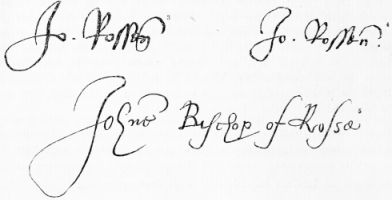
The tract now published in the following volume, is printed from a MS. in my possession, collated with the transcript of another in the Library of the Monastery of St Augustine in Cadiz. It is a small black-letter quarto of the sixteenth century, containing thirty-four pages of vellum, illuminated with small, plain, capitals, such as the ordinary initials of inferior missals. It was once in the possession of the historian and faithful adherent of Queen Mary, John Lesley, bishop of Ross, as appears by his signature in the first leaf—“Jo. Rossen.” Immediately below is noted, in his small neat hand, “Primo Maii, 1571, I tuck my feaver and ageu at ix huris at nyt.”... Some of the many calamities which scattered the adherents of the house of Stuart, and brought together many of their persons and their remains in the Catholic seclusions of the Continent, conveyed the Vestiarium Scoticum, and many papers of the Bishop of Ross into the Library of the Scots College at Douay. During the long incognito of the prince Charles Edward, between the years 1749 and 1754, he visited that seminary, for purposes which expired in the obscurity wherein they were planned; and, during his stay, he received from the fathers many papers which had belonged to Queen Mary, her adherents, and King James the Seventh. Among others, of a very different nature, was found the Bishop of Ross’s copy of the Vestiarium Scoticum. This copy, now in my possession, being the oldest and the most perfect, has served as the original to the present publication.
The next in value, that which belonged to the Library of the Convent of St Augustine, is a small paper folio, bound in panel, written in the ordinary running hand of the time of James the Sixth. By the signature and date, it had at one time belonged to “ane honerabil man Maister James Dunbarre wtin ye burg of Innernesse, in ye yeir of God ain thousand sax hunder and aucht yeirs.” By a subsequent name upon the cover—“Johan O’Neil, cleric”—it had probably passed into the hands of one of the many expatriated Irish priests, who were driven to the Continent, during the reigns of Elizabeth and James the Sixth; and, in this revolution, probably found its way into the Monastery of St Augustine. Spain was at that time the principal sanctuary for the Irish and Island refugees; and it is not improbable that the possessor of the volume might have been one of the followers of the unfortunate James McDonald of Isla and the Glens, who, on his expulsion from Ulster and the Isles, fled to the Court of Philip the Third. Between this copy and that of the Bishop of Ross there are but very few variations, and almost all, apparently, accidental omissions of the copyist: wherever they occur they have been noted on the margin of this edition.
Besides these copies, there is, also, in my possession, a third, of a much lower character and later period, obtained from an old Ross-shire Highlander named John Ross, one of the last of the sword-players, who may yet be remembered by those who recollect the porters of Edinburgh twenty years ago. It is an inferior, modern copy, bearing the stigmats of various barbarous hands, which have inflicted upon its pages divers attempts to transmit to posterity the names of a certain John and Marye Inglis, who have borne testimony to their familiarity with its leaves in the year 1721. It is written with negligence and inaccuracy, in a very ill hand, and with several substitutions, variations, and omissions, which, in some instances, appear to have been the result of carelessness; in others, the attempts of an illiterate transcriber to adapt the work to his ideas of the clans in his own time. It may, indeed, be conjectured that it was transcribed from an original which, in some degree, differed from the copies of the Bishop of Ross and the Library of St Augustine, since the names of several clans and low-country families follow in a succession different from these MSS. This, however, might have been the result of accidental omission and subsequent re-entry.... These last [the three preceding copies] are the only MSS. of that work which have fallen under my observation; but, according to a notice communicated by Lord Lovat, it appears that another was long in possession of the Frasers of Inchberry. Since the removal of that family it is supposed to have been taken to America, and is described as a small quarto MS. in black letter, containing not only a description, but illuminations, of all the clan tartans. If this tract was not the Vestiarium Scoticum, it must have been one containing a more elaborate illustration of tartans than the work of Sir Richard Urquhart, and of which I have discovered no other copy.
Of the author of the Vestiarium I have discovered no illustration, and of his period there is little evidence. In his Envoi, he intimates that he had spent the greater part of his life in military service, and that, at various times, he had composed some works upon heraldry, hunting, and the use of arms; but of these productions I am not aware of any existing notices; and I know of no one of his name who has pursued such studies, except the genealogical knight, Sir Thomas, who deduced the descent of his family from Adam.[80]
The contents of the Vestiarium are remarkable. In a short introduction the author rebukes his countrymen for their adoption of foreign modes to the neglect of those of their ancestors, and, lest the old Scots fashions should sink into oblivion, as in the case of other nations, “I have taken on hande to compil accordant to my pvir habylitye, a trewe ensample off alle or the maiste parte, the pryncyppul tartanis of Scotlonde sic as I may discerne them.” A short treatise “of the settiss or stryppis and coullouris of terteinis” follows. Then come in succession the tartans of the chief Highland clans, each tartan being described with a technical minuteness which permits of their representation, either by way of illustration or in a fabric, with perfect ease and certainty. The tartans of the clans of the lesser families or houses in the Highlands, and, after them, those of the Low Country or Border clans, are detailed in a similar manner. Short notes on the plaids worn by women, and on hose and trews, with a list of the badges of clans and families, and a poetical conclusion, complete the volume.
As to the dates when the three works on which the Vestiarium is based came into his possession, the editor is explicit in reference to only one—that obtained from John Ross, the old swordsman, of which he got possession in 1819.[81] The two others were, however, several years in his possession before publication, and he had apparently no intention of giving their contents to the world until urged to do so by the late Sir Thomas Dick Lauder. In 1829 Sir Thomas was staying at Relugas House in Morayshire, while John Sobieski Stuart and his brother, Charles Edward Stuart, under the name of Hay, or Hay Allan, were occupants of Logie, about a mile from Relugas. Sir Thomas brought the MSS. under Sir Walter Scott’s notice in a letter dated from Relugas 1st June 1829, in which he gives a general account of the only one of the three manuscripts referred to in the introduction to the Vestiarium which was ever in his possession—viz., John Ross’s copy[82]—from which the transcript now in possession of Miss Dick Lauder was made.[83] It was lent him for the purpose by John Sobieski Stuart, and it contains those skits which it was prophesied at the time would cast ridicule on the original.[84] He writes to Sir Walter:—
I wish to communicate to you an account of a very curious manuscript which I have great hope may interest you as much as it has done me. It is entitled Liber Vest[i]arium Scotia, otherwise clippit the Garderope of Scotland, Beand ane Mirrour to shewe the true Tertaynis of the principal Scottyshe famylies, be Schyr Richarde Urquharde Knychte. The original belongs to Mr Allan Hay, father to the Messrs Hay, now residing at Logie House, within a mile of this place. It is written in beautifully clear and distinct black letter, and belonged to Lesly, Bishop of Ross, the historian, whose autograph is on it in the shape of a curious memorandum. To give you some idea of the style of the manuscript I shall copy the following commencement of the preface, in which the time when it was written is sufficiently marked by internal evidence:—
Forasmeikle, &c. [The remainder of the quotation from the introduction is not written into the copy of Sir Thomas’s letter retained by him.]
After this follows a dissertation on the rules for making tartan, which is prefaced thus:—
First, for the manner of making and devising of tertennis, &c. [Here again the quotation stops short.]
From this last quotation we are made aware of a fact of which I confess myself to have been always very sceptical hitherto. I mean that tartans were some centuries ago in use universally over Scotland, and accordingly the author of the manuscript, after giving us first descriptions of thirty-eight different tartans belonging to the principal Highland families, and eleven of the “terteinis of lesser famylies or houses, the quhilk be comand frae the cheff houses and original clannes,” goes on with “Here begynnethe off the Laich Cuntre Pairtes and Border clannes,” of which families he gives us the description of twenty-nine tartans. Among these last you may believe the tartan of the illustrious family of Scott is not forgotten. The descriptions are all so very particular that it is quite impossible to mistake them, and as I wished to possess myself of a copy of the manuscript (which I wrote out myself), Mr Charles Stuart Hay, with very great politeness, agreed to illuminate it for me, with drawings of all the tartans, a work which occupied him unceasingly for above three weeks, by which labour he has made me a most beautiful book. There is no printed copy of the manuscript, but the Messrs Hay, Junior, are in possession of a manuscript copy which is very old, and I have heard of another manuscript copy of it which did exist somewhere in Strathglass, but which has been ineffectually sought for as yet. The original came into the family of Mr Allan Hay from the unfortunate Prince Charles Stuart. So far as I know it is now the oldest and best authority (perhaps I should say the only authority) on the subject of tartans; and in these times of rage for tartans, when the most uncouth spurious modern “coats of many colours” are every day invented, manufactured, christened after particular names and worn as genuine, a book of this kind containing authority so invaluable must become extremely popular. At present a woful want of knowledge on the subject prevails. Some of the clans are at this moment ignorantly disputing for the right to the same tartans, which, in fact, belongs to none of them, but are merely modern inventions for clothing Regimental Highlanders. Hardly does one of the clans now wear its tartan with its legitimate sets, stripes, and spranges perfect in all their parts. The Messrs Hay have already instructed several of the chiefs of clans who have had webs of their true tartans made; and as one instance of this I may mention that Cluny Macpherson appeared at the late fancy ball at Edinburgh in his beautiful and genuine tartan as taken from the MS.: viz., “thre wyde stryppes of black upon a white fielde, and throuchout the mydward black ain yellowe, and upon the quite sett twa spranges of crimsoun of ten thredis;” which excited universal admiration. Macleod has got a sketch of his splendid tartan, “three black stryps upon ain yellow fylde,” &c. His and MacLauchlane’s, both families of Norwegian origin, being the only yellow fields. Comyn, who was quite ignorant of his tartan, has now worn more than ever at the Caledonian balls in London his “twa wyd strypis of greine upon ain scarlatt field,” &c.; and so of many more whom the Messrs Hay have enlightened as being their particular friends. A curious cor[r]oboration of the accuracy of the manuscript (if cor[r]oboration had been wanting) occurred in the case of Lovat. Talking of his tartan, he told the Messrs Hay that, although the tartan he then wore was that which was always worn by the Clan Fraser as their clan tartan, yet some old people of the name maintained that there should be a white sprainge through it. The Messrs Hay, on consulting the manuscript, found the tartan to be exactly as worn by Lovat, with the addition of the white sprainge, and described as follows:—“Frizzel hath fovr strippes upone ain scarlatt fyeld quhairoff the outerward be of greine, and the innerward of blewe, and upon the scarlatte sette ys ane sprainge of quhite of saxteine threids,” &c., &c. I need not mention any more but that of Scott, which is as follows:—“Scott hathe four stryppis upon ain fyeld,” &c., &c. But to illustrate this perfectly to you I have begged of my friend, Mr Charles Stuart Hay, to make for you the accompanying colored drawing, on the back of which you have the different colors accurately laid down of their proper relative breadths, and the whole of the proper size for weaving, so that you have only to send the sheet to Messrs Wilson, Carpet and Tartan manufacturers at Bannockburn, who will make you any quantity of the tartan, soft, hard, or delicately fine merino, as you may specify, and in every respect perfectly correct as to pattern, they having already executed many orders from similar drawings and directions by Mr Hay. So I hope to see both you and Miss Scott doing honour to the ancient garb of your antecessors (sic), though ladies, as you will afterwards see, being rather difficult to fix, were left very much to their “awin fauntasyes” in such matters. That I may complete the account of this curious manuscript I may add that after the tartans have been gone through we have a dissertation of “womenis quhite plaids clyppit Arryssadis, the quhilk are not orderit after their clannes, but after their awin conceits and as it liketh them.” Then we have a short treatise of “Hoses and Trewsis,” and then “Hereafter followethe of senyes of divers clannes,” &c., in the list of which I find “Scotte, Blaeberrye,” with which I hope Miss Scott will adorn her head at the next ball she honours with her presence, and so make war fairly under her proper badge. The whole concludes, as most books of those times were wont to do, with a L’Envoy in the following lines:—
Dames and Lordyngis. [Here the quotation ends in Sir Thomas’s copy. It has been considered unnecessary to reprint the lines with which the Vestiarium concludes.]
What Sir Richard Urquhart the author was I have not yet made out, but presume that he was of the Cromarty family, though I confess I cannot find one of the name corresponding to the times in the celebrated Urquhart genealogy, which begins with Adam. I think I have now told you enough of this curious MS. to lead you to approve of the advice I have given to the brothers Messrs Hay, that they ought to publish it without one moment’s delay, illustrated with minute specimens of all the tartans described in it, with a scale attached to each, so as to make one aware of the proper size the cloth should be wrought. This, I am happy to say, I have prevailed on them to do, and the plan they think of is to print it at their own expense after they shall have got as many subscribers as will ensure their being no losers; and as engravings would not only be deadly as to cost, but totally inadequate to the purpose of giving specimens of the tartans, and, indeed, useless where the effect cannot be given without colouring them with the same trouble that is bestowed on a drawing, they have resolved to get a given number of yards of silk ribbon woven of each pattern of the breadth of ladies sash ribbons, whence pieces of perhaps four or six inches in length may be cut and neatly laid down with paste on drawing paper, which will make a cheap, novel, very beautiful, and most satisfactory illustration to the work, and render it in every respect a popular as it will be an elegant national work for the drawing-room table, which cannot fail to be much in request.[85] I mean to write to Mr Cadell and the Taits to get information for the gentlemen as to the expense of printing and publishing the work, and they have already written to Wilson at Bannockburn about the silk ribbons. If you should happen to see Mr Cadell, your noticing the work to him would be very obliging; and if you find my description of it sufficiently interesting to induce you to talk of it to your friends, and, above all, if you could notice it publicly at the Royal and Antiquarian Societies, and at the Highland Society, and Celtic Society, Border Club, &c., you would do more good in paving the way for its success than a thousand advertisements, and would confer a very great obligation on the Messrs Hay.[86]
Sir Walter’s reply is dated 7th June 1829. That portion of it relating to the present subject is here transcribed:—
I need not say I have the greatest interest in the MS. which you mention, in case it shall really prove an authentic document. There would not be the least difficulty in getting the Bannatyne Club to take, perhaps, 100 copies, or obtaining support enough so as at the least to preclude the possibility of loss to the ingenious Messrs Hay Allans. But I think it indispensable that the original MS. should be sent for a month or so to the Register House, under the charge of the Deputy Register, Mr Thomson, that its antiquity be closely scrutinised by competent persons. The art of imitating ancient writing has got to a considerable perfection, and it has been the bane of Scottish literature and disgrace of her antiquities that we have manifested an eager propensity to believe without inquiry and propagate the errors which we adopt too hastily ourselves. The general proposition that the Lowlanders ever wore plaids is difficult to swallow. They were of twenty different races, and almost all distinctly different from the Scoto-Irish, who are the proper Scots, from which the Royal Family are descended. For instance, there is scarce a great family in the Lowlands of Scotland that is not to be traced to the Normans, the proudest as well as most civilised race in the eleventh and twelfth centuries. Is it natural to think that, holdin[g] the Scots in the contempt in which they did, they would have adopted their dress?... I could shew, I think, that there is no period in Scottish history when the manners, language, or dress of the Highlanders were adopted in the low country. They brought them with them from Ireland, as you will see from the very curious prints in Derricke’s picture of Ireland, where you see the chief and followers of the wild Irish in the ordinary Highland dress tempore Queen Elizabeth. Besides this, where has slept this universal custom that nowhere, unless in this MS., is it even heard of? Lesley knew it not, though the work had been in his possession, and his attention must have been called to it when writing concerning the three races of Scots, Highlanders, Lowlanders, and bordermen, and treating of their dress in particular. Andrew Borde knows nothing of [it], nor the Frenchman who published the geographical work from which Pinkerton copied the prints of the Highlander and Lowlander, the former in a frieze plaid or mantle, while the Lowlander strides away in a cloak and trunk hose, like his neighbour the Fleming. I will not state other objections, though so many occur, that the authenticity of the MS. being proved, I would rather suppose the author had been some tartan weaver zealous for his craft, who wished to extend the use of tartan over the whole kingdom. I have been told, and believe till now, that the use of tartan was never general in Scotland (Lowlands) until the Union, when the detestation of that measure led it to be adopted as the national colour, and the ladies all affected tartan screens.
To this letter Sir Thomas sent a reply dated 20th July 1829:—
The Messrs Hay have shewn no backwardness to obey your wishes [i.e., to send the MS. for inspection]. I read to them that part of your letter intended for their ears (keeping, of course, strictly to myself all that was confidential) [Sir Thomas, no doubt, refers to the second portion of Sir Walter’s letter relating to the descent of John Sobieski Stuart and his brother Charles Edward, which, as having no relation to the subject of this work, has not been reproduced], when they displayed every possible readiness to get the older copy of the MS. sent from London, where it is in their father’s possession, to Edinburgh, as you desire; and accordingly they took an early opportunity of writing to their father to beg he would send it without delay. Meanwhile they immediately put into my hands the old copy of the MS. in their possession,[87] with full powers to transmit it to you. In the event of their father having any doubt about parting with what he values as the apple of his eye, they suggested the alternative of the MS. being examined in London by Meyrick, or any of the people about the British Museum, or any one else, in short, in whose judgment in such matters you could have confidence. I may repeat again that there are two copies of the MS. in their family, viz., that which is believed to be the original, which is in possession of the father in London, and that which is presumed to be a copy (though a copy of above a century old). The latter is in my custody at this moment, ready to be sent you. But I very much regret that the father not only refuses the request made to him about sending down the London MS.,[88] but also expresses the strongest objection to its publication. I shall copy for you what he says by-and-bye, but before doing so I shall copy for you the description of the London or original MS., which description was sent down some time ago at my request in a letter from the father:—
My copy of the Vest[i]arium Scotiæ is written on vellum in the common black letter hand of the sixteenth century, with illuminated capitals at the heads of sections of the kind used in ordinary missals. There are thirty-four pages in the book, which is a small quarto, bound in white vellum, and stamped and gilt. I never heard of any other MS. copy of the work than that in our possession, but there was a printed copy made by order of the late prince, with an introduction describing the book and containing facsimiles of the capitals, and the Bishop of Ross’s date. By the former it appeared that the original had been in the Library of the Scots College at Douay, and from it was removed, with many other of the MSS. of that body, and presented to His Royal Highness some time afterwards. The printed copy was in possession of His Royal Highness the Cardinal of York a short time before his death, and is supposed to have fallen into the hands of the English Government, and along with what they obtained of the Stuart papers.
In addition to this information about the MS. (which I asked for that I might put it as a memorandum on my own copy), Mr Hay sent me a traced facsimile of the Bishop of Ross’s name and notandum, which I read, “Jo. Rossen, primo Maii 1571. I tuck my feaver and ageu at ix huris at nyt.” This I now enclose for your inspection, with a request that you will have the goodness to return it to me safely when you have had leisure to satisfy yourself perfectly with it, as I mean to paste it on to a blank leaf in my copy. It is not impossible that you may know of or hear of some signatures of John Leslie’s to be found in some of the public collections in Edinburgh. If so, it would be curious to compare this facsimile with it. And now with regard to the father’s letter refusing to send the original MS. I copy it verbatim from the first half sheet of it, which his son has torn off and sent me:—
July 5th, 1829.—My dearest Ian,—I have been reflecting upon all which you request concerning the MS., but you know that there are certain things about which I never consult either the feelings or the opinions of others, but act up to previous unalterable determinations; therefore I feel sorry that you did not consult me before you gave any acquiescence to the purpose of publishing the Garderope of Scotland, as you ought to have remembered the private memorandums written on the blank leaves, and that it was impossible, coupled with other circumstances, to subject them to common curiosity, which neither I nor you can think of for a moment to reclaim the whole history and use of tartan from oblivion. [As to the opinion of Sir Walter Scott, inasmuch as I never heard it respected among antiquaries as of the least value, it is quite indifferent to me.][89] I wish for no connection with the public either for me or mine, or anything in my possession; and if you had kept still more retired from observation the relics of which I gratified you and Charles by the keeping, it would have been a much better proof of your regard for them and respect to the memory of those to whom they belonged. Love to all, and believe me, my dearest Ian, your affectionate father,
J. T. Stuart Hay.
Sir Thomas Dick Lauder considered this refusal to be quixotic; but it was absolute. He addresses himself at great length to the task of proving the high character for veracity of the Messrs Hay, and he adds:—
I cannot for a moment believe that the brothers Allan Hay could be guilty of the fraud of attempting to foist a forged manuscript upon me. And, indeed, for what purpose should they attempt so base a thing? Not, certainly, from a thirst for publication, because they never entertained the idea of printing it until repeatedly urged to do so by myself and some other friends who happened to see it, not through any ostentation of theirs, but more as matter of accident than anything else, for they did not seem to set any great value on their old copy.
But although you may be very ready to acquit the Allan Hays of being the impostors, yet it must be admitted that the MS. may nevertheless be a forgery. But if the Allan Hays be acquitted and their story be believed, we then establish that, if there be forgery at all, it must be a forgery of some antiquity. Now, in trying this alternative I confess I think it much more difficult to believe that any one could have undertaken so tedious and fruitless a labour in times when MSS. were much less cared about than they are now, than to believe that the MS. in question really is what it pretends to be. And I do think that the internal evidence of the manuscript itself is very strongly in its favour, and that it is extremely unlikely that any one could have constructed a cheat with so many genuine characters about it. With all this, I must also own that the mere circumstance that Sir Walter Scott doubts is enough to shake the firmest opinion.
To Sir Thomas Dick Lauder’s letter of 20th July Sir Walter Scott replied on 19th November, and that portion of his reply which relates to the Vestiarium is in the following terms:—
As for the Vestiarium, without pretending to know how it may have been got up, it is not, as Audrey says, a true thing, and, allowing the ingenuity of your arguments, one is obliged to allow so many extremely improbable circumstances and mere possibilities, that if any single one of them is not so weighty as to break down the whole system, their combined influence certainly will do so.
I cannot believe there is any copy of such a work among the Cardinal Duke of York’s papers. I am one of the commissioners for examining these papers, which are to a certain extent already catalogued. I will, however, keep a look out for the work of Master Urquhart, which I think his name is. To suppose Lowlanders to be Highlanders we must suppose that they spoke the Gaelick, and held the system of clanship. Without this there could be no occasion for wearing clan tartans. Now, every law or regulation concerning clanship is limited to the Highlands and to the Borders, who seem to have it as a tie of communion calculated to bind a tribe strongly together. But we are now required to believe that there was none of that distinction of dress at all, and if not of dress, why should there have been any difference of language or laws? A nation’s dress is much more easily changed than its manners and language; but here the dress alone remains, the manners and language that associated with it are totally gone. The idea of distinguishing the clans by their tartans is but a fashion of modern date in the Highlands themselves; much less could it be supposed to be carried to such an extent in the Lowlands as the manuscript pretends. Tartan itself is unquestionably a Lowland word, and the stuff “tiretain” fetched from Flanders, and I suspect the Highlander wore a frieze mantle like the Irish chief, without what we now call the bracken.
To this letter Sir Thomas replied on 29th November 1829. By that time the terrible calamity, of which he gives so vivid a picture in the Moray Floods, had happened to Relugas, and he appears to have had little heart to write about anything else. But he makes an allusion to the Vestiarium; and a very striking one it is. With all deference to the very distinct expressions of opinion by his distinguished correspondent, he observes:—
I confess I am still a believer. What do you think of the facsimile of old Leslie’s handwriting? By-the-bye, I will thank you to send it me in Mr Hay’s parcel,[90] to save me from sending to London for another. I have examined the old copy of the manuscript in my possession,[91] and find the water-mark of the paper to be ante-Union, the supporters to the arms being two unicorns.
Here closes this remarkable correspondence, and we hear no more of the Vestiarium until its publication by Tait in 1842, with the name of John Sobieski Stuart on the title-page as editor. So remarkable a work could not fail to attract attention. The most striking criticism on the book, so far as ability and bitterness went, and the only one to which any reply was vouchsafed, is that contained in the Quarterly Review for June 1847.[92] This criticism the brothers Stuart believed to have been written by the late Mr Dennistoun, but it was in reality the work of the late Professor George Skene, of Glasgow University, brother of the late Dr. William Forbes Skene, from materials furnished chiefly by the late Dr. Mackintosh Mackay. One half of the criticism consists of an unsparing attack on the alleged claims of the brothers to Royal descent, and the other of an attack upon the authenticity of the Vestiarium. Professor Skene first proposed to discuss the printed text for indications of its genuineness, or the reverse. Had he done so, the result could hardly have failed to be interesting, the language of the work offering a fair field for criticism. He not only did not do so, but fell into a series of very extraordinary errors regarding facts. He wrote:—
We cannot find that the actual MS., “which belonged to the Douay College,” and “contains the signature of the Bishop of Ross,” has ever been exhibited to any learned society in the north, or even to any individual scholar or antiquary unconnected with the present publication; but about twenty years ago, a description of the MS., with a transcript of part, at least, if not the whole of it, was sent to the Society of Scottish Antiquaries, with a request that they would patronise its publication; and by their secretary the specimen was placed in the hands of Sir Walter Scott, who kindly undertook to examine it, and give the society the benefit of his opinion as to its authenticity. The secretary, accompanied by our informant, a reverend friend deeply versed in Highland lore, waited upon him shortly afterwards to ascertain the result of the scrutiny. Sir Walter assured them that the style and dialect of the specimen shewn him were utterly false, a most feeble and clumsy imitation of the genuine writing of the period, and indignantly declared his conviction that the manuscript itself must be an absolute fabrication.[93]
To this attack the editor of the Vestiarium made the following reply:—
The reviewer proceeds to proclaim an opinion asserted to have been delivered by Sir Walter Scott, that the MS. was a clumsy imitation of the genuine writing of its professed period, “and unentitled to any credit.” The reviewer, however, has concealed that Sir Walter Scott never saw the original MS., and that he died some years before the publication of the printed edition—consequently that he never had any opportunity of forming a judgment even from a careful and formal copy. According to the acknowledgment of the reviewer himself, the asserted opinion of Sir Walter was founded upon a “description of the MS., with a transcript of a part, if not the whole.” How far any critic could presume to form a judgment upon any “transcript,” especially an imperfect “part,” of a work, we leave to the experience of those accustomed to the criticism of old writings. But the reviewer has farther concealed the nature of the “transcript” said to have been exhibited to Sir Walter Scott. After the originals of the Vestiarium were in the possession of its editor, there never was made more than one “transcript,” that alluded to by the reviewer as “a transcript obtained by a gentleman in the north.” This copy, or, as admitted by the reviewer, “a part,” was transmitted by the transcriber to some of his friends in Edinburgh, at which time we believe, as asserted by the reviewer, it was casually shewn to Sir Walter Scott. The reviewer, however, has concealed the nature of this transcript, upon which Sir Walter’s asserted opinion is so maliciously quoted. Far from being, as might have been expected, a critical facsimile, or even matter-of-fact copy from the original, it was a sort of “Hood’s Comic Almanack” of tartans, neatly written, not in “clerks’,” “scriveners’,” or any other MS. text of the sixteenth century, but in ordinary Roman letter, consequently, exhibiting no “imitation” of the “genuine writing” of the period, said to have been contra-distinguished in Sir Walter’s observation, and still farther at variance with the original, or any object of serious criticism, by being illustrated in vermilion, with bizarre caricatures in the form of burlesque head and tail pieces, generally graphic puns and hieroglyphics for the name of each family whose title they adorned. Of their description, consequently, of the serious character of the MS. of which Sir Walter Scott’s criticism is so gravely reported, a conclusion may be formed by a few examples, such as, for “Dundas” the sketch of a small “Dun,” and on its summit an “ass.” For Brodie (pronounced in Scots Broadie), a large, i.e., a “Broad” “eye.” And for Montgomery the view of a mount, enlivened by several dancing figures, intended to associate the idea of “go-merry,” and the like. Such is the manuscript said to have been exhibited to and condemned by Sir Walter Scott as “of no authority whatever.” Its removal from authority, however, was farther extended by the fact that it was not even a transcript of the oldest MS. on which the reviewer sits in judgment, but of an inferior, tattered, and inaccurate copy, no older than the year 1721, and which was the only one “in the north” when the amiable and distinguished friend[94] of the possessor, designated by the reviewer after that borealian locality, made the transcript, with which he amused some idle winter days, with the conceits which, it was then predicted, would extend to the original a connection of misconception and ridicule.
According to this expectation, all those who became acquainted with the tract only through the medium of the copy supposed that the illustrations, as well as the text, were equally facsimiles of the original MS.; and if Sir Walter Scott had no explanation to the contrary, he, of course, entertained the same conclusion, and thus must have supposed the tract a greater enormity of absurdity than has even been assumed by the reviewer.[95]
Professor Skene, writing of what happened “about twenty years ago” concerning an affair in which he took no part, may well have fallen into casual error, but his “reverend friend deeply versed in Highland lore” ought to have had some memory. The correspondence between Sir Thomas Dick Lauder and Sir Walter Scott clearly shows that John Ross’s MS. was first brought under Sir Walter’s notice in June 1829, a period fairly enough corresponding in 1847 to “twenty years ago.” But the only “description,” or “transcript,” of the part or whole he ever saw was that contained in Sir Thomas’s letter of 1st June 1829, and how far the materials there given enabled Sir Walter to form a judgment of the style, dialect, or writing of the original may be gathered from the fact that he made no attempt to do so. There are Sir Walter’s own letters of 7th June and 19th November 1829 on the subject, in which his unfavourable opinion of the authenticity of the Vestiarium is based, not upon the appearance or language of the manuscript, which he had no opportunity of examining, but upon its ascription of tartans to the Lowlanders, to the lack of express notices on the subject by early writers, and to the use of the tartans as distinguishing the clans. Sir Walter wrote with the knowledge of his period, and how far his views are borne out by later investigation may be gathered by a study of the contents of the preceding pages.
Professor Skene’s statements—first, that a description of the manuscript, with a transcript of part, if not the whole of it, was sent to the Society of Scottish Antiquaries, with a request that they would patronise its publication; second, that the specimen was placed by their secretary in the hands of Sir Walter Scott, who undertook to express an opinion upon it; and, third, that the secretary and “our informant” afterwards waited upon Sir Walter to ascertain what his opinion was—are unverified. All that has yet been discovered, indeed, goes to show that nothing of the kind ever took place, and that the “facts” stated in the Quarterly Review had their origin only in the imagination of the learned professor’s “reverend friend.” The minutes of the Society of Antiquaries of Scotland for that period are yet in existence. They are kept with a careful, even a tedious minuteness; and is it possible to suppose that the series of events detailed in the Quarterly Review of June 1847 as having taken place “about twenty years ago,” involving questions of such importance to antiquaries, especially to Scottish antiquaries, could have been entirely omitted from them? Yet they are. No mention whatever of the circumstances stated by Professor Skene to have occurred “about twenty years ago” appears.
John Sobieski Stuart’s position in the affair is quite plain. We find from the correspondence that all Sir Walter really saw was the description and extracts contained in Sir Thomas’s letter of 1st June 1829; but the editor of the Vestiarium, aware of the fact that Sir Thomas had a transcript of the work, which he had expressly offered to show Sir Walter, and confronted with the absolute statement by Professor Skene, on the authority of his “reverend friend,” that Sir Walter had seen a transcript, arrived naturally at the conclusion that the transcript Sir Walter was asserted to have seen was the only one in existence, that made by Sir Thomas Dick Lauder, and directed his reply accordingly. Had he been aware of the real facts of the case, his reply to Professor Skene might have been even more crushing than it was.
Professor Skene made an attack in another quarter. He questioned the authenticity of the work on the ground that there were several and serious errors in the genealogies of the clans whose tartans are described, and he specified particularly M’Nab, Farquharson, Clan Gun, Cluny Macpherson, and Mackintosh, the occurrence of errors in regard to whose genealogies, he urged, demonstrated that the Vestiarium was a forgery. To reply to these criticisms John Sobieski Stuart seriously set himself, and with remarkable ability and success.[96]
Finally, Professor Skene fell foul of the Bishop of Ross’s signature.
It matters little to the public who was the perpetrator of the present forgery. It may have been “the late Mr Robert Walker,”[97] who is so ready with an entry from “the Bishop’s Diary” in its support—a “Diary” which, like Mr Sobieski Stuart’s MS. itself, formed “part of the Douay papers.”[98] It may have been the defunct porter of Auld Reekie, John Ross, from whom one of the copies is said to have been procured. And apropos of this latter possibility we would recommend Mr Sobieski Stuart to again look at his original MS., and consider whether what he has taken for the signature of the well-known bishop, John of Ross, be not in fact a quaint attempt of his friend the sword-player to write his own name in an old hand, after practising upon the fever and ague notice which accompanies it.[99]
To this taunt John Sobieski Stuart made no reply. Possibly it was beyond his power to give any example of the bishop’s signature beyond the one in his possession. And yet the propriety of comparing an authoritative example of Leslie’s handwriting with that appearing in the Vestiarium obviously suggests itself, and did not escape Sir Thomas Dick Lauder’s observation. He wrote on 20th July 1829,[100] enclosing Sir Walter Scott a traced facsimile of the signature for his satisfaction, and adding “it is not impossible you may know of or hear of some signatures of John Leslie’s to be found in some of the public collections in Edinburgh. If so, it would be curious to compare this facsimile with it.” Of this request no notice appears to have been taken by Sir Walter, and Sir Thomas again returns to the charge on 29th November,[101] when he asked Sir Walter for his opinion of the authenticity of the signature, and requesting him to return the facsimile. But the day of Sir Walter’s own trouble had come, and he contented himself with returning the facsimile to Sir Thomas without any attempt at verification. One obvious explanation of Sir Walter’s proceeding is that the public records were not then so accessible as they are now, and a search must have proved both tedious and expensive.
Of Leslie’s signature as Bishop of Ross (Jo. Rossen.) not many examples are available, but the Editor’s attention has been drawn to one in the Lord Treasurer’s Accounts. It is submitted that the reader may be able to form an opinion as to whether the facsimile in the Vestiarium is more likely to represent the signature of the Bishop of Ross or the scrawl of an Edinburgh street porter of 1819.
D. W. S.
FOOTNOTES:
NOTES ON WORKS TREATING OF TARTANS.
1. The Scottish Gaël; or, Celtic Manners as preserved among the Highlanders: Being an Historical and Descriptive Account of the Inhabitants, Antiquities, and National Peculiarities of Scotland; more particularly of the Northern or Gaëlic Parts of the Country, where the singular habits of the Aboriginal Celts are most tenaciously retained. By James Logan, Fellow of the Society of Antiquaries of Scotland. London: Smith, Elder, & Co., 65 Cornhill. 1831. 2 vols. 8vo. Large paper in royal 8vo.
This work contains in an appendix a list of fifty-four tartans, which Logan states were as many as he could procure and authenticate. Along with the name of each tartan is a table stating the colours and relative proportions of the stripes in eighths of an inch. This plan of measurement, it appears, was the joint idea of Logan and Captain Mackenzie of Gruinard. It is really a modification of that of the old Highland weavers of winding on a stick the correct number of threads of each colour in the proper order. One coloured plate (an illustration of the tartan of the Earl of Inverness) is given, with the object of explaining the system of measurement and colouring set forth in the work. Each volume contains a coloured frontispiece representing Highlanders in tartan dress.
A reprint (omitting the plate of the tartan) was issued in 1876, edited, with memoir and notes, by the Rev. Alexander Stewart, of Ballachulish and Ardgour, “Nether Lochaber.” Inverness: Hugh Mackenzie, Bank Lane. Edinburgh: Maclachlan and Stewart, South Bridge.
2. Vestiarium Scoticum. From the Manuscript formerly in the Library of the Scots College at Douay. With an Introduction and Notes by John Sobieski Stuart. Edinburgh: William Tait, 107 Princes Street. 1842. Imperial 4to.
The Vestiarium, referred to at some length in the Introduction, was, if we set aside the single plate issued by Logan in 1831, the first work published containing illustrations of tartans. According to Lowndes, whose information on the point was derived from the late Dr. David Laing, only fifty copies were printed, and it is curious that none of the great Edinburgh libraries is in possession of a complete copy. It contains (a) a preface giving an account of the three MS. copies of the work known to the editor; (b) a roll of the clans from the original MS. of 1571, accompanied by the ordinary Parliamentary rolls of 1587 and 1594, and the one compiled by Lord President Forbes in 1745; (c) an introduction treating very fully of the use of tartan in early times; (d) the text of the MS., wherein are minutely described (1) twenty-five tartans of the “chieff Hieland clannes;” (2) eleven tartans of the “lesser famylies or housis, the quhilk be cum frae ye chieff housis and oryginale clannes;” (3) thirty tartans belonging to the “low country pairtes and bordovr clannes;” (4) nine tartans of the “bordovr clannes;” (5) a list of clans and their badges of distinction.
The illustrations of the book consist of one plate containing reproductions of styles of dress from early seals and illuminated manuscripts, and seventy-five coloured plates representing tartans. The latter are executed by the “machine painting” process introduced by the Messrs Smith, of Mauchline, for their tartan woodwork, and for beauty of execution and exactness of detail have not been excelled by any method of colour printing subsequently invented. The wide use made of the tartan illustrations in this work by subsequent writers is duly noted under the respective works.
3. The Clans of the Scottish Highlands: Illustrated by appropriate Figures displaying the Dress, Arms, Armorial Insignia, and Social Occupations, from Original Sketches by R. R. M’Ian, Esq., with accompanying Descriptive and Historical Memoranda of Character, Mode of Life, &c., &c., by James Logan, Esq., F.S.A. Sc., Cor. Mem. Soc. Ant., Normandy, &c., author of The Scottish Gaël, Introduction to the “Sar Obair nam bard Gaëllach,” &c. London: Ackermann & Co. 1845-47. 2 vols.
Originally issued in parts, commencing in the year 1843, and terminating in 1849, in two sizes, imperial quarto and imperial folio. The quarto edition was reprinted by Willis, Sotheran, & Co. in 1857. It contains seventy-two coloured plates of figures illustrating various forms, ancient and modern, of the Highland dress, drawn by M’Ian. Two coloured frontispieces represent the heraldic shields and badges of the clans. There is a separate pagination for each of the parts, making the work of reference troublesome. Logan travelled over a great part of the Highlands and Islands collecting the interesting details relating to the clans here presented. Of the illustrations, the greater number is based on authenticated details of dress, but many are imaginative, as no records exist covering the period to which they are assigned. The tartans depicted are partly those in Logan’s Scottish Gaël, while others are unacknowledged reproductions from the designs in the Vestiarium Scoticum.
4. The Costume of the Clans, with Observations upon the Literature, Arts, Manufactures, and Commerce of the Highlands and Western Isles during the Middle Ages; and on the Influence of the Sixteenth, Seventeenth, and Eighteenth Centuries upon their present condition. By John Sobieski Stolberg and Charles Edward Stuart. John Menzies, Princes Street, Edinburgh; D. Bogue, Fleet Street, London; M. Amoyat, Paris; Leopold Michelsen, Leipzig; Gottlieb Haase Söhne, Prague. 1845. Folio. Reprinted 1892, with a Biographical Introduction. Edinburgh: John Grant.
When projected this magnificent and sumptuous work was intended to extend to two volumes, of which only the first appeared, the cost of production having proved excessive, and entailed a heavy loss upon the authors. It contains thirty-five plates. Of these, six, which are uncoloured, consist of representations of Highland dress, obtained principally from sculptured stones. The coloured plates contain representations of thirty-seven figures, obtained from the following sources: Paintings, 29; engravings, 5; drawing, 1; illuminated MS., 1; medal die, 1. The work was also issued uncoloured in two states—viz., with India proofs, and with plain prints. Copies of the original coloured issue are very rare, no copy being preserved in any of the great Edinburgh libraries. I have compared the colouring of the reprint, and also the original of the plain prints, with twenty of the figures depicted in the paintings from which they are taken, scattered in various family collections throughout Scotland. The remaining nine paintings I have hitherto been unable to trace. In every instance that has come under my observation the colouring of the plates turns out to be not only incorrect, but as a rule hopelessly misleading. What makes this all the more extraordinary is that the plain outline drawings representing the original work of the authors are extremely accurate in rendering the most minute details, except the features, which are usually very indifferently copied. Of the remaining eight figures noted above as in colour, seven are represented in tartan, on what authority as to sett I have been unable to ascertain. The letterpress contains a treatise on the Highland dress, which, considering the period at which it was written, and the difficulty of access to the widely scattered materials of which it is composed, is a perfect marvel of industry and ability. It has been the productive quarry of all successive writers on the Highland dress.
5. Authenticated Tartans of the Clans and Families of Scotland: Painted by Machinery, with Map of the Highlands, showing the Territories of the Clans. Introductory Essay on The Scottish Gaël, by a Member of the Society of Antiquaries of Scotland. William and Andrew Smith, Scotch Snuff-Box Makers by appointment to his late Majesty, and by command to Her Majesty the Queen. Mauchline, Ayrshire, Scotland. 4to.
First issued in parts with the title on the wrapper, Original Tartans of the Highland Clans and Lowland Families of Scotland, the preface being dated 1st March 1850. Between the issue of the prospectus and its accompanying plates and the completion of the publication of the work several changes were made in the illustrations. For example, Plate I. of the Stuart tartan was first represented as in the Vestiarium, but was afterwards changed to the present more familiar design. For information regarding the tartans the Messrs Smith relied chiefly on the manufacturers, with whom the work remains the standard of reference. It contains, however, inaccuracies in identification and arrangement, some of which are referred to in the letterpress accompanying the tartans in the present volume. The plates, of which there are sixty-nine, are executed by the publishers’ process of “machine painting” to which reference has already been made under the Vestiarium.
A miniature edition (without date, a want the publishers are now unable to supply) of the plates in the above was issued. The only letterpress it contains is the title-page, table of contents, and the names of the tartans.
6. The Clans of the Highlands of Scotland: Being an Account of their Annals, Separately and Collectively, with Delineations of their Tartans, and Family Arms. Edited by Thomas Smibert, Esq. Edinburgh: Published by James Hogg. Glasgow: David Robertson. London: R. Groombridge & Sons. 1850. 8vo.
In this work, which deals entirely with the histories of the clans, there are included fifty-five coloured lithographic plates of tartans. No individual account of these is given, but in his notice the author states: “With respect to the Sets of the Clan-Tartans here given, the work of Mr Logan has been held, after due consideration, to be preferable as a general guide. The Vestiarium Scoticum of Mr Stuart is certainly a publication of value in various respects, having plainly been prepared with much elaboration and care, and accordingly it would be unwise to reject its indications wholly, because of the doubts entertained as to its claims to antiquity and authenticity. The parties responsible for the present work, however, have had recourse to the best original sources of information, and trust by that means to maintain accuracy, without blindly following any previous authority.” The best comment on these observations is to be found in the fact that while the bulk of the illustrations are copied from Logan, and many others are early and genuine examples of tartans never before that time illustrated, a number were adopted from the Vestiarium.
7. A History of the Highlands and of the Highland Clans: With an extensive selection from the hitherto inedited Stuart Papers. By James Browne, LL.D., Advocate. A new edition, with sixty-six illustrative engravings and numerous woodcuts. London, Edinburgh, and Dublin: A. Fullarton & Co. 1850. 4 vols. 8vo.
Contains twenty-two plates of tartans executed in colour lithography, being reproductions, indifferently executed, of designs first published in the Vestiarium Scoticum. No notes or explanations of any kind accompany the plates.
8. Highlanders of Scotland: Portraits illustrative of the Principal Clans and Followings, and the Retainers of the Royal Household at Balmoral, in the Reign of Her Majesty Queen Victoria. By Kenneth Macleay, Esq., R.S.A. With Copious Notices from Authentic Sources. In Coloured Lithographs by Vincent Brooks. London: Mr Mitchell, Publisher to Her Majesty, 33 Old Bond Street, W. Edinburgh: Blackwood & Sons. 1870. 2 vols. imperial folio.
The illustrations consist of coloured lithographic reproductions of drawings made by command of Her Majesty the Queen. Biographical notes accompany each plate. The figures are represented in various styles of the modern Highland dress.
There are also two quarto uncoloured editions of the work—one reduced from the original lithographs, illustrated with lithographic prints; the other, photographed from the original drawings, is illustrated by silver prints.
9. Clans and Tartans. Andrew Elliot, 17 Princes Street, Edinburgh. 4to.
Published 28th September 1872. A series of tartans from the work of Messrs Smith, and executed by their “machine painting” process. No notes accompany the plates.
10. A History of the Scottish Highlands, Highland Clans, and Highland Regiments: With an Account of the Gaelic Language, Literature, and Music. By the Rev. Thomas Maclauchlan, LL.D., F.S.A. Scot.; and an Essay on Highland Scenery by the late Professor John Wilson. Edited by John S. Keltie, F.S.A. Scot. Illustrated with a series of Portraits, Views, Maps, &c., engraved on steel, Clan Tartans, and upwards of two hundred woodcuts, including Armorial Bearings. A. Fullarton & Co., Edinburgh and London. 1875. 2 vols. 8vo.
A reissue on a larger scale of Dr. Browne’s work (No. 7). The thirty-one examples of tartans here given are, unlike those contained in No. 7, reproductions of those in Messrs Smith’s work, and the plates are executed by their process. Beyond including the plates no notice of the tartans is taken. The work has been frequently reissued.
11. Sketches of the Clans of Scotland: With Coloured Plates of Tartans. By Clansmen, J. M. P.,-F. W. S. Edinburgh: Maclachlan & Stewart. 1884. 8vo.
The twenty-two plates of tartans contained in this book are lithographic reproductions, poorly executed, of tartans illustrated in the Vestiarium Scoticum. A short introduction and some notes on the clans accompany the plates.
12. The Tartans of the Clans of Scotland; also an Introductory Account of Celtic Scotland, Clanship, Chiefs, their Dress, Arms, &c., and with Historical Notes of each Clan. By James Grant, author of The Romance of War, Old and New Edinburgh, &c. Emblazoned arms of the chiefs, and a map of the districts occupied by the various clans are added. W. & A. K. Johnston, Edinburgh and London. 1886. Imperial 4to.
The seventy-one tartans illustrated in this beautiful book will, with one exception, be found to have been included in the works previously referred to. There is, as in the case of the Messrs Smith’s book, a number of errors in identification and arrangement. The illustrations are the finest examples of lithographic printing as applied to tartan designs which have hitherto appeared, and they show clearly where the method succeeds and where it fails.
13. The Scottish Clans and their Tartans: With Notes. W. & A. K. Johnston, Edinburgh and London. [1891.] 16mo.
There has never hitherto been brought together in such a compact form so many examples of tartans, the work containing ninety-six plates executed by the same process as in the publishers’ larger work (No. 12). It is necessary, however, to point out that some of them are designs invented within a few years, and of no authority as clan tartans. A second edition, with additional notes, was issued in 1892.