OF THE MAKING OF A BOOK
Reading edition
I SPECIMEN PROOF SHEET SHOWING MARKS USED IN PROOF-READING.
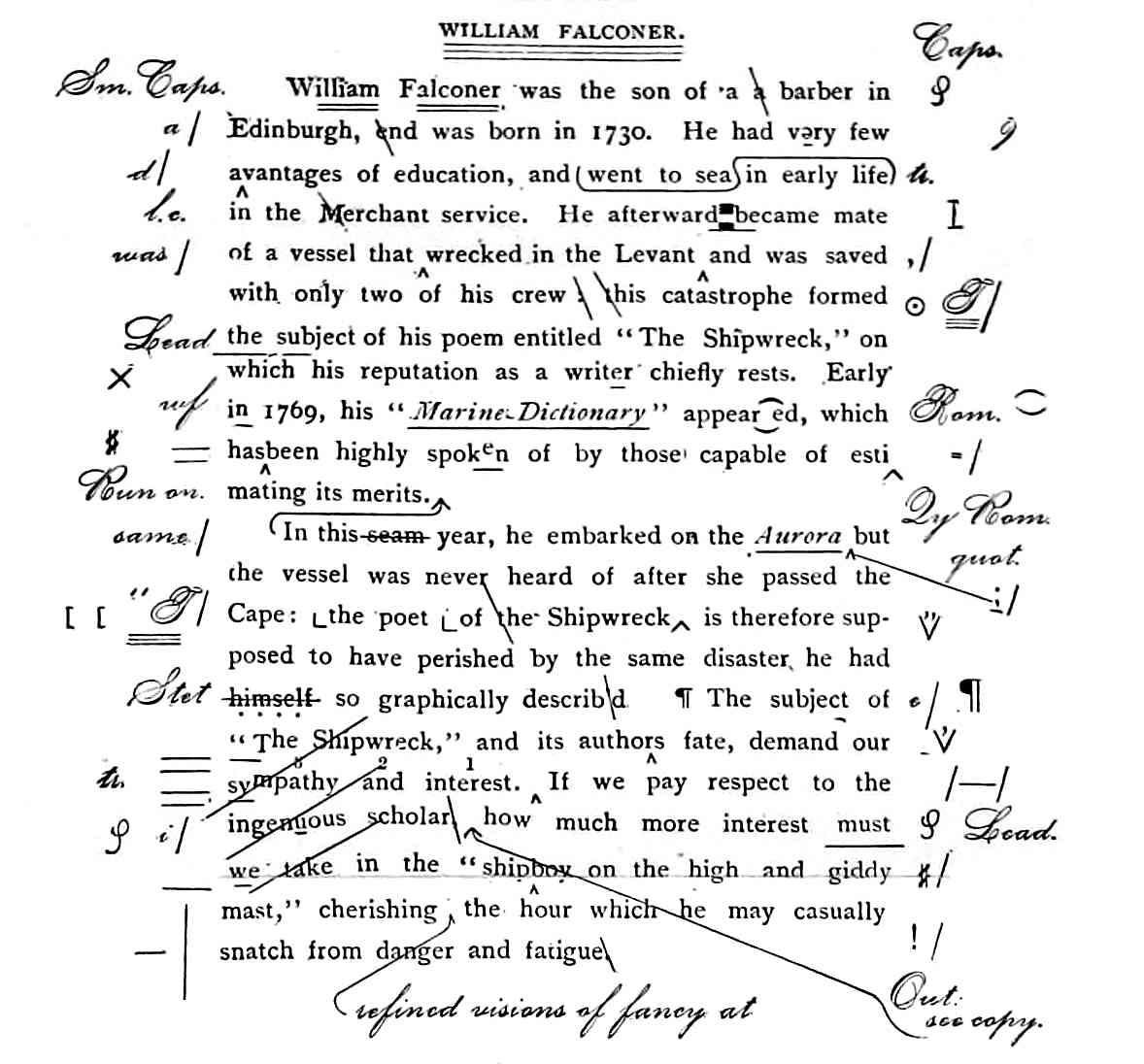
II SPECIMEN PROOF SHEET SHOWING THE SAME PAGE AS AFTERWARDS CORRECTED IN THE TYPE.
WILLIAM FALCONER.
William Falconer was the son of a barber in Edinburgh, and was born in 1730. He had very few advantages of education, and in early life went to sea in the merchant service. He afterward became mate of a vessel that was wrecked in the Levant, and was saved with only two of his crew. This catastrophe formed the subject of his poem entitled “The Shipwreck,” on which his reputation as a writer chiefly rests. Early in 1769, his “Marine Dictionary” appeared, which has been highly spoken of by those capable of estimating its merits. In this same year, he embarked on the “Aurora”; but the vessel was never heard of after she passed the Cape: the poet of “The Shipwreck” is therefore supposed to have perished by the same disaster he had himself so graphically described.
The subject of “The Shipwreck,” and its author’s fate, demand our interest and sympathy.—If we pay respect to the ingenious scholar who compiled the “Marine Dictionary,” how much more interest must we take in the “ship boy on the high and giddy mast,” cherishing refined visions of fancy at the hour which he may casually snatch from danger and fatigue!
OF THE
MAKING OF A BOOK
A FEW TECHNICAL SUGGESTIONS INTENDED TO SERVE AS AIDS TO AUTHORS
“Look, Lucius, here’s the book I sought for so.” Julius Cæsar, Act IV, Scene iii.
COMPILED BY THE LITERARY DEPARTMENT OF
D. APPLETON AND COMPANY
436 FIFTH AVENUE, NEW YORK
1904
Copyright, 1904, by D. APPLETON AND COMPANY