Comparison of T. s. parietalis and T. s. fitchi
Reading edition
Like most widely ranging subspecies, parietalis and fitchi vary geographically and local populations often are noticeably different from typical material. It is possible that future revisors will recognize additional subspecies, but in the variant populations known to us the degree of differentiation is slight as compared, for instance, with that in the subspecies of Thamnophis elegans. Scalation is remarkably uniform in all the subspecies of sirtalis, but coastal and northern populations tend to have fewer ventrals and subcaudals than do their counterparts farther inland and farther south. In their geographic variation the ventrals and subcaudals follow clines, and do not in themselves warrant subspecific divisions. Variation occurs chiefly in the color and pattern including the intensity of dark pigmentation of the dorsolateral area, head, ventral surface and lower edge of the lateral stripe; in extent, position and shade of red or pale colored markings on the dorsolateral area; in presence and extent of reddish suffusion on the head, in the region of the lateral stripe, and on the ventral surface of the tail. Most of these same characters vary within the subspecies fitchi, but the range of variation is relatively minor. Fitch (op. cit.:582-584) described typical populations and also described briefly several small series from British Columbia, Idaho, Oregon, and California which were not entirely typical. Most frequent variation was in heavy reddish suffusion on the sides of the head not found in typical fitchi. In each local population of this subspecies the characters seem to be remarkably uniform and stable.
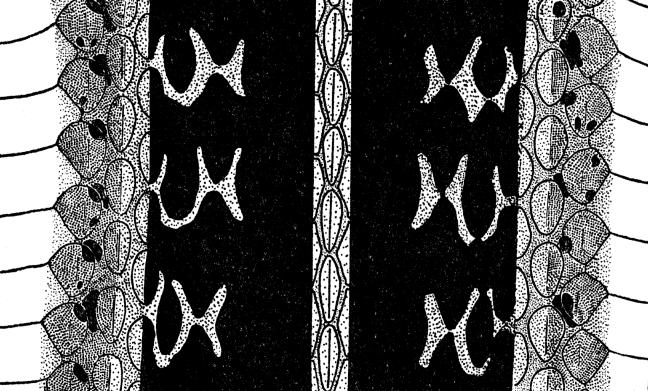
Fig. 2. Diagrammatic drawing of pattern in stretched skin of T. s. fitchi; the pale markings on the black dorsolateral area are scarlet (× 2-1/2).
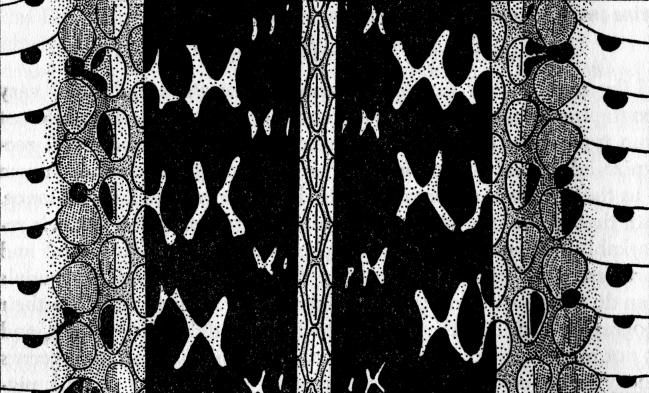
Fig. 3. Diagrammatic drawing of stretched skin of T. s. parietalis; the scarlet markings extend farther dorsally than in T. s. fitchi and black spots are prominent on the ventrals laterally. Some individuals of parietalis have much paler ground color, resembling ornata except in minor details (× 2-1/2).
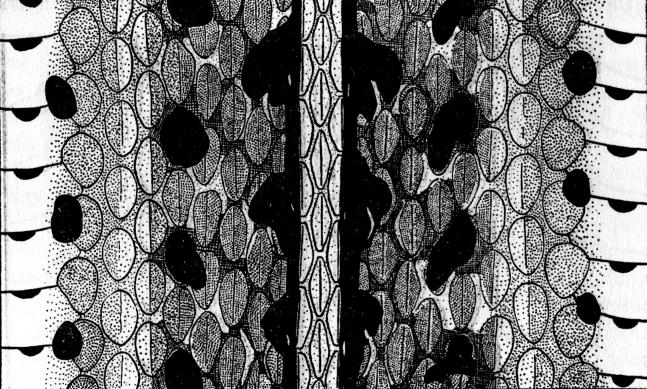
Fig. 4. Diagrammatic drawing of stretched skin of T. s. ornata. The ground color is like that of parietalis but paler with a continuous black area bordering the dorsal stripe (× 2-1/2).
T. s. parietalis differs from fitchi in several trenchant characters, and there are additional slight or average differences between the two. In approximate order of their importance the differences are as follows: 1) The red (or pale yellow or green or buffy) marks on skin between the scales on the upper half of the dorsolateral area (that is between the sixth and seventh, seventh and eighth and eighth and ninth scale rows) present in parietalis are missing in fitchi or are represented by only an occasional small fleck. 2) The dorsolateral area is black or nearly so in fitchi but averages paler in parietalis, in which a wide range of shades may be found from black to olive brown. 3) The red of the dorsolateral area frequently invades the lateral stripe, which sometimes is mostly red, and may even invade the ventrals in parietalis, but in fitchi the red marks are usually confined to the dorsolateral area, and do not invade the lateral stripe. 4) The prominent paired black dots or semicircular marks on the anterior edge of each ventral in parietalis are largely lacking in fitchi, which rarely has any dark marks on the ventral surface. 5) The dorsal stripe consistently involves the middorsal scale row and the adjacent half of the next row on each side, and is bright yellow in fitchi, but in parietalis it may be slightly wider, may be duller with more dusky suffusion, and its edges may be less sharply defined.