Chapter III
Reading edition
THE LATER RESEARCHES.
The first difficulty that faced us was the identification of the forms seen on focusing the sight on gases.[2] We could only proceed tentatively. Thus, a very common form in the air had a sort of dumb-bell shape (see Plate I); we examined this, comparing our rough sketches, and counted its atoms; these, divided by 18—the number of ultimate atoms in hydrogen—gave us 23.22 as atomic weight, and this offered the presumption that it was sodium. We then took various substances—common salt, etc.—in which we knew sodium was present, and found the dumb-bell form in all. In other cases, we took small fragments of metals, as iron, tin, zinc, silver, gold; in others, again, pieces of ore, mineral waters, etc., etc., and, for the rarest substances, Mr. Leadbeater visited a mineralogical museum. In all, 57 chemical elements were examined, out of the 78 recognized by modern chemistry.
In addition to these, we found 3 chemical waifs: an unrecognized stranger between hydrogen and helium which we named occultum, for purposes of reference, and 2 varieties of one element, which we named kalon and meta-kalon, between xenon and osmium; we also found 4 varieties of 4 recognized elements and prefixed meta to the name of each, and a second form of platinum, that we named Pt. B. Thus we have tabulated in all 65 chemical elements, or chemical atoms, completing three of Sir William Crookes' lemniscates, sufficient for some amount of generalization.
Plate I. Sodium.
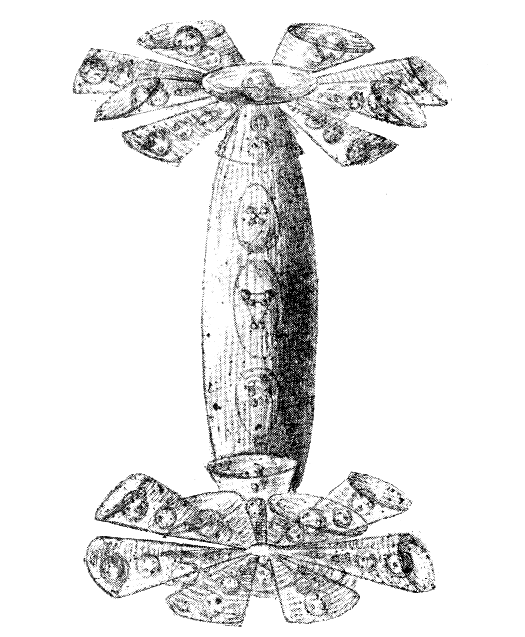
In counting the number of ultimate atoms in a chemical elemental atom, we did not count them throughout, one by one; when, for instance, we counted up the ultimate atoms in sodium, we dictated the number in each convenient group to Mr. Jinarâjadâsa, and he multiplied out the total, divided by 18, and announced the result. Thus: sodium (see Plate I) is composed of an upper part, divisible into a globe and 12 funnels; a lower part, similarly divided; and a connecting rod. We counted the number in the upper part: globe—10; the number in two or three of the funnels—each 16; the number of funnels—12; the same for the lower part; in the connecting rod—14. Mr. Jinarâjadâsa reckoned: 10 + (16 x 12) = 202; hence: 202 + 202 + 14 = 418: divided by 18 = 23.22 recurring. By this method we guarded our counting from any prepossession, as it was impossible for us to know how the various numbers would result on addition, multiplication and division, and the exciting moment came when we waited to see if our results endorsed or approached any accepted weight. In the heavier elements, such as gold, with 3546 atoms, it would have been impossible to count each atom without quite unnecessary waste of time, when making a preliminary investigation. Later, it may be worth while to count each division separately, as in some we noticed that two groups, at first sight alike, differed by 1 or 2 atoms, and some very slight errors may, in this way, have crept into our calculations.
In the following table is a list of the chemical elements examined; the first column gives the names, the asterisk affixed to some indicating that they have not yet been discovered by orthodox chemistry. The second column gives the number of ultimate physical atoms contained in one chemical atom of the element concerned. The third column gives the weight as compared with hydrogen, taken as 18, and this is obtained by dividing the calculated number of ultimate atoms by 18. The fourth column gives the recognized weight-number, mostly according to the latest list of atomic weights, the "International List" of 1905, given in Erdmann's "Lehrbuch der Unorganischen Chemie." These weights differ from those hitherto accepted, and are generally lighter than those given in earlier text-books. It is interesting to note that our counting endorses the earlier numbers, for the most part, and we must wait to see if later observations will endorse the last results of orthodox chemistry, or confirm ours.
-------------------------------------------- Hydrogen | 18 | 1 | 1 *Occultum | 54 | 3 | -- Helium | 72 | 4 | 3.94 Lithium | 127 | 7.06 | 6.98 Baryllium | 164 | 9.11 | 9.01 Boron | 200 | 11.11 | 10.86 Carbon | 216 | 12 | 11.91 Nitrogen | 261 | 14.50 | 14.01 Oxygen | 290 | 16.11 | 15.879 Fluorine | 340 | 18.88 | 18.90 Neon | 360 | 20 | 19.9 *Meta-Neon | 402 | 22.33 | -- Sodium | 418 | 23.22 | 22.88 Magnesium | 432 | 24 | 24.18 Aluminium | 486 | 27 | 26.91 Silicon | 520 | 28.88 | 28.18 Phosphorus | 558 | 31 | 30.77 Sulphur | 576 | 32 | 31.82 Chlorine | 639 | 35.50 | 35.473 Potassium | 701 | 38.944 | 38.85 Argon | 714 | 39.66 | 39.60 Calcium | 720 | 40 | 39.74 *Metargon | 756 | 42 | -- Scandium | 792 | 44 | 43.78 Titanium | 864 | 48 | 47.74 Vanadium | 918 | 51 | 50.84 Chromium | 936 | 52 | 51.74 Manganese | 992 | 55.11 | 54.57 Iron | 1008 | 56 | 55.47 Cobalt | 1036 | 57.55 | 57.7 Nickel | 1064 | 59.ll | 58.30 Copper | 1139 | 63.277 | 63.12 Zinc | 1170 | 65 | 64.91 Gallium | 1260 | 70 | 69.50 Germanium | 1300 | 72.22 | 71.93 Arsenic | 1350 | 75 | 74.45 Selenium | 1422 | 79 | 78.58 Bromine | 1439 | 79.944 | 79.953 Krypton | 1464 | 81.33 | 81.20 *Meta-Krypton | 1506 | 83.66 | -- Rubidium | 1530 | 85 | 84.85 Strontium | 1568 | 87.11 | 86.95 Yttrium | 1606 | 89.22 | 88.34 Zirconium | 1624 | 90.22 | 89.85 Niobium | 1719 | 95.50 | 93.25 Molybdenum | 1746 | 97 | 95.26 Ruthenium | 1848 | 102.66 | 100.91 Rhodium | 1876 | 104.22 | 102.23 Palladium | 1904 | 105.77 | 105.74 Silver | 1945 | 108.055 | 107.93 Cadmium | 2016 | 112 | 111.60 Indium | 2052 | 114 | 114.05 Tin | 2124 | 118 | 118.10 Antimony | 2169 | 120.50 | 119.34 Tellurium | 2223 | 123.50 | 126.64 Iodine | 2287 | 127.055 | 126.01 Xenon | 2298 | 127.66 | 127.10 *Meta-Xenon | 2340 | 130 | -- *Kalon | 3054 | 169.66 | -- *Meta-Kalon | 3096 | 172 | -- Osmium | 3430 | 190.55 | 189.55 Iridium | 3458 | 192.11 | 191.56 Platinum A | 3486 | 193.66 | 193.34 *Platinum B | 3514 | 195.22 | -- Gold | 3546 | 197 | 195.74 --------------------------------------------
PLATE II. MALE (left) and FEMALE (right).
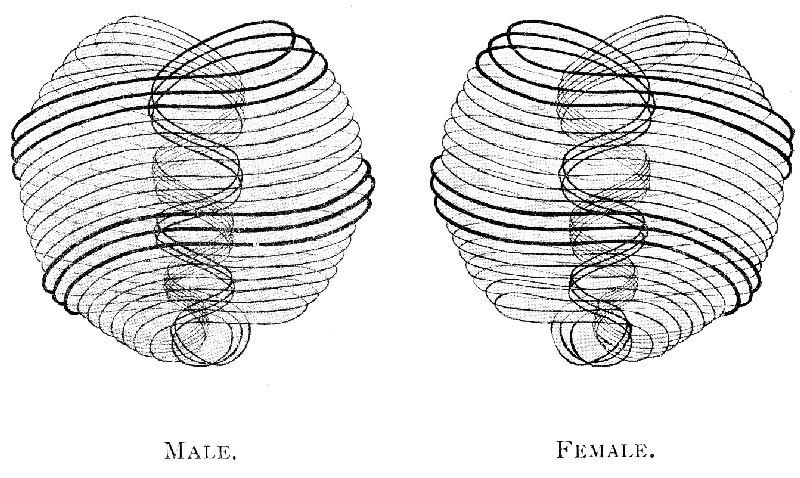
As the words "ultimate physical atom" must frequently occur, it is necessary to state what we mean by the phrase. Any gaseous chemical atom may be dissociated into less complicated bodies; these, again, into still less complicated; these, again, into yet still less complicated. These will be dealt with presently. After the third dissociation but one more is possible; the fourth dissociation gives the ultimate physical atom.[3] This may vanish from the physical plane, but it can undergo no further dissociation on it. In this ultimate state of physical matter two types of atoms have been observed; they are alike in everything save the direction of their whorls and of the force which pours through them. In the one case force pours in from the "outside," from fourth-dimensional space,[4] and passing through the atom, pours into the physical world. In the second, it pours in from the physical world, and out through the atom into the "outside" again,[4] i.e., vanishes from the physical world. The one is like a spring, from which water bubbles out; the other is like a hole, into which water disappears. We call the atoms from which force comes out positive or male; those through which it disappears, negative or female. All atoms, so far as observed, are of one or other of these two forms. (Plate II.)
It will be seen that the atom is a sphere, slightly flattened, and there is a depression at the point where the force flows in, causing a heart-like form. Each atom is surrounded by a field, formed of the atoms of the four higher planes, which surround and interpenetrate it.
The atom can scarcely be said to be a "thing," though it is the material out of which all things physical are composed. It is formed by the flow of the life-force[5] and vanishes with its ebb. When this force arises in "space"[6]—the apparent void which must be filled with substance of some kind, of inconceivable tenuity—atoms appear; if this be artificially stopped for a single atom, the atom disappears; there is nothing left. Presumably, were that flow checked but for an instant, the whole physical world would vanish, as a cloud melts away in the empyrean. It is only the persistence of that flow[7] which maintains the physical basis of the universe.[8]
In order to examine the construction of the atom, a space is artificially made[9]; then, if an opening be made in the wall thus constructed, the surrounding force flows in, and three whorls immediately appear, surrounding the "hole" with their triple spiral of two and a half coils, and returning to their origin by a spiral within the atom; these are at once followed by seven finer whorls, which following the spiral of the first three on the outer surface, and returning to their origin by a spiral within that, flowing in the opposite direction—form a caduceus with the first three. Each of the three coarser whorls, flattened out, makes a closed circle; each of the seven finer ones, similarly flattened out, makes a closed circle. The forces which flow in them, again, come from "outside," from a fourth-dimensional space.[10] Each of the finer whorls is formed of seven yet finer ones, set successively at right angles to each other, each finer than its predecessor; these we call spirillæ.[11]
It will be understood from the foregoing, that the atom cannot be said to have a wall of its own, unless these whorls of force can be so designated; its "wall" is the pressed back "space." As said in 1895, of the chemical atom, the force "clears itself a space, pressing back the undifferentiated matter of the plane, and making to itself a whirling wall of this matter." The wall belongs to space, not to the atom.
In the three whorls flow currents of different electricities; the seven vibrate in response to etheric waves of all kinds—to sound, light, heat, etc.; they show the seven colours of the spectrum; give out the seven sounds of the natural scale; respond in a variety of ways to physical vibration—flashing, singing, pulsing bodies, they move incessantly, inconceivably beautiful and brilliant.[12]
The atom has—as observed so far—three proper motions, i.e., motions of its own, independent of any imposed upon it from outside. It turns incessantly upon its own axis, spinning like a top; it describes a small circle with its axis, as though the axis of the spinning top moved in a small circle; it has a regular pulsation, a contraction and expansion, like the pulsation of the heart. When a force is brought to bear upon it, it dances up and down, flings itself wildly from side to side, performs the most astonishing and rapid gyrations, but the three fundamental motions incessantly persist. If it be made to vibrate, as a whole, at the rate which gives any one of the seven colors, the whorl belonging to that color glows out brilliantly.
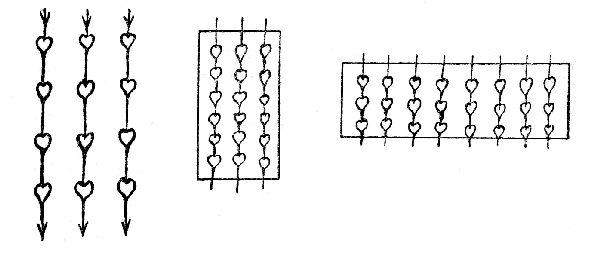
An electric current brought to bear upon the atoms checks their proper motions, i.e., renders them slower; the atoms exposed to it arrange themselves in parallel lines, and in each line the heart-shaped depression receives the flow, which passes out through the apex into the depression of the next, and so on. The atoms always set themselves to the current. The well-known division of diamagnetic and paramagnetic depends generally on this fact, or on an analogous action on molecules, as may be seen in the accompanying diagrams.[13]
Two atoms, positive and negative, brought near to each other, attract each other, and then commence to revolve round each other, forming a relatively stable duality; such a molecule is neutral. Combinations of three or more atoms are positive, negative or neutral, according to the internal molecular arrangement; the neutral are relatively stable, the positive and negative are continually in search of their respective opposites, with a view to establishing a relatively permanent union.
Three states of matter exist between the atomic state and the gaseous—the state in which the chemical atoms are found, the recognized chemical elements; for our purposes we may ignore the liquid and solid states. For the sake of clearness and brevity in description, we have been obliged to name these states; we call the atomic state of the chemist elemental; the state which results from breaking up chemical elements, proto-elemental; the next higher, meta-proto-elemental; the next higher, hyper-meta-proto-elemental; then comes the atomic state. These are briefly marked as El., Proto., Meta., and Hyper.[14]
The simplest unions of atoms, never, apparently consisting of more than seven, form the first molecular state of physical matter.
Types of Hyper-Meta-Proto-Elemental Matter.
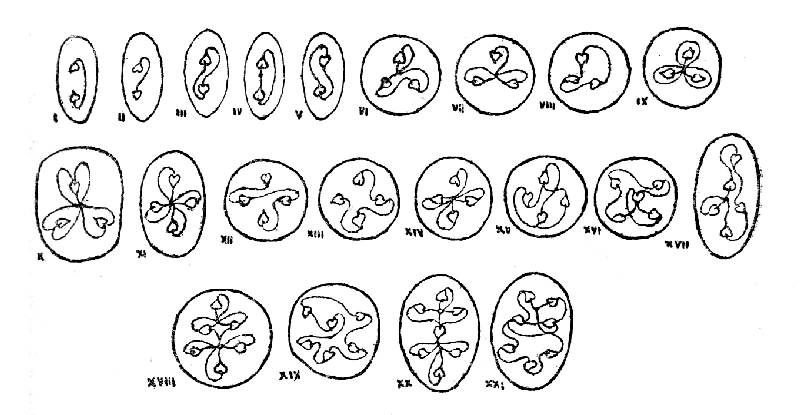
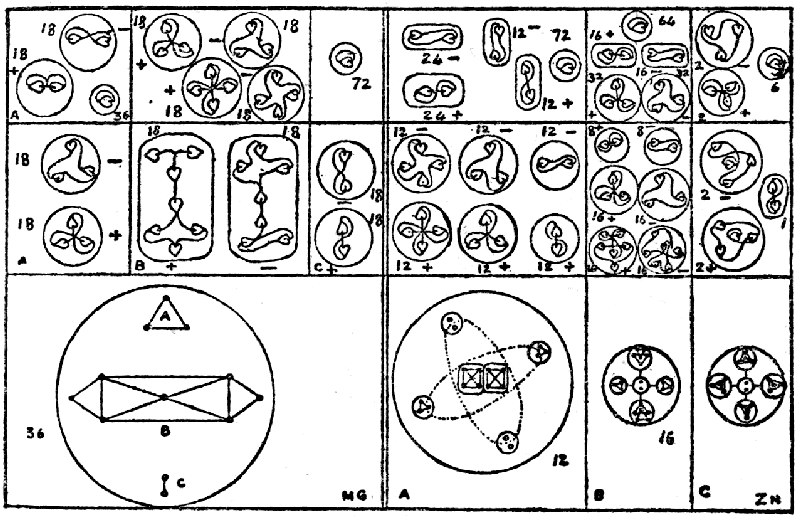
Here are some characteristic combinations of the Hyper state; the atom is conventional, with the depression emphasised; the lines, always entering at the depression and coming out at the apex, show the resultants of lines of force; where no line appears entering the depression, the force wells up from fourth-dimensional space; where no line appears leaving the apex, the force disappears into fourth-dimensional space; where the point of entry and departure is outside the atoms, it is indicated by a dot.[15]
The molecules show all kinds of possible combinations; the combinations spin, turn head over heels, and gyrate in endless ways. Each aggregation is surrounded with an apparent cell-wall, the circle or oval, due to the pressure on the surrounding matter caused by its whirling motion; they strike on each other[16] and rebound, dart hither and thither, for reasons we have not distinguished.
Types of Meta-Proto-Elemental Matter.
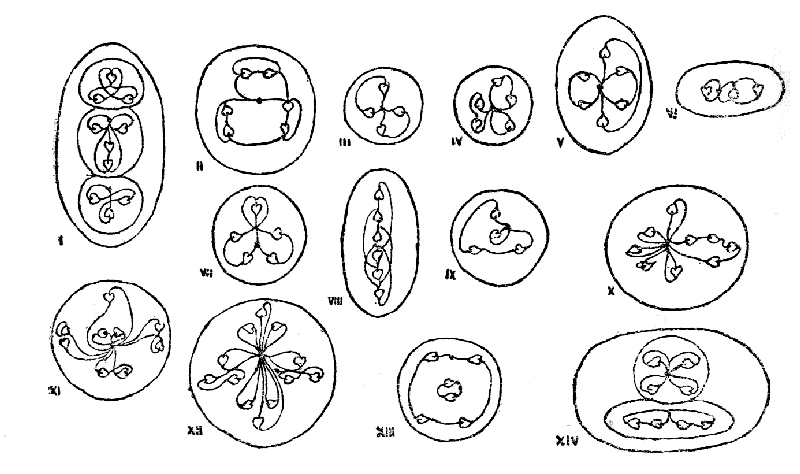
The Meta state, in some of its combinations, appears at first sight to repeat those of the Hyper state; the only obvious way of distinguishing to which some of the molecules of less complexity belong is to pull them out of the "cell-wall"; if they are Hyper molecules they at once fly off as separate atoms; if they are Meta molecules they break up into two or more molecules containing a smaller number of atoms. Thus one of the Meta molecules of iron, containing seven atoms, is identical in appearance with a Hyper heptad, but the latter dissociates into seven atoms, the former into two triads and a single atom. Long-continued research into the detailed play of forces and their results is necessary; we are here only able to give preliminary facts and details—are opening up the way. The following may serve as characteristic Meta types:—
These are taken from constituents of the various elements; 1 from Gl; 2 and 3 from Fe; 4 from Bo; 5, 6 and 7 from C; 8 from He; 9 from Fl; 10, 11, 12 from Li; 13 and 14 from Na. Others will be seen in the course of breaking up the elements.
The Proto state preserves many of the forms in the elements, modified by release from the pressure to which they are subjected in the chemical atom. In this state various groups are thus recognizable which are characteristic of allied metals.
Types of Proto-Elemental Matter.
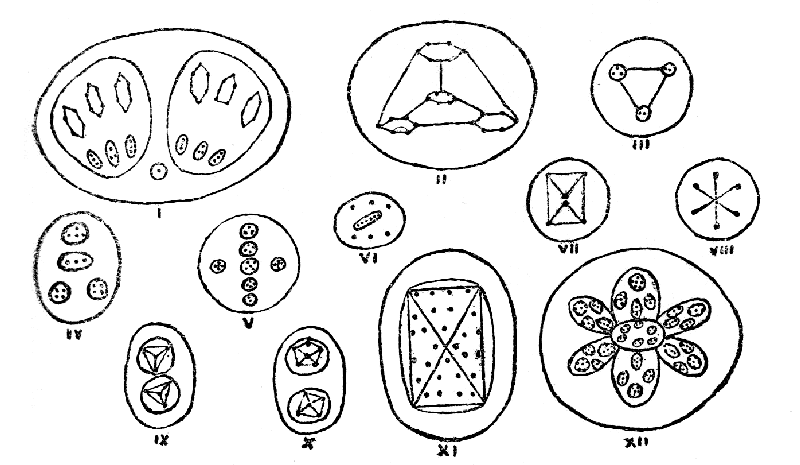
These are taken from the products of the first disintegration of the chemical atom, by forcibly removing it from its hole. The groups fly apart, assuming a great variety of forms often more or less geometrical; the lines between the constituents of the groups, where indicated, no longer represent lines of force, but are intended to represent the impression of form, i.e., of the relative position and motion of the constituents, made on the mind of the observer. They are elusive, for there are no lines, but the appearance of lines is caused by the rapid motion of the costituents up and down, or along them backwards and forwards. The dots represent atoms, or groups of atoms, within the proto-elements. 1 is found in C; 2 and 3 in He; 4 in Fl; 5 in Li; 6 in N; 7 in Ru; 8 in Na; 9 and 10 in Co; 11 in Fe; 12 in Se. We shall return to these when analysing the elements, and shall meet many other proto-elemental groupings.
The first thing which is noticed by the observer, when he turns his attention to the chemical atoms, is that they show certain definite forms, and that within these forms, modified in various ways, sub-groupings are observable which recur in connexion with the same modified form. The main types are not very numerous, and we found that, when we arranged the atoms we had observed, according to their external forms, they fell into natural classes; when these, in turn, were compared with Sir William Crookes' classification, they proved to be singularly alike. Here is his arrangement of the elements, as it appeared in the Proceedings of the Royal Society, in a paper read on June 9th, 1898.
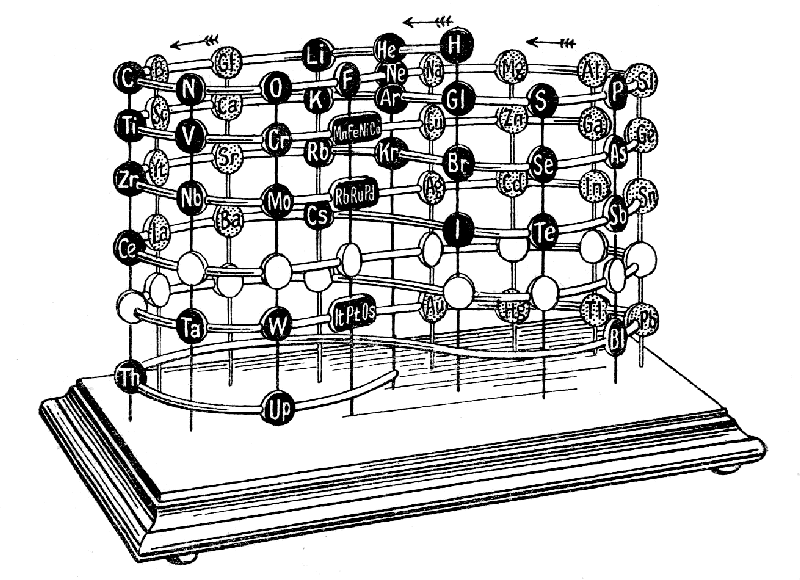
This is to be read, following the lines of the "figures of eight": H, He, Li, Gl, B, C, N, and so on, each successive element being heavier than the one preceding it in order. The disks which fall immediately below each other form a class; thus: H, Cl, Br, I; these resemble each other in various ways, and, as we shall presently see, the same forms and groupings re-appear.
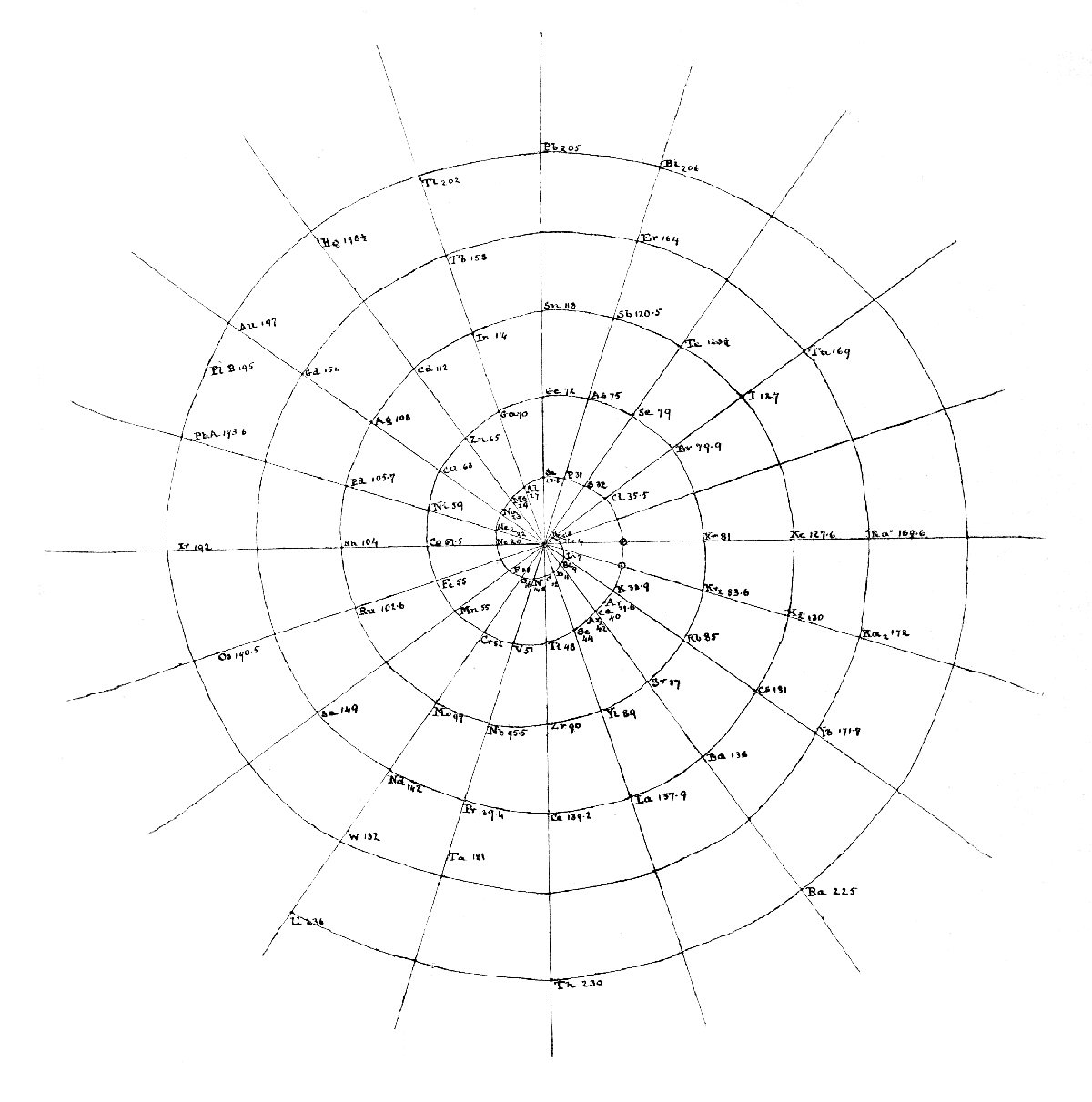
Another chart—taken from Erdmann's Lehrbuch—arranges the elements on a curved line, which curiously resembles the curves within the shell of a nautilus. The radiating lines show the classes, the whole diameter building up a family; it will be observed that there is an empty radius between hydrogen and helium, and we have placed occultum there; on the opposite radius, iron, rubidium and osmium are seen.
The external forms may be classified as follows; the internal details will be dealt with later :—
Plate III.
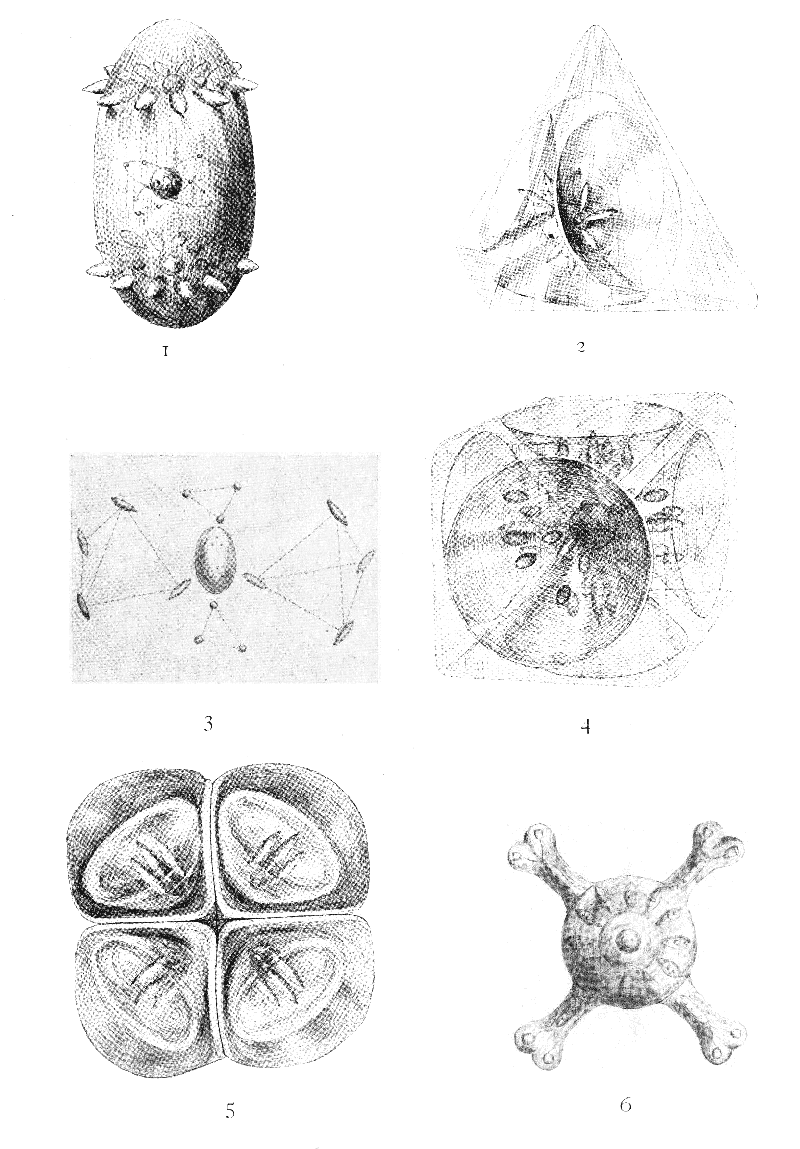
1. The Dumb-bell.—The characteristics of this are a higher and lower group, each showing 12 projecting funnels, grouped round a central body, and a connecting rod. It appears in sodium, copper, silver, and gold,[17] and gold is given (1 on Plate III) as the most extremely modified example of this form. The 12 almond-like projections, above and below, are severally contained in shadowy funnels, impossible to reproduce in the drawing; the central globe contains three globes, and the connecting portion has swollen out into an egg, with a very complicated central arrangement. The dumb-bell appears also in chlorine, bromine and iodine, but there is no trace of it in hydrogen, the head of the group. We have not met it elsewhere. It may be remarked that, in Sir William Crookes' scheme, in which they are all classed as monads, these two groups are the nearest to the neutral line, on the ingoing and outgoing series, and are respectively positive and negative.
II and IIa. The Tetrahedron.—The characteristics of this form are four funnels, containing ovoid bodies, opening on the face of a tetrahedron. The funnels generally, but not always, radiate from a central globe. We give beryllium (glucinum) as the simplest example (2 on Plate III), and to this group belong calcium and strontium. The tetrahedron is the form of chromium and molybdenum, but not that of the head of their group, oxygen, which is, like hydrogen, sui generis. These two groups are marked in orthodox chemistry as respectively positive and negative, and are closely allied. Another pair of groups show the same tetrahedral form: magnesium, zinc and cadmium, positive; sulphur, selenium and tellurium, negative. Selenium is a peculiarly beautiful element, with a star floating across the mouth of each funnel; this star is extremely sensitive to light, and its rays tremble violently and bend if a beam of light falls on it. All these are dyads.
The tetrahedron is not confined to the external form of the above atoms; it seems to be one of the favourite forms of nature, and repeatedly appears in the internal arrangements. There is one tetrahedron within the unknown element occultum; two appear in helium (3 on Plate III); yttrium has also two within its cube, as has germanium; five, intersecting, are found in neon, meta-neon, argon, metargon, krypton, meta-krypton, xenon, meta-xenon, kalon, meta-kalon, tin, titanium and zirconium. Gold contains no less than twenty tetrahedra.
III. The Cube.—The cube appears to be the form of triads. It has six funnels, containing ovoids, and opening on the faces of the cube. Boron is chosen as an example (4 on Plate III). Its group members, scandium and yttrium, have the same form; we have not examined the fourth; the group is positive. Its negative complement consists of nitrogen, vanadium and niobium, and we have again to note that nitrogen, like hydrogen and oxygen, departs from its group type. Two other triad groups, the positive aluminium, gallium and indium (the fourth unexamined) and the negative phosphorus, arsenic and antimony (the fourth unexamined), have also six funnels opening on the faces of a cube.
IV. The Octahedron.—The simplest example of this is carbon (5 on Plate III). We have again the funnel with its ovoids, but now there are eight funnels opening on the eight faces of the octahedron. In titanium (6 on Plate III) the form is masked by the protruding arms, which give the appearance of the old Rosicrucian Cross and Rose, but when we look into the details later, the carbon type comes out clearly. Zirconium is exactly like titanium in form, but contains a large number of atoms. We did not examine the remaining two members of this group. The group is tetratomic and positive. Its negative pendant shows the same form in silicon, germanium and tin; again, the fourth was unexamined.
Plate IV.
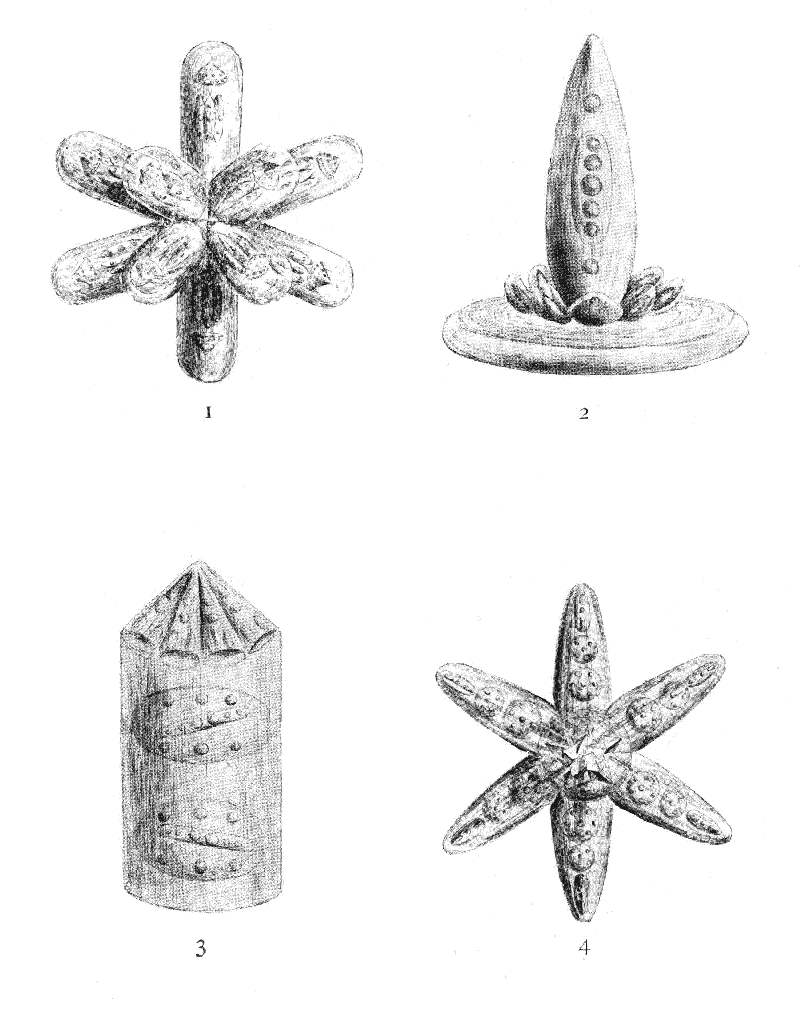
V. The Bars.—These characterise a set of closely allied groups, termed "inter-periodic." Fourteen bars (or seven crossed) radiate from a centre, as in iron (1 on Plate IV), and the members of each group—iron, nickel, cobalt; ruthenium, rhodium, palladium; osmium, iridium, platinum—differ from each other by the weight of each bar, increasing in orderly succession; the details will be given later. Manganese is often grouped with iron, nickel, and cobalt (see Crookes' lemniscates), but its fourteen protruding bodies repeat the "lithium spike" (proto-element 5) and are grouped round a central ovoid. This would appear to connect it with lithium (2 on Plate IV) rather than with fluorine (3 in Plate IV), with which it is often classed. The "lithium spike" re-appears in potassium and rubidium. These details, again, will come out more clearly later.
VI. The Star.—A flat star, with five interpenetrating tetrahedra in the centre, is the characteristic of neon and its allies (4 on Plate IV) leaving apart helium, which, as may be seen by referring to 3, Plate IV, has an entirely different form.
There are thus six clearly defined forms, typical of classes, with two—lithium and fluorine—of doubtful affinities. It is worthy of notice that in diatomic elements four funnels open on the faces of tetrahedra; in triatomic, six funnels on the faces of cubes; in tetratomic, eight funnels on the faces of octahedra.
Thus we have a regular sequence of the platonic solids, and the question suggests itself, will further evolution develop elements shaped to the dodecahedron and the icosahedron?
II.
We now pass from the consideration of the outer forms of the chemical elements to a study of their internal structure, the arrangement within the element of more or less complicated groups—proto-elements—capable of separate, independent existence; these, once more, may be dissociated into yet simpler groups—hyper-meta-proto-elements—equally capable of separate, independent existence, and resolvable into single ultimate physical atoms, the irreducible substratum of the physical world (see Theosophist, 1908, pp. 354-356).[18]
We shall have to study the general internal structure, and then the breaking up of each element, and the admirable diagrams, patiently worked out by Mr. Jinarâjadâsa, will make the study comparatively easy to carry on.
The diagrams, of course, can only give a very general idea of the facts they represent; they give groupings and show relations, but much effort of the imagination is needed to transform the two-dimensional diagram into the three-dimensional object. The wise student will try to visualize the figure from the diagram. Thus the two triangles of hydrogen are not in one plane; the circles are spheres, and the atoms within them, while preserving to each other their relative positions, are in swift movement in three-dimensional space. Where five atoms are seen, as in bromine and iodine, they are generally arranged with the central atom above the four, and their motion indicates lines which erect four plane triangles—meeting at their apices—on a square base, forming a square-based four-sided pyramid. Each dot represents a single ultimate atom. The enclosing lines indicate the impression of form made on the observer, and the groupings of the atoms; the groups will divide along these lines, when the element is broken up, so that the lines have significance, but they do not exist as stable walls or enclosing films, but rather mark limits, not lines, of vibrations. It should be noted that it is not possible to show five of the prisms in the five intersecting tetrahedra of prisms, and 30 atoms must, therefore, be added in counting.
The diagrams are not drawn to scale, as such drawing would be impossible; the dot representing the atom is enormously too large compared with the enclosures, which are absurdly too small; a scale drawing would mean an almost invisible dot on a sheet of many yards square.
The use of the words "positive" and "negative" needs to be guarded by the following paragraphs from the article on "Chemistry" in the Encyclopædia Britannica. We use the words in their ordinary text-book meaning, and have not, so far, detected any characteristics whereby an element can be declared, at sight, to be either positive or negative:—
"When binary compounds, or compounds of two elements, are decomposed by an electric current, the two elements make their appearance at opposite poles. These elements which are disengaged at the negative pole are termed electro-positive or positive or basylous elements, while those disengaged at the positive pole are termed electro-negative or negative or chlorous elements. But the difference between these two classes of elements is one of degree only, and they gradually merge into each other; moreover the electric relations of elements are not absolute, but vary according to the state of combination in which they exist, so that it is just as impossible to divide the elements into two classes according to this property as it is to separate them into two distinct classes of metals and non-metals."
We follow here the grouping according to external forms, and the student should compare it with the groups marked in the lemniscate arrangement shown in Article II (p. 377, properly p. 437, February), reading the group by the disks that fall below each other; thus the first group is H, Cl, Br, I (hydrogen, chlorine, bromine, iodine) and a blank for an undiscovered element. The elements grow denser in descending order; thus hydrogen is an invisible gas; chlorine a denser gas visible by its colour; bromine is a liquid; iodine is a solid—all, of course, when temperature and pressure are normal. By the lowering of temperature and the increase of pressure, an element which is normally gaseous becomes a liquid, and then a solid. Solid, liquid, gaseous, are three interchangeable states of matter, and an element does not alter its constitution by changing its state. So far as a chemical "atom" is concerned, it matters not whether it be drawn for investigation from a solid, a liquid, or a gas; but the internal arrangements of the "atoms" become much more complicated as they become denser and denser, as is seen by the complex arrangements necessitated by the presence of the 3546 ultimate atoms contained in the chemical "atom" of gold, as compared with the simple arrangement of the 18 ultimate atoms of hydrogen.
According to the lemniscate arrangement, we should commence with hydrogen as the head of the first negative group, but as it differs wholly from those placed with it, it is better to take it by itself. Hydrogen is the lightest of the known elements, and is therefore taken as 1 in ordinary chemistry, and all atomic weights are multiples of this. We take it as 18, because it contains eighteen ultimate atoms, the smallest number we have found in a chemical element. So our "number-weights" are obtained by dividing the total number of atoms in an element by 18 (see p. 349, January).
Plate V.
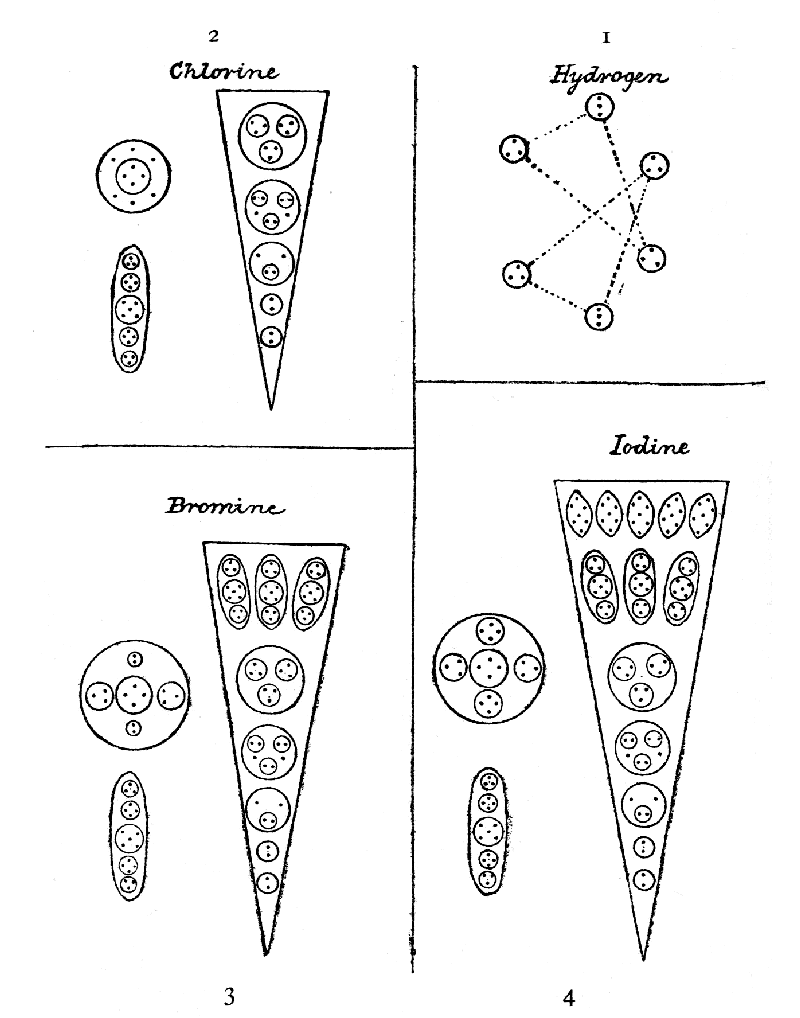
Hydrogen
(Plate V, 1).—Hydrogen not only stands apart from its reputed group by not having the characteristic dumb-bell shape, well shown in sodium (
Plate I
, opposite p. 349, January), but it also stands apart in being positive, serving as a base, not as a chlorous, or acid, radical, thus "playing the part of a metal," as in hydrogen chloride (hydrochloric acid), hydrogen sulphate (sulphuric acid), etc.
It is most curious that hydrogen, oxygen and nitrogen, the most widely spread gases, all differ fundamentally in form from the groups they reputedly head.[19] Hydrogen was the first chemical element examined by us, nearly thirteen years ago, and I reproduce here the substance of what I wrote in November, 1895, for we have nothing to add to nor amend in it.
Hydrogen consists of six small bodies, contained in an egg-like form (the outer forms are not given in the diagrams). The six little bodies are arranged in two sets of three, forming two triangles which are not interchangeable, but are related to each other as object and image. The six bodies are not all alike; they each contain three ultimate physical atoms, but in four of the bodies the three atoms are arranged in a triangle, and in the remaining two in a line.
HYDROGEN: 6 bodies of 3 18 Atomic weight 1 Number weight 18/18 1
I.—The Dumb-bell Group.
I a.—This group consists of Cl, Br, and I (chlorine, bromine and iodine); they are monads, diamagnetic and negative.
Chlorine
(
Plate V
, 2).—As already said, the general form is that of the dumb-bell, the lower and upper parts each consisting of twelve funnels, six sloping upwards and six downwards, the funnels radiating outwards from a central globe, and these two parts being united by a connecting rod (see, again, sodium,
Plate I
).
The funnel (shown flat as an isosceles triangle, standing on its apex) is a somewhat complicated structure, of the same type as that in sodium (Plate VI, 2), the difference consisting in the addition of one more globe, containing nine additional atoms. The central globe is the same as in sodium, but the connecting rod differs. We have here a regular arrangement of five globes, containing three, four, five, four, three atoms respectively, whereas sodium has only three bodies, containing four, six, four. But copper and silver, its congeners, have their connecting rods of exactly the same pattern as the chlorine rod, and the chlorine rod reappears in both bromine and iodine. These close similarities point to some real relation between these groups of elements, which are placed, in the lemniscates, equi-distant from the central line, though one is on the swing which is going towards that line and the other is on the swing away from it.
CHLORINE: Upper part {12 funnels of 25 atoms 300 {Central globe 10 Lower part same 310 Connecting rod 19 ---- Total 639 ---- Atomic weight 35.473 Number weight 639/18 35.50
(The Atomic Weights are mostly from Erdmann, and the Number Weights are those ascertained by us by counting the atoms as described on p. 349, January, and dividing by 18. Prof. T.W. Richards, in Nature, July 18, 1907, gives 35.473.)
Bromine
(
Plate V
, 3).—In bromine, each funnel has three additional bodies, ovoid in shape, an addition of 33 atoms being thus made without any disturbance of form; two pairs of atoms are added to the central globe, and a rearrangement of the atoms is effected by drawing together and lessening the swing of the pair of triplets, thus making symmetrical room for the newcomers. The connecting rod remains unchanged. The total number of atoms is thus raised from the 639 of chlorine to 1439. Over and over again, in these investigations, were we reminded of Tyndall's fascinating description of crystal building, and his fancy of the tiny, ingenious builders busied therein. Truly are there such builders, and the ingenuity and effectiveness of their devices are delightful to see.
[20]
BROMINE: Upper part {12 funnels of 58 atoms 696 {Central globe 14 Lower part same 710 Connecting rod 19 ---- Total 1439 ---- Atomic weight 79.953 Number weight 1459/18 79.944
Iodine
(
Plate V
, 4).—We find herein that the central globe gains 4 atoms, the two pairs becoming 2 quartets; the connecting rod exactly reproduces the rods of chlorine and bromine; the funnel is also that of bromine, except that five bodies, containing 35 atoms, are added to it. The 1439 atoms of bromine are thus raised to 2887.
IODINE: Upper Part {12 funnels of 90 atoms 1116 {Central globe 18 Lower part same 1134 Connecting rod 19 ---- Total 2287 ---- Atomic weight 126.01 Number weight 2287/18 127.055
The plan underlying the building up of groups is here clearly shown; a figure is built up on a certain plan, in this case a dumb-bell; in the succeeding members of the group additional atoms are symmetrically introduced, modifying the appearance, but following the general idea; in this case the connecting rod remains unaltered, while the two ends become larger and larger, more and more overshadowing it, and causing it to become shorter and thicker. Thus a group is gradually formed by additional symmetrical additions. In the undiscovered remaining member of the group we may suppose that the rod will have become still more egg-like, as in the case of gold.
I b.—The corresponding positive group to that which we have been considering consists of Na, Cu, Ag, and Au (sodium, copper, silver and gold), with an empty disk between silver and gold, showing where an element ought to be. These four elements are monads, diamagnetic, and positive, and they show the dumb-bell arrangement, although it is much modified in gold; we may presume that the undiscovered element between silver and gold would form a link between them.
Plate VI.
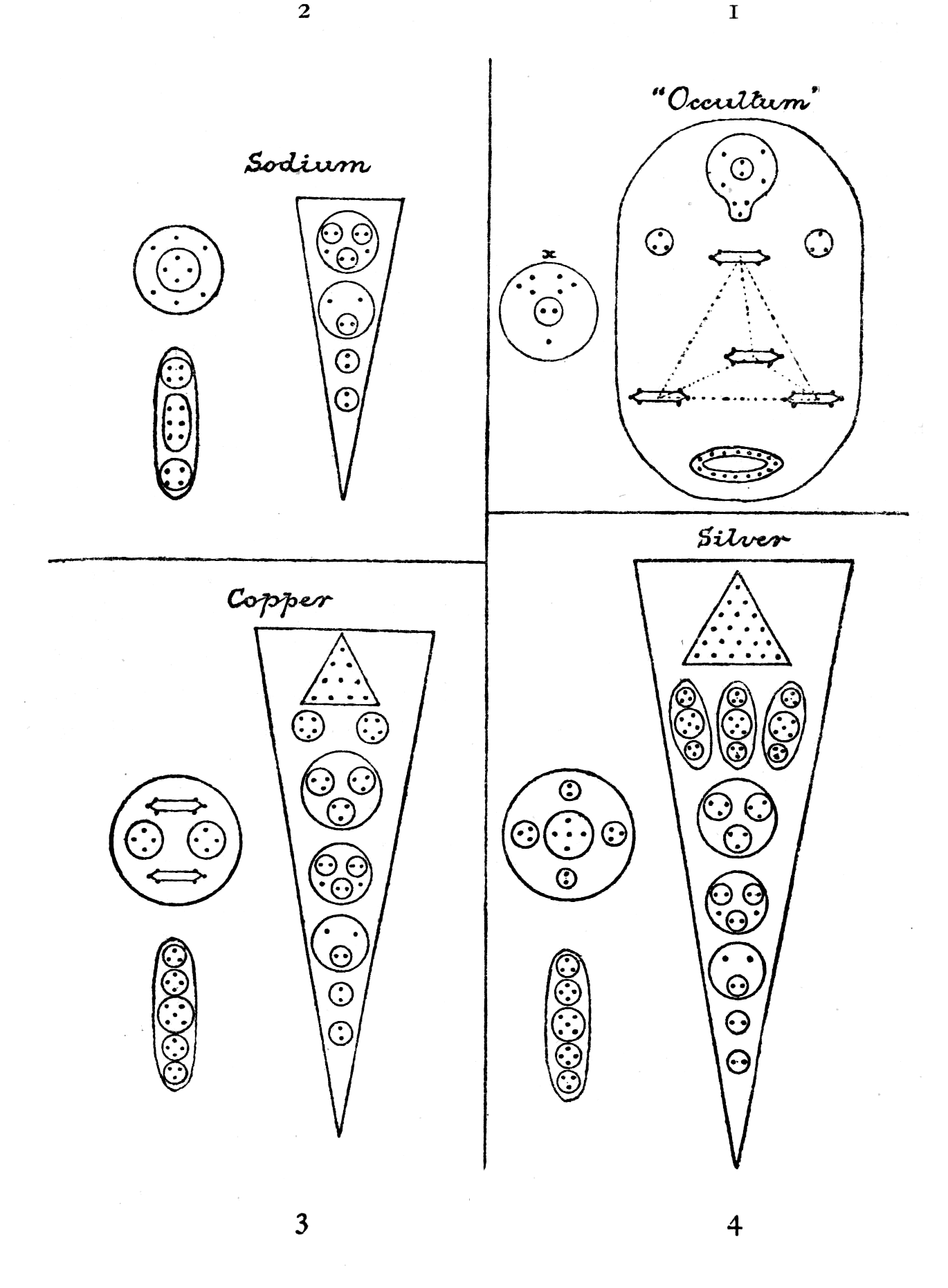
Sodium
(Plate VI, 2) has been already described (p. 349, January), as a type of the group, so we need only refer to its internal arrangement in order to note that it is the simplest of the dumb-bell group. Its twelve funnels show only four enclosed bodies, the same as we see in chlorine, bromine, iodine, copper and silver, and which is very little modified in gold. Its central globe is the simplest of all, as is its connecting rod. We may therefore take it that sodium is the ground-plan of the whole group.
SODIUM: Upper part { 12 funnels of 16 each 192 { Central globe 10 Lower part same 202 Connecting rod 14 ---- Total 418 ---- Atomic weight 23.88 Number weight 418/19 23.22
Copper
(
Plate VI
, 3) introduces an addition in the funnel, that we shall find elsewhere,
e.g.
, in silver, gold, iron, platinum, zinc, tin, the triangular arrangement near the mouth of the funnel and adds to the ten atoms in this nineteen more in three additional enclosed bodies, thus raising the number of atoms in a funnel from the sixteen of sodium to forty-five. The number in the central globe is doubled, and we meet for the first time the peculiar cigar or prism-shaped six-atomed arrangement, that is one of the most common of atomic groups. It ought to imply some definite quality, with its continual recurrence. The central column is the three, four, five, four, three, arrangement already noted.
COPPER: Upper part {12 funnels of 45 atoms 540 {Central globe 20 Lower part same 560 Connecting rod 19 ---- Total 1139 ---- Atomic weight 63.12 Number weight 1139/18 63.277
Silver
(
Plate VI
, 4) follows copper in the constitution of five of the bodies enclosed in the funnels. But the triangular group contains twenty-one atoms as against ten, and three ovoids, each containing three bodies with eleven atoms, raise the number of atoms in a funnel to seventy-nine. The central globe is decreased by five, and the prisms have disappeared. The connecting rod is unaltered.
SILVER: Upper part {12 funnels of 79 atoms 948 {Central globe 15 Lower part same 963 Connecting rod 19 ---- Total 1945 ---- Atomic weight 107.93 Number weight 1945/18 108.055
(This atomic weight is given by Stas, in Nature, August 29, 1907, but it has been argued later that the weight should not be above 107.883.)
Plate VII.
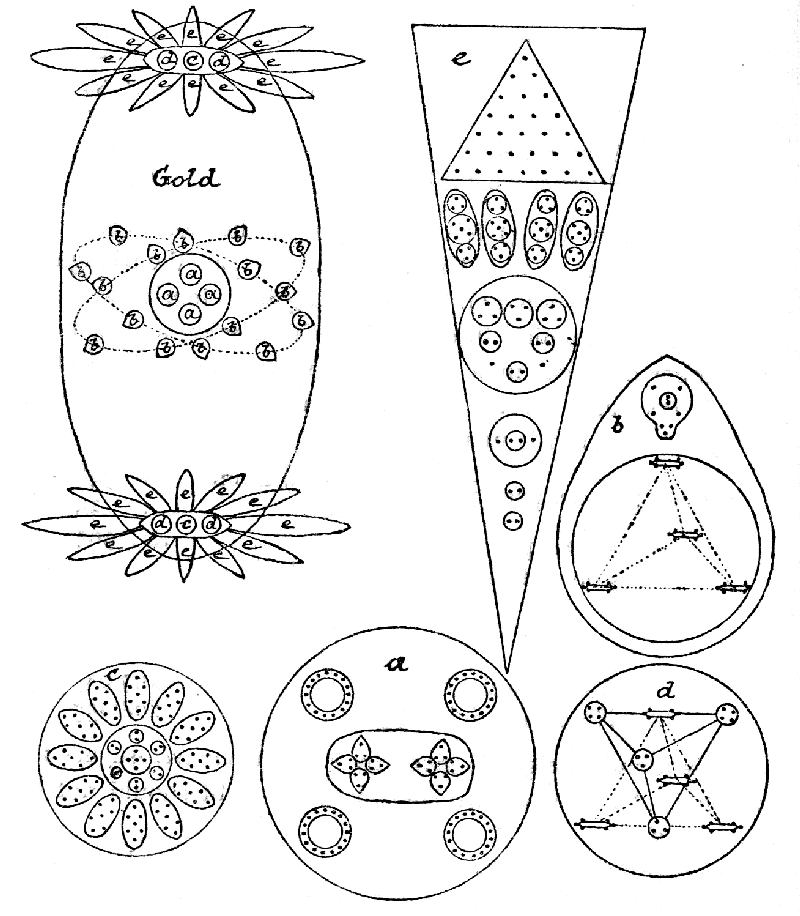
Gold
(Plate VII) is so complicated that it demands a whole plate to itself. It is difficult to recognize the familiar dumb-bell in this elongated egg, but when we come to examine it, the characteristic groupings appear. The egg is the enormously swollen connecting rod, and the upper and lower parts with their central globes are the almond-like projections above and below, with the central ovoid. Round each almond is a shadowy funnel (not drawn in the diagram), and within the almond is the collection of bodies shown in
e
, wherein the two lowest bodies are the same as in every other member of the negative and positive groups; the third, ascending, is a very slight modification of the other thirds; the fourth is a union and re-arrangement of the fourth and fifth; the fifth, of four ovoids, adds one to the three ovoids of bromine, iodine and silver; the triangular group is like that in copper and silver, though with 28 atoms instead of 10 or 21, and it may be noted that the cone in iron has also 28. The central body in the ovoid is very complicated, and is shown in
c
, the bodies on each side,
d
, are each made up of two tetrahedra, one with four six-atomed prisms at its angles, and the other with four spheres, a pair with four atoms and a pair with three. We then come to the connecting rod. One of the four similar groups in the centre is enlarged in
a
, and one of the sixteen circling groups is enlarged in
b
. These groups are arranged in two planes inclined to one another.
GOLD: Upper part { 12 funnels of 97 atoms 1164 { Central ovoid {c 101 {2 d, 38 76 Lower part same 1341 Connecting rod { 4 a 84 336 {16 b 33 528 ---- Total 3546 ---- Atomic weight 195.74 Number weight 3546/18 197
It may be noted that the connecting rod is made up of exactly sixteen atoms of occultum, and that sixteen such atoms contain 864 ultimate atoms, the exact member of atoms in titanium.
III.
Occultum was observed by us in 1895, and, finding that it was so light, and so simple in its composition, we thought that it might be helium, of which we were unable, at the time, to obtain a sample. When, however, helium itself came under observation in 1907, it proved to be quite different from the object before observed, so we dubbed the unrecognised object Occultum, until orthodox science shall find it and label it in proper fashion.
Occultum (Plate VI, 1).
We here meet the tetrahedron for the first time, with each angle occupied by a six-atomed group, the atoms arranged as on the end triangles of a prism. This form recurs very often, and was noted, last month, as seen in copper (Plate VI, 3); it revolves with extreme rapidity around its longitudinal axis, and looks like a pencil sharpened at both ends, or a cigar tapering at both ends; we habitually spoke of it as "the cigar." It appears to be strongly coherent, for, as will be seen below, its six atoms remain attached to each other as meta-compounds and even when divided into two triplets as hyper-compounds, they revolve round each other.
Above the tetrahedron is a balloon-shaped figure, apparently drawn into shape by the attraction of the tetrahedron. The body below the tetrahedron looks like a coil of rope, and contains fifteen atoms; they are arranged on a slanting disk in a flat ring, and the force goes in at the top of one atom, and out of the bottom of it into the top of the next, and so on, making a closed circuit. The two little spheres, each containing a triplet, are like fill-up paragraphs to a compositor—they seem to be kept standing and popped in where wanted. The sphere marked x is a proto-compound, the balloon when set free.
As was noted under gold (p. 41), sixteen occultum bodies, re-arranged, make up the connecting rod in gold:—
OCCULTUM: Tetrahedron 24 Balloon 9 Triplets 6 Rope-circle 15 ---- Total 54 ---- Atomic weight Not known Number weight 54/18 3
Dissociation of Atoms.
Before proceeding to the study of other chemical atoms, as to their general internal arrangements, it is desirable to follow out, in those already shown, the way in which these atoms break up into simpler forms, yielding successively what we have called proto-, meta-, and hyper-compounds. It is naturally easier to follow these in the simpler atoms than in the more complex, and if the earlier dissociations are shown, the latter can be more readily and more intelligibly described.
The first thing that happens on removing a gaseous atom from its "hole" (see pp. 21 to 23) or encircling "wall," is that the contained bodies are set free, and, evidently released from tremendous pressure, assume spherical or ovoid forms, the atoms within each re-arranging themselves, more or less, within the new "hole" or "wall." The figures are, of course, three-dimensional, and often remind one of crystals; tetrahedral, octagonal, and other like forms being of constant occurrence. In the diagrams of the proto-compounds, the constituent atoms are shown by dots. In the diagrams of the meta-compounds the dot becomes a heart, in order to show the resultants of the lines of force. In the diagrams of the hyper-compounds the same plan is followed. The letters a, b, c, &c., enable the student to follow the breaking up of each group through its successive stages.
Hydrogen (Plate V, 1).
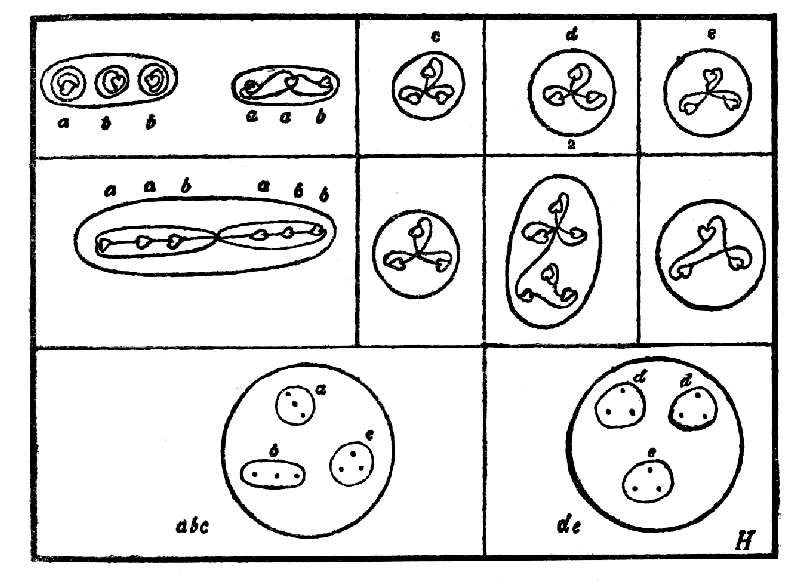
The six bodies contained in the gaseous atom instantaneously re-arrange themselves within two spheres; the two linear triplets unite with one triangular triplet, holding to each other relative positions which, if connected by three right lines, would form a triangle with a triplet at each angle; the remaining three triangular triplets similarly arrange themselves in the second sphere. These form the proto-compounds of hydrogen.
In the dissociation of these, each group breaks up into two, the two linear triplets joining each other and setting free their triangular comrade, while two of the triangular triplets similarly remain together, casting out the third, so that hydrogen yields four meta-compounds.
In the hyper-condition, the connexion between the double triplets is broken, and they become four independent groups, two like ix, in the hyper-types (p. 25), and two remaining linear, but rearranging their internal relations; the two remaining groups break up into two pairs and a unit.
The final dissociation sets all the atoms free.
Occultum (Plate VI, 1).
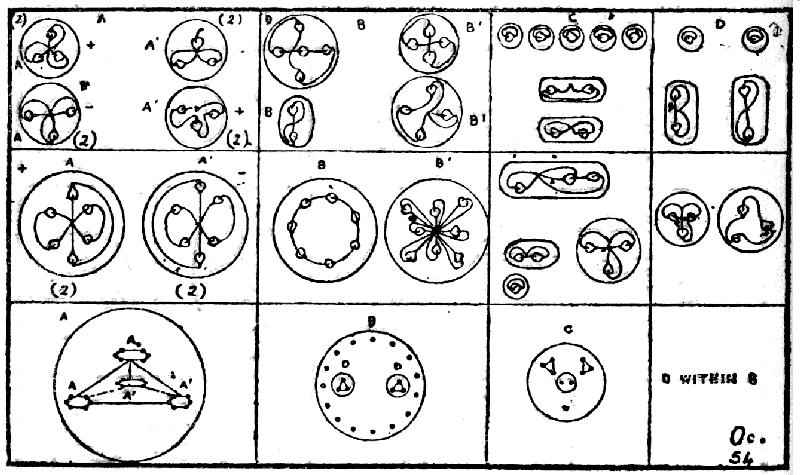
On the first dissociation of the component parts of occultum, the tetrahedron separates as a whole, with its four "cigars," flattening itself out within its hole, a; two "cigars" are positive and two negative, marked respectively a and a'. The rope becomes a ring within a sphere, b, and the two bodies d d, which are loose in the gaseous atom, come within this ring. The balloon becomes a sphere.
On further dissociation, the "cigars" go off independently, showing two types, and these again each divide into triplets, as meta-compounds. B, on the meta-level, casts out the two d bodies, which become independent triplets, and the "rope" breaks into two, a close ring of seven atoms and a double cross of eight. These subdivide again to form hyper-compounds, the ring yielding a quintet and a pair, and the double cross separating into its two parts.
The balloon, c, becomes much divided, the cohesion of its parts being slight; it forms two triplets, a pair and a unit, and these set free, on further dissociation, no less than five separate atoms and two duads.
The two triplets of d each cast out an atom on dissociation, and form two pairs and two units.
Sodium (Plate VI, 2).
It is convenient to consider sodium next, because it is the basic pattern on which not only copper, silver and gold are formed, but also chlorine, bromine and iodine.
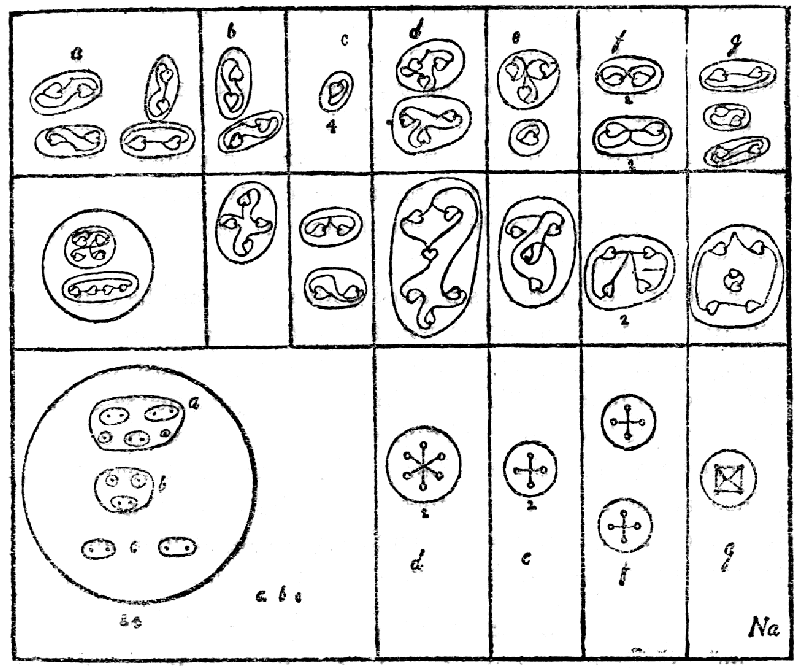
When sodium is set free from its gaseous condition, it divides up into thirty-one bodies—twenty-four separate funnels, four bodies derived from the two central globes, and three from the connecting rod. The funnels become spheres, and each contains four enclosed spheres, with more or less complicated contents. Each central globe yields a sextet and a quartet, and the rod sets free two quartets and a peculiarly formed sextet.
When the proto-compounds are dissociated, the funnel-sphere sets free: (1) the contents of a, rearranged into two groups of four within a common sphere; the sphere yields four duads as hyper-compounds; (2) the contents of b, which unite themselves into a quartet, yielding two duads as hyper-compounds; and (3) the contents of the two spheres, c, which maintain their separation as meta-compounds, and become entirely independent, the atoms within the sphere revolving round each other, but the spheres ceasing their revolution round a common axis, and going off in different directions. The atoms break off from each other, and gyrate in independent solitude as hyper-"compounds." Thus each funnel yields finally ten hyper-bodies.
The part of the central globe, marked d, with its six atoms, whirling round a common centre, becomes two triplets, at the meta-stage, preparing for the complete separation of these as hyper-bodies. The second part of the same globe, marked e, a whirling cross, with an atom at each point, becomes a quartet in the meta-state, in which three atoms revolve round a fourth, and in the hyper-state this central atom is set free, leaving a triplet and a unit.
Each of the two bodies marked f, liberated from the connecting rod, shows four atoms whirling round a common centre, exactly resembling e in appearance; but there must be some difference of inner relations, for, in the meta-state, they re-arrange themselves as two pairs, and divide into two as hyper-bodies.
The body marked g is a four-sided pyramid, with two closely joined atoms at its apex; these still cling to each in mutual revolution as a meta-body, encircled by a ring of four, and this leads to a further dissociation into three pairs on the hyper-level.
Chlorine (Plate V, 2).
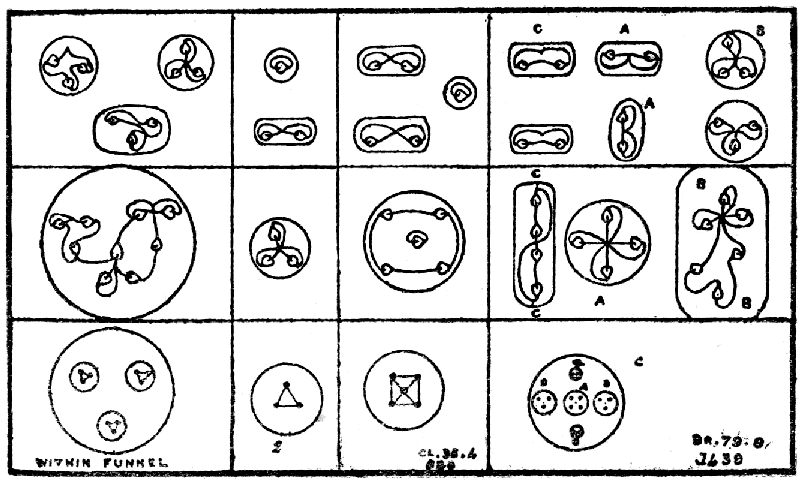
The description of the funnel of sodium applies to that of chlorine, until we come to the body nearest the mouth, the sphere containing three additional bodies; this remains within the funnel in the first dissociation, so that again we have twenty-four separate funnels as proto-compounds; the central globes are the same as in sodium, and yield the same four bodies; the connecting rod sets free five bodies, of which two are the same; we have thus thirty-three separate bodies as the result of the dissociation of chlorine into its proto-compounds. As all the compounds which are in sodium break up in the same way into meta- and hyper-compounds, we need not repeat the process here. We have only to consider the new meta- and hyper-compounds of the highest sphere within the funnel, and the two triplets and one quintet from the connecting rod.
The additional body within the proto-funnel is of a very simple character, three contained triangles within the flattened sphere. On release from the funnel, on the meta-level, the atoms rearrange themselves in a whirling set of three triplets, and these break off from each other as hyper-compounds. The two triplets from the connecting rod, also, are of the simplest character and need not delay us. The five-atomed body, a four-sided pyramid as a proto-compound, becomes a ring whirling round a centre on the meta, and two pairs with a unit on the hyper.
Bromine (Plate V, 3).
Three additional bodies appear at the top of the funnel, which otherwise repeats that of chlorine. The connecting rod is the same and may be disregarded. The central globes become more complex. The additions are, however, of very easy types, and hence are readily dealt with. Each of the three similar ovoid bodies contains two triplets—each a triangle and a quintet—a four-sided pyramid. These are the same, as may be seen in the connecting rod of chlorine, and we need not repeat them. Only the globe remains. This does not break up as a proto-compound but is merely set free, a and the 2 bs whirling in a plane vertical to the paper and the two smaller bodies, cc, whirling on a plane at right angles to the other. These two disengage themselves, forming a quartet as a meta-compound, while a makes a whirling cross and bb a single sextet; these further dissociate themselves into four pairs and two triplets.
Iodine (Plate V, 4).
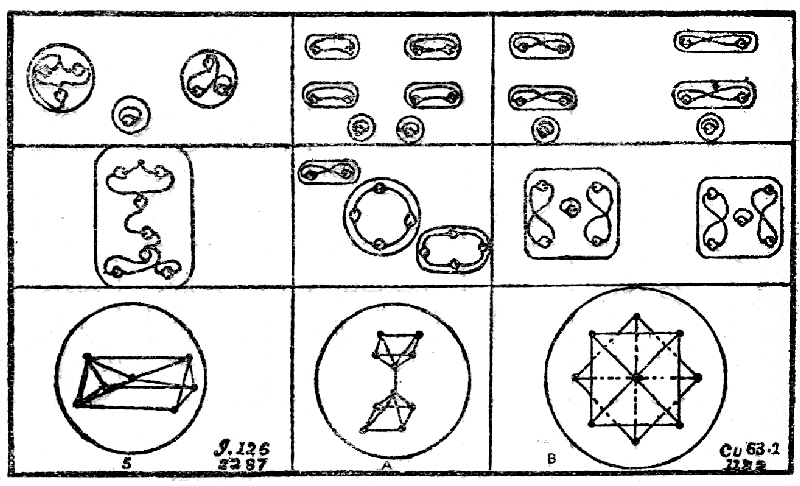
Iodine has nothing new to give us, except five similar ovoid bodies at the top of each funnel, and two quartets instead of two pairs in the central globe. The ovoid bodies become spheres when the funnels are thrown off, and a crystalline form is indicated within the sphere. The atoms are arranged in two tetrahedra with a common apex, and the relationship is maintained in the meta-body, a septet. The latter breaks up into two triplets and a unit on the hyper-level. In the central globes, the a of bromine is repeated twice instead of the pairs in cc.
Copper (Plate VI, 3).
We have already disposed of occultum, on this plate, and of sodium, which lies at the root of both groups. Copper, we now find, is also very largely off our hands, as the funnel provides us with only two new types—two spheres—each containing five atoms in a new arrangement, and the triangular body at the mouth with its ten atoms. This triangular body, with an increased number of atoms, reappears in various other chemical elements. The central globes are different from any we have had before, in their internal arrangement, but the constituents are familiar; there are two contained spheres with four atoms each, the a in the globe of bromine (see above) and 2 "cigars." The "cigars" may be followed under occultum (see above). The connecting rod is as in chlorine, bromine and iodine.
The atoms in the bodies a and b are curiously arranged. A consists of two square-based pyramids turned so as to meet at their apices, and breaks up into two quartet rings and a duad. B is again two four-sided pyramids, but the bases are in contact and set at right angles to each other; the second apex is not seen, as it is directly below the first. The pyramids separate as meta-bodies, and the atoms assume the peculiar arrangement indicated and then break up into four pairs and two units on the hyper level.
IV.
Silver (Plate VI, 4 and Ag below).
Silver presents us with only two new bodies, and even these are only new by slight additions to old models. The triangular shaped body at the apex of the funnel, containing 21 atoms, is intermediate between the similar bodies in copper and iron. As a proto-element it becomes three triangles, joined at their apices, in fact a tetrahedron in which no atoms are distributed on the fourth face. The faces separate on the meta level and give three seven-atomed figures, and each of these breaks up into two triplets and a unit. The central globe only differs from that of bromine by the addition of one atom, which gives the familiar four-sided pyramid with a square base as in chlorine (see p. 46).
Gold (Plate VII and Au below).
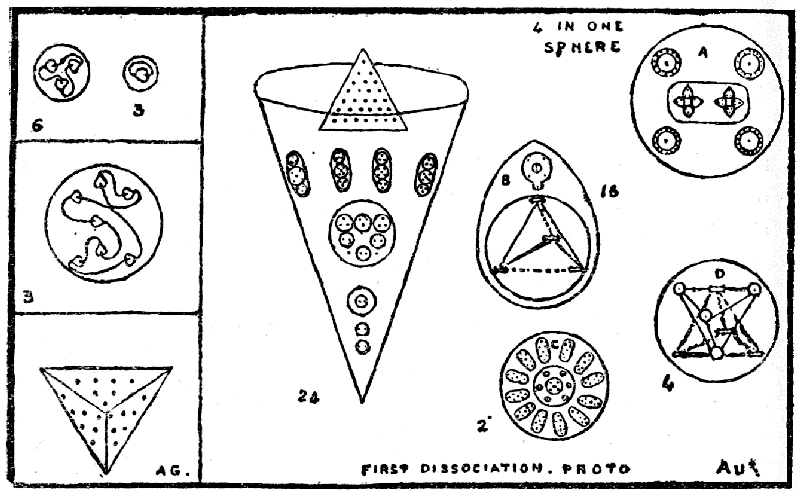
The disintegration of gold first yields forty-seven bodies on the proto-level; the twenty-four funnels separate, and the central globes which hold each twelve together set free their six contained globes (c, d), thirty bodies being thus liberated. The sixteen bodies on the central inclined planes, marked b, break away, their central globe, with its four contained globes, remaining unchanged. But this condition does not last. The motion of the funnels changes and thus the funnels cease to exist and their contents are set free, each funnel thus liberating nine independent bodies; the sixteen b separate into two each; the four a liberate five each; the two c set free thirteen each; the four d finally liberate two each: 302 proto elements in all.
The funnel is almost that of iodine, re-arranged. Four of the first ring in the iodine funnel are replaced by the triangular body, which becomes a four-sided pyramid with an occupied base. The second ring of three ovoids in iodine becomes four in gold, but the internal arrangement of each ovoid is the same. The next two spheres in the iodine funnel coalesce into one sphere, with similar contents, in the gold funnel. The fifth in iodine is slightly rearranged to form the fourth in descent in gold, and the remaining two are the same. B has been broken up under occultum (p. 628) and can be followed there. The sixteen rings set free from the four a, after gyrating round the central body, now become a sphere, break up, as in occultum (see p. 44) into a meta seven-atomed ring and an eight-atomed double cross, and so on to the hyper level. The sphere with its two contained bodies breaks up into eight triangles on the meta level, and each of these, on the hyper, into a duad and a unit. The twelve septets of c assume the form of prisms as in iodine (see p. 48) and pursue the same course, while its central body, a four-sided pyramid with its six attendants, divides on the meta level into six duads, revolving round a ring with a central atom as in chlorine (p. 47), the duads going off independently on the hyper-level and the ring breaking up as in chlorine. The "cigar" tetrahedron of d follows its course as in occultum, and the other sets free two quartets and two triplets on the meta level, yielding six duads and two units as hyper compounds. It will be seen that, complex as gold is, it is composed of constituents already familiar, and has iodine and occultum as its nearest allies.
II and IIa.—The Tetrahedral Groups.
II.—This group consists of beryllium (glucinum), calcium, strontium and barium, all diatomic, paramagnetic and positive. The corresponding group consists of oxygen, chromium, molybdenum, wolfram (tungsten) and uranium, with a blank disk between wolfram and uranium: these are diatomic, paramagnetic, and negative. We have not examined barium, wolfram, or uranium.
Plate VIII.
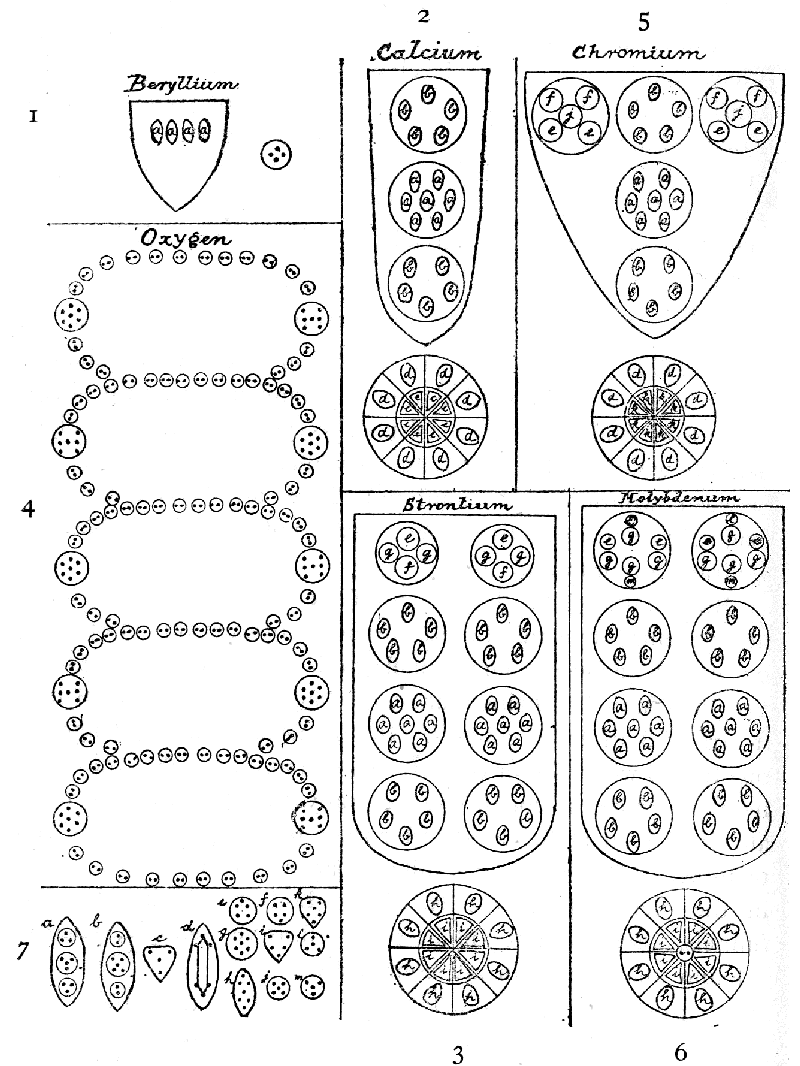
Beryllium
(
Plate III
, 2, and
Plate VIII
, 1). In the tetrahedron four funnels are found, the mouth of each funnel opening on one of its faces. The funnels radiate from a central globe, and each funnel contains four ovoids each with ten atoms within it arranged in three spheres. In the accompanying diagrams one funnel with its four ovoids is shown and a single ovoid with its three spheres, containing severally three, four, and three atoms, is seen at the left-hand corner of the plate (7
a
). The members of this group are alike in arrangement, differing only in the increased complexity of the bodies contained in the funnels. Beryllium, it will be observed, is very simple, whereas calcium and strontium are complicated.
BERYLLIUM: 4 funnels of 40 atoms 160 Central globe 4 ---- Total 164 ---- Atomic weight 9.01 Number weight 164/18 9.11
Calcium
(
Plate VIII
, 2) shows in each funnel three contained spheres, of which the central one has within it seven ovoids identical with those of beryllium, and the spheres above and below it contain each five ovoids (7
b
) in which the three contained spheres have, respectively, two, five, and two atoms. The central globe is double, globe within globe, and is divided into eight segments, radiating from the centre like an orange; the internal part of the segment belonging to the inner globe has a triangular body within it, containing four atoms (7
c
), and the external part, belonging to the encircling globe, shows the familiar "cigar" (7
d
). In this way 720 atoms are packed into the simple beryllium type.
CALCIUM: 4 funnels of 160 atoms 640 Central globe 80 ---- Total 720 ---- Atomic weight 39.74 Number weight 720/18 40.00
Strontium
(
Plate VIII
, 3) shows a still further complication within the funnels, no less than eight spheres being found within each. Each of the highest pair contains four subsidiary spheres, with five, seven, seven, five atoms, respectively (7
e
,
g
,
f
). The
g
groups are identical with those in gold, but difference of pressure makes the containing body spherical instead of ovoid; similar groups are seen in the top ring of the iodine funnel, where also the "hole" is ovoid in form. The second pair of spheres contains ten ovoids (7
b
) identical with those of calcium. The third pair contains fourteen ovoids (7
a
) identical with those of beryllium, while the fourth pair repeats the second, with the ovoids re-arranged. The internal divisions of the double sphere of the central globe are the same as in calcium, but the contents differ. The "cigars" in the external segments are replaced by seven-atomed ovoids (7
h
)—the iodine ovoids—and the external segments contain five-atomed triangles (7
i
). Thus 1,568 atoms have been packed into the beryllium type, and our wonder is again aroused by the ingenuity with which a type is preserved while it is adapted to new conditions.
STRONTIUM: 4 funnels of 368 atoms 1472 Central globe 96 ---- Total 1568 ---- Atomic weight 86.95 Number weight 1568/18 87.11
The corresponding group, headed by oxygen—oxygen, chromium, molybdenum, wolfram and uranium—offers us another problem in its first member.
Oxygen
(
Plate VIII
, 4). This was examined by us in 1895, and the description may be reproduced here with a much improved diagram of its very peculiar constitution. The gaseous atom is an ovoid body, within which a spirally-coiled snake-like body revolves at a high velocity, five brilliant points of light shining on the coils. The appearance given in the former diagram will be obtained by placing the five septets on one side on the top of those on the other, so that the ten become in appearance five, and thus doubling the whole, the doubling point leaving eleven duads on each side. The composition is, however, much better seen by flattening out the whole. On the proto level the two snakes separate and are clearly seen.
OXYGEN: Positive snake { 55 spheres of 2 atoms } { + 5 disks of 7 atoms } 145 Negative snake " 145 ---- Total 290 ---- Atomic weight 15.87 Number weight 290/18 16.11
Chromium
(
Plate VIII
, 5) "reverts to the ancestral type," the tetrahedron; the funnel is widened by the arrangement of its contents, three spheres forming its first ring, as compared with the units in beryllium and calcium, and the pairs in strontium and molybdenum. Two of these spheres are identical in their contents—two quintets (7
f
), a quintet (7
j
), and two quintets (7
e
),
e
and
f
being to each other as object and image. The remaining sphere (7
b
) is identical with the highest in the calcium funnel. The remaining two spheres, one below the other, are identical with the corresponding two spheres in calcium. The central globe, as regards its external segments, is again identical with that of calcium, but in the internal segments a six-atomed triangle (7
k
) is substituted for the calcium four-atomed one (7
e
).
CHROMIUM: 4 funnels of 210 atoms 840 Central globe 96 ----- Total 936 ----- Atomic weight 51.74 Number weight 936/18 52.00
Molybdenum
(
Plate VIII
, 6) very closely resembles strontium, differing from it only in the composition of the highest pair of spheres in the funnels and in the presence of a little sphere, containing two atoms only, in the middle of the central globe. The topmost spheres contain no less than eight subsidiary spheres within each; the highest of these (7
e
) has four atoms in it; the next three have four, seven and four (7
e
g
e
), respectively; the next three are all septets (7
g
), and the last has four—making in all for these two spheres 88 atoms, as against the 48 in corresponding spheres of strontium, making a difference of 160 in the four funnels.
MOLYBDENUM: 4 funnels of 408 atoms 1632 Central globe 98 ----- Total 1730 ----- Atomic weight 95.26 Number weight 1730/18 96.11
II a.—This group contains magnesium, zinc, cadmium, and mercury, with an empty disk between cadmium and mercury; we did not examine mercury. All are diatomic, diamagnetic and positive; the corresponding group consists of sulphur, selenium and tellurium, also all diatomic and diamagnetic, but negative. The same characteristics of four funnels opening on the faces of a tetrahedron are found in all, but magnesium and sulphur have no central globe, and in cadmium and tellurium the globe has become a cross.
Plate IX.
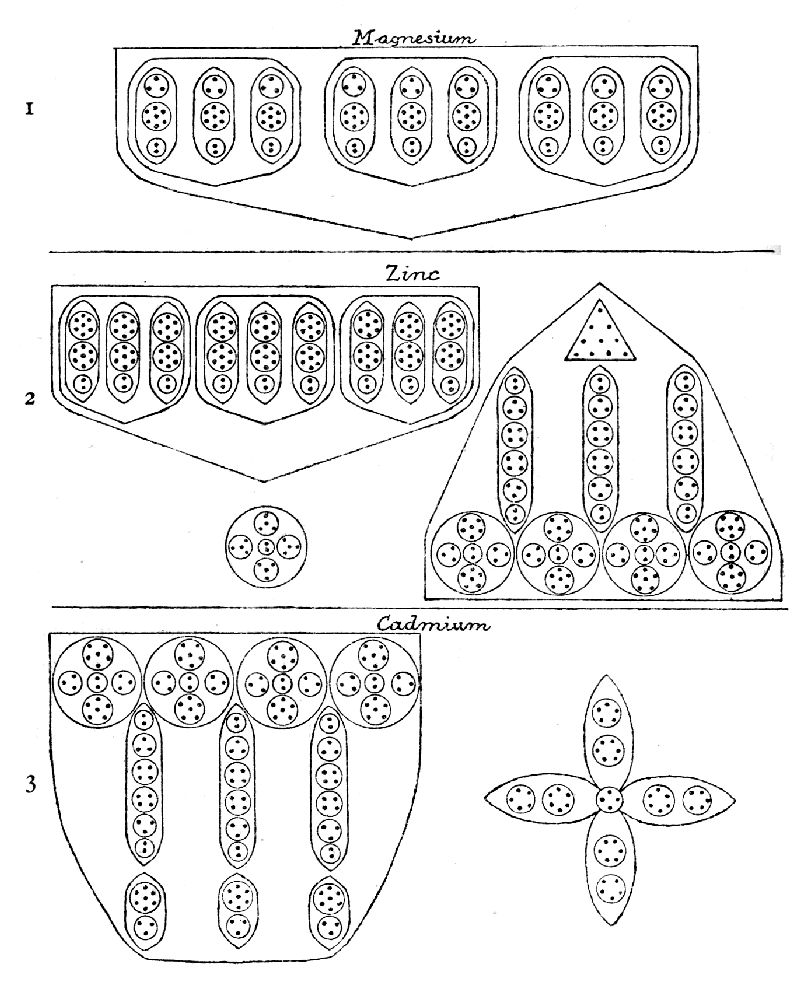
Magnesium
(
Plate IX
, 1) introduces us to a new arrangement: each group of three ovoids forms a ring, and the three rings are within a funnel; at first glance, there are three bodies in the funnel; on examination each of these is seen to consist of three, with other bodies, spheres, again within them. Apart from this, the composition is simple enough, all the ovoids being alike, and composed of a triplet, a septet and a duad.
MAGNESIUM: 4 funnels of 108 atoms 432 Atomic weight 24.18 Number weight 432/18 24.00
Zinc
(
Plate IX
, 2) also brings a new device: the funnel is of the same type as that of magnesium, while septets are substituted for the triplets, and 36 additional atoms are thus slipped in. Then we see four spikes, alternating with the funnels and pointing to the angles, each adding 144 atoms to the total. The spikes show the ten-atomed triangle, already met with in other metals, three very regular pillars, each with six spheres, containing two, three, four, four, three, two atoms, respectively. The supporting spheres are on the model of the central globe, but contain more atoms. Funnels and spikes alike radiate from a simple central globe, in which five contained spheres are arranged crosswise, preparing for the fully developed cross of cadmium. The ends of the cross touch the bottoms of the funnels.
ZINC: 4 funnels of 144 atoms 576 4 spikes of 144 atoms 576 Central globe 18 ----- Total 1170 ----- Atomic weight 64.91 Number weight 1170/18 65.00
Cadmium
(
Plate IX
, 3) has an increased complexity of funnels; the diagram shows one of the three similar segments which lie within the funnels as cylinders; each of these contains four spheres, three pillars and three ovoids, like the spike of zinc turned upside down, and the zinc ten-atomed triangle changed into three ten-atomed ovoids. The centre-piece is a new form, though prefigured in the central globe of zinc.
CADMIUM: 3 segments of 164 atoms = 492 4 funnels of 492 atoms 1968 Central body 48 ----- Total 2016 ----- Atomic weight 111.60 Number weight 2016/18 112.00
The corresponding negative group is headed by
Plate X.
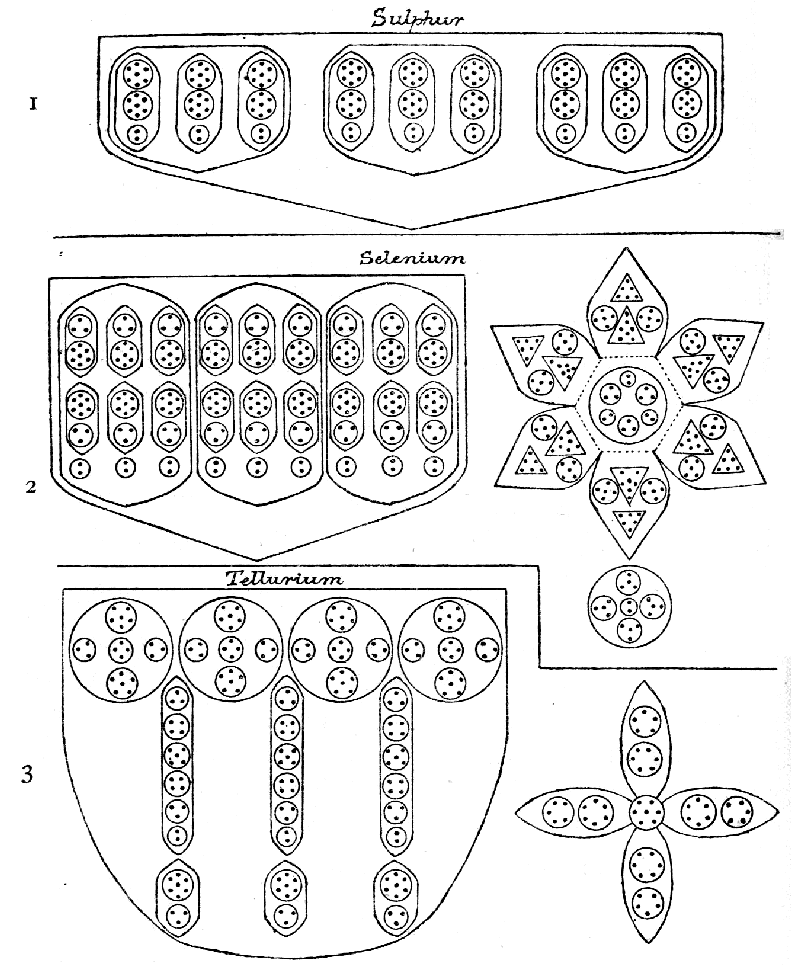
Sulphur
(
Plate X
, 1), which, like magnesium, has no central globe, and consists simply of the zinc funnels, much less compressed than zinc but the same in composition.
SULPHUR: 4 funnels of 144 atoms 576 Atomic weight 31.82 Number weight 576/18 32.00
Selenium
(
Plate X
, 2) is distinguished by the exquisite peculiarity, already noticed, of a quivering star, floating across the mouth of each funnel, and dancing violently when a ray of light falls upon it. It is known that the conductivity of selenium varies with the intensity of the light falling upon it, and it may be that the star is in some way connected with its conductivity. It will be seen that the star is a very complicated body, and in each of its six points the two five-atomed spheres revolve round the seven-atomed cone. The bodies in the funnels resemble those in magnesium, but a reversed image of the top one is interposed between itself and the small duad, and each pair has its own enclosure. The central globe is the same as that of zinc.
SELENIUM: 4 funnels of 198 atoms 792 4 stars of 153 atoms 612 Central globe 18 ----- Total 1422 ----- Atomic weight 78.58 Number weight 1422/18 79.00
Tellurium
(
Plate X
, 3), it will be seen, closely resembles cadmium, and has three cylindrical segments—of which one is figured—making up the funnel. The contained bodies in the pillars run three, four, five, four, three, two, instead of starting with two; and a quartet replaces a duad in the globes above. The central cross only differs from that of cadmium in having a seven-atomed instead of a four-atomed centre. So close a similarity is striking.
TELLURIUM: 3 segments of 181 atoms = 543 4 funnels of 543 atoms 2172 Central body 51 ----- Total 2223 ----- Atomic weight 126.64 Number weight 2223/18 123.50
V.
We must now consider the ways in which the members of the tetrahedral groups break up, and as we proceed with this study we shall find how continual are the repetitions, and how Nature, with a limited number of fundamental methods, creates by varied combinations her infinite variety of forms.
Beryllium (Plate III, 2, and VIII, 1).
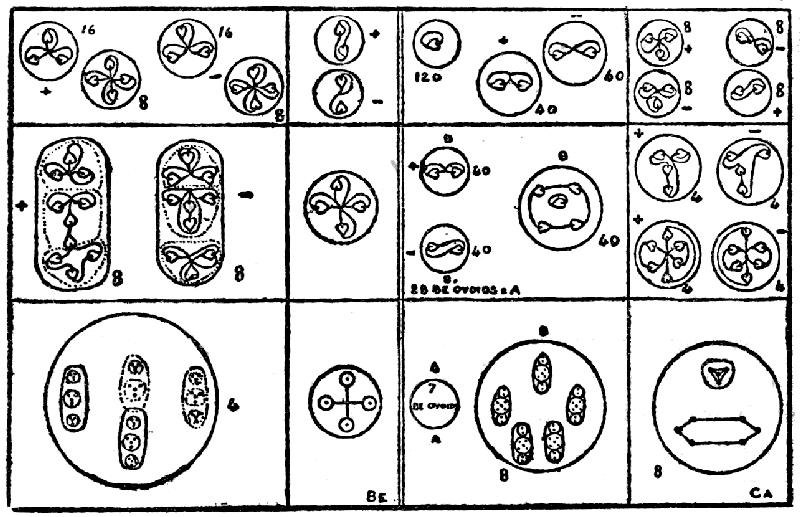
Beryllium offers us four similar funnels and a central globe, and the proto-elements consist of these five bodies, set free. The funnel, released from pressure, assumes a spherical form, with its four ovoids spinning within it, and the central globe remains a sphere, containing a whirling cross. On the meta level, the ovoids are set free, and two from each funnel are seen to be positive, two negative—sixteen bodies in all, plus the cross, in which the resultant force-lines are changed, preparatory to its breaking into two duads on the hyper level. On that level, the decades disintegrate into two triplets and a quartet, the positive with the depressions inward, the negative with the depressions outward.
Calcium (Plate VIII, 2).
The funnels, as usual, assume a spherical form on the proto level, and show, in each case, three spheres containing ovoids. These spheres, still on the proto level, break free from their containing funnel, as in the case of gold (p. 49), twelve bodies being thus liberated, while the central globe breaks up into eight segments, each of which becomes globular, and contains within it a "cigar" and a somewhat heart-shaped body. Four spheres, each containing seven ten-atomed ovoids, are identical with those in beryllium, and can be followed in its diagram. Eight spheres, each containing five nine-atomed ovoids of a different type, set free, on the meta level, eighty duads—forty positive and forty negative—and forty quintets, which are identical with those in chlorine. On the hyper level, the duads become single atoms, within a sphere, and the central atom from the quintet is also set free, one hundred and twenty in all. The remaining four atoms of the quintet divide into two duads.
The central globe, dividing into eight, becomes eight six-atomed spheres on the meta, the "cigar" behaving as usual, four "cigars" being positive and four negative, and becoming dissociated into triplets; the four atoms within the heart-shaped body appear as a tetrahedron, remain together on the meta level, and break up into duads on the hyper.
Strontium (Plate VIII, 3).
The third member of this group repeats the a groups of beryllium and the b groups of calcium, and they dissociate into the bodies already described under these respectively. The two upper globes in each funnel repeat each other, but each globe contains four smaller spheres showing three varieties of forms. The two marked g, which are repeated in the central globe as h, are seven-atomed, and appear as spheres or ovoids according to pressure. They are figured on p. 48, under iodine; e and f are related as object and image, and we have already seen them in copper (pp. 38 and 48); in each case, as in copper, they unite into a ten-atomed figure; on the meta level the pair of fours form a ring, and the remaining two atoms form a duad; i, which repeats f, makes a ring with the fifth in the centre, as in the five-atomed b of calcium, as shown above. There is, thus, nothing new in strontium, but only repetitions of forms already studied.
Oxygen (Plate VIII, 4).
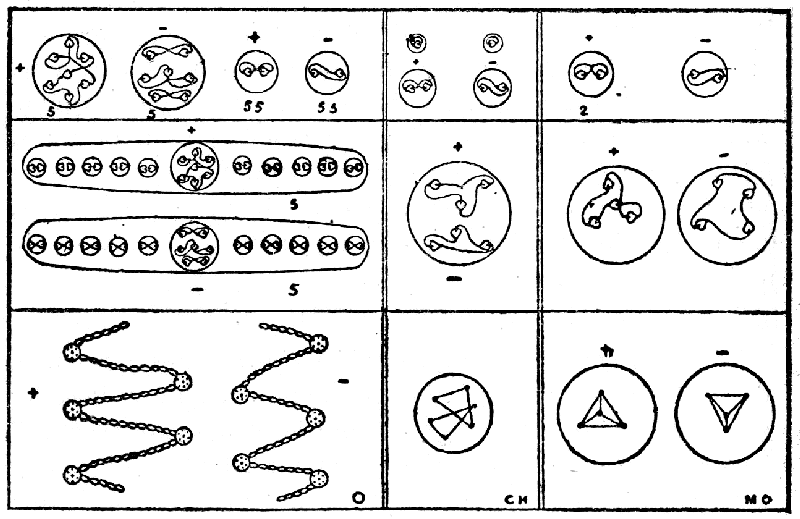
The disintegration of oxygen as given in 1895 may be repeated here, and the better presentation given on p. 54 renders it easier to follow the process. On the proto level the two "snakes" divide; the brilliant disks are seven-atomed, but are differently arranged, the positive snake having the atoms arranged as in the iodine ovoids, whereas the negative snake has them arranged as in a capital H. The snakes show the same extraordinary activity on the proto level as on the gaseous, twisting and writhing, darting and coiling. The body of the snake is of two-atomed beads, positive and negative. On the meta level the snakes break into ten fragments, each consisting of a disk, with six beads on one side and five on the other, remaining as lively as the original snake. They shiver into their constituent disks, and beads on the hyper level, there yielding the ten disks, five positive and five negative, and the 110 beads, fifty-five positive and fifty-five negative.
Chromium (Plate VIII, 5).
When we go on to chromium and molybdenum, we return to our familiar funnels and central globes, and the secondary spheres within the funnels—quickly set free, as before, on the proto level—give us no new combinations in their contained spheres and ovoids. The a of beryllium, the b of calcium and strontium, and d of calcium, the e and f of strontium, are all there; j in chromium is the same as the central sphere in the b ovoid. In the central globe, k, is a pair of triangles as in hydrogen, consisting of only six atoms, which on the meta level revolve round each other, and break up into two duads and two units on the hyper.
Molybdenum (Plate VIII, 6).
Molybdenum presents us with only two new forms, and these are merely four-atomed tetrahedra, occurring in pairs as object and image. All the other bodies have already been analysed.
II a.—We come now to the second great tetrahedral group, which though very much complicated, is yet, for the most part, a repetition of familiar forms.
Magnesium (Plate IX, 1).
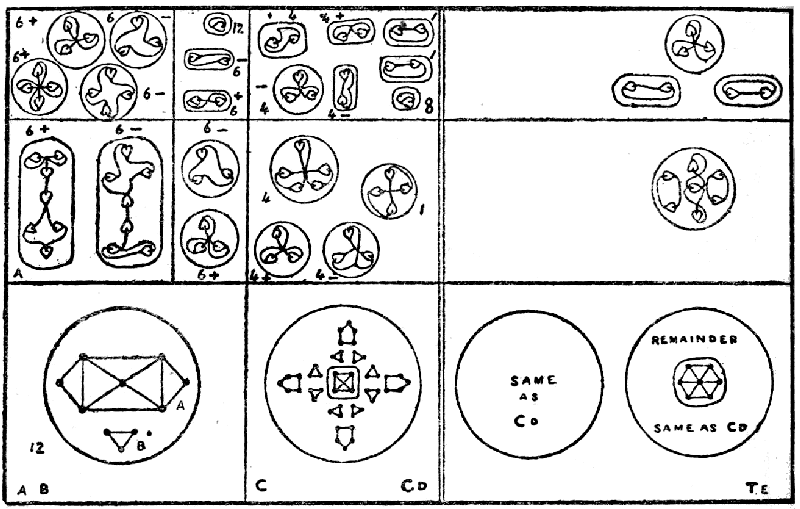
We are still among tetrahedra, so have to do with four funnels, but each funnel contains three rings, and each ring three ovoids; on the proto level a triple dissociation takes place, for the funnels let free the rings as large spheres, in each of which rotate three twelve-atomed ovoids, and then the ovoids break loose from the spheres, and themselves become spherical, so that we have finally thirty-six proto compounds from the tetrahedron. On the meta level the contained bodies, a triplet, Mg a, a septet, Mg b, and a duad, Mg c, are set free from each globe, thus yielding one hundred and eight meta compounds. On the hyper level the triplet becomes a duad and a unit; the duad becomes two units; and the septet a triplet and a quartet.
Zinc (Plate IX, 2).
We can leave aside the funnel, for the only difference between it and the magnesium funnel is the substitution of a second septet for the triplet, and the septet is already shown in the magnesium diagram. We have, therefore, only to consider the spikes, pointing to the angles of the enclosing tetrahedron, and the central globe. These are set free on the proto level and the spikes immediately release their contents, yielding thus thirty-two separate bodies.
The triangular arrangement at the top of the spike is the same as occurs in copper (b on p. 48), and can be there followed. One of the three similar pillars is shown in the accompanying diagram under Zn a. The compressed long oval becomes a globe, with six bodies revolving within it in a rather peculiar way: the quartets turn round each other in the middle; the triplets revolve round them in a slanting ellipse; the duads do the same on an ellipse slanting at an angle with the first, somewhat as in gold (a and b, p. 40). The spheres within the globes at the base of the spikes, Zn b, behave as a cross—the cross is a favourite device in the II a groups. Finally, the central globe, Zn c, follows the same cruciform line of disintegration.
Cadmium (Plate IX, 3).
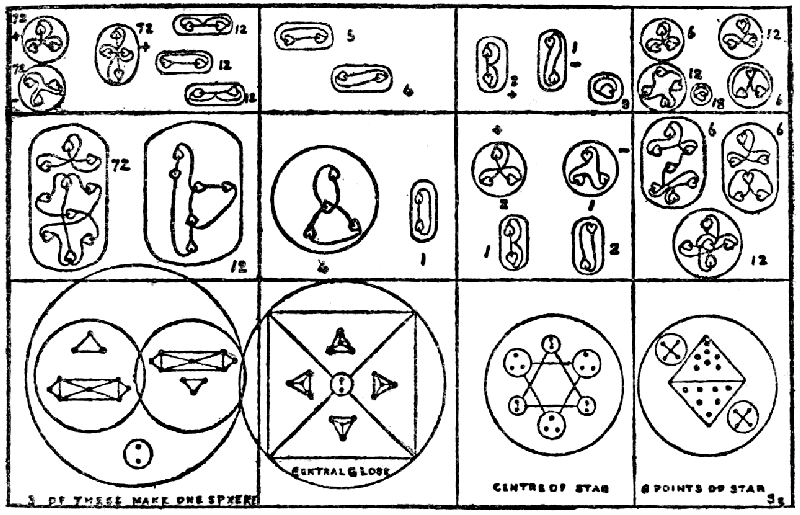
Cadmium follows very closely on the lines of zinc; the pillars of the zinc spike are reproduced in the rings of the cadmium funnel; the globes are also the globes of cadmium; so neither of these needs attention. We have only to consider the three ten-atomed ovoids, which are substituted for the one ten-atomed triangle of zinc, and the central cross. The ovoids become spheres (Cd a, b), the contained bodies revolving within them, a whirling on a diameter of the sphere, cutting it in halves, as it were, and b whirling round it at right angles; the cross also becomes a sphere (Cd c), but the cruciform type is maintained within it by the relative positions of the contained spheres in their revolution. The subsequent stages are shown in the diagram.
Sulphur (Plate XI, 1).
Sulphur has nothing new, but shows only the funnels already figured in magnesium, with the substitution of a second septet for the triplet, as in zinc.
Selenium (Plate X, 2).
The funnel of selenium is a re-arrangement of the twelve-atomed ovoids of magnesium and the ten-atomed ovoids of cadmium. The funnels, on disintegrating, set free twelve groups, each containing nine spheres. On the meta level the ten-atomed bodies are set free, and the twelve-atomed divide into duads and decads, thus yielding seventy-two decads and thirty-six duads; the duads, however, at once recombine into hexads, thus giving only twelve meta elements, or eighty-four in all from the funnels. The central globe holds together on the proto level, but yields five meta elements. The star also at first remains a unit on the proto level, and then shoots off into seven bodies, the centre keeping together, and the six points becoming spheres, within which the two cones, base to base, whirl in the centre, and the globes circle round them. On the meta level all the thirty bodies contained in the star separate from each other, and go on their independent ways.
Selenium offers a beautiful example of the combination of simple elements into a most exquisite whole.
Tellurium (Plate X, 3).
Tellurium very closely resembles cadmium, and they are, therefore placed on the same diagram. The pillars are the same as in chlorine and its congeners, with a duad added at the base. The ten-atomed ovoid is the same as in cadmium and follows the same course in breaking up. It would be interesting to know why this duad remains as a duad in selenium and breaks up into a septad and triad in the other members of the group. It may be due to the greater pressure to which it is subjected in selenium, or there may be some other reason. The cross in tellurium is identical with that in cadmium, except that the centre is seven-atomed instead of four-atomed.
VI.
III and IIIa.—The Cube Groups.
We have here four groups to consider, all the members of which are triads, and have six funnels, opening on the six faces of a cube.
III.—Boron, scandium and yttrium were examined; they are all triatomic, paramagnetic, and positive. The corresponding group consists of nitrogen, vanadium and niobium; they are triatomic, paramagnetic, and negative. We have not examined the remaining members of these groups. In these two groups nitrogen dominates, and in order to make the comparison easy the nitrogen elements are figured on both Plate XI and Plate XII. It will be seen that scandium and yttrium, of the positive group, differ only in details from vanadium and niobium, of the negative group; the ground-plan on which they are built is the same. We noted a similar close resemblance between the positive strontium and the negative molybdenum.
Plate XI.
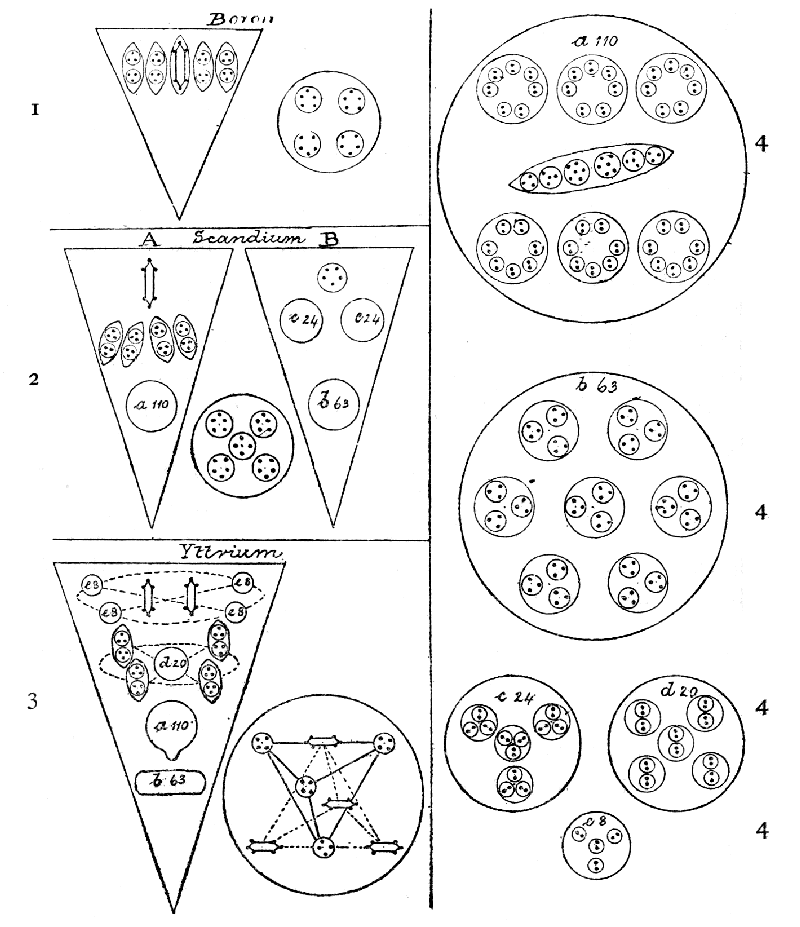
Boron
(
Plate III
, 4, and Plate
XI
, 1). We have here the simplest form of the cube; the funnels contain only five bodies—four six-atomed ovoids and one six-atomed "cigar." The central globe has but four five-atomed spheres. It is as simple in relation to its congeners as is beryllium to its group-members.
BORON: 6 funnels of 30 atoms 180 Central globe 20 ---- Total 200 ---- Atomic weight 10.86 Number weight 200/18 11.11
Scandium
(
Plate XI
, 2). For the first time we meet funnels of different types, A and B, three of each kind; A appear to be positive and B negative, but this must be stated with reserve.
In A the boron funnel is reproduced, the "cigar" having risen above its companion ovoids; but the most important matter to note in respect to this funnel is our introduction to the body marked a 110. This body was observed by us first in nitrogen, in 1895, and we gave it the name of the "nitrogen balloon," for in nitrogen it takes the balloon form, which it also often assumes in other gaseous elements. Here it appears as a sphere—the form always assumed on the proto level—and it will be seen, on reference to the detailed diagram 4 a, to be a complicated body, consisting of six fourteen-atomed globes arranged round a long ovoid containing spheres with three, four, six, six, four, three, atoms respectively. It will be observed that this balloon appears in every member of these two groups, except boron.
The B funnel runs largely to triads, c and b, b (see 4 b) having not only a triadic arrangement of spheres within its contained globes, but each sphere has also a triplet of atoms. In c (see 4 c) there is a triadic arrangement of spheres, but each contains duads. B is completed by a five-atomed sphere at the top of the funnel. It should be noted that a, b and c all are constituents of nitrogen.
The central globe repeats that of boron, with an additional four-atomed sphere in the middle.
SCANDIUM: 3 funnels (A) of 140 atoms 420 3 " (B) of 116 " 348 Centre globe 24 ---- Total 792 ---- Atomic weight 43.78 Number weight 792/18 44.00
Yttrium
(
Plate XI
, 3). Here we have a quite new arrangement of bodies within the funnel—the funnel being of one type only. Two "cigars" whirl on their own axes in the centre near the top, while four eight-atomed globes (see 4
e
) chase each other in a circle round them, spinning madly on their own axes—this axial spinning seems constant in all contained bodies—all the time. Lower down in the funnel, a similar arrangement is seen, with a globe (see 4
d
)—a nitrogen element—replacing the "cigars," and six-atomed ovoids replacing the globes.
The "nitrogen balloon" occupies the third place in the funnel, now showing its usual shape in combination, while the b globe (see 4 b) of scandium takes on a lengthened form below it.
The central globe presents us with two tetrahedra, recalling one of the combinations in gold (see Plate VII d), and differing from that only by the substitution of two quartets for the two triplets in gold.
One funnel of yttrium contains exactly the same number of atoms as is contained in a gaseous atom of nitrogen. Further, a, b, and d are all nitrogen elements. We put on record these facts, without trying to draw any conclusions from them. Some day, we—or others—may find out their significance, and trace through them obscure relations.
YTTRIUM: 6 funnels of 261 atoms 1566 Central globe 40 ---- Total 1606 ---- Atomic weight 88.34 Number weight 1606/18 89.22
The corresponding negative group, of nitrogen, vanadium and niobium, is rendered particularly interesting by the fact that it is headed by nitrogen, which—like the air, of which it forms so large a part—pervades so many of the bodies we are studying. What is there in nitrogen which renders it so inert as to conveniently dilute the fiery oxygen and make it breathable, while it is so extraordinarily active in some of its compounds that it enters into the most powerful explosives? Some chemist of the future, perhaps, will find the secret in the arrangement of its constituent parts, which we are able only to describe.
Plate XII.
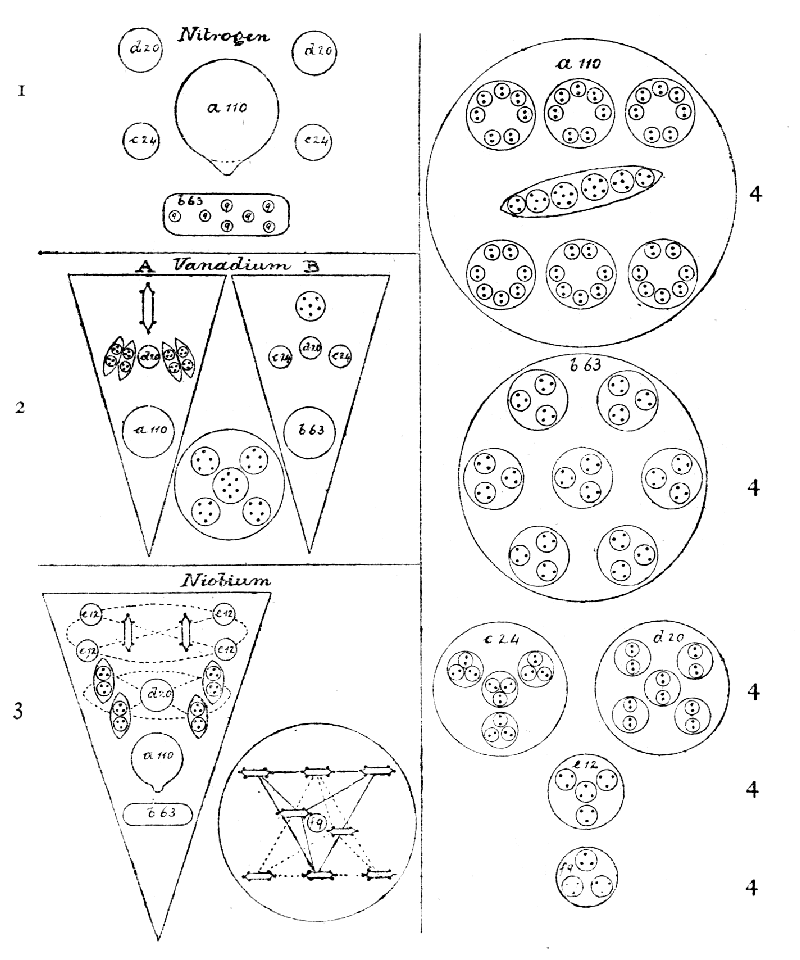
Nitrogen
(
Plate XII
, 1) does not assume the cubical form of its relatives, but is in shape like an egg. Referring again to our 1895 investigations, I quote from them. The balloon-shaped body (see 4
a
) floats in the middle of the egg, containing six small spheres in two horizontal rows, and a long ovoid in the midst; this balloon-shaped body is positive, and is drawn down towards the negative body
b
(see 4
b
) with its seven contained spheres, each of which has nine atoms within it—three triads. Four spheres are seen, in addition to the two larger bodies; two of these (see 4
d
), each containing five smaller globes, are positive, and two (see 4
c
) containing four smaller globes, are negative.
NITROGEN: Balloon 110 Oval 63 2 bodies of 20 atoms 40 2 " " 24 " 48 ---- Total 261 ---- Atomic weight 14.01 Number weight 261/18 14.50
Vanadium
(
Plate XII
, 2) closely follows scandium, having two types of funnels. Funnel A only differs from that of scandium by having a globe (see 4
d
) inserted in the ring of four ovoids; funnel B has a six-atomed, instead of a five-atomed globe at the top, and slips a third globe containing twenty atoms (see 4
d
) between the two identical with those of scandium (see 4
c
). The central globe has seven atoms in its middle body instead of four. In this way does vanadium succeed in overtopping scandium by 126 atoms.
VANADIUM: 3 funnels (A) of 160 atoms 480 3 " (B) " 137 " 411 Central globe 27 ---- Total 918 ---- Atomic weight 50.84 Number weight 918/18 51.00
Niobium
(
Plate XII
, 3) is as closely related to yttrium as is vanadium to scandium. The little globes that scamper round the "cigars" contain twelve atoms instead of eight (see 4
e
).
The rest of the funnel is the same. In the central globe both the tetrahedra have "cigars," and a central nine-atomed globe spins round in the centre (see 4 f), seventeen atoms being thus added.
NIOBIUM: 6 funnels of 277 atoms 1662 Central globe 57 ---- Total 1719 ---- Atomic weight 93.25 Number weight 1719/18 95.50
III a.—Aluminium, gallium and indium were examined from this group. They are triatomic, diamagnetic, and positive. The corresponding group contains phosphorus, arsenic and antimony: bismuth also belongs to it, but was not examined; they are triatomic, diamagnetic and negative. They have no central globes.
Plate XIII.
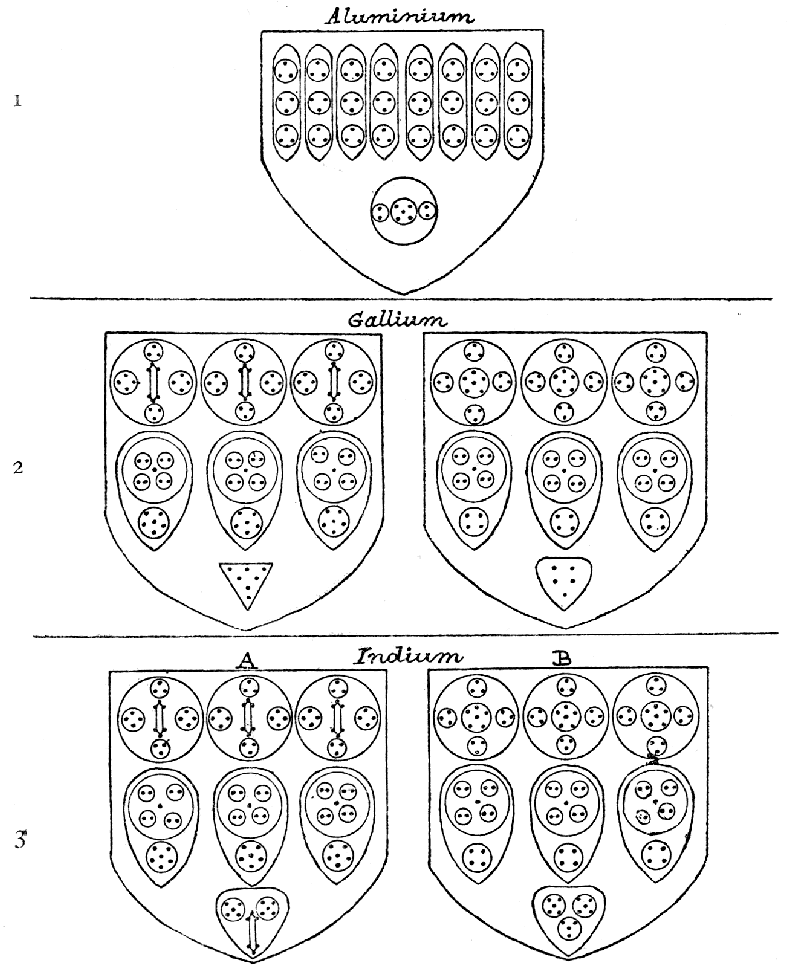
Aluminium
(
Plate XIII
, 1), the head of the group, is, as usual, simple. There are six similar funnels, each containing eight ovoids, below which is a globe.
ALUMINIUM: 6 funnels of 81 atoms 486 Atomic weight 26.91 Number weight 486/18 27.00
Gallium
(
Plate XIII
, 2) has two segments in every funnel; in the segment to the left a "cigar" balances a globe, equally six-atomed, in that of the right, and the globes to right and left are four-atomed as against three-atomed. In the next row, the smaller contained globes have six atoms as against four, and the cones have respectively seven and five. By these little additions the left-hand funnel boasts one hundred and twelve atoms as against ninety-eight.
GALLIUM: Left segment 112 atoms } Right segment 98 " } = 210 6 funnels of 210 atoms 1260 ---- Atomic weight 69.50 Number weight 1260/18 70.00
Indium
(
Plate XIII
, 3) repeats the segments of gallium exactly, save in the substitution of a sixteen-atomed body for the seven-atomed cone of the left-hand segment, and a fourteen-atomed body for the five-atomed corresponding one in gallium. But each funnel now has three segments instead of two; three funnels out of the six contain two segments of type A and one of type B; the remaining three contain two of type B, and one of type A.
INDIUM: Segment A 121 atoms Segment B 107 " 3 funnels of 2 A and 1 B ([242 + 107] 3) 1047 3 " " 2 B and 1 A ([214 + 121] 3) 1005 ---- Total 2052 ---- Atomic weight 114.05 Number weight 2052/18 114.00
The corresponding negative group, phosphorus, arsenic, and antimony, run on very similar lines to those we have just examined.
Plate XIV.
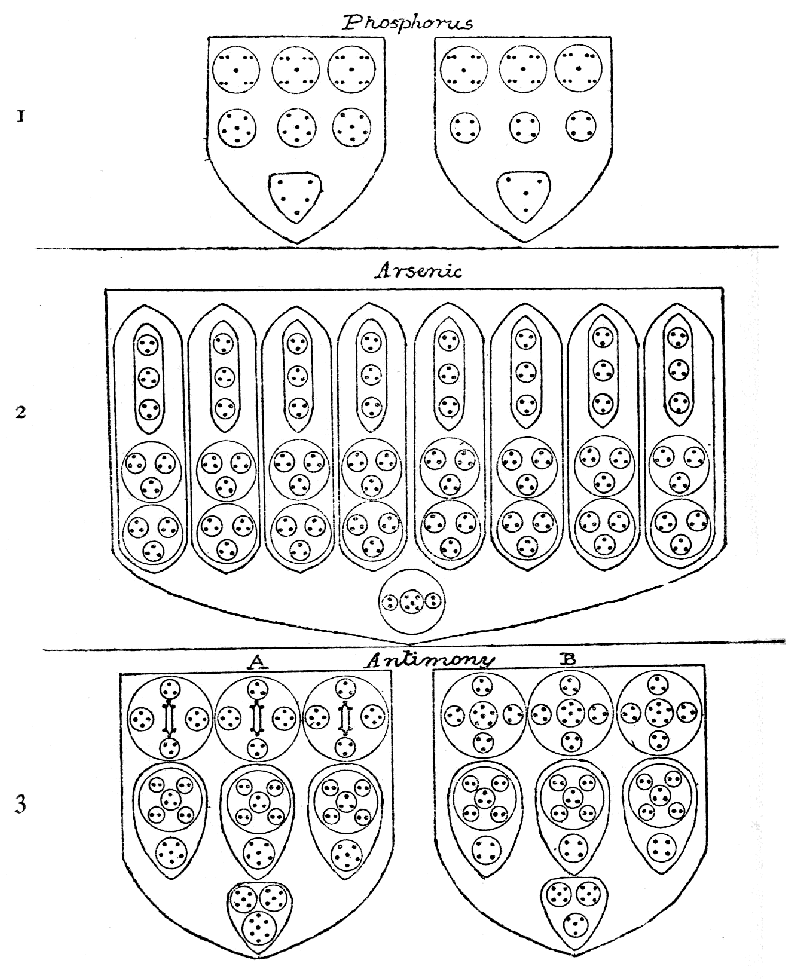
Phosphorus
(
Plate XIV
, 1) offers us a very curious arrangement of atoms, which will give some new forms in breaking up. Two segments are in each funnel, in fact the only two of group III
a
which do not show this arrangement, or a modification thereof, are aluminium and arsenic.
PHOSPHORUS: Left segment 50 atoms Right segment 43 " -- 93 6 funnels of 93 atoms 558 Atomic weight 30.77 Number weight 558/18 31.00
Arsenic
(
Plate XIV
, 2) resembles aluminium in having eight internal sub-divisions in a funnel, and the ovoids which form the top ring are identical, save for a minute difference that in aluminium the ovoids stand the reverse way from those in arsenic. It will be noted that in the former the top and bottom triangles of atoms have the apices upwards, and the middle one has its apex downwards. In arsenic, the top and bottom ones point downwards, and the middle one upwards. Arsenic inserts sixteen spheres between the ovoids and globe shown in aluminium, and thus adds no less than one hundred and forty-four atoms to each funnel.
ARSENIC: 6 funnels of 225 atoms 1350 Atomic weight 74.45 Number weight 1350/18 75.00
Antimony
(
Plate XIV
, 3) is a close copy of indium, and the arrangement of types A and B in the funnels is identical. In the middle rings of both A and B a triplet is substituted for a unit at the centre of the larger globe. In the lowest body of type A the "cigar" has vanished, and is represented by a seven-atomed crystalline form.
ANTIMONY: Segment A 128 atoms Segment B 113 atoms 3 funnels of 2 A and 1 B ([256 + 113]3) 1107 3 " " 2 B and 1 A ([226 + 128]3) 1056 ---- Total 2163 ---- Atomic weight 119.34 Number weight 120.16
VII.
Boron (Plate III, 4, and Plate XI, 1).
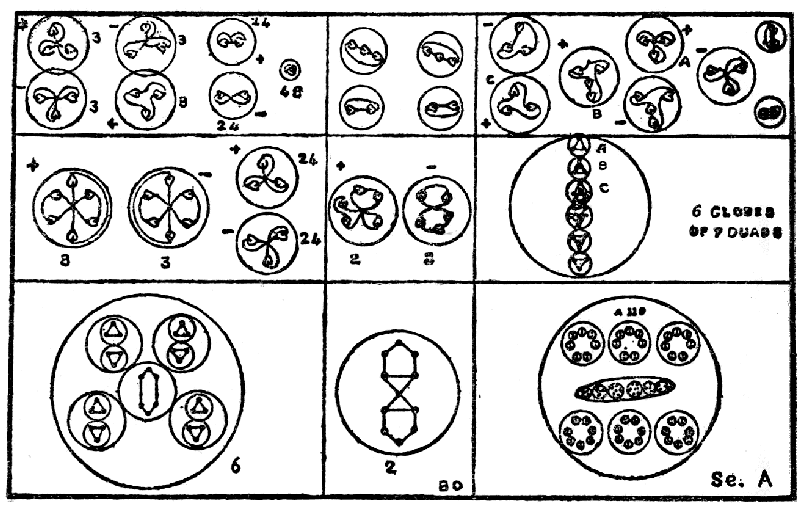
The disintegration of boron is very simple: the funnels are set free and assume the spherical form, showing a central "cigar" and four globes each containing two triplets. The central globe is also set free with its four quintets, and breaks at once in two. On the meta level the "cigar" breaks up as usual, and the triplets separate. On the hyper level, the "cigar" follows its usual course, and the triplets become duads and units. The globe forms two quintets on the meta level, and these are resolved into triplets and duads.
Scandium (Plate XI, 2).
In funnel A the "cigar" and the ovoids behave as in boron, but the "balloon," a 110 (XI, 4), escapes from the funnel as it changes to a sphere, and holds together on the proto level; on the meta, it yields six globes each containing seven duads, and these are all set free as duads on the hyper level; the ovoid is also set free on the meta level becoming a sphere, and on the hyper level liberates its contained bodies, as two triplets, two quartets and two sextets.
In funnel B there is a quintet, that behaves like those in the globe of boron, on escaping from the funnel, in which the bodies remain on the proto level, with the exception of b 63, which escapes. On the meta level, c (Plate XI, 4), c assumes a tetrahedral form with six atoms at each point, and these hold together as sextets on the hyper level. At the meta stage, b (Plate XI, 4 b) sets free seven nine-atomed bodies, which become free triplets on the hyper. The central globe shows a cross at its centre, with the four quintets whirling round it, on the proto level. On the meta, the quintets are set free, and follow the boron type, while the cross becomes a quartet on the meta level, and two duads on the hyper.
Yttrium (Plate XI, 3).
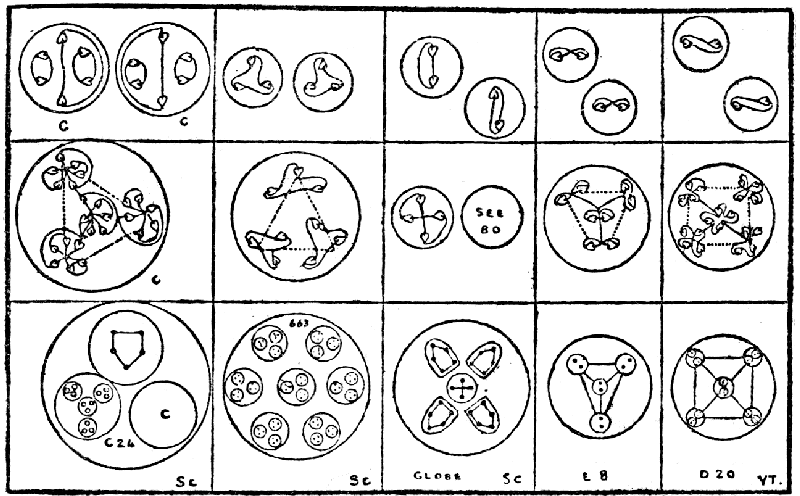
In yttrium, on the proto level, a 110 and b 63 both escape from the funnel, and behave as in scandium. The ovoids and "cigars," set free on the meta level, behave as in boron. The central globe breaks up as in gold (pp. 49 and 50), four quartets being set free instead of two quartets and two triplets. We have only to consider e 8 and d 20 (Plate XI, 4). E 8 is a tetrahedral arrangement of duads on the meta level, set free as duads on the hyper. D 20 is an arrangement of pairs of duads at the angles of a square-based pyramid on the meta, and again free duads on the hyper.
Nitrogen (Plate XII, 1).
Nitrogen has nothing new to show us, all its constituents having appeared in scandium and yttrium.
Vanadium (Plate XII, 2).
The A funnel of vanadium repeats the A funnel of scandium, with the addition of d 20, already studied. In the B funnel scandium B is repeated, with an addition of d 20 and a sextet for a quintet; the sextet is the c of the "nitrogen balloon." The central globe follows boron, save that it has a septet for its centre; this was figured in iodine (p. 48).
Niobium (Plate XII, 3).
Niobium only differs from yttrium by the introduction of triplets for duads in e; on the meta level we have therefore triplets, and on the hyper each triplet yields a duad and a unit. The only other difference is in the central globe. The tetrahedra separate as usual, but liberate eight "cigars" instead of four with four quartets; the central body is simple, becoming three triads at the angles of a triangle on the meta level, and three duads and three units on the hyper.
Aluminium (Plate XIII, 1).
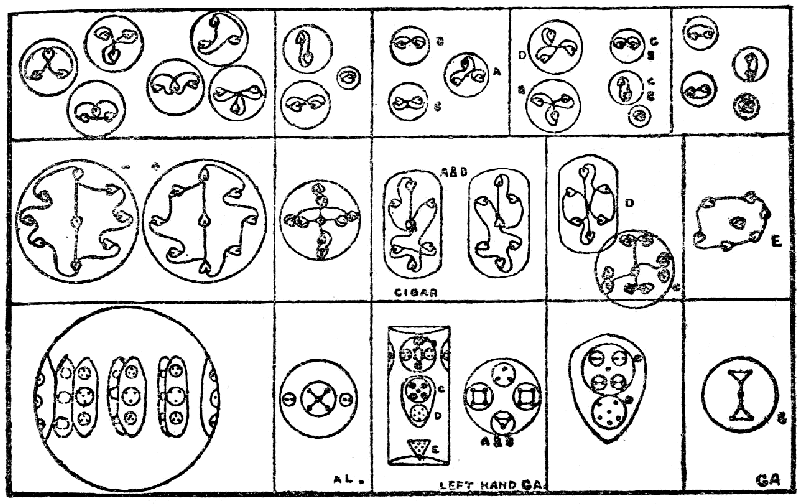
The funnels let go the globes, but the eight ovoids remain within them, so that seven bodies are let loose on the proto level. When the ovoids are set free at the meta stage they become spherical and a nine-atomed body is produced, which breaks up into triangles on the hyper level. The globe becomes a cross at the meta stage, with one atom from the duads at each arm in addition to its own, and these form four duads on the hyper, and a unit from the centre.
Gallium (Plate XIII, 2).
In gallium the funnel disappears on the proto level, setting free its two contained segments, each of which forms a cylinder, thus yielding twelve bodies on the proto level. On the meta, the three upper globes in each left-hand segment are set free, and soon vanish, each liberating a cigar and two septets, the quartet and triad uniting. On the hyper the quartet yields two duads but the triangle persists. The second set of bodies divide on the meta level, forming a sextet and a cross with a duad at each arm; these on the hyper level divide into two triangles, four duads and a unit. The seven-atomed cone becomes two triangles united by a single atom, and on the meta level these form a ring round the unit; on the hyper they form three duads and a unit.
In the right-hand segment, the same policy is followed, the four triads becoming two sextets, while the central body adds a third to the number. The second ring has a quartet instead of the sextet, but otherwise breaks up as does that of the left; the quintet at the base follows that of boron.
Indium (Plate XIII, 3).
The complication of three segments of different types in each funnel does not affect the process of breaking up, and indium needs little attention. A is exactly the same as the left-hand funnel of gallium, save for the substitution of a globe containing the familiar "cigar" and two square-based pyramids. B is the same as the right-hand funnel of gallium, except that its lowest body consists of two square-based pyramids and a tetrahedron. All these are familiar.
Phosphorus (Plate XIV, 1).
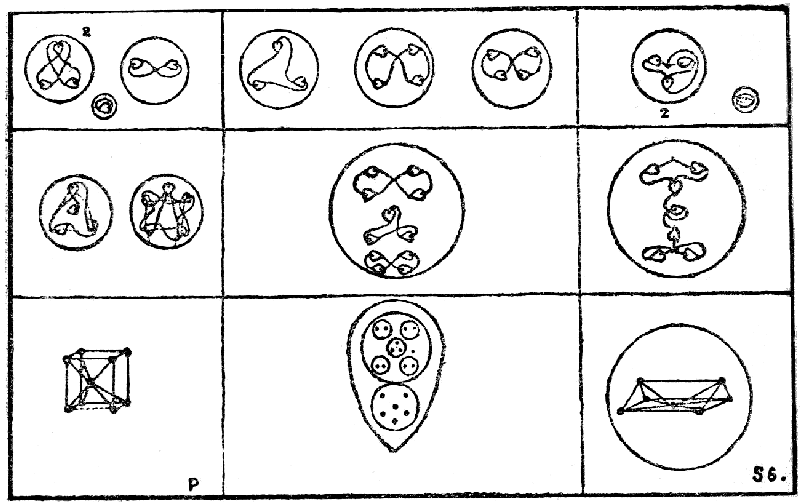
The atoms in the six similar spheres in the segments of the phosphorus funnel are arranged on the eight angles of a cube, and the central one is attached to all of them. On the meta level five of the nine atoms hold together and place themselves on the angles of a square-based pyramid; the remaining four set themselves on the angle of a tetrahedron. They yield, on the hyper level, two triads, a duad, and a unit. The remaining bodies are simple and familiar.
Arsenic (Plate XIV, 2).
Arsenic shows the same ovoids and globe as have already been broken up in aluminium (see ante); the remaining sixteen spheres form nine-atomed bodies on the meta level, all similar to those of aluminium, thus yielding twelve positive and twelve negative; the globe also yields a nine-atomed body, twenty-five bodies of nine.