Part 4 — GLOSSARY OF CHEROKEE WORDS. (continued 2)
Reading edition
utsuʻgi—the tufted titmouse (Parus bicolor); also called uʻstutiʻ, “topnot, or tip,” on account of its crest.
uʻtsutiʻ—fish. Also, many.
Uwagaʻhi (commonly written Ocoee)—“Apricot place,” from uwaʻga, the “apricot vines,” or “maypop,” (Passiflora incarnata), and hi, locative. A former important settlement on Ocowe river, near its junction with Hiwassee, about the present Benton, in Polk county, Tenn.
uwaʻyi—hand, paw, generally used with the possessive suffix, as uwayeʻni, “his hand.”
uweʻla—liver.
uweʻnahi—rich; used also as a personal name.
Uwʻtsunʻta—“Bouncer” (habitual); from kʻtsi, “it is bouncing.” A traditional serpent described as moving by jerks like a measuring worm, to which also the name is applied.
Uyahyeʻ—a high peak in the Great Smoky range, probably on the line between Swain county, N. C., and Sevier county, Tenn.
Uyʻgilaʻgi—abbreviated from Tsuyuʻgilaʻgi, “where there are dams,” i. e., beaver dams; from guʻgiluʻunskuʻ, “he is damming it.” 1. A former settlement on Oothcaloga (Ougillogy) creek of Oostanaula river, near the present Calhoun, in Gordon county, Ga.; 2. Beaverdam creek, west of Clarksville, in Habbersham county, Ga.
Valleytown—see Guʻnahitunʻyi.
Vengeance creek—see Gansaʻtiʻyi.
Wachesa—see Watsiʻsu.
wadanʻ—thanks!
waʻdi—paint, especially red paint.
waʻdige-askaʻli—“his head (is) brown,” i. e., “brown-head”; from wadigeʻi, brown, brown-red, and askaʻli, head; the copperhead snake.
Wadiʻyahi—a feminine name of doubtful etymology. An expert basket-making woman among the East Cherokee, who died in 1895. She was known to the whites as Mrs. Bushyhead.
Wafford—see Tsuskwanunʻta.
Waʻginsi—the name of an eddy at the junction of Little Tennessee and the main Tennessee rivers at Lenoir, in London county, Tenn. The town is now known to the Cherokee by the same name, of which the meaning is lost.
waguliʻ—whippoorwill; the name is an onomatope; the Delaware name is wekolis.
Wahnenauhi—see Waniʻnahi.
waʻhuhuʻ—the screech-owl.
waʻka—cow; from the Spanish vaca, as is also the Creek waga and the Arapaho wakuch.
walaʻsi—the common green frog.
Walasiʻyi—“Frog place.” 1. A former settlement, known to the whites as Frogtown, upon the creek of the same name, north of Dahlonega, in Lumpkin county, Ga. 2. Le Conte and Bullhead Mountains in the Great Smoky range on the N. C.-Tenn. line, together with the ridge extending into Sevier county, Tenn., between the Middle and West forks of Little Pigeon river.
walasʻ-unulʻsti—“it fights frogs,” from walaʻsi, frog, and unulʻsti, “it fights” (habitually); guʻlihuʻ, “I am fighting.” The Prosartes lanuginosa plant.
Walasʻ-unulstiyiʻ—“Place of the plant,” walasʻ-unulʻsti, commonly known to the whites as Fightingtown, from a translation of the latter part of a name; a former settlement on Fighting creek, near Morgantown, in Fannin county, Ga.
Waliniʻ—a feminine name, compounded from Wali, another form of Kwali, “Polly,” with a suffix added for euphony.
Waneʻ-asunʻtlunyi—“Hickory footlog place,” from waneʻi, hickory, asun-tlunʻi (q. v.), footlog, bridge, and yi, locative. A former settlement, known to the whites as Hickory-log, on Etowah river, a short distance above Canton, in Cherokee county, Ga.
Waniʻnahiʻ—a feminine name of uncertain etymology; the Wahnenauhi of the Wahnenauhi manuscript.
Washington—see Waʻsituʻna.
Waʻsi—the Cherokee form for Moses.
Waʻsituʻna, Waʻsuntuʻna (different dialect forms)—a Cherokee known to the whites as Washington, the sole survivor of a Removal tragedy. The name denotes a hollow log (or other cylindrical object) lying on the ground at a distance; the root of the word is asiʻta, log, and the w prefix indicates distance.
Waʻsuluʻ—a large red-brown moth which flies about blossoming tobacco in the evening.
Wataʻgi (commonly written Watauga, also Wataga, Wattoogee, Whatoga, etc.)—a name occurring in two or more towns in the old Cherokee country; one was an important settlement on Watauga creek of Little Tennessee river, a few miles below Franklin, in Macon county, N. C.; another was traditionally located at Watauga Old Fields, about the present Elizabethton on Wateuga river, in Carter county, Tenn. The meaning is lost.
Watauʻga—see Wataʻgi.
Watsiʻsa—a prominent old Cherokee, known to the whites as Wachesa, a name which cannot be translated, who formerly lived on Beaverdam creek of Hiwassee river, below Murphy, in Cherokee county, N. C. From the fact that the Unicoi turnpike passed near his place, it was locally known as Wachesa trail.
waʻya—wolf; an onomatope, an imitation of the animal’s howl; cf. the Creek name, yaha.
Waʻyaʻhi—“Wolf place,” i. e., place of the Wolf clan; the form AniʻWaʻyaʻhi is not used. Wolftown settlement on upper Soco creek, on the East Cherokee reservation, in Jackson county, N. C.
Waya Gap—see Aʻtahiʻta.
Wayeh—see Wayi.
Wayi—“Pigeon”; the modern Cherokee name for Big Pigeon river, in western N. C.; probably a translation of the English name. It appears also as Wayeh.
Welch, Lloyd—see Daʻsiʻgiyaʻgi.
wesa—cat.
White-path—see Nunnaʻhi-tsuneʻga.
Willstown—a former important settlement, so-called from the half-breed chief known to the whites as Red-headed Will, on Will’s creek below Fort Payne, in Dekalb county, Ala. The settlement was frequently called from him Wiliʻyi, “Will’s place,” but this was not the proper local name.
Wilsiniʻ—The Cherokee name for H. W. Spray, agent and superintendent for the East Cherokee reservation; an adaptation of his middle name, Wilson.
Wil-usdiʻ—“Little Will,” from Wiliʻ, Will and usdiʻga or usdiʻ, little. The Cherokee name for Colonel W. H. Thomas, for many years the recognized chief of the eastern band.
Wissactaw—see gahawiʻstia.
Wolftown—see Waʻyaʻhi.
Wootassite—see Outacity.
Wrosetasatow—see Outacity.
Wudeʻligunʻyi—the west; literally “there where it (the sun) goes down,” (w prefixed implies distance, yi, locative). See also Usunhiʻyi and wusuhihunʻyi.
Wuligaʻnatutun—excelling all others, either good or bad; it may be used as equivalent to wastun, “beyond the limit.”
wusuhihunʻyi—“there where they stay over night,” i. e., “the west.” An archaic term used by the narrator of the story of Untsaiyiʻ.
Xuala—see Ani-Suwaʻli.
ya—a suffix denoting principal or real, as tsiskwaʻya, “principal bird,” the sparrow; Aniʻ-Yunwiyaʻ, “principal or real people,” Indians.
Yahulaʻli—“Yahuʻla place,” from Yuhuʻla, a Cherokee trader said to have been taken by the spirit people; Yahuʻla, seems to be from the Creek yohoʻlo, a name having reference to the song (yoholo), used in the “black drink” ceremony of the Creeks; thus aʻsi-yohoʻlo, corrupted into Osceola, signified “the black drink song”; it may, however, be a true Cherokee word, yahuʻlu or yahuʻli, the name for a variety of hickory, also for the “doodle-bug”; Unyahuʻla is a feminine name, but cannot be translated. Yahoola creek, near Dahlonega, in Lumpkin county, Ga.
Yalaʻgi—Alarka creek of Little Tennessee river, above the junction of Tuckasegee, in Swain county, N. C.; the meaning of the name is lost.
yandaskaʻga—a faultfinder.
Yan-eʻgwa—“Big-Bear,” from yanu, bear, and egwa, great, large. A prominent chief about the year 1800; the name occurs in treaties as Yonah, Yohanaqua and Yonahequah.
yaʻnu—bear.
Yaʻnu-dinehunʻyi—“where the bears live,” from yanu, bear, dinehuʻ, “they dwell” (eʻhu, “I dwell, I live”) and yi, locative. A place on Oconaluftee river, a short distance above the junction with Tuckasegee, in Swain county, N. C.
Yanugunʻski—“the bear drowns him” (habitually), from yanu, bear, and tsigunʻiskaʻ, “I am drowning him.” A noted East Cherokee chief, known to the whites as Yonaguska or Drowning-bear.
yanʻ-utseʻstu—“The bear lies on it”; the shield fern (Aspidium).
Yaʻnu-uʻnatawastiʻyi—“where the bears wash,” (from yanu, bear, and yi, locative); a former pond in the Great Smoky Mountains, about the head of Raven Fork, in Swain county, N. C.
Yawaʻi—“Yawa place”; a place on Yellow creek of Cheowa river, in Graham county, N. C.
Yellow-Hill—see Elawaʻdiyi.
Yohanaqua—see Yan-eʻgwa.
yoho-o!—an unmeaning song refrain.
Yonaguska—see Yaʻnugunʻski.
Yonah—1. (mountain) see Gadaluʻlu. 2. An abbreviated treaty form for the name of the chief Yanaʻgwa.
Yonahequah—see Yan-eʻgwa.
Ytaua, Ytava—see Iʻtawaʻ.
Yu!—an unmeaning song refrain and interjection.
Yuhaʻli—Euharlee creek, of lower Etowah river, in Bartow county, Ga. The name is said by the Cherokee to be a corruption of Yufala (Eufaula), a well known Creek local name.
yunsuʻ—buffalo; cf. Creek yenaʻsa, Choctaw yanash, Hichitee yaʻnasi.
Yunsaʻi—“Buffalo place”; West Buffalo creek of Cheowa river in Graham county, N. C.; the site of a former Cherokee settlement.
yunʻwi—person, man.
Yunʻwi Amaʻyineʻhi—“Water-dwelling people,” from yunʻwi, person, and amaʻyineʻhi, plural of amayeʻhi, q. v.; a race of water fairies.
Yunʻwi Gunahiʻta—“Long Man”; a formulistic name for the river, personified as a man with his head resting on the mountain and his feet stretching down to the lowlands, who is constantly speaking to those who can understand the message.
Yunʻwiniʻgisgi—“man-eaters,” literally, “They eat people” (habitually), from yunʻwi, person, man, and uni, giski, “they eat” (habitually), from tsikiuʻ, “I am eating”; the Cherokee name for a distant cannibal tribe, possibly the Atakapa or the Tonkawa.
Yunʻwi-tsulenunʻyi—“where man stood,” originally yunʻwi-dikatagunʻyi, “where the man stands,” from yunʻwi, person, man, tsitaʻga, “I am standing,” and yi, locative; Standing Indian, a high bald mountain at the head of Nantahala river, in Macon county, N. C.
Yunʻwi Tsunsdiʻ—“little people,” from yunʻwi, person, people, and tsunsdiʻga or tsunsdi, plural of usdiʻga or usdiʻ, little; the Cherokee fairies.
Yunʻwi Usdiʻ—“little man.” A formulistic name for ginseng, aʻtali-guliʻ, q. v.
Yunʻwi-usgaʻseʻti—“dangerous man, terrible man”; a traditional leader in the westward migration of Cherokee.
Yunʻwiyaʻ—“Indian,” literally, “principal or real person,” from yunʻwi, person, and ya, a suffix denoting principal or real.
yuʻwe-yuweheʻ—an unmeaning song refrain.
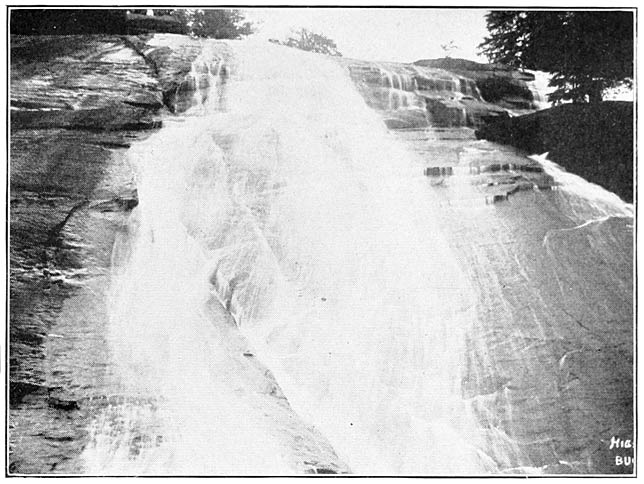
High Falls, Buck Forest, N. C.
“And it bounds full many a fathom
In its final furious fall.”
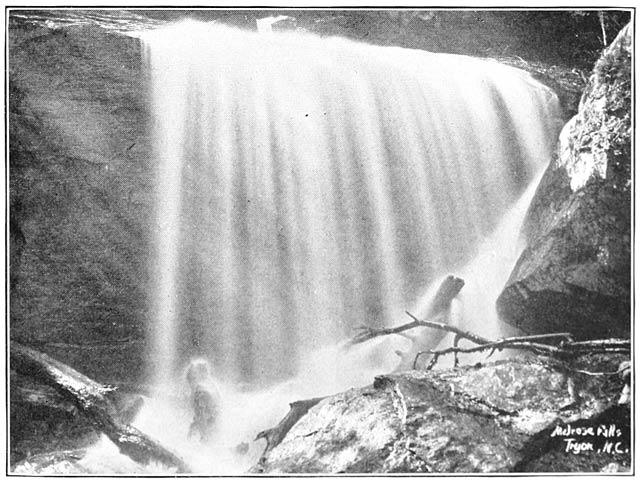
Melrose Falls, Tryon, N. C.
“Plunges down deep in the gulches
Where the rocks are worn with age.”