Part 3 (continued 2)
Reading edition
Malone walked several blocks without noticing where he was going. He tried to think things over, and everything seemed to fall into a pattern that remained, agonizingly, just an inch or so out of his mental reach. The mental bursts, the trouble the United States was having, Palveri, Queen Elizabeth, Burris, Mike Sand, Dr. O'Connor, Sir Lewis Carter and even Luba Ardanko juggled and flowed in his mind like pieces out of a kaleidoscope. But they refused to form any pattern he could recognize.
He uttered a short curse and managed to collide with a bulky woman with frazzled black hair. "Pardon me," he said politely.
"The hell with it," the woman said, looking straight past him, and went jerkily on her way. Malone blinked and looked around him. There were a lot of people still on the streets, but they didn't look like normal New York City people. They were all curiously tense and wary, as if they were suspicious not only of him and each other, but even themselves. He caught sight of several illegal-looking bulges beneath men's armpits, and many heavily sagging pockets. One or two women appeared to be unduly solicitous of their large and heavy handbags. But it wasn't his job to enforce the Sullivan Law, he told himself. Especially while he was on vacation.
A single foot patrolman stood a few feet ahead, guarding a liquor store with drawn revolver, his eyes scanning the passers-by warily while he waited for help. Behind him, the smashed plate glass and broken bottles and the sprawled figure just inside the door told a fairly complete story.
Down the block, Malone saw several stores that carried Closed or Gone Out Of Business signs. The whole depressing picture gave him the feeling that all the tragedies of the 1930-1935 period had somehow been condensed into the past two weeks.
Ahead there was a chain drugstore, and Malone headed for it. Two uniformed men wearing Special Police badges were standing near the door eyeing everyone with suspicion, but Malone managed to get past them and went on to a telephone booth. He tried dialling the Washington number of the FBI, but got only a continuous beep-beep, indicating a service delay. Finally he managed to get a special operator, who told him sorrowfully that calls to Washington were jamming all available trunk lines.
Malone glanced around to make sure nobody was watching. Then he teleported himself to his apartment in Washington and, on arriving, headed for the phone there. Using that one, he dialed again, got Pelham's sad face on the screen, and asked for Thomas Boyd.
Boyd didn't look any different, Malone thought, though maybe he was a little more tired. Henry VIII had obviously had a hard day trying to get his wives to stop nagging him. "Ken," he said. "I thought you were on vacation. What are you doing calling up the FBI, or do you just want to feel superior to us poor working slobs?"
"I need some information," Malone said.
Boyd uttered a short, mirthless laugh. "How to beat the tables, you mean?" he said. "How are things in good old Las Vegas?"
Malone, realizing that with direct-dial phones Boyd had no idea where he was actually calling from, kept wisely quiet. "How about Burris?" he said after a second. "Has he come up with any new theories yet?"
"New theories?" Boyd said. "What about?"
"Everything," Malone said. "From all I see in the papers things haven't been quieting down any. Is it still Brubitsch, Borbitsch and Garbitsch putting psychodrugs in water-coolers, or has something new been added?"
"I don't know what the chief thinks," Boyd said. "Things'll straighten out in a while. We're working on it—twenty-four hours a day, or damn near, but we're working. While you take a nice, long vacation that—"
"I want you to get me something," Malone said. "Just go and get it and send it to me at Las Vegas."
"Money?" Boyd said with raised eyebrows.
"Dossiers," Malone said. "On Mike Sand and Primo Palveri."
"Palveri I can understand," Boyd said. "You want to threaten him with exposure unless he lets you beat the roulette tables. But why Sand? Ken, are you working on something psionic?"
"Me?" Malone said sweetly. "I'm on vacation."
"The chief won't like—"
"Can you send me the dossiers?" Malone interrupted.
Boyd shook his head very slowly. "Ken, I can't do it without the chief finding out about it. If you are working on something ... hell, I'd like to help you. But I don't see how I can. You don't know what things are like here."
"What are they like?" Malone said.
"The full force is here," Boyd said. "As far as I know, you're the only vacation leave not canceled yet. And not only that, but we've got agents in from the Sureté and New Scotland Yard, agents from Belgium and Germany and Holland and Japan ... Ken, we've even got three MVD men here working with us."
"It's happening all over?" Malone said.
"All over the world," Boyd said. "Ken, I'm beginning to think we've got a case of Martian Invaders on our hands. Or something like it." He paused. "But we're licking them, Ken," he went on. "Slowly but surely, we're licking them."
"How do you mean?" Malone said.
"Crime is down," Boyd said, "away down. Major crime, I mean—petty theft, assault, breaking and entering and that sort of thing has gone away up, but that's to be expected. Everything's going to—"
"Skip the handbasket," Malone said. "But you're working things out?"
"Sooner or later," Boyd said. "Every piece of equipment and every man in the FBI is working overtime; we can't be stopped forever."
"I'll wave flags," Malone said bitterly. "And I wish I could join you."
"Believe me," Boyd said, "you don't know when you're well off."
Malone switched off. He looked at his watch; it was ten-thirty.
XII
That made it eight-thirty in Las Vegas. Malone opened his eyes again in his hotel room there. He had half an hour to spare until his dinner date with Luba. That gave him plenty of time to shower, shave and dress, and he felt pleased to have managed the timing so neatly.
Two minutes later, he was soaking in the luxury of a hot tub allowing the warmth to relax his body while his mind turned over the facts he had collected. There were a lot of them, but they didn't seem to mean anything special.
The world, he told himself, was going to hell in a handbasket. That was all very well and good, but just what was the handbasket made of? Burris' theory, the more he thought about it, was a pure case of mental soapsuds, with perhaps a dash of old cotton-candy to make confusion even worse confounded.
And there wasn't any other theory, was there?
Well, Malone reflected, there was one, or at least a part of one. Her Majesty had said that everything was somehow tied up with the mental bursts—and that sounded a lot more probable. Assuming that the bursts and the rest of the mixups were not connected made, as a matter of fact, very little sense; it was multiplying hypotheses without reason. When two unusual things happen, they have at least one definite connection: they're both unusual. The sensible thing to do, Malone thought, was to look for more connections.
Which meant asking who was causing the bursts, and why. Her Majesty had said that she didn't know, and couldn't do it herself. Obviously, though, some telepath or a team of telepaths was doing the job. And the only trouble with that, Malone reflected sadly, was that all telepaths were in the Yucca Flats laboratory.
It was at this point that he sat upright in the tub, splashing water over the floor and gripping the soap with a strange excitement. Who'd ever said that all the telepaths were in Yucca Flats? All the ones so far discovered were—but that, obviously, was an entirely different matter.
Her majesty didn't know about any others, true. But Malone thought of his own mind-shield. If he could make himself telepathically "invisible," why couldn't someone else? Dr. Marshall's theories seemed to point the other way—but they only went for telepaths like Her Majesty, who were psychotic. A sane telepath, Malone thought, might conceivably develop such a mind-shield.
All known telepaths were nuts, he told himself. Now, he began to see why. He'd started out, two years before, hunting for nuts, and for idiots. But they wouldn't even know anything about sane telepaths—the sane ones probably wouldn't even want to communicate with them.
A sane telepath was pretty much of an unknown quantity. But that, Malone told himself with elation, was exactly what he was looking for. Could a sane telepath do what an insane one couldn't—and project thoughts, or at least mental bursts?
He got out of the cooling tub and grabbed for a terry-cloth robe. Not even bothering about the time, he closed his eyes. When he opened them again he was in the Yucca Flats apartment of Dr. Thomas O'Connor.
O'Connor wasn't sleeping, exactly. He sat in a chair in his bare-looking living room, a book open on his lap, his head nodding slightly. Malone's entrance made no sounds, and O'Connor didn't move or look around.
"Doctor," Malone said, "is it possible that—"
O'Connor came up off the chair a good foot and a half. He went: "Eee," and came down again, still gripping the book. His head turned.
"It's me," Malone said.
"Indeed," O'Connor said. "Indeed indeed. My goodness." He opened his mouth some more but no words came out of it. "Eee," he said again, at last, in a conversational tone.
Malone took a deep breath. "I'm sorry I startled you," he said, "but this is important and it couldn't wait." O'Connor stared blankly at him. "Dr. O'Connor," Malone said, "it's me. Kenneth J. Malone. I want to talk to you."
At last O'Connor's expression returned almost to normal. "Mr. Malone," he said, "you are undressed."
Malone sighed. "This is important, doctor," he said. "Let's not waste time with all that kind of thing."
"But, Mr. Malone—" O'Connor began frostily.
"I need some information," Malone said, "and maybe you've got it. What do you know about telepathic projection?"
"About what?" O'Connor said. "Do you mean nontelepaths receiving some sort of ... communication from telepaths?"
"Right," Malone said. "Mind-to-mind communication, of course; I'm not interested in the United States mail or the telephone companies. How about it, doctor? Is it possible?"
O'Connor gnawed at his lower lip for a second. "There have been cases reported," he said at last. "Very few have been written up with any accuracy, and those seem to be confined to close relatives or loved ones of the person projecting the message."
"Is that necessary?" Malone said. "Isn't it possible that—"
"Further," O'Connor said, getting back into his lecture-room stride, "I think you'll find that the ... ah ... message so received is one indicating that the projector of such a message is in dire peril. He has, for instance, been badly injured, or is rapidly approaching death, or else he has narrowly escaped death."
"What does that have to do with it?" Malone said. "I mean, why should all those requirements be necessary?"
O'Connor frowned slightly. "Because," he said, "the amount of psionic energy necessary for such a feat is tremendous. Usually, it is the final burst of energy, the outpouring of all the remaining psionic force immediately before death. And if death does not occur, the person is at the least greatly weakened; his mind, if it ever does recover, needs time and rest to do so."
"And he reaches a relative or a loved one," Malone said, "because the linkage is easier; there's some thought of him in that other mind for him to 'tune in' on."
"We assume so," O'Connor said.
"Very well, then," Malone said. "I'll assume so, too. But if the energy is so great, then a person couldn't do this sort of thing very often."
"Hardly," O'Connor said.
Malone nodded. "It's like ... like giving blood to a blood bank," he said. "Giving ... oh, three quarts of blood. It might not kill you. But if it didn't, you'd be weak for a long time."
"Exactly," O'Connor said. "A good analogy, Mr. Malone." Malone looked at him and felt relieved that he'd managed to get the conversation onto pure lecture-room science so quickly. O'Connor, easily at home in that world, had been able to absorb the shock of Malone's sudden appearance while providing the facts in his own inimitable, frozen manner.
"So one telepath couldn't go on doing it all the time," he said. "But—how about several people?"
"Several people?" O'Connor said.
"I mean ... well, let's look at that blood bank again," Malone said. "You need three quarts of blood. But one person doesn't have to give it. Suppose twelve people gave half a pint each."
"Ah," O'Connor said. "I see. Or twenty-four people, giving a quarter-pint each. Or—"
"That's the idea," Malone said hurriedly. "I guess there'd be a point of diminishing returns, but that's the point. Would something like that be possible?"
O'Connor thought for what seemed like a long time. "It might," he said at last. "At least theoretically. But it would take a great deal of mental co-ordination among the participants. They would all have to be telepaths, of course."
"In order to mesh their thoughts right on the button, and direct them properly and at the correct time," Malone said. "Right?"
"Ah ... correct," O'Connor said. "Given that, Mr. Malone, I imagine that it might possibly be done."
"Wonderful," Malone said.
"However," O'Connor said, apparently glad to throw even a little cold water on the notion, "it could not be done for very long periods of time, you understand. It would happen in rather short bursts."
"That's right," Malone said, enjoying the crestfallen look on O'Connor's face. "That's exactly what I was looking for."
"I'm ... ah ... glad to have been of service," O'Connor said. "However, Mr. Malone, I should like to request—"
"Oh, don't worry," Malone said. "I won't slam the door." He vanished.
It was eight-fifty. Hurriedly, he rinsed himself off, shaved and put on his evening clothes. But he was still late—it was two minutes after nine when he showed up at the door that led off the lobby to the Universal Joint. Luba was, surprisingly, waiting for him there.
"Ready for a vast feast?" she asked pleasantly.
"In about a minute and a half," Malone said. "Do you mind waiting that long?"
"Frankly," Luba said, "in five minutes I will be gnawing holes in the gold paneling around here. And I do want to catch the first floor show, too. I understand they've got a girl who has—"
"That," Malone said sternly, "should interest me more than it does you."
"I'm always interested in what the competition is doing," Luba said.
"Nevertheless," Malone began, and stopped. After a second he started again: "Anyhow, this is important."
"All right," she said instantly. "What is it?"
He led her away from the door to an alcove in the lobby where they could talk without being overheard. "Can you get hold of Sir Lewis at this time of night?" he asked.
"Sir Lewis?" she said. "If ... if it's urgent, I suppose I could."
"It's urgent," Malone said. "I need all the data on telepathic projection I can get. The scientists have given me some of it—maybe Psychical Research has some more. I imagine it's all mixed up with ghosts and ectoplasm, but—"
"Telepathic projection," Luba said. "Is that where a person projects a thought into somebody else's mind?"
"That's it," Malone said. "Can Sir Lewis get me all the data on that tonight?"
"Tonight?" Luba said. "It's pretty late and what with sending them from New York to Nevada—"
"Don't bother about that," Malone said. "Just send 'em to the FBI Offices in New York. I'll have the boys there make copies and send the copies on." Instead, he thought, he would teleport to New York himself. But Luba definitely didn't have to know that.
"He'd have to send the originals," Luba said.
"I'll guarantee their safety," Malone said. "But I need the data right now."
Luba hesitated.
"Tell him to bill the FBI," Malone said. "Call him collect and he can bill the phone call, too."
"All right, Ken," Luba said at last. "I'll try."
She went off to make the call, and came back in a few minutes.
"O.K.?" Malone said.
She smiled at him, very gently. "O.K.," she said. "Now let's go in to dinner, before I get any hungrier and the Great Universal loses some of its paneling."
Dinner, Malone told himself, was going to be wonderful. He was alone with Luba, and he was in a fancy, fine, expensive place. He was happy, and Luba was happy, and everything was going to be perfectly frabjous.
It was. He had no desire whatever, when dinner and the floor show were over, to leave Luba. Unfortunately, he did have work to do—work that was more important than anything else he could imagine. He made a tentative date for the next day, went to his room, and from there teleported himself to FBI Headquarters, New York.
The agent-in-charge looked up at him. "Hey," he said. "I thought you were on vacation, Malone."
"How come everybody knows about me being on vacation?" Malone said sourly.
The agent-in-charge shrugged. "The only leave not canceled?" he said. "Hell, it was all over the place in five minutes."
"O.K., O.K.," Malone said. "Don't remind me. Is there a package for me?"
The agent-in-charge produced a large box. "A messenger brought it," he said. "From the Psychical Research Society," he said. "What is it, ghosts?"
"Dehydrated," Malone said. "Just add ectoplasm and out they come, shouting Boo! at everybody."
"Sounds wonderful," the agent-in-charge said. "Can I come to the party?"
"First," Malone said judiciously, "you'd have to be dead. Of course I can arrange that—"
"Thanks," the agent-in-charge said, leaving in a hurry. Malone went on down to his office and opened the box. It contained books, pamphlets and reports from Sir Lewis, all dealing with some area of telepathic projection. He spent a few minutes looking them over and trying to make some connected sense out of them, but finally he gave up and just sat and thought. The material seemed to be no help at all; it told him even less than Dr. O'Connor had.
What he needed, he decided, was somebody to talk to. But who? He couldn't talk to the FBI, and nobody else knew much about what he was trying to investigate. He thought of Her Majesty and rejected the notion with a sigh. No, what he needed was somebody smart and quick, somebody who could be depended on, somebody with training and knowledge.
And then, very suddenly, he knew who he wanted.
"Well, now, Sir Kenneth," he said. "Let's put everything together and see what happens."
"Indeed," said Sir Kenneth Malone, "it is high time we did so, Sirrah. Proceed: I shall attend."
"Let's start from the beginning," Malone said. "We know there's confusion in all parts of the country—in all parts of the world, I guess. And we know that confusion is being caused by carefully timed accidents and errors. We also know that these errors appear to be accompanied by violent bursts of psionic static—violent energy. And we know, further, that on three specific occasions, these bursts of energy were immediately followed by a reversal of policy in the mind of the person on the receiving end."
"You mean," Sir Kenneth put in, "that these gentlemen changed their opinions."
"Correct," Malone said. "I refer, of course, to the firm of Brubitsch, Borbitsch and Garbitsch, Spying Done Cheap."
"Indeed," Sir Kenneth said. "Then the operators of this strange force, whatever it may prove to be, must have some interest in allowing the spies' confession?"
"Maybe," Malone said. "Let's leave that for later. To get back to the beginning of all this: it seems to me to follow that the accidents and errors which have caused all the confusion throughout the world happen because somebody's mind is changed just the right amount at the right time. A man does something he didn't intend to do—or else he forgets to do it at all."
"Ah," Sir Kenneth said. "We have done those things we ought not to have done; we have left undone those things we ought to have done. And you feel, Sirrah, that a telepathic command is the cause of this confusion?"
"A series of them," Malone said. "But we also know, from Dr. O'Connor, that it takes a great deal of psychic energy to perform this particular trick—more than a person can normally afford to expend."
"Marry, now," Sir Kenneth said. "Meseemeth this is not reasonable. Changing the mind of a man indeed seems a small thing in comparison to teleportation, or psychokinesis, or levitation or any such witchery. And yet it take more power than any of these?"
Malone thought for a second. "Sure it does," he said. "I'd say it was a matter of resistance. Moving an inanimate object is pretty simple—comparatively, anyhow—because inert matter has no mental resistance."
"And moving oneself?" Sir Kenneth said.
"There's some resistance there, probably," Malone said. "But you'll remember that the Fueyo system of training for teleportation involved overcoming your own mental resistance to the idea."
"True," Sir Kenneth said. "'Tis true. Then let us agree that it takes great power to effect this change. Where does our course point from that agreement, Sirrah?"
"Next," Malone said, "we have to do a little supposing. This project must be handled by a fairly large group, since no individual can do it alone. This large group has to be telepathic—and not only for the reasons Dr. O'Connor and I specified."
"And why else?" Sir Kenneth demanded.
"They've also got to know exactly when to make this victim of theirs change his mind," Malone said. "Right?"
"Correct," Sir Kenneth said.
"We've got to look for a widespread organization of telepaths," Malone said, "with enough mental discipline to hold onto a tough mental shield. Strong, trained, sane men."
"A difficult assignment," Sir Kenneth commented.
"Well," Malone said, "suppose you hold on for a second—don't go away—and let me figure something out."
"I shall wait," sir Kenneth said, "without."
"Without what?" Malone murmured. But there was no time for games. Now, then, he told himself—and sneezed.
He shook his head, cursed softly and went on.
Now, then....
There was an organization, spread all over the Western world, and with what were undoubtedly secret branches in the Soviet Union. The organization had to be an old one—because it had to have trained telepaths, of a high degree of efficiency. And training took time.
There was something else to consider, too. In order to organize to such a degree that they could wreak the complete havoc they were wreaking, the organization couldn't be completely secret; there are always leaks, always suspicious events, and a society that spent time covering all of those up would have no time for anything else.
So the organization had to be a known one, in the Western world at least—a known group, masquerading as something else.
So far, everything made sense. Malone frowned and tried to think. Where, he wondered, did he go from here?
Maybe this time a list would help. He found a pencil and a piece of paper, and headed the paper: Organization. Then he started putting down what he knew about it, and what he'd figured out:
1. Large 2. Old 3. Disguised
It sounded, so far, just a little like Frankenstein's Monster wearing a red wig. But what else did he know about it?
After a second's thought, he murmured: "Nothing," and put the pencil down.
But that, he realized, wasn't quite true. He knew one more thing about the organization. He knew they'd probably be immune to the confusion everybody else was suffering from. The organization would be—had to be—efficient. It would be composed of intelligent, superbly co-operative people, who could work together as a unit without in the least impairing their own individuality.
He reached for the pencil again, and put down:
4. Efficient
He looked at it. Now it didn't remind him so much of the Monster. But it didn't look terribly familiar, either. Who did he know, he thought, who was large, old, disguised and efficient?
It sounded like an improbable combination. He set the paper down, clearing off some of the PRS books to make room for it. And then he stopped.
The papers the PRS had sent him....
And he'd gotten them so quickly, so efficiently....
They were a large organization....
And an old one....
He looked for a desk phone, found one and grabbed at it frantically.
The girl who answered the phone looked familiar. Malone suddenly remembered to check the time—it was just after nine. The girl stared at him. She did not look terribly old, but she was large and she had to be disguised. There seemed to be a lot of teeth running around in this case, Malone thought, between the burlesque stripper in Las Vegas and Miss Dental Display here in New York. Nobody, he told himself, could have collected that many teeth honestly.
"Psychical Research Society," she said. "Oh, Mr. Malone. Good morning."
"Sir Lewis," Malone said in a rush. "Sir Lewis Carter. I want to talk to him. Hurry."
"Sir Lewis Carter?" the girl said very slowly. "Oh, I'm sorry, Mr. Malone, but he won't be in at all today."
"Home number," Malone said desperately. "I've got to."
"Well, I can give you that, Mr. Malone," she said, "but it wouldn't do you any good, really. Because he went away on his vacation and when he does that he never tells us where. You know? He won't be back for two or three weeks," she added as an afterthought.
Malone said: "Oog," and thought for less than a second. "Somebody official," he said. "Got to talk to somebody official. Now."
"Oh, I can't do that either, Mr. Malone," the toothy girl said. "All of the executives already left on their vacation. They just left a skeleton force here at the office."
"They're all gone?" Malone said hollowly.
"That's right," the girl said with great cheer. "As a matter of fact, I'm in charge now. You know?"
"I'm afraid I do," Malone said. "It's very important, though. You don't have any idea where any of them went?"
"None at all," she said. "I'm sorry, but that's how it is. Maybe if you were me you'd ask questions, but I just follow orders and those were my orders. To take over until they get back. You know? They didn't tell me where and I just didn't ask."
"Great," Malone said. He wanted to shoot himself. Everything was obvious now—about twenty-four hours too late. And now, they'd all gone—for two weeks—or for good.
The girl's rancid voice broke in on his thoughts.
"Oh, Mr. Malone," she said. "I'm sorry, but I just remembered they left a note for you."
"A note?" Malone said. "For me?"
"Sir Lewis said you might call," the girl said, "and he left a message. If you'll hold on a minute I'll read it."
Malone waited tensely. The girl found a slip of paper, blinked at it and read:
"My dear Malone, I'm afraid that what you have deduced is quite correct; and, as you can see, that leaves us no alternative. Sorry. Miss Luba A. sends her apologies to you, since she is joining us; my apologies are also tendered." The girl looked up. "It's signed by Sir Lewis," she said. "Does that mean anything to you, Mr. Malone?"
"I'm afraid it does," Malone said blankly. "It means entirely too much."
XIII
After Miss Dental Display had faded from Malone's screen, he just sat there, looking at the dead, gray front of the visiphone and feeling about twice as dead and at least three times as gray.
Things, he told himself, were terrible. But even that sentence, which was a good deal more cheerful than what he actually felt, did nothing whatever to improve his mood. All of the evidence, after all, had been practically living on the tip of his nose for God alone knew how long, and not only had he done nothing about it, he hadn't even seen it.
There was the organization, staring him in the face. There was Luba—nobody's fool, no starry-eyed dreamer of occult dreams. She was part of the Psychical Research Society, why hadn't he thought to wonder why she was connected with it?
And there was his own mind-shield. Why hadn't he wondered whether other telepaths might not have the same shield?
He thought about Luba and told himself bitterly that from now on she was Miss Ardanko. Enough, he told himself, was enough. From now on he was calling her by her last name, formally and distantly. In his own mind, anyhow.
Facts came tumbling in on him like the side of a mountain falling on a hapless traveler, during a landslide season. And, Malone told himself, he had never possessed less hap in all of his ill-starred life.
And then, very suddenly, one more fact arrived, and pushed the rest out into the black night of Malone's bitter mind. He stood up, pushing the books away, and closed his eyes. When he opened them he went to the telephone in his Las Vegas hotel suite, and switched it on. A smiling operator appeared. Malone wanted to see him die of poison, slowly.
"Give me Room 4-T," he snapped. "Hurry."
"Room forty?" the operator asked.
"Damn it," Malone said, "I said 4-T and I meant 4-T. Four as in four and T as in—as in China. And hurry."
"Oh," the operator said. "Yes, sir." He turned away from the screen. "That would have been Miss Luba Ardanko's room, sir?" he said.
"Right," Malone snapped. "I ... wait a minute. Would have been?"
"That's correct, sir," the operator said. "She checked out, sir, early this morning. The room is unoccupied."
Malone swallowed hard. It was all true, then. Sir Lewis' note hadn't simply been one last wave of the red cape before an angry bull. Luba was one of them.
Miss Ardanko, he corrected himself savagely.
"What time?" he said.
The operator consulted an information board before him. "Approximately one o'clock, sir," he said.
"In the morning?"
"Yes, sir," the clerk said.
Malone closed his eyes. "Thanks," he said.
"You're quite welcome, sir," the operator said. "A courtesy of the Great Universal Ho—"
Malone cut him off. "Ho, indeed," he said bitterly. "Not to mention ha and hee—hee and yippe-ki-yay. A great life." He whisked himself back to New York in a dismal, rainy state of mind. As he sat down again to the books and papers the door to the room opened.
"You still here?" the agent-in-charge said. "I'm just going off duty and I came by to check. Don't you ever sleep?"
"I'm on vacation, remember?"
"Some vacation," the a-in-c said. "If you're on special assignment why not tell the rest of us?"
"I want it to be a surprise," Malone said. "And meantime, I'd appreciate it if I were left entirely to my own devices."
"Still conjuring up ghosts?" the a-in-c said.
"That," Malone said, "I don't know. I've got some long-distance calls to make."
He started with the overseas calls, leaving the rest of the United States time for the sun to get round to them. His first call, which involved a lot of cursing on Malone's part and much hard work for the operator, who claimed plaintively that she didn't know how things had gotten so snarled up, but overseas calls were getting worse and worse, went to New Scotland Yard in London. After great difficulty, Malone managed to get Assistant Commissioner C. E. Teal, who promised to check on the inquiry at once.
It seemed like years before he called back, and Malone leaped to the phone.
"Yes?" he said.
Teal, red-faced and apparently masticating a stick of gum, said: "I got C. I. D. Commander Gideon to follow up on that matter, Mr. Malone. As you know, it's after noon here—"
"And they're all out to lunch," Malone said.
"As a matter of fact," Teal went on, "they seem to have disappeared entirely. On vacation, that sort of thing. It is rather difficult attempting any full-scale tracing job just now; our men are terribly overworked. I imagine you've had reports from the New Scotland Yard representatives working with you there—"
"Oh, certainly," Malone said. "But the hour; what does that have to do with anything?"
"I'm afraid I was thinking of our Inspector Ottermole," Teal said. "He was sent to locate Dr. Carnacki, President of the Psychical Research Society here. On being told that Dr. Carnacki was 'out to lunch,' Ottermole investigated every restaurant and eating-place within ten blocks of the offices. Dr. Carnacki was not present; he, like the rest of the Society here, appears to have left for places unknown."
"Thorough work," Malone said.
"Ottermole's a good man," Teal said. "We've checked as quickly as possible, Mr. Malone. I would like to ask you a question in return."
"Ask away," Malone said.
Teal looked worried. "Do you people think this may have anything to do with the present ... ah ... trouble?" he said. "Things are quite upset here, as you know; so many members of Parliament have resigned or ... ah ... died that the realm is being run by a rather shakily assembled coalition government. There is even some talk of giving executive power to Her Majesty until a general election can be held."
For one brief moment, Malone thought Teal was talking about Rose Thompson. Then he recalled Her Majesty Queen Elizabeth II, and felt better. Things weren't quite as bad as he'd thought.
But they were bad enough. "We simply don't know yet," he said untruthfully. "But as soon as anything definite comes up, of course, you'll be informed."
"Thank you, Mr. Malone," Teal said. "Of course, we'll do the same." And then, still masticating, he switched off.
Paris was next, then Rome, Berlin and a couple more. Every one had the same result. From Maigret of the Paris Sureté to Poirot in Belgium, from Berlin's strict officialdom to the cheerful Hollanders, all the reports were identical. The PRS of each country had gone underground.
Malone buried his face in his hands, thought about a cigar and decided that even a cigar might make him feel worse. Where were they? What were they doing now? What did they plan to do?
Where had they gone?
"Out of the everywhere," he heard himself say in a hollow, sepulchral voice, "into the here."
But where was the here?
He tried to make up his mind whether or not that made sense. Superficially, it sounded like extremely bad English, but he wasn't sure of anything any more. Things were getting much too confused.
He close his eyes wearily, and vanished.
When he opened them, he was in his Washington apartment. He went over to the big couch and sat down, feeling that if he were going to curse he might as well be comfortable while he did it. But, some minutes later, when the air was a bright electric blue around him, he didn't feel any better. Cursing was not the answer.
Nothing seemed to be.
What was his next move?
Where did he go from here?
The more he thought about it, the more his mind spun. He was, he realized, at an absolute, total dead end.
Oh, there were things he could do. Malone knew that very well. He could make a lot of noise and go through a lot of waste motion; that was what it amounted to. He could have all the homes of all the missing PRS members checked somehow. That would undoubtedly result in the startling discovery that the PRS members involved weren't home. He could have their dossiers sent to him, which would clutter everything with a great many more pieces of paper. But he felt quite sure that the pieces of paper would do no good at all. In general, he could raise all hell—and find nothing whatever.
Now, he told himself sadly, he had the evidence to start the FBI in motion. The only trouble was that he could think of nowhere for them to go.
And, though he had evidence that might convince Burris—the PRS members, after all, had done a rather unusual fadeout—he had nowhere near enough to carry the case into court, much less make a try at getting the case to stand up once carried in. That was one thing he couldn't do, he realized, he couldn't issue warrants for the arrest of anybody at all.
But, vacation or no vacation, he thought solemnly, he was an FBI Agent, and his motto was: "There's always a way." No normal method of tracking down the PRS members, or finding their present whereabouts, was going to work. They'd been covering themselves for such an emergency, undoubtedly, for a good many years—and if anyone got close, a burst of mental energy was quite enough to turn the seeker aside.
Nobody, Malone told himself grimly, was perfect. There were clues lying around somewhere; he was sure of that. There had to be. The problem was simply to figure out where to look, and how to look, and what to look for.
Somewhere, the clues were sitting quietly and waiting for him to find them. The thought cheered him slightly, but not very much. He stood up slowly and went into the kitchen to start heating water for coffee. There was, he told himself, a long night ahead of him. He sighed gently. But there was no help for it; the work had to be done—and done quickly.
But when eight cigars had been reduced to ash, and what seemed like several gallons of coffee had sloshed their way into Malone's interior workings, his mind was as blank as a baby's. The lovely, opalescent dawn began to show in the East, and Malone tendered it some extremely rude words. Then, Haggard, red-eyed, confused, violently angry, and not one inch closer to a solution, he fell into a fitful doze on his couch.
When he awoke, the sun was high in the sky, and outside his window the cheerful sound of too much traffic floated in the air. Downstairs somebody was playing a television set too loudly, and the voice reached Malone's semiaware mind in a great tinny shout:
"The President, taking action on the current crisis, has declared martial law throughout the nation," a voice said in an important-sounded monotone. "Exempt from this proclamation are members of the Armed Services, Special Agents and the Federal Bureau of Investigation. The proclamation, issued this morning, was made public in a special news conference which—"
Malone ripped out a particularly foul oath and sat up on the couch. "That," he muttered, "is a fine thing to wake up to." He focused his eyes, with only slight difficulty, on his watch. The time was a little after two.
"Later developments will be reported as and when they occur," the announcer was saying, "and in one hour a special panel of newscasters will be assembled here to discuss this latest action in the light of present happenings. Any special rules and regulations will be broadcast over this station—"
"Shut up," Malone said. He had wasted a lot of time doing nothing but sleeping, he told himself. This was no time to be listening to television. He got up and found, to his vague surprise, that he felt a lot better and clearer-headed than he had been. Maybe the sleep had actually done him some good.
He yawned, blinked and stretched, and then padded into the bathroom for a shower and shave. After he'd changed he thought about a morning or afternoon cup of coffee, but last night's dregs appeared to have taken up permanent residence in his digestive tract, and he decided against it at last. He swallowed some orange juice and toast and then, heaving a great sigh of resignation and brushing crumbs off his shirt, he teleported himself over to his office.
Now he knew that, sooner or later, he was going to have to talk to Burris. Burris had to know, even if there was nothing to be done.
And now was just as good—or as bad—a time as any.
He didn't hesitate. He punched the button on his intercom for Burris' office and then sat back, with his eyes closed, waiting for the well-known voice.
It didn't come.
Instead, Wolf, the Director's secretary, spoke up.
"Burris isn't in, Malone," he said. "He had to fly to Miami. I can get a call through to him on the plane, if it's urgent, but he'll be landing in about fifteen minutes. And he did say he'd call in this afternoon."
"Oh," Malone said. "Sure. O.K. It isn't urgent." He was just as glad of the reprieve; it gave him one more chance to work matters through to a solution, and hand it to Burris on a silver platter. "But why Miami?" he added.
"Don't you hear about anything any more?" Wolf asked.
"I've been on vacation."
"Oh," Wolf said. "Well, the Governor of Mississippi was assassinated yesterday, at Miami Beach."
"Ah," Malone said. He thought about it for a second. "Frankly," he said, "this does not strike me as an irreparable loss to the nation. Not even to Mississippi."
"You express my views precisely," Wolf said.
"How about the killer?" Malone said. "I gather they haven't got him yet, or Burris wouldn't be on his way down."
"No," Wolf said. "The killer would be on his way here instead. But you know how things are—everything's confused. Governor Flarion was walking along Collins Avenue when somebody fired at him, using a high-powered rifle with, I guess, a scope sight."
"Professional," Malone commented.
"It looks like it," Wolf said. "And he picked the right time for it, too—the way things are he was just one more confusion among the rest. Nobody even heard the sniper's shot; the governor just fell over, right there in the street. And by the time his bodyguards found out what had happened, it was impossible even to be sure just which way he was facing when the shot had been fired."
"And as I remember Collins Avenue—" Malone started.
"Right," Wolf said. "But it's even worse now, with everything going nuts. Out where Governor Flarion was taking his stroll, there's an awful lot of it to search. The boys are trying to find somebody who saw a man acting suspicious in any of the nearby buildings, or heard a shot, or saw anybody at all lurking or loitering anywhere near to the scene."
"Lovely," Malone said. "Sounds like a nice complicated job."
"You don't know the half of it," Wolf said. "There's also the Miami Beach Chamber of Commerce. According to them, Flarion died of a heart attack, and not even in Miami Beach. Everything happening down there isn't happening, according to them; Miami Beach is the one unsullied beauty spot in a mixed-up United States."
"All I can say," Malone offered, "is good luck. This is the saddest day in American history since the assassination of Huey P. Long."
"Agreed," Wolf said. "Want me to tell Burris you called?"
"Right," Malone said, and switched off.
The assassination of Nemours P. Flarion, he told himself, obviously meant something. It pointed straight toward some entirely new kind of answer. Granted, old Nemours P. had been a horrible mistake, a paranoid, self-centered, would-be, dictator whose final act was quite in keeping with the rest of his official life. Who else would be in Miami Beach, far away from his home state, while the President was declaring nationwide martial law?
But that, Malone told himself, wasn't the point. Or not quite the point, anyhow.
Maybe some work would dig up more facts. Anyhow, Malone was reasonably sure that he could reassign himself from vacation time, at least until he called Burris. And he had work to do; nobody was going to hand him anything on a silver serving salver.
He punched the intercom again and got the Records office.
"Yes, sir?" a familiar voice said.
"Potter," Malone said, "this is Malone. I want facsimiles of everything we have on the Psychical Research Society, on Sir Lewis Carter, and on Luba Ardanko. Both of these last are connected with the Society."
"You're back on duty, Malone?" Potter said.
"Right," Malone said. "Make that fast, will you?"
Potter nodded. "Right away," he said.
It didn't take long for the facsimile records to arrive, and Malone went right to work on them. Maybe somewhere in those records was the clue he had desperately needed. Where was the PRS? What were they doing now? What did they plan to do?
And why had they started the whole row in the first place?
The PRS, he saw, was even more widely spread than he had thought. It had branches in almost every major city in the United States, in Europe, South Africa, South America and Australia. There was even a small branch society in Greenland. True, the Communist disapproval of such nonmaterialistic, un-Marxian objectives as Psychical Research showed up in the fact that there were no registered branches in the Sino-Soviet bloc. But that, Malone thought, hardly mattered. Maybe in Russia they called themselves the Lenin Study Group, or the Better Borschch League. He was fairly sure, from all the evidence, that the PRS had some kind of organization even behind the Iron Curtain.
Money backing didn't seem to be much of a problem, either. Malone checked for the supporters of the organization and found a microfilmed list that ran into the hundreds of thousands of names, most of them ordinary people who seemed to be interested in spiritualism and the like, and who donated a few dollars apiece to the PRS. Besides this mass of small donations, of course, there were a few large ones, from independently wealthy men who gave support to the organization and seemed actively interested in its aims.
It wasn't an unusual picture; just an exceptionally big one.
Malone sighed and went on to the personal dossiers.
Sir Lewis Carter himself was a well-known astronomer and mathematician. He was a Fellow of the Royal Society, the Royal Astronomical Society and the Royal Mathematical Society. He had been knighted for his contributions in higher mathematics only two years before he had come to live in the United States. Malone went over the papers dealing with his entry into the country carefully, but they were all in order and they contained absolutely nothing in the way of usable clues.
Sir Lewis' books on political and historical philosophy had been well-received, and he had also written a novel, "But Some Are More Equal," which, for a few weeks after publication, had managed to claw its way to the bottom of the best-seller list.
And that was that. Malone tried to figure out whether all this information did him any good, and the answer came very quickly. The answer was no. He opened the second dossier.
Luba Ardanko had been born in New York. Her mother had been a woman of Irish descent named Mary Foley, and had died in '69. Her father had been a Hungarian named Chris Yorgen Ardanko, and had died in the same year.
Malone sighed. Somewhere in the dossiers, he was sure, there was a clue, the basic clue that would tell him everything he needed to know. His prescience had never been so strong; he knew perfectly well that he was staring at the biggest, most startling and most complete disclosure of all. And he couldn't see it.
He stared at the folders for a long minute. What did they tell him? What was the clue.
And then, very slowly, the soft light of a prodigal sun illuminated his mind.
"Mr. Malone," Malone said gently, "you are a damned fool. There are times when it is necessary to discard the impossible after you have seen that the obscure is the obvious."
He wasn't sure whether that meant anything, or even whether he knew what he was saying. But, as the entire structure of facts became clear, and then turned right upside down in his mind and changed into something else entirely—something that told him not only who, and where, but also why, he became absolutely sure of one thing.
He knew the final answer.
And it was obvious. Obvious as all hell!
XIV
There was, of course, only one thing to do and only one place to go. Malone teleported to the New York offices of the FBI and went immediately downstairs to the garage, where a specially-built Lincoln awaited him at all times.
One of the mechanics looked up curiously as Malone headed for the car. "Want a driver?" he said.
Malone thanked his lucky stars that he didn't have to get into any lengthy and time-consuming argument about whether or not he was on vacation. "No, thanks," he said. "This is a solo job."
That, he told himself, was for sure. He drove out onto the streets and into the heavy late-afternoon traffic of New York. The Lincoln handled smoothly, but Malone didn't press his luck in the traffic which he thought was even worse than the mess he'd driven through with the happy cab driver two days before. He wasn't in any hurry now, after all. He had all the time in the world, and he knew it. They—and, for once, Malone could put real names to that "they"—would still be waiting for him when he got there.
If he got there, he thought suddenly, turning a corner and being confronted with a great mass of automobiles wedged solidly fender to fender as far as the eye could see. The noise of honking horns was deafening, and great clouds of smoke rose up to make the scene look like the circle of Hell devoted to hot-rod drivers. Malone cursed and sweated until the line began to move, and then cursed and sweated some more until he was out of the city at last.
It took quite a lot of time. New York traffic, in the past forty-eight hours, hadn't gotten better; it had gotten a lot worse. He was nearly exhausted by the time he finally crossed the George Washington Bridge and headed west. And, while he drove, he began to let his reflexes take over most of the automotive problems now that New York City was behind him.
He took all his thoughts from behind the shield that had sheltered them and arrayed them neatly before him. They were beamed, he told himself firmly, to one particular group of persons and to no one else. Everything was perfectly clear; all he had to do now was explain it.
Malone had wondered, over the years, about the detectives in books. They always managed to wrap everything up in the last chapter, which was perfectly all right by itself. But they always had a whole crowd of suspects listening to them, too. Malone knew perfectly well that he could never manage a setup like that. People would interrupt him. Things would happen. Two dogs would rush in and start a battle royal on the floor. There would be an earthquake or an invasion of little green Venusians, or else somebody would just decide to faint and cause a furor.
But now, at long last, he realized, he had his chance. Nobody could interrupt him. And he could explain to his heart's content.
Because the members of the PRS were telepathic. And Kenneth J. Malone, he thought happily, was not.
Luba, he was sure, would be tuned in on him as he drove toward their Pennsylvania hiding place. At least, he wanted to think so; it made things much more pleasant. And he hoped that Luba, or whoever was really tuned in, would alert everybody else, so they could all hook in and hear his grand final explanation of everything.
He opened his mind in that one special direction, beaming his thoughts to nobody else but the group he'd decided on. A second of silence passed.
And then a sound began. Malone had passed a company of soldiers some yards back, but he hadn't noticed them particularly; with the country under martial law, soldiers were going to be as common as tree frogs. Now, however, something different was happening.
Malone felt the car tremble slightly, and stopped. Past him, rolling along the side of the highway he was on, came a parade of thirty-ton tanks. They rumbled and roared their slow, elephantine way down the highway and, after what seemed about three days, disappeared from sight. Malone wondered what the tanks were for, and then dismissed it from his mind. It certainly wasn't very pleasant to think about, no matter how necessary it turned out to be.
He started up again. There were few cars on the road, although a lot of them were parked along the sides. A series of Closed signs on filling stations explained that, and Malone began to be grateful for the national emergency. It allowed him to drive without much interference, anyhow.
And a hearty good afternoon to all, he thought—especially to Miss Luba Ardanko. I hope she's tuned in ... and, if she isn't, I hope somebody alerts her. Frankly, I'd rather talk to her than to anyone else I can think of at the moment. As a matter of fact, it's a little easier to concentrate if I talk out loud, so I think I'll do that.
He swerved the car at this point, neatly avoiding a broken wooden crate that crouched in wait for him. "Road hog," he told it bitterly, and went on.
"Nothing personal," he went on after a second. "I don't care if you're all listening in, as a matter of fact. And I'm not going to hide anything." He thought a second, and then added: "Frankly, I'm not sure I've got anything to hide."
He paused and, in his imagination, he could almost hear Luba's voice.
I'm listening, Kenneth, she said. Go on.
He fished around in his mind for a second, wondering exactly where to start. Then he decided, in the best traditions of the detective story, not to mention "Alice in Wonderland," to start at the beginning.
"The dear old Psychical Research Society," he said, speaking earnestly to his windshield, "has been going on for a good many years now—since the 1880's, as a matter of fact. That's a long time and it adds up to a lot of Psychical Research. A lot of famous and intelligent people have belonged to the Society. And, with all that, it's hardly surprising that, after nearly a hundred years of work, something finally turned up."
At this point, there was another interruption. A couple of sawhorses blocked the road ahead of Malone. As he stared at them, he felt his prescience begin to itch. He took out his .44 Magnum and slowed the car, memorizing the road as he passed it. He stopped the car before the sawhorses. Three enlisted men carrying M-1 rifles, and a stern, pale captain, his bars pointing sideways and glittering on his shoulders, appeared from the sides of the road.
The captain's voice was a military bark. "Out of the car!"
Malone began to obey.
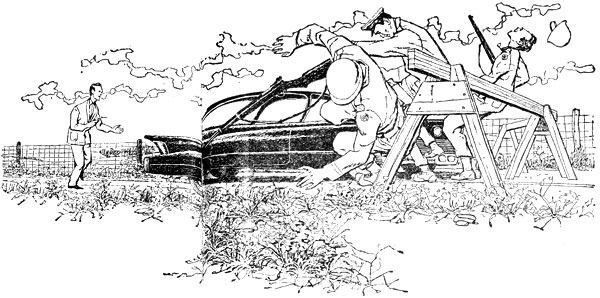
"With your hands up!" the captain snapped. Malone dropped the .44 unobtrusively into his jacket pocket and complied. Then, as he came out of the car, he teleported himself back to a section of the road he'd memorized, ten feet behind the car. The four men were gaping, dumbfounded, as Malone drew his gun and shot them. Then he removed the sawhorses, got back in his car, reloaded the .44, put it back in his holster and drove on.
"Now," he said in a thoughtful tone. "Where was I?"
He imagined Luba's voice saying: You were telling us how, all this time, it's hardly surprising—
"Oh, yes," he said. "Well, then. So you solved some of the problems, you'd set. You learned how to use and control telepathy and teleportation, maybe, long before scientific boys like Dr. O'Connor became interested. But you never announced it publicly. You kept the knowledge all to yourself. 'Is this what the common folk call telepathy, Lord Bromley?' 'Yes, Lady Bromley.' 'Much too good for them, isn't it?' And maybe it is, at that; I don't know."
His thoughts, he recognized, were veering slightly. After a second he got back on the track.
"At any rate," he went on, "you—all of your out there—are responsible for what's happening to this country and all of Europe and Asia—and, for all I know, the suburbs of Hell.
"I remember one of the book facsimiles you got me, for instance," he said. "The writer tried for an 'expose' of the Society, in which he attempted to prove that Sir Lewis Carter and certain other members were trying to take over the world and run it to suit themselves, using their psionic powers to institute a rather horrible type of dictatorship over the world.
"It was a pretty convincing book in a lot of ways. The author evidently know a lot about what he was dealing with."
At this point, Malone ran into another roadblock. There had been a fight of some kind up ahead, and a lot of cars with what looked like shell-holes in them were piled on one side of the road. The State Police were working under the confused direction of an Army major to straighten things out, while a bulldozer pushed the cars off the road onto the grass bordering it. The major stopped what he was doing and came to meet Malone as the car stopped.
"Get off the road," the major said surlily.
Malone looked up at him. "I've got some identification here," he said. "Mind if I get it out?"
The major reached for a gun and held it. "Go ahead," he said. "Don't try anything funny. It's been hell up and down this road, mister."
Malone flipped out his wallet and showed the identification.
"FBI?" the Major said. "What're you doing out here?"
"Special assignment," Malone said. "Oh ... by the way ... you might send some men back a ways. There are four dead mean in military uniforms lying on the road near a couple of sawhorses."
The major stared. "Dead?" he said at last. "Dead how?"
"I shot them," Malone said.
"You—" The major's finger tightened on the trigger of his gun.
"Now wait a minute," Malone said. "I said they were in military uniforms. I didn't say they were soldiers."
"But—"
"Three enlisted men carrying M-1 rifles?" Malone said. "When the M-1's out of date? And a captain with his bars on sideways? No, major. Those were renegades. Looters of some kind; they wanted to kill me and get the car and any valuables I happened to have."
The major, very slowly, relaxed his grip on the gun and his arm fell to his side. "You did the smart thing, Mr. Malone," he said.
"And I've got to go on doing it," Malone said. "I'm in a hurry."
He noticed a newspaper fluttering at the side of the road, not too near the cars. Somehow it made everything seem even more lonely and strange. The headlines fluttered into sight:
MARTIAL LAW EDICT
"MUST BE OBEYED," SAYS GOVERNOR
But Riots Are Feared In Outlying Towns
MAN AND WIFE CONFESS KILLING OF RELATIVES ABOARD PRIVATE PLANE:
Force Kin To Drop Off
There was a photo of a woman there, too, and Malone could read just a little of the caption:
"Obeying the edict of martial law laid down by the President, Miss Helen A.—"
He wondered vaguely if her last name were Handbasket.
The major was looking at him. "O.K., then," he said.
"I can go on?" Malone said.
The major looked stern. "Drive on," he said.
Malone got the car going; the roadblock was lifted for him and he went on by.
After a moment, he said: "Pardon the interruption. I trust that all the devoted listeners to Uncle Kenneth's Happy Hour are still tuned in."
Go ahead, said Lou's voice.
"All right, let's take a look at what you've been doing. You've caused people to change their minds about what they've been intending to do. You can cause all sorts of hell to break loose that way. You have a lot of people you want to get rid of, so you play on their neuroses and concoct errors for them to fight. You rig things so that they quit, or get fired, or lose elections, or get arrested, or just generally get put out of circulation. Some of the less stable ones just up and did away with themselves.
"Sometimes, it's individuals who have to go. Sometimes, it's whole groups or maybe even whole nations. And sometimes it's in between, and you manage to foul up organizational moves with misplaced papers, mis-sent messages, errors, changed minds, and everything else you can think of.
"You know," he went on, "at first I couldn't see any pattern in what was going on—though I remember telling myself that there was a kind of justice in the way this thing was just as hard on gangsters as it was on businessmen and Congressmen.
"The Congressman from Gahoochie County, Arkansas, gets himself in a jam over fraudulent election returns on the same day that the accountant for the Truckers Union sends Mike Sands' books to the Attorney General. Simple justice, I call it.
"And, you know, seen from that viewpoint, this whole caper might come out looking pretty good. If most of the characters you've taken care of are just the boys who needed taking care of, I'd say more power to you—except for one thing. It's all right to get rid of all the fools, idiots, maniacs, blockheads, morons, psychopaths, paranoids, timidity-ridden, fear-worshipers, fanatics, thieves, and the rest of the general, all-round, no-good characters; I'm all for it. But not this way. Oh, no.
"You've pressed the panic button, that's what you've done.
"You've done more damage in two weeks than all those fumblebrains have been able to do in several myriads of lifetimes. You've loused up the economy of this nation and every other civilized nation. You've caused riots in which innocent people have died; you've caused thousands more to lose their businesses and their savings. And only God Himself knows how many more are going to die of starvation and murder before this thing is over.
"And you can't tell me that all of those people deserve to die."
He slowed down as he came to a small town, and for the first time in many miles he focused on the road ahead with his full mind. The town, he saw, looked like a shambles. There were four cars tastefully arranged on the lawn of what appeared to be the local library. Across the street, a large drugstore was in flames, and surprised people were hurrying to put it out. There didn't seem to be any State Police or Army men around, but they'd passed through; Malone saw a forgotten overseas cap lying on the road ahead.
With a shock, he realized that he was now in Pennsylvania, close to where he wanted to go. A signboard told him the town he was looking at was Milford. It was a mess, and Malone hoped fervently that it was a mess that could eventually be cleaned up.
The town was a small one, and Malone was glad to get out of it so quickly.
"That's the kind of thing I mean," he said aloud. Then he paused. "Are you there, anybody?"
He imagined he heard Luba's voice saying: Yes, Ken. Yes, I'm here. Listening to you.
Imagination was fine but, of course, there was no way for them to get through to him. They were telepathic, but Kenneth J. Malone, he told himself sadly, was not.
"Hello, out there," he went on. "I hope you've been listening so far, because there isn't too much more for me to say.
"Just this: you've wrecked my country, and you've wrecked almost all of the rest of civilization. You've brought my world down around my ears.
"I have every logical reason to hate your guts. By all the evidence I have, you are a group of the worst blackguards who ever existed; by all the evidence, I should be doing everything in my power to exterminate you.
"But I'm not.
"My prescience tells me that what you've been doing is right and necessary. I'm damned if I can see it, but there it is. I just hope you can explain it to me."
XV
Soon, he was in the midst of the countryside. It was, of course, filled with country. It spread around him in the shape of hills, birds, trees, flowers, grass, billboards and other distractions to the passing motorist.
It took Malone better than two hours more to find the place he was looking for. Long before he found it, he had come to the conclusion that finding country estates in Pennsylvania was only a shade easier than finding private homes in the Borough of Brooklyn. In both cases, he had found himself saddled with the same frantic search down what seemed likely routes which turned out to lead nowhere. He had found, in both cases, complete ignorance of the place on the part of local citizens, and even strong doubts that the place could possibly have any sort of existence.
The fact that is was growing dark didn't help much, either.
But he found it at last. Rounding a curve in a narrow, blacktop road, he saw the home behind a grove of trees.
He recognized it instantly.
He had seen it so often that he felt as if he knew it intimately.
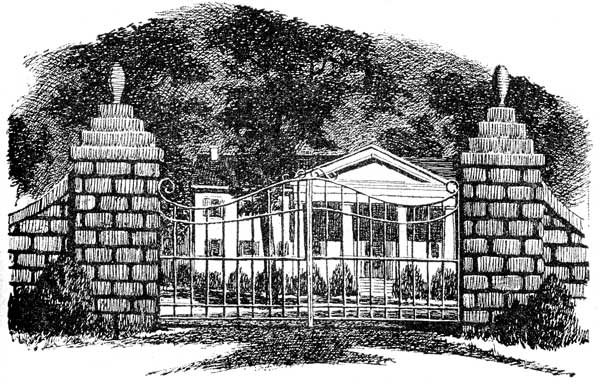
It was a big, rambling, Colonial-type mansion, painted a blinding and beautiful white, with a broad, pillared porch and a great carved front door. The front windows were curtained in rich purples, and before the house was a great front garden, and tall old trees. Malone half-expected Scarlett O'Hara to come tripping out of the house at any minute shouting: "Rhett! The children's mush is on fire!" or something equally inappropriate.
Inside it, however, if Malone were right, was not the magnetic Scarlett. Inside the house were some of the most important members of the PRS—and one person who was not a member.
But it was impossible to tell from the outside. Nothing moved on the well-kept grounds, and the windows didn't show so much as the flutter of a purple curtain. There was no sound. No cars were parked around the house—nor, Malone realized, thinking of "Gone With the Wind," were there any horses or carriages.
The place looked deserted.
Malone thought he knew better, but it took a few minutes for him to get up enough courage to go up the long driveway. He stared at the house. It was an old one, he knew, built long before the Civil War and originally commanding a huge tract of land. Now, all that remained of the vast acreage was the small portion that surrounded the house.
But the original family still inhabited it, proud of the house and of their part in its past. Over the years, Malone knew, they had kept it up scrupulously, and the place had been both restored and modernized on the inside without harming the classic outlines of the hundred-and-fifty-year-old structure.
A fence surrounded the estate, but the front gate was swinging open. Malone saw it and took a deep breath. Now, he told himself, or never. He drove the Lincoln through the opening slowly, alert for almost anything.
There was no disturbance. Thirty yards from the front door he pulled the car to a cautious stop and got out. He started to walk toward the building. Each step seemed to take whole minutes, and everything he had thought raced through his mind again. Nothing seemed to move anywhere, except Malone himself.
Was he right? Were the people he'd been beaming to really here? Or had he been led astray by them? Had he been manipulated, in spite of his shield, as easily as they had manipulated so many others?
That was possible. But it wasn't the only possibility.
Suppose, he thought, that he was perfectly right, and that the group was waiting inside. And suppose, too, that he'd misunderstood their motives.
Suppose they were just waiting for him to get a little closer.
Malone kept walking. In just a few steps, he could be close enough so that a bullet aimed at him from the house hadn't a real chance of missing him.
And it didn't have to be bullets, either. They might have set a trap, he thought, and were waiting for him to walk into it. Then they would hold him prisoner while they devised ways to....
To what?
He didn't know. And that was even worse; it called up horrible terrors from the darkest depths of Malone's mind. He continued to walk forward.
Finally he reached the steps that led up to the porch, and took them one at a time.
He stood on the porch. A long second passed.
He took a step toward the high, wide and handsome oaken door. Then he took another step, and another.
What was waiting for him inside?
He took a deep breath, and pressed the doorbell button.
The door swung open immediately, and Malone involuntarily stepped back.
The owner of the house smiled at him from the doorway. Malone let out his breath in one long sigh of relief.
"I was hoping it would be you," he said weakly. "May I come in?"
"Why, certainly, Malone. Come on in. We've been expecting you, you know," said Andrew J. Burris, Director of the FBI.
XVI
Malone sat, quietly relaxed and almost completely at ease, in the depths of a huge, comfortable, old-fashioned Morris chair. Three similar chairs were clustered around a squat, massive coffee table, made of a single slab of dark wood set on short, curved legs. Malone looked around at the other three with a relaxed feeling of recognition: Andrew J. Burris, Sir Lewis Carter and Luba Ardanko.
Sir Lewis softly exhaled a cloud of smoke as he removed the briar from his mouth. "Malone," he asked gently, "how did you know we would be here?"
"Well," Malone said, "I just ... I mean, it was obvious as soon as I—" He stopped, frowning. "I had one thing to go on, anyway," he said. "I figured out the PRS was responsible for all the troubles because it was so efficient. And then, while I was sitting and staring at the file reports, it suddenly came to me: the FBI was just as efficient. So it was obvious."
"What was?" Burris said.
Malone shrugged. "I thought you'd been keeping me on vacation because your mind was being changed," he said. "Now I can see you were doing it of your own free will."
"Yes," Sir Lewis said. "But how did you know you'd find us here, Malone?"
There was a shadow in the room, but not a visible one. Malone felt the chill of sudden danger. Whatever was going to happen, he realized, he would not be around for the finish. He, Kenneth Joseph Malone, the cuddly, semi-intrepid FBI Agent he had always known and loved, would never get out of this deadly situation. If he lived, he would be so changed that—
He didn't even want to think about it.
"What sort of logic," Sir Lewis was saying, "led you to the belief that we would all be here, in Andrew's house?"
Malone forced his mind to consider the question. "Well," he began, "it isn't exactly logic, I guess."
Luba smiled at him. He felt a little reassured, but not much. "You should have phrased that differently," she said. "It's: 'It isn't exactly logic. I guess.'"
"Not guess," Sir Lewis said. "You know. Prescience, Malone. Your precognitive faculty."
"All right," Malone said. "All right. So what?"
"Take it easy," Burris put in. "Relax, Malone. Everything's going to be all right."
Sir Lewis waved a hand negligently. "Let's continue," he said. "Tell me, Malone: if you were a mathematics professor, teaching a course in calculus, how would you grade a paper that had all the answers but didn't show the work?"
"I never took calculus," Malone said. "But I imagine I'd flunk him."
"Why?" Sir Lewis said.
"Because if he can't back up his answer," Malone said slowly, "then it's no better than a layman's guess. He has to give reasons for his answers; otherwise nobody else can understand him."
"Fine," Sir Lewis said. "Perfectly fine. Now—" he puffed at his pipe—"can you give me a logical reason for arriving at the decision you made a few hours ago?"
The danger was coming closer, Malone realized. He didn't know what it was or how to guard himself against it. All he could do was answer, and play for time.
"While I was driving up here," he said, "I sent you a message. I told you what I knew and what I believed about the whole world picture as it stands now. I don't know if you received it, but I—"
Luba spoke without the trace of a smile. "You mean you didn't know?" she said. "You didn't know I was answering you?"
That was the first pebble of the avalanche, Malone knew suddenly—the avalanche that was somehow going to destroy him. "You forced your thoughts into my mind, then," he said as coolly as he could. "Just as you forced decision on the rest of society."
"Now, dammit, Malone!" Burris said suddenly. "You know those bursts take a lot of energy, and only last for a fraction of a second!"
Malone blinked. "Then you ... didn't—"
Of course I didn't force anything on you, Kenneth. I can't. Not all the power of the entire PRS could force anything through your shield. But you opened it to me.
It was Luba's mental "voice." Malone opened his mouth, shut it and then, belatedly, snapped shut the channel through which he'd contacted her. Luba gave him a wry look, but said nothing. "You mean I'm a telepath?" Malone asked weakly.
"Certainly," Sir Lewis snapped. "At the moment, you can only pick up Luba—but you are certainly capable of picking up anyone, eventually. Just as you learned to teleport, you can learn to be a telepath. You—"
The room was whirling, but Malone tried to keep his mind steady. "Wait a minute," he said. "If you received what I sent, then you know I've got a question to ask."
There was a little silence.
Finally Sir Lewis looked up. "You want to know why you felt we—the PRS—were innocent of the crimes you want to charge us with. Very well." He paused. "We have wrecked civilization: granted. We could have done it more smoothly: granted."
"Then—"
Sir Lewis' face was serious and steady. Malone tensed.
"Malone," Sir Lewis said, "do you think you're the only one with a mental shield?"
Malone shook his head. "I guess stress—fixity of mind or purpose—could develop it in anyone," he said. "At least, in some people."
"Very well," Sir Lewis said. "Now, among the various people of the world who have, through one necessity or another, managed to develop such shields—"
Burris broke in impatiently. His words rang, and then echoed in the old house.
"Some fool," he said flatly, "was going to start the Last War."
"So you had to stop it," Malone said after a long second. "But I still don't see—"
"Of course you don't," Sir Lewis said. "But you've got to understand why you don't see it first."
"Because I'm stupid," Malone said.
Luba was shaking her head. Malone turned to face her. "Not stupid," she said. "But some people, Kenneth, have certain talents. Others have—other talents. There's no way of equating these talents; all are useful, each performs a different function."
"And my talent," Malone said, "is stupidity. But—"
She lit a cigarette daintily. "Not at all," she said. "You've done a really tremendous job, Kenneth. I was trained ever since I was a baby to use my psionic abilities—the PRS has known how to train children in that line ever since 1970. Only Mike Fueyo developed a system for instruction independently; the boy was, and is, a genius, as you've noticed."
"Agreed," Malone said. "But—"
"You, however," Luba said, "have the distinction of being the first human being who has, as an adult, achieved his full powers without childhood training. In addition, you're the only human being who has ever developed to the extent you have—in precognition, too."
She puffed on the cigarette. Malone waited.
"But what you don't have," she said at last, very carefully, "is the ability to reason out the steps you've taken, after you've reached the proper conclusion."
"Like the calculus student," Malone said. "I flunk." Something inside him grated over the marrow in his bones. It was as though someone had decided that the best cure for worry was coarse emery in the joints, and he, Kenneth J. Malone, had been picked for the first experiment.
"You're not flunking," Luba said. "You're a very long way from flunking, Kenneth."
Burris cleared his throat suddenly. Malone turned to him. The Head of the FBI stuck an unlighted cigar into his mouth, chewed it a little, and then said: "Malone, we've been keeping tabs on you. Your shield was unbreakable—but we have been able to reach the minds of people you've talked to: Mike Sands, Primo Palveri, and so on. And Her Majesty, of course: you opened up a gap in your shield to talk to her, and you haven't closed it down. Until you started broadcasting here on the way up, naturally."
"All right," Malone said, waiting with as much patience as possible for the point.
"I tried to take you off the case," Burris went on, "because Sir Lewis and the others felt you were getting too close to the truth. Which you were, Malone, which you were." He lit his cigar and looked obscurely pleased. "But they didn't know how you'd take it," he said. "They ... we ... felt that a man who hadn't been trained since childhood to accept the extrasensory abilities of the human mind couldn't possibly learn to accept the reality of the job the PRS has to do."
"I still don't," Malone said. "I'm stupid. I flunk. Remember?"
"Now, now," Burris said helplessly. "Not at all, Malone. But we were worried. I lied to you about those three spies—I put the drug in the water-cooler. I tried to keep you from learning the Fueyo method of teleportation. I didn't want you to learn that you were telepathic."
"But I did," Malone said, "And what does that make me?"
"That," Sir Lewis cut in, "is what we're attempting to find out."
Malone felt suitably crushed, but he wasn't sure by what. "I've got some questions," he said after a second. "I want to know three things."
"Go ahead," Sir Lewis said.
"One:" Malone said, "How come Her Majesty and the other nutty telepaths didn't spot you? Two: How come you sent me out on these jobs when you were afraid I was dangerous? And three: What was it that was so safe about busting up civilization? How did that save us from the Last War?"
Sir Lewis nodded. "First," he said, "we've developed a technique of throwing up a shield and screening it with a surface of innocuous thoughts—like hiding behind a movie screen. Second ... well, we had to get the jobs done, Malone. And Andrew thought you were the most capable, dangerous or not. For one thing, we wanted to get all the insane telepaths in one place; it's difficult to work when the atmosphere's full of such telepathic ravings."
"But wrecking the world because of a man with a mind-shield—why not just work things so his underlings wouldn't obey him?" Malone shook his head. "That sounds more reasonable."
"It may," Sir Lewis said. "But it wouldn't work. As a matter of fact, it was tried, and it didn't work. You see, the Sino-Soviet top men were smart enough to see that their underlings were being tampered with. And they've developed a system, partly depending on automatic firing systems, partly on individuals with mind-blocks—that is, people who aren't being tampered with—which we can't disrupt directly. So we had to smash them."
"And the United States at the same time," Burris said. "The economic balance had to be kept; a strong America would be forced in to fill the power vacuum otherwise, and that would make for an even worse catastrophe. And if we weren't in trouble, the Sino-Soviet Bloc would blame their mess on us. And that would start the Last War before collapse could get started. Right, Malone?"
"I see," Malone said, thinking that he almost did. He told himself he could feel happy now; the danger—which hadn't been danger to him, really, but danger from him toward the PRS, toward civilization—was over. But he didn't feel happy. He didn't feel anything.
"There's a crisis building in New York," Sir Lewis said suddenly, "that's going to take all our attention. Malone, why don't you ... well, go home and get some rest? We're going to be busy for a while, and you'll want to be fresh for the work coming up."
"Sure," Malone said listlessly. "Sure."
As the others rose, he closed his eyes and took a deep breath. Then he vanished.
XVII
Two hours passed, somehow. Bourbon and soda helped them pass, Malone discovered; he drank two high-balls slowly, trying not to think about anything. He felt terrible. After a while he made himself a third high-ball and started on it. Maybe this would make him feel better. Maybe he thought, he ought to break out his cigars and celebrate.
But there didn't seem to be very much to celebrate somehow. He felt like an amoeba on a slide being congratulated on having successfully conquered the world.
He drank some more bourbon-and-soda. Amoebae, he told himself, didn't drink bourbon-and-soda. He was better off than an amoeba. He was happier than an amoeba. But somehow he couldn't imagine any amoeba in the world, no matter how heart-broken, feeling any worse than Kenneth J. Malone.
He looked up. There was another amoeba in the room.
Then he frowned. She wasn't an amoeba, he thought. She was the scientist the amoeba was supposed to fall in love with, so the scientist could report on everything he did, so all the other scien—psiontists could know all about him. But whoever heard of a scien—psiontist—falling in love with an amoeba? Nobody. It was fate. And fate was awful. Malone had often suspected it, but now he was sure. Now he was looking at things from the amoeba's side, and fate was terrible.
"No, Ken," the psiontist said. "It needn't be at all like that."
"Oh, yes, it need," Malone said positively. "It need be even worse. When I have some more to drink, it'll be even worse. Wait and see."
"Ken," Luba said softly, "you don't have to suffer this way."
"No," Malone said agreeably, "I don't. You could shoot me and then I'd be dead. Just quit all this amoebing around, O.K.?"
"You're already half shot," Luba said sharply. "Now be quiet and listen. You're angry because you've fallen in love with me and you're all choked up over the futility of it all."
"Exactly," Malone said. "Ex-positively-actly. You're a psionic super-man—woman. You can figure things out in your own little head instead of just getting along on dum psionic luck like us amoebae. You're too far above me."
"Ken, listen!" Luba snapped. "Look into my mind. You can link up with me: go ahead and do it. You can read me clear down to the subconscious if you want to."
Malone blinked.
"Now, Ken!" Luba said.
Malone looked. For a long time.
Half an hour later, Kenneth J. Malone, alone in his room, was humming happily to himself as he brushed a few specks of dust from the top of his best royal blue bowler. He faced the mirror on the wall, puffed on the cigar clenched between his teeth, and adjusted the bowler to just the right angle.
There was a knock on the door. He went and opened it, carefully disposing of the cigar first. "Oh," he said. "What are you doing here?"
"Just saying hello," Thomas Boyd grinned. "Back at work?"
Boyd didn't know, of course, what had happened. Nor need he ever know. "Just about," Malone said. "Spending the evening relaxing, though."
"Hm-m-m," Boyd said. "Let me guess. Her name begins with L?"
"It does not," Malone said flatly.
"But—" Boyd began.
Malone cast about in his mind for an explanation. Telling Boyd the truth—that Luba and Kenneth J. Malone just weren't equals as far as social intercourse went—would leave him exactly nowhere. But, somehow, it had to be said. "Tom," he said, "suppose you met a beautiful girl—charming, wonderful, brilliant."
"Great," Boyd said. "I like it already."
"Suppose she looked about ... oh ... twenty-three," Malone went on.
"Do any more supposing," Boyd said, "and I'll be pawing the ground."
"And then," Malone said, very carefully, "suppose you found out, after you'd been out with her ... well, when you took her out, say, you met your grandmother."
"My grandmother," Boyd said virtuously, "doesn't go to joints like that."
"Use your imagination," Malone snapped. "And suppose your grandmother recognized the girl as an old schoolmate of hers."
Boyd swallowed hard. "As a what?"
"An old schoolmate," Malone said. "Suppose this girl were so charming and everything just because she'd had ... oh, ninety years or so to practice in."
"Malone," Boyd said in a depressed tone, "you can spoil more ideas—"
"Well," Malone said, "would you go out with her again?"
"You kidding?" Boyd said. "Of course not."
"But she's the same girl," Malone said. "You've just found out something new about her, that's all."
Boyd nodded. "So," he said, "you found out something new about Luba. Like, maybe, she's ninety years old?"
"No," Malone said. "Nothing like that. Just—something." He remembered Queen Elizabeth's theory of politeness toward superiors: people, she'd said, act as if they believed their bosses were superior to them, but they didn't believe it.
On the other hand, he thought, when a man knows and believes that someone actually is superior—then, he doesn't mind at all. He can depend on that superiority to help him. And love, ordinary man-and-woman love, just can't exist.
Nor, Malone told himself, would anyone want it to. It would, after all, be damned uncomfortable.
"So who's the girl?" Boyd said. "And where? The clubs are all closed, and the streets probably aren't very safe just now."
"Barbara Wilson," Malone said, "and Yucca Flats. I ought to be able to get a fast plane." He shrugged. "Or maybe teleport," he added.
"Sure," Boyd said. "But on a night with so many troubles—"
"Oh, King Henry," Malone said, "hearken. A man who looks as historical as you do ought to know a little history."
"Such as?" Boyd said, bristling slightly.
"There have always been troubles," Malone said. "In the Eighth Century, it was Saracens; in the Fourteenth, the Black Death. Then there was the Reformation, and the Prussians in 1870, and the Spanish in 1898, and—"
"And?" Boyd said.
Malone took a deep breath. He could almost feel the court dress flowing over him, as the court manners did. Lady Barbara, after all, attendant to Her Majesty, would expect a certain character from him.
After a second, he had it.
"In 1914, it was enemy aliens," said Sir Kenneth Malone.