ITALY (continued 5)
Reading edition
There is, mean time, resident in the neighbourhood an English gentleman, his name Greenfield, who has formed to himself a mighty sweet habitation in the English taste, but not extensive, as his property don't reach far: he is however a sort of little oracle in the country I am told; gives money, and dispenses James's powders to the poor, is happy in the esteem of numberless people of fashion, and the comfort of his country people's lives beside; who, travelling to Sienna, as many do for the advantage of studying Italian to perfection, find a friend and companion where perhaps it is least expected.
The cathedral here at Sienna deserves a volume, and I shall scarcely give it a page. The pavement of it is the just pride of Italy, and may challenge the world to produce its equal. St. Mark's at Venice floored with precious stones dies away upon the comparison; this being all inlaid with dove-coloured and white marbles representing historical subjects not ill told. Were this operation performed in mosaic work, others of rival excellence might be found. The pavement of Sienna's dome is so disposed by an effort of art one never saw but here, that it produces an effect most resembling that of a very fine and beautiful damask table-cloth, where the large patterns are correctly drawn.
Rome however is to be our next stage, and many of our English gentlemen now here, are with ourselves impatiently waiting for the numberless pleasures it is expected to afford us. I will here close this chapter upon our various desires; one wishing to see St. Peters; one setting his heart upon entering the Capitol: to-morrow's sun will light us all upon our search.
ROME.
The first sleeping place between Sienna and this capital shall not escape mentioning; its name is Radicosani, its title an inn, and its situation the summit of an exhausted volcano. Such a place did I never see. The violence of the mountain, when living, has split it in a variety of places, and driven it to a breadth of base beyond credibility, its height being no longer formidable. Whichever way you turn your eyes, nothing but portions of this black rock appear therefore; so here is extent without sublimity, and here is terror mingled with disgust. The inside of the house is worthy of the prospect seen from its windows; wild, spacious, and scantily provided. Never had place so much the appearance of a haunted hall, where Sir Rowland or Sir Bertrand might feel proud of their courage when
The knight advancing strikes the fatal door, And hollow chambers send a sullen roar. Merry
To this truly dismal reposing place is however kindly added a little chapel; and few persons can imagine what a comfortable feel it gave me on entering it in the morning after hearing the winds howl all night in the black mountain. Here too we first made acquaintance with Signor Giovanni Ricci, a mighty agreeable gentleman, who was kindly assistant to us in a hundred little difficulties, afterwards occasioned by horses, postillions, &c. which at last brought us through a bad country enough to Viterbo, where we slept.
The melancholy appearance of the Campagna has been remarked and described by every traveller with displeasure, by all with truth. The ill look of the very few and very unhealthy inhabitants confirms their descriptions; and beside the pale and swelled faces which shock one's sight, here is a brassy scent in the air as of verdigris, which offends one's smell; the running water is of an odd colour too, like that in which copper has been steeped. These are sad desolated scenes indeed, though this is not the season for mal' aria neither, which, it is said, begins in May, and ends with September. The present sovereign is mending matters as fast as he can, we hear; and the road now cutting, will greatly facilitate access to his capital, but cannot be done without a prodigious expence. The first view of Rome is wonderfully striking.
Ye awful wrecks of ancient times! Proud monuments of ages past Now mould'ring in decay. Merry.
But mingled with every crowding, every classical idea, comes to one's recollection an old picture painted by R. Wilson about thirty years ago, which I am now sure must have been a very excellent representation.
Well, then! here we are, admirably lodged at Strofani's in the Piazza di Spagna, and have only to chuse what we will see and talk on first among this galaxy of rarities which dazzles, diverts, confounds, and nearly fatigues one. I will speak of the oldest things first, as I was earnest to see something of Rome in its very early days, if possible; for example the Sublician Bridge, defended by Cocles when the infant republic, like their favourite Hercules in his cradle, strangled the serpent despotism: and of this bridge some portion may yet be seen when the water is very low.
The prison is more ancient still however; it was built by the kings; and by the solidity of its walls, and depth of its dungeon, seems built for eternity. Was it not this place to which Juvenal alludes, when he says,
Felicia dicas Tempora quæ quondam sub regibus atque tribunis Viderunt uno contentam carcere Romam.
And it is in this horrible spot they shew you the miraculous mark of St. Peter's head struck against the wall in going down, with the fountain which burst out of the ground for his refreshment. Antiquaries, however, assure us, that he could not have ever been confined there, as it was a place for state prisoners only, and those of the highest rank: they likewise tell us that Jugurtha passed seven months there, which is as difficult to believe as any miracle ever wrought; for the world was at least somewhat civilized in those days, and how it should be contented with looking quietly on whilst a Prince of Jugurtha's consequence should be so kept, appears incredible at the distance of 1900 years. That Christians should be treated still worse, if worse could be found for them, is less strange, when every step one treads is upon the bones of martyrs; and who dares say that the surrounding campagna, so often drenched in innocent blood, may not have been cursed with pestilence and sterility to all succeeding ages? I have examined the place where Sylla massacred 8000 fellow-citizens at once, and find that it produces no herb but thistles, a weed almost unknown in any other part of Italy; and one of the first punishments bestowed on sinful man.
Marcellus's Theatre, an old fountain erected by Camillus when Dictator, and the Tarpeian rock, attract attention powerfully: the last particularly,
Where brave Manlius stood, And hurl'd indignant decads down, And redden'd Tyber's flood. Greatheed.
People have never done contradicting Burnet, who says, in his travels, that a man might jump down it now and not do himself much harm: the truth is, its present appearance is not formidable; but I believe it is not less than forty feet high at this moment, though the ground is greatly raised.
Of all things at Rome the Cloaca is acknowledged most ancient; a very great and a very useful work it is, of Ancus Martius, fourth king of Rome. The just and zealous detestation of Christians towards Pontius Pilate, is here comically expressed by their placing his palace just at its exit into the Tyber; and one who pretended to doubt of its being his residence, would be thought the worse of among them.
I recollect nothing else built before the days of the Emperors, who, for the most part, were such disgracers of human nature and human reason, that one would almost wish their names expunged, and all their deeds obliterated from the face of the globe, which could ever tamely submit to such truly wretched rulers.
The Capitol, built by Tarquin, stood till the days of Marius and Sylla it seems; that last-named Dictator erected a new one, which was overthrown in the contests about Vitellius; Vespasian set it up again, but his performance was burned soon after its author's death; and this we contemplate now, is one of the works of Domitian, and celebrated by Martial of course. Adrian however added one room to it, dedicated to Egyptian deities alone: as a matter of mere taste I fancy, like our introducing Chinese temples into the garden; but many hold that it was very serious and superstitious regard, inspired by the victory Canopus won over the Persian divinity of fire, by the subtlety of the Egyptian priests, who, to defend their idol from that all-subduing element, wisely set upon his head a vessel filled with water, and having previously made the figure of Terra Cotta hollow, and full of water, with holes bored at the bottom stopped only by wax to keep it in, a seeming miracle extinguished the flames, as soon as approached by Canopus; whose triumph was of course proclaimed, and he respected accordingly. The figure was a monkey, whose sitting attitude favoured the imposture: our antiquaries tell us the story after Suidas.
As cruelty is more detestable than fraud, one feels greater disgust at the sight of captive monarchs without hands and arms, than even these idolatrous brutalities inspire; and no greater proof can be obtained of Roman barbarity, than the statues one is shewn here of kings and generals over whom they triumphed; being made on purpose for them without hands and arms, of which they were deprived immediately on their arrival at Rome.
Enormous heads and feet, to which the other parts are wanting, let one see, or at least guess; what colossal figures were once belonging to them; yet somehow these celebrated artists seem to me to have a little confounded the ideas of big and great like my countryman Fluellyn in Shakespear's play: while the two famous demi-gods Castor and Pollux, each his horse in his hand, stand one on each side the stairs which lead to the Capitol, and are of a prodigious size—fifteen feet, as I remember. The knowing people tell us they are portraits, and bid us observe that one has pupils to his eyes, the other not; but our laquais de place, who was a very sensible fellow too, as he saw me stand looking at them, cried out, "Why now to be sure here are a vast many miracles in this holy city—that there are:" and I heard one of our own folks telling an Englishman the other day, how these two monstrous statues, horses and all I believe, came out of an egg: a very extraordinary thing certainly; but it is our business to believe, not to enquire. He saw my countenance express something he did not like, and continued, "Eh basta! sarà stato un uovo strepitoso, è cosi sinisce l'istoria[AE]."
In this repository of wonders, this glorious campidoglio, one is first shewn as the most valuable curiosity, the two pigeons mentioned by Pliny in old mosaic; and of prodigious nicety is the workmanship, though done at such a distant period: and here is the very wolf which bears the very mark of the lightning mentioned by Cicero:—and here is the beautiful Antinous again; he meets one at every turn, I think, and always hangs his head as if ashamed: here too is the dying gladiator; wonderfully fine! savage valour! mean extraction! horrible anguish! all marking, all strongly characteristical expressions—all there; yet all swallowed up, in that which does inevitably and certainly swallow up all things—approaching death.
The collection of pictures here would put any thing but these statues out of one's head: Guido's Fortune flying over the globe, scattering her gifts; of which she gave him one, the most precious, the most desirable. How elegantly gay and airy is this picture! But St. Sebastian stands opposite, to shew that he could likewise excel in the pathetic. Titian's famous Magdalen, of which the King of France boasts one copy, a noble family at Venice another, is protested by the Roman connoisseurs to reside here only; but why should not the artist be fond of repeating so fine an idea? Guercino's Sybil however, intelligently pensive, and sweetly sensible, is the single figure I should prefer to them all.
Before we quit the Capitol, it is pity not to name Marforio; broken, old, and now almost forgotten: though once companion, or rather respondent to Pasquin, and once, a thousand years before those days, a statue of the river Nar, as his recumbent posture testifies; not Mars in the forum, as has been by some supposed. The late Pope moved him from the street, and shut him up with his betters in the Capitol.
Of Trajan and Antonine's Pillars what can one say? That St. Peter and St. Paul stand on the tops of each, setting forth that uncertainty of human affairs which they preached in their life-time, and shewing that they, who were once the objects of contempt and abhorrence, are now become literally the head stones of the corner; being but too profoundly venerated in that very city, which once cruelly persecuted, and unjustly put them to death. Let us then who look on them recollect their advice, and set our affections on a place of greater stability. The columns are of very unequal excellence, that of Trajan's confessedly the best; one grieves to think he never saw it himself, as few princes were less puffed up by well-deserved praise than he; but dying at Seleucia of a dysenteric fever, his ashes were brought home, and kept on the top of his own pillar in a gilt vase; which Sextus Quintus with more zeal than taste took down, I fear destroyed, and placed St. Peter there. Apollodorus was the architect of the elegant structure, on which, says Ammianus Marcellinus, the Gods themselves gazed with wonder, seeing that nothing but heaven itself was finer. "Singularem sub omni cælo structuram etiam numinum ascensione mirabilem."
I know not whether this is the proper place to mention that the good Pope Gregory, who added to the possession of every cardinal virtue the exertion of every Christian one, having looked one day with peculiar stedfastness at this column, and being naturally led to reflect on his character to whose honour it was erected, felt just admiration of a mind so noble; and retiring to his devotions in a church not far off, began praying earnestly for Trajan's soul: till a preternatural voice, accompanied with rays of light round the altar he knelt at, commanded his forbearance of further solicitation; assuring him that Trajan's soul was secure in the care of his Creator. Strange! that those who record, and give credit to such a story, can yet continue as a duty their intercessions for the dead!
But I have seen the Coliseo, which would swallow that of pretty Verona; it is four times as large I am told, and would hold fourscore thousand spectators. After all the depredations of all the Goths, and afterwards of the Farnese family, the ruin is gloriously beautiful; possibly more beautiful than when it was quite whole; there is enough left now for Truth to repose upon, and a perch for Fancy beside, to fly out from, and fetch in more.
The orders of its architecture are easily discerned, though the height of the upper story is truly tremendous; I climbed it once, not to the top indeed, but till I was afraid to look down from the place I was in, and penetrated many of its recesses. The modern Italians have not lost their taste of a prodigious theatre; were they once more a single nation, they would rebuild this I fancy; for here are all the conveniencies in grande, as they call it, that amaze one even in piccolo at Milan and Turin: Here were supper-rooms, and taverns, and shops, and I believe baths; certainly long galleries big enough to drive a coach round, and places where slaves waited to receive the commands of masters and ladies, who perhaps if they did not wait to please them, would scarcely scruple to detain them in the cage of offenders, and keep them to make sport upon a future day.
The cruelties then exercised on servants at Rome were truly dreadful; and we all remember reading that in Augustus's time, when he did a private friend the honour to dine with him, one of the waiters broke a glass he was about to present full of liquor to the King; at which offence the master being enraged, suddenly caused him to be seized by the rest, and thrown instantly out of the window to feed his lampreys, which lived in a pond on which the apartment looked. Augustus said nothing at the moment; to punish the nobleman's inhumanity however, he sent his officers next morning to break every glass in the house: A curious chastisement enough, and worthy of a nation who, being powerful to erect, populous to fill, and elegantly-skilful to adorn such a fabric as this Coliseum which I have just been contemplating, were yet contented and even happy to view from its well-arranged seats, exhibitions capable of giving nothing but disgust and horror;—lions rending unarmed wretches in pieces; or, to the still deeper disgrace of poor Humanity, those wretches armed unwillingly against each other, and dying to divert a brutal populace.
These reflections upon Pagan days and classical cruelties do not disturb however the peace of an old hermit, who has chosen one of these close-concealed recesses for his habitation, and accordingly dwells, dismally enough, in a hole seldom visited by travellers, and certainly never enquired about by the natives. I stumbled on his strange apartment by mere chance, and asked him why he had chosen it? He had been led in early youth, he said, to reflect upon the miseries suffered by the original professors of Christianity; the tortures inflicted on them in this horrible amphitheatre, and the various vicissitudes of Rome since: that he had dedicated himself to these meditations: that he had left the world seventeen years, never stirring from his cell but to buy food, which he eat alone and sparingly, and to pay his devotions in the Via Crucis, for so the old Arena is now called; a simple plain wooden cross occupying the middle of it, and round the Circus twelve neat, not splendid chapels; a picture to each, representing the various stages of our Saviour's passion. Such are the meek triumphs of our meek religion! And that such substitutes should have replaced the African savages, tigers, hyænas, &c. and Roman gladiators, not less ferocious than their four-legged antagonists, I am quite as willing to rejoice at as the hermit: They must be better antiquarians too than I am, who regret that a nunnery now covers the spot where ambitious Tullia drove over the bleeding body of her murdered parent,
Pressit et inductis membra paterna rotis:
That nunnery, supported by the arch of Nerva, which is all that is now left standing of that Emperor's Forum.
I must not however quit the Coliseum, without repeating what passed between the King of Sweden and his Roman laquais de place when he was here; and the fellow, in the true cant of his Ciceroneship, exclaimed as they looked up, "Ah Maesta! what cursed Goths those were that tore away so many fine things here, and pulled down such magnificent pillars, &c." "Hold, hold friend," replies the King of Sweden; "I am one of those cursed Goths myself you know: but what were your Roman nobles a-doing, I would ask, when they laboured to destroy an edifice like this, and build their palaces with its materials?"
The baths of Livia are still elegantly designed round her small apartments; and one has copies sold of them upon fans; the curiosity of the original is to see how well the gilding stands; in many places it appears just finished. These baths are difficult of access somehow; I never could quite understand how we got in or out of them, but they did belong to the Imperial palace, which covered this whole Palatine hill, and here was Nero's golden house, by what I could gather, but of that I thank Heaven there is no trace left, except some little portion of the wall, which was 120 feet high, and some marbles in shades, like women's worsted work upon canvass, very curious, and very wonderful; as all are natural marbles, and no dye used: the expence must have surpassed credibility.
The Temple of Vesta, supposed to be the very temple to which Horace alludes in his second Ode, is a pretty rotunda, and has twenty pillars fluted of Parian marble: it is now a church, as are most of the heathen temples.
Such adaptations do not please one, but then it must be allowed and recollected that one is very hard to please: finding fault is so easy, and doing right so difficult!
The good Pope Gregory, who feared (by sacred inspiration one would think) all which should come to pass, broke many beautiful antique statues, "lest," said he, "induced by change of dress or name perhaps our Christians may be tempted to adore them:" and we say he was a blockhead, and burned Livy's decads, and so he did; but he refused all titles of earthly dignity; he censured the Oriental Patriarchs for substituting temporal splendours in the place of primitive simplicity; which he said ought alone to distinguish the followers of Jesus Christ. He required a strict attention to morality from all his inferior clergy; observed that those who strove to be first, would end in being last; and took himself the title of servant to the servants of God.
Well! Sabinian, his successor, once his favourite Nuncio, flung his books in the fire as soon as he was dead; so his injunctions were obeyed but while he lived to enforce them; and every day now shews us how necessary they were: when, even in these enlightened times, there stands an old figure that every Abate in the town knows to have been originally made for the fabulous God of Physic, Esculapius, is prayed to by many old women and devotees of all ages indeed, just at the Via Sacra's entrance, and called St. Bartolomeo.
A beautiful Diana too, with her trussed-up robes, the crescent alone wanting, stands on the high altar to receive homage in the character of St. Agnes, in a pretty church dedicated to her fuor delle Porte, where it is supposed she suffered martyrdom; and why? Why for not venerating that very Goddess Diana, and for refusing to walk in her procession at the New Moon, like a good Christian girl. "Such contradictions put one from one's self" as Shakespear says.
We are this moment returned home from Tivoli; have walked round Adrian's Villa, and viewed his Hippodrome, which would yet make an admirable open Manège. I have seen the Cascatelle, so sweetly elegant, so rural, so romantic; and I have looked with due respect on the places once inhabited, and ever justly celebrated by genius, wit, and learning; have shuddered at revisiting the spot I hastened down to examine, while curiosity was yet keen enough to make me venture a very dangerous and scarcely-trodden path to Neptune's Grotto; where, as you descend, the Cicerone shews you a wheel of some coarse carriage visibly stuck fast in the rock till it is become a part of it; distinguished from every other stone only by its shape, its projecting forward, and its shewing the hollow places in its fellies, where nails were originally driven. This truly-curious, though little venerable piece of antiquity, serves to assist the wise men in puzzling out the world's age, by computing how many centuries go to the petrifying a cart wheel. A violent roar of dashing waters at the bottom, and a fall of the river at this place from the height of 150 feet, were however by no means favourable to my arithmetical studies; and I returned perfectly disposed to think the world's age a less profitable, a less diverting contemplation, than its folly.
We looked at the temple of the old goddess that cured coughs, now a Christian church, dedicated to la Madonna della Tosse; it is exactly all it ever was, I believe; and we dined in the temple of Sibylla Tiburtina, a beautiful edifice, of which Mr. Jenkins has sent the model to London in cork, which gives a more exact representation after all than the best-chosen words in the world. I would rather make use of them to praise Mr. Jenkins's general kindness and hospitality to all his country-folks, who find a certain friend in him; and if they please, a very competent instructor.
In order however to understand the meaning of some spherical pots observed in the Circus of Caracalla, I chose above all men to consult Mr. Greatheed, whose correct taste, deep research, and knowledge of architecture, led me to prefer his account to every other, of their use and necessity: it shall be given in his own words, which I am proud of his permission to copy.
"Of those pots you mention, there are not any remaining in the Circus Maxiouis, as the walls, seats and apodium of that have entirely disappeared. They are to be seen in the Circus of Caracalla, on the Appian way; of this, and of this alone, enough still exists to ascertain the form, structure, and parts of a Roman course. It was surrounded by two parallel walls which supported the seats of the spectators. The exterior wall rose to the summit of the gallery; the interior one was much lower, terminated with the lowest rows, and formed the apodium. This rough section may serve to elucidate my description. From wall to wall an arch was turned which formed a quadrant, and on this the seats immediately rested: but as the upper rows were considerably distant from the crown of the arch, it was necessary to fill the intermediate space with materials sufficiently strong to support the upper stone benches and the multitude. Had these been of solid substance, they would have pressed prodigious and disproportionate weight on the summit of the arch, a place least able to endure it from its horizontal position. To remedy this defect, the architect caused spherical pots to be baked; of these each formed of itself an arch sufficiently powerful to sustain its share of the incumbent weight, and the whole was rendered much less ponderous by the innumerable vacuities.
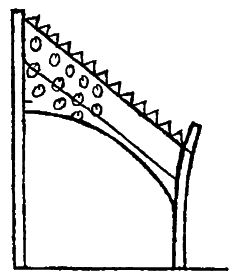
"A similiar expedient was likewise used to diminish the pressure of their domes, by employing the scoriæ of lava brought for that purpose from the Lipari Islands. The numberless bubbles of this volcanic substance give it the appearance of a honeycomb, and answer the same purpose as the pots in Caracalla's Circus, so much so, that though very hard, it is of less specific gravity than wood, and consequently floats in water."
Before I quit the Circus of Caracalla, I must not forbear mentioning his bust, which so perfectly resembles Hogarth's idle 'Prentice; but why should they not be alike?
For black-guards are black-guards in every degree,
I suppose, and the people here who shew one things, always take delight to souce an Englishman's hat upon his head, as if they thought so too.
This morning's ramble let us to see the old grotto, sacred to Numa's famous nymph, Ægeria, not far from Rome even now. I wonder that it should escape being built round when Rome was so extensive as to contain the crowds which we are told were lodged in it. That the city spread chiefly the other way, is scarce an answer. London spreads chiefly the Marybone way perhaps, yet is much nearer to Rumford than it was fifty or sixty years ago.
The same remark may be made of the Temple of Mars without the walls, near the Porta Capena: a rotunda it was on the road side then: it is on the road side now, and a very little way from the gate.
Caius Cestius's sepulchre however, without the walls, on the other side, is one of the most perfect remains of antiquity we have here. Aurelian made use of that as a boundary we know: it stands at present half without and half within the limit that Emperor set to the city; and is a very beautiful pyramid a hundred and ten feet high, admirably represented in Piranesi's prints, with an inscription on the white marble of which it is composed, importing the name and office and condition of its wealthy proprietor: C. Cestius, septem vir epulonum. He must have lived therefore since Julius Caesar's time it is plain, as he first increased the number of epulones to seven, from three their original institution. It was probably a very lucrative office for a man to be Jupiter's caterer; who, as he never troubled himself with looking over the bills, they were such commonly, I doubt not, as made ample profits result to him who went to market; and Caius Cestius was one of the rich contractors of those days, who neglected no opportunity of acquiring wealth for himself, while he consulted the honour of Jupiter in providing for his master's table very plentiful and elegant banquets.
That such officers were in use too among the Persians during the time their monarchy lasted, is plain from the apocryphal story of Bel and the Dragon in our Bibles, where, to the joy of every child that reads it, Daniel detects the fraud of the priests by scattering ashes or saw-dust in the temple.
But I fear the critics will reprove me for saying that Julius Caesar only increased the number to seven, while many are of opinion he added three more, and made them a decemvirate: mean time Livy tells us the institution began in the year of Rome 553, during the consulate of Fulvius Purpurio and Marcellus, upon a motion of Romuleius if I remember. They had the privilege granted afterwards of edging the gown with purple like the pontiffs, when increased to seven in number; and they were always known by the name Septemviratus, or Septemviri Epulonum, to the latest hours of Paganism.
The tomb of Caius Cestius is supposed to have cost twelve thousand pounds sterling of our money in those days; and little did he dream that it should be made in the course of time a repository for the bones of divisos orbe Britannos: for such it is now appointed to be by government. All of us who die at Rome, sleep with this purveyor of the gods; and from his monument shall at the last day rise the re-animated body of our learned and incomparable Sir James Macdonald: whose numerous and splendid acquirements, though by the time he had reached twenty-four years old astonished all who knew him, never overwhelmed one little domestic virtue. His filial piety however; his hereditary courage, his extensive knowledge, his complicated excellencies, have now, I fear, no other register to record their worth, than a low stone near the stately pyramid of Jupiter's caterer.
The tomb of Cæcilia Metella, wife of the rich and famous Crassus, claims our next attention; it is a beautiful structure, and still called Capo di Bove by the Italians, on account of its being ornamented with the oxhead and flowers which now flourish over every door in the new-built streets of London; but the original of which, as Livy tells us, and I believe Plutarch too, was this. That Coratius, a Sabine farmer, who possessed a particularly fine cow, was advised by a soothsayer to sacrifice her to Diana upon the Aventine Hill; telling him, that the city where she now presided—Diana—should become mistress of the world, and he who presented her with that cow should become master over that city. The poor Sabine went away to wash in the Tyber, and purify himself for these approaching honours[AF]; but in the mean time, a boy having heard the discourse, and reported it to Servius Tullius, he hastened to the spot, killed Coratius's cow for him, sacrificed her to Diana, and hung her head with the horns on, and the garland just as she died, upon the temple door as an ornament. From that time, it seems, the ornament called Caput Bovis was in a manner consecrated to Diana, and her particular votaries used it on their tombs. Nor could one easily account for the decorations of many Roman sarcophagi, till one recollects that they were probably adapted to that divinity in whose temple they were to be placed, rather than to the particular person occupying the tomb, or than to our general ideas of death, time, and eternity. It is probably for this reason that the immense sarcophagus lately dug up from under the temple of Bacchus without the walls, cut out of one solid piece of red porphyry, has such gay ornaments round it, relative to the sacrifices of Bacchus, &c.; and I fancy these stone coffins, if we may call them so, were often made ready and sold to any person who wished to bury their friend, and who chose some story representing the triumph of whatever deity they devoted themselves to. Were the modern inhabitants of Rome who venerate St. Lorenzo, St. Sebastiano, &c. to place, not uncharacteristically at all—a gridiron, or an arrow on their tombstone, it might puzzle succeeding antiquarians, and yet be nothing out of the way in the least.
Of the Egyptian obelisks at Rome I will not strive to give any account, or even any idea. They are too numerous, too wonderful, too learned for me to talk about; but I must not forbear to mention the broken thing which lies down somewhere in a heap of rubbish, and is said to be the greatest rarity in Rome, column, or obelisk and the greatest antiquity surely, if 1630 years before the birth of Christ be its date; as that was but two centuries after the invention of letters by Memnon, and just about the time that Joseph the favourite of Pharaoh died. There is a sphinx upon it, however, mighty clearly expressed; and some one said, how strange it was, if the world was no older than we think it, that they should, in so early a stage of existence, represent, or even imagine to themselves a compound animal[AG]: though the chimæra came in play when the world was pretty young too, and the Prophet Isaiah speaks of centaurs; but that was long after even Hesiod's time.
A modern traveller has however, with much ingenuity of conjecture, given us an excellent reason why the Sphinx was peculiar to Egypt, as the Nile was observed to overflow when the sun was in those signs of the Zodiack:
The lion virgin Sphinx, which shows What time the rich Nile overflows.
And sure I think, as people lived longer then than they do now; as Moses was contemporary with Cecrops, so that monarchy and a settled form of government had begun to obtain footing in Greece, and apparently migrated a little westward even then; that this column might have employed the artists of those days, without any such exceeding stretch of probability as our modern Aristotelians study to make out, from their zeal to establish his doctrine of the world's eternity. While, if conjecture were once as liberally permitted to believers as it is generously afforded to scepticks, I know not whether a hint concerning Sphinx's original might not be deduced from old Israel's last blessing to his sons; The lion of Judah, with the head of a virgin, in whose offspring that lion was one day to sink and be lost, except his hinder parts; might naturally enough grow into a favourite emblem among the inhabitants of a nation who owed their existence to one of the family; and who would be still more inclined to commemorate the mystical blessing, if they observed the fructifying inundation to happen regularly, as Mr. Savary says, when the Sun left Leo for Virgo.
The broken pillar has however carried me too far perhaps, though every day passed in the Pope's Musæum confirms my belief, nay certainty, that they did mingle the veneration of Joseph with that of their own gods: The bushel or measure of corn on the Egyptian Jupiter's head is a proof of it, and the name Serapis, a further corroboration: the dream which he explained for Pharaoh relative to the event that fixed his favour in that country, was expressed by cattle; and for apis, the ox's head, was perfectly applicable to him for every reason.
But we will quit mythology for the Corso. This is the first town in Italy I have arrived at yet, where the ladies fairly drive up and down a long street by way of shewing their dress, equipages, &c. without even a pretence of taking fresh air. At Turin the view from the place destined to this amusement, would tempt one out merely for its own sake; and at Milan they drive along a planted walk, at least a stone's throw beyond the gates. Bologna calls its serious inhabitants to a little rising ground, whence the prospect is luxuriantly verdant and smiling. The Lucca bastions are beyond all in a peculiar style of miniature beauty; and even the Florentines, though lazy enough, creep out to Porto St. Gallo. But here at Roma la Santa, the street is all our Corso; a fine one doubtless, and called the Strada del Popolo, with infinite propriety, for except in that strada there is little populousness enough God knows. Twelve men to a woman even there, and as many ecclesiastics to a lay-man: all this however is fair, when celibacy is once enjoined as a duty in one profession, encouraged as a virtue in all. Where females are superfluous, and half prohibited, it were as foolish to complain of the decay of population, as it was comical in Omai the South American savage, when he lamented that no cattle bred upon their island; and one of our people replying, That they left some beasts on purpose to furnish them; he answered, "Yes, but the idol worshipped at Bola-bola, another of the islands, insisted on the males and females living separate: so they had sent him the cows, and kept only the bulls at home."
Au reste, as the French say, we must not be too sure that all who dress like Abates are such. Many gentlemen wear black as the court garb; many because it is not costly, and many for reasons of mere convenience and dislike of change.
I see not here the attractive beauty which caught my eye at Venice; but the women at Rome have a most Juno-like carriage, and fill up one's idea of Livia and Agrippina well enough. The men have rounder faces than one sees in other towns I think; bright, black, and somewhat prominent eyes, with the finest teeth in Europe. A story told me this morning struck my fancy much; of an herb-woman, who kept a stall here in the market, and who, when the people ran out flocking to see the Queen of Naples as she passed, began exclaiming to her neighbours—"Ah, povera Roma! tempo fù quando passò qui prigioniera la regina Zenobia; altra cosa amica, robba tutta diversa di questa reginuccia[AH]!"
A characteristic speech enough; but in this town, unlike to every other, the things take my attention all away from the people; while, in every other, the people have had much more of my mind employed upon them, than the things.
The arch of Constantine, however, must be spoken of; the sooner, because there is a contrivance at the top of it to conceal musicians, which added, as it passed, to the noise and gaiety of the triumph. Lord Scarsdale's back front at Keddlestone exhibits an imitation of this structure; a motto, expressive of hospitality, filling up the part which, in the original, is adorned with the siege of Verona, that to me seems well done; but Michael Angelo carried off Trajan's head they tell us, which had before been carried thither from the arch of Trajan himself. The arch of Titus Vespasian struck me more than all the others we have named though; less for its being the first building in which the Composite order of architecture is made use of, among the numberless fabrics that surround one, than for the evident completion of the prophecies which it exhibits. Nothing can appear less injured by time than the bas-reliefs, on one side representing the ark, and golden candlesticks; on the other, Titus himself, delight of human kind, drawn by four horses, his look at once serene and sublime. The Jews cannot endure, I am told, to pass under this arch, so lively is the annihilation of their government, and utter extinction of their religion, carved upon it. When reflecting on the continued captivity they have suffered ever since this arch was erected here at Rome, and which they still suffer, being strictly confined to their own miserable Ghetto, which they dare not leave without a mark upon their hat to distinguish them, and are never permitted to stir without the walls, except in custody of some one whose business it is to bring them back; when reflecting, I say, on their sorrows and punishments, one's heart half inclines to pity their wretchedness; the dreadful recollection immediately crosses one, that these are the direct and lineal progeny of those very Jews who cried out aloud—"Let his blood be upon us, and upon our children!"—Unhappy race! how sweetly does St. Austin say of them—"Librarii nostri facti sunt, quemadmodum solent libros post dominos ferre."
The arca degli orefici is a curious thing too, and worth observing: the goldsmiths set it up in honour of Caracalla and Geta; but one plainly discerns where poor Geta's head has been carried off in one place, his figure broken in another, apparently by Caracalla's order. The building is of itself of little consequence, but as a confirmation of historical truth.
The fountains of Rome should have been spoken of long ago; the number of them is known to all though, and of their magnificence words can give no idea. One print of the Trevi is worth all the words of all the describers together. Moses striking the rock, at another fountain, where water in torrents tumble forth at the touch of the rod, has a glorious effect, from the happiness of the thought, and an expression so suitable to the subject. When I was told the story of Queen Christina admiring the two prodigious fountains before St. Peter's church, and begging that they might leave off playing, because she thought them occasional, and in honour of her arrival, not constant and perpetual; who could help recollecting a similar tale told about the Prince of Monaco, who was said to have expressed his concern, when he saw the roads lighted up round London, that our king should put himself to so great an expence on his account—in good time!—thinking it a temporary illumination made to receive him with distinguished splendour. These anecdotes are very pretty now, if they are strictly true; because they shew the mind's petty but natural disposition, of reducing and attributing all to self: but if they are only inventions, to raise the reputation of London lamps, or Roman cascades, one scorns them;—I really do hope, and half believe, that they are true.
But I have been to see the two Auroras of Guido and Guercino. Villa Ludovisi contains the last, of which I will speak first for forty reasons—the true one because I like it best. It is so sensible, so poetical, so beautiful. The light increases, and the figure advances to the fancy: one expects Night to be waked before one looks at her again, if ever one can be prevailed upon to take one's eyes away. The bat and owl are going soon to rest, and the lamp burns more faintly as when day begins to approach. The personification of Night is wonderfully hit off. But Guercino is such a painter! We were driving last night to look at the Colisseo by moon-light—there were a few clouds just to break the expanse of azure and shew the gilding. I thought how like a sky of Guercino's it was; other painters remind one of nature, but nature when most lovely makes one think of Guercino and his works. The Ruspigliosi palace boasts the Aurora of Guido—both are ceilings, but this is not rightly named sure. We should call it the Phoebus, for Aurora holds only the second place at best: the fun is driving over her almost; it is a more luminous, a more graceful, a more showy picture than the other, more universal too, exciting louder and oftener repeated praises; yet the other is so discriminated, so tasteful, so classical! We must go see what Domenichino has done with the same subject.
I forget the name of the palace where it is to be admired: but had we not seen the others, one should have said this was divine. It is a Phoebus again, this is; not a bit of an Aurora: and Truth is springing up from the arms of Time to rejoice in the sun's broad light. Her expression of transport at being set free from obscurity, is happy in an eminent degree; but there are faults in her form, and the Apollo has scarcely dignity enough in his. The horses are best in Guide's picture: Aurora at the Villa Ludovisi has but two; they are very spirited, but it is the spirit of three, not six o'clock in a summer morning. Surely Thomson had been living under these two roofs when he wrote such descriptions as seem to have been made on purpose for them; could any one give a more perfect account of Guercino's performance than these words afford?
The meek-ey'd morn appears, mother of dews, At first faint-gleaming in the dappled East Till far o'er æther spreads the widening glow, And from before the lustre of her face White break the clouds away: with quicken'd step Brown Night retires, young Day pours in apace And opens all the lawny prospect wide.
As for the Ruspigliosi palace I left these lines in the room, written by the same author, and think them more capable than any description I could make, of giving some idea of Guido's Phoebus.
While yonder comes the powerful King of Day Rejoicing in the East; the lessening cloud, The kindling azure, and the mountains brow Illum'd with fluid gold, his near approach Betoken glad; lo, now apparent all He looks in boundless majesty abroad, And sheds the shining day.
So charming Thomson wrote from his lodgings at a milliner's in Bond-street, whence he seldom rose early enough to see the sun do more than glisten on the opposing windows of the street: but genius, like truth, cannot be kept down. So he wrote, and so they painted! Ut pictura poesis.
The music is not in a state so capital as we left it in the north of Italy; we regret Nardini of Florence, Alessandri of Venice, and Ronzi of Milan; and who that has heard Signior Marchesi sing, could ever hear a successor (for rival he has none), without feeling total indifference to all their best endeavours?
The conversations of Cardinal de Bernis and Madame de Boccapaduli are what my countrywomen talk most of; but the Roman ladies cannot endure perfumes, and faint away even at an artificial rose. I went but once among them, when Memmo the Venetian ambassador did me the honour to introduce me somewhere, but the conversation was soon over, not so my shame; when I perceived all the company shrink from me very oddly, and stop their noses with rue, which a servant brought to their assistance on open salvers. I was by this time more like to faint away than they—from confusion and distress; my kind protector informed me of the cause; said I had some grains of marechale powder in my hair perhaps, and led me out of the assembly; to which no intreaties could prevail on me ever to return, or make further attempts to associate with a delicacy so very susceptible of offence.
Mean time the weather is exceedingly bad, heavy, thick, and foggy as our own, for aught I see; but so it was at Milan too I well remember: one's eye would not reach many mornings across the Naviglio that ran directly under our windows. For fine bright Novembers we must go to Constantinople I fancy; certain it is that Rome will not supply them.
What however can make these Roman ladies fly from odori so, that a drop of lavenderwater in one's handkerchief, or a carnation in one's stomacher, is to throw them all into, convulsions thus? Sure this is the only instance in which they forbear to fabbricare fu l'antico[Build upon the old foundations], in their own phrase: the dames, of whom Juvenal delights to tell, liked perfumes well enough if I remember; and Horace and Martial cry "Carpe rosas" perpetually. Are the modern inhabitants still more refined than they in their researches after pleasure? and are the present race of ladies capable of increasing, beyond that of their ancestors, the keenness of any corporeal sense? I should think not. Here are however amusements enough at Rome without trying for their conversations.
The Barberini palace, whither I carried a distracting tooth-ach, amused even that torture by the variety of its wonders. The sleeping faun, praised on from century to century, and never yet praised enough; so drunk, so fast asleep, so like a human body! Modesty reproving Vanity, by Leonardo da Vinci, so totally beyond my expectation or comprehension, great! wise! and fine! Raphael's Mistress, painted by himself, and copied by Julio Romano; this picture gives little satisfaction though except from curiosity gratified, the woman is too coarse. Guido's Magdalen up stairs, the famous Magdalen, effacing every beauty, of softness mingled with distress. A St. John too, by dear Guercino, transcendent! but such was my anguish the very rooms turned round: I must come again when less ill I believe.
Nothing can equal the nastiness at one's entrance to this magazine of perfection: but the Roman nobles are not disgusted with all sorts of scents it is plain; these are not what we should call perfumes indeed, but certainly odori: of the same nature as those one is obliged to wade through before Trajan's Pillar can be climbed.
That the general appearance of a city which contains such treasures should be mean and disgusting, while one literally often walks upon granite, and tramples red porphyry under one's feet, is one of the greatest wonders to me, in a town of which the wonders seem innumerable: that it should be nasty beyond all telling, all endurance, with such perennial streams of the purest water liberally dispersed, and triumphantly scattered all over it, is another unfathomable wonder: that so many poor should be suffered to beg in the streets, when not a hand can be got to work in the fields, and that those poor should be permitted to exhibit sights of deformity and degradations of our species to me unseen till now, at the most solemn moments, and in churches where silver and gold, and richly-arrayed priests, scarcely suffice to call off attention from their squallid miseries, I do not try to comprehend. That the palaces which taste and expence combine to decorate should look quietly on, while common passengers use their noble vestibules, nay flairs, for every nauseous purpose; that princes whose incomes equal those of our Dukes of Bedford and Marlborough, should suffer their servants to dress other men's dinners for hire, or lend out their equipages for a day's pleasuring, and hang wet rags out of their palace windows to dry, as at the mean habitation of a pauper; while looking in at those very windows, nothing is to be seen but proofs of opulence, and scenes of splendour, I will not undertake to explain; sure I am, that whoever knows Rome, will not condemn this ebauche of it.
When I spoke of their beggars, many not unlike Salvator Rosa's Job at the Santa Croce palace, I ought not to have omitted their eloquence, and various talents. We talked to a lame man one day at our own door, whose account of his illness would not have disgraced a medical professor; so judicious were his sentiments, so scientific was his discourse. The accent here too is perfectly pleasing, intelligible, and expressive; and I like their cantilena vastly.
The excessive lenity of all Italian states makes it dangerous to live among them; a seeming paradox, yet certainly most true; and whatever is evil in this way at any other town, is worst at Rome; where those who deserve hanging, enjoy almost a moral certainty of never being hanged; so unwilling is everybody to detect the offender, and so numerous the churches to afford him protection if found out.
A man asked importunately in our antichamber this morning for the padrone, naming no names, and our servants turned him out. He went however only five doors, further, found a sick old gentleman sitting in his lodging attended by a feeble servant, whom he bound, stuck a knife in the master, rifled the apartments, and walked coolly out again at noon-day: nor should we have ever heard of such a trifle, but that it happened just by so; for here are no newspapers to tell who is murdered, and nobody's pity is excited, unless for the malefactor when they hear he is caught.
But the Palazzo Farnese is a more pleasing speculation; the Hercules faces us entering; Guglielmo della Porta made his legs I hear, and when the real ones were found, his were better: and Michael Angelo said, it was not worth risquing the statue to try at restoring the old ones. There is another Hercules stands near, as a foil to Glycon's, I suppose; and the Italians tell you of our Mr. Sharp's acuteness in finding some fault till then undiscovered, a very slight one though, with some of the neck muscles: they tell it approvingly however, and make one admire their candour, even beyond their Flora, who carries that in her countenance which they possess in their hearts. Under a shed on the right hand you find the famous groupe called Toro Farnese. It has been touched and repaired, they tell you, till much of the spirit is lost; but I did not miss it. The Bull and the Brothers are greatness itself; but Dirce draws no compassion by her looks somehow, and the lady who comes to her relief, seems too cold a spectatress of the scene.
There were several broken statues in the place, and while my companions were examining the groupe after I had done, the wench's conversation who shewed it made my amusement: as we looked together at an Egyptian Isis, or, as many call her, the Ephesian Diana, with a hundred breasts, very hideous, and swathed about the legs like a mummy at Cairo, or a baby at Rome, I said to the girl, "They worshipped these filthy things formerly before Jesus Christ came; but he taught us better," added I, "and we are wiser now: how foolish was not it to pray to this ugly stone?"—"The people were wickeder then, very likely;" replied my friend the wench, "but I do not see that it was foolish at all."
Who says the modern Romans are degenerated? I swear I think them so like their ancestors, that it is my delight to contemplate the resemblance. A statue of a peasant carrying game at this very palace, is habited precisely in the modern dress, and shews how very little change has yet been made. The shoes of the low fellows too particularly attract my notice: they exactly resemble the ancient ones, and when Persius mentions his ploughman peronatus arator, one sees he would say so to-day.
The Dorian palace calls however, and people must give way to things where the miraculous powers of Benvenuto Garofani are concerned; where Lodovico Caracci exhibits a testa del redentore beyond all praise, uniting every excellence, and expressing every perfection; where, in the deluge represented by Bonati, one sees the eagle drooping from a weight of rain, majestic in his distress, and looking up to the luminous part of the picture as if hoping to discover some ray of that sun he never shall see again. How characteristic! how tasteful is the expression! The famous Virgin and Child too, so often engraved and copied.
I will run away from this Doria; it is too full of beauty—it dazzles: and I will let them shew the pale green Gaspar Pouffins, so valuable, so curious, to whom they please, while Nature and Claude content my fancy and fill up every idea.
At the Colonna palace what have I remarked? That it possesses the gayest gallery belonging to any subject upon earth: one hundred and thirty-nine feet long, thirty-four broad, and seventy high: profusely ornamented with pillars, pictures, statues, to a degree of magnificence difficult to express. The Herodias here by Guido, is the perfection of dancing grace. No Frenchman enters the room that does not bear testimony to its peculiar excellence. But here's Guercino's sweet returning Prodigal, and here is a Madonna disperata bursting as from a cavern to embrace the body of her dead son and saviour.—Such a sky too! But it is treating too theatrically a subject which impresses one more at last in the simple Pietà[AI] d'Annibale Caracci at Palazzo Doria.
One wonderfully-imagined picture by Andrea Sacchi, of Cain flying from the sight of his murdered brother, shall alone detain me from mentioning here at Rome what certainly would never have been thought on by Englishmen had it remained at Windsor; no other than our old King Charles's cabinet, sold to the Colonna family by Cromwell, and set about in the old-fashioned way with gems, cameos, &c. one of which has been stolen.
And now to the Borghese, which I am told is for a time to finish my fatigues, as after three days more we go to Naples. News perfectly agreeable to me, who never have been well here for two hours together.
All the great churches remain yet unvisited: they are to be taken at our return in spring; mean while I will go see Mons Sacer in spite of connoisseurship, though the place it seems is nothing, and the prospect from it dull; but it produces thoughts, or what is next to thought,—recollection of books read, and events related in one's early youth, when names and stories make impression on a mind not yet hardened by age, or contracted by necessary duty, so as no longer to receive with equal relish the tales of other times. The lake too, with the floating islands, should be mentioned; the colour of which is even blue with venom, and left a brassy taste in my mouth for a whole day, after only observing how it boiled with rage on dropping in a stone, and incrusted a stick with its tartar in two minutes. One of our companions indeed leaped upon the little spots of ground which float in it, and deserved to feel some effect of his rashness; but it is sufficient to stand near, I think; one scarcely can escape contagion. The sudden and violent powers observable in this lake should at least check the computists from thinking they can gather the world's age from its petrefactions.
But we are called to the Vatican, where the Apollo, Laocoon, Antinous, and Meleager, with others of less distinguished merit, suffer one to think on nothing but themselves, and of the artists who framed such models of perfection. Laocoon's agonies torment one. I was forced to recollect the observation Dr. Moore says was first made by Mr. Locke, in order to harden my heart against him who appears to feel only for himself, when two such youths are expiring close beside him. But though painting can do much, and sculpture perhaps more, at least one learns to think so here at Rome, the comfort is, that poetry beats them both. Virgil knew, and Shakespeare would have known, how to heighten even this distress, by adding paternal anguish:—here is distress enough however.
Let us once more acknowledge the modesty and candour of Italians, when we repeat what has been so often recorded, that Michael Angelo refused adding the arm that was wanting to this chef d'oeuvre; and when Bernini undertook the task, he begged it might remain always a different colour, that he might not be suspected of hoping that his work could ever lie confounded with that of the Greek artist.
Such is not the spirit of the French: they have been always adding to Don Quixote! a personage whose adventures were little likely to cross one's fancy in the Vatican; but perfection is perfection.
Here stands the Apollo though, in whom alone no fault has yet been found. They tell you, he has just killed the serpent Python. "Let us beg of him," says one of the company, "just to turn round and demolish those cursed snakes which are devouring the poor old man and his boys yonder." This was like the speech of Marchez donc to the fine bronze horse under the heavenly statue of Marcus Aurelius at the Capitol, and made me hope that story might be true. It is the fashion for every body to go see Apollo by torch light: he looks like Phoebus then, the Sun's bright deity, and seems to say to his admirers, as that Divinity does to the presumptuous hero in Homer,
Oh son of Tydeus, cease! be wise, and see How vast the difference 'twixt the gods and thee.
Indeed every body finds the remark obvious, that this statue is of beauty and dignity beyond what human nature now can boast; and the Meleager just at hand, with the Antinous, confirm it; for all elegance and all expression, unpossessed by the Apollo, they have, while none can miss the inferiority of their general appearance to his.
The Musæum Clementinum is altogether such though, that these singularly excellent productions of art are only proper and well-adapted ornaments of a gallery, so stately as, on the other hand, that noble edifice seems but the due repository of such inhabitants. Never were place and decorations so adapted: never perhaps was so refined a taste engaged on subjects so worthy its exertion. The statues are disposed with a propriety that charms one; the situation of the pillars so contrived, the colours of them so chosen to carry the eye forward—not fatigue it; the rooms so illuminated: Hagley park is not laid out with more judicious attention to diversify, and relieve with various objects a mind delighting in the contemplation of ornamented nature; than is the Pope's Musæum calculated to enchain admiration, and fix it in those apartments where sublimity and beauty have established their residence; and those would be worse than Goths, who could think of moving even an old torso from the place where Pius Sextus has commanded it to remain.
The other parts of this prodigious structure would take up one's life almost to see completely, to remember distinctly, and to describe accurately. When the reader recollects that St. Peter's, with all its appurtenances, palace, library, musæum, every thing that we include in the word Vatican, is said by the Romans to occupy an equal quantity of space, to that covered by the city of Turin: the assertion need not any longer be thought hyperbolical.
I will say no more about it till at our return from Naples we visit all the churches.
Vopiscus said, that the statues in his time at Rome out-numbered the people; and I trust the remark is now almost doubly true, as every day and hour digs up dead worthies, and the unwholesome weather must surely send many of the living ones to their ancestors: upon the whole, the men and women of Porphyry, &c. please me best, as they do not handle long knives to so good an effect as the others do, "qui aime bien a s'ègorger encore[Who have still a taste to be cut-throats]," says a French gentleman of them the other day. There is however an air of cheerfulness in the streets at a night among the poor, who fry fish, and eat roots, sausages, &c. as they walk about gaily enough, and though they quarrel too often, never get drunk at least.
The two houses belonging to the Borghese family shall conclude my first journey to Rome, and with that the first volume of my observations and reflexions.
Their town palace is a suite of rooms constructed like those at Wanstead exactly; and where you turn at the end to come back by another suite, you find two alabaster fountains of superior beauty, and two glass lustres made in London, but never wiped since they left Fleet-street certainly. They do not however want cleaning as the fountains do; which, by the extraordinary use made of them, give the whole palace an offensive smell.
Among the pictures here, the entombing our blessed Saviour by Rafaelle is most praised: It is supposed indeed wholly inestimable, and I believe is so, while Venus, binding Cupid's eyes, by Titian, engraved by Strange, is possibly one of the pleasantest pictures in Rome. The Christ disputing with the Doctors is inimitable, one of the wonderful works of Leonardo da Vinci: but here is Domenichino's Diana among her nymphs, very laboured, and very learned. Why did it put me in mind of Hogarth's strolling actresses dressing in a barn?
Villa Borghese presents more to one's mind at once than it will bear, from the bas relief of Curtius over the door that faces you going in, to the last gate of the garden you drive out at;—large as the saloon is however, the figure of Curtius seems too near you; and the horse's hind quarters are heavy, and ill-suited to the forehand; but here are men and women enough, and odd things that are neither, at this house; so we may let the horse of Curtius alone.
Nothing can be gayer or more happily expressed in its way than the Centaur, which Dr. Moore, like Dr. Young, finds not fabulous; while the brute runs away with the man, and Cupid keeps urging him forward. The fawn nursing Bacchus when a baby, is another semi-human figure of just and high estimation; and that very famous composition for which Cavalier Bernini has executed a mattress infinitely softer to the eye than any real one I ever found in his country, has here an apartment appropriated to itself.
From monsters the eye turns of its own accord towards Nero, and here is an incomparable one of about ten years old, in whose face I vainly looked for the seeds of parricide, and murderous tyranny; but saw only a sturdy boy, who might have been made an honest man perhaps, had not the rod been spared by his old tutor, whose lenity is repaid by death here in the next room. It is a relief to look upon the smiling Zingara; her lively character is exquisitely touched, her face the only one perhaps where Bernini could not go beyond the proper idea of arch waggery and roguish cunning, adorned with beauty that must have rendered its possessor, while living, irresistible. His David is scarcely young enough for a ruddy shepherd swain; he seems too muscular, and confident of his own strength; this fellow could have worn Saul's armour well enough. Æneas carrying his father, I understand, is by the other Bernini; but the famous groupe of Apollo and Daphne is the work of our Chevalier himself.
There is a Miss Hillisberg, a dancer on the stage, who reminds every body of this graceful statue, when theatrical distress drives her to force expression: I mean the stage in Germany, not Rome, whence females are excluded. But the vases in this Borghese villa! the tables! the walls! the cameos stuck in the walls! the frames of the doors, all agate, porphyry, onyx, or verd antique! the enormous riches contained in every chamber, actually takes away my breath and leaves me stunned. Nor are the gardens unbecoming or inadequate to the house, where on the outside appear such bas-reliefs as would be treasured up by the sovereigns of France or England, and shewn as valuable rarities. The rape of Europa first; it is a beautiful antique. Up stairs you see the rooms constantly inhabited; in the princess's apartment, her chimney-piece is one elegant but solid amethyst: over the prince's bed, which changes with the seasons, hangs a Ganymede painted by Titian, to which the connoisseurs tell you no rival has yet been found. The furniture is suitably magnificent in every part of the house, and our English friends assured me, that they met the lady of it last night, when one gentleman observing how pretty she was, another replied he could not see her face for the dazzling lustre of her innumerable diamonds, that actually by their sparkling confounded his sight, and surrounded her countenance so that he could not find it.
Among all the curiosities however belonging to this wealthy and illustrious family, the single one most prized is a well-known statue, called in Catalogues by the name of the Fighting Gladiator, but considered here at Rome as deserving of a higher appellation. They now dispute only what hero it can be, as every limb and feature is expressive of a loftier character than the ancients ever bestowed in sculpture upon those degraded mortals whom Pliny contemptuously calls Hordiarij, and says they were kept on barley bread, with ashes given in their drink to strengthen them. Indeed the statue of the expiring Gladiator at the Capitol, his rope about his neck, and his unpitied fate, marked strongly in his vulgar features, exhibits quite a separate class in the variety of human beings; and though Faustina's favourite found in the same collection was probably the showiest fellow then among them, we see no marks of intelligent beauty or heroic courage in his form or face, where an undaunted steadiness and rustic strength make up the little merit of the figure.
This charming statue of the prince Borghese is on the other hand the first in Rome perhaps, for the distinguished excellencies of animated grace and active manliness: his head raised, the body's attitude, not studied surely, but the apparent and seemingly sudden effect of patriotic daring. Such one's fancy forms young Isadas the Spartan; who, hearing the enemy's approach while at the baths, starts off unmindful of his own defenceless state, snatches a spear and shield from one he meets, flies at the foe, performs prodigies of valour, is looked on by both armies as a descended God, and returns home at last unhurt, to be fined by the Ephori for breach of discipline, at the same time that a statue was ordered to commemorate his exploits, and erected at the state's expence. Monsignor Ennio Visconti, who saw that the figure reminded me of this story, half persuaded himself for a moment that this was the very Isadas; and that Jason, for whom he had long thought it intended, was not young enough, and less likely to fight undefended by armour against bulls, of whose fury he had been well apprised. Mr. Jenkins recollected an antique ring which confirmed our new hypothesis, and I remained flattered, whether they were convinced or no.
END OF THE FIRST VOLUME.