WHO, OF ALL INVENTORS, MADE BREAD CHEAP (continued 3)
Reading edition
"Of the two machines which I purchased of you I used the large one, having sold the small one to Richard Millwood, who rents the farm of Dr. Noble. Strange as it may appear, I could find no landholder in the vicinity who had enterprise enough to risk the purchase of that machine until they could see it work; but after the performance was once witnessed, the impression it made was such as to justify me in ordering you to have ten ready by next harvest for New Castle County, Del. Mr. Millwood's wheat was very heavy, one measured acre having sixty dozen sheaves upon it, and the whole cutting time on the forty acre field was but two days, making for the small machine a full average of twenty acres per day, without any repairing or accident. None of the hands who worked it had ever seen such a machine before those you sent to me. My crop has not all passed through the half bushel yet, but it will fall but little short of 3,000 bushels—expect it will all be in market to-morrow.
"In conversation with Col. Vandergrift, the present owner of the Reaper you sold to the St. George and Appoquinomick Agricultural Society, in 1838, he told me that he had cut about 700 acres of wheat and oats with it since he owned it, and up to that time the cost of repairs had been $1.25 for every hundred acres cut. It was then in good repair.
"Yours,
"JOHN JONES."
"Jefferson County, Va., "August 9th, 1845.
"To Mr. Obed Hussey:
"Dear Sir:—We, the undersigned, having used your reaping machine during the recent harvest in cutting our respective crops, take great pleasure in tendering to you this voluntary testimonial of the very high estimation in which we hold your invention. We have now tried your machines fully and fairly, and we are unanimous in the conclusion that in every case they have borne the test in a manner which has excited our highest admiration of their merits. We were particularly pleased with their work in lodged grain; they cut and gather every straw with the utmost ease, and the only fault at all that we have had to find with them was that they did not cut wet grain with facility; this single defect, however, we are pleased to perceive you have completely remedied with the late improvement (with open guards to the knives, etc.) which the most of us saw at work in Mr. Wm. Butler's field cut wet grain and green oats as well as could possibly be desired—it will also cut timothy and clover—so that now we have no hesitation in recommending your reaper, as we hereby most cordially do, to our brother farmers, as the most complete and efficient in agricultural operations, and as one which, whilst from its simple and substantial construction, is not liable to be broken or to get out of order, will at the same time save its owner the first year more than its original cost.
"WM. BUTLER, J. H. TAYLOR, W. SHORTT, JOSEPH M'MURRAN, DANIEL G. HENKLE, DAVID L. HENSELL, W. G. BUTLER, JAS. S. MARKELL, V. M. BUTLER, ANDREW M'INTIRE, ADAM SMELL, GEORGE TABB, JOHN MARSHALL."
"Washington County, "Aug. 7th, 1845.
"I hereby certify that I have used Mr. Obed Hussey's wheat cutter through the late harvest, and that it answered my fullest expectations, in every respect, except that it will not cut when the wheat is damp from rain or the dews of the morning. I cut 140 acres of wheat with it in nine days; and on one occasion, cut off thirty acres in eighteen hours, from daylight in the morning until 11 o'clock the next day, and with the same four horses, never having changed them during that time.
"JOHN R. DALL."
"Oaklands (near Geneva), N. Y. "26th August, 1845.
"Mr. Obed Hussey, Baltimore:
"Dear Sir:—Having housed all the grain crops of this farm, it is due to you that I should now frankly admit the removal of all my doubts in regard to the effectiveness and excellence of your 'Reaping Machine.' The doubts expressed in my early correspondence with you arose from the many abortive attempts in this country and in England to produce a reaping machine, possessing power and simplicity and durability; most of them were complicated, and proved too fragile.
"Soon after the arrival of your machine, I tried its power and became readily familiar with the manner of using it; the result of my experience will appear from the following facts:
"The wheat crop of this farm covered 104 acres, producing 2,540 shocks, 30,480 sheaves, as counted on the ground, and again when housed in the grain barn and sheds.
"The whole crop was cut by your reaping machine in eight days, using one team, a boy to drive and a man to manage the machine.
"The average quantity cut per day was thirteen acres.
"The largest quantity cut on any one day was seventeen acres.
"The longest period for working the machine on any one day was nine hours.
"Seven men were stationed on the field to bind the sheaves.
"The cost of cutting the wheat with your machine is twenty-five cents per acre.
"The total cost for cutting, raking, binding and shocking is seventy-eight cents and a fraction per acre.
"The cost may be stated as follows, viz:
A man and team for eight days at $1.50 per day $12.00
A boy to drive for eight days at fifty cents per day 4.00
Interest on cost of machine and for wear and tear, say at 10 per cent 10.00 ______ $26.00
"Which is equal to 25 cents per acre on 104 acres. The seven men employed to rake and bind received, each, $1 per day for eight days, say $56, which sum added to the cost for cutting or reaping, gives a total cost of $82, or 78-88/100 cents per acre.
"I have compared this cost with the cost paid by my neighboring farmers this season, and find it vastly in favor of your machine. The individual in this town who harvested with the most economy paid $1 13/100 per acre—other farmers have paid from $1 25/100 to $2 per acre.
"Since the wheat harvest the machine has cut with signal advantage about twenty acres of oats.
"The wheat and oats were cut with such neatness and precision that the gleanings were not sufficient to pay the labor of raking.
"The machine remains in perfect order, and did not fail to perform all you promised.
"I deem it one of the best labor-saving machines ever offered for the advantage of the farmer; its effectiveness, simple and durable construction, have been witnessed with satisfaction by a large number of my neighbor farmers.
"Respectfully yours,
"J. DELAFIELD."
The machine alluded to in the above letter is the low priced one at $100.
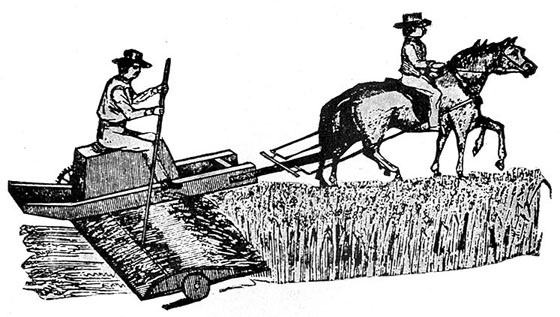
Hussey's Rear-Delivery Reaper. (From "Who Invented the Reaper?" by R. B. Swift.)
For 1846, 1847 and 1848 we copy from the Richmond Planter and American Farmer—and all from North Carolina, though the evidence from other sections is much more extended, and equally as conclusive:
"Somerset Place, Washington Co., "North Carolina 25th Aug. 1847.
"To the Editor of the American Farmer:
"Dear Sir:—Yours of the 6th ult. arrived at my residence during my absence in consequence of which I was unable to return you an answer in time for your August number of the American Farmer. I trust, however, the delay will not materially affect the value of my communication. In consequence of the recommendation of a gentleman who had used "Hussey's Reaper" in the harvest of 1846 with much satisfaction, I was induced to make a trial of one the present season. It was put in operation under the direction and supervision of Mr. Hussey himself, upon a field of reclaimed low ground, originally Cypress Swamp, which of course could only be cultivated in beds—these beds were six feet wide, including the water-furrow between, and were intersected at intervals of about fifty yards by drains, known to us as tap-ditches, which cross the water furrows at right angles, and are cut from two to four inches deeper than the furrows themselves. I am particular in describing the land, as I had always supposed that an insuperable obstacle in the way of the regular action of any machine would be found in the irregularity of surface into which our land is necessarily thrown by our system of culture. The machine surmounted every anticipated difficulty, and was eminently successful, both in cutting lengthwise with the beds and across them. The wheat was cut in a most thorough manner; nothing escaped the cutting surfaces, nor did weeds or any other obstruction of the kind hinder the machine from doing its work perfectly. During the running of the machine one day in the harvest, seventeen acres of wheat were cut by it.[6] This was done by using relays of horses, four at each time, the same hands being employed, however, and the working time was twelve hours. After a heavy rain we were obliged to abandon the use of the machine, owing to the fact that the ground became so soft that the "road wheel" as it is termed, buried in the soil, and would become clogged with mud. This difficulty can, I have no doubt, be easily overcome by increasing the "tread" of this wheel, and making some slight alteration in the cog-wheel which gears into it.
A McCormick Failure
"Some two years since I saw an experiment made upon an adjoining estate with McCormick's machine; it cut occasionally well where the wheat was free from weeds, but any obstruction from that source would immediately choke it, when of course the wheat would be overrun without being cut. The experiment proved a failure, and the machine was laid aside. The blade in this machine appears to me to be too delicate in its cutting surface to succeed, except under the most favorable circumstances. Quite a number of McCormick's have been in use in this part of the country during the last two years, and to my inquiries concerning them I have received but one answer and that an unfavorable one. The few of Hussey's machines, on the contrary, that have been employed within my ken, have in each instance given entire satisfaction. I do not hesitate to say that when well managed, with a skilful hand at the rake, in dry wheat (I do not recommend it when the straw is wet), it will, as compared with ordinary cutting, save per acre the entire expense of reaping, from the thorough manner in which every stalk is cut, thus preventing loss or waste.
"Believing, as I do, that a great desideratum to those who grow wheat upon a large scale, is to be found in Mr. Hussey's reaper, I cannot but wish that both he and they may reap the benefit of its general adoption.
"I am, sir,
"Very respectfully your ob't serv't,
"JOSIAH COLLINS."
"Edenton, N. C., "January 25th, 1848.
"To the Editor of the American Farmer:
"Dear Sir:—Some months ago I received a letter from you, making enquiries of me relative to Hussey's Reaping Machine. When your letter reached me I was on the eve of leaving home for the summer, and since my return home, my engagements have been of such a character as to cause me until the present to neglect replying to it.
"I have used one of Hussey's machines one season, and though under circumstances not very favorable for the machine, I take pleasure in stating that its operation was satisfactory. During my harvest, which was about three weeks' duration, this machine was kept constantly at work, with the exception of a day and a half, yet I did not ascertain how many acres it would reap. Mr. Collins, of Lake Scuppernong also used one last season, and from him I learned that he cut upwards of twenty acres a day.
"There is certainly much less wheat left in the field by one of these machines than is by the ordinary method of reaping by the scythe or reap hook; it cuts close, lays the straw smoothly, thus rendering tying of it in sheaves much easier.
"I have witnessed McCormick's, which I consider a poor affair, and meriting no consideration except a dissent from me. Many of this last kind of reaper found their way here a few years ago; they now, or rather their remains, may be seen lying in the field whence they will never be removed.
"THOS. D. WARREN."
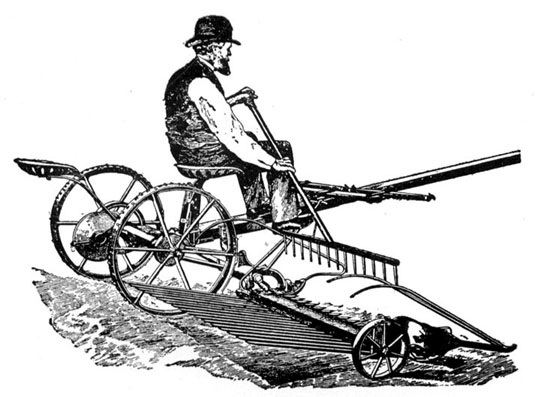
Modern Rear-Delivery Reaper. (From "Who Invented the Reaper?" by R. B. Swift.)
From the Richmond Planter.
HUSSEY'S AND M'CORMICK'S REAPERS
"It is very painful to be compelled to inflict a private injury in the discharge of a public duty; upon a particular system of cultivation we can talk and write without restraint; but when we are called on to discuss the merits of an invention, upon which the fortunes of the originator may absolutely depend, it is a much more responsible and delicate office. We are aware, too, that in introducing a subject of the kind, we are opening the floodgates of a controversy that is often hard to close; we have had the strongest evidence of that fact in the controversy that once occurred in this paper between Messrs. McCormick and Hussey, and yet it is to the relative merits of the reaping machines of these two gentlemen that we are compelled again to draw the public attention. Probably not less than fifteen thousand dollars has been spent in Virginia this summer for reaping machines, and it becomes a subject of great importance to the wheat growing community at least, to ascertain how such a sum is annually to be dispensed to the greatest advantage. We shall express no opinion ourself in the discussion which must necessarily follow the introduction of this subject, and we would greatly prefer that neither of the gentlemen more particularly interested in the subject would appear in our columns. We will publish statements of facts for either, provided they are made over responsible names, and are short and permanent. As one of these facts we feel bound to state that we acted this year as the agent for McCormick's machine, and we have heard great complaint of the manner in which it was gotten up; but it is but fair also to state, that we believe Mr. McCormick himself has been superintending the manufacture of his machine in the State of New York, and that probably his work has not been as well done as it would have been could he have seen to it in person. The following communication is altogether in favor of Hussey's machine:
Hussey's Machine "Vastly Superior"
"I have had in operation on my plantation this year both Hussey's and McCormick's reapers. Now, as you have asked me to furnish the Planter with the result of my own experience and opinion as to the comparative merit of the two machines, it is now at your service. I have had them both in operation (as the weather would permit) for the last fortnight, and have cut with the two rather upwards of two hundred acres of wheat. Both machines have been, I think, very fairly tested in all qualities of grain, from wheat five feet and more in height, both standing up, and lodged and tangled, and averaging, as is supposed, from thirty and forty bushels, down to light, thin wheat, not averaging more than four bushels (being some galled hills) and I am candidly and decidedly of opinion that Hussey's machine is vastly superior. I deem it superior, not only in the execution of its work, but in the durability of the machine. So well pleased am I with its performance that I have ordered another machine of Hussey's for my next harvest, and also one, and probably two, for my father's plantation. I consider this machine invaluable to the grower of wheat, and would recommend every farmer who grows even fifty acres of wheat, to purchase one. He may rest assured that he will be pleased with his purchase. I shall probably be in Richmond shortly.
"Yours very respectfully,
"T. POLLOCK BURGUYN.
"Occonichee Wigwam, near Halifax, N. C., "June 20, 1846.
"For 1849 and 1850 we will return and see how the invention progresses on the broad prairies and fertile lands of the West, where it first operated—in 1833 and 1834—and where, too, although the most luxuriant crops are grown with comparatively but little labor, it would in many cases be next to impossible to save them without the aid of this invaluable invention.
"These certificates embrace the mowing of large crops of grass as well as grain, and in addition, the cutting of more than three hundred acres of hemp in the harvest of 1849 and 1850, by 'the same single machine.'
"Hussey's complete success in cutting grass and hemp was no new thing ten years ago; but we suppose, like the grain cutting, in the view of Philip Pusey, Esq., M. P., 'Its perfection depended on its being new only in England,' full eighteen years after it was effected in America.
A General Opinion
"Blackberry, Kane County, Ill., "August 28, 1849.
"This may certify that I have had one of Mr. Hussey's mowing and reaping machines on my farm this year cutting wheat, oats, and grass for a short time. I think nothing can beat it cutting timothy grass, and I intend to purchase one for that purpose. While the machine was cutting prairie grass in my field, I cut off a dry poplar stake, one inch in diameter, which had been sticking in the ground after it had been laid off for a ditch. I am of the opinion that it will cut wheat well, where it is so much lodged, or so foul with stiff weeds or corn stalks that it cannot be cut with any other machine I have seen in this country. Some of my neighbors say that they intend to have Mr. Hussey's reaper in preference to any other; and from what I can learn this opinion is pretty general in my neighborhood amongst those who have seen this machine work, and are acquainted with other machines. My brother farmers have had great trouble with McCormick's machine, by the breaking of sickles, and the great difficulty or rather the impossibility of getting them repaired, or getting new ones made when broken, whereas the blades of Mr. Hussey's machine can be made by any common blacksmith. I have no doubt but Mr. Hussey's machine will come into general use.
"D. W. ANNIS."
"Franklin Precinct, DeKalb Co., "August 13, 1849.
"This may certify that we have seen Mr. O. Hussey's machine cut about an acre of wheat, so badly lodged that McCormick's reaper could do nothing with it, nor could it be cradled. Said Hussey's machine cut it handsomely, and laid it in very good bundles for binding.
"JOHN SCHOOMAKER, ALBERT FIELD, JOHN M. SCHOOMAKER, DANIEL MILLER, ALBERT FIELD, JR., ISAAC CRILL, JOHN MILLER."
"Berkshire, Kane County, Ill., "August 6, 1849.
"We, the undersigned, having seen Mr. Hussey's reaper work at cutting grass and grain, think it preferable to McCormick's or any other machine that we have seen. It cut wheat that could not be cut with McCormick's reaper or a cradle. We are well acquainted with McCormick's machine.
"P. A. HIXBY, JOHN GRIGGS, JR., JOHN GRIGGS, HARRY POTTER, JOHN SHIRWOOD, SETH SHIRWOOD, DAVID SHANKS, ABRAHAM SHIRWOOD, JAMES HESS, ALSON BANKER, D. C. WRIGHT, ELISHA WRIGHT."
"Oswego, Ill., "August 2, 1849.
"This may certify that I cut a lot of Black Sea Wheat with Mr. O. Hussey's Reaper; the wheat was so badly lodged that no McCormick Reaper or Cradle could cut it; Mr. Hussey's Reaper cut it clean and laid the bundles out of the track in good order for binding. I have seen the work done by this machine in grass; it was as good work as ever I saw done by a scythe, or better. For my choice I should rather have my grass cut by the Reaper than by the scythe. Every farmer ought to have such a machine, and every farmer I hear talk about it says the same.
"PHILIP YOUNG."
"Sugar Grove, "August 8, 1849.
"This may certify that we have seen Mr. O. Hussey's machine operate in clean grain, and where weeds were very tall, large and thick. In the former, it operated as well as any machine we have seen; in the latter, it worked to a charm, even where it was impracticable to cut with one of McCormick's Reapers.
"HARRY WHITE, L. B. SNOW, CHAUNCEY SNOW, SULLIVAN DORR, HIRAM TUBS, DWIGHT SPENCER, SAMUEL WARD, A. LOGAN."
"Springfield, Ill., "Dec. 25, 1850.
"Mr. Obed Hussey, Baltimore, Md.:
"Dear Sir:—I have used one of your Mowing and Reaping Machines, and consider it the best machine I ever saw, and never intend to do without one, if it is possible to get one, even if I have to go to Baltimore and remain at the shop till one can be made. I do candidly believe if I had had one ten years ago I would now feel like a much younger man; and cheerfully recommend them to all who have grass or grain to cut, as a machine that will do their work in perfect order, neatness, and with ease to all employed.
"JOHN SIMMS, "Four miles west of Springfield, Ill."
"Utica, Lasal Co., Ill., "Dec. 14, 1850.
"Obed Hussey, Esq.:
"Dear Sir:—I received your Reaping and Mowing Machine in time for harvest, and used it for harvesting and for mowing. I am fully satisfied that your machines are the best yet offered to the farmers of this State. I have mowed about four hundred acres, a great portion of which was wild prairie, very frequently running against stones and ant heaps with sufficient force to throw both driver and raker off the machine, without injury to the machine. Why your machine is preferable to any other, is, after you have cut your different kinds of grain, fully as well as can be done with any other machine, with not over fifteen minutes' work, you can take the same machine into your meadow or on to the prairie, and cut your grass at the rate of ten acres per day, cutting closer and cleaner than can be done with a scythe. With proper care, your machines will last fifteen or twenty years, with trifling repairs.
"Respectfully yours,
JAMES CLARK."
"Island Grove, Sangamon Co., Ill., "December 25, 1850.
"Mr. Obed Hussey, Baltimore, Md.:
"Dear Sir:—Last summer I received two of Hussey's Mowing and Reaping Machines; one from your own shop in Baltimore, and the other manufactured in this State. Unfortunately for me, I retained the one manufactured in this State, and with some difficulty succeeded in cutting about two hundred acres of wheat and grass. The one from your shop I let Mr. John Simms have, who cut his wheat, oats and hay (about seventy-five acres) with perfect satisfaction and ease, most of it with two horses, and without being obliged to grind the knives. After Mr. Simms finished his harvest he let Mr. James D. Smith, of Island Grove, have it, who cut about three hundred acres of grass with it, the machine giving perfect satisfaction.
"Very respectfully yours,
"EDWARD J. ENO."
"Carrolton, Green Co., Ill., "Dec. 27, 1850.
"I procured one of Mr. Hussey's Reaping and Mowing Machines from Baltimore last spring; I cut eighty acres of wheat, and ten acres of oats, and fifty acres of timothy with it, to my entire satisfaction—after which I cut sixty acres of cloverseed with it in less than five days. I could not have saved the cloverseed without the machine, so I consider I saved the whole cost of the machine in the saving of the cloverseed alone.
"SAMUEL THOMAS."
"Springfield, Ill., "Dec. 25, 1850.
"Mr. Obed Hussey, Baltimore, Md.:
"Dear Sir:—During the harvest of August, 1849, with one of your machines I cut sixty acres of Hemp, using a set of 4½ feet knives and guards, and two teams of four horses each, changing every two rounds, which cut on an average eight acres per day. This last harvest, the same single machine, with 6 foot guides and knives,[7] operated by the same force, cut successfully 250 acres of hemp, or from 10 to 12 acres per day. From this experience, I take pleasure in recommending your Cutters above the hemp cradle and hook, not only as labor-saving, by the expedition with which they cut, but as hemp saving, from the perfect thoroughness, evenness and nearness to the ground with which they do their work, and the regular and collected form in which they leave the hemp after being cut.
"Yours respectfully,
"EDWARD S. COX."
"Carrolton, Lebanon Co., Ill., "Sept., 1850.
"Mr. O. Hussey:
"The four Reaping and Mowing Machines you sent arrived safe and in good order. Their performance far exceeded our expectations, the work went on so smoothly that we scarcely knew it was hay time and harvest. * * * If your machine had been as well known as they are now, you could have sold twenty as well as one.
"Yours,
"JONAS WARD."
The few letters which follow, taken from the American Farmer, and referring to a still later period, are selected for their brevity, from many others, and principally from Maryland and Ohio. It is considered unnecessary to extend the list, for the operation and character of the machine is too well and too widely known at this day to render it necessary to the intelligent farmer and general reader, in any grain growing section of the country.[8]
"Harewood, "12mo., 8, 1852.
"Having used one of O. Hussey's Reaping and Mowing Machines during the last harvest (1852) I can state that in cutting wheat, oats and cloverseed—also in mowing my crop of grass—it has fully answered my expectations, doing the work better than I ever had it done by the scythe, and at much less expense. The machine has been tested by cutting some fifty to sixty acres of grass—quite sufficient to prove its complete adaptation to mowing as well as reaping.
"EDWARD STABLER."
"Wye House, "Dec. 20, 1852.
"Dear Sir:—Having worked your Reaper for many years I have fully tested its merits. It has proved itself to be not only a wheat saving implement but a labor and time saving one—these are all important to the farmer.
"It does its work completely, regardless of the position of the wheat, if in condition to bind.
"Those you sent me in the spring worked well through the harvest, and proved their strength.
"Yours respectfully,
"EDW'D LLOYD."
"Oxford, Md., "Dec. 8, 1852.
"Mr. Obed Hussey:
"Sir:—I have used your Reaper with such entire satisfaction that I am but performing a duty to my brother farmers by recommending it in the strongest terms.
"For sixteen years I have used a Reaping Machine, and know from experience that the most important qualities are strength and simplicity. In these respects your machine is superior to any other, and is the only one I have seen which can be safely entrusted to the management of ordinary overseers, with negro laborers.
"Yours, etc.,
"TENCH TILGHMAN."
"Hayes, Montgomery Co., Md., "December 7, 1852.
"I purchased in the year 1851 one of Mr. Obed Hussey's Reaping Machines. I used it that year and this year in cutting my grain; I was pleased with the machine; I consider it a valuable implement, and hope never to be without one while I continue to be a farmer. My machine was used in cutting wheat and oats—it was not designed for grass. I employed it about half the day, and reaped about ten acres of land in grain—the rest of the day was devoted to the securing of the grain; I used four horses. My machine, I believe, was of the smallest size, and was without front wheels; with wheels it would have been a relief to the horses.
"I cannot speak of the relative value of this machine compared with others, having never seen any Reaping Machines but Hussey's at work. I do not think I could be induced to return to the old mode of cutting grain by the scythe and cradle.
"Respectfully yours, etc.,
"ROBERT P. DUNLOP."
"Forest Hill, King and Queens Co., Va., "December 24, 1852.
"Mr. O. Hussey:
"Sir:—It gives me pleasure to state that I used your Reaping Machine in my late harvest with great satisfaction. It fully equals my expectation as a labor-saving implement, and does the work better than can be done by the cradle. I would farther state that the seven which were purchased along with mine for my relations and friends of this country have given in every instance, entire satisfaction.
"Very respectfully,
"WM. D. GRESHAM."
"To the Editor of the American Farmer:
"Dear Sir:—Having had a fair opportunity of observing the performance of Mr. Hussey's celebrated 'Reaper' on my farm last season, under circumstances peculiarly calculated to test its efficiency, I think it not inappropriate to bear my testimony in its favor.
"I finished cutting my grain more than a week ago. The grain was not only blown as flat as possible, but was tangled and twisted together, and lying in every direction; so much so that it would have been impossible to cut a large portion of it with the cradle. No one who saw the field believed the machine could possibly succeed.
"I take great pleasure in stating that its success was perfect and entire. It cut and gathered the grain in the very worst spots almost as well as that which was standing; and I was thus enabled to mow my crop in about one-half the time the old fashioned method would have required, thereby effecting a large pecuniary gain. It cuts the grass as evenly and as close as the most expert mower. I need scarcely say that I am perfectly satisfied with it. I subscribe myself yours, etc.,
"AQUILLA TABOT."
"Alexandria, Va., "12 mo., 11, 1852.
"It gives me much pleasure to state that I have had in use on my farm in Montgomery County, Md., for the past two seasons, one of 'Hussey's Reapers,' and its operation has given me entire satisfaction in every respect. It appears to combine the three qualities so important to the farmer, efficiency, durability and economy. I can, with great sincerity, recommend its general adoption.
"BENJAMIN HALLOWELL."
"To Obed Hussey:
"Dear Sir:—Having used one of your Reapers upon land, a great deal of which was hilly, stony and rough, I take pleasure in saying that it has given entire satisfaction, and proved to be a very durable, well built, and great labor saving machine.
"Respectfully,
"A. B. DAVIS."
"Greenwood, Mont. Co., Md., Dec. 20, 1852."
"Pickaway County, O., "July 1, 1851.
"I made an experiment this season in my field of testing the McCormick and Hussey Reapers. I tried each fairly and under similar circumstances. I am satisfied that Hussey's is decidedly the best Reaper, both as to cutting grain and durability. The objections made to Hussey's Reaper by agents and manufacturers of other machines I do not find, upon trial, to exist in any one particular.
"WM. STAGE."
"We, the undersigned, present at the trial, concur in Mr. Stage's statement: Z. Pritchett, John Reber, Philip Stuart, Isaac Stage, John Hogeland, Michael Eyer."
"Salem Tp., Champaign Co., O., "July, 1851.
"I have worked with McCormick and Hussey's Reapers three seasons, and unqualifiedly pronounce Hussey's the best machine. It cuts cleaner and faster, and leaves the grain in better order on the ground; and this is the opinion of every hand in giving an expression of the comparative merits of the two machines.
"THOS. OUTRAM."
"Union Township, Champaign County, O., "July, 1851.
"I have for the past four seasons worked Hussey's Reaper, and unhesitatingly pronounce it vastly superior to McCormick's or any other Reaper I have seen used.
"WILLIAM T. ZOMBRO."
"Salem Township, Champaign County, O., "July, 1851.
"I have had Hussey's Reaper used on my farm. It will cut 20 acres of the heaviest wheat per day, with ease. I consider it far superior to the McCormick Reaper.
"JOSHUA BUFFINGTON."
"Ross County, Ohio, "July, 1851.
"I have used Hussey's Reaper, and consider it an invaluable machine. I have seen McCormick's Reaper operate, and am of opinion that Hussey's is the best machine.
"D. M'CONNELL."
"Union Township, Champaign County, O., "August, 1851.
"I have used Hussey's Reaper for four years. I prefer it to every other machine. I do not have to drive fast, and the raking is the easiest work in the field.
"JOHN EARSOM."
"Salem Township, Champaign County, O., "August, 1851.
"I bought a Hussey Reaper this season, and it has given the best satisfaction. I cut wheat that was down as badly as any I ever saw. It operated well by driving in a slow walk. My hands would rather rake than bind.
"JOHN LEE."
"Union Township, Champaign County, O., "July, 1851.
"I have used for five years Hussey's Reaper. It is a labor and grain saving machine. It is a much better machine than McCormick's, in several particulars; it is more substantial, not so liable to injury, and will cut faster and cleaner. I cut this season, with three horses, sixteen acres of heavy wheat, in five hours and thirty minutes.
"REZIN C. WILSON."
"Bergen, "September 1, 1851.
"This is to certify that I have for three seasons used one of Hussey's Reaping Machines, which I purchased at the Genesee Seed Store, and that it gives perfect satisfaction. I have cut my wheat when it was very badly lodged, much faster, better and cheaper than it could have been done in any other way. I had one of McCormick's, but left it in the road, a useless article, as I consider it, having tried for three years to use it without success.
"I consider Hussey's machine just the thing for our farmers, and I could not now, after having proved its merits, be induced to be without one.
"NOAH WILSON."
With a few general remarks as to the reputation of Reaping Machines in England, and on the authority of the annexed English publications, we take leave of the subject.
At the trial for which the "Great Council Medal" was awarded, but which no practical farmer in this country would consider as any trial at all, being merely the attempt to cut a small space in green and wet grain, and during the temporary absence of Hussey, his machine was operated by ignorant laborers of the "Chrystal Palace," and who had never before seen a reaping machine.
This did not satisfy the English farmers; complaints were soon heard of injustice, partiality, and unfairness. It compelled C. H. McCormick or his agents to offer a challenge, which was promptly accepted by Hussey; and before the Cleveland Agricultural Society a tolerably fair trial was had of the rival machines, though neither the grain nor ground was then in a suitable state. For the decision of twelve prominent men and practical farmers we refer to the annexed English account for the complete triumph of the unmedalled machine.
In an interview with an extensive agricultural implement maker of Yorkshire—himself an inventor of many valuable implements, and to no small extent a rival—he spoke of Obed Hussey as a man who conferred honor on his own country; as well by his genius and talents, as by his integrity of character. This feeling was alike honorable to the gentleman who gave it expression, and just to an American citizen.
Mr. Hussey's Distinction
Obed Hussey is perhaps the only American who ever waved the "Stars and Stripes" on the soil of England [placed there, too, at different times, on his machine, by Englishmen] or who could do it without a strong feeling of envy and jealousy being engendered. Even Englishmen, jealous as they are known to be, viewed Hussey as a public benefactor, and his mission as one calculated either directly or indirectly to benefit all classes. Yet in his own country, which he has so signally benefited, he is compelled to supplicate for years, and as yet in vain, for rights, that others, with not a tithe of his claim and merit, but with more ample means perhaps, or more influential friends, succeed in obtaining. It is a reproach to the age and to the Halls of Legislation. When it was supposed this great invention was perfected in England, many years ago—though not successful, as was subsequently proved—the Nation took the matter in hand, and Parliament voted a reward to its author.
At the great Agricultural Exhibition for "Bath and the West of England," held at Plymouth in 1853, the Plymouth Mail states: ["the interest and excitement created by the trial of Reaping Machines was very great, and the crowd of persons assembled to witness their performance was immense"]—that Hussey won the prize for Reaping, by acclamation, over all competitors—the only other American machine present, McCormick's included; and an eye witness states that three cheers were proposed for Mr. Hussey by Sir Thomas Ackland, the President, and member of Parliament, which was responded to by thousands, and without a dissenting voice; that his reaper was crowned with laurel by the Judges, and the "Stars and Stripes" waved in triumph twenty-five feet high over American ingenuity and enterprise on English soil.
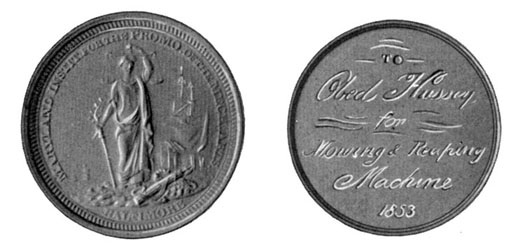
Gold medal won by Mr. Hussey with the Reaper at Baltimore in 1853.
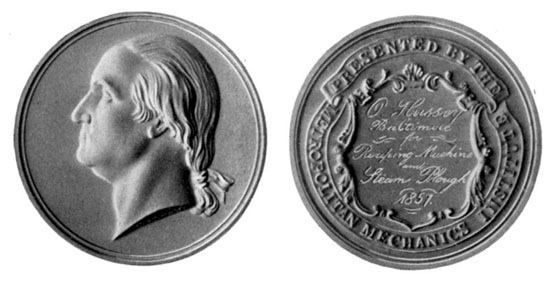
Silver medal won by Mr. Hussey with the Reaper and his Steam Plough at New York in 1857.
A Mowing Machine as Well as a Reaper
At this trial it was again demonstrated to the agriculturists of Great Britain by Obed Hussey [and not the first time, though he was the first to do it] that his machine would cut their grass quite as perfectly as their "corn." The Mail goes on to say: "A mowing machine was so remote from the expectations and hopes of the Society, that no prize was offered for one; yet Mr. Hussey was prepared with a mowing machine, which was taken to an adjoining field of meadow grass and clover mixed. The people followed, but evidently with no expectation of being gratified. The machine mower was put in action, and to the admiration of every one, it cut the grass with an evenness and precision which is truly surprising, being more close and even than a scythe. The grass left behind the machine was quite evenly spread, and where it was not so, it lay so light and open that the use of the tending machine was scarcely necessary. The admiration of the truly astonishing performance was universal.
"The cutting the rye was looked for, but mowing the grass took every one by surprise. Thus a great desideratum has been achieved; the farmer has now only to gear up his horses and take a ride through his meadow, and his grass is cut."
Again, at the Royal Agricultural Society's Exhibition, held at Lincoln, the present season, the Mark Lane Express states that Hussey's machine won the prize over all competitors; and admits that Bell's machine was "at last fairly beaten."
Is there an American who can read these accounts who does not feel indebted to the man who, solely by his own perseverance and skill, has added lustre to his country's renown in the peaceful walks of life? If the same man, as a "warrior in hostile array," had raised the same flag in triumph on the same soil, how would his countrymen have rewarded him? Doubtless by a "vote of thanks by both Houses of Congress," together with a sword and gold medal, if not a monument in addition!
A Peaceful Conquest
Should not those be equally honored and rewarded by the Country, who are engaged in the arts and in agriculture; who devote their energies to add to the comfort and happiness of their fellow man, as those engaged in shedding blood, making widows and orphans to mourn for their untimely bereavement, and who literally for hire, not patriotism, and with the spirit demons, seek to slay and destroy?
We fully believe so; for fame and renown in arms are rarely or never acquired, except by entailing misery and distress on our fellow beings, and engendering the worst feelings and passions of our nature.
But we hope for the advent of better days; when, if the political sword is not literally beaten into a plough-share, and the partisan spear turned into a pruning hook, the inventive genius and talent of our countrymen shall be more aided and better rewarded by Government, in its praiseworthy efforts "for the diffusion of knowledge among men," in all that really ennobles the mind, and benefits the whole human family. Such, at least, is the earnest wish and desire of
A FARMER AND MECHANIC.
HUSSEY'S REAPING AND MOWING MACHINE IN ENGLAND
An Unfair Disadvantage
"In presenting the following pages for consideration of the farmers of the country, the subscriber has confined himself strictly to matters selected from English papers, which will speak for itself. As a short explanation from me will be looked for, I will merely state that at the trial in presence of the Exhibition Jury, Mr. McCormick's machine was operated by an experienced hand sent from the United States, while mine was managed by English laborers of the lower class, who were total strangers to it, and had never seen it in operation. The trial was made in unripe wheat on a rainy day. My machine was very improperly adjusted for the work and wrongly put together, in consequence of which the ignorant raker failed to deliver the sheaves, and it stopped as a matter of course, and was immediately laid aside, after cutting but a few feet. My machine was never tried in presence of that Jury by any other hands, or in any other condition, myself not being in England.
"It was on such a trial that the Exhibition medal was disposed of, and with what justice the reader can judge by reading the following pages. On my arrival in England I took my machine into the field that it might work its way into public favor as it best could. After being exhibited in several places, its rising fame appeared to produce some effect, as it will appear by the following in the Windsor and Eaton Express of November 8, 1851:
"Alluding to the astonishing and unexpected performance of my Reaper, it says: 'By this unlooked for turn of events, the proprietors of McCormick's machine found that their supremacy was no longer undisputed, and that the necessity was laid upon them to look to their laurels; they therefore came boldly forward, and threw down the gauntlet!'
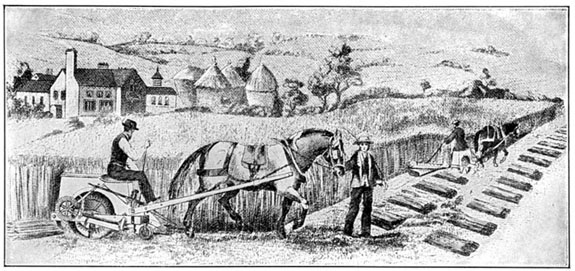
Hussey's Side-Delivery Reaper As Used in England. (From An Old Print)
How McCormick Received a Medal
"That farmers who are acquainted with my reaper may understand why it failed to perform well in the hands of strangers at the Exhibition trial where McCormick got the medal, it will be necessary for me to say that when the machine was sent from Baltimore it was set to cut high. That when the inexperienced hands undertook to make it cut low, they pitched down the cutters by putting on the tongue, not knowing any other way to lower it. In doing so the hind part of the platform was of course raised high. In this condition the unpracticed raker failed to push the heavy wet wheat off up an inclined plane; and as a matter of course the machine choaked, and for the same reason that a mill will choak when the corn goes in faster than the meal comes out. A skillful hand would have lowered the cut at the axle of the machine, and brought the platform horizontal or lowest at the rear, as it should be in cutting wet grain.
"The following pages will show the result, the authenticity of which, if doubted, will be proved by the production of the originals in my possession.
"OBED HUSSEY.
"Baltimore, Md., Jan. 1, 1852."
From the Hull [England] Advertiser, September 5, 1851.
"At the annual meeting on Mr. Mechi's Farm at Tiptree Heath, a few weeks ago, a brief report of which appeared in the Hull Advertiser at the time, several reaping machines were tested, the result then being that one manufactured and invented by Mr. McCormick, of America, was the only one which was considered to have done its work properly. Amongst those tried was one invented and manufactured by Mr. O. Hussey, Baltimore, Md. (U. S.) which, in the opinion of gentlemen then present, did not fully accomplish the object in view. It should, however, be mentioned, that while Mr. McCormick's machine had on that trial the advantage of the superintendence of persons intimately acquainted with its mechanism, and who had been accustomed to the working of the machine for some years, Mr. Hussey's invention was (in the absence of the inventor) in the hands of persons entirely unacquainted with the proper mode of working it. Since then Mr. Hussey himself has come over to England in order to superintend his machine, and the result has been that it is now brought out to receive a thorough trial of its merits.
"The trial of Wednesday, however, was the best. It took place in a field belonging to Mr. Coskill, Grovehill Lane, Beverly. There was assembled during the day a great number of farmers and gentlemen interested in agriculture, who witnessed the trial with great interest.
"The wheat in this case was very much 'laid;' indeed in many places it was almost flat on the ground. It therefore afforded one of the best opportunities for judging of the capabilities of the machine under disadvantageous circumstances that could possibly occur.
"On the whole, the conclusion come to was that the reaping was done as well by machine as by hand. No one doubted for a moment that it would cut corn well where it was standing; but some farmers thought it would not equal the scythe where the corn was laid. The result, however, showed the contrary, and every person acknowledged that it had succeeded admirably. After cutting a large quantity of wheat, the machine was taken into another field, and after a slight alteration, set to work to cut clover. We understand that on the day before previous to coming to Hull, it had been tried on clover and cut it extremely well.
Winning Its Own Way
"As the machine cut along it was followed closely by groups of farmers striving hard to find flaws in its performance. But they could not. On the contrary, in those places where the corn was most 'laid,' and where, consequently, the greatest difficulty must occur in the cutting, the manner in which the reaper did its work elicited their loudest approbation. 'Why,' said one burly old gentleman by our side, 'a man with a scythe could never cut it like that.' 'It is wonderful,' said another.
From the Morning Advertiser, September 12, 1851.
"On Monday last, the public trial of Hussey's patent Reaping Machine took place with the permission of his Grace, the Duke of Marlborough, on his Grace's estate of Blenheim, near Woodstock, Oxfordshire, and also, on the adjoining one of Mr. Southern, one of the most considerable landed proprietors of the country. A large assemblage of the Agriculturists of the highest class attracted by the celebrity which this ingenious and efficient contrivance has acquired for itself in a course of successful experiments performed last week in Yorkshire, were present to witness the trial, mostly from Oxfordshire and the adjoining counties, but many from a considerable distance, and all of them concurred in the most ready acknowledgments of its advantages.
The Duke of Marlborough's Test
"The reaping commenced at 11 o'clock in the barley field, the machine being drawn by two fine chestnut horses, lent by his Grace for the purpose of the experiment, in which he took the deepest interest, following the reaper in a car, and watching with evident satisfaction, the ease and rapidity with which the blades cut down the golden produce of the field. The crop was by no means one calculated to favor the experiment. On the contrary, some of it was down and much laid. It was cut down, however, with great regularity and speed, and the general evenness of the stubble was the subject of general remark. As the machine passed on, hewing its way at a smart pace through the dense mass of stalks, the crowd of eager observers rushed after it, and many were the cheers with which it was welcomed. Occasionally, to satisfy the ideas of the more fastidious, the level of the cutters was changed, so as to leave a greater or less length of stubble, and it was evident to all that in this respect the machine was susceptible of the nicest adjustment. Some times at the end of a turn it was rested to give the farmers an opportunity of inspecting it, which they seemed never tired of doing, and then it was turned round at right angles to cut in the cross direction. In the experiments upon barley, it showed itself capable of reaping the enormous space of fifteen acres, which we believe is from eight to nine times the power of the most vigorous and skillful reaper. Afterwards the machine was taken into a large field of clover, which it cut to within two inches of the ground, and with still greater rapidity.
"His Grace repeatedly expressed his admiration of the powers of the apparatus, and congratulated some of the agricultural gentlemen present with him on the prospects of greater economy and security in harvesting which it afforded them. These opinions were generally entertained upon the ground, and yesterday at Bishop's Startford, in Hartfordshire, the farmers of that part of the country witnessed a similar experiment, attended with results precisely similar, and which gave them the same satisfaction."
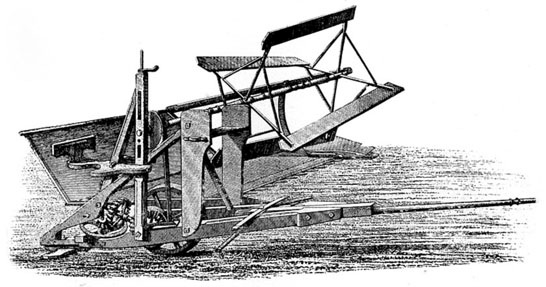
McCormick's American Reaper
The following testimonial was given by the Duke of Marlborough:
"Tuesday, September 9th, 1851.
"Having yesterday witnessed the working of the American Reaping Machine, patented by Mr. Hussey, and being requested to give my opinion upon its execution, I state that it performed its work admirably, laying the corn when cut very neatly for tying up, and leaving the stubble very regular.
"MARLBOROUGH."
Following upon these various successes, an advertisement from the proprietors of McCormick's Machine appeared in the public papers, as follows:
MR. M'CORMICK'S AMERICAN REAPER
The Challenge
"Public Challenge to Makers and Venders of Reaping Machines: We, the undersigned, agents for Mr. McCormick, having observed sundry advertisements and circulars complaining of the decision of the Jurors of the Great Exhibition of 1851 in favor of Mr. McCormick's Reaper, and of the reports given in the public journals of the trials which led to such decision, do hereby give notice to Messrs. Wm. Dray & Co., Messrs. Garrett & Son, Mr. O. Hussey, and all other makers and venders of Reaping Machines whatsoever, that M'CORMICK'S Reaper will be tried at the Cleveland Society's Show at Marton, Middlesbrough, near Stockton-on-Tees, on the 25th inst., and publicly CHALLENGE them or any of them, to meet us there, with their machines, for the purpose of a comparative trial of the respective merits of each, to be determined by the Chairman and Council of the Cleveland Society, or by such Judge or Judges as the said Society may appoint. BURGESS & KEY, 103 Newgate Street, London."
The Challenge was immediately accepted.
MR. HUSSEY'S AMERICAN REAPER
The Acceptance
"In answer to an advertisement which appeared in the Times of the 18th, from Messrs. Burgess & Key, giving us a PUBLIC CHALLENGE to a TRIAL of the AMERICAN REAPING MACHINES, we hereby announce that we shall willingly ACCEPT the SAME, and on the 25th inst. we shall be prepared at the Cleveland Society's Show, Marton, Middlesborough, near Stockton-on-Tees, to prove to the Agricultural World the superiority of HUSSEY'S REAPER for general farming purposes. We stipulate, however, that the Machines shall be tested, not only on a particular patch of good upstanding grain, where they might, perhaps, prove equal, but on an average variety of conditions, as to short and laid corn, etc., such as the farmer will usually meet with. Its capabilities for cutting green crops, such as clover, etc., shall also be proved. It must be evident to the Farming Public that the Reaping Machine which will cut a crop of the greatest variety and difference of condition must possess the greatest merit. WM. DRAY & CO., Agricultural Warehouse, Swan-Lane, London Bridge."
Accordingly the matter was arranged, and the following gentlemen were called upon to act as jurors:
Henry Stephen Thompson, Esq., of Moat Hall, Foreman; Mr. Wm. Lister of Dunsa Bank; Mr. Jno. Booth of Killerby; Mr. John Parrington, of Brancepeth; Mr. Wm. Wetherell, of Kirkbridge, Darlington; Mr. Robert Hymers, of Marton; Mr. Christopher Cobson, Linthorpe; Mr. Robert Fawcitt, of Ormsby; Mr. Joseph Parrington, of Cross Beck; Mr. John Outhwaite, of Bainesse; Mr. Geo. Reed, Hutton Lowcross; Mr. Thomas Phillips, of Helmsley, and Mr. Thomas Outhwaite, of Bainesse.
The following were the conditions to be submitted by the representatives of the respective machines:
The machines to be tried on wheat and barley in such order, and for such lengths of time, as the jurymen may direct. The jury to have full power to use any means they deem advisable in order to put the machines to the severest trial. The jury in deciding on the merits of the two machines, to take into their consideration:
Conditions of the Contest
1st. Which of the two cuts corn in the best manner.
2d. Which of the two causes the least waste.
3d. Which of the two does the most work in a given time.
4th. Which of the two leaves the corn in the best order for gathering and binding.
5th. Which of the two is the best adapted for the ridge and furrow.
6th. Which of the two is the least liable to get out of order.
7th. Which of the two at first cost is least price.
8th. Which of the two requires the least amount of horse labor.
9th. Which of the two requires the least amount of manual labor.
As no report was made of the trial on the first day, the following may be relied upon:
From the Gateshead Observer, September 27, 1851.
"It was curious to see on the soil of a Cleveland farm two implements of agriculture lying side by side in rivalry, respectively marked, 'McCormick, inventor, Chicago, Illinois,' 'Hussey, inventor, Baltimore, Maryland'—America competing with America, on English soil.
"Mr. Hussey led off. An attempt was made to keep back the eager crowd; but their curiosity was irrepressible; they flocked in upon the machine so that the experiment could not be properly performed, nor could the jury duly discharge their duties. P. C. Thompson did his very best; he was all but everywhere at once; but what avails a police force, one strong, against a concourse of Yorkshire yeomanry and clowns? It was requisite that he should have recruits, and a body of self-elected 'specials' came to his aid, who succeeded in procuring approach to a clear course. Mr. Hussey then took his seat anew, and his machine cut down a breadth of wheat from end to end of the field. It seemed to us to do its work neatly and well. The wheat was cleverly delivered from the teeth of the reaper, and handed over to the binders by the rake."
To William Dray and Company.
"Stockton-on-Tees, September 27th, 1851.
"Sir—Having been in communication with you relative to the trial of your Reaper against McCormick's, and feeling deeply interested in the introduction of the new implement into this district, particularly one of so much importance as a Reaping Machine, I think it is not probably out of place in me if I give you the result of my observations during the two trials which have taken place. From the fact that McCormick's Machine obtained the prize at the Great Exhibition (though I do not pin my faith upon awards made by Agricultural and other societies) the letter of Mr. Pusey's, in the Royal Agricultural Society's Journal, the various newspaper reports, etc., etc., it was natural for me to be predisposed in favor of McCormick's Machine; indeed Mr. M. had a prestige in his favor, which of course operated against the 'Little Hussey.' Previous to starting, at Marton, on Thursday, the gentlemen representing McCormick's machine expressed themselves desirous of testing the machines early in the morning when the dew was on, believing that their machine would cut the grain under such circumstances, and that yours would not. Well, on Thursday we had a deluge rain, the surface of the land was very soft, and the corn very wet. Everybody there was astonished to see your machine brought up the field at a trot, cutting its way to the admiration of all present; it not only cut to the leaning corn, but it cut cross over the corn leaning to the left of the postillion (I presume I must call him). McCormick's machine then attempted to start (he made two or three attempts) but the attendant confessed it was impossible to do so. That there might be no mistake about it, your representatives proposed that their machines should go up again; the jury said 'No! we are satisfied that your machine can cut it under the present circumstances,' and so ended Thursday's trial."
From the Gateshead Observer, October 4.
"We left the members and friends of this society, on Friday, the 26th ult. on the Show-ground at Middlesbrough, immersed in rain. The scene now shifts to the Townhall, where, in a handsome and spacious apartment, we find them assembled in the evening, to dinner, to the number of 150, with the Earl of Zetland in the chair, and in the vice-chair Mr. John Vaughan, of the firm of Bolckow & Vaughan, iron-masters and manufacturers. His lordship was supported by the Rev. W. F. Wharton, of Birmingham, and Messrs. J. T. Wharton, Henry Pease, G. D. Trotter, Isaac Wilson, George Coates, J. W. Pease, George Reade, John Pierson, etc.; and the vice-chair by Messrs. C. Dryden, W. Fallows, R. Chilton, etc. In the body of the hall were the leading inhabitants of the town and neighborhood; also, Mr. Burgess and Mr. Samuelson (who had come to the meeting with Mr. McCormick's reaping machine), Mr. Hussey, the inventor of the reaper which bears his name, and Mr. Pierce and Mr. Stevens (on the part of Messrs. Dray & Co., agents for Mr. Hussey).
"On the removal of the cloth, the noble Chairman (behind whose seat was inscribed on the wall in conspicuous characters, 'Success to the Cleveland Agricultural Society—Eighteenth Anniversary') gave the customary loyal toasts, and took occasion to observe that had it not been for the Exhibition of Industry, projected by Prince Albert, the 'Reaping Machine,' from which he anticipated great benefits to agriculture, would not have been introduced into this country. (Applause.)
"The Earl of Zetland again referred to the reaping machine. Such an aid to agriculture, his lordship observed, was needed in Cleveland and elsewhere.
"Mr. J. T. Wharton, of Skelton Castle, said he had never witnessed so much enthusiasm in an agricultural district as was displayed in connection with the reaping machine. Had the day been fine the number of spectators present yesterday (Thursday) would have been at least fourfold what it was. Bad as the weather was, not only was there a large muster of members of the society, but 803 persons, many of them from a considerable distance, paid sixpence each for admission to the ground. The trial of the rival machines was, unfortunately, so short, and conducted under such adverse circumstances, that it was impossible to pronounce any opinion as to their relative merits; but what he saw of Hussey's was as satisfactory as he could expect. (Applause.)
"Mr. George Reade, of Hutton Lowcross, said, had it not been for the boisterous weather, the receipts of the Society at Ormesby and Middlesbrough would have been marvelous. As it was, there was a large assemblage to witness the trial of the American reaping machines, and they were regarded with an anxious desire that they might succeed. Indeed, let any ingenious mechanic—he cared not whether he was English, Scotch, Irish, American or German—come before a jury of the farmers of Cleveland with an implement or machine for the improvement of Agriculture, and it would be judged with candor, impartiality and uprightness, and the inventor should go home satisfied that he had experienced fair play. (Applause.)
"Mr. Isaac Wilson proposed the health of 'The Strangers.' To those gentlemen the members were greatly indebted for their attendance. Had the weather permitted, they would all have experienced much pleasure from an inspection of the celebrated reaping machines in action, and the ingenious draining plough of Mr. Fowler, which did him very much credit. (The toast was drank with musical honors.)
"Mr. Pierce, the representative of Dray & Co., being called upon to respond, rose and said, bad as the weather had been, he had been delighted with his visit to Middlesbrough. The kindness of the inhabitants soon made him no stranger. He was not four and twenty hours in the place before he fraternized with the whole parish. (Laughter.) He rejoiced that Mr. Hussey's reaping machine was now in the hands of a jury of Cleveland farmers. It would have a fair, honest, impartial trial; and what more could an Englishman desire. (Applause.) He thanked the company for the honor which they had conferred upon their visitors from a distance, and wished continued success to their flourishing society. (Applause.)
Mr. Hussey's Toast to England
"Mr. Hussey was next called upon, and said that he had for many years been building machines in America. If he had had the least idea of the interest which England would take in the reaping of crops by machinery, it would have been a difficult thing to keep him on the other side of the Atlantic; and he knew not, now, after the reception which he had met with, how he should ever get home again. (Applause and laughter.)
"Mr. Steevens, Dray & Co.'s engineer, was also called upon to rise, and stated that his employers had purchased Mr. Hussey's machine because they saw it to be the best, and they would meet every competitor in the three kingdoms, fearless of the result. (Cheers.)
"[It should be stated that Messrs. Fowler, Burgess, Samuelson,[9] etc., had by this time left the hall, and therefore could not be called upon.]
"Mr. Parrington, having read the award, announced that a second trial of McCormick's and Hussey's reaping machines would be made, if the weather were favorable, on the following morning (Saturday), at 9 o'clock, at Mr. Fawcitt's farm. The jury, appointed by the committee, would give no opinion on the trial of the previous day (Thursday). That would go for nothing. They would devote the whole of next day, if necessary, to a full, fair, and satisfactory trial of the two machines. (Applause.)
"On Saturday morning, the weather was so far favorable that there was no rain. The trial, therefore, took place. There was a numerous gathering of land-owners, farmers, laborers, etc., but not so crowded a muster as to obstruct the experiment.
"The foreman of the jury, Mr. Thompson, being unavoidably absent, his place was supplied by the Rev. W. F. Wharton, of Birmingham. Messrs. Lister, Outhwaite, (J. and T. P.) Booth, Wetherell, Phillips, and Dobson, were also absent. Their places were filled by Mr. William Morley, Dishforth; Mr. Thomas Parrington, Marton; Mr. J. T. Wharton, Shelton Castle; Mr. Wm. Hill, Staunton; Mr. Joseph Coulson, Sexhow; Mr. Joseph Harrison, White House; Mr. John Mason Hopper, Marton.
"The trial commenced in a level enclosure, adjoining the road from Stockton and Middlesbrough to Ormesby Hall (the residence of Sir Wm. Pennyman, Bart.). The wheat was laid. We have seen a crop in worse condition, but not often. The straw was damp and soft. The soil was loamy and light, and the field free from wet; it was to Mr. Fawcitt's credit that he was able to place such a field at the service of the society under the circumstances; still, the earth was in a state to clog the wheels of the reapers. Altogether, the test was a severe one for the competitors. Mr. Samuelson, Mr. Burgess, and Mr. D. C. Mackenzie (the son of an emigrant from Ivernesse) were in charge of Mr. McCormick's machine. The other was in the hands of the inventor himself, Mr. Hussey, and of Mr. Pierce and Mr. Steevens (who represented the agents, Messrs. Dray & Co.)
"The Rev. Mr. Wharton (the jury, competitors, etc., having gathered round him on the field, on Saturday morning) announced that after the lapse of an hour, when the corn would be in such a condition that Mr. Fawcitt, as he had just said, would, under ordinary circumstances, reap it himself, the trial would commence.
"The question was, now, which of the two machines should begin. A 'toss' gave the chance to Mr. Pierce, and he requested Mr. Burgess to lead off.
"McCormick's machine then got into action, taking the crop in the most favorable manner—that is, leaning toward the knife. Passing along the field (which was from two to three hundred yards in length) it cut down a breadth of little more than four feet. The corn being laid, the flier, of course did not come into practical operation; nor was it necessary that it should do so—the elements having already done its work. The corn was well cut—the stubble a little too high.
"Another breadth or two having been cut, Hussey's machine followed, and cut some breadths—somewhat wider than McCormick's, and closer to the ground.
"Mackenzie, when we pointed out the shorter stubble of his rival, admitted the fact, but said there would be no difficulty—not the slightest—in bringing Mr. McCormick's knife nearer to the ground. In America, however, where the straw is comparatively of little or no value, the stubble is no object, and there are some advantages in cutting high.
"A backer of McCormick's machine (and many bets have been laid on the two machines) urged that Hussey's would spoil clover when going among wheat. The reply was, that Hussey's knife could be raised or depressed at pleasure.
"The next test was cutting the crop across ridge and furrow, so that the corn was lying neither to nor from the knife, but sidewise. Both the machines cut the corn under these circumstances—Hussey's the cleaner of the two.
"The jury then required the experiment to be made along the field, with the corn lying from the knife.
"Mr. Hussey consented, and the machine succeeded in cutting the corn—leaving a tolerable stubble, but not so short and regular as before.
"McCormick's machine was then tried, and failed. As it scoured over the corn, making sad havoc, there were loud cries of 'Stop! stop! you're wasting it!'
"Barley was next cut, with much the same result. In this case, Mr. Hussey adjusted his platform for discharging the corn at the side.
Hussey Wins 6 to 4
"The binders being summoned before the jury, and asked which of the two machines they preferred, so far as their particular department was concerned, decided, 4 for McCormick's, 6 for Hussey's.
"Clover was now to be tried, but at this stage of the proceedings we left the field. Clover-cutting, we should state, formed no part of the competition. The agreement merely refers to wheat and barley. McCormick's machine is not intended for clover-cutting; but some of the land owners and farmers were anxious to see clover cut by Hussey's machine. Mr. Thompson, we understand, had requested his proxy to have the experiment made. We were told on the ground that the machine had already been tried on clover at Newport, near Middlesbrough, and 'cut it well—if the weather had been dry it would have cut it beautifully.'
"It was pleasant to mark the anxiety and watchfulness of the gentlemen in charge of the two machines. Mr. McCormick suffered no loss from his absence, he was so admirably represented; and in Messrs. Pierce and Steevens, Dray & Co. had invaluable agents—on the Thursday in particular, when a storm, which ravaged land and sea, could not deter them or Mr. Hussey, from practically attesting the reaper's prowess in the field. The trial, throughout, was conducted with a fidelity to self which would not throw a point away, and a courtesy to rivals which should ever mark honorable competition."
From a Correspondent.
"Stockton, Monday, September 29.—A report reached me, after I left the farm, that Hussey's machine cut the barley very much better than McCormick's. It came to me, however, through parties who might fairly be suspected of a bias, and therefore I kept my judgment in suspense until I could obtain information on which I could more implicitly rely. This I have now got. I have been to the farm again today, and made inquiries of persons who saw the completion of the trial. McCormick's machine did not cut the barley so well as Hussey's. It cut it much too high; and as the crop was very much laid, the heads only, in many cases were cut off. We had Hussey's machine in operation to-day, both on barley and wheat, and made better work than on Saturday. Mr. Fawcitt worked it with the greatest ease. I think he would soon beat the inventor himself. Even I, townsman as I am, made fair work; and in an hour or two's practice, I would engage to cut a crop in a manner not to be found fault with. You may safely say that any ordinary workman about a farm would be able to manage the machine; and when I say this of Hussey's, it is also true of McCormick's. The one may be a better machine than the other, but the merits of either of them may be brought into practical action by a laborer of average intelligence and skill. It is the opinion of farmers and others with whom I have conversed, that the saving per acre, by the use of Hussey's machine, would be about 5s.
"At the close of the contest on Saturday, the knives of the two machines were placed in the hands of Mr. Robinson, engineer to Mr. Bellerby, of York, that he might report thereon, and on the machinery generally, to the Jury.
"Wednesday, October 1.—The Marquis of Londonderry, and several other gentlemen, have visited Mr. Fawcitt's farm, to see the machine at work.
"The laurels so recently placed upon the brow of Mr. McCormick have been plucked off—not wholly, but in great part—by his fellow countryman, Mr. Hussey.
"We would enlarge upon this theme, but our report has left us little room. We would only say, that while the farmers of Cleveland, and of the Island generally, are turning their attention to agricultural improvements—by reaping machines, draining ploughs, and steam ploughs—we would say to them, in the words of Mr. Hussey to the Cleveland horse-jockey, when his machine was ready for its work, 'Now, then, go ahead!'"
REPORT OF THE JURY
"The Jury regret exceedingly the most unfavorable state of the weather on the days of trial (a perfect hurricane raging during the whole of the first day), and their consequent inability to make so full and satisfactory a trial as they could have wished.
"The machines were tested on a crop of wheat, computed at 25 bushels per acre, very short in the straw, and if possible, more laid than the wheat.
"The Jury, taking the different points submitted to their consideration, in the order as mentioned:
"1. Their unanimous opinion, that Mr. Hussey's machine, as exhibited by Messrs. Wm. Dray & Co., cut the corn in the best manner, especially across ridge and furrow, and when the machine was working in the direction of the corn laid.
"2. By a majority of eleven to one, that Mr. Hussey's machine caused the least waste.
"3. Taking the breadth of the two machines into consideration, that of Mr. Hussey did most work.
"4. That Mr. Hussey's machine leaves the cut corn in the best order for gathering and binding. This question was submitted to the laborers employed on the occasion, and decided by them, as above, by a majority of 6 to 4.
"5. Their unanimous opinion that Mr. Hussey's machine is best adapted for ridge and furrow.
"6. This question was referred by the Jury to Mr. Robinson, foreman to Messrs. Bellerby, of York, a practical mechanic of acknowledged ability, whose report is appended below.
"7. That Mr. Hussey's machine at first cost is less price.
"8, 9. The Jury decline to express a decided opinion on these points in consequence of the state of the weather.
"The trials took place on the farm of Robert Fawcitt, of Ormsby, near Marlbro'-on-Tees, who in the most liberal and disinterested spirit allowed his crops to be trodden down and damaged to a very great extent, especially on the 25th, when in spite of the storm an immense crowd assembled to witness the trials.
"The Jury cannot conclude their report without expressing the great pleasure they have derived from seeing two machines brought into competition that were able to do such very good work, and also at witnessing the friendly, straightforward, and honorable way in which the exhibitors of the respective machines met on this occasion.
"Signed on behalf of the Jury,
"W. F. WHARTON, Foreman."
MR. ROBINSON'S REPORT ON QUESTION 6.
"Having carefully examined both machines, and given the subject due consideration, I am of opinion that McCormick's Reaping Machine, as at present made, is most liable to get out of order.
"(Signed) THOMAS ROBINSON.
"York, 30th September, 1851."
From the London Mercantile Journal.
"The Great Exhibition and Transatlantic Superiority Over European Ingenuity—American Reaping Machines.—The close of the Crystal Palace has given rise to many panegyrics, and we would not for one moment detract from its merits; it has been deservedly the admiration of the world, and visited by thousands of its inhabitants. Brought into life by the most eminent men, and supported by royalty; the means taken were such as no private individual could have accomplished; every exertion was used to obtain the choicest relics that the earth could produce; almost every country vied in exhibiting the arts and treasures of its products and manufactures, and were with one exception considered eminently successful. The United States of America, however, was thought to be deficient, and in one or two cases some rather strong and even coarse remarks were indulged in. But what are the results? France can boast of the richness of its silks and artificial manufactures, and England of its machinery; but we find that our own newspapers are filled with admiration at the inventions of Brother Jonathan. We shall only slightly touch upon the sensation produced by the splendid performance of the American yacht, and the dexterity displayed in the lock-picking, which was previously deemed impracticable. But it may be said that these are trifling matters in a national point of view; still, facts have been elicited by these apparent trifling incidents, for we find that the superior build of the little American yacht involves a principle—it being now admitted that in nautical matters the Americans are equal, if not superior, to other nations in their construction of their merchant vessels, and also in the equipment of their ships of war. On the land they are equally successful; their reaping machines have astonished our agriculturists. We extract from the Gateshead Observer, and other local papers, the surprising performance of Hussey's and McCormick's machines. Our readers are aware that there are two rival parties competing their powers on British ground, and without entering into the question as to which of the two performed their work in the best manner, we copy the result of the trial. The Durham Advertiser states that the performance took place at Middlesbro', and says:
19 Out of 20 Favored the Hussey Reaper
"'Few subjects have created a greater sensation in the agricultural world than the recent introduction into the country of the reaping machines of Mr. McCormick, and the subsequent appearance, of a rival, of no inferior description, in a similar implement from Mr. Hussey. The interesting trial of the two in competition, intended to have taken place on Thursday last, was postponed, in consequence of the torrents of rain, until Saturday, when, under the superintendence of a very efficient jury empanelled to decide the respective merits of the two implements, the contest came off. The compact form of Hussey's implement was in its favor, though from the notoriety of McCormick's at Mr. Mechi's farm, the general preference was at first on his side. McCormick's machine was first tried against the inclination of the corn, and completed its portion in very good style, leaving the sheaves in a handy manner at the side of the furrow. Hussey's completed a similar breadth, but deposited the sheaves behind, and consequently several binders were required to follow the machine to clear the course for cutting the next breadth, an imperfection, which, however, it was understood could be easily remedied, and the back deliver replaced by a side one. This breadth was closer cut than the one executed by McCormick's reaper. The two were then tried across the ridge, where Hussey's implement carried the palm, McCormick's leaving a very considerable portion of the straw standing behind it; and the last trial upon the wheat, in the direction of the lean of the wheat, Hussey's machine did its work very fairly, while McCormick's was obliged to be stopped in its course, after having taken the heads of the wheat, but left the whole of the straw standing. At this time two opinions did not exist among the company present—Hussey's being the favorite. The trial was then carried to some barley, where Hussey's again succeeded in obtaining public favor. The more compact form of Hussey's implement, as well as the superiority of the clipping action over the cutting action of McCormick's, entitle it to a greater share of public favor, and as the advantages of a side delivery can be easily applied to it, it will doubtless become the more general in use amongst the farmers. We cannot, however, but think that some mechanical process might be substituted for raking the sheaf from the receiving board, and this with a few other mechanical improvements, would we think, make Hussey's reaping machine a perfect, useful and economical agricultural implement. The latter may be also advantageously applied to the cutting of clover crops, which is quite out of the question with the farmer. Another Correspondent on this subject says: "The jury did not on Saturday announce their decision, nor have they yet made a report. Nineteen farmers out of twenty who witnessed the trial were in favor of Hussey's machine.'"
"The Gateshead Observer remarks: 'The great Cleveland contest between the two American reaping machines, respectively invented by Mr. McCormick, of Chicago, and Mr. Hussey, of Baltimore, originally appointed for Thursday, the 25th ult., frustrated, for a time by the deluge and hurricane of that disastrous day, came off on Saturday, the 27th. The trial was one of great severity, the crops of wheat and barley were laid, and the straw damp and soft. The laurels so recently placed upon the brow of Mr. McCormick have been plucked off—not wholly, but in great part, by his fellow countryman, Mr. Hussey. Both the machines proved their ability to do good work, but Mr. Hussey's attested its superiority; and the English farmer has now seen, thanks to Prince Albert and the Exhibition of Works of Industry, that his corn and grasses, hitherto slowly and laboriously reaped with the sickle and the scythe, may now be plained off the land, in five feet breadth, as rapidly as a horse can trot.'"
A "Considerable Doubt"
"'A trial has taken place before the Cleveland Agricultural Society of the respective merits of McCormick's and Hussey's American Reaping Machines, and the report of the jury of practical men, appointed by the consent of both parties to decide the question of merit is favorable to the latter implement. This decision throws considerable doubt upon the justice of the award of a great medal at the exhibition to McCormick's.'—London Times, October 7."
Following upon its success at Cleveland, the proprietors were invited to exhibit the machine at the Barnard Castle Agricultural Society, Lord Harry Vane, president.
"Barnard Castle, October 8, 1851.
"The undersigned President, Vice Presidents, and members of the Barnard Castle Agricultural Society and others who have witnessed the working of the American Reaping Machine, invented by Mr. Hussey, do certify their unqualified approval of its operations and entire success.
"Lord Harry Vane, President. W. F. Wharton, Vice President. John Mitchell, V. P., Forcett Hall, Yorkshire, Esq. J. S. Edgar, M. D., Barnard Castle, Esq. John Dickonson Holmes, Barnard Castle, Solicitor. George P. Harrison, Forcett, Yorkshire, Esq., Farmer. Edward Scaith, Keverston, near Darlington, Esq., Farmer, and Assistant Draining Commissioner. Thomas Robinson, Hutton Hall, near Richmond, Yorkshire, Esq., Farmer. Richard Kay, Forcett Valley, near Darlington, Esq., Farmer. William Harrison, Greta Bridge, Yorkshire, Esq., Farmer. Thomas Carter, Scales, near Richmond, Esq., Farmer. Jno Whitfield, London, Esq. Rev. Thomas Boys Croome, Scotland. William Watson, Jr., Barnard Castle, Solicitor. J. R. Monkhouse, Barnard Castle, Manufacturer. Samuel Nelson, of Scaife House, near Staindrop, Durham, Esq., Farmer. William Thompson, Lanehead, near Ovington, Yorkshire, Esq., Farmer. John Ethwaite, Bainesse, near Catterick, Yorkshire, Farmer. Rev. George Dugard, Barnard Castle, Incumbent of Yorkshire, Farmer. William Watson, Secretary of the Barnard Agricultural Association."
From the Darlington and Stockton [England] Times, October 11.
BARNARD CASTLE AGRICULTURAL SOCIETY.
MR. HUSSEY'S REAPING MACHINE.
"Great interest was excited in Barnardcastle and its neighborhood on Tuesday last, by the announcement that Mr. Hussey's reaping machine would be exhibited at the forthcoming meeting of the Barnardcastle Agricultural Society; and that a trial of its powers would be made previous to the meeting. Accordingly, on Tuesday last, the machine was brought into operation in a field of barley, belonging to Mr. George White, of Stainton, near Barnardcastle, which it cut admirably well. The Rev. W. F. Wharton, and other gentlemen in the vicinity, besides a vast number of farmers, were present. The Judges on the occasion were H. S. Thompson, Esq., of Moat Hall (one of the Agricultural Jury of the Great Exhibition); W. Lister, Esq., of Dunsa Bank; and T. Robinson, Esq., of Hutton. Luncheon was provided for a large party in an out-building near the scene of the experiments, and it is a fact worthy of notice that after dinner Mr. Thompson proposed the health of Mr. Hussey (who was present) with great fervour, and spoke of the disadvantages under which Mr. Hussey's Machine had labored when tried against McCormick's for the Great Exhibition Medal; Mr. Hussey not being in the country at that time, and no one being present who understood the adjusting or working of the implement. Mr. Thompson said he was now so thoroughly satisfied of its great merits that he would do his best to get a medal awarded to it. After luncheon, the machine was taken to the grounds of Mr. Adamson, and tried upon a field of oats, which were so laid as to form a very severe test to the machine, but it nevertheless was successful there also. The party retired greatly pleased with it, and some of the most wary agriculturists ordered machines upon the ground. On Wednesday morning a large assemblage of agriculturists met on the farm of Mr. F. Atkinson, Westwood, Startforth, to see the machine cut a field of wheat, and there again the experiment yielded all that even its inventor could desire. We understand that a large number of orders were given for machines by the farmers present, which is perhaps the very best test of their views in the matter. The general impression seemed to be that it would prove of incalculable value to the agricultural interest.
A Toast to Mr. Hussey
"At about 3 o'clock in the afternoon, a large party sat down to a sumptuous dinner at the King's Head Inn. Lord Harry Vane presided and the Rev. W. F. Wharton occupied the vice-chair. After dinner the usual loyal toasts having been proposed, the vice-chair proposed the health of Mr. Hussey; that gentleman, he said, had contributed to their gratification and interest in bringing his invention there for trial; the result of that trial had exceeded everything they could have previously imagined or hoped; and therefore he begged they would excuse him for proposing this health so early, as Mr. Hussey and his agents's representative, Mr. Pierce, had to leave by the first train from Darlington, which they had then but sufficient time to reach. He proposed the healths of Mr. Hussey and of the enterprising firm, Messrs. Dray & Co., who had undertaken to bring that machine into the British market. The toast was drank with honors. Mr. Hussey briefly returned thanks.
"After some further proceedings, the Vice-Chairman proposed the health of the President. Lord Harry Vane responded.
"A Worthy, Modest and Unassuming Man"
"The healths of the Vice-Presidents were proposed. Mr. Mitchell briefly responded. Mr. Wharton, in acknowledging the toast, took the opportunity of again bringing before the meeting the merits of the invention which had been the object of that day's attraction. It had been most unfortunate that when the trial took place for the prize of the great exhibition, Mr. Hussey had not arrived in this country—nobody knew how it was managed, whilst McCormick's was properly attended to. Mr. Hussey's machine did no work, and Mr. McCormick took the medal. No sooner did Mr. Hussey arrive than he prayed for a further trial, but the Jury could not grant it. All difficulty was removed by Mr. McCormick throwing down the gauntlet. The trial came off in Cleveland—the result was clear and satisfactory in favor of Mr. Hussey's machine as decidedly superior. Mr. Thompson, of Moat Hall, one of the Great Exhibition Jury, was also one of the Judges in Cleveland, and was so satisfied on the subject that he left, determined to urge for a medal for Mr. Hussey. It must be a source of pleasure to all to find that justice was thus about to be done to a worthy, modest and unassuming man."
From the Darlington and Stockton Times, October 11, 1851.
THE REAPING MACHINES AT BARNARDCASTLE.
"To the Editor of the Darlington and Stockton Times:
"Sir—I beg to trouble you with a few particulars of Mr. Hussey's American Reaping Machine, which I yesterday saw working in a field near Barnardcastle. I am not a farmer, and of course cannot be thoroughly au fait at describing an agricultural implement, nor am I sufficiently versed in mechanics to explain to you the construction of the machine in all its details, but of the result I can speak, and that with confidence.
"Drawn by two horses, a man seated on the near side horse as driver, this wonderful implement was drawn with perfect ease, at more than the rate of three miles an hour, round and round a field, partly in wheat and partly in barley, cutting a breadth of corn in its progress with a regularity and evenness that was surprising. No straggling stalks of corn were left, none of the slovenly irregular work too often seen where manual labor is employed was to be discovered; on the contrary, the field after shearing, looked nearly as smooth and even as a kitchen floor or turnpike road. The farmer has now no longer occasion to be behind the reapers, dinning in their ears, 'shear low"—'now do shear low;' for this machine, with a very simple adjustment, will cut the corn as low as he can possibly require. A seat on the machine is provided for a man, who, with a large rake, and with motion resembling the pushing of a punt, removes the corn from the machine as it is cut, and leaves it for the binders to put together in sheafs.
"The assistance of two men and two horses are thus all that is required to draw and to guide this wonderful sickle—and so manned, it will cut with the ease and regularity I have described, from perhaps ten to twelve acres in the working day. Nor as far as I could see, or learn from the observation of others, does there appear to be any drawback against its general adoption. Its price (£21) is not exorbitant—its construction is not so complex as to cause a fear of frequent repairs being required; men of the common run of agricultural laborers are quite competent to go with it, and the work of drawing it is not distressing to the horses. Neither does the nature of the ground appear to be much an object, for it traveled as well over ridge and furrow as it did upon a level.
"Nothing could be more unanimous than the approval of which the machine met with from all who saw its work, and I was informed that nine machines were ordered on the ground. Among the purchasers was the Duke of Cleveland, who, with Lord Harry Vane, was present and examined its working and construction minutely. The curiosity excited by the machine was great, and an immense number of people visited the ground during the two days. Noblemen and gentlemen, farmers and farm laborers, tradesmen and mechanics, men and women, flocked to see the implement which from the other side of the Atlantic has come to effect so important a revolution in the labor of the harvest field, and all were agreed that Brother Jonathan, though still a young man, had some clever notions in his head, and that John Bull, in the case of the reaping machine, would not be above taking advantage of his intelligence. I am, etc.,
"A. B."
From the London Daily News.
HUSSEY'S REAPING MACHINE—TRIAL BEFORE PRINCE ALBERT.
"The celebrated battle of the Ganges hardly excited more interest in the railway world than the battle of the Reaping machines has lately created in the agricultural world; nor is the result perhaps very much less important in the latter case than in the former.
Hussey's by Far the Best
"Of the recent inventions for diminishing the cost of production, the most remarkable are undoubtedly the Reaping machines of Messrs. Hussey and McCormick. Perhaps it would be more accurate to call them importations than inventions, since both have been in use for a considerable time in America; and amongst the benefits arising from the Exhibition, it is certainly not the least that it has introduced to the agriculturist of Great Britain implements of the highest practical utility, which might otherwise have remained forever exclusively in the hands of their brethren across the Atlantic. It will be remembered that a trial of the two rival machines took place last summer, at Mr. Mechi's model farm in Essex, having been directed by the royal commissioners, with the view of determining the comparative merits of the two instruments, whose patentees were competitors for the forthcoming medal prizes. At that time Mr. Hussey, the American inventor of the machine called after his name, had not arrived in the country. The weather, too, was very unpropitious for the trial, notwithstanding which a very large number of gentlemen were present. The machines were tried upon a field of wheat, and the result was such as to convince all present of the superiority, in every point of view, of McCormick's machine—a conviction which was subsequently confirmed by the fact of the Exhibition medal being awarded exclusively to the patentee of that machine. The tables, however, were soon to be turned. Mr. Hussey arrived in England; a challenge having been given by the agents of Mr. McCormick, it was accepted by Mr. Hussey, and his English agent, Mr. Dray; and, after a fair contest before the Cleveland Society, at Middlesbro', near Stockton-on-Tees, on the 25th and 27th of September, a jury of twelve agriculturists pronounced a verdict in favor of the unmedalled machine. They decided that of the two machines, Hussey's had the preponderance of advantages—that it cut corn in the best manner, caused the least waste, did the most work in a given time, left the cut corn in the best order for gathering and binding, was the best adapted for ridge and furrow, was the least liable to get out of repair, and was the least price at first cost. On the two other points submitted to them, namely, which machine required the least amount of horse labor, and which the least amount of manual labor, the jury declined to express a decided opinion, in consequence of the state of the weather."
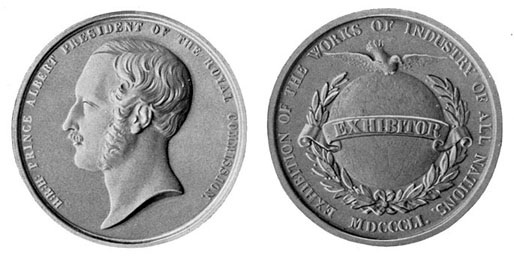
Bronze medal won by Mr. Hussey with his Reaper in England in 1851.
Arrival of the Prince
"There have been many other trials of Hussey's machine in different parts of the country, and the result has been so far uniformly satisfactory. Amongst these we have now to mention a very interesting one which took place by appointment last Saturday, at Windsor, in the presence of his Royal Highness, Prince Albert, originating in a correspondence between General Wemyss, on behalf of the Prince, and Messrs. Dray & Co. of Swan-lane, the agents for Mr. Hussey. The spot selected for the trial was behind the statue of George III, at the end of the Long Walk, fern—of which there is an abundance in that locality—being the article on which the machine had to operate. The Prince having from an early hour in the morning been engaged in shooting in the vicinity of the statue, at half-past twelve, resigned his gun, and proceeded on horseback, in company with General Wemyss and Col. Seymour, to the spot appointed for the trial of the machine. Dismounting from his horse, his Royal Highness saluted briefly and gracefully the assembled company, and especially Mr. Hussey and Mr. Dray. He then asked a few general questions respecting the history of the machine, and observed that as the ground selected was very uneven (it was in fact remarkably so) the trial would be a good one. After a brief delay, the gear being declared in order, on went the machine, drawn by two strong horses, and heedless of ruts and hillocks in its course, which was very rapid, bringing down every thing it encountered cleanly and completely, including two or three slices of turf at least a foot long, and more than an inch thick.
"The performances of the machine were not confined to one single course. A considerable amount of work was performed in the most satisfactory manner, Mr. Hussey himself sitting on the box at the side, and throwing aside what was cut down in the manner best adapted for gathering and binding. Indeed the work was not confined to the fern; a rabbit which was not accustomed to this species of interference was startled and cruelly lacerated before it had time to escape.