"A Story of Britain's Peril" (continued 2)
Reading edition
“Well, you know me well enough, Trustram, to be quite certain of my discretion. I never tell a soul any official information which may come to me—and I hear quite a lot from my Cabinet friends—as you may well imagine.”
“I do trust you, Mr Rodwell,” his friend replied. “If I did not, I should not have told you the many things I have regarding my own department.”
Lewin Rodwell smoked on, his legs crossed, his right hand behind his head as he gazed at his friend.
“Well, you arouse my curiosity when you say that the Admiralty have in store a surprise for us which we shall know later. Where is it to take place?”
Again Charles Trustram hesitated. Then he answered, with some reluctance:
“In the North Sea, I believe. A certain scheme has been arranged which will, we hope, prove effectual.”
“A trap, I suppose?”
Trustram laughed faintly.
“I didn’t tell you so, remember,” he said quickly.
“Ah, I see!—a trap to draw the German Fleet north—up towards Iceland. Is my surmise correct?”
Trustram’s smile was a silent affirmative. “This is indeed interesting,” Rodwell exclaimed. “I won’t breathe a word to anyone. When is it to be?”
“Within a week.”
“You mean in a week. To-day is Wednesday—next Wednesday will be the sixteenth.”
Again Trustram smiled, as Rodwell, with his shrewd intelligence, divined the truth.
“It’s all arranged—eh? And orders have been sent out to the Fleet?” asked the financier.
Again Trustram laughingly replied, “I didn’t say so,” but from his friend’s manner Lewin Rodwell knew that he had learnt the great and most valuable secret of the true intentions of the British Navy.
It was not the first piece of valuable information which he had wormed out of his official friends. So clever was he that he now pretended to be highly eager and enthusiastic over the probable result of the strategy.
“Let’s hope Von Tirpitz will fall into the trap,” he said. “Of course it will have to be very cunningly baited, if you are to successfully deceive him. He’s already shown himself to be an artful old bird.”
“Well—without giving anything away—I happen to know, from certain information passing through my hands, that the bait will be sufficiently tempting.”
“So we may expect to hear of a big naval battle about the sixteenth. I should say that it will, in all probability, be fought south of Iceland, somewhere off the Shetlands.”
“Well, that certainly is within the range of probability,” was the other’s response. “All I can tell you—and in the very strictest confidence, remember—is that the scheme is such a cleverly conceived one that I do not believe it can possibly fail.”
“And if it failed?”
“Well—if it failed,” Trustram said, hesitating and speaking in a lower tone—“if it failed, then no real harm would occur—only one thing perhaps: that the East Coast of England might be left practically unguarded for perhaps twelve hours or so. That’s all.”
“Well, that would not matter very much, so long as the enemy obtains no knowledge of the British Admiral’s intentions,” remarked Lewin Rodwell, contemplating the end of his cigar and reflecting for a few seconds.
Then he blurted out:
“Gad! that’s jolly interesting. I shall wait for next Wednesday with all eagerness.”
“You won’t breathe a word, will you? Remember, it was you who obtained the information by suggestion,” Trustram said, with a good-humoured laugh.
“Can’t you really rely on me, my dear fellow, when I give you my word of honour as an Englishman to say nothing?” he asked. “I expect I am often in the know in secrets of the Cabinet, and I am trusted.”
“Very well,” replied his friend. “I accept your promise. Not a word must leak out. If it did, then all our plans would be upset, and possibly it would mean the loss of one, or more, of our ships. But you, of course, realise the full seriousness of it all.”
“I do, my dear Trustram—I do,” was the reassuring answer. “No single whisper of it shall pass my lips. That, I most faithfully promise you.”
Chapter Eight.
Toilers of the North Sea.
Just as it was growing dark on the following evening, a powerful pale grey car, with cabriolet body, drew out of the yard of the quaint old Saracen’s Head Hotel at Lincoln, and, passing slowly through the town, set out on the straight, open road which led past Langworth station to Wragby, and on to Horncastle.
The occupant of the car, muffled up as though he were an invalid, had come in from London half an hour before, taken his tea in the coffee-room, and had resumed his journey, together with his smart, clean-shaven chauffeur.
Though he posed as an invalid at the Saracen’s Head, yet as soon as the car had left the town he threw off his thick muffler, opened his coat and drew a long sigh of relief.
Truth to tell, Mr Lewin Rodwell, whose photograph appeared so constantly in the picture-papers, was not over anxious to be seen in Lincoln, or, indeed, in that neighbourhood at all. With Penney, his trusted chauffeur—a man who, like himself, was a “friend of Germany”—he had set out from Bruton Street that morning, and all day they had sat side by side on their journey towards the Fens.
Many times, after chatting with Penney, he had lapsed into long spells of silence, during which time he had puffed vigorously at his cigar, and thought deeply.
Until, after about five miles, they passed Langworth station, they had been content with their side-lights, but soon they switched on the huge electric head-lamps, and then they “put a move on,” as Rodwell was anxious to get to his journey’s end as quickly as possible.
“You’ll drop me, as usual, at the three roads beyond Mumby. Then go into Skegness and put up for the night. Meet me at the same spot to-morrow morning at seven-thirty.”
“Very well, sir,” was the young man’s obedient reply.
“Let’s see,” remarked Rodwell. “When we were up in this lonely, forsaken part of the country a week ago, where did you put up?”
“The last time in Louth, sir. The time before in Lincoln, and the time before that in Grimsby. I haven’t been in Skegness for a full month.”
“Then go there, and mind and keep your mouth shut tight!”
“I always do, sir.”
“Yes, it pays you to do so—eh?” laughed Rodwell. “But I confess, Penney, that I’m getting heartily sick of this long journey,” he sighed, “compelled, as we are, to constantly go many miles out of our way in order to vary the route.”
“The road is all right in summer, sir, but it isn’t pleasant on a cold stormy night like this—especially when you’ve got a two-mile walk at the end of it.”
“That’s just it. I hate that walk. It’s so dark and lonely, along by that open dyke. Yet it has to be done; and, after all, the darker the night—perhaps the safer it is.” Then he lapsed again into silence, while the car—well-driven by Penney, who was an expert driver—flew across the broad open fenlands, in the direction of the sea.
The December night was dark, with rain driving against and blurring the windscreen, in which was a small oblong hole in the glass, allowing Penney to see the long, lonely road before him. Passing the station at Horncastle, they continued through the town and then up over the hill on the Spilsby road and over the wide gloomy stretch until, about half-past seven o’clock, after taking a number of intricate turns up unfrequented fen-roads, they found themselves passing through a small, lonely, ill-lit village. Beyond this place, called Orby, they entered another wide stretch of those low-lying marshes which border the North Sea on the Lincolnshire coast, marshes intersected by a veritable maze of roads, most of which were without sign-posts, and where, in the darkness, it was a very easy matter to lose one’s way.
But Penney—who had left the high road on purpose—had been over those cross-roads on many previous occasions. Indeed, he knew them as well as any Fenman, and without slackening speed or faltering, he at last brought the car to a standstill a few miles beyond the village of Mumby, at a point where three roads met about two miles from the sea.
It was still raining—not quite so heavily as before, but sufficiently to cause Rodwell to discard his fur-lined overcoat for a mackintosh. Then, having placed an electric flash-lamp in his pocket, together with a large bulky cartridge envelope, a silver flask and a packet of sandwiches, he took a stout stick from the car and alighting bade the young man good-night, and set forth into the darkness.
“I wonder whether I’ll be in time?” he muttered to himself in German, going forward as he bent against the cold driving rain which swept in from the sea. He usually spoke German to himself when alone. His way, for the first mile, was beside a long straight “drain,” into which, in the darkness, it would have been very easy to slip had he not now and then flashed on his lamp to reveal the path.
Beneath his breath, in German, he cursed the weather, for already the bottoms of his trousers were saturated as he splashed on through the mud, while the rain beat full in his face. Presently he came in sight of a row of cottage-windows at a place called Langham, and then, turning due north into the marshes, he at last, after a further mile, came to the beach whereon the stormy waters of the North Sea were lashing themselves into a white foam discernible in the darkness.
That six miles of low-lying coast, stretching from the little village of Chapel St. Leonards north to Sutton-on-Sea, was very sparsely inhabited—a wide expanse of lonely fenland almost without a house.
Upon that deserted, low-lying coast were two coastguard stations, one near Huttoft Bank and the other at Anderby Creek, and of course—it being war-time—constant vigil was kept at sea both night and day. But as the district was not a vulnerable one in Great Britain’s defences, nothing very serious was ever reported from there to the Admiralty.
By day a sleepy plain of brown and green marshes, by night a dark, cavernous wilderness, where the wild sea beat monotonously upon the shingle, it was a truly gloomy, out-of-the-world spot, far removed from the bustle of war’s alarm.
Lewin Rodwell, on gaining the beach at the end of a long straight path, turned without hesitation to the right, and walked to the south of the little creek of Anderby for some distance, until he suddenly ascended a low mound close by the sea, half-way between Anderby Creek and Chapel Point, and there before him stood a low-built fisherman’s cottage, partly constructed of wood, which by day was seen to be well-tarred and water-tight.
Within a few yards of the beach it stood, with two boats drawn up near and a number of nets spread out to dry; the home of honest Tom Small and his son, typical Lincolnshire fishermen, who, father and son, had fished the North Sea for generations.
At the Anchor, in Chapel St. Leonards, old Tom Small was a weekly visitor on Saturday nights, when, in that small, close-smelling bar-parlour, he would hurl the most bitter anathemas at the “All Highest of Germany,” and laugh his fleet to scorn; while at Anderby Church each Sunday morning he would appear in his best dark blue trousers, thick blue jacket and peaked cap, a worthy hardworking British fisherman with wrinkled, weatherbeaten face and reddish beard. He was of that hardy type of seafarer so much admired by the town-dweller when on his summer holiday, a man who, in his youth, had been “cox” of the Sutton lifeboat, and who had stirring stories to tell of wild nights around the Rosse Spit and the Sand Haile, the foundering of tramps with all hands, and the marvellous rescues effected by his splendid crew.
It was this man, heavily-booted and deep-voiced, by whom Lewin Rodwell was confronted when he tapped at the cottage door.
“Come, hurry up! Let me in!” cried Rodwell impatiently, after the door was slowly unlocked. “I’m soaked! This infernal neighbourhood of yours is absolutely the limit, Small. Phew!” and he threw down his soaked cap and entered the stone-flagged living-room, where Small’s son rose respectfully to greet him.
“Where are my other clothes?” he asked sharply, whereupon the weatherbeaten fisherman produced from an old chest in the corner a rough suit of grey tweeds, which Rodwell, carried to the inner room on the left, and quickly assumed.
“Pretty nice weather this!” he shouted cheerily to father and son, while in the act of changing his clothes. “Is all serene? Have you tested lately?”
“Yes, sir,” replied the elder man. “I spoke at five o’clock an’ told ’em you were coming. So Mr Stendel is waiting.”
“Good!” was Rodwell’s reply. “Anybody been looking around?”
“Not a soul to-day, sir. The weather’s been bad, an’ the only man we’ve seen is Mr Bennett, from the coastguard station, on his patrol. He was ’ere last night and had a drop o’ whisky with us.”
“Good?” laughed Rodwell. “Keep well in with the coastguard. They’re a fine body, but only a year or so ago the British Admiralty reduced them. It wasn’t their fault.”
“We do keep in with ’em,” was old Tom Small’s reply, as Rodwell re-entered the room in dry clothes. “I generally give ’em a bit o’ fish when they wants it, and o’ course I’m always on the alert looking out for periscopes that don’t appear,” and the shrewd old chap gave vent to a deep guttural laugh.
“Well now, Small, let’s get to work,” Rodwell said brusquely. “I’ve got some important matters on hand. Is all working smoothly?”
“Splendidly, sir,” answered the younger man. “Nothing could be better. Signals are perfect to-night.”
“Then come along,” answered the man who was so universally believed to be a great British patriot; and, turning the handle of the door on the right-hand side of the living-room, he entered a small, close-smelling bedroom, furnished cheaply, as the bedroom of a small struggling fisherman would be. The Smalls were honest, homely folk, the domestic department being carried on by Tom’s younger daughter, Mary, who at the moment happened to be visiting her married sister in Louth.
The son, Ted, having lit a petrol table-lamp—one of those which, filled with spirit, give forth gas from the porous block by which the petrol is absorbed and an intense light in consequence—Lewin Rodwell went to the corner of the room where an old curtain of crimson damask hung before a recess. This he drew aside, when, hanging in the recess, were shown several coats and pairs of trousers—the wardrobe of old Tom Small; while below was a tailor’s sewing-machine on a treadle stand—a machine protected by the usual wooden cover.
The latter he lifted; but beneath, instead of a machine for the innocent needle-and-cotton industry, there was revealed a long electrical tapping-key upon an ebonite base, together with several electrical contrivances which, to the uninitiated, would present a mysterious problem.
A small, neatly-constructed Morse printing machine, with its narrow ribbon of green paper passing through beneath a little glass cover protecting the “inker” from the dust; a cylindrical brass relay with its glass cover, and a tangle of rubber-insulated wires had been hidden beneath that square wooden cover, measuring two and a half feet by one.
Behind the sewing-machine stand, and cunningly concealed, there ran a thick cable fully two inches in diameter, which was nothing else but the shore-end of a submarine cable directly connecting the East Coast of England with Wangeroog, the most northerly of the East Frisian Islands, running thence across to Cuxhaven, at the mouth of the Elbe, and on by the land-line, via Hamburg, to Berlin.
The history of that cable was unknown and unsuspected by the British public, who, full of trust of the authorities, never dreamed that there could possibly be any communication from the English shore actually direct into Berlin. Five years before the declaration of war the German Government had approached the General Post Office, offering to lay down a new cable from Wangeroog to Spurn Head, in order to relieve some of the constantly increasing traffic over the existing cables from Lowestoft, Bacton and Mundesley. Long negotiations ensued, with the result that one day the German cable-ship Christoph passed the Chequer shoal and, arriving off the Spurn Lighthouse, put in the shore-end, landed several German engineers to conduct the electrical control-tests between ship and shore, and then sailed away back to Germany, paying out the cable as she went.
In due course, after the arranged forty days’ tests from Wangeroog to the Spurn, the cable was accepted by the General Post Office, and over it much of the telegraphic traffic between England and Germany had, for the past five years, been conducted.
On the declaration of war, however, telegraph engineers from York had arrived, excavated the cable out of the beach at the Spurn, and effectively cut the line, as all the lines connecting us with German stations had been severed. After that, the British postal authorities contented themselves that no further communication could possibly be established with the enemy, and the public were satisfied with a defiant isolation.
They were ignorant how, ten days after the cables had been cut, old Tom Small, his son and two other men, in trawling for fish not far from the shore, had one night suddenly grappled a long black snaky-looking line, and, after considerable difficulties, had followed it with their grapnels to a certain spot where, with the aid of their winch, they were able to haul it on board in the darkness.
Slimy and covered with weeds and barnacles, that strategic cable had been submerged and lay there, unsuspected, ready for “the Day,” for, truth to tell, the Spurn Head-Wangeroog cable had possessed a double shore-end, one of which had been landed upon British soil, while the other had been flung overboard from the German cable-ship four miles from land, while old Tom Small and his son had been established on shore in readiness to perform their part in dredging it up and landing it when required.
So completely and carefully had Germany’s plans been laid for war that Small, once an honest British fisherman, had unsuspectingly fallen into the hands of a certain moneylender in Hull, who had first pressed him, and had afterwards shown him an easy way out of his financial difficulties; that way being to secretly accept the gift of a small trawler, on condition that, any time his services were required by a strange gentleman who would come down from London and bring him instructions, he would faithfully carry them out.
In the middle of the month of August 1914 the mysterious gentleman had arrived, showed him a marked chart of the sea beyond the five-fathoms line at the Sand Haile, and had given him certain instructions, which he had been forced to carry out.
Not without great difficulty had the second shore-end of the cable been brought ashore at night just opposite his cottage, and dug into the sand at low water, the end being afterwards carried into the little bedroom in the cottage, where, a few days before, several heavy boxes had arrived—boxes which old Tom afterwards saw contained a quantity of electric batteries and weird-looking apparatus.
It was then that Lewin Rodwell arrived for the first time, and, among other accomplishments, being a trained telegraph electrician, he had set the instruments up upon the unsuspicious-looking stand of the big old sewing-machine.
Small, who daily realised and regretted the crafty machinations of the enemy in entrapping him by means of the moneylender in Hull, was inclined to go to the police, confess, and expose the whole affair.
Rodwell, with his shrewd intuition, knew this, and in consequence treated father and son with very little consideration.
Even as he stood in the room that night fingering the secret instruments, which he had just revealed by lifting the cover, he turned to the weatherbeaten old man and said, in a hard, sarcastic voice:
“You see the war is lasting longer than you expected, Small—isn’t it? I suppose you’ve seen all that silly nonsense in the papers about Germany being already at the end of her tether? Don’t you believe it. In a year’s time we shall have only just started.”
“Yes, sir,” replied the old fellow, in a thick voice. “But—well, sir, I—I tell you frankly, I’m growing a bit nervous. Mr Judd, from the Chapel Point coastguard, came ’ere twice last week and sat with me smokin’, as if he were a-tryin’ to pump me.”
“Nervous, be hanged, Small. Don’t be an idiot!” Rodwell replied quickly. “What can anybody know, unless you yourself blab? And if you did—by Gad! your own people would shoot you as a traitor at the Tower of London—you and your boy too! So remember that—and be very careful to keep a still tongue.”
“But I never thought, when that Mr Josephs, up in London, wrote to me sending me a receipt for the money I owed, that I was expected to do all this!” Small protested.
“No, if you had known you would never have done it!” laughed Rodwell. “But Germany is not like your gallant rule-of-thumb England. She leaves nothing to chance, and, knowing the cupidity of men, she takes full advantage of it—as in your case.”
“But I can’t bear the suspense, sir; I feel—I feel, Mr Rodwell—that I’m suspected—that this house is under suspicion—that—”
“Utter bosh! It’s all imagination, Small,” Lewin Rodwell interrupted. “They’ve cut the cable at the Spurn, and that’s sufficient. Nobody in England ever dreams that the German Admiralty prepared for this war five years ago, and therefore spliced a second end into the cable.”
“Well, I tell you, sir, I heartily wish I’d never had anything to do with this affair,” grumbled old Tom.
“And if you hadn’t you’d have been in Grimsby Workhouse instead of having six hundred and fifty-five pounds to your credit at the bank in Skegness. You see I know the exact amount. And that amount you have secured by assisting the enemy. I know mine is a somewhat unpalatable remark—but that’s the truth, a truth which you and your son Ted, as well as your two brothers must hide—if you don’t want to be tried by court-martial and shot as traitors, the whole lot of you.”
The old fisherman started at those words, and held his breath.
“We won’t say any more, Tom, on that delicate question,” Rodwell went on, speaking in a hard, intense voice. “Just keep a dead silence, all of you, and you’ll have nothing to fear or regret. If you don’t, the punishment will fall upon you; I shall take good care to make myself secure—depend upon that!”
“But can’t we leave this cottage? Can’t we get away?” implored the old fellow who had innocently fallen into the dastardly web so cleverly spun by the enemy.
“No; you can’t. You’ve accepted German money for five years, and Germany now requires your services,” was Rodwell’s stern, brutal rejoinder. “Any attempt on your part to back out of your bargain will result in betraying you to your own people. That’s plain speaking! You and your son should think it over carefully together. You know the truth now. When Germany is at war she doesn’t fight in kid-gloves—like your idiotic pigs of English!”
Chapter Nine.
To “Number 70 Berlin.”
Lewin Rodwell, as a powerful and well-informed secret agent, was no amateur.
After the old fisherman had left the close atmosphere of that little room, Rodwell seated himself on a rickety rush-bottomed chair before the sewing-machine stand, beside the bed, and by the bright light of the petrol table-lamp, carefully and with expert touch adjusted the tangle of wires and the polished brass instruments before him.
The manner in which he manipulated them showed him to be perfectly well acquainted with the due importance of their adjustment. With infinite care he examined the end of the cable, unscrewing it from its place, carefully scraping with his clasp-knife the exposed copper wires protruding from the sheath of gutta percha and steel wire, and placing them each beneath the solid brass binding-screws upon the mahogany base.
“The silly old owl now knows that we won’t stand any more nonsense from him,” he muttered to himself, in German, as he did this. “It’s an unsavoury thought that the old fool, in his silly patriotism, might blab to the police or the coastguard. Phew! If he did, things would become awkward—devilish awkward.”
Then, settling himself before the instruments, he took from his inner pocket the long, bulky envelope, out of which he drew a sheet of closely-written paper which he spread out upon the little table before him. Afterwards, with methodical exactness, he took out a pencil and a memorandum-block from his side-pocket, arranging them before him.
Again he examined the connections running into the big, heavy tapping-key, and then, grasping the ebonite knob of the latter, he ticked out dots and dashes in a manner which showed him to be an expert telegraphist.
“M.X.Q.Q.” were the code-letters he sent. “M.X.Q.Q.” he clicked out, once—twice—thrice. The call, in the German cable war-code, meant: “Are you ready to receive message?”
He waited for a reply. But there was none. The cable that ran for three hundred miles, or so, beneath the black, storm-tossed waters of the North Sea was silent.
“Curious!” he muttered to himself. “Stendel is generally on the alert. Why doesn’t he answer?”
“M.X.Q.Q.” he repeated with a quick, impatient touch. “M.X.Q.Q.”
Then he waited, but in vain.
“Surely the cable, after the great cost to the Empire, has not broken down just at the very moment when we want it!” he exclaimed, speaking in German, as was his habit when excited.
Again he sent the urgent call beneath the waters by the only direct means of communication between Britain’s soil and that of her bitter enemy.
But in Tom Small’s stuffy little bedroom was a silence that seemed ominous. Outside could be heard the dull roar of the sea, the salt spray coming up almost to the door. But there was no answering click upon the instruments.
The electric current from the rows of batteries hidden in the cellar was sufficient, for he had tested it before he had touched the key.
“Tom,” he shouted, summoning the old fisherman whom he had only a few moments before dismissed.
“Yes, sir,” replied the old fellow gruffly, as he stalked forward again, in his long, heavy sea-boots.
“The cable’s broken down, I believe! What monkey-tricks have you been playing—eh?” he cried angrily.
“None, sir. None, I assure you. Ted tested at five o’clock this evening, as usual, and got an acknowledgment. The line was quite all right then.”
“Well, it isn’t now,” was Rodwell’s rough answer, for he detected in the old man’s face a secret gleaming satisfaction that no enemy message could be transmitted.
“I believe you’re playing us false, Small!” cried Rodwell, his eyes flashing angrily. “By Gad! if you have dared to do so you’ll pay dearly for it—I warn you both! Now confess!”
“I assure you, sir, that I haven’t. I was in here when Ted tested, as he does each evening. All was working well then.”
The younger man, a tall, big-limbed, fair-haired toiler of the sea, in a fisherman’s blouse of tanned canvas like his father, overhearing the conversation, entered the little room.
“It was all right at five, sir. I made a call, and got the answer.”
“Are you sure it was answered—quite sure?” queried the man from London.
“Positive, sir.”
“Then why in the name of your dear goddess Britannia, who thinks she rules the waves, can’t I get a reply now?” demanded Rodwell furiously.
“How can I tell, sir? I got signals—good strong signals.”
“Very well. I’ll try again. But remember that you and your father are bound up to us. And if you’ve played us false I shall see that you’re both shot as spies. Remember you won’t be the first. There’s Shrimpton, up at Gateshead, Paulett at Glasgow, and half a dozen more in prison paying the penalty of all traitors to their country. The British public haven’t yet heard of them. But they will before long—depend upon it. The thing was so simple. Germany, before the war, held out the bait for your good King-and-country English to swallow. That you English—or rather a section of you—will always swallow the money-bait we have known ever so long ago.”
“Mr Rodwell, you needn’t tell us more than we know,” protested the old fisherman. “You and your people ’ave got the better of us. We know that, to our cost, so don’t rub it in.”
“Ah! as long as you know it, that’s all right,” laughed Rodwell. “When the invasion comes, as it undoubtedly will, very soon, then you will be looked after all right. Don’t you or your son worry at all. Just sit tight, as this house is marked as the house of friends. Germany never betrays a friend—never!”
“Then they do intend to come over here?” exclaimed the old fisherman eagerly, his eyes wide-open in wonderment.
“Why, of course. All has been arranged long ago,” declared the man whom the British public knew as a great patriot. “The big expeditionary force, fully fit and equipped, has been waiting in Hamburg, at Cuxhaven and Bremerhaven, ever since the war began—waiting for the signal to start when the way is left open across the North Sea.”
“That will never be,” declared the younger man decisively.
“Perhaps not, if you have dared to tamper with the cable,” was Rodwell’s hard reply.
“I haven’t, I assure you,” the young man declared. “I haven’t touched it.”
“Well, I don’t trust either of you,” was Rodwell’s reply. “You’ve had lots of money from us, yet your confounded patriotism towards your effete old country has, I believe, caused you to try and defeat us. You’ve broken down the cable—perhaps cut the insulation under the water. How do I know?”
“I protest, Mr Rodwell, that you should insinuate this!” cried old Tom. “Through all this time we’ve worked for you, and—”
“Because you’ve been jolly well paid for it,” interrupted the other. “What would you have earned by your paltry bit of fish sent into Skegness for cheap holiday-makers to eat?—why, nothing! You’ve been paid handsomely, so you needn’t grumble. If you do, then I have means of at once cutting your supplies off and informing the Intelligence Department at Whitehall. Where would you both be then, I wonder?”
“We could give you away also!” growled Ted Small.
“You might make charges. But who would believe you if you—a fisherman—declared that Lewin Rodwell was a spy—eh? Try the game if you like—and see!”
For a few moments silence fell.
“Well, sir,” exclaimed Ted’s father. “Why not call up again? Perhaps Mr Stendel may be there now.”
Again Rodwell placed his expert hand upon the tapping-key, and once more tapped out the call in the dot-and-dash of the Morse Code.
For a full minute all three men waited, holding their breath and watching the receiver.
Suddenly there was a sharp click on the recorder. “Click—click, click, click!”
The answering signals were coming up from beneath the sea.
“B.S.Q.” was heard on the “sounder,” while the pale green tape slowly unwound, recording the acknowledgment.
Stendel was there, in the cable-station far away on the long, low-lying island of Wangeroog—alert at last, and ready to receive any message from the secret agents of the All Highest of Germany.
“B.S.Q.—B.S.Q.”—came up rapidly from beneath the sea. “I am here. Who are you?” answered the wire rapidly, in German.
Lewin Rodwell’s heart beat quickly when he heard the belated reply to his impatient summons. He had fully believed that a breakdown had occurred. And if so, it certainly could never be repaired.
But a thrill of pleasure stirred him anew when he saw that his harsh and premature denunciation of the Smalls had been unwarranted, and the cable connection—so cunningly contrived five years before, was working as usual from shore to shore.
Cable-telegraphy differs, in many respects, from ordinary land-telegraphy, especially in the instruments used. Those spread out before Rodwell were, indeed, a strange and complicated collection, with their tangled and twisted wires, each of which Rodwell traced without hesitation.
In a few seconds his white, well-manicured and expert hand was upon the key again, as the Smalls returned to their living-room, and he swiftly tapped out the message in German:
“I am Rodwell. Are you Stendel? Put me through Cuxhaven direct to Berlin: Number Seventy: very urgent.”
“Yes,” came the reply. “I am Stendel. Your signals are good. Wait, and I will put you through direct to Berlin.”
The “sounder” clicked loudly, and the clockwork of the tape released, causing the narrow paper ribbon to unwind.
“S.S.” answered Rodwell, the German war-code letters for “All right. Received your message and understand it.”
Then he took from his pocket his gold cigarette-case, which bore his initials in diamonds on the side, and selecting a cigarette, lit it and smoked while waiting for the necessary connections and relays to be made which would enable him to transmit his message direct to the general headquarters of the German Secret Service in the Koeniger-gratzerstrasse, in Berlin.
In patience he waited for a full ten minutes in that close little room, watching the receiving instrument before him. The angry roar of the wintry sea could be heard without, the great breakers rolling in upon the beach, while every now and then the salt spindrift would cut sharply across the little window, which rattled in the gusty wind.
Click—click—click! The long letter T repeated three times. Then a pause, and the call “M.X.Q.Q.—J.A.J.70.”
By the prefix, Rodwell knew that he was “through,” and actually in communication with the headquarters of the German espionage throughout the world; that marvellously alert department from which no secret of state, or of hostile army or navy was safe; the department formed and controlled by the great Steinhauer, who had so many times boasted to him, and perhaps with truth, that at the Koeniger-gratzerstrasse they knew more of England than even the English themselves knew.
True, the British public will never be able to realise one hundredth part of what Germany has done by her spy-system, or of the great diplomatic and military successes which she has achieved by it. Yet we know enough to realise that for years no country and no walk of life—from the highest to the lowest—has been free from the ubiquitous, unscrupulous and unsuspected secret agents of whom Lewin Rodwell was a type.
In Germany’s long and patient preparation for the world-war, nothing in the way of espionage was too large, or too small for attention. The activity of her secret agents in Berlin had surely been an object-lesson to the world. Her spies swarmed in all cities, and in every village; her agents ranked among the leaders of social and commercial life, and among the sweepings and outcasts of great communities. The wealthiest of commercial men did not shrink from acting as her secret agents. She was not above employing beside them the very dregs of the community. No such system had ever been seen in the world. Yet the benefits which our enemies were deriving from it, now that we were at war, were incalculable.
By every subtle and underhand means in her power, Germany had prepared for her supreme effort to conquer us, and, as a result of this it was that Lewin Rodwell that night sat at the telegraph-key of the Berlin spy-bureau actually established on British soil.
He waited until the call had been repeated three times with the secret code-number of the Koeniger-gratzerstrasse, namely: “Number 70 Berlin.”
Then, putting out his cigarette, he drew his chair forward until his elbows rested upon the table, and spreading out the closely-written document before him, tapped out a signal in code.
The letters were “F.B.S.M.”
To this kind of pass-word, which was frequently altered from time to time, he received a reply: “G.L.G.S.” and then he added his own number, “0740.”
The signals exchanged were quite strong, and he drew a long breath of relief and satisfaction.
Then, settling down to his dastardly work, he began to tap out rapidly the following in German:
“On Imperial War Service. Most Urgent. From 0740 to Berlin 70. Transmitted Personally.
“Source of information G.27, British Admiralty. Lieutenant Ralph Beeton, Grenadier Guards, British secret agent, is at present staying at Kaiserhof Hotel, Berlin, as James B. James, an American citizen, of Fernville, Kansas, and is transmitting reports. Captain Henry Fordyce, British Navy, is at Park Hotel, Düsseldorf, as Francis Dexter, iron merchant of New Orleans, and has sent reports regarding Erhardt’s ordnance factory. Both should be arrested at once. Lieutenant George Evans, reported at Amsterdam on the 5th, has gone to Emden, and will probably be found at the Krone Hotel.”
Then he paused. That message had, he knew, sealed the fate of three brave Englishmen who had dared to enter the camp of our enemies. They would be arrested within an hour or so, and most certainly shot as spies. His face broadened into an evil grin of satisfaction as the truth crossed his mind.
He waited for an acknowledgment that his report had been received. Then, having listened to the answering click—clickety—click, he sent a second message as follows:—
“British Naval Dispositions: Urgent to Q.S.R.
“Source of information H.238. To-night, off the Outer Skerries, Shetlands, are battleships King Charles (flag), Mole, Wey, Welland, Teign, Yare, Queen Boadicea, Emperor of India, King Henry VIII; with first-class cruisers Hogue, Stamford, Petworth, Lichfield, Dorchester; second-class cruisers Rockingham, Guildford, Driffield, Verulam, Donnington, Pirbright, Tremayne and Blackpool; destroyers Viking, Serpent, Chameleon, Adder, Batswing, Sturdy and Havoc, with eight submarines, the aircraft-ship Flyer, and repair-ship Vulcan. Another strong division left Girdle Ness at 4 p.m. coming south. The division in Moray Firth remains the same. Trusty, Dragon, Norfolk and Shadower left Portsmouth this evening going east. British Naval war-code to be altered at midnight to 106-13.”
The figures he spelt out very carefully, repeating them three times so that there could be no mistake. Again he paused until, from Berlin, they were repeated for confirmation.
Afterwards he proceeded as follows:
“Ruritania leaves Liverpool for New York at noon to-morrow, carrying bullion. Also liners Smyrna, Jacob Elderson, City of Rotterdam and Great Missenden leave same port for Atlantic ports to-morrow. Submarines may be advised by wireless.”
Once more he paused until he received the signal of acknowledgment, together with the query whether the name of one of the ships mentioned was Elderson or Elderton. But Lewin Rodwell, with keen interest in his fell work of betraying British liners into the hands of the German pirate submarines, quickly tapped out the correct spelling, repeating it, so that there should be no further mistake.
After yet another pause, the man seated in the fisherman’s stuffy little bedroom grasped the telegraph-key and made the signals—“J.O.H.J.”—which, in the German war-code, meant: “Take careful note and report to proper quarter instantly.”
“All right,” came the answering signal, also in code. “Prepared to receive J.O.H.J.”
Then, after a few seconds, Rodwell glanced again at the closely-written sheet spread before him, and began to tap out the following secret message in German to the very heart of the Imperial war-machine:
“Official information just gained from a fresh and most reliable source—confirmed by H.238, M.605, and also B.1928—shows that British Admiralty have conceived a clever plan for entrapping the German Grand Fleet. Roughly, the scheme is to make attack with inferior force upon Heligoland early on Wednesday morning, the 16th, together with corresponding attack upon German division in the estuary of the Eider and thus draw out the German ships northward towards the Shetlands, behind which British Grand Fleet are concealed in readiness. This concentration of forces northward will, according to the scheme of which I have learned full details, leave the East coast of England from the Tyne to the Humber unprotected for a full twelve hours on the 16th, thus full advantage could be taken for bombardment. Inform Grand Admiral immediately.”
Having thus betrayed the well-laid plans of the British Admiralty to entice the German Fleet out of the Kiel canal and the other harbours in which barnacles were growing on their keels, Lewin Rodwell, the popular British “patriot,” paused once more.
But not for long, because, in less than a minute, he received again the signal of acknowledgment that his highly interesting message to the German Admiralty had been received, and would be delivered without a moment’s delay.
Then he knew that the well-organised plans of the British Fleet, so cleverly conceived and so deadly if executed, would be effectively frustrated.
He gave the signal that he had ended his message and, with a low laugh of satisfaction, rose from the rickety old chair and lit another cigarette.
Thus had England been foully betrayed by one of the men whom her deluded public most confidently trusted and so greatly admired.
Chapter Ten.
The Khaki Cult.
Twenty-four hours later Lewin Rodwell was standing upon the platform of the big Music Hall, in George Street, Edinburgh, addressing a great recruiting meeting.
The meeting, presided over by a well-known Scotch earl, had already been addressed by a Cabinet Minister; but when Rodwell rose, a neat, spruce figure in his well-fitting morning-coat, with well-brushed hair, and an affable smile, the applause was tremendous—even greater than that which had greeted the Minister.
Lewin Rodwell was a people’s idol—one of those who, in these times, are so suddenly placed high upon the pedestal of public opinion, and as quickly cast down.
A man’s reputation is made to-day and marred to-morrow. Rodwell’s rapid rise to fortune had certainly been phenomenal. Yet, as he had “made money in the City”—like so many other people—nobody took the trouble to inquire exactly how that money had been obtained. By beating the patriotic drum so loudly he stifled down inquiry, and the public now took him at his own valuation.
A glib and forceful orator, with a suave, persuasive manner, at times declamatory, but usually slow and decisive, he thrust home his arguments with unusual strength and power.
In repeating Lord Kitchener’s call for recruits, he pointed to the stricken fields of Belgium, recalling those harrowing scenes of rapine and murder, in August, along the fair valley of the Meuse. He described, in vivid language, the massacre in cold blood of seven hundred peaceful men, women and young children in the little town of Dinant-sur-Meuse, the town of gingerbread and beaten brass; the sack of Louvain, and the appalling scenes in Liège and Malines, at the same time loudly denouncing the Germans as “licentious liars” and the “spawn of Satan.” From his tongue fell the most violent denunciations of Germany and all her ways, until his hearers were electrified by his whole-souled patriotism.
“The Kaiser,” he cried, “is the Great Assassin of civilisation. There is now ample evidence, documentary and otherwise, to prove that he, the Great War Lord, forced this great war upon the world at a moment which he considered propitious to himself. We now, alas I know that as far back as June 1908 the Kaiser assembled his Council and, in a secret speech, declared war against England. You, ladies and gentlemen, have been bamboozled and befooled all along by a Hush-a-bye Government who told you that there never would be war:” emphatic words which were met with loud yells of “Shame!” and execration.
“The Cabinet,” he continued, “knew all along—they knew as far back as 1908—that this Mad Dog of Germany intended to strangle and crush us. Yet, what did they do? They told you—and you believed them—that we should never have war—not in our time, they said; while in the House of Commons they, knowing what they did, actually suggested disarmament! Think of it!”
Renewed cries of “Shame!” rose from all parts of the hall.
“Well,” Lewin Rodwell went on, clenching his fist, “we are at war—a war the result of which no man can, as yet, foresee. But win we must—yet, if we are to win, we must still make the greatest sacrifices. We must expend our last shilling and our last drop of blood if victory is at last to be ours. Germany, the mighty country of the volte-face, with her blood-stained Kaiser at her head, has willed that Teuton ‘kultur’ shall crush modern civilisation beneath the heel of its jack-boot. Are you young men of Scotland to sit tight here and allow the Germans to invade you, to ruin and burn your homes, and to put your women and children to the sword? Will you actually allow this accursed race of murderers, burglars and fire-bugs to swarm over this land which your ancestors have won for you? No! Think of the past history of your homes and your dear ones, and come forward now, to-night, all of you of military age, and give in your names for enlistment! Come, I implore of you!” he shouted, waving his arms. “Come forward, and do your duty as men in the service of mankind—your duty to your King, your country, and your God!”
His speech, of which this was only one very small extract, was certainly a brilliant and telling one. When he sat down, not only was there a great thunder of applause while the fine organ struck up “Rule Britannia,” but a number of strong young men, in their new-born enthusiasm, rose from the audience and announced their intention of enlisting.
“Excellent!” cried Rodwell, rising again from his chair. “Here are brave fellows ready to do their duty! Come, let all you slackers follow their example and act as real honest, patriotic men—the men of the Scotland of history!”
This proved an incentive to several waverers. But what, indeed, would that meeting have thought had they caught the words the speaker whispered in German beneath his breath, as he reseated himself? “More cannon-fodder,” he had muttered, though his face was brightened by a smile of supreme satisfaction of a true Briton, for he had realised by his reception there in Edinburgh, where audiences were never over-demonstrative, how exceedingly popular he was.
Afterwards he had supper at the Caledonian Hotel with the Cabinet Minister whom he had supported; and later, when he retired to his room, he at once locked the door, flung off his coat, and threw himself into the armchair by the fire to smoke and think.
He was wondering what action his friends at Number 70 Berlin were taking in consequence of the report he had made on the previous night. On Wednesday the north-east coast of England would be left unguarded. What, he wondered, would happen to startle with “frightfulness” the stupid English, whom he at heart held in such utter contempt?
That same night Jack Sainsbury was on his way home in a taxi from the theatre with Elise. They had spent a delightful evening together. Mrs Shearman had arranged to accompany them, but at the last moment had been prevented by a headache. The play they had seen was one of the spy-plays at that moment so popular in London; and Elise, seated at his side, was full of the impressions which the drama had left upon her.
“I wonder if there really are any spies still among us, Jack?” she exclaimed, as, with her soft little hand in his, they were being whirled along up darkened Regent Street in the direction of Hampstead.
“Alas! I fear there are many,” was her lover’s reply. “Poor Jerrold told me many extraordinary things which showed how cleverly conceived is this whole plot against England.”
“But surely you don’t think that there are really any spies still here. There might have been some before the war, but there can’t be any now.”
“Why not, dearest?” he asked very seriously. He was as deeply in love with her as she was with him. “The Germans, having prepared for war for so many years, have, no doubt, taken good care to establish many thoroughly trustworthy secret agents in our midst. Jerrold often used to declare how certain men, who were regarded as the most honest, true John Bull Englishmen, were actually in the service of the enemy. As an instance, we have the case of Frederic Adolphus Gould, who was arrested at Rochester last April. He was a perfect John Bull: he spoke English without the slightest trace of accent; he hated Germany and all her works, and he was most friendly with many naval officers at Chatham. Yet he was discovered to be a spy, having for years sent reports of all our naval movements to Germany, and in consequence he was sent to penal servitude for six years. In the course of the inquiries it was found that he was a German who had fought in the Franco-German war, and was actually possessed of the inevitable iron cross!”
“Impossible!” cried the girl, in her sweet, musical voice.
“But it’s all on record! The fellow was a dangerously clever spy; and no doubt there are many others of his sort amongst us. Jerrold declared so, and told me how the authorities, dazzled by the glamour of Teuton finance, were, unfortunately, not yet fully awake to the craft and cunning of the enemy and the dangers by which we are beset.”
Then he lapsed into silence.
“Your friend Dr Jerrold took a very keen interest in the spy-peril, didn’t he?”
“Yes, dear. And I frequently helped him in watching and investigating,” was his reply. “In the course of our inquiries we often met with some very strange adventures.”
“Did you ever catch a spy?” she asked, quickly interested, for the subject was one upon which Jack usually avoided speaking.
“Yes, several,” was his brief and rather vague reply. The dead man’s discretion was reflected upon him. He never spoke of his activity more frequently than was necessary. In such inquiries silence was golden.
“And you really think there are many still at large?”
“I know there are, Elise,” he declared quickly. “The authorities are, alas! so supine that their lethargy is little short of criminal. Poor Jerrold foresaw what was happening. He had no axe to grind, as they have at the War Office. To-day the policy of the Government seems to be to protect the aliens rather than interfere with them. Poor Jerrold’s exposure of the unsatisfactory methods of our bureau of contra-espionage to a certain member of Parliament will, I happen to know, be placed before the House ere long. Then matters may perhaps be remedied. If they are not, I really believe that the long-suffering public will take affairs into their own hands.”
“But I don’t understand what spies have done against us,” queried Elise, looking into her lover’s face in the furtive light of the street-lamp they were at that moment passing. Her question was quite natural to a woman.
“Done!” echoed her fine manly lover. “Why, lots of our disasters have been proved to be due to their machinations. The authorities well know that all our disasters do not appear in the newspapers, for very obvious reasons. Look what spies did in Belgium! Men who had lived in that country all their lives, believed to be Belgians and occupying high and responsible positions—men who were deeply respected, and whose loyalty was unquestioned—openly revealed themselves as spies of the Kaiser, and betrayed their friends the instant the Germans set foot on Belgian soil. All has long ago been prepared for an invasion of Great Britain, and when ‘the Day’ comes we shall, depend upon it, receive a very rude shock, for the same thing will certainly happen.”
“How wicked it all is!” she remarked.
“All war is ‘wicked,’ dearest,” was the young man’s slow reply. “Yet I only wish I were fit enough to wear khaki.”
“But you can surely do something at home,” she suggested, pressing his hand. “There are many things here to do, now that you’ve left the City.”
“Yes, I will do something. I must, and I will!” he declared earnestly.
A silence again fell between them.
“It is a great pity poor Dr Jerrold died as he did,” the girl remarked thoughtfully at last. “I met him twice with you, and I liked him awfully. He struck me as so thoroughly earnest and so perfectly genuine.”
“He was, Elise. When he died—well—I—I lost my best friend,” and he sighed.
“Yes,” she answered. “And he was doing such a good work, patiently tracing out suspicious cases of espionage.”
“He was. Yet by so doing he, like all true patriots, got himself strangely disliked, first by the Germans themselves, who hated him, and secondly by the Intelligence Department.”
“The latter were jealous that he, a mere civilian doctor, should dare to interfere, I suppose,” remarked the girl thoughtfully.
“The khaki cult is full of silly jealousies and petty prejudices.”
“Exactly. It was a very ridiculous situation. Surely the man in khaki cannot pursue inquiries so secretly and delicately as the civilian. The Scotland Yard detective does not go about dressed in the uniform of an inspector. Therefore, why should an Intelligence officer put on red-tabs in order to make himself conspicuous? No, dearest,” he went on; “I quite agree with the doctor that the officials whose duty it is to look after spies have not taken sufficient advantage of patriotic civilians who are ready to assist them.”
“Why don’t you help them, Jack?” suggested the girl. “You assisted Dr Jerrold, and you know a great deal regarding spies and their methods. Yet you are always so awfully mysterious about them.”
“Am I, darling?” he laughed, carrying her hand tenderly to his lips and kissing it fondly.
“Yes, you are,” she protested quickly. “Do tell me one thing—answer me one question, Jack. Have you any suspicion in one single case?—I mean do you really know a spy?”
Jack hesitated. He drew a long breath, as again across his troubled mind flashed that thought which had so constantly obsessed him ever since that afternoon before Jerome Jerrold had died so mysteriously.
“Yes, Elise,” he answered in a thick voice. “Yes, I do.”
Chapter Eleven.
The Enemy’s Cipher.
The afternoon of December 16th, 1914—the 135th day of the war—was grey and gloomy in Northumberland Avenue, that short thoroughfare of high uniform hotels and buildings.
The street-lamps had just been lit around Trafalgar Square when Lewin Rodwell passed out of the big hall of the Constitutional Club, and down the steps into the street. At the moment a newsboy dashed past crying the evening papers.
The words that fell upon Rodwell’s ear caused him to start; and, stopping the lad, he purchased a paper, and, halting, read the bold, startling headlines: “Bombardment of the East Coast this morning: Great destruction of seaside towns.”
“Ach!” he murmured with a grin of satisfaction. “Ach! Number 70 was not slow in acting upon my message. Instead of the German Fleet falling into the trap, they have taught these pigs of English a lesson. Not long ago one Minister declared that if the German Fleet did not come out of the Kiel Canal, that the brave British would dig them like rats out of a hole. Good! They have come out to respond to that challenge,” and he laughed in grim satisfaction. “Let’s see what they’ve done.”
Turning upon his heel, in his eagerness to learn the truth, he reascended the broad steps of the Club, and in the hall seated himself and eagerly devoured the account which, at that moment, was thrilling the whole country.
The paper stated, as all will remember, that the German ships having, by some extraordinary and unknown means, succeeded in evading the diligent watch kept upon them in the North Sea, had appeared on the Yorkshire coast early that morning. A German battleship, together with several first-class cruisers, had made a raid, and shelled Hartlepool, Scarborough and Whitby. At the three towns bombarded much damage was done, hotels, churches and hospitals being struck; and, according to the casualty list at that moment available, twenty-nine persons had been killed and forty-six wounded at Hartlepool; two killed and two wounded at Whitby, and thirteen casualties in Scarborough. The paper added that the list of casualties was believed to be very much greater, and would, it was thought, amount to quite two hundred. British patrol boats had endeavoured to cut off the Germans, whereupon the latter had fled.
Lewin Rodwell, having read the leading article, in which the journal loudly protested against the bombardment of undefended towns, and the ruthless slaughter of women and children, cast the paper aside, rose and again went out.
As he walked in the falling twilight towards Pall Mall, he laughed lightly, muttering in German, beneath his breath: “That is their first taste of bombardment! They will have many yet, in the near future. They laugh at our Zeppelins now. But will they laugh when our new aircraft bases are ready? No. The idiots, they will not laugh when we begin to drop bombs upon London!”
And, hailing a taxi, he entered it and drove home to Bruton Street, where Sir Boyle Huntley was awaiting him.
The man with the bloated, red face and loose lips greeted his friend warmly as he entered the quiet, cosy study. Then when Franks, Rodwell’s man, had pulled down the blinds and retired, he exclaimed:
“Seen this evening’s paper? Isn’t it splendid, Lewin! All your doing, my dear fellow. You’ll get a handsome reward for it. Trustram is very useful to us, after all.”
“Yes,” was the other’s reply. “He’s useful—but only up to a certain point. My only regret is that we haven’t a real grip upon him. If we knew something against him—or if he’d borrowed money from one of our friends—then we might easily put on the screw, and learn a lot. As it is, he’s careful to give away but little information, and that not always trustworthy.”
“True,” was Sir Boyle’s reply. “But could we not manage to entice him into our fold? We’ve captured others, even more wary than he, remember.”
“Ah! I wish I could see a way,” replied Rodwell reflectively, as he stood before his own fireplace, his hands thrust deep into his trousers pockets.
“To my mind, Lewin, I foresee a danger,” said the stout man, tossing his cigarette-end into the grate as he rose and stood before his friend.
“How?”
“Well—last night I happened to be at the theatre, and in the stalls in front of me sat Trustram with young Sainsbury, the fellow whom we dismissed from the Ochrida office.”
“Sainsbury!” gasped the other. “Is he on friendly terms with Trustram, do you think?”
“I don’t think, my dear fellow—I am certain,” was the reply. “He had his girl with him, and all three were laughing and chatting merrily together.”
“His girl? Let me see, we had him watched a few days ago, didn’t we? That’s a girl living up at Hampstead—daughter of a Birmingham tool-manufacturer, Elise Shearman, isn’t she?” remarked Rodwell slowly, his eyebrows narrowing as he spoke.
“I believe that was the name. Olsen watched and reported, didn’t he?” asked the Baronet.
“Yes. I must see him. That young fellow is dangerous to us, Boyle—distinctly dangerous! He knows something, remember, and he would have told his friend Jerrold—if the latter had not conveniently died just before his visit to Wimpole Street.”
“Yes. That was indeed a lucky incident—eh?”
“And now he is friendly with Charles Trustram. How did they meet, I wonder?”
“Trustram was, of course, a friend of Jerrold’s.”
“Ah—I see. Well, we must lose no time in acting,” exclaimed Lewin Rodwell in a low, hard voice. “I quite realise the very grave and imminent danger. We may be already suspected by Trustram.”
“Most probably, I think. We surely can’t afford to court disaster any further.”
“No,” was Rodwell’s low, decisive answer, and he drew a long breath. “We must act—swiftly and effectively.”
And then he lapsed into a long silence, during which his active brain was ardently at work in order to devise some subtle and deadly plan which should crush out suspicion and place them both in a position of further safety.
At the moment, the British public believed both men to be honest, patriotic supporters of the Government—men who were making much sacrifice for the country’s welfare.
What if the horrible and disgraceful truth ever became revealed? What if they were proved to be traitors? Why, a London mob would undoubtedly lynch them both, and tear them limb from limb!
One man in England knew the truth—that was quite plain—and that man was young Sainsbury, the clerk who had accidentally overheard those indiscreet words in the boardroom in Gracechurch Street.
Lewin Rodwell, though ever since that afternoon when he had been so indiscreet he had tried to hide the truth from himself, now realised that, at all hazards, the young man’s activity must be cut short, and his mouth closed.
Sir Boyle remained and dined with him. As a bachelor, and an epicure, Lewin Rodwell always gave excellent dinners, dinners that were renowned in London. He had a French chef to whom he paid a big salary—a man who had been chef at Armenonville, in the Bois, in Paris. Upon his kitchen Rodwell spared nothing, hence when any of those men—whom he afterwards so cleverly made use of to swell his bank-balance—accepted his hospitality they knew that the meal would be perhaps the best procurable in all London.
Many are the men-about-town who pride themselves upon their knowledge of the gastronomic art, and talk with loving reflections of the soups, entrées, and what-not, that they have eaten. Most of such men are what may be termed “hotel epicures.” They swallow the dishes served at the fashionable hotels—dishes to the liking of their own palates possibly—smack their lips, pay, and are satisfied. But the real epicure—and he is indeed a rara avis—is the one who knows that the thin-sliced grey truffle, light as a feather, cannot be put on a fillet in London, and that “sea-truffles” have never been seen in the Metropolis.
To be a real epicure one must be a cosmopolitan, taking one’s bouillabaisse in Marseilles, one’s red mullet in Leghorn, one’s caviare at eleven in the morning in Bucharest, one’s smoked fish and cheese in Tromso, one’s chicken’s breasts with rice in Bologna, and so on, across the face of the earth. To the man who merely pretends to know, the long gilt-printed menu of the smart London hotel becomes enticing to the palate, but to the man who has eaten his dinner under many suns it is often an amusing piece of mysteriously-worded bunkum.
Lewin Rodwell and his friend the Birthday Baronet sat down together to a perfectly-cooked and perfectly-served repast. Franks, the quiet, astute, clean-shaven man, a secret friend of Germany like his master, moved noiselessly, and the pair chatted without restraint, knowing well that Franks—whose real name was Grünhold—would say nothing. It was not to his advantage to say anything, because he was a secret agent of Germany of the fifth class—namely, one in weekly receipt of sixty marks, or three pounds.
Rodwell was apprehensive, unhappy, and undecided. Truth to tell, he wanted to be alone, to plot and to scheme. His friend’s presence prevented him from thinking. Yet, after dinner, he was compelled to go forth with him somewhere, so they went to the revue at the Hippodrome, and on to Murray’s afterwards.
It was half-past two o’clock in the morning when Rodwell re-entered with his latch-key and, passing into his den, found upon his writing-table a rather soiled note, addressed in a somewhat uneducated hand, which had evidently been left during his absence.
Throwing off his overcoat, he took up the note and, tearing it open, read the few brief unsigned lines it contained. Then, replacing it upon the table, he drew his white hand across his brow, as though to clear his troubled brain.
Afterwards he crossed to the small safe let into the wall near the fireplace and, unlocking it, took forth a little well-worn memorandum-book bound in dark blue leather.
“Cipher Number 38, I think,” he muttered to himself, as he turned over its pages until he came to that for which he was in search.
Then he sat down beneath the reading-lamp and carefully studied the page, which, ruled in parallel columns, displayed in the first column the alphabet, in the second the key-sentence of the cipher in question—one of forty-three different combinations of letters—and in the third the discarded letters to be interspersed in the message in order to render any attempt at deciphering the more difficult.
In that cleverly-compiled little volume were forty-three different key-sentences, each easy of remembrance, and corresponding in its number of letters with about two-thirds, or so, of the number of letters of the alphabet. From time to time it changed automatically, according to the calendar and to a certain rule set forth at the end of the little volume. Hence, though the spy’s code was constantly being changed without any correspondence from headquarters—“Number 70 Berlin”—yet, without a copy of the book, the exact change and its date could not be ascertained.
Truly, the very best brains of Germany had, long ago, been concentrated upon the complete system of espionage in Great Britain, with the result that the organisation was now absolutely perfect.
Taking a sheet of ruled paper from one of the compartments in the American rolltop desk before him, Lewin Rodwell, after leaning back wearily in his chair to compose himself, commenced, by reference to the pages of the little book before him, to trace out the cipher equivalents of the information contained in the note that had been left for him by an unknown hand in his absence.
He opened the big silver cigarette-box at his elbow, and having taken a cigarette, he lit it and began reducing the information into cipher, carefully producing a jumble of letters, a code so difficult that it had for a long time entirely defied the British War Office, the Admiralty, the Foreign Office, and the French Secret Service.
Though marvellously ingenious, yet it was, after all, quite simple when one knew the key-sentence.
Those key-sentences used by “Number 70 Berlin” in their wonderful and ever-changing secret code—that code by which signal lights were flashed across Great Britain by night, and buzzed out by wireless by day—were quite usual sentences, often proverbs in English, such as “A little knowledge is a dangerous thing,” “A man and his money are soon parted,” “Give one an inch and he’ll take an ell,” “Money makes the world go round,” and so on.
Simple, of course. Yet the very simplicity of it all, combined with the constant change, constituted its greatest and most remarkable secrecy. The great Steinhauer, with his far-reaching tentacles of espionage across both hemispheres, held his octopus-like grip upon the world, a surer, a more subtle and a more ingenious hold than the civilised world, from the spies of Alexander the Great down to those of President Kruger, had ever seen.
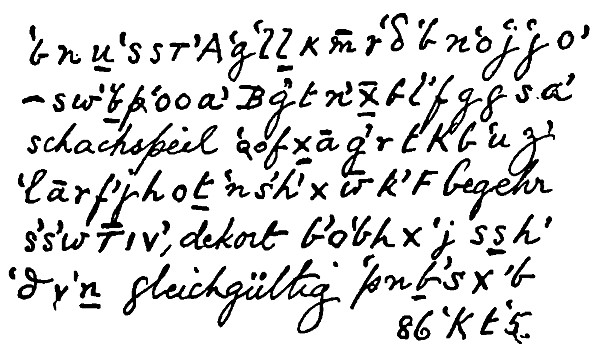
With infinite care, and because the information concerning certain naval movements in the Channel was urgent, he produced a mass of letters with words in German interspersed—a cipher message which resulted a fortnight later in one of our battleships being sunk in the Channel, with only eighty survivors. Of the message the following is a facsimile:—
Chapter Twelve.
On Thin Ice.
One evening early in January three men had assembled and held a serious conference in Jack Sainsbury’s modest little flat in Heath Street, Hampstead. His sister being out for the day, Jack had personally admitted his visitors, who were Charles Trustram and Sir Houston Bird, and the trio had sat by the fire discussing a matter of the greatest moment.
Briefly, the facts were as follow: Trustram had, ever since the raid on Scarborough, wondered whether the failure of the British naval plan to entrap the German Fleet had been directly due to his own indiscretion in mentioning to Lewin Rodwell what was intended. He deeply regretted having let out what had been an absolute secret; yet Rodwell was a man of such tried and sterling patriotism, constantly addressing audiences in the interests of recruiting, and a man whose battle cry “Britain for the British” had been taken up everywhere. No one was possessed of a deeper and more intense hatred of Germany than he, and Trustram felt certain that no man was a greater enemy of the Kaiser.
The papers wrote fulsome praise of his splendid example and his fine patriotic efforts, both as regards recruiting and in the raising of funds for various charitable objects; therefore the Admiralty official was wont to comfort himself with the reflection that such a man could never be an agent of Germany.
Only a few days ago, when he had confessed to Sir Houston and the latter had, on his part, spoken to Sainsbury, the puzzle had become pieced together; and on that evening, as the trio sat opposite each other, the young fellow explained how he had been dismissed from the Ochrida Company at the instigation of Lewin Rodwell and his titled sycophant Sir Boyle Huntley.
“There is a mystery,” Jack went on. “I’m certain there’s some great mystery regarding poor Jerrold’s sudden death,” he said decisively. “I was, that night, on my way to him, to tell him what I had accidentally learnt, and to seek his advice how to act. Yet, poor fellow, he died in my arms.”
“His suicide was certainly quite unaccountable,” declared Sir Houston. “I often reflect and wonder whether he really did commit suicide—and yet it was all quite plain and straightforward. He must have swallowed a tablet—coated, no doubt, or the effect must have been far more rapid.”
“But why did he declare that he’d been shot?” asked Trustram, whose fine, strong face was dark and thoughtful.
“Ah! Who knows? There’s the mystery,” replied the great pathologist. “Of course, men sometimes have curious hallucinations immediately prior to death. It might have been one.”
“He was in terrible agony—poor fellow,” Jack remarked.
“No doubt, no doubt. But the drug would, of course, account for that.”
“Then, in the light of your expert medical knowledge, you don’t think that his death was a mysterious one?” Jack queried.
“No, I don’t say that at all,” was the reply of the busy man, who was working night and day among the wounded in the hospitals. “I merely say that Jerrold was poisoned—and probably by his own hand. That’s all.”
“You say ‘probably,’” remarked Trustram. “Could that man, Rodwell, have had anything to do with it do you think?”
“My dear Mr Trustram, how can we possibly tell?” asked Sir Houston. “What real evidence have we got? None.”
“And so clever are our enemies that we are not likely ever to get any, I believe,” was Trustram’s hard reply. “I only know what has happened to our plans for the defeat of the German Fleet. Is it really possible that this Lewin Rodwell, one of the most popular men in England, is a German agent?”
“If you dared to say so, the whole country would rise and kill you with ridicule,” remarked Jack Sainsbury. “Once the British public establishes a man as a patriot, their belief in him remains unshaken to the very end. This war is a war where spies and spying, treachery and double-dealing, play a far bigger part than the world ever dreams. Jerrold always declared to me that there were German spies in every department of the State, just as there are in France, in Russia, and in Italy. No secret of any of the European States is a secret from the central spy-bureau in Berlin.”
“Jerrold knew that. He set out sacrificing body and soul—nay, his very life—to assist our Intelligence Department,” Trustram remarked.
“I know,” said Jack. “They were foolishly jealous of his knowledge—jealous of the facts he had gathered during his wanderings up and down Germany, and jealous of the sources of information. They pretended a certain friendliness towards him, of course, but, as you know, the khaki cult is never in unison with the civilian. Jerrold did his duty—did it splendidly, as a true Englishman should. His work will live as a record. Seven years ago he commenced, at a time when the money-grubbing, ostrich-like section of the public—bamboozled by politicians who pretended not to know, yet who knew too well, and who told us there would be no war—not in our time—were content in amassing wealth. What did they care for the country’s future, as long as they drew big dividends? Jerrold foresaw the great Teutonic plot against civilisation, and was not afraid to point to it. What did he get for his pains? Ridicule, derision, and aspersions that his mind was deranged, and that he was a mere romancer. Well, to-day he’s dead, and we can only judge him by his works.”
“There are others—certain others too—whom we may also judge by their works,” remarked Trustram grimly—“their subtle, fiendish works, aimed at the downfall of our Empire. If the truth had been realised when Lord Roberts started out to speak—and when the whole Government united to poke fun and heap ridicule upon the great Field-Marshal, who knew more of real warfare than the whole tangle of red-tape at Whitehall combined—then to-day thousands of brave men, the flower of our youth, who have laid down their lives in the trenches in Flanders, would have been alive to-day. No!” he cried angrily. “There are traitors in our midst, and yet if one dares to suspect, if one dares to breathe a word, even to inquire and bring absolute evidence, the only thing which the khaki-clad Department will vouchsafe to the informant is a meagre printed form to acknowledge that one’s report has been ‘received.’ After that, the matter is buried.”
“Perhaps burnt,” laughed Sir Houston.
“Most probably,” Trustram asserted. “To me, an Englishman, the whole situation is as utterly appalling as it is ludicrous. We must win. And it is up to us all to see that we do win.”
“Excellent!” cried Sir Houston. “And so we will—all three of us. I’ll go to the War Office to-morrow and try and see someone in authority. You, Sainsbury, will come with me, and you’ll make your statement—you’ll tell them all that you know. They must take some notice of it!”
“I should be quite ready,” was Jack’s reply. “But will they believe me? They didn’t believe poor Jerrold, remember—and he actually held proof positive of certain traitorous acts. The whole idea of the Intelligence Department is to pooh-pooh any report furnished by a civilian. Indeed, Jerrold showed me a signed statement by a British officer whom the authorities had actually threatened to cashier because he had assisted him to investigate some night-signalling in Surrey!”
“Impossible!” cried Sir Houston.
“It’s the absolute truth. I’ve had the statement in my own hands. He was an officer stationed in a town in Surrey.”
“Well,” remarked the great pathologist. “Let us allow the past bygones to be bygones. Let us work—not in resentment of the past, but for our protection in the future. What shall we do?”
The two men were silent. On the one hand they saw the fortress-wall which the War Office placed between the civilian and the man in khaki. Reports of espionage were extremely unwelcome at Whitehall. And yet how could men in khaki and assistant-provost-marshals, with their crimson brassards of special-constable or veteran volunteer conspicuousness, ever hope to cope with the clever, subtle and wary spies of Germany? The whole thing was too farcical for words.
The British public, trustful of this cult of khaki and of a Cabinet who daily bleated forth “All is well!” had no knowledge, for instance, of the cleverly-laid plan of the enemy in Russia—the plot to blow up Ochta, the Russian Woolwich. Later, the English, in their ignorance of German intrigue, asked each other why no forward move was being made—the move promised us in the spring. They knew nothing of that great disaster, so cleverly accomplished by Germany’s spies, the blowing up of Ochta, that disaster which entirely crippled Russia, and which resulted, later on, in her retreat from Warsaw. It was this—alas that I should pen these lines!—which prevented the British and French from advancing during the whole spring and summer of 1915.
The Russians, our gallant allies, were producing, at the Putilof works, great siege guns, bigger than any turned out from Krupp’s. Yet, after Ochta had been blown up by means of a cable laid by spies under the Neva before the war, so that hardly one brick stood upon another and Petrograd had been shaken as by an earthquake in consequence, what could Russia do? She had no munitions; therefore why make guns?
That act of German spies in directly crippling Russia—an act plotted and prepared ten years previously—had checked the striking power of France, and quite defeated the splendid intentions of Lord Kitchener and our own good General French.
Let history speak. As our two armies were holding only a small section of the line, it was more convenient for the general interests of the Allies that we should, instead of employing our increased forces, postpone the entry into action of our national armies, and bend our chief energies to the task of supplying Russia with the munitions which had suddenly become to her a matter of life or death.
Was not this, indeed, an object-lesson to England?
The trio were discussing the situation, when Jack Sainsbury exclaimed:
“And yet the public will not believe that there are spies amongst us—even in face of daily events of incendiary fires, of submarine outrages, and of spies who, arriving with American passports, are watched, arrested, and executed at the Tower of London.”
“True?” cried Trustram. “I agree entirely with all you say. Shall we act—or shall we join in the saliva of sweetness and raise the chorus that the Germans are, after all, dear good people?”
“Never!” exclaimed Sir Houston fiercely. “Jerrold knew, and he died mysteriously. We, all three of us, know. Let us act; let us raise our voices, as the Duke of Newcastle, Lord Charles Beresford, Lord Leith of Fyvie, Lord Crawford, Lord Portsmouth, Lord Headley, and all the others have raised theirs. ‘Britain for the British,’ I say, and we must win—and, at all hazards, we will win!”
“Yes, but what shall we do? How are we now to act?” queried Jack, looking at his visitors.
“That we must decide,” Sir Houston responded. “We know many things—things that are proved as far as Lewin Rodwell is concerned. We must watch—and watch very closely and carefully—then we shall learn more.”
“But while we are watching the Empire is, surely, in gravest peril?” Trustram protested.
“We have an Intelligence Department which is said to be dealing with news leaking from our shores.”
“Intelligence Department?” laughed Jack Sainsbury. “Read the German papers, and you’ll see that the public in Germany are daily told the actual truth concerning us, while we are deliberately kept in ignorance by the superior cult of khaki.” Then he added, “The whole of this system of secrecy, and of playing upon the public mind, must be broken down, otherwise very soon, I fear, the British will believe nothing that is told them. We won’t be spoon-fed on tit-bits any more. We are not the pet-dogs of a Hide-the-Truth administration.”
“That’s a bit stiff,” declared Trustram with a frown, as befitted an official wearing His Majesty’s uniform.
“I don’t care! I speak exactly what I feel. The British Empire is to-day greatly menaced, and if we are to win, we must face the facts and speak out boldly. We don’t want these incompetent khaki-clad amateur detectives telling the matter-of-fact British nation official untruths. Why, only the other day the Parliamentary mouthpiece of the War Office told us that every German secret agent was known and under constant surveillance! Is that the truth, I ask you, or is it a deliberate official falsehood? Read Hansard’s reports. I have quoted from them!”
The two men could not raise a protest. They knew, alas! that the words the young man had spoken were the actual and ghastly truth.
“Well,” he went on, looking at his visitors, “we know what is in progress—or at least we have the strongest suspicion of it. Now, what decision have you both arrived at? What, in the interests of the safety of the Empire, shall we do?”
Trustram shrugged his shoulders blankly, while Sir Houston drew a long breath.
Neither man replied. What could they do, save to warn the War Office, who they knew would probably turn a deaf ear to all their suspicions?
Chapter Thirteen.
Towards the Brink.
Later that same evening Jack, who had walked down Fitzjohn’s Avenue to Mr Shearman’s, as was his habit, found Elise’s father at home.
Though old Dan Shearman, a hale, bluff North-country man, rather liked young Sainsbury, yet, at heart, he would have preferred a man of established prosperity as his daughter’s husband—a manufacturer like himself, or a professional man with a good paying practice. Dan Shearman—as everybody called him in Birmingham—was a practical man, and had made a fortune by dint of hard toil and strict economy. He had begun as a half-timer in a cotton-mill in Oldham, and had risen, step by step, until now he was one of the biggest private employers of labour in the Midlands.
For years he had hoped that Elise would make a rich marriage, yet her chance meeting with Jack Sainsbury had suddenly turned the course of events, and both he and his wife could not hide from themselves how deeply the young couple had fallen in love with one another. More than once husband and wife had consulted as to whether it would not be to Elise’s future interest if they broke off the attachment. Indeed, just before the outbreak of war, they had contemplated sending Elise for a long stay with her aunt, who was married to an English merchant in Palerno.
Yet, partly because the girl begged to remain in London, and partly because of Mrs Shearman’s liking for young Sainsbury, the bluff old fellow gave way—though there always remained the fact that Jack was a mere clerk and that, at the present time, he was out of a situation. That he had been rejected by the military doctors Mr Shearman knew, but he was unaware that Jack had been left a legacy by the doctor who had so mysteriously committed suicide in Wimpole Street.
“Hey, lad!” old Dan cried cheerily, as Jack entered the little smoking-room. “Sit yer down a moment, an’ have a cigarette. There’s some over yonder!”
When the young man had lit up and seated himself, Shearman asked:
“Well! what’s the pay-pers say to-night—eh? Aw wonder ’ow this ’ere war is goin’ on?”
“Badly, sir, I fear,” was Sainsbury’s prompt reply. “We don’t seem to be able to move against the superior power of the enemy.”
“Superior power be ’anged, lad!” cried the round-faced, grey-haired old man, his eyes flashing as he spoke. “Aw don’t believe in what these ’ere writers talk about—their big guns, their superior power, an’ all that! We’re still powerful enough in good old England to lick the ’ole lot o’ them sour-krowts, as I ’eard a man in New Street callin’ ’em yesterday.”
“Well, I hope so,” laughed Sainsbury, who really was anxious to get upstairs to the drawing-room, where he knew Elise was eagerly awaiting him. “But at present we seem to be progressing very slowly. The Russian steam-roller, as it was called, has come to a halt.”
“Ah! a bit more o’ them there writers’ bunkum! What aw say is that we’re a-bein’ misled altogether. Nawbody tells the truth, and nawbody writes it. What yer reads to-day, lad, ’ll be flatly contradicted to-morrow. So what’s the use o’ believin’ anything?”
He was, truly, a bluff old chap who, born and bred in Lancashire, had afterwards spent three parts of his life in and about Birmingham. Old Dan Shearman was a man who always wanted hard facts, and when he got them he would make use of them in business, as well as elsewhere, with an acumen far greater than many men who had been educated at a public school. He rather prided himself upon his national-school training, and was fond of remarking, “Aw doan’t pretend to much book-learnin’, but aw knows my trade, an aw knows ’ow to make money by it—which a lot o’ people doan’t!”
Jack Sainsbury always found him amusing, for he was full of dry, witty remarks; and as he sat for a quarter of an hour, or so, the old fellow, puffing at his cigar—though he always smoked his pet pipe in his private office at the works—made some very caustic remarks about official red-tape at Whitehall.
“We’re a-makin’ munitions now,” he explained. “But oh! the queries we get, and the visits from officers in uniform—people who come and tell me ’ow aw should run my business, yet the first time they’ve ever seen a Drummond lathe is in one of my workshops. Aw say that ’arf of it’s all a mere wicked waste of a man’s time!”
“Yes,” sighed the young man—“I suppose there is far too much officialism; and yet perhaps it is necessary.” Then he added, “Is Elise at home, do you know?”
“Yes, she’s at ’ome, lad—she’s at ’ome!” laughed the old fellow cheerily. “Aw know you want to go oop to ’er. Well, aw did the same when I wor your age. Aw won’t keep yer longer. So go oop, lad, an’ see ’er. My wife’s out somewhere—gone to see one of ’er fine friends, I expect.”
Jack did not want further persuasion. Leaving the old man, he closed the door, ran up the carpeted steps two at a time and, in a few moments, held his well-beloved fondly in his arms.
She looked very pretty that night—a sweet, rather demure little figure in a smart, but young-looking dinner-gown of pale cornflower-blue crêpe-de-chine, a dress which well became her, setting off her trim, dainty figure to perfection, while the touch of velvet of the same shade in her fair hair enhanced her beauty.
“Oh! I’m so glad you’ve come, dear!” cried the girl, as she looked fondly into her lover’s face with those clear, childlike eyes, which held him always beneath their indescribable spell. And as he imprinted soft kisses upon her lips, she added: “Do you know, Jack, I may be most awfully silly—probably you’ll say I am—but the truth is I have suddenly been seized by grave apprehensions concerning you.”
“Why, darling?” he asked quickly, still holding her in his strong arms.
“Well, I’ll confess, however silly it may appear,” said the girl. “All day to-day I’ve felt ever so anxious about you. I know that, like poor Dr Jerrold, you are trying to discover and punish the spies of Germany. Now, those people know it. They are as unscrupulous as they are vindictive, and I—well, I’ve been seriously wondering whether, knowing that you are their enemy, they may not endeavour to do you some grave harm.”
“Harm!” laughed the young man. “Why, whatever makes you anticipate such a thing, darling?”
“Well—I don’t really know,” was her reply. “Only to-day I’ve been thinking so much about it all—about Dr Jerrold’s strange death, and of all you’ve lately told me—that I’m very apprehensive. Do take care of yourself, Jack dear, won’t you—for my sake?”
“Of course I will,” he said, with a smile. “But what terrible fate do you anticipate for me? You don’t really think that the Germans will try and murder me, do you?”
“Ah! You don’t know what revenge they might not take upon you,” the girl said as they stood together near the fire in the big, handsome room, his arm tenderly around her waist. “Remember that poor Dr Jerrold upset a good many of their plans, and that you helped him.”
“Well, and if I did, I don’t really anticipate being assassinated,” he answered, quite calmly.
“But the doctor died. Why?” asked the girl. “Could his death have been due to revenge, do you think?”
Jack Sainsbury was silent. It was not the first time that that vague and terrible suggestion had crossed his mind, yet he had never uttered a word to her regarding his suspicions.
“Jerome committed suicide,” was his quiet, thoughtful reply.
“That’s what the doctors said. But do you think he really did?” queried the girl.
Jack shrugged his shoulders, but made no reply.
“Ah! I see! You yourself are not quite convinced!” she said, looking him straight in the face.
“Well, Elise,” he said after a brief silence, and with a forced laugh, “I really don’t think I should worry. I can surely take care of myself. Perhaps you would like me to carry a revolver? I’ll do so, if it will content you.”
“You can’t be too careful, dear,” she said earnestly, laying her slim fingers upon his arm. “Remember that they are the spies of the most barbarous race on earth and, in order to gain their ends, they’ll stick at nothing.”
“Not even at killing your humble and most devoted servant—eh?” laughed Jack. “Well, if it will relieve your mind I’ll carry a pistol. I have an automatic Browning at home—a bit rusty, I fear.”
“Then carry it with you always, dear.—I—” But she hesitated in her eagerness, and did not conclude her sentence.
In a second he realised that she had been on the point of speaking, of telling him something. Yet she had broken off just in time. That fact puzzled him considerably.
“Well,” he asked, his serious gaze fixed upon those big blue eyes of his well-beloved, while her fair head rested upon his shoulder: “what has caused you these gloomy forebodings concerning myself, dearest? Tell me.”
“Oh, nothing,” she replied in a strange, nervous voice. “I suppose that I’m horribly silly, of course. But, knowing all that you have told me about the wonderful spy-system of Germany, I have now become gravely apprehensive regarding your safety.”
Jack saw that she was endeavouring to conceal something. What knowledge had she gained? In an instant he grew eagerly interested. Yet he did not, at the moment, press her further.
“And you think that the fact of carrying a gun will be a protection to me, do you, little one? Well, most women believe that. Yet, as a matter of fact, firearms are very little protection. If a man is seriously marked down by an enemy, a whole army of detectives cannot save him. Think of the political assassinations, anarchist outrages, and the like. Police protection has usually proved futile.”
“But you can take proper ordinary precautions,” she suggested.
“And pray, dear, why do you ask me to take precautions?” he inquired. Then, looking earnestly into her eyes, he added very gravely: “Something—or somebody—has put all these grim fears into your head. Now, dearest, tell me the truth,” he urged.
She made no response. Her eyes were downcast, and he saw that she hesitated. For what reason?
“Whoever has put all these silly ideas into your head, darling, is responsible to me!” he said in a hard voice.
“Well, Jack, I—I really can’t help it. I—I love you, as you know; and I can’t bear to think that you are running into danger, as you undoubtedly are.”
He looked into her pretty face again.
“Now look here, darling,” he went on: “aren’t you getting just a little too nervous about me? I quite admit that in these days of wars, of terrible massacres, of barbarism and of outrages of which even African savages would not be guilty, one is apt to become unduly nervous. You’ve been reading the papers, perhaps. They don’t always tell us the truth nowadays, with the Censor trying to hide up everything.”
“No, Jack,” she said boldly. “I haven’t been reading the papers. I’m only anxious to save you.”
“But how do you know that I’m in any danger?” he asked quickly. “Why be anxious at all? I assure you that I’m perfectly safe. Nobody will lift a finger against me. Why should they?”
“Ah! you don’t see,” she cried. “There is a motive—a hidden motive of revenge. Your enemies intend to do you harm—grievous bodily harm. I know that.”
“How?” he asked quickly, fixing her splendid eyes with his.
That straight, bold question caused her to hesitate. She had intended to prevaricate, that he knew. She did not wish to reveal the truth to him, yet she feared lest he might be annoyed. Nevertheless, so serious was he, so calm and utterly defiant in face of her grave warning, that a second later she found herself wavering.
“Well,” she replied, “I—I feel absolutely certain that it is intended that some harm shall come to you.”
“Then I’d better go to Scotland Yard and say that I’m threatened—eh?” he laughed merrily. “And they will put on somebody to watch me, well knowing that, if the whole of Scotland Yard—from the Assistant Commissioner downwards—were put on to shadow me, the result would be just the same. I should surely be killed, if my enemies had seriously plotted my death.”
“That’s just my very argument,” she said sagely, her pretty head slightly inclined as she spoke. “I feel convinced that some evil is intended.”
“But why, darling?” he asked in surprise. “What causes you all these silly notions?”
“Several things. Frankly, I don’t believe that Dr Jerrold took his own life. I believe that he was a victim of the dastardly spies of the Great Assassin.”
Jack said nothing. The mystery in Wimpole Street was great. Yet, how could they dispute the medical evidence?
“That’s another matter,” he remarked. “How does that concern my safety?”
“It does, very deeply. Your enemies know that you assisted Jerrold, and I am firmly convinced that you are marked down in consequence.”
“My darling!” he cried, drawing her closer to him. “You really make me feel quite creepy all over!” and he laughed.
“Oh, I do wish, dear, you’d take this grave danger seriously!”
“But I don’t. That’s just it!” he answered. “I quite understand, darling, that you may be anxious, but I really feel that your anxiety is quite groundless and hence unnecessary.”
The girl sighed, and then protested, saying—
“Ah! if you would only heed my warning!”
“Haven’t I promised to do so? I’m going to carry my revolver in future.”
“You take it as a huge joke!” she said in dissatisfaction, disengaging herself slowly from his embrace.
“I do. Because I can’t see why you should warn me. Who has put such thoughts into your head? Surely I know how to take care of myself?” he exclaimed.
“Perhaps you do. But that a grave danger threatens you, Jack, I happen to know,” was her serious reply.
“How do you know?” he asked quickly, facing her. He had, all along, seen that, for some unaccountable reason, she was hesitating to tell him the truth.
“Well,” she said slowly, “if—if I tell you the truth, Jack dear, you won’t laugh at me, will you?” she asked at last.