Introductory material (continued 4)
Reading edition
Friday, July 1.—Therm. 84°. The Damání crowd is off, and now comes the settling question. I saw at once that extortion was intended; but I cannot get Abú to act or speak with any force. They want two months to prepare. Asked at first 2,300 dollars; after much wrangling they came down to 1,500: this, added to the extravagant sum demanded by the Sheïkh, is more than I can venture to give, without the sanction of Mr. Willshire. I have written to him to know how I am to act. That same villain, Majíbí, who has already robbed me of 320 ducats, is at the bottom of all this. I hold a threat over them, that I have another way open. I now learn, that a report has got abroad of my being one of the royal family of England; that I have plenty of money, and that the people of Sús intend making me pay a larger sum for permission to return. We have counted too much on the Sheïkh. This has quite upset me.
Saturday, July 2.—Therm. 84°. Lots of wounded. The trouble I have in persuading these people that all cannot bear the same quantity of medicine, is quite provoking. I have made up some bread-pills to complete the number, where one would require three, and another only two. The Damánís have dropt to one thousand dollars, but I have refused to give an answer till I hear from Mr. Willshire. I sent to inquire about the two Christian Spaniards, who are in the desert. Wrote to Lord Palmerston, at Sheïkh Beïrúk’s request, and to Lord Glenelg, Thom, and G. Dodd. Sat up till day-light, having to dispatch my courier early. Laid down just as the sun was rising.
Sunday, July 3.—Therm. 82°. The Sheïkh came to me as soon as I had laid myself down. He told me that the Damánís were under an idea that I was a person of great consequence, and have large sums at my command; and that they have only to ask and receive. He said that as I should be obliged to pay the one thousand dollars to get on either way, I had better make up my mind to it; that he must admit his own agent had played the rascal, for he had not expended the sum he claims; but as he has received the money from the consul, there is, I fear, little chance of getting any of it back again. Wrote to his Royal Highness, Lord Glenelg, Mr. Hay, &c. Sent for my double-barrelled pistols, but forgot the spectacles. Sent to Mr. Hay for some knives and other things from Gibraltar. Read the prayers, and took to my carpet early, as I had been up two nights.
Monday, July 4.—Therm. 84°. Symptoms of great heat. Received a large present of Kermesú Nasárá, (fig of the Christians) and the prickly pear, (called Tagharnúp by the Berbers); they came very acceptably: there were also a few half-ripe pears and some apricots; I am afraid of fruit, but ate some of the first. The Damánís are very anxious for my answer. The Sheïkh Mohammed Múlid tells him, he will make an oath AHAD .................. that he will conduct me in safety to Tumbuktú and Jennah, and that he will obtain for me whatever I want from Hámed Libbú. I like this man; but have been so often disappointed, that I have some fear of eventually changing my opinion. He is more frank and open, and more like the man of his word, than any I have seen since I set my foot in Africa. Had great fun with the Taghakánth people, giving them some imitations of character. We are all friends. I was struck with the quiet and happy state of the slaves lately arrived here, who say they would not accept their liberty on condition of having to cross again the desert. This gives me a fearful idea of it; but I will try it.
Tuesday, July 5.—Therm. 84°. The Sheïkh Mohammed Múlid came to make his AHAD oath, that he would protect me, and do all in his power for me. Wrote to Mr. Willshire all particulars (of the information I had received), and likewise told him that Mons. Anthoine D’Abbadie intended to start from Tunis. Four slaves are here from Kóng, who have told Abú that his cousin and school-fellow Kutúk the warrior, is now the king of Kóng, and that his power extends to Ashantí. An Arab from some distance came in to-day with some savage-looking wretches: I was sitting or rather lying on the ground writing: I sent them off in a hurry; but was afterwards told that the Arab was a great Sheïkh, who, having heard of the arrival of a great Christian Sheïkh, had come to pay me a visit. On his return I told him that he ought to have taken off his slippers; he made a fair apology: I then asked him to sit down; when he said that he had heard of a Christian who could tell by a little magic thing, where any place in the world lay; but that he could not believe the story, and had therefore come to ask me about it. I humoured the man, and got out my pocket compass, and told him to question me; when I told him where each place was, and the number of days, which I had already learnt, between any two or more places. He then stated, that he had heard that I walked half the day and half the night, and was never tired. Is that true? said he; to which when I replied in the affirmative, he asked to inspect my feet, and after counting my toes, he told his companions that I had only five on each foot: he then examined the knee-pan and cried out Wáhed aëdá, ‘only one;’ then taking me by the hand, he praised the prophet. From this, as usual, he asked to see every thing, when I had to open boxes, &c., and could hardly get him and his party away: he then asked for a present; a little tobacco did here, but as he is coming again to-morrow, (it will not be so easy to satisfy him). I learnt a good deal from Tayyeb about Tumbuktú; he says that it contains sixteen mosques, of which Sídí ’Alís is the largest; that it takes two hours to go round the city, which now reaches to Kabrah; and that has a village contiguous to it on the north; that in these countries people walk but little: that its markets are now better than those of Jennah; and that people come to it from all quarters. He states also that Lamdo Lillahi[113] stands on the river, whereas the map makes it appear twenty miles to the east. He lived till he was thirteen years old at Tumbuktú, and has been here more than two years: he knows more than most persons of his age; but is a great scamp. His mother is one of Hámed Libbú’s family, and I therefore put up with many of his rogueries. The heat has been very trying to-day.
Wednesday, July 6.—Therm. 84°. At eleven A.M. the town was alarmed by the report that all the Sheïkh’s camels had been stolen. All the people mounted, and set off armed: even the women went out of the town on the road to Agadír, to see what was going on. At two P.M. most of the people returned: the report was only partially true. A few had been stolen, but the direction they had taken was known. Mohammed Sierra mounted my horse, and with two others went to get a reinforcement on the road. The reports about the great power of the Sheïkh, are all moonshine: it is in reality nothing. During my stay here, I have seen much of the African Arabs; they differ greatly from the Asiatic: they are more wild in their appearance, but far more cultivated: nearly all of them can read, and a great many can write. I have been much pressed about giving my answer as to going on. I must wait one week more; although I fear that the two months will have elapsed from the time of deciding. Am very anxious for the villain Majíbí and his party to leave me; I cannot bear the sight of that fellow, ever since I was convinced of his roguery. Am in some anxiety about my gold watch, as the Thillahs have stripped the last couriers that passed through Sús. This Majíbí’s villainy is capable of any thing. I gave him a rub this morning, and if I had only protection here, I would give him the stick.
Thursday, July 7.—Therm. 76°. Had a large party to dinner to day, as the Sheïkh had killed a cow. These beasts have come to feast on the entrails, which they prefer to the meat; on being asked what we did with them, I told them to their utter dismay, that we gave them to the common dogs, as well-bred ones would not touch them. Had some of the meat sent me, but it was not very palatable. I received likewise a present of unripe pears; for these people will not permit the fruit to ripen. At one P.M. about thirty of the tribe of Assereit Terjmert arrived here: they are worse than any I have seen as yet: had a row with them. The Sheïkh and all his people, who are evidently afraid of being asked for something by all new-comers, slink away, and leave me alone with every fresh batch of vagabonds: I told them my mind as well as I could, and then scolded them in English. At night the Aboudah Ich Saabi came, as it was expected, on a conference relative to this quarrel; but as it turned out, they only came to gorge: a cow is not killed every day. There is a report, that two hundred horse will be here to-morrow, with what truth, time will show. Am happy to hear that the beasts from Mogador are to go back on Monday next.
Friday, July 8.—Therm. 82°. Felt poorly all day. Dies non.
Saturday, July 9.—Therm. 82°. All are busy to-day in preparing for the káfilah, which is to start for Suweïrah on Monday. Feel far from well. Went to the medicine chest: but find that the least dose disagrees with me. Renewed rumours of wars. The Damánís are anxious for my answer, and I am equally anxious to give one. I know not how things will go on. Am sick of the whole affair, and feel a presentiment that it will be a failure.
Sunday, July 10°.—Therm. 82. Read prayers. The weather is heavy and sultry. This has proved one of the most trying days for the constitution, as the excessive heat has been succeeded by a very cold wind in the evening, and this followed by a most sultry night. All the people are fully occupied in preparing for the káfilah, which is to start to-morrow morning with ivory, gum, &c.; I find that the ivory sells here at seventy mitcal the canter, while at Mogador it brings sixty dollars: the quantity of it is enormous. Felt very poorly all day, and did not go out.
Monday, July 11.—Therm. 84°. All has been bustle to-day. The káfilah had hardly started, when the two hundred horse arrived. They came to hold a conference about going to war with a neighbouring tribe, as one of the Sheïkh’s friends had been killed by a Marabout of that people: after a long consultation, it was agreed, that as the Marabout was non compos, there could be no intention of an insult, and thus instead of a fight we had a feast. The Damánís are preparing to be off, as my answer is expected to-morrow. I fear I must give all the money: it is an anxious time for me. There is a great talk about my long stay, and some of the Shilhah[114] people are not over civil. The Sheïkh, poor man, is desirous to pay me every attention; but he is fearful of enforcing a proper authority over these people. Money is his curse, and he is avarice personified. The heat is excessive.
Tuesday, July 12.—Therm. 84°. The heat is beyond every thing to-day; the sun literally scorches: all are gasping. The slaves are lying about. The Arabs say, that in the Sahrá on such a day, twenty draughts of water would not quench the thirst. It is one of the hot winds. I have been walking for more than two hours to the astonishment of the natives. Evening came, but no post. The heat still tremendous. I have been drinking tea for more than an hour, and am still thirsty. Sent out again respecting the Spanish slaves: hope to get the poor fellows. There has been a slight quarrel between the Sheïkh and his son; but matters are, I suppose, now made up, as the son came to pray in his father’s room. Some ostrich marrow was sent to me to purchase, but I will not buy it without some eggs. Patients are beginning to be troublesome again. I feel myself somewhat better than yesterday.
Wednesday, July 13.—Therm. 86°. Symptoms of summer. Am looking most anxiously for the post. The Damánís have all left, except Mohammed and Hámed, who are waiting for Mr. Willshire’s answer. I gave them a present which cost me thirty-nine ducats: they were highly pleased, and so was the Sheïkh. At three P.M. the thermometer under the colonnade was at 100°, and though there is a breeze, the sun is scorching. All are done up. As there was no post, I was in very bad spirits, and went early to rest: hope to get a little sleep.
Thursday, July 14.—Therm. 84°. To-day all are done up and out of temper, with the exception of Abú. The heat is excessive; we are all stripped to our shirts. Evening brought a cooling breeze, and this brought back our spirits. I was obliged to lie down early, oozing at every pore. Despite my little food, and the great heat, have picked up most of my lost flesh. Am in great anxiety for the post; it has not arrived to-day; if it does not come to-morrow, I shall suspect something has gone wrong.
Friday, July 15.—Therm. 84°. Dies non. Out of health, spirits and temper. No post.
Saturday, July 16.—Therm. 84°. Felt very poorly; kept my bed. Getting out of all patience, as no post has arrived. Am in great anxiety about my watch and letters from England. All this is owing to the villain Majíbí.
Sunday, July 17.—Therm. 86°. Passed a bad night: was up early and went out to bathe. Read the prayers. Was in hopes of the post arriving at the usual time: disappointed. Sent Abú to the market, who brought nothing I could eat; there was no fruit or vegetables. I cannot manage the kuskusú. Received a present of six bunches of grapes from a poor slave boy, to whom I had given some medicines; he had walked out to meet the people coming to market, and had bought all they had. Sent a present of a loaf of sugar to the beautiful Jewess by Abú, together with three bunches of the grapes, to ask if she could make me a pie; for which there is no name in Arabic. I cannot go to the Leïlá myself, but have been promised something as near to Abú’s directions as she can make it. I would have done it at home, but Abú is a bad cook. As the grapes were very sour, I mashed up two bunches with milk and sugar, and fancied it gooseberry-fool; contrived, however, to make a meal of it; the only one I have had for many days. I intended to take a ride, but the heat was greater than I had ever felt. At two P.M. the thermometer in the sun was at 141°. It fell one degree at a quarter-past three P.M. and did not sink below 138° till half-past five P.M. I was obliged to cover the stirrups and kummiyahs,[115] and all metal articles, with pieces of háïk: the stirrups were too hot to be handled. The horses and cattle are all suffering; yet there is a strong wind from the N.W., but it is blowing fire. Mohammed tells me that on the E. of the mountains, which shut out this wind, it is impossible to face the hot wind. All here are astonished at my being able to stand it; there is no fear of me; I am living too low to take any harm. My fear is not that my stomach will go, but my head. Still no post. All are in anxiety. A cold current of air is passing over us. At nine P.M. the moon and stars are shooting with a peculiar glare, such as I have often witnessed here after great heat. At ten P.M. the heat returned, and nearly suffocated us. I dread the night—being half destroyed by the vermin. Am very anxious for to-morrow.
Monday, July 18.—Therm. 86°. Rose early and went out. There was more wind than yesterday. It feels cooler, but promises to be a hot day. Conceiving I might be mistaken, while reading “Hints on various Sciences,” p. 166, I took three thermometers, and suspended one six feet from the ground, but exposed to the air and sun, at the distance of six feet from the wall, into which a pole had been driven, from which it hung perpendicularly. At twelve this had reached to 115° Fahrenheit. I then laid a second on a mat, exposed to the sun; and this rose to 138°. The third I placed erect on the box of the thermometer, which rested on the sand, and was propped up by a piece of stick. This last rose to 126°. After they had been exposed about a quarter of an hour, the three gave the following results:—
Hanging. Standing. Lying. S[116]
At One 119° 126° 143°
Two 119 124 139 109°
Three 121 131 139 110
Five 120 121 126 107
At half-past five, the wind freshened again. During the whole of this period the wind was very strong from N.W. to N.N.W., and carried a cambric handkerchief, in which was placed a stone of one pound, at the rate of four knots an hour. The Arabs, who took the greatest interest in any thing that I was doing, wanted to know what I was about, and whether it had any reference to the country. As I always had a story ready to excite their wonder or a laugh, I told them that I expected a letter from England, and I was endeavouring to ascertain how fast the ship was sailing; that the little glasses were to tell me the heat of the sun, and the handkerchief the force of the wind; that if when the sun was so hot, the wind had a certain power; I knew how much greater would be the power of the wind, when the sun was less hot; and by the velocity of the wind, I could tell the rate of the ship’s sailing; the sun and the wind being enemies to each other. Upon this they cried out “Tayyabek Allah:” after this came the usual finale, by my taking some fire from the sun by the burning glass; and what astonished them more than any thing else, was that they could do it themselves as well as I could. At five P.M. I received my grape-pie from the Jewess; but it was a sad failure, as it was the third day in which I had gone without a dinner. It is now evident the post has been stopped on purpose. I am in a nest of villains, and know not how to extricate myself. The heat continued of the most distressing kind: at midnight the thermometer was 100°.
Tuesday, July 19.—Therm. 95°. The heat is beyond endurance. No sleep. All are lying down and panting. The long-wished-for post has at last arrived: and this morning every thing was settled for our starting without fail on September 15. All travelling now is quite impossible, as the camels are dying on the route from the north, in consequence of the heat, which is greater than usual. Every body is suffering, and yet they say it is cool here, compared with the temperature on the south side of the mountains. I have nothing on, but what decency requires. The consumption of water is immense.
Wednesday, July 20.—Therm. 95°. The heat is terrific. No sleep, no rest. The stream that passes the Sheïkh’s garden was this morning at 75°. Mashaba (Majíbí) and his gang left us at three P.M. Went out a little this afternoon, as I felt poorly, and procured some eggs from the Arabs in the tents, but many of them were rotten. I have now had no food for a week. Would give a dollar for a draught of beer. Thirst distressing, and am pouring with perspiration. The walls of the house are cracking with the heat and the ground is distressing to the feet. Wrote to Mr. Willshire. The Damánís are preparing to start to-morrow.
Thursday, July 21.—Therm. 95°. This morning I exposed about a quart of water in a tea-kettle, on the roof of the house, to the action of the sun. The water was brought from a small rill that passes the Sheïkh’s garden, and was 75° when about fifty yards from the spring. At twelve the water in the kettle had risen to 112°; at three P.M. it was taken away to be used as hot water; this happened a few minutes before I got up to try its temperature. The heat decreased much towards the evening. Have been very poorly all day, and must have recourse to a blue pill at night.
Friday, July 22.—Therm. 82°, and has been lower. This sudden fall of 15° has been felt severely. At no period has the glass reached within 15° of what it was yesterday. It has made me quite ill, and unable to go out to a fantasía in the afternoon. A káfilah is now preparing for Suweïrah.
Saturday, July 23.—Therm. 83°. There was a heavy mist early this morning. Thank God, the heat is lessened. The trees and fruit were parched up by the heat of the three last days. The cattle are dying in the roads, and the very slaves suffering. Feel very poorly; and have now starved for a week, and been obliged to go often to the medicine-chest. Had to send to the Jews for brandy to keep me up. I am expecting some fruit to-morrow, and hope to get a fowl also, and make some broth. Obliged to shut up books.
Sunday, July 24.—Therm. 85°. The weather fine and pleasant, and the house quiet. Read the prayers. Received a present of two fine quinces, called here ................ Their flavour is exceedingly fine; they came from Tamazert; those that are grown here are not near ripe; the others have a thin yellow rind, and their flavour is like that of ripe raspberries. Being far from well, I did not leave the house. Abú went to market, and bought some eggs, and dispatched Seulïmán to Tamazert to buy more, together with half-a-dozen of fowls; the latter being very dear here, about threepence each. I have agreed to purchase a cow in partnership with Seulïmán, whose child is sick, and wants more milk, &c., than he can get. I am to be supplied with fresh butter every day. The cost of the animal, which has just had a calf, is ten mitcals, about twenty-five shillings. This is a sore subject for the Sheïkh,[117] who has had a quarrel with his women, and they will not supply me. I really pity the man.
Monday, July 25.—Therm. 86°. Felt a little better; but as I was still poorly, kept to the house. No incident.
Tuesday, July 26.—Therm. 78°. Day cold and cloudy. There was a large arrival from Bamara. Felt very poorly to-day; these sudden changes almost kill me. Got at last a fowl to-day, and ate a little. Complained strongly to the Sheïkh.
Wednesday, July 27.—Therm. 80°. Health improving. There was an addition to our party. Did not go out. House the best place. Had a new dish to-day; stewed quinces and meat: it was not bad, but I had no appetite.
Thursday, July 28.—Therm. 78°. Not so well to-day; kept to the house. In the evening a party from Taghakánth brought intelligence of the war still raging.
Friday, July 29.—Therm. 77°. Day fine; went out a little: am much better, thank God.
Saturday, July 30.—Therm. 75°. The night has been cool, and very pleasant. Went out a little this morning: towards the middle of the day the heat returned with great power. A simúm is blowing in the desert; we are all covered with dust, and the houses are perfectly obscured. I tried the water again to-day: a quart was exposed from one to three P.M. in a tea-pot, on the top of the house; it rose to 112°; at four P.M. it had reached 125°, when it came into service, being half-boiled, to fill up the tea-kettle. We are to have three or four oppressive days again. Spirits very low. Took a half pint of the Jews’ brandy, having a very cholera-feel.
Sunday, July 31.—Therm. 80°. Passed a very bad night. Walked out a little. Read the prayers, and mean to fast to-day. In the afternoon we felt the simúm again, and the night was oppressive in the extreme.
Monday, Aug. 1.—Therm. 86°. The whole horizon buried in a cloud of dust. The mountains to the S. and S.E. were not visible; the cattle exhibit a disinclination to go to their pastures. We are to have a sweltering day, by all appearance. We are looking out for the post, which, we suppose, was stopt yesterday by the excessive heat, and will not now reach us before to-morrow. Felt very poorly this evening.
Tuesday, Aug. 2.—Therm. 80°. Very poorly, and kept to the house.
Wednesday, Aug. 3.—Therm. 75°. Much cooler. There is a strong breeze, but the dust still comes from the desert. For the three last nights we have been annoyed with the jackalls, who have been driven in from the Sahrá. Felt a little better to-day, and went out for an hour. No appetite. This confinement is very sad. Received large presents of unripe fruit. These people will leave nothing to ripen; they are perfect hogs. A host of jackalls have made their appearance. Gave Abú a lesson in medicine; made him number the bottles in the chest, for fear of being too ill to go to it myself, and he should poison me. We have some misgivings about the post, which is three days behind its time. Persons have been dispatched to look after the postman.
Thursday, Aug. 4.—Therm. 76°. A high wind, with dust, which nearly blinded us all. Feel rather better to-day. Still no post, and all in anxiety.
Friday, Aug. 5.—Therm. 76°. Weather much pleasanter. The night cool, and not so many vermin. Received a fine present of grapes. This evening the post came in, but brought no letters. The Sheïkh is in a great rage about a letter, which that rascal, Majíbí, has written; who now that he has been blown upon, is trying to make mischief. Affairs are rather ticklish. I have a hard game to play to keep all matters right. There is some unpleasant talk about the length of my stay, and some not very pleasing hints to the Sheïkh about his treatment of me. I have tried to put every thing in a correct light.
Saturday, Aug. 6.—Therm. 78°. Fine day. Feel somewhat better. There has been another fight between the Jews about my food and washing. I fear the Sheïkh leans to the scoundrel, whose wife is more free-looking than Fehedia, whom he cannot seduce: the case is to be heard to-morrow.
Sunday, Aug. 7.—Therm. 76°. Early this morning Sídí Mohammed El Fakír arrived from Suweïrah, bringing me a letter, together with tea, sugar, and coffee, from Mr. Willshire, and a present of fruit from himself. By the letter I learnt that the Sheïkh had written to Mr. Willshire for the money for the journey, which the Sheïkh said he had paid the Damánís. I do not, nor does Mr. Willshire, like this paying before hand. Had a large party at breakfast; there was one Múléï ’Alí, and some hogs of Berbers. Read the prayers, and prepared to catch the Sheïkh. He promises to give me an acknowledgment, that I shall have nothing to pay on my arrival at Tumbuktú, and that all shall be right. There are no signs of my tent coming back. Sídí Mohammed, who is anxious that I should not go on, brought his son, the only really learned man here, who is to write privately to Mr. Willshire, should any thing happen to me. I am more than ever pleased with the Fakír, and feel great satisfaction in having a person who can communicate, if necessary, with Suweïrah, unknown to the Sheïkh. I am not over easy that all is quite safe: these are a thankless people, and are now very angry that I have complained so much of the bad treatment I have experienced. I shall make friends with this young man, and try what can be done through him, in case of need. Feel much better to-day.
Monday, Aug. 8.—Therm. 78°. The house is full of visitors again, and my pest, the Sheïkh Hammó, has returned. Abú was puzzled to-day in some questions about Hájí Majíbí. Gave him a lesson to-night; but he is a very dull scholar: he has no idea of position,[118] nor can I make him understand the drawing of the ka’bah. Some mischief is at work from that rascal, Majíbí, who has gone back to Suweïrah. I will catch him yet. Feel better to-day, and am beginning to be myself again.
Tuesday, Aug. 9.—Therm. 78°. Up early, and out to breakfast. The post arrived with letters from Mr. Willshire, who says that he has sent half the money for the journey; but that no pesetas were to be procured, and therefore the remaining half would be sent by Hájí ’Abíb, whom Mr. W. insists upon coming here to see me off—an event which now seems doubtful. I do not like this payment of all the money before hand, as I may be left on the road, although I have great faith in the Damánís. I had some high words with the Sheïkh. His people owe Mr. Willshire five thousand dollars, and would not take a credit for the one thousand. My good opinion of the Sheïkh all oozing away. He is a beastly miser. Wrote to Mr. W. Felt done up again by this business.
Wednesday, Aug. 10.—Therm. 66°. The night was so cold, that I had to get up, and put on some clothes; and this morning the glass shews a fall of 10°. Felt this change very sensibly, and the more so as I have been out of temper since yesterday’s row with the Sheïkh. As there were symptoms of heat, I tried the thermometer, and found that it stood
At 10 A.M. in the shade 80° in the sun 110°.
— 12 M. 82° 124°.
— 2 P.M. 82° 120°.
— 6 76° 85°.
— 10 in doors 75° out of doors 70°.
I feel rather uneasy about the arrangements. Heard of a party going to Tumbuktú in ten days. I have been told not to pay all the money before hand. Am determined to speak again to the Sheïkh, even if I am to give up the thing. All parties here are agreed as to my having been ill treated. I fear this man is now bent on plunder. I mean to dispatch a courier privately to Mr. Willshire to-morrow. I cannot allow myself to be robbed with impunity. My treatment is now as bad as ever, and if the money be once paid, I shall never get on.
Thursday, Aug. 11.—Therm. 70°. It begins to feel very cold. All the people have taken to their Sulhams. A man was shot through the ankle, and they came to me for some camphor, their sovereign remedy. I told them that all mine was gone, and desired them to go to Mes’úd. This strange fellow was born a Jew, and is now a Muselmán. He is much looked up to. He too said that all his camphor was gone; but was sure that I had some; for he had seen a great many Jinns[119] about at this place, and one or two big ones at Agader, where I go sometimes, and he was sure that they came for my camphor; that they stole a great deal of his, and were very fond of it, and would come a long way to get it. Finding, however, the applicant, who was the father of the boy, to be greatly distressed for the want of the camphor, I give him a little and some plasters. Mes’úd told him how to tie it up, and Abú had to write a charm to keep away the Jinns, and prevent them attacking the boy on the road, which Mes’úd said they would be sure to do unless he took the spell with him. Abú wrote two extra charms for the Táleb, on the condition that he would shew me his book of magic to-morrow.
Friday, Aug. 12.—Therm. 70°. Had a great row with the Sheïkh, who has over-shot the mark; I fear we shall quarrel yet, and the thing fail entirely. Got the book on magic, but had to pay a mithkál for looking at it.
Saturday, Aug. 13.—Therm. 70°. Weather cloudy and wind cold. Towards noon, I had a great row with Sídí Salám, and threatened to leave the house; I have frightened them a little, but made myself ill again.
Sunday, Aug. 14.—Therm. 63°. It feels quite cold; I have taken to clothe again. The people are preparing to go to the Múlíd at Muwah, which takes place on Wednesday. Read the prayers. A sand wind from the desert, which nearly blinded us: at five P.M. the glare was so vivid as to distress the eyes; one could see the doors of the houses, and the faces of all the people in the Sók. It had also the effect of the mirage in giving a gigantic appearance to all persons; we could distinguish even the tracks on the mountains, which were some miles distant: it lasted above an hour. A Jew lad, who has been in the habit of bringing me food, came with his schoolmaster, the Rabbi, to take leave; he can repeat the whole of the Pentateuch, although he is unable to read a letter: his schoolmaster told me he had been teaching him to be a tradesman, not a scholar. The lad got a dollar from me to pay his expenses on the road. The Sheïkh is not yet returned.
Monday, Aug. 15.—Therm. 72°. Wind strong. A large káfilah is starting for Suweïrah. The Sheïkh is to come back this evening. I am sick at heart. Fasted to-day, partly out of spite to these people, and partly by way of medicine.
Tuesday, Aug. 16.—Therm. 72°. This was rather an interesting morning. The Arabs who are about to return to the Sahrá, came for the Mazkát Allah. This is a kind of tithe given of the barley, only to those people whose land will not produce any, and whose occupation as guides to the káfilahs prevent them from tilling the ground. It is not however the unjust tithe on the industry and capital of the English farmer; but is a tenth of the actual increase—in the scriptural meaning. The seed-corn is deducted, together with the quantity requisite for the wages of the labourers, and the cost of tillage, and gathering the produce; of which one tenth of the actual increase is given. There was a great variety of character (deportment), and a blessing was given to, and by each person as he came for and went away with his share. In this manner they obtain corn enough for nearly all their wants. A few presents were brought for the Sheïkh, who I could see, gave grudgingly, and in return asked very anxiously, if they wanted to buy any thing. I had a great row with Sheïkh Hammód, and nearly came to blows. This fellow is the greatest hog I have ever seen. I am very anxious to hear again from Suweïrah; had Kádí ’Alí been here, I would have left the house this morning. To-day was the ceremony of swearing faith to the Sheïkh, and of protection to the káfilahs to and from Wad Nún. Portions of the Koran were read; the Ahdah[120] taken, and faith pledged, accompanied by the ceremony of stepping over a stone. I have frightened the Sheïkh, and I hope to some purpose: but matters are hard to arrange.
Wednesday, Aug. 17.—Therm. 74. These Arabs of the Sahrá are certainly the men in Belzoni’s tomb, with their curls standing out, and dresses close to their necks, and feathers in their heads; none of them ever wear turbans. Some have a string of pearls (islik); some a cord; but the generality are content with their thick woolly curls, that make the head look like a mop, or the hair upon a poodle dog. They are a slim race, but very hardy and courageous. Two large wolves were killed this morning. We are looking out for the post. The wind is high, but with the haze over the mountains, the fore-runner of a return of the heat. At eleven A.M. it blew a perfect hurricane. The Simúm[121] felt like the blast of a furnace. The thermometer rose suddenly from eighty-five degrees to ninety-five degrees. The heat was terribly oppressive; we all felt it, and the people were lying about and panting, and all work was suspended. This lasted till one P.M. and has so heated the air, that there is no moving. The Sheïkh says there will be two or three such days: that we are lucky in not having started; but that the weather will then become settled. This is the approach of their second summer. I have this day had a proper explanation. The Jew has been sent for, and ordered to purchase every thing requisite on pain of banishment, and to bring in a weekly bill of my expenses. The poor fellow at first thought I had been making a complaint; but has gone away quite satisfied. There are symptoms, I am sorry to see, of further detention. At half-past two P.M. the hurricane returned; when the whole air was loaded with dust that made the sun look red. The thermometer, was, in the sun, one hundred and twenty-one degrees, and at three P.M. one hundred and twenty-six degrees; in the shade, one hundred degrees and one hundred and one degrees respectively; with a very trying wind, E.S.E. This has been a thirty-drink day. The heat at night was excessive. I am to go to the Jew’s to-morrow with the Sheïkh. A great change has taken place: I have frightened these people in right earnest, and I am determined to keep the vantage ground.
Thursday, Aug. 18.—Therm. 86°. Very hot outside the door. Went to the Millah with the Sheïkh to breakfast, at the chief Jew’s, Soleïmán. Every thing was very good, indeed, of a rather superior kind: but what a place to live in! We went on foot, the Sheïkh carrying a loaded pistol in one hand, and with the other on his kummiyah.[122] After eating for two hours, the Muselmán party went home to sleep. I remained with the sons and daughters of Israel, who had come to the Millah, which is seldom honoured by a visit from the Sheïkh, and still less frequently to eat there. The Jew’s wife is one of the most beautiful creatures I have ever seen: she is much respected, and possesses some property of her own. The Rabbi, at my request, read the first five chapters of Genesis, and then a portion of Exodus. I hoped to find some other books; but there were only Sepher Kodesh.[123] Returned home, and found a great change for the better in the establishment. The heat was excessive: the thermometer at 101° in the colonnade. The moon looked pale and sickly. At midnight the thermometer stood at 101°: every body was fainting from the oppressiveness of the heat.
Friday, Aug. 19.—Therm. 89°. The heat suffocating: went out a little to accustom myself to it. At two P.M. the thermometer was at 110° in the shade. This is the second summer here: it lasts for twenty or thirty days. All nature parched up. Kept to the house the greater part of the day.
Saturday, Aug. 20.—Therm. 90°. There has been a difference of twenty degrees between to-day and last Saturday, and of twenty-four degrees between the 10th and 20th of this month. I am regularly steaming. Am going to the Jew’s again: it is their Sabbath feast. Their olla podrida does not agree with me very well. It is put into the oven on Friday just before sunset, and remains till it is wanted, stewing from twelve to twenty hours in a river of oil. The day was, however, a change from my imprisonment. The Rabbi read a part of Genesis. Walked to the Millah, the heat excessive; returned home, and had some pleasant talk with the Sheïkh: was right glad to get away from the smell of the Jews, and from nose-blowing, &c.
Sunday, Aug. 21.—Therm. 88°. Day fine. The hot wind has ceased. Read the prayers, and passed all day in the house with the Greek Testament.
Monday, Aug. 22.—Therm. 76°. A great fall in the glass. Felt very cold in the night; morning cloudy, with appearance of rain in the west. Mohammed Serren brought one of his sahabi[124] for me to prescribe something for him; the poor fellow was very ill, and came with lots of commissions from others; but not being able to explain himself very well, he mounted his horse, and went to some tents in the neighbourhood, and brought me a louse, telling me that the chief of the tribe, a great friend of his, had them all over his body; and that as his skin bred them, he wished to know how he was to get rid of them. He then detailed his own domestic disease. He had the prettiest woman in the tribe for his wife; but she did not like him. He therefore wanted me to give him a charm to compel her to love him. Hearing a rattling of chains below, I went out to inquire the cause of it, and asked if they were intended for an elephant; but received for answer, that they were for the poor devils who had stolen the Sheïkh’s horse: they are to be chained up for God knows how long. The Arab returned for his medicines; and when I was about to give him some directions about his diet, he said it was of no use, for they had but two kinds of food, milk and ’eïsh (barley-bread). There has been a great commotion amongst the Jews. Poor Eïsh Ben Músa came crying to me, having heard that the Sheïkh had made me promise to go and eat at Suleïmán’s, who is a great rascal, and whom I dislike. The beast came, and wanted to explain away his rascality. I find I cannot go there, but fighting follows.
Tuesday, Aug. 23.—Therm. 84°. Walked out. An arrival from the desert here from Suweïrah, but with no news either way. The Jews are boring me to death. Do not feel very well. Towards night it turned cold.
Wednesday, Aug. 24.—Therm. 72°. Had some talk with the Sheïkh. It appears that all will be ready in about ten days. The place was alarmed this morning by a heavy firing heard in the direction of Eït Bamárah, and it was known how the people of As-sírer had gone out to punish some Harámís[125] in that direction. We went out, but could see nothing: the news was brought by a horse, whose rider is supposed to have been shot. The animal, it was known, would, if he were started, make as hard as he could to the Sheïkh’s stable. All mounted, and were off to the scene of action; it proved, however, a false alarm; no great mischief done; the place in an uproar. All the parties who started after P.M. are now returning. Weather much cooler.
Thursday, Aug. 25.—Therm. 78°. Day beautiful. The post is arrived at last. More money is asked by the Sheïkh, who now refuses to give me a letter of credit. I fear I am in the hands of a rascal. I have had a bit of a row with him, and have threatened to go back.
Friday, Aug. 26.—Therm. 68°. There has been a fall of ten degrees. This morning the son of Mohammed ’Abád arrived, bringing news that his father will be here in a day or two. This looks like a beginning; although he admits that they will not start for fifteen days of their month equal to eleven of ours. The place is crowded with persons, who have come from the south, who had heard of an attack intended to be made on the town. Am quite sick of my Jew visitors, who, under the pretence of bringing me food, stop here half the day. Hámed tells me to get every thing ready; for as soon as his father arrives, we are to start.
Saturday, Aug. 27.—Therm. 70°. Hámed has let out much of the Sheïkh’s rascality. There is a conference taking place about a war with Bamárah: this is a very anxious time for me. Had my dinner at the Millah, and afterwards went to the synagogue.
Sunday, Aug. 28.—Therm. 70°. The cold was so great last night, that I was forced to have recourse to my háïk. Read the prayers, and kept my room all the day.
Monday, Aug. 29.—Therm. 70°. A party, with about sixty camels, started this morning to wait for me on the confines of the desert. Kept up a long conversation, to the great amusement of the people. There has been a large arrival of Shilhahs, who have again put off our excursion. Cold to-night.
Tuesday, Aug. 30.—Therm. 70°. Some little rain has fallen during the night. The place is swarming with people, partly owing to the war, and partly to the Sók at Hámed Omonsa. A flock of the same kind of green, brown, and red birds, with long beaks, and a shrill note, that are so common on the coast of Arabia Felix, made their appearance here. Wrote to Mr. Wilkinson.
Wednesday, Aug. 31.—Therm. 68°. Went off to the sea, accompanied by the Sheïkh and eleven persons, including two slaves. We travelled very slowly the first hour W. by N., and then three miles due N. In about half an hour arrived at one of the Sheïkh’s houses, having passed the ruins of a town with tombs: then turning S., rode till twelve, when we came to about fifty tents, which were so low, that they were covered by the bushes, nor did I see them till the dogs were on us. The whole plain through which we had ridden, is capable of cultivation. We found in it large flocks of sheep and goats, and herds of camels. At half-past twelve, turned W.S.W., and then S.W., and rode till four P.M., when we came to a large and powerful spring of salt and bitter water. Here the Sheïkh divided three loaves among the party, and being thirsty, we took a little draught. The sea was distant about one mile, but not visible, as it lay just under Cape Nún. We had crossed the Búkukmán, which was dry, and the Sayyad, which had but little water, and the As-saká, whose water was little and bad: these three, after their junction, form a fine body of water that falls into the sea. We now turned due S., and crossed a chain of hills, and started several herds of gazelles, and came, at seven P.M., to a large encampment on a fine plain. Poor Abú was knocked up, and was near falling twice from his horse. After the tent was pitched, all went to prayers. At nine, the Sheïkh of this, and an adjoining encampment, came to make their feast on the heart, liver, and entrails of the sheep, thrown upon hot charcoal, and then taken off, and wrapped up in the caul and the mesenteric gland, roasted on ramrods, and then handed round; the Sheïkh pushing each piece at the end of the ramrod. At midnight the whole body was brought, and made into kuskusú. I did not eat any thing, but had merely some camel’s milk for drink, and then went to sleep.
Thursday, Sept. 1.—Therm. 64°. Cloudy, and with a mist equal to rain. Up at five A.M. to prayers; then came kuskusú. I got a part of one of my loaves: the people of all the tents came to pay their respects, and brought with them lots of vermin. I was greatly annoyed; they are sad savages. The appearance of the place last night was very grand; there were fifty large fires burning, throwing their light upon immense herds of cattle, and on the savage countenances of men and women. Abú was very ill, but would eat. We did not start till one P.M., as the Sheïkh had some business to transact. We kept along the valley S.S.W. for an hour, and then turning N.W., crossed a chain of mountains, called Abú-l’Asel, from the quantity of honey they produced, the bees hiving in the Euphorbium plant. At six P.M. we arrived at the large encampment of El Báshá. There are here above one hundred tents, one thousand camels, with sheep, and goats out of number: there are also regular workmen, &c. here, and the encampment has the look of a town. Supper came, as last night, when I took my milk, but ate nothing: then came the story-teller, who gave a genealogical history of the Arabs from the time of Abraham, and of the patriarchs from Noah; then of the Koreïsh; and, lastly, of the Tagakánths, who are certainly the men alluded to in Belzoni’s tomb; they have passed by several names, that of Ansár is the one they held the longest; the story-teller finished with some verses complimentary to the Sheïkh and the Christian. He improvised with great fluency.
Friday, Sept. 2.—Therm. 70°. We had thunder and rain during the night. This place is called El Fyeshabd (............). At seven A.M. we saddled our horses to send them to water; they had none to drink, except from salt springs, for this the third day: the people, however, were unwilling to let them go, and they have therefore sent for water, although not a drop is to be obtained within some miles. While the others were feasting on their kuskusú, I took my milk. There then ensued a long argument about the antiquity of the Ergebat and Tagakánth genealogies, &c. To prevent a quarrel, the bard recited a poem. The people here are undoubtedly a happy race. With a firm conviction in the truth of their religion, and feeling none of the artificial wants of civilized life, they are satisfied with what nature produces, and bear the inconveniences to which they are exposed with resignation. I amused them with some matches, percussion-caps, &c. They then went to prayers, and heard a sermon. The day was hazy and cold towards the evening. We started at six P.M., and rode an hour and half W. to another encampment; but there was no milk for me, although the same kind of feast for others, which I cannot touch; while the water was worse than would be Harrogate and sea-water mixed together. Of course I could not swallow a mouthful.
Saturday, Sept. 3.—Very cold during the night. Thermometer in tent was 70° at eight A.M. We did not get off till nine A.M. Impossible to keep to the road, as we had to turn every five minutes to visit different encampments. At half-past ten we saw the sea. Turned W. by N. and rode for an hour up the dry bed of a river, of which the people do not even know the name; it is, however, said to have water in it near the sea. We came to three large wells, where there were many flocks watering; they were very salt; but luckily I got some milk for myself. Rode S.S.W. for three hours without the Sheïkh seeming to know where he was going. We took up our position for the night at two wretched tents. There was the usual supper; but I could eat nothing, and was compelled to have recourse to tea, with salt water and dry bread. Hope we are going to turn back, as I find it hard work to travel without food. Passed an high sand-hill, and saw many snakes and covies of birds. I have now learnt that we are to be out ten days.
Sunday, Sept. 4.—Therm. 72°. This threatens to be a very hot day. Up at five A.M. but did not start till ten, as people were constantly coming to the Sheïkh. Our course was S.S.W. and then W. At half-past twelve we started a very large boar, who gave us a good chase for an hour, when we killed him. His tusks were four inches and a half long, and the upper one six inches in curl; he took four balls to bring him down. We killed likewise a couple of snakes. At half-past two we reached Frou el Wád Draha: this river, and not Akessa, should have been in the map: it has but little water. The tide runs high up; the bed is very salt: this is the place where the Sheïkh wants to have a port, but it is too exposed, the surf great, and the water shallow. We encamped at some tents close by the sea, where I bathed. Begin to feel the want of food. The water was very bad and I could get no milk. Some fishermen had gone out in the morning; we waited for the return of their boat, when I got a fish; the first morsel of food I have had. Could find, however, nothing to drink but salt water. During the day a quarrel arose about killing the boar. The tents were wretched.
Monday, Sept. 5.—Therm. 65°. Cold. Up at five to prayers. Got a draught of milk, and a piece of bread, which is now becoming hard; then went off to the sea, and bathed, and took soundings. Waited two hours on the beach for the Sheïkh and his people, whom I met on the road, when I was returning. Arrived at home, I dried my clothes, which I had washed. Had a visit from all the ladies of the place; they had buttons, beads and needles. I was much distressed at their not having any milk or food that I could eat. It was amusing to witness the pleasure these people feel in having a talk with a Christian. Went down to the sea and saw the boat nearly swamped. My mule got away, and it cost us two hours’ hard work to catch her. The coast to the north all bluff and rocky, to the south sand-hills, and shallow water. After being half-starved, got at length some milk at midnight.
Drawn by J. G. Wilkinson Esqre. from a Sketch taken by the late John Davidson. Drawn on Stone & Printed by P. Gauci, 9, North Crest. Bedford Sqre. THE RIVER DRAHA. 48 Miles W.S.W. of Wadnoon.
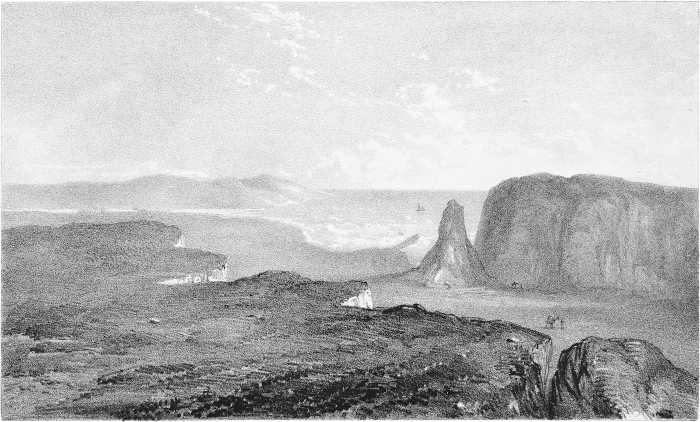
Tuesday, Sept. 6.—Therm. 60°. Had a row with the Sheïkh. Some of the people had stolen my horse’s corn. A cool wind from the N.E. Abú upset the milk I had saved for breakfast. We started at half-past nine, and rode fast for fourteen miles E.N.E., and then due N. Crossed several sand-hills, and saw many gazelles, boars and serpents. At five P.M. came to a small spring of fresh water. My horse has been three days without any, and has had only salt water since the day before he left Wad Nún. We came almost to blows to get a mouthful for him; I was obliged to go without any myself; for as the quantity is so small, it is the law to keep it for human beings alone. We halted for an hour, and then turning a little west, crossed a high range, and came again to El Bushra, where I got a belly-full of milk and of bread which was now mouldy.
Wednesday, Sept. 7.—Therm. 60°. It was arranged for us to return home this evening; but a dispute arose about a spring, and some salt-beds, and the question of war with the Tagakánths and Ergebats detained us the whole day. This conference was one of the most interesting scenes I ever witnessed. Upon one of the poles of the tent were suspended the guns, on the other the sword and cuneas; the Sheïkh stood in the centre, myself at his right hand, and the Kadí on his left; the charges and questions, the animated pleadings, the powerful appeals, &c. together with the noise of those siding with each party, all presented a striking picture. There was some difficulty in settling matters; but all differences were eventually brought to a close by a feast, when I got my milk and laid down.
Thursday, Sept. 8.—Therm. 62°. Off at half-past six. Rode very fast till half-past one, when we halted at the Sheïkh’s garden. We had crossed the Assaka, and came to the Syod, which is here only a ditch. We then lighted a fire, and got some good tea made with fresh water; there was plenty of figs to give a relish to the remainder of the musty bread. I had now travelled hard for ten days, and had eaten nothing but a small piece of fish, dry bread and camel’s milk. I perfectly astonished these people, ............... but was much benefitted and pleased by the trip. Got home at six P.M. when I had coffee and a wash.
Here ends Mr. Davidson’s Journal, from which the notes have been extracted; and the three following letters, addressed to Mr. Willshire, will tell all that his friends have to communicate up to the period of his lamented decease.
“Wad Nún, October 7th 1836.
“Being still in this horrible place, and with little chance of getting away, I should not have written this to-day, had I not been anxious to take advantage of any opportunity of giving you a piece of information which will astonish you. The Tagakánths, notwithstanding all that the Sheïkh ’Abíb and Hámed promised, have not arrived here. Another express has been sent to them; but even after their arrival there is to be a stop: should this prove to be the case, I will give up the project, content to lose all the money I have paid. In twelve days from this, I shall have completed six calendar months here, and during a great part of the time I have been treated worse than a dog. I have told Hámed, and as soon as I can get the Sheïkh and ’Abíb together, I shall tell them likewise, that if I do not start by to-morrow week, I shall insist upon their returning the money they have had; at all events, that Hájí ’Abíb must give me the five hundred dollars he brought, and the camels which have been purchased with my funds; and I must make up my mind to be robbed of the rest. This I have often threatened to do; but now I will act up to my resolves, let what will happen. Zain came yesterday and told me he would wait no longer; that he had engaged some sixty of the Ben Alí tribe, who take twenty-seven men mounted on horses as a flying guard, and who are determined to fight their way through, if necessary; he says he can send me on with the greatest confidence; that unless he was certain of accomplishing the object, he would not risk his brother’s property; but that I must go at once. I shewed him every thing packed up, ready to start at a moment’s notice, and that I was only waiting for some bread that I expected. He asked me how I was situated? I told him of every thing, and that one hundred and ten dollars, including the present premium on the pesettas, had been paid to the Sheïkh for the Tagakánths. He lifted up his hands and said, it ought not to have been more than half that sum. Besides I have brought him, said I, a present amounting to one hundred and eighty dollars, and that he has asked for guns, which will cost him from six to seven hundred dollars more. Moreover, I have promised, if I am satisfied with his conduct, to send him pistols, powder, &c.; that I had left the money in your hands. He got up, and said, it was too bad; but as I had paid the money, it was no use to say anything more; it was gone without the chance of recovery. He thinks, and so do I, that the Sheïkh and his party will give themselves no further trouble about the matter. Zain and his friends are the people, who, as I told you some time since, offered to carry me to Tumbuktú for five hundred dollars, and not to receive any money until they had delivered me there in safety. The third and principal matter I have to communicate is, that Sídí Alí Ben Ilft is gone to join the caravan going to Tumbuktú; he came here last night to tell me so. No sooner, however, was it known in the Sheïkh’s room that he was there, than they sent Hájí ’Abíb to bring him to them. At first he refused to go; but afterwards he went, and then came back and staid with me till late. He says that he will go through all Súdan with me, and even back to England, if I wish it. He begged me to visit him this morning, and I have just left him. He wants me not to hurry the káfilah; and from what I could collect from his conversation with Hámed, he is disposed to give a large sum to delay the káfilah one month longer, and a good sum to delay it twenty days. This he says, is to give him time to arrange his affairs, but I know too well it is to get further instructions from Fez. I have stated decidedly that I will not wait twenty days. This Sídí Alí would be of great use as a protector, but I want none. My mind is made up, I am sorry to say, to leave my bones in Súdán, and it is as firmly made up to make a severe example before I fall. I am determined, on the least treachery I see here or on the road, to fire first, and my pistols never miss. I feel that I am in bad hands here. Close and Moor-like as Sídí Alí is, I wormed out of him that there was some fear lest I should divert a most lucrative trade into another channel. Sídí Alí will not believe that I have paid the sum I stated; so trifling is the hire of camels to Tumbuktú, that they leave it to chance, and even with the salt they are glad to obtain ten mithkáls, not of gold; but merely the ten ............ a camel-load for the salt, including cost and carriage; as it is the back carriage that pays. All here are in great commotion, since they have learnt about Sídí Alí, and they know not what to do. I am sorry for Hájí ’Abíb, who is really concerned about this bad treatment. He complains sadly of the food; and his servant, who has been four times to Tumbuktú, says the dogs there live better than the Sheïkh here. He cannot eat the food, and means to cook for himself. He is preparing a little meat for me, but I cannot buy a pot to put it into. I stated in my last that I was not going to put on any disguise. I have been so accustomed to the dirt and filth in which I have been living for some time past, that it has become quite natural to me. You, perhaps, know more about Khovut than any other person, and when I tell you I have been living in Khotu, sleeping on it for nearly three months, you can form a pretty good idea of my disguise. I never expect to become white again. My beard is very long, my hair is cut close to the head, leaving one long tuft over the left ear, my bare legs and arms are covered with the bites of vermin; my cheek bones are very prominent, and teeth very sharp from having little or nothing to do.
“I have told you a great deal about Sheïkh Berúk, but the finishing stroke was put to it this morning. I yesterday purchased two sheep, to prepare a little meat to serve me either to go or return. After cutting what meat I could off the bones, and putting this aside, one of the slaves was sent from the house to bring them away, there being enough for the dinner, and the small pieces were of no use to me. I asked the girl why she was taking them away? She replied, ‘the Sheïkh had sent her for them.’ This conduct was strongly contrasted with that of Sídí Alí, who sent for Abú, and told him that he had heard I was buying meat, but he would not allow it; there were plenty of people to buy and cook meat for me, if necessary; and he would not have it said, that a stranger was buying his food while he was in their country.
“I am daily at the tents of the Tagakánths, and the ladies, not one, but several, have openly asked me to pass the night with them; an arrangement to which their husbands make not the least objection. The Sheïkh alone, who is no great favourite, is jealous of the little attention shewn to others. Hájí ’Abíb says, he does not know how to manage these people. He is too close-fisted for them.
“Hámed has just been here (Saturday P.M.). I asked him to sit down; he said he was ashamed, and would not sit in my room, till his father came or sent a letter, bidding him to bring me on.
“I wrote a hasty P. S. about the medicines for the Sultán. My friend, G. D———d, tells me that two such chests were never sent from any house: besides the medicines, ............ of silver, glass and copper, mortars of glass and slabs for pills and ointments, I ordered the best work on medicine, the latest on diseases of the eye, and the paper of anatomical figures made at Paris, which are taken to pieces by leaves, and through which the medical schools in Egypt and Persia are taught anatomy, as religious prejudices in those countries do not permit persons to make use of dead subjects for dissection. I likewise ordered several cases of bottles of Seidlitz and other powders for Sídí Ben Alí. All these I know have been sent, and I have paid for them: their non-arrival is owing probably to the want of proper directions to the Káïd of Tangier to forward them on: the matter should be really looked into for the national credit.
“Sunday.—Some observations have been made about my bones, and I was this morning told they were taken to make soup for the Sheïkh’s party in the garden, to which they all thought I should go; but I am too poorly to stir out. At length there is news from the tents, ordering all to be ready on Friday next to leave on Saturday or Sunday. I shall not believe it, till I am really on my camel. I have got no bread as yet.
“Wednesday Evening.—Your welcome letter, with the parcel, reached this place yesterday evening: the messenger wanted to return this day; but I was totally unable to hold a pen yesterday, and can but ill manage writing to-day. Ever since Sunday I have been upon my carpet alarmingly ill. This it appears is the sickly season of Wád Nún: my first attack was ophthalmia. From this the disorder went to the throat, and I had what they call a falling of the palate, and to such an extent, that, after finding no relief from strong blisters and gargling, and fearing suffocation, I was about to cut a hole in my throat to admit of breathing; but Hájí ’Abíb, the Sheïkh, the Jews, &c. all begged me to try the remedy of the country; and for the last two days I have had a stick covered with tar poked down my throat, and have inhaled the fumes of boiled tar twice or thrice a-day. I am now wonderfully better, and am able to speak and swallow hot liquids, though I cannot the saliva. The quantity of this secretion has quite astonished me: there has been a continued discharge for hours together, and amounting during the night to above a quart. Hámed has been particularly attentive, and so have all; and all have been frightened not a little. To-day I have had some severe palpitations, for which, if they return, I shall bleed myself till I faint, and repeat this as often as nature will allow. I do, perhaps, wrong in writing, but I know your kindness and good feeling would make you more anxious, should you hear of my illness through any other channel.
“I am sorry I cannot answer your questions. Nobody knows when we are to go: Hámed says, it is not the Sheïkh’s fault; that the times are difficult. His father will be here to-morrow or the day after; and we shall start the next day. If he comes to-night, we shall be off to-morrow. I have sent Abú to see about some cakes from the Jews. The letters to England must have miscarried, as there were some private ones of mine that would certainly have been answered.
“I have been obliged to coin an answer to the Sheïkh, and telling him that it will be time enough to think of commercial intercourse, as soon as he should have performed his engagements with me, and for the execution of which he had been paid before hand. He begins to feel alarmed, and is half ashamed of himself. I cannot write now what he has disclosed; but I shall be at him again before the messenger departs.
“Friday night.—I am much better, although I do not consider myself quite out of danger. I was obliged to make four incisions in the throat by the knife, before I could obtain relief. I will go to-morrow, if the people come, of which there appears but little chance. I would readily step into the grave to get away from this place; the thought of dying here, to be plundered by the Sheïkh and his crew of vagabonds, annoys me more than my bodily sufferings. Abú is quite useless: his fear makes him totally helpless; but this only serves to rouse me. Hájí Abíb’s servant, Fahir, has certainly saved me for the present. This strange fellow wants to leave his master, and come to me. I do not think this would be fair on my part; I shall, however, sound his master on the subject, who first made the offer for me to take him: but I believe the wretches here do not wish the boy to go back to Súdán, as he knows too many of their dirty tricks. One circumstance alone keeps up my spirits; all my predecessors started in good health and failed. Bruce, in whose career and my own are many singular coincidences, started in nearly the same shattered state of health, after a detention in Abyssinia of six months, as I do now, and yet he succeeded; and so, perhaps, may I; but my hopes are very faint.
“Saturday, four P.M.—I have this day spoken again to the Sheïkh; but he fights shy of every question. I shall, therefore, tell Abíb to-night, that I cannot stand this trifling any longer, and that on Monday I expect to have my money returned. It is all nonsense that I cannot get through Súdán before the rainy season commences, and it would be certain death in my state of health to think of braving them out. I have been shamefully used. The Sheïkh and Majíbí have played this game to suit their own views, without caring a straw for you or me: the former came snivelling about his expectation of a ship arriving, and that traders would be glad to come here. I told him that nobody believed in his power, and that the best proof of his weakness was his inability to send me on. I perceive that you have a great idea of his influence; but a week’s residence here would convince you, that with the exception of his own immediate dependants, not a soul would go out of the way to serve him; he is a mean, low, avaricious, and crafty savage; an arrant coward, and one who grudges even the barley that is daily served out for brute and beast. There is often more disturbance about overfilling the measure, than would take place in England if the Bank had failed. You seem to think there is some danger in his taking offence: you need not fear on that head, as he knows that he would then have to give the money back again.
“Sunday, P.M.—I have told the Sheïkh, that as the 15th October is now past, my orders were to wait no longer; and that as the Taghakánths had not made their appearance, I expected he would either return the money, or send me on, or let me take my own steps for proceeding to Tumbuktú. I had just laid down, after having read the prayers, and while Abú was at the market, when I heard some high words outside of the door, and in came the Sheïkh, Abíb, and Hámed. The first was foaming with rage; the second blushing up to his turban; while Hámed was sinking to the ground, like one doomed to die. All were talking, and in my weak state it was too much for me: being, however, an old soldier in argument, and finding all the party in anger, I kept myself more than ordinary cool. As soon as I could get them to speak one at a time, I found that some reports from Suweïrah had reached this place, accusing the Sheïkh of having played the rogue, and of having kept half the money of the Taghakánths for himself; and that the scandal had even extended to Fez. The Sheïkh asked, in a threatening manner, if Hámed had told me so. Perceiving that the doom of the poor lad would be fixed, if I told the truth, I was obliged to deny it. Had I not done so, the Sheïkh, I am certain, would have killed the lad on the spot. The Sheïkh then broke out in no measured terms against all of us; and though he confessed I had good reason to complain, he swore he had not taken a single morznum for himself; and that he would not allow his character to be trifled with. He said tauntingly, that all he had of mine was a gun, a caftan, and three suílhams; and he would give them back, and I might make out my bill for the other things, and he would pay for them. At this juncture Abú returned, and I requested him to tell the Sheïkh, that I was not a merchant, and knew nothing about bills; that if he found any difficulty in fulfilling his engagements, my bill was a very simple one; he had only to return the 1,000 dollars in pesetas, and the 350 paid to Hámed, and to send me back to the place from whence he brought me; that I did not care to go on, as it was plain he could not insure my safety. This quite cooled him; and he turned round to poor Hámed, and bade him get his horse; ride to the tents; bring his father and people, and let them answer me. The poor fellow was shipped off by Abíb, who now took up the subject, and stated that the Sheïkh’s character had been injured by a report, said to have come from you, that he has taken the Taghakánths’ money, and was now unwilling to send me on. Upon this there was lots of swearing, &c., and the Sheïkh became so warm, that he drank about a gallon of water, and left us, saying that, if the Taghakánths did not come in ten or fifteen days at farthest, he would take me back to Agadír. As soon as he was gone, I told Abíb that, from the size of the parcels given me to keep by Mohammed El Abd and Hámed Mulid, I did believe they had received one-half of the amount, and that you were to send the second half to me and not to the Sheïkh, and I would pay it over to the Taghakánths, or to him, if they stated they had received the whole sum. At this moment the Sheïkh returned, and muttered something about the Taghakánths owing him money, and that if he had paid himself, it was the same as paying it to them. This is probably what led Hámed to believe and say that the Sheïkh had paid only half, and had kept the remainder for himself. Hámed was now left alone with us. He said the Sheïkh would murder him, if he knew that it was he who had spread the report. He then left me to get his horse; but the order was countermanded, and he is now with me eating some bread, and watering it with his tears. Abíb says, he does not know what to do; but hopes that I will wait the fifteen days. Sídí Alí Ben Ilft told Abú in the market to-day, that if we get away in less than a month, he would give me leave to cut off his head. There is certainly some by-play here. This Sídí Alí has been using every means to dissuade me, and there is no doubt that his going is connected with my movements. I am sorry I can give you no certain news about the Spanish slaves. The man left here nearly a month ago, and seemed very careless about the matter, when he found that he was not to have a present or money before starting. I am making Abú collect whatever information he can pick up. News has just been brought that the Taghakánths are moving their tents, as the Ergebats have threatened to fall upon the káfilah as soon as it starts, to wreak their vengeance for the last attack. I am happy to tell you I am much better; but this blow of the Simúm, with which, it appears, I have been struck, has been very serious. I have a low ague; but feel too much pain in the chest when I cough to venture upon quinine. Between ourselves I have reason to be glad of this delay. I have had a little cake made by the Jews, but very indifferent and dear; I hope I shall now get the bread.”
The next letter, which is the last that was written from Wád Nún, relates some of the circumstances to which allusion is made by Mr. Willshire, and which have been already printed in the Journal of the Geographical Society. It is dated
“Saturday, Nov. 5, 1836.
“My pen almost refuses to write Wád Nún. Your kind letter reached me this morning, and I can answer it in better spirits, because I am happy to say my health is improving fast; but I cannot say much about my confidence in the success of the enterprize. The start is to be on Monday; although I do not go on that day. Every thing is now packed up, and ready to be placed upon the camels, with which Abú starts at day-break on Monday. I am to be left here, as if I had sent him on; Mohammed El Abd remains behind. On Wednesday or Thursday, according to the distance made by the camels the first day, we start on horseback, accompanied by the Sheïkh Berúk, and about a half-dozen horsemen, and we are to make Yeist, if possible, in one day. There I leave the district of Wád Nún; and to that place is a three days’ journey for loaded camels. I there leave my horse, and mount my camel, and we push on to the tents. It has been positively stated to the Sheïkh, that we are to stop only the night at the tents; but this is false: I have become so used to the language of the Taghakánths, that I understand more than they think; and I heard that we should be there two or three days at least, if not more. The journey is to be made in the shortest time possible. Berúk says thirty days; my conductor, however, adds five or six; to this, he says, that we shall go as a post, and form a party of only five, including Abú and myself.
“Mohammed El Abd came again at night, and there was again a sort of grumbling about the expense. I asked why I was to pay 230 mithkáls for a camel, when the usual hire for a káfilah was only from ten to twelve? This was a silencer. Instead of being the lions of the desert, they are only the jackals, and pay tribute to even a single Arab, who happens to cross them on the route. The Woobd Allah (Zeïn’s people) are the persons with whom I ought to have gone: they are still waiting here, and Zeïn has started this morning for Akka, to know the reason. I have at last got the account of the things I have purchased here, and which I have signed, requesting you to pay the amount to Abíb. It is fifty-one and a-half dollars, to which will be added the price of a thick haïk, if one can be procured.
“Night.—Mohammed El Abd has been here again, and I have read to him what I have written to you, and added, that all will now look to him, not only to protect me, but to send me on. He shewed me his letters to the two principal persons, and one of them is the great Marabout, whose word alone is enough to protect me. His letters state, that I am an Englishman; that the English have been always the friends of the Mussulman; that they are all their support; for they buy all the produce, and furnish all the things that are consumed in this country.
“Berúk is so proud of the very idea of a ship coming to his territory, that he has ordered Hájí Abíb to write to every body who can assist us in the least. He brings me new milk with his own hand; he is here ever and anon, and by keeping a jog upon his responsibility, all may yet be well. I have quite frightened Mohammed El Abd, by telling him of our power to stop the trade, and to make him personally responsible, if I am detained even at Tumbuktú.
“Midnight.—My party remained here very late; I feel that after the dressing I gave my conductor this morning, I have got once more the upper hand of all the party, and will now keep it. To-day I have parted with all my hair, the last remains but one of Christian appearance, and taken up the Tisbeah. On Monday I shall have to do without an interpreter, and on Wednesday, it is now said, we are to put on the turban and start. You shall hear from the tents, if possible; but this is not a very easy matter, as there are four tribes at war on the route, and no man dares go singly: as much as eleven mithkáls have been refused to carry a letter; but I suppose that for his own sake, the Sheïkh will arrange this. Abú is quite well, but not in the highest spirits. Let me assure you once more how grateful I am for all the trouble and anxiety you have taken in this matter. May Heaven bless and reward you and yours, and may we meet again in good old England, and there over our honest glass talk over the difficulties we have conquered. I do not wish to boast too much; but I do feel that few men would have gone through even what I have suffered already, and God knows I have much before me yet: but a merciful Providence has hitherto preserved me through many and great dangers, and on this I firmly rely.”
At last, after a delay of nearly seven months, Mr. D. was fairly en route for the goal of his travels—Tumbuktú. But he had scarcely entered the desert, when he perished by the hand of the assassin. His last letter is the following, dated
“Yeist, Tuesday, November 15th, 1836.
“This is the fourth day since my arrival here, and as yet I am uncertain about getting on. Having a spare hour to myself, for all the town have gone out in the expectation of an attack, I take the opportunity of writing up my journal. We did not actually start on Monday, as I stated, but all was in readiness, and we began by moving our things on that day. I had long predicted that there would be no rain, till I was allowed to depart; a prediction that turned out true to the letter. On Tuesday, scarcely had the remainder of the baggage been moved to the tents, and the horses saddled, when it rained in such torrents as to make it impossible to set out. It was, therefore, arranged for myself to start at midnight with the horse party, and for Abú to follow at break of day with the camels and baggage. The whole night was, however, passed in discussing what route we should take, and day had fairly dawned before all preparations were completed. We all started about seven A.M., but took different routes out of the town. I was accompanied by the Sheïkh Berúk and Hájí Abíb to the hill outside the town, where they took leave of me, and I was then committed to the care of the Sheïkh Mohammed El Abd, and Hámed Mulid. The superior conduct and character of these persons as compared with that of Berúk, his son and escort, was greatly in favour of the Taghakánths. But now let me give you a little pleasing information. At the eleventh hour nothing could exceed the attention and assurances of the Sheïkh and Hájí Abíb. The former in giving me into the hands of the Taghakánths, said, ‘He placed me in their hands as his own flesh and blood; if any thing happened to me, it would happen to him; I had done much for them. He counted upon making a name through me. I had waited long; and that now there was to be no delay, but to go on at once to the journey’s end, and that Mohammed El Abd was to return post haste with a letter, informing them of my safe arrival.’ I heard from his conversation here last night, that if he gets back to Wád Nún in three months, Berúk is to give him one hundred mithkáls of gold. Hájí Abíb wrote all the letters, and helped to pack up, and was much more nervous than I should be if I were going to the scaffold. I found that Abú had packed up my Suilham; but as it was said that I must have one, although I had three Haìks, Hájí Abíb took off his own, which he compelled me to accept. I told him I should write to you to get him another, which I pray you will have the goodness to do.
“I shall not say one word about our journey to Tinzerat, which were two days of misery and annoyance, owing to my companions, who thank God, returned on Friday morning. I was then given in charge to Sheïkh Hammó, and a party of twenty horse came from Yeist to Tinzerat to bring us here. Sheïkh Berúk’s horse was sent back, and I was mounted on one of Hammó’s, with a long gun placed in my hand, and haíked up to the mouth. We were off at eight A.M. On the road we were joined by twelve more, making our party, including the Taghakánths and self thirty-six, who were whooping, firing and galloping, to frighten the Haràmis, the road being very dangerous. A beautiful ride of eight hours brought us in sight of this place. Hammó, with twenty horsemen, pushed into the town. On entering it accompanied by Sheïkh Bel Aide, and another person, he rode up towards myself and fired off his gun at my horse’s feet. The whole place was out under arms. I rode up between two files of men with their arms; and on entering the gate leading to his house, two men mounted, with their guns crossed, made their appearance. Here he halted, and called for powder, when a grand volley was fired, which was followed by the screams of the ladies on the house-tops; and then turning to me said, ‘Well, Christian, is this the proper way to receive and treat you?’ I was then taken to his house, where with his own hands he swept the court-yard and spread a carpet, and told me I was welcome, and bade me ask for whatever I wanted. Milk, and dates fresh from the trees, were then brought me, and all to my perfect satisfaction. Early on Saturday he came to say, that a camel was ready for me, if I wished to start. I found Zein here, who had been unable to get his people on, although they swore that nothing should stop them. They allege that the state of the roads is so bad, as all the tribes are at war; and though the different caravans are said to amount to near five hundred men and three thousand camels, they cannot get on. Zeïn left yesterday for Akka to bring his people here to accompany me, if possible, as it is now settled that I am not to go to the tents at all, but make direct for the Sahrá, and proceed to Tumbuktú without seeing even a tent or a single person. We have just finished a consultation, when it was determined to start on Thursday night. The journey will be accomplished in a very short time, as the camels are to drink only six times. How we are to manage I know not, as we can carry but little of any thing, and from all appearances I fear there will be no káfilah this year. All are in great alarm. Mohammed El Abd has learned that people are on the look-out at the tents for my arrival, and it has been told them that I am coming for certain with the káfilah; which is accordingly to be delayed here for three or four days, so that we shall be a good week on the road before it is known that we have got off. I am happy to say that I have picked up amazingly, and have now no fears about my health. I should have liked your glass of wine, but it did not reach me. Hájí Abíb will bring back the horse and my gun, of which the latter is to be sent to England; but unless you can do it easily, not till you hear from me at Tumbuktú. Mohammed El Abd says he wants to go to Suweïrah, and shall carry my letter to you himself and say, there is the letter from Yel Yayha: the Taghakánths have kept their word; God grant that he may.
“Evening. The people have returned. One man was killed, and another shot through the arm on the road we passed on Friday.
“Wednesday, 16.—The answer from the Woobed Allah, which was expected this morning, has not arrived. Mohammed El Abd says, that if they do not come here as written for, he will start to-morrow night or Friday morning without them. They were intended to form an escort for the three first days. The attention and civilities of my host continue unabated. I suspect, however, that the Taghakánths live so poorly in their own quarters, that they are loath to leave any place where there is good food and no paying for it. By our present arrangements we shall save nearly six days, as the tents are not in the direct route. It is, however, impossible to get any certain answers or information to be depended upon. Changes take place every hour not only in places, but in persons; and the man, who at one time was as true as the sun, and to be trusted with any thing, is at another a thief and haràmi.”
“P.M.—The son of the Marabout Sheïkh has arrived with a party of horse, who are to escort us across the Wad Draha, and one day beyond.
“You must, my kind friend, excuse me for again adverting to one of my former letters. But the great interest you have taken in the success of my enterprise, and the immense trouble you have had, demands every possible return on my part. I am still in the district of Wád Nún, where I can assure Sheïkh Berúk is scouted and laughed at by all. Every body thinks with me, that he is worth nothing: that he is speculating with the property of others; his whole tribe, excepting Hájí Abíb, are bad, low and disreputable. Do not let him overdraw too much, or you will be a loser. His life is not a good one, and as to his sons they are the greatest rips I ever saw. Every step we have taken from his cursed place, we have found the people improved, far more liberal and hospitable, and although they are rather savage, they exhibit a nobleness of character, of which there is not a particle in the family of Berúk. If I mistake not, Seyd Boazer will open your eyes as to this crew.