Chapter VI · ANALYSIS OF THE CHAPTER.
Reading edition
This chapter contains an account of the opening of six of the seven seals. It need hardly be said to anyone who is at all familiar with the numerous—not to say numberless—expositions of the Apocalypse, that it is at this point that interpreters begin to differ, and that here commences the divergence towards those various, discordant, and many of them wild and fantastic theories, which have been proposed in the exposition of this wonderful book. Up to this point, though there may be unimportant diversities in the exposition of words and phrases, there is no material difference of opinion as to the general meaning of the writer. In the epistles to the seven churches, and in the introductory scenes to the main visions, there can be no doubt, in the main, as to what the writer had in view, and what he meant to describe. He addressed churches then existing (ch. i.‒iii.), and set before them their sins and their duties; and he described scenes passing before his eyes as then present (ch. iv. v.), which were merely designed to impress his own mind with the importance of what was to be disclosed, and to bring the great actors on the stage, and in reference to which there could be little ground for diversity in the interpretation. Here, however, the scene opens into the future, comprehending all the unknown period until there shall be a final triumph of Christianity, and all its foes shall be prostrate. The actors are the Son of God, angels, men, Satan, storms, tempests, earthquakes, the pestilence and fire; the scene is heaven, earth, hell. There is no certain designation of places; there is no mention of names—as there is in Isaiah (xlv. 1) of Cyrus, or as there is in Daniel (viii. 21; x. 20; xi. 2) of the “king of Grecia;” there is no designation of time that is necessarily unambiguous; and there are no characteristics of the symbols used that make it antecedently certain that they could be applied only to one class of events. In the boundless future that was to succeed the times of John, there would be, of necessity, many events to which these symbols might be applied, and the result has shown that it has required but a moderate share of pious ingenuity to apply them, by different expositors, to events differing widely from each other in their character, and in the times when they would occur. It would be too long to glance even at the various theories which have been proposed and maintained in regard to the interpretation of the subsequent portions of the Apocalypse, and wholly impossible to attempt to examine those theories. Time, in its developments, has already exploded many of them; and time, in its future developments, will doubtless explode many more, and each one must stand or fall as, in the disclosures of the future, it shall be found to be true or false. It would be folly to add another to those numerous theories, even if I had any such theory (see the Preface), and perhaps equal folly to pronounce with certainty on any one of those which have been advanced. Yet this seems to be an appropriate place to state, in few words, what principles it is designed to pursue in the interpretation of the remainder of the book.
(1) It may be assumed that large portions of the book relate to the future; that is, to that which was future when John wrote. In this all expositors are agreed, and this is manifest indeed on the very face of the representation. It would be impossible to attempt an interpretation on any other supposition, and somewhere in that vast future the events are to be found to which the symbols here used had reference. This is assumed, indeed, on the supposition that the book is inspired—a fact which is assumed all along in this exposition, and which should be allowed to control our interpretation. But assuming that the book relates to the future, though that supposition will do something to determine the true method of interpretation, yet it leaves many questions still unsolved. Whether it refers to the destruction of Jerusalem, on the supposition that the work was written before that event, or to the history of the church subsequent to that; whether it is designed to describe events minutely, or only in the most general manner; whether it is intended to furnish a syllabus of civil and ecclesiastical history, or only a very general outline of future events; whether the times are so designated that we can fix them with entire certainty; or whether it was intended to furnish any certain indication of the periods of the world when these things should occur;—all these are still open questions, and it need not be said that on these the opinions of expositors have been greatly divided.
(2) It may be assumed that there is meaning in these symbols, and that they were not used without an intention to convey some important ideas to the mind of John and to the minds of his readers—to the church then, and to the church in future times. Comp. Notes on ch. i. 3. The book is indeed surpassingly sublime. It abounds with the highest flights of poetic language. It is Oriental in its character, and exhibits everywhere the proofs of a most glowing imagination in the writer. But it is also to be borne in mind that it is an inspired book, and this fact is to determine the character of the exposition. If inspired, it is to be assumed that there is a meaning in these symbols; an idea in each one of them, and in all combined, of importance to the church and the world. Whether we can ascertain the meaning is another question; but it is never to be doubted by an expositor of the Bible that there is a meaning in the words and images employed, and that to find out that meaning is worthy of earnest study and prayer.
(3) Predictions respecting the future are often necessarily obscure to man. It cannot be doubted, indeed, that God could have foretold future events in the most clear and unambiguous language. He who knows all that is to come as intimately as he does all the past, could have caused a record to have been made, disclosing names, and dates, and places, so that the most minute statements of what is to occur might have been in the possession of man as clearly as the records of the past now are. But there were obvious reasons why this should not occur, and in the prophecies it is rare that there is any such specification. To have done this might have been to defeat the very end in view; for it would have given to man, a free agent, the power of embarrassing or frustrating the divine plans. But if this course is not adopted, then prophecy must, from the nature of the case, be obscure. The knowledge of any one particular fact in the future is so connected with many other facts, and often implies so much knowledge of other things, that without that other knowledge it could not be understood. Suppose that it had been predicted, in the time of John, that at some future period some contrivance should be found out by which what was doing in one part of the world could be instantaneously known in another remote part of the world, and spread abroad by thousands of copies in an hour, to be read by a nation. Suppose, for instance, that there had been some symbol or emblem representing what actually occurs now, when in a morning newspaper we read what occurred last evening at St. Louis, Dubuque, Galena, Chicago, Cincinnati, Charleston, New Orleans; it is clear that at a time when the magnetic telegraph and the printing-press were unknown, any symbol or language describing it that could be employed must be obscure, and the impression must have been that this could be accomplished only by miracle—and it would not be difficult for one who was disposed to scepticism to make out an argument to prove that this could not occur. It would be impossible to explain any symbol that could be employed to represent this until these wonderful descriptions should become reality, and in the meantime the book in which the symbols were found might be regarded as made up of mere riddles and enigmas; but when these inventions should be actually found out, however much ridicule or contempt had been poured on the book before, it might be perfectly evident that the symbol was the most appropriate that could be used, and no one could doubt that it was a divine communication of what was to be in the future. Something of the same kind may have occurred in the symbols used by the writer of the book before us.
(4) It is not necessary to suppose that a prophecy will be understood in all its details until the prediction is accomplished. In the case just referred to, though the fact of the rapid spread of intelligence might be clear, yet nothing would convey any idea of the mode, or of the actual meaning of the symbols used, unless the inventions were themselves anticipated by a direct revelation. The trial of faith in the case would be the belief that the fact would occur, but would not relate to the mode in which it was to be accomplished, or the language employed to describe it. There might be great obscurity in regard to the symbols and language, and yet the knowledge of the fact be perfectly plain. When, however, the fact should occur as predicted, all would be clear. So it is in respect to prophecy. Many recorded predictions that are now clear as noon-day, were once as ambiguous and uncertain in respect to their meaning as in the supposed case of the press and the telegraph. Time has made them plain; for the event to which they referred has so entirely corresponded with the symbol as to leave no doubt in regard to the meaning. Thus many of the prophecies relating to the Messiah were obscure at the time when they were uttered; were apparently so contradictory that they could not be reconciled; were so unlike anything that then existed, that the fulfilment seemed to be impossible; and were so enigmatical in the symbols employed, that it seemed in vain to attempt to disclose their meaning. The advent of the long-promised Messiah, however, removed the obscurity; and now they are read with no uncertainty as to their meaning, and with no doubt that those predictions, once so obscure, had a divine origin.
The view just suggested may lead us to some just conceptions of what is necessary to be done in attempting to explain the prophecies. Suppose, then, first, that there had been, say in the dark ages, some predictions that claimed to be of divine origin, of the invention of the art of printing and of the magnetic telegraph. The proper business of an interpreter, if he regarded this as a divine communication, would have consisted in four things: (a) to explain, as well as he could, the fair meaning of the symbols employed, and the language used; (b) to admit the fact referred to, and implied in the fair interpretation of the language employed, of the rapid spread of intelligence in that future period, though he could not explain how it was to be done; (c) in the meantime it would be a perfectly legitimate object for him to inquire whether there were any events occurring in the world, or whether there had been any, to which these symbols were applicable, or which would meet all the circumstances involved in them; (d) if there were, then his duty would be ended; if there were not, then the symbols, with such explanation as could be furnished of their meaning, should be handed on to future times, to be applied when the predicted events should actually occur. Suppose, then, secondly, the case of the predictions respecting the Messiah, scattered along through many books, and given in various forms, and by various symbols. The proper business of an interpreter would have been, as in the other case, (a) to explain the fair meaning of the language used, and to bring together all the circumstances in one connected whole, that a distinct conception of the predicted Messiah might be before the mind; (b) to admit the facts referred to, and thus predicted, however incomprehensible and apparently contradictory they might appear to be; (c) to inquire whether anyone had appeared who combined within himself all the characteristics of the description; and (d) if no one had thus appeared, to send on the prophecies, with such explanations of words and symbols as could be ascertained to be correct, to future times, to have their full meaning developed when the object of all the predictions should be accomplished, and the Messiah should appear. Then the meaning of all would be plain; and then the argument from prophecy would be complete. This is obviously now the proper state of the mind in regard to the predictions in the Bible, and these are the principles which should be applied in examining the book of Revelation.
(5) It may be assumed that new light will be thrown upon the prophecies by time, and by the progress of events. It cannot be supposed that the investigations of the meaning of the prophetic symbols will all be in vain. Difficulties, it is reasonable to hope, may be cleared up; errors may be detected in regard to the application of the prophecies to particular events; and juster views on the prophecies, as on all other subjects, will prevail as the world grows older. We become wiser by seeing the errors of those who have gone before us, and an examination of the causes which led them astray may enable us to avoid such errors in the future. Especially may it be supposed that light will be thrown on the prophecies as they shall be in part or wholly fulfilled. The prophecies respecting the destruction of Babylon, of Petra, of Tyre, of Jerusalem, are now fully understood; the prophecies respecting the advent of the Messiah, and his character and work, once so obscure, are now perfectly clear. So, we have reason to suppose, it will be with all prophecy in the progress of events, and sooner or later the world will settle down into some uniform belief in regard to the design and meaning of these portions of the sacred writings. Whether the time has yet come for this, or whether numerous other failures are to be added to the melancholy catalogue of past failures on this subject, is another question; but ultimately all the now unfulfilled prophecies will be as clear as to their meaning as are those which have been already fulfilled.
(6) The plan, therefore, which I propose in the examination of the remaining portion of the Apocalypse is the following: (a) To explain the meaning of the symbols; that is, to show, as clearly as possible, what those symbols properly express, independently of any attempt to apply them. This opens, of itself, an interesting field of investigation, and one where essential service may be done, even if nothing further is intended. Without any reference to the application of those symbols, this, of itself, is an important work of criticism, and, if successfully done, would be rendering a valuable service to the readers of the sacred volume. (b) To state, as briefly as possible, what others who have written on this book, and who have brought eminent learning and talent to bear on its interpretation, have supposed to be the true interpretation of the symbols employed by John, and in regard to the times in which the events referred to would occur. It is in this way only that we can be made acquainted with the real progress made in interpreting this book, and it will be useful at least to know how the subject has struck other minds, and how and why they have failed to perceive the truth. I propose, therefore, to state, as I go along, some of the theories which have been held as to the meaning of the Apocalypse, and as to the events which have been supposed by others to be referred to. My limits require, however, that this should be briefly done, and forbid my attempting to examine those opinions at length. (c) To state, in as brief and clear a manner as possible, the view which I have been led to entertain as to the proper application of the symbols employed in the book, with such historical references as shall seem to me to confirm the interpretation proposed. (d) Where I cannot form an opinion as to the meaning, to confess my ignorance. He does no service in a professed interpretation of the Bible who passes over a difficulty without attempting to remove it, or who, to save his own reputation, conceals the fact that there is a real difficulty; and he does as little service who is unwilling to confess his ignorance on many points, or who attempts an explanation where he has no clear and settled views. As his opinion can be of no value to anyone else unless it is based on reasons in his own mind that will bear examination, so it can usually be of little value unless those reasons are stated. It is as important for his readers to have those reasons before their own minds as it is for him; and unless he has it in his power to state reasons for what he advances, his opinions can be worth nothing to the world. He who lays down this rule of interpretation may expect to have ample opportunity, in interpreting such a book as the Apocalypse, to confess his ignorance; but he who interprets a book which he believes to be inspired, may console himself with the thought that what is now obscure will be clear hereafter, and that he performs the best service which he can if he endeavours to explain the book up to the time in which he lives. There will be developments hereafter which will make that clear which is now obscure; developments which will make this book, in all past ages apparently so enigmatical, as clear as any other portion of the inspired volume, as it is now, even with imperfect view which we may have of its meaning, beyond all question one of the most sublime books that has ever been written.
This chapter describes the opening of the first six seals. (1) The first discloses a white horse, with a rider armed with a bow. A crown is given to him, symbolical of triumph and prosperity, and he goes forth to conquer, ver. 1, 2. (2) The second discloses a red-coloured horse, with a rider. The emblem is that of blood—of sanguinary war. Power is given him to take peace from the earth, and a sword is given him—emblem of war, but not of certain victory. Triumph and prosperity are denoted by the former symbol; war, discord, bloodshed, by this, ver. 3, 4. (3) The third discloses a black horse, with a rider. He has a pair of balances in his hand, as if there were scarcity in the earth, and he announces the price of grain in the times of this calamity, and a command is given not to hurt the oil and the wine, ver. 5, 6. The emblem is that of scarcity—as if there were oppression, or as a consequence of war or discord, while at the same time there is care bestowed to preserve certain portions of the produce of the earth from injury. (4) The fourth discloses a pale horse, with a rider. The name of this rider is Death, and Hell (or Hades) follows him—as if the hosts of the dead came again on the earth. Power is given to the rider over the fourth part of the earth, to kill with sword, with hunger, with death, and with wild beasts. This emblem would seem to denote war, wide-wasting pestilence, famine, and desolation—as if wild beasts were suffered to roam over lands that had been inhabited; something of which paleness would be an emblem. Here ends the array of horses; and it is evidently intended by these four symbols to refer to a series of events that have a general resemblance—something that could be made to stand by themselves, and that could be grouped together. (5) The fifth seal opens a new scene. The horse and the rider no longer appear. It is not a scene of war, and of the consequences of war, but a scene of persecution. The souls of those who were slain for the word of God and the testimony which they held are seen under the altar, praying to God that he would avenge their blood. White robes are given them—tokens of the divine favour, and emblems of their ultimate triumph; and they are commanded to “rest for a little season, till their fellow-servants and their brethren that should be killed as they were should be fulfilled;” that is, that they should be patient until the number of the martyrs was filled up. In other words, there was (a) the assurance of the divine favour towards them; (b) vengeance, or the punishment of those who had persecuted them, would not be immediate; but (c) there was the implied assurance that just punishment would be inflicted on their persecutors, and that the cause for which they had suffered would ultimately triumph, ver. 9‒11. (6) The opening of the sixth seal, ver. 12‒17. There was an earthquake, and the sun became dark, and the moon was turned to blood, and the stars fell, and all kings and people were filled with consternation. This symbol properly denotes the time of public commotion, of revolution, of calamity; and it was evidently to be fulfilled by some great changes on the earth, or by the overturning of the seats of power, and by such sudden revolutions as would fill the nations with alarm.
5 And when he had opened the third seal, I heard the third beast say, Come and see. And I beheld, and lo, a black horse; and he that sat on him had a pair of balances in his hand.
5, 6. And when he had opened the third seal.. Unfolding another portion of the volume. See Notes on ch. v. 1. ¶ I heard the third beast say, Come and see. See Notes on ch. iv. 7. It is not apparent why the third beast is represented as taking a particular interest in the opening of this seal (comp. Notes on ver. 3), nor is it necessary to show why it was so. The general design seems to have been, to represent each one of the four living creatures as interested in the opening of the seals, but the order in which they did this does not seem to be a matter of importance. ¶ And I beheld, and lo, a black horse. The specifications of the symbol here are the following: (a) As before, the horse. See Notes on ver. 2. (b) The colour of the horse: lo, a black horse. This would properly denote distress and calamity—for black has been regarded always as such a symbol. So Virgil speaks of fear as black: “atrumque timorem” (Æn. ix. 619). So again, Georg. iv. 468:
“Caligantem nigra formidine lucum.”
So, as applied to the dying Acca, Æn. xi. 825:
“Tenebris nigrescunt omnia circum.”
Black, in the Scriptures, is the image of fear, of famine, of death. La. v. 10: “Our skin was black like an oven, because of the terrible famine.” Je. xiv. 2: “Because of the drought Judah mourneth, and the gates thereof languish; they are in deep mourning [literally, black] for the land.” Joel ii. 6: “All faces shall gather blackness.” Na. ii. 10: “The knees smite together, and there is great pain in all loins, and the faces of them all gather blackness.” Comp. Re. vi. 12; Eze. xxxii. 7. See also Bochart, Hieroz. P. i. lib. ii. c. vii. pp. 106, 107. From the colour of the horse here introduced we should naturally look for some dire calamity, though the nature of the calamity would not be designated by the mere use of the word black. What the calamity was to be must be determined by what follows in the symbol. Famine, pestilence, oppression, heavy taxation, tyranny, invasion—any of these might be denoted by the colour of the horse. (c) The balances: and he that sat on him had a pair of balances in his hand. The original word here rendered a pair of balances, is ζυγὸν. This word properly means a yoke, serving to couple anything together, as a yoke for cattle. Hence it is used to denote the beam of a balance, or of a pair of scales—and is evidently so used here. The idea is, that something was to be weighed, in order to ascertain either its quantity or its value. Scales or balances are the emblems of justice or equity (comp. Job xxxi. 6; Ps. lxii. 9; Pr. xi. 1; xvi. 11); and when joined with symbols that denote the sale of corn and fruit by weight, become the symbol of scarcity. Thus “bread by weight” (Le. xxvi. 26) denotes scarcity. So in Eze. iv. 16, “And they shall eat bread by weight.” The use of balances here as a symbol would signify that something was to be accurately and carefully weighed out. The connection leads us to suppose that this would appertain to the necessaries of life, and that it would occur either in consequence of scarcity, or because there would be an accurate or severe exaction, as in collecting a revenue on these articles. The balance was commonly the symbol of equity and justice; but it was also, sometimes, the symbol of exaction and oppression, as in Ho. xii. 7: “The balance of deceit is in his hands; he loveth to oppress.” If the balances stood alone, and there were no proclamation as to what was to occur, we should look, under this seal, to a time of the exact administration of justice, as scales or balances are now used as emblems of the rigid application of the laws and of the principles of justice in courts, or in public affairs. If this representation stood alone, or if the black horse and the scales constituted the whole of the symbol, we should look for some severe administration, or perhaps some heavy calamity under a rigorous administration of laws. The reference, however, to the “wheat and barley,” and to the price for which they were to be weighed out, serves still further to limit and define the meaning of the symbol as having reference to the necessaries of life—to the productions of the land—to the actual capital of the country. Whether this refers to scarcity, or to taxation, or both, must be determined by the other parts of the symbol. (d) The proclamation: And I heard a voice in the midst of the four beasts say. That is, from the throne, ch. iv. 6. The voice was not that of one of the four beasts, but it seemed to come from among them. As the rider went forth, this was the proclamation that was made in regard to him; or this is that which is symbolized in his going forth, to wit, that there would be such a state of things that a measure of wheat would be sold for a penny, &c. The proclamation consists essentially of two things—that which refers to the price or value of wheat and barley, and that which requires that care shall be taken not to injure the oil and the wine. Each of these demands explanation. ¶ A measure of wheat for a penny. See the margin. The word rendered measure—χοῖνιξ, chœnix—denotes an Attic measure for grain and things dry, equal to the forty-eighth part of the Attic medimnus, or the eighth part of the Roman modius, and consequently was nearly equivalent to one quart English (Rob. Lex.). The word rendered penny, δηνάριον—Lat. denarius—was of the same value as the Greek δραχμή, drachmē, and was equivalent to about fourteen cents or sevenpence. This was the usual price of a day’s labour, Mat. xx. 2, 9. The chœnix, or measure of grain here referred to, was the ordinary daily allowance for one man [Odyss., xix. 27, 28). See Stuart, in loco. The common price of the Attic medimnus of wheat was five or six denarii; but here, as that contained forty-eight chœnixes or quarts, the price would be augmented to forty-eight denarii—or it would be about eight times as dear as ordinary; that is, there would be a scarcity or famine. The price of a bushel of wheat at this rate would be about four dollars and a half or 18 shillings—a price which would indicate great scarcity, and which would give rise to much distress. ¶ And three measures of barley for a penny. It would seem from this that barley usually bore about one-third the price of wheat. It was a less valuable grain, and perhaps was produced in greater abundance. This is not far from the proportion which the price of this grain usually bears to that of wheat, and here, as in the case of the wheat, the thing which would be indicated would be scarcity. This proclamation of “a measure of wheat for a penny” was heard either as addressed to the horseman, as a rule of action for him, or as addressed by the horseman as he went forth. If the former is the meaning, it would be an appropriate address to one who was going forth to collect tribute—with reference to the exact manner in which this tribute was to be collected, implying some sort of severity of exaction; or to one who should distribute wheat and barley out of the public granaries at an advanced price, indicating scarcity. Thus it would mean that a severe and heavy tax—represented by the scales and the scarcity—or a tax so severe as to make grain dear, was referred to. If the latter is the meaning, then the idea is that there would be a scarcity, and that grain would be dealt out by the government at a high and oppressive price. The latter idea would be as consonant with the symbol of the scales and the price mentioned as the other, if it were not for the additional injunction not to “hurt the oil and the wine”—which cannot be well applied to the idea of dealing out grain at a high price. It can, however, be connected, by a fair interpretation of that passage, with such a severity of taxation that there would be a propriety in such a command—for, as we shall see, under the explanation of that phrase, such a law was actually promulgated as resulting from severity of taxation. The idea, then, in the passage before us, would seem to be, (a) that there would be a rigid administration of the law in regard to the matter under consideration—that pertaining to the productions of the earth—represented by the balances; and (b) that that would be connected with general scarcity, or such an exercise of this power as to determine the price of grain, so that the price would be some three times greater than ordinary. ¶ And see thou hurt not the oil and the wine. There has been a great variety of interpretations proposed of this passage, and it is by no means easy to determine the true sense. The first inquiry in regard to it is, to whom is it addressed? Perhaps the most common impression on reading it would be, that it is addressed to the horseman with the balances, commanding him not to injure the oliveyards and the vineyards. But this is not probably the correct view. It does not appear that the horseman goes forth to destroy anything, or that the effect of his going forth is directly to injure anything. This, therefore, should not be understood as addressed to the horseman, but should be regarded as a general command to any and all not to injure the oliveyards and vineyards; that is, an order that nothing should be done essentially to injure them. If thus regarded as addressed to others, a fair and congruous meaning would be furnished by either of the following interpretations: either (a) considered as addressed to those who were disposed to be prodigal in their manner of living, or careless as to the destruction of the crop of the oil and wine, as they would now be needed; or (b) as addressed to those who raised such productions, on the supposition that they would be taxed heavily, or that large quantities of these productions would be extorted for revenue, that they should not mutilate their fruit-trees in order to evade the taxes imposed by the government. In regard to the things specified here—oil and wine—it may be remarked, that they were hardly considered as articles of luxury in ancient times. They were almost as necessary articles as wheat and barley. They constituted a considerable part of the food and drink of the people, as well as furnished a large portion of the revenue, and it would seem to be with reference to that fact that the command here is given that they should not be injured; that is, that nothing should be done to diminish the quantity of oil and wine, or to impair the productive power of oliveyards and vineyards. The state of things thus described by this seal, as thus interpreted, would be, (a) a rigid administration of the laws of the empire, particularly in reference to taxation, producing a scarcity among the necessary articles of living; (b) a strong tendency, from the severity of the taxation, to mutilate such kinds of property, with a view either of concealing the real amount of property, or of diminishing the amount of taxes; and (c) a solemn command from some authoritative quarter not to do this. A command from the ruling power not to do this would meet all that would be fairly demanded in the interpretation of the passage; and what is necessary in its application, is to find such a state of things as would correspond with these predictions; that is, such as a writer would have described by such symbols on the supposition that they were referred to.
Now it so happens that there were important events which occurred in the Roman empire, and connected with its decline and fall, of sufficient importance to be noticed in a series of calamitous events, which corresponded with the symbol here, as above explained. They were such as these: (a) The general severity of taxation, or the oppressive burdens laid on the people by the emperors. In the account which Mr. Gibbon gives of the operation of the Indictions, and Superindictions, though the specific laws on this subject pertained to a subsequent period, the general nature of the taxation of the empire and its oppressive character may be seen (Decline and Fall, i. 357‒359). A general estimate of the amount of revenue to be exacted was made out, and the collecting of this was committed to the pretorian prefects, and to a great number of subordinate officers. “The lands were measured by surveyors who were sent into the provinces; their nature, whether arable, or pasture, or woods, was distinctly reported; and an estimate made of their common value, from the average produce of five years. The number of slaves and of cattle constituted an essential part of the report; an oath was administered to the proprietors, which bound them to disclose the true state of their affairs; and their attempts to prevaricate or elude the intention of the legislature were severely watched, and punished as a capital crime, which included the double guilt of treason and of sacrilege. According to the different nature of lands, their real produce in the various articles of wine or oil, corn or barley, wood or iron, was transported by the labour or at the expense of the provincials to the imperial magazines, from whence they were occasionally distributed for the use of the court or of the army, and of the two capitals, Rome and Constantinople,” i. p. 358. Comp. Lactant. de Mort. Persecut., c. 23. (b) The particular order, under this oppressive system of taxation, respecting the preservation of vineyards and oliveyards, may be referred to, also, as corresponding to the command sent forth under this rider, not to “hurt the oil and the wine.” That order was in the following words:—“If any one shall sacrilegiously cut a vine, or stint the fruit of prolific boughs, and craftily feign poverty in order to avoid a fair assessment, he shall, immediately on detection, suffer death, and his property be confiscated” (Cod. Theod. l. xiii. lib. xi. seq.; Gibbon, i. 358, note). Mr. Gibbon remarks: “Although this law is not without its studied obscurity, it is, however, clear enough to prove the minuteness of the inquisition, and the disproportion of the penalty.” (c) Under this general subject of the severity of taxation—as a fact far-spreading and oppressive, and as so important as to hasten the downfall of the empire, may be noticed a distinct edict of Caracalla as occurring more directly in the period in which the rider with the balances may be supposed to have gone forth. This is stated by Mr. Gibbon (i. 91) as one of the important causes which contributed to the downfall of the empire. “The personal characters of the emperors, their victories, laws, and fortunes,” says he, “can interest us no farther than they are connected with the general history of the decline and fall of the monarchy. Our constant attention to that object will not suffer us to overlook a most important edict of Antoninus Caracalla, which communicated to all the free inhabitants of the empire the name and privileges of Roman citizens. His unbounded liberality, however, flowed not from the sentiments of a generous mind; it was the sordid result of avarice,” &c. He then proceeds at length to state the nature and operations of that law, by which a heavy tax, under the pretence of liberality, was in fact imposed on all the citizens of the empire—a fact which, in its ultimate results, the historian of the Decline and Fall regards as so closely connected with the termination of the empire. See Gibbon, i. pp. 91‒95. After noticing the laws of Augustus, Nero, and the Antonines, and the real privileges conferred by them on those who became entitled to the rank of Roman citizens—privileges which were a compensation in the honour, dignity, and offices of that rank for the measure of taxation which it involved—he proceeds to notice the fact that the title of “Roman citizen” was conferred by Caracalla on all the free citizens of the empire, involving the subjection to all the heavy taxes usually imposed on those who sustained the rank expressed by the title, but with nothing of the compensation connected with the title when it was confined to the inhabitants of Italy. “But the favour,” says he, “which implied a distinction, was lost in the prodigality of Caracalla, and the reluctant provincials were compelled to assume the vain title, and the real obligations, of Roman citizens. Nor was the rapacious son of Severus [Caracalla] contented with such a measure of taxation as had appeared sufficient to his moderate predecessors. Instead of a twentieth, he exacted a tenth of all legacies and inheritances; and during his reign he crushed alike every part of the empire under the weight of his iron sceptre,” i. 95. So again (Ibid.), speaking of the taxes which had been lightened somewhat by Alexander, Mr. Gibbon remarks: “It is impossible to conjecture the motive that engaged him to spare so trifling a remnant of the evil; but the noxious weed, which had not been totally eradicated, again sprung up with the most luxuriant growth, and in the succeeding age darkened the Roman world with its deadly shade. In the course of this history we shall be too often summoned to explain the land-tax, the capitation, and the heavy contributions of corn, wine, oil, and meat, which were exacted from the provinces for the use of the court, the army, and the capital.” In reference to this whole matter of taxation as being one of the things which contributed to the downfall of the empire, and which spread woe through the falling empire—a woe worthy to be illustrated by one of the seals—a confirmation may be derived from the reign of Galerius, who, as Cæsar, acted under the authority of Diocletian; who excited Diocletian to the work of persecution (Decline and Fall, i. 317, 318); and who, on the abdication of Diocletian, assumed the title of Augustus (Decline and Fall, i. 222). Of his administration in general Mr. Gibbon (i. 226) remarks: “About that time the avarice of Galerius, or perhaps the exigencies of the state, had induced him to make a very strict and rigorous inquisition into the property of his subjects for the purpose of a general taxation, both on their lands and on their persons. A very minute survey appears to have been taken of their real estates; and wherever there was the slightest suspicion of concealment, torture was very freely employed to obtain a sincere declaration of their personal wealth.” Of the nature of this exaction under Galerius; of the cruelty with which the measure was prosecuted—particularly in its bearing on Christians, towards whom Galerius cherished a mortal enmity (Decline and Fall, i. 317); and of the extent and severity of the suffering among Christians and others, caused by it—the following account of Lactantius (De Mort. Persecut., c. 23) will furnish a painful but most appropriate illustration:—“Swarms of exactors sent into the provinces and cities filled them with agitation and terror, as though a conquering enemy were leading them into captivity. The fields were separately measured, the trees and vines, the flocks and herds numbered, and an examination made of the men. In the cities the cultivated and rude were united as of the same rank. The streets were crowded with groups of families, and every one required to appear with his children and slaves. Tortures and lashes resounded on every side. Sons were gibbeted in the presence of their parents, and the most confidential servants harassed that they might make disclosures against their masters, and wives that they might testify unfavourably of their husbands. If there were a total destitution of property, they were still tortured to make acknowledgments against themselves, and, when overcome by pain, inscribed for what they did not possess. Neither age nor ill-health was admitted as an excuse for not appearing. The sick and weak were borne to the place of inscription, a reckoning made of the age of each, and years added to the young and deducted from the old, in order to subject them to a higher taxation than the law imposed. The whole scene was filled with wailing and sadness. In the meantime individuals died, and the herds and the flocks diminished, yet tribute was none the less required to be paid for the dead, so that it was no longer allowed either to live or die without a tax. Mendicants alone escaped, where nothing could be wrenched, and whom misfortune and misery had made incapable of farther oppression. These the impious wretch affecting to pity, that they might not suffer want, ordered to be assembled, borne off in vessels, and plunged into the sea.” See Lord on the Apoc., pp. 128, 129. These facts in regard to the severity of taxation, and the rigid nature of the law enforcing it; to the sources of the révenue exacted in the provinces, and to the care that none of those sources should be diminished; and to the actual and undoubted bearing of all this on the decline and fall of the empire, are so strikingly applicable to the symbol here employed, that if it be supposed that it was intended to refer to them, no more natural or expressive symbol could have been used; if it were supposed that the historian meant to make a record of the fulfilment, he could not well have made a search which would more strikingly accord with the symbol. Were we now to represent these things by a symbol, we could scarcely find one that would be more expressive than that of a rider on a black horse with a pair of scales, sent forth under a proclamation which indicated that there would be a most rigid and exact administration of severe and oppressive laws, and with a special command, addressed to the people, not for the purposes of concealment, or from opposition to the government, to injure the sources of revenue. It may serve further to illustrate this, to copy one of the usual emblems of a Roman procurator or questor. It is taken from Spanheim, De Usu Num. Diss., vi. 545. See Elliott, i. 169. It has a balance as a symbol of exactness or justice, and an ear of grain as a symbol employed with reference to procuring or exacting grain from the provinces.
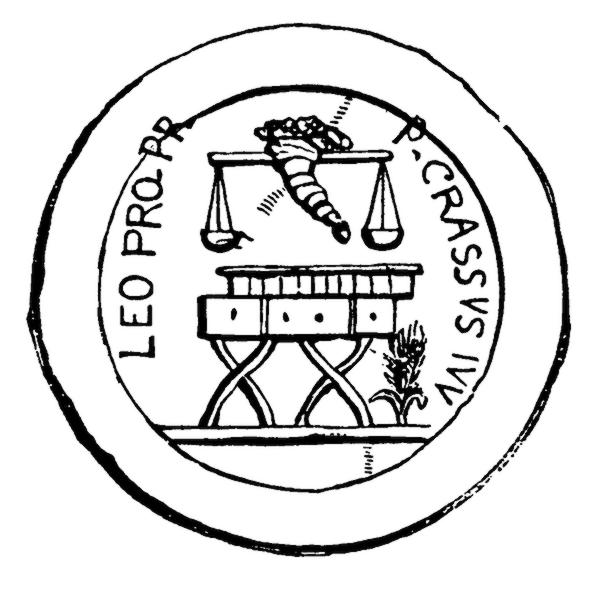
Emblem of a Roman Procurator.
7 And when he had opened the fourth seal, I heard the voice of the fourth beast say, Come and see.
7. And when he had opened the fourth seal. See Notes, ch. v. 1. ¶ I heard the voice of the fourth beast say. The flying eagle. Notes, ch. iv. 7. As in the other cases, there does not appear to have been any particular reason why the fourth of the living creatures should have made this proclamation rather than either of the others. It was poetic and appropriate to represent each one in his turn as making proclamation. ¶ Come and see. See Notes, ver. 1.