Annotated List of Mammals
Reading edition
Condylura cristata. Star-nosed Mole.
Tall-sedge, 2.
Two were trapped September 3 and 5, 1920, in a short, open runway in very moist soil at the edge of a small ditch running through tall sedges in a beaver meadow near Gogebic Lake, Ontonagon County.
Sorex personatus personatus. Masked Shrew.
Grassy-meadow, 2. Black spruce—tamarack bog, 2. Wet hardwood forest, 3. Dry hardwood forest, 3. Shrub stage, 2.
In the Cisco Lake Region in July, one was taken in a small black spruce bog, two in a narrow tongue of grass between tall sedges and sphagnum bordering Mud Lake, three in the wetter parts of the hardwood forest, and three in the upland, well-drained hardwood forest. Near Little Girl's Point in August, two were taken in a growth of shrubs in a burn. Near Gogebic Lake, Ontonagon County, one was taken September 4 in a black spruce bog.
Sorex richardsonii. Richardson Shrew.
Tall-sedge, 15. Grassy-meadow, 1. Sphagnum bog, 1.
This species was found only in or near tall sedges growing in moist or marshy situations. In the Cisco Lake Region six were taken near Mud Lake in July. Four of these were taken in tall sedges, one in grass alongside the sedges, and one in sphagnum between the sedges and the lake. August 30 to September 5, eleven were taken in tall sedges in a beaver meadow near Gogebic Lake, Ontonagon County.
An adult female trapped at Mud Lake, July 30, contained five large embryos. There were two pairs of inguinal and one pair of abdominal mammae. Another adult female trapped in the same place, July 22, had two pairs of inguinal mammae, but no abdominal mammae were found.
The latter individual was moulting, patches of new fur having replaced the old on the top of the head midway between the ears and eyes, between the shoulders, and on the rump. The other female mentioned above, taken July 30, had nearly completed her moult.
Only two specimens have been previously recorded from Michigan, one from Alger County and the other from Chippewa County.[2]
Neosorex palustris palustris. Marsh Shrew, Water Shrew.
Tall-sedge, 1. Ditch-border, 3.
September 1 a marsh shrew was trapped in the tall sedges of a beaver meadow near Gogebic Lake, Ontonagon County. Most of the body had been eaten by some carnivore. Other specimens were taken on each of the two succeeding days, and a fourth on September 5.
The first specimen taken was trapped eight feet from a tiny stream which flowed through the marshy sedges. Two of the others were taken on the muddy bank of the stream near the water's edge, and the fourth about 35 feet from the water. All were secured within a radius of 35 feet.
This species has been recorded but once previously from Michigan, from Chippewa County.[3]
Microsorex hoyi. Hoy Shrew.
Black spruce-tamarack bog, 1. Wet hardwood forest, 1.
One specimen was taken July 17 at Fish-hawk Lake in a moderately wet part of the hardwood forest. Another was taken July 29 at the edge of a small black spruce bog.
Blarina brevicauda talpoides. Bob-tailed Shrew.
Tall-sedge, 8. Grassy-meadow, 6. Alder-thicket, 1. Black ash swamp, 6. Arbor-vitae swamp, 4. Black spruce—tamarack bog, 1. Wet hardwood forest, 32. Dry hardwood forest, 8. Shrub stage, 1. Paper birch—aspen stage, 6.
The species is rather generally distributed, but is by far the most common in moist woods. In the Cisco Lake Region 11 were secured; in the Little Girl's Point district, 10; and near Gogebic Lake in Ontonagon County, 52. In the latter district it was the most abundant mammal species, even exceeding Peromyscus in numbers; indeed, Peromyscus was relatively uncommon in the partly swampy woods of the region, and it might be that the abundance of the bob-tailed shrews accounts for the scarcity of the deer-mice, for the shrews undoubtedly at times prey upon the mice. The specimen recorded above from the black spruce-tamarack bog was taken near Gogebic Lake in a boggy swamp, which, while dominated by black spruces, yet contained a considerable number of arbor-vitae and hemlocks.
In the wet hardwood forest near Gogebic Lake Blarina runways are exceedingly abundant, usually running along or under sticks or logs. Commonly they are just under the leaves, but sometimes for a short distance are without covering. One old log examined was found to be honey-combed with these tunnels. The deeper runways nearly always follow down just under a tree root.
The uterus of a female taken July 10, at Fish-hawk Lake, showed a few small swellings which were identified in the field as embryos. Unfortunately, the uterus was not preserved. No embryos were found in 26 other females taken between July 15 and September 4. In the latter part of the season fewer immature specimens were taken than earlier in the summer. These facts show that in this region the species breeds in the spring or early summer and does not usually breed again during July and August.
Myotis lucifugus lucifugus. Little Brown Bat.
Aerial, 15.
Nine individuals were shot while they were flying over the lakes in the Cisco Lake Region. These were taken between 8:00 and 9:00 p. m. from July 1 to August 2; but on moonlight nights bats, believed to be of this species, were seen flying as late as 10:00 p. m. At the camp near Little Girl's Point one was shot at 7:55 p. m., August 11, as it flew about over the road through the dry hardwood forest. Five others were shot at the Gogebic Lake camp as they flitted through an opening in the wet hardwood forest. These were taken between 7:30 and 7:55 p. m., August 23 to September 2; but bats almost certainly of this species appeared regularly in the evenings about 7:10 p. m.
Lasionycteris noctivagans. Silver-haired Bat.
Aerial, 3.
Near the Little Girl's Point camp one was shot at 7:50 p. m., August 9, and two more in the same region about 7:45 p. m., August 17. One was flying along a road through the dry hardwood forest at a height about equal to that of the tree-tops, and the others were taken in a small clearing in the same forest.
Nycteris borealis borealis. Red Bat.
Aerial, 2.
Two were secured near the Little Girl's Point camp at about 7:45 p. m., one August 9 and the other August 14, as they flew about over the road through the dry hardwood forest.
Nycteris cinerea. Hoary Bat.
Aerial, 1.
The only specimen secured was shot at 7:55 p. m., August 9, while it was flying over the road through the dry hardwood forest near Little Girl's Point.
Ursus americanus americanus. Black Bear.
Wet hardwood forest, 1. Dry hardwood forest, 1.
Reported by residents as being rather common. July 10 a large black bear was seen to cross the railroad track and enter the hardwood forest not over a quarter-mile from Cisco Lake Station. Tracks of a large individual were seen in the mud bordering a small brook in maple-birch-hemlock forest about three miles southeast of the station July 17 and August 15. At dusk, August 28, while Mr. Sherman was setting up a camera and flashgun along a deer trail about 100 yards from the camp on Gogebic Lake, a small bear passed within twenty-five paces of him, apparently but little concerned with his presence or that of the nearby camp and fire, except that it sniffed the air occasionally.
Canis lycaon. Timber Wolf.
Mud-flat, signs. Tall-sedge, tracks. Dry hardwood forest, reported.
Residents reported it common in all the districts visited by us. We saw signs and tracks in several habitats; and residents saw a wolf in the dry hardwood forest near our camp in the Little Girl's Point district.
Canis latrans. Coyote.
J. E. Fischer reported in 1920 that coyotes had appeared and become numerous in the region at the north end of Lake Gogebic within the last few years. We have secured several skulls and skeletons taken by him in 1920-21.
Vulpes fulva. Red Fox.
Mountain-heath, signs.
Signs of fox were found in late August in a narrow growth of heath at the top of a cliff about a mile north of Lake Gogebic Station. J. E. Fischer has sent us a fox taken in January, 1921, in Gogebic County near Gogebic Lake. Benjamin J. Twombley reports that a few occur in the Cisco Lake Region. J. E. Marshall, in 1911, reported that a few occurred around Gogebic Lake.
Urocyon cinereoargenteus. Gray Fox.
J. E. Marshall reported in 1911 that it was rare, but that he had trapped two near Gogebic Lake.
Martes americanus americanus. Marten.
J. E. Marshall reported in 1911 that it was getting scarce in Gogebic and Ontonagon counties. He trapped a number near Gogebic Lake in the winter of 1884-1885, and took 15 in the winter of 1889-90. In 1920 J. E. Fischer reported marten rare near Gogebic Lake.
Martes pennantii pennantii. Fisher.
In 1911 J. E. Marshall reported that it was getting scarce near Gogebic Lake; he trapped four in the winter of 1889-90 and two in 1890-91. J. E. Fischer took one in Ontonagon County near Gogebic Lake in the winter of 1919-20. Ole Petersen in 1911 reported it rare near Gogebic Lake.
Mustela cicognanii cicognanii. Bonaparte Weasel.
Black spruce—tamarack bog, 1. Dry hardwood forest, 4.
Trappers report it common throughout the areas visited. We took five specimens near Little Girl's Point. Several specimens taken in the Cisco Lake Region during the winter of 1920-21 were presented to us by Benjamin J. Twombley, and J. E. Fischer sent us a specimen taken in December, 1920, near Gogebic Lake.
Mustela vison letifera. Mink.
Forest—shore, 6. Wet hardwood forest, den.
Reported by trappers as common throughout the area studied. In the Cisco Lake Region two were trapped at the water's edge beside a growth of paper birch saplings; and another was shot as it was running along the bank of the Ontonagon River at the edge of a stand of hemlocks. Three others were seen swimming near the latter locality July 29. Upon the approach of the canoe they swam rapidly to an old hollow log in wet hardwood forest on shore. Around and through the log well-worn runways showed evidence of the presence of a den.
Mephitis hudsonica. Skunk.
Ditch-border, 1. Dry hardwood forest, 5.
Four skunks were taken in the dry hardwood forest of the Cisco Lake Region, one in the same type of habitat near the Little Girl's Point camp, and another in a trap set in the bottom of a muddy ditch in the beaver meadow near Gogebic Lake.
An adult male, trapped July 14 in the Cisco Lake Region, was badly infested with tapeworms in the middle part of the small intestine. An adult female, taken July 19, was found to have many tapeworms in the intestine, many nematodes in the lung tissue, an infested liver, and a large number of nematodes in a cavity in the top of the skull.
While we were photographing a captive juvenile August 2 at Lindsley Lake a horsefly (identified as Tabanus atratus by J. S. Rogers) burrowed into the fur on the rump of the skunk and began sucking blood.
Taxidea taxus taxus. Badger.
J. E. Marshall reports that he trapped one in the winter of 1889-90 between Gogebic Lake and Lake Superior.
Lutra canadensis canadensis. Otter.
In 1911 J. E. Marshall reported that quite a few remained around Gogebic Lake; he took quite a number in the winter of 1884 and several in the winters of 1889 to 1891. J. E. Fischer took two in Ontonagon County in January, 1921.
Lynx canadensis. Canada Lynx.
J. E. Marshall reports that it was not very plentiful near Gogebic Lake in 1884. He took one in the winter of 1890-91; in 1911 it had almost or entirely disappeared.
Lynx ruffus ruffus. Bob-cat.
J. E. Marshall reports that he took three or four near Gogebic Lake in the winter of 1890-91; in 1891-92 it had become quite numerous; and it continued to increase until 1911 at least. In 1920 residents reported that a few occurred in all the regions visited by us.
Peromyscus maniculatus gracilis. Deer-mouse.
Tall-sedge, 4. Black ash swamp, 5. Arbor-vitae swamp, 11. Black spruce—tamarack bog, 4. Hemlock forest, 16. White pine forest, 5. Wet hardwood forest, 78. Dry hardwood forest, 143. Shrub stage, 19. Paper birch—aspen, 15. Young hardwood forest stage, 2. Edificarian, 6.
In the Cisco Lake Region and in the vicinity of Little Girl's Point this species is the most abundant mammal, but in the wet woods at the Gogebic Lake camp it is much less abundant, being exceeded in numbers by the bob-tailed shrew. A total of 308 deer-mice were taken during the summer. It was found in a variety of forest habitats, but it is most abundant in the dry upland woods of the Little Girl's Point Region. The individuals taken in the tall sedges at Mud Lake were probably stragglers from the nearby shrubs and forest, for no deer-mice were taken in the extensive sedges of the large beaver meadow studied near Gogebic Lake. Probably most of those taken in the black spruce bogs were stragglers also, though one individual taken in a large black spruce bog was 50 yards from the nearest deciduous woods.
When we arrived in the Cisco Lake Region in late June young and subadults were abundant, many of the female subadults, as well as the adults, carrying embryos. Embryos were found throughout the summer up to August 25. Of females containing embryos, five had 4 embryos each, ten females 5 embryos each, nine females 6 embryos each, and one female 8 embryos.
Synaptomys cooperi fatuus. Lemming-vole.
Tall-sedge, 1. Black spruce—tamarack bog, 2. Wet hardwood forest, 1. Dry hardwood forest, 1.
In the Cisco Lake Region an adult female was taken in dry hardwood forest near Fish-hawk Lake June 28, 1920. It contained 6 embryos each 21 mm. long. A juvenile was trapped July 26 on top a log in the tall sedges at Mud Lake. The log bridged over a particularly wet part of the marshy sedges and was at the edge of the hardwood forest. Two other juveniles were taken the next day, one in a small black spruce log, and the other in wet hardwood forest at the edge of the same bog. In Ontonagon County near Gogebic Lake a subadult male was taken September 5 in a large black spruce bog.
Evotomys gapperi gapperi. Red-backed vole.
Black ash swamp, 2. Black spruce—tamarack bog, 6. Arbor-vitae swamp, 2. Hemlock forest, 5. White pine forest, 2. Wet hardwood forest, 18. Dry hardwood forest, 17. Shrub stage, 5. Paper birch—aspen stage, 3.
Thirty were taken in the Cisco Lake Region, 10 at the Little Girl's Point camp, and 20 near Gogebic Lake in Ontonagon County. It was most common in the forests. Two individuals recorded from the arbor-vitae swamp were taken in a mixed swamp of small arbor-vitae, black spruce, and hemlock with many alders, this situation probably forming a stage in the succession following a beaver meadow. Also, one of the specimens recorded from the paper birch—aspen stage was taken in an open stand of old paper birches with a forest floor of grass, conditions not typical of the stage.
Of 13 females examined from June to August, two contained 4 embryos each, two 5 embryos each, and two 6 embryos each. August 14, at Little Girl's Point, was the last date on which embryos were found.
The species is somewhat diurnal. Several times one was seen in daylight about the camp in the Cisco Lake Region, and several were trapped during daylight hours.
A captive was fond of tender grass blades, but refused the harder stems. In eating he sat up on the hind feet and handled the food with the fore feet.
An immature male taken August 8 near Little Girl's Point had a considerable infestation of seed ticks on the posterior lobes of both ears.
Microtus pennsylvanicus pennsylvanicus. Meadow vole.
Mud-flat, 6. Tall-sedge, 28. Grassy-meadow, 6. Black ash swamp, 1. Arbor-vitae swamp, 1. Leather leaf bog, 15. Sphagnum bog, 9. Black spruce—tamarack bog, 1. Shrub stage, 17.
Sixty-five were taken in the Cisco Lake Region and 19 in Ontonagon County, near Gogebic Lake. It is most abundant in grassy and sedgy meadows and in open bogs, though it is found rarely in swamps and tree-covered bogs. The individual listed from the arbor-vitae swamp was taken in a young growth of arbor-vitae, black spruce, hemlock, and many alders, and not in typical arbor-vitae swamp habitat. Of the 17 listed from the shrub stage, one was taken in a wet, sedgy part of a shrub-covered burn at Poor Lake, and the others were secured in the shrub and grass clearing around the camp house on Lindsley Lake.
Of ten females examined, July 10 to September 5, one contained 3 embryos, one 4 embryos, and two 5 embryos each. September 5 was the last date on which embryos were found. The three embryos found on the last date were each 23 mm. in length and together they weighed 8.5 grams, which was 26 per cent of the weight of the mother with the embryos removed.
Both adults and immature young were seen moving about, and were also trapped in broad daylight, but it is more active in the evening just before sunset.
A captive juvenile was placed July 19 in a large tub with an adult female, which might have been its mother, for both were taken on succeeding days in the same trap. The young one immediately tried to nurse, but was severely bitten and driven away, though it made numerous unsuccessful attempts later. When approaching the old female the baby frequently gave a high-pitched squeak, and the old female replied by a hoarse squeak, evidently of warning, for the young one was bitten when it approached in defiance of the warning note and threatening attitude of the adult. The baby evidently had been weaned, and the old female was found to contain five large embryos.
Ondatra zibethica zibethica. Muskrat.
Forest—shore, 5. Water lily, 1. Pondweed, 2. Willow-thicket, signs.
Muskrats are numerous in the Cisco Lake Region, and five specimens were taken. Near Little Girl's Point one was seen swimming in a small stream. At the mouth of Merriweather Creek on Gogebic Lake signs were noted in a willow thicket, and muskrats were reported numerous in the region.
An adult female trapped July 6 at Fish-hawk Lake contained six large embryos; another female taken July 10 contained no embryos, but the mammae were filled with milk; and two females taken July 26 contained no embryos.
In the Cisco Lake Region broken mussel shells were abundant in the muskrat runways along the shores. Remains of pondweeds were also frequently found in the runways, and a quantity of leaves with a few heads containing flowers and seeds collected July 8 were identified by E. A. Bessey as Potamogeton richardsonii.
Zapus hudsonius hudsonius. Jumping-mouse.
Mud-flat, 4. Tall-sedge, 12. Grassy-meadow, 8, Arbor-vitae swamp, 1. Sphagnum bog, 1. Black spruce—tamarack bog, 1. Wet hardwood forest, 2. Dry hardwood forest, 1. Shrub stage, 10. Paper birch—aspen stage, 2.
Numerous in suitable habitats in the Cisco Lake Region, at Little Girl's Point, and at Gogebic Lake. Most common in open grasses and sedges. Five of those recorded above from the shrub stage were taken in open shrubs and grass in the clearing around the camp house on Lindsley Lake; and the two recorded from the paper birch—aspen stage were taken at Cisco Lake in an open stand of old paper birch with a forest floor of grass.
Juveniles were taken throughout the summer, but no one of seven adult or nearly adult females examined between July 7 and September 4 contained embryos.
A captive taken July 18, after feeding ravenously on a cooky, retired to a corner and went to sleep. The position taken in this case was a sitting one, the animal resting on the widely spread feet as far as the heels, and on the tail. The head was bent far over, the nose extending between the hind legs. The long tail was curled around the body, it resting on the ground for its whole length. The operation of cleaning the tail was observed two days later. The animal worked from the base of the tail toward the tip, using the fore feet to present the tail to the mouth, where it was licked off. During the process the head was held over on one side, nearly touching the ground.
Napaeozapus insignis fructectanus. Woodland Jumping Mouse.
Wet hardwood forest, 1. Dry hardwood forest, 6.
Three were taken in the Cisco Lake Region and four in the Little Girl's Point Region, all in heavy forest.
Neither of two adult females taken August 8 and 10 contained embryos.
Erethizon dorsatum dorsatum. Porcupine.
Forest—shore, 13. Wet hardwood forest, 10. Dry hardwood forest, 17. Shrub stage, 5. Paper birch—aspen stage, 10. Overflow swamp, 5. Edificarian, 1.
Common at all camps. Many were taken in traps set for carnivores. Well-marked trails at the edges of lakes and streams through the forests are evidently made mostly by these animals. It is detested by the inhabitants of the region, chiefly for the damage done to any woodwork which contains the least amount of salt.
Porcupines spend a considerable amount of time inside hollow linden, yellow birch, and hemlock trees, as shown by the large piles of droppings noted at the lower openings of numerous such hollow trees.
June 30, and again on July 2, young individuals were closely observed while feeding on the leaves of the yellow water lily. These individuals were on the logs in an overflow swamp, and they reached down with a fore foot into the water to secure the food, which was then presented to the mouth with the same foot. One of these porcupines seemed to be very disinclined to wet his feet, except the fore feet in reaching for food; the other individual waded out on a log which was submerged several inches, but he showed a ludicrous determination to hold the tail up out of the water.
A juvenile weighing only 914 grams was taken as late as July 21 at Fish-hawk Lake, but no embryos were found in the period between June 29 and September 3. It is often active throughout the day as well as in the night.
A young individual taken in a trap July 3 was found surrounded by a swarm of mosquitoes, which seemed to annoy him considerably, for he shook his skin frequently to dislodge them. One mosquito settled on a lower eyelid as we watched, and others kept alighting on his nose. When he raised his quills on our approach many mosquitoes attacked the skin exposed on the back.
Marmota monax canadensis. Canada Woodchuck.
Hemlock forest, 5. Shrub stage, 9.
A few occur in the Cisco Lake Region, where they are most common in the shrubby clearings. Several adults fed commonly on the refuse from the camp. The stomach of a captured individual contained a considerable quantity of cooked corn, spaghetti, and boiled ham. Three woodchucks were noted at different times in hemlock forest along the lake shores.
A half-grown juvenile was seen to swim the Ontonagon River near its entrance to Cisco Lake. This was on July 10, near noon, with bright sunshine. The river here is at least 75 yards in width, but has no perceptible current.
Juveniles taken in traps were observed to extrude scent glands from the anus when approached. These glands are three in number, one on each side of the anus and one beneath. They are small, whitish, and cup-shaped. Normally they lie just inside the anus, but on excitement they are everted and the fold of skin forming the edge of the anus is rolled outward so that the glands lie outside. We detected a faint musky odor which might have come from these glands.
In the Little Girl's Point district several inhabited a woodpile in hemlock forest at the edge of a wide road. None were found near Gogebic Lake.
Eutamias borealis neglectus. Lake Superior Chipmunk.
Tall-sedge, 1. Grassy-meadow, 3. Black spruce—tamarack bog, 1. Hemlock forest, 1. Wet hardwood forest, 1. Shrub stage, 20. Paper birch—aspen stage, 2.
Common in shrubby clearings and burns in the Cisco Lake and Little Girl's Point regions. A few were taken in tall sedges and grass not far from shrubs; one was taken in a small black spruce bog, about five yards from the surrounding wet hardwood forest; one was taken in hemlock forest near the lake shore; and one was seen in wet hardwood forest near the lake shore. Not seen near Gogebic Lake.
These chipmunks were several times observed feeding on ripe raspberries. August 5, near Watersmeet, one was seen sitting on a rail fence beside a pasture, eating a grasshopper, the remains of which have been identified by T. H. Hubbell as Melanoplus sp. probably bivittatus.
Tamias striatus griseus. Gray Chipmunk.
Black ash swamp, 1. Hemlock forest, 1. Wet hardwood forest, 10. Dry hardwood forest, 8. Shrub stage, 2.
Five records were obtained in the Cisco Lake Region; 9 near Little Girl's Point, and 8 near Gogebic Lake. It is most numerous in hardwood forest.
An adult male taken July 5 had in its cheek-pouches numerous seeds of Carex and a fruit capsule of Viola, the identification being by E. A. Bessey. Of eight adult or nearly adult females examined between July 5 and September 1, one taken July 15 in the Cisco Lake Region contained eight large embryos.
Sciurus hudsonicus loquax. Southeastern Red-squirrel.
Black ash swamp, 1. Arbor-vitae swamp, 3. Black spruce—tamarack bog, 2. Hemlock forest, 1. White pine forest, 1. Wet hardwood forest, 9. Dry hardwood forest, 7. Shrub stage, 1. Paper birch—aspen stage, 3. Early hardwood forest stage, 1. Edificarian, 1.
Seventeen records from the Cisco Lake Region; 6 from Little Girl's Point; and 7 from Gogebic Lake. None were noted more than a few yards from the protection of a forest.
In a grove of white pines near Little Girl's Point cut pine scales were numerous August 13 on the ground and on logs, and one red-squirrel taken had much pitch on the fur around the mouth. August 24, cut-open fir cones were numerous around the small fir trees in a paper birch—aspen growth near Gogebic Lake, and were certainly the work of this species. July 2 a young red-squirrel which had frequently been seen around the camp in the Cisco Lake Region was found ravenously feeding on the kidney of a recently skinned woodchuck. After feeding it showed no fear, and allowed itself to be picked up; it seemed very sleepy and slept for about a half-hour before running away. This individual was badly infested with fleas. Another juvenile taken July 1 in the same region was infested with small patches of red seed ticks around the anus, anterior to the genital opening, on the belly, on the thigh, and at the base of one ear.
Six small embryos were found in an adult female taken in the Cisco Lake Region July 16.
Sciurus carolinensis leucotis. Gray-squirrel.
In 1911, J. E. Marshall reported that a few occurred near Gogebic Lake.
Glaucomys sabrinus macrotis. Mearns Flying-squirrel.
Black ash swamp, 1. Hemlock forest, 1. Wet hardwood forest, 2. Dry hardwood forest, 1.
Two were taken in the Cisco Lake Region and three near Gogebic Lake in Ontonagon County. A female taken July 4 near Fish-hawk Lake was still suckling young, and contained no embryos, but a female taken July 6 in the same region contained five small embryos. An immature female taken August 27 near Gogebic Lake was without embryos.
Castor canadensis michiganensis. Woods Beaver.
Leather leaf bog, house.
Two houses were found in the Cisco Lake Region, both being in leather leaf bogs near deep water. Around the house studied there was an incomplete moat connected with a channel leading to deep water, and canals and tunnels radiated out through the bog. No beavers were observed nor secured, but fresh cuttings were noted at the edges of some of the "forms" in the bog.
A few beaver are reported to occur near Little Girl's Point and near Gogebic Lake. E. E. Brewster in 1895 wrote Dr. Gibbs that it was not uncommon in Gogebic County and in probably all the counties of the Upper Peninsula where trapping and lumbering had been discontinued; he stated that beaver were appearing again even in localities where formerly most sought. In 1911, J. E. Marshall reported it scarce near Gogebic Lake.
Lepus americanus phæonotus. Snowshoe Hare.
Forest—shore, 1. Arbor-vitae swamp, signs. Leather leaf bog, signs. Black spruce—tamarack bog, 1. Wet hardwood forest, signs. Dry hardwood forest, 1. Shrub stage, 7. Paper birch—aspen stage, 1. Cultivated-field, 1. Edificarian, 1.
Rare during the season of 1920 in the areas visited. In the Cisco Lake Region an adult female was taken in a trap set for muskrat under water on a brushy point. Other hares were occasionally seen in the evenings in the shrubby clearing around the camp house; and one was even seen on the porch. Droppings were found in a leather leaf bog, and a hare was seen at the edge of a black spruce—tamarack bog. Near Little Girl's Point a juvenile was taken August 13 in the upland hardwood forest, but was partly eaten in the trap by some carnivore; several were seen in shrubby clearings; and a young one was reported captured in an oat field by a farmer. Droppings were found in an arbor-vitae swamp. Near Gogebic Lake in Ontonagon County droppings were found in wet hardwood forest, in a thick growth of aspen and white birch saplings, and in an extensive tamarack bog.
An adult female taken July 4 at Fish-hawk Lake had much milk in the mammae. At the camp on Lindsley Lake June 27 one was seen to eat some wood ashes; and June 30 one was seen to feed on the blades of quack grass (Agropyron repens), which was identified by E. A. Bessey.
Odocoileus virginianus borealis. Northern White-tailed Deer.
Forest—shore, 1. Mud-flat, signs. Tall-sedge, 1. Grassy-meadow, 1. Alder-thicket, signs. Black ash swamp, signs. Arbor-vitae swamp, signs. Black spruce—tamarack bog, signs. Hemlock forest, signs. Wet hardwood forest, 10. Dry hardwood forest, 7. Shrub stage, 8. Paper birch—aspen stage, 1.
Deer are abundant in the Cisco Lake Region; they are less common near Lake Gogebic; and only a few were seen near Little Girl's Point. Most of those seen were in the hardwood forest and in the brushy clearings, but trails and signs were common in many habitats.
Wolves were reported to prey extensively on deer in the region, and wolf dung examined August 7 near Little Girl's Point contained much deer hair and some deer bones.
Alces americanus. Moose.
J. E. Marshall reports that a moose was seen near Gogebic Lake in the winter of 1885, and an individual, perhaps the same one, was killed on Flambeau Reservation that year.
Northern Michigan Mammals Plate I
Fig. 1. Beach of Lake Superior just east of Little Girl's Point. A dirt bluff at the right of the picture. August 10, 1920.
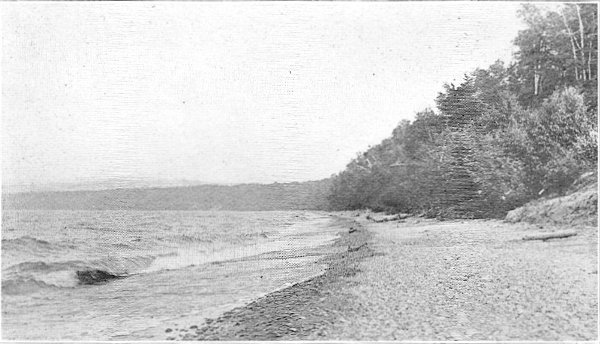
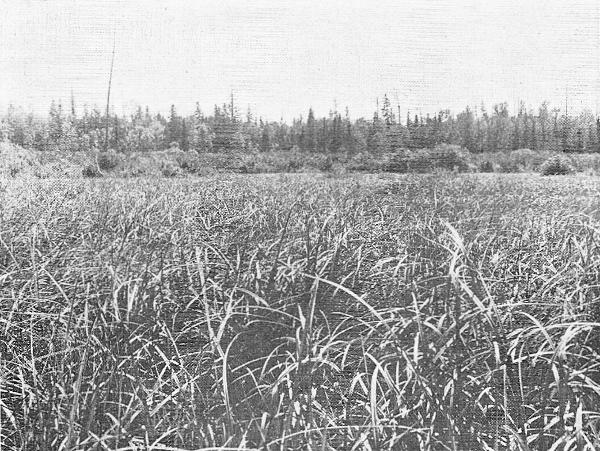
Fig. 2. Tall-sedge habitat in a beaver meadow on the west side of Gogebic Lake, Ontonagon County. September 1, 1920.
Northern Michigan Mammals Plate II
Fig. 1. Leather leaf bog invaded by tamaracks, Ontonagon River near Cisco Lake. August 3, 1920.
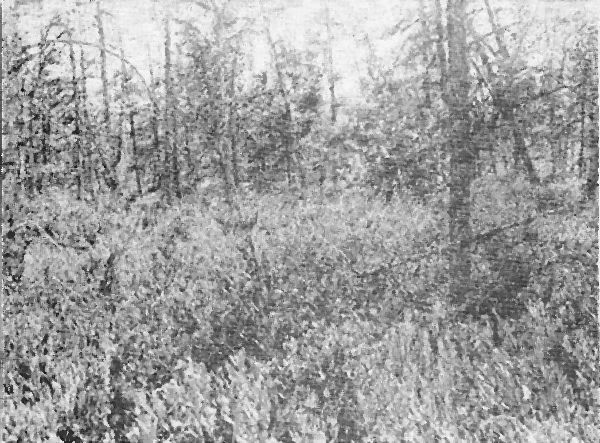
Fig. 2. Arbor-vitae swamp four miles southeast of Little Girl's Point. The ground is very moist. August 16, 1920.
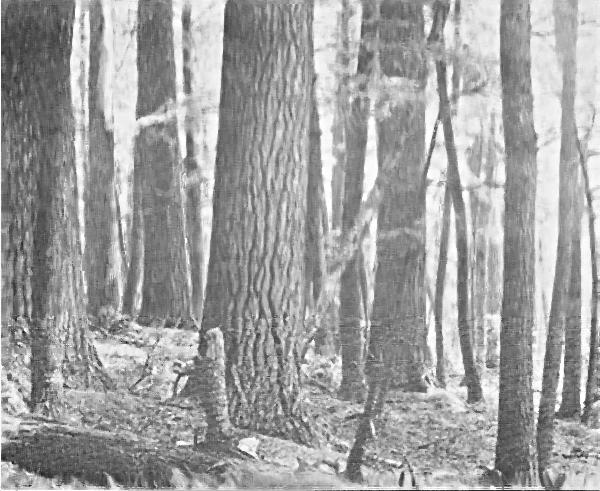
Northern Michigan Mammals Plate III
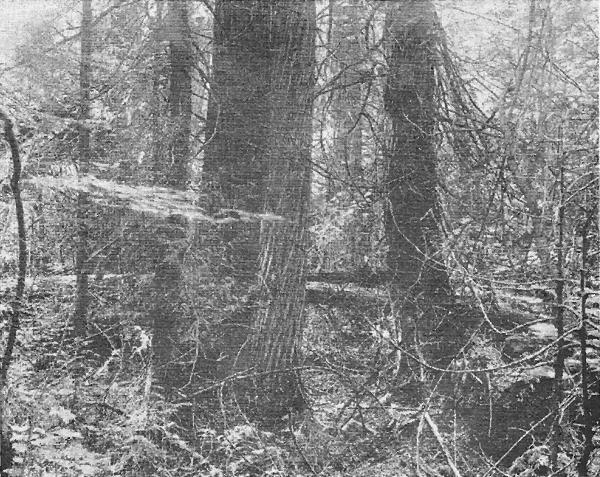
Fig. 1. Dry hardwood on a ridge four miles southeast of Little Girl's Point. Sugar maple, yellow birch, and linden are dominant. Undergrowth low. August 16, 1920.
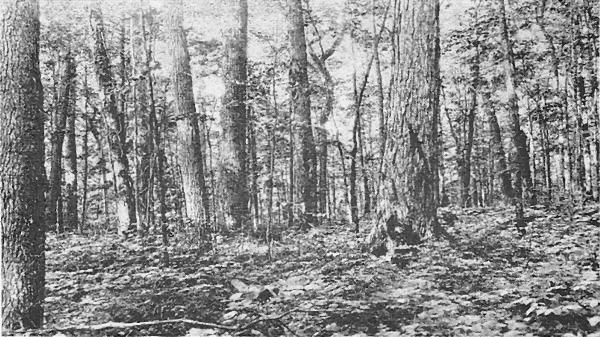
Fig. 2. Virgin white pine grove, Gogebic County. Trunks up to four feet in diameter. Little undergrowth. August 17, 1920.