Sections in Alluvium.
Reading edition
In digging the foundations for the chimney of the Electric Lighting Works opposite Magdalene College the following section was seen (Fig. 1, p. 8).
Under the new Tennis Courts in Park Parade facing Mid-summer Common the section was somewhat different (Fig. 2, p. 9).
While in the pit dug some years ago by Mr Bullock at the other end of the Parade at the lower end of Portugal Place in the south-east corner of the Common there was a section very similar to the last (Fig. 3, p. 10).
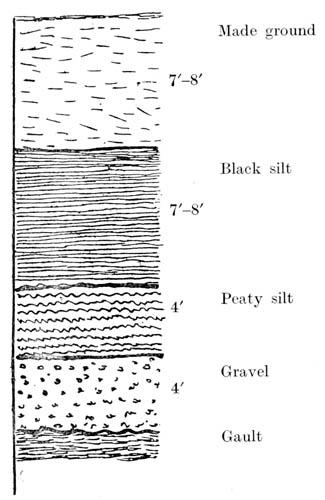
Fig. 1. Section seen in foundations of chimney for Electric Lighting Works near river opposite Magdalene College, July, 1892.
These three sections, immediately north of Cambridge where the valley of the Cam opens out on to the Fens, are important as showing the variations right across the alluvium from side to side and the absence, here at any rate, of any indication of a constant sequence distinctly pointing to important geographical changes. A section seen under Pembroke College Boat House gave 16 feet of clay and peaty silt on the black gravel which here, as in the borings at the Backs of the Colleges, forms the base of the alluvium. About half way down were bones of horse and stag, but I do not believe that these are of any great antiquity, probably not earlier than mediaeval.
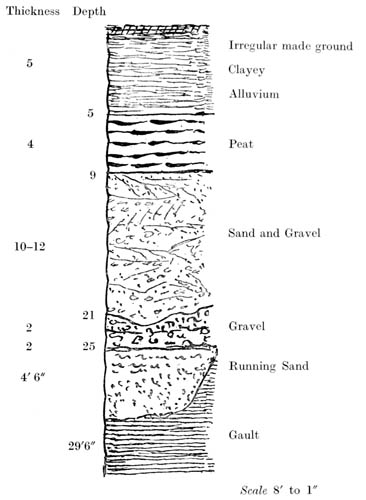
Fig. 2. Section seen in digging foundations of Tennis Courts on Midsummer Common, Cambridge.
Lower down the river near Ely a most important and interesting section has recently been exposed. A new bridge was built over the Ouse near the railway station and to obtain material for easing the gradient up to the bridge a pit was sunk close to it on the east side of the river, and was carried down to the Kimmeridge Clay thus giving a clear section through the whole of the alluvium (Fig. 4, p. 11).
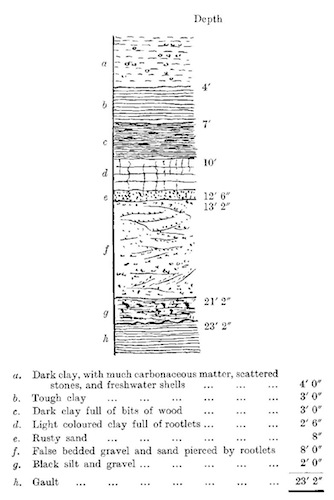
Fig. 3. Section seen in Bullock's Pit in S.E. corner of Midsummer Common.
It will be noticed that there is very little peat here and all of it was below O.D. The upper four feet of the clayey peat (f) looked as if the vegetable matter had been transported, perhaps from peat beds being destroyed by the river higher up, and been carried down in flood with the clay, while the lower four feet of peat (h) was only a cleaner sample of the same, before the river had cut down into the clay. The trees in both f and h were not trees that had grown on the spot and had been blown down, but were broken, water-worn, and evidently transported.
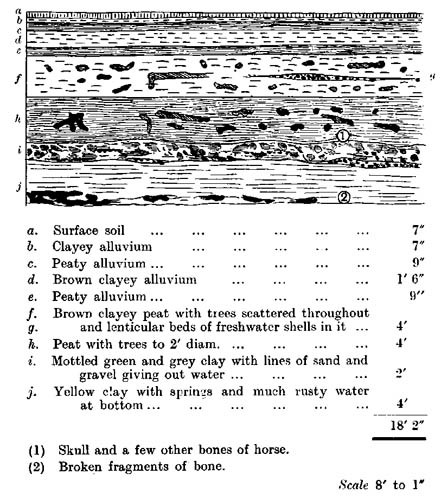
Fig. 4. Section seen in pit dug for material for making up the roadway east of the new bridge over the Ouse by the railway station. Ely, 1910.
If now we travel about 30 miles a little west of north we shall arrive near the shore of the Wash about half way across its southern coast line at Sutton Bridge. Here I had an opportunity of seeing the material of which the alluvium is composed. With a view to securing a sound base for the foundation of the piers of the Midland and Great Northern Railway bridge an excavation was made through the whole of the Fen Beds down to the Boulder Clay which as I have already stated was reached at a depth of 73 feet. The clerk of the works kindly gave me the following measurements (Fig. 5).
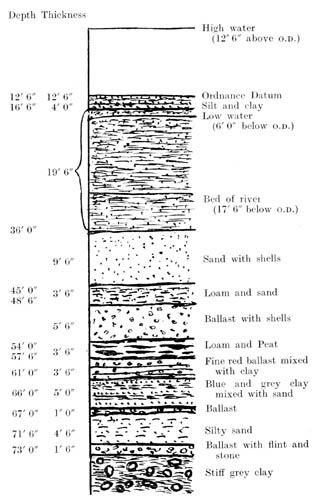
Fig. 5. Section seen at Sutton Bridge.
Here again we see that the only peat is a bed between three and four feet in thickness of mixed loam and peat more than 40 feet below mean sea level.
From these sections it is clear that along the direct and more permanent outfall from Cambridge to the north, peat forms but a small part of the Fen Beds.
Peat is a substance of so much value as fuel, of such importance to the agriculturist, of such commercial value in what we may call its by-products, and of such scientific interest in the history of its formation and the remains which its antiseptic properties have preserved, that it has, as might be expected, a large literature of its own.
I have before me a list of more than 150 references to peat or to the Fens.