Volume 4 — Notes.
Reading edition
DANIEL DEFOE AND THE "MERCATOR."
Wilson, in his Life of Defoe, vol. iii. p. 334., gives an account from Tindal, Oldmixon, Boyer, and Chalmers, of the Mercator and its antagonist, the British Merchant. He commences by observing that Defoe "had but little to do with this work" (the Mercator), and quotes Chalmers, who seems totally to mistake the passage in Defoe's Appeal to Honour and Justice, pp. 47-50., in which the Mercator is mentioned, and to consider it as a denial on his part of having had any share in the work. Defoe's words are—
"What part I had in the Mercator is well known, and would men answer with argument and not with personal abuse, I would at any time defend any part of the Mercator which was of my writing. But to say the Mercator is mine is false. I never was the author of it, nor had the property, printing, or profit of it. I had never any payment or reward for writing any part of it, nor had I the power of putting what I would into it, yet the whole clamour fell upon me."
Defoe evidently means only to deny that he was the originator and proprietor of the Mercator, not that he was not the principal writer in it. The Mercator was a government paper set on foot by Harley to support the proposed measure of the Treaty of Commerce with France; and the Review, which Defoe had so long and so ably conducted, being brought to a close in the beginning of May, 1713, he was retained to follow up the opinions he had maintained in the Review as to the treaty in this new periodical. He had not the control of the work undoubtedly, otherwise, cautiously abstaining as he does himself from all personal attacks upon his opponents, the remarks on Henry Martin would not have appeared, which led to a severe and very unjust retaliation in the British Merchant, in which Defoe's misfortunes are unfeelingly introduced. There cannot, however, be the slightest doubt to any one at all acquainted with Defoe's style, or who compares the Mercator with the commercial articles in the Review, that the whole of the Mercator, except such portion as appears in the shape of letters, and which constitutes only a small part of the work, was written by Defoe. The principal of these letters were probably written by William Brown.
The excessive rarity of the Mercator, which Wilson could never obtain, and of which probably very few copies exist, has rendered it the least known of Defoe's publications. Even Mr. M'Culloch, from the mode in which he speaks of it (Literature of Political Economy, p. 142.), would appear not to have seen it. And therefore, whilst the British Merchant, "the shallow sophisms and misstatements" of which we now treat with contempt, is one of the most common of commercial books, having gone through at least three editions, besides the original folio, the Mercator, replete as it is with the vigour, the life and animation, the various and felicitous power of illustration, which this great and truly English author could impart to any subject, still exists only in probably four or five copies of the original folio numbers. How many of the advocates for free trade are acquainted with a production in which one of the most gifted minds that the country ever produced, exerts his delightful powers and most effectual "unadorned eloquence" in the support of their favourite doctrine?
I do not see any copy of the Mercator noticed in the printed catalogue of the British Museum. I owe my own to the kindness of MR. BOLTON CORNEY, who allowed me to possess it, having purchased it, I believe, at Mr. Heber's sale.
JAS. CROSSLEY.
PUNISHMENT OF EDWARD PRINCE OF WALES, BY KING EDWARD I., FOR DISRESPECT TO A JUDGE.
MR. FOSS has lately shown, in his valuable lives of The Judges of England, that historical accuracy has been sacrificed in representing Henry V., on his accession, to have re-invested Sir William Gascoigne with "the balance and the sword." Lord Campbell, warned that chroniclers, historians, moralists, and poets had, without historical warrant, taken for true the story which Shakspeare has made so familiar to us, has, in his Lives of the Chief Justices, examined the evidence for attributing to the young king the act of magnanimity, and has affirmed (vol. i. p. 131.) not only that Sir William committed the prince, but that he actually filled the office of Chief Justice under him when he became Henry V. The noble and learned lord has been at some pains to authenticate the story of the commital of the prince, and has shown that there is no sufficient reason for disbelieving that the dauntless judge did make "princely power submit" to justice; and he has brought forward also the probable sources of Shakspeare's information. But these are silent as to the reinstatement of the illustrious judge; and MR. FOSS has established that the young king lost no time in dispensing with the "well-practised wise directions" of Sir William Gascoigne. One is really sorry to be obliged to relinquish belief in the historical foundation of the scene to which Shakspeare has given such fine dramatic effect in his noble lines. My object, however, in now writing is to point out a circumstance in some respects parallel, which occurred in the reign of Edward I. In looking thorough the Abbreviatio Placitorum to-day, I find the record of a judgment in Michaelmas Term, 33 Edw. I. (1305), in which a curious illustration is given of the character of that sovereign; for it appears that Edward Prince of Wales having spoken words insulting to one of the king's ministers (when and to whom I wish I could ascertain), the monarch himself firmly vindicated the respect due to the royal dignity in the person of its servants, by banishing the prince from his house and presence for a considerable time. This anecdote occurs in the record of a complaint made to the king in council, by Roger de Hecham (in Madox the name occurs as Hegham or Heigham), a Baron of the Exchequer, of gross and upbraiding language having been contemptuously addressed to him by William de Brewes, because of his judgment in favour of the delinquent's adversary. The record recites that such contempt and disrespect towards as well the king's ministers as himself or his courts are very odious to the king, and proceeds—— but I will give the original:
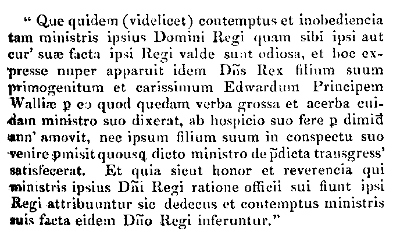
"Que quidem (videlicet) contemptus et inobediencia tam ministris ipsius Domini Regi quam sibi ipsi aut cur' suæ facta ipsi Regi valde sunt odiosa, et hoc expresse nuper apparuit idem Dñs Rex filium suum primogenitum et carissimum Edwardum Principem Walliæ p' eo quod quedam verba grossa et acerba cuidam ministro suo dixerat ab hospicio suo fere p' dimid' ann' amovit, nec ipsum filium suum in conspectu suo venire p'misit quousq' dicto ministro de 'pdicta transgress' satisfecerat. Et quia sicut honor et reverencia qui ministris ipsius Dñi Regi ratione officii sui fiunt ipsi Regi attribuuntur sic dedecus et contemptus ministris suis facta eidem Dño Regi inferuntur."
And accordingly the said Edward was adjudged to go in full court in Westminster Hall, and ask pardon of the judge whom he had insulted; and for the contempt done to the king and his court was then to stand committed to the Tower, there to remain during the king's pleasure. (Abb. Plac. lib. impres. p. 257.)
Roger de Hegham occurs as a Baron of the Exchequer in 26 Edw. I., and died 2 Edw. II. (Madox, ii. 58.)
WILLIAM SIDNEY GIBSON.
Newcastle-upon-Tyne.
NOTE ON THE WORD "Αδελφος."
I have attempted to ascertain the primary signification of the word "αδελφος," for the purpose of laying down a rule for its right interpretation in the sacred scriptures. If I have succeeded, we may be enabled to understand rightly one or two disputed passages in the New Testament, of which I hope to treat in a subsequent number.
Thus says Scapula on the word:
"Αδελφος, frater propriè, frater uterinus; fit enim a dictione δελφυς, uterus; et α significante ομου, pro ομοδελφος."
His etymology, as far as it goes, is quite correct: but still, we must trace its different parts up to the fountain-head, in order to understand the word aright. Let us then first take away its prefix α, and its constructive affix ος, and the remaining δελφ will be found to be a compound word, derived from the Sanscrit language, proving its identity therewith by means of the intermediate Semitic dialects.
Chaldee dul, situla, urna, a vessel for holding liquor. Arabic dal, a fat woman. These primary steps lead us to a passage in Isaiah li. 1., "the hole of the pit:" where the idea (not the word) is contained, and forms a connecting link between the Chaldee and Sanscrit; where, by taking t for d (a letter of the same organ), we have Sanscrit tal, a hole, pit, cause, origin, &c.; talla, a young woman, reservoir, pit, &c.; Greek (from the Syriac) ταλιθα, a damsel, Mark v. 41.; and by affixing the Sanscrit pha, or pa, fruitfulness, nourishment, drink, &c., we get talpa, a wife, bed, &c. Hebrew dalaph, stillavit. Syriac dalpha, conjunctio venerea. Delilah, a proper name, Judges xvi. 4. We thus ascertain that δελ-φ relates to the fruit or fruitfulness, &c. of the womb: and by putting the constructive affix υς = the Sanscrit as or us, we have δελφυς, uterus, &c.
We now come to the most important part of the compound αδελφος, viz. the Sanscrit ā = ομου, simul, at the same time; and we find that this ā refers us to "a limit conclusive" (to that place, to that time), and also to a "limit inceptive" (from THAT place, from that time); consequently, the primary meaning of α-δελ-φ-ος, is what Scapula has defined it to be, "frater uterinus," a brother to, or from the SAME womb.
My deduction from hence is, that where the context, or history, does not point us to a more general sense of the word, i.e. to relatives such as cousins, or to the whole human race adopting the same term; correct criticism seems to demand the signification of the word in its primary meaning.
T. R. BROWN.
Vicarage, Southwick, near Oundle.
LAMBERT, THE "ARCH-REBELL."
Mr. Hallam (Const. Hist., vol. ii. p. 26. ed. 1850), after some remarks on the execution of Vane, who was brought to trial together with Lambert in 1661, asserts that the latter, "whose submissive behaviour had furnished a contrast with that of Vane, was sent to Guernsey, and remained a prisoner for thirty years." Mr. Hallam does not quote his authority for this statement, which I also find in the older biographical dictionaries. There exists, however, in the library of the Plymouth Athenæum, a MS. record which apparently contradicts it. This is a volume called Plimmouth Memoirs, collected by James Yonge, 1684. It contains "a Catalogue of all the Mayors, together with the memorable occurrences in their respective years," beginning in 1440. Yonge himself lived in Plymouth, and the later entries are therefore made from his own knowledge. There are two concerning Lambert:
"1667. Lambert, the arch-rebell, brought prisoner to this Iland."
[The Island of St. Nicholas at the entrance of the harbour, fortified from a very early period.]
"1683, Easter day. My Lord Dartmouth arrived in Plimmo. from Tangier. In March, Sir G. Jeffry, the famously [Query, infamously] loyal Lord Chief Justice, came hither from Launceston assize: lay at the Mayor's: viewed ye citadells, Mt. Edgecumbe, &c.
"The winter of this yeare proved very seveare. East wind, frost, and snow, continued three moneths: so that ships were starved in the mouth of the channell, and almost all the cattel famisht. Ye fish left ye coast almost 5 moneths. All provisions excessive deare; and had we not had a frequent supply from ye East, corne would have been at 30s. per bushell,—above 130,000 bushells being imported hither, besides what went to Dartmo., Fowy, &c.
"The Thames was frozen up some moneths, so that it became a small citty, with boothes, coffee houses, taverns, glasse houses, printing, bull-baiting, shops of all sorts, and whole streetes made on it. The birdes of the aire died numerously. Lambert, that olde rebell, dyed this winter on Plimmo. Island, where he had been prisoner 15 years and mo."
The trial of Lambert took place in 1661. He may have been sent at first to Guernsey, but could only have remained there until removed in 1667 to Plymouth. His imprisonment altogether lasted twenty-one years.
Lambert's removal to Plymouth has, I believe, been hitherto unnoticed. Probably it was thought a safer (and certainly, if he were confined in the little island of St. Nicholas, it was a severer) prison than Guernsey.
RICHARD JOHN KING.
THE CAXTON COFFER.
An opinion prevails that biographers who lived nearest the times of the individuals whom they commemorate are most entitled to belief, as having at command the best sources of information. To this rule, however, there are numerous exceptions; for time, which casts some facts into oblivion, also produces fresh materials for historians and biographers.
It is certainly advisable to consult the earliest memoir of an individual in whose fate we take an interest, and even each successive memoir, in order that we may trace the more important historical particulars, and such critical opinions as seem to require discussion, to their true source. The result of some comparisons of this description, on former occasions, has almost led me to consider biographers as mere copyists—or, at the best, artists in patch-work. I shall now compare, on one point, the earlier biographers of Caxton:—
"Gvilhelmus Caxton, Anglus—habitavit interim in Flandria 30 annis cum domina Margareta Burgundiæ ducissa regis Edwardi sorore."—Joannes BALE, 1559.
"Gvilhelmvs Caxtonus, natione Anglus. Vir pius, doctus, etc. In Flandria quidem triginta annis vixit cum Margareta Burgundiæ duce, regis Edwardi quarti sorore."—Joannes PITSEUS, 1619.
"William Caxton, born in that town [sc. Caxton!]. He had most of his education beyond the seas, living 30 years in the court of Margaret dutchesse of Burgundy, sister to king Edward the Fourth, whence I conclude him an Anti-Lancastrian in his affection."—Thomas FULLER, 1662.
"William Caxton—was a menial servant, for thirty years together, to Margaret dutchess of Burgundy, sister to our king Edward IV., in Flanders."—William NICOLSON, 1714.
"Gulielmus Caxton natus in sylvestri regione Cantiae; in Flandria, Brabantia, Hollandia, Zelandia xxx annis cum domina Margareta, Burgundiae ducissa, regis Edwardi IV. sorore vixit."—Thomas TANNERUS, 1748.
Now, according to Fabian, Stow, and others, Margaret of York was married to Charles duke of Burgundy in 1468; and if Caxton did not return to England about the year 1471, as Stow asserts, he was certainly established at Westminster in 1477. The thirty years of the learned writers must therefore be reduced to less than ten years!
The discrepancy between these writers, on another important point, is not less remarkable than their agreement in error, as above-described. Pits says Caxton flourished in 1483; Fuller, that he died in 1486; and Tanner, that he flourished about 1483, and died in 1491. Shakspere died in 1616: in what year did he flourish?
BOLTON CORNEY.
Minor Notes.
A Hint to Catalogue Makers.
—Among the many excellent schemes proposed for the arrangement and diffusion of common means of information, one simple one appears to have been passed over by your many and excellent correspondents. I will briefly illustrate an existing deficiency by an example.
While collecting materials for a projected critical commentary on the Timæus of Plato, I was surprised to find the commentary of Chalcidius wholly wanting in our library at Christ Church. Subsequently (when I did not want it, having secured a better edition at the end of Fabricius' Hippolytus) I discovered a fine copy of Badius Ascensius' editio princeps, bound up with Aulus Gellius and Macrobius, but utterly ignored in the Christ Church catalogue.
This instance shows the necessity of carefully examining the insides of books, as well as the backs and title-pages, during the operation of cataloguing. Our public libraries are rich in instances of a similar oversight, and many an important and recherché work is unknown, or acquires a conventional rarity, through its concealment at the end of a less valuable, but more bulky, treatise.
I have been aroused to the propriety of publishing this suggestion, by purchasing, "dog cheap", a volume labelled Petrus Crinitus, but containing Hegesippus (i.e. the pseudo-Ambrosian translation from Josephus) and the Latin grammarians at the end, all by the afore-mentioned printer.
THEODORE ALOIS BUCKLEY.
Virgil and Goldsmith.
—The same beautiful thought is traceable in both Virgil and Goldsmith. In book iii. of the Æneid, lines 495-6. we read:
"Vobis parta quies; nullum maris æquor arandum; Arva neque Ausoniæ, semper cedentia retro, Quærenda."
In the Traveller these lines occur:
"But me, not destined such delights to share, My prime of life in wandering spent and care; Impell'd, with steps unceasing, to pursue Some fleeting good, that mocks me with the view; That, like the circle bounding earth and skies, Allures from far, yet, as I follow, flies ——"
ALFRED GATTY.
Mental Almanac (Vol. iv., p. 203.).
—MEM. The additive number for this present November is 1. Hence next Wednesday is 4 + 1, that is, the 5th. The Sunday following, is 1 + 1 + 7, that is, the 9th. And similarly for any other day or week in this month.
A. E. B
Leeds, Nov. 1. 1851.
Merlin and the Electric Telegraph.
—The following extract from the prophecy of Merlin in Geoffrey of Monmouth's British History, book vii. ch. 4., reads rather curiously in these days of railways and of electric telegraph communication between France and England:—
"Eric shall hide his apples within it, and shall make subterraneous passages. At that time shall the stones speak, and the sea towards the Gallic Coast be contracted into a narrow space. On each bank shall one man hear another, and the soil of the isle shall be enlarged. The secrets of the deep shall be revealed, and Gaul shall tremble for fear."
I should like to be informed if there have ever been any detailed and systematic attempts made at interpreting the whole of this curious prophecy of Merlin's.
W. FRASER.