Notices to Correspondents.
Reading edition
Although we have this week again enlarged our paper to twenty-four pages, we have been compelled to postpone many interesting articles. Among these we may particularise "Illustrations of Chaucer, No. VI.," a valuable paper by Mr. Singer on "John Tradescant," and another on the "Tradescent Family" by Mr. Pinkerton; and many Replies.
A. X. The Brussels edition of the Biographie Universelle is in 21 vols. Bickers of Leicester Square marks a copy half-bound in 7 vols. at Five Guineas.
Trivia and A. A. D. The oft-quoted line "Tempora Mutantur," &c., is from Borbonius. See "Notes and Queries," Vol. i., pp. 234. 419.
A. A. D. is referred to p. 357. of our last Number for an explanation of "Mind your Ps and Qs."
Nemo's Query respecting Pope Joan was inserted in No. 75. p. 265.; a Reply to it appears in No. 77. p. 306.; and we have several more communications to which we hope to give insertion next week.
Replies Received.—Ramasse—Prayer at the Healing—M. or N.—Deans Very Reverend—Family of the Tradescants—Epitaph on the Countess of Pembroke—West Chester—Demosthenes and New Testament—Pope Joan—Handbills at Funerals—Ventriloquist Hoax—Solid-hoofed Pigs—Aerial Apparitions—Apple-pie Order—Wife of James Torre—Snail-eating—Epigram by T. Dunbar.
Vols. I. and II., each with very copious Index, may still be had, price 9s. 6d. each.
Notes and Queries may be procured, by order, of all Booksellers and Newsvenders. It is published at noon on Friday, so that our country Subscribers ought not to experience any difficulty in procuring it regularly. Many of the country Booksellers, &c., are, probably, not yet aware of this arrangement, which will enable them to receive Notes and Queries in their Saturday parcels.
All communications for the Editor of Notes and Queries should be addressed to the care of Mr. Bell, No. 186. Fleet Street.
Errata.—Page 336. l. 4. for "Burkdon" read "Burkdou." (i. e. Bourdeaux); p. 341. l. 11. for "laurando" read "lacerando;" and in p. 352. instead of between the years "1825 and 1850," read "1825 and 1830;" and we are requested to add that the churchwardens' account of S. Mary de Castro, Leicester, had disappeared from the parish chest long prior to the time mentioned.
PRINTING.
A LECTURE, SPEECH, SERMON, OR ORATION, occupying about three quarters of an hour in delivery, printed on good paper, in bold clear type: 500 copies, 3l. 17s. 6d.; 1000 copies, 5l. 10s. 1000 Circulars, Note Size, printed on Cream-laid Note Paper, fly leaf, 17s. 6d., 1000 Ditto, on Superfine Cream-laid Letter Paper, fly leaf, 1l. 5s.
Bateman and Hardwicke, 38. Carey Street, Lincoln's Inn.
This day is published, fcap. 8vo., price 5s.,
PLEASURES, OBJECTS, and ADVANTAGES of LITERATURE. By the Rev. R. A. Willmott, St. Catherine's, Bear Wood, Author of "Jeremy Taylor, a Biography."
London: T. Bosworth, 215. Regent Street.
NEW WORK BY PROFESSOR DE MORGAN.
This day, in One Volume, oblong 8vo., price 5s., cloth,
THE BOOK OF ALMANACS; with INDEX, by which the Almanac belonging to any Year preceding A. D. 2000 can be found; with means of finding New and Full Moons from B. C. 2000 to A. D. 2000. By Augustus De Morgan, Professor of Mathematics in University College, London.
The "Book of Almanacs" will enable any one to lay open before him the whole Almanac of any past year, of the present year, or of any future year, up to A. D. 2000, whether in old style or new, by one consultation of a simple Index. This book will be useful to all who ever want an Almanac, past, present, or future;—to Clergymen, as a perpetual index to the Sundays and Festivals;—to Lawyers in arranging evidence which runs over a long period, and to Courts of Law in hearing it;—to Historical and Antiquarian Inquirers, in testing statements as to time and date;—to all, in fact, who are ever required to interest themselves about time past or future.
Taylor, Walton, and Maberly, Upper Gower Street, and Ivy Lane, Paternoster Row.
Now ready, royal 8vo., pp. 1653. 21s.
A COPIOUS AND CRITICAL LATIN-ENGLISH LEXICON, founded on the larger Latin-German Lexicon of Dr. William Freund; with Additions and Corrections from the Lexicons of Gesner, Facciolati, Scheller, Georges, &c. &c. By E. A. Andrews, LL.D.
London: Sampson Low, 169. Fleet Street. New York: Harper and Brothers.
GREAT EXHIBITION. CENTRAL AVENUE. An Illustrated Priced Catalogue of Church Furniture Contributed by GILBERT J. FRENCH, Bolton, Lancashire, forwarded Free by Post on application. Parcels delivered Carriage Free in London, daily.

CATALOGUES OF JOHN RUSSELL SMITH'S LITERARY COLLECTIONS.
1. Parts I. and II. of a Classified Catalogue of 25,000 Ancient and Modern Pamphlets.
2. Books on the History and Topography of Great Britain, arranged in Counties.
3. Twelve Hundred Books and Pamphlets relating to America.
4. Five Hundred Books relating to the Counties of Kent, Sussex, and Surrey.
5. Ancient Manuscripts, Deeds, Charters, and other Documents relating to English Families and Counties.
6. Parts II. and III. for 1851, of Choice, Useful, and Curious Books, in most Classes of Literature, containing 1600 articles.
*** Any of the above Catalogues may be had, gratis, on application, or any one will be sent by post on receipt of four postage labels to frank it.
4. Old Compton Street, Soho, London.
Just published, 12mo. cloth, 5s.
THE DIALECT AND FOLK-LORE OF NORTHAMPTONSHIRE. A Glossary of Northamptonshire Provincialisms, Collection of Fairy-Legends, Popular Superstitions, &c. By Thomas Sternberg.
"A skilful attempt to record a local dialect."—Notes and Queries, No. 72.
"Mr Sternberg has evinced a striking and peculiar aptitude for this branch of enquiry."—Northampton Mercury.
"The notes on Folk-lore are curious, and worthy consultation."—Gentleman's Magazine.
J. Russell Smith, 4. Old Compton Street, Soho, London.
WESTERN LIFE ASSURANCE AND ANNUITY SOCIETY, 3. Parliament Street, London.
VALUABLE NEW PRINCIPLE.
Payment of premiums may be occasionally suspended without forfeiting the policy, on a new and valuable plan, adopted by this society only, as fully detailed in the prospectus.
A. Scratchley, M.A.,
Actuary and Secretary; Author of "Industrial Investment and Emigration; being a Second Edition of a Treatise on Benefit Building Societies, &c." Price 10s. 6d.
London: J. W. Parker, West Strand.
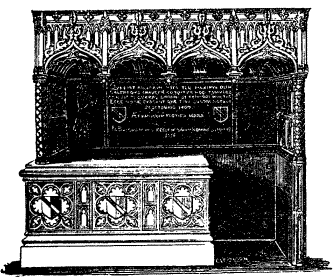
COMMITTEE FOR THE REPAIR OF THE TOMB OF GEOFFREY CHAUCER.
JOHN BRUCE, Esq., Treas. S.A., 5, Upper Gloucester Street, Dorset Square.
J. PAYNE COLLIER, Esq., V.P.S.A., Geys House, Maidenhead.
PETER CUNNINGHAM, Esq., F.S.A., Madeley Villas, Kensington.
WILLIAM RICHARD DRAKE, Esq., F.S.A., Honorary Treasurer, 46. Parliament Street.
THOMAS W. KING, Esq., F.S.A., York Herald, College of Arms, St. Paul's.
SIR FREDERICK MADDEN, K.H., British Museum.
JOHN GOUGH NICHOLS, Esq., F.S.A., 25. Parliament St.
HENRY SHAW, Esq., F.S.A., 37. Southampton Row, Russell Square.
SAMUEL SHEPHERD, Esq., F.S.A., Marlborough Square, Chelsea.
WILLIAM J. THOMS, Esq., F.S.A., Honorary Secretary, 25. Holy-Well Street, Millbank, Westminster.
The Tomb of Geoffrey Chaucer in Westminster Abbey stands in need of repair. The portrait and the inscriptions have disappeared; the overhanging canopy has suffered damage; the table is chipped and broken; the base is fast mouldering into irretrievable decay.
Such an announcement is calculated to stir every heart that can respond to the claims of poetry, or feel grateful for the delight which it affords to every cultivated mind. It summons us, like the sound of a trumpet, "To the rescue!" It cannot be that the first and almost the greatest of English bards should ever be allowed to want a fitting memorial in our "Poet's Corner," or that the monument which was erected by the affectionate respect of Nicholas Brigham, nearly three centuries ago, should, in our time, be permitted to crumble into dust.
A sum under One Hundred Pounds will effect a perfect repair.
It is thought that there can be no difficulty in raising such a sum, and that multitudes of people in various conditions of life, and even in distant quarters of the globe, who venerate the name of Chaucer, and have derived instruction and delight from his works, will be anxious to contribute their mite to the good deed.
The Committee have therefore not thought it right to fix any limit to the subscription; they themselves, with the aid of several distinguished noblemen and gentlemen, have opened the list with a contribution from each of them of Five Shillings, but they will be ready to receive any amount, more or less, which those who value poetry and honour Chaucer may be kind enough to remit to them.
The design of the Committee is sanctioned by the approval of the Earl of Carlisle, the Earl of Ellesmere, the Earl of Shaftesbury, Lord Braybrooke. Lord Londesborough, Lord Mahon, the Right Hon. C. W. W. Wynn, and by the concurrence of the Dean and Chapter of Westminster.
An account of the sums received and expended will be published when the work is completed.
Subscriptions are received by all the members of the Committee, and at the Union Bank, Pall Mall East. Post-office orders may be made payable to William Richard Drake, Esq., the Treasurer, 46. Parliament Street, at the Charing Cross Office.
In a few days will be published, in One handsome Volume 8vo., profusely Illustrated with Engravings by Jewitt,
Some Account of Domestic Architecture in England;
FROM
THE CONQUEST TO THE END OF THE THIRTEENTH CENTURY.
WITH
NUMEROUS ILLUSTRATIONS OF EXISTING REMAINS FROM ORIGINAL DRAWINGS.
BY T. HUDSON TURNER.
The Table of Contents of this Volume will best explain its Object.
INTRODUCTION.
The Romans in England—Their Villas and Houses—Ordinary Plan of a Roman House—Method of Building—The Saxons—Their Style of Building; they probably occupied Roman Houses—A Saxon Hall—Houses of Winchester and London in the Saxon Period—Decoration of Buildings—Romanesque Style of Architecture introduced during the Saxon Period—Drawings in Saxon MSS., their Character and Value as Architectural Evidence—The Greek, or Byzantine School; its Influence on Saxon Art—Antiquity of Chimneys; None at Rome in the Fourteenth Century—Character of the Military Buildings of the Saxons—The Castles of Coningsburgh and Bamborough later than the Saxon Period—Arundel, the only Castle said to have been standing in the time of the Confessor—Norman Castles—Domestic Architecture of the Normans—Stone Quarries—Use of Plaster—Bricks and Tiles—Brickmaking, its Antiquity in England—Masons and other Workmen—Glazing—Iron Works in England—Architectural Designs of the Middle Ages, how made—Working Moulds of Masons, &c.
CHAPTER I.—TWELFTH CENTURY.
General Remarks—Imperfect Character of existing Remains of the Twelfth Century—Materials for the History of Domestic Architecture; their Nature—General Plan of Houses at this Date—Halls—Other Apartments of Ordinary Houses—Bedchamber, Kitchen, Larder, &c.—King's Houses at Clarendon and other Places—Hall, always the Chief Feature of a Norman House—Alexander Necham, his Description of a House—Plan of Norman Halls—Their Roofs—Situation of other Apartments relatively to the Hall—Kitchens—Cooking in the Open Air—Bayeux Tapestry—Remains of a Norman House at Appleton, Berks—Fences, Walls, &c.—Some Norman Houses built in the form of a Parallelogram, and of Two Stories—Boothby Pagnell, Lincolnshire—Christ Church, Hants—Jews' House at Lincoln—Moyses' Hall, Bury St. Edmund's—Staircases, Internal and External—External Norman Stair at Canterbury—Houses at Southampton—Building Materials—Use of Lead for Roofs—English Lead exported to France—Style of Norman Roofs—Metal Work; Hinges, Locks, Nail-heads, &c.—Gloucester celebrated for its Iron Manufactures—External Decoration of Buildings—Windows—Glazing—Fire-places—Kitchens open in the Roof—Hostelry of the Prior of Lewes—Internal Walls Plastered—Furniture of Houses, Tapestry, &c—Floors generally of Wood—Character London Houses in the Twelfth Century—Assize of 1189 regulating Buildings in London—Assize of the Year 1212 relating to the same Subject—- Majority of London Houses chiefly of Wood and Thatched—Wages of Workmen—Cookshops on Thames Side—Chimneys not mentioned in the London Assizes, &c.
CHAPTER II.—EXISTING REMAINS.
Oakham Castle, Rutlandshire—The King's House, Southampton—Minster, Isle of Thanet—Christ Church, Hants—Manor-house at Appleton—Sutton Courtney, Berks—St. Mary's Guild, and Jews' Houses, Lincoln—Staircase, Canterbury—Warnford, Hants—Fountain's Abbey—Priory, Dover—Moyses' Hall, Bury St. Edmund's—Hostelry of the Prior of Lewes, Southwark—Boothby Pagnell, Lincolnshire—Barnack, Northamptonshire—School of Pythagoras, Cambridge—Notes on Remains of Early Domestic Architecture in France.
CHAPTER III.—THIRTEENTH CENTURY.
General Remarks—Hall at Winchester—Reign of Henry III. remarkable for the Progress of Architecture—Condition of Norman Castles in the Thirteenth Century—Plan of Manor-houses at this Date—House built for Edward I. at Woolmer, Hants—Description of House at Toddington, by M. Paris—Meaning of term Palatium—Longthorpe, Stoke-Say Castle—West Deane, Sussex—Aydon Castle—Little Wenham Hall—Two Halls at Westminster, temp Henry III.—Temporary Buildings erected at Westminster for the Coronation of Edward I.—Private Hospitality in this Century—Kitchens—Wardrobes—Influence of Feudal Manners on Domestic Architecture—Building Materials—Wood extensively used—Manor-house of Timber engraved on a Personal Seal—Extensive Use of Plaster—Roofs of the Thirteenth Century—Windows—Glass and Glazing—Digression on the History of Glass-making in England—No Glass made in England until the Fifteenth Century—Wooden Lattices, Fenestrals, &c.—Fire-places and Chimneys—Mantels—Staircases, External and Internal—Internal Decoration of Houses—Wainscote—Polychrome—Artists of the Time of Henry III.; their Style—Their Names—Spurs, Screens, &c.—Tapestry not used in Private Dwellings in the Thirteenth Century. Flooring—Tiles—Baths Cameræ Privatæ—Conduits and Drains—Houses in Towns—Parisian Houses—Other Foreign Examples—Furniture—Carpets—General State of England in the Thirteenth Century—State of Towns—London and Winchester compared—Travelling—Hackneymen—Inns—State of Trade in England—Agriculture—Remarks on Horticulture.
CHAPTER IV.—THIRTEENTH CENTURY.—EXISTING REMAINS.
Aydon Castle, Northumberland—Godmersham, Kent—Little Wenham Hall, Suffolk—Longthorpe, near Peterborough—Charney Basset, Berks—Master's House, St. John's Hospital, Northampton—Stoke-Say Castle, Shropshire—Coggs, Oxfordshire—Cottesford, Oxfordshire—Parsonage House, West Tarring, Sussex—Archdeacon's House, Peterborough—Crowhurst, Sussex—Bishop's Palace, Wells—Woodcroft Castle, Northamptonshire—Old Rectory House, West Deane, Sussex—Acton Burnell, Shropshire—Somerton Castle, Lincolnshire—Old Soar, Kent—The King's Hall at Winchester—The Priory, Winchester—Stranger's Hall, Winchester—House at Oakham, known as Flore's House—Thame, Oxfordshire—Chipping-Norton, Oxfordshire—Middleton Cheney, Oxfordshire—Sutton Courtney, Berkshire.
CHAPTER V.—HISTORICAL ILLUSTRATIONS.
Extracts from the Liberate Rolls of Henry III., 1229-1259, relating to the following places:—
Bridgenorth — Brigstock — Brill — Bristol — Canterbury — Clarendon — Cliff — Clipstone — Corfe Castle — Dover — Dublin — Evereswell — Feckenham — Freemantle — Geddington — Gillingham — Gloucester — Guildford — Havering — Hereford — Hertford — Kennington — Litchfield — London, (Tower) — Ely House — Ludgershall — Marlborough — Newcastle — Northampton — Nottingham — Oxford — Rochester — Sherbourn — Silverstone — Westminster — Winchester — Windsor — Woodstock.
SUPPLEMENTARY NOTES OF FOREIGN EXAMPLES.
General Remarks — Treves — Laon — Ratisbon — Gondorf — Metz — Toulouse — Laon — Brée — Coucy — Carden — Tours — Angers — Fontevrault, (Kitchen) — Perigueux — St. Emilion — Mont St. Michel — Beauvais.
APPENDIX OF DOCUMENTS.
OXFORD: JOHN HENRY PARKER; AND 377. STRAND, LONDON.
Printed by Thomas Clark Shaw, of No. 8. New Street Square, at No. 5. New Street Square, in the Parish of St. Brid in the City of London; and published by George Bell, of No. 186. Fleet Street, in the Parish of St. Dunstan the West, in the City of London, Publisher, at No. 186. Fleet Street aforesaid.—Saturday, May 10. 1851.