Introductory material (continued 3)
Reading edition
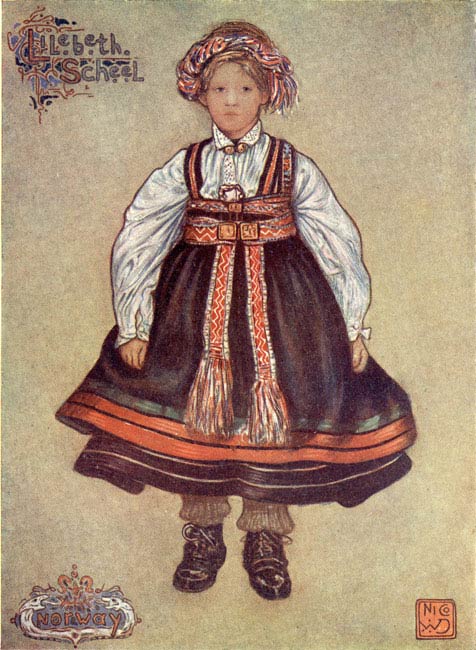
A LITTLE SÆTERSDALEN PEASANT GIRL
When a shoal of herring arrives, always announced by whales and flights of birds who feed on the small fish, telephones and telegraphs are set in motion to summon the fishermen to the spot, and to order barrels and salt for the packing of the fish. These are sent as speedily as possible by special steamers. When the shoal approaches the coast, an immense net encloses it as completely as possible. The fish are massed so compactly that a boat crossing the shoal is raised by them. The brilliancy of their scales as they dash about, almost on the surface of the water, is dazzling. Landed, they are immediately split open, cleaned, salted, and packed for transportation.
Whale fishing is carried on to some extent off the north of Norway. On the little island of Skaaro there is a building where whale oil is prepared for use. From afar off the sickening smell announces the industry of the island: repulsive morsels of greasy débris float on the surface of the water. At the landing place the rocky beach is so covered with grease that it is difficult to walk without falling. A friend arrived just as a whaler appeared on the horizon, dragging after her the carcase of an enormous whale, weighing seventy-five thousand kilogrammes. Such an animal will give about fifty thousand pounds' weight of oil, and will bring the captors between £280 and £300. Such a giant requires for his daily meal twenty or thirty tons of fish. To take them he opens his jaws, and closes them on water and fish alike; he swallows the fish, allows the water to filter through the curious formation of his mouth, and then squirts it up like a fountain through an opening in the skull. It is this jet of water which often causes his ruin, by indicating his position to the watchful whalers. On the boat which is chasing him is a cannon, loaded with an enormous harpoon, which is attached to the ship by a long rope wound round a pulley. The extremity of the harpoon is armed with an explosive bomb. When the whale appears the harpoon is shot at it. Following its instinct of self-preservation, it dives deep. The rope gives out rapidly. When it is entirely unwound it naturally pulls against the harpoon, the forked ends of which, in the resistance, tear the flesh of the animal. As a final result the bomb bursts in the body of the whale, and generally wounds it mortally. The corpse floats on the surface; it is attached to the boat and towed to the station, where it is cut up. The fat produces a large amount of oil; the whalebone is a productive article of commerce; and most of the remainder of the animal is converted into manure.
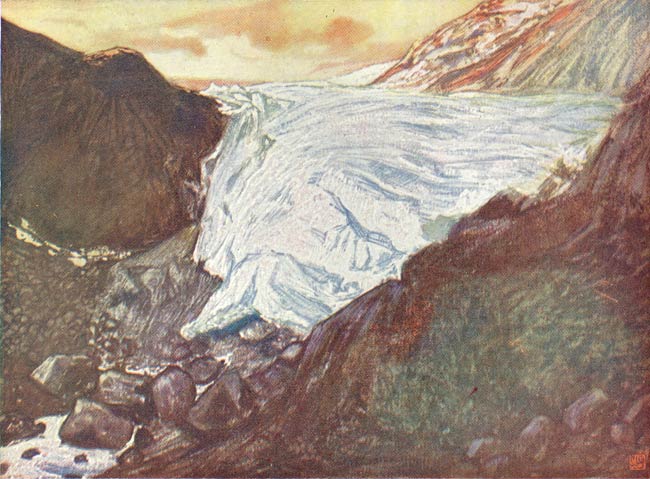
BUERBRÆ, ODDE HARDANGER
It is on account of the great importance and interest which we in England attach to the salmon fishing that I do not dare to deal with it, except to make an apology that any book on Norway should be without at least a chapter on this splendid sport. Though the accomplished angler is allowed to relate fish stories without interruption from an absolutely incredulous audience, the remarks of an inexperienced outsider would, I fear, not be received with equal docility. I am sure that an angler is born, not made: for, though I am ignorant on the subject, all my life I have listened to enthusiastic fisherman's talk, and was brought up in a nursery in which were "skied" various victims of my father's prowess as an angler.
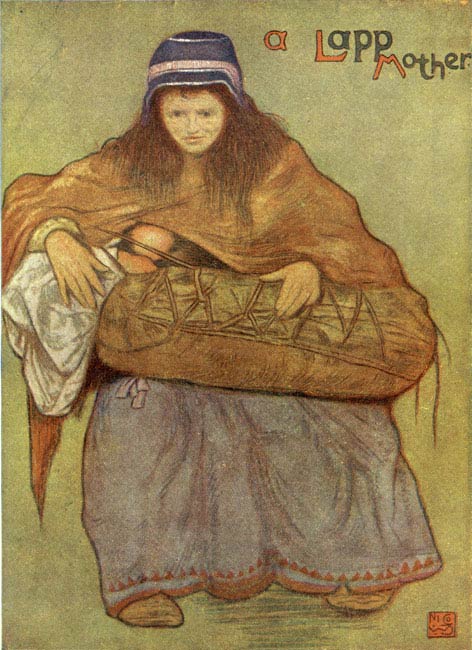
A LAPP MOTHER AND CHILD
Since the beginning of my book I have learnt so much about the Lapps that I must enlarge on my borrowed history of them in Chapter VIII. The Lapps are nomadic on account of their reindeer, and it is following these animals where they choose to roam in search of food that takes them wandering all over the northern half of Norway. There are only two Lapp villages—Karasjok, in Finmarken, and Kontokeimo, near the Russian frontier. The permanent residences consist of cabins built of turf, stones, or small tree-trunks. These huts are round and have one opening in the top, where the light penetrates and the smoke comes out. In the middle of the hut a fire is kept continually burning, with a big cauldron hanging over it, suspended by a chain. The members of the family and their servants, if they have any, sleep on either side of the fire. The Lapps are small, in great contrast to the Norwegians of this region, who average over six feet in height. The children are often exceedingly pretty; but they soon lose their charm and become ugly, and are not rendered more attractive by their dirty habits. All their garments are made of reindeer skin, and the women add to these various silk shawls and handkerchiefs brightly coloured; by the quantity and the quality of these one may judge of their rank and richness. The Lapps are supposed to share a common origin with the Magyars of Hungary, though these, if they recognise the relationship, cannot feel flattered. It is certain that the Lapps were the first inhabitants of Norway. In appearance they are unprepossessing. They have small eyes, very low foreheads, flat noses, and thick-lipped mouths. Like the Hungarians, they are incredibly proud. They despise everything that is not Lapp, and refuse to allow their daughters in marriage to Norwegians. (I should have thought that the Norwegians would not have worried much about this restriction.) They are all baptized in the Lutheran Church; but that is as far as their religion goes in most cases. They are unmoral and superstitious.
One might gather from the books of some of Norway's great writers that the nation is on the whole rather casual about morality. It would appear that their religion, while condemning as worthy of hell quite honest pleasures, looks with indulgence on a certain moral laxity, which is indeed so habitual that it passes uncriticised. Among the very strictly religious population in the south-west, a pastor would be quickly got rid of if he forgot himself so far as to play the piano or drink intoxicants; but this same people some ten years ago venerated as a martyr one of their clergy who, forced to confess in public crimes against the morality of his own parishioners, was consequently deposed by the Government. His flock, of their own initiative, built him a magnificent church, and, providing him with a liberal sufficiency, retained him as the director of their spiritual welfare.
Two Oratorians, visiting Norway some years ago in a yacht, decided to spend a few days fishing at a hamlet somewhere in the Sogne Fjord. They had all the preparations for Mass with them, and wished to take a small unused chalet as a chapel. The farmer who owned the building was willing, and negotiations were concluded on payment of a nominal rent, when the farmer realised that my friends were of the Old Religion. There was no question of proselytism, as the idea concerned only the two priests and their Catholic English friends on the yacht; but all the countryside was up in arms, and a few days later prominent personages from Christiania had arrived on the scene to put a stop to the possibility of such happenings. In the meantime, however, my friends, little dreaming of the importance attached to their doings, had pursued their way along the coast, and were innocently fishing elsewhere. At present the ecclesiastical prejudice of the Norwegians is less marked, though Jews are sedulously discouraged, and Jesuits are forbidden the country.
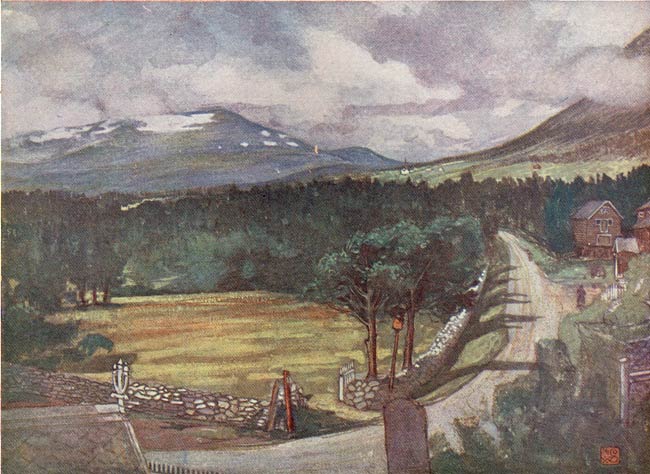
SNOW-CAPPED MOUNTAINS AT AUNE
Various hospitals are attended by Catholic nursing sisters, who are in great favour with the medical profession and with the patients who are lucky enough to fall under their care.
All this time I am trying hard, by roundabout means, to get back to Bergen, because I wish to fit in, in proper context, a remark which I heard about the town. It seems that I cannot get back there legitimately, though I had hoped that the Sisters of Charity would help me through with their hospitals.
I was listening to the woes of the American Consul in Bergen. He was descanting on the want of entertainment and the absence of all things which make an American's life possible in any country on the globe outside his perfect native land. I sympathised with him, and threw in a little grumble of my own, having relation to the weather. "O, the weather!" said my red-headed friend, very hopelessly and crossly. "Why, sure, if a Bergen horse sees a person without an umbrella, he shies." This seems pretty feeble as I set it down; but at the time the Consul was disconsolate and far from wishing to amuse me, bored and discontented. Thus his remark just happened to tickle me: we both laughed until we cried, and felt very much the better for the diversion.
Frequently, at times of ennui, we found diversion in music, or in information about that art. The lure, though perhaps it can hardly be called a musical instrument, is a primitive means of conveying sound. The herds on the mountains used it to call their cattle together. It is said that no two lures have tones exactly alike, and that the cattle are able to distinguish and place the particular sound of their guardian's lure. It is a wooden trumpet, nearly five feet long, made of two hollow pieces of birchwood, bound together throughout the whole length with strips of willow. Besides being used to call the cattle together, it is often carried by travelling parties to avert the risk of anyone being lost in the wilds. Its notes may be heard at a great distance, and are rather harsh and discordant, possessing none of the musical qualities of the Alp horn used by the Swiss for the same purpose. Grieg composed charming music for a song called "The Princess." The words led me to suppose that the lure is rather a fascinating instrument; and the above description rather disillusioned me, until I decided to allow a good deal for poetic licence.
The Norwegians are exceedingly musical. Their national music gives wonderful expression to their moods. Almost invariably in the gayest pieces one catches here and there a pathetic little droop which gives a very particular character to Norwegian music. In the country the post of fiddler is handed down from generation to generation, together with certain airs which are looked upon as family property; but official fiddlers are by no means the only musicians in the district. These are found in every family, dividing their favours between the violin and the guitar. The organist L. Lindeman did great service to his country by collecting and preserving hundreds of national ballads, dances, and hymns, which had lived only in the ear and the soul of the people, and thus were lost entirely to the outer world. The oldest of these songs are the sagas, sung traditions that have been handed down from immemorial ages. They recount the heroic exploits of the Vikings and warriors of heathen times. Many ballads tell of the beautiful huldre, of the fay who presages the destruction of fishermen, of the water sprite, and of the brownies who, living underground, are covetous of cattle. To gratify their taste, the brownies help themselves to such as graze on the mountains, but only if their guardian's eyes are turned off his charges; they make dwarfs of the beasts to enable them to enter crevices in the ground, in order that they may descend to subterranean passages. Many songs about these malicious fairies do the maidens sing as they keep their eyes carefully fixed on the herds, to prevent their being stolen in like manner. Some of the songs consist of hundreds of four-line verses, which must surely be a hard test to the memory of the singers. Sometimes two singers will have a duet in such a song, singing verse after verse alternately. He whose memory, or, in default of memory, invention, fails him first is loser.
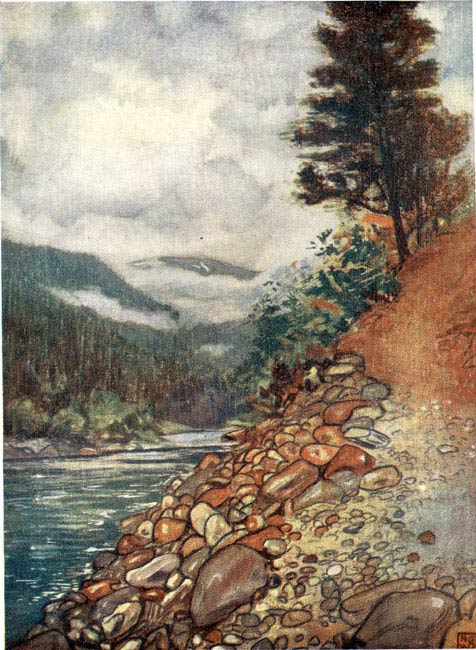
RIVER AT GJORA
The Norwegian national dances have in their melodies and rhythms a bold and natural character which gives them considerable worth. The principal are the halling, a Hardanger solo dance consisting of wild gyrations and vigorous kicks at rafters of the room. He who kicks highest is the champion. The other dance is the springar, which is a dance for two, with no less call for the display of muscular powers.
The two favourite instruments of the people, on which all this music has been played for centuries, are the langelik, which somewhat resembles a zither, and the Hardanger violin. The langelik has a long, flat body, with round holes, and at least seven strings, which are struck with a plectrum. The tone is rather weak, and the sound is somewhat monotonous, as the possibility of producing modulated sounds is almost entirely excluded.
The Hardanger fiddle is higher and more arched in its build than the violin we know. The instrument is decorated as much as possible, the scroll being a dragon's head, or something equally fantastic: and the body of the fiddle is richly carved and ornamented with incrustations of ivory and mother-of-pearl. Beneath the four upper strings, which are tuned to suit the individual tastes of the musician, and under the finger-board, there are four, sometimes more, sympathetic strings of fine steel wire. By the aid of this instrument the people make wonderful sketches in music descriptive of the beauty of dawn and the close of a summer's day, with the birds' trills, or the huldre's song, or the ringing of marriage bells. I have all this from a Norwegian book, and from instruments I have both seen and heard.
The best known of the modern music-makers of the north is the great Norwegian Edward Grieg, whose genius is familiar to all musicians the world over. He was born in Bergen, and lives there still, though he has travelled much in Germany, Holland, and Italy. Another name which we know well in this country is that of Sinding, who is of the younger generation.
Norway has no regular opera; but the concerts which are given in the beautiful National Theatre are eagerly attended, and the programmes are representative of the musical talent of Europe.
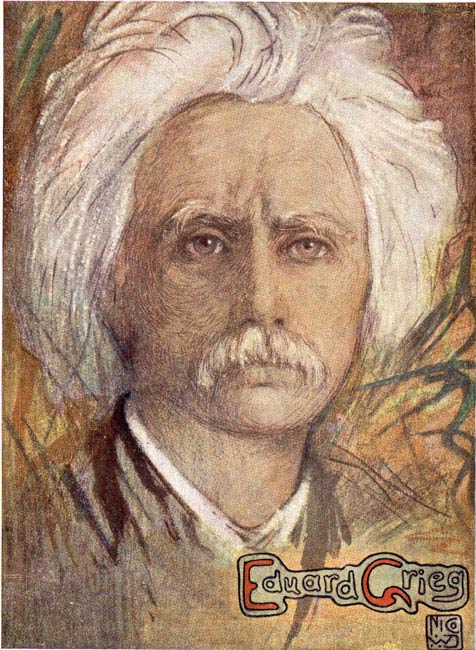
GRIEG
LEGENDS AND LITERATURE
CHAPTER X
LEGENDS AND LITERATURE
In Norwegian folk-lore the devil is a person with many relations, who are called Jutuls. In favour of the legends about them there is often some circumstantial evidence. Does a mountain or a rock bear similitude to the figures of human beings or of animals? Be sure that the Norwegians will have some tradition to account for the formation by proving to you that such rocks or mountains are the various creatures they resemble, bewitched. In the voyage along the northern coast of Norway from Trondhjem to the North Cape, the traveller will pass seven extraordinary mountains called "The Seven Sisters." A little farther he will see a rocky island which from certain points of view resembles a cloaked man on horseback riding into the sea. The head and ears of the horse are particularly natural.
The history of these islands is entertaining. One of the devil's younger brothers, who lived in this district, went on a visit to his seven sisters, who, like himself, were of giant growth. The sisters had with them a female cousin. With this Jutula their brother fell in love, and, as is customary in such cases, they swore eternal fidelity to each other. Business called the Jutul home; his beloved cousin was sent for to nurse a sick brother. She fulfilled this duty to admiration, and in the weakness of his convalescence her brother listened to the story of her love and promised her that she should wed her Jutul cousin. On his complete recovery he became less amenable, and, ignoring his promise, insisted that his sister should wed one of his dissolute companions. It is said that the Jutula's chief objection to this man was that he smelt strongly of tobacco; but I think that this must be embroidery, as my story is older than the use of tobacco. In any case, her refusal was absolute, and the brother was obliged to employ malignant magic. All the messengers from the Jutul, loving and beloved by his sister, were turned into rocks before they could reach her ear. The amorous Jutul was not aware that his beloved had a brother, or any other relation, and, concluding that she was the last of her race, believed also that it was she who had petrified his messengers. Wrathful, and having as his birthright an unerring aim, he mounted his steed and shot from his cross-bow a bolt at the dwelling of the Jutula. The perfidious brother was bathing at the time, and, presumably for the purposes of the story, he wore a sou'wester. The bolt, shot from seventy miles' distance, passed through the hat, and carried away a portion of the victim's skull; then, skimming the water, it pierced the heart of the fair one. She knew that only her lover had this unerring aim, and, thinking him faithless and cruel, used her dying moments in the exercise of her hereditary power, and petrified herself, her lover, his horse, and the floating sou'wester. There they remain to this day. Overlooking the scene of sorrow stand the seven sisters of the misguided lover, petrified with horror at the fate of their relations. The distance between the various islands is considerable; but it must be remembered that we tell of giants.
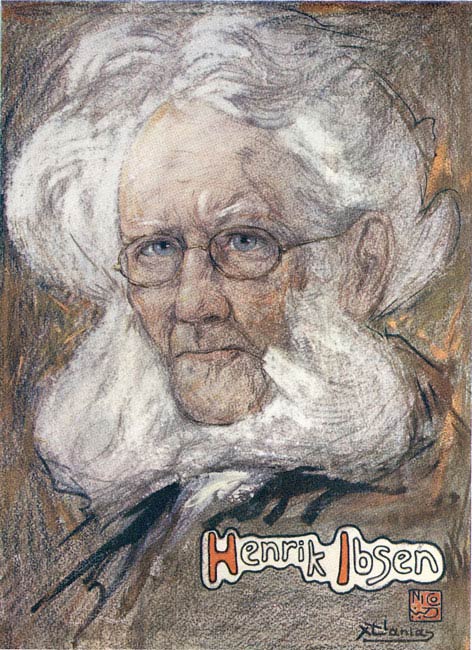
HENRIK IBSEN
Norwegian geography abounds in spots such as these, to which are attached legends; and in no country is the folk-lore more rich and varied. The charming story-teller, Asbjornsen, and his friend Bishop Moe, collected many delightful fairy-tales, mostly traditional, but eked out by their own imaginations. These stories are entrancing, and at the time when they were first given to the public they awoke a romantic tendency in Norwegian literature. They had a great influence on the work of Joseph Welhaven, contemporary with the great Weigeland, who died at this time. Welhaven had been rather overshadowed by his rival, who, for the part he had played in political struggles, was idolised as the people's hero. Also, his work had been too much influenced by the great Germans who were his contemporaries. The charming figures in the fairy-tales of his country gave him inspiration for wonderful romances with the genuine Norwegian ring and subjects taken from national life. Asbjornsen, however, is more than a retailer of folk-lore. He frames his tales in description of the country in which he has found them on the lips of the people, and thus produces vivid pictures of peasant life. The sister of Henrik Weigeland, Camille Collett, during her widowhood burst forth as a literary genius. Apart from her talents as a writer, she was one of the pioneers of the women's movement in Norway, which country has been more influenced by this agitation than any other European State. Immense importance is attached to it; the great geniuses Ibsen and Bjornson show much interest in the moral side of the question; and all Norwegians are very eager to discuss the subject, which is far too large and complicated for myself.
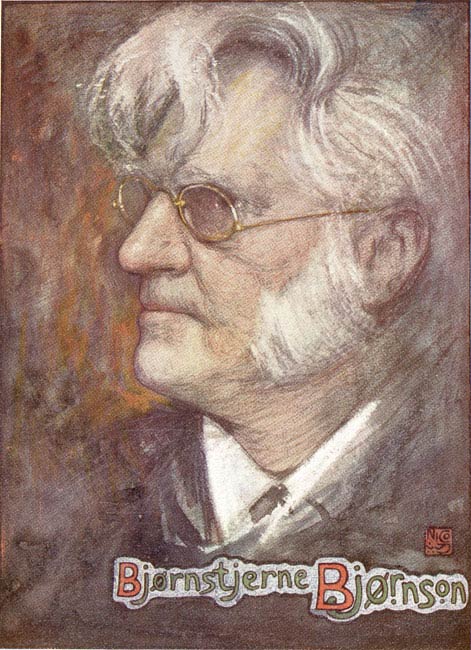
BJORNSTJERNE BJORNSON
Ibsen is best known as a playwright. Indeed, from the time he succeeded in drama all other interests were put aside. The Norwegian Government provided him, at the age of thirty-six, with pecuniary aid to enable him to travel. It was in Rome that he wrote two of his greatest plays, Peer Gynt and Brand. To-day his literary activity has ceased, and all who will may see the great man seated at a window of his flat in Christiania almost any time during the livelong day.
Bjornstjerne Bjornson is still producing. He has written delightful romances; but for the last few years he, like Ibsen, has devoted himself to the stage. It is interesting to note that the splendid National Theatre in Christiania is managed by the writer's eldest son. His plays and those of Ibsen are magnificently acted, and always received with enthusiastic appreciation by the Norwegian public, which gives all its great men a splendid meed of appreciative recognition—how well deserved it is, the whole world will acknowledge. The translated commentary on the Norwegian literature of the last fifty years makes me feel that I would give everything for a knowledge of the language sufficient to let me enter into the treasure-house of untranslated genius.
Many of our modern authors are translated into Norwegian. I noticed that every book-shop window contained caricatures of Mark Twain and translations of his works. Surely there was some particular reason for this celebrity of an American humourist in Norway over and above the excellence of his work, which one would have thought difficult to do justice by in translation?
German books form a large part of the stock-in-trade of the Norwegian bookseller. The German language is very generally known—much more so than either French or English. In this and many other things it is plainly to be seen that there is much good feeling between Germany and Norway.
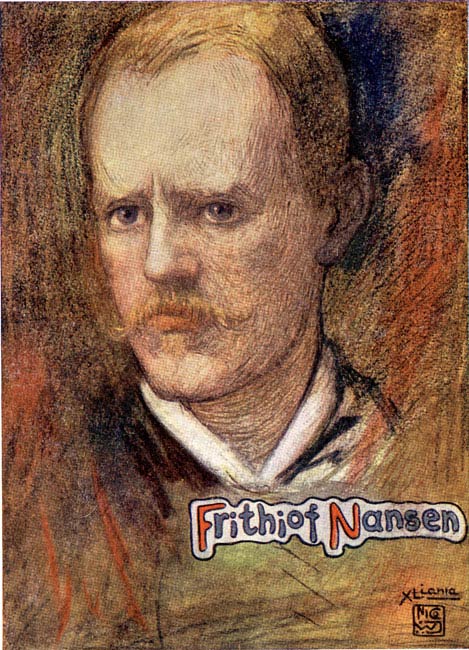
FRIDTJOF NANSEN
Public baths are to be found all over Norway—in some places are still found the badstuer. These are primitive Turkish baths, timber rooms heated with red-hot stones. Water is poured on the stones, and scalding steam is produced. I read in an old book on Norway an account by an American traveller of a visit to such a bath. He appears to have been rather a popular person among the Norwegian peasants, and was invited one Saturday in the depth of winter to assist at the general ablution. He relates with much amusing comment how all the bathers ran from their dwelling-places to the "bath chamber" in what he calls "the costume of Paradise." This in the depth of winter! Determined to do the whole thing properly, he followed their chilly example. At the bath, the whole company sat round the room on a sort of shelf. When they were thoroughly well steamed they wended their way back to their respective houses in the same lack of costume. There was no discrimination of sexes.
The writer speaks in high praise of the simplicity, innocence, and cleanliness of the people. There is in all writings on Norway a unanimity as to their good qualities. For my own part, the points about them that impressed me most were their absolute honesty and the complete absence of servility. While any Norwegian is delighted to show politeness to the stranger, and even to take a good deal of trouble in helping him on his way, all these attentions arise from a supreme feeling of courtesy and rarely from hope of reward. Anyone wishing to have particular information as to a subject concerning the country will be met on all sides with practical offers of assistance. He will find books relating to his subject showered upon him, and kind offers to accompany him and show him practical illustrations. This generous spirit, which has its source in love of the native land, is nowhere more marked than in such an establishment as Bennet's, the Thomas Cook and Sons of Norway. This, one would say, is a strictly commercial affair; yet there is no end to the trouble Bennet or his staff will take to encourage visitors to see as much as possible of their lovely country in a pleasant way, and this without remuneration of any kind.
Writing from Norway in 1820, a visitor says—"There is no country which accords better with my taste than Norway, nor is there any cast of inhabitants or people that I have visited for whom I have more esteem. Here at least are the true haunts of simple natures, and it has been one of the pleasantest passages of my life to dwell among the mountains. The Norwegians are a virtuous race; patriarchal simplicity, uprightness and hospitality, kindness and piety, are their characteristics. They entertain great reverence for their laws. In many other countries the laws are not obeyed on one uniform principle; here, on the contrary, the people respect them from principle."