Front matter (continued 5)
Reading edition
"Aye, indeed, yer reverence, it's what we nayther of us looked for, an' it's a terrible change altogether. I'm wondering what in the world I'll do wid my bits o' things—my little sticks o' furniture, ye know, sir. Biddy Kinsella was up here a little while ago lookin' out for me pot—it's an elegant pot, an' I'm loth to part with it—but she says Bill tould her there's no such thing as a pot to be seen out there. So I'll have to lave it with her. But the bed, Father Taylor, it's the bed that's throublin' me the most. It's a beautiful bed, your reverence."
The priest glanced towards that valuable article of furniture, and responded heartily and admiringly:—
"It is, indeed, a wonderful bed."
"Sure there isn't its like in the place," resumed Mary. "It was me mother's bed, so it was—she looked very well when she was laid out on it," she added thoughtfully. "Very well, indeed, she looked! I always thought that Dan an' meself 'ud be waked in that bed, too. Well, well, the Lord knows best, doesn't he, yer reverence? But I'd think very bad of lettin' that bed out o' this to go anywhere on'y to yer reverence's house."
"Bless me!" cried Father Taylor, unable to restrain a surprised laugh; but he quickly composed his features.
"Aye, indeed, yer reverence, I'd be proud if ye'd let me make ye a present of it," said poor old Mary, trying to straighten her little bent back, and peering at him with anxious eyes. "Sure it's altogether too proud Dan an' meself 'ud be, an' ye wouldn't believe the beautiful nights' rests we do be gettin' out o' that bed."
"I'm quite sure you do," responded the priest warmly; "but upon my word, Mary, do you know I'm afraid the Bishop mightn't like it."
Mrs. Brophy was appalled at the magnitude of the idea. Father Taylor continued in a very solemn voice, but with a twinkle in his eye:—
"You see, Mary, we poor priests are not allowed luxuries, and if his lordship were to arrive unexpectedly and walk into my room and see that grand bed in the corner he might think it very queer."
"Would he now?" said Mary, in awestruck tones.
"You wouldn't like to get me into trouble, Mary, I'm sure," pursued Father Taylor. "The Bishop might think I was getting beyond myself altogether."
Mrs. Brophy heaved a deep sigh; she was depressed, but magnanimous. It would ill become her, she observed, to be gettin' his reverence into trouble, and who'd think his lordship was that wicked? Holy man! She would say no more; and Father Taylor was devoutly thankful for her forbearance. He would have done anything rather than hurt her feelings, but the mere sight of that ancient, venerable, and much-begrimed four-poster made him shudder; while he scarcely ventured to contemplate the attitude likely to be assumed by his housekeeper—of whom he stood in some little awe—if the question were mooted of adding this piece of furniture to her well-polished and carefully-dusted stock.
Wishing to change the subject, he remarked that Mary's beautiful cup of tea had been scarcely tasted. "Why, I thought every drop was precious," he added, laughing; "but I suppose you will not be counting the grains now as you used to do."
"I don't seem to fancy it this mornin' the way I used to do sometimes," responded Mrs. Brophy plaintively.
"Ah," said the priest, half-sadly, "you will have plenty of everything over there, Mary, but I doubt if you will relish anything as much as what you and Dan used to buy out of the price of your chickens. Nothing is so sweet as what we earn for ourselves, woman dear. I fancy the potatoes grown in your little bit of ground, and boiled in your own black pot, taste sweeter, somehow, than all the fine dinners that Mrs. Larry will be giving you."
"Thrue for ye, yer reverence," put in Dan, suddenly appearing in the doorway. "'Pon me word, I wish that ould letther an' all that was in it had stopped where it was, before it came upsettin' us that way. I'd sooner stop where I am, so I would—I would so—there now ye have it!" turning defiantly to his wife. "Sure it'll be the death of the two of us lavin' the ould place, an' thravellin' off across the say among strangers. An' what good will it do us, as I do be sayin' to herself here, for Larry to be puttin' up a monyement for us over beyant there, where there's ne'er a one at all that knows us?"
"To be sure, I was forgetting the monument," said Father Taylor, laughing again. "I was to have the choosing of it, too, wasn't I? Let me look at the letter again, Mary. Yes, here it is. 'The reverend gentleman, whoever he is, that's parish priest in Clonkeen now'—It's the very same reverend gentleman that used to give Master Larry many a good box on the ear long ago when he was a little rascally lad; but I suppose he thought I was dead and buried by this time—he wants to have us all underground. Well, well, it's a pity I'm not to have the choosing of that monument—I'd have picked out the finest that money could buy."
He intended this as a joke, and Dan and Mary uttered a somewhat melancholy, but complimentary laugh; then they looked at each other wistfully, as though regretting that they were not in a position to enable their pastor to gratify his artistic tastes.
Dan presently confided his troubles and difficulties anent the changing of the order, and was desired by the priest to call in the afternoon, when he would himself go with him to the post-office. Then Father Taylor withdrew, feeling a little sad at the thought of losing two such old parishioners, and a little impatient with the over-affectionate nephew, who had so late in the day insisted on their uprootal.
"How much more sensible it would have been," he said to himself, "how much more truly kind, if Larry, instead of transplanting the poor old couple in their old age, had sent them a small sum of money every month to enable them to end their days in comfort at home." But there was apparently nothing for it now but to take what steps he could to help them over the difficulties of their flitting.
About five o'clock Dan duly made his appearance, wearing a much more jubilant aspect than when his pastor had taken leave of him. With a comical and somewhat sheepish grin he produced the "ordher" in a crumpled condition from his tattered pocket, and handed it over to the priest, remarking, as he did so, that "it was a quare thing to think what a power o' money did be in a little or'nary thing like that."
"Yes, indeed," said Father Taylor, with a sigh, "that little bit of paper will carry you and Mary all the way over the sea, and across a State as big as Ireland."
"Would it now?" inquired Dan, eyeing it curiously. "Well now, to tell you the truth, yer reverence, herself an' me has been havin' a bit of a chat. She thinks bad, the cratur', of lavin' the bed, an' the ould pot, an' all our little sticks o' things behind, ye know, sir, an' I do be thinkin' I'd never get my health at all out of ould Ireland; an' any way the two of us is too ould to be thravellin' off that way. An' so herself says to me—she says:—'Dan,' says she, 'I think the best way would be for ye to step down to his reverence's,' says she, 'an' give him the ordher,' she says, 'an' ax him,' says she, 'if he'll just write a line to poor Larry, an' let him know that we haven't the heart nor the strength to be lavin' our own little place. An' bid him,' says she, "ax Larry if it 'ud be all the same to him if his reverence was to keep the money for us agin we want it.'"
"To be sure, to be sure," cried Father Taylor, delighted. "You show your good sense, Dan, and so does Mary. I'll just go with you now, and change the order; and I'll let Larry know that I'll keep the money for you, and pay it out little by little as long as it lasts."
"Not at all, not at all," interrupted Dan, hastily and indignantly. "Bedad, it isn't that we want yer reverence to do for us. Sure the raison I'm afther givin' ye the ordher is for you to keep it safe, the way we'll have it for the monyement."
"THE SPIDER AND THE GOUT"
Old Pat Clancy lived in a small cabin immediately beneath the Rock of Donoughmor, and looked upon the ruined castle on the top as his especial property, the legends concerning them being treasured by him as jealously as though they were traditions of his own ancestors. A proud man was Pat when piloting the occasional strangers who wished to inspect the keep up the steep and slippery path which led to the ancient portcullis, and conducting them thence to the banqueting-hall, sparing the luckless pilgrim, in fact, no corner of the edifice or its surroundings, and pausing only on the mossy slope to the rear, where, his charge having duly admired "the view over three counties," he would proudly point out the precise spots where Fin-ma-coul had "wrastled" with and overthrown another "monsthrous joynt" of name unknown, the traces of the encounter being yet visible in the short turf.
"Ne'er a blade o' grass at all 'ud grow on them," Pat would cry, pointing triumphantly to the irregular hollows in the soil supposed to be the traces of the giant's mighty feet. These, by the way, occasionally varied oddly in extent; during the summertime, when most visitors were to be expected, being noticeably large, and much deeper than at other seasons.
Poor Pat's devotion to his beloved ruins was the cause of his undoing. One spring morning, when a late frost had made the grass unusually slippery, just as he was expounding to an interested audience how the Danes used to shoot "arrers through them little slits of windies in the wall beyant," his foot slipped, and after rolling for a little distance down the steep incline, he went over the precipitous side of the crag, and fell some twenty feet on to the stones below. Many bones were broken, and as surgical aid was difficult to obtain, and but of poor quality when at last secured, most of them were badly set, and the poor old fellow remained to the end of his days a cripple. How he and his wife and their last remaining child, a son born to them when Pat was already old, managed thenceforth to eke out a living would have been a marvel to their neighbours, if similar problems of existence had not been so common in the countryside. There was the pig, of course, and a few chickens, and "herself" did a day's work now and then in the fields, and escorted the visitors over the ruins, well primed and prompted by Patrick as to the "laygends and tragedies" (traditions) of those sacred precincts; and little Mike minded the sheep, and frightened crows and picked turnips for their landlord, "ould Pether Rorke beyant at Monavoe," but "Goodness knows," as the neighbours would say, shaking their heads at each other, "it was not much of a livin' the poor child 'ud make out of him—the ould villain! Didn't he let his own flesh and blood go cold and hungry—'twasn't to be expected he'd do more nor he could help for a stranger. Aye indeed, he was a great ould villain! To think of him with lashin's and lavin's of everything an' money untold laid by, an' his only son's widdy livin' down there with a half-witted lodger in a little black hole of a place that was not fit for a pig, let alone a Christian, an' the beautiful little cratur', his grandchild, Roseen, runnin' about barefut, with her dotey little hands an' feet black an' blue wid the cowld—sure what sort of a heart had the man at all?"
Old Pat was sitting alone one summer's afternoon, "herself" having gone up to Donoughmor with some Quality, and Mike not having yet returned from work, when little Roseen Rorke poked her sunny face in at the door.
"Is that yourself?" said Pat pleasantly. He was fond of the child, as was every one in the neighbourhood, and being a fellow-sufferer from the hard-heartedness of her grandfather, who was, as has been said, his landlord, was perhaps the most violent of her champions.
Roseen's blue eyes, peering through her tangled sheaf of golden-brown curls, took a hasty and discontented survey of the small kitchen.
"Isn't Mike here?" she inquired.
"He's not, asthore, an' won't be home this hour most likely; but come in out o' the scorching sun, an' sit down on the little creepy stool. Herself will be in in a few minutes, an' maybe she'll give ye a bit o' griddle cake."
Roseen unfastened the half-door and came in, her little bare brown feet making no sound on the mud floor. She was a pretty child for all her sunburnt face and scanty unkempt attire. Poor Widow Rorke has long ceased to take pride in the fact that her husband had been the son of the richest farmer in all the countryside, and did not care to keep up appearances, all her energies being devoted to the struggle for daily bread; nevertheless, the short red flannel frock was as becoming to Roseen as any more elegant garment could have been, and when she approached the hearth and sat down on the three-legged stool by Pat's side, he breathed a blessing on her pretty face that was as admiring as it was fervent.
Crossing one shapely sunburnt leg over the other, and gazing pensively at the smouldering turf sods, she heaved a deep sigh.
"They're afther goin' out an' lavin' me," she lamented.
"Did they, asthore? Sure they had a right to have taken ye along wid them. Where are they gone to at all, alanna?"
"Me mother's after goin' to the town to buy a bit o' bread, an' Judy's streeled off with herself, goodness knows where, wid her ould pipe in her pocket. Dear knows when she'll be back; an' she bid me stop at home an' mind the fire, but I come away out o' that as soon as her back was turned."
The bright eyes glanced defiantly at the old man and then suddenly clouded over; the corners of the little mouth began to droop, and the small bare shoulders to heave.
"They'd no call to go lavin' me all by meself."
"Troth they hadn't, mavourneen," agreed Pat, clackling his tongue sympathetically. "It was too hard on ye, altogether, but sure you won't cry now, there's a good little girl; crying never done any one a ha'porth o' good yit. Look at me here wid all my ould bones broke; I might cry the two eyes out o' my head an' never a wan at all ud' get mended for me."
Roseen sat up blinking. "Did it hurt ye much, Misther Clancy, when your bones was broke on ye?"
"Is it hurt, bedad! Ye'd hear me bawlin' up at the crass roads. Sure I thought it was killed I was! My ancistor couldn't have shouted louder when he had the Earl Strongbow's spear stuck in him. Will I tell ye about that, alanna, to pass the time till herself comes in?"
Roseen shook her head discontentedly.
"I know that story," she said. "I wisht ye'd tell me about the Spider an' the Gout though, Misther Clancy. Ah do, an' I'll sit here listenin' as quiet as a mouse."
Pat rubbed his unshaven chin with the lean fingers of his one serviceable hand, the bristles of his week-old beard making a rasping sound the while, and glanced down sideways at the eager little petitioner.
"Is it the Spider an' the Gout?" he said, knitting his brows with affected reluctance. "Sure I am sick an' tired tellin' ye that. No, but I'll tell ye 'The little man and the little woman that lived in the vinegar bottle.' ... Wanst upon a time, there was a weeshy-dawshy little man—'"
"Ah no, Misther Clancy, I don't care for that," interrupted Roseen, jumping up and clapping her hands to her ears. "It's a horrible ould story. They'd have been drownded," she added seriously.
Pat chuckled. "Well, sit down, an' don't offer to say a word unless you hear me goin' out. Sure maybe I disremember it altogether."
Roseen sat down obediently and fixed her eyes on the old man's face.
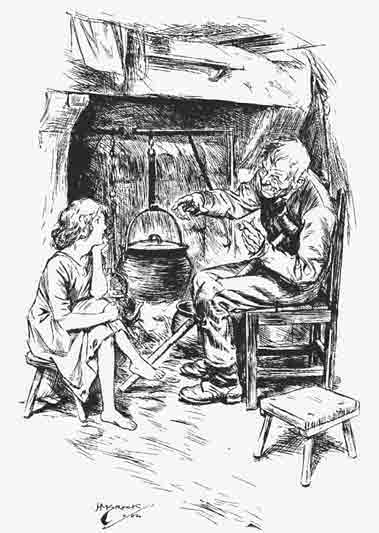
"Wanst upon a time," began Dan
"Wanst upon a time," began Dan, with a twinkle in his eye, "the pigs were swine." Roseen gave an impatient wriggle. "Well, well, it's too bad to be tormentin' ye that way. I'll begin right now.—Well, very well then. There was wan time the Spider an' the Gout was thravellin' together, goin' to seek their fortun's. Well, they come to the crass roads. 'Lookit here,' says the Spider, 'it's time for you an' me to be partin' company,' says he; 'I'm goin' up along here to the right,' says he, 'to that great big house on the hill. A very rich man lives there,' says he, 'an' I think the quarthers 'ull suit me. You can go down that little boreen to the left,' he says; 'there's a little cabin there that belongs to some poor fellow or other. The door is cracked,' says the Spider, 'and the windy is broke. Ye can slip in aisy,' he says, 'an' creep into the poor fellow's toe before he knows where he is.'—'Is that so?' says the Gout. 'Oh, that indeed!' says he; 'it'll suit me very well,' says he, 'if that's the way it is. An' I'll tell you what we'll do,' says the Gout, 'you an' me'll meet here this time to-morrow night an' tell each other how we're gettin' on,' says he."
Pat paused, rubbing his knotted fingers up and down the ragged knees of his corduroys. Roseen heaved a deep sigh, and folded one dimpled hand over the other, her eyes meanwhile fixed unwinkingly on the face of the narrator. The interest of the tale was now growing absorbing.
"Well, the Spider went off wid himself up to the rich man's house, an' what do ye think the poor fellow found when he got there?"
Roseen was perfectly aware of the state of affairs which the Spider discovered, knowing as she did every word of the story by heart, but deemed it her duty to shake her head slightly and raise her eyebrows in a manner which denoted that she was absolutely at fault.
"Well," pursued Pat, "every door in the whole place was shut up, an' every windy was bolted an' barred, an' though the poor Spider ran this way an' that way, an' round the house an' round the house, not a hole nor a crack could he find; an' there he had to stop outside in the wind an' the rain."
Roseen's face betokened extreme compassion for the Spider. Pat went on, drawing in his breath with a sucking sound.
"Well then, very well then; next mornin' the sarvants was sweepin' and clanin' an' dustin', here an' there an' everywhere, the way they do in the houses of Quality. One o' them left the hall door open an' in creeps the little Spider, an' away wid him acrass the hall, an' never stops till he gets to the great big parlour. Up the wall wid him then as fast as he could leg it, an' there if he doesn't go and make his web in a corner of a great big gould pictur' frame. Well, there he sat, the poor fellow, but ne'er a fly at all come next or nigh him, an' by-an'-by in walks the housemaid wid her great big broom, an' if she didn't—"
"You are afther forgettin'!" interrupted Roseen, quickly seizing the opportunity of using her tongue, and proceeding with as close an imitation of Pat's manner as she could muster. "In walks the housemaid. 'Och,' says she, 'what brings you here at all, ye dirty little spalpeen!'"
"To be sure," said Pat, "I was near forgettin' that altogether. 'Och,' says she (in shrill tones of horror supposed to proceed from the startled housemaid), 'what brings you here at all, ye dirty little spalpeen? You infarnal little sckamer,' says she."
Roseen gave a delighted little cackle, this being an addition on Pat's part and charming her by its vigour and originality.
"'You infarnal little sckamer, what brings you here at all?' And she whips out her duster an' hot the poor Spider such a crack that his web was destroyed on him altogether, an' it was on'y by the greatest good luck he was able to creep out of her way behind the corner of the frame, or she'd have had him killed as well. Well, the poor fellow, there he sat the whole livelong day, niver so much as offerin' to spin another web; an' sure if he had it 'ud have been no use, for there wasn't the sign of a fly at all. When evenin' come the masther of the house had company, an' there was atin' an' drinkin' an' the best of everything but the poor little Spider was lookin' on, very near perishin' wid hunger an' fright. Well, at the long and the last, when he thought there was nobody lookin', he crept down the wall an' folleyed wan o' the sarvants out o' the room, an' by good luck, the hall door was open, so the poor fellow made off wid himself as fast as he could. Down the road wid him till he come to where the Gout was sittin' waitin' for him at the crass roads. 'Is that yourself?' says the Spider. 'How did you get on?' says he. 'Och,' says the poor Gout"—and here Pat assumed a tone of extreme weakness and exhaustion—"'it's near killed I am altogether; I never put in such a time in me life.' 'Well, for that matther,' says the Spider, 'I might say the same; but what happened to ye at all? Tell me all about it in the name of goodness,' says he.
"'Well,' says the Gout, 'I went off down the boreen the same as ye told me, an' I come to the little cabin beyant; the door was open an' in I walked, but o—o—oh! Wh—o—o—oh!' (Pat indulged in a prolonged shiver, while Roseen chuckled and clapped her hands.) 'The cowld of that place was near bein' the death o' me! Sure the wind blew into it,' says he, 'an' the rain was comin' through the roof, an' there wasn't as much fire on the hearth as 'ud warm a fly itself. Well, the poor man come in afther a bit,' says the Gout, 'an' I slipped in through a crack in his owld wore-out brogue, an' into his toe. "Och, Mary," says the poor man to his wife, "I have a terrible bad pain in me toe! What'll I do in the world?" says he; "I'll never be able to stir a fut to-morrow." "Whisht, sure it's maybe a bit of a cramp ye've got. Wait a bit," she says, "an' I'll fetch ye a sup o' the wather I'm afther bilin' the pitaties in, maybe that'll do ye good," she says. 'Well,' says the Gout, 'if the fellow didn't go an' put his fut, an' me in it, into an owld rusty bucket full of pitaty-wather! I thought he'd have destroyed me altogether. An' such a night as I passed, wid scarcely a blanket at all on the bed! An' nothin' 'ud sarve the man but to get up before light, an' go thrampin' off through the mud an' rain till I was nearly perished. There he was draggin' me up an' down at the tail of a plough, wid the wet soakin' in through the holes in his brogues, till I couldn't stand it any more, an' I come away wid meself, an' I've been waitin' for ye this two hours.' 'Ho then, indeed,' says the Spider, 'I'd have been glad enough to be out of it before this; I never was so put about in me life as I was up there,' says he. 'Sure they had all their windies shut up,' says he, 'and the doors too, an' ne'er a sign of a fly at all in it when I did get in,' he says; 'an' the whole place that clane, an' sarvants running about, till I couldn't so much as find a corner to spin my web,' says he. 'Och, dear,' says the Gout, 'that's a poor case entirely; what sort of a place was it at all, an' what were they doin' in it?'
"'Ah, 'twas a great big place—altogether too big for my taste; an' they had roarin' fires in the grates. I was near killed wid the hate.'
"'That indeed!' says the Gout, pricking up his ears." Roseen listened solemnly, not in the least astonished to be told that the personage in question was possessed of ears; she supposed "a Gout" to be a living thing, an insect probably, of a more noxious kind than a spider.
"'Fires!' says the Gout; 'an' was they atin' an' drinkin' at all?' says he.
"'Atin' an' drinkin'!' says the Spider. 'Bedad, they're afther spendin' hours at it, an' were in the thick of it when I come away. If ye were to see the j'ints that was in it, ye wouldn't believe your own eyes; an' chickens an' turkeys,' he says, 'was nothin' at all to them, and they was swalleyin' down pigeons an' partridges an' them sorts o' little birds, the same as if they wasn't worth counting.'
"'Oh, oh!' says the Gout, smacking his lips, 'an' did ye chanst to see any dhrinkin' at all?' 'Goodness gracious!' says the Spider, 'sure there was rivers of wine goin' down every man's throat!'
"'That'll do,' says the Gout. 'I'll bid ye good evening,' he says, 'an' I'll be off wid meself up there; an' I'll tell ye what,' says he, 'I'll be in no hurry to lave it!' he says, winking acrass at the other, 'an' you thry the cabin,' he says, lookin' back over his shoulder; 'maybe it'll suit ye betther nor me.' Well, the poor Spider ran off as fast as he could, an' when he come to the poor man's housheen, in he walked, widout a bit o' throuble at all, an' sure there was plenty of flies there waitin' for him. They used to come buzzing in an' out through the broken windies all day long.
"'Och, bedad! I am in luck,' says the Spider to himself, 'if on'y the ould woman 'ull let me stop in it an' not be thryin' to desthroy me wid her duster, the way the girl up beyant at the Coort did.' But sure, the poor ould woman had other things to be thinkin' of nor to be goin' afther Spiders. She left him alone in peace an' comfort, an' the poor fellow thought he was in heaven, afther all he had to put up wid at the other place. Well, there he lived till he died, an' he got so fat wid all the flies he was afther killin' that it was an apple-complex that carried him off at the end!
"Well, Misther Gout went marching up the hill at a fine rate, an' when he come to the rich man's house, who should he see, by the greatest good luck, but the masther himself, standin' on the steps o' the hall door, sayin' good-bye to the company. He lay quiet till the last of the illigant carr'ages had drove off, an' the master stepped inside again.
"'I think I'll have a smoke,' says he—here Pat assumed an aristocratic air and spoke in refined and mincing tones—'before I go to bed. William,' says he to one of the futmen, 'bring me me slippers.' Well, the gentleman sat down in a grand soft armchair, an' the futman brought his slippers—an' if the Gout didn't take the opportunity an' pop into his big toe!"
Roseen jumped up from her stool with a chuckle of anticipation. Pat proceeded to give utterance to a series of hollow and extraordinary groans, and to writhe in a manner intended to convey the extreme agony of the rich man. Roseen fairly danced about, imitating Pat's moanings to the best of her ability. "Ou-ou-ou-ough! Ugh!" "'By this an' by that,' says the gentleman, 'tare an' ages!' says he, 'thunder an' turf!' he says, 'what in the world is the matter wid me big toe?'
"Well, the misthress comes runnin' down in a great state. 'My dear,' she says (here Pat affected an extremely Englified falsetto), 'I am afeard you are very sick,' says she; 'ye'd best have a sup of port wine,' says she.
"'Ou-ou-ough!' says the masther, 'maybe it would do me good. Fetch it there, quick,' he says to the sarvants, 'or I'll be the death o' some of yez!'
"Well, they brought him port wine, an' they brought him whisky, an' they brought a beautiful velvet cushion an' put it under the gentleman's fut; an' the Gout winks to himself, an' says he, 'Troth, I'll not be in a hurry to quit out o' this. Sure it's in clover altogether I am,' he says.
"Well, there ye have the story now, alanna, an' here's herself comin' down the hill an' Mike afther her."
But Roseen was too much excited to heed the last announcement. "Was it this way, the way the rich man was groanin'?" she asked, once more imitating Pat's extraordinary utterances. The old man nodded, and Roseen stood still meditatively scratching one little brown leg with the curved-in toes of the other. "I wisht," she observed presently, in a pensive tone, "that a Gout 'ud get into me gran'father's big toe; it 'ud sarve him right!"
Pat was rubbing his hands and chuckling to himself over this remark when his wife entered, hot and weary after her peregrinations over the ruins.
"Sixpence is all they're afther givin' me," she observed plaintively. "Dear knows, it's hard set we are to live these times at all."
"Is it sixpence, woman alive!" cried Pat; "I wonder they had the face to offer it to ye. Well, well, I was looking for a shillin' now, or maybe two. Here, cut the child a bit o' griddle cake; she's been keepin' me company this long while, haven't ye, Roseen? An' it's starvin' she is out-an'-out."
"Come here, alanna," said Mrs. Clancy, taking down the flat loaf from the shelf in the corner; "wait till I put a pinch o' sugar on it. I'm sorry I haven't butther for ye, but there isn't a bit in the house at all. There now."
"Thank you, ma'am," said Roseen, extending an eager hand.
"Ye're welcome, darlint. Here, Mike, ye'd like a bit too, wouldn't ye?"
"Aye," said Mike, drawing near likewise.
He was a sturdy little fellow of about eleven, with an open sunburnt face, hair bleached almost lint-white by the sun, and twinkling blue eyes like his father's. The mother passed her thin knotted hand lovingly over his tangled head and smilingly bade him "be off out o' that with Roseen."
The two little figures darted out in the sunlight, and soon were to be seen bounding like deer up the steep golden-green slope that led to the "Rock."
"What do ye think the little one there is afther sayin' to me?" asked Pat, shading his eyes with his hand as he peered after them. "'I wisht,' says she, 'a Gout 'ud get into me gran'father's fut,' says she; 'it 'ud sarve him right,' she says. I was afther tellin' her the 'Story of the Spider an' the Gout,' ye know."
"Did she now?" cried Mrs. Clancy, sinking down on the stool which Roseen had vacated and clapping her hands together. "Well now, that bates all! But she's the 'cutest little thing—I never seen her aiqual."
"'I wisht,' quoted Dan meditatively, 'a Gout 'ud get into me gran'father's big toe an' stay there,' says she. Ha, ha; bedad I wisht it would too, the ould naygur."
Meanwhile the children pattered up the hill and spoke no word until they reached the summit. Sitting down under the great portcullis, they munched their bread and sugar amicably together, Mike's eyes pensively gazing in front of him the while, and Roseen's roving hither and thither with quick, eager glances. Suddenly she tilted her head backward, gazing at a narrow horizontal slit in the masonry high over their heads. "That's where they used to throw the bilin' lead down in ould ancient times when anybody wanted to come fightin' them."
Mike gazed upwards likewise, still slowly munching, but said nothing.
"When you an' me grows up an' gets married to each other, the way we always said we would," pursued Roseen, "this 'ud be a gran' place to live."
Mike's face brightened, and he nodded enthusiastically. "It would so," he agreed.
"There's lots o' beau'ful rooms that we could live in," resumed Roseen, "an' we'd make a fire in that great big enormous stone hearth beyant, an' we'd ate off o' that big stone table, an' when anybody 'ud offer to come annoyin' us, we'd just melt a bit o' lead an' throw it down on them."
Mike looked astonished and perturbed. "Sure it 'ud burn the flesh off o' their bones. I wouldn't like to be doin' that, Roseen."
"If they was rale bad people," said Roseen persuasively; "rale wicked, crule people, the same as me gran'father beyant, it 'ud sarve them right,—or we might throw down a sup of bilin' wather," she added as a concession.
Mike appeared unconvinced.
"I don't think ye have a right to be talkin' that way of your gran'father," he said reprovingly; "an' he isn't that bad. He never offered to lay a finger on me as long as I am in it, barring the time I let the sheep into the hay-field."
"He's a crule ould villain!" returned Roseen conclusively. "Look at all he done on me mother. Come on now," with a sudden change of tone, "whistle a tune an' we'll have a dance."
Mike looked lovingly at the last fragments of his griddle cake, the enjoyment of which he had been anxious to prolong as much as possible, and then after a little sigh, crammed them into his mouth and led the way to the giant's wrestling ground.
"Wait a bit," he cried, as Roseen took hold of the folds of her ragged skirt daintily in the finger and thumb of each hand, and looked expectantly towards him, "I'm just goin' to thramp a bit in the joynt's steps."
"What are ye doin' that for at all?" asked Roseen, knitting her brows.
"Sure me father bid me never go past this way widout stampin' them down a bit to keep them from gettin' smaller," answered Mike, hammering diligently with his bare heel at the corners of the "futprints" of the mighty Fin-ma-coul.
The operation at last concluded, he rejoined the little girl on a small grassy plateau surrounded by low growing Irish gorse. The heather, mingling with these furze bushes, was just beginning to bloom, and here and there a tall foxglove towered above the undulating irregular mass of purple and gold. Taking her place in the centre of her ball-room, Roseen again looped up her skirt and pointed her shapely little foot. Mike began to whistle a jig tune, his sturdy brown legs twinkling the while in time to the measure. Now and then his piping grew faint, and was interrupted by gasps for breath, whereupon Roseen, still vigorously footing it, would take up the tune after a fashion of her own, her voice imitating as nearly as might be the sound of a fiddle. Overhead a lark was soaring, and his trill, wafted down to them, mingled with their quaint human music; far away over that brown and purple stretch of bog the plovers were circling, their faint melancholy call sounding every now and then. The sun would soon set, the air was already turning a little chilly, and the dew was falling. The shadow of the ruined tower fell obliquely across the golden-green carpet of their ball-room; but the children danced on, Roseen's curls shaken into a light feathery nimbus round her brow, a beautiful colour in her cheeks, and her little white teeth parted in a smile of delight; while Mike pranced and capered, as though old Peter's stick had never fallen about his shoulders, and there were no holes in the roof at home.
ROSEEN
Peter Rorke stood on the threshold of Monavoe, his big comfortable house, looking round him with the proud air of the proprietor. It is commonly said that the Devil is not so black as he is painted, and in the case of Peter Rorke the proverb would seem to be justified. In appearance and manner there was nothing about the man to bear out his evil reputation. A close observer would indeed detect, in his long narrow face, and particularly in the neighbourhood of his rather small closely-set eyes, certain lines and wrinkles which conveyed an impression of meanness—the one sin which, as some one very truly observes, is apparently found least possible to forgive, particularly, one might add, by Irish folk. But, on the whole, Peter Rorke was not an ill-looking old fellow, and now as he stood basking in the autumn sunlight, while his eyes wandered from one to the other of his possessions, his face wore quite a pleasant expression. In truth, it would have been difficult, even for the most humble of mortals, not to feel a certain exhilaration on gazing at the evidences of prosperity at Monavoe. The house, to begin with, was solid and comfortable, the barns and granaries were full to overflowing; yonder were stables for the six fine cart-horses now toiling at various corners of Peter's domain; adjoining them the cow-houses, where Peter could not only accommodate twelve milch-cows, but fatten in the winter an equal number of "stall-feds"; in the "haggard" to the rear were the innumerable golden stacks and hay-ricks which were, of all his possessions, those most valued by the Master of Monavoe. No one in the country was so clever in selecting time and weather for cutting and carting; no one so cunning in ascertaining the most opportune moments for selling, or so far-seeing with regard to prices. At this very moment Peter Rorke was gazing at an immense rick of "prime old hay" which he had had the prudence to keep back while all his neighbours were selling. His wisdom now appeared; there had been an unexpected failure in the hay crop that season, the prices had gone up accordingly, and Peter looked forward to receiving more than double the sum that his produce was actually worth.
Rousing himself at length from what, to one of his temperament, had been a reverie of long duration, he turned round and called loudly to some one whom he supposed to be within: "Rose, Rose! Are ye there, girl?"
There was no answer, and after a moment's pause he called again impatiently. A very old woman with a white sun-bonnet tilted over her brow came slowly from the back premises. "Where is my granddaughter, Judy?" he asked, with a frown. Judy was no favourite of his.
"She isn't here at all," she observed; and then jerking her thumb over her shoulder in the direction of some outhouses, "she went acrass to the dairy a while ago."
Peter Rorke grunted, and, without another glance at the old woman, began to walk at a rapid pace in the direction she had indicated. As he drew near the partly open door of the dairy, the sound of a girl's voice could be heard merrily lilting a tune; and when Peter entered the owner of the voice turned round, abruptly ceasing her song and gazing at him with a startled look. This was Roseen, a tall and comely lassie of seventeen, in whose pretty, saucy face, however, and clear blue eyes, there still remained much of the child. Her mother had died when she was about fifteen, and, to the astonishment of every one who knew him, Peter Rorke had announced his intention of adopting his grandchild. He had never had any objections to the girl herself, he declared loftily; she was well enough in every way, and his own son's child; he could never put up with the mother, it was true—a common little servant girl that his son had no right to have been speaking to, much less to be goin' an' gettin' married to. Peter would never bring himself to recognise him at all after he had demeaned himself that way, and as long as the wife lived he couldn't be expected to take any notice of the child; but now that she was dead an' gone to her own place, wherever that might be, he wasn't goin' to let his granddaughter go out to sarvice. She was Miss Rorke, and her place was at Monavoe, where all the Rorkes had lived and died for more generations than any one cared to count.
When, however, he had, with a good deal of pompous benevolence, driven up on his outside-car to fetch Miss Rorke from the tumbled-down cabin which had been hitherto the only home she had known, that young lady, instead of being properly grateful, and impressed by her relative's condescension, had displayed a spirit of independence, and indeed stubbornness, which the worthy old gentleman found as bewildering as mortifying. He had never taken any notice of them before, she had averred; he had let her father starve, and her mother work herself to death. Roseen was not going to be beholden to him now—she'd earn her own bread, so she would, an' if he thought shame of his grandchild goin' to sarvice, she was glad of it, so she was, an' she'd make sure an' tell every one the way he was afther thratin' them. Peter had rubbed his lantern-jaw and glanced askance at the determined little maiden who stood facing him, her blue eyes flashing through her tears, and every line of face and figure betokening resolution. First, he had been puzzled, then angry, finally he had had recourse to entreaty, feeling in his heart that he could never look the neighbours in the face again if the story got about that this chit had "got the better of him that way." At length Roseen had suffered herself to be softened, and agreed, after much persuasion, to a compromise. She would condescend to take up her abode under her grandfather's roof on the condition that Judy came too. Judy was one of these appendages so frequently to be seen in Irish cabins, there being, apparently, scarcely any householder so poor that he or she cannot afford to shelter some one poorer still. While there is a roof over their heads, a potato to put into their mouths, the Irish peasants will share with one another. Ever since Roseen could remember, Judy had been an inmate of their home; she had helped in the small household labours, tended Mrs. Rorke after her own fashion when she had been sick, scolded and adored Roseen from babyhood to youth. There was not much else poor Judy could do, except smoke her pipe when, by some lucky chance, a "bit o' baccy" came in her way: she was not only old and lame, but half-witted, very nearly "innocent." What Peter's feelings had been may be guessed when invited to receive this strange-looking old creature into his house; but Roseen had been firm, and he had finally consented.
Whether there had been some dormant family affection in that withered heart of his, which had sprung to life now that poor Mrs. Rorke no longer stood between him and his own flesh and blood, or whether the girl's obstinacy had aroused in him a corresponding desire to carry his point, or whether, as some of the neighbours ill-naturedly said, he thought if the fine little colleen was to go to sarvice at all, she might as well come to him for no wages as to be airnin' from somebody else, remains a mystery; but it is certain that in spite of the unpleasant condition imposed by Roseen, Peter felt a curious glow of pride and pleasure when he assisted Roseen to alight at the door of Monavoe. Since then he had certainly grown fond of her, and was moreover proud of her good looks and winsome ways. He had sent her to a boarding-school, a grand convent establishment for young ladies, where the good nuns had done their best to impart to her all that was deemed essential for Mr. Rorke's granddaughter to learn. Roseen knew already how to read, and could write after a fashion of her own; she now learnt arithmetic, and could, indeed, keep her butter accounts by dint of much counting on slim sunburnt fingers and puckering of her pretty white forehead; but alas! all attempts to attain more elegant accomplishments remained fruitless—Roseen was a thorough little dunce. Much to the relief of all parties, she returned to Monavoe at the end of twelve months, and thereupon devoted her energies to the more homely acquirements in which she had since become an adept. She could do anything with those deft fingers of hers: her butter was proverbial, her bread excellent, she could trim a hat and hem a duster with equal speed and nicety, and as for clear-starching and getting up fine things, she was the wonder of the rustic matrons for ten miles round.
Roseen had been making butter when her grandfather entered, and, turning round, displayed a face rosy with her exertions, and arms bare to the elbow.
"So here ye are," remarked Peter, his grim face relaxing as much as was possible to it; "I've been lookin' for ye everywhere. Do ye know what I am after doin' for you this fine mornin'?"
"What?" asked Roseen, a little apprehensively, while the colour deepened in her cheeks. Peter leaned against the long stone shelf that ran round the dairy wall, and smiled before replying: "I am after makin' the finest match for you that's to be had in all the country side."
The flush mounted to Roseen's very temples and then died away; she paused a moment to steady her voice before venturing on a query. "I seen Mr. Quinn goin' down the road a little while ago—is it him?"
"Ah, you little rogue! you were on the lookout, were ye?" cried Peter jocosely. "Well, you are right; it is him. You are the rale lucky girl, Roseen! You'll be the richest woman in the town-land."
Roseen glanced down, apparently wrestling with some inward emotion, and presently observed in a small, strangled voice: "Sure, he is twenty year older nor me."
"What matter?" said Peter; "he'll be all the better able to take care o' you. It's better to marry a man with sense, nor to go takin' up with some young whipper-snapper that would be thinkin' of nothin' but spendin' money and carryin' on with nonsense."
"He's an ould widower," cried Roseen, wrinkling up her little nose with an expression of disgust.
"Well," said Peter, "an' a good thing too; you'll come in for all the beautiful dresses and jewels and things the first Mrs. Quinn left behind."
"I am not goin' to take her lavin's, then," retorted Roseen with spirit. "Neither her jew'lry, her dresses, nor her husband will I have, so there! That's my answer, an' you may tell him so. He may go make up his match with somebody else for me." With a whisk of her skirts and a stamp of her foot, she returned to her butter.
"Come, come!" said Peter, knitting his brows. "Come, come, come!" he repeated, in warning tones; "this won't do, miss."
Roseen tossed her head, and gave her roll of butter two or three little pats.
"If I bid you take Mr. Quinn, you'll have to take him," said Peter angrily.
"I won't, then," retorted Roseen, and she finished off one little roll and fell to preparing another.
"You owe everything in this wide world to me, I would have you remember," cried Peter, stammering in his wrath; "if I was to turn you out o' doors this minute, ye wouldn't have a place to go to."
"I would soon find a place," said Roseen. "I told ye that before I come here."
Peter, finding the threat of no avail, changed his tactics, and assumed a wheedling tone.
"Listen, Roseen, like a good sensible girl. Sure, ye know very well it's me that holds the place of father an' mother to you now, an' it's my duty to see you are settled an' provided for. Well, now, ye might sarch the world over an' not find such a good man as Mr. Quinn, an' a real gentleman, too, mind you. Sure, it's jumping with joy you ought to be. An' lookit here, Roseen, you are all the descendants I have, an' if you do as I bid you, I'll make me will after ye are married to Mr. Quinn, an' leave the two 'o you this place an' everything in the wide world that I have. There now!"
This tempting prospect was too much for Roseen. She whisked round again so rapidly that she overturned a pan of cream; her cheeks were flaming, her eyes flashing with anger.
"I'll be thankin' ye not to talk to me that way, grandfather," she cried. "I declare it's enough to vex a saint! I won't have Mr. Quinn, an' wouldn't if he gave me a carpet of gould to walk upon. That's me answer, an' he needn't be waitin' for me, for I won't have him."
Peter Rorke shook his head sorrowfully.
"Ye'll be bringin' me white hairs with sorrow to the grave, the same as your father," he remarked, oblivious of the fact that the poor fellow in question had only succeeded in laying low his own curly black ones. "I declare me heart's broke. Ye had a right to have a bit more consideration for me, Roseen, after all I done for ye. Did I ever give ye a cross word, now, since you come here?"
Roseen opened her eyes a little blankly, stricken with sudden remorse. It was true her grandfather had ever treated her kindly since she had come to Monavoe, and indeed, after a certain queer fashion, the two had grown to be rather fond of each other.
"Haven't I always given you everything you wanted?" pursued Peter, in a querulous tone; "everything in reason, anyhow. Look at the beautiful blue tabinet dress I gave you—sure there isn't the like in the place—and the new hat ye have, an' kid gloves an' all! Sure, I never deny you anything! An' you up an' give me them disrespectful answers, an' refuse to do the only thing I ever axed ye!"
Tears were actually twinkling in the old man's narrow eyes, so much aggrieved did he feel himself to be. Roseen began to cry too. "It's me that has me heart broke," she sobbed. "How can I go marryin' Mr. Quinn wid his ugly red face, an' him an ould widower an' cross-eyed into the bargain? Sure, if it was anything else now—" A burst of woe interrupted her utterance.
"Me child," said Peter impressively, "I know more what's for your good nor you do yourself; but don't distress yourself too much, alanna: Mr. Quinn says he does not mind waitin' as long as you like, so we'll say no more about it for a while."
"O—o—o—oh!" groaned Roseen.
Peter prevented further lamentations by assuring her, with various affectionate pats on the arm, that he knew she would never go annoyin' her poor ould grandfather, but they'd say no more about it, for a bit anyhow. He withdrew, leaving Roseen still sobbing amid the fragments of a broken milk-pan, and perhaps the ruins of a castle in the air.
Presently, however, she dried her eyes, and, being a methodical person, set to work to repair the disorder around her. When the broken crockery was removed, the cream wiped up, and the remaining butter rolled into shape, she went out, closing the dairy door after her and, giving a hasty glance to right and to left, made her way swiftly across the "haggard" and down a grassy lane beyond, to a large field, where a man was to be seen leisurely assembling together a troop of cows.
Roseen ran quickly across the grass towards him, stopping as soon as she perceived that he had caught sight of her, and beckoning to him mysteriously.
"Come here, Mike!" she cried softly, as he hastened towards her, "I've something to be tellin' ye."
Mike quickened his pace. He was a tall young fellow, but slender, with an honest, good-humoured face. Without being handsome, there was something attractive about him—an alertness, a vigour in the well-knit limbs, a candour and kindliness in the expression of the open face, a tenderness, moreover, in the blue eyes as they rested on Roseen—which would seem to account for the fact that these former playfellows were now lovers.
Roseen looked piteously at him, as he halted beside her, gazing with alarm at the trace of tears which still remained on her face.
"Me grandfather wants me to get married to Mr. Quinn," she announced briefly.
"God bless us!" ejaculated Mike, his cheeks growing pale beneath their tan. "What did ye say, alanna?"
"I said I wouldn't," answered Roseen.
"That's me brave girl! I declare ye're afther givin' me such a fright, I don't know whether I am on me head or on me heels. Was he goin' to murther ye for that?"
"He was at first," replied the girl, "and then he began sayin'—Oh dear, oh dear, me heart's broke!" She was sobbing now violently.
"Sure, what matther what he says?" cried Mike, much concerned. "Ye have no call to be frettin' that way; let him say what he likes, bad luck to him! Sure, ye won't be havin' Mr. Quinn, Roseen, will ye?"
"N—no," said Roseen. "Me grandfather says I'm bringin' his white hairs with sorrow to the grave."
"Ah, the ould gomeril!" retorted Mike unsympathetically. "Bedad, what hairs he has isn't white at all, but red as carrots! Don't ye be listenin', Roseen, asthore. Sure, ye wouldn't marry ugly Mr. Quinn?" he repeated anxiously.
"I would not," replied Roseen; "but I don't like me grandfather to be talkin' that way. An'—an' his hair isn't that red, Mike," she added reprovingly; "ye have no call to be sayin' it is."
"If I never said worse nor you have said yourself often an' often!" retorted the lad. "Many's the time I heard ye at it."
"That was before I had sense," replied Roseen, a trifle loftily; "ye have no call to be castin' that up at me now. Me an' me grandfather has never fell out since I come here."
"Oh, that indeed," said Mike sarcastically; "ye're gettin' altogether too good an' too grand. Hothen indeed, I may as well make up my mind to it—ye'll be Mrs. Quinn before the year is out. Sure, what chanst has a poor fellow the same as meself, wid the ould wans at home to support as well as meself, when there's such a fine match as Mr. Quinn to the fore! Och bedad! when ye're sittin' along wid him on your side-car, ye'll never offer to throw so much as a look at poor Mike."
At this affecting picture Roseen wept more than ever, and brokenly assured the honest fellow that not for all the Mister Quinns in the world would she ever forget him, and that she would wait for him till she was grey, she would, an' marry nobody else, no matter what might happen.
Thus reassured, Mike could not do less than apologise for his intemperate language, and a reconciliation was in the act of taking place when Mr. Peter Rorke chanced to look over the hedge. It was past milking-time, and he had come to see why his cows had not been driven in as usual. Leaning on his stick and trembling with rage, he apostrophised the young pair in no measured terms.
"Now I understand, miss," he added, after relieving his mind by a burst of eloquence, "now I understand why you thought so bad of Mr. Quinn's kind offer. It was this young schamer ye had in your mind—him that ye should think no more of nor the dirt under your feet."
"Well then, grandfather," cried Roseen hotly, "I may as well tell ye straight out that I won't stand here an' hear Michael Clancy abused. He's all the husband ever I'll have, an' ye may make up your mind to that."
Peter spluttered with fury and brandished his stick. It was perhaps well for the girl that the hedge divided them.
"Get in wid ye into the house this minute out o' me sight," he screamed. "Him your husband! A dirty little beggar's brat that I picked up out o' the gutter for charity!"
"Charity yourself," interrupted Mike, squaring his shoulders. "I've done more work for ye nor ever ye paid me for—now! And the Clancys is as good as the Rorkes, an' an oulder family, though we are down in the world, along wid bad luck an' misfortun'."
"The Clancys is an ould ancient family," chimed in Roseen. Her grandfather turned to her, almost beside himself with exasperation.
"Get in wid ye to the house this instant, as I bid ye, miss; or it'll be the worse for ye. Be off, now, before I come over the hedge to you."
"If you dar' lay a finger," began Mike; but Roseen interrupted him with a little defiant laugh.
"Sure, I am not afeard of him, Mike. I am more afeard of his hurting himself nor me; but I'm goin' now, anyway, an' I am glad ye know the truth, grandfather, so that ye needn't be botherin' me about Mr. Quinn."
She went away, moving slowly and carrying her curly head very high.
Peter watched her till she was out of sight and hearing, and then turned to Mike.
"Now then," he cried, "we'll have this matter settled. You'll go out o' this, me lad, an' so will your father an' mother. They're owin' me a year's rent an' more."
"Didn't I tell ye I would work it off, little by little?" said Mike, who had suddenly become very pale. "It was me poor mother bein' sick last year that thrun us back, an' you said ye would have patience wid us."
"Then ye had a right to behave better," returned Rorke. "How dar' ye go make up to my granddaughter, you young villain? I'd have ye to know that Miss Rorke is not for the likes of you."
All poor Mike's pride and valour seemed to have deserted him since Peter's threat.
"Sure, Roseen an' me was always fond of one another," he said pleadingly. "I couldn't remember a time when we wasn't. Her an' me was ould playfellows, and she used to be as much at our place as at home."
"It won't be your place much longer," retorted Peter curtly. "Out o' this ye may all go, bag an' baggage, the whole pack of yous."
"Me father hasn't stirred out o' that chimley corner for years an' years," urged Mike; "an' me mother, God help her! she's near as bad as him wid the weakness an' the terrible cough she has this while back. It 'ud be the death of her out an' out—sure, where could the cratur's go?"
"Let them go to the poor-house, unless you can make a livin' for them somewhere out o' this. I'll not have ye here, mind. Ye needn't come an' work to-morrow, an' ye may tell your father an' mother to be gettin' ready to march, for they'll be havin' the bailiff in on them as soon as I can get him."
A deep flush replaced Mike's pallor and a shiver of indignation shook him from head to foot.
"Mr. Rorke," he cried, "ye don't mane what ye are sayin'. Ye'd never have the heart to turn them two ould craturs out on the roadside to die?"
"Wouldn't I though?" retorted Peter; "ye'll soon find out for yourselves whether I would or not."
He turned and was hastening homewards, when Mike called after him. The old man faced him, still sneering.
"This will not bring you luck," cried Mike, his young voice quivering, his face working with emotion, his usually merry eyes ablaze with passion. "I tell you it'll bring a curse on you. You'll live to rue the day you turned on us that way—an' maybe it won't be long before ye are sorry."
Peter's only answer was an ironical laugh, and he once more resumed his homeward journey, leaving Mike standing pale and trembling beside the hedge.
Peter entered the house, flushed with triumph, and, calling loudly for Roseen, informed her that he was after sendin' that fine young sweetheart of hers about his business.
"Ye don't mane to say you turned him off!" cried the girl, in dismay. "The poor fellow, how is he to live at all, him that has his old father and mother to keep as well as himself?"
"His father and mother won't be costing him anything much now, I am thinkin'," explained Peter politely. "That grand ancient family of the Clancys will soon be out o' this place, an' living in the greatest aise and comfort at the country's expense in the poorhouse, me dear."
"What do ye mane at all? Indeed Mike will never let them go there. He'll work till the two hands drops off of him, but he will conthrive to keep a roof over their heads."
"Will he now?" said Rorke, still laboriously urbane. "I wonder what roof that'll be?"
Roseen looked up quickly, her parted lips suddenly turning white.
"I am thinking," resumed Peter, "he'll have to make haste an' find a place for them, for they'll be out o' the old one soon enough."
"Grandfather!" cried Roseen, "ye're not going to put them out in airnest, are ye? Sure ye'd never have the heart! The poor old couple is dying on their feet as it is. It'll be the death o' them altogether if ye go do that."
"An' a very good thing too," retorted Peter. "We'll be shut o' the whole of them out-an'-out, that way."
"Ye're a regular hard-hearted old Turk," cried Roseen, "that's what ye are! The whole countryside will cry shame on ye! It is outrageous, so it is! 'Pon me word, ye're as bad as Cromwell."
"Ah, ha," said Peter, "I'll tell ye what it is, Roseen, the more impidence ye give me, the more I'll do on the Clancys. Now! Ye bold little lump! How dar' ye go speak to me that way? I'll teach ye to be carryin' on wid the likes o' that. Not another word out o' ye now, or I'll walk down to the Clancys this minute an' throw them out on the road before dark."
Roseen's fury was replaced by terror.
"Och, grandfather, sure ye wouldn't do the like! I ax your pardon for spakin' disrespectful to ye. Sure ye're not in airnest? Ye won't raly put the poor old man and his wife there out o' their little place? They won't be troublin' you long. A-a-h, grandfather, me own dear grandfather, do lave them where they are an' I'll promise faithful never to give you a crass word again."
But neither the coaxing tone nor the touch of the soft clinging arms, which the girl now wound about him, moved Peter's heart.
"Out o' this them Clancys goes, bag and baggage," he asserted; "if ye'd wanted me to let them stay where they were, an' them owin' me so much rent an' all, ye ought to have behaved different. But on account of this impident young sckamer ye go tellin' me ye won't marry Mr. Quinn, the man I chose for ye, an' I catch ye sweetheartin' an' carryin' on wid that ploughboy there, demanin' yourself altogether. Sure nobody could be expected to stand that. I won't stand it anyhow. Out they go, and off the whole o' them may march."
Roseen was silent for a moment, apparently battling with herself, and at last she said in a very shaky voice:
"It's a poor case if it's me that's bringin' this throuble on them all. Grandfather, if—if I was to give ye me word that I wouldn't spake to Mike in the way of courtin' agin—"
"Wisha!" cried Peter sarcastically, "much good that would do. I know the way ye would keep your promise, me lady; no, no, I'll make sure of this job."
"Oh, grandfather! I'll promise, I promise faithful never so much as to look at Mike!"
But Peter was inexorable; he had been wounded in his tenderest point, bearded by these two impudent young people—set at nought. His pride, moreover, could not brook the proximity of the audacious youth who had dared to aspire to the hand of his granddaughter, and of the parents who had, as he had been reminded that day, ventured to befriend her when he himself had cast her off.
He felt that he must be rid of them without delay. Poor Roseen crept upstairs and sat disconsolately at the window, watching the corner of the haggard where she expected before long to see Mike appear. It had been the custom of the young pair to meet for a few moments every evening, under the shadow of the big hayrick and there converse before Mike returned home. He would surely come, if only to say good-bye. Poor fellow, what would he do? Whither would he go? Big tears rolled down Roseen's cheeks as she thought of his desperate plight.
As she sat watching and waiting—for she dared not venture out too soon lest her grandfather's suspicions should be aroused—a sudden rattling and fumbling at the lock of her own door made her turn round. The door was opened for a moment, a lean hand thrust into the room, the key which had been on the inner side was withdrawn suddenly; then the door quickly closed again, and before Roseen thoroughly realised what had happened, old Peter locked her in.
"Good night, me dear!" he cried ironically through the keyhole; "I think it's as well for ye to stay quiet this evenin' an' not be takin' any more walks, or tirin' or excitin' yourself. Pleasant dreams, dear."
Down the stairs he went, chuckling to himself and leaving the girl furious. She banged at the door with all her might and main, but the lock held fast and no one came to her rescue; then she rushed to the window and threw it open; but the distance from the ground was too great for even a desperate maiden to jump, and she wrung her hands frantically. Mike would think she had given him up; he would fancy her grandfather had got round her, and that she had deserted him in his humiliation and distress. Was there nobody who would help her, no one by whom she could convey at least a message?
As if in answer to her agonised prayer, certain shuffling steps were presently heard below, and old Judy's white sunbonnet appeared round the corner of the house. Roseen clapped her hands: here was one who would do her bidding, a faithful hench-woman who could be trusted to carry out her orders in defiance of old Peter's commands.
"Judy!" cried the girl softly, bending out of the window.
Judy looked up in astonishment. "Is it there ye are?" she cried.
"Oh, Judy, my grandfather has me locked in! Listen now! I want ye to do something for me."
Judy's face clouded over. "I was just stalin' out to have me little pipe," she said. "The masther does be killin' me, when he catches me at it, an' I was makin' me way off while he had his back turned."
"Ah, ye can smoke away as much as ye like," cried Roseen impatiently. "See here, Judy, all I want ye to do is to stand over there, by the corner of the haggard, an' watch till Mike comes, an' tell him me grandfather's afther lockin' me up, an' I can't get out this evenin', but the first chanst I have to-morrow I'll run round. An' tell him"—here her voice faltered—"that no matther what any one says, I'll always be faithful to him. An' I'll never get married to anybody on'y to himself."
Judy's beady black eyes were fixed somewhat vacantly on her mistress's face during this speech, but she nodded at the end, and on being adjured not to forget, informed Roseen, somewhat tartly, that she had no notion of forgettin'. She hobbled off fingering her beloved pipe, and Roseen, sitting by the window, watched the twilight deepen and saw the world grow misty and indistinct, and heard the birds twittering as they went to roost. Then the stars came out one by one, and a pale young moon showed faintly in the sky; it was night now, but Judy had not returned. Was it possible that Mike had failed to appear at the trysting-place.
After what seemed an interminable time, Judy's uncertain footfalls were again heard, and her white bonnet showed indistinctly in the dusk, bobbing up and down as she approached. Roseen craned forward her head eagerly. "What did he say, Judy?"
"I'm afther losin' me lovely pipe," responded the old woman, halting beneath the window. "What in the world will I do? I'm afther losin' it. Oh dear! oh dear!—the on'y bit o' comfort I had."
"Whisht, whisht; ye'll find it to-morrow, when the light comes. Did ye see Mike, Judy? An' what did he say?"
"Ah, don't be botherin' me about Mike," wailed Judy, "I have other things to be thinkin' of, I'm afther losing me beautiful pipe; me heart's broke entirely!"
"Judy, Judy! I'll give ye the loveliest pipe ever ye seen, an' a beautiful roll o' twist, if on'y ye'll tell me. Wasn't Mike in it at all, Judy? Tell me that, for the love of Heaven."
Judy made a desperate effort to collect the scattered remnants of her wits, and presently said doubtfully: "Is it Mike ye are axing about? Sure what 'ud bring Mike to the haggard? I did not see him—an' me pipe is lost on me!"
Roseen fairly stamped her foot. Why had she been such a fool as to count on this poor old idiotic creature? Probably while Judy was hunting for her pipe, Mike had watched and waited in vain for a sign from his love.
Judy shuffled off, lamenting, but Roseen sat still at her open casement, pondering mournfully on the misfortunes which had overwhelmed those she loved, and bewailing her impotence to help them. Soon all was absolutely still; the house was wrapt in slumber, and at last, rising, chilled and weary, the girl prepared to go to rest. As she closed the window her eye was caught by a curious appearance in the sky, immediately above the long line of the regularly shaped stacks in the haggard. The big hayrick particularly was defined with curious clearness against what seemed to be a glow in the sky. As she looked a sudden tongue of flame sprang out from the western corner, and ran leaping up the great dark mass, spreading and widening as it went; then sparks were thrown out, and Roseen suddenly realised that the great rick, composed of tons upon tons of hay, worth at this moment a fortune in itself, was on fire. Screaming she rushed frantically to the door, but owing to Peter's forethought she was locked in. In vain she hammered and shrieked; no one heeded her. Such labourers as remained on the premises at night slept over the stables; the two maid-servants whom Peter employed only came by day. If Judy heard, she had not the sense to heed; and old Peter himself, snuggling into his pillows, merely turned over when the din reached his ears, muttering to himself with righteous indignation that a body would think the girl would know better nor behave that way, but let her shout as much as she liked an' tire herself out, she'd be apt to be a bit quieter in the mornin'. Meanwhile the little flame, which Roseen had first seen, had grown apace. The slight crackling sound which had originally accompanied its progress, was replaced by a sullen roar; volumes of ruddy smoke filled the air; a pungent, peculiar smell penetrated even to Roseen's room, almost suffocating her. Would no one hear, would no one heed? Taking the poker she knocked on the floor, hoping to produce some response from her grandfather, but finding that he did not answer she fell to hammering and battering the lock of her door with such vigour and good-will that at last she succeeded in breaking it. Rushing down stairs, candle in hand, she burst in upon old Peter.
"Get up, grandfather, get up at wanst! the big rick is on fire, and will be burnt to a cinder if you don't make haste." Old Peter sat up, blinking at the light, and at first refusing to believe Roseen; but when the girl flung open the window and he saw and heard for himself that the alarm was only too well founded, he fairly burst out crying like a child.
"Me rick, me beautiful rick! I'm ruined and destroyed entirely! What'll I do at all?"
"Get up!" said Roseen sharply, "and let's get all the help we can. I'll run out an' call Jack an' Barney, an' do you put on your clothes an' fill the stable bucket."
She flew out, and after some trouble succeeded in rousing the men in question, who, however, when they arrived on the scene and saw the extent of the damage which had already been done, gave her little hope of being able to arrest its progress.
"Sure it's all wan sheet of flame, none of us could get near it," cried one, pointing to the rick. "What good would a bucket or two of wather do on that?"
"Well, do something can't yez?" cried Roseen. "There's no good in standin' there, lookin' at it. I'll run off an' fetch Mike Clancy; he has more sense nor the whole o' yez put together."
Off she sped, finding her way easily, even in the dark, along the familiar path; but when she reached the cabin, and after much knocking succeeded in arousing Mrs. Clancy, disappointment awaited her—Mike was nowhere to be found.
The news went round the country next morning, first that old Peter Rorke's famous hayrick and two of the neighbouring cornstacks were burnt to the ground, and secondly that Michael Clancy had mysteriously disappeared. By-and-by certain additional circumstances were reported which caused people to connect the one fact with the other, and to comment thereon in whispers, with divers nods and winks, and mysterious jerks of the thumb. Michael was after havin' words with the ould fellow, it was rumoured, on account of his bein' sweet on Roseen, an' him and his ould father and mother were goin' to be put out o' their little place. Sure no wonder the poor boy—Well, well, he'd have had the time to get far enough off by this, an' it was nobody's business, on'y his own, poor fellow!
It was whispered that Jack McEvoy had seen Mike on the evening before, standing in the corner of the haggard lookin' about him "rale distracted, ye'd say." "What are ye doin' there at all, this time o' night?" said Jack. "Och, nothin' much," says Mike, "just streelin' about." "Well," says Jack, "I'm afeard ye are after gettin' poor Roseen into throuble; there's the great blow-up entirely goin' on beyant there at the house. The masther's murdherin' Roseen for the way the two of yez has been goin' on. He had her crying, the poor little girl," says Jack; "I h'ard her through the windy," says he. "'Oh, grandfather,' she says, 'I'll never spake to Mike agin, I give ye me word,' she says. 'I'll never ax to look at him,' says she. Well," Jack said, "if ye'd seen the look that come over Mike's face! He staggered back, so he did. 'The ould devil,' says he, 'he's afther gettin' round her an' turnin' her agin me.'" "Och, to be sure," says Jack, "he's a rale ould villain! Is it true that he's puttin' yez all out in the road?" "He is," says Mike, "but he'll be sorry for it yet?"
"Mind that now," some one would say, and the nods and the shakings of the heads would become more mysterious than ever, and then the gossips would begin to chuckle over Peter's discomfiture; the universal verdict being that "It sarved him right, the covetious ould blackguard!" Mrs. Clancy had told Roseen, weeping, that Mike was gone off wid himself. He had come in late, very near distracted, the poor boy, an' he had said "good-bye" to his father an' mother, an' had told them he was goin' to England to try an' make a bit o' money at the potato-harvest, the way they wouldn't have to go to the workhouse when Mr. Rorke turned them out.
Gone without a word of farewell to her! Roseen betook herself homewards full of bewildered pain; but kept her own counsel.
When the whispers anent the probable cause of his disappearance reached her ears, she felt a momentary thrill of apprehension, but her faith in her old friend survived this temptation. "Mike never done the like," she said to herself, with a proud little toss of her head; even when by—and—by the lad was openly accused of having been the cause of the disaster, she took his part against all comers, making no secret of her own intention, frustrated by her grandfather, of meeting him in the haggard, and announcing boldly that it was on her account that Mike had come there.
Old Peter, who had behaved like a man distracted while his property was being consumed before his eyes, was the first to connect the disappearance of Mike with this act of destruction, and declared he would leave no stone unturned in his efforts to capture and punish him.
The police were soon on poor Mike's track, and before long he was discovered in the act of embarking for Liverpool, and ignominiously dragged back to the scene of his supposed exploit. In vain he denied all knowledge of the deed, putting forward the same motive for his absence as his mother had done; circumstances were adverse to him, and the evidence against him sufficiently strong to justify the magistrate in committing him for trial at the approaching assizes. In the meantime the unfortunate fellow was despatched to the county gaol.
Peter Rorke remained in a condition of mind bordering upon frenzy; some of his neighbours opined that he was goin' out of his wits altogether, and there were moments when Roseen herself was in terror of him. The old man's excitement took a most unpleasant form, his hatred of Mike and his unfortunate parents being little less than rabid.
Not only were the poor old couple evicted with the least possible delay, but their few "sticks of furniture," precious to themselves and worth absolutely nothing to anybody else, were seized and carried off to Monavoe—there being no bidders at the sale which Peter held in "distraint for rent."
Poor old Pat was helped out of the cabin and insisted on seating himself by the roadside to watch proceedings, though his wife tried anxiously to persuade him to accept at once the hospitality pressed upon them by sympathetic neighbours.
"Lave me alone," he growled, "I'll see this out, so I will. Och, bedad, they are afther liftin' out the bed now—mind it doesn't fall to pieces on yez before yez get it into the cart. Troth, ould Peter himself ought to sleep in that iligant bed; it's the pleasant dhrames he'd have!"
"It doesn't become ye to be talkin' that way, Pat," cried "Herself," flushed and weeping; "that was me mother's bed, so it was. Oh dear, oh dear! that I should live to see it taken off of us that way! And there's me pot that I biled mornin' an' evenin' these years an' years!"
"Och, musha, lave the pot," retorted Pat; "sure what good is the pot to us when we haven't a bit to put in it? Troth, now the ould sckamer beyant has Mike in prison, we may give up altogether. Yourself an' me will soon be undher the Daisy-quilt, never fear. There they have me ould chair, now," he added sardonically; "troth it looks well cocked up there. Mind the china now, Jack McEvoy; herself here thinks there isn't the like in the country,—have ye all now, the two mugs an' the three plates, an' the cups an' saucers, an' the little taypot with the cracked spout? Ah, don't be forgettin' the little jug though, the little weeny jug with a rose on it. Sure, what are ye crying for, woman! Isn't it great grandeur for the little jug to be goin' up to Monavoe? Bedad, ould Peter'll be apt to be puttin' it undher a glass case on the chimley-piece!"
Their friends and neighbours gathering round gazed with puzzled looks at the old man as he sat enthroned on his heap of stones, his knotted trembling hands leaning on a blackthorn stick, his face flushed, and his eyes blazing under their shaggy white brows. They could scarcely understand his stoicism; Mrs. Clancy's lamentations were far more comprehensible to them.
"I won't be in it long," she wailed, "throublin' anybody. Sure, what matther if it's in the poorhouse the two of us ends our days, now poor Mike has been sent to gaol on us! Ah! God bless us! I could never hould up me head agin afther that."
"God help ye!" commented a bystander. "Don't be frettin' that a-way, ma'am; sure even if he's in gaol itself, he'll be out agin before ye know where yez are an' maybe they wouldn't keep him in it at all."
"'Deed then they had a right to let him out at wanst," groaned Mrs. Clancy from beneath her apron. "The Lord knows he never done what they're afther sayin' he done."
"Hothen, indeed, I wouldn't make too sure of that," put in Pat. "Why wouldn't he do it? Bedad, he'ud have done well if he done twice as much. No, but he had a right to have burnt the ould villain in his bed an' got shut of him out-an'-out—the on'y mistake the poor fellow made, was lettin' him off so aisy."
"Whisht, whisht! in the name of goodness! God bless us! what is it ye're sayin' at all? Sure, poor Mike's as innocent as a lamb."
"Heth, he's the fine lamb!" retorted the father sarcastically. "Well, I believe they have everything now, down to the little creepy. Good luck to ye, Jack McEvoy; mind how ye go takin' it up the road—don't be dhroppin' any of it out o' the cart. Give me compliments to Mr. Rorke, and tell him I hope he'll enjoy my iligant furnitur, an' much good may it do him!"
Jack McEvoy, one of Peter's men, climbed into the cart sheepishly enough and drove off. Once more the neighbours pressed round the homeless old pair, quarrelling for the honour of harbouring them.
"It's coming along wid me they are," cried one, "aren't yez now? sure of course they are. Isn't mine the biggest house anywhere in Donoughmor?"
"Ah, but it's that far off," argued another. "Look at the length of time it 'ud take them to be gettin' there, an' the two of them so wake on their legs, God help them! No, but it'll be betther for them step down to my little place that's handy. An' it ud' take them no time at all to get there."
"Good gracious, woman, where would ye put them in that little shebeen—sure there isn't room in it for your own childer. God bless them! the fine childer they are too—but where in the world would you find a corner for Misther and Mrs. Clancy?"
"Troth, I'll find a corner aisy enough; and it wouldn't do a ha'porth of harm to the two little fellows if they were to sleep for a few nights undher the turf stack outside. It's grand warm weather we are havin', Glory be to Goodness, an' they'd sleep as sound as a bell by the side of it."
"Oh, not at all, ma'am," put in Mrs. Clancy, "we wouldn't dhrame to be puttin' ye about that much; the poor little fellows might be gettin' their deaths o' cold on ye. Indeed it doesn't matther where we go; we are a throuble to every wan. I wisht the Lord 'ud take us out of it altogether," she added dismally; "I'd sooner be in the old gully-hole at wanst nor be goin' to the poorhouse, and, dear knows, that's where we'll have to go."
"Not wan bit, then," cried Pat resolutely, "not wan fut will ye iver put in the poorhouse, woman, nor me neither. We'll be back in the ould place here yit, see if we aren't. Nobody 'ud go in it on'y ourselves, an' it'll be there waitin' for us till the poor boy comes out an' puts us back in it."
The neighbours glanced from one to the other, and by common accord decided to humour the old man.
"To be sure ye will, Misther Clancy. The two of yez will be back there before we can turn round, an' Mike will be apt to be gettin' your bits o' things back for yez too. Sure the old rogue up there will have no call to keep them wanst the boy has paid up the bit yez owe him."
"Troth, it'll be no time at all before you're back, Pat, an' ye had a right to lave talkin' that way about the poorhouse, ma'am. There isn't a wan of us that 'ud ever let yez go there, bad luck to it! No, indeed, ma'am."
"Aye, we'll be back yet in the ould little place," repeated Pat with conviction, "we will so; come on out o' that, Mary, an' make up your mind where it is we're goin' this night. Sure the craturs here is fightin' for the honour of havin' us. Stop turnin' your head round now; the place won't run away on ye till we're back in it."
All the neighbours were indeed vying with each other in their anxiety to entertain and comfort the helpless old pair, and prove at once their sympathy with them in their trouble and their indignation with Peter Rorke.
"He done it just out of spite, mind ye," they said one to the other. "Wasn't he afther promisin' Mike to let him work out the thrifle o' rent they were owin?"
"Aye! he is the outrageousest ould villain that ever stepped," was the general verdict. Nevertheless, as in all communities there is generally one ill-conditioned person, even in the little village of Donoughmor there was to be found a time-server who, wishing for reasons of his own to ingratiate himself with Peter Rorke, was base enough to report to him old Pat Clancy's hasty words.
"He's saying he wished Mike had burnt ye in your bed, an' more by token," added Peter's informant, "he's tellin' every wan that it'll be no time at all before he's back in his own place again the same as ever he was, an' that you may do what ye like on him, he doesn't care."
"He says that, does he?" cried Peter, crimson with fury; "I'll soon show him he's makin' a bit of a mistake. 'Pon me word, did ever anybody hear the like o' that?"
"Well, that's what he says," repeated the other. "'I wisht,' he says, 'that Mike had burnt the ould villain in his bed,' says he. That's the very word he said, 'the ould villain' he says; 'an' got shut of him,' says he, 'but it'll be no time at all before herself an' me is back in the ould place,' he says. He did so—it's the truth I'm tellin' ye, that's the very way he said it."
"I'll show him different then," repeated Peter. "I wisht I'd thought of it first off—the way he'd have seen it."
"An' what's that, sir?"
"You'll soon see. 'Pon me word, I wisht I had him there now in his bed, the ould raskil, the way I could do on him what he's wishin' his spalpeen of a son had done on me. Are ye there, Pat?" he cried, raising his voice.
"I am, sir," returned some one from the region of the stables.
"Is Barney there?"
"He is."
"Bring him along wid ye then; an' call Jack McEvoy and a couple more of the boys. Bring a pick wid ye, an' a couple of them hatchets—an' Pat!"
"Sir?" replied Pat, suddenly appearing from behind the stable-wall.
"Run round to the kitchen an' fetch the big bottle of paraffin off o' the long shelf there."
"I will, sir. Where will we be goin' to, sir?"
"I have a little job for yous to do down at Donoughmor," said Peter. "Hurry up now the whole of yous; I don't want to be losin' more time over it nor I can help."
The officious visitor, finding that matters were likely to become more unpleasant than he had anticipated, disappeared while preparations were going forward, and it was only at the head of his own startled and unwilling band of followers that Peter at length sallied forth. Not a word said Peter Rorke until he reached the Clancys' deserted cabin, and with his own hands set fire to the thatch; then falling back a step or two he rubbed his hands and chuckled.
"There, now," he cried, "let us see if I can't make near as good a bonfire as Mike Clancy himself! Throw a sup more paraffin on, you, Pat; now stand back all of yous, an' look at the fine blaze. As soon as we have the roof off of it, you can all set to work an' pull the whole place down. Then we'll see if the Clancys will come to their own again, as the ould blackguard Pat keeps tellin' every one. I don't think it'll be worth his while to step back in it when I've done with it."
The poor little rotten roof, mossgrown as it was, did not burn as rapidly as Peter could have wished, but by dint of much coaxing and a plentiful sprinkling of paraffin, the fire at last gained ground, and a dense smoke began to issue from the smouldering thatch. Peter coughed and choked, and at last calling out to his men that he would be with them again as soon as that part of the job was over, climbed up the rocky hillside, pausing only when he had reached the summit, and turning round with a long gasping breath. The air was clearer there, and it pleased him to look down from this eminence on his destructive work. The smoke of the burning roof hung over the little dwelling as though to hide its degradation; jets of flame leaped through it now and then; from time to time one of his men approached with the bottle of paraffin, but the rest stood together looking on, somewhat sullenly. Farther down the lane a few women and old folks had gathered together; from his altitude Peter watched them, marking their eager gestures and imagining the horror and disgust in their faces. "Let them say what they like," he muttered to himself grimly, "I'll not leave a bit o' the place standin'. Aye! they may curse an' swear as much as they like, it doesn't hurt me."
Suddenly he bethought him how Mike had threatened him before setting fire to his rick; his hard-heartedness would bring a curse upon him, the boy had said. Peter asked himself now, with a dry chuckle, upon whom the curse had fallen most heavily. It was certainly a piece of bad luck to lose his splendid rick, but he had paid the villains well out for it. There was Mike in gaol, the old people living on the charity of their neighbours, with no prospect before them but to end their days in the workhouse; their goods scattered, their cabin razed to the ground—who was the most accursed?
Ha! one of those women down there had fallen on her knees and was raising her hands to heaven; another crone was shaking her fist in his direction. Let them pray and let them threaten—Peter was not afraid of anything or anybody, neither God nor man—not of the devil himself!
A sudden sound of stones falling just behind him made him turn round quickly. He could see nothing, but a curious scraping and rustling were still to be heard. He was standing almost beneath a low stone wall which traversed the summit. The sound appeared to him to come from a spot immediately above his head; he looked up and could see through a fissure in the wall what seemed to be a moving form. His gaze remaining fixed and fascinated on this object, distinguished at last a dark face with two gleaming eyes surmounted by horns. All Peter Rorke's vaunted courage deserted him; conscience-stricken and smitten by sudden agonising fears, he uttered a shrill quavering scream and began to totter down the hill with all the speed he could muster.
The steep path had been rendered more slippery than usual by recent rain, and afforded very insecure footing. Peter, rushing blindly forward, soon lost all control over his limbs, and fell at last, rolling over and over until he dropped on the rocks below.
His men, hastening to his assistance, hardly dared to raise him from the ground, and when they had at last mustered courage to do so, they were under the firm belief that it was the corpse of their master which they were carrying home. But Peter Rorke was not dead yet, and to the surprise of all who had known him, soon demonstrated that he was going to cheat a certain Old Gentleman—who had been considered his intimate friend during his long life—of his company at the close of it. His end in fact was most edifying. He made his peace with both God and man before he departed. To the last he remained persuaded that the horned face, which had peered at him through the ruins of Donoughmor, was that of the devil himself.