SMALL CRANBERRY. Vaccinium Oxycoccus.
Reading edition
There’s not a flower but shews some touch
In freckle, freck or stain,
Of His unrivalled pencil.
Hemans.
HERE is scarcely to be found a lovelier little plant than the common marsh Cranberry. It is of a trailing habit, creeping along the ground, rooting at every joint, and sending up little leafy upright stems, from which spring long slender thready pedicels, each terminated by a delicate peach-blossom tinted flower, nodding on the stalk, so as to throw the narrow pointed petals upward. The leaves are small, of a dark myrtle-green, revolute at the edges, whitish beneath, unequally distributed along the stem. The deep crimson smooth oval berries are collected by the squaws and sold at a high price in the fall of the year.

There are extensive tracts of low, sandy swampy flats in various portions of Canada, covered with a luxuriant growth of low Cranberries. These spots are known as Cranberry Marshes; these places are generally overflowed during the spring; many interesting and rare plants are found in these marshes, with mosses and lichens not to be found elsewhere, low evergreens of the heath family, and some rare plants belonging to the Orchidaceous tribes, such as the beautiful Grass-pink (Calopogon pulchellus), and Calypso borealis.
Not only is the fruit of the low Cranberry in great esteem for tarts and preserves, but it is also considered to possess valuable medicinal properties, having been long used in cancerous affections as an outward application—the berries in their uncooked state are acid and powerfully astringent.
This fruit is successively cultivated for market in many parts of the Northern States of America, and is said to repay the cost of culture in a very profitable manner.
So much in request as Cranberries are for household use, it seems strange that no enterprising person has yet undertaken to supply the markets of Canada. In suitable soil the crop could hardly prove a failure, with care and attention to the selection of the plants at a proper season.
The Cranberry forms one of the sub-orders of the heath family (Ericaceæ), and its delicate pink-tinted flowers are not less beautiful than many of the exotic plants of that tribe, which we rear with care and pains in the green-house and conservatory; yet, growing in our midst as it were, few persons that luxuriate in the rich preserve that is made from the ripe fruit, have ever seen the elegant trailing-plant, with its graceful blossoms and myrtle-like foliage.
The botanical name is of Greek origin, from oxus, sour, and coccus, a berry. The plant thrives best in wet sandy soil and low mossy marshes.
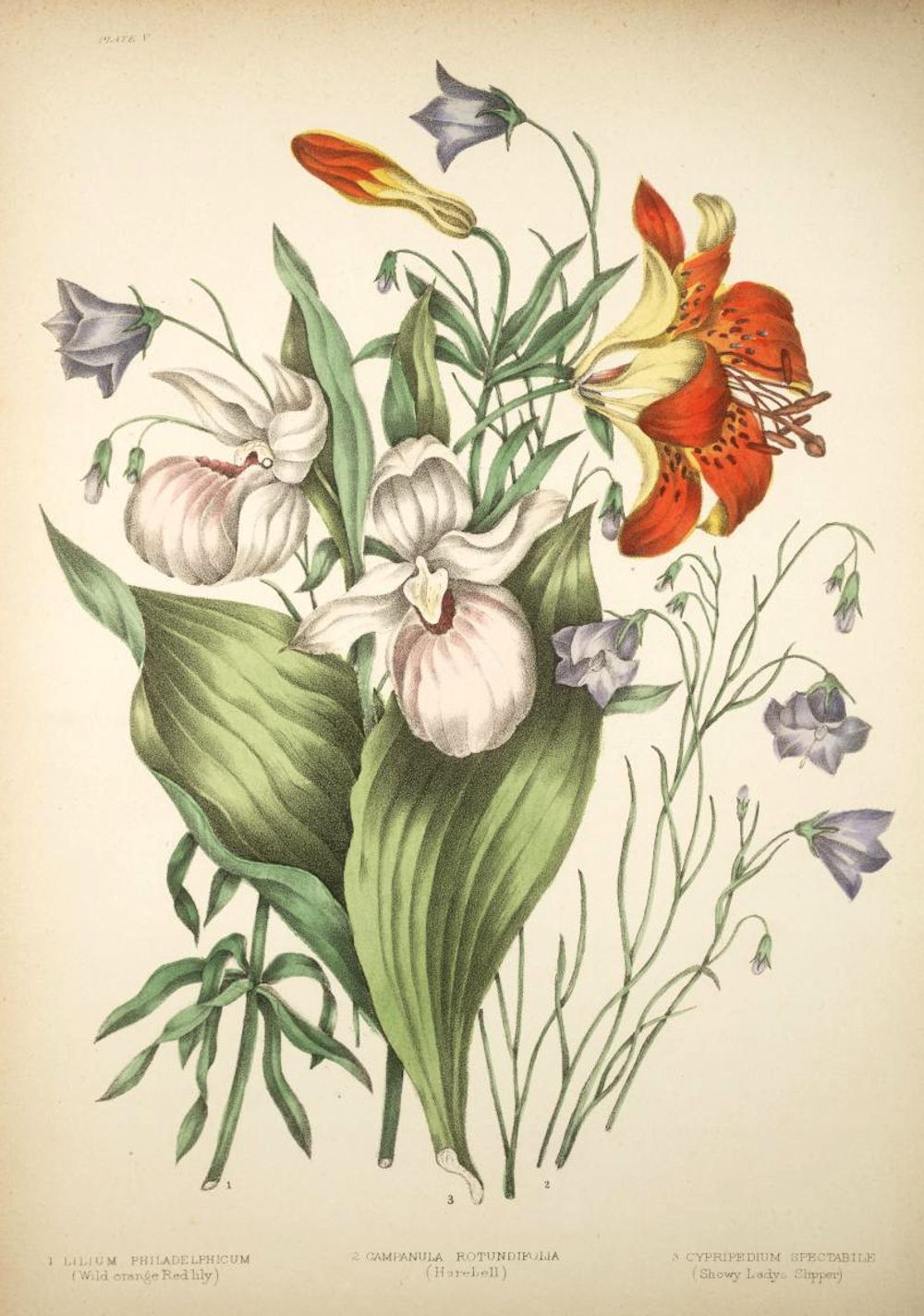
PLATE VI.
1 LILIUM PHILADELPHICUM 2 CAMPANULA ROTUNDIFOLIA 3 CYPRIPEDIUM SPECTABILE
(Wild orange Red lily)(Harebell)(Showy Lady’s Slipper)
Nat. Ord. Liliaceæ.—(Gray.)