"Norman Vallery" (continued 5)
Reading edition
“Oh, how dreadful it will be to have to wait all that time,” thought Fanny.
She was sent out of the room several times by her mamma, as she could do nothing, and as often stole back again, only feeling at rest when seated by her young brother’s bedside.
At last Norman appeared to drop off to sleep, and her granny, who had taken her mamma’s place, whispered that she must go out and enjoy some fresh air.
Just as she descended the steps, she saw old Alec and little Robby coming towards the house. Robby darted forward to meet her.
“O Mistress Fanny, how is the young gentleman?” he asked in an eager tone.
“My brother is very, very ill,” answered Fanny, unable to restrain her tears.
Robby looked very sad, but his countenance brightened up in a little time as he said—
“Don’t cry, young lady, grandfather and I have been praying that God will take care of Master Norman, and make him well—I am sure He will—so don’t cry, don’t cry.”
Fanny dried her tears, for she had the same hope in her heart, remembering that she, too, had been praying, and she knew that God hears children’s prayers as well as those of grown people.
She thanked Robby and old Alec very much for coming to inquire for her brother, and asked them to come into the house as she was sure her papa and the laird and Mrs Maclean would like to see them. Her mamma was lying down to rest, and her granny was with Norman she knew, or they would like to see them too. Old Alec, however, declined, saying that he only came to ask after the young master, and that he must be back to attend to his cattle and sheep.
He was going away, when the laird caught sight of him, and insisted on his coming in with Robby. Mrs Maclean loaded Robby with all sorts of things, and Captain Vallery wished to show his gratitude in some substantial way to old Alec and his little grandson, for saving Norman’s life.
Alec persisted that neither he nor the child wished for any reward for doing what was simply their duty.
“That is no reason why I should not show my gratitude, and I will consult with the laird how I can best do so,” answered the captain.
For many days Norman remained very ill, and every day old Alec and the little boy came to inquire for him.
“Robby will not rest till he has heard how the young master is going on,” said his grandfather, “and though I tell him he cannot help him to get well, still he says he must come to ask how he is doing.”
Fanny spent every moment that she was allowed to do so in her brother’s room.
At length the doctor said that the complaint had taken a favourable turn, and that Norman would soon get well. He looked, however, very pale and thin, and very unlike the strong ruddy boy he had before appeared. Fanny was now allowed to be frequently with him. Their poor mamma, from her constant watching by his bedside, was herself made ill, and even granny required rest and fresh air.
What an active attentive little nurse did Fanny make, and how pleasantly and gently she talked to Norman, telling him all sorts of things which she could think of, to interest him. She daily brought him his meals; he said that he would rather take them from her than from any one else, as the tea and broth and pudding always tasted nicer when she gave them to him.
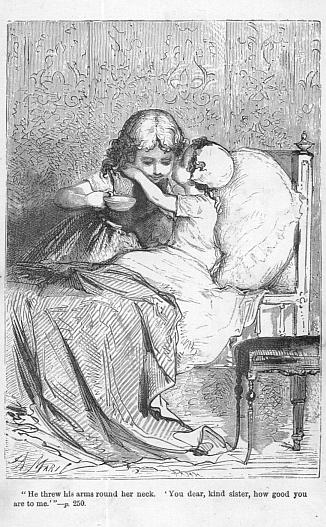
She had not liked to talk of Robby and Alec for fear of reminding him of Pecksy. One day when she brought him a cup of broth, and he was sitting propped up with pillows, he threw his arms round her neck.
“You dear, kind sister,” he said, “how good you are to me, and I have never been good to you; I don’t think anybody else would be as kind to me if I had treated them as I have you.”
“Oh, but you know I love you, Norman, and though you have been angry sometimes, that should not make me cease to love you. But here, take the broth, and then I will tell you that not only I, but others care for you, and have prayed that you might be made well, whom you have treated rudely and ill.”
Norman took the broth and then he asked—
“Who are they who care for me besides mamma and perhaps granny?”
“Of course, granny cares for you very much indeed,” said Fanny, who did not like her brother to say that. “And so do others;” and then she told him how day after day old Alec and Robby had come to the house to inquire for him, how grieved Robby had been when he heard that he was ill, and how thankful when he was told that he was recovering.
“That little boy!” exclaimed Norman; “why, I always abused him and scolded him, and now I remember I kicked him in the carriage, and called him names when he ran after me. It was he who threw the end of his handkerchief to me, when I fell into the water. Oh yes! and I pulled him in too, when he was trying to help me, and he might have been drowned. He can only hate me, I should think.”
“Far from hating you, he has forgotten entirely how ill you treated him, and has been as anxious as any one about you,” said Fanny.
“Oh, I have been a very naughty boy, I will try to be so no more. I know I said that before, but now I will really try to do what I am told, and be kind and gentle to everybody, as granny said I ought to be, and I will pray to God to help me to be so. I before thought that I was going to be good, but I did not pray, I wanted to be good all by myself, and I know that I was very soon as bad as ever.”
How thankful Fanny felt when she heard Norman say this; again and again she kissed him, and with joy afterwards told her granny and her mamma what he had said.
From this time Norman rapidly got better, and was soon able to be dressed and go downstairs. Fanny was delighted to draw him about the grounds in the little cart, and in two or three days the doctor thought that he might take a drive in the pony carriage.
“Oh then, let me go and see Robby,” he exclaimed. “I want so much to thank him for saving me from being drowned, and for coming to ask about me.”
Chapter Twelve.
Right at last.
The first fine day after Norman was allowed to go out, the laird kindly undertook to drive him and Fanny and their mamma and granny over to old Alec’s cottage. Robby was much delighted to see the young gentleman. Norman, instead of treating him in the haughty way he had before, allowed himself to be led about by the little fellow, who wanted to show him his pet lamb and birds, and a little arbour, with a seat in it, which his grandfather had made for him.
“Robby,” said Norman, taking his hand, “I know I was very naughty, and that I treated you very ill, but if you will forgive me and let me be your friend, I shall be very thankful. I do indeed feel ashamed of myself.”
Fanny, who overheard this was more than ever satisfied that her brother’s heart was really changed.
Robby thanked Norman, and again told him how glad he was that he had got well, and that he would like to be his friend, and help him, and fight for him if needs be, more than anything else.
The children spent a very happy morning, and the drive did Norman much good.
Captain and Mrs Vallery were most anxious to show their gratitude to old Alec and his grandson. Mrs Vallery among other things they proposed doing, sent to the nearest town for some clothes suitable for little Robby. Mrs Maclean drove over with them, that she might tell her guests how their present was received. Robby opened the parcel himself and could scarcely believe that its contents were for him. He had never before, indeed, been so comfortably dressed. He was unable to find words to express his pleasure, but he did his best to say how grateful he felt for the unexpected gifts. Mrs Maclean undertook to see that he was in future well supplied with warm clothing. The laird likewise engaged a big lad to assist Alec in looking after his cattle and sheep, that Robby might be sent to school; and Captain Vallery purchased several animals, which he presented to the old man, observing that as now he had a servant he would be able to tend a larger number than formerly. Mrs Leslie also made him and his grandson several useful presents. Still Norman acknowledged that for his part, he owed them more than he could ever repay.
At length the time came when Mrs Leslie and her daughter and son-in-law, with their children had to return South. The last visit to old Alec and his grandson was paid. They bade farewell to the kind laird and Mrs Maclean.
The carriage drove to the door, and the journey was begun. Among the luggage was a mysterious package—what it contained Fanny was not allowed to know, and if she was curious about it, she so far restrained her curiosity as not to ask questions. Norman, however, seemed to be acquainted with its contents, and lifting up the thick covering placed over it, he was seen to pour in water and seeds from a little parcel of which his papa had charge.
The railway was soon reached, and while at the station, Norman kept strict watch over the mysterious package.
The party spent only one day in Edinburgh when the package was carried at once into Captain Vallery’s room.
During the journey from Edinburgh to London, it was placed under charge of the guard, who promised faithfully that no harm should befall it.
How happy Fanny felt, when at length they reached their dear old home with granny quite well, in spite of the fatigue she had undergone, and Norman not only recovered, but evidently so very different to what he had been before. One of his first acts was to run up to Susan to tell her that he hoped she would find him a good boy. Trusty, who came out barking with delight, sprang up to lick the hand of everybody else, but carefully avoided Norman. Norman, however, called to him in a gentle voice, and when he came up patted his head and stroked his back, and Trusty wagged his tail as much as to say, “I am glad you are not afraid of me, and I hope we shall be good friends in future.” Such they became, and many a romp had Trusty with the young gentleman.
Fanny on going to her room, found Nancy in her doll’s house ready to welcome her, and turning round what should she see but Miss Lucy, looking bright and fresh, with a low frock such as she wore when she first arrived. There were no marks on her neck, no disfiguring blotches on her face. If she was not the original Miss Lucy, she was so exactly like her that she must be, Fanny thought, her twin sister.
“Oh how very kind,” exclaimed Fanny, “I need have no fear now of leaving Miss Lucy by herself either in the drawing-room or elsewhere.”
After talking to her for some time, and introducing her to Nancy she ran downstairs, eager to thank her papa and mamma and granny, or whoever had obtained a new Miss Lucy for her.
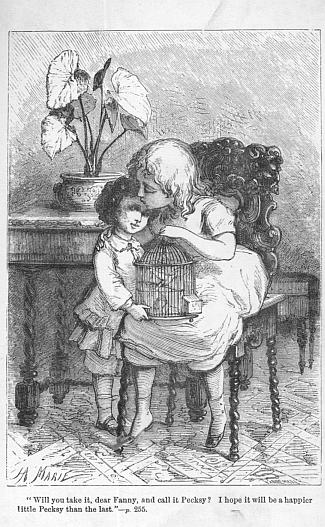
No one was in the drawing-room, but a minute afterwards Norman came in, carrying in his hand a gaily-painted bird-cage, with a beautiful little bird inside. The bird-cage was exactly the size of the mysterious package.
“There, dear Fanny,” he said, “we have brought it all the way from Glen Tulloch. I bought it with some money which papa gave me to do what I liked with. But I was afraid it might die on the journey, so I did not like to offer it you till arrived safely here. Will you take it, dear Fanny, and call it Pecksy? I hope it will be a happier little Pecksy than the last.”
For a moment Norman hung down his head, and then he looked up with a beaming smile as Fanny kissed him, and thanked him again and again for his gift.
Norman then begged Fanny to come up to her room, and he there pointed out a hook which had been placed in the wall on which she might hang her bird-cage and reach it without difficulty, though too far off the ground for Trusty to frighten it, or for Kitty, the cat, even by exerting her utmost agility to reach it.
Fanny thought herself the happiest little girl in existence.
She showed Norman the new Miss Lucy, whose appearance astonished him even more than it had Fanny.
Norman spent some happy weeks at home, and Mrs Norton expressed herself much pleased at the progress he made. The time then came for him to go to school, and after he had been there for some time, the master wrote word that he was among the most attentive and obedient of his pupils, and that he had not a word of complaint to make of him. All his friends felt very happy on receiving this information, and Fanny looked forward with delight for his return home for the holidays.
He maintained his character, and though it cannot be said he has no faults, he undoubtedly does his best to overcome them, and I shall be very glad if all the young readers of this tale, will endeavour to do the same—trusting to the same help which he sought and obtained.
The End.
| Chapter 1 | | Chapter 2 | | Chapter 3 | | Chapter 4 | | Chapter 5 | | Chapter 6 | | Chapter 7 | | Chapter 8 | | Chapter 9 | | Chapter 10 | | Chapter 11 | | Chapter 12 |