PHIL'S PANSIES.
Reading edition
A GOLDEN TEXT STORY.
BY
LUCY ELLEN GUERNSEY
AUTHOR OF
"IRISH AMY," "OPPOSITE NEIGHBORS," "TWIN ROSES," ETC.
PHILADELPHIA:
AMERICAN SUNDAY-SCHOOL UNION,
NO. 1122 CHESTNUT STREET. ————————— NEW YORK: 8 & 10 BIBLE HOUSE, ASTOR PLACE. CHICAGO: 73 RANDOLPH ST.
CONTENTS. ——————
NO TALENT. A GOLDEN TEXT STORY.
CHAP. I.—IN THE SUMMER-HOUSE
CHAP. II.—PUG
CHAP. III.—PATCHWORK
CHAP. IV.—KNITTING
CHAP. V.—THE KNITTING FINISHED
PHIL'S PANSIES. A GOLDEN TEXT STORY.
CHAP. I.—THE SEEDS
CHAP. II.—SEEDS BY THE WAYSIDE
CHAP. III.—THE WEEDS
CHAP. IV.—FLOWERS
CHAP. V.—THE FRUIT
NO TALENT.
A GOLDEN TEXT STORY.
BY
LUCY ELLEN GUERNSEY
AUTHOR OF
"IRISH AMY," "OPPOSITE NEIGHBORS," "TWIN ROSES," ETC.
————————— "Inasmuch as ye have done it unto one of the least of these my brethren, ye have done it unto me."—Matt. 25:40. —————————
PHILADELPHIA:
AMERICAN SUNDAY-SCHOOL UNION,
NO. 1122 CHESTNUT STREET. ————————— NEW YORK: 8 & 10 BIBLE HOUSE, ASTOR PLACE. CHICAGO: 73 RANDOLPH ST.
——————————————————————————————————————————————————————————————— Entered according to Act of Congress, in the year 1880, by the AMERICAN SUNDAY-SCHOOL UNION, In the Office of the Librarian of Congress, at Washington. ———————————————————————————————————————————————————————————————
NO TALENT. ——————
CHAPTER FIRST.
IN THE SUMMER-HOUSE.
AMITY BOGARDUS sat in the little summer-house, which stood on the top of the great pile of rocks in her grandfather's grounds. To speak with precision they were her grounds, for this little plain Amity, who was sitting in such a mournful posture coiled up on the rustic sofa, was the owner of this great place with its grand old stone house, its beautiful gardens and great trees, and lawns shaven as smooth as velvet, with gray, mossy rocks sticking up through the turf here and there. The greenhouses, and hot-houses, and grape-houses, the carriages and horses, and high-bred Alderney cows, and all the rest belonged to her. Yes, the prettiest and grandest place in all Brookvale belonged to this little plain girl, and thousands upon thousands of dollars beside.
"An heiress!" says somebody. "Oh, then we know all about her. She is a vain, proud girl, who looks down on every one, and thinks nothing of people who are not rich. And then she is going to lose all her property somehow, and get good all of a sudden. That is always the way with heiresses."
I confess that is very apt to be the way with heiresses in books; but it was not at all the way with Amity Bogardus. A more humble-minded child, one who thought less of herself and more of her neighbors, it would be hard to find. Indeed, the mean opinion she had of herself, her looks, her manners, her talents, often made her very unhappy, as was the case just now. She was apt to steal away by herself, and sit and think how very sad it was to be a poor, homely little girl, with a round Dutch face all of a color, grayish hazel eyes, and straight hair, which was only light—not golden, nor flaxen, nor auburn, nor even red—which would have been something.
"It is just the color of the light part of Aunt Julia's Pug," said Amity, pulling a lock of the offending hair round into the light, with a spiteful little twitch, as if the poor hair could help its color. "And, to make the matter better, I must have dark eyebrows coming together over my nose and green eyes."
And then Amity pushed the offending hair off her forehead and laid her head down on the window seat, and cried a little, as she reflected how delightful it would be to be as handsome and accomplished as her aunt Julia, till from dreaming awake she came to dreaming in earnest. She was waked from her nap by the sound of voices near by.
"Shall we take the trouble to climb up to the summer-house?" said Aunt Julia. "It is so hazy I am afraid the view would hardly pay us for the labor."
"Suppose we sit down here in the shade," said another voice, which Amity knew at once to be that of Mrs. Paget, a lady whom Amity had often admired at a distance, but with whom she had been too shy to make acquaintance.
"And what about Amity?" said Mrs. Paget. "Is she like her father?"
"Oh, not a bit—just her mother over again," said Miss Julia, decidedly.
"If she is her mother over again, she must be a very good child," said Mrs. Paget. "A more blameless person than Anna Van Schoonhoven I never knew."
"Oh, the child is good enough—that is, I have never seen anything to the contrary," answered Miss Julia, carelessly. "But the trouble is she is so totally uninteresting. She has no talent."
"Of any kind?" asked Mrs. Paget. And Amity knew by the tone of her voice just how her eyebrows went up as she spoke.
"Why no," answered Miss Julia. "She has no ear for music; in fact she can hardly tell one tune from another. She has no talent for drawing, and I don't believe she will ever pronounce French decently. And then she is so hopelessly common looking. Her figure might be improved by proper corsets, I think, but she complains that they hurt her, and so papa won't let her wear them. Such absurd ideas men have! But it don't make much difference. No dressing will ever make anything of her but a dowdy Dutch doll. It is really a great disappointment."
"I dare say," said Mrs. Paget.
"I want papa to send her to Mrs. Green's," continued Miss Julia: "I am sure she will make something of the child, if any one can; but he has taken up the most singular prejudice against Mrs. Green, and won't let her go. He says Mrs. Green has no reality in herself, and takes all they have out of her pupils. I wish you would use your influence with him."
"I am afraid I do not like Mrs. Green any better than Mr. Bogardus does," said Mrs. Paget. "But where is Amity? I have not seen her at all."
"Oh, she is moping about the place somewhere, I suppose," said Aunt Julia. "She is given to that kind of thing. See, there is a carriage. Shall we go in?"
"I don't think I will. I don't care about meeting strangers," said Mrs. Paget, glancing at her deep mourning. "I will climb up on the rocks and look at the view—I should like to see the summer-house again."
Mrs. Paget was a light, active little body, and she did not seem to find the steep path up the side of the ledge at all fatiguing. She had another object in the climb besides the view. She had seen the flutter of a little black dress, and she was quite sure she had heard a suppressed sob; and the idea crossed her mind that Amity might have overheard the talk below, and been hurt by it.
She was quite right. Amity had overheard her aunt's remarks, and been cruelly hurt by them. To be sure she had said the same thing to herself a hundred times, but nobody had ever spoken it out in plain English before. It seemed somehow to make matters a great deal worse.
"'A dowdy Dutch doll!'"
Yes, that was all she was, or ever would be, and there was no use in trying. She wished she were a Roman Catholic, so that she might go into the great convent down by the river, and hide herself from the relations that were ashamed of her. Or else she wished she could die; then they would have the money and the fine place, and she would be with her mother, who loved her dearly, and had never been mortified because her little girl was not a beauty nor a genius. These were foolish thoughts, and rather naughty besides, but Amity was a poor, lonely, unhappy little girl, with nobody to whom she could tell her troubles; so it is no great wonder that she gave way to impatience.
"Poor little thing! I imagined as much," thought Mrs. Paget; but she did not say a word.
She was one to whom God had given a great many talents, and among them was that of sympathy. She knew how to comfort others with the comfort wherewith she herself was comforted of God, as the apostle indicates (2 Cor. 1:4). She saw that Amity was greatly hurt and excited, and not in any state to hear reason; so she just sat down, and lifting the little girl's head from the hard bench laid it in her lap, on her cool, soft cambric handkerchief, and stroked the hair as gently as if it had been the most beautiful wavy auburn hair in the world—stroked it as no one had ever done since the child's mother died.
Somehow her very touch calmed and comforted Amity. Presently she raised her tear-stained face.
"I am afraid it was very naughty to listen," said she, in a quivering voice; "I didn't mean to, but I was caught here, and did not know what to do at first."
"I understand," said Mrs. Paget; "I don't think you were at all to blame, so don't fret about it, my dear. Was that what you were crying about?"
"Yes, ma'am."
"But, my dear, you must not let idle words hurt you so much. There are plenty of them always flying about, and if we let them sting us every time they come near, we might as well live in a wasps' nest."
"If they had not been true, I would not have minded," said Amity. "But it is all so. I am just what Aunt Julia called me, and I shall never be anything else. Even 'a Dutch doll' is good to play with, and I am not that."
"Are you sure?" asked Mrs. Paget.
"Every one says so," answered Amity.
"How many is 'every one'? I am sure your grandfather never said so."
"No: grandpapa is so polite he would never hurt any one's feelings; but I am sure he is disappointed because I don't look like his family. I suppose when I am of age I shall have ever so much money, and perhaps I can do some good with that," continued Amity, who somehow felt as if it would be a comfort to tell all her thoughts to her new friend. "But I don't think it is always easy to do good with money either."
"Very true and besides, you would have a good while to wait. Eleven years is a long time to live in the world without doing any good in it; don't you think so?"
"Yes, ma'am," answered Amity, slowly. "I don't know what I can do though. It is just as Aunt Julia says: I have no talent. I don't like music, at least I don't care about any but hymn tunes, and such like. I can't draw one bit—not even a straight line."
"Few people can the first time they try," said Mrs. Paget.
"And I am very slow about learning," continued Amity, "especially French. I can't catch the sounds somehow, and I hate the sound of it. It is just like a wagon rattling over a rough road."
Mrs. Paget smiled.
"You make out a hard case, Amity. But now will you let me ask you two or three serious questions?"
"Yes, ma'am."
"Why do you suppose God made you and set you in this world?"
"I don't know," answered Amity, rather doubtfully.
"Doesn't it seem as if he must have meant you to do something?"
"I suppose so," answered Amity. "The trouble is to find out what he wants me to do."
"If you really wish to work for him, I don't think you will fail in finding work," said Mrs. Paget. "I never knew any of his children to suffer in that way. The difficulty often is that they are not willing to do the work which he provides, but they want to do something else—something which shall make a great figure in the eyes of the world, or perhaps of the church; something which will be pleasant and easy, or for which they fancy they have a particular genius, which nobody appreciates. A young lady thinks it would be a fine thing to be a 'Sister of Charity,' though she cannot possibly sit up at night with a sick neighbor, or help to lay out a dead child. She wants to go on a foreign mission, but she can't take a class in Sunday-school or sewing-school."
"That reminds me of something," said Amity, eagerly. "I heard you say the other day that you wanted some patchwork basted for the sewing-school, and I thought perhaps you would let me do it. Mother taught me to sew when I was very little, and I like patchwork. I have made a whole bed-quilt for a lady in the hospital since I came here."
"Then it seems you have one talent, and a very useful one. As to the patchwork, I assure you I shall be glad to turn the whole basket over to you, if only I can depend on your having the work ready—if you won't get tired of it after a week or two."
"I don't think I shall," said Amity modestly. "I almost always do stick to what I begin, because I hate to leave things half done."
"Then there is another talent."
"But, after all, I am a homely little thing," said Amity, recurring to her first grievance. "If only my eyebrows were not so ugly, I don't think I should mind the rest."
"The ancient Greeks would have considered your eyebrows a great beauty," said Mrs. Paget. "I am not going to flatter you, Amity, by telling you that you are pretty, or to say that beauty is of no account. I don't think so. Beauty is like other gifts of God, to be used for his service and glory. He has not seen fit to give it to you, and you must try to be content without it. Your duty toward your neighbors requires you to be neat and tidy, and to dress so as not to offend the taste of those about you. After that, the less you think of your looks the better.
"As to the rest, do whatever comes in your way; help when you can and comfort when you can, and do all in the name of the Lord Jesus, remembering his words, 'It is more blessed to give than to receive,' and 'Whosoever shall give to drink unto one of these little ones a cup of cold water only in the name of a disciple, verily I say unto you, he shall in no wise lose his reward.' Do you love him, my dear?"
Amity looked down on the floor, and a color came to her face which made her look lovely for the moment.
"Yes, ma'am," she whispered. "I love him because he died on the cross for my salvation."
"And have you asked him to show you what he would have you do?"
"I don't think I have," said Amity. "I never thought of it in that way."
"Then let that be your first work. Now we have talked enough; only remember this, my child: every person has at least one talent given him, for which he must answer to him who gave it. Remember, too, that the man who had one talent was the man who hid it away, and was judged and punished accordingly. Now let us go up to the house."
CHAPTER SECOND.
PUG.
MRS. PAGET did not go back to the house after all. At the turn of the road she met her carriage, with a note from her daughter telling her of the arrival of friends from a distance; so she got into the carriage and went home, leaving with Amity a note for Miss Julia.
Amity, left alone, turned out of the broad gravel road into a little path which went winding among the shrubs and trees. She knew she would not be wanted at the house, and she felt as if she would like to think over what she had heard.
She thought to such good purpose that her eyes grew bright, her head was raised, and the corners of her mouth lifted themselves up as if somebody had put little pulleys in them. Before she had finished her walk, she had come to the wise conclusion that she had been making herself very unhappy for nothing, and that after all she had a great deal to be thankful for. Every one was good to her—even Aunt Julia, who, after all, had not meant to hurt her feelings, since she could not know that any one was in the summer-house. She had books and flowers, and grandpapa let her have as many pets as ever she liked, and had promised her a pony.
"And if I am not handsome, why, then I am not, and that is all about it," said Amity, very wisely. "Miss Lilly Paget is not handsome either, and every one likes her quite as well as they do Aunt Julia, for aught I know. And if I can't play or paint, or do any of the grand things, I must be content with the little ones, that's all."
And then Amity fell into a still graver way of thinking. She was a thoughtful little girl; she had been her mother's only companion and comfort for years. Mrs. Bogardus had not been a happy woman. I cannot tell you all about it here, but there had been a sad family quarrel, which lasted for years. It grew out of the fact that Mr. Henry Bogardus married the daughter of his father's half-brother, against the will of the parents and other friends on both sides. There was a great deal of money involved, and many lawsuits grew up, and, as I said, the quarrel lasted for years, long after poor foolish young Henry Bogardus was lying in his far-away grave in South America, whither he had gone in hopes of doing something for his wife and child.
But the feud was made up in the last year of Mrs. Bogardus's life, and Grandfather von Schoonhoven, seeing that he could not possibly take his great property into the grave with him, gave it all to little Amity. She was left to the guardianship of old Judge Bogardus, and all the family had come to spend the summer at Pine Ridge.
Amity, having been for some years her mother's only companion, was old—rather too old—for her years.
"The child needs young society," Mrs. Paget said to Miss Julia.
And Miss Julia replied, "That is another reason for sending her to Mrs. Green's."
At which, Mrs. Paget tossed up her beautiful chin in way she had, and said nothing more.
Amity turned aside once more to a little rustic seat around the trunk of a great chestnut, and sat some little time leaning her head on her hands. Then she arose and went down a somewhat steep path with something like a dancing step till she came to a little bridge which was thrown over a deep hollow or chasm in the ground, at the bottom of which was a small pond. There was a way to get down to the water, but it was steep and rather dangerous. Amity was about to cross the bridge when she heard a pitiful whine, and looking down she saw an old friend—or I might better say an old enemy—in great trouble.
"Why, Pug!" she exclaimed. "How in the world did you get down there?"
Pug raised his little black nose and gave a pitiful howl, as if he would say, "The question is how I am to get up again."
He had fallen into the pond and seemed to be hurt, for he could hardly keep his head above water; and though he was close to the edge of the pond, he could not scramble out.
Now Amity had no reason to like Pug, who Was a sadly-spoiled dog. He would never be friends with her; he often barked and snapped at her; and he expected her to get up and open the door for him twenty times in an hour, if he chose to go in and out as often.
But she could not see the poor little fellow in danger of drowning without feeling sorry for him. At first she thought she would call one of the men; but it was a long way to the house or barn, and she felt sure that Pug would be drowned before she could get back. She looked at the path.
"It is pretty steep; but after all, I have been up and down a great deal worse places than that, in Vermont," said she. "I can't go and leave him there. Yes, poor fellow, yes, Mite is coming!"
"Mite" had been Mrs. Bogardus's pet name for her little girl, and Amity loved it dearly; but nobody called her by it now. She went slowly and safely down the path, and holding fast by a stout bush, stooped down, and, by the aid of Pug's collar, she succeeded in landing him safely on the bank.
The poor dog yelped piteously, and Amity rather expected he would snap at her; but instead of that, he licked her hand. He was very much hurt—so that he could not stand; one of his paws was cut, and Amity thought his leg was broken.
"You poor little thing! How did you get into such a scrape?" said Amity.
Pug whined and licked her hand again, but he could not tell his story. The fact was he had seen a water-rat, and being a rash and inconsiderate, as well as a brave, dog, he had jumped after the rat without even thinking how or where he was to land. The result was that he did not land at all, but fell first on a sharp ridge of rock, and then tumbled into the water.
"Now I should like to know how in the world I am to get you up," said Amity. "I don't see how it is to be done, unless I carry you in my apron—if only you won't bite me!"
But Pug had no notion of biting. He was a sensible dog, with all his faults, and he perceived that Amity was trying her best to help him, so he submitted patiently when Amity gathered him up in her apron. And though the journey up the bank hurt him cruelly, he only whined to himself, and never offered to bite.
"You are a darling dog, so you are!" said Amity, patting the poor, piteous little black nose which Pug held up to her. "I suppose I had better take you straight to Aunt Julia. She must be very uneasy about you."
Aunt Julia was standing out on the lawn with some visitors, and she looked—like a queen, Amity thought, with her lace shawl, and her shady hat with a long white feather curling round the crown. In her interest for the dog, Amity quite forgot to be shy of the strange ladies. She had draggled her frock in the wet bushes, and the blood from Pug's wound had soaked through her white apron, so that she made rather an untidy figure.
"You unlucky child!" said Aunt Julia. "What have you done now?"
"Have you hurt yourself?" asked one of the ladies, in a kindly voice.
"No, ma'am," answered Amity: "it is Pug who is hurt. He has fallen down the bank by the pond, Aunt Julia, and I am afraid his leg is broken. Just see!"
But Aunt Julia drew back with a little scream of dismay.
"Don't bring him near me, child! I never can bear the sight of blood. I dare say he will go mad and bite somebody. Take him away, and tell some one to drown him."
"Drown Pug!" said Amity: she could hardly believe her ears.
"Oh, I wouldn't do that!" said the lady who had spoken to Amity. "I dare say he can be cured."
"I don't believe it," said Miss Julia: "he will be limping about, a horrid object for ever so long. Little wretch! After my giving forty dollars for him, to go and spoil himself so."
"It was very inconsiderate in him," said Mrs. Barnard dryly.
"Well there, do take him away, and relieve our eyes and ears," said Miss Julia. "You should never have brought him here."
"I shouldn't have done so, only I thought you loved him, Aunt Julia," said Amity; and she walked away without another word.
Mrs. Barnard followed her a few steps.
"Take him down to the stable, my dear, and ask my man Lewis what to do with him," said she. "Lewis knows all about animals, and he is a famous dog-doctor. He will tell you whether the poor little fellow can be cured, or whether it will be more merciful to put him out of pain. You are a dear little girl, I think. Will you come some day and make me a visit?"
"Yes, ma'am," said Amity. She would hardly have answered "Yes" so readily if she had not been thinking more about Pug than herself.
She hurried away to the stable, her heart boiling over with anger and pity.
"To think that she would not even look at the poor thing!" said she. "I don't believe she can love anything."
Amity was nearly right. Miss Julia had lived for amusement so long that she really cared for very little else. She had bought Pug because he was of a very pure and rare breed, and because it was the fashion to have such a dog; and also because another lady wanted him. He had amused her for a while with his tricks for he was an accomplished dog, but she had grown tired of him lately.
"Pugs were growing common, like everything else," she said.
She thought she must have a Japanese spaniel.
Lewis, Mrs. Barnard's coachman, was sitting on a block by the stable door talking to William, her grandfather's man. He started at the sight of Amity and the pug-dog.
"What in the world brings you down here, Miss Amity? Has anything happened?"
Amity told her story, and the men clustered round to look at the dog.
"Stand away, can't you, and don't crowd the young lady," said Lewis, who was a very genteel colored man indeed. "'Pears like you ain't no manners at all. Haven't you got a basket or something to put him in, William?"
William produced a basket, and folded an old blanket in the bottom. Pug was laid in his bed, and Lewis proceeded to examine his hurts.
"His leg is broke, but it can be set," he said presently. "He is a good deal bruised, too, but he'll get over that. Oh yes, miss, he'll do well enough, and be as good as a new dog yet! I'll whittle out some splints for his leg directly; but you had better go away, for I shall have to hurt him some, and little ladies are mostly so soft-hearted they don't like to see things hurt."
Amity patted and stroked Pug while Lewis was contriving and cutting out his splints, and explained to him that his leg was going to be set, in order that it might get well; and that he must be a good dog and not bite Lewis, but try to bear the pain patiently. She was so busy with her pet that she did not see any one coming, until she was startled by hearing her grandfather say, in a tone of displeasure,—
"Amity, is this you? What are you doing here at the barn? This is not a proper place for you at all!"
A few days before, Amity would have crept away without a word, to hide in some corner; but she was not thinking of herself now.
"It was Pug brought me, grandpapa," said she. "He has fallen down and hurt himself dreadfully; but Mrs. Barnard said Lewis might tell whether he could be cured, so I brought him down to see."
"Oh, very well! If it is a work of mercy, I have nothing to say," answered Judge Bogardus, smiling. "What does Lewis think of his patient?"
"I think he can be cured, sir, though like as not he'll go a little lame."
"Very well; do your best for him. Come, my dear; you had better walk up to the house with me."
"So you went down to the pond," said the Judge, as they walked along. "Were you not afraid?"
"Oh no, grandpapa! I used to climb about everywhere when I lived in the Green Mountains."
"So much the better for you. And do you like it here as well as you did in the mountains?"
"I should if mother was here," said Amity, in a voice which shook a little.
The Judge pressed Amity's little fat hand warmly, but he did not speak just then. Presently he said in a cheerful tone:
"If you like mountains so well, we will go over to the Mountain House some time and spend a week. Would that please you?"
"Oh yes, grandpapa!"
"Very well; we will consider it an engagement then. Now it is time for you to dress for dinner. Put on a white frock. I like to see little girls in white."
Amity ran up stairs to her room determined to make herself look as nicely as possible. She brushed her hair till it shone like satin, and took pains with the tie of her neck and sash ribbons as she had never done before. Since grandpapa really cared how she looked, she would try to please him.
"Well, how did you leave your patient?" said Mrs. Barnard to Amity, near whom she sat at lunch. "Does Lewis think he can be cured?"
"Oh yes, ma'am! He thinks he will be lame a good while though."
"You owe Amity a great debt for saving the life of your favorite, Julia," said the Judge. "She showed a good deal of courage and presence of mind in the way she saved Pug."
"I think she would have done quite as well to let him alone," said Miss Julia. "I told her to let the men drown him, but it seems she has taken her own way about the matter. There, I am not blaming you, child," she added, good-naturedly, seeing that Amity blushed.
Miss Julia was almost always good-natured, unless she was uncomfortable. She was "pleasant when she was pleased," as the saying goes, and that was something, for a good many people are not even that.
"May I have Pug, if you don't want him when he gets well?" asked Amity, when she had a chance of speaking to her aunt after dinner.
"To be sure, if you want him, child," answered Miss Julia, in some surprise; "but I thought you and Pug were not very good friends."
"We never have been, but he was just as grateful as he could be when I took him out of the water; and besides," said Amity, sighing a little, "you know he will want some one to like him."
Miss Julia stooped down and kissed her little niece—a thing she had hardly ever done before of her own accord. "You are a good little soul," said she. "Yes, you may have him and welcome. I dare say you will make an excellent mistress for him."
"Oh, thank you, Aunt Julia! And there is one other thing: Mrs. Paget wants me to baste the patchwork for the sewing-school girls. May I?"
"Mrs. Paget has sewing-school on the brain, I think," said Miss Julia. "Yes, to be sure, if you like to do it. Why do you ask?"
"I always asked mamma before I did any such thing," said Amity.
"And a very good plan it is, when one has a mamma to ask. Yes, baste as much patchwork as you please. Tell Anna to give you my old pink and white cambric; that will make you some very pretty pieces. I like to help people amuse themselves in their own way, even when that way is not mine. But remember, if I find you bent into a heap over your work, I shall take it away from you."
"I will remember, Aunt Julia. Good night."
"What a pleasant day this has been!" said Amity to herself. "I am so glad I saw Mrs. Paget. I think she is right: I won't think about my looks, only to try to be nice and dress as grandpapa likes to see me; and I will try to be useful and pleasant. After all, Aunt Julia is very kind to me, and all people can't be alike; only I do think it is queer that she shouldn't care anything about Pug."
CHAPTER THIRD.
PATCHWORK.
THE next morning Lewis came with a note and a large Fayal basket, both directed to Amity. Perhaps you have never seen one of these baskets. They are brought from Fayal, in the Azores Islands. They are made of wide thin strips of cedar plaited together, and are very pretty and convenient. The note was as follows:—
"DEAR AMITY: I send you the basket of patchwork, which you will find in a sad state of confusion. There are hardly two blocks of a size in the whole concern. So much for people not doing what they undertake. I shall be very glad if you can put enough to rights for us to begin upon next Saturday: a dozen good-sized blocks will do. I am going to give you a 'Golden Text' to go with this work and any other you may have to do. There are only a few words in it, but they mean a great deal: "'YE HAVE DONE IT UNTO ME!' "I dare say you know where it is to be found. "I hope Pug is better. Lewis says he has as much sense about being sick as a man—which is not saying a great deal. "Faithfully yours, "HELEN PAGET."
Amity knew very well where to find the words of her Golden Text, and she repeated them to herself:
"'And the King shall answer and say unto them, Verily I say unto you, Inasmuch as ye have done it unto one of the least of these my brethren, ye have done it unto me.'" (Matt. 25:40).
"Then I can do this for him," thought Amity—"even such little common work as this. He will know it and be pleased with it."
And Amity waited a minute before opening the basket, while she asked that she might have help to do the work faithfully. There is no kind of good work in which we cannot ask his help.
"But I can't think what any one could be thinking about to cut patchwork like that," said Amity as she spread out the pieces on the floor. "Just see here, Anna, what work! There are no two pieces alike."
"That comes from cutting one piece by another," said Anna, who was an excellent seamstress and a very good girl beside. "You must have a stiff paper pattern and measure by that. Keep to your pattern all the time: that is a good rule for more things than patchwork. But what is it all for, Miss Amity?"
Amity told her the story.
"Dear heart, how very nice!" said Anna, who was an English girl. "Where I came from, we all learned to sew in school. I think it would be good for you to have a class, Miss Amity; it would be a very nice diversion for you."
"I am hardly old enough for that," said Amity, smiling. "I'm afraid the girls wouldn't respect me, and I should be dreadfully afraid of them. And besides, Anna, I don't think I should quite like to do such work for a diversion."
"Many ladies do it," said Anna.
"Perhaps that is the reason they get tired and leave off so soon."
"I shouldn't wonder if you were right, miss. Well, I'll get you the red wrapper Miss Bogardus said you were to have; it will be very pretty to put your stripes together with."
Amity found her work more difficult than she expected; but she was very persevering, and she had Anna to appeal to in any difficulty. By Saturday she had a large number of pieces basted and ready for use.
"Ah! That is something like," said Mrs. Paget as she looked over the box which Amity brought her. "If you can do as much for us every week, it will be a very great help. Did you find a roll of aprons in the basket? I have mislaid one somewhere."
"Yes, ma'am," answered Amity: "I will go and bring it down."
"How very neatly the child has done them! Do you see, Julia?" said Mrs. Paget.
"I dare say she has. She seems a persevering little body. I think it will be a very good thing if she takes a fancy to that kind of work, as she has really no talent for anything else."
"A talent for being useful is about as good a talent as any one can have in this world," said Mrs. Paget, "and perhaps in the other also. There seems, at least, some ground for thinking so."
Miss Julia only smiled. She was used to such remarks from her friend, and did not mind them in the least.
"Papa," said Miss Julia at dinner, a fortnight afterward, "Mrs. Roby called here this morning. She has taken a cottage at Long Branch, and wishes us to come down and spend a month with them. Have you any objection?"
"None in the least to your going, if you like it," answered Judge Bogardus. "As for me, I have another engagement, and with a young lady too: so that my going is out of the question, even if I wished it—which I don't."
"What engagement can you possibly have with a young lady?" asked Miss Julia, in surprise.
"I have engaged to take Miss Amity Bogardus to the mountains. We spoke first of the Catskills; but, if it is all the same to her, I think we will go to the White Mountains instead—eh, miss?"
Amity grew scarlet to the root of her light hair.
"Oh, grandpapa! Did you really mean it?"
"When you know grandpapa better, my dear, you will know that he never says anything he does not mean. So you think you will like the White Mountains, and perhaps a bit of Lake George, quite as well as the Catskills?"
"Yes, indeed! I always did want to see them near, so much."
"I wish you would learn not to color so at every little thing, Amity," said Miss Julia, a little pettishly: "it is very well for a dark girl, but it does not suit your style. Papa, do you really mean to take the child about with you in that way? Who will take care of her clothes and keep her decent?"
"We must try to do that between us, eh, Amity? Do you think you can do your part?"
"Oh yes, grandpapa!"
"Well, I dare say you can. You are such an old-fashioned little body," said Aunt Julia, getting back her good humor, which indeed was seldom lost long at a time. "I must look over your clothes and see what you need. I suppose a flannel suit and two or three calicos, with a nice frock or two, will be best for the mountains."
"You must settle all that," said the Judge: "only we won't have any finery."
"There is no great room for finery in such mourning as Amity's; and, besides, nobody puts it on children now. When will you set out?"
"Some time next week, I think. Will that give time for all you have to do?"
Amity thought her grandfather spoke to her.
"Oh yes, sir!" she answered. "I have nothing to do except to finish my French Reader and baste up enough patchwork to last to the end of the school."
"Eh, what's that? Have you set up school?"
"Mrs. Paget has drawn Amity into working for the sewing-school," said Miss Julia. "Fancy her wanting me to take a class!"
"Well, why shouldn't you?"
"I haven't any talent for that kind of thing," said Miss Julia, shrugging her shoulders; "and I can't endure smells of boiled cabbage and onions, like Mrs. Paget."
"It seems rather a good thing that there are people who can," said Judge Bogardus. "Well then, we will consider the matter settled. Please see that she has everything needful, Julia."
"I will attend to it," answered Miss Julia. "I think we will go down to the city for two or three days; and then we can finish all our shopping at once. Will you like that, Amity?"
"Oh yes, Aunt Julia, ever so much!"
"You have one talent, I will say for you, and a very good one," remarked Aunt Julia—"that of being easily pleased."
"I ought to be pleased when everybody is so good to me," said Amity.
"A great many people ought to be what they are not, my dear. Don't you want to run out in the garden and find some pretty buds for my hair? I am going to a little party at Mrs. Barnard's."
"She is a dear little thing, after all," said Miss Julia to her father, when they were alone. "I never saw a child who made so little trouble; and she has brightened up quite wonderfully lately. If only she were not so dreadfully homely."
"Handsome is that handsome does," said the Judge, as he left the table.
Aunt Julia and Amity paid their visit to New York.
"Now we will have some lunch, and after that we will go up to the Park for a drive," said Miss Julia.
They had been shopping all the morning and all the day before; Miss Julia had bought a good many beautiful things for herself, and some nice ones for Amity—among others a very pretty and convenient Russian leather writing-case and travelling inkstand.
"That is my present," said she. "I shall expect you to write me a letter telling me all about your journey and adventures."
"I think I have too many nice presents," said Amity.
"Oh, the other things are not presents—they come out of your own purse."
"It does not seem as if I had any purse," said Amity. "I cannot get used to the thought that I shall have plenty of money of my own. Mamma had to be so careful and saving."
"Well, well, we won't think about that any more," said Miss Julia, hastily. "'Let by-gones be by-gones' is an excellent rule. What will you have for your lunch?"
"Please choose for me, Aunt Julia. I never know what I do want when there are so many things."
"You will soon get over that, my dear. I suppose something substantial, with an ice cream, will suit you."
Aunt Julia gave her orders, and then leaned back in her corner of the nice little sofa, reading a French book she had just bought, while Amity amused herself with looking about her at the gayly-dressed groups of ladies and children who filled the large restaurant dining-rooms. Presently a lady came in with a little boy who walked rather feebly with two crutches. She set him up in a comfortable chair, and, saying something which Amity did not hear, went out and left him. The child, who was about eight years old, sat very contentedly for a while, and then began playing with some marbles which he took out of his pocket. By and by two of them fell on the floor. The boy looked at them wistfully, but made no effort to pick them up.
"Aunt Julia, may I pick up that lame boy's marbles for him?" whispered Amity. "He cannot get them himself."
Miss Julia nodded, and Amity picked up the marbles, and laid them on the table.
"Thank you," said the boy. "I won't let them fall again."
"I will make a fence, so they can't roll off so easily," said Amity; and taking a napkin she rolled it up and laid it on the edge. "There, that will make a nice fence—now they won't roll off."
"I like you," said the child, looking up in Amity's face. "You are not pretty, but you are lovely. Why do you wear black? Is your mother dead?"
"Yes," said Amity, her lip quivering a little.
"Mine is dead, too. Who takes care of you now?"
"Grandpapa and Aunt Julia."
"Mrs. Franklin takes care of me. She is good, but she is not like mother. Is that your aunt?"
"Yes, that is Aunt Julia. What is your name?"
"My name is John—John Hamilton."
"And mine is Amity Bogardus."
"Say it again—slow, please. Amity Bogardus," he repeated once or twice. "There now, I sha'n't forget. I don't know much, you see, but when people are good to me, I like to remember them. Thank you, 'Amity Bogardus.'"
"What did that child say his name was?" asked Miss Julia, when they had finished their lunch and were in the carriage again.
"'John Hamilton,' aunt; and wasn't it funny? He said he didn't know much, but he liked to remember people that were good to him."
"He looked as if there were something peculiar about him," said Aunt Julia. "I wonder whether he can be Mrs. John Hamilton's son. I heard she left a boy who was quite deficient in mind and body."
"He said his mother was dead, and that Mrs. Franklin took care of him. Did you notice how dull his eyes were, aunt, as if there were a veil over them?"
"I did not like to look very closely at him," answered Miss Julia. "It is not kind to seem to stare at a person who is unfortunate in any way. See what a pretty pony that little girl is driving! I must have you learn to drive when you come home again."
"Oh, I know how," said Amity. "Old Deacon Bradshaw taught me; and he used to lend me his old white horse and the buckboard to take mamma out riding."
Miss Julia began to talk of something else. She did not like to think of the time when her sister-in-law was teaching a little school in Vermont, to support her worse than useless husband and her only child.
A month later Amity was standing in the long drawing-room at Congress Hall, in Saratoga. She had had, as she said, "a lovely time" in the mountains with her grandfather. They had come to Saratoga by the way of Lake George, and they were now expecting Miss Julia, who was coming from Long Branch to meet her father, and spend some time at the springs. Amity was very much tanned, which did not improve her beauty; but still she looked much better than when we saw her first. The sad, downcast look was gone from her face; she held up her head; and the little pulleys in the corners of her mouth had drawn it into quite a different shape.
So when people said of her, "What a very homely child!" they usually added, "but she has a pleasant face, after all."
Amity had been in the great hotel only two or three days, but she had made several acquaintances among the little girls, and to two or three of these she was now talking.
"Did you hear Johnny Hamilton cry last night?" said one of the girls, Emma Fairchild by name. "Poor little fellow, how he did scream!"
"Johnny Hamilton!" repeated Amity. She was trying to remember where she had heard the name.
"Hear him? I should think I did," said another girl, very much "dressed up" with a sash and scarlet stockings. "I never heard such a noise. Ma says it is a shame to have such a wretched object about the house, and she means to speak to Mr. H. about it."
"Who is he?"
"Oh, he is a miserable little idiot! He doesn't know anything at all."
"My mother says it is wrong to call 'an idiot,'" said Emma Fairchild. "He can talk plain, and sensibly too, only he is so very slow, and can't seem to think of what he wants to say. He likes to be read to, and you never saw any one so fond of music. Mrs. Franklin told mother that was one reason she staid here—because Johnny liked to hear the band and see the people. He has very bad attacks of pain sometimes, and then he cries as he did last night; but generally he is very good and pleasant."
"He hasn't sense enough to be anything else," said Maud, with the usual toss of her head.
"It takes very little sense to be disagreeable," remarked Emma, demurely. "See, there he comes! Let's go and speak to him. He always likes that."
Amity looked at the pale lame little boy, whom a kind-looking lady was carefully placing in an arm chair by the window. Yes, it was the same little boy she had seen in New York.
"Just see him!" said Maud, in a loud whisper. "Now doesn't he look like an idiot?"
"No, I don't think he does; and anyway, Maud, we ought not to stare at him. Aunt Julia says it is very rude to stare at a person who has anything odd or unfortunate about him. I have seen this little boy before. I wonder if he will know me!"
"Of course he won't. Come, let us go out on the veranda."
"I am going to speak to Johnny first," said Emma. "Come, Amity."
"She just wants to show how good she is, and that Amity is just such another," said Maud to her companions, as they went out of the room. "She knows she is homely, and she means to try the good dodge."
To do Maud justice, this spiteful speech was not original with her. She had heard it from her mother, who did not much believe in goodness, except for the sake of display. Mrs. Wickford was an unhappy woman. She loved the world dearly, and the world did not like her at all.
Johnny smiled as the girls spoke to him, and answered Emma's kind "How do you do to-day, Johnny?" slowly but distinctly.
Then, as he looked at Amity, his dull eyes brightened.
"I know you," he said quite eagerly; "I know your name: I say it in my prayers every night. Amity Bogardus," he repeated slowly. "I remember your eyebrows like a bridge."
"Why, where did you see Amity?" asked Emma.
"She picked up my marbles for me," answered Johnny. "It was in a place where you go to have lunch."
"In a restaurant in New York," said Amity. "I did not think you would know me again, Johnny. You have a good memory."
Johnny looked pleased.
"I can remember some things," said he. "You picked up my marbles and made a fence for them, and you spoke pleasantly to me. What is 'an idiot,' Emma?"
"An idiot is a person who does not know anything—not even his own name, or the days of the week," answered Emma. "Why do you ask, Johnny?"
"A lady said I was 'an idiot,'" replied Johnny, with a quivering lip: "I heard her just now; and she said I ought not to be here, because people did not like to see me, and it made it unpleasant. It was that girl's mother who wears the red stockings."
"Just like her!" said Emma, who was a kindhearted little thing, but rather too hasty and outspoken. "My mother says she is a horrid, vulgar woman. Never mind, Johnny; you are not an idiot at all, and I am sure you know lots of things."
"And you like to stay here, don't you?" said Amity.
"Yes; I like to see the pretty ladies, and to hear the music, and watch the water come out of the ground over there," and he pointed toward the park. "It acts as if it was glad to come out into the light. Do you think it is?"
"Perhaps so," said Amity. "And what else do you like?"
"I like to hear stories, and verses, and hymns," said Johnny, "and to go to church, only I can't understand what the minister says very well. I used to like to knit, but I forgot how when I was so sick. Mrs. Franklin says she will get some one to teach me again when we get home."
"I don't think you are one bit like 'an idiot,'" said Emma. "Amity, I must go now: I have to take my bath at eleven."
"I will sit with Johnny a little while, till his nurse comes back," said Amity, who was considering whether it would be possible for her to teach Johnny to knit again. "It would be 'doing something for the Lord Jesus,' as Mrs. Paget says," she thought.
"Talk to me," said Johnny; "I like to hear you."
"What shall I talk about?" asked Amity.
"Oh, tell me something that happened at your home."
"Well, I will tell that happened: I will tell you how Pug fell into the water."
And so she did, making a long story about the matter.
Johnny listened with great interest for a while, but presently grew sleepy and began to nod.
Amity was just considering what she had better do when Mrs. Franklin came in. Johnny roused up a little.
"Did I go to sleep? That wasn't—wasn't—"
"Polite, you mean," said Mrs. Franklin, as Johnny stammered and tried to think of the word he wanted. "Never mind, my dear: the young lady will excuse you when she knows how little sleep you had last night. You shall lie down on this sofa and have a good nap, and I will sit by you. Poor little man! I am very glad to see him sleep," she added, as Johnny laid his head down and dropped off again. "I am very much obliged to you, Miss—"
"My name is Amity Bogardus," said Amity, as Mrs. Franklin paused. "I saw Johnny only once, in New York, but he knew me again directly."
"Yes, he has a good memory for those people who are kind to him. He has often spoken of you."
"Has he always been as he is now?" Amity ventured to ask.
"He has always been a little peculiar, but he has been much worse since his mother died. He was very sick with the same fever that killed her, and since then, his mind has failed a great deal."
"He told me he used to know how to knit," said Amity.
"Yes, and I mean to try to have him taught again, but I am not a knitter myself, I am sorry to say."
"Perhaps I could teach him," said Amity. "I know how to knit pretty well, and I have taught two or three children. I would not mind trying, if you liked."
"You are very kind," said Mrs. Franklin, looking much pleased, "but I am afraid you would find it a great deal of trouble."
"I don't mind trouble, if only I could do it," said Amity; "but there would be no harm in trying—would there, do you think?"
"None at all, if your parents are willing; but you must ask them first."
"My father and mother are dead, but I will ask my grandfather," said Amity, "and if he is willing, I will begin after breakfast to-morrow. Grandpapa reads his papers then, and does not want me."
CHAPTER FOURTH.
KNITTING.
"I HAVE no objections," said Judge Bogardus, when Amity spoke to him about her plans; "only you know, my little girl, if you begin, you must keep on. It won't do to disappoint the poor little fellow because you get tired sometimes and want to do something else."
"I don't think I am apt to get tired of what I try to do," said Amity, thinking at the same time, "I am sure grandpapa need not have said that to me."
"You do not always have as many temptations as you do here," said her grandfather; "and let me tell you one thing, Amity: it is a very good way of getting ready for a failure to think too much of yourself. If you begin or try to go on in your own strength, you will never succeed."
Judge Bogardus did not often speak in this way, and Amity was all the more struck with his words. They seemed to bring her down somehow from a little pinnacle of self-conceit she had been standing on, and she answered quite humbly:
"I know, grandpapa. That was what mother was always saying."
"Your mother was a good woman, my dear, and I hope you will be another. Teach the poor little boy by all means if you can, but don't expect too much of him; and now go and get your hat. I want you to ride with me."
The next morning the knitting lessons began. Poor Johnny was very slow, and it was two or three days before he could catch the motions so as to go on by himself; but at last he did so, and could make out to knit a row without dropping more than half the stitches. Amity used to knit every other row (a very good way to do when one is teaching any child to knit).
"Shall I ever learn, do you think?" asked Johnny.
"Oh yes! You are doing a little better every day. Pretty soon you can begin to knit sponge-towel, and when it is done, you can give it to Mrs. Franklin for a present."
"Won't that be nice? When I go where my mamma is, Amity, I shall tell her how good you have been to her poor little boy, And you, too," he added, turning to Mrs. Franklin, who sat by as if afraid she might be hurt; "I shall tell her you were almost the same as my own mother; not quite the same, you know—nobody could be that."
"You are my dear little boy," said Mrs. Franklin, kissing the poor little thin hand Johnny held out to her; "but your hands are hot, Johnny; does your side ache again?"
"A little," said Johnny.
"Where have you been, and where do you keep yourself all the mornings?" asked Emma Fairchild, as she met Amity on the veranda when the lesson was done. "Why don't you come out after breakfast when it is cool and pleasant?"
"I am busy then," said Amity.
"Why, surely you don't do lessons now you are here!" said Emma.
"Not my own lessons," returned Amity.
"I know what she does: she is teaching that idiot boy to knit," said Maud. "Mrs. Franklin told mamma so."
"Are you really?" asked Emma.
Amity nodded.
"And can he learn?"
"Oh yes! He can knit quite a good deal, and he is so pleased, poor little fellow! But, Maud, you shouldn't call him 'an idiot.' He is not that, though he is backward, and oh, so slow!"
"And he really likes it?"
"Oh yes! And I have taught him some other things, too."
"What things?"
"Little hymns and verses and such things. He can learn almost anything with a rhyme to it."
"Well, anyhow, I think you are real good to teach him," said Emma; "isn't she, Maud?"
"Yes, I suppose so, but I shouldn't like it," said Maud; "and it isn't so very much to do, either. Mamma knows a lady that founded a hospital for poor children—paid for it all herself, and her name is on the front of it. That would be something worth while—something that every one would know."
"But we ought not to do good things just to have people know them, I suppose; should we?" asked Emma, doubtfully. "I should not think that was right."
"Of course it isn't right. It is just like the Pharisees sounding a trumpet before them," answered Amity, with decision.
"Everybody does, anyhow," persisted Maud. "My mother gave ten dollars and some clothes to the Old Woman's Home, and because it was not put in the paper with the other donations, she said she would never give them anything again. * But, Amity, you are very rich, ain't you?"
"I shall be some time, I suppose," said Amity.
"Then I should think you would like to do some grand thing—like building a hospital or an asylum. Just think! You might have a beautiful building on one of the avenues, with your name on it for every one to read when you are dead."
"And what good would that do you?" asked Emma.
"Oh, I don't say I should do it. That is quite another thing," answered Maud, arranging her sash as she spoke. "I believe in using your money for yourself and having a good time. People are never grateful for being helped—ma says so. She said, after Mrs. Franklin went away: 'Well, I only hope they will be grateful, that's all; but I don't expect it;' and she said it was a shame for Mrs. Franklin to impose on you so."
"She doesn't impose on me," said Amity, rather vexed.
"Oh, well! It's all right so long as you don't think so," said Maud, with a disagreeable little laugh. "I should think it a good deal of an imposition if any one was to get all that out of me. Ma says, 'Mrs. Franklin knows which side her bread is buttered.'"
"It wasn't a very pretty speech if ma did say it," said Emma, imitating Maud's affected pronunciation. "Come, Amity, let's go and get some Columbia water."
The girls took their glasses of the clear, sparkling water, and then walked away through the grounds. Emma chattered away in her usual off-hand fashion, which, to do her justice, was usually a very pleasant and good-natured one. Amity was so silent that Emma presently broke off her prattle, and asked her what she was thinking about.
"About Maud," answered Amity. "I don't think you need have been so sharp with her, Emma. I am afraid she was offended."
"Well, I dare say you are right," replied Emma. "I don't think I am apt to be sharp," (which was quite true), "but, somehow, Maud does always rub me the wrong way—she and her mother. Well, I don't know how to say what I mean, but they somehow seem to me to care only for the outside—not for what things really are, but only what people will say about them."
"You needn't have mimicked her, or spoken so about her mother any way," said Amity. "You wouldn't like it yourself, and I think you ought to be more careful. People will think you are very inconsistent."
Now all this was true enough, and if Amity had hinted it or even spoken it out to Emma in a more gentle and humble manner, I have no doubt that the little girl would have taken it kindly, for she was really trying hard to be a good Christian child. But Amity spoke sharply, and with a tone of superiority which "rubbed Emma the wrong way," as she said directly.
"Well, you needn't lecture me if I did," said she, sharply, in her turn. "You talk just like that horrid girl in the book we were reading, who scolded her grandmother for wasting her time knitting a bed-quilt." *
Amity drew herself up. "If you are going to talk like that, I think we had better drop the subject," said she, trying, without much success, to look and speak like Aunt Julia. But the air which may be quite imposing in a tall, handsome grown-up lady has quite the contrary effect in a dumpy, tow-headed little girl.
And Emma only laughed.
"Dear me, how grand!" said she. "But it isn't a bit of use, Amity: you can't look tall if you try."
Amity did not condescend to say another word. She turned and walked back as quickly as possible by the way she had come.
"Oh don't, Amity!" called Emma, sorry in a moment, as she always was if she hurt any one's feelings. "I didn't mean to make you angry; I was only in fun."
But Amity would not look around.
"Oh dear!" said Emma to herself. "How sorry I am! And she was right, too: I ought not to have spoken so to Maud. To be sure, she need not have put on such airs, but then I need not have laughed. I mean to find both the girls after dinner, and make it up."
And Emma, who, as I have said, was really trying to serve her Master, folded her hands and said a little silent prayer for forgiveness and help to do better another time.
It would have been well for Amity if she had done the same. But she did not. She only thought how unkind Emma had been, and how careless and thoughtless she was. And then she began to think about what Maud had said, and to wonder whether Mrs. Franklin and Johnny were really as grateful as they ought to be for her kindness to them.
In fact, Amity had for some days been getting into a bad way. She had been thinking how much better it was to be good and useful (as she was) than to be handsome like Emma, or splendidly dressed like Maud, or to play the piano and sing like Jenny Barnard! How good it was in her to stay a whole hour with Johnny every morning, instead of running out to play! There is no more sure and certain way of becoming worse than other people than this of thinking how much better we are than other people.
Then it was such a grand idea, this of founding an institution like the lady Maud had spoken of. What should it be—an orphan asylum, or a hospital for children, or a school for idiots like Johnny? All that money would be hers when she was twenty-five, and the great place at Rockside, and the two grand houses in Fifth Avenue that Aunt Julia had shown her. Perhaps she might turn Rockside itself into an asylum, to be called "The Bogardus Institute"; or should she call it "Amity Park"? Yes, that would be the best; then, when people asked the meaning of the name, they would be told that it was the name of the young lady who had given all her fortune to found this noble charity. The last phrase pleased Amity very much, for it sounded like something she had read.
The same evening Amity and Maud were standing together on the veranda. Amity had not seen Emma since their little tiff in the morning, but she had sought out Maud as soon as she returned from her afternoon ride with her grandfather.
"Perhaps I can do her some good," she had said to herself. "At any rate, I ought to show her that I don't mean to insult her, like Emma."
If any one had told Amity that she wanted to show how much better she was than Emma, Amity would have denied with scorn that she ever thought of such a thing.
As Maud and Amity were standing together, Emma came up to them, her cheeks very pink and her eyes looking brighter than usual, and a little as if the tears might be pretty near them.
"Maud," said she, winking rather hard, "I am sorry I mimicked you this morning, and spoke so about your mother. Please forgive me."
Maud stared a moment, as if she did not quite understand Emma's meaning. Then she laughed, not mockingly, but quite good-humoredly.
"My! That wasn't anything," said she. "I had forgotten all about it, and I didn't care anyway. I say a great deal worse things than that myself, very often. I couldn't think what you meant at first."
"Then you are not angry?" said Emma.
"No, not a bit. I am not so silly as that, I hope. I did not mind it at all and if I had, I should have got all over it by this time. I never can keep mad, if I try ever so hard. But anyhow, it is real sweet in you to come and say you are sorry—isn't it, Amity?"
"It is better to take care and not say things one has to be sorry for," said Amity. Somehow she did not feel pleased at all with the turn things had taken.
Her remark did not make Emma's task any easier, but she had come to do her duty, and she did it.
"And, Amity, I am sorry I laughed at you, and said you were like that horrid girl in the book. It was all true what you said, and I have been thinking about it ever since."
"If you are sorry, of course that is all about it," answered Amity, coldly; "only, another time I hope you won't be so ready to snap one up, that's all."
"Well now, Amity, I call that mean," said Maud, as Emma went slowly away, and entered the house.
"What is mean?"
"Taking Emma up that way, when she said she was sorry. I am sure it is more than I would have done, after what you said, and I don't set myself up to be pious either. I sha'n't forget it in a hurry. How lovely she looked, didn't she?"
"Handsome is that handsome does," replied Amity, quoting her grandfather's proverb. "She just wanted to make a scene."
"Amity, for shame!" said Maud, who had a good disposition, and might have been a good girl if she had been taught. "I don't believe she ever thought of such a thing."
"Of course you know all about it," said Amity, tartly.
"I don't know anything about it, nor you either," returned Maud. "You can't see inside of Emma's heart any more than I can. You know what we had in the Bible lesson only last Sunday—'Judge not, that ye be not judged' (Matt. 7:1)."
"It doesn't mean such things," said Amity.
"What does it mean then? I don't pretend to be pious—sometimes I think I should like to be."
"Then why don't you?" asked Amity, contemplating her, and thinking that here was a nice opening for the "talk" she had prepared to give Maud.
"Well, for several reasons. I wasn't brought up that way, for one thing; but if I were going to be pious, I would rather have Emma's kind than yours."
The "talk" did not seem possible after this very outspoken remark.
And when Maud said, "I am going to find Emma," Amity did not try to keep her.
CHAPTER FIFTH.
THE KNITTING FINISHED.
ALL that evening Amity staid by herself, thinking over the wonderful and glorious things she would do when she was grown-up, and had her fortune in her own hands. She had not been given to thinking very much about this fortune, and therefore it had hitherto done her no harm; for it is not money, but "the love of money," which "is the root of all evil." But now she was thinking of it, and that in one of the most undesirable ways in the world, for she was considering how she should spend it, not for the glory of God and the good of others, but to increase her own consequence in the eyes of the world.
The result was that she quite forgot the cotton and needles she had promised to buy for Johnny, and came near forgetting his lesson in the morning. She was so late in coming that Mrs. Franklin sent a messenger to know if she meant to give the lesson.
"Of course I do," answered Amity, so shortly that her grandfather looked over his spectacles. "I only wish I had said I would come every other morning."
"It might have been as well," remarked her grandfather; "but you cannot very well change the plan now you have begun, especially as we go away so soon. But don't waste any more time, for I want you to go over to Albany with me at half-past twelve to meet Aunt Julia, and it is after nine now."
"I might miss the lesson for one morning," said Amity.
"No, no, don't do that: the poor little fellow will feel very much disappointed. And besides, a promise is a promise; remember that, little girl."
"I wish grandfather would not always call me a little girl, and before people too," said Amity to herself as she went along the hall and up the long stairs: "I am not such a baby as all that. And I don't see why he should care so much more for Johnny's comfort than mine. I do think, as Mrs. Wickford says, it is taking a great deal out of me to expect me to spend an hour every day with that poor little idiot."
Johnny was looking out for Amity, and his first eager words were, "Have you got the cotton, Amity?"
Amity was vexed at her own forgetfulness, and seized the first excuse that came to her mind. Now excuses are very dangerous things to handle for people who wish to speak the exact truth.
"I haven't got the cotton, Johnny, because I am going over to Albany to-day, and can get it so much better there."
Johnny's pale face flushed and his eyes filled with tears. Like other people of deficient mind, he was apt to set his heart very strongly on whatever was promised him. People who have the care of such persons cannot be too careful not to disappoint them.
"But you said you would get it—you said you would!" he repeated piteously. "And now you haven't brought it at all!"
"Hush, Johnny; don't cry, my dear," said Mrs. Franklin: "you will make your head ache. Amity will get your cotton in Albany, and that will be a great deal nicer."
"Of course it will," said Amity, feeling both vexed and ashamed. "And besides, you will be able to knit a great deal better when you have had another lesson. We will begin the towels to-morrow."
"'To-morrow' never comes," said Johnny. "It is always to-day, all the time. I don't see the use of talking about 'to-morrow' when it never is 'to-morrow.'" *
"There is some truth in that," said Mrs. Franklin, smiling; then, in a low voice, she said to Amity, "Never mind—only don't disappoint him again. It is so hard to divert his mind from anything he has set his heart on, and especially anything that has been promised him."
"Well, come, Johnny, if you want to knit; I haven't any time to spare," said Amity, not in the pleasantest tone in the world. "Take care! You will have all your stitches off."
The sharp warning, as often happens brought on the very trouble it was meant to prevent. Johnny started nervously, and out came the needle. Johnny was not as well as usual, and he was already nervous and excited with waiting and with his disappointment. He dropped the work and began to cry.
"There now, don't cry," said Amity. "I will pick up the stitches, and you must be more careful another time. But do stop crying first of all!" she added, more sharply still, as Johnny sobbed. "I won't touch the work till you do. There is no earthly use in your being such a baby. Hush now!"
But for Johnny to stop crying when he once began was impossible, and the more Amity scolded him the more he cried. Till Mrs. Franklin, who had gone out, came back to find him utterly beside himself, sobbing and calling for "mamma" and "Aunty Franklin" by turns.
"You cannot do anything with him now," said Mrs. Franklin to Amity. "He will go on till he cries himself to sleep. I presume that will be the worst of it."
"I should think you would govern him, and not let him cry so," remarked Amity, vexed with herself, with Johnny, and everybody. "I don't believe it is any kindness to him to let him be so naughty and troublesome."
"Johnny is neither naughty nor troublesome," answered Mrs. Franklin, a good deal annoyed, for she was very fond of her poor little charge. "He is very good considering how many hindrances he has. Pray, Miss Amity, how would you go to work to govern a child with spinal and heart disease?"
"Anyhow, there is no use in my trying to do any more this morning," said Amity, as Johnny's sobs grew worse and worse; "and I must get ready to go to Albany with grandfather. Good-by, Johnny. I will buy your cotton in Albany, and if you will be good and not cry, I will begin your work to-morrow."
"Now you must not talk to me, my dear," said Judge Bogardus, when they were safely seated in the drawing-room car; "I have a paper to look over." So saying, he took from his pocket one of those long written papers which Amity was learning to know by sight, and Amity was left to her own thoughts.
They were not very pleasant. Amity had been brought up to speak the truth and to consider a lie one of the worst of sins; and as she looked back over the events of the morning, she could not but see that the excuse she had made to Johnny about the cotton was a false one. She had never thought of buying the cotton in Albany till that minute. She had forgotten all about it. Moreover, she had been cross and unkind to Johnny, and pert to Mrs. Franklin. In short, she had behaved like anything but a Christian.
"Well, I will buy his cotton, and that will make it true, and I will get him a pretty present beside. Let me see. I have four dollars that I meant for my sofa cushion like Mrs. Fairchild's, but the cushion can wait. I wonder if I could buy a little musical box for that. He would like it, I know, for he is so fond of music; and that would be giving up something, too, because I really want the cushion, and I shall not have any more money till next month. Yes, I will buy the music-box if I can find it, and if not, I will buy him a bird. That will do nicely."
Amity felt quite good as she made mind to sacrifice her cushion to Johnny, and the good feeling lasted till late in the evening, when they took the last train for Saratoga. Aunt Julia had not come after all. They had waited for her to the last minute, and then received a telegram that she would not arrive for two days more. Amity was tired and hungry. The car was too dark to read, and grandpapa was too sleepy to talk; so she had nothing to do but to think.
She had found a very pretty music-box for four dollars, and she had bought the cotton and some pretty wooden needles for Johnny beside, but somehow she did not feel satisfied. The lie she had told stuck in her conscience. You know you sometimes get a "pricker" in your finger, and do not feel it for some hours or even days. Then it begins to throb and burn, and unless you can get it out, you will have a bad time with it. Amity's false excuse was like the thorn. It had been quiet for a while, but now it began to trouble her. Conscience would persist in calling it by its right name, and in telling her that she had been unkind and unfaithful to the poor little motherless, helpless child, and perhaps had done him more harm than she would ever do him good. She had a very uneasy feeling as she remembered what Mrs. Franklin said about "heart disease." What if Johnny should die?
When a person has been brought up in the habit of listening to the voice of conscience, the habit is not easily broken up. That voice may be silenced or disregarded for a time, but in some interval of quiet it will make itself heard, and must be silenced a great many times before it ceases to speak whenever it has a chance. Now, as Amity sat in the quiet, half-lighted car, with nobody to talk to and nothing to look at but the lamps and the two or three gentlemen nodding in their chairs, her faults showed themselves to her in all their ugliness. She had been unkind to the poor, helpless little boy who loved her so dearly, she had broken a promise which she might just as well have kept, and she had told a lie to hide her own carelessness. Yes, a lie! She I called it by its right name now. She knew she could have bought the cotton in Saratoga just as well as in Albany, if she had not forgotten it.
But Amity had not yet gotten quite to the root of the thorn. She felt ashamed and sorry for her faults, and honestly asked for forgiveness, and for help to do better. Then she began to think how she had fallen into such trouble.
"It seems strange it should have come from my wanting to help Johnny!" she said to herself.
And then, all at once, as if some one had held a mirror up to her, she saw herself as she really had been for some days. She had not been thinking nearly so much of helping Johnny as of showing off herself—of showing how good and self-sacrificing she was—so much better than Maud, who cared for nothing but her fine white frocks and colored silk stockings—than Emma, who cared for nothing but play. She had been thinking how much better it was to be good, as she was, than to be dressy like Maud or beautiful like Emma. She had taken pains to have every one know that she spent an hour after breakfast teaching the little boy to knit, and she had been greatly "set up" in her own good opinion when the ladies praised her.
Then all those foolish dreams about setting up a hospital, and making her name famous—Amity could not think of them now without disgust. It had been her self—her own dear precious self—who was to be praised and glorified. Of her GOLDEN TEXT—of the motto which her friend Mrs. Paget had given her that day in the summer-house—she had never thought at all.
Amity buried her face in her hands, leaned her head against the side of the car, and cried bitterly. She had never been so ashamed and so unhappy in all her life.
"I wish I had never seen Johnny! I wish I had never come to Saratoga at all!" was her first thought. "But then I dare say I should have been just as bad anywhere else!" was her second. And she began to remember other cases where she had done things "to be seen of men."
It was a very sad two hours that Amity passed in the parlor-car that night, but it Was one of the most profitable evenings of her whole life. They were very late in reaching Saratoga, and Amity went straight to her own room. She was very tired and sleepy, and her head ached with sight-seeing and with crying, but she did not go to bed till she had kneeled down and confessed all her sin to her heavenly Father, and asked forgiveness in his name whose blood "cleanseth us from all sin" (1 John 1:7). Then feeling somewhat comforted she lay down to sleep, after she had taken from her bag the presents she had bought for Johnny, and set them on her dressing-table.
There was a good deal of moving about on the floor overhead, and once she thought she heard some one crying.
"I hope Johnny is not sick again!" she thought. "Poor dear little man! I will make it up to him somehow." And with this thought she fell asleep.
But Amity was to find, as so many other people have found, that it is not so easy to "make up." She slept rather late, and as soon as she was dressed, she took the little music-box which she had wound up, and the cotton, and went up to Johnny's room.
"I will take the things to him directly," she thought; "then he can amuse himself with them, and as soon as I have done breakfast, I will give him his lesson."
As she came into the hall where Johnny lodged, she was surprised to see that the door was open, and that several people were standing about it, among them Mrs. Wickford, who held up her finger as Amity drew near. Maud was leaning against her mother, with her face hidden, but Amity could see that she was crying.
"What is the matter?" asked Amity, in a half whisper. "Is Johnny worse?"
"Hush, my dear!" said Mrs. Wickford, in a low tone. "The poor little boy is very near the end of his troubles. He will not suffer much more."
Amity looked into the open door. Johnny was sitting up in bed, supported by Mrs. Franklin. The doctor was on one side of the bed, and Mr. Gordon, a minister who was staying in the house, stood on the other, with a book in his hand, as if he had been reading or praying. Johnny seemed to breathe with difficulty, but his cheeks were a little red, and his eyes had dropped the kind of veil which usually covered them, and looked bright and clear, as Amity had never seen them before.
Mrs. Franklin was crying quietly, and Johnny put up his little hand and stroked her cheek, as he did when he wished to express affection. As he did so, his eyes fell on Amity, and he smiled brightly.
"Come and speak to him, Amity," said Mrs. Franklin. "He has asked for you several times."
As Amity drew near, and bent over to kiss the little boy, the music-box which she held in her hand began to play.
"What is that?" asked Johnny, in a whisper, but clearly and distinctly.
"It is a music-box I brought you from Albany," said Amity, trying to speak calmly, though she felt as if she should choke. She held out to him the pretty toy, which was playing Beethoven's last waltz. Johnny took it in his hand and held it up to his face.
"Pretty, pretty!" said he. And then, with a great effort, he added, "I was cross yesterday—I am sorry."
"Don't, Johnny," said Amity, feeling as if this was more than she could bear. "It was I who was cross, not you. But I have got your cotton, and we will have a nice time knitting when you get better."
"I shall never get better," said Johnny. "I am going to mamma, and I am glad." Then, looking at Mrs. Franklin, he added, "The watch—Amity—you said I might, you know."
Mrs. Franklin put her hand under the pillow and took out a pretty gold watch, which she gave to Johnny. Johnny laid it in Amity's hand.
"It is yours—take it, Amity!"
"It is his mother's watch," explained Mrs. Franklin. "He wants to give it to you."
"Oh, I can't—I can't!" sobbed Amity, drawing back.
Johnny looked troubled.
"Take it, my dear—don't worry him," whispered the clergyman.
"Put it on," said Johnny, and he seemed pleased when she did so.
He lay still a few minutes longer listening to the music-box. Then he suddenly raised himself and stretched out his arms.
"Mamma!" he exclaimed, joyfully, and then, sinking back with a gentle sigh, he was gone!
That day's lesson was not lost on Amity, She had learned, by bitter experience, that it is not so easy to "make up" for unkindness and neglect. "That which is crooked cannot be made straight: and that which is wanting cannot be numbered" (Eccles. 1:15) or "made up."
"I feel as if I had killed him!" she said, later in the day, as she stood by Johnny's bedside. "Perhaps if I had not made him cry, he might have been alive now!"
"You must not feel so," replied Mrs. Franklin. "We have known for a long time that the poor child had but a little time to live. The doctor says it is a great wonder that he has lasted so long. He was not well yesterday morning, and that was the reason he cried so easily."
"And Amity was good to him, wasn't she?" said Maud, who had just come in with a box of beautiful flowers.
"Yes, she gave him a great many happy hours."
"I'm sure I wish I had ever done anything for him," continued Maud. "But I didn't. I wouldn't let him take my talking doll, and I called him 'an idiot.' Mrs. Franklin, won't you please take these flowers? I bought them with my own money. I felt as if I wanted to do something. I know one thing, anyhow," said Maud, as they walked away: "I never will call any one names again. I suppose we ought not to wish Johnny back, because he is a great deal better off; but I can't help wishing I could see him long enough to tell him how sorry I am."
"You will have to tell it to the Lord, as I did," said Amity, softly.
————————
"And what kind of a girl has Amity turned out?" asked Mrs. Paget of Miss Julia, when they met in Europe.
Miss Julia, however, was not Miss Julia now. She was the wife of an American embassador. Mrs. Paget had been abroad for some years.
"Amity! Oh, she is just the same homely little round-about thing she was at twelve years old. She has not changed at all."
"I did not think she would ever be handsome," remarked Mrs. Paget; "but how is she in other respects. Is she bright?"
"Why, I hardly know what to say. She is a good deal of a reader, and likes steady plodding work like mathematics. She is wonderfully industrious, too—always busy about something. She keeps house now, and really, for one so young, she manages uncommonly well. She is a great deal better at accounts than ever I was, and keeps the house cheerful and pleasant. Then she makes herself useful in the church—teaches in Sunday-school, looks after poor folks, and has a great sewing-class. She is always knitting babies' socks, or a shawl for some old woman, or a comforter for some urchin in her class. That is her style of fancy work."
"She must keep herself pretty busy."
"Oh, she does; but then she likes that sort of thing. To do her justice, she does not make any parade of her deeds, like some people I could name. She never seems to think of herself in connection with them."
"She must have made a very nice woman, by your description, Julia."
"Oh yes, indeed she is. A more dutiful child than she is to father could not be. But she does not care at all for general society, and would rather stay at home and make babies' shoes than go to the best opera that ever was performed. In short, she is a good, honest, homely little body, but she will never make any figure in the world, with all her advantages. She really has no talent—none at all."
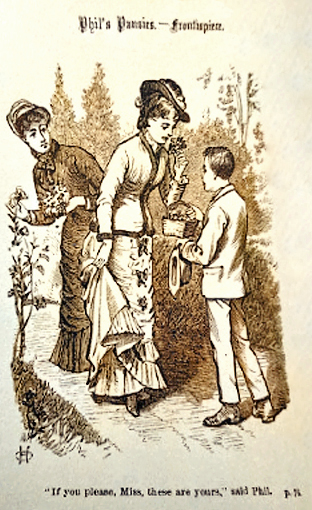
"Phil's Pansies."—Frontispiece. "If you please, Miss, these are yours," said Phil.
PHIL'S PANSIES.
A GOLDEN TEXT STORY.
BY
LUCY ELLEN GUERNSEY
AUTHOR OF
"IRISH AMY," "OPPOSITE NEIGHBORS," "TWIN ROSES," ETC.
————————— "Cast thy bread upon the waters: for thou shalt find it after many days."— Eccles. 11:1. —————————
PHILADELPHIA:
AMERICAN SUNDAY-SCHOOL UNION,
NO. 1122 CHESTNUT STREET. ————————— NEW YORK: 8 & 10 BIBLE HOUSE, ASTOR PLACE. CHICAGO: 73 RANDOLPH ST.
——————————————————————————————————————————————————————————————— Entered according to Act of Congress, in the year 1880, by the AMERICAN SUNDAY-SCHOOL UNION, In the Office of the Librarian of Congress, at Washington. ———————————————————————————————————————————————————————————————
PHIL'S PANSIES. ——————
CHAPTER FIRST.
THE SEEDS.
MISS ISABEL had been taking great pains with her class that day. She had walked down to Sunday-school, more than a mile, in the rain to meet her scholars, and she was expecting to walk home again. She had spent much time in studying the lesson herself, and she had noted down some things which she hoped the boys would like to hear. The "Golden Text" of the lesson was this:
"Cast thy bread upon the waters: for thou shall find it after many days" (Eccles. 11:1).
Miss Isabel had been telling the boys of the custom to which this verse referred, and of which, as it happened, none of them had ever heard. She told them how, in some parts of the world, there was very little rain, and the lands were watered by streams from some neighboring river or reservoir; how the farmers scattered their grain on the surface, and then, as the water sank into the ground, how the seed was buried and took root and grew; and so, after many days, the farmer found his "bread" again in the shape of ripe, waving grain, ready for the harvest.
You might think the boys would have been pleased to hear such a story as this, and that they would have listened and remembered, when she told them of what the seed cast on the waters was meant to represent; namely, the word of God, and the other means of doing good which he has placed in our hands, and which we must use at the right time and in the right way, even though our doing so should seem as hopeless work as throwing seed into the water.
But Horace Maberly had his head full of a boating frolic, which he meant to tell the boys about after school, and Harry Merton was thinking whether his aunt meant to ask him home to dinner with her, and John Drayton was watching a wasp, and the others had their heads full of nothing but idleness,—all but one. Phil O'Connor listened with all his ears, and they were very large ones, and what was better with all his heart and soul; and when Miss Isabel stopped talking, he ventured to ask a question. It was the first time he had spoken a word in the class, and he was a good deal scared at the sound of his own voice, but he kept on:
"Please, Miss Isabel, suppose you haven't any seed and no place to plant any?"
The other boys stared at Phil, and Horace laughed rather rudely, but Miss Isabel turned to him with a smile. She had been feeling tired and sad, and it was a real pleasure to perceive that one of the class at least had listened.
"I don't think that ever happens, Phil," said she. "God gives every one of us some kind of seed to sow, and some kind of a place to sow it in. It may be a very small, narrow corner that we have to cultivate; but if we work faithfully at that he is sure to give us more. We can all speak kindly to some one, or give some one a little help, or take some hindrance out of their way. A very poor old man once gave a boy poorer than himself a pair of old shoes to wear, that the boy might go to church and Sunday-school. The shoes had holes in them. The old man was fond of his coffee for breakfast, but he went without a whole week that he might have the money to get the shoes mended. The boy went to Sunday-school, where he learned to read and love his Bible, and he afterward became a useful and learned Christian minister. That was a very little bit of seed—a pair of old shoes—and see what a great crop it bore."