Part 3 / Book 2 — BOOK II.
Aline Delano translation
THE THREE CHILDREN.
I.
PLUS QUAM CIVILIA BELLA.
The summer of 1792 had been a very rainy one; but that of 1793 was so extremely warm that, although the civil war had gone far towards ruining the roads in Brittany, the people—thanks to the fine weather—were able to travel from place to place, for a dry soil makes the best road.
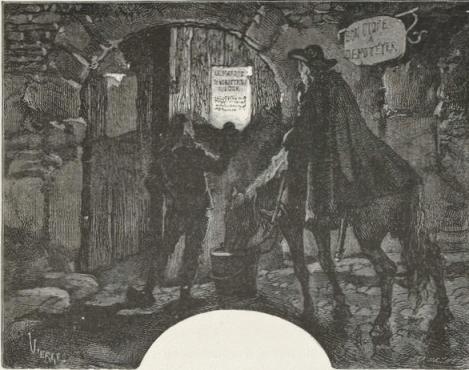
At the close of a clear July day, about an hour after sunset, a man on horseback, riding from the direction of Avranches, stopped before the little inn called the Croix-Blanchard, situated at the entrance of Pontorson. For some years its sign had borne the following inscription: "Good cider obtained here." The day had been a very warm one, but now the wind was beginning to rise.
The traveller was wrapped in an ample cloak that fell over his horse's back. He wore a broad-brimmed hat, ornamented with a tricolored cockade, which was rather a bold thing to do in a country like this, with its hedges and sharpshooting, for which a cockade offered an excellent target. The cloak fastened around his neck was pushed back, leaving his arms free, and revealing at the same time a tricolored belt and the butts of two pistols protruding from it, while a sabre hung down below the cloak. At the sound of the horses hoofs stopping before the inn the door opened, and the landlord came out, holding a lantern in his hand. It was just at twilight, when it is still light out of doors, although dark within.
The host glanced at the cockade.
"Do you mean to stop here, citizen?"
"No."
"Where are you going, then?"
"To Dol."
"In that case, you would do better to return to Avranches, or else remain at Pontorson."
"Why so?"
"Because they are fighting at Dol."
"Ah!" said the rider; then he continued, "Give my horse some oats."
The host, having brought the trough and poured the oats into it, proceeded to unbridle the horse, which began at once snuffing and champing, while the dialogue went on.
"Is this one of the requisition horses, citizen?" "No."
"Does it belong to you?"
"Yes. I bought him and paid for him."
"Where do you come from?"
"From Paris."
"Not directly?"
"No."
"I should say not. The roads are blocked; but the post still runs."
"As far as Alençon. I left it there."
"Ah, it will not be long before we shall have no more posts in France. The horses are all gone; one worth three hundred francs costs six hundred, and the price of fodder is beyond all reason. I used to be a postmaster; and now, you see, I keep a tavern. Out of thirteen hundred and thirteen postmasters, two hundred have resigned. Have you been travelling according to the new tariff, citizen?"
"You mean the tariff of the 1st of May? Yes."
"Twenty sous a post for a carriage, twelve for a gig, five for a van. Did you not buy this horse at Alençon?"
"Yes."
"And you have been travelling all day?"
"Yes, since dawn."
"And yesterday?"
"And the day before."
"I should think so. You came by the way of Domfront and Mortain."
"And Avranches."
"You had better take my advice, and rest, citizen. Are you not tired? Your horse certainly is."
"Horses may be tired, but men have no right to give way to fatigue."
Again the host gazed at the traveller, whose face, grave, calm, and severe, was framed by gray hair.
Casting a glance along the road, that was deserted as far as the eye could reach, he said,—
"And so you are travelling alone."
"I have an escort."
"Where is it?"
"My sabre and pistols."
The innkeeper went for a pail of water; and while he was watering the horse he contemplated the traveller, saying to himself, "He looks like a priest, all the same."
The rider continued,—
"You say there is fighting at Dol?"
"Yes. They are just about ready to begin."
"Who is fighting?"
"One ci-devant against another."
"How is that?"
"I mean that the ci-devant who is a Republican is fighting against another who takes sides with the king."
"But there is no longer a king."
"There is the little fellow. But the strangest part is that the two ci-devants are related to each other."
Here the rider listened attentively, while the innkeeper continued:—
"One is a young man, and the other an old one. It is the grand-nephew fighting against his great-uncle. The uncle is a Royalist, while the nephew is a patriot; the uncle commands the Whites, the nephew the Blues. Ah! they will show no mercy to each other, you may be sure! It is a war to death!"
"Death?"
"Yes, citizen. Perhaps you might like to see the polite speeches they fling at each other's head. Here is a placard, which the old man has managed to post on all the houses and trees, and which I found had been stuck on my very door."
The host held up his lantern to a square bit of paper glued upon one of the panels of his door, and as it was written in very large characters, the rider was able to read it as he sat in his saddle:—
"The Marquis de Lantenac has the honor to inform his grand-nephew the Viscount Gauvain that if the Marquis is so fortunate as to take him prisoner, M. le Viscount may rest assured that he will be speedily shot."
"And here is the reply," continued the innkeeper.
He turned so as to throw the light of his lantern upon a second placard on the other panel of the door, directly opposite the first one.
"Gauvain warns Lantenac that if he catches him he will have him shot."
"Yesterday the first placard was posted on my door," said the host, "and this morning came the second. He was not kept waiting for his answer."
The traveller, in an undertone, as though speaking to himself, uttered certain words which the innkeeper caught without fully understanding their meaning:—
"Yes, this is more than waging war against one's native land; it is carrying it into the family. And it must needs be done; great regenerations are only to be purchased at this price."
And the traveller, with his eyes still riveted to the second placard, lifted his hand to his hat and saluted it.
The host continued:—
"You see, citizen, this is the way matters stand. In the cities and in larger towns we are in favor of revolution, but in the country they are opposed to it; which amounts to saying that we are Frenchmen in the cities, and Bretons in the villages. It is a war between the peasants and the townspeople. They call us patauds,[1] and we call them rustauds.[2] They have the nobles and the priests on their side."
"Not all of them," interrupted the rider.
"That is true, citizen, for here we have a Viscount fighting against a Marquis; and I verily believe," he added aside, "that I am speaking to a priest at this minute."
"Which of the two is likely to gain the day?"
"I should say the Viscount, so far. But he has a hard time of it. The old man is a tough customer. They belong to the Gauvains, a noble family in these parts, of which there are two branches; the Marquis de Lantenac is the head of the older, and the Viscount Gauvain of the younger branch. To-day the two branches are fighting each other. You never see this among trees, but often among men. This Marquis de Lantenac is all-powerful in Brittany; the peasants regard him as a prince. On the very day he landed he rallied eight thousand men; in a week three hundred parishes had risen. If he had only been able to establish a foothold on the coast, the English would have made a descent. Luckily Gauvain, who, strange to say, is his grand-nephew, was on the spot. He is a Republican commander, and has got the upper hand of his great-uncle. And then, as good luck would have it, this Lantenac at the time of his arrival, when he was massacring a multitude of prisoners, gave orders to have two women shot, one of whom had three children, who had been adopted by a Paris battalion. This roused the rage of the battalion, which is called the Bonnet-Rouge. There are but few of the original Parisians left, but they are desperate fighters. They have been incorporated into Commandant Gauvain's division. Nothing can resist them. Their great object is to avenge the women and recapture the children. No one knows what the old Marquis did with the little ones, and that is what infuriates the Parisian grenadiers. Had not these children been mixed up in it, this war would not have been what it is. The Viscount is a good and brave young fellow; but the old man is a terrible Marquis. The peasants call this the war of Saint Michel against Beelzebub. You know, maybe, that Saint Michel is the patron of these parts. There is a mountain named after him in the middle of the bay. They give him credit for conquering the Devil and burying him under another hill not far away, called Tombelaine."
"Yes," murmured the rider. "Tumba Beleni,—the tomb of Belenus, Belus, Bel, Belial, Beelzebub."
"I see that you are well informed." And the host said to himself,—
"He knows Latin; surely he must be a priest." Then he added:—
"Well, citizen, this war is beginning all over again for the peasants. No doubt they think the Royalist general is Saint Michel, and the patriot commander Beelzebub; but if there is a devil it is Lantenac, and Gauvain is an angel if there ever was one. Will you take nothing, citizen?"
"I have my gourd and a bit of bread. But you have not told me what is going on at Dol."
"To be sure; well, Gauvain is in command of the exploring division of the coast. Now, Lantenac's plan was to stir up a general insurrection, to bring Lower Normandy to the aid of Lower Brittany, to throw open the door to Pitt, and to lend a helping hand to the great Vendean army in the shape of twenty thousand English and two hundred thousand peasants. Gauvain has checkmated this plan. He holds the coast and drives Lantenac back into the interior and the English into the sea. Lantenac was here, but Gauvain dislodged him, recaptured Pont-au-Beau, drove him out from Avranches and Villedieu, and prevented him from reaching Granville. He is manoeuvring now to force him to retreat into the forest of Fougères, and there to surround him. Yesterday everything was favorable, and Gauvain was here with his division. All at once, mind you, the old man, who is a shrewd one, made a point; the news came that he had marched on Dol. If he should take it, and succeeds in establishing a battery on Mont-Dol,—for he has artillery,—that will give the English a chance to land, and then all is lost. That is the reason why Gauvain, who has a head on his shoulders, knowing there was not a moment to be lost, consulted no one; nor did he wait for orders, but giving the signal to saddle, and harnessing his artillery, he collected his troops, drew his sabre, and while Lantenac is hurrying towards Dol, Gauvain is all ready to pounce upon Lantenac; and Dol is to be the place where these two Breton heads will clash, and a famous crash it will be. They are at it now."
"How long does it take to reach Dol?"
"For troops with artillery carriages, at least three hours; but they are there now."
The traveller, as he listened, said,—
"You are right; I think I can hear the cannon." The host, too, was listening.
"Yes, citizen, and the firing is steady. You had better spend the night here. There is nothing to be gained by going over there."
"I cannot stop. I must continue my journey."
"You are wrong. I do not know anything about your business, but the risk is great, and unless all that you hold dearest in the world is at stake—"
"That is precisely the state of things," replied the rider.
"Now, supposing your son—"
"You are very near the truth," said the rider.
The innkeeper raised his head as he said to himself,—
"And yet I thought this citizen was a priest." Then, after a moment's reflection, he added: "But a priest may have children, after all."
"Put the bridle back on my horse," said the traveller. "How much do I owe you?"
After receiving his pay, the host put the trough and bucket against the wall, and came back to the traveller.
"Since you are determined to go, take my advice. You must be going to Saint-Malo. Now, then, do not go by the way of Dol. There are two roads,—one leading through Dol, and the other along the coast. There is very little difference in their length. The road along the coast passes through Saint-Georges-de-Brehaigne, Cherrueix, and Hirelle-Vivier. You leave Dol to the south, and Cancale to the north, and at the end of this street, citizen, you will come to a place where the two roads fork,—that of Dol to the left, that of Saint-Georges-de-Brehaigne to the right. Mark my words: if you go to Dol, you will plunge headlong into the massacre; so do not take the left-hand turning, but keep to the right."
"Thank you," said the traveller.
And he set spurs to his horse.
As it was now quite dark, he soon vanished in the gloom, and the innkeeper lost sight of him.
When the traveller reached the end of the street where the two roads forked, he heard the voice of the innkeeper calling to him from the distance,—
"Turn to your right!"
He turned to the left.
II.
DOL.
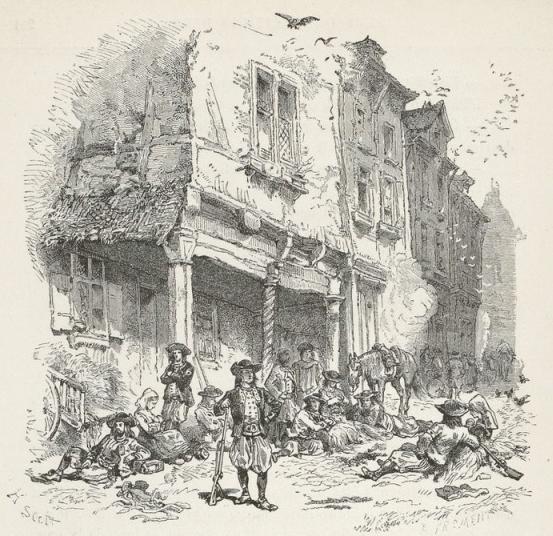
Dol, a Franco-Spanish city in Brittany, as the old records call it, is not really a city; it is a street,—a grand old Gothic street, with rows of houses supported by pillars on both sides of it. These houses are not built in straight lines, but stand irregularly, now and then elbowing into the street, which is, to be sure, a very wide one. The rest of the town is a mere network of lanes, all leading into this great diametrical street,—emptying into it, one might say, like streams into a river, with Mont-Dol towering above it. The city, with neither gates nor walls, could not have withstood a siege; but the street was quite capable of sustaining one. The houses, like promontories, which but fifty years ago were still standing, and the two pillared galleries bordering the street, made it a strong and well-nigh impregnable redoubt. Each of the houses was a fortress in itself, and the enemy would have found himself forced to capture them one by one. Almost in the middle of the street stood the old market.
The innkeeper of the Croix-Branchard had told the truth; a furious battle was raging in Dol even while he was speaking. A nocturnal duel between the Whites who arrived in the morning and the Blues who appeared at night had burst suddenly upon the town. The forces were unequal, the Whites numbering six thousand, while the Blues were only fifteen hundred; but they fought with equal fury. Surprising as it may seem, it was the fifteen hundred who attacked the six thousand.
A mob pitted against a phalanx. On one side were six thousand peasants, with images of the Sacred Heart upon their leathern waistcoats, white ribbons on their round hats, Christian emblems on their leather cuffs, rosaries hanging from their belts, carrying pitchforks oftener than sabres, and carbines without bayonets, dragging along cannon by means of ropes, wretchedly equipped, undisciplined, with no suitable weapons, yet mad with rage. On the other side were fifteen thousand soldiers, wearing three-cornered hats with the tricolored cockade, long-tailed coats, with broad lapels, and shoulder-belts crossed, short sabres with copper hilts, muskets with long bayonets, well-drilled and disciplined, obedient though savage, knowing how to obey like men who could at need command, volunteers like the others, but patriots withal, although barefooted and in rags; paladins in the shape of peasants fighting in defence of Monarchy; barefooted heroes in the ranks of the Revolution; while the life and soul of both Royalists and Republicans was centred in their leaders,—Lantenac, the man advanced in years, and the young Gauvain.
Standing side by side in the Revolution with young giants like Danton, Saint-Just, and Robespierre, were the ideal and youthful forms of Hoche and Marceau, and like unto them was Gauvain.
Gauvain was thirty years of age, with the chest of Hercules, the solemn eye of a prophet, and the laugh of a child. He never smoked; he neither drank nor swore. He carried a dressing-case with him throughout the entire war, and took great care of his nails, his teeth, and his luxuriant brown hair. Whenever they halted, it was his habit carefully to shake his commander's uniform, riddled with balls and whitened with dust as it was. Though always rushing headlong into the thickest of the fray, he had never been wounded. His voice, unusually melodious, could assume at need the imperative ring of command. He set the example of sleeping on the ground, in the wind, the rain, and the snow, wrapped in his cloak, with his charming head resting on a stone. His was a heroic and innocent soul. Let him but take a sabre in his hand, he was straightway transformed. He had that effeminate aspect that changes to something formidable in battle.
A thinker and philosopher withal; in short, a youthful sage. Beautiful to look upon as Alcibiades, his speech showed the wisdom of Socrates.
In that grand improvisation which men called the French Revolution, this young man at once became a leader.
The division which he had formed was like a Roman legion; an army on a small scale, complete in itself; it consisted of infantry and cavalry; it had its scouts, its pioneers, its sappers, its engineers; and as the Roman legion had its catapults, this army had its cannon. Three well-mounted pieces strengthened the division, while leaving it easy to handle.
Lantenac was also a military leader, but a more accomplished one,—more cautious, and at the same time more daring. The veritable old hero is cooler than a younger man, because he is farther removed from the heyday of life, and more daring from the consciousness that he is nearer death. What has he to lose? So slight a matter. This explains the bold and yet scientific manoeuvres of Lantenac. Yet on the whole, in this obstinate wrestling-match between the old and the young, Gauvain almost always had the advantage, and he owed this rather to chance than to anything in himself. Every sort of good-fortune, even though it may be terrible, falls to the lot of youth. Victory has something feminine in its nature.
Lantenac was exasperated with Gauvain; first, because his nephew had defeated him, and second, because he was his nephew. What possessed him to be Jacobin?—a Gauvain! Unruly youngster that he was. His heir,—for the Marquis had no children,—a great-nephew, almost a grandchild! "Ah!" cried this quasi grandfather, "if he falls into my hands, I will kill him like a dog."
The Republic, moreover, had good reason to feel uneasy about this Marquis de Lantenac. He had no sooner landed than its terror began. The mere utterance of his name was like a powder-train spread through the Vendean insurrection, of which he straightway became the centre. In a revolt of this kind, where each one is jealous of his neighbor, where each has his bush or his ravine, if a superior leader appears, the separate chiefs who have been on a level will rally round him and submit themselves to his authority. Nearly all the forest captains had joined Lantenac, and whether near or remote, they all obeyed him. Only Gavard, who had been the first to join him, had departed. And why was this? Because he had enjoyed the confidence of the Republic and been in a position of authority. Gavard had held all the secrets and had adopted the old-fashioned system of civil war, which Lantenac had come to change and replace. A successor can hardly agree with a man of that stamp. The shoe of La Rouarie was not a fit for Lantenac, and so Gavard had gone to join Bonchamp.
Lantenac belonged to the military school of Frederic II.; he understood the art of warfare, which consists of combining the greater with the lesser; he favored neither the great Catholic and Royal army, that "mass of confusion" destined to be crushed, nor the guerilla troops scattered through the thickets and hedges, useful to harass, but powerless to crush. There is either no end to guerilla warfare, or else it comes to an unfortunate one: it begins by attacking the Republic and ends by robbing a diligence. Lantenac did not propose to carry on the Breton war altogether in the open country like La Rochejaquelein, nor yet in the forest like Chouan. He neither approved of the Vendée nor of the Chouannerie; he believed in real warfare; he was willing to use the peasant, but he wished to support him by the soldier. He required bands for strategy and regiments for tactics. The village armies so easily disbanded he considered excellent for an attack, an ambush, or a surprise, but he felt that they lacked solidity; they were like water in his hands; he sought a solid foundation for this unstable and diffusive warfare; to the savage army of the forest he proposed to add regular troops as a sort of pivot about which to manoeuvre the peasants. Had this scheme, deep-laid and terrible as it was, proved successful, the Vendée would never have been conquered.
But where could regular troops be found? Where look for soldiers? Where seek for regiments, and find a ready-made army? In England. Hence Lantenac's determination that the English should effect a landing. Thus do parties compromise with their consciences. He quite lost sight of the red coat, eclipsed as it was by the white cockade. Lantenac had but one idea,—first to seize upon some point on the coast, and then to deliver it into the hands of Pitt. It was with this object that, seeing Dol unprotected, he had thrown himself upon it, knowing that once in possession of Dol, he could readily gain Mont-Dol, and by means of the latter gain a footing on the coast.
The spot was well chosen. From Mont-Dol the cannon would sweep Fresnois on one side; and Saint-Brelade, on the other, would keep the fleet of Cancale at a distance, and leave the whole beach, from Raz-sur-Couesnon to Saint-Mêloir-des-Ondes, open to an attack.
In order to insure success, Lantenac had brought with him six thousand of the most active men in the regiment at his disposal, together with all his artillery,—ten sixteen-pound culverins, one demi-culverin, and one four-pounder. He proposed to establish a strong battery on Mont-Dol, on the principle that a thousand shots fired from ten cannon do more execution than fifteen hundred fired from five cannon.
With six thousand men, he felt sure of success. In the direction of Avranches they had nothing to fear but Gauvain with his fifteen hundred men. Towards Dina there was Léchelle, to be sure, with twenty-five thousand; but he was twenty leagues away. In regard to the latter, Lantenac felt quite safe, the distance offsetting the numbers; and as for Gauvain though he was quite near, his force was very small. WE may here remark that Léchelle was a fool, who afterwards allowed his twenty-five thousand men to be slaughtered on the moors of Croix-Bataille,—a mistake for which he strove to atone by suicide.
So Lantenac felt quite safe. His entrance into Dol had been sudden and stern. The Marquis de Lantenac enjoyed a hard reputation; and knowing him to be merciless, the terrified inhabitants shut themselves up in their houses without attempting resistance, and the six thousand Vendeans installed themselves in the city after the disorderly fashion of a band of rustics. It was almost like a market-ground; in default of quartermasters, they chose their own quarters, camping at haphazard, cooking, in the open air, dispersing hither and yonder through the churches, dropping their muskets to take up their rosaries. Lantenac, accompanied by a few artillery officers, proceeded without delay to reconnoitre Mont-Dol, leaving Gouge-le-Bruant, whom he had appointed field-sergeant, in command. This Gouge-le-Bruant has left but an indistinct trace in history. He had two nicknames,-Brise-Bleu in token of his massacre of the patriots, and Imânus, because there was something indescribably horrible about him. Imânus is derived from immanis, and old Low-Norman word, which expresses a superhuman degree of ugliness, almost godlike in its terror,—a demon, a satyr, an ogre. An old manuscript says, "With my own eyes I beheld Imânus." To-day the old people in Brittany no longer know who Gouge-le-Bruant was, nor what Brise-Bleu means; but they have a vague idea of the Imânus, whose name is interwoven with all the local superstitions. He still is spoken of in Trémorel and Plumaugat,—the two villages where Gouge-le-Bruant has left the impress of his ill-omened footstep. In the Vendée, where all the inhabitants were savages, Gouge-le-Bruant was the barbarian. He was a sort of Cacique tattooed all over with crucifixes and fleurs-de-lis. Upon his face was the hideous, almost supernatural glow of a soul unlike that of any other human being. He was as brave in battle as Satan himself, and atrociously cruel when the battle was over. His heart, full of mysterious determinations, now urged him to acts of devotion, now to deeds of wildest fury. Did he use his reason? Yes, after a serpentine fashion. Heroism was his starting-point, murder his goal. It was impossible to conceive how his resolutions, often grand in their very monstrosity, could have entered his mind. He was capable of any horror, when least expected. His ferocity was on a scale of epic grandeur.
Hence his peculiar surname, Imânus.
The Marquis de Lantenac relied upon his cruelty; but while none could dispute the fact that he excelled in cruelty, in matters of strategy and tactics he was less efficient, and it may perhaps have been a mistake on the part of the Marquis when he made him his field-sergeant. But however that may be, he left him behind in charge, with the injunction to look after matters in general.
Gouge-le-Bruant was more of a fighter than a soldier, and guarding a town was not so much in his line as massacring a clan would have been; still, he posted sentries. When at nightfall the Marquis, having decided upon the position of his battery, was returning to Dol, he suddenly caught the sound of cannon. Looking in the direction of the sound, he saw a red smoke rising from the street. This meant a surprise, an invasion, an attack; fighting was going on in the town.
Although not easily taken by surprise, he was now utterly amazed, for he had anticipated nothing of the sort. What could it mean? Evidently not Gauvain, for a man would hardly attack an enemy outnumbering him four to one. Could it be Léchelle? But was it possible for him to have made such a forced march? Léchelle was improbable, Gauvain impossible.
Lantenac urged on his horse. On the way he met some of the inhabitants in the act of flight; but when he questioned them, they seemed beside themselves with terror, crying, "The Blues! the Blues!" And on his arrival he found the situation a bad one.
This is what had happened.
III.
SMALL ARMIES AND GREAT BATTLES.
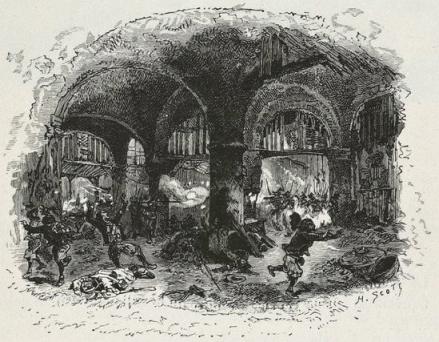
On their arrival at Dol, the peasants, as we have seen, had dispersed through town, each man guided by his own fancy, as it often happens when "on obéit d'amitié," as the Vendeans expressed it,—a form of obedience that may produce heroes, but not well-disciplined soldiers. They had stored their artillery, together with the baggage, under the arches of the old market, and feeling weary, when they had eaten and drunk and said their beads, they stretched themselves out in the middle of the principal street, that was encumbered rather than guarded. As night came on most of them fell asleep, pillowing their heads on their knapsacks, some having their wives beside them; for it often happened that the peasant women followed the men. In the Vendée, women about to become mothers frequently acted as spies. It was a mild July night The constellations shone forth against the deep-blue sky. The entire bivouac, which might have been mistaken for the halt of a caravan rather than for a military encampment, gave itself up to quiet slumber. Suddenly by the glimmering twilight those who were still awake perceived three cannon levelled at the entrance of the principal street.
It was Gauvain. He had surprised the guard, had entered the town, and with his division held the entrance of the street.
A peasant started up, crying, "Who goes there?" and fired off his musket. A cannon-shot, followed by a terrific volley of musketry, was the reply. The whole sleeping crowd sprang up with a start. It was a rude shock to be roused by a volley of grape-shot from a peaceful sleep beneath the stars.
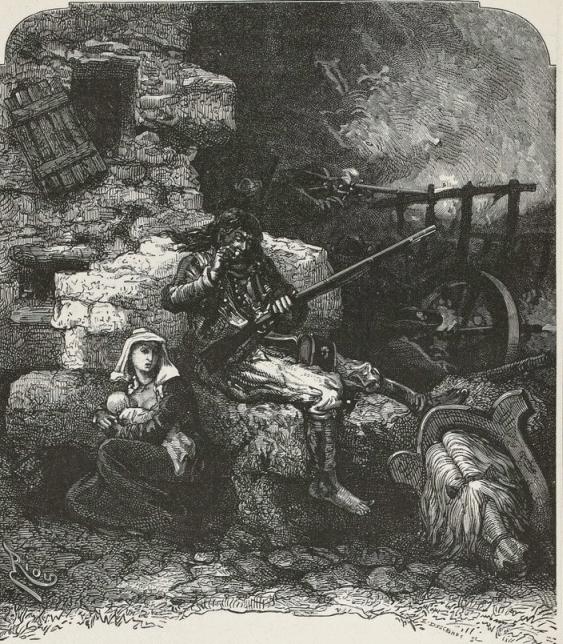
The first moment was terrific. There is nothing more tragic than the confusion of a panic-stricken crowd. They snatched their weapons. Many fell as they ran yelling to and fro. Confused by the unexpected assault, the lads lost their heads and fired madly at one another. The townspeople, bewildered by all this confusion, rushed in and out of their houses, shouting to each other as they wandered helplessly about,—a dismal struggle in which women and children played a part. The balls whistling through the air left streaks of light in the darkness behind them. Amid the smoke and tumult a constant firing issued from every dark corner. The entanglement of the baggage-wagons and cannon-carriages was added to the general confusion. The horses, rearing, trampled upon the wounded, whose groans could be heard on every side. Some were horror-stricken, others stupefied. Officers were looking for their men, and soldiers for their officers. In the midst of all this some there were who displayed a stolid indifference. One woman, seated on the fragment of a wall, was nursing her new-born babe, while her husband, with bleeding wounds and a broken leg, leaned against it as he calmly loaded his musket and fired at random in the darkness, killing or not, as it happened. Men lying flat on the ground fired between the spokes of the wagon-wheels. At times there rose a hideous din of clamors, and again the thundering voice of the cannon would overwhelm all. It was frightful,—like the felling of trees when one falls upon the other.
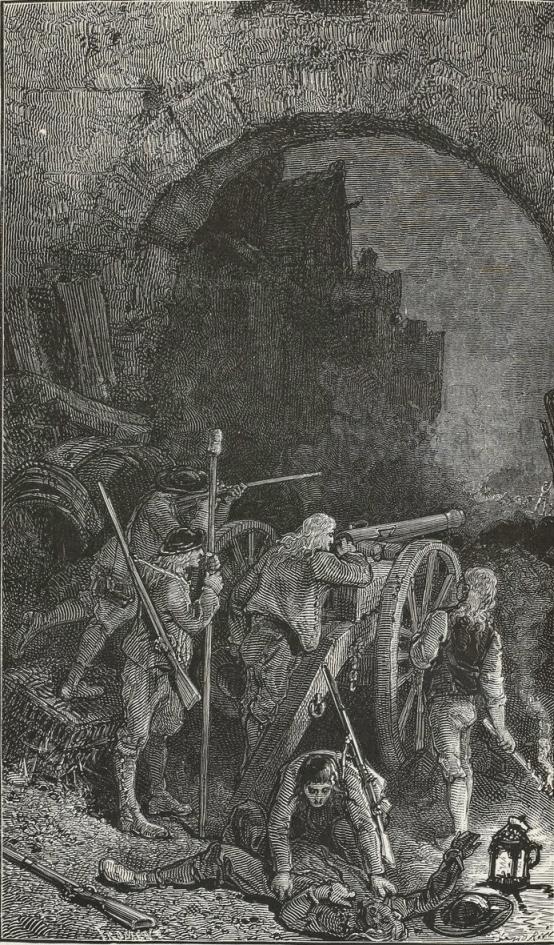
Gauvain from his ambush aimed with precision, and lost but few men. But at last the peasants, intrepid in spite of the disaster, ended by taking the defensive. They fell back on the market, which was like a great dark fortress, with its forest of stone pillars. There they made a stand; anything that resembled a forest inspired them with courage. The Imânus did his best to atone for the absence of Lantenac. They had cannon; but, to the great surprise of Gauvain, they made no use of them. This was due to the fact that the artillery officers had gone with the Marquis to reconnoitre Mont-Dol, and the peasants did not know how to manage the culverins and demi-culverins; but they riddled with balls the Blues who cannonaded them. The peasants answered the grape-shot by a volley of musketry. They now had the advantage of a shelter, having heaped up the drays, the carts, the baggage, and all the small casks that were lying about in the old market, thus improvising a high barricade, with openings through which they could pass their muskets, and from which they opened a deadly fire. So rapidly had they worked, that in a quarter of an hour the market presented an impregnable front.
Matters were beginning to look serious for Gauvain. The sudden transformation of a market into a fortress, and the peasants assembled in a solid mass within, was a condition of affairs which he had not anticipated. He had taken them by surprise, it is true; but he had not succeeded in routing them. He had dismounted, and holding his sword by the hilt, he stood with folded arms, gazing steadfastly into the gloom, his own figure distinctly revealed by the flame of the torch that lighted the battery,—a target for the men of the barricade; of which fact he took no heed, as he stood there lost in thought, while a shower of balls from the barricade fell around him.
He set his cannon against their rifles; and victory is ever on the side of the cannon-ball. He who has artillery is sure to win the day, and his well-manned battery gave him the advantage.
Suddenly a flash of lightning burst forth from the dark market; there came a report like a peal of thunder, and a bullet went crashing through a house over Gauvain's head.
The barricade was paying him back in his own coin.
What was going on? This was a new development. The artillery was no longer confined to one side.
A second ball followed the first, embedding itself in the wall close to Gauvain; and a third ball knocked off his hat.
These balls were of a calibre so heavy that they must have been fired from a sixteen-pounder.
"They are aiming at you, commander," cried the gunners, as they put out the torch; and Gauvain, still absorbed in his reverie, stooped to pick up his hat.
Some one was indeed aiming at Gauvain, and it was Lantenac.
The Marquis had just reached the barricade from the opposite side.
The Imânus hastened to meet him.
"Monseigneur, we have been taken by surprise."
"By whom?"
"I do not know."
"Is the road to Dinan open?"
"I believe so."
"We must begin to retreat."
"We have done so. Many have already fled."
"I am not speaking of flight, but of retreat. Why did you not use the artillery?"
"The men were beside themselves, and then the officers were absent."
"I was to be here."
"Monseigneur, I sent everything I could on to Fougères,—the women, the baggage, and all useless incumbrances; but what is to be done with the three little prisoners?"
"Do you mean the children?"
"Yes."
"They are our hostages. Send them on to the Tourgue."
So saying, the Marquis started for the barricade, and directly after his arrival things took on another aspect. The barricade was not well constructed for artillery; there was room for but two cannon; the Marquis placed in position the two sixteen-pounders for which embrasures were made. As he was leaning on one of the cannon, watching the enemy's battery through the embrasure, he caught sight of Gauvain.
"It is he!" he cried.
Then, taking the swab and the ramrod, he loaded the piece, adjusted the sight, and took aim.
Three times he aimed at Gauvain and missed him, but the third shot knocked off his hat.
"Bungler!" murmured Lantenac. "A little lower, and I should have had his head."
Suddenly the torch went out, and he had only darkness before him.
"Well, let it go," he said.
And turning to the peasant gunners, he exclaimed:
"Let them have the grape-shot!"
Gauvain for his part was also in deadly earnest. The situation had become a serious one since the development of this new phase of the conflict, and the barricade was now cannonading him. Who could tell how soon it might pass from the defensive to the offensive? The enemy numbered at least five thousand, even allowing for the dead and the fugitives, while he had no more than twelve hundred service-able men at his command. What would happen to the Republicans if the enemy should become aware of their limited number? Their rôles would soon be reversed; from playing the part of assailants, he would become the object of assault. If the barricade were to make a sortie, all would be lost.
What was to be done? It was out of the question to think of attacking the barricade in front; an attempt to capture it by main strength would be folly; twelve hundred men could not dislodge five thousand. Imperative as it was to make an end of it, knowing as he did that delay was fatal, still he realized that to force the enemy's hand would be impossible. What was he to do?
Gauvain belonged to this neighborhood; he was familiar with the town, and knew that behind the old market, where the Vendeans were intrenched, was a labyrinth of narrow and crooked streets.
He turned to his lieutenant, the brave Captain Guéchamp, who afterwards became famous for clearing the forest of Concise, where Jean Chouan was born, and who prevented the capture of Bourgneuf by cutting the rebels off from the highway that led to the pond of La Chaine.
"Guéchamp," said Gauvain, "I intrust you with the command. Fire as rapidly as possible. Riddle the barricade with cannon-balls, and keep them busy over yonder."
"I understand," said Guéchamp.
"Mass the whole column with their guns loaded, and hold them in readiness for an attack."
He whispered a few words in Guéchamp's ear.
"It shall be done," said the latter.
Gauvain continued,—
"Are all our drummers ready?"
"Yes"
"We have nine. Keep two and give me seven."
The seven drummers silently ranged themselves in front of Gauvain.
"Step forward, battalion of the Bonnet-Rouge!" exclaimed Gauvain.
Twelve soldiers, one of whom was a sergeant, stepped from the ranks.
"I called for the whole battalion," said Gauvain.
"Here it is," replied the sergeant.
"Are there but twelve?"
"Only twelve of us left."
"Very well," said Gauvain.
This sergeant was that very Radoub, the rough and kindly soldier who in the name of the battalion had adopted the three children found in the forest of La Saudraie.
It will be remarked that only half that battalion was massacred at Herbe-en-Pail, and Radoub, by good luck, was not among them.
A forage-wagon was standing near, and Gauvain pointed it out to the sergeant.
"Let your men weave ropes of straw and bind them around their muskets to deaden the noise when they clash against each other."
A minute went by; the order was silently executed in the darkness.
"It is done," said the sergeant.
"Take off your shoes, soldiers," continued Gauvain.
"We have none," replied the sergeant.
Including the drummers, they numbered nineteen men; Gauvain was the twentieth.
"Follow me, in single file!" cried Gauvain. "Let the drummers go before the battalion. You will command the battalion, sergeant!"
He placed himself at the head of this column, and while the cannonading still continued on both sides, these twenty men glided along like shadows and plunged into the deserted lanes.
Thus they proceeded for some time, skirting along the fronts of the houses. It seemed as though the whole town were dead; the citizens had taken refuge in their cellars. Every door was barred and every shutter closed. Not a light was to be seen anywhere.
But through this silence they still heard the awful din on the principal street: the cannonading went on; the Republican battery and the Royal barricade spit out their grape-shot with unabated fury.
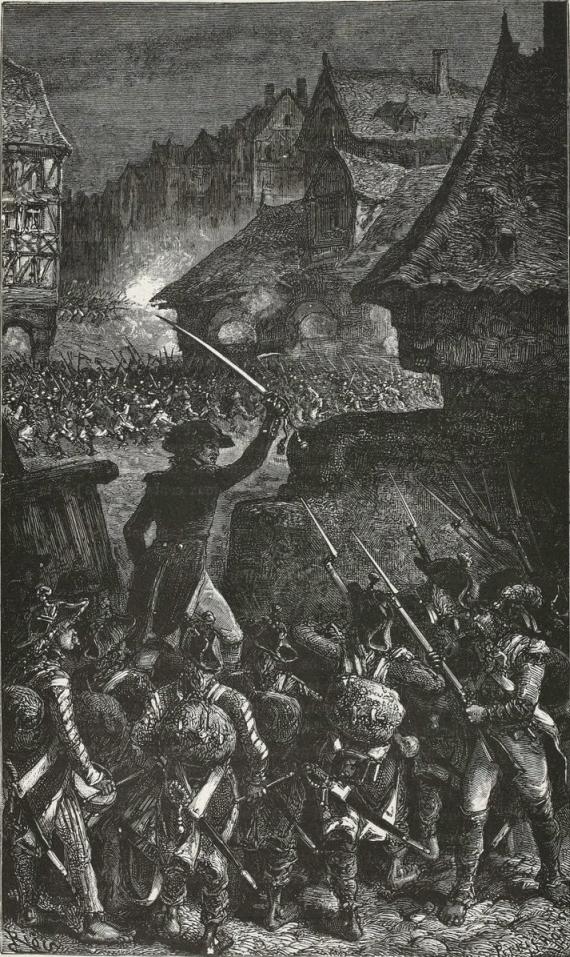
After marching twenty minutes, winding in and out, Gauvain, who had led the way unerringly through this darkness, reached the end of a lane that led into the principal street; they were now, however, on the other side of the market.
The position was changed. On that side there was no intrenchment,—a common mistake of barricade builders; the market was open, and one could walk in under the pillars, where several baggage-wagons stood ready to leave. Gauvain and his nineteen men were in the presence of the five thousand Vendeans as before, only instead of facing them they found themselves in their rear.
Gauvain whispered to the sergeant; the straw was unwound from the muskets, and the twelve grenadiers ranged themselves in a line behind the corner of the lane, while the seven drummers, with uplifted drumstick, waited for the signal.
The artillery firing was intermittent, when suddenly, during the interval between two discharges, Gauvain raised his sword, and in a voice that rang out like a clarion upon the silence, exclaimed,—
"Two hundred men to the right, two hundred to the left, the rest in the centre."
The drums beat and the twelve musket-shots were fired.
Then Gauvain uttered the formidable battle-cry of the Blues,—
"Charge! Bayonets!"
The effect was wonderful.
All this crowd of peasants finding themselves assailed in the rear, imagined that another army had come up from behind. At the same time, on hearing the beating of the drums, the column which held the upper part of the street and was commanded by Guéchamp began to move, sounding the charge in its turn, and starting on the run, attacked the barricade; the peasants saw themselves between two fires. A panic magnifies, and at such moments a pistol-shot sounds like the report of a cannon; imagination distorts every sound, and the barking of a dog seems like the roar of a lion. Let us add, moreover, that the peasant takes fright as easily as a thatch catches fire, and as quickly as a burning thatch becomes a conflagration, a panic among peasants grows into a rout; and on this occasion the flight was beyond description.
In a few moments the market was deserted; the terrified lads scattered in all directions, and the officers were helpless. The Imânus killed two or three of the fugitives, but it was of no avail. Nothing could be heard save the cry, "Sauve qui peut," and with the rapidity of a cloud driven onward by a hurricane, the entire army scattered through the streets as through the meshes of a sieve and vanished into the country.
Some fled towards Châteauneuf, some towards Plerguer, and others in the direction of Antrain.
The Marquis de Lantenac, who was the last man to leave the scene, spiked the guns with his own hands, and then quietly and calmly took his departure, saying as he went,—
"It is evident that the peasants cannot be depended upon to stand their ground. We need the English."
IV.
A SECOND TIME.
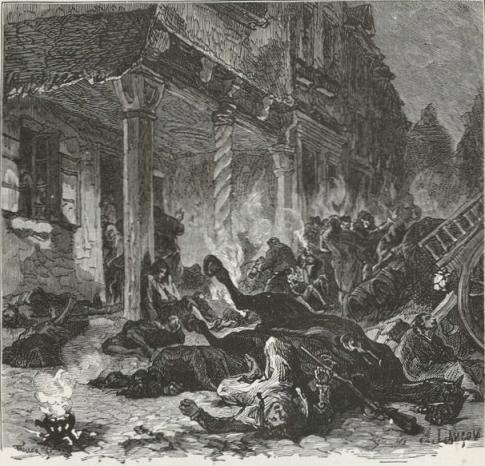
They had won the victory, and, turning to the men of the battalion of the Bonnet-Rouge, Gauvain exclaimed,—
"Though you are but twelve, you are equal to a thousand."
One word from the chief in times like these was as good as the cross of honor.
Guéchamp, who had been sent by Gauvain outside the city in pursuit of the fugitives, captured many of them.
Torches were lighted, and the town was searched.
All those who had not been able to escape, surrendered themselves. The principal street, illuminated by pots-à-feu, was strewn with the dead and the wounded. The fierce struggle that always terminates a battle was still continued by a few groups of desperate fighters, who, however, on being surrounded, threw down their arms and surrendered.
Gauvain had observed amid the wild tumult of the flight a fearless man, vigorous and agile as a faun, who stood his own ground while covering the flight of the others. This peasant, after handling his musket like an expert, alternately firing: and Rising the butt as a club, until he had broken it, now stood grasping a pistol in one hand and a sabre in the other, and no man dared approach him. Suddenly Gauvain saw him reel, and lean against one of the pillars of the principal street. He was evidently wounded, but he still held his sabre and his pistols. Gauvain put his sword under his arm and came up to him. As he called upon him to surrender, the man gazed steadily at him, while the blood oozing from his wound formed a pool at his feet.
"You are my prisoner," said Gauvain. "What is your name?"
"Danse-à-l'Ombre," was the reply.
"You are a brave fellow," said Gauvain, extending his hand.
"Long live the King!" cried the man.
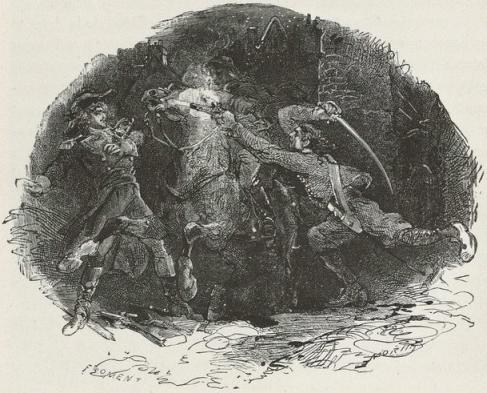
Then gathering all his strength, and raising both hands simultaneously, he fired his pistol at Gauvain's heart, at the same time aiming a blow at his head with the sabre.
This movement, tiger-like in its rapidity, was yet forestalled by the action of another. A horseman had appeared on the scene; he had been there for some moments without attracting attention, and when he saw the Vendean lift his sabre and pistol, he threw himself between the latter and Gauvain, intercepting the sabre-thrust by his own person, while his horse was struck by the pistol-shot, and both horse and rider fell to the ground. Thus Gauvain's life was saved. All this took place as quickly as one would utter a cry.
The Vendean also sank to the pavement.
The blow from the sabre struck the man full in the face; he lay on the ground in a swoon. The horse was killed.
Gauvain drew near, asking, as he approached, if any could tell who he was.
On looking at him more closely he saw that the blood was gushing over the face of the wounded man, covering it as with a red mask, and rendering it impossible to distinguish his features. One could see that his hair was gray.
"He has saved my life," said Gauvain. "Does any one here know him?"
"Commander," said a soldier, "he has but just arrived in town. I saw him coming from the direction of Pontorson."
The surgeon-in-chief of the division hurried up with his instrument-case.
The wounded man was still unconscious, but after examining him the surgeon said,—
"Oh, this is nothing but a simple cut. It can be sewed, and in eight days he will be on his feet again. That was a fine sabre-cut."
The wounded man wore a cloak and a tricolored belt, with pistols and a sabre. They placed him on a stretcher, and after undressing him, a bucket of water was brought, and the surgeon washed the wound. As the face began to appear, Gauvain studied it attentively.
"Has he any papers about him?" he asked.
The surgeon felt in his side pocket and drew out a pocket-book, which he handed to Gauvain.
Meanwhile the wounded man, revived by the cold water, was regaining his consciousness. His eyelids quivered slightly.
Gauvain was looking over the pocket-book, in which he discovered a sheet of paper folded four times; he opened it and read,—
"Committee of Public Safety. Citizen Cimourdain—"
"Cimourdain!" he cried; whereupon the wounded man opened his eyes.
Gauvain was beside himself.
"It is you, Cimourdain! For the second time you have saved my life."
Cimourdain looked at Gauvain, while a sudden burst of joy, impossible to describe, lit up his bleeding face.
Gauvain fell on his knees before him, exclaiming:
"My master!"
"Thy father!" said Cimourdain.
V.
A DROP OF COLD WATER.
It was many a year since last they met, but their hearts had never been separated, and they knew each other again as if they had parted but yesterday.
A hospital had been improvised in the town hall of Dol, and Cimourdain was placed on a bed in a small room adjoining the large hall devoted to the other wounded men. The surgeon who had sewed up his wound put a stop to all exciting conversation between the two men, considering it wiser to leave Cimourdain to sleep. Besides, Gauvain was called away by the thousand duties and cares incident to victory. Cimourdain was left alone, but he could not sleep, excited as he was by the double fever of his wound and of his joy.
He knew he was not sleeping, and yet he hardly felt sure that he was awake. Could it be possible that his dream had come to pass? Cimourdain was one of those men who have no faith in good luck, and yet it had fallen to his lot. He had found Gauvain. He had left him a child, he found him a man,—a grand, brave, awe-inspiring conqueror, and that in the cause of the people. In the Vendée, Gauvain was the pillar of the Revolution, and it was really Cimourdain himself who had bestowed this support upon the Republic. This conqueror was his pupil. Cimourdain beheld his own thought illumining the youthful countenance of this man, for whom a niche in the Republican Pantheon was perhaps reserved; his disciple, the child of his mind, was a hero from this time forth, and would soon become famous; it seemed to Cimourdain like seeing his own soul transformed into a genius. As he watched Gauvain in the battle he had felt like Chiron watching Achilles. There is a certain analogy between the priest and the Centaur, since a priest is but half a man.
The incidents of this day's adventure, added to the sleeplessness caused by his wound, filled Cimourdain with a strange sort of intoxication. He seemed to see a youthful destiny rising before him in all its splendor, and the knowledge of his own absolute control of this destiny contributed to increase his deep joy. It needed but one more triumph like that which he had just witnessed, and at a word from Cimourdain, the Republic would place Gauvain at the head of an army. Nothing dazzles one so much as an unexpected success. This was the epoch of military dreams. Every man had a longing to create a general; Westermann was the hero of Danton's dream, Rossignol of Marat's, Ronsin of Hébert's; and Robespierre would have liked to ruin them all. So why not Gauvain? Cimourdain asked himself; and thereupon he proceeded to lose himself in dreams. There were no limits to his imaginings; as he passed from one hypothesis to another, all obstacles vanished before him. For this is a ladder on which, having once set foot, one never pauses; the ascent is a long one, starting from man and ending at the stars. A great general is only the commander of an army; a great captain is also a leader of thought; Cimourdain pictured Gauvain as a great captain. It seemed to him—for fancies travel fast—that he saw him on the sea, pursuing the English; on the Rhine, driving before him the kings of the North; in the Pyrenees, repulsing Spain; on the Alps, setting the signal for insurrection before the eyes of Rome. Cimourdain was a man who possessed two distinct natures,—the one tender, the other gloomy,—both of which were satisfied; for since the inexorable was his ideal, it gratified him to see Gauvain at once glorious and terrible. Cimourdain thought of all he had to pull down before he could build up. "And certainly," he said to himself, "this is no time to indulge in tender emotions. Gauvain will be up à la hauteur,"[3]—an expression of the day. Cimourdain pictured Gauvain to himself with a sword in his hand, girded in light, a flaming meteor on his brow, spreading the grand ideal wings of justice, right, and progress, and, like an angel of extermination, crushing the darkness beneath his heel.
Just at the crisis of this reverie, which one might almost have called an ecstasy, through the half-open door he heard men talking in the great ambulance-hall adjoining his room, and he recognized Gauvain's voice, which, in spite of years of absence, had always rung in his ears; for the voice of the man often retains something of its childish tones. He listened. There was a sound of footsteps, and he heard the soldiers saying,—
"Here is the man who fired at you, commander. He had crawled into a cellar when no one was watching; but we found him, and here he is."
Then Cimourdain heard the following conversation between Gauvain and the man:—
"Are you wounded?"
"I am well enough to be shot."
"Put this man to bed, dress his wounds, take good care of him until he recovers."
"I want to die."
"But you are going to live. You tried to kill me in the name of the King; I pardon you in the name of the Republic."
A shadow crossed Cimourdain's brow. He seemed to wake as with a start, and whispered to himself in a tone of gloomy dejection,—
"Yes, he has a merciful nature, there can be no doubt."
VI.
A HEALED BREAST, BUT A BLEEDING HEART.
A Gash is quickly healed; but there was elsewhere one more seriously wounded than Cimourdain. This was the woman who had been shot, and whom the beggar Tellmarch had rescued from the great pool of blood at the farm Herbe-en-Pail.
Michelle Fléchard was in a more critical condition than Tellmarch had supposed. There was a wound in the shoulder-blade corresponding to that above her breast; one ball had broken her collar-bone, while another had entered her shoulder; but as the lung was uninjured, she might recover. Tellmarch was what in peasant language is called a "philosopher," that is to say, a combination of doctor, surgeon, and wizard. Upon the bed of seaweed in his underground den he nursed the wounded woman, using those mysterious remedies called "simples;" end thanks to his care, she lived.
The collar-bone knitted together, the wounds in the breast and the shoulder closed, and after a few weeks the wounded woman became convalescent.
One morning she was able to walk out of the carnichot, leaning on Tellmarch; she seated herself under the trees, in the sun. Tellmarch knew very little about her; for a wound in the breast necessitates silence, and during the death-like agony which preceded her recovery she had hardly spoken a word. Whenever she seemed about to open her lips, Tellmarch would prevent her; but he could not control her thoughts, and he observed by the expression in her eyes the heart-rending nature of her ever-recurring fancies. This morning she felt strong, and could almost walk alone. The doctor who has cured his patient enjoys a sense of fatherhood; and as he watched her, Tellmarch felt happy. The good old man began to smile as he addressed her.
"Well, it seems we are up; our wounds are healed."
"All but those of the heart."
And presently she added,—
"Then you don't know where they are?"
"Whom do you mean?" asked Tellmarch.
"My children."
The word "then" revealed a whole world of meaning; it seemed to say: "Since you do not speak of them to me, since you have been with me for so many days without opening your lips to me on the subject, since you silence me every time I try to speak, since you seem to fear that I am going to talk about them,—it must mean that you have nothing to tell me." During the course of her fever she had often noticed that whenever, in her delirious ramblings, she had called for her children (the perceptions of delirium are sometimes acute), the old man would make no reply.
The truth was that Tellmarch did not know what to tell her. It is not easy to speak to a mother of her lost children; and besides, what did he know? Nothing at all, in fact,—that a mother had been shot, that he had found this mother on the ground, that when he had lifted her up she was nearly dead, that this dying woman had three children, and lastly, that the Marquis de Lantenac, after ordering the mother to be shot, had carried away the children; and here his information ceased. What had become of the children? Were they still living? Having made inquiries, he had learned that there were two boys, and a little girl barely weaned; and this was the extent of his knowledge. He asked himself more questions than he could answer in regard to this unhappy family; but the neighbors whom he had asked only shook their heads. M. de Lantenac was a man of whom no one cared to talk.
They were equally reluctant either to speak about Lantenac or to talk to Tellmarch. Peasants have their own peculiar superstitions. They disliked Tellmarch. Tellmarch le Caimand was a perplexing man. Why was he always looking up at the sky? What was he doing, what could he be thinking about, when he stood motionless for hours at a time? Surely he must be a very odd sort of man. While the district was in a state of combustion and conflagration, when warfare, devastation, and carnage were the sole occupations of life, when every man was doing his best to burn houses, murder families, massacre outposts, and plunder villages, thinking of nothing but setting ambushes and traps and killing one another, here was this hermit absorbed in nature, enjoying absolute peace of mind, gathering plants and herbs, interested only in flowers, birds, and stars,—of course he was a dangerous character! He must be insane. He never hid behind a bush to fire at his fellow-men. "The man is mad!" said the passers-by. Hence he inspired a certain awe, and men avoided him, thus increasing the isolation of his life.
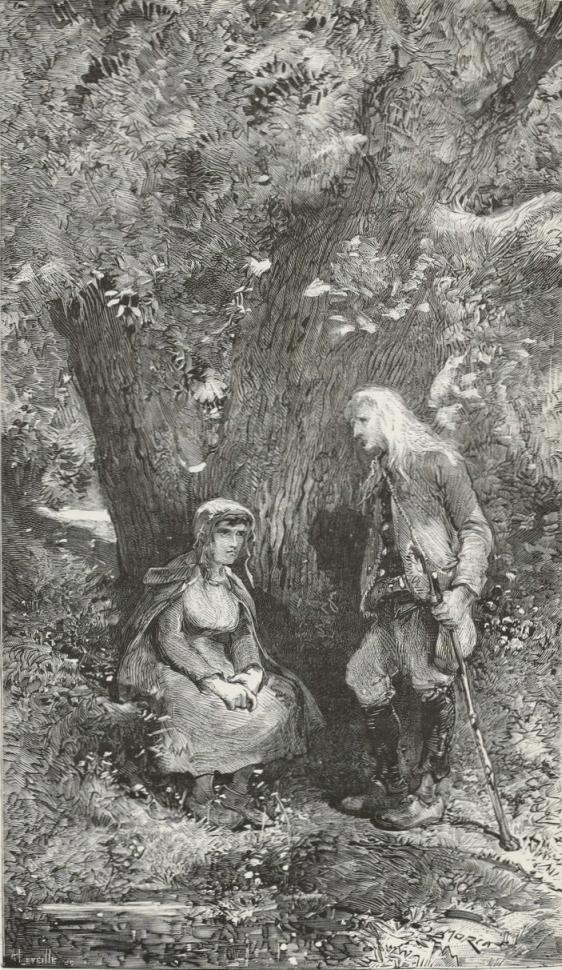
They asked him no questions, and seldom vouchsafed replies; therefore he had been unable to get the information he wanted. The conflict had been transferred to other districts, and the fighting was more remote. The Marquis de Lantenac had vanished from the horizon; and war must set its foot on a man of Tellmarch's character before he becomes aware of its existence.
After hearing these words, "My children!" Tellmarch ceased to smile, and the mother sank into deep thought. What was passing in her soul? She seemed to have plunged into the depths. Suddenly she looked up at Tellmarch, and repeated her demand almost angrily,—
"My children!"
Tellmarch bent his head like a culprit.
He was thinking of the Marquis de Lantenac, who, so far from returning his thought, had probably forgotten his very existence. He realized the fact as he said to himself, "When a nobleman is in danger he reckons you among his acquaintance; but let the danger pass, and he forgets that he ever saw you."
And he asked himself, "Why, then, did I save him?" To which question he made reply, "Because he was a man."
For some moments he dwelt upon this thought; then he resumed the thread of his meditations,—
"Am I sure of this?"
And presently he repeated those bitter words: "Had I but known!"
This whole experience gave him a sense of oppression, for his own action in the affair was enigmatical to him. His thoughts were sad, since a sense of guilt had crept into them. A kindly act may prove in the end to have been an evil one. He who saves the wolf kills the sheep; he who sets the vulture's wing is responsible for his talons. The unreasoning anger of this mother was therefore justified.
Still he felt a certain consolation in the knowledge that he had saved the mother, which partly balanced his regret for having saved the Marquis.
"But the children?"
The mother was also thinking; and these two currents of thoughts moved side by side, perhaps to mingle unawares in the shadowy land of reverie.
Meanwhile her eyes, gloomy as the night, rested again on Tellmarch.
"We cannot go on like this," she said.
"Hush!" rejoined Tellmarch, putting his finger on his lips.
She continued,—
"I am angry with you for saving me; you did wrong. I would rather have died, for then I should surely see them and know where they are. They would not see me, but I should be near them. The dead must have power to protect."
He took her by the arm, and felt her pulse.
"You must calm yourself, or you will have a relapse."
She asked him almost harshly,—
"When can I go away?"
"Go away?"
"Yes. When shall I be fit for tramping?"
"Never, if you are unreasonable; to-morrow, if you are good."
"What do you call being good?"
"Trusting in God."
"God? What has He done with my children?"
She seemed to be wandering. Her voice had grown very gentle.
"You must see," she went on to say, "that I cannot stay like this. You never had any children; but I am a mother: that makes a difference. One cannot judge of a thing unless he knows what it is like. Did you ever have any children?"
"No," replied Tellmarch.
"But I have. Can I live without my children? I should like to be told why my children are not here. Something is happening, but what it is I cannot understand."
"Come," said Tellmarch, "you are feverish again. You mustn't talk any more."
She looked at him and was silent.
And from that day she kept silence again.
This implicit obedience was more than Tellmarch desired. She spent hour after hour crouching at the foot of the old tree, like one stupefied. She pondered in silence,—that refuge of simple souls who have sounded the gloomy depths of woe. She seemed to give up trying to understand. After a certain point despair becomes unintelligible to the despairing.
As Tellmarch watched her, his sympathy increased. The sight of her suffering excited in this old man thoughts such as a woman might have known. "She may close her lips," he said to himself, "but her eyes will speak, and I see what ails her. She has but one idea; she cannot be resigned to the thought that she is no longer a mother. Her mind dwells constantly on the image of her youngest, whom she was nursing not long ago. How charming it must be to feel a tiny rosy mouth drawing ones soul from out one's body, feeding its own little life on the life of its mother!"
He too was silent, realizing the impotence of speech in the presence of such sorrow.
There is something really terrible in the silence of an unchanging thought, and how can one expect that a mother will listen to reason? Maternity sees but one side. It is useless to argue with it. One sublime characteristic of a mother is her resemblance to a wild animal. The maternal instinct is divine animalism. The mother ceases to be a woman; she becomes a female, and her children are her cubs.
Hence we find in the mother something above reason and at the same time below it,—a something which we call instinct. Guided as she is by the infinite and mysterious will of the universe, her very blindness is charged with penetration.
However anxious to make this unfortunate woman speak, Tellmarch could not succeed. One day he said to her:—
"Unfortunately I am old, and can no longer walk. My strength is exhausted before I reach my journey's end. I would go with you, only that my legs give out in about fifteen minutes and I have to stop and rest. However, it may be just as well for you that I cannot walk far, as my company might be more dangerous than useful. Here, I am tolerated; but the Blues suspect me because I am a peasant, and the peasants because they believe me to be a wizard."
He waited for an answer, but she did not even raise her eyes.
A fixed idea ends either in madness or heroism. But what heroism can be expected from a poor peasant woman? None whatever. She can be a mother, and that is all. Each day she grew more and more absorbed in her reverie. Tellmarch was watching her.
He tried to keep her busy. He bought her needles, thread, and a thimble, and to the delight of the poor Caimand, she really began to busy herself with sewing; she still dreamed, it is true, but she worked also,—a sure sign of health,—and by degrees her strength returned. She mended her underwear, her dress, and her shoes, her eyes all the while preserving a strange, far-away look. As she sewed she hummed to herself unintelligible songs. She would mutter names, probably children's names, but not distinctly enough for Tellmarch to understand. Sometimes she paused and listened to the birds, as though she expected a message from them. She watched the weather, and he could see her lips move as she talked to herself in a low voice. She had made a bag and filled it with chestnuts, and one morning Tellmarch found her gazing vaguely into the depths of the forest, and he saw that she was all ready to start.
"Where are you going?" he asked.
And she replied,—
"I am going to look for them."
He made no effort to detain her.
VII.
THE TWO POLES OF TRUTH.
After a few weeks, crowded with the vicissitudes of civil war throughout the district of Fougères, the talk ran for the most part upon two men, wholly unlike in character, who were nevertheless engaged in the same work, fighting side by side in the great revolutionary struggle. The savage duel still continued, but the Vendée was losing ground,—especially in Ille-et-Vilaine, where, thanks to the young commander who at Dol had so opportunely confronted the audacity of six thousand Royalists with that of fifteen hundred patriots, the insurrection, if not suppressed, was at least far less active, and restricted to certain limits. Several successful attacks had followed that exploit, and from these repeated victories a new state of affairs had sprung into existence. Matters had assumed a different aspect, but a singular complication had arisen.
That the Republic was in the ascendant throughout this region of the Vendée was beyond a doubt; but which Republic? Amidst the dawning of triumph, two republics confronted each other,—that of terror, determined to conquer by severity, and that of mercy, striving to win the victory by mildness. Which was to prevail? The visible representatives of these two forms, one of which was conciliatory and the other implacable, were two men, each possessing influence and authority,—one a military commander, the other a civil delegate. Which of the two would win the day? The delegate was supported by a tremendous influence; he came bringing with him the threatening watchword from the Paris Commune to the battalion of Santerre: "No mercy, no quarter!" As a means of compelling implicit obedience to his authority, he had the decree of the Convention reading as follows: "Penalty of death to whomsoever shall set at liberty or connive at the escape of a rebel chief," and also full powers from the Committee of Public Safety, with an injunction commanding obedience to him as a delegate, signed by Robespierre, Danton, and Marat. The soldier, for his part, had but the power that is born of pity.
His weapons of defence were his right arm to chastise the enemy, and his heart to pardon them. As a conqueror, he felt that he had a right to spare the conquered.
Hence a conflict, deep but as yet unacknowledged, between these two men. They lived in different atmospheres, both wrestling with rebellion,—the one armed with the thunderbolts of victory, the other with those of terror.
Throughout the Bocage, men talked of nothing else; and the extreme intimacy of two men of such utterly opposite natures contributed to increase the anxiety of those who were watching them on every side. These two antagonists were friends. Never were two hearts drawn together by a deeper or a nobler sympathy. The man of ungentle nature had saved the life of him who was merciful; the scar on his face bore witness to the fact. These men represented in their own persons the images of death and of life, embodying the principle of destruction and that of peace, and they loved each other. Conceive, if you can, Orestes merciful and Pylades pitiless. Try to imagine Arimanes the brother of Ormus!
Let us also add that of these two men, the one who was called ferocious showed himself at the same time the most brotherly of men. He dressed wounds, nursed the sick, spent his days and nights in the ambulances and hospitals, took pity on the barefooted children, kept nothing for himself, but gave all he had to the poor. He never missed a battle,—always marching at the head of the columns; was ever in the thickest of the fight,—armed, it is true, for he always wore in his belt a sabre and two pistols, yet practically unarmed, for no one had ever seen him draw his sword or raise his pistols. He faced blows, but never returned them. It was said that he had been a priest.
These two men were Gauvain and Cimourdain,—at variance in principles, though united in friendship: it was like a soul cleft in twain; and Gauvain had in truth received the gentler half of Cimourdain's nature. One might say that the latter has bestowed the white ray upon Gauvain, and kept the black one for himself. Hence a secret discord. Sooner or later this suppressed disagreement could hardly fail to explode; and one morning the contest began as follows.
Cimourdain said to Gauvain,—
"What have we accomplished?"
To which the latter replied,—
"You know as well as I. I have dispersed Lantenac's bands. He has but a few men left, and has been driven to the forest of Fougères. In eight days he will be surrounded."
"And in fifteen?"
"He will be captured."
"And then?"
"You have seen my notice?"
"Yes; and what then?"
"He is to be shot."
"A truce to clemency. He must be guillotined."
"I approve of a military death."
"And I of a revolutionary one."
Looking Gauvain full in the face, Cimourdain said,—
"Why did you order those nuns of the convent of Saint-Marc-le-Blanc to be set at liberty?"
"I do not wage war against women," replied Gauvain.
"Those women hate the people; and when there is a question of hatred, one woman is equal to ten men. Why did you refuse to send that band of fanatical old priests, whom you took at Louvigné, before the revolutionary tribunal?"
"Neither do I wage war against old men."
"An old priest is worse than a young one. The rebellion that is advocated by white hair is so much the more dangerous. People have faith in wrinkles. Do not indulge in false pity, Gauvain. The regicide is the true liberator. Keep your eye on the tower of the Temple."
"The Temple Tower! I would have the Dauphin out of it. I am not making war against children."
Cimourdain's eye grew stern.
"Learn then, Gauvain, that one must make war on a woman when her name is Marie-Antoinette, on an old man if he happens to be Pope Pius VI., and upon a child who goes by the name of Louis Capet."
"I am no politician, master."
"Try, then, not to be a dangerous man. Why was it that during the attack of the post of Cossé, when the rebel Jean Treton, repulsed and defeated, rushed alone, sabre in hand, against your entire division, you cried, 'Open the ranks! Let him pass through!'"
"Because it is not fit that fifteen hundred men should be allowed to kill one man."
"And why at Cailleterie d'Astillé, when you saw that your soldiers were about to kill the Vendean Joseph Bézier, who was wounded and just able to drag himself along, did you cry, 'Forward! leave this man to me!' and directly afterwards fire your pistol in the air?"
"Because one shrinks from killing a fallen enemy."
"There you were wrong. Both of these men are leaders at this present moment. Joseph Bézier is known as Moustache, and Jean Treton as Jambe-d'Argent. By saving their lives you presented the Republic with two enemies."
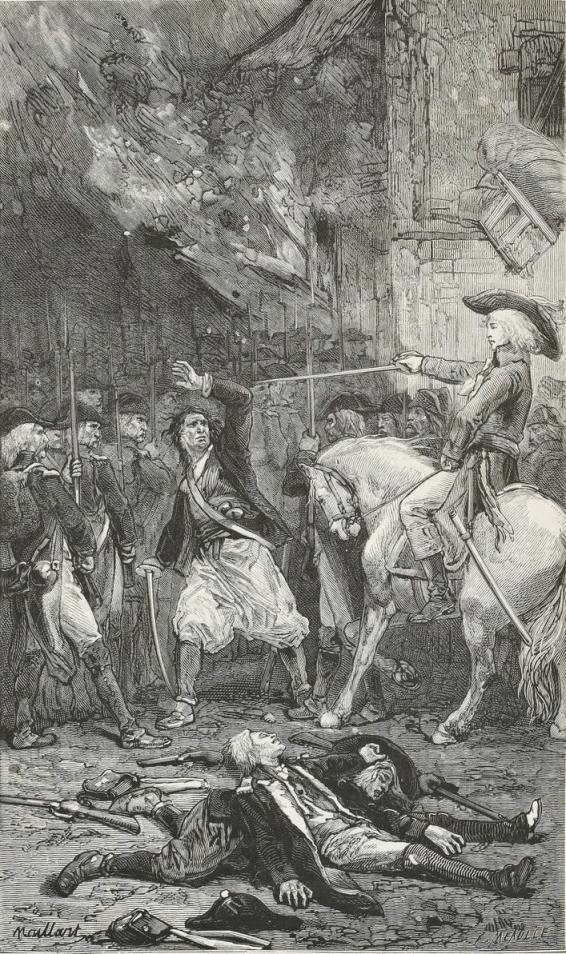
"I should prefer to make friends for her rather than enemies."
"After the victory of Landéan, why did you not shoot the three hundred peasant prisoners?"
"Because Bonchamp pardoned the Republican prisoners, and I wished it to be known that the Republic pardons the Royalist prisoners."
"Then I suppose you will pardon Lantenac if you take him?"
"No."
"Why not,—since you pardoned three hundred peasants?"
"The peasants are only ignorant men. Lantenac knows what he is about."
"But Lantenac is your kinsman."
"And France nearer than he."
"Lantenac is an old man."
"To me Lantenac is a stranger; he has no age. He is ready to summon the English, he represents invasion, he is the country's enemy, and the duel between us can only be ended by his death or mine."
"Remember these words, Gauvain."
"I have said them."
For a while both men remained silent, gazing at each other; then Gauvain continued,—
"This will be a bloody year,—this '93."
"Tate care," cried Cimourdain. "There are terrible duties to be performed, and we must beware of accusing the innocent instrument. How long since we have blamed the doctor for his patient's illness? Yes, the chief characteristic of this stupendous year is its pitiless severity. And why is this? Because it is the great revolutionary year,—the year which is the very incarnation of revolution. Revolution feels no more pity for its enemy, the old world, than the surgeon feels for the gangrene against which he is fighting. The business of revolution is to extirpate royalty in the person of the king, aristocracy in that of the nobleman, despotism in that of the soldier, and superstition and barbarism in the persons of the priest and the judge,—in one word, of every form of tyranny in the image of the tyrant. The operation is a fearful one, but revolution performs it with a steady hand. As to the amount of sound flesh that must be sacrificed, ask a Boerhave what he thinks of it. Do you suppose it possible to remove a tumor without loss of blood? Can a conflagration be extinguished without violent efforts? These terrible necessities are the very condition of success. A surgeon may be compared to a butcher, or a healer may seem like an executioner. Revolution is devoted to its fatal work. It mutilates that it may save. What! can you expect it to take pity on the virus? Would you have it merciful to poison? It will not listen. It holds the past within its grasp, and it means to make an end of it. It cuts deeply into civilization, that it may promote the health of mankind. You suffer, no doubt; but consider for how short a time it will endure,—only so long as the operation requires; and after that is over you will live. Revolution is amputating the world; hence this hemorrhage,—'93."
"A surgeon is calm," said Gauvain, "and the men I see are violent."
"Revolution requires the aid of savage workmen," replied Cimourdain; "it repulses all trembling hands; it trusts only such as are inexorable. Danton is the impersonation of the terrible, Robespierre of the inflexible, Saint-Just of the immovable, and Marat of the implacable. Take note of it, Gauvain. We need these names. They are worth as much as armies to us. They will terrify Europe."
"And possibly the future also," replied Gauvain. He paused, and then continued,—
"But really, master, you are mistaken. I accuse no one. My idea of revolution is that it shall be irresponsible. We ought not to say this man is innocent, or that one is guilty. Louis XVI. is like a sheep cast among lions. He wishes to escape, and in trying to defend himself he would bite if he could; but one cannot turn into a lion at will. His weakness is regarded as a crime; and when the angry sheep shows his teeth, 'Ah, the traitor!' cry the lions, and they proceed straightway to devour him, and afterwards fall to fighting among themselves."
"The sheep is a brute."
"And what are the lions?"
This answer set Cimourdain thinking.
"The lions," he replied, "represent the human conscience, principles, ideas."
"It is they who have caused the Reign of Terror."
"Some day the Revolution will justify all that."
"Take care lest Terror should prove the calumny of the Revolution."
Gauvain continued,—
"Liberty, equality, fraternity,—these are the dogmas of peace and harmony. Why give them so terrible an aspect? What are we striving to accomplish? To bring all nations under one universal republic. Well, then, let us not terrify them. Of what use is intimidation? Neither nations nor birds can be attracted by fear. We must not do evil that good may come. We have not overturned the throne to leave the scaffold standing. Death to the king, and life to the nations. Let us strike off the crowns, but spare the heads. Revolution means concord, and not terror. Schemes of benevolence are but poorly served by merciless men. Amnesty is to me the grandest word in human language. I am opposed to the shedding of blood, save as I risk my own. Still, I am but a soldier; I can do no more than fight. Yet if we are to lose the privilege of pardoning, of what use is it to conquer? Let us be enemies, if you will, in battle; but when victory is ours, then is the time to be brothers."
"Take care!" repeated Cimourdain for the third time; "take care, Gauvain! You are dearer to me than a son."
And he added, thoughtfully,—
"In times like these pity may be nothing less than treason in another form."
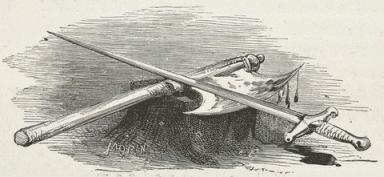
Listening to these two men, one might have fancied himself hearing a dialogue between a sword and all axe.
VIII.
DOLOROSA.
Meanwhile the mother was searching for her little ones, walking straight onward; and how she subsisted we cannot tell, since she did not know herself. She walked day and night, begging as she went, often living on herbs and sleeping upon the ground in the open air, among the bushes, under the stars, and sometimes mid the rain and the wind. Thus she wandered from village to village and from farm to farm, making inquiries as she went along, but, tattered and torn as she was, never venturing beyond the threshold. Sometimes she found a welcome, sometimes she was turned away; and when they refused to let her come in, she would go into the woods.
Unfamiliar as she was with the country beyond Siscoignard and the parish of Azé, and having nothing to serve as guide, she would retrace her steps, going over and over the same ground, thus wasting both time and strength. Sometimes she followed the highway, sometimes the cart-ruts, and then again she would turn into the paths in the woods. In this wandering life she had worn out her wretched garments. At first she had her shoes, then she went barefoot, and it was not long before her feet were bleeding.
Unconsciously she travelled on, mid bloodshed and warfare, neither hearing, seeing, nor trying to shield herself, simply looking for her children. As the entire country was in rebellion, there were no longer any gendarmes, or mayors, or authorities of any kind. Only such persons as she encountered on the way would she stop to ask.
"Have you seen three little children anywhere?"
And when the passers-by lifted their heads she would say,—
"Two boys and a girl," and go on to name them:
"René-Jean, Gros-Alain, Georgette. Have you not seen them?"
And again,—
"The oldest one was four and a half and the youngest twenty months."
Presently she would add,—
"Do you know where they are? They have been taken from me."
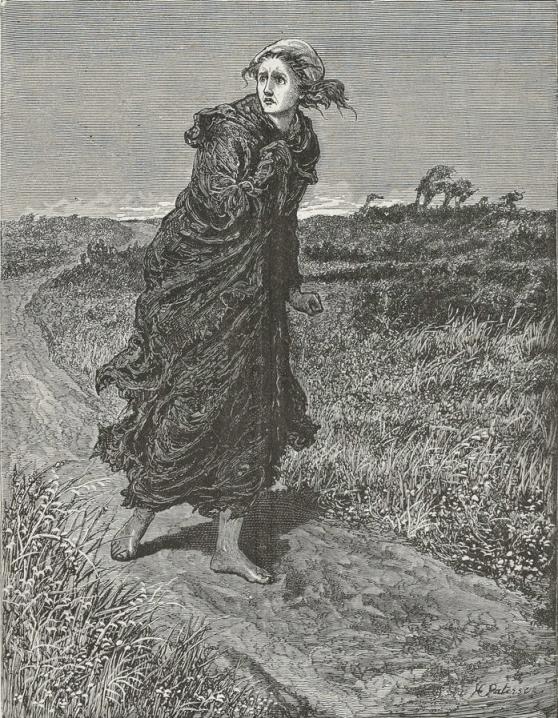
People gazed at her, and that was all.
Perceiving that she was not understood, she would explain,—
"It is because they are mine. That is the reason."
And then seeing the passers-by continue their way, she would stand speechless, tearing her breast with her nails. One day, however, a peasant stopped to listen to her. The worthy man set his wits at work.
"Let us see. Did you say three children?" he asked.
"Yes."
"Two boys?"
"And a girl."
"And you are looking for them?"
"Yes."
"I was told that a nobleman had carried off three little children and keeps them with him."
"Where is that man? Where are they?" she cried.
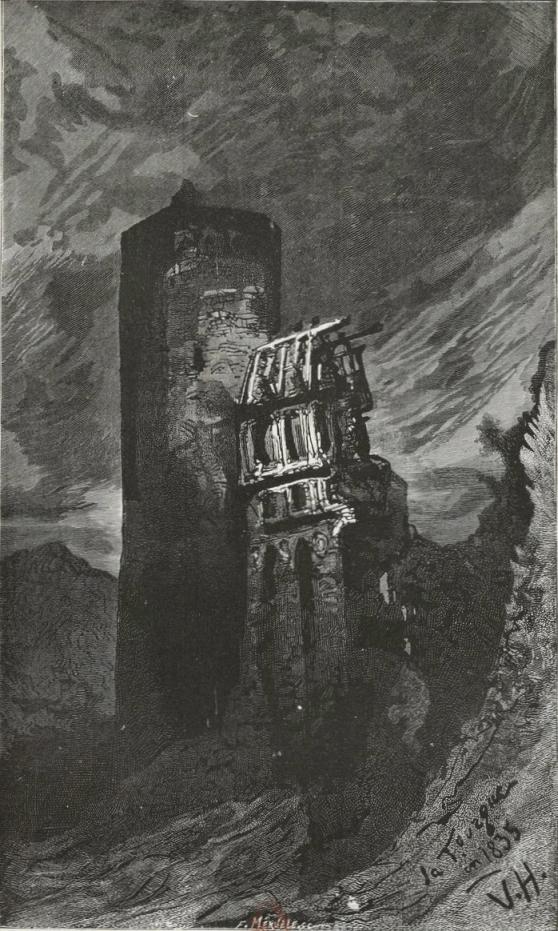
"Yon must go to the Tourgue," answered the peasant.
"And shall I find my children there?"
"Very likely you will."
"What did you say the name was?"
"The Tourgue."
"What is the Tourgue?"
"It is a place."
"Is it a village, a castle, or a farm?"
"I never was there."
"Is it far?"
"I should say so."
"In what direction?"
"In the direction of Fougères."
"Which way shall I go?"
"You are now at Ventortes," replied the peasant. "You will leave Ernée on your left and Coxelles on your right; you must pass through Longchamps, and cross the Leroux."
The peasant raised his hand and pointed westward.
"Keep straight ahead, facing the sunset."
She had already started before he had time to lower his arm.
He called out to her.
"You must be careful; they are fighting over there."
She never turned to reply, but walked straight ahead without pausing.
IX.
A PROVINCIAL BASTILE.
I.
LA TOURGUE.
The traveller who forty years ago entered the forest of Fougères from the direction of Laignelet and came out towards Parigné, might have beheld on the edge of this dense forest a sinister sight, for emerging from the thicket he would come directly upon the Tourgue, and not the living Tourgue, but the dead one.
The Tourgue cracked, battered, scarred, dismantled. A ruin may be called the ghost of an edifice. Nothing could be more lugubrious than the aspect of the Tourgue. A high circular tower stood alone like a malefactor on the edge of the wood, and rising as it did from a precipitous rock, its severe and solid architecture gave it the appearance of a Roman structure, combining within itself the elements of power and of decay. In fact, it might in one sense be called Roman, since it was Romance. It was begun in the ninth century and finished in the twelfth, after the time of the third crusade. The style of the imposts of its embrasures indicated its period. If one approached it and cared to climb the slope, he might perceive a breach in the wall; and if he ventured to enter in, he would find a vacant space and nothing more. It was not unlike the inside of a stone trumpet set upright on the ground. From top to bottom there were no partitions, and neither ceilings nor floors; here and there arches and chimneys had evidently been torn away, and falconet embrasures were still seen; at different heights, rows of granite corbels and a few cross-beams covered with the ordure of the night birds marked the separate stories; a colossal wall, fifteen feet thick at its base and twelve at its summit; cracks here and there, and holes which once were doors, and through which one caught glimpses of staircases within the gloomy walls. One who passing by at evening might venture in, would hear the cry of the wood-owl, the goat-suckers, and the night-herons; would find brambles, stones, and reptiles beneath his feet; and overhead, through a dark circular opening at the top of the tower which looked like the mouth of an enormous well, he might see the stars.
Local tradition relates that there were secret doors in the upper stories of this tower, like those in the tombs of the kings of Judah, composed of one large stone turning on a pivot, which when closed could not be distinguished from the wall itself,—a fashion in architecture brought home by the crusaders, together with the pointed arch. When these doors were closed, it was impossible to discover them, so skilfully were they fitted into the rest of the stones. Such doors can be found to-day in those mysterious Libyan cities which escaped the earthquakes that buried the twelve cities in the time of Tiberius.
II.
THE BREACH.
The breach by which one gained access to the ruin was the opening of a mine. A connoisseur familiar with Errard, Sardi, and Pagan would have appreciated the skill with which this mine was planned. The fire-chamber, in the shape of a biretta, was of a size accurately proportioned to the strength of the keep which it was intended to destroy. It was capable of containing at least two hundred-weight of powder. The winding passage which led to it was more effective than a straight one. The saucisse, laid bare among the broken stones as the result of the crumbling caused by the mine, was seen to have the requisite diameter of a hen's-egg. The explosion had made a deep rent in the wall, by which the assailants were enabled to enter. It was evident that this tower must have sustained formal sieges from time to time. It was riddled with balls, and these were not all of the same epoch; every missile has its own special way of marking a rampart, and each one, from the stone bullets of the fourteenth century to the iron ones of the eighteenth, had left a scar upon this donjon-keep.
The breach opened into what must have been the ground-floor; and directly opposite, in the wall of the tower, was the gateway of a crypt, cut in the rock and extending under the hall of the lower floor throughout the foundation of the tower.
This crypt, three-fourths filled up, was cleared out in 1835, under the direction of Auguste Le Provost, the antiquary of Bernay.
III.
THE OUBLIETTE.
This crypt was the oubliette. Every keep possessed one, and this, like many other penal dungeons of the same period, had two stories. The first story, accessible through the gate, consisted of a good-sized vaulted chamber, on a level with the hall of the ground-floor. On the walls of this room might be seen two vertical furrows, parallel with each other, reaching from wall to wall and passing along the vault, where they had left a deep rut, reminding one of wheel-tracks,—and such in fact they were; for these two furrows were hollowed out by two wheels. In old feudal times men had been torn limb from limb here in this very room, by a process less noisy than that of being drawn and quartered. They had a pair of wheels so large and powerful that they filled the entire room, touching both walls and ceiling, and to each wheel was attached an arm and a leg of the victim; and when these wheels were turned in opposite directions, the man was torn asunder. It required great power; hence the ruts worn in the stone by the grazing of the wheels. A room of this kind may be seen at Vianden.
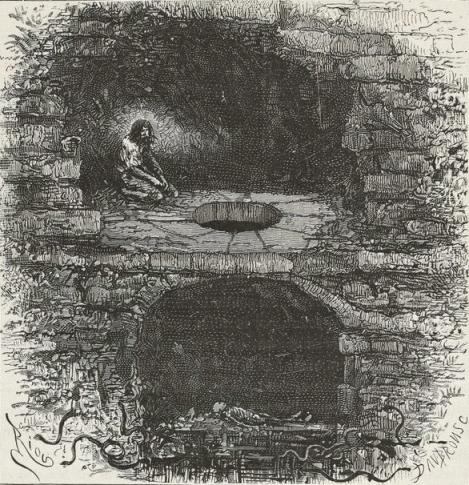
Above this room there was another, the actual oubliette, whose only entrance was a hole which served the purpose of a door; the victim, stripped of his clothes, was let down, by means of a rope tied under his armpits, into the room below, through an opening made in the middle of the flagging of the upper room. If he persisted in living, food was thrown to him through this aperture. A similar hole may still be seen at Bouillon.
This chamber below, excavated under the hall of the ground-floor to such a depth that it reached water, and constantly swept by an icy wind, was more like a well than a room. But the wind so fatal to the prisoner in the depths was, on the other hand, favorable to the one overhead, groping about beneath the vault, who could breathe the easier on account of it; indeed, all the air he had, came up through this hole. But then any man who entered, or rather fell, into this tomb, never came out again. It behooved the prisoner to look out for himself in the darkness, for it needed but one false step to change the scene of his sufferings. That, however, was his own affair. If he were tenacious of life, this hole was his danger; but if he were weary of it, it was his resource. The upper story was the dungeon, the lower one the tomb,—a superposition not unlike that of the society of the period.
This is what our ancestors called a moat-dungeon; but since the thing itself has disappeared, the name has no longer any meaning for us. Thanks to the Revolution, we can listen with indifference to the sound of these words. On the outside of the tower, and above the breach, which forty years ago was its only entrance, might be seen an embrasure somewhat wider than the other loopholes, from which hung an iron grating, loosened and broken.
IV.
THE BRIDGE-CASTLE.
A stone bridge whose three arches were but slightly damaged, was connected with this tower on the side opposite to the breach. This bridge had once supported a building whose few remaining fragments bore the traces of a conflagration; it was only the framework that was left standing, and as the light shone through its interstices as it rose side by side with the tower, it had the effect of a skeleton beside a phantom.
To-day this ruin is utterly demolished, leaving no trace whatever behind. A single peasant can destroy in one day structures that kings have labored for centuries to erect. La Tourgue, a peasant abbreviation, signifies La Tour-Gauvain, just as La Jupelle stands for La Jupellière, and Pinson le Tort, the name of a hunchback leader, for Pinson le Tortu.
La Tourgue, which even forty years ago was a ruin, and which to-day is but a shadow, was a fortress in 1793. It was the old Bastile of the Gauvains, and served to guard, towards the west, the entrance of the forest of Fougères, which is now little more than a grove.
This fortress was built on one of those great blocks of slate which are found in abundance between Mayence and Dinan, scattered in all directions among the copses and along the heath like the missiles of some Titanic combat. The tower composed the entire fortress; and below the tower stood the rock at whose base flowed one of those water-courses which swells into a torrent in January and dries up in June.
Simple as were its means of defence, this tower was almost impregnable in the Middle Ages, but the bridge had proved a source of weakness. The Gauvains of Gothic times had built it without a bridge. It was formerly accessible by means of one of those swinging bridges that could be instantly severed by the stroke of an axe. So long as the Gauvains remained Viscounts it pleased them just as it was, and they were satisfied with it. But when they became Marquises and exchanged the keep for the Court, they spanned the stream with three arches and thus offered access in the direction of the plain very much as they had yielded to the advances of the king. The marquises of the seventeenth century and the marchionesses of the seventeenth no longer prided themselves on their impregnability. They abandoned the traditions of their ancestors to follow the fashions of Versailles.
Facing the tower towards the west was a somewhat elevated plateau adjoining two plains; this plateau was very near the tower, only separated from it by a deep ravine through which flowed a stream tributary to the Couesnon. The bridge that connected the fortress with the plateau stood on lofty piles, and on these piles was constructed as at Chenonceaux a building in the Mansard style of architecture, but more comfortable than the tower. Customs were still very rude, and the lords continued to occupy chambers in the keep that were more like dungeons than bedrooms. As to the building on the bridge, which was a diminutive kind of castle, a long corridor had been added to it, by way of entrance, which was called the hall of the guards. Over this hall, which was like an entresol, was the library, and above that a granary. Separated by pillars stood the long windows with their small panes of Bohemian glass; medallions were sculptured on the walls. The fortress was three stories high; halberds and muskets were to be found below, books in the middle, and over all the bags of oats,—a somewhat barbarous arrangement, but princely to the last degree.
The tower loomed above this coquettish building presenting a stern and gloomy contrast.
The platform offered a point of attack from which the bridge could be destroyed.
Between these two buildings there was no harmony whatsoever; the roughness of the one jarred against the elegance of the other. It would seem as if two semicircles ought to be identical; yet no two styles have less in common than that of a Roman semicircle and a classic archivolt. That tower, a worthy companion for the forest, was a strange neighbor for the bridge, which might have come from Versailles. Fancy Louis XIV. leaning on the arm of Alain Barbe-Torte. There was something appalling in this juxtaposition. An inexpressible spirit of terror pervaded the combined majesty of these structures.
Let us repeat, that from a military point of view the bridge went far towards betraying the tower; for while it added to its beauty it diminished its strength, ornamenting it on the one hand and weakening it on the other; by placing it on a level with the plateau, it had exposed it to attacks from that direction, although it still remained impregnable in the direction of the forest. Formerly it had commanded the plateau, but matters were now reversed. An enemy installed on the plain would speedily become master of the bridge. The library and the granary were advantageous to the besiegers rather than to the besieged, since the contents of both are of a combustible nature. For an assailant who knows how to avail himself of fire as a means of assault, it matters but little whether it be a Homer or a bundle of hay, provided it burns. The French offered a proof of this fact to the Germans when they burned the library at Heidelberg, as did the Germans in burning that of Strasbourg. In short, this bridge built on to the Tourgue was a strategic mistake; but in the seventeenth century, under Colbert and Louvois, the Princes Gauvain, like the Princes de Rohan or La Tremoille, believed themselves henceforth safe from assault. Still, the builders of the bridge had taken certain precautions. In the first place, anticipating the chances of fire, they had fastened crosswise below the three windows looking towards the stream, by iron clamps which no longer than fifty years ago were still to be seen, a strong ladder, equal in length to the height of the first two stories of the bridge,—a height surpassing that of three ordinary stories; secondly, foreseeing the possibility of a siege, they had isolated the bridge from the tower by means of a low and heavy iron door, arched at the top and locked with a large key, whose hiding-place was known to the master alone; once closed, it could defy the battering-ram and almost brave the cannon-ball.
One must cross the bridge to reach this door, which was the only means of access to the tower.
V.
THE IRON DOOR.
As a result of the elevation of this castle on the bridge by means of piles, its second story was on a level with the corresponding story of the tower; and here, for greater safety, the iron door had been placed.