PAUL CARUS (continued 2)
Reading edition
"Yet even from him we're not in special peril He will, ere long, to other thoughts incline. The must may foam absurdly in the barrel. Nathless, it turns at last to wine." Tr. by Bayard Taylor.
Nietzsche did not live long enough to experience a period of matured thought. He died before the fermentation of his mind had come to its normal close, and so his life will remain forever a great torso, without intrinsic worth, but suggestive and appealing only to the immature, including the "herd animal" who would like to be an overman.
The very immaturity of Nietzsche's view becomes attractive to immature minds. He wrote while his thoughts were still in a state of fermentation, and he died before the wine of his soul was clarified.
Nietzsche is an almost tragic figure that will live in art as a brooding thinker, a representative of the dissatisfied, a man of an insatiable love of life, with wild and unsteady looks, proud in his indomitable self-assertion, but broken in body and spirit. Such he was in his last disease when his mind was wrapt in the eternal night of dementia, the oppressive consciousness of which made him exclaim in lucid moments the pitiable complaint. "Mutter, ich bin dumm" As such he is represented in Klein's statue,[10] which in its pathetic posture is a psychological masterpiece.
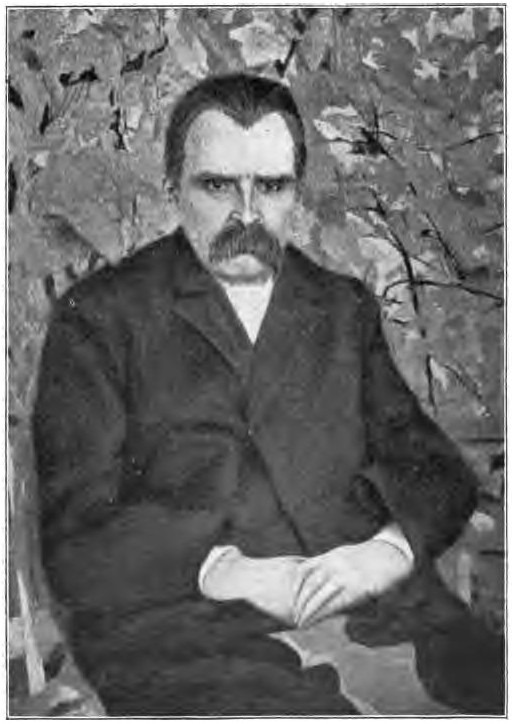
FRIEDRICH NIETZSCHE—THE LATEST PORTRAIT, AFTER AN OIL PAINTING BY C. STOEVING.
Nietzsche's works are poetic effusions more than philosophical expositions and yet we would hesitate to call him a poet. His poems are not poetical in the usual sense. They lack poetry and yet they appeal not only to his admirers, but also to his critics and enemies. Most of them are artificial yet they are so characteristic that they are interesting specimens of a peculiar kind of taste. They strike us as ingenious, because they reflect his eccentricities.
In a poem entitled "Ecce Homo"[11] he characterizes himself:
"Yea, I know from whence I came! Never satiate, like the flame Glow I and consume me too Into light turns what I find, Cinders do I leave behind, Flame am I, 'tis surely true."
NIETZSCHE'S PREDECESSOR
Friedrich Nietzsche, the author of Thus Spake Zarathustra and the inventor of the new ideal called the "overman," is commonly regarded as the most extreme egotist, to whom morality is non-existent and who glories in the coming of the day in which a man of his liking—the overman—would live au grand jour. His philosophy is an individualism carried to its utmost extreme, sanctioning egotism, denouncing altruism and establishing the right of the strong to trample the weak under foot. It is little known, however, that he followed another thinker, Johann Caspar Schmidt, whose extreme individualism he adopted. But this forerunner who preached a philosophy of the sovereignty of self and an utter disregard of our neighbors' rights remained unheeded; he lived in obscurity, he died in poverty, and under the pseudonym "Max Stirner" he left behind a book entitled Der Einzige und sein Eigentum.
The historian Lange briefly mentioned him in his History of Materialism, and the novelist John Henry Mackay followed up the reference which led to the discovery of this lonely comet on the philosophical sky.[1]
The strangest thing about this remarkable book consists in the many coincidences with Friedrich Nietzsche's philosophy. It is commonly deemed impossible that the famous spokesman of the overman should not have been thoroughly familiar with this failure in the philosophical book market; but while Stirner was forgotten the same ideas transplanted into the volumes of the author of Thus Spake Zarathustra found an echo first in Germany and soon afterwards all over the world.
Stirner's book has been Englished by Stephen T. Byington with an introduction by J. L. Walker at the instigation of Benjamin R. Tucker, the representative of American peaceful anarchism, under the title The Ego and His Own. They have been helped by Mr. George Schumm and his wife, Mrs. Emma Heller Schümm. These five persons, all interested in this lonely and unique thinker, must have had much trouble in translating the German original and though the final rendering of the title is not inappropriate, the translator and his advisers agree that it falls short of the mark. For the accepted form Mr. B. R. Tucker is responsible, and he admits in the preface that it is not an exact equivalent of the German. Der Einzige means "the unique man," a person of a definite individuality, but in the book itself our author modifies and enriches the meaning of the term. The unique man becomes the ego and an owner (ein Eigener), a man who is possessed of property, especially of his own being. He is a master of his own and he prides himself on his ownhood, as well as his ownership. As such he is unique, and the very term indicates that the thinker who proposes this view-point is an extreme individualist. In Stirner's opinion Christianity pursued the ideal of liberty from the world; and in this sense Christians speak of spiritual liberty. To become free from anything that oppresses us we must get rid of it, and so the Christian to rid himself of the world becomes a prey to the idea of a contempt of the world. Stirner declares that the future has a better lot in store for man. Man shall not merely be free, which is a purely negative quality, but he shall be his own master; he shall become an owner of his own personality and whatever else he may have to control. His end and aim is he himself. There is no moral duty above him. Stirner explains in the very first sentence of his book:
"What is not supposed to be my concern! First and foremost, the good cause, then God's cause, the cause of mankind, of truth, of freedom, of humanity, of justice; further, the cause of my people, my prince, my fatherland; finally, even the cause of mind, and a thousand other causes. Only my cause is never to be my concern. 'Shame on the egoist who thinks only of himself!"
Stirner undertakes to refute this satirical explanation in his book on the unique man and his own, and a French critic according to Paul Lauterbach (p. 5) speaks of his book as un livre qu'on quitte monarque, "a book which one lays aside a king."
Stirner is opposed to all traditional views. He is against church and state. He stands for the self-development of every individual, and insists that the highest duty of every one is to stand up for his ownhood.
J. L. Walker in his Introduction contrasts Stirner with Nietzsche and gives the prize of superiority to the former, declaring him to be a genuine anarchist not less than Josiah Warren, the leader of the small band of New England anarchists. He says:
"In Stirner we have the philosophical foundation for political liberty. His interest in the practical development of egoism to the dissolution of the state and the union of free men is clear and pronounced, and harmonizes perfectly with the economic philosophy of Josiah Warren. Allowing for difference of temperament and language, there is a substantial agreement between Stirner and Proudhon. Each would be free, and sees in every increase of the number of free people and their intelligence an auxiliary force against the oppressor. But, on the other hand, will any one for a moment seriously contend that Nietzsche and Proudhon march together in general aim and tendency—that they have anything in common except the daring to profane the shrine and sepulcher of superstition?
"Nietzsche has been much spoken of as a disciple of Stirner, and, owing to favorable cullings from Nietzsche's writings, it has occurred that one of his books has been supposed to contain more sense than it really does—so long as one had read only the extracts.
"Nietzsche cites scores or hundreds of authors. Had he read everything, and not read Stirner?
"But Nietzsche is as unlike Stirner as a tight-rope performance is unlike an algebraic equation.
"Stirner loved liberty for himself, and loved to see any and all men and women taking liberty, and he had no lust of power. Democracy to him was sham liberty, egoism the genuine liberty.
"Nietzsche, on the contrary, pours out his contempt upon democracy because it is not aristocratic. He is predatory to the point of demanding that those who must succumb to feline rapacity shall be taught to submit with resignation. When he speaks of 'anarchistic dogs' scouring the streets of great civilized cities, it is true, the context shows that he means the communists; but his worship of Napoleon, his bathos of anxiety for the rise of an aristocracy that shall rule Europe for thousands of years, his idea of treating women in the Oriental fashion, show that Nietzsche has struck out in a very old path—doing the apotheosis of tyranny. We individual egoistic anarchists, however, may say to die Nietzsche school, so as not to be misunderstood: We do not ask of the Napoleons to have pity, nor of the predatory barons to do justice. They will find it convenient for their own welfare to make terms with men who have learned of Stirner what a man can be who worships nothing, bears allegiance to nothing. To Nietzsche's rhodomontade of eagles in baronial form, born to prey on industrial lambs, we rather tauntingly oppose the ironical question: Where are your claws? What if the 'eagles' are found to be plain barnyard fowls on which more silly fowls have fastened steel spurs to hack the victims, who, however, have the power to disarm the sham 'eagles' between two suns?
"Stirner shows that men make their tyrants as they make their gods, and his purpose is to unmake tyrants.
"Nietzsche dearly loves a tyrant.
"In style Stirner's work offers the greatest possible contrast to the puerile, padded phraseology of Nietzsche's Zarathustra and its false imagery. Who ever imagined such an unnatural conjuncture as an eagle 'toting' a serpent in friendship? which performance is told of in bare words, but nothing comes of it. In Stirner we are treated to an enlivening and earnest discussion addressed to serious minds, and every reader feels that the word is to him, for his instruction and benefit, so far as he has mental independence and courage to take it and use it The startling intrepidity of this book is infused with a whole-hearted love for all mankind, as evidenced by the fact that the author shows not one iota of prejudice or any idea of division of men into ranks. He would lay aside government, but would establish any regulation deemed convenient, and for this only our convenience is consulted. Thus there will be general liberty only when the disposition toward tyranny is met by intelligent opposition that will no longer submit to such a rule. Beyond this the manly sympathy and philosophical bent of Stirner are such that rulership appears by contrast a vanity, an infatuation of perverted pride. We know not whether we more admire our author or more love him.
"Stirner's attitude toward woman is not special. She is an individual if she can be, not handicapped by anything he says, feels, thinks, or plans. This was more fully exemplified in his life than even in this book; but there is not a line in the book to put or keep woman in an inferior position to man, neither is there anything of caste or aristocracy in the book."
It is not our intention to enter here into a detailed criticism of Stirner's book. We will only point out that society will practically remain the same whether we consider social arrangements as voluntary contracts or as organically developed social institutions, or as imposed upon mankind by the divine world-order, or even if czars and kings claim to govern "by the grace of God." Whatever religious or natural sanction any government may claim to possess, the method of keeping order will be the same everywhere. Wrongs have been done and in the future may still be committed in the name of right, and injustice may again and again worst justice in the name of the law. On the other hand, however, we can notice a progress throughout the world of a slow but steady improvement of conditions. Any globe-trotter will find by experience that his personal safety, his rights and privileges are practically the same in all civilized countries, whether they are republics like Switzerland, France and the United States, or monarchies like Sweden, Germany and Italy. At the same time murders, robberies, thefts and other crimes are committed all over the world, even in the homes of those who pride themselves on being the most civilized nations. The world-conception lying behind our different social theories is the same wherever the same kind of civilization prevails. Where social evils prevail, dissatisfaction sets in which produces theories and reform programs, and when they remain unheeded, a climax is reached which leads to revolution.
Stirner's book begins with a short exhortation headed with Goethe's line,
"My trust in nothingness is placed."
He discusses the character of human life (Chap. I) and contrasts men of the old and the new eras (Chap. II). He finds that the ancients idealized bodily existence while Christianity incarnates the ideal. Greek artists transfigure actual life; in Christianity the divine takes abode in the world of flesh, God becomes incarnate in man. The Greeks tried to go beyond the world and Christianity came; Christian thinkers are pressed to go beyond God, and there they find spirit. They are led to a contempt of the world and will finally end in a contempt of spirit. But Stirner believes that the ideal and the real can never be reconciled, and we must free ourselves from the errors of the past. The truly free man is not the one who has become free, but the one who has come into his own, and this is the sovereign ego.
As Achilles had his Homer so Stirner found his prophet in a German socialist of Scotch Highlander descent, John Henry Mackay. The reading public should know that Mackay belongs to the same type of restless reformers, and he soon became an egoistic anarchist, a disciple of Stirner. His admiration is but a natural consequence of conditions. Nevertheless Mackay's glorification of Stirner proves that in Stirner this onesided world-conception has found its classical, its most consistent and its philosophically most systematic presentation. Whatever we may have to criticize in anarchism, Stirner is a man of uncommon distinction, the leader of a party, and the standard-bearer of a cause distinguished by the extremeness of its propositions which from the principle of individualism are carried to their consistent ends.
Mackay undertook the difficult task of unearthing the history of a man who, naturally modest and retired, had nowhere left deep impressions. No stone remained unturned and every clue that could reveal anything about his hero's life was followed up with unprecedented devotion. He published the results of his labors in a book entitled "Max Stirner, His Life and His Work."[2] The report is extremely touching not so much on account of the great significance of Stirner's work which to impartial readers appears exaggerated, but through the personal tragedy of a man who towers high above his surroundings and suffers the misery of poverty and failure.
Mr. Mackay describes Stirner as of medium height, rather less so than more, well proportioned, slender, always dressed with care though without pretension, having the appearance of a teacher, and wearing silver-or steel-rimmed spectacles. His hair and beard were blonde with a tinge of red, his eyes blue and clear, but neither dreamy nor penetrating. His thin lips usually wore a sarcastic smile, which, however, had nothing of bitterness; his general appearance was sympathetic. No portrait of Stirner is in existence except one pencil sketch which was made from memory in 1892 by the London socialist, Friedrich Engels, but the criticism is made by those who knew Stirner that his features, especially his chin and the top of his head, were not so angular though nose and mouth are said to have been well portrayed, and Mackay claims that Stirner never wore a coat and collar of that type.
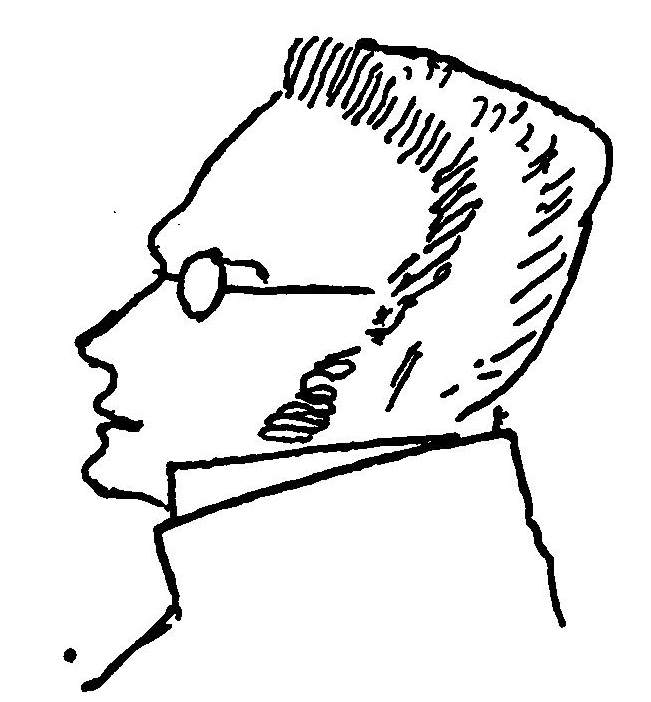
PENCIL SKETCH OF MAX STIRNER. The only portrait in existence.
Stirner was of purely Frankish blood. His ancestors lived for centuries in or near Baireuth. His father, Albert Christian Heinrich Schmidt of Anspach, a maker of wind-instruments, died of consumption in 1807 at the age of 37, half a year after the birth of his son. His mother, Sophie Eleanora, née Reinlein of the city of Erlangen, six months later married H. F. L. Ballerstedt, the assistant in an apothecary shop in Helmstedt, and moved with him to Kulm on the Vistula. In 1818 the boy was sent back to his native city where his childless god-father and uncle, Johann Caspar Martin Sticht, and his wife took care of him.
Young Johann Caspar passed through school with credit, and his schoolmates used to call him "Stirner" on account of his high forehead (Stirn) which was the most conspicuous feature of his face. This name clung to him throughout life. In fact his most intimate friends never called him by any other, his real name being almost forgotten through disuse and figuring only in official documents.
Stirner attended the universities of Erlangen, Berlin and Königsberg, and finally passed his examination for admission as a teacher in gymnasial schools. His stepfather died in the summer of 1837 in Kulm at the age of 76. It is not known what became of his mother who had been mentally unsound for some time.
Neither father nor stepfather had ever been successful, and if Stirner ever received any inheritance it must have been very small. On December 12 of 1837 Stirner married Agnes Clara Kunigunde Burtz, the daughter of his landlady.
Their married life was brief, the young wife dying in a premature child-birth on August 29th. We have no indication of an ardent love on either side. He who wrote with passionate fire and with so much insistence in his philosophy, was calm and peaceful, subdued and quiet to a fault in real life.
Having been refused appointment in one of the public or royal schools Stirner accepted a position in a girls' school October 1, 1839. During the political fermentation which preceded the revolutionary year of 1848, he moved in the circle of those bold spirits who called themselves Die Freien and met at Hippel's, among whom were Ludwig Buhl, Meyen, Friedrich Engels, Mussak, C. F. Köppen, the author of a work on Buddha, Dr. Arthur Müller and the brothers Bruno, Egbert and Edgar Bauer. It was probably among their associates that Stirner met Marie Dähnhardt of Gadebusch near Schwerin, Mecklenberg, the daughter of an apothecary, Helmuth Ludwig Dähnhardt. She was as different from Stirner as a dashing emancipated woman can be from a gentle meek man, but these contrasts were joined together in wedlock on October 21, 1843. Their happiness did not last long, for Marie Dähnhardt left her husband at the end of three years.
The marriage ceremony of this strange couple has been described in the newspapers and it is almost the only fact of Stirner's life that stands out boldly as a well-known incident. That these descriptions contain exaggerations and distortions is not improbable, but it cannot be denied that much contained in the reports must be true.
On the morning of October 21, a clergyman of extremely liberal views, Rev. Marot, a member of the Consistory, was called to meet the witnesses of the ceremony at Stirner's room. Bruno Bauer, Buhl, probably also Julius Faucher, Assessor Kochius and a young English woman, a friend of the bride, were present. The bride was in her week-day dress. Mr. Marot asked for a Bible, but none could be found. According to one version the clergyman was obliged to request Herr Buhl to put on his coat and to have the cards removed. When the rings were to be exchanged the groom discovered that he had forgotten to procure them, and according to Wilhelm Jordan's recollection Bauer pulled out his knitted purse and took off the brass rings, offering them as a substitute during the ceremony. After the wedding a dinner with cold punch was served to which Mr. Marot was invited. But he refused, while the guests remained and the wedding carousal proceeded in its jolly course.
In order to understand how this incident was possible we must know that in those pre-revolutionary years the times were out of joint and these heroes of the rebellion wished to show their disrespect and absolute indifference to a ceremony that to them had lost all its sanctity.
Stirner's married life was very uneventful, except that he wrote the main book of his life and dedicated it to his wife after a year's marriage, with the words,
"Meinem Liebchen Marie Dähnhardt."
Obviously this form which ignores the fact that they were married, and uses a word of endearment which in this connection is rather trivial, must be regarded as characteristic of their relation and their life principles. Certain it is that she understood only the negative features of her husband's ideals and had no appreciation of the genius that stirred within him. Lauterbach, the editor of the Reclam edition of Stirner's book, comments ironically on this dedication with the Spanish motto Da Dios almendras al que no tiene muelas, "God gives almonds to those who have no teeth."
Marie Dähnhardt was a graceful blonde woman rather under-sized, with heavy hair which surrounded her head in ringlets according to the fashion of the time. She was very striking and became a favorite of the round table of the Freien who met at Hippel's. She smoked cigars freely and sometimes donned male attire, in order to accompany her husband and his friends on their nightly excursions. It appears that Stirner played the most passive part in these adventures, but true to his principle of individuality we have no knowledge that he ever criticized his wife.
Marie Dähnhardt had lost her father early and was in possession of a small fortune of 10,000 thalers, possibly more. At any rate it was considered quite a sum in the circle of Stirner's friends, but it did not last long. Having written his book, Stirner gave up his position so as to prevent probable discharge and now they looked around for new resources. Though Stirner had studied political economy he was a most unpractical man; but seeing there was a dearth of milk-shops, he and his wife started into business. They made contracts with dairies but did not advertise their shop, and when the milk was delivered to them they had large quantities of milk on hand but no patrons, the result being a lamentable failure with debts.
In the circle of his friends Stirner's business experience offered inexhaustible material for jokes, while at home it led rapidly to the dissolution of his marriage. Frau Schmidt complained in later years that her husband had wasted her property, while no complaints are known from him. One thing is sure that they separated. She went to England where she established herself as a teacher under the protection of Lady Bunsen, the wife of the Prussian ambassador.
Frau Schmidt's later career is quite checkered. She was a well-known character in the colony of German exiles in London. One of her friends there was a Lieutenant Techow. When she was again in great distress she emigrated with other Germans, probably in 1852 or 1853, to Melbourne, Australia. Here she tasted the misery of life to the dregs. She made a living as a washerwoman and is reported to have married a day laborer. Their bitter experiences made her resort to religion for consolation, and in 1870 or 1871 she became a convert to the Catholic Church. At her sister's death she became her heir and so restored her good fortune to some extent. She returned to London where Mr. Mackay to his great joy discovered that she was still alive at the advanced age of eighty. What a valuable resource her reminiscences would be for his inquiries! But she refused to give any information and finally wrote him a letter which literally reads as follows: "Mary Smith solemnly avowes that she will have no more correspondence on the subject, and authorizes Mr. ———-[3] to return all those writings to their owners. She is ill and prepares for death."
The last period of Stirner's life, from the time when his wife left him to his death, is as obscure as his childhood days. He moved from place to place, and since his income was very irregular creditors pressed him hard. His lot was tolerable because of the simple habits of his life, his only luxury consisting in smoking a good cigar. In 1853 we find him at least twice in debtor's prison, first 21 days, from March 5 to 26,1853, and then 36 days, from New Year's eve until February 4 of the next year. In the meantime (September 7) he moved to Philippstrasse 19. It was Stirner's last home. He stayed with the landlady of this place, a kind-hearted woman who treated all her boarders like a mother, until June 25, 1856, when he died rather suddenly as the result of the bite of a poisonous fly. A few of his friends, among them Bruno Bauer and Ludwig Buhl, attended his funeral; a second-class grave was procured for one thaler 10 groats, amounting approximately to one American dollar.
During this period Stirner undertook several literary labors from which he possibly procured some remuneration. He translated the classical authors on political economy from the French and from the English, which appeared under the title Die National-Oekonomen der Franzosen und Engländer (Leipsic, Otto Wigand, 1845-1847).
He also wrote a history of the Reaction which he explained to be a mere counter-revolution. This Geschichte der Reaction was planned as a much more comprehensive work, but the two volumes which appeared were only two parts of the second volume as originally intended.
The work is full of quotations, partly from Auguste Comte, partly from Edmund Burke. None of these works represent anything typically original or of real significance in the history of human thought.
His real contribution to the world's literature remains his work Der Einzige und sein Eigentum, the title of which is rendered in English The Ego and His Own, and this, strange to say, enthrones the individual man, the ego, every personality, as a sovereign power that should not be subject to morality, rules, obligations, or duties of any kind. The appeal is made so directly that it will convince all those unscientific and half-educated minds who after having surrendered their traditional faith find themselves without any authority in either religion or politics. God is to them a fable and the state an abstraction. Ideas and ideals, such as truth, goodness, beauty, are mere phrases. What then remains but the concrete bodily personality of every man of which every one is the ultimate standard of right and wrong?
EGO-SOVEREIGNTY
Strange that neither of these philosophers of individuality, Nietzsche or Stirner, ever took the trouble to investigate what an individual is! Stirner halts before this most momentous question of his world-conception, and so he overlooks that his ego, his own individuality, this supreme sovereign standing beyond right and wrong, the ultimate authority of everything, is a hazy, fluctuating, uncertain thing which differs from day to day and Anally disappears.
The individuality of any man is the product of communal life. No one of us could exist as a rational personality were he not a member of a social group from which he has imbibed his ideas as well as his language. Every word is a product of his intercourse with his fellow-beings. His entire existence consists in his relations toward others and finds expression in his attitude toward social institutions. We may criticize existent institutions but we can never do without any. A denial of either their existence or their significance proves an utter lack of insight into the nature of personality.
We insert here a few characteristic sentences of Stirner's views, and in order to be fair we follow the condensation of John Henry Mackay (pp. 135-192) than whom certainly we could find no more sympathetic or intelligent student of this individualistic philosophy.
Here are Stirner's arguments:
The ancients arrived at the conclusion that man was spirit. They created a world of spirit, and in this world of spirit Christianity begins. But what is spirit? Spirit has originated from nothing. It is its own creation and man makes it the center of the world. The injunction was given, Thou shalt not live to thyself but to thy spirit, to thy ideas. Spirit is the God, the ego and the spirit are in constant conflict. Spirit dwells beyond the earth. It is in vain to force the divine into service here for I am neither God nor man, neither the highest being nor my being. The spirit is like a ghost whom no one has seen, but of whom there are innumerable creditable witnesses, such as grandmother can give account of. The whole world that surrounds thee is filled with spooks of thy imagination. The holiness of truth which hallows thee is a strange element. It is not thine own and strangeness is a characteristic of holiness. The specter is truly only in thine ownhood..... Right is a spleen conferred by a spook; might, that is myself. I am the mighty one and the owner of might.... Right is the royal will of society. Every right which exists is created right. I am expected to honor it where I find it and subject myself to it. But what to me is the right of society, the right of all? What do I care for equality of right, for the struggle for right, for inalienable rights? Right becomes word in law. The dominant will is the preserver of the states. My own will shall upset them. Every state is a despotism. All right and all power is claimed to belong to the community of the people. I, however, shall not allow myself to be bound by it, for I recognize no duty even though the state may call crime in me what it considers right for itself. My relation to the state is not the relation of one ego to another ego. It is the relation of the sinner to the saint, but the saint is a mere fixed idea from which crimes originate (Mackay, pages 154-5).
It will sometimes be difficult to translate Stirner's declarations in their true meaning; for instance: "I am the owner of mankind, I am mankind and shall do nothing for the benefit of another mankind. The property of mankind is mine. I do not respect the property of mankind. Poverty originates when I can not utilize my own self as I want to. It is the state which hinders men from entering into a direct relation with others. On the mercy of right my private property depends. Only within prescribed limits am I allowed to compete. Only the medium of exchange, the money which the state makes, am I allowed to use. The forms of the state may change, the purpose of the state always remains the same. My property, however, is what I empower myself to. Let violence decide, I expect all from my own.
"You shall not lure me with love, nor catch me with the promise of communion of possessions, but the question of property will be solved only through a war of all against all, and what a slave will do as soon as he has broken his fetters we shall have to see. I know no law of love. As every one of my sentiments is my property, so also is love. I give it, I donate it, I squander it merely because it makes me happy. Earn it if you believe you have a right to it. The measure of my sentiments can not be prescribed to me, nor the aim of my feelings determined. We and the world have only one relation toward each other, that of usefulness. Yea, I use the world and men." (Pp. 156-157.)
As to promises made and confidence solicited Stirner would not allow a limitation of freedom. He says: "In itself an oath is no more sacred than a lie is contemptible." Stirner opposes the idea of communism. "The community of man creates laws for society. Communism is a communion in equality." Says Stirner, "I prefer to depend on the egotism of men rather than on their compassion." He feels himself swelled into a temporary, transient, puny deity. No man expresses him rightly, no concept defines him; he, the ego, is perfect. Stirner concludes his book: "Owner I am of my own power and I am such only when I know myself as the only one. In the only one even the owner returns into his creative nothingness from which he was born. Any higher being above, be it God or man, detracts from the feeling of my uniqueness and it pales before the sun of this consciousness. If I place my trust in myself, the only one, it will stand upon a transient mortal creator of himself, who feeds upon himself, and I can say,
"Ich hab mein Sach' auf nichts gestellt." "My trust in nothingness is placed.'"
We call attention to Stirner's book, "The Only One and His Ownhood," not because we are strongly impressed by the profundity of his thought but because we believe that here is a man who ought to be answered, whose world-conception deserves a careful analysis which finally would lead to a justification of society, the state and the ideals of right and truth.
Society is not, as Stirner imagines, an artificial product of men who band themselves together in order to produce a state for the benefit of a clique. Society and state, as well as their foundation the family, are of a natural growth. All the several social institutions (kind of spiritual organisms) are as much organisms as are plants and animals. The co-operation of the state with religious, legal, civic and other institutions, are as much realities as are individuals, and any one who would undertake to struggle against them or treat them as nonentities will be implicated in innumerable struggles.
Stirner is the philosopher of individualism. To him the individual, this complicated and fluctuant being, is a reality, indeed the only true reality, while other combinations, institutions and social units are deemed to be mere nonentities. If from this standpoint the individualism of Stirner were revised, the student would come to radically different conclusions, and these conclusions would show that not without good reasons has the individual developed as a by-product of society, and all the possessions, intellectual as well as material, which exist are held by individuals only through the assistance and with the permission of the whole society or its dominant factors.
Both socialism and its opposite, individualism, which is ultimately the same as anarchism, are extremes that are based upon an erroneous interpretation of communal life. Socialists make society, and anarchists the individual their ultimate principle of human existence. Neither socialism nor anarchism are principles; both are factors, and both factors are needed for preserving the health of society as well as comprehending the nature of mankind. By neglecting either of these factors, we can only be led astray and arrive at wrong conclusions.
Poor Stirner wanted to exalt the ego, the sovereign individual, not only to the exclusion of a transcendent God and of the state or any other power, divine or social, but even to the exclusion of his own ideals, be it truth or anything spiritual; and yet he himself sacrificed his life for a propaganda of the ego as a unique and sovereign being. He died in misery and the recognition of his labors has slowly, very slowly, followed after his death. Yea, even after his death a rival individualist, Friedrich Nietzsche, stole his thunder and reaped the fame which Stirner had earned. Certainly this noble-minded, modest, altruistic egotist was paid in his own coin.
Did Stirner live up to his principle of ego sovereignty? In one sense he did; he recognized the right of every one to be himself, even when others infringed upon his own well-being. His wife fell out with him but he respected her sovereignty and justified her irregularities. Apparently he said to himself, "She has as much right to her own personality as I have to mine." But in another sense, so far as he himself was concerned, he did not. What became of his own rights, his ownhood, and the sweeping claim that the world was his property, that he was entitled to use or misuse the world and all mankind as he saw fit; that no other human being could expect recognition, nay not even on the basis of contracts, or promises, or for the sake of love, or humaneness and compassion? Did Stirner in his poverty ever act on the principle that he was the owner of the world, that there was no tie of morality binding on him, no principle which he had to respect? Nothing of the kind. He lived and died in peace with all the world, and the belief in the great ego sovereignty with its bold renunciation of all morality was a mere Platonic idea, a tame theory which had not the slightest influence upon his practical life.
Men of Stirner's type do not fare well in a world where the ego has come into its own. They will be trampled under foot, they will be bruised and starved, and they will die by the wayside. No, men of Stirner's type had better live in the protective shadow of a state; the worst and most despotic state will be better than none, for no state means mob rule or the tyranny of the bulldozer, the ruffian, the brutal and unprincipled self-seeker.
Here Friedrich Nietzsche comes in. Like Stirner, Nietzsche was a peaceful man; but unlike Stirner, Nietzsche had a hankering for power. Being pathological himself, without energy, without strength and without a healthy appetite and a good stomach, Nietzsche longed to play the part of a bulldozer among a herd of submissive human creatures whom he would control and command. This is Nietzsche's ideal, and he calls it the "overman." Here Nietzsche modified and added his own notion to Stirner's philosophy.
Individualistic philosophies are therefore based on an obvious error by misunderstanding the nature of the individual man, by forgetting the reality of society and its continued significance for the individual life. A careful investigation of the nature of the state as well as of our personality would have taught Stirner that both the state and the individual are realities. The state and society exist as much as the individuals of which they are composed,[1] and no individual can ignore in his maxims of life the rules of conduct, the moral principles, or whatever you may call that something which constitutes the conditions of his existence, of his physical and social surroundings. The dignity and divinity of personality does not exclude the significance of super-personalities; indeed, the two, super personal presences with their moral obligations and concrete human persons with their rights and duties, co-operate with each other and produce thereby all the higher values of life.
Stirner is onesided but, within the field of his onesided view, consistent. Nietzsche spurns consistency but accepts the field of notions created by Stirner, and, glorying in the same extreme individualism, proclaims the gospel of that individual who on the basis of Stirner's philosophy would make the best of a disorganized state of society, who by taking upon himself the functions of the state would utilize the advantages thus gained for the suppression of his fellow beings; and this kind of individual is dignified with the title "overman."
Nietzsche has been blamed for appropriating Stirner's thoughts and twisting them out of shape from the self-assertion of every ego consciousness into the autocracy of the unprincipled man of power; but we must concede that the common rules of literary ethics can not apply to individualists who deny all and any moral authority. Why should Nietzsche give credit to the author from whom he drew his inspiration if neither acknowledges any rule which he feels obliged to observe? Nietzsche uses Stirner as Stirner declares that it is the good right of every ego to use his fellows, and Nietzsche shows us what the result would be—the rise of a political boss, a brute in human shape, the overman.
Nietzsche is a poet, not a philosopher, not even a thinker, but as a poet he exercises a peculiar fascination upon many people who would never think of agreeing with him. Most admirers of Nietzsche belong to the class which Nietzsche calls the "herd animals," people who have no chance of ever asserting themselves, and become hungry for power as a sick man longs for health.
Individualism and anarchism continue to denounce the state, when they ought to reform it and improve its institutions. In the meantime the world wags on. The state exists, society exists, and innumerable social institutions exist. The individual grows under the influence of other individuals, his ideas—mere spooks of his brain—yet the factors of his life, right or wrong, guide him and determine his fate. There are as rare exceptions a few lawless societies in the wild West where a few outlaws meet by chance, revolver in hand, but even among them the state of anarchy does not last long, for by habit and precedent certain rules are established, and wherever man meets man, wherever they offer and accept one another's help, they co-operate or compete, they join hands or fight, they make contracts, form alliances, and establish rules, the result of which is society, the state, with all the institutions of the state, the administration, the legislature, the judiciary, with all the intricate machinery that regulates the interrelations of man to man.
The truth is that man develops into a rational, human and humane being through society by his intercourse with other men. Man is not really an individual in the sense of Stirner and Nietzsche, a being by himself and for himself, having no obligations to his fellows. Man is a part of the society through which he originated and to which he belongs and to overlook, to neglect and to ignore his relations to society, not to recognize definite obligations or rules of conduct which we formulate as duties is the grossest mistake philosophers can make, and this becomes obvious if we consider the nature of man as a social being as Aristotle has defined it.
ANOTHER NIETZSCHE
The assertion of selfhood and the hankering after originality make Nietzsche the exponent of the absolute uniqueness of everything particular, and he goes to the extreme of denying all kinds of universality—even that of formal laws (the so-called uniformities of nature), reason, and especially its application in the field of practical life, morality. His ideal is "Be thyself! Be unique! Be original!" Properly speaking, we should not use the term ideal when speaking of Nietzsche's maxims of life, for the conception of an ideal is based upon a recognition of some kind of universality, and Nietzsche actually sneers at any one having ideals. The adherents of Nietzsche speak of their master as "der Einzige," i. e., "the unique one," and yet (in spite of the truth that every thing particular is in its way unique) the uniformities of nature are so real and unfailing that Nietzsche is simply the representative of a type which according to the laws of history and mental evolution naturally and inevitably appears whenever the philosophy of nominalism reaches its climax. He would therefore not be unique even if he were the only one that aspires after a unique selfhood; but the fact is that there are a number of Nietzsches, he happening to be the best known of his type. Other advocates of selfhood, of course, will be different from Nietzsche in many unimportant details, but they will be alike in all points that are essential and characteristic. One of these Nietzsches is George Moore, a Britain who is scarcely familiar with the writings of his German double, but a few quotations from his book, Confessions of a Young Man, will show that he can utter thoughts which might have been written by Friedrich Nietzsche himself. George Moore says:
"I was not dissipated, but I loved the abnormal" (p. 18).
"I was a model young man indeed" (p. 20).
"I boasted of dissipations" (p. 19).
"I say again, let general principles be waived; it will suffice for the interest of these pages if it be understood that brain-instincts have always been, and still are, the initial and the determining powers of my being" (p. 47).
George Moore, like Nietzsche, is one of Schopenhauer's disciples who has become sick of pessimism. He says:
"That odious pessimism! How sick I am of it" (p. 310).
When George Moore speaks of God he thinks of him in the old-fashioned way as a big self, an individual and particular being. Hence he denies him. God is as dead as any pagan deity. George Moore says:
"To talk to us, the legitimate children of the nineteenth century, of logical proofs of the existence of God, strikes us in just the same light as the logical proof of the existence of Jupiter Ammon" (p. 137).
George Moore is coarse in comparison with Nietzsche. Nietzsche is no cynic; he is pure-hearted and noble by nature. Moore is voluptuous and vulgar. Both are avowed immoralists, and if the principle of an unrestrained egotism be right, George Moore is as good as Nietzsche, and any criminal given to the most abominable vices would not be worse than either.
Nietzsche feels the decadence of the age and longs for health; but he attributes the cause of his own decadence to the Christian ideals of virtue, love, and sympathy with others. George Moore cherishes the same views; he says:
"We are now in a period of decadence, growing steadily more and more acute" (p. 239).
"Respectability ... continues to exercise a meretricious and enervating influence on literature" (p. 240).
"Pity, that most vile of all vile virtues, has never been known to me. The great pagan world I love knew it not" (p. 200).
"The philanthropist is the Nero of modern times" (p. 185).
Both Nietzsche and Moore long for limitless freedom; but Moore seems more consistent, for he lacks the ideal of the overman and extends freedom to the sex relation, saying:
"Marriage—what an abomination! Love—yes, but not marriage...freedom limitless" (p. 168-169).
Moore loves art, but his view of art is cynical, and here too he is unlike Nietzsche; he says:
"Art is not nature. Art is nature digested. Art is a sublime excrement" (p. 178).
Both believe in the coming of a great social deluge. George Moore says:
"The French revolution will compare with the revolution that is to come, that must come, that is inevitable, as a puddle on the road-side compares with the sea. Men will hang like pears on every lamp-post, in every great quarter of London, there will be an electric guillotine that will decapitate the rich like hogs in Chicago" (p. 343).
Ideals are regarded as superstitions, and belief in ideas is deemed hypocritical. George Moore says:
"In my heart of hearts I think myself a cut above you, because I do not believe in leaving the world better than I found it; and you, exquisitely hypocritical reader, think that you are a cut above me because you say you would leave the world better than you found it" (p. 354).
The deeds of a man, his thoughts and aspirations, which constitute his spiritual self, count for nothing; the body alone is supposed to be real, and thus after death a pig is deemed more useful than a Socrates. Continues Moore:
"The pig that is being slaughtered as I write this line will leave the world better than it found it, but you will leave only a putrid carcass fit for nothing but the grave" (p. 353).
Wrong is idealized:
"Injustice we worship; all that lifts us out of the miseries of life is the sublime fruit of injustice.
"Man would not be man but for injustice" (p. 203).
"Again I say that all we deem sublime in the world's history are acts of injustice; and it is certain that if mankind does not relinquish at once and for ever, its vain, mad, and frantic dream of justice, the world will lapse into barbarism" (p. 205).
George Moore gives a moment's thought to the ideal of "a new art, based upon science, in opposition to the art of the old world that was based on imagination, an art that should explain all things and embrace modern life in its entirety, in its endless ramifications, be it, as it were, a new creed in a new civilization ... that would continue to a more glorious and legitimate conclusion the work that the prophets have begun"; but he turns his back upon it. It would be after all a product of development; it would be the tyranny of a past age, and he says, "as well drink the dregs of yesterday's champagne" (p. 128).
NIETZSCHE'S DISCIPLES
It is said that barking dogs do not bite, and this being true, we must look upon Nietzsche's philosophy as a harmless display of words and a burning desire for power without making any attempt to practice what he preached. His philosophy, so far as he is concerned, is a purely Platonic love of an unattainable star whose brilliance dazzled the imagination of a childlike peaceful weakling. Suppose, however, for argument's sake, that Nietzsche had been a man of robust health, and that he had been born at the time of great disturbances, offering unlimited chances to an unscrupulous ambition, would he under these circumstances have led the life he preached, and in case he had done so, would he have boldly and unreservedly admitted his principles while carrying out his plans? Did ever Cæsar or Napoleon or any usurper, such as Richard III, who unscrupulously aspired for power, own that he would shrink from nothing to attain his aim? Such a straightforward policy for any schemer would be the surest way of missing his aim. Such men, on the contrary, have played hypocrites, and have pretended to cherish ideals generally approved by the large masses of the people whom Nietzsche calls the herd. So it is obvious that the philosophy of Nietzsche if it were ever practically applied, would have become a secret doctrine known only to the initiated few, while the broad masses would be misguided by some demonstrative show of moral principles that might be pleasing to the multitudes and yet at the same time conceal the real tendency of the overman to gain possession of his superior position.
Nietzsche's influence upon professional philosophers is comparatively weak. Whenever mentioned by them, it is in criticism, and he is generally set aside as onesided, and perhaps justly, because he was truly no philosopher in the strict sense of the word. He was no reasoner, no logician, and we can not, properly speaking, look upon his philosophy as a system or even a systematized view of the world. Nietzsche made himself the exponent of a tendency, and as such he has his followers among large masses of those very people whom he despised as belonging to the herds. As Nietzsche idealized this very quality in which he was lacking, so his followers recruit themselves from the ranks of those people who more than all others would be opposed to the rule of the overman. His most ardent followers are among the nihilists of Russia, the socialists and anarchists of all civilized countries. The secret reason of attraction, perhaps unknown to themselves, seems to be Nietzsche's defense of the blind impulse and the privilege which he claims for the overman to be himself in spite of law and order and morality, and also his contempt for rules, religious, philosophical, ethical or even logical, that would restrict the great sovereign passion for power.
Nietzsche's philosophy has taken a firm hold of a number of souls who rebel against the social, the political, the religious, and even the scientific, conditions of our civilization. Nietzsche is the philosopher of protest, and, strange to say, while he himself is aristocratic in his instincts, he appeals most powerfully to the masses of the people.
Nietzsche's disciples are not among the aristocrats, not among the scholars, not among the men of genius. His followers are among the people who believe in hatred and hail him as a prophet of the great deluge. His greatest admirers are anarchists, sometimes also socialists, and above all those geniuses who have failed to find recognition. Nietzsche's thought will prove veritable dynamite if it should happen to reach the masses of mankind, the disinherited, the uneducated, the proletariat, the Catilinary existences. Nietzsche's philosophy is an intoxicant to those whom he despised most; they see in him their liberator, and rejoice in his invectives.
Invectives naturally appeal to those who are as unthinking as the brutes of the field, but feel the sufferings of existence as much as do the beasts of burden. They are impervious to argument, but being full of bitterness and envy they can be led most easily by any kind of denunciations of their betters. Nietzsche hated the masses, the crowd of the common people, the herd. He despised the lowly and had a contempt for the ideals of democracy. Nevertheless, his style of thought is such as to resemble the rant of the leaders of mobs, and it is quite probable that in the course of time he will become the philosopher of demagogues.
A great number of Nietzsche's disciples share their master's eccentricities and especially his impetuosity. Having a contempt for philosophy as the work of the intellect, they move mainly in the field of political and social self-assertion; they are anarchists who believe that the overman is coming in labor troubles, strikes, and through a subversion of the authority of government in any form.
The best known German expounders of Nietzsche's philosophy have been Rudolph Steiner and Alexander Tille.[1] Professor Henri Lichtenberger of the University of Nancy was his interpreter in France,[2] and the former editor of The Eagle and the Serpent, known under the pseudonym of Erwin McCall, in England. This periodical, which flourished for a short time only, characterized its own tendency as follows:
"The Eagle and the Serpent is a bi-monthly journal of egoistic philosophy and sociology which teaches that in social science altruism spells damnation and egoism spells salvation. In the war against their exploiters the exploited cannot hope to succeed till they act as a unit, an 'ego.'"
A reader of The Eagle and the Serpent humorously criticised the egoistic philosophy as follows:
"Dear Eagle and Serpent.—I am one of those unreasonable persons who see no irreconcilable conflict between egoism and altruism. The altruism of Tolstoy is the shortest road to the egoism of Whitman. The unbounded love and compassion of Jesus made him conscious of being the son of God, and that he and the Father were one. Could egoism go further than this? I believe that true egoism and true altruism grow in precisely equal degree in the soul, and that the alleged qualities which bear either name and attempt to masquerade alone without their respective make-weights are shams and counterfeits. The real desideratum is balance, and that cannot be permanently preserved on one leg. However, you skate surprisingly well for the time being on one foot, and I have enjoyed the first performance so well that I enclose 60 cents for a season-ticket—ERNEST H. CROSBY. Rhinebeck, N. Y., U. S. A."
A German periodical Der Eigene, i. e., "he who is his own," announced itself as "a journal for all and nobody," and sounded "the slogan of the egoists," by calling on them to "preserve their ownhood."
Another anarchistic periodical that stood under the influence of Nietzsche appeared in Budapest,[3] Hungary, in German and Hungarian under the name Ohne Staat, ("Without Government") as "the organ of ideal anarchists," under the editorship of Karl Krausz.
Perhaps the most worthy exponent of Nietzsche in England to-day is his translator Thomas Common. He does not consider himself an orthodox Nietzsche apostle but thinks that Nietzsche has given the world a very important revelation and that his new philosophy of history and his explanation of the role of Christianity are among the most wonderful discoveries since Darwin. At the same time Mr. Common pronounces Nietzsche's doctrine of eternal recurrence "very foolish" and believes his use of the terms "good" and "evil" so perverted that he was frequently confused about them and so misled superficial readers. Mr. Common published at regular intervals during the years 1903 to 1909 ten numbers of a small periodical entitled variously Notes for Good Europeans and The Good European Point of View, and expects to resume its publication soon. Its motto is from Nietzsche, "In a word—and it shall be an honorable word—we are Good Europeans ... the heirs of thousands of years of the European spirit." Its purpose is expressed in its first number as follows: "Our general purpose is to spread the best and most important knowledge relating to human well-being among those who are worthy to receive it, with a view to reducing the knowledge to practice, after some degree of unanimity has been attained.... As Nietzsche's works, notwithstanding some limitations, exaggerations and minor errors, embody the foremost philosophical thought of the age, it will be one of our special objects to introduce these works to English readers."
These numbers contain many bibliographical and other notes of interest to friends or critics of the Nietzsche propaganda. Mr. Common has published selections from Nietzsche's works under the title, Nietzsche as Critic, Philosopher, Poet and Prophet.[4]
In America Nietzsche's philosophy is represented by a book of Ragnar Redbeard, entitled Might is Right, the Survival of the Fittest.[5] The author characterizes his work as follows:
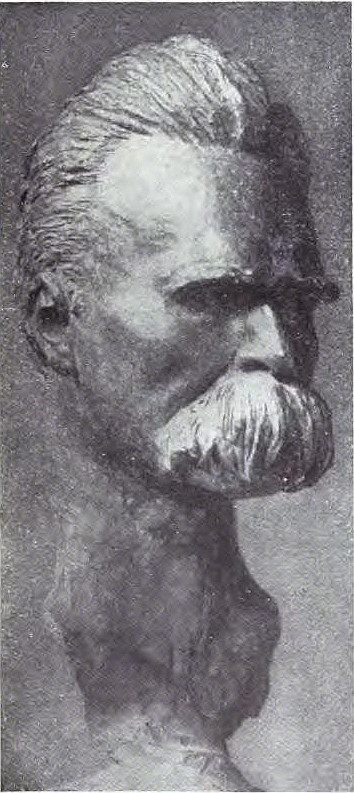
BUST OF NIETZSCHE, BY KLINGER.
"This book is a reasoned negation of the Ten Commandments—the Golden Rule—the Sermon on the Mount—Republican Principles—Christian Principles—and Principles' in general.
"It proclaims upon scientific evolutionary grounds, the unlimited absolutism of Might, and asserts that cut-and-dried moral codes are crude and immoral inventions, promotive of vice and vassalage."
The author is a most ardent admirer of Nietzsche, as may be learned from his verses made after the pattern of Nietzsche's poetry. He sings:
"There is no 'law' in heaven or earth that man must needs obey! Take what you can, and all you can; and take it while you—may.
"Let not the Jew-born Christ ideal unnerve you in the fight. You have no 'rights,' except the rights you win by—might.
"There is no justice, right, nor wrong; no truth, no good, no evil. There is no 'man's immortal soul,' no fiery, fearsome Devil.
"There is no 'heaven of glory:' No!—no 'hell where sinners roast' There is no 'God the Father,' No!—no Son, no 'Holy Ghost.'
"This world is no Nirvâna where joy forever flows. It is a grewsome butcher shop where dead 'lambs' hang in—rows.
"Man is the most ferocious of all the beasts of prey. He rangeth round the mountains, to love, and feast, and—slay.
"He sails the stormy oceans, he gallops o'er the plains, and sucks the very marrow-bones of captives held in—chains.
"Death endeth all for every man,—for every 'son of thunder'; then be a lion (not a 'lamb') and—don't be trampled under."
A valuable recent addition to the discussion of egoism is The Philosophy of Egoism by James L. Walker, (Denver, 1905).
We know of no American periodical which stands for Nietzsche's views, except, perhaps, The Lion's Paw (Chicago) which claims to follow no one. In the last years of the nineteenth century Clarence L. Swartz published at Wellesley, Mass., an egoistic periodical called the I. This magazine is no longer in existence, but Mr. Swartz is very active in the International Intelligence Institute whose aims are universal language, universal nationality and universal peace. He still maintains the same philosophical view which he held as editor of the I, but his philosophical egoism has led him in far different paths from those of Nietzsche—into the paths of peace and not of struggle. He expresses his present conception as follows:
"In the last analysis there is no right but might. Such is the common ordinary rule of every-day life, from which there is no escape, even were escape desirable. Any attempt to overthrow or circumvent or even dispute the exercise of this prerogative of the mighty is but to assert or oppose a greater might. Expediency always dictates how might should be exercised. Politically, I hold that the non-coercion of the non-invasive individual is the part of wisdom. The individual is supreme, and should be preserved as against society, for in no other way can evolution perform its perfect work."
The Free Comrade edited by J. Wm. Lloyd and Leonard Abbott, an avowedly socialistic and individualistic paper, originally under the sole editorship of Lloyd, stood for Nietzsche and his egoism, but can no longer be said to do so.
THE PRINCIPLE OF VALUATION
It may be interesting in this connection to mention the case of an American equivalent to Nietzsche's philosophy, which so far as I know has never yet seen publicity.
Some time ago the writer of this little book became acquainted with a journalist who has worked out for his own satisfaction a new system of philosophy which he calls "Christian economics," the tendency of which would be to preach a kind of secret doctrine for the initiated few who would be clever enough to avail themselves of the good opportunity. He claims that the only thing worth while in life is the acquisition of power through the instrumentality of money. He who acquires millions can direct the destiny of mankind, and this tendency was first realized in the history of mankind in this Christian nation of ours, whose ostensible faith is Christianity. Our religion, he argues, is especially adapted to serve as a foil to protect and conceal the real issue, and so he calls his world-conception, "Christian economics." Emperors and kings are mere puppets who are exhibited to general inspection, and so are presidents and all the magistrates in office. Political government has to obey the behests of the financiers, and the most vital life of mankind resides in its economical conditions.
The inventor of this new system of "Christian economics" would allow no other valuation except that of making money, on the sole ground that science, art and the pleasures of life are nothing to man unless he is in control of power which can be had only through the magic charm of the almighty dollar.
I shall not comment upon his view, but shall leave it to the reader, and am here satisfied to point out its similarity to Nietzsche's philosophy. There is one point only which I shall submit here for criticism and that is the principle of valuation which is a weak point with both the originator of "Christian economics" and with Friedrich Nietzsche.
Nietzsche proclaimed with great blast of trumpets, if we may so call his rhetorical display of phrases, that we need a revaluation of all values; but the best he could do was to establish a standard of valuation of his own. Every man in this world attains his mode of judging values according to his character, which is formed partly by inherited tendencies, partly by education and is modified by his own reflections and experiences. There are but few persons in this world who are clearsighted enough to formulate the ultimately guiding motive of their conduct. Most people follow their impulses blindly, but in all of them conduct forms a certain consistent system corresponding to their own idiosyncrasy. These impulses may sometimes be contradictory, yet upon the whole they will all agree, just as leaves and blossoms, roots and branches of the same tree will naturally be formed according to the secret plan that determines the growth of the whole organism. Those who work out a specially pronounced system of moral conduct do not always agree in practical life with their own moral principle, sometimes because they wilfully misrepresent it and more frequently because their maxims of morality are such as they themselves would like to be, while their conduct is such as they actually are. Such are the conditions of life and we will call that principle which as an ultimate raison d'être determines the conduct of man, his standard of valuation. We will see at once that there is a different standard for each particular character.
A scientist as a rule looks at the world through the spectacles of the scientist. His estimation of other people depends entirely on their accomplishments in his own line of science. Artist, musician, or sculptor does the same. To a professional painter scarcely any other people exist except his pupils, his master, his rivals and especially art patrons. The rest of the world is as indifferent as if it did not exist; it forms the background, an indiscriminate mass upon which all other values find their setting. All the professions and vocations, and all the workers along the various lines of life are alike in that every man has his own standard of valuation.
A Napoleon or a Cæsar might have preached the doctrine that the sciences, the arts and other accomplishments are of no value if compared with the acquisition of power, but I feel sure that it would not have been much heeded by the mass of mankind, for no one would change his standard of value. A financier might publicly declare that the only way to judge people is according to the credit they have in banking, but it would scarcely change the standard of judgment in society. Beethoven knew as well as any other of his contemporaries the value of money and the significance of power, and yet he pursued his own calling, fascinated by his love for music. The same is true not only of every genius in all the different lines of art and science, but also of religious reformers and inventors of all classes. Tom, Dick and Harry in their hankering for pleasure and frivolous amusement are not less under the influence of the conditions under which they have been born than the great men whose names are written in the book of fame. It is difficult for every one of us to create for himself a new standard of valuation, for what Goethe says of man's destiny in a poem entitled Daimon, is true:[1]
"As on the day which has begotten thee The sun and planets stood in constellation, Thus growest and remainest thou to be, For't is life's start lays down the regulation How thou must be. Thyself thou canst not flee. Such sibyl's is and prophet's proclamation. For truly, neither force nor time dissolveth, Organic form as, living, it evolveth."
The original reads thus:
"Wie an dem Tag der dich der Welt verliehen, Die Sonne stand zum Grusse der Planeten, Bist alsobald and fort und fort gediehen Nach dem Gesetz, wonach du angetreten. So musst du sein, dir kannst du nicht entfliehen, So sagten schon Sibyllen, so Propheten; Und keine Zeit und keine Macht zerstückelt, Geprägte Form, die lebend sich entwickelt."
Our attitude in life depends upon our character, and the basic elements of character are the product of the circumstances that gave birth to our being. Our character enters unconsciously or consciously in the formulation of our standards of value which we will find to be the most significant factors of our destinies. Now the question arises, Is the standard of value which we set up, each one of us according to his character, purely subjective or is there any objective criterion of its worth?
We must understand that to a great extent our choice of a profession and other preferences in our occupations or valuations are naturally different according to conditions; some men are fit to be musicians, or scholars, or traders, or farmers, or manufacturers, and others are not. The same profession would not be appropriate for every one. But there is a field common to all occupations which deals with man's attitude toward his fellow beings and, in fact, toward the whole universe in general. This it is with which we are mainly concerned in our discussion of a criterion of value because it is the field occupied by religion, philosophy and ethics. Tradition has sanctioned definite views on this very subject which have been codified in certain rules of conduct different in many details in different countries according to religion, national and climatic conditions, and the type of civilization; yet, after all, they agree in most remarkable and surprising coincidences in all essential points.
Nietzsche, the most radical of radicals, sets up a standard of valuation of his own, placing it in the acquisition of power, and he claims that it alone is entitled to serve as a measure for judging worth because, says he, it alone deals with that which is real in the world; yet at the same time he disdains to recognize the existence of any objective criterion of the several standards of value. If he were consistent, he ought to give the palm of highest morality to the man who succeeds best in trampling under foot his fellowmen, and he does so by calling him the overman, but he does not call him moral. To be sure this would be a novel conception of morality and would sanction what is commonly execrated as one of the most devilish forms of immorality. Nietzsche takes morality in its accepted meaning, and so in contradiction to himself denies its justification in general.
Considering that every one carries a standard of valuation in himself we propose the question, "Is there no objective criterion of valuation, or are all valuations purely subjective?" This question means whether the constitution of the objective world in which we all live, is such as to favor a definite mode of action determined by some definite criterion of value.
We answer that subjective standards of valuation may be regarded as endorsed through experience by the course of events in the world whenever they meet with success, and thus subjective judgments become objectively justified. They are seen to be in agreement with the natural course of the world, and those who adhere to them will in the long run be rewarded by survival. Such an endorsement of standards can be determined by experience and has resulted in what is commonly called "morality." We may here take for granted that the moral valuation is a product of many millenniums and has been established, not only in one country and by one religion, nor in one kind of human society, but in perfect independence in many different countries, under the most varied conditions, and finds expression in the symbolism of the most divergent creeds. The beliefs of a Christian, of a Buddhist, of a Mussulman in Turkey, or a Taoist in the Celestial Empire, of a Parsee in Bombay, or Japanese Shintoist, are all as unlike as they can be, but all agree as to the excellency of moral behavior which has been formulated in these different religions in sayings incorporated in their literature. We find very little if anything contradictory in their standards of valuation, and if there is any objective norm for the subjective valuation of man it is this moral consensus in which all the great religious prophets and reformers of mankind agree.
A transvaluation of all values is certainly needed, and it is taking place now. In fact it has always taken place whenever and wherever mankind grows or progresses or changes the current world-conception.
The old morality has been negative and we feel the need of positive ideals. The old doctrines are formulated in rules which forbid certain actions and our commandments begin with the words "Thou shalt not...." Those folk are esteemed moral who obey these restrictions or at least do not ostensibly infringe upon them, and this practically limits morality to mediocrity. How often have great and noble people been condemned as immoral because some irregularities would not fit the Procrustean bed of customary respectability! Think only of George Eliot who had to suffer under the prejudices of Sunday-School morality! We need a higher standard in which we may set aside the paltry views of the old morality without losing our ideals. We need a positive norm, the norm which counts in the actual world and in history, where man is measured not by his sins of omission but by his positive accomplishments; not by the errors he has or has not committed, but by his deeds, by the work with which he has benefited mankind. Therefore the new morality does not waste much time with the several injunctions, "Thou shalt not ..." but impresses the growing generation with the demand: "Do something useful; show thyself efficient; be superior to others in nobility, in generosity, in energy; excel in one way or another"; and in this sense a transvaluation of the old values is being worked out at present.
We will grant that Nietzsche's demand of a transvaluation of all values may mean to criticize the narrow doctrines and views of the religion of his surroundings. But as he expresses himself and according to his philosophical principle he goes so far as to condemn not only the husk of all these religious movements, but also their spirit. In spite of his subjectivism which denies the existence of anything ideal, and goes so far as to deny the right even of truth to have an objective value, Nietzsche establishes a new objectivism, and proposes his own, and indeed very crude, subjective standard of valuation as the only objective one worthy of consideration for the transvaluation of all values.
Nietzsche's real world, or rather what he deemed to be the real world, is a dream, the dream of a sick man, to whom nothing possesses value save the boons denied him, physical health, strength, power to dare and to do.
The transvaluation of all values which Nietzsche so confidently prophesied, will not take place, at least not in the sense that Nietzsche believed. There is no reason to doubt that in the future as in the past history will follow the old conservative line of development in which different people according to their different characters will adopt their own subjective standards, and nature, by a survival of the fittest will select those for preservation who are most in agreement with this real world in which we live, a world from which Nietzsche, according to the sickly condition of his constitution, was separated by a wide gulf. He thirsted for it in vain, and we believe that he had a wrong conception of the wealth of its possibilities and viewpoints.
INDIVIDUALISM
Nietzsche is unquestionably a bold thinker, a Faust-like questioner, and a Titan among philosophers. He is a man who understands that the problem of all problems is the question, Is there an authority higher than myself? And having discarded belief in God, he finds no authority except pretensions.
Nietzsche apparently is only familiar with the sanctions of morality and the criterion of good and evil as they are represented in the institutions and thoughts established by history, and seeing how frequently they serve as tools in the hands of the crafty for the oppression of the unsophisticated masses of the people, he discards them as utterly worthless. Hence his truly magnificent wrath, his disgust, his contempt for underling man, for the masses, this muddy stream of present mankind.
If Nietzsche had dug deeper, he would have found that there is after all a deep significance in moral ideals, for there is an authority above the self by which the worth of the self must be measured. Truth is not a mere creature of the self, but is the comprehension of the immutable eternal laws of being which constitute the norm of existence. Our self, "that creating, willing, valuing 'I,' which (according to Nietzsche) is the measure and value of all things," is itself measured by that eternal norm of being, the existence of which Nietzsche does not recognize.
What is true of Nietzsche applies in all fundamental questions also to his predecessor, Max Stirner. It applies to individualism in any form if carried to its consistent and most extreme consequences.
Nietzsche is blind to the truth that there is a norm above the self, and that this norm is the source of duty and the object of religion; he therefore denies the very existence of duty, of conviction, of moral principles, of sympathy with the suffering, of authority in any shape, and yet he dares to condemn man in the shape of the present generation of mankind. What right has he, then, to judge the sovereign self of to-day and to announce the coming of another self in the overman? From the principles of his philosophical anarchism he has no right to denounce mankind of to-day, as an underling; for if there is no objective standard of worth, there is no sense in distinguishing between the underman of to-day and the overman of a nobler future.
On this point, however, Nietzsche deviates from his predecessor Stirner. The latter is more consistent as an individualist, but the former appeals strongly to the egoism of the individual.
Nietzsche is a Titan and he is truly Titanic in his rebellion against the smallness of everything that means to be an incarnation of what is great and noble and holy. But he does not protest against the smallness of the representatives of truth and right, he protests against truth and right themselves, and thus he is not merely Titanic, but a genuine Titan,—attempting to take the heavens by storm, a monster, not superhuman but inhuman in proportions, in sentiment and in spirit. Being ingenious, he is, in his way, a genius, but he is not evenly balanced; he is eccentric and, not recognizing the authority of reason and science, makes eccentricity his maxim. Thus his grandeur becomes grotesque.
The spirit of negation, the mischief-monger Mephistopheles, says of Faust with reference to his despair of reason and science:
"Reason and Knowledge only thou despise, The highest strength in man that lies!... And I shall have thee fast and sure." —Tr. by Bayard Taylor.
Being giant-like, the Titan Nietzsche has a sense only for things of large dimensions. He fails to understand the significance of the subtler relations of existence. He is clumsy like Gargantua; he is coarse in his reasoning; he is narrow in his comprehension; his horizon is limited. He sees only the massive effects of the great dynamical changes brought about by brute force; he is blind to the quiet and slow but more powerful workings of spiritual forces. The molecular forces that are invisible to the eye transform the world more thoroughly than hurricanes and thunderstorms; yet the strongest powers are the moral laws, the curses of wrong-doing and oppression, and the blessings of truthfulness, of justice, of good-will. Nietzsche sees them not; he ignores them. He measures the worth of the overman solely by his brute force.
If Nietzsche were right, the overman of the future who is going to take possession of the earth will not be nobler and better, wiser and juster than the present man, but more gory, more tiger-like, more relentless, more brutal.
Nietzsche has a truly noble longing for the advent of the overman, but he throws down the ladder on which man has been climbing up, and thus losing his foothold, he falls down to the place whence mankind started several millenniums ago.
We enjoy the rockets of Nietzsche's genius, we understand his Faust-like disappointment as to the unavailableness of science such as he knew it; we sympathize with the honesty with which he offered his thoughts to the world; we recognize the flashes of truth which occur in his sentences, uttered in the tone of a prophet; but we cannot help condemning his philosophy as unsound in its basis, his errors being the result of an immaturity of comprehension.
Nietzsche has touched upon the problem of problems, but he has not solved it. He weighs the souls of his fellowmen and finds them wanting; but his own soul is not less deficient. His philosophy is well worth studying, but it is not a good guide through life. It is great only as being the gravest error, boldly, conscientiously, and seriously carried to its utmost extremes and preached as the latest word of wisdom.
It has been customary that man should justify himself before the tribunal of morality, but Nietzsche summons morality itself before his tribunal. Morality justifies herself by calling on truth, but the testimony of truth is ruled out, for truth—objective truth—is denounced as a superstition of the dark ages. Nietzsche knows truth only as a contemptible method of puny spirits to make existence conceivable—a hopeless task! Nietzsche therefore finds morality guilty as a usurper and a tyrant, and he exhorts all esprits forts to shake off the yoke.
We grant that the self should not be the slave of morality; it should not feel the "ought" as a command; it should identify itself with it and make its requirements the object of its own free will. Good-will on earth will render the law redundant; but when you wipe out the ideal of good-will itself together with its foundation, which is truth and the recognition of truth, the struggle for existence will reappear in its primitive fierceness, and mankind will return to the age of savagery. Let the esprits forts of Nietzsche's type try to realize their master's ideal, and their attempts will soon lead to their own perdition.
We read in Der arme Teufel,[1] a weekly whose radical editor would not have been prevented by conventional reasons from joining the new fad of Nietzscheanism, the following satirical comment on some modern poet of original selfhood:
"'I am against matrimony because I am a poet Wife, children, family life,—well, well! they may be good enough for the man possessed of the herding instinct But I object to trivialities in my own life. I want something stimulating, sensation, poetry 1 A wife would be prosaic to me, simply on account of being my wife; and children who would call me papa would be disgusting. Poetry I need! Poetry!' Thus he spoke to a friend, and when the latter was gone continued his letter reproaching a waitress for again asking for money and at the same time reflecting upon the purity of her relations to the bartender who, she pretended, was her cousin only...."
If marriage relations were abolished to-day, would not in the course of time some new form of marriage be established? Those who are too proud to utilize the experiences of past generations, will have to repeat them for themselves and must wade through their follies, sins, errors, and suffer all the consequences and undergo their penalties.
Nietzsche tries to produce a Cæsar by teaching his followers to imitate the vices of a Catiline; he would raise gods by begetting Titans; he endeavors to give a nobler and better standard to mankind, not by lifting the people higher and rendering them more efficient, but by depriving them of all wisdom and making them more pretentious.
If the ethics of Nietzsche were accepted to-day as authoritative, and if people at large acted accordingly, the world would be benefited in one respect, viz., hypocrisy would cease, and the selfishness of mankind would manifest itself in all its nude bestiality. Passions would have full sway; lust, robbery, jealousy, murder, and revenge would increase, and Death in all forms of wild outbursts would reap a richer harvest than he ever did in the days of prehistoric savage life. The result would be a pruning on a grand scale, and after a few bloody decades those only would survive who either by nature or by hypocritical self-control deemed it best to keep the lower passions and the too prurient instincts of their selfhood in proper check, and then the old-fashioned rules of morality, which Nietzsche declared antiquated, would be given a new trial in the new order of things. They might receive a different sanction, but they would find recognition.
Nietzsche forgets that the present social order originated from that general free-for-all fight which he commends, and that if we begin at the start we should naturally run through the same or a similar course of development to the same or very similar conditions. Will it not be better to go on improving than to revert to the primitive state of savagery?
There are superstitious notions about the nature of the sanction of ethics, but for that reason the moral ideals of mankind remain as firmly established as ever.
The self is not the standard of measurement for good and evil, right and wrong, as Nietzsche claims in agreement with the sophists of old; the self is only the condition to which and under which it applies. There is no good and evil in the purely physical world, there is no suffering, no pain, no anguish—all this originates with the rise of organized animal life which is endowed with sentiency; and further there is no goodness and badness, no morality until the animal rises to the height of comprehending the nature of evil. The tiger is in himself neither good nor bad, but he makes himself a cause of suffering to others; and thus he is by them regarded as bad. Goodness and badness are relative, but they are not for that reason unreal.
It is true that there is no "ought" in the world as an "ought"; nor are there metaphysical ghosts of divine commandments revealing themselves. But man learns the lesson how to avoid evil and reducing it to brief rules which are easily remembered, he calls them "commandments."
Buddha was aware that there is no metaphysical ghost of an "ought," and being the first positivist before positivism was ever thought of, his decalogue is officially called "avoiding the ten evils," not "the ten commandments," the latter being a popular term of later origin.
Granting that there is no metaphysical "ought" in the world and that it finds application only in the domain of animate life through the presence of the self or rather of many selves, we fail to see that the self is the creator of the norm of good and evil. Granting also that there are degrees of comprehending the nature of evil and that different applications naturally result under different conditions, we cannot for that reason argue that ethics are purely subjective and that there is no objective norm that underlies the moral evolution of mankind and comes out in the progress of civilization more and more in its purity.
Nietzsche is like a schoolboy whose teacher is an inefficient pedant. He rebels against his authority and having had but poor instruction proclaims that the multiplication table is a mere superstition with which the old man tries to enslave the free minds of his scholars. Are there not different solutions possible of the same example and has not every one to regard his own solution as the right solution? How can the teacher claim that he is the standard of truth? Why, the very attempt at setting up a standard of any kind is tyranny and the recognition of it is a self-imposed slavery. There is no rightness save the rightness that can be maintained in a general hand-to-hand contest, for it is ultimately the fist that decides all controversies.
Nietzsche calls himself an atheist; he denies the existence of God in any form, and thus carries atheism to an extreme where it breaks down in self-contradiction. We understand by God (whether personal, impersonal, or superpersonal) that something which determines the course of life; the factors that shape the world, including ourselves; the law to which we must adjust our conduct. Nietzsche enthrones the self in the place of God, but for all practical purposes his God is blunt success and survival of the fittest in the crude sense of the term; for according to his philosophy the self must heed survival in the struggle for existence alone, and that, therefore, is his God.
Nietzsche's God is power, i. e., overwhelming force, which allows the wolf to eat the lamb. He ignores the power of the still small voice, the effectiveness of law in the world which makes it possible that man, the over-brute, is not the most ferocious, the most muscular, or the strongest animal. Nietzsche regards the cosmic order, in accommodation to which ethical codes have been invented, as a mere superstition. Thus it will come to pass that Nietzsche's type of the overman, should it really make its appearance on earth, would be wiped out as surely as the lion, the king of the beasts, the proud pseudo-overbrute of the animals, will be exterminated in course of time. The lion has a chance for survival only behind the bars of the zoölogical gardens or when he allows himself to be tamed by man, that weakling among the brutes whose power has been built up by a comprehension of the sway of the invisible laws of life, physical, mental and moral.
What is the secret of Nietzsche's success? While other men of greater consistency, among them his predecessor Stirner, failed, he attained an unparalleled fame, and his philosophy exercised an extraordinary influence upon large classes of people not only in Germany but also abroad, in Russia, in France, in the United States and even in conservative England.
We must concede that Nietzsche possesses a poetic power of oratory; he appeals to sentiment; he is not much of a thinker, not a philosopher, but a leader and a prophet, and as such he stands for the most extreme egoism. Nietzsche attempts to establish the absolute sovereignty of the individual and grants a most irresponsible freedom to the man who dares; and this principle of doing away with moral maxims has made him popular.
The truth is that our moral sanctions are no longer accepted. People still believe in God, in the authority of church and state, but their belief is no longer a living faith. Whatever they may think of God, the old God, the God of traditional dogmatism, is gone. He is no longer a living power in the hearts of the people; and so, large masses rejoice to have the proclamation frankly stated that God is dead, that they need no longer fear hell, and that the chains of their slavery are broken.
Nietzsche is consistent in his denial of the traditional sanctions. He understands not only that there are no gods, that the powers of nature as personifications do not exist, but that the laws of nature are mere abstract generalizations. We need no longer believe in Hephaestos, the god of fire; there is no use to bow the knee to him or do homage to his divinity. Nor is there any truth in the existence of a phlogiston, a metaphysical fire-stuff, or any fire essence; there are only scattered facts of burning. Everything else is mere superstition. Generalizations exist only in our imagination, and so we should get rid of the idea that there is any truth at all. Science is a pretender which is apt to make cowards of us. That man is wise who is not hampered by scruple or doubt of any kind and simply follows the bent of his mind, subjecting to himself every thing he finds, including his fellow human beings.
This bold and reckless proposition appeals to egoism and it seems so true that abstract formulas and generalizations are empty. Weight exists; there is gravity; there are particular phenomena of masses in mutual attraction, but gravitation, the law of these actual happenings, is a mere formula, an imaginary quantity, a mere thought about which we need not worry. The law of gravitation is a human invention and has no real existence in the realm of facts.
And the same would of course be true about the interrelations among human beings in their social intercourse, too. All the several maxims of conduct, which are called moral and constitute our code of ethics, are built upon generalizations. There is no sanction for them. The gods who were formerly supposed to be responsible for the several domains of facts have died long ago. The Jewish deity called Elohim, the Lord, entered upon the inheritance of the ancient gods, but he too had to die. Thereupon his place was taken by metaphysical essences, pale ghosts of a mysterious nature, but they too died and so the last shadow of anything authoritative is gone. We are en face du rien; therefore let us boldly enjoy our freedom. Let us be ourselves; let our passions take their course; let us do wrong if it suits us; let us live without consideration of anything, just as we please. There is no sanction of moral maxims to be respected; there is no authority of conduct; there is no judge; there is no evil, no wrong.
This seems pretty plausible to our modern generation raised in the traditions of nominalism, but would we really ignore the law of gravitation because the Newtonian formula is a man-made abstraction and a mere generalization? Yet, if we do not give heed to it we fall, and the same is true of any law of nature. Our sciences are mental constructions; they are mind-made, and so far as they are built out of the material of our experience they tally with facts and we call them true. Our social interrelations, too, constitute conditions observable in experience; they can be formulated in Jaws and applied to practical life; they can be expressed in maxims of conduct and have received various sanctions successively, the sanctions of religion, the sanctions of metaphysics, the sanctions of science. In the age of savagery the sanction of moral maxims was offered us in a mythological dress. With the rise of monotheism our moral sanction came to us as the command of a supreme ruler of the universe; in the age of abstract philosophy as metaphysical principles, and in the age of science these should be recognized as lessons of experience.
CONCLUSION.
We will gladly grant that personifications are mythological fictions, that metaphysical entities are products of a philosophical imagination and that the scientific formulas are abstract generalizations, but we deny that generalizations are unmeaning; they signify some actual features of reality. Abstract ideas are not purely fictitious; they denote significant qualities or occurrences, and the relations in life, the forms of things, combinations, or in general the non-material configurations, co-operations, combinations and functions are the most important and the most significant aspects of existence. Indeed, matter and energy are only the clumsy conditions of being; they denote actuality and reality, but all things, all events, all facts are such as they are on account of their form—on account of that feature which is non-material and non-energetic.