NICANOR TELLER OF TALES (continued 6)
Reading edition
"Ay, and I think that I shall never see him more. For surely his lord will slay him when he knows what he hath done," said Sada.
Suddenly she put her head on Eldris's shoulder and wept; and Eldris, by way of showing sympathy, having love sorrows of her own, put her arms about her and wept also.
II
The lord Eudemius laid himself upon his couch of ebon and carved ivory with the air of a man whose work has been well done. Midnight was long gone, the great house was quiet, and the desire of his heart stood forth in fulfilment. He had a son; his dying house was propped with fresh strength and vigor, and the gods of the shades might claim him when they would. One week ago had the marriage been celebrated. Each night since there had been feasts, with at every feast new dishes contrived, new sports and entertainments offered, new souvenirs of price distributed, to provide the jaded senses of his guests with fresh gratification. Now the festivities were nearly over; already some of the lords had gone. Among them was Count Pomponius, with his Wardens of the Eastern Marches, for it was reported that Saxons were again harrying and burning along the coast.
In the mellow light of the bronze lamps the face of Eudemius showed softer, less inscrutable, with eyes more kindly. On it was great weariness, but also a great content. He put forth a hand and touched the bell on the stand beside his couch. The strain under which he had labored was lifting; he could afford to relax. The silvery tinkle of sound had scarcely fallen into the quiet of the room when Mycon, chief of the eunuchs, entered, parting the curtains, with his arms crossed before his face.
"Bid Cyrrus bring hither his lyre," said Eudemius.
Many and many a day had gone since their dark lord had given such command; the cries and groans of his slaves had been music enough for him. Mycon bowed in silence and went. Before five minutes had fled, word of the miracle had gone from end to end of the ranks of those whose duty it was to watch the house by night; and weary men and women smiled and blessed their little lady, who perhaps had bought for them the dawn of a happier day.
Cyrrus the musician entered, a slender Greek boy; and the low light was caught by the silver frame of the lyre he bore, and rippled on its strings. He put himself where he should not be too much under his lord's eyes, and played; and as though the instinct of his art had taught him what to do, the music he played was plaintive and low and soothing. Eudemius lay with arms behind his head and stared at the painted ceiling where naked nereids sported. By slow degrees, still more his hard face softened; under the spell of the music and of his thoughts his thin lips parted to a smile. Slow and soft the melody rippled into the quiet room, singing of placid waters smiling in the sun, with lilies floating on their bosom, of young fleecy clouds and tender shadows. Again it changed, with dropping notes like tears, and whispered of the yearning hopes of men, of world pain and heart's peace, of longings unfulfilled and prayers unanswered. Two tears, the slow and difficult tears of age, stole down Eudemius's gray furrowed cheeks and lost themselves in his silken pillow.
"My child!" he whispered. "My little, little child!"
In that moment the pathetic unloved beauty of her came nearer to touching him than ever before. He forgot that he had sold her into bondage; forgot that her happiness might not lie along the road of his. She had done what he would have her do; she had been a dutiful daughter, and at the last he rejoiced in her.
Varia, at that hour, sat alone in her chamber, awaiting the coming of her lord. There were traces of tears upon her cheeks; her lids drooped with weariness and sleep. They had taken away her robes of state, in which she had sat by Marius's side through interminable hours of merrymaking, when a thousand eyes had stared at her from a swimming sea of lights, and she had shrunk and trembled beneath their glances. They had put upon her a thin robe of Seres silk of rose, with no ornament or jewel upon it. With bare neck and arms, and warm white throat bending with the drooping flower of her head, she looked more than ever a child. To all that they had done to her throughout the endless days of festival, she had submitted docilely, dazed, if she could have told it, by the excitement of those around her. Faces, scenes, events, had passed before her in a blurred confusion, in which she could neither think nor see clearly. She had repeated words of whose meaning she had no knowledge; she had drunk wine and only been distressed that a drop had fallen upon her royal robe; she had broken a cake of bread and only wondered why her little black slave was not there to gather up the crumbs. Of her lord she had seen little, save upon one fearful night of which the memory still sent burning shudders through her frightened heart. She drifted upon a gray sea of loneliness, torn from her old shelters, given nothing to which she might turn and cling.
She got up from the chair covered with rugs of white fur, in which she had been nestling like a great rose, and went to the window which looked upon the garden, all her movements restless, like some shy creature caged. Now the garden lay deserted, desolate in the mistiness of the moonlight. She held her arms out to it in vague yearning.
"I would I were out there now!" she cried softly. "Where the trees whisper and the lake sleeps, and none but may hear the music of one voice. He is gone—he is gone from me, and I know not where they have taken him. And I long for him; I would I could creep into his arms and rest upon his breast forever, for then I should not be frightened. Now I am left alone—I know not where to turn for very fear—my head it burneth and my hands are cold. And I fear to be alone—and the night is dark—so dark!"
A gust of wind rose slowly through the trees, like the flapping of unseen wings, and Varia shivered. The moon was now and again obscured under vast driving clouds; through the gloom trees massed themselves into blots of sinister shadow. When the wind's voice died, the earth hung silent, in suspense, so that Varia held her breath in sheer unconscious attunement to it. In the garden she saw a black shape flying with quick darting swoops. She knew it for a bat, but her eyes dilated with nervous fright. It was so very still—in all the world there was no sound at all. She glanced fearfully over her shoulder. Even the lighted room was not reassuring; it also held the same waiting stillness which she dared not break by so much as a sigh. Only the flame from the perfumed lamps flickered wanly in the draught. Her wide eyes fixed themselves upon the window, striving to pierce the mystery of the dark without; she yielded helplessly to the sway of the vast unnamed forces around her, a child frightened in the night. She sank upon the floor by the window, hiding her face.
"Nerissa!" she called in a small and shaken voice, and wept, more frightened at the little cry drowned in the tense stillness. Never had she been so alone in her life; never so frightened. She clung to the window, crouched as small as possible, not daring to look up.
And across the night a sound grew out of the void and came to her, and her face blanched, and she caught at her throat with shaking hands. Faint, elusive, coming from very far away, to be felt rather than heard, it was now like the distant trampling of the feet of many men, now like the rush of water over stones, now like the whisper of the wind in trees, scarcely a thing apart from the silence which enfolded and engulfed it. It was a voice from nowhere, warning her straining senses of unknown and sinister things to come.
"Why, sweetheart, art hiding from me?" a voice said almost at her ear, and Varia, taken unawares and startled out of all control, screamed aloud and shrank lower into her corner, sobbing violently.
Marius stooped over her and took her hands away from her face.
"What is wrong?" he demanded. "Why these tears, little wife?"
"It was so dark!" Varia wailed. "And there was no sound at all, and then there was a sound—"
She wept again, her fresh terrors submerging even her fear of him.
Marius picked her up in his arms, carried her to the couch, and laid her there, and a moment she clung to his hand desperately. He was something human to hold to; so she would have clung to Nerissa, or even to Mycon.
"Afraid of the dark!" Marius scoffed gently. "Well, I am here now, and there is nothing shall harm thee. Of a truth, I did begin to think the feast would never have an end. The more I burned to be done with it and come to thee, the more the minutes dragged. I pictured thee, awaiting me here in thy secret bower; thy flushing face and the veiling shadow of thy hair, thy denying hands and averted glances—and thy father's guests might well have thought me a love-sick fool, thinking of nothing but his secret hope that his mistress might prove kind."
Varia sat upright on the couch and put her feet upon the floor, and his eyes followed the gracious outlines of her form beneath its drapery of rose. She pushed her hair back from her eyes and looked at him. Slow crimson spread from throat to brow; her glance wavered and fell. Quite suddenly she put both hands to her face, hiding her eyes from his, and turned her face away. It was a gesture of a child, infinitely touching, all-betraying in its pure artlessness. He started toward her, his dark eyes keen; and she sat quite still, passive to this fate of hers from which flight no longer might avail her. But with the touch of his hand upon her shoulder there came a soft insistent knocking at the door.
Marius smothered a curse and strode to open it. Mycon stood upon the threshold, and in the lamplight his face showed gray. He stammered like one caught in guilt.
"Lord, thy pardon! There is trouble without, and the master sends to ask my lord's presence. We be encompassed by barbarians who have crept upon us."
"Tell thy lord I come," said Marius. Varia was forgotten; scarcely had the slave vanished down the corridor when Marius was after him, leaving his bride alone.
Now in the villa were to be heard the first sounds of people aroused from sleep to find themselves in the midst of unknown dangers. Voices, frightened and impatient, echoed back and forth along the corridors; lights gleamed across the courts. Men and women, half dressed, began to appear, questioning feverishly, delivering themselves of theories to any who would listen.
"They say that if he will surrender Felix they will depart at once in peace."
"How came they to know that he was here? Who told them?"
"He will not surrender Felix—"
"If he does not—holy gods!—we shall all be slain and plundered."
And above all, a woman's voice:
"I will not stay to be robbed! I shall leave this house at once!"
In the great court men had gathered about Eudemius and Marius, who held hasty consultation. Felix, pale, nursing carefully his wounded arm, was on the outskirts of the group. His face all unconsciously betrayed his state of mind. It was white and flaccid; and at every yelp of the hounds outside who clamored for his life, he cringed and quivered. But he was very quiet, and the talk surged over his head as though he had not been there. Men cast glances of scorn unveiled upon him, but he was long past caring what they thought. He wanted his life; his eyes craved protection. In his face was a desperate dumb reliance on the pride and honor of Eudemius, which would not allow him to surrender one who had claimed his hospitality; craven himself, he yet recognized and centred all his faith upon this stern and scornful pride which must uphold its traditions at whatever cost.
Several of the younger lords who had been or were then in military service came forth, offering themselves, not at all averse, it would seem, to such variation in the entertainment. A handful of drunken barbarians—what were these? Upon them and upon Marius the defence of the villa devolved. Marius gave his orders swiftly, and one by one his lieutenants sped away. All slaves capable of bearing arms were to be equipped at once from the armory. Men were already stationed at intervals along the outer walls to guard against surprise. The house seethed with uproar, which no efforts of discipline could quench. Women wept and clung together, terrified each by the others' terror. They huddled in bunches around the walls, catching at every man who would pause to speak with them. Yes, there had been a barbarian even within the hall, a great fellow, tall as the house, who spat fire and spoke Latin as no Roman had ever heard Latin spoken before. Ay, truly, all the gods might witness that he had spat fire. And then he had left, taking back to his dogs of comrades their lord's refusal to yield up his guest. So there would be an attack, and men had many other things to do than to be stopped and chattered to by foolish women. Mingled always with the lamentations of these was men's shouting, a trampling of many feet, a swift confusion. The lights, continually fanned by the passing of people, began to take on a lurid glare. In the wind which blew about the crowded court, cressets flared horribly, with very evil-smelling smoke. Their light fell waveringly on jewels and golden collars and rich robes, and on burnished weapons in the hands of slaves. Long since had the porter fled from his lodge, and his place was taken by a score of eager defenders.
Marius snatched a moment from the importunities of those who would know the precise state of their danger, and exactly how long it must be before they should all be slain, and ran up the stairs which led to the upper rooms. He felt his way through the darkness until he came upon a window, very narrow and small, so high that he could overlook the rest of the house and by leaning out see something of what went on in front. And at what he saw he gave an exclamation, sharp and low, and his eyes glittered like those of a warhorse which scents battle. For all below him were lights which glinted in and out across the night; and to his trained ears rose the stamp and snort of stallions held in check, and the stir and rustle of many men. How many he could not tell, for the moon, fighting her way through a smother of clouds, gave scarce light to see, and in the trees the shadows were delusive.
A man's voice shouted; other voices took it up, until a seething bubble of sound, hoarse and significant, eddied around the house and lost itself in distance. A stealthy stir and movement heaved itself from among the shadows; there was the clank of a weapon against an iron stirrup; vague forms seemed to circle more closely about the house. The voice shouted again and was answered by a scurry of horses' feet.
"There be more than I had thought," Marius muttered, and turned to go. "And they are not all mounted. Also I think that they will try to take the door by storm. Well, they can try! More than two may play at that game!"
In time, those without began an attempt to batter their way in, so that Marius proclaimed them very drunk and more foolish. He said nothing of his suspicion that this was merely intended to mask an attack in some other quarter, and was inclined to be scornful of this untried foe. So that some of the old men, taking no consideration of the fact that although his words were light his actions were prompt and well-planned, became timid, and the shrieks of the women redoubled at every assault upon the door. He strove to assure them that if their besiegers did break in, they could get no further for the bristling hedge of swords and spears which waited. But to this the timid ones replied with reason that they did not want them in at all. Various guests began to take it in their heads that this was not the entertainment they had come for; and in an access of the strange panic which is liable to plunge even the most sober crowd into blind folly, if nothing worse, collected their valuables and their attendants and prepared incontinently to fly from the house. Greatly their wrath raged when Marius refused to let them out. They muttered that the heads of upstarts were easily turned by a little power, and they had rather be slain in the open than butchered like rats in their hole.
And at this, the first hint of insubordination among his forces, Marius became no longer the easy-going gallant whom most of them had known, but a being new and strange. He sprang to the mastery of the situation by, as it were, divine right, a right which was his by grace of the power that had trained him to face and control crises such as these. He treated these high-born lords and ladies as though they had been squads of mutinous recruits; he lashed them with his glance; he no longer requested, he ordered. His voice held a rasp which none had ever heard, and which brought them from displeased dignity to instant and abject obedience. He spared none,—faded voluptuary, whining graybeard, nor restive youth; in an hour he had bullied and frightened them into working like galley-slaves, and all the house was under the iron discipline of his camp.
In her chamber, Varia, in all her terror and loneliness, was forgotten. About her was an insistent clamor of confusion; she stood in the middle of the room, dazed and overwhelmed by it, the light flowing softly over her. Now and again a shouted order was flung across the tumult; with this there began presently to mingle sounds from without. In the corridor words flew by her, whose meaning she scarcely comprehended.
"They have taken a tree to batter down the door—"
"My lord Marius saith we are not to use the boiling pitch until he gives command."
"He was crossing the court and an arrow fell from heaven and smote him."
"Thou liest, fool! It came in at a window!"
And almost in her ears, so close it seemed, a masterful voice shouted:
"Where is that fat beast Hito who hath the keys?" and was gone like smoke.
And Hito's name was taken up and tossed from hall to hall; she heard it now near, now far, in the midst of the rush of hasty footsteps and the tangle of voices. A scream pierced through the clamor and hung a moment above all other sounds; someone was wounded. She had a vision of Claudius the physician brushing by her half-open door. As from a mist of terror she saw the flying of his skirt and the gleam of his silver beard. The actual point of attack was too far away for her to know what went on. She began to draw her breath in small gasping sobs, glancing this way and that, as one who longs to flee and dares not.
A sound in the garden caught her ears; from where she stood she strained her eyes to see. Only the armed man on guard behind the little narrow door, vine-hung, which led to the outer world. The man, though she could not see him for the darkness, was short and fat, and his little pig's eyes were glazed with fear. But there came other sounds; and a black figure heaved itself above the wall, on the outer side, against the starlight, and tottered insecurely there. And then that armed man squealed, and cast his weapon on the ground, and knelt; and this also she could not see. Nor could she hear the words which the black figure on the wall flung down, nor what was answered, abjectly, with prayers and promises. She did not see the dark bulk slide scrambling down the wall, landing cat-like on its feet; she did not see it struggle a moment with the kneeling man who tried to rise and flee, and thrust him forward on his face. Again new sounds reached her out of all the uproar on the other side of the house; the grating of a key, the thud of feet upon the sward. Black figures came headlong out of the night; there was a clash of spurs on the marble steps; and one man, and another, and a third, leaped into the lighted room.
First of them all was a short man, bowed in the legs, with a red scrub of beard and yellow eyes which gleamed at her. And those behind him were great and blond and bearded, with drawn daggers, and round shields of bull's hide on their left arms. They crowded on the heels of the foremost, and stopped short, staring in the brilliant light at the palpitating figure of rose.
Until then Varia had shrunk and wept and trembled, a terrified child, alone, with no hand to cling to. But as the first barbarian crossed her threshold, she faced him, a desperate, tender thing at bay. Unknown, unreckoned with, there lurked within her the strange race-instinct, born of blood in which was no drop of craven blood, and of caste which was greater than that of kings. She was the product of her day and her environment; but she was the product also of her mighty past, of great men who had fought and ruled their world, and great women who had ruled with them. It was instinct, dumb and blind, but it held her on her feet, facing them, though her eyes were frozen with terror; and she obeyed it because she had no sense or will to disobey.
For one heart-beat there was no sound but the heavy panting of men's breath. Then a man snatched a golden cup rimmed with rubies, which stood on a stand near the window, and thrust it into his breast. With his first motion the two others started upon Varia where she stood, rose and white, in the middle of the chamber. Midway, the larger man pushed the smaller red-bearded one aside; he recovered, with a vicious pass of his knife, which the other gave aside to parry.
"I entered first!" the red one shouted. "Hands off, thou son of swine! Said we not that I, Wulf, who brought thee hither, should have first choice? Call you the others; thus we shall catch them front and rear."
"Call yourself!" said the other. He sprang forward, clutching at Varia, slipped on the polished floor, and plunged headlong at her feet. Varia screamed in terror; and as Wulf overleaped his prostrate comrade and caught her in his arms, screamed again. Her head was crushed against Wulf's leather-clad breast, but she struggled and cried aloud as a hare cries when the hounds have brought it down.
There was a rush from the corridor outside, a long-drawn shout of warning and triumph, answered by yells from the garden, where more black figures came leaping. Wardo, grimed from head to foot, dashed into the room at the head of his men as a crowd of invaders surged through the long window. He lunged at Wulf with the short broad sword he carried, and the point came away red. Wulf gurgled and fell, dragging Varia with him; and the fight closed over them both as water closes over a cast stone.
And as Life had entered the garden by that little narrow door, so Death also entered, bringing with it what Death must bring.
III
When dawn washed the first faint streak of gray across the night sky, the barbarians, beaten back and baffled, retreated to the great Wood from which they had come, and lurked darkly there.
"I think we are not yet through with them," said Marius. He had seen Saxons fight before.
With dawn, also, Eudemius sent forth a trusty slave westward to seek aid from the civil authorities and from his own people at the mine, the nearest point at which it might be obtained, and with the dawn was found the body of Hito, stabbed in the back, lying near the little garden door which led to the outer world.
Many of the guests chose to take their chances of attack, and left the villa hurriedly while yet the day was young. Eudemius could not hold them prisoners, and would not if he could. His own was enough to guard. But Felix did not go, and Eudemius could not order him forth. He dared not leave the villa, where he felt a measure of security; were he to do so, he knew that it would be his fate to be captured and killed before he could win to safety. So they shrugged their shoulders and left him.
That day the villa, unmolested and with half its inmates gone, seemed to sink into a calm of exhaustion, which, after the night that had passed, was like the calm of death. Marius and Eudemius themselves superintended the cleaning up of the house, the strengthening of barricades, the muster of the slaves for what further service might be needed.
"I trust the messengers whom I sent forth have not been waylaid," Eudemius said.
"Help could not come before to-morrow night," Marius answered. "It will go hard with us if we cannot hold out that long. This time it may be that we shall fare better; there will be no Hito to betray us."
"I shall have him buried at the crossroads with a stake through his evil heart!" said Eudemius. "There be eleven dead awaiting burial. This we shall do to-night. And Varia, my son, how fares she?"
"She is unhurt, but exhausted, and the old woman watches her," said Marius. "Sleep thou also, and I shall see to setting a watch about the house, and that those may take rest who can be spared."
Mycon entered, his arms before his face.
"Lords, there be a slave, Wardo the Saxon, who insists that he hath grave matters for thine ears. He is in very evil plight—"
"Let him stand forth," said Eudemius.
Wardo came, tall, grim, very dirty. A bloody rag bound his head; he limped, and one of his sandals was stained with blood. He crossed his arms before his face, and waited.
"Speak!" Eudemius commanded.
And Wardo spoke, standing erect, his blue eyes on his lord's face.
"Lord, it was not Hito who betrayed the household, as I hear men say. It was I. There is a little man, red like a fox, who came to a house on Thorney where was I. He also is Saxon. And I, being drunken with much wine, did boast to this one of my lord's greatness, and of the feasts which were made within this house, and the wealth which was herein. And when I was sober, after many hours, one told me of what I had done, and of how this red Saxon was gone to set his fellows upon my lord. So I rode until my horse fell with me and died, but I was too late to bring warning to my lord. When I reached this house last night, it was surrounded, with the door beaten down and men swarming within. So I, being Saxon, and not suspected in the dark, entered, shouting, with others. And in my lady's chamber found I that red Wulf, who is no wolf, but a sly thieving fox, and tried to slay him. But he got away. I am my lord's man."
"It is well that you have told me this," said Eudemius. "At sunset you shall be crucified. Go."
Wardo crossed his arms before his face and went.
When his work about the house was done, Marius entered softly the room where Varia lay, tended by Nerissa. The old woman slipped away, and Varia held out a slim hand to him in one of her sudden and unaccountable moods of coquetry. He kissed it gallantly.
"How fares my lady?"
Varia shivered.
"I do not wish to think of it! Were it not for Wardo—"
"Ay, that is true," said Marius, misunderstanding. "Well, by this night his fault will be punished. But how know you of what Wardo hath done?"
"How?" she echoed in surprise. "Was it not my life he saved? And what is he to be punished for? What hath he done?"
"Naught that in the least would interest thee," he told her.
"He shall not be harmed," she said firmly. "He saved me from two great men and one little one who would have slain me, and he is not to suffer for it."
"Now this is something new. Dost know, sweeting, that had it not been for this knave Wardo, no great men nor little would have come upon thee? It was he who betrayed us, and it is right that he should suffer for it."
Her eyes filled with tears.
"He saved my life, and I will not have him suffer! What is to be done to him this night?"
He tried to put her off.
"Never mind him, sweet one. Think of him no more."
But she repeated stubbornly:
"What is to be done to him this night?" She glanced at him, one of her strange and sidelong glances. "Is he to be—crucified?"
Marius started in spite of himself.
"Who told thee?" he demanded.
"None told me," she answered. She raised her hands to her temples. "I felt it—here. So, I say that he shall not be crucified, nor harmed in any way at all. And thou must see to it!" She was like an imperious young empress, commanding her meanest slave.
"And if I will not?" said the slave, perversely.
Her child's mouth quivered.
"But thou wilt!" she pleaded. She laid a hand upon his bare sinewy arm, fingering the heavy golden armlet on it, and for a fleeting instant raised her eyes to his. "Thou wilt?" she repeated sweetly.
His dark face hardened against her wiles.
"The man hath played the traitor. He also is Saxon. Who knows but that he may set his fellows on again? Nay, lady wife; I fear thy man must die."
"Ah, no!" she begged. "It is the first request I make of thee—thou'lt not refuse it if I ask thee?"
"Ask it then," said Marius, his eyes on her, "in the right and proper way that a wife should ask her husband."
Rose-leaf color flushed her cheeks; she raised herself to her knees amid the draperies of the couch, and clasped her folded hands upon her breast, and closed her eyes, devout and meek and holy.
"Pray thee, let Wardo go, my lord!" she said softly, and opened her eyes quickly to see how he might take it. "Is it thus thou wouldst have me ask?"
He bent his head, sudden laughter in his eyes, and kissed her pleading lips.
"Who could resist thee, lady mine?" he cried gayly. "Sure never did unworthy man have so fair a lawyer. Ay, child, if he saved thy life—and thy account and his do tally—he shall go free."
Varia slipped out of his arms and clapped her hands.
"Go then—go quickly and tell my lord father so! He will do it for thee, as thou hast done it for me. Is it not so?"
So it came to pass that evening that the cross in the chamber of fate knew not its victim; and for this there were more reasons than a girl's tender wiles.
For while the flame of sunset again stabbed the dusk of night, came men out from the Wood of Anderida, fifteen miles away, some on foot and some on horseback, with at their head the red Wulf, astride a great bay horse. Wardo, from his station on the roofs, saw them from far off; saw also that many as they had been the night before, they were now fivefold more, an army bent on plunder, captained by lawlessness. And still no aid had come. Wardo told Marius, and Marius went up on the roofs to see, and came back square of jaw and with moody eyes. He sought out Eudemius, where the latter was going the rounds of their makeshift defences, and said:
"This red hound of hell hath come back upon us and brought his pack, five times as many as before. Thou knowest I am not one to turn tail when there is fighting to be done, but I can see what is to be seen. And we have women and children with us."
"You think, then, that we should fly from here?" Eudemius asked with sombre eyes.
"I think we are lucky to have the chance to attempt it," said Marius, curtly. "Were it not better to lose half rather than all? For an hour we might stand against them, scarcely more. Thy familia numbers five hundred souls; of these some are wounded and more are but incumbrances. If it pleaseth thee to stay, thou knowest that nothing will suit me better. A good fight against odds is worth risking much for. I but state the case as I have seen it."
"My fighting days are over," said Eudemius. "But I am not too old to run. And there are the women and the children. Be it as thou sayest, lad. This work is thy work—" he broke off to chuckle grimly—"and thou'rt a clever workman! We have chariots and horses, and I will give command to pack what papers and things of value I may."
Again the villa was in uproar. Chests were strapped on sumpter mules; chariots with pawing horses stood in the main courtyard, ready to be gone. Slaves ran here and there with scrolls and bundles in their arms; cooks left the meat turning on the spits; dancing girls, wrapped in cloaks and clinging to their treasures, huddled together, waiting for the start. The gates were opened, and all but certain of the stewards and body-slaves were permitted to depart. They swarmed from the villa like ants when their hill is crushed, and spread off to the west, away from the direction of the enemy. And always the slave stationed on watch cried down to those below the approach, near and ever nearer, of that enemy; and at every cry a spasm of increased activity shuddered through the house. It was each one for himself, and the hindmost would surely rue it.
"Should we be separated in the night, let us plan to meet at one spot," said Marius. He was strapping a bundle of food and a flask of wine to his saddle-bow, in the hurrying confusion of the courtyard, too old a campaigner to face a march without supplies. Eudemius nodded, his arms full of papers, which a slave was placing in a box.
"At Londinium, then, whence I shall sail for Gaul as soon as may be. We will wait there, each for the other. If the barbarians sweep the country widely, we may not at first be able to reach there."
"That is true," said Marius. "I have thought of that. Our best plan will be to hold west from here, make a half circle and gain the Bibracte road, and when the brutes are worrying the carcass here, return eastward, passing them by the road, and so reach Londinium. The gods grant that Ætius can spare me a legion!"
In the end they barely escaped. The slave on watch shouted warning; the stewards flung themselves on their horses and made off. Varia ran into the court, crying for Nerissa; without ado Marius lifted her into the chariot, of which Wardo held the reins. The chariot of Eudemius, driven by himself, was already rumbling through the gateway. There was a terrified scurry of slaves from under his horses' feet. He swung into the road and lashed the stallions to a gallop. Close at his heels Wardo followed, his grays leaping in the traces, with Varia, white-faced, crouched low in front of him. The hollow thunder of the wheels mingled with the pounding of hoofs as they dashed into the oak-bordered road. Marius swung himself to his horse's back as the beast reared with excitement, found his stirrups, and galloped hard after, his sword clapping against his greave. He did not see who followed through the gate, for as he caught up with the flying chariots, the first of the pursuers mounted the brow of the hill to the east of the house, not a quarter of a mile away.
Some of them rode their horses into the courtyard; others took up the trail of the fleeing Romans. But they were there for plunder; soon they gave up the chase and galloped back to strive for their share with the others. Those slaves who had been left behind or who were overtaken on the road were slain; as the sun went down there began in the stately halls an orgy which sounded to high heaven.
So when they had eaten and drunk until they could eat and drink no more, they fought among themselves over the division of the spoils; and between them all they killed their leader, Wulf the red son of Wulf. Also, in their drunken frenzy, they tried to set the villa on fire. In the midst of this, while they swept ravening through the rooms like devouring flame, while every court held its knot of drunken brawlers, who cursed and fought in darkness or under the flaring light of cressets, a detachment of milites stationarii, or military police, in whose hands was the maintenance of law and public order, rode over the western hills, coming hotfoot from Calleva, thirty miles away. They fell upon the barbarians, taking them by surprise; these forgot their quarrels and made common cause against this sudden foe. At once bloody battle was waged beneath the stars; the pillared halls rang to the clang of weapons and the thud of armed feet. Men in armor of bronze came crashing to the ground with their blood spreading from them darkly over the marble floors; in the courtyards men at every moment stumbled over bodies of the dead and dying.
And an hour before dawn there arrived from the west a body of footsore miners, armed for the most part with picks, which it appeared they were skilled in using in a variety of ways. These combined with the stationarii; for an hour red death swept through hall and court and chamber, to the tune of the yelling of the human wolf-pack loosed for blood. At the end of it the barbarians, harried before and behind, unable to rally, fell into panic and started to flee, laden with what spoil they could bear away. By dawn what was left of the villa was again in Roman hands, a wreck mighty in its desolation, epitome of the splendor that had been and the tragedy that was to come. The pendulum of Time had started on its inevitable downward course, and where had been power and grandeur were but the ashes of pomp and pride.
IV
Now, four days after that night when Wardo had betrayed his lord in the house of Chloris, men coming up from the mine, at sunset when the day's work was done, were herded by their overseers and guards into the bare open space at the mouth of the mine. The superintendent came among them, a grizzled man, hard-faced, as became his lot, and spoke. Beside him was a slave whom some there recognized as from the villa, travel-stained and dropping with fatigue, just arrived with letters from his lord.
"An attack hath been made upon the house of our lord by barbarians and insurgents," said the superintendent, glancing over the tablets he held. "It was repulsed, but with loss upon both sides. The barbarians came from the Silva Anderida, and it is thought that they are being reinforced by others, and will try again. My lord is hard pressed, for the house is crowded with guests gathered for the marriage feast of our lady. The attack hath been stubborn beyond belief; the barbarians demand that one lord Felix, who slew their chief at Anderida, be given up to them, and this my lord will not do. Also my lord saith that knowledge of the rich treasure in the house was betrayed to the barbarians by a drunken slave, and they are hot for plunder. Therefore he hath sent to me, as the nearest one to afford him help, commanding that I say to you in his name: Those of you whose crimes are not murder or against religion shall be returned to the house to take part in its defence, as many as can be singled out by to-morrow's dawn. For loyal service and obedience to orders, ye shall receive the freedom of casarii and your sentence here shall be cancelled. To-night your records shall be looked up, and to-morrow those of you whose names and numbers are called will be sent forward as quickly as may be."
Half a hundred voices raised a tired cheer, not so much because their lord was in danger, as because there was prospect of release. The nightly rations of black bread and beans were served out. Some men took their portion to the huts where they slept, as beasts carry food to their lair; but these were for the most part condemned for murders and religious crimes and knew that they had no hope of freedom. The majority gathered in discussion about the fires, always with alert sentries hovering near at hand. All that night the air throbbed with expectation.
In the first dark hours of morning the blast of a brazen trumpet brought five hundred men into the open, eager to know their fate. The superintendent and his assistants appeared with lists of names which they had worked all night to complete. Men pressed close around him, eager not to lose a word; the overseers, whips in hand, mingled with the crowd to check incipient disturbances. A score of mounted guards were drawn up near by, waiting to escort the detail. Lanterns shone here and there through the thin gray mist which hung over the broken land.
Nicanor woke at the first brassy blare of the trumpet. His face was keen with his first conscious thought; there was no doubt that he would be of those chosen. He made his toilet with a shake of his tunic, and went outside. Around him, in the semi-darkness, figures were hurrying to where the superintendent, mounted on a keg, was calling the roll by the light of a lantern, with his hood pulled well over his face against the keen air of morning. His harsh voice, shouting names and numbers, rose above the stir and rustle of excited men.
Three rods from his hut, Nicanor was jostled violently by one who wheeled with an oath to see who had run against him.
"Have a care, Balbus!" Nicanor said shortly. "What is thy haste? Dost hope that thou wilt be chosen, man-killer? What wouldst give to be in my place? For I shall go, having neither religion nor blood upon my head."
Balbus snarled at the taunt. It had been flung at him before, with variations, until his temper was frayed to breaking-point. From Nicanor it was not to be endured; for since the day of the rat-fight encounters between the two had been frequent and bloody, in spite of the guards' whips. Now jealousy was added to the wrath of Balbus, and with this the devil in him broke its chains. But after his nature, he was treacherous. He said nothing, nor gave warning that his anger was more than skin-deep; and made as though to pass Nicanor and go his way. Nicanor went on, laughing carelessly. But he was scarcely past when Balbus wheeled around and struck. There was the glimmer of a blade, a smothered oath, and that was all. Nicanor turned as though to attack his assailant, who had sprung back, staggered, pitched forward, and fell, rolling down the slight declivity. He struggled a moment to rise, and lay down again, very quiet, and the slope of ground hid him from casual observation in the camp.
Balbus drove his weapon into the earth to clean it, hid it in his shirt, and hurried into the crowd of miners, who, as the roll-call progressed, were being divided into two groups.
"Nimus!" the superintendent called, and a man stepped forward and joined the smaller group. "Nico! Niger! Nicanor!"
And at this Balbus pressed forward, elbowing to the superintendent's side.
"Master, the man Nicanor hath been fighting, it would seem, although with whom I do not know. When I came by, I saw him lying dead upon the ground by the huts."
"Nonius! Ollus!" cried the overseer, and in the same breath—"When I have started these I will send men to bury him.—Ossian!"
Shortly after sunrise three hundred and fifty men were started under escort to their lord's assistance, equipped as well as might be with the means at hand.
When Nicanor struggled back to consciousness, after unmarked hours, the noise of the tramping of men had ceased, and again the world was dark. He tried to move, and a twinge of agony hot as flame shot through him, shocking him into full wakefulness. He sat upright, wincing with pain, and slowly felt himself all over. There was blood upon his head, where he had struck it against a stone in falling, but it was caked and dried. And his tunic was torn, on the left side, just behind and under the shoulder. It took him some time to reach around and find the place, for every movement was slow torture. The cloth at this place was stiff with what he knew was blood. So, then, this was where the knife of Balbus had gone home. He wondered if the wound were serious. The stars danced dizzily before his eyes, and he was faint from loss of blood. But there was a thing he had to do, a thing which all through unconsciousness had given him no rest. Across the deeps of night and of oblivion a voice was calling, and he must follow it while he had life to stand. He got to his feet and stood swaying uncertainly. By sheer force of will he steadied himself, and turning his back on the silent settlement, started walking across the rough and broken country straight eastward toward the road which led to his heart's desire.
Sometimes he walked; sometimes he fell and lay staring at the high sky and the wheeling stars, waiting without sound or motion until he could gather strength to rise. Sometimes he felt his tunic wet with fresh blood, and could not get at the wound to stanch it, and did not try; sometimes iron hammers, red-hot, beat upon his temples and left him blind and reeling with pain. Always one idea possessed him; he must get to her who called him. She was in danger; he cursed the gods who had held him back from starting to her rescue with his mates. Time lost—his chance gone—though he died for it, he would not let himself be beaten in this by Fate. Every ounce of the dogged sullen strength of him gathered itself to meet the demands of his stubborn will. And always, whether he walked in reason or in delirium, his course held eastward, straight as a homing pigeon for its loft.
In time, when the sun was high, he reached the road which crossed the Sabrina and led to the moor towns beyond. Here he entered the barge of a waterman about to leave the bank, and sat waiting to be ferried across, staring straight before him, with never an answer to the boatman's idle talk. The boat's nose poked into the further bank, and the boatman demanded his fare. Nicanor looked at him with eyes glittering with fever beneath his shaggy thatch of hair, and shook his head mutely, as at one who spoke an unknown tongue. He got out of the boat and walked up the road, and the man crossed his fingers in superstitious fright, muttered a prayer to the river-gods against ill luck, and let him go.
Once started again, Nicanor walked all that day, and at nightfall reached Corinium, five and twenty miles away. Here his overwrought strength gave out, and he slept as the dead sleep, in the fields outside the town. Hours before dawn he woke, haunted by the demon of unrest which rode him, begged food and a cup of milk at a farmhouse by the road, and started on again. All that day he walked, a mere machine dominated by a force which would drive it forward to the very verge of dissolution; and in the late evening he reached Cunetio. Here he did not know when he stopped, for he went to sleep on his feet, and woke and found himself on his back by the roadside, with the sun at high noon. Desperate for the time he had lost, he hastened on, and in an hour came upon one of the small stations threaded along the high-roads between towns which were more than ten Roman miles apart, kept as taverns by diversores for the entertainment of travellers. There were folk stopping here, for outside the inn door stood horses, saddled and tethered. Nicanor selected the animal which best pleased him,—a tall roan,—mounted, and rode away without so much as a glance behind him for pursuit.
After that his way was easier. He met people, who stared at him and sometimes asked questions which he heard himself answering. Dimly, without at all taking it in, he understood that they were vastly excited about something, but it was not worth while to ask questions on his own account. They were mere shadows, without substance, which drifted by and were forgotten; only he and his desire in all the world were real. So he reached Calleva, in the open country amid the heather, where he stopped for an hour for food and to rest his horse. On again then for fifteen miles, and he rode through the station of Bibracte, and turned aside into the oak-lined by-road for the last ten miles of his journey—miles which stretched before him as the most endless of all. Again excitement burned in his veins like fever; he kicked his horse into a gallop which more than once threatened life and limb. They pounded up the last slope which hid the villa from view, spent horse and exhausted man, and gained the rise. And Nicanor flung the roan back upon its haunches with a jerk which all but broke its jaw.
"Holy gods!" he muttered; and then—"Holy gods! Am I mad—or do I dream again?"
The sight burst upon him in all its blinding suddenness and appalling hideousness,—a smoking ruin where had been the stately mansion of his lord; blank windows grinning at him like dead, open eyes; the garden of his dreams desecrated, its wall shattered, lying open, naked and despoiled, before the world. At the tinge of smoke which hovered like the breath of death above the place, his horse flung up its head and snorted. Nicanor lifted his arms to the high heaven which for him was empty, and brought them slowly down before his face.
"Oh, thou heedless god, whoever thou mayest be that hast done this thing!" he cried into the bitterness of the desolation before him, "smite thou me also, for there is naught left for me! The stars fight against me; I am cursed with unending bitterness, and all that I can do is of no avail."
The shock was as great as though he saw her whom he sought lying dead before him. For the first time he faltered, not knowing whither to go or what to do, not daring to search for what he feared to find. His horse, standing with legs spread wide and drooping head, heaved a great sob of exhaustion from its panting flanks. Nicanor, staring ahead of him with gloomy eyes, roused, picked up his loose reins, and rode down the hill. At the yawning doorway, where no porter challenged, he swung himself from the saddle and went into the great central court. Here was grass uprooted, a fountain wrecked; marble walks were stained with blood and the marks of feet; plants were torn up and broken. Through empty room after empty room he hurried,—to hers, his lady's, first of all. And at the threshold of her bedchamber he stumbled over a body,—Nerissa's, the old nurse; and behind her lay Mycon, chief of the eunuchs. The room was in confusion; chests were torn open and their contents rifled; furniture was upset and hacked. In the bathroom near by, the marble bath, sunken in the floor, was filled with water, and there were towels and unguents and perfumes ready at hand. A bronze strigil lay across the threshold, where it had been dropped in someone's hasty flight.
On from here he went, sick with fear of what might have been, and passed through other rooms. Here were the same signs of wanton destruction; mosaic floors cracked and defaced, statues overthrown, hangings torn down and swaying to the wind in rags. He found other bodies; Hito's huddled in the violated garden, amid the tangle of wrecked vines and trampled shrubbery; and those of many slaves. The storerooms had been looted, and broken amphoræ and the remains of food showed where drunken orgies had been held. In the Hall of Columns every article of gold or silver had been carried off. Priceless vessels in embossed and enamelled glass lay shattered into fragments; even some of the bronze lamps were gone. Velvet covers had been stripped from the couches; the table was drenched in spilled wine. A bust of the Emperor which had stood on its marble pedestal at the end of the hall lay upon the floor, mutilated almost beyond recognition—work of Romans, this, of the insurgents who refused to acknowledge the divinity of their temporal lord and sovereign.
Nicanor stood in the doorway, the lone living figure in a great desolation. All his fears and uncertainties were written in his face. When had this thing happened? What had become of his lord and his lord's guests? And his lady, what of her? Had the relief from the mine been in time, and why were there no signs of them? What had become of the invaders, and why had all living things so completely disappeared? And where were the stationarii, that they had not taken possession of the place in the name of the law?
He went back to those rooms which had been his lady's, torn with bitter doubt and dread. He walked reverently among the things which had been hers, as one who treads on holy ground, touching with his hands a chair over which was flung a rug of snowy furs, as though she had just left it—a table covered with bottles and perfume pots. And beside the couch where she had lain he dropped upon his knees and hid his face in the silken covers.
Heavy footsteps echoed outside in the empty corridor, and Nicanor started to his feet, a hand on his knife. A man entered, stepping over Nerissa's body, and stopped short. By his dress, his iron helmet, and short sword, Nicanor knew him for a stationarius. This one, recovering from his surprise, advanced quickly.
"So, fellow, I've caught you red-handed!" he cried, and grasped Nicanor's shoulder. Nicanor winced at the touch, but made no effort to get away.
"There is no need of that," he said quietly. "I am my lord's man, slave in this house until a month ago." His collar of brass, with its graven name, bore evidence to his words. "I pray you tell me of what hath happened here, and of my lord, and his—his people."
"That is another matter," said the stationarius, and let him go. "I thought thee of those roving reavers who have plagued us day and night. Thou hast indeed been out of the world not to know these things. Three nights ago this happened. We were sent down from Calleva as soon as the word was brought, but when we arrived the mischief had been done. The lords had fled; the barbarians were in possession, and wallowing in the havoc they had wrought. We gave them battle; in the midst of it came your lord's men from the mines, whom also he had sent for. The barbarians fled with what booty they could gather. Now the place is patrolled by stationarii. We have been burying bodies and saving what property we might, until your lord shall give command concerning it."
"And my lord?" Nicanor asked. "Whither hath he fled?"
"It is said to Londinium," the soldier answered. "Thence to Rutupiæ to take ship for Gaul. But of this I know not the truth. We are directed to send in our reports to his house in Londinium; that is all that hath been told us."
"Then have I no time to lose," said Nicanor.
Forthwith he remounted and rode eastward from the villa into the deepening dusk. He turned into the Noviomagus road which led northward to Londinium, down which he had been brought a prisoner so long a time before, when first he had entered into his slaveship. And here he saw that his lord's mansion had not been the only place to suffer.
For he found himself in the very track of the barbarians as they had spread out of the Silva Anderida, through a neck of which, fifteen miles ahead, the road passed. An acrid smell of smoke hung heavy in the twilight; when he reached the station of Noviomagus he found it all in flames, with dark figures which ran wildly in and out against the glare. Here he changed his exhausted horse for a riderless gray which came snorting with terror out of the smoke and gloom, ready to welcome a master's hand and voice. He caught it, left the good roan by the roadside, and hastened on. He met and passed people on the road fleeing from burning houses and wrecked homes; in his ears were the crackle of flames and the wailing of women who mourned their dead. From small hamlets scattered in the country, folk were seeking refuge in the larger towns. Yet when he had passed these heedless, scattered groups, he rode almost alone.
All through the scented night he rode, and the round yellow moon rode with him. Strange things were happening beneath that moon; in the crucible of destiny a new land was forming, a new order of things was rising on the ashes of the old. Change, long germinating in hidden depths, was in the air, blowing warm with the breath of the South; in the earth, stirring with the first quickening of Spring; in the hearts and minds of men. And it was in Nicanor's heart as he rode fast through the night, fostered in his long season of darkness, unconscious, and inevitable as the changes which were taking place around him.
Ahead of him the great road stretched white in the moonlight, a broad ribbon which lost itself among hills and in the shadows of trees. In his ears was the thunder of his horse's feet, pounding insistent clamor into the quiet of the night; the wind of the speed of his going swept cool against his face. The night was gray around him, a velvet moon-steeped darkness, odorous with the fragrance of breaking earth. Far away the deep-throated bay of a dog rose and died across the world. A bell note, thinned by distance to a faint dream-sound, stole over silent hill and valley; peace seemed to wrap the world around as in a cloister garden. Yet not so many miles away were blazing fires, and red wounds, and the black and bitter death of a battle lost. With every mile the scene unrolled itself before him; off in the wide rolling country, which stretched on either hand, lights twinkled here and yonder, wakeful eyes of watchfulness among the hills. He passed pale glimmering bogs where by day lonely herons brooded, and wide barren heaths over which the road led straight as an arrow's flight.
And as the miles reeled away under him his excitement began to mount with the sweep of his horse's stride. The exultation of rapid motion mingled with the rising fever of his wound; he wished to shout aloud, to sing. Vague forms seemed to slip by him in the shadows; in every bush beside the road he saw white faces lurking. Strange and half-formed impressions haunted him, of bearded men passing, who sometimes spoke an unknown tongue and sometimes vanished silently as ghosts. Later, he could not tell if he had seen them or if it had been but his fevered dreams; for always when he forced himself to rouse and look about him sanely, the road reached before him white and deserted.
All sense of pain left him, even all consciousness of the horse that he bestrode. He seemed floating miraculously through air, and was aware of vague surprise that he did not fall. He could not stop; an iron weight upon his shoulders crushed him to the earth, but at the same time a force against which he could not struggle drove him on. He became possessed of the idea that again he was working in the mines, under the overseer's lash; the sound of his horse's feet merged imperceptibly into the tapping of the picks, hideously loud, and the maddening rhythm of the sound pounded his brain into bruised torpor. Then he knew that he was on fire; from head to foot he burned, parched as a soul in hell. Balls of flame danced before his eyes; while he looked upon them they turned to faces grinning from out a blood-red mist. The faces drew closer and melted into one face, Varia's face, as he had seen it last, white, with scarlet lips and flaming poppies upon either temple.
Then the mist in his eyes cleared suddenly, and he saw the figure below the face, wreathed in a floating web of moonlight through which white limbs gleamed, with dusky hair that streamed behind it in a cloud; saw that it was flying from him upon a great white horse. And as it fled it looked back at him with laughing eyes which yet were Varia's eyes; and in its hand it bore a wan pale flame which was his soul, the essence of the genius in him which was his life. At once he knew the figure to be Life and Love, and all that men strive for and hold most dear; and all his being leaped to the fierce desire for conquest, and he shouted in triumph and pursued. But as fast as the good gray went, with ears laid back and neck outstretched and body flattened to its desperate headlong stride, that great white horse went faster, bearing ever just beyond his reach the slim figure, veiled in misty moonbeams, that laughed into his eyes yet fled from his embraces.
He laughed aloud in answer, caught up in the whirlwind of his furious speed; heaven and earth held nothing but the divine frenzy of his desire. Fire coursed through his veins; the chase was Life itself, full-blooded, reckless, exultant and sublime, rioting gloriously with untamed passion. He was a god, all-conquering in the fierce pride of his lusty youth and strength; Life was his, and Love was his, if he could seize them. Now the gray's head was at the white horse's shoulder; now he bent forward, laughing his hot triumph into those eyes which were Varia's eyes, his arm outstretched to grasp the mist-veiled figure that leaned away from him, flying from him yet ready to yield in his clasp, with the pale flame wavering in one hand and a white arm raised to ward him off. He had no eyes for the road ahead; a stride, and the prize would be in his eager arms. Ahead was the darkness of the great wood; a stride, and he was within its shadow. The moon was blotted out by the high blackness of trees; and in a heart-beat with its light were gone the white horse and the slim rider with its veil of gauze—gone like a wreath of smoke or a dream which is lost in darkness. He reeled in his saddle under the shock of it, and cried aloud in his disappointment; baffled, he thought that he had lost his quarry among the trees. The gray thundered on, with the reins hanging loose upon its neck, through the damp silence of the wood, where night hung heavy, and out into the open, where again the road gleamed white and empty beneath the moon.
And then the moon was gone, and light went out of the world, and he knew himself for a soul cast into outer darkness. His mind was blank; he knew not whether he lived or died, nor did he care. He lived in a nebulous void of gray unconsciousness, horribly empty of all thought and all sensation.
So he would have ridden, blindly, until his horse fell or he was halted. But through sheer exhaustion his fever burned itself out, and left him sane once more, and clinging to his horse's neck. His strength was gone; he was dazed and drunken. He came to himself abruptly, like a man starting from uneasy sleep, and stared about him, not knowing even how far he had been carried. He was on the break of the slope leading down to the marsh-ford, and the lights of Thorney glinted over the water in his eyes.
V
His horse stumbled, and he pulled it up with an oath. Now he was vividly conscious, every nerve strung taut, every sense alert, as a man will sometimes oddly waken from heavy slumber. They went down the slope at a lurching gallop, along the road churned into mire by the passing of many carts, and splashed into the muddy waters of the ford. And on the further bank the good gray stumbled again, tried gallantly to regain its stride, and came crashing to the ground with a coughing groan and a long sickening stagger. But Nicanor had saved himself from a falling horse before. He was on his feet almost as the beast was down, reeling with sheer weakness, but recovering with dogged persistence. He left the horse dying at the water's edge, and started running up the street which led across the island from ford to ford, and his black shadow raced beside him in the moonlight.
At the low cabin next to the house of Chloris he stopped and pounded on the door.
"Who comes?" cried a great voice within.
"It is I, Nicanor! Let me in!" said Nicanor, huskily, out of a throat parched and stiff, and still pounded.
The door opened with a rasping of bolts. The bulk of Nicodemus appeared, half undressed, his single eye glinting under its furze of brow.
"Thou, lad? In the name of the goddess mothers, what dost thou here at this hour? Not drunk again? Ha, so! Easy!"
Nicanor, with a hoarse and empty laugh, staggered forward even as his spent steed had done, and Nicodemus caught him and lowered him to the floor. He sat quite helpless, fully conscious, yet with the strength of his limbs gone from him for the moment utterly.
Nicodemus shouted for Myleia. She came, unkempt and kindly; between them the two got Nicanor to his feet and helped him to a bunk. A lodger, wakened by the noise, thrust out a tousled head, saw only a drunken wayfarer, and went to sleep again, all undisturbed. But at this point Nicanor resisted.
"Nay, not yet! I have first a thing to do.—Nico, hath there been trouble of sorts on Thorney these last three days?"
Nicodemus shook his great sides with laughter.
"Trouble? Yea, verily! Thorney hath been hopping to a mad dance these days, promise you!"
"And thou hast been dancing with the maddest," said Myleia, a hand upon his shoulder. "What quarrel is it of thine, my big ugly bear? Some day thou'lt be brought home to me dead, or else be haled away to be sold as slave."
"Never fear it, jewel of my heart," Nicodemus said tenderly. "Now see we to this battered one. See, here be a bruise upon his skull the bigness of a duck's egg. Get my shears, sweeting, and I'll clip this lion's mane of hair. It will lighten his head that that silver tongue of his may wag the better."
"No, you will not!" said Nicanor. "Give me wine and let my hair alone. Man, I tell you I've no time to lose. What happened here?"
"Out of the calm came forth a thunderbolt," said Nicodemus, watching as Myleia brought a bowl of water, with cloths and soothing herbs. She thrust the bowl into his hands, and he stood, great and hairy and patient, holding it for her while she cut away Nicanor's tunic, where it had stuck fast to the wound, and washed away the clotted blood and grime. "But not so long ago as thou hast said. Yester eve comes a cloud of dust over the hill by the marshes, and in the cloud as strange a sight as man may see. Chariots, with horses smoking in the traces, lords on horseback, slaves and rabble, all flying from the gods know what. A tall man, very pale, with a mouth set like the jaws of a trap; a younger one, to whom all turned for command and advice; a woman lovely as—er, that is to say, fair enough to please a taste not over-critical as mine, very pale, with red lips and the eyes of a little child in trouble. They stopped here, even at this house, it being nearest, and bought food and wine, resting for a time, for the woman was as one half dead from weariness. Then went they on once more, and took the road for Londinium. I made as much as five and twenty—"
Nicanor raised his head, and his eyes were full of a weary triumph.
"Nico, that pale lord is my lord, and that fair lady my lady, and I must follow them even across to Gaul."
"What use?" said Nicodemus. "They will not stay their passage for thee. Tarry rather with us, and be healed. In the wink of a cat's eye I'll have that collar from off thy throat, and no man be the wiser. We have no son, this old woman of mine and I; stay thou and be son to us. Thy lord will not miss thee, having other matters in his head. And it is long since we heard word from thee, lad."
"I had thought the girl would have told thee," Nicanor said. "And she—where is she?"
"Eh? What she?" Nicodemus asked blankly, and Myleia paused to listen.
"A girl, Eldris by name, half a Briton, I think, who escaped from my lord's house. I told her to come hither, that thou wouldst give her shelter until I could come. Hath she not been here?"
"Never hath such an one darkened these doors of mine," said Nicodemus, and Myleia nodded, adding quickly:
"Nay, or I should know!"
"She hath likely been captured and returned," Nicanor said, and let the subject drop.
In spite of all they could say to him, he borrowed a horse from Nicodemus, and at dawn set forth for Londinium, haggard and stubborn and ridden by haunting desire which would not let him rest. And toward evening he returned, and in his face was written failure. What he told them gave no clew to that which all men could read in him.
"My lord and his family sailed yester eve for Gaul. A ship was on the point of starting, and they were taken on board. This I learned from a waterman at the quays, who had helped to load their goods. And I know beyond doubt that they are gone, and that they will not return hither.... Now I am weary and would rest."
His voice was utterly dead, without life or spirit. Nicodemus, pierced by a glimmer of strange knowledge, laid a hand upon his shoulder. Very dearly he loved his shaggy teller of tales, even though he knew that whether he loved or not was small matter to his idol. His voice lowered to a husky growl of tenderness.
"Son, is all well with thee?"
A spasm, swift and sharp, passed over Nicanor's face, and was gone like a shadow. His eyes flinched as though a hand had touched a raw and quivering nerve.
"Nay," he answered, very quietly. "It is not well."
He wandered out, in time, away from their anxious questionings, across the marsh-ford, and toward the gray hills which rolled away to east and west, where the noise of the traffic could not follow. He threw himself upon the ground and stared upward at the gray misty skies, where no blue showed through and where black dots of birds went sailing. Here was the ground of his boyhood dreams,—he knew it with a tinge of bitterness,—dreams that had ended always under gray skies, upon the bleak hills of the uplands. Here, where the full shy heart of him had first known the secret of its power in those long-gone boyhood days, he had entered upon his heritage, thinking only of its joy, knowing nothing of its pain. And here he had returned. Then he had seen himself a soaring lark, singing out its life in pure joy and triumph in a fair world of dreams and sunshine. Now he knew that the lark was caged, doomed to beat its wings forever against bars stronger than iron, that the dreams were shattered and the world was dark. His life was empty; he had lost all, a slave without a master, a singer whose song was stilled. His face, unchanging, stared at the changeless sky; he lay stolid and motionless, and aching with dumb loneliness. Out of all the world he knew himself alone, set apart from his kind by that heritage which his ardent youth had thought all joy; alien, with his world not the world of those around him, and his way the way of loneliness.
In time, Nature had her way with him, and he slept, alone upon the hillside, in the dead slumber of exhaustion. The world thundered on around him; the web of Life unrolled endlessly from the distaff of the Second Fate; and he slept on, unheeding.
VI
In the late afternoon, when gray shadows were stealing westward over the quiet hills, came Eldris along the road toward Thorney, with an empty basket on her arm. She looked younger, rounder, better fed; her eyes were darkly blue and full of light, her skin as white as milk. Coming up a slight rise of ground, she saw the long figure lying against the hillside but a short distance away, and recognized it and stopped short, turning white, with a hand against her heart, all unprepared for what she had yearned to see. She went to him swiftly, and knelt beside him as he slept.
"Thank God! He hath returned—he is alive and well!" she whispered. "I had feared—oh, I know not what I feared! How hath he escaped? Ay me, but he is changed! There is that in his face which was not there before, and there is something gone from it. So thin he is—sure he hath been ill."
She hung over him in rapt absorption of tenderness; she listened to his slow and heavy breathing; she longed to draw his rough black head into her arms. Yet she dared scarcely touch him, since even in sleep he was still too much his own; rosy and shy she leaned above him, her face transfigured. They were alone in the world, with gray empty skies above them and gray silent hills rolling upon either hand.
With one finger she touched a lock of his hair, rough and matted, and dearer to her than all silken tresses; and he lay as one dead, very far from her. She whispered his name, but not for him to hear; at the deepness of his slumber she became emboldened. She stroked the hair from his forehead with mother-tender hands; her eyes brooded over him. He was her god; out of his strength he had saved her when she was helpless, so she murmured, ready, womanlike, to glorify; now he lay broken at her feet, with lean lithe limbs relaxed, with lids down-dropped over the gray sombre eyes which never had looked love into her eyes, with lips still grim and set even in the unconsciousness of sleep. She bent her head and with her lips touched the hair that she had smoothed. He stirred, and she started, a guilty thing, crimsoned with shame; but he did not wake. Her ears caught a word, as though in sleep he had felt a warm presence near him.
"Beloved!"
And for a name she listened hungrily, but none came. Who had found a place in that deep stern heart of his?—so she asked herself with a small inward twinge of an emotion new and strange. For whom had his keen eyes softened? Who had listened thralled to the silver speech which was all his? Who had known the strength of his arms? Who had found the spell which would soothe his savage moods to stillness and unloose the flood-gates of his magic? Whose was the name so sacred that even in sleep his lips could guard it?
"That is what he wants," she murmured; "some one to love him, to understand and comfort when he is so black and bitter, and I think it is what he hath never found. Ah, pray God he may find that one!"
Because she loved, it was given her to understand. And, understanding, she caught a glimpse of the tragedy of the loneliness in which those souls must wander whose world is not the world of everyday life and love and death. Quick tears dimmed her eyes, of pity because she understood; and one fell warm on the quiet face at her knee.
Nicanor opened his eyes, without moving, but Eldris saw, and sat stiffened with fear, self-betrayed in her swift flush. He raised himself on an elbow and looked at her, smiling slightly.
"Thou?" he said, with no surprise in his voice, as though he had thought of nothing but to find her there. "I thought Nicodemus said thou hadst not come."
"I did not go to him," said Eldris. "I was at another house a little while. Now I am taken care of by the priests of Saint Peter's."
Nicanor nodded. His eyes had not left her face.
"Perhaps that is best. Why dost thou weep?"
Eldris flushed again. But his gray eyes were inexorable; they dragged truth from her in spite of all her will.
"I—thou wert sleeping, and I thought thee ill, and I—was sorry."
"I am not ill," he answered, and his voice was gentle. "But let us speak of thee. Now I have come, not so soon as I had thought to come. It was not mine to say what I should do."
"You mean—?" Eldris said quickly. "Tell me of it. Tell me all of it, I pray you!"
Nicanor's eyes changed with the quick sweet smile which at rare times had power to lighten his face as a shaft of sunshine lights a thundercloud.
"All?" he repeated indulgently. "So, then, this is the tale."
He sat rocking gently back and forth, hands clasped about his knees, looking not at her at all, but away over the billowing hills.
"When thou hadst slipped away from the door of that torture room, I and Hito amused ourselves. And when our game was ended, he had no thought of thee nor thy escape; me it was upon whom all his loving care was centred. So it was commanded that I be taken to the lowest dungeon cell, there to meditate upon the sins which were mine.... I think that in all the world no man knows darkness as do I. Night is not dark; it hath the silver stars above it, and in the world the red earth-stars of men. But I was in darkness which was the darkness of the grave made manifest; it pressed upon mine eyes like leaden weights, and numbed my brain, and was a cloak which smothered me. What hours rolled on I knew not. I was fed or I starved; all was one. There was no time, there was no life, there was no death; there was but a naked soul sitting in still darkness. Five paces is my cell from wall to wall; shoulder high above the floor is a jutting stone. I doubt not that it is red with blood, since each time I passed, it scored me if I had not care."
Her shiver brought his glance back to her; with a smile he woke to recollection of her presence.
"I cry not thy sympathy, sweet sister; for there were times, and these were many, when the door of that dungeon opened wide, and Hito himself could not take from me my freedom. When I was back upon the moors with shepherds, who listened while I spoke; when I was by the camp-fires of Thorney in the Fords and men left their business at my word; and there was no darkness then in all the world. Back on the hills, where the clouds sweep free and the wind calls; back in the press of life, amid the crowding feet of men; back in the Garden of Lost Dreams, where flowers bloomed and grass was green and tender, and brown birds sang of love and life and freedom. And Hito, fond fool, rubbed his hands and thought he held me caged!"
"The sight burst upon him in all its hideousness,—where had been the stately mansion of his lord."
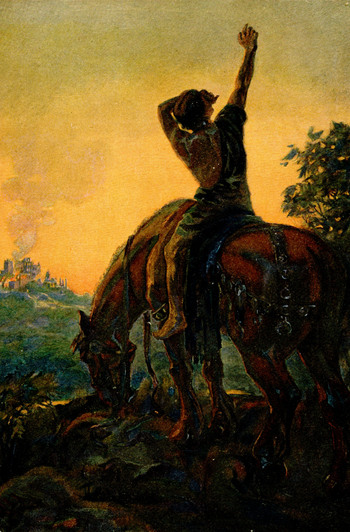
He was very far from her again, in his own strange world; and she sat and watched him, her soul in her shining eyes, if he had but seen it, and knew she could not enter with him. He spoke more quickly; his voice fell to a deeper note, and in it was a mystery at which Eldris caught her breath.
"And out of the darkness there came a Tale to me, and thereafter there was light. And the tale is not yet ended—but it grows, it grows! Night and day it rings within my head; always it is with me, mine and mine only. But there is that in it which eludes me, which I seek and cannot find. And until I find it, the tale is not yet done. And it is of a Child, a Babe who lay within his mother's arms and smiled at all the world."
Eldris started, and her eyes, fixed upon his face, widened and filled with light. And again at her motion Nicanor came back to her. He looked at her, and his own eyes were as she had seen them once before, when upon a day she had told him that the name men called him was the silver-tongued.
"Once thou didst tell that tale to me," he said, "and day or night it hath never left me since. When it is ended, and I have found this thing I seek, then I'll tell it thee."
He took up his speech again, and she hung upon his words, unafraid to watch him since his eyes were turned from her.
"So there was a gray rat within this my dungeon cell; and at such times when the light faded and I was back therein, I coaxed and fed him, and taught him how to fight. Eh, he was a gallant beast, and his scar is yet upon my hand. He, my gaunt gray rat, and this little Christ of thine were all that kept my brain from madness those days when I sat in darkness. And in time, I, with others, was sent off to the mines, and there we labored until word came that men were needed to help our lord, who was attacked in his household by barbarians. But I was left behind when these were started, wounded by one with whom I had a quarrel about this same gray rat. When I reached our lord's house, it was empty, sacked and spoiled, and stationarii patrolled it. So I came onward to Londinium and here again was I left behind. Our lord hath left the country, and we are free to live or die as we may. I had no plan for thee when I bade thee to come hither, for there was no time for planning with Hito's jaws agape for thee." He rose to his feet and stood looking down upon her. "Now we be both alone, and there is but one thing for it that I can see. Thou must come with me. I cannot promise thee ease nor even safety, but what I have, thou shalt have also."
"With thee!" Eldris repeated below her breath, and turned her face from him. It flushed and was radiant; love brimmed over in her eyes. Was she the one who might find her place in that stern, deep heart of his,—she who might learn the spell which would soothe those bitter moods of his to stillness? Her eyes glowed and drooped. And then, slowly, across her face there fell a shadow, and the shadow was of the cross. She knew nothing of evasion; as her heart, so her lips spoke.
"With thee!" she breathed again. A sob caught her throat. In her turn she rose and faced him. "Ah, I would so gladly—so gladly! But—I can go with thee in but one way, and that way as thy wife."
Nicanor looked at her.
"Why, thou knowest that may not be," he said gently, yet with some surprise. "I am a slave, and a slave hath no rights before the law, nor to lawful marriage. It is the law. But come thou!"
Eldris turned white.
"I am Christian!" she said painfully, "and that thing I may not do. Father Ambrose teacheth that Christ hath forbidden."
"I did not make the law," said Nicanor. "Could I do so, I'd give thee gladly the name of wife. But even thus, more of honor I could not give thee. It is not what I wish to do, but what I must do." He took her face between his hands. "Child, the law is made, not by man, but by men; and it is not for man only, but for men. Were it not found good by men, it could not be. And the law, in its wisdom, saith that a slave is a beast, a thing without rights; and I am a slave. There is no law which could marry me to thee.... I cannot give thee marriage,—I, a slave."
"And I, a Christian, cannot go without," said Eldris, very low. Two tears rolled from beneath her wan closed lids. Nicanor bent his tall head and kissed them away, with what tenderness a brother might give a sister dearly loved. But with sudden wild sobbing Eldris flung up her arms and clasped his neck, and hid her face against him.
"Oh, I would go with thee!" she wept. "Heart of my heart, I would follow to the world's end, wherever thy path might lead me. I love thee, Nicanor, oh, my man of the silver tongue! and I shall love thee even till I die. But go with thee I may not—I dare not! Is this right? Were thy law and my religion made for this, to wreak such woe upon those who follow them? It is cruel,—it is more cruel than death, and I would to God that I were dead!"
Nicanor stood a moment silent, stroking her dark hair gently.
"No man would hold thee less worthy, since the case is as it must be. Never have I heard of slaves who took thy view of this. All thy life shalt thou have honor and protection. Were it in my power to mend matters, and I did not, the fault would then lie with me. As it is, it is no man's fault, and we have the right to make the best we may of it."
She shook her head, struggling with her tears. His tone changed; it deepened and thrilled until she thrilled with it; in it she heard the concentration of all loneliness and all bitterness.
"Come to me, Eldris, for I need thee sorely! All my life have I gone chained, desiring what I could not win, longing for what lay beyond me. Must it be so again? Once one said: 'Seek thou the sanctuary while yet there may be time; and when thou art entered in all else shall be as nothing, for there thou shalt have peace.' Then I did not understand; now know I too well. That is what all my life I have never found, though I have sought in many places, and for a weary while. Therefore pray your God to pity me and all who are as I, for I am ridden by ten thousand devils—a flame consumes me which I cannot quench. An ambition is not all a blessing to him who hath it! Oh, the dreams that were mine, which the high gods gave to me, and which are gone,—gone as the smoke goes and shall never come again! The glimpse I have had of a world that should be mine and never can be mine hath shown me all that I have lost. I beat my hands against the bars, and what doth it avail? I am a slave—a slave was I born and a slave shall I die. There is beauty in the world, and I may not see it; there is knowledge in the world, and I may not share it; and my soul is sick with longing for what all men may have but I. There is a thing within me which cries panting for release, and rends me because I know not how to set it free. It is agony and delight, pain and joy beyond all naming; and once I thought it only joy. Thus ever hath it been: what I have thought would bring me peace hath brought me pain, and pain that I know not what I have done to deserve. It was not thus when I lived a brute's life among the brutes in far, gray, northern hills; there was I content, not knowing that I wanted something more. Now have I stretched my hands out to a star, and found it so far beyond my reach that for me its light is lost in darkness which will never lift. Yet the star is shining,—but not for me."
The torrent of his speech checked. His voice dropped from the strain of its hoarse passion. He gathered her two hands closer on his breast.
"We be two outcasts, thou and I!—thou shunning, I shunned. Yet we still have each the other. Now do I come seeking the sanctuary of thy love, thy balm and healing for the hands and heart I have beaten against my bars. Wilt thou deny? Must I be turned away? Eldris, come!"
"Oh!" cried Eldris, her heart in her stricken voice. Long she looked at him, with eyes drowned in tears and lips quivering, all her struggle in her torn face. But suddenly she drew her hands from his, and slipped to her knees before him, and hid her face in shaking fingers.
"Oh, God!" she prayed,—and once Nicanor had heard words babbling so from a man upon the rack who never knew that he had talked aloud,—"keep me from going with him! I want to so—oh, I want to so! Make me strong—never let me yield to what is sin! Keep me from going with him! I love him so that I would sin for him! Dear Jesus Lord, keep me from doing that! But make me strong very quickly, or I must go—how can I stay when he so sorely needs me? Oh, God, God, God, I could comfort him so well! We cannot help it, neither he nor I. Nay, I will not weaken,—I will be strong, quite strong,—but in pity Thou must help a little too! I love Thee and the little Jesus, but I love him more—oh, nay—not more! I did not mean it!" She raised her streaming face, turning at the last from the Power whence no help came, to the human strength beside her. "Oh, beloved, help me, for I cannot fight alone!"
So, at the need of one soul, into the world another soul was born, and the long travail of spirit rending flesh was ended.
"Dear heart, be strong!—thy will shall be my will. If it be sin to thee, thou shalt not sin through me!" Nicanor said, and knelt beside her.
Nerveless and shaken with strangling sobs, she crept into the shelter of his arms, trusting him wholly now that his word was hers, pleading unconsciously that he save her from herself and from him. He lifted her to her feet, soothing her with touch and voice, forgetting himself in her distress. Her religious scruples he could not comprehend; the gods of religion were to be invoked when one wanted material benefits from them, not held as mentors to dictate one's course in life. But since she had such scruples, and since he was learning new, strange tolerance for and sympathy with others, it was not his to blame her for them; rather to remember that though they might be nothing to him, they were all to her, and were therefore not to be held lightly. So, because he was slowly gaining the strength to think of others before himself,—and of strength this is the surest test,—and because the tenderness of a strong man is greater than all the tenderness of a woman, he soothed her and brought her peace; and, it may be, in bringing it he found a measure of it himself. She was very dear to him,—dear as one might be who was not enshrined above all her kind forever. Heart and soul he was another's, for all time and all eternity; yet life was his to live and to make the best of it, even though there was a locked and guarded chamber in it of which the key was lost....