"Nic Revel" (continued 5)
Reading edition
How to make Pete grasp the fact that he was coming to join him? For even if he saw something floating down he would never think that it was his companion.
This task too was easy.
Cutting the longest cane he could reach, he cut off the leafy top, made a notch in what was left, and then inserting the point of his knife in the remaining sleeve of his shirt, he tore it off, ripped up the seam, and after dragging one end down through the knot and slit in the cane, he bound up the end with a strip of cotton, stuck the base firmly in the bundle or truss he had bound together, and so formed a little white flag.
“If he sees that he’ll know,” said Nic triumphantly; and without a moment’s hesitation he thrust off from the bank with his cane bundle under one arm, and struck out with the other, finding plenty of support, and nothing more to do than fight his way out to where the stream ran most swiftly.
The scrap of white cotton fluttered bravely now and then, as, forcing himself not to think of the dangers that might be around, Nic watched and watched. He soon began to see the boat more distinctly, and in good time made out that his companion in misfortune grasped the position, rowing himself to the nearest drooping tree, making fast to a bough, and then laying in one oar and fixing the other up astern as a signal for his companion’s guidance.
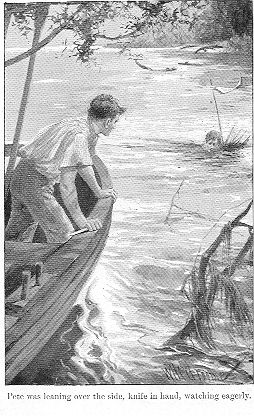
How short the time seemed then, and how easily Nic glided down, till he became aware of the fact that Pete was leaning over the side, knife in hand, watching eagerly. This sent a shudder through the swimmer, setting him thinking again of the perils that might be near, and how unlikely any effort of Pete’s would be to save him should one of the reptiles attack.
The dread, however, soon passed off, for Nic’s every nerve was strained to force the bundle of canes across the stream, so that it might drift right down upon the boat.
He could only succeed in part, and it soon became evident that he would float by yards away; but Pete was on the alert. He cast the boat adrift from where he had secured it to a drooping bough, and giving a few vigorous pulls with one oar, in another minute he had leaned over the bows, grasped his companion’s hands, dragged him into the boat, and then, as the buoyant bundle of canes floated away, the poor fellow sank back in the bottom of the boat and lay staring helplessly.
“Don’t you take no notice o’ me, Master Nic,” he said hoarsely. “Just put an oar over the ztarn and keep her head ztraight. Zhe’ll go down fast enough. We ought to row up to fetch that fish we left, but we couldn’t do it, zir; for I’m dead beat trying to get to you—just dead beat.”
He closed his eyes, and then opened them again as he felt the warm grasp of Nic’s hand, smiled at him, till his eyelids dropped again, and then sank into a deep stupor more than sleep.
Chapter Thirty Four.
Woman’s Pity.
The sun sank lower and disappeared behind the trees straight away as the boat drifted on; the sky turned of a glorious amber, darkened quickly, and then it was black night, with the eerie cries of the birds rising on either side, and the margins of the swift river waking up into life with the hoarse bellowings and croakings of the reptiles which swarmed upon the banks. Every now and then there was a rush or a splash, or the heavy beating of the water, as some noisome creature sought its prey; and Nic sat there watching and listening, wakeful enough, and always on the alert to catch the breathing of his companion, who for hours had not stirred.
“Beat out,” said Nic to himself; “utterly exhausted, poor fellow! If I could only feel that it was a natural sleep.”
He was thoroughly done-up himself, and in spite of his efforts to keep awake, and the dread inspired by the movements of the strange creatures splashing about in the water, and often enough apparently close at hand, he could not keep from dozing off time after time, but only to start up in an agony of fear. He hardly lost consciousness, and at such times the startling noises and movements around him in the darkness seemed to be continued in the wild dreams which instantly commenced.
Now in imagination he saw through the transparent darkness some huge alligator making for the boat, where it reared itself up, curved over, and seemed about to seize upon Pete, when he raised the oar with which he was keeping the boat’s head straight and struck at the monster with all his might, and in the act awoke.
Another time Nic dropped off, to imagine that they were slowly gliding beneath the far-spreading boughs of a gigantic forest tree; and, as they swept on, something soft and heavy suddenly hung down into the boat, began crawling about, and at last stopped its progress by coiling itself round one of the thwarts, and then raising its head high in the air and beginning to dart its tongue, now at Nic, now at the motionless body of Pete, who still lay sleeping soundly.
Nic felt powerless, and lay watching the approach of the huge boa, seeing it plainly in spite of the darkness and suffering an agony of horror as he felt that he could not move, but must lie there, quite at the mercy of the powerful reptile, which drew the boat over so much on one side that the water, as it rippled by, rose apparently higher and higher till it was about to pour in.
Ripple, ripple, ripple, against the sides, while the boughs of a tree swept over his face, the touch awakening the dreamer, who uttered a low gasp of relief as he realised how much the water and the brushing of the leaves over his face had had to do with the dream from which he had just been roused.
Morning at last, with the east all aglow, and the beauties of river and tree sweeping away the horrors of the black night.
Pete awoke as if by instinct, and started into a sitting position, to stare hard at his companion.
“Why, Master Nic, you aren’t never gone and let me sleep all night?”
“Indeed, but I have, Pete,” replied Nic. “Feel better?”
“No, zir. Never felt so ’shamed of myself in my life. Oh dear! oh dear! To think of my doing that! Where are we, zir? ’Most got to that t’other zattlement, aren’t uz?”
“What! where we rested for the night, Pete? No; I don’t think we are near that yet.”
“Then get nigh we must,” cried Pete, putting out his oar. “We’ve got to find some braxfuss there. What we had yes’day don’t zeem to count a bit. I zay, though, you don’t think they got another boat and passed us while we were asleep, do you?”
“No, Pete,” replied Nic, smiling; “and I don’t think that we shall dare to land at that plantation lower down. The man there would know we are escaped slaves, and stop us.”
“He’d better not,” said Pete, with a curious look in his eyes. “He’s the only man there.”
“There are several blacks.”
“Blacks!” cried Pete contemptuously. “I’m not afraid o’ them. It’s o’ no use, Master Nic; I’ve tried hard to bear it, and I can bear a deal, but when it comes to starvation it’s again’ my natur’. I must eat, and if he calls twenty blacks to stop me I mean to have zomething, and zo shall you. Why, lad, you look as if you’re half-dead wi’ want o’ zleep and a morsel o’ food. Nay, nay; you leave that oar alone, and cover your head up with those leaves while you have a good rest. By that time p’raps we may get a bit o’ braxfuss.”
“I’m not sleepy, Pete,” said Nic sadly.
“P’raps not, zir; but man must eat and he must zleep, so you lie back in the bottom of the boat. Now, no fighting agen it, zir; you worked all night, zo I must work all day.”
“Well, I’ll lie down for an hour, Pete, for I do feel very weary. As soon as you think an hour’s gone, you wake me up.”
“Right, Master Nic, I will,” cried Pete heartily; and after a glance up and down the river, the young man sank back in the bottom of the boat, settled the leafy cap and veil in one over his face to shield it from the sun, and the next minute—to him—he unclosed his eyes to find that Pete was kneeling beside him with a hand on each shoulder as if he had been shaking the sleeper.
“Hullo! Yes; all right, Pete, I’ve had such a sleep. Why, Pete, it must be getting on for noon.”
“Ay, that it is, my lad; noon to-morrow. But don’t bully me, zir; you was zleeping just lovely, and I couldn’t waken you. Here we are at that farm-place, and I don’t zee the man about, but yonder’s the two women.”
“And the dogs, Pete?”
“Nay, don’t zee no dogs. Maybe they’re gone along wi’ the master. Come on, lad; I’ve tied the boat up to this post, and we’ll go up and ask the women yonder to give us a bit o’ zomething to eat.”
The place looked very familiar as Nic glanced round and recalled the time when he reached there, and their departure the next morning, with the looks of sympathy the two women had bestowed.
Just as he recalled this he caught sight of the younger woman, who came from the door of the roughly-built house, darted back and returned with her mother, both standing gazing at their visitors as they landed from the boat.
“Must go up to the house quiet-like, Master Nic, or we shall scare ’em,” said Pete. “Just you wave your hand a bit to show ’em you know ’em. Dessay they ’members we.”
Nic slowly waved his hand, and then shrugged his shoulders as he glanced down at his thin cotton rags; and his piteous plight made him ready to groan.
“We must go up to them as beggars, Pete,” he said.
“That’s right enough for me, Master Nic; but you’re a gentleman, zir, and they’ll know it soon as you begin to speak. Let’s go on, zir. I’m that hungry I could almost eat you.”
Nic said nothing, but began to walk on towards the house by his companion’s side, anxiously watching the two women the while, in the full expectation that they would retreat and shut the door against their visitors.
But neither stirred, and the fugitives were half-way to the house, when suddenly there was a growl and a rush.
“Knives, Master Nic,” cried Pete, for three great dogs came charging from the back of the low shed which had given the slaves shelter on their journey up the river. The dogs had evidently been basking in the sunshine till they had caught sight of the strangers, and came on baying furiously.
Nic followed his companion’s example and drew his knife, feeling excited by the coming encounter; but before the dogs reached them the two women came running from the door, crying out angrily at the fierce beasts, whose loud barking dropped into angry growls as they obeyed the calls of their mistresses—the younger woman coming up first, apron in hand, to beat off the pack and drive them before her, back to one of the out-buildings, while her mother remained gazing compassionately at the visitors.
“Thank you,” said Nic, putting back his knife. “Your dogs took us for thieves. We are only beggars, madam, asking for a little bread.”
“Have you—have you escaped from up yonder?” said the woman, sinking her voice.
“Yes,” said Nic frankly. “I was forced away from home for no cause whatever. I am trying to get back.”
“It is very shocking,” said the woman sadly, as her daughter came running up breathlessly. “Some of the men they have there are bad and wicked, and I suppose they deserve it; but Ann and I felt so sorry for you when you came that night months ago. You seemed so different.”
“You remember us, then?” said Nic, smiling sadly.
“Oh yes,” cried the younger woman eagerly. “But they are hungry, mother. Bring them up to the house; I’ve shut-in the dogs.”
“I don’t know what your father would say if he knew what we did,” said the woman sadly. “It’s against the law to help slaves to escape.”
“It isn’t against the law to give starving people something to eat, mother.”
“It can’t be; can it, dear?” said the woman. “And we needn’t help them to escape.”
“No,” said Pete; “we can manage that if you’ll give us a bit o’ bread. I won’t ask for meat, missus; but if you give us a bit, too, I’d thank you kindly.”
“Bring them up, mother,” said the girl; “and if father ever knows I’ll say it was all my fault.”
“Yes; come up to the house,” said the elder woman. “I can’t bear to see you poor white men taken for slaves.”
“God bless you for that!” cried Nic, catching at the woman’s hand; but his action was so sudden that she started away in alarm.
“Oh mother!” cried the girl; “can’t you see what he meant?”
The woman held out her hand directly, and Nic caught it. The next moment he had clasped the girl’s hands, which were extended to him; but she snatched them away directly with a sob, and ran into the house, while the mother bade the pair sit down on a rough bench to rest.
The girl was not long absent; but when she returned with a big loaf and a piece of bacon her eyes looked very red.
“There,” she said, setting the provisions before them; “you’d better take this and go, in case father should come back and see you. Don’t, please, tell us which way you’re going, and we won’t look; for we shouldn’t like to know and be obliged to tell. Oh!”
The girl finished her speech with a cry of horror; for how he had approached no one could have said, but the planter suddenly came up with a gun over his shoulder, and stood looking on as, with a quick movement, Pete snatched at the loaf and thrust it under one arm.
“Hullo!” said the man quietly as he looked from one to the other; “where are the dogs?”
“I shut ’em up, father, so as they shouldn’t hurt these two poor men.”
“An’ s’pose these two poor men wanted to hurt you; what then?”
“But they didn’t, father,” said the girl, as the mother stood shivering. “They were hungry, and only wanted something to eat.”
“Yes, that’s right, master,” said Pete stoutly. “We shouldn’t hurt no one.”
“Let’s see,” said the planter; “I’ve seen you both before. My neighbour brought you up months ago.”
“Yes,” said Nic firmly; “but he had no right to detain us as slaves.”
“Humph! S’pose not,” said the planter, glancing sharply from one to the other. “So you’re both runaways?”
“We are trying for our liberty,” replied Nic, who was well upon his guard; but the man’s reply disarmed him.
“Well, it’s quite nat’ral,” said the planter, with a chuckle. “Hot work hoeing the rows, eh? Took the boat, I s’pose, and rowed down?”
“Yes,” said Pete gruffly.
“Hungry too, eh?”
“Yes,” said Pete again.
“Course you would be. Quite nat’ral. They’ve give you a bit to eat, I see. Well, then, you’d better come and sit down out o’ the sun and eat it, and then be off, for your overseer won’t be long before he’s down here after you. He’s a sharp un, Master Saunders, aren’t he?”
“Yes; he’s sharp enough,” said Pete quietly.
“He’ll be down after you with his dogs, and then, if he catches you, there’ll be a big row and a fight, and I don’t want nothing o’ that sort, my lads. Come on, and bring your bread and meat in here.—Ann, my gal, get ’em a pitcher o’ cool, fresh water.”
“Yes, father,” said the girl; and, as the planter turned off to lead the way, Nic caught the lass’s eyes; for she began to make quick movements of her lips, and her eyes almost spoke as she pointed towards the river and signed to them to go.
Nic gave her an intelligent nod, and followed Pete after the planter into the great, barn-like place which had been their prison for the night when they were there before; but as he passed the door he noticed the great wooden bar turning upon a bolt, and fully realised that the girl’s signs were those of warning, for treachery was meant.
“Nice and cool in here,” said the man. “Sit ye down on the corn-husks there. My gal will soon be back with the water; and I wouldn’t be long, if I were you, in case Master Saunders should come down the river, for when he asked me if you two was here I couldn’t tell a lie about it, could I?”
“No,” growled Pete. “That would be a pity.”
“Ay; it would. But he’d know you was both here by the boat. Where did you tie it up?”
“Just at the bottom there, by the trees,” said Nic, to whom these words were addressed.
“Ah, ’tis the best place,” said the man, halting by the door, and standing aside to make room for the young men to pass. “In with you. It’s better than being in the hot sun. Seems a bit dark; but it’s cooler to have your dinner there. Well,” he continued, “why don’t you go in? The dogs are not here.”
“Because it looks like a trap, sir,” said Nic firmly. “Do you want to shut us up there, and keep us prisoners till your neighbour comes?”
“Yes, I do,” cried the planter fiercely as he stepped back, and with one motion brought down and cocked his piece, which he presented at the young man’s breast. “In with you both, or I’ll shoot you like dogs!”
He raised his gun to his shoulder and drew the trigger; but it was too late. Nic had sprung forward, striking up the barrel; and, as the mother and daughter shrieked aloud from the house door, there was a sharp report, which set the dogs baying furiously from the shed in which they were fastened.
A short struggle followed, in which the gun was wrested from the planter’s hands by Nic, and the next moment Pete had joined in the fray, securing the planter’s arms, and then with Nic’s help he was dragged and thrown into the great barn. Then the door was banged to and fastened with the bar; and the prisoner began to call and threaten what he would do if his people did not let loose the dogs.
What followed would have seemed almost comic to a spectator, for the two women came hurrying up with their fingers stuck in their ears.
“Run—run to your boat!” they whispered. “We can’t hear what he says now, but we must soon, and then we shall be obliged to let out the dogs.”
“Oh, mother!” cried the girl, “the blacks will be here directly.”
“Yes, yes,” cried the elder woman, who somehow seemed to have heard that. “Run, then, run, and get away before it is too late.”
“God bless you both for what you have done for us!” cried Nic. “I pray that you may not get into more trouble on our account.”
“Oh, father won’t hurt me,” said the girl; “and he shan’t hurt mother. Serve him right for being so cruel. You never did him any harm.”
“Oh, run, run!” cried the woman, with her fingers still in her ears; and the two young men dashed off to the boat and leapt in, Nic’s next action, as Pete unfastened the slight cord, being to fling the gun as far out into the river as he could.
“Oh!” cried Pete, “what did you do that for?” as the gun fell with a splash and disappeared.
“I was not going to steal the scoundrel’s gun,” said Nic, seizing an oar.
“Well, it wouldn’t ha’ been any use without powder and zhot,” said Pete as he thrust the boat out into the stream. “Good-bye to you both,” he shouted, waving his hand to the two women, who stood waving their aprons.
“But it seems cowardly, Pete, to go and leave them in the lurch.”
“Ay, it do, Master Nic; but it only means a rowing for them, and it’s life and liberty for us.”
There was another wave of a white apron as the boat glided out into mid-stream, and Nic responded with his hand. Then trees interposed and hid the house and sheds from view, and the fugitives went on straining at their oars till they felt that their safety was assured, when they relaxed their efforts.
“That was close, Master Nic,” said Pete. “Treacherous martal. Wish I’d give him a good topper before we zhut the door.”
“I’m glad you did not, for his wife and daughter’s sake,” replied Nic. “Poor things! they will suffer for their gentle, womanly compassion towards a pair of poor escaped slaves.”
“Ay, it was good of ’em, Master Nic. Zees how hungry we were, and fetches that fresh brown loaf, and all that pink-and-white bacon as looks d’licious. Zo, as we’re going gently on, and not likely for him to take boat after us, what do you say to staying all that horrid gnawing of our insides with a good bite and sup? But—I say, Master Nic, what did you do with that bacon and bread?”
Nic looked sharply up at Pete, and the latter uttered a dismal groan. The bread and bacon had gone, neither knew where, in the struggle, and the landing and encounter had all been for nothing.
“Not quite,” Nic said later on. They had learned how much gentle compassion existed for the poor white slaves, even in a district where the sight of them was so common.
“P’raps so, Master Nic; but I’d give all the compassion in the world just now for a zlice of that bacon and a hunk of bread. What’s to be done now, zir?”
“Row, Pete, row; and let’s try and forget our hunger in the knowledge that we are so far free.”
“Right, zir; we will. But what about that treacherous hound? Think he’s got a boat?”
“Sure to have,” replied Nic.
“Then he’ll come after as zoon as he can get help; and if he do—Well, I should be sorry to hurt him, on account of them as was kind to us; but if he does ketch it, mind, Master Nic, it’s his fault and not mine.”
There was no more talking, for both felt morose and weak, their growing sense of hunger making them more and more silent and disinclined to speak.
Still, fortune favoured them to a certain extent, for there had been rain somewhere inland, and the stream ran as if it were in flood higher up, so that their rate of progress was swift.
As the hours went on and there was no sign of pursuit—no enemies who had made a short cut to the river-bank waiting to fire at them from among the trees—the fugitives grew more and more confident; and when at last they reached another swamp, the alligators appeared to be less monstrous and the gloomy place lost half its forbidding aspect.
At last, after endless difficulties, and nearly starved, the tidal part of the river was reached, and, to the delight of both, they found that they had hit exactly the right moment, for the tide was at its height, and stood as if waiting to bear them onward towards the sea.
Excitement had kept off all thought of food; but when, after a long journey, they approached the straggling town at nightfall and saw the twinkling lights, an intense desire seized upon both to land as soon as possible and satisfy their needs.
“You see, we lost everything, Master Nic, in that struggle. What you looking at, zir?”
“You, Pete. I was thinking.”
“What about, zir?”
“About this place. If we land we must go to some house for food; and when we two half-naked, miserable, starved wretches have obtained what we want we shall be asked to pay.”
“My word!” gasped Pete, ceasing to row. “I never thought of that. And we aren’t got any money.”
“Not a coin.”
“And they’d want it here just the same as they would at home, though it is a foreign country?”
“Of course.”
“Then I tell you what, Master Nic,” said Pete after a long pause; “we must go straight to zomebody and tell ’em how we’ve been zarved, and ask him to help us.”
“We should have to tell them everything, Pete.”
“Of course, zir; downright honest.”
“And who would believe us at a place like this, where we know that poor wretches are brought to go up to the plantations?”
“Oh, hark at him!” sighed Pete. “And I’d been thinking our troubles were over, and we’d got nothing to do but get plenty to eat and a good ship to take us home. You’re right, zir; it would be as mad as March hares to go ashore. They’d put us in prison and keep us there till old Zaunders come again with his dogs and guns and niggers to take us back; and when we got to the plantation it would be the lash and short commons, and the hoe again out in the hot sun.”
“Yes, Pete,” said Nic sadly; “that is what I fear.”
“And you’re a deal longer-headed than me, master. It’s going and giving ourselves up for the sake of a good dinner. Master Nic!”
“Yes, Pete.”
“Just buckle your belt a bit tighter, two or three holes, like this. That’s the way. Now then, take hold of your oar again. We can hold out another day or two on what we can find, while we coast along till we see a ship outward bound somewhere. Sure to be lots. Then we’ll row till they see us and pick us up. They won’t bring us back, that’s for sartain, but to the port they’re going to; and of course they can’t starve us. Then they’ll hand us over to a judge o’ some kind, and as soon as he hears your story you’ll be all right; and—and—”
“Yes, Pete?”
“I know I’ve been a bad un; Master Nic; but I’m going to turn over a new leaf, zir, and never meddle wi’ the zalmon again. You’ll put in a good word for a poor fellow, won’t you?”
“A good word for you—for one who has been ready to risk his life again and again to help me? Pete, we have been brothers in our great misfortune, and we must hold together, come what may.”
“Then take a good grip of your oar, Master Nic, and let’s forget being empty by taking our fill of work. Pull away, my lad, right out, and I dessay the tide’ll run us along the shore, as it does at home. When the day comes again we shall zoon zee a zhip. We can’t give up now. Ready?”
“Yes.”
“Then pull.”
And in their desperate strait, feeling as they did that they would starve sooner than go back to slavery, those two bent to their oars in the darkness that closed them in, and rowed on with the swift tide. The lights on the shore grew fainter, the tide swifter, and the water became rough; but they rowed on, hungry, exhausted: on and on, ignorant of the set of the tides, of the trend of the coast, and without a drop of fresh water to satisfy their thirst. A mad, mad attempt; but it was for liberty—for all that man holds dear. What wonder that when the day dawned both had sunk forward over their oars and were sleeping heavily, to wake at last with the southern sun beating down upon their heads, and that they gazed at each other in a half-delirious, stupefied way, wondering what had happened and where they were.
There was a faint appearance as of a cloud low down on the water far-away, but no cloud overhead, nothing but the burning, blistering sun to send a fierce energy through Nic’s veins, which made him keep calling wildly upon Pete to row, row hard, before they were overtaken and dragged back to a white slave’s life.
Pete’s eyes were staring fiercely, and looked bloodshot, while his throat was hot and dry, his brain felt as if on fire; but at every order from Nic he bent down over his oar and pulled and pulled, till his strokes grew more and more wild, and at last, as he made one more desperate than ever, he did not dip the blade, but fell backward from the thwart. Then, after vainly trying to pull with both oars himself, Nic turned to face his companion in misfortune, wondering in his delirium why he was there.
The sun went down like a ball of fire on his left, and directly after, as it seemed, rose like a ball of fire on his right. It was that, he felt, which caused all his suffering, and in his rage and indignation he turned upon it fiercely, and then bent down to lap up the sparkling water which tempted him and seemed to promise to allay his awful thirst.
He reached down and dipped his hand, but the attitude seemed to send the blood like molten lead running to his brain, and with a weary groan he fell sidewise and rolled over in the bottom of the boat.
Chapter Thirty Five.
Safe at last.
“Looks like a ship’s longboat, sir; but she’s right under the sun, and I can’t make her out.”
“Any one in her?”
“No, sir; not a soul.”
The conversation was between the captain and one of the foremast men of the good ship Sultan, bound from a western city with passengers and sugar to the port of Bristol. The wind was very light, and men were up aloft, setting the main top-gallant sail, when the boat was sighted only a little way out of the vessel’s course.
Then the captain argued, as he took a look at her from the main-top, that a boat like that might be battered, and not worth the trouble of picking up; but, on the other hand, she might; and finally, after taking the first-mate into debate, it was decided to steer a point or two to the west and pick her up.
“For who knows what she may have aboard, or what good ship may have been wrecked?” the skipper said to one of the passengers brought on deck by the news of a boat in sight, for such an event broke the monotony of the tedious voyage.
As the news spread through the ship the rest of the passengers came on deck, and when the boat was neared, the captain, as he stood inspecting the object through his glass, began to be satisfied that the find was in good condition, and then the announcement came from aloft that there were two bodies lying in the bottom.
The excitement now became fierce; one of the ship’s boats was swung out on the davits ready for lowering, manned, and dropped, and finally the prize was brought alongside, with its freight still alive, but apparently at their last gasp.
Fortunately the captain was a man of old experience in the tropics, and noting that there was neither food nor water on board, he put the right construction upon the poor fellows’ condition—that they were dying of hunger and thirst, after escaping from some wrecked or sinking vessel.
Merchant captains have a smattering of knowledge, and a medicine chest on board, and there were willing hands to take charge of “the poor shipwrecked men;” but it was a hard fight with the raging fever and delirium from which both suffered, and again and again they were given over, and were still too weak to answer questions when Bristol port was reached, and they were taken to hospital ashore.
It was quite a month before the journey home could be taken in the old stage-coach bound from Bristol to Plymouth.
But Nic bore it well, for Captain Revel was seated by his side, holding his hand as if afraid that after all his son might slip from his grasp and the old suffering recommence.
“It nearly killed me before, my boy,” he said piteously, as he urged his son to be careful not to exert himself in the least. “I gave you up for dead, and I was following you fast, Nic, for I don’t believe I should have lived another year.”
“I’ll take care, father; never fear,” said the young man cheerily, for, though thin and worn, his eyes were brightening, and there were signs of returning health in his cheeks. “I only need a good, quiet rest in the old place, where I can lie and watch the sea, or go down the shady old combe, to listen to the falls and watch the salmon leap.”
“Ugh! don’t talk about the fish,” cried the Captain, with a shudder; “they were the cause of all this suffering.”
“Oh no,” said Nic, smiling. “It was all that terrible mistake.”
“Well, don’t let’s talk about the past,” said the Captain hurriedly; “or only about one thing, my boy. I did want to consult you about that fellow who’s up aloft with William Solly.”
“About Pete, father?”
“Yes, the scoundrel! He was as bad as the salmon.”
“Poor old Pete!” said Nic, smiling. “He saved my life over and over again, father. I want you to take him into your service.”
“What! that poacher who used to defy us all?”
“Poachers make the best keepers, father, when they reform; and Pete has proved himself a good man and true. Will you tell him he is to stay?”
“I’ll keep a dozen of such fellows if you’ll only get strong and well again, my boy,” said the old sailor eagerly. “I’ll tell him next time we change horses. But I shall never forgive Lawrence.”
“What, father!” cried Nic, smiling. “Why?”
“An old comrade like he has always been, to have such a stupid blunder made by those under his command.”
“A terrible mistake, father; but, to be quite fair, it was all my doing, and I was hoist with my own petard.”
“No, no, Nic; you’re wrong,” said the old man, “and William Solly—an impudent rascal!—was right.”
“How, father?”
“Well, my boy, it was all my fault for making such a fuss about a few salmon. William Solly had the insolence to tell me I made a trouble about nothing, and wanted a real one to do me good. This has been a real one, Nic, and I’ve suffered bitterly.”
“But there’s fair weather ahead, father.”
“Please God, my boy,” said the old man piously, and with his voice trembling, “and—and there, Nic, I’ve got you back again, and you will get well, my boy—you will get well, won’t you?”
“Fast, father,” replied Nic, pressing the old man’s hand.
Nic did mend rapidly in the rest and quiet of his old home, where one day Captain Lawrence, newly returned from a long voyage, came to see his old friend, and heard Nic’s adventures to the end.
“A bitter experience, my dear boy,” he said; “but let’s look to the future now: never mind the past.”
But one day, when the convalescents had been for two months drinking in the grand old Devon air, Nic was rambling through the combe with Pete, both pretty well strong again, when the latter said:
“I want to be zet to work now, Master Nic, or to be zent away; for I feel as if I ought to be doing zomething, instead of idling about here.”
“You’ve talked like that before, Pete,” said Nic, smiling. “Have a little patience, and then you shall begin.”
“But it zeems zo long, zir. I zay, though, it’s rather queer, isn’t it, for me to be water bailiff and keeper over the vish as I used to take. Think Humpy Dee and them others will get away and come back again?”
“I hope so,” said Nic slowly and thoughtfully. “They deserved their punishment, but they will have had enough by now.”
“Nay, you’re a bit too easy, Master Nic. Humpy’s a down bad one, and I should like the others to have one year more out yonder, and Humpy too.”
“Too long for white slaves, Pete,” said Nic. “We have suffered with them, and know what the sufferings are; so I forgive them. What say you?”
“Zame as you do, Master Nic; o’ course, that is, if they don’t come back and meddle with our zalmon again—our zalmon! That zounds queer, Master Nic, don’t it? I can’t quite feel as if it’s all true.”
“But it is true, Pete; and we are here safe in the good old home, after what seems now like an ugly dream.”
“Dinner-bell’s rung twice, Master Nic,” said William Solly, coming upon them suddenly from behind the trees; “and you can’t ’spect to get your strength up proper if you aren’t reg’lar at the mess. I run out to look for you, to keep the skipper from—Well, there now—if he aren’t come to look for you hisself! Give him a shout, and say you’re coming.”
Nic hailed, and hurried back to meet the old officer, while William Solly turned to Pete:
“Come along, messmet; the beef and soft tack’s waiting. And so you’re going to stop here altogether!”
“I s’pose so,” said Pete.
“And we’re to be messmets reg’lar sarving under Captain Revel and Master Nic?”
“That’s it,” said Pete sturdily.
“Well,” said Solly, “I aren’t jealous, for you did the right thing by the young master; so let’s shake hands.”
This was solemnly done, and Solly went on:
“As good a skipper as ever stepped a deck, and as fine a boy as ever breathed. Pete, messmet, you’ve dropped into a snug thing.”
“Which that zame I know,” said Pete gruffly.
“But you saved Master Nic’s life, and the skipper’s too, by bringing the young master back; and I’m glad you’re going to stay. So suppose we shakes hands agen?”
They did, as if they meant it, too.
They did mean it, and somehow a great attachment sprang up between those two men, while as time rolled on Nic smiled more than once on meeting them consulting together about matters connected with the estate, and made Solly wince.
At last, after a good deal of hesitation, Solly turned upon his young master.
“Beg pardon, sir,” he said; “speaking respeckful like—”
“What is it?” said Nic, for the man stopped.
“Well, sir, you know; and it goes hard on a chap as is doing his dooty and wants to keep things straight.”
“I still don’t understand you, Solly,” said Nic.
“Well, sir, it’s all along o’ that there chap, Pete: you never ketch me a-talking to him, and giving him a bit o’ good advice about what the skipper likes done, but you grins.”
“Grins?”
“Oh, it’s no use to make believe, Master Nic, because you do, and it hurts.”
“They were not grins,” said Nic. “I only smiled because I was glad to see you two such good friends.”
“Ho!” ejaculated Solly; “that was it, sir? I thought you was grinning and thinking what an old fool I was.”
“Nothing of the sort.”
“Well, I’m glad o’ that, Master Nic, though it do seem a bit queer that I should take a lot o’ notice of a feller as fought agen us as he did. But we aren’t friends, sir.”
“Indeed!” said Nic.
“It’s on’y that I can’t help taking a bit to a man as stood by you as he did over yonder in furren abroad. You see, a man like that’s got the making of a good true mate in him.”
“Yes, Solly, of as good a man as ever stepped.”
Two years had passed, when one day Solly watched his opportunity of catching Nic alone in the grounds, and followed him.
“Master Nic!” he whispered hoarsely.
The young man turned round, and Solly “made a face” at him. That is to say, he shut his left eye very slowly and screwed up the whole of his countenance till it was a maze of wrinkles.
“What is it, Solly?”
“Pete’s over yonder, sir, by the combo, and wants to speak to you.”
“Oh, very well, I’ll go,” said Nic, and the old sailor nodded, looked mysterious, slapped his mouth to indicate that it was a secret mission, and hurried away.
“What does it all mean?” said Nic to himself. “Why, I do believe Pete is going to tell me that he wants to be married, and to ask if my father will object.”
He reached the combe, to find Pete, now a fine sturdy-looking Devon man in brown velveteen jacket and leather gaiters, counting the salmon in the pool.
Pete turned sharply directly he heard Nic approach, and the serious look in the man’s face told that something unusual had occurred.
“Morn’, Master Nic, zir.”
“What is it, Pete? Surely you don’t mean that we’ve had poachers again?”
“Poachers it be, zir,” said the man mysteriously; “but they won’t come here again. Master Nic, there’s three on ’em come back, and I’ve zeen ’em.”
“What! From the plantation?”
“Yes, zir; after a long spell of it they managed to give the dogs zome poison stuff they got out of the woods. The blacks told ’em of it. Manshy something it was.”
“Manchioneel! I know,” said Nic.
“That’s it, zir, and it killed ’em. They got away in a boat—a new un, I s’pose.”
“I’m glad they escaped, poor fellows,” said Nic; “but is that scoundrel Dee with them?”
Pete was silent.
“Dead, Pete?”
“Yes, zir, ’fore we’d been gone two months,” said the man gravely. “He went at Zaunders one day with his hoe, and nearly killed him; but the dogs heard the fight, and rushed down.”
“Ah! the dogs!” cried Nic.
“Yes, zir, and what with their worrying and a shot he’d had from Zaunders, it meant a couple o’ the blacks with spades, and a grave in the woods.”
“Horrible!” ejaculated Nic.
“Yes, zir, horrible. Humpy allus hated me, and I s’pose I never liked him; but if I’d been there, zir, I’d ha’ helped him fight for his life agen them zavage dogs.”
“I know you would, Pete,” cried Nic warmly. “But what about these men—are they going to stay in the neighbourhood?”
“Not they, zir. They belong to the crew of a ship in Plymouth harbour; and zomehow they got to know that I was here. They walked all the way o’ purpose to wish me luck and zhake hands and zay they hadn’t aught agen me, for they’d found out how it was they was took. It was poor Humpy as made ’em believe it was me. They went back lars night.”
“Poor Humpy!” said Nic wonderingly.
“Well, yes, zir. You zee, he waren’t like other men,” said Pete simply. “He was born all crooked and out o’ shape and ugly, and got teased and kicked about when he was a boy; and I zuppose it made him zour and evil-tempered. Then he grew up stronger than other men, and he got to love getting the better of them as had knocked him about. I dunno, but it allus zeemed zo to me. Well, poor chap, he’s dead, and there’s an end on it.”
“Yes,” said Nic, gravely repeating the man’s words, “there’s an end of it.”
The End.
| Chapter 1 | | Chapter 2 | | Chapter 3 | | Chapter 4 | | Chapter 5 | | Chapter 6 | | Chapter 7 | | Chapter 8 | | Chapter 9 | | Chapter 10 | | Chapter 11 | | Chapter 12 | | Chapter 13 | | Chapter 14 | | Chapter 15 | | Chapter 16 | | Chapter 17 | | Chapter 18 | | Chapter 19 | | Chapter 20 | | Chapter 21 | | Chapter 22 | | Chapter 23 | | Chapter 24 | | Chapter 25 | | Chapter 26 | | Chapter 27 | | Chapter 28 | | Chapter 29 | | Chapter 30 | | Chapter 31 | | Chapter 32 | | Chapter 33 | | Chapter 34 | | Chapter 35 |