Volume 2 — Continuing the Famous Dispatches of the British Commander in Chief to Lord Kitchener
Reading edition
The previous dispatches, reviewing the operations of the British regular and territorial troops on the Continent under Field Marshal French's chief command, appeared in THE NEW YORK TIMES CURRENT HISTORY of Jan. 23, 1915, bringing the account of operations to Nov. 20, 1914. The official dispatch to Earl Kitchener presented below records the bitter experiences of the Winter in the trenches from the last week of November until Feb. 2, 1915.
The following dispatch was received on Feb. 12, 1915, from the Field Marshal Commanding in Chief, the British Army in the Field.
To the Secretary of State for War, War Office, London, S.W.
General Headquarters,
Feb. 2, 1915.
My Lord: I have the honor to forward a further report on the operations of the army under my command.
1. In the period under review the salient feature was the presence of his Majesty the King in the field. His Majesty arrived at Headquarters on Nov. 30 and left on Dec. 5.
At a time when the strength and endurance of the troops had been tried to the utmost throughout the long and arduous battle of Ypres-Armentières the presence of his Majesty in their midst was of the greatest possible help and encouragement.
His Majesty visited all parts of the extensive area of operations and held numerous inspections of the troops behind the line of trenches.
On Nov. 16 Lieutenant his Royal Highness the Prince of Wales, K.G., Grenadier Guards, joined my staff as aide de camp.
2. Since the date of my last report the operations of the army under my command have been subject almost entirely to the limitations of weather.
History teaches us that the course of campaigns in Europe, which have been actively prosecuted during the months of December and January, have been largely influenced by weather conditions. It should, however, be thoroughly understood throughout the country that the most recent development of armaments and the latest methods of conducting warfare have added greatly to the difficulties and drawbacks of a vigorous Winter campaign.
To cause anything more than a waste of ammunition long-range artillery fire requires constant and accurate observation; but this most necessary condition is rendered impossible of attainment in the midst of continual fog and mist.
Again, armies have now grown accustomed to rely largely on aircraft reconnoissance for accurate information of the enemy, but the effective performance of this service is materially influenced by wind and weather.
The deadly accuracy, range, and quick-firing capabilities of the modern rifle and machine gun require that a fire-swept zone be crossed in the shortest possible space of time by attacking troops. But if men are detained under the enemy's fire by the difficulty of emerging from a water-logged trench, and by the necessity of passing over ground knee-deep in holding mud and slush, such attacks become practically prohibitive owing to the losses they entail.
During the exigencies of the heavy fighting which ended in the last week of November the French and British forces had become somewhat mixed up, entailing a certain amount of difficulty in matters of supply and in securing unity of command.
By the end of November I was able to concentrate the army under my command in one area, and, by holding a shorter line, to establish effective reserves.
By the beginning of December there was a considerable falling off in the volume of artillery fire directed against our front by the enemy. Reconnoissance and reports showed that a certain amount of artillery had been withdrawn. We judged that the cavalry in our front, with the exception of one division of the Guard, had disappeared.
There did not, however, appear to have been any great diminution in the numbers of infantry holding the trenches.
3. Although both artillery and rifle fire were exchanged with the enemy every day, and sniping went on more or less continuously during the hours of daylight, the operations which call for special record or comment are comparatively few.
During the last week in November some successful minor night operations were carried out in the Fourth Corps.
On the night of Nov. 23-24 a small party of the Second Lincolnshire Regiment, under Lieut. E.H. Impey, cleared three of the enemy's advanced trenches opposite the Twenty-fifth Brigade, and withdrew without loss.
On the night of the 24th-25th Capt. J.R. Minshull Ford, Royal Welsh Fusiliers, and Lieut. E.L. Morris, Royal Engineers, with fifteen men of the Royal Engineers and Royal Welsh Fusiliers, successfully mined and blew up a group of farms immediately in front of the German trenches on the Touquet-Bridoux Road which had been used by German snipers.
On the night of Nov. 26-27 a small party of the Second Scots Guards, under Lieut. Sir E.H.W. Hulse, Bart., rushed the trenches opposite the Twentieth Brigade, and after pouring a heavy fire into them returned with useful information as to the strength of the Germans and the position of machine guns.
The trenches opposite the Twenty-fifth Brigade were rushed the same night by a patrol of the Second Rifle Brigade, under Lieut. E. Durham.
On Nov. 23 the One Hundred and Twelfth Regiment of the Fourteenth German Army Corps succeeded in capturing some 800 yards of the trenches held by the Indian Corps, but the general officer commanding the Meerut Division organized a powerful counter-attack, which lasted throughout the night. At daybreak on Nov. 24 the line was entirely re-established.
The operation was a costly one, involving many casualties, but the enemy suffered far more heavily.
We captured over 100 prisoners, including 3 officers, as well as 3 machine guns and two trench mortars.
On Dec. 7 the concentration of the Indian Corps was completed by the arrival of the Sirhind Brigade from Egypt.
On Dec. 9 the enemy attempted to commence a strong attack against the Third Corps, particularly in front of the trenches held by the Argyll and Sutherland Highlanders and the Middlesex Regiment.
They were driven back with heavy loss, and did not renew the attempt. Our casualties were very slight.
During the early days of December certain indications along the whole front of the allied line induced the French commanders and myself to believe that the enemy had withdrawn considerable forces from the western theatre.
Arrangements were made with the commander of the Eighth French Army for an attack to be commenced on the morning of Dec. 14.
Operations began at 7 A.M. by a combined heavy artillery bombardment by the two French and the Second British Corps.
The British objectives were the Petit Bois and the Maedelsteed Spur, lying respectively to the west and the southwest of the village of Wytschaete.
At 7:45 A.M. the Royal Scots, with great dash, rushed forward and attacked the former, while the Gordon Highlanders attacked the latter place.
The Royal Scots, commanded by Major F.J. Duncan, D.S.O., in face of a terrible machine gun and rifle fire, carried the German trench on the west edge of the Petit Bois, capturing two machine guns and fifty-three prisoners, including one officer.
The Gordon Highlanders, with great gallantry, advanced up the Maedelsteed Spur, forcing the enemy to evacuate their front trench. They were, however, losing heavily, and found themselves unable to get any further. At nightfall they were obliged to fall back to their original position.
Capt. C. Boddam-Whetham and Lieut. W.F.R. Dobie showed splendid dash, and with a few men entered the enemy's leading trenches; but they were all either killed or captured.
Lieut. G.R.V. Hume-Gare and Lieut. W.H. Paterson also distinguished themselves by their gallant leading.
Although not successful, the operation was most creditable to the fighting spirit of the Gordon Highlanders, most ably commanded by Major A.W.F. Baird, D.S.O.
As the Thirty-second French Division on the left had been unable to make any progress, the further advance of our infantry into the Wytschaete Wood was not practicable.
Possession of the western edge of the Petit Bois was, however, retained.
The ground was devoid of cover and so water-logged that a rapid advance was impossible, the men sinking deep in the mud at every step they took.
The artillery throughout the day was very skillfully handled by the C.A.R.A.'s of the Fourth and Fifth Divisions—Major Gen. F.D.V. Wing, C.B.; Brig. Gen. G.F. Milne, C.B., D.S.O., and Brig. Gen. J.E.W. Headlam, C.B., D.S.O.
The casualties during the day were about 17 officers and 407 other ranks. The losses of the enemy were very considerable, large numbers of dead being found in the Petit Bois and also in the communicating trenches in front of the Gordon Highlanders, in one of which a hundred were counted by a night patrol.
On this day the artillery of the Fourth Division, Third Corps, was used in support of the attack, under orders of the General Officer Commanding Second Corps.
The remainder of the Third Corps made demonstrations against the enemy with a view to preventing him from detaching troops to the area of operations of the Second Corps.
From Dec. 15 to 17 the offensive operations which were commenced on the 14th were continued, but were confined chiefly to artillery bombardment.
The infantry advance against Wytschaete Wood was not practicable until the French on our left could make some progress to afford protection to that flank.
On the 17th it was agreed that the plan of attack as arranged should be modified; but I was requested to continue demonstrations along my line in order to assist and support certain French operations which were being conducted elsewhere.
4. In his desire to act with energy up to his instructions to demonstrate and occupy the enemy, the General Officer Commanding the Indian Corps decided to take the advantage of what appeared to him a favorable opportunity to launch attacks against the advanced trenches in his front on Dec. 18 and 19.
The attack of the Meerut Division on the left was made on the morning of the 19th with energy and determination, and was at first attended with considerable success, the enemy's advanced trenches being captured. Later on, however, a counter-attack drove them back to their original position with considerable loss.
The attack of the Lahore Division commenced at 4:30 A.M. It was carried out by two companies each of the First Highland Light Infantry and the First Battalion, Fourth Gurkha Rifles of the Sirhind Brigade, under Lieut. Col. R.W.H. Ronaldson. This attack was completely successful, two lines of the enemy's trenches being captured with little loss.
Before daylight the captured trenches were filled with as many men as they could hold. The front was very restricted, communication to the rear impossible.
At daybreak it was found that the position was practically untenable. Both flanks were in the air, and a supporting attack, which was late in starting, and, therefore, conducted during daylight, failed, although attempted with the greatest gallantry and resolution.
Lieut. Col. Ronaldson held on till dusk, when the whole of the captured trenches had to be evacuated, and the detachment fell back to its original line.
By the night of Dec. 19 nearly all the ground gained during the day had been lost.
From daylight on Dec. 20 the enemy commenced a heavy fire from artillery and trench mortars on the whole front of the Indian Corps. This was followed by infantry attacks, which were in especial force against Givenchy, and between that place and La Quinque Rue.
At about 10 A.M. the enemy succeeded in driving back the Sirhind Brigade and capturing a considerable part of Givenchy, but the Fifty-seventh Rifles and Ninth Bhopals, north of the canal, and the Connaught Rangers, south of it, stood firm.
The Fifteenth Sikhs of the Divisional Reserve were already supporting the Sirhind Brigade. On the news of the retirement of the latter being received, the Forty-seventh Sikhs were also sent up to reinforce Gen. Brunker. The First Manchester Regiment, Fourth Suffolk Regiment, and two battalions of French territorials under Gen. Carnegy were ordered to launch a vigorous counter-attack to retake by a flank attack the trenches lost by the Sirhind Brigade.
Orders were sent to Gen. Carnegy to divert his attack on Givenchy village, and to re-establish the situation there.
A battalion of the Fifty-eighth French Division was sent to Annequin in support.
About 5 P.M. a gallant attack by the First Manchester Regiment and one company of the Fourth Suffolk Regiment had captured Givenchy, and had cleared the enemy out of the two lines of trenches to the northeast. To the east of the village the Ninth Bhopal Infantry and Fifty-seventh Rifles had maintained their positions, but the enemy were still in possession of our trenches to the north of the village.
Gen. Macbean, with the Secunderabad Cavalry Brigade, Second Battalion, Eighth Gurkha Rifles, and the Forty-seventh Sikhs, was sent up to support Gen. Brunker, who, at 2 P.M., directed Gen. Macbean to move to a position of readiness in the second line trenches from Maris northward, and to counter-attack vigorously if opportunity offered.
Some considerable delay appears to have occurred, and it was not until 1 A.M. on the 21st that the Forty-seventh Sikhs and the Seventh Dragoon Guards, under the command of Lieut. Col. H.A. Lempriere, D.S.O., of the latter regiment, were launched in counter-attack.
They reached the enemy's trenches, but were driven out by enfilade fire, their gallant commander being killed.
The main attack by the remainder of Gen. Macbean's force, with the remnants of Lieut. Col. Lempriere's detachment, (which had again been rallied,) was finally rushed in at about 4:30 A.M., and also failed.
In the northern section of the defensive line the retirement of the Second Battalion, Second Gurkha Rifles, at about 10 A.M. on the 20th, had left the flank of the First Seaforth Highlanders, on the extreme right of the Meerut Division line, much exposed. This battalion was left shortly afterward completely in the air by the retirement of the Sirhind Brigade.
The Fifty-eighth Rifles, therefore, were ordered to support the left of the Seaforth Highlanders, to fill the gap created by the retirement of the Gurkhas.
During the whole of the afternoon strenuous efforts were made by the Seaforth Highlanders to clear the trenches to their right and left. The First Battalion, Ninth Gurkha Rifles, reinforced the Second Gurkhas near the orchard where the Germans were in occupation of the trenches abandoned by the latter regiment. The Garhwal Brigade was being very heavily attacked, and their trenches and loopholes were much damaged; but the brigade continued to hold its front and attack, connecting with the Sixth Jats on the left of the Dehra Dun Brigade.
No advance in force was made by the enemy, but the troops were pinned to their ground by heavy artillery fire, the Seaforth Highlanders especially suffering heavily.
Shortly before nightfall the Second Royal Highlanders, on the right of the Seaforth Highlanders, had succeeded in establishing touch with the Sirhind Brigade; and the continuous line (though dented near the orchard) existed throughout the Meerut Division.
Early in the afternoon of Dec. 20 orders were sent to the First Corps, which was then in general army reserve, to send an infantry brigade to support the Indian Corps.
The First Brigade was ordered to Bethune, and reached that place at midnight on Dec. 20-21. Later in the day Sir Douglas Haig was ordered to move the whole of the First Division in support of the Indian Corps.
The Third Brigade reached Bethune between 8 A.M. and 9 A.M. on the 21st, and on the same date the Second Brigade arrived at Lacon at 1 P.M.
The First Brigade was directed on Givenchy, via Pont Fixe, and the Third Brigade, through Gorre, on the trenches evacuated by the Sirhind Brigade. The Second Brigade was directed to support, the Dehra Dun Brigade being placed at the disposal of the General Officer Commanding Meerut Division.
At 1 P.M. the General Officer Commanding First Division directed the First Brigade in attack from the west of Givenchy in a northeasterly direction, and the Third Brigade from Festubert in an east-northeasterly direction, the object being to pass the position originally held by us and to capture the German trenches 400 yards to the east of it.
By 5 P.M. the First Brigade had obtained a hold in Givenchy, and the ground south as far as the canal; and the Third Brigade had progressed to a point half a mile west of Festubert.
By nightfall the First South Wales Borderers and the Second Welsh Regiment of the Third Brigade had made a lodgment in the original trenches to the northeast of Festubert, the First Gloucestershire Regiment continuing the line southward along the track east of Festubert.
The First Brigade had established itself on the east side of Givenchy.
By 3 P.M. the Third Brigade was concentrated at Le Touret, and was ordered to retake the trenches which had been lost by the Dehr Dun Brigade.
By 10 P.M. the support trenches west of the orchard had been carried, but the original fire trenches had been so completely destroyed that they could not be occupied.
This operation was performed by the First Loyal North Lancashire Regiment and the First Northamptonshire Regiment, supported by the Second King's Royal Rifle Corps, in reserve.
Throughout this day the units of the Indian Corps rendered all the assistance and support they could in view of their exhausted condition.
At 1 P.M. on the 22d Sir Douglas Haig took over command from Sir James Willcocks. The situation in the front line was then approximately as follows:
South of the La Bassée Canal the Connaught Rangers of the Ferozepore Brigade had not been attacked. North of the canal a short length of our original line was still held by the Ninth Bhopals and the Fifty-seventh Rifles of the same brigade. Connecting with the latter was the First Brigade, holding the village of Givenchy and its eastern and northern approaches. On the left of the First Brigade was the Third Brigade. Tenth had been lost between the left of the former and the right of the latter. The Third Brigade held a line along, and in places advanced to, the east of the Festubert Road. Its left was in communication with the right of the Meerut Division line, where troops of the Second Brigade had just relieved the First Seaforth Highlanders. To the north, units of the Second Brigade held an indented line west of the orchard, connecting with half of the Second Royal Highlanders, half of the Forty-first Dogras, and the First Battalion Ninth Gurkha Rifles. From this point to the north the Ninth Jats and the whole of the Garhwal Brigade occupied the original line which they had held from the commencement of the operations.
The relief of most units of the southern sector was effected on the night of Dec. 22. The Meerut Division remained under the orders of the First Corps, and was not completely withdrawn until Dec. 27.
In the evening the position at Givenchy was practically re-established, and the Third Brigade had reoccupied the old line of trenches.
During the 23d the enemy's activities ceased, and the whole position was restored to very much its original condition.
In my last dispatch I had occasion to mention the prompt and ready help I received from the Lahore Division, under the command of Major Gen. H.B.B. Watkis, C.B., which was thrown into action immediately on arrival, when the British forces were very hard pressed during the battle of Ypres-Armentières.
The Indian troops have fought with the utmost steadfastness and gallantry whenever they have been called upon.
Weather conditions were abnormally bad, the snow and floods precluding any active operations during the first three weeks of January.
5. At 7:30 A.M. on Jan. 25 the enemy began to shell Bethune, and at 8 A.M. a strong hostile infantry attack developed south of the canal, preceded by a heavy bombardment of artillery, minenwerfers, and, possibly, the explosion of mines, though the latter is doubtful.
The British line south of the canal formed a pronounced salient from the canal on the left, thence running forward toward the railway triangle and back to the main La Bassée-Bethune Road, where it joined the French. This line was occupied by half a battalion of the Scots Guards, and half a battalion of the Coldstream Guards, of the First Infantry Brigade. The trenches in the salient were blown in almost at once, and the enemy's attack penetrated this line. Our troops retired to a partially prepared second line, running approximately due north and south from the canal to the road, some 500 yards west of the railway triangle. This second line had been strengthened by the construction of a keep half way between the canal and the road. Here the other two half battalions of the above-mentioned regiments were in support.
These supports held up the enemy, who, however, managed to establish himself in the brick stacks and some communication trenches between the keep, the road, and the canal—and even beyond the west of the keep on either side of it.
The London Scottish had in the meantime been sent up in support, and a counter-attack was organized with the First Royal Highlanders, part of the First Cameron Highlanders, and the Second King's Royal Rifle Corps, the latter regiment having been sent forward from the Divisional Reserve.
The counter-attack was delayed in order to synchronize with a counter-attack north of the canal which was arranged for 1 P.M.
At 1 P.M. these troops moved forward, their flanks making good progress near the road and the canal, but their centre being held up. The Second Royal Sussex Regiment was then sent forward, late in the afternoon, to reinforce. The result was that the Germans were driven back far enough to enable a somewhat broken line to be taken up, running from the culvert on the railway, almost due south to the keep, and thence southeast to the main road.
The French left near the road had also been attacked and driven back a little, but not to so great an extent as the British right. Consequently the French left was in advance of the British right, and exposed to a possible flank attack from the north.
The Germans did not, however, persevere further in their attack.
The above-mentioned line was strengthened during the night, and the First Guards Brigade, which had suffered severely, was withdrawn into reserve and replaced by the Second Infantry Brigade.
While this was taking place another and equally severe attack was delivered north of the canal against the village of Givenchy.
At 8:15 A.M., after a heavy artillery bombardment with high explosive shells, the enemy's infantry advanced under the effective fire of our artillery, which, however, was hampered by the constant interruption of telephonic communication between the observers and batteries. Nevertheless, our artillery fire, combined with that of the infantry in the fire trenches, had the effect of driving the enemy from its original direction of advance, with the result that his troops crowded together on the northeast corner of the village and broke through into the centre of the village as far as the keep, which had been previously put in a state of defense.
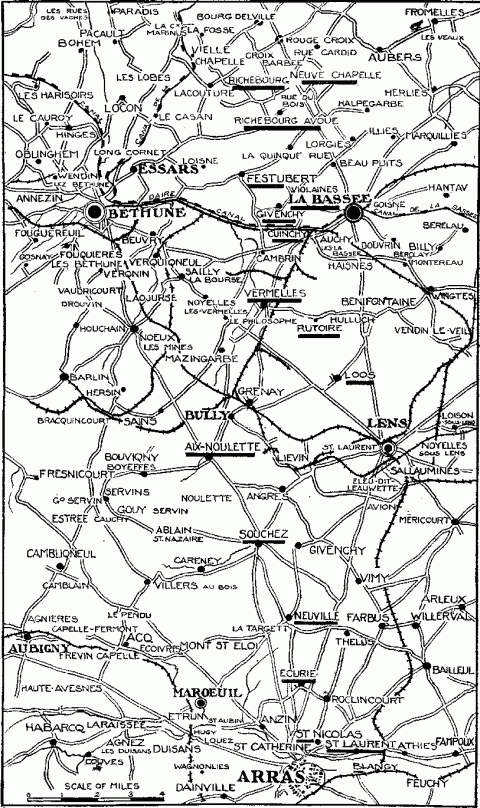
The places underlined in the above map indicate the points around La Bassée and southward to Arras, where part of the British Expeditionary Force was heavily engaged.
The Germans had lost heavily, and a well-timed local counter-attack, delivered by the reserves of the Second Welsh Regiment and First South Wales Borderers, and by a company of the First Royal Highlanders, (lent by the First Brigade as a working party—this company was at work on the keep at the time,) was completely successful, with the result that after about an hour's street fighting all who had broken into the village were either captured or killed, and the original line around the village was re-established by noon.
South of the village, however, and close to the canal, the right of the Second Royal Munster Fusiliers fell back in conformity with the troops south of the canal, but after dark that regiment moved forward and occupied the old line.
During the course of the attack on Givenchy the enemy made five assaults on the salient at the northeast of the village about French Farm, but was repulsed every time with heavy loss.
6. On the morning of Jan. 29 attacks were made on the right of the First Corps, south of the canal in the neighborhood of La Bassée.
The enemy, (part of the Fourteenth German Corps,) after a severe shelling, made a violent attack with scaling ladders on the keep, also to the north and south of it. In the keep and on the north side the Sussex Regiment held the enemy off, inflicting on him serious losses. On the south side the hostile infantry succeeded in reaching the Northamptonshire Regiment's trenches, but were immediately counter-attacked and all killed. Our artillery co-operated well with the infantry in repelling the attack.
In this action our casualties were inconsiderable, but the enemy lost severely, more than 200 of his killed alone being left in front of our position.
7. On Feb. 1 a fine piece of work was carried out by the Fourth Brigade in the neighborhood of Cuinchy.
Some of the Second Coldstream Guards were driven from their trenches at 2:30 A.M., but made a stand some twenty yards east of them in a position which they held till morning.
A counter-attack, launched at 3:15 A.M., by one company of the Irish Guards and half a company of the Second Coldstream Guards, proved unsuccessful, owing to heavy rifle fire from the east and south.
At 10:05 A.M., acting under orders of the First Division, a heavy bombardment was opened on the lost ground for ten minutes; and this was followed immediately by an assault by about fifty men of the Second Coldstream Guards with bayonets, led by Capt. A. Leigh Bennett, followed by thirty men of the Irish Guards, led by Second Lieut. F.F. Graham, also with bayonets. These were followed by a party of Royal Engineers with sand bags and wire.
All the ground which had been lost was brilliantly retaken, the Second Coldstream Guards also taking another German trench and capturing two machine guns.
Thirty-two prisoners fell into our hands.
The General Officer Commanding First Division describes the preparation by the artillery as "splendid, the high explosive shells dropping in the exact spot with absolute precision."
In forwarding his report on this engagement, the General Officer Commanding First Army writes as follows:
Special credit is due—
(i) To Major Gen. Haking, commanding First Division, for the prompt manner in which he arranged this counter-attack and for the general plan of action, which was crowned with success.
(ii) To the General Officer commanding the Fourth Brigade (Lord Cavan) for the thorough manner in which he carried out the orders of the General Officer commanding the division.
(iii) To the regimental officers, non-commissioned officers, and men of the Second Coldstream Guards and Irish Guards, who, with indomitable pluck, stormed two sets of barricades, captured three German trenches, two machine guns, and killed or made prisoners many of the enemy.
8. During the period under report the Royal Flying Corps has again performed splendid service.
Although the weather was almost uniformly bad and the machines suffered from constant exposure, there have been only thirteen days on which no actual reconnoissance has been effected. Approximately, 100,000 miles have been flown.
In addition to the daily and constant work of reconnoissance and co-operation with the artillery, a number of aerial combats have been fought, raids carried out, detrainments harassed, parks and petrol depots bombed, &c.
Various successful bomb-dropping raids have been carried out, usually against the enemy's aircraft material. The principle of attacking hostile aircraft whenever and wherever seen (unless highly important information is being delivered) has been adhered to, and has resulted in the moral fact that enemy machines invariably beat immediate retreat when chased.
Five German aeroplanes are known to have been brought to the ground, and it would appear probable that others, though they have managed to reach their own lines, have done so in a considerably damaged condition.
9. In my dispatch of Nov. 20, 1914, I referred to the reinforcements of territorial troops which I had received, and I mentioned several units which had already been employed in the fighting line.
In the positions which I held for some years before the outbreak of this war I was brought into close contact with the territorial force, and I found every reason to hope and believe that, when the hour of trial arrived, they would justify every hope and trust which was placed in them.
The Lords Lieutenant of Counties and the associations which worked under them bestowed a vast amount of labor and energy on the organization of the territorial force; and I trust it may be some recompense to them to know that I, and the principal commanders serving under me, consider that the territorial force has far more than justified the most sanguine hopes that any of us ventured to entertain of their value and use in the field. Commanders of cavalry divisions are unstinted in their praise of the manner in which the yeomanry regiments attached to their brigades have done their duty, both in and out of action. The service of divisional cavalry is now almost entirely performed by yeomanry, and divisional commanders report that they are very efficient.
Army corps commanders are loud in their praise of the territorial battalions, which form part of nearly all the brigades at the front in the first line, and more than one of them have told me that these battalions are fast approaching—if they have not already reached—the standard of efficiency of regular infantry.
I wish to add a word about the Officers' Training Corps. The presence of the Artists' Rifles (Twenty-eighth Battalion, the London regiment) with the army in France enabled me also to test the value of this organization.
Having had some experience in peace of the working of the Officers' Training Corps, I determined to turn the Artists' Rifles (which formed part of the Officers' Training Corps in peace time) to its legitimate use. I therefore established the battalion as a training corps for officers in the field.
The cadets passed through a course, which includes some thoroughly practical training, as all cadets do a tour of forty-eight hours in the trenches, and afterward write a report on what they see and notice. They also visit an observation post of a battery or group of batteries, and spend some hours there.
A commandant has been appointed, and he arranges and supervises the work, sets schemes for practice, administers the school, delivers lectures, and reports on the candidates.
The cadets are instructed in all branches of military training suitable for platoon commanders.
Machine-gun tactics, a knowledge of which is so necessary for all junior officers, is a special feature of the course of instruction.
When first started, the school was able to turn out officers at the rate of seventy-five a month. This has since been increased to 100.
Reports received from divisional and army corps commanders on officers who have been trained at the school are most satisfactory.
10. Since the date of my last report I have been able to make a close personal inspection of all the units in the command. I was most favorably impressed by all I saw.
The troops composing the army in France have been subjected to as severe a trial as it is possible to impose upon any body of men. The desperate fighting described in my last dispatch had hardly been brought to a conclusion when they were called upon to face the rigors and hardships of a Winter campaign. Frost and snow have alternated with periods of continuous rain.
The men have been called upon to stand for many hours together almost up to their waists in bitterly cold water, only separated by one or two hundred yards from a most vigilant enemy.
Although every measure which science and medical knowledge could suggest to mitigate these hardships was employed, the sufferings of the men have been very great.
In spite of all this they presented, at the inspections to which I have referred, a most soldierlike, splendid, though somewhat war-worn, appearance. Their spirit remains high and confident; their general health is excellent, and their condition most satisfactory.
I regard it as most unfortunate that circumstances have prevented any account of many splendid instances of courage and endurance, in the face of almost unparalleled hardship and fatigue in war, coming regularly to the knowledge of the public.
Reinforcements have arrived from England with remarkable promptitude and rapidity. They have been speedily drafted into the ranks, and most of the units I inspected were nearly complete when I saw them. In appearance and quality the drafts sent out have exceeded my most sanguine expectations, and I consider the army in France is much indebted to the Adjutant General's Department at the War Office for the efficient manner in which its requirements have been met in this most essential respect.
With regard to these inspections I may mention in particular the fine appearance presented by the Twenty-seventh and Twenty-eighth Divisions, composed principally of battalions which had come from India. Included in the former division was the Princess Patricia's Royal Canadian Regiment. They are a magnificent set of men, and have since done excellent work in the trenches.
It was some three weeks after the events recorded in Paragraph 4 that I made my inspection of the Indian Corps, under Sir James Willcocks. The appearance they presented was most satisfactory and fully confirmed my opinion that the Indian troops only required rest and a little acclimatizing to bring out all their fine inherent fighting qualities.
I saw the whole of the Indian Cavalry Corps, under Lieut. Gen. Rimington, on a mounted parade soon after their arrival. They are a magnificent body of cavalry and will, I feel sure, give the best possible account of themselves when called upon.
In the meantime, at their own particular request, they have taken their turn in the trenches and performed most useful and valuable service.
11. The Right Rev. Bishop Taylor Smith, C.V.O., D.D., Chaplain General to the Forces, arrived at my headquarters on Jan. 6, on a tour of inspection throughout the command.
The Cardinal Archbishop of Westminster has also visited most of the Irish regiments at the front and the principal centres on the line of communications.
In a quiet and unostentatious manner the Chaplains of all denominations have worked with devotion and energy in their respective spheres.
The number with the forces in the field at the commencement of the war was comparatively small, but toward the end of last year the Rev. J.M. Simms, D.D., K.H.C., principal Chaplain, assisted by his secretary, the Rev. W. Drury, reorganized the branch and placed the spiritual welfare of the soldier on a more satisfactory footing. It is hoped that the further increase of personnel may be found possible.
I cannot speak too highly of the devoted manner in which all the Chaplains, whether with the troops in the trenches or in attendance on the sick and wounded in casualty clearing stations and hospitals on the line of communications, have worked throughout the campaign.
Since the commencement of hostilities the work of the Royal Army Medical Corps has been carried out with untiring zeal, skill, and devotion. Whether at the front under conditions such as obtained during the fighting on the Aisne, when casualties were heavy and accommodation for their reception had to be improvised, or on the line of communications, where an average of some 11,000 patients have been daily under treatment, the organization of the medical service has always been equal to the demands made upon it.
The careful system of sanitation introduced into the army has, with the assistance of other measures, kept the troops free from any epidemic, in support of which it is to be noticed that since the commencement of the war some 500 cases only of enteric have occurred.
The organization for the first time in war of motor ambulance convoys is due to the initiative and organizing powers of Surgeon General T.J. O'Donnell, D.S.O., ably assisted by Major P. Evans, Royal Army Medical Corps.
Two of these convoys, composed entirely of Red Cross Society personnel, have done excellent work under the superintendence of regular medical officers.
Twelve hospital trains ply between the front and the various bases. I have visited several of the trains when halted in stations, and have found them conducted with great comfort and efficiency.
During the more recent phase of the campaign the creation of rest depots at the front has materially reduced the wastage of men to the line of communications.
Since the latter part of October, 1914, the whole of the medical arrangements have been in the hands of Surgeon General Sir A.T. Sloggett, C.M.G., K.H.S., under whom Surgeon General T.P. Woodhouse and Surgeon General T.J. O'Donnell have been responsible for the organization on the line of communications and at the front respectively.
12. The exceptional and peculiar conditions brought about by the weather have caused large demands to be made upon the resources and skill of the Royal Engineers.
Every kind of expedient has had to be thought out and adopted to keep the lines of trenches and defense work effective.
The Royal Engineers have shown themselves as capable of overcoming the ravages caused by violent rain and floods as they have been throughout in neutralizing the effect of the enemy's artillery.
In this connection I wish particularly to mention the excellent services performed by my Chief Engineer, Brig. Gen. G.H. Fowke, who has been indefatigable in supervising all such work. His ingenuity and skill have been most valuable in the local construction of the various expedients which experience has shown to be necessary in prolonged trench warfare.
13. I have no reason to modify in any material degree my views of the general military situation, as expressed in my dispatch of Nov. 20, 1914.
14. I have once more gratefully to acknowledge the valuable help and support I have received throughout this period from Gen. Foch, Gen. D'Urbal, and Gen. Maud'huy of the French Army. I have the honor to be, your Lordship's most obedient servant,
J.D.P. FRENCH, Field Marshal, Commanding in Chief, the British Army in the Field.