Act III.—Same as Act I.—Win-Kye enters down run, carrying paint-pail in one hand, brush in other.
Reading edition
Win-Kye. Ole man talkee, painteeman talkee: all ligh', Win-Kye walkee, cally pail, inside he mouth he plenty cly, "lookee out fol paint." Painteeman, Chinaman, alle same.
Jube (appearing on run). Win, you imp ob sin, you, you Shanghi, you jes' brung back dat ar whitewash.
Win-Kye. All ligh', Jubee, me bling 'em back, in the sweetee bymby.
Jube (comes down). Look yere, you Celestial imp, quit yer fool! dis year ain't no time for mischievity; dis year am a solem' occasion; de ole man's found his long forgotten chile,—his lost offsprung,—an'—an' you've run off wid der baby's playthings.
Win-Kye. Muchee solly, baby cly. Supposee you sing him,—
"Littee Jack Horner Makee sit inside corner, Chow-chow he Clismas pie. He put inside tu'm, Hab catchee one plum. Hi, yah! what one good chilo my!"
Jube. Golly! hear dat Chineesers infusions ob potrey. Dat all comes ob his contract wid art. Win-Kye, gib me dem ar 'tensils.
Win-Kye. Me paintee locks, me paintee tlees, all samee so. (Points at sign on rock.) "Washee, washee." (Exit 1 E. R.)
Jube. See him hoof it. Dis years de melencolic effect ob tryin' to turn a mongo into a Sambo. I's jes' tried to cibilize dat ar heathen, to gib him a brack heart; an' he no sooner gits a hold ob a paint-brush, off he goes, like ole Nebacanoozer, on a tear.
(Enter Moselle, from cabin.)
Moselle. Jube, have you seen my daddy?
Jube. Seen your what? Golly, Mosey, you took my bref away! Seen him! Well, I guess, Mosey, dar was a yearthquake jes' flopped ober dis year camp las' night: seed it, seed it, felt de shock fro my physical cistern; an' I guess de ole man is scourin' round to kill a fatted calf or a mule.
Moselle. What are you talking about, Jube?
Jube. Mosey, brace yerself: be a man. De Book ob Rebelation am open. Abigal's son am returned.
Moselle. Who's son?
Jube. Abigal's son. Don't you know what de good Book says?
Moselle. The prodigal son, Jube.
Jube. What's de dif? what's de dif? Dat gal's son am returned to his fadder's buzzum; and you're shook. You may cry, "Hi, daddy! ho, daddy!" but dar am no daddy.
Moselle. Jube, tell me, quick, what has happened to daddy?
Jube. I'll tole yer all about it. Las' night I went down to de ole man's ranch on perticlar business. Well, de ole man was down dar, I was down dar, Win was down dar, an'—an' somebody else was down dar. Now, you know de ole man dat was down dar; you know me dat was down dar; you know Win dat was down dar; but—but you can't guess who dat somebody else was, dat was down dar, to dat ar ranch down dar.
Moselle. Why should I guess who was down dar, when you are so anxious to tell me?
Jube. Well, I tole yer.
(Enter Vermont, R. 2 E.)
Vermont. At your peril, Jube.
Moselle. O daddy, here you are! (Crosses from L. to R.) I was about to hear something dreadful about you.
Jube. Yas, indeed. I was jes' breakin' to her, genteel, de mournful tidin's.
Vermont. I'll break your head if you say another word. You git.
Jube. Yas; but I got her all braced. I can finish in just free minutes. You see, I was down dar—
Vermont. If you're not up there in less than three minutes—(Puts hand behind him.)
Jube (runs up stage). Don't you do it, don't you do it. I was only goin' to say dat, dat somebody else down dar—
Vermont. Start.
Jube. Was Abigal's son. (Dashes up run, and off)
Moselle. Ha, ha, ha! Poor Jube! He missed his chance by stopping too long "down dar." Now, daddy, what's the matter? where's the "yearthquake" struck?
Vermont. That's some of the darkey's nonsense.
Moselle. Now, daddy, that's a fib. Look me in the eye. No. Stop! If it's any thing I should know, you will tell me: you've always been so good to me.
Vermont. Well, never mind me. What have they done with Dandy Dick, the forger?
Moselle. He's no forger. He's as innocent of crime as you are. O daddy! I want some money.
Vermont. All right, little one. (Pulls out bag.) What's the figger?
Moselle. It's rather high.
Vermont. Never mind: the bank's open.
Moselle. Twenty thousand dollars.
Vermont. Twenty! Bank's broke. (Puts back bag.) We ain't struck no diamond mine lately, and nuggets are scarce. Couldn't you make a little discount?
Moselle. O daddy! twenty thousand dollars will set Dick free.
Vermont. Free! Not an ounce of dust comes out of my bag for him. He's played you a mean trick; and, if the detective don't take him off, I will. Why, Mosey, I thought you had more spirit.
Moselle. I love him, daddy.
Vermont. And he with another gal hanging round his neck.
Moselle. Why, daddy, she's his sister!
Vermont. What! (Aside.) Another prodigal! This camp's getting lively. (Aloud.) His sister. That's another sort.
Moselle. And you will find the money?
Vermont. Find twenty thousand? Oh, yes, Mosey! I'll take my pick, and go right off. As finds are about here, it may take a few years—
Moselle. Years! We must have it to-day. O daddy, you've plenty banked at Carson!
Vermont. Mosey, when you was a little gal, we used to sit down by the creek.
Moselle. Where you found me, longer ago than I can remember.
Vermont. We used to sit there day after day, while I told you stories.
Moselle. Yes, fairy stories.
Vermont (sits on rock, R.). I'll tell you one now.
Moselle (sits on the ground beside him, throws arm across his knee). A fairy story?
Vermont. I reckon. Once on a time there was a gospel shebang, and in it was a gospel sharp and a pan lifter.
Moselle. You mean a church, a parson, and a deacon?
Vermont. That's just what I mean.
Moselle. Then, please remember, you are talking to a young lady, and not to the boys.
Vermont. Jes' so. Well, the parson and the deacon didn't hitch horses,—couldn't work in the same hole,—were always flinging dirt all over each other, whenever they got to arguing. So one day they had it hot about wrastling Jacob and the angel. The deacon thought Jacob didn't have a fair show. He allowed that Jacob, at collar and elbow, would have thrown the angel every round; and the parson got mad, and told the deacon if he'd step behind the she—church, he'd show him the angel's trip. The deacon wa'n't to be stumped at wrastlin', so at it they went. Three rounds, and the deacon went to grass every time. Now, when a parson can throw a deacon, it shows a backslidin' that's not healthy. So the deacon thought, and quietly packed his kit, and started for green fields and pasters new, leaving behind a wife and kids. Well, he struck jest about such a place as this, and stuck to it twelve years. He didn't forget the folks at home. Both his heart and his dust went back to 'em, and sometimes he'd have given all his old boots for one look at 'em.
Moselle. Why didn't he go back?
Vermont. What! With that wrastlin' angel bossing the shebang? Not for Jacob.
Moselle. Ho, ho! You are the deacon.
Vermont. I was. Now I'm only Vermont.
Moselle. And my daddy.
Vermont. Last night I wrastled again. I was thrown, and by a boy—my kid—from old Vermont.
Moselle. Your son?
Vermont. You bet.
Moselle. Oh, daddy! ain't you glad?
Vermont. Glad! Why, Mosey, he's got the angel trip, by which the parson threw me.
Moselle. But ain't you glad he's found you? It must be so good to hear news from home.
Vermont. Well, Mosey, you keep quiet: I don't want the boys to know he's my son. I've told you—
Moselle. A fairy story. I understand.
Vermont. Jes' so. A fairy story, without the fairy.
Moselle (rising). Oh! you're the fairy, for you are always doing good. But where is he? I must see him.
Vermont. In my ranch.
Moselle. I'll just run down and have a peep at him,—the boy who threw the deacon—no, the fairy. Ha, ha, ha! (Runs off R. 2 E.)
Vermont. I reckon I'm a healthy old fairy.
(Enter Mother, from cabin.)
Mother. Where's Moselle?
Vermont. She's just run down to have a look at the kid—
Mother. A look at what?
Vermont (aside). Hang it! There's a slip for the fairy. (Aloud.) She's just run down to my ranch. She'll be back in a minute. Widder, you believe that story about the creek and Mosey?
Mother. Certainly.
Vermont. Don't believe it any longer: it's a blamed lie.
Mother. Vermont!
Vermont. That's me, and here's the truth. I was diggin' in Goblin Gulch in them days; and one night a woman, with a child in her arms, came to my ranch. Poor thing! she was all used up with tramping. She was looking for a miner,—her husband, she said. She told me his name; and when she found I didn't know him, she jest dropped on the ground, and died there. I was alone with a dead woman and a live child, and not another soul within five miles. Well, widder, I was skeered. If I was found with them, as likely as not I'd been lynched for murder. So I jest buried the mother, and brought the child to you.
Widow. What was the name of her husband?
Vermont. Widder, that's the mischief. Blame my old wooden head, I couldn't remember. That's why I brought Mosey to you with a lie. If I'd told the truth, that would have been the first question you'd have asked me. If I could only remember that,—if I could only hear it again.
Mother. That would be a clew to Moselle's parentage.
Vermont. It will come to me some day. Till then, the little one has a daddy in old Vermont.
Mother. And a mother in me.
Vermont (holds out hand). Widder, put it there. (They shake hands.) I've heard tell of some wimmen that banked all their affections in one buzzum, and, when the proprietor of that bank went prospecting among the stars, kept gathering the same kind of gold-dust for the final deposit. I reckon, widder, you're one of that kind. And when you jine your pardner, Tom Merton, pure ore will be scarce in Nevada.
Mother. Ah, Vermont, what a pity you're a bachelor! You'd make such a good father.
Vermont (confused). Well, yes, jes' so. (Aside.) What will she say when she sees the kid?
Mother. And such a good husband! When I look at you, it seems as if I had my dear old man back again. Poor Tom! (Puts apron to her eyes.)
Vermont (looks at her, scratches his head). Poor old gal! (Puts arm around her waist.) Cheer up, widder: it's only a little while, and you'll hear his voice calling—
Silas (appearing on run). Say, dad, where's my paint-pot?
Vermont. The kid! (Runs off R. 2 E. Mother screams, and runs into cabin.)
(Silas comes down, looks after Mother, then after Vermont.)
Silas. For further particulars see small bills. After so recent reminders of his connubial relations, it strikes me that the deacon is a little giddy, and the sooner he is returned to the bosom of his family, the better.
(Enter Moselle, R. 2 E.)
Moselle. There was no one there. (Sees Silas.) Hallo, medicine man! Where's daddy?
Silas. My daddy?
Moselle. No: mine,—Vermont.
Silas (aside). Her daddy! Great heavings! The deacon's a Mormon! (Aloud.) So, Vermont is your daddy?
Moselle. Why, certainly. Didn't you know that?
Silas. Well, no. I haven't examined the family records lately. Who's your mammy?
Moselle. Mother Merton.
Silas. Murder!
Moselle. What's the matter?
Silas. That accounts for it.
Moselle. Accounts for what?
Silas. The very affecting embrace of an aged Romeo and a mature Juliet. I just now interrupted a tight squeeze, in which your mammy was the squeezeed, and your daddy the squeezor.
Moselle. You saw that? Ha, ha, ha! Won't the boys be tickled!
Silas. Boys! Do you mean to say there are boys too?
Moselle. Why, certainly, lots of them.
Silas (aside). Great Scott! There'll be music in the air, with an anvil chorus thrown in, when daddy goes marching home. (Aloud.) But where do I come in?
Moselle. You?
Silas. Yes. For if Vermont is your daddy, and Mother Merton your mammy, and Deacon Steele is my father, and Hannah Steele is my mother, I must belong somewhere among the boys—of the old boy.
Moselle. Why, you must be the kid—Abigal's son. Ha, ha, ha!
Silas. Abigal! (Aside.) What! Another family springing up! Oh, this is too much! Hannah Steele's young ones—Mother Merton's boys—Abigal's kid. The old Turk! I must get the old man home.
Moselle. So you're the boy that threw his father?
Silas. Threw him! Why, he's floored me!
Moselle. I'm real glad you've found him, he's so lonesome sometimes. And daddy's got a big heart that would take the whole world in.
Silas (aside). He seems to have taken in a pretty big slice of the better half already.
Moselle. Now, you must have great influence with daddy, and you must help me free Dick.
Silas. Who's Dick?
Moselle. One of the boys.
Silas (aside). Thought so. (Aloud.) Well, how can I help you free brother Dick?
Moselle. By inducing daddy to find the money.
Silas. Oh! Dick's in a scrape?
Moselle. Yes; and twenty thousand dollars will set him free. Daddy has it.
Silas (aside). So daddy's a big bonanza, as well as a bigamist.
Moselle. You see, Dick's accused of forgery; but he's innocent. A detective has secured him, and will take him back to-day, unless the money is found to reimburse the bank with what Richard Fairlee is supposed to have defrauded it.
Silas. Richard Fairlee? I've heard that name before.
Moselle. Alice Fairlee's brother.
Silas (aside). Heavings! Another tribe. Richard!—Ah! I have it.
(Enter Win-Kye, R. 1 E., with pail and brush.)
Win-Kye. All time walkee, paintee tlee, paintee lock—
Silas. Ah, the thief! Give me that paint. (Runs at Win-Kye, with outstretched arm. Win-Kye runs under it, and up C.)
Win-Kye. Not muchee. My can go all ligh'. Melican man chin-chin girly. Chinaman look out for paintee. (Exit up run.)
Silas. Stop, I say! He's off, and I'm after him. (Runs up and turns.) I'll look out for Dick by and by. Just now I must look out for paint. (Exit.)
Moselle. Ha, ha, ha! you'll have a long chase.
(Enter Agnes, from cabin.)
Agnes. Moselle, how can you laugh when this very day Dick leaves us?
Moselle. He's not gone yet; and just as surely as I believe in his innocence, just so sure am I that something will prevent his departure. Tom Carew has not been seen this morning, and he's not the man to desert a friend. Depend upon it, he is working for his release from that horrid detective.
(Enter Jerden, from cabin.)
Jerden. Meaning me. Thanks for your complimentary notice, and a thousand thanks for the hospitality which has given my prisoner and myself a good night's rest and a hearty breakfast. (Crosses to R.) Mr. Fairlee is packing up, and in a few moments you will be rid of us.
Moselle. Dick packing up? I'll stop that. (Exit into cabin.)
Jerden. Miss Fairlee, you accompany your brother, of course?
Agnes. No, sir: at his request I remain here.
Jerden. You remain? impossible! You will not suffer your brother to meet his trial without you by his side to comfort him?
Agnes. If he wishes it, yes.
Jerden. But this is unnatural, heartless—
Agnes. Sir?
Jerden. I beg your pardon; but your presence in New York would aid him greatly in establishing his innocence.
Agnes. Ah! you believe he is innocent?
Jerden. Return with us, and I will prove him so.
Agnes. Who are you?
Jerden. One who has long loved you,—who, though a detective, has wealth and power to set your brother free, and surround you with every luxury.
Agnes. Why, this is madness. I know you not but as one to be despised, a man-hunter and a thief-taker.
Jerden. Nay, but I can explain—
Agnes. Nothing to satisfy me that you are not a base wretch seeking to profit by the anxiety of a sister. I remain here.
Jerden. Go you must and shall, even if I have to arrest you as the accomplice of your brother.
Agnes. You would not dare. I have only to raise my voice, to bring to my side a score of manly fellows, who would swing you from a tree, and free your prisoner. Here law is justice, and war on women a crime.
Jerden. And yet I dare. Your flight so soon after your brother, your being found here together, are strong proof of your complicity in the crime.
Agnes. Another word, and I call.
(Jube creeps on from R. 2 E.)
Jerden (seizes her wrist). Silence, or—(Puts his hand round to his hip. Jube creeps close to him, and, as his hand comes round, pulls pistol out of Jerden's pocket, and puts it over his shoulder, pointing to his nose.)
Jube. Was you lookin' fer dis yer, boss?
Jerden (backing to C.). Fool! give me that pistol.
Jube. Yas, indeed, when Gabriel blows his trumpet in de mornin', but not dis year morning. (Shouts) Dandy Dick, dandy Dick, now's yer chance: hoof it, hoof it!
(Enter Dick from cabin, followed by Moselle.)
Dick. What's the matter, Jube?
Jube. Got de bead on de detect. Now's yer chance: hoof it—
Dick (crosses to Jube, and takes the pistol). Enough of this. I go with Jerden. (Gives pistol to Jerden.) Take your pistol. I might change my mind, and then you would need it.
Jube. Dat's jes' fool business. Put your mouf right into der lion's head.
Jerden. 'Tis time we were moving.
Dick. All right! I'll be ready in a moment. (Crosses to L.) Good-by, Moselle.
Moselle (throwing her arms about his neck). No, no: you must not. Where's daddy? where's Tom? Call the boys, Jube.
(Enter Vermont R. 2 E.)
Vermont. What's the trouble, little one?
Moselle (crossing to him). O daddy! you will not let Dick be carried to prison?
Vermont. How am I to help it?
Moselle. The money, daddy!
Vermont. What! twenty thou—No. No: I'd willingly chip in.
Jube. Yas, indeed, we'll all chip in.
Vermont. But we can't raise that amount of dust.
(Tom comes down run with a rusty old pickaxe on his shoulder, and a piece of canvas grasped by four corners in his right hand.)
Tom. Then, call on me. (Stops on platform)
Moselle. Tom!
Tom. Dick, you're free. Look there! (Throws canvas down on stage: it opens, showing a mass of dirt, and nuggets of gold.)
Dick. Gold!
Jube (runs up, and picks up a nugget). Look at dar, look at dar!
Vermont. What have you struck, Tom?
Tom. What for ten long years has been to us a legend,—the lost mine of Nevada. See! here's the very pick he left in the hole. Detective, I cover your offer, and take your man.
Jerden. Not with stolen gold.
Tom (comes down L.). Stolen?
Jerden. Ay, stolen. You have jumped another man's claim. For proof, you bring his pick left in the mine. Its owner still lives.
Tom. Yes; and here he is (Nevada comes down run slowly), the richest miner in all Nevada.
Nevada (on platform). That's me, boys, that's me; but it's all locked up. Ah! if I could only find the key. You should dig no more, boys. You should live in palaces, dine off gold. Ah, gold, gold! Shall I—(Sees gold on stage.) What's that?
Tom. That's fruit,—golden fruit, dug right out of your garden, Nevada. Your mine is found.
Nevada. No, no: I've been up the ravine three miles—
Tom. So have I.
Vermont. Then climbed the bowlders—
Tom. To where the giant lies across the stream—
Nevada. Over it to the gorge a mile beyond; then to the right—to the left, and, and—
Tom. There's where you missed it. Had you turned back five rods, you would have found a clump of bushes hiding the gorge below; and there lifting your eyes, you would have seen on a bowlder high up, a sign—
(Enter on run, Silas.)
Silas. Busted's Balm, you bet!
Tom. Right, stranger. You gave me the clew. Where you fell, there is the old mine. Do you hear, Nevada? your mine.
Nevada. My mine, my—Now, Tom, don't trifle with the old man. You could not have found what I all these years have sought in vain. No, no.
Tom. Nevada, do you know this? (Showing pick.)
Nevada (takes pick). Why, Tom, Tom, this is mine,—my old pick! Where did you find it?
Tom. Where you left it. Old man, look at me. Did I ever deceive you?
Nevada. It is my old pick (hugs it), and that's my gold. (Comes down.) Let me touch it. (Tom takes up a nugget, and hands it to him.) Ah, I feel it now, the gold for which I slaved! Ah! you have embittered my life, rich as you are. You might have blessed me had you come sooner; but now, now (throws down the gold), O Tom, Tom! I'd give it all for one sight of the wife and little one. (Sobs, and falls on Tom's neck.)
Tom. Ah, tears! that's good: he's all right. Take him in, Mosey. (Moselle leads Nevada into cabin.) Now, you wait, Jerden, and you'll find the old man ready to treat with you for Dick's freedom.
Jerden. I decline to treat with him or you. I shall take my prisoner, Richard Fairlee.
Silas (comes down). What name?
Jerden. Richard Fairlee, forger.
Silas. Ah, forger! I thought I knew something about him.
Jerden. Well, what do you know?
Silas. That he is innocent. For further particulars—Where's my paint?
Win-Kye (outside). Heap gone uppee. (Enters down run, handle of pail in his hand, paint on his face and on his dress.) Paintee lock, grizzley stick um head out, wantee paint too, snatchee pail, me scootee. (Holds up handle.) Savem piecee.
Silas. Ah! (Snatches handle.) You've saved enough. (Tears paper from handle.) Here it is.
All. What?
Silas. The latest add of the balm—(All groan.) I'll give you a dose. Listen! (Reads.) "Wonderful discovery. The firm of Gorden, Green, & Co. have obtained convincing proof that the forgery perpetrated a year ago was not the act of their clerk, Richard Fairlee, but was a shrewd plot concocted by one Stephen Corliss, for the ruin of that young man."
Dick. The truth at last!
Agnes (takes his hand). Good news, brother!
Jerden (aside). Discovered.
Silas. Hold on: there's something more. (Reads.) "Remarkable as this is, it is nothing compared to the wonderful discovery, Busted's Balm." (General groan.) "For further particulars see"—
Win-Kye. Topside locks, all ligh', John.
Silas. Mr. Fairlee, you've had a close shave.
Win-Kye. Catchee man close shabe too. No lazor, no soapee: see! (With a quick movement snatches beard from Jerden.)
Dick. Stephen Corliss!
Agnes. That man!
Jerden. Yes, that man. Agnes Fairlee, to win you I have plotted. I have failed, and now await my sentence.
Tom. I told you miner law was swift and sure. (Jube creeps up run, and crouches behind masking rocks.)
Jerden. I understand,—a rope, a tree, and murder. (Draws pistol.) Not for me. (Dashes up run. Jube rises before him.)
Jube (wrests pistol from him). Dis is a private way, dangerous passing.
Jerden. Curse the luck! (Turns, and runs off L. behind cabin.)
Vermont. Not that way, man.
Tom. The ledge! the ledge!
Jube. Don't you do it. Ah! he's gone ober de ledge, down three hundred feet. Good-by, detect! (Comes down.)
Agnes. What a horrible fate!
Tom. Better that than the tree.
Vermont (comes C., and takes up pick). This is the pick that opened Nevada's bonanza. Why, it's little better than—What's this? a name cut into it? (Looks at it closely.) Ah (drops it agitated), widder, widder! (Enter Mother from cabin.)
Mother. What is it, Vermont?
Vermont (seizes her by wrist, and leads her R.). Widder, it's come, it's come. My old head couldn't strike it, but Tom has,—the name.
Widow. What name?
Vermont. A name long forgotten, but now brought to light,—John Murdock.
(Enter Nevada from cabin followed by Moselle.)
Nevada. Who called my name?
Vermont. Your wife.
Nevada. My wife?
Vermont. Yes: at the door of my ranch in Goblin Gulch ten years ago, searching for you, with her child in her arms.
Nevada. My wife? where is she?
Vermont (takes off his hat). In heaven.
Nevada (covers his face). My poor wife.
Vermont. She couldn't find her husband, so she went home to her father. But the child—
Nevada. Ah, the child! my little Lisa.
Vermont (aside). Lisa! Now, there's a name; and I went and called her Moses.
Moselle. Lisa, Lisa! Why, somebody called me by that name long, long ago.
Nevada. No: that was my child's name.
Vermont. Right, Nevada: your child left in my arms; your child that has been tenderly cared for, who is the luck of this camp. (Crosses, and takes Moselle's hand.)
Tom and Jube. Our Mosey!
Vermont. Is—
Nevada. My child!
Vermont. Lisa Murdock. (Passes her to C.)
Moselle. My father, you—
Nevada (clasping her in his arms). Mine, mine at last.
Vermont (crosses to Mother). Widder!
Mother. Vermont! (They fall into each other's arms.)
Silas (astonished). Deacon Steele! (Vermont, in confusion, drops the Widow; Tom, Dick, Agnes, Jube, and Win-Kye go C., and shake hands with Nevada and Moselle. Silas beckons Vermont down C.)
Silas. Ain't you rather going it with the widow?
Vermont. What do you mean?
Silas. Well, you see, I'm not used to the customs of this part of the country; and I don't know how to break it to mother.
Vermont. Break what?
Silas. This new departure of yours. By the way, how many have you?
Vermont. How many what?
Silas. Well, it's rather a delicate question for a son to ask his father; but how many wives have you?
Vermont. Silas Steele, are you mad? One,—your mother.
Silas. Oh! then the widow and Abigail and the boys and the kid—
Vermont. Well, what of them?
Silas. Are they relatives of yours?
Vermont. I have but one relative in this part of the country, and he seems to be little better than a fool.
Silas. Mother says he takes after his dad. (Aside.) I guess the old gent's all right, after all.
Vermont. Look here, Silas. (Leads him down C.) Where did you learn that trip by which you threw me last night?
Silas. Oh! from Parson Bunker. Remember the parson, don't you?
Vermont (aside). I thought so,—the wrestling angel.
Silas. Cold day for him when he gave that away, for I threw him every time after that.
Vermont (excited). What! you threw the parson?
Silas. Just as easy as I laid you.
Vermont (excitedly shakes his hand). Silas, I'm proud of you. Look here, widder, Nevada, Tom, everybody, this is my son from Vermont. Look at him: he can throw the parson, the wrestling angel. Look at him.
Mother. Your son? then, you are married?
Vermont. Well, I hope so. I'm going home to see Hannah, and make up with the parson, after I've had a shy at his shins with the angel trip.
Moselle. And leave me, daddy?
Vermont. Ah, little one, that will be hard! but Nevada has jumped my claim with a prior claim. In you he's found his child.
Nevada. Yours and mine, Vermont. You must never forget, that, when I deserted her for love of gold, you took her to your heart.
Vermont. I couldn't help it. Blamed if the little thing didn't crawl right in, and nestle, as if she belonged there.
Moselle. And it was such a warm nest, I hope I shall never be turned out of it.
Vermont. Never, you bet.
Nevada. You shall go home well fixed. The old mine shall be made to give up its treasures. Henceforth it shall be known as the Carew and Murdock mine.
Tom. No, no, Nevada: I have no right—
Nevada (takes his hand). We must be partners; for what I lost, you found. In our good fortune all shall share.
Dick (takes Moselle's hand). Then, I'll take mine here.
Nevada. And rob me of the jewel I prize the most?
Moselle. Not rob, father, only give it a new setting.
Dick. In my heart.
Tom. You can trust him, Nevada; and he's had such bad luck, he deserves a nugget.
Moselle. Thank you, Tom. One of these days I'll speak a good word for you with his sister.
Tom. Do I need it, Agnes?
Agnes (gives her hand). Not with me, Tom.
Jube (R.). Golly! see 'em parin' off. Nex' couple, slaminade. Say, tender hoof, whar's your pardner?
Silas (R.). There don't seem enough to go round; but I'm on the lookout—
Win-Kye. Lookee out for paint. See small billies. All ligh'.
Vermont (points to gold). Nevada, shall I gather up the dust for you?
Nevada. No: scatter it among the boys. It is dust, indeed, no longer to be prized by me, but for the richer treasure it has disclosed (to Moselle),—you, my darling. (Puts arm about Moselle.)
Moselle. O father, the clouds are lifting! You are coming out of the darkness.
Nevada. Yes, little one; and in the new light of your eyes, I see tokens of the wealth I abandoned for a phantom. In you I find—
Vermont (takes Nevada's hand). A nugget, you bet!
Nevada. Yes, the jewel of my lost mine.
SITUATIONS.
Nevada C., clasping Moselle with left arm, his right hand in that of Vermont. Mother next Vermont R., Silas R., Jube extreme R.; Dick next Moselle L., Tom and Agnes L., Win-Kye extreme L.
Curtain.
Always Get the Best. 50 of the Choicest Selections in the
No.1
Reading Club and Handy Speaker.
Edited by George M. Baker.
Price, cloth, 50 cents; paper, 15 cents.
CONTENTS.
The Red JacketGeorge M. Baker.
Old Age
MahmoudLeigh Hunt.
The Closet Scene from "Hamlet"
How he saved St. Michael'sAldine.
Samson
The Story of the Bad Little Boy who didn't come to GriefMark Twain.
Mr. Candle and his Second WifeDouglas Jerrold's Fireside Saints.
TaulerWhittier.
The DoorstepE. C. Stedman.
Old Farmer Gray gets photographedJohn H. Yates.
Mr. O'Gallagher's Three Roads to LearningCapt. Marryat.
The Jester's SermonWalter Thornbury.
"The Boofer Lady"Dickens's "Mutual Friend."
Defiance of Harold the DauntlessScott.
Battle HymnKörner.
The Story of the Faithful SoulAdelaide Procter.
"Curfew must not ring To-Night"Rosa Hartwick Thorpe.
The Showman's CourtshipArtemus Ward.
How Terry saved his Bacon
The Senator's PledgeCharles Sumner.
Overthrow of BelshazzarBarry Cornwall.
The Hour of PrayerMrs. Hemans.
The Squire's StoryJohn Phœnix.
The Happiest CoupleSheridan.
GodivaTennyson.
Farmer Bent's Sheep-Washing
The Deutsch Maud MullerCarl Pretzel.
Charles SumnerCarl Schurz.
The BricklayersG. H. Barnes.
A Stranger in the PewHarper's Mag.
The Mistletoe-BoughBayley.
The Puzzled Census-TakerJ. G. Saxe.
The Voices at the ThroneI. Westwood.
Hans Breitmann's PartyCharles G. Leland.
Rob Roy MacGregorWalter Scott.
Der DrummerCharles F. Adams.
The Yankee and the Dutchman's Dog
Popping the Question
The Bumpkin's Courtship
The Happy LifeSir Henry Wotton.
At the Soldiers' GravesRobert Collyer.
Nobody thereAnonymous.
The Factory-Girl's DiaryMorton.
In the Tunnel
"Jones"
The Whistler
"Good and Better"
Jakie on Watermelon Pickle
The Old Methodist's Testimony
Sold by all booksellers and newsdealers, and sent by mail, postpaid, on receipt of price.
LEE and SHEPARD, Publishers, Boston.
You will find one of your Favorites among 50 of the Choicest Selections in the
No.2
Reading Club and Handy Speaker.
Edited by George M. Baker.
Price, cloth, 50 cents; paper, 15 cents.
CONTENTS.
The RescueJohn Brownjohn.
The Pickwickians on IceDickens.
A PictureMrs. H. A. Bingham.
Tobe's MonumentElizabeth Kilham.
The Two AnchorsR. H. Stoddard.
The Old Ways and the NewJohn H. Yates.
By the Alma RiverMiss Muloch.
Trial Scene from "Merchant of Venice"Shakspeare.
The SistersJohn G. Whittier.
Farm-Yard Song
The Fortune-HunterJohn G. Saxe.
Curing a ColdMark Twain.
In the Bottom Drawer
Two Irish IdylsAlfred Perceval Graves.
Over the RiverPriest.
The Modest CousinSheridan Knowles.
Biddy's Troubles
The Man with a Cold in his Head
Harry and I
The Shadow on the Wall
The Little PuzzlerSarah M. B. Platt.
A Traveller's Evening SongMrs. Hemans.
Calling a Boy in the Morning
Cooking and CourtingTom to Ned.
A Tragical Tale of the Tropics
The Paddock ElmsB. E. Woolf
The BobolinkAldine.
Toothache
The Opening of the PianoAtlantic Monthly.
Press OnPark Benjamin.
The Beauty of YouthTheodore Parker.
Queen MabRomeo and Juliet.
A Militia GeneralThomas Corwin.
Address of Spottycus
Our Visitor, and what he came for
"What's the Matter with that Nose?"Our Fat Contributor.
Workers and ThinkersRuskin.
The Last RideNora Perry.
Baby Atlas
PossessionOwen Meredith.
There is no DeathSir E. Bulwer Lytton.
The Learned NegroCongregationalist.
Nearer, my God, to TheeSarah F. Adams.
A Short SermonNot by a Hard-Shell Baptist.
Goin' Home To-dayW. M. Carleton.
The Broken PitcherAnonymous.
A Baby's Soliloquy
The Double SacrificeArthur William Austin.
Sunday MorningGeorge A. Baker, jun.
The Quaker MeetingSamuel Lover.
Sold by all booksellers and newsdealers, or sent by mail on receipt of price.
LEE & SHEPARD, Publishers, Boston.
You will find the Piece you are looking for among 60 of the Choicest Selections in the
No.3
Reading Club and Handy Speaker.
Edited by George M. Baker.
Price, cloth, 50 cents; paper, 15 cents.
CONTENTS.
Fra GiacomoRobert Buchanan.
Bob Cratchit's Christmas-DinnerDickens.
The First Snow-FallJames Russell Lowell.
The Countess and the SerfJ. Sheridan Knowles.
Aurelia's Unfortunate Young ManMark Twain.
LossesFrancis Browne.
Mad LuceAll the Year Round.
The Solemn Book-AgentDetroit Free Press.
What the Old Man saidAlice Robbins.
Bone and Sinew and BrainJohn Boyle O'Reilly.
Pat and the Oysters
TwilightSpanish Gypsy.
The SingerAlice Williams.
Speech of the Hon. Pervese Peabody on the Acquisition of Cuba
Bunker HillGeorge H. Calvert.
Two BirthsCharles J. Sprague.
The Old Fogy Man
Auction Mad
The Wedding-FeeR. M. Streeter.
Schneider's TomatoesCharles F. Adams.
The WolvesJ. T. Trowbridge.
The Ballad of the OystermanOliver Wendell Holmes.
The Deck-Hand and the Mule
A Lay of Real LifeTom Hood.
Riding DownNora Perry.
The Minute-men of '75George William Curtis.
Uncle Reuben's BaptismVicksburg Herald.
How Persimmons took Cah ob der BabySt. Nicholas.
The Evils of IgnoranceHorace Mann.
Scenes from the School of ReformThomas Morton.
AmbitionHenry Clay.
The Victories of PeaceCharles Sumner.
For Love
The Flower-Mission, juniorEarl Marble.
The Sons of New EnglandHon. George B. Loring.
The Jonesville Singin' QuireMy Opinions and Betsey Bobbet's.
The Last TiltHenry B. Hirst.
The Burial of the DaneHenry Howard Brownell.
Appeal in Behalf of American LibertyStory.
The Church of the Best LicksEdward Eggleston.
The Roman Soldier. Destruction of HerculaneumAtherstone.
TemperanceWendell Phillips.
Roast Pig. A Bit of LambCharles Lamb.
Similia Similibus
Two Loves and a LifeWilliam Sawyer.
The Recantation of GalileoFrancis E. Raleigh.
MosquitoesK. K.
The Law of Kindness; or, The Old Woman's Railway SignalElihu Burritt.
OdeGeorge Sennott.
Mr. Stiver's HorseThe Danbury News Man.
Sold by all booksellers and newsdealers, and sent by mail, postpaid, on receipt of price.
LEE & SHEPARD, Publishers, Boston.
If you are looking for Something New, you will find it among 50 of the Choicest Selections in the
No.4
Reading Club and Handy Speaker.
Edited by George M. Baker.
Price, cloth, 50 cents; paper, 15 cents.
CONTENTS.
The TrampGeorge M. Baker.
Joan of ArcDe Quincey.
DecorationT. W. Higginson.
Minot's LedgeFitzjames O'Brien.
Scene from "The Hunchback"Sheridan Knowles.
Widder Green's Last Words
The Cane-Bottomed ChairThackeray.
The House-Top SaintMrs. J. D. Chaplin.
TomConstance Fenimore Woolson.
The Song of the Dying
My Neighbor's Baby
"The Paper Don't Say"
The Post-BoyMrs. C. J. Despard.
What is a Minority?J. B. Gough.
Robert of LincolnBryant.
Daddy WorthlessLizzie W. Champney.
Zenobia's DefenceWilliam Ware.
William Tell
Mary Maloney's PhilosophyPhiladelphia Bulletin.
Custer's Last ChargeFrederick Whittaker.
Mother's Fool
The Little Black Eyed RebelWill Carleton.
"The Palace o' the King"William Mitchell.
GrandfatherTheodore Parker.
"Business" in MississippiChronicle, Augusta, Ga.
The Indian's ClaimEverett.
The Battle-Flag of Sigurd
The Way Astors are MadeJ. M. Bailey.
Mr. Watkins celebratesDetroit Press.
The Palmetto and the PineMrs. Virginia L. French.
Pip's FightDickens.
Cuddle DoonAlexander Anderson.
The Hot Roasted ChestnutJ. Ed. Milliken.
St. John the Aged
The Bell of AtriLongfellow.
Mr. O'Hoolaban's Mistake
The Little Hero
The Village Sewing-Society
He Giveth His Beloved Sleep
The Dignity of LaborRev. Newman Hall.
A Little Shoe
"The Penny Ye Meant to Gi'e"H. H.
A Question
The Cobbler's Secret
The Lost Cats
The Pride of Battery BF. H. Gassaway.
Leedle Yawcob StraussCharles F. Adams.
Two Portraits
Elder Sniffles' Courtship
Goin' SomewhereM. Quad.
Sold by all booksellers and newsdealers, and sent by mail, postpaid, on receipt of price.
LEE & SHEPARD, Publishers, Boston.
NOVELTIES IN ENTERTAINMENTS.
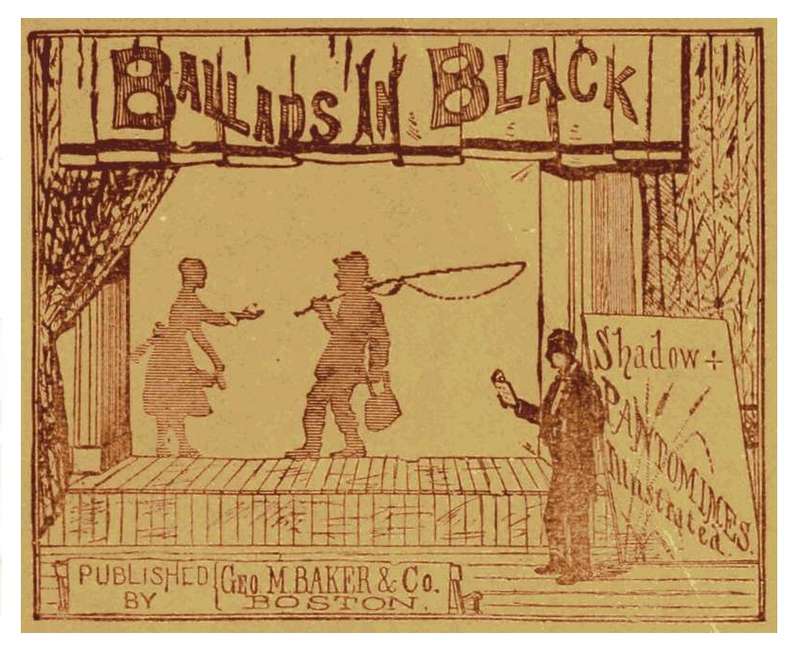
BALLADS IN BLACK.
A Series of Original Readings, to be produced as
SHADOW PANTOMIMES.
With Full Directions for Representation, by F. E. Chase.
Illustrated with Fifty full-page Silhouettes, by J. F. Goodrich, containing the following Pantomimes:
DRINK,ANONYMOUS
DRIGGS AND HIS DOUBLE, CINDERELLA,
ORPHEUS, THE ORGAN-GRINDER, IN PAWN.
Price in Boards, Illustrated Cover, $1.00.
Either of the above pantomimes will be sold singly at 25 cents.
A. WARD'S WAX FIGGER SHOW.
"A serious of wax statoots ecalled by few, and exceld by none."
Arranged as an entertainment similar to the well-known Jarley's Wax Works; with a descriptive lecture in the language of the renowned humorist.
PRICE 25 CTS.
AN ORIGINAL OPERETTA.
For two male and two female characters, entitled,
ANASTASIA; or, The Peer and the Pretty One.
By HENRY M. BAKER. Price 25 Cts.
Plays for Amateur Theatricals.
BY GEORGE M. BAKER,
Author of "Amateur Dramas," "The Mimic Stage," "The Social Stage," "Stage," "The Drawing Room Stage," "Handy Dramas," "The Exhibition Drama," "A Baker's Dozen," etc.
Titles in this Type are New Plays. Titles in this Type are Temperance Plays.
DRAMAS.
In Four Acts.
Better Than Gold. 7 male, 4 female char.25
In Three Acts.
Our Folks. 6 male, 5 female char.15
The Flower of the Family. 5 male, 3 female char.15
Enlisted for the War. 7 male, 3 female characters15
My Brother's Keeper. 5 male, 3 female char.15
The Little Brown Jug. 5 male, 3 female char.15
In Two Acts.
Above the Clouds. 7 male, 3 female characters.15
One Hundred Years Ago. 7 male, 4 female char.15
Among the Breakers. 6 male, 4 female char.15
Bread on the Waters. 5 male, 3 female char.15
Down by the Sea. 6 male, 3 female char.15
Once on a Time. 4 male, 2 female char.15
The Last Loaf. 5 male, 3 female char.15
In One Act.
Stand by the Flag. 5 male char.15
The Tempter. 3 male, 1 female char.15
COMEDIES AND FARCES.
A Mysterious Disappearance. 4 male, 3 female char.15
Paddle Your Own Canoe. 7 male, 3 female char.15
A Drop too Much. 4 male, 2 female characters15
A Little More Cider. 5 male, 3 female char.15
A Thorn Among the Roses. 2 male, 6 female char.15
Never Say Die. 3 male, 3 female char.15
Seeing the Elephant. 6 male, 3 female char.15
The Boston Dip. 4 male, 3 female char.15
The Duchess of Dublin. 6 male, 4 female char.15
Thirty Minutes for Refreshments. 4 male, 3 female char.15
We're all Teetotalers. 4 male, 2 female char.15
Male Characters Only.
A Close Shave. 6 char.15
A Public Benefactor. 6 char.15
A Sea of Troubles. 8 char.15
COMEDIES, &c continued.
Male Characters Only.
A Tender Attachment. 7 char.15
Coals of Fire. 6 char.15
Freedom of the Press. 8 char.15
Shall Our Mothers Vote? 11 char.15
Gentlemen of the Jury. 12 char.15
Humors of the Strike. 8 char.15
My Uncle the Captain. 6 char.15
New Brooms Sweep Clean. 6 char.15
The Great Elixir. 9 char.15
The Hypochondriac. 5 char.15
The Man with the Demijohn. 4 char.15
The Runaways. 4 char.15
The Thief of Time. 6 char.15
Wanted, a Male Cook. 4 char.15
Female Characters Only.
A Love of a Bonnet. 5 char.15
A Precious Pickle. 6 char.15
No Cure no Pay. 7 char.15
The Champion of Her Sex. 8 char.15
The Greatest Plague in Life. 8 char.15
The Grecian Bend. 7 char.15
The Red Chignon. 6 char.15
Using the Weed. 7 char.15
ALLEGORIES.
Arranged for Music and Tableaux.
Lightheart's Pilgrimage. 8 female char.15
The Revolt of the Bees. 9 female char.15
The Sculptor's Triumph. 1 male, 4 female char.15
The Tournament of Idylcourt. 10 female char.15
The War of the Roses. 8 female char.15
MUSICAL AND DRAMATIC.
An Original Idea. 1 male, 1 female char.15
Bonbons; or, the Paint King. 6 male, 1 female char.25
Capuletta; or, Romeo and Juliet Restored. 3 male, 1 female char.15
Santa Claus' Frolics.15
Snow-bound; or, Alonzo the Brave and the Fair Imogene. 3 male, 1 female char.25
The Merry Christmas of the Old Woman who lived in a Shoe.15
The Pedler of Very Nice. 7 male char.15
The Seven Ages. A Tableau Entertainment. Numerous male and female char.15
Too Late for the Train. 2 male char.15
The Visions of Freedom. 11 female char.15
Geo. M. Baker & Co., 47 Franklin St., Boston.
Baker's Humorous Dialogues. Male characters only. 25 cents. Baker's Humorous Dialogues. Female characters only. 25 cents.