LESSON L.
Reading edition
EVEN TOES.
“Then bend your gaze across the waste—what see ye? The giraffe Majestic stalks toward the lagoon, the turbid lymph to quaff; With outstretched neck, and tongue adust, he kneels him down to cool His hot thirst with a welcome draught from foul and brackish pool.”
—F. Freiligrath.
The order of ungulate has for its second sub-order the even-toed animals. This group is distinguished by the power and habit, which all its species have, of bringing back into the mouth, food already swallowed, in order to re-chew it thoroughly. This habit is called ruminating or chewing the cud. We have all observed it in sheep, kine, and camels.
The most notable characteristic of these animals is the formation of the stomach, which is divided into several compartments of different construction. The second of these stomach compartments is small and lined with cells of a honey-combed appearance. The slightly chewed food, on reaching this receptacle, is gradually moulded into pellets or small masses, which, instead of passing into the next lower division of the digestive apparatus, rise into the throat, are re-conveyed to the animal’s mouth, and are slowly chewed into a fine pulp. Any one who has watched a cow or sheep lying at ease, calmly and steadily chewing the cud, has seen a picture of quiet enjoyment.
The lowest division of the stomach of a cud-chewer is called the rennet-bag, from a fluid called rennet, which it contains, which digests all the food. Rennet has the property of curdling milk, or rather of making it partly solid without rendering it sour. It is used in making cheese. This rennet, mingled with the well-masticated food of the cud-chewers, completes the process of digestion. All liquids swallowed by these animals find their way at once to the rennet-bag.
All cud-chewers feed upon vegetable substances, and chiefly upon grass, of which they eat the stalks and fibrous portions as well as the blades. In a former lesson we spoke of the need of sheep for “roughness,” as stock men call it—a need which is shared by all ruminants. This roughness is the coarse and innutritious portions mixed with the richer parts of their food, to enable them to chew the cud, and to prevent indigestion, which would be caused by too rich and compact diet.
The teeth of cud-chewers are especially formed for grazing; there are no incisors or cutting teeth on the upper jaw, except in the camel family. The teeth are of two kinds, incisors (on the lower jaw) and grinders, or molars. These grinders are wide teeth, and as the jaws move, the molars act upon each other from side to side, the lower jaw grinding against the upper one. Watch a cow as she eats, and you will observe this motion.
Now let us look at these even-toed feet. You will say that these animals have hoofs divided in the centre, while the hoof of a horse is not divided at all. The pig, which does not ruminate, has a hoof centrally divided, like that of a sheep; and the hare, which chews the cud, has several separate toes, and belongs to the rodents. Amid all this diversity there is this constant characteristic, that the cud-chewers of the ungulates have the toes of each foot collected under what is called a cloven hoof, as if a solid hoof had been cleft into two.
There are four families of even-toed ruminants—the hollow-horned, including kine, sheep, goats, and antelopes, the deer tribe, the camel tribe, and the camelopards.
To the hollow-horned family belong our most useful domestic animals, and those earliest associated with man. The cow family affords us beef, our principal meat food, also butter, cheese, and milk; while the hides furnish our chief supply of leather. The bones are used for making buttons, combs, knife-handles; the hair is used in plaster; glue and gelatine and calves’ foot jelly are made from the hoofs. Oxen are largely used for draught purposes. What, then, should we do without the bovine race?
The sheep was no doubt the first domesticated animal; its gentle nature, and the ease with which it can be reared, made it an early associate with the homes of men; its wool furnishes probably our chief clothing supply; its flesh is a favorite food; many nations drink its milk, from which they make also cheese and butter. Thus we have in the sheep an animal indispensable to our civilization.
The goat is a third hollow-horn, the flesh and milk of which are much used in many countries, while the goat’s long and silky hair is in demand for woven fabrics.
Finally among the hollow-horns we find the famous animals of the antelope family, the beautiful, timid gazelle, the fleet chamois, the fierce, untamable gnu, the graceful ibex. If we had time to describe all these, we should find before us some of the most charming creatures in the world. They live in high mountain districts, and the Swiss is never more happy than when he pursues the chamois over the steep crests and among the crags of his native land.
The largest and most untamable of the hollow-horns is that cousin of our patient, useful ox, the bison, or buffalo,[92] an animal rapidly becoming extinct through cruel and wanton slaughter. While few of us have seen the bison himself, his shaggy pelt is well known in the buffalo robes of our sleighs and carriages, and in the heavy overcoats made for northern travel. Next to the elephant and the rhinoceros, the bison is the largest of land-mammals.
If we lived in Arabia instead of America, we should set beside the sheep, as the special ally of men, the camel. We have all seen this creature in menageries and zoological gardens,—a tall, awkward beast, with long legs, a shambling gait, one or two humps on its oddly shapen back, a small head, the upper lip split in the centre, a long neck, small ears, a dusty, shaggy coat, and a demeanor of patient endurance. Buffon says that “the camel is the chief treasure of the East.”
Gentle and hardy, demanding but little food, and that of the coarsest description,—a few dates, a few handfuls of grain,—capable of going for days without water, a strong beast of burden, this is one of the most important members of an Arab family. The milk of the camel affords the Arab cheese, and also a nourishing drink; of the animal’s long hair is woven cloth for clothing and for tent covering; its flesh is used for food; and across the long, hot, arid stretches of his desert land, the Arab rides in safety, seated on his tent and household goods piled upon the back of this “ship of the desert.”
From the earliest times the camel has been the only means of conveying travellers and Eastern commodities across the desert. It travels thirty or forty miles a day, under the hot sun, carrying a burden of five hundred or six hundred pounds.
Camels have broad, callous soles over the bottoms of their feet. These enable them to tread firmly without sinking in the desert sand. There are also callous knobs on their knees and breasts, which protect them as they kneel to receive burdens, or sleep in a kneeling position. The training of the young camel begins when it is but a few days old, and it is taught to get along with the smallest possible allowance of food, drink, and sleep.
The stomach of the camel is provided with numerous little sacs, called water-cells; these drain off a considerable quantity of water when the camel is drinking, and retain it for several days, restoring it gradually to the stomach. The camel seems to prefer coarse, unsucculent, dry food, and burning sunshine; it never seeks the shade. It is perhaps apathetic, rather than gentle; it seems little impressed by kindness, and, like the elephant, has a long memory for injuries.
Following the camel in our menageries usually comes a very strange-looking beast, the tallest of all animals. With its long neck, small head, and its habit of browsing off the tree-tops, it reminds us of what we have read of that fossil beast, the iguanodon. This is the giraffe, often called the camelopard, which name is given it because it has a somewhat camel-like form, and the beautiful spotted skin of a leopard.
If we watch a giraffe in a menagerie, we shall remark the beauty of its silky, spotted coat, the gentleness of its large, eager eyes, its two short horns covered with skin, its ears turned backward, its long, dark tongue, with which it constantly licks its lips and nostrils. Timid and mild, the giraffe shows vexation only by pawing the ground rapidly with its fore hoofs; it will bend its stately head to accept an apple or a carrot from a little child, and seems to forget the days when it wandered through the African forests, and browsed on fruit and leaves from the tops of the trees.
The giraffe is one of the swiftest of animals, and it is almost impossible to take an adult alive. They are generally captured while very young, and brought up on camels’ milk, until old enough to eat grain and green fodder.
The Western hemisphere gives us no animal corresponding to the giraffe. In South America the llama in some measure represents and takes the place of the camel; but the tall and beautiful giraffe stands alone of his kind.
We now turn to the fourth family of the ruminants, distinguished by the fact that they shed and renew their horns. The horns of the cow, ox, sheep, antelope, and goat are permanent. If by any accident they are lost, they are not renewed; but the deer family shed their horns, which indeed, are not properly called horns, but antlers. Antlers are a horny growth, large and branching, divided into what are called tines. Up to a certain age these antlers grow, fall off, and are renewed every year, and there is no mammal peculiarity more wonderful than the rapid growth of these large frontal ornaments. In many of the deer species the male alone wears the antlers. In the reindeer family both males and females have these huge horny branches.
The deer family is distinguished for grace of movement and beauty of form. They have smooth, close, hairy coats, but on the breast of the male deer the hair grows long and is called a beard. The eyes are large, clear, and bright, full of gentle eagerness, and furnished on the inner corner with a curious hollow, or gland, called the tear-pit. They have small, pointed ears, and short tails; their legs are slim, and their hoofs are small, the whole animal being built for lightness in running. Even the antlers are not nearly so heavy as they look, for they are porous and full of air-cells.
The deer family is distributed over the entire world. Deer vary in size from the large elk or moose, the royal stag, and the magnificent wapiti, to the small roe deer, not so large as a sheep, and the pigmy deer, which is the smallest of all ruminants, and indeed, is not larger than a hare.
Deer are vegetable-feeders, and in the coldest climates are capable of living on lichens, and the scantiest fare. In the far north reindeer or caribous furnish the chief wealth of the people, and serve instead of cows, horses, and sheep, their flesh and milk being the chief food-supply, and their skins furnishing clothing and bedding. They serve also as draught animals, and pull sledges over the snow with incredible swiftness.
Deer generally live in herds; the mother is a most vigilant and tender parent, devoting herself to her twin children with tireless care. Deer are distinguished for the perfection of their senses of sight, smell, and hearing, and as soon as one of a herd discovers anything that indicates danger, the alarm is given, and away they go. The deer mothers, while feeding, are constantly alert, and hurry their little ones off at the first hint of danger. The general disposition of the deer is amiable, but the old males sometimes fight furiously together, and if brought to bay by hunters, defend themselves valiantly with hoofs and horns.
Passing now from the ungulates, we reach a very well-known order of mammals, called the carnivora, or flesh-eaters. This order is divided into two sub-orders, the pinnipeds, or “fin-footed,” and the fissipeds, or “slit-footed.” In our study of the seal we have had the best example of the fin-footed, or aquatic carnivora. Bring up your dog or your cat for a sample of the slit-footed flesh-eaters. Ponto, set your foot down firmly, and let us look at it. All the toes are of equal length; the foot looks as if a roundish foot had been deeply slit into toes, which are hairy up to the nails. The feet of web-footed animals would look like this if they were not webbed.[93]
These slit-footed, or fissiped creatures, are divided into several species, and there is considerable difference in their way of treading; some, as the cats, walk on their toes. Come here, kitty, let us see your feet. Kitty can draw her claws close into the “velvet,” or fur, of her paw so that you would not know she had sharp nails. As she does this she curls her foot up into a cushion, and walks on the ends of her toes. Look at her foot when she stretches it; how well you can see the slit-foot arrangement and the clawed toes. Kitty is a mild and domestic representative of the great, feline race, at the head of which stands the lion. Ponto, on the other hand, is a civilized and educated specimen of the canine race, which numbers among its members the wolf.
While kitty draws in her claws and walks on her toes, the bears are what is called plantigrade carnivora, for they walk on the flat soles of their feet. These carnivora are all flesh-eaters, but when educated and refined, like Ponto and Kitty, they will eat any kind of food.
Among the carnivora we enumerate lions, tigers, bears, cougars, hyenas, panthers, wolves, jackals, leopards, cats, dogs, badgers, and many more. You see they embrace all the fiercest and most dangerous wild beasts, as well as our domestic friends, the cat and the dog. If you will open Kitty’s mouth, or Ponto’s, you will see what style of teeth these carnivora have; they are made for tearing flesh, and are accompanied by sharp claws for holding fast the living prey. All the carnivora are singularly strong, agile, and tenacious of life. The carnivora are so varied and interesting, that we leave them to be studied elsewhere, and indeed so we must serve the final order of mammals—the primates.[94]
These primates are divided into two sub-orders, the quadrumana, or four-handed animals, and the human race. Many scientists, instead of the order primates, with these two sub-orders, give us the order quadrumana, or monkeys, and the order bimana, or man, and that is the better division.
The quadrumana, or ape families, contain a large number of curious and interesting animals, all natives of tropical regions. They are hairy creatures, with three kinds of teeth, and are adapted for eating nearly all kinds of food. They are well known to us in menageries, and are frequently seen on our streets, fancifully dressed, and in company with a man and an organ, surrounded also by a group of admiring children.
“How many children are there in your family, Pierre?” we one day asked a bright little Italian boy.
“Four, and the monkey, signora.”
“But the monkey, Pierre, does not count with the children.”
“O signora! for care and trouble he counts more than the children! He must have the warmest corner and the best food. At night, for warmth, he sleeps in my father’s arms. He gets cold ten times as often as we do; and if he gets a cold he must have the doctor, for he is likely to die. If he dies, away go all our saved dollars for more monkey! Gracious! O signora! do you think our father would let our monkey run round in the streets and look out for his own dinner as Marie and I do? The thing is impossible!”
THE END.
FOOTNOTES:
SEA-SIDE AND WAY-SIDE.
BOOK I.
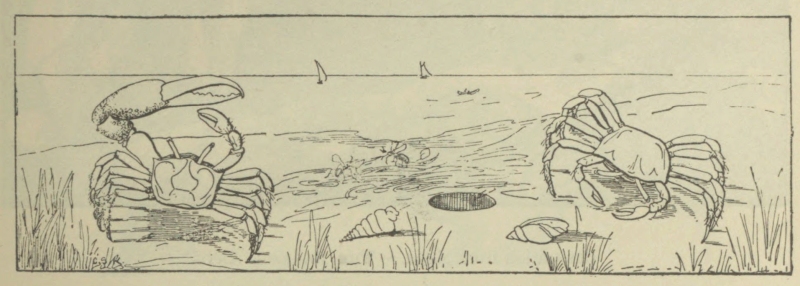
Illustration from
No. 1
.—
Mr. and Mrs. Crab.
CONTENTS.
Lesson.
I. Mr. and Mrs. Crab.
II. Mr. Crab and his House.
III. More about Mr. Crab.
IV. Mr. and Mrs. Crab get New Coats.
V. What the Crab does.
VI. Mr. Crab and his Friends.
VII. Some Other Crabs.
VIII. The Hermit Crab.
IX. The Crab’s Enemies.
X. The Uses of Crabs.
XI. Mrs. Wasp and her Home.
XII. What Mrs. Wasp can do.
XIII. A Look at Mrs. Wasp.
XIV. Mrs. Wasp’s Year.
XV. Mrs. Wasp at Home.
XVI. Review.
XVII. The Bee and the Man.
XVIII. How the Bee is Made.
XIX. The Bee at Home.
XX. The Bee Babies.
XXI. The Bee War.
XXII. The Bee’s Work.
XXIII. The Wise Bees.
XXIV. Earth Bees.
XXV. Other Bees.
XXVI. More about Bees.
XXVII. The Spider and his Dress.
XXVIII. The Spider at Home.
XXIX. The Little Nest.
XXX. The Spider and his Food.
XXXI. Very Queer Spiders.
XXXII. Review.
XXXIII. Out of Harm’s Way.
XXXIV. Shell-Fish.
XXXV. The Story of Mr. Conch.
XXXVI. Sea-Babies.
XXXVII. More about Sea-Babies.
XXXVIII. About Mr. Drill.
XXXIX. The Story of a War.
XL. How Shell-Fish Feed.
XLI. Review.
Book I. 95 pages. 32 illustrations. 30 cts.
BOOK II.
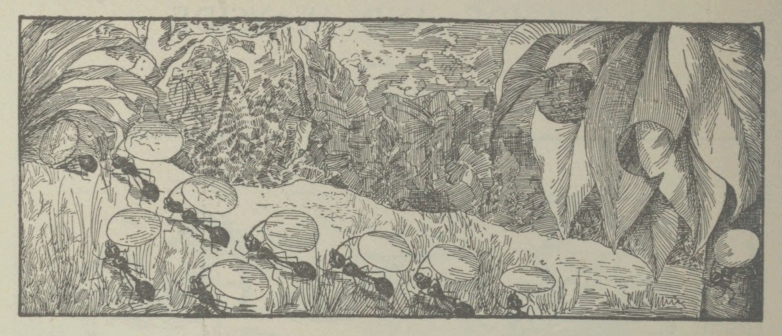
Illustration from
No. 2
.—
The Parasol Ants.
CONTENTS.
Lesson.
I. A Look at an Ant.
II. The Life of an Ant.
III. The Ant’s Home.
IV. The Ants at Home.
V. The Ants on a Trip.
VI. The Farmer Ants.
VII. Ants and their Trades.
VIII. The Slave Ants.
IX. Wonder Ants.
X. The Ways of Ants.
XI. Mr. Worm and his Family.
XII. The Earth-worm at Home.
XIII. Mr. Worm at Work.
XIV. Mr. Worm’s Cottage by the Sea.
XV. Mr. Worm at Home.
XVI. A Look at a House-Fly
XVII. How to Look at a Fly.
XVIII. Mrs. Fly and her Foes.
XIX. Of what Use are Flies.
XX. A Swarm of Flies.
XXI. Some Queer Flies.
XXII. In Armor Clad.
XXIII. When Mr. Beetle was Young.
XXIV. How to Learn about Beetles.
XXV. The Rose Beetle.
XXVI. Princes and Giants.
XXVII. The Little Sexton.
XXXVIII. The Story of the Stag Beetle.
XXIX. Mr. Beetle Seeks for a Home.
XXX. The Little Water-Men.
XXXI. Whirligig Beetles.
XXXII. What a Fisherman Told.
XXXIII. Mr. Barnacle and his Son.
XXXIV. A Fishing Party.
XXXV. A Last Look at Mr. Barnacle.
XXXVI. Flowers of the Sea.
XXXVII. The Life of a Jelly-Fish.
XXXVIII. Sea-Stars.
XXXIX. A Sea-Change.
XL. The Star-Fish with an Overcoat.
XLI. The Flying Flowers.
XLII. Under the Water.
XLIII. A Happy Change.
XLIV. The Dragon-Fly and his Cousins.
XLV. The Wings of the Dragon.
Review Lessons.
Book II. 184 pages. 39 illustrations. 40 cts.
BOOK III.
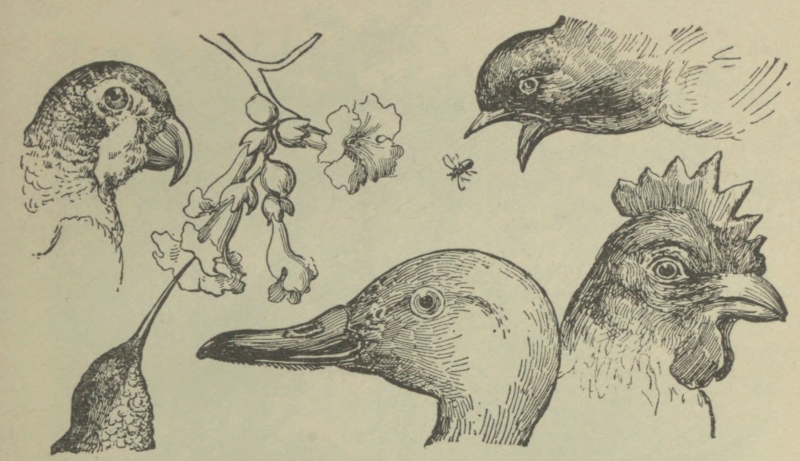
Illustration from
No. 3
.—
Beaks.
CONTENTS.
Lesson.
I. The Great Mother.
II. The Earth’s Eldest Child.
III. A Look at a Plant.
IV. A Year in a Plant’s Life.
V. The Growth of Plants.
VI. The Food of Plants.
VII. Seeds and Leaves.
VIII. The Color of Plants.
IX. The Motion of Plants.
X. Plants and their Partners.
XI. Air, Water, and Sand Plants.
XXII. Plants that eat Animals.
XIII. Weather Prophet Plants.
XIV. Plant Clocks.
XV. The School Cabinet.
XVI. The Old Man of the Meadow.
XVII. The Life of the Old Man.
XVIII. The Robber Cousin.
XIX. The Merry Cousins.
XX. Queer Cricket.
XIX. Other Hoppers.
XXII. A Real Live Fairy.
XXIII. The Child of the Day.
XXIV. Life Among Snow and Roses.
XXV. Joseph’s Coat.
XXVI. Cousin Moth.
XXVII. The Child of the Night.
XXVIII. The Bird.
XXIX. Beaks and Claws.
XXX. Trees, Ground, and Water Birds.
XXXI. On the Wing.
XXXII. Nest Building.
XXXIII. The Bird at Home.
XXXIV. Birds of Song.
XXXV. The Other Partner.
XXXVI. A Brigade of Birds.
XXXVII. The Birds in the Woods.
XXXVIII. The Birds in the House.
XXXIX. The Lost Birds.
XL. The Fin Family
XLI. Outside and Inside.
XLII. Where they live.
XLIII. How they Behave.
XLIV. Fry and School.
XLV. Scales and Teeth.
XLVI. Big and Little Brothers.
Book III. 300 pages. 29 illustrations. 50 cts.
BOOK IV.
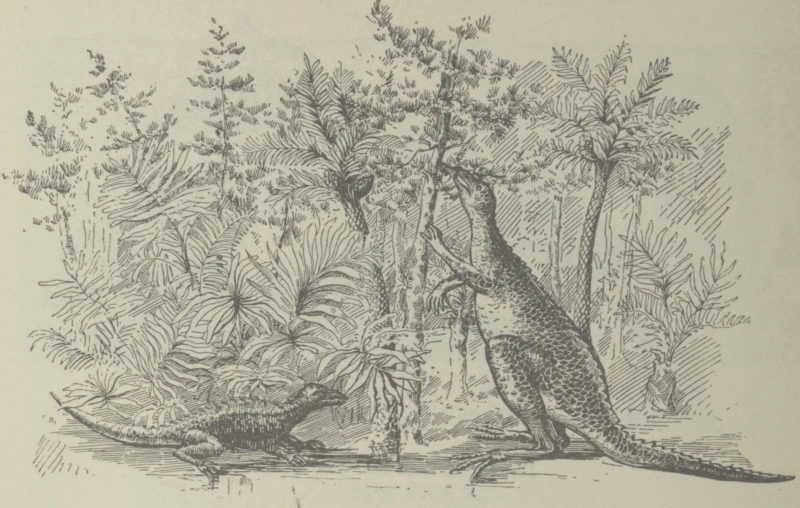
Illustration from
No. 4
.—
The Reign of the Pine.
CONTENTS.
I. Earth Building.
II. The First Continent.
III. The Age of Crabs and Corals.
IV. The Pines and the Reptiles.
V. The Palm and the Man.
VI. The Starry Heavens.
VII. A Fragment of the Milky Way.
VIII. Plan and Progression.
IX. The King of the Day.
X. The Queen of the Night.
XI. Vanished Fauna.
XII. A Mountain of Fossils.
XIII. Written in Rocks.
XIV. Footprints in the Sand.
XV. The Winter of the World.
XVI. Fossil Crabs.
XVII. Stone-Fish and Stone-Lilies.
XVIII. Long-Buried Reptiles.
XIX. Birds of other Ages.
XX. The Early Mammals.
XXI. Very Old Families.
XXII. The Marvel in Mail.
XXIII. The Wonderful Builder.
XXIV. An Opossum Hunt.
XXV. A New Fashion of Pappoose.
XXVI. Low Down in the Scale.
XXVII. With a Duck’s Bill.
XXVIII. In Australian Rivers.
XXIX. A Walk Among Wonder Trees.
XXX. Still in the Wonder Grove.
XXXI. A Noisy Family.
XXXII. The Frogs’ Cousin.
XXXIII. Salamanders.
XXXIV. A Citizen of the Marsh Lands.
XXXV. A Stranger from Mexico.
XXXVI. Some Merry Little Friends.
XXXVII. The Ancient Monster.
XXXVIII. El Lagarto.
XXXIX. Wiser than any Beast of the Field.
XL. Our Common Enemy.
XLI. With a House on His Back.
XLII. A Real Live Mermaid.
XLIII. Great Whales Also.
XLIV. A Seal-Skin Cloak.
XLV. Flying Mammals.
XLVI. Order out of Confusion.
XLVII. Nibblers.
XLVIII. Gnawers.
XLIX. The Thick Skins.
L. The Ruminants.
Book IV. 370 pages. 28 illustrations. 60 cents.
RICKS’ NATURAL HISTORY OBJECT LESSONS.
PART I.—PLANTS AND ANIMALS.
Chapter.
I. Introduction.
II. A Typical Plant.
III. General Classification of Plants.
IV. Minute Structure of Plants.
V. Roots and their Functions.
VI. Stems and their Uses.
VII. Leaves and Buds.
VIII. Flowers, their Parts and Uses.
IX. Fruits and Seeds.
X. The Palm Trees.
XI. Cereals, the Sugar-Cane, etc.
XII. Starches.
XIII. Oils and Fats.
XIV. Gums, Resins, Gum-Resins, etc.
XV. Cotton, Hemp, Flax, Jute.
XVI. Paper.
XVII. Bleaching and Dyeing.
XVIII. Tea, Coffee and Chocolate.
XIX. Spices.
XX. Opium, Quinine and Camphor.
XXI. Indigo, Oak-Galls, etc.
XXII. Classification of Animals.
XXIII. and XXIV. Classification of Vertebrata.
XXV. Classification of Invertebrata.
XXVI. Coverings of Vertebrate Animals.
XXVII. The Bony Skeleton and its Modifications.
XXVIII. Teeth,—Varieties and Uses.
XXIX. Tongues.
XXX. Tails and their Uses.
XXXI. The Principal Internal Organs of Animals.
PART II.—SPECIMEN LESSONS.
Lesson.
I. Paws and Claws.
II. Cocoa-Nut.
III. Cotton and Wool.
IV. An Egg.
V. Acorn and Hazel-Nut.
VI. Milk.
VII. Onion, Turnip, Carrot.
VIII. Cat and Dog.
IX. Down.
X. A Quill Feather.
XI. Gutta Percha.
XII. Leaves.
XIII., XIV. and XV. Starch.
XVI. The Horse.
XVII. The Cow and the Sheep.
XVIII. Honey and Wax.
XIX. Ivory.
XX. and XXI. Seeds and Seedlings.
XXII. Olive Oil.
XXIII. Liber.
XXIV. Mammals and Birds.
XXV. Reptiles and Fishes.
XXVI. Mammals.
XXVII. Chewing the Cud.
XXVIII. Horns and their Uses.
XXIX. Parts of a Flower.
XXX. Birds’ Nests.
XXXI. The Hedgehog.
XXXII. Whale Oil.
XXXIII. Leather.
XXXIV. The Mole.
XXXV. Cotton.
XXXVI. Vertebrata and Invertebrata.
XXXVII. The Cockroach.
XXXVIII. The Earthworm.
XXXIX. Spider’s Threads.
XL. Bleaching.
XLI. The Rat and His Relatives.
XLII. Beaks of Birds.
XLIII. and XLIV. Snakes.
XLV. and XLVI. Fishes.
XLVII. Insects—Form and Structure.
XLVIII. Insects—Benefits and Injuries.
XLIX. Insects,—Metamorphosis.
L. Insects, Legs and Feet.
LI. Insect and Spider.
LII.-LIV. Legs and Feet,—Mammals.
LV.-LVI. Legs and Feet,—Birds.
LVII. Flour.
LVIII. The Frog.
LIX. The Frog,—Life History.
LX. and LXI. Eggs.
LXII. Snails.
LXIII. Snails—Whelk and Periwinkle.
LXIV. Snails.
LXV. The Amoeba and Foraminifera.
LXVI. The Hydra.
LXVII. Sea Anemones and Corals.
LXVIII. Plant Factories.
352 pages. 121 illustrations and seven plates. Cloth $1.50.
Elementary Science.
Natural History Object Lessons. A Manual for Teachers.
By Geo. Ricks, Inspector of Schools, London School Board. Cloth. 352 pages. Retail price, 1.50.
Guides for Science-Teaching.
Published under the auspices of the Boston Society of Natural History. For teachers who desire to practically instruct classes in Natural History, and designed to supply such information as they are not likely to get from any other source. 26 to 200 pages each. Paper.
I. Hyatt’s About Pebbles, 10 cts.
II. Goodale’s Few Common Plants, 20 cts.
III. Hyatt’s Sponges, 20 cents.
IV. Agassiz’s First Lesson in Natural History, 25 cts.
V. Hyatt’s Coral and Echinoderms, 30 cts.
VI. Hyatt’s Mollusca, 30 cts.
VII. Hyatt’s Worms and Crustacea, 30 cts.
VIII. Hyatt’s Insects.
XII. Crosby’s Common Minerals and Rocks, 40 cts. Cloth, 60 cts.
XIII. Richards’ First Lessons in Minerals, 10 cts.
XIV. Bowditch’s Hints for Teachers on Physiology, 20 cts.
XV. Clapp’s Observations on Common Minerals, 30 cts.
Note Book. To accompany Science Guide No. XV.
Paper. 48 pages, ruled and printed. Price, 15 cents.
Science teaching in the Schools.
By Wm. N. Rice, Prof. of Geology, Wesleyan Univ., Conn. Paper. 46 pp. Price, 25 cts.
Elementary Course in Practical Zoology.
By B. P. Colton, A. M., Professor of Science, Illinois Normal University. Cloth. 196 pages. Price by mail, 85 cts.; Introduction price, 80 cts.
First Book of Geology.
By N. S. Shaler, Professor of Palæontology, Harvard University. 272 pages, with 130 figures in the text. Price by mail, 1.10; Introduction price, 1.00.
The Teaching of Geology.
By N. S. Shaler, author of First Book in Geology. Paper. 74 pages. Price, 25 cents.
Astronomical Lantern and How to Find the Stars.
By Rev. James Freeman Clarke. Intended to familiarize students with the constellations, by comparing them with fac-similes on the lantern face. Price of the Lantern, in improved form, with seventeen slides and a copy of “How to Find the Stars,” $4.50. “How to Find the Stars,” separately. Paper. 47 pages. Price 15 cts.
Studies in Nature and Language Lessons.
By Prof. T. Berry Smith, of Central College, Fayette, Mo. A combination of simple natural-history object-lessons, with elementary work in language. Boards. 121 pages. Price, 50 cts. Parts I. and II. Boards. 48 pages. Price, 20 cts.
D. C. HEATH & CO., Publishers,
BOSTON, NEW YORK, AND CHICAGO.
Arithmetic.
Aids to Number.—First Series. Teachers’ Edition.
Oral Work—One to ten. 25 cards with concise directions. By Anna B. Badlam, Principal of Training School, Lewiston, Me., formerly of Rice Training School, Boston. Retail price, 40 cents.
Aids to Number.—First Series, Pupils’ Edition.
Written work.—One to ten. Leatherette. Introduction price, 25 cents.
Aids to Number.—Second Series. Teachers’ Edition.
Oral Work.—Ten to One Hundred. With especial reference to multiples of numbers from 1 to 10. 32 cards with concise directions. Retail price, 40 cents.
Aids to Numbers.—Second Series. Pupils’ Edition.
Written Work.—Ten to One Hundred. Leatherette. Introduction price, 25 cents.
The Child’s Number Charts. By Anna B. Badlam.
Manilla card, 11 × 14 inches. Price, 5 cents each; $4.00 per hundred.
Drill Charts. By C. P. Howland, Principal of Tabor Academy, Marion, Mass.
For rapid, middle-grade practice work on the Fundamental Rules of Arithmetic. Two cards, 8 × 9 inches. Price, 3 cents each; or $2.40 per hundred.
Review Number Cards. By Ella M. Pierce, of Providence, R. I.
For Second and Third Year Pupils. Cards, 7 × 9 inches. Price, 3 cents each; or $2.40 per hundred.
Picture Problems. By Miss H. A. Luddington.
Principal of Training School, Pawtucket, R. I.; formerly Teacher of Methods and Training Teacher in Primary Department of State Normal School, New Britain, Conn., and Training Teacher in Cook County Normal School, Normal Park, Ill. 70 colored cards, 4 × 5 inches, printed on both sides, arranged in 9 sets, 6 to 10 cards in each set, with card of directions. Retail price, 65 cents.
Mathematical Teaching and its Modern Methods.
By Truman Henry Safford, Ph. D., Professor of Astronomy, Williams College, Mass. Paper. 47 pages. Retail price, 25 cents.
The New Arithmetic.
By 300 authors. Edited by Seymour Eaton, with Preface by T. H. Safford, Professor of Astronomy, Williams College, Mass. Introduction price, 75 cents.
D. C. HEATH & CO., Publishers,
BOSTON, NEW YORK, AND CHICAGO.
Music and Drawing.
Whiting’s Public School Music Course.
Boards. Books I. to V., 112 pages each. Price each, 25 cents. Book VI., 256 pages. Price, 54 cents. Part-Song and Chorus Book. Boards. 256 pages. Price, 96 cents.
This Course consists of a graded series of six elementary Music Readers (thus giving new music for each grade) and a High School Reader, with accompanying Charts. Every device that would make the books useful has been adopted. The exercises and songs are well adapted to the different grades and are all of a high order. It is believed that this series is by far the most complete and useful one ever published in this country.
Whiting’s Public School Music Charts.
First Series, 30 charts, $6.00; Second Series, 14 charts, $3.00; charts separately (two charts on a leaf), 50 cents.
The First Series is designed for the lowest primary grades, which should be taught from the charts before they read from the First Music Reader. The Second Series is designed for the lowest Grammar Grades, and should precede the use of the Second Music Reader.
These Charts are well graded, progressive, educative, and interesting.
Whiting’s Complete Music Reader.
Boards. 224 pages. Price, 75 cents.
Designed for Mixed, High, and Normal Schools, Academies, and Seminaries. A large variety of exercises and solfeggios are given for practice in connection with the Rudimentary Department, which is quite complete. Two-, three-, and four-part songs constitute a very important part of the book.
Supplementary Music for Public Schools.
Eight pages numbers, 3 cents; Twelve pages numbers, 4 cents; Sixteen pages numbers, 5 cents. Send for complete list. New numbers are constantly being added.
Whittlesey and Jamieson’s Harmony in Praise.
A collection of Hymns for college and school chapel exercises, and for families. 75 cents.
Thompson’s Educational and Industrial Drawing.
As at present proposed the entire system will consist of the following Series of Drawing Books and Manuals: (1) Manual Training Series; Two Manuals. (Ready. Price, 25 cents each.) (2) Primary Freehand Series; Four Books and Manual. (Ready. Price, $1.00 dozen.) (3) Advanced Freehand; Four Books and Manual. (Ready. Price, $1.50 dozen.) (4) Model and Object; Three Books and Manual. (Ready. Price, $1.75 dozen.) (5) Historical Ornament; Three Books and Manual. (In press.) (6) Decorative Design; Three Books and Manual. (7) Geometrical; Two Books and Manual. (8) Orthographic Projection; Two Books and Manual. (9) Perspective; Three Books and Manual.
This System of Drawing is accompanied by an abundant supply of apparatus. The author has had many years’ experience in teaching from the lowest Primary through the Grammar, High, and Technical Schools, and it is believed that the books are so well thought out both from a philosophical and from a practical point of view, as to be adapted to all approved methods and views in the study of drawing.
Send for full descriptive circulars and special introduction prices.
D. C. HEATH & CO., Publishers,
Boston, New York, Chicago, and London.
Geography and Maps.
Redway’s Manual of Geography.
Modern Facts and Ancient Fancies. Cloth. 175 pages. Price, 65 cents.
This book renders the latest discoveries in Geography available for the use of teachers. A part of the work is devoted to the discussion of old traditions that still cumber many text-books. It is full of useful hints, and of bright, interesting information.
Redway’s Reproduction of Geographical Forms.
I. Sand and Clay Modeling. II. Map-Drawing and Map-Projection. Illustrated. Paper. 84 pages. Price, 30 cents.
Nichols’ Topics in Geography.
Cloth. 176 pages. Price, 65 cents.
Contains a comprehensive outline of all geographical facts usually taught in our best primary and grammar schools, together with many excellent suggestions for increasing the interest of pupils, and much information of interest not usually accessible to teachers.
Jackson’s Earth in Space, or Astronomical Geography.
Illustrated. Cloth. 80 pages. Price, 40 cents.
Presents, in a few simple lessons, the main facts of this world’s relation to other worlds.
Picturesque Geography.
Twelve plates, 15 × 20 inches, and descriptive pamphlet. Per set, $3.00; mounted, $5.00.
Intended to picture the natural divisions of land and water, and at the same time to meet the modern demand for artistic and instructive pictures for decoration of schoolrooms.
Progressive Outline Maps:
United States, United States, No. 2 (with State boundaries), World on Mercator’s Projection* (12 × 20 in.); North America, South America, Europe, Central and Western Europe,* Africa, Asia, Asia Minor, Australia, British Isles,* England,* Greece,* Italy,* Palestine.* New England, Middle Atlantic States, Southern States, Southern States—western section, Central Eastern States, Central Western States, Pacific States, New York, Ohio, Washington (State), The Great Lakes, (each 10 × 12 in.). 2 cts. each; per hundred, $1.50. Those marked with a star (*) may be had with black outline for historical study. Samples sent on receipt of 10 cents. Circulars free.
Heath’s Outline Map of the United States.
Small (desk) size, 2 cts. each; $1.50 per hundred. Intermediate size, 28 × 40 inches, each 30 cts.; large size, 50 cts.; mounted, $3.00.
Roney’s Student’s Outline Map of England.
For use in English History and Literature, to be filled in by pupils. 5 cts.
Outline Map of Ancient History.
For recording historical growth and statistics (14 × 17 in.), 3 cts. each; per hundred, $2.50.
Practical School Maps.
Printed from entirely new plates, and including the latest geographical discoveries and political changes. Includes Europe, Asia, Africa, North America, South America, Hemispheres, United States, Palestine, and Canaan.
[In press, ready soon.
D. C. HEATH & CO., Publishers, Boston, New York, Chicago, and London.
English Language.
Hyde’s Lessons in English, Book I. For the lower grades. Contains
exercises for reproduction, picture lessons, letter writing,
uses of parts of speech, etc. $ .35
Hyde’s Lessons in English, Book II. For Grammar schools.
Has enough technical grammar for correct use of language .50
Hyde’s Lessons in English, Book II. with Supplement. Has
in addition to the above, 118 pages of technical grammar .60
Supplement bound alone .30
Hyde’s Derivation of Words .15
Buckbee’s Primary Word Book .25
Badlam’s Suggestive Lessons in Language. Being Part I. and
appendix of Suggestive Lessons in Language and Reading .50
Smith’s Studies in Nature, and Language Lessons. A combination
of object lessons with language work .50
Part I bound separately .20
Meiklejohn’s English Language. Treats salient features with a
master’s skill and with the utmost clearness and simplicity 1.20
Meiklejohn’s English Grammar. Also composition, versification,
paraphrasing, etc. For high schools and colleges .80
Meiklejohn’s History of the English Language. 78 pages. Part
III. of English Language, above .30
Williams’ Composition and Rhetoric by Practice. For high
school and college. Combines the smallest amount of theory with
an abundance of practice. Revised edition .90
Strang’s Exercises in English. Examples in Syntax, Accidence,
and Style for criticism and correction .35
Hempl’s Old English Grammar and Reader. In press.
Huffcutt’s English in the Preparatory School. Presents as practically
as possible some of the advanced methods of teaching English
grammar and composition in the secondary schools .25
Woodward’s Study of English. Discusses English teaching from
primary school to high collegiate work .25
Genung’s Study of Rhetoric. Shows the most practical discipline
of students for the making of literature .25
In addition to the above we have text-books in English and American Literature, and many texts edited for use in English Literature classes.
D. C. HEATH & CO., PUBLISHERS. BOSTON, NEW YORK & CHICAGO.
Reading.
Wright’s Nature Readers: Sea-side and Way-side.
Boards. Illustrated. No. I., 95 pages. Price, 25 cents. No. II., 184 pages. Price, 35 cents. No. III., 300 pages. Price, 50 cents. No. IV., 000 pages. Price, 60 cents.
Designed for schools and families. Intended to awaken in children a taste for scientific study, to develop their powers of attention, and to encourage observation, by directing their minds to the living things that meet their eyes on the road-side, at the sea-shore, and about their homes.
The First Reader treats of crabs, wasps, spiders, bees, and some mollusks. The Second Reader treats of ants, flies, earth-worms, beetles, barnacles, star-fish, and dragon-flies. The Third Reader has lessons in plant life, grasshoppers, butterflies, and birds. The Fourth Reader treats of world life in its different aspects and periods.
Badlam’s Suggestive Lessons in Language and Reading. A Manual for Primary Teachers. Cloth, square. 283 pages. Price, $1.50.
A thoroughly helpful book, the outgrowth of a real experience, and of such a suggestive character that its lessons cannot fail in their adaptability to the various grades.
The first part gives Outline Lessons for Oral Work, specimens of stories told by children, and simple fables for reproduction.
The second part is devoted to Suggestive Lessons for blackboard reading and word-building. The plan embraces the best known features of the various methods of teaching.
Badlam’s Primer. In the series “Stepping Stones to Reading.”
Illustrated. Boards. 131 pages. Price, 25 cents.
Its main features are its simplicity, variety, and gradual development of the lessons.
Badlam’s First Reader. Illustrated. Boards. 170 pages. Price, 30 cts.
Follows and develops the general plan of the Primer.
Fuller’s Illustrated Primer. Illustrated. Boards. 103 pages. 25 cts.
This book presents the “Word Method” in an attractive form for little children.
Fuller’s Phonic Drill Charts.
Three Charts. Manilla paper. 30 × 42 inches. Price, unmounted, $1.25; mounted, $2.25.
These charts have been prepared for the purpose of exercising pupils in making the elementary sounds and in combining these to form syllables and words.
Smith’s Reading and Speaking. Familiar Talks to Young Men who would Speak well in Public. Cloth. 171 pages. Price, 60 cents.
A collection of suggestions to would-be speakers, consisting of informal talks on matters of importance to all young men.
Readers for Home and School.
A series of volumes to be edited by Professor Charles Eliot Norton, of Harvard University, and Miss Kate Stephens.
This series is to be of material from the standard imaginative literature of the English language. It will draw freely upon the treasury of favorite stories, poems, and songs with which every child should become familiar, and which have done most to stimulate the fancy and direct the sentiment of the best men and women of the English-speaking race.
[In preparation.
D. C. HEATH & CO., Publishers, Boston, New York, Chicago, and London.
Why should Teachers Read the Literature of their Profession?
1. Because no man can stand high in any profession who is not familiar with its history and literature.
2. Because it saves time which might be wasted in trying experiments that have already been tried and found useless.
Compayré’s History of Pedagogy. “The best and most comprehensive
history of Education in English.”—Dr. G. S. Hall. $1.75
Compayré’s Lectures on Teaching. “The best book in existence on
the theory and practice of Education.”—Supt. MacAllister, Philadelphia. 1.75
Gill’s System of Education. “It treats ably of the Lancaster and Bell
movement in Education—a very important phase.”—Dr. W. T. Harris. 1.25
Radestock’s Habit in Education. “It will prove a rare ‘find’ to teachers
who are seeking to ground themselves in the philosophy of their art.”—E.
H. Russell, Worcester Normal. 0.75
Rousseau’s Emile. “Perhaps the most influential book ever written on the
subject of Education.”—R. H. Quick. 0.90
Pestalozzi’s Leonard and Gertrude. “If we except ‘Emile’ only, no
more important educational book has appeared, for a century and a half, than
‘Leonard and Gertrude.’”—The Nation. 0.90
Richter’s Levana; or the Doctrine of Education. “A spirited
and scholarly book.”—Prof. W. H. Payne. 1.40
Rosmini’s Method in Education. “The most important pedagogical
work ever written.”—Thomas Davidson. 1.50
Malleson’s Early Training of Children. “The best book for mothers
I ever read.”—Elizabeth P. Peabody. 0.75
Hall’s Bibliography of Pedagogical Literature. Covers every
department of Education. 1.50
Peabody’s Home, Kindergarten and Primary School Education.
“The best book outside of the Bible I ever read.”—A Leading
Teacher. 1.00
Newsholme’s School Hygiene. Already in use in the leading training
colleges in England. 0.75
DeGarmo’s Essentials of Method. “It has as much sound thought to
the square inch as anything I know of in pedagogics.”—Supt. Balliet,
Springfield, Mass. 0.65
Hall’s Methods of Teaching History. “Its excellence and helpfulness
ought to secure it many readers.”—The Nation. 1.50
Seidel’s Industrial Education. “It answers triumphantly all objections
to the introduction of manual training to the public schools.”—Charles H.
Ham, Chicago. 0.90
Badlam’s Suggestive Lessons on Language and Reading.
“The book is all that it claims to be and more. It abounds in material that
will be of service to the progressive teacher.”—Supt. Dutton, New Haven. 1.50
Redway’s Teachers’ Manual of Geography. “Its hints to teachers
are invaluable, while its chapters on ‘Modern Facts and Ancient Fancies’ will
be a revelation to many.”—Alex. E. Frye, Author of “The Child in
Nature.” 0.65
Nichols’ Topics in Geography. “Contains excellent hints and suggestions
of incalculable aid to school teachers.”—Oakland (Cal.) Tribune. 0.65
D. C. HEATH & CO., Publishers,
BOSTON, NEW YORK AND CHICAGO.